P R E S E N T E D B Y :
S A Y A L E E S H I N D E
M . E . C O M P U T E R E N G G .
A I S S M S C O E , P U N E
UNIT 5
QUALITY OF SERVICE(QoS)
OF
CLOUD
GUIDED BY:
Prof.DEEPALI UJLAMBKAR
CONTENTS
 QOS Management
 Auto scaling
 Load balancing
 Resource scheduling for cloud computing
QOS Management
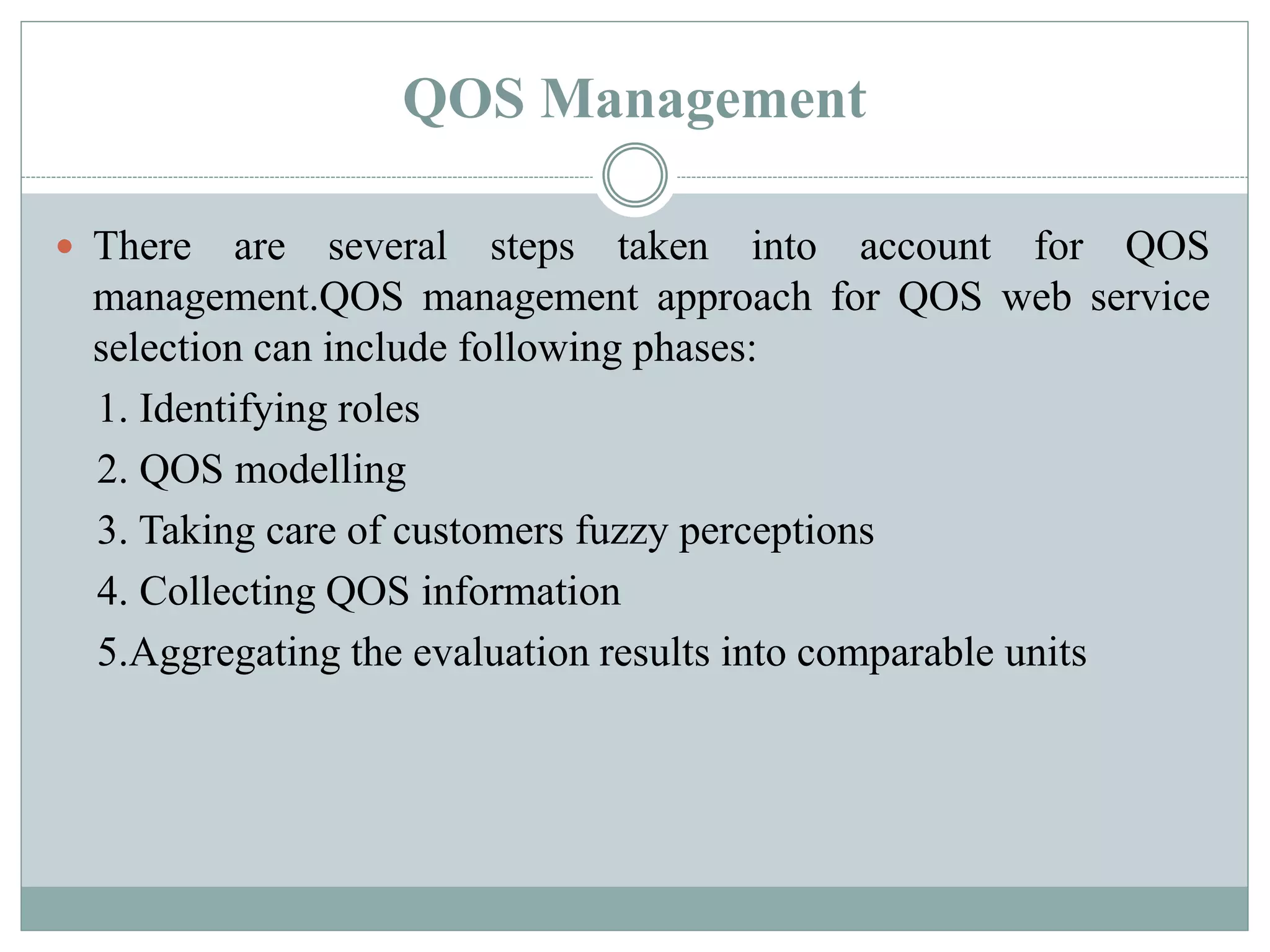
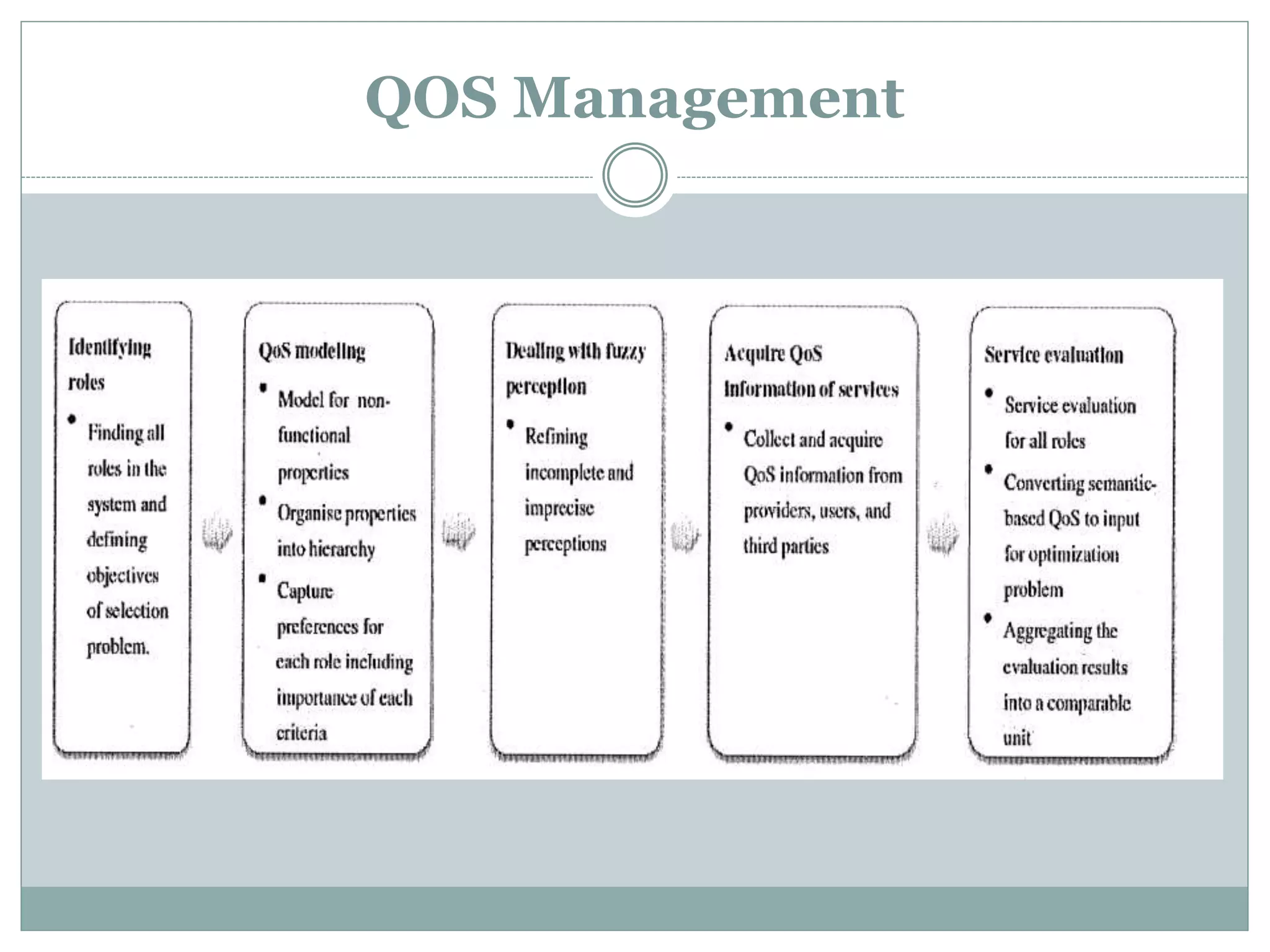
 There are several steps taken into account for QOS
management.QOS management approach for QOS web service
selection can include following phases:
1. Identifying roles
2. QOS modelling
3. Taking care of customers fuzzy perceptions
4. Collecting QOS information
5.Aggregating the evaluation results into comparable units
QOS Management
Auto scaling
 Cloud computing is a recent technology to provide resources
from large data centers .
 In order to provide excellent service, service providers have to
improve scalability factor.
 In recent trends, providers use auto scaling mechanism to scale
resources according to users need.
 Auto scaling is ability to scale up or down capacity automatically
according to condition of user define.
Load balancing
 Load balancing in cloud computing is used to distribute large
processing node to smaller processing node for enhancing overall
performance of system.
 It helps in fair allocation or computing resources to achieve high
user satisfaction and proper resource utilization.
 The load balancing is technique that helps network and resources
by providing max throughput with min response time.
 There are two load balancing algorithm are present:
1. Batch Mode Heuristic scheduling algorithm
2. Online mode heuristic scheduling algorithm
Dynamic Load Balancing
 Dynamic load balancing can be done in two ways:
1. Distributed
2. Non˗distributed
 In distributed one, dynamic load balancing algorithm is executed
by all nodes present in system and task of load balancing is
shared among them.
 In non distributed type, either one node or group of nodes do the
task of load balancing.
Policies or strategies in dynamic load
balancing
1) Transfer policy:
The part of dynamic load balancing algorithm which selects a
job for transferring from local node to remote node is referred
to as transfer policy.
2) Selection policy:
It specifies processors involved in load exchange.
Policies or strategies in dynamic load
balancing
3) Location policy:
The part of load balancing algorithm which selects
destination need for transferred task is referred to as
location policy.
4) Info policy:
The part of dynamic load balancing algorithm which
responsible for collecting information about nodes in
system is referred to as Info policy.
Resource scheduling for cloud computing
 Resource scheduling algorithm minimize the variation during the
resource demand.
 It improves efficiency.
 Modify activities within time, in other word modify resource
loading for each unit of time.
 There are different types of resource scheduling algorithm are as
follows:
1) Genetic algorithm
2) Bee algorithm
3) Ant colony algorithm
4) Work flow algorithm
5) Load balance algorithm
Genetic Algorithm
 The genetic algorithm is used for finding optimal solutions to
dynamic resource constrained scheduling problems.
 Genetic algorithm was applied to project scheduling problems.
It goes through various steps such as selection, crossover and
mutation to evolve better solutions.
 Application:
1.Bioinformatics
2.computational science
3.Engineering
Bee algorithm
 It is a nature inspired algorithm which tries to track the
activities of bee to get their food.
 First select the scout bee to go and search a wide domain of
areas, if a scout bee finds a potential food resource it returns to
its hive and does waggle dance which tells other bees the
direction and the distance of the potential food resource.
 A set of selected bees goes to the food resource and start
bringing honey while other scout bees does the same work and
sets of bees are sent to different location to bring the food.
 After every identification of food resource the scout bee
informs other and sets its course for other new sites nearby the
potential food resource.
Ant colony algorithm
Steps:
 First ant finds food source via any way then returns to the nest
leaving behind the trial pheromone.
 Ants take the shortest route because long portion of other ways
lose their trial pheromones.
Work flow algorithm
 Work flow scheduling is the problem of mapping each task to
appropriate resource.
Steps:
 A workflow enables the structuring of applications in directed
acyclic graph from where each node represents the task and edge
represents the dependencies between the nodes of the application.
 A single workflow consist of a set of task and each task
communicate with another task in the workflow.
Load balance algorithm
 Using load balance algorithm it achieves optimal resource
utilization, maximize throughput, minimize response time and
avoid overload.
 The load balancing service is usually provided by dedicated s/w
or h/w, such as a multilayer switch or as a domain name system
server.
Thank You…

QUALITY OF SERVICE(QoS) OF CLOUD

  • 1.
    P R ES E N T E D B Y : S A Y A L E E S H I N D E M . E . C O M P U T E R E N G G . A I S S M S C O E , P U N E UNIT 5 QUALITY OF SERVICE(QoS) OF CLOUD GUIDED BY: Prof.DEEPALI UJLAMBKAR
  • 2.
    CONTENTS  QOS Management Auto scaling  Load balancing  Resource scheduling for cloud computing
  • 3.
    QOS Management  Thereare several steps taken into account for QOS management.QOS management approach for QOS web service selection can include following phases: 1. Identifying roles 2. QOS modelling 3. Taking care of customers fuzzy perceptions 4. Collecting QOS information 5.Aggregating the evaluation results into comparable units
  • 4.
  • 5.
    Auto scaling  Cloudcomputing is a recent technology to provide resources from large data centers .  In order to provide excellent service, service providers have to improve scalability factor.  In recent trends, providers use auto scaling mechanism to scale resources according to users need.  Auto scaling is ability to scale up or down capacity automatically according to condition of user define.
  • 6.
    Load balancing  Loadbalancing in cloud computing is used to distribute large processing node to smaller processing node for enhancing overall performance of system.  It helps in fair allocation or computing resources to achieve high user satisfaction and proper resource utilization.  The load balancing is technique that helps network and resources by providing max throughput with min response time.  There are two load balancing algorithm are present: 1. Batch Mode Heuristic scheduling algorithm 2. Online mode heuristic scheduling algorithm
  • 7.
    Dynamic Load Balancing Dynamic load balancing can be done in two ways: 1. Distributed 2. Non˗distributed  In distributed one, dynamic load balancing algorithm is executed by all nodes present in system and task of load balancing is shared among them.  In non distributed type, either one node or group of nodes do the task of load balancing.
  • 8.
    Policies or strategiesin dynamic load balancing 1) Transfer policy: The part of dynamic load balancing algorithm which selects a job for transferring from local node to remote node is referred to as transfer policy. 2) Selection policy: It specifies processors involved in load exchange.
  • 9.
    Policies or strategiesin dynamic load balancing 3) Location policy: The part of load balancing algorithm which selects destination need for transferred task is referred to as location policy. 4) Info policy: The part of dynamic load balancing algorithm which responsible for collecting information about nodes in system is referred to as Info policy.
  • 10.
    Resource scheduling forcloud computing  Resource scheduling algorithm minimize the variation during the resource demand.  It improves efficiency.  Modify activities within time, in other word modify resource loading for each unit of time.  There are different types of resource scheduling algorithm are as follows: 1) Genetic algorithm 2) Bee algorithm 3) Ant colony algorithm 4) Work flow algorithm 5) Load balance algorithm
  • 11.
    Genetic Algorithm  Thegenetic algorithm is used for finding optimal solutions to dynamic resource constrained scheduling problems.  Genetic algorithm was applied to project scheduling problems. It goes through various steps such as selection, crossover and mutation to evolve better solutions.  Application: 1.Bioinformatics 2.computational science 3.Engineering
  • 12.
    Bee algorithm  Itis a nature inspired algorithm which tries to track the activities of bee to get their food.  First select the scout bee to go and search a wide domain of areas, if a scout bee finds a potential food resource it returns to its hive and does waggle dance which tells other bees the direction and the distance of the potential food resource.  A set of selected bees goes to the food resource and start bringing honey while other scout bees does the same work and sets of bees are sent to different location to bring the food.  After every identification of food resource the scout bee informs other and sets its course for other new sites nearby the potential food resource.
  • 13.
    Ant colony algorithm Steps: First ant finds food source via any way then returns to the nest leaving behind the trial pheromone.  Ants take the shortest route because long portion of other ways lose their trial pheromones.
  • 14.
    Work flow algorithm Work flow scheduling is the problem of mapping each task to appropriate resource. Steps:  A workflow enables the structuring of applications in directed acyclic graph from where each node represents the task and edge represents the dependencies between the nodes of the application.  A single workflow consist of a set of task and each task communicate with another task in the workflow.
  • 15.
    Load balance algorithm Using load balance algorithm it achieves optimal resource utilization, maximize throughput, minimize response time and avoid overload.  The load balancing service is usually provided by dedicated s/w or h/w, such as a multilayer switch or as a domain name system server.
  • 16.