Cloud Computing Security
           조인순
2


Topics
1.   What is Cloud Computing?
2.   The Same Old Security Problems
3.   Virtualization Security
4.   New Security Issues and Threat Model
5.   Data Security
3


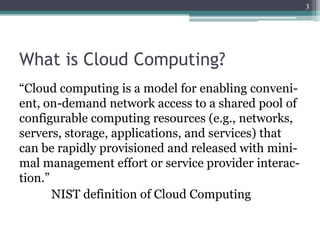
What is Cloud Computing?
“Cloud computing is a model for enabling conveni-
ent, on-demand network access to a shared pool of
configurable computing resources (e.g., networks,
servers, storage, applications, and services) that
can be rapidly provisioned and released with mini-
mal management effort or service provider interac-
tion.”
       NIST definition of Cloud Computing
4


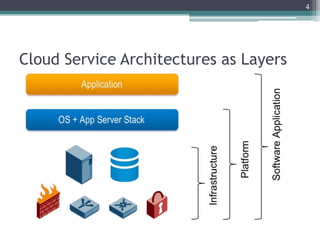
Cloud Service Architectures as Layers
5


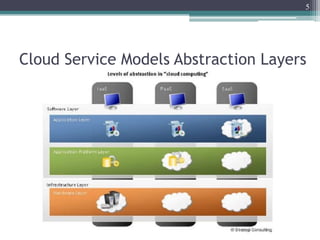
Cloud Service Models Abstraction Layers
6


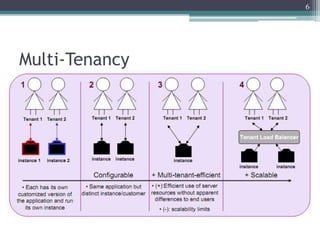
Multi-Tenancy
7


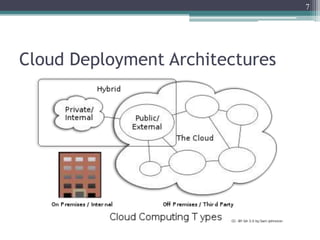
Cloud Deployment Architectures
8


Same Old Security Issues
1.   Data Loss
2.   Downtimes
3.   Phishing
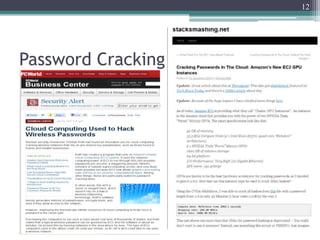
4.   Password Cracking
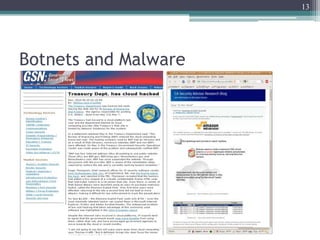
5.   Botnets and Other Malware
9


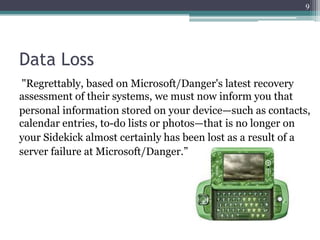
Data Loss
 "Regrettably, based on Microsoft/Danger's latest recovery
assessment of their systems, we must now inform you that
personal information stored on your device—such as contacts,
calendar entries, to-do lists or photos—that is no longer on
your Sidekick almost certainly has been lost as a result of a
server failure at Microsoft/Danger.”
10


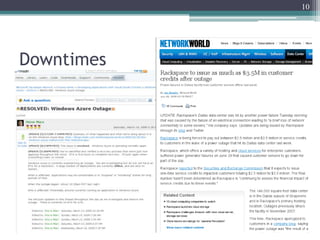
Downtimes
11


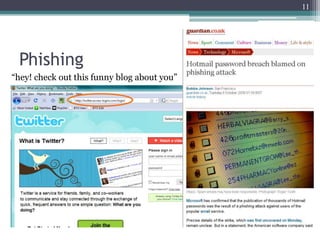
 Phishing
“hey! check out this funny blog about you”
12


Password Cracking
13


Botnets and Malware
14


Virtualization Security
1. Features
 1. Isolation
 2. Snapshots
2. Issues
 1.   State Restore
 2.   Hypervisor Security
 3.   Inner-VM Attacks
 4.   Scaling
15


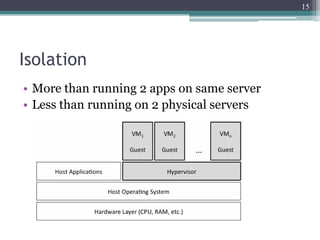
Isolation
• More than running 2 apps on same server
• Less than running on 2 physical servers
16


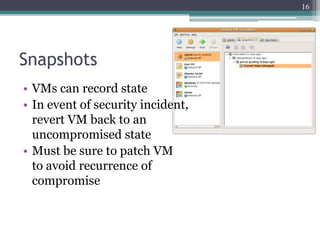
Snapshots
• VMs can record state
• In event of security incident,
  revert VM back to an
  uncompromised state
• Must be sure to patch VM
  to avoid recurrence of
  compromise
17


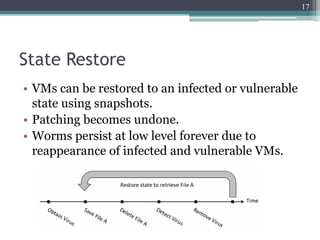
State Restore
• VMs can be restored to an infected or vulnerable
  state using snapshots.
• Patching becomes undone.
• Worms persist at low level forever due to
  reappearance of infected and vulnerable VMs.
18


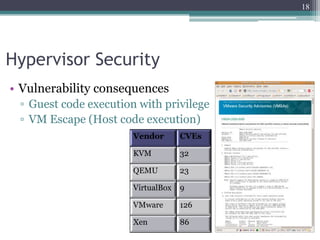
Hypervisor Security
• Vulnerability consequences
 ▫ Guest code execution with privilege
 ▫ VM Escape (Host code execution)
                       Vendor       CVEs

                       KVM          32

                       QEMU         23

                       VirtualBox   9

                       VMware       126

                       Xen          86
19


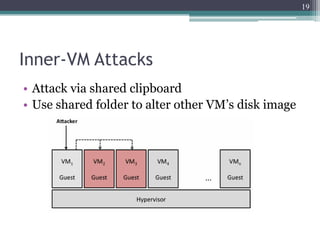
Inner-VM Attacks
• Attack via shared clipboard
• Use shared folder to alter other VM’s disk image
20


Scaling
• Growth in physical machines limited by budget
  and setup time
• Adding a VM is easy as copying a file, leading to
  explosive growth in VMs
• Rapid scaling can exceed capacity of
  organization’s security systems
21


New Security Issues
1.   No Security Perimeter
2.   Larger Attack Surface
3.   New Side Channels
4.   Lack of Auditability
5.   Data Security
22


No Security Perimeter
• Little control over physical or network location
  of cloud instance VMs
• Network access must be controlled on a host by
  host basis
23


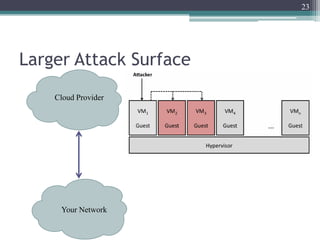
Larger Attack Surface
    Cloud Provider


     Your Network
24


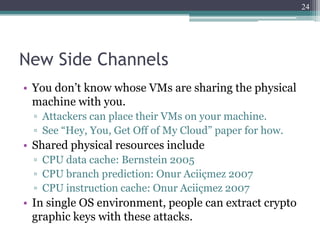
New Side Channels
• You don’t know whose VMs are sharing the physical
  machine with you.
  ▫ Attackers can place their VMs on your machine.
  ▫ See “Hey, You, Get Off of My Cloud” paper for how.
• Shared physical resources include
  ▫ CPU data cache: Bernstein 2005
  ▫ CPU branch prediction: Onur Aciiçmez 2007
  ▫ CPU instruction cache: Onur Aciiçmez 2007
• In single OS environment, people can extract crypto
  graphic keys with these attacks.
25


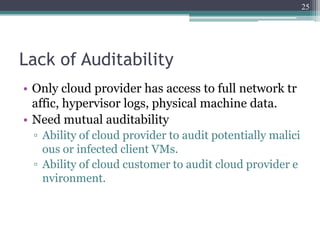
Lack of Auditability
• Only cloud provider has access to full network tr
  affic, hypervisor logs, physical machine data.
• Need mutual auditability
 ▫ Ability of cloud provider to audit potentially malici
   ous or infected client VMs.
 ▫ Ability of cloud customer to audit cloud provider e
   nvironment.
26


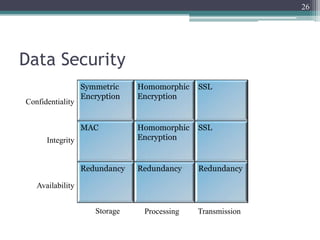
Data Security
                  Symmetric    Homomorphic   SSL
                  Encryption   Encryption
Confidentiality


                  MAC          Homomorphic   SSL
      Integrity                Encryption


                  Redundancy   Redundancy    Redundancy

   Availability


                     Storage    Processing   Transmission

Cloud security

  • 1.
  • 2.
    2 Topics 1. What is Cloud Computing? 2. The Same Old Security Problems 3. Virtualization Security 4. New Security Issues and Threat Model 5. Data Security
  • 3.
    3 What is CloudComputing? “Cloud computing is a model for enabling conveni- ent, on-demand network access to a shared pool of configurable computing resources (e.g., networks, servers, storage, applications, and services) that can be rapidly provisioned and released with mini- mal management effort or service provider interac- tion.” NIST definition of Cloud Computing
  • 4.
  • 5.
    5 Cloud Service ModelsAbstraction Layers
  • 6.
  • 7.
  • 8.
    8 Same Old SecurityIssues 1. Data Loss 2. Downtimes 3. Phishing 4. Password Cracking 5. Botnets and Other Malware
  • 9.
    9 Data Loss "Regrettably,based on Microsoft/Danger's latest recovery assessment of their systems, we must now inform you that personal information stored on your device—such as contacts, calendar entries, to-do lists or photos—that is no longer on your Sidekick almost certainly has been lost as a result of a server failure at Microsoft/Danger.”
  • 10.
  • 11.
    11 Phishing “hey! checkout this funny blog about you”
  • 12.
  • 13.
  • 14.
    14 Virtualization Security 1. Features 1. Isolation 2. Snapshots 2. Issues 1. State Restore 2. Hypervisor Security 3. Inner-VM Attacks 4. Scaling
  • 15.
    15 Isolation • More thanrunning 2 apps on same server • Less than running on 2 physical servers
  • 16.
    16 Snapshots • VMs canrecord state • In event of security incident, revert VM back to an uncompromised state • Must be sure to patch VM to avoid recurrence of compromise
  • 17.
    17 State Restore • VMscan be restored to an infected or vulnerable state using snapshots. • Patching becomes undone. • Worms persist at low level forever due to reappearance of infected and vulnerable VMs.
  • 18.
    18 Hypervisor Security • Vulnerabilityconsequences ▫ Guest code execution with privilege ▫ VM Escape (Host code execution) Vendor CVEs KVM 32 QEMU 23 VirtualBox 9 VMware 126 Xen 86
  • 19.
    19 Inner-VM Attacks • Attackvia shared clipboard • Use shared folder to alter other VM’s disk image
  • 20.
    20 Scaling • Growth inphysical machines limited by budget and setup time • Adding a VM is easy as copying a file, leading to explosive growth in VMs • Rapid scaling can exceed capacity of organization’s security systems
  • 21.
    21 New Security Issues 1. No Security Perimeter 2. Larger Attack Surface 3. New Side Channels 4. Lack of Auditability 5. Data Security
  • 22.
    22 No Security Perimeter •Little control over physical or network location of cloud instance VMs • Network access must be controlled on a host by host basis
  • 23.
    23 Larger Attack Surface Cloud Provider Your Network
  • 24.
    24 New Side Channels •You don’t know whose VMs are sharing the physical machine with you. ▫ Attackers can place their VMs on your machine. ▫ See “Hey, You, Get Off of My Cloud” paper for how. • Shared physical resources include ▫ CPU data cache: Bernstein 2005 ▫ CPU branch prediction: Onur Aciiçmez 2007 ▫ CPU instruction cache: Onur Aciiçmez 2007 • In single OS environment, people can extract crypto graphic keys with these attacks.
  • 25.
    25 Lack of Auditability •Only cloud provider has access to full network tr affic, hypervisor logs, physical machine data. • Need mutual auditability ▫ Ability of cloud provider to audit potentially malici ous or infected client VMs. ▫ Ability of cloud customer to audit cloud provider e nvironment.
  • 26.
    26 Data Security Symmetric Homomorphic SSL Encryption Encryption Confidentiality MAC Homomorphic SSL Integrity Encryption Redundancy Redundancy Redundancy Availability Storage Processing Transmission