Cloud Lock-in and
 Interoperability
               Ashwin Waknis
                Persistent Systems


                                     1
Agenda
 Cloud Computing – A Recap
 Cloud Lock-in
 Portability & Interoperability
 Emerging Standard
 Best Practices
Q&A


                                   2
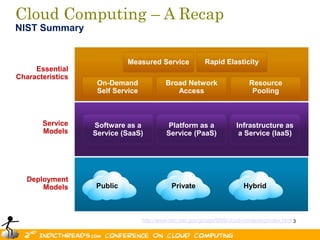
Cloud Computing – A Recap
NIST Summary


                           Measured Service                 Rapid Elasticity
     Essential
Characteristics
                   On-Demand               Broad Network                      Resource
                   Self Service               Access                           Pooling


       Service    Software as a              Platform as a               Infrastructure as
       Models     Service (SaaS)            Service (PaaS)                a Service (IaaS)


   Deployment
       Models     Public                      Private                       Hybrid


                                  http://www.csrc.nist.gov/groups/SNS/cloud-computing/index.html 3
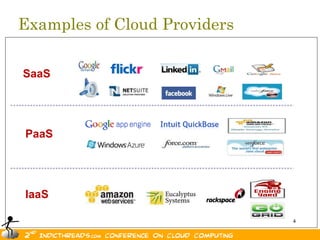
Examples of Cloud Providers

SaaS


PaaS


IaaS

                              4
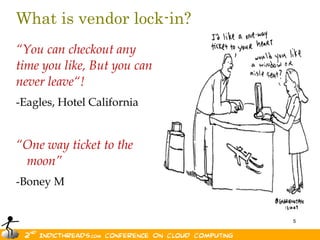
What is vendor lock-in?
“You can checkout any
time you like, But you can
never leave“!
-Eagles, Hotel California


“One way ticket to the
 moon”
-Boney M


                             5
Back to basics: Definitions
Lock-in: When there is significant cost to switch cloud
vendors
Portability: Ability to move application, data, tools
from one cloud to another
Interoperability: Ability for different cloud to talk to
each other
Federation: Ability to bring together services from
various cloud vendors to provide a solution


                                                           6
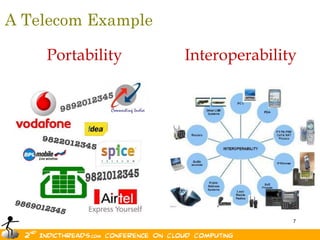
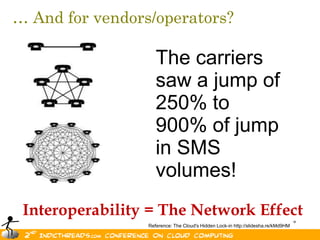
A Telecom Example

    Portability     Interoperability


                                   7
What was in it for customers?

 Portability + Interoperability
+ Federation
= More choices => Lower costs
& Innovative solutions


                                  8
… And for vendors/operators?

                    The carriers
                    saw a jump of
                    250% to
                    900% of jump
                    in SMS
                    volumes!
 Interoperability = The Network Effect                                             9
                 Reference: The Cloud's Hidden Lock-in http://slidesha.re/kMd9HM
What does that mean?
Cloud vendors are not against interoperability
or federation. They just need to agree on
standards.
Some cloud vendors are implicitly against
portability. Because that means they have to be
cost effective and innovative.


                                           10
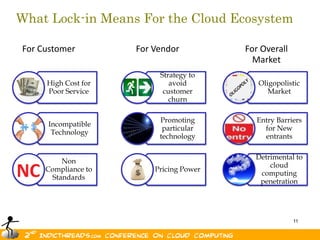
What Lock-in Means For the Cloud Ecosystem

For Customer         For Vendor          For Overall
                                           Market
                          Strategy to
     High Cost for           avoid          Oligopolistic
     Poor Service          customer            Market
                             churn

                          Promoting        Entry Barriers
     Incompatible
                           particular        for New
      Technology
                          technology         entrants

                                           Detrimental to
         Non
                                               cloud
     Compliance to       Pricing Power
                                            computing
      Standards
                                            penetration


                                                       11
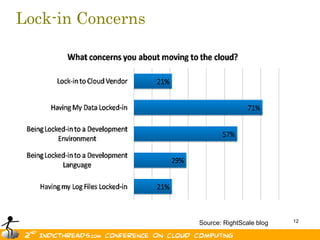
Lock-in Concerns


                   Source: RightScale blog   12
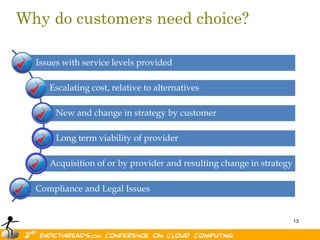
Why do customers need choice?

  Issues with service levels provided

     Escalating cost, relative to alternatives

       New and change in strategy by customer

       Long term viability of provider

     Acquisition of or by provider and resulting change in strategy

  Compliance and Legal Issues


                                                                      13
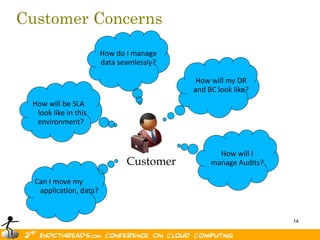
Customer Concerns
                        How do I manage
                        data seamlessly?

                                            How will my DR
                                            How will my DR
                                           and BC look like?
                                           and BC look like?
 How will be SLA
  look like in this
  environment?


                                                  How will I
                               Customer         manage Audits?

  Can I move my
   application, data?


                                                                 14
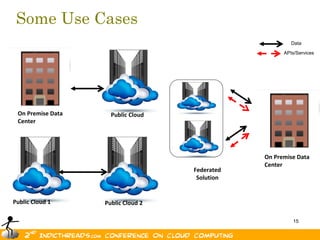
Some Use Cases
                                                         Data

                                                      APIs/Services


 On Premise Data     Public Cloud
 Center


                                                On Premise Data
                                                Center
                                    Federated
                                     Solution


Public Cloud 1     Public Cloud 2

                                                          15
Portability means taking
     what you own


                           16
What is portable?
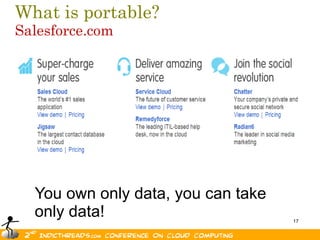
Salesforce.com


  You own only data, you can take
  only data!                        17
What is portable?
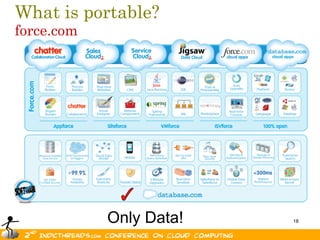
force.com


            Only Data!   18
What is portable?
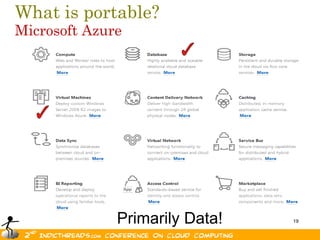
Microsoft Azure


              Primarily Data!   19
What is portable?
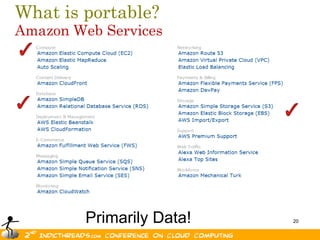
Amazon Web Services


         Primarily Data!   20
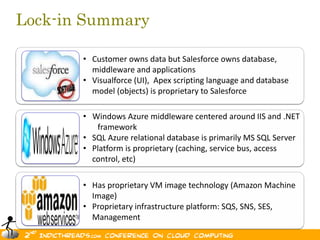
Lock-in Summary

       • Customer owns data but Salesforce owns database,
         middleware and applications
       • Visualforce (UI), Apex scripting language and database
         model (objects) is proprietary to Salesforce

       • Windows Azure middleware centered around IIS and .NET
          framework
       • SQL Azure relational database is primarily MS SQL Server
       • Platform is proprietary (caching, service bus, access
         control, etc)

       • Has proprietary VM image technology (Amazon Machine
         Image)
       • Proprietary infrastructure platform: SQS, SNS, SES,
         Management                                          21
Bright spots on portability
Rightscale
VMForce
CloudFoundry
OpenStack
Open Source: Eucalyptus, Cloud.com


                                      22
Cloud Standards


                  23
Distributed Management Task Force
DMTF – Development, validation and promotion of systems
management standards.
Cloud Management Working Group
 Develop a set of prescriptive specifications that deliver architectural semantics and
implementation details to achieve interoperable management of clouds between
service requester/developers and providers.
 Primary focus on cloud resource management aspects of IaaS including SLA, QoS,
utilization, provisioning, monitoring, reporting and auditing.
 Working on deliverables from
    Common Information Model (CIM) : provides a common definition of management
   information for systems, networks, applications and services, and allows for vendor
   extensions
    Open Virtualization Format (OVF) : OVF is a hypervisor-neutral, efficient, extensible,
   and open specification for the packaging and distribution of virtual appliances composed
   of one or more virtual computer systems                                            24
Distributed Management Task Force

Cloud Auditing Data Federation Working Group
Open standards for cloud auditing that support submission and
retrieval of audit event data from cloud provider in form of
customizable reports and logs.
 Scope will include
   Data model and specification
   Interface model, API specification
   Interaction model


                                                                25
Members


          26
Storage Networking Industry Association

Developing and promoting standards, technologies, and
educational services and promoting activities that expand the
breadth and quality of the storage and information management
market.
Cloud Data Management Interface (CDMI)
 Applications will use to create, retrieve, update and delete data
  elements from the Cloud
 Discover the capabilities of the cloud storage offering and
  manage containers and its data
 Manage data system metadata on containers and contained data
  elements

                                                                 27
Members


          28
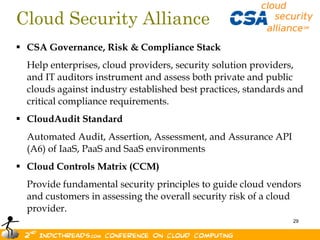
Cloud Security Alliance
 CSA Governance, Risk & Compliance Stack
  Help enterprises, cloud providers, security solution providers,
  and IT auditors instrument and assess both private and public
  clouds against industry established best practices, standards and
  critical compliance requirements.
 CloudAudit Standard
  Automated Audit, Assertion, Assessment, and Assurance API
  (A6) of IaaS, PaaS and SaaS environments
 Cloud Controls Matrix (CCM)
  Provide fundamental security principles to guide cloud vendors
  and customers in assessing the overall security risk of a cloud
  provider.
                                                                29
Members


          30
Other Standards Bodies
 European Telecom Standards Institute
    TC Cloud – Convergence of IT and telecommunication
 National Institute of Standards and Technology
    Definition, Standards and Use Cases
 Open Grid Forum
    Open Cloud Computing Interface (OCCI) – Specs for cloud based
     interactions
 Open Cloud Consortium
    Standards, benchmarks and reference implementations
 Organization for the Advancement of Structured Information
  Standards (OASIS)
    Identity in the cloud (IDCloud)
                                                                     31
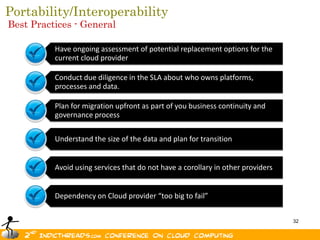
Portability/Interoperability
Best Practices - General

          Have ongoing assessment of potential replacement options for the
          current cloud provider

          Conduct due diligence in the SLA about who owns platforms,
          processes and data.

          Plan for migration upfront as part of you business continuity and
          governance process

          Understand the size of the data and plan for transition


          Avoid using services that do not have a corollary in other providers


          Dependency on Cloud provider “too big to fail”


                                                                                 32
Portability/Interoperability
Best Practices - IaaS


        Understand the VM format for portability


        Get a good handle on VM conversion: VMware to Hyper-V to
        Zen


        Understand the de-provisioning process of the provider


        Understand HW and SW platform dependencies


        Limit the use of vendor specific infrastructure pieces


                                                                   33
Portability/Interoperability
Best Practices - PaaS


          Before finalizing a platform, make sure they are not so
          unique/proprietary that switching will hard.


          Use standard API, syntax and standards where possible.
          Document exceptions.


          Understand the tools, modules specifics to PaaS provider and
          document them.


          Understand how platform services like logging, monitoring and
          auditing would transfer to new provider.


                                                                          34
Portability/Interoperability
Best Practices - SaaS


        Export data regularly into a format that can be used without the
        SaaS provider


        Make sure you can export meta-data from the cloud provider


        Confirm migration of backups as well as historical logs, audit data
        and monitoring data.


        Make sure any data required for legal, regulatory and compliance
        reasons are migrated.


                                                                              35
Portability
A Contrarian View
• Comparison to buying a car
• Comparison to renting a fully furnished
  house
• The value of I/P/SaaS provider is in its
  proprietary system
• Proprietary also means innovative


                                             36
Key Takeaways
 Lock-in is not new. Nor is portability and
  interoperability
 Today cloud vendors provide limited portability
 Near future of interoperability is bright; portability
  will take some time.
 Follow standard best practices on all platforms to
  minimize lock-in
 Lock-in is not evil as long as it is informed decision

                                                   37
Questions?


             38
Thank You!


Ashwin Waknis
Persistent Systems


                     39

Cloud Lock-in vs. Cloud Interoperability - Indicthreads cloud computing conference 2011

  • 1.
    Cloud Lock-in and Interoperability Ashwin Waknis Persistent Systems 1
  • 2.
    Agenda  Cloud Computing– A Recap  Cloud Lock-in  Portability & Interoperability  Emerging Standard  Best Practices Q&A 2
  • 3.
    Cloud Computing –A Recap NIST Summary Measured Service Rapid Elasticity Essential Characteristics On-Demand Broad Network Resource Self Service Access Pooling Service Software as a Platform as a Infrastructure as Models Service (SaaS) Service (PaaS) a Service (IaaS) Deployment Models Public Private Hybrid http://www.csrc.nist.gov/groups/SNS/cloud-computing/index.html 3
  • 4.
    Examples of CloudProviders SaaS PaaS IaaS 4
  • 5.
    What is vendorlock-in? “You can checkout any time you like, But you can never leave“! -Eagles, Hotel California “One way ticket to the moon” -Boney M 5
  • 6.
    Back to basics:Definitions Lock-in: When there is significant cost to switch cloud vendors Portability: Ability to move application, data, tools from one cloud to another Interoperability: Ability for different cloud to talk to each other Federation: Ability to bring together services from various cloud vendors to provide a solution 6
  • 7.
    A Telecom Example Portability Interoperability 7
  • 8.
    What was init for customers? Portability + Interoperability + Federation = More choices => Lower costs & Innovative solutions 8
  • 9.
    … And forvendors/operators? The carriers saw a jump of 250% to 900% of jump in SMS volumes! Interoperability = The Network Effect 9 Reference: The Cloud's Hidden Lock-in http://slidesha.re/kMd9HM
  • 10.
    What does thatmean? Cloud vendors are not against interoperability or federation. They just need to agree on standards. Some cloud vendors are implicitly against portability. Because that means they have to be cost effective and innovative. 10
  • 11.
    What Lock-in MeansFor the Cloud Ecosystem For Customer For Vendor For Overall Market Strategy to High Cost for avoid Oligopolistic Poor Service customer Market churn Promoting Entry Barriers Incompatible particular for New Technology technology entrants Detrimental to Non cloud Compliance to Pricing Power computing Standards penetration 11
  • 12.
    Lock-in Concerns Source: RightScale blog 12
  • 13.
    Why do customersneed choice? Issues with service levels provided Escalating cost, relative to alternatives New and change in strategy by customer Long term viability of provider Acquisition of or by provider and resulting change in strategy Compliance and Legal Issues 13
  • 14.
    Customer Concerns How do I manage data seamlessly? How will my DR How will my DR and BC look like? and BC look like? How will be SLA look like in this environment? How will I Customer manage Audits? Can I move my application, data? 14
  • 15.
    Some Use Cases Data APIs/Services On Premise Data Public Cloud Center On Premise Data Center Federated Solution Public Cloud 1 Public Cloud 2 15
  • 16.
  • 17.
    What is portable? Salesforce.com You own only data, you can take only data! 17
  • 18.
  • 19.
    What is portable? MicrosoftAzure Primarily Data! 19
  • 20.
    What is portable? AmazonWeb Services Primarily Data! 20
  • 21.
    Lock-in Summary • Customer owns data but Salesforce owns database, middleware and applications • Visualforce (UI), Apex scripting language and database model (objects) is proprietary to Salesforce • Windows Azure middleware centered around IIS and .NET framework • SQL Azure relational database is primarily MS SQL Server • Platform is proprietary (caching, service bus, access control, etc) • Has proprietary VM image technology (Amazon Machine Image) • Proprietary infrastructure platform: SQS, SNS, SES, Management 21
  • 22.
    Bright spots onportability Rightscale VMForce CloudFoundry OpenStack Open Source: Eucalyptus, Cloud.com 22
  • 23.
  • 24.
    Distributed Management TaskForce DMTF – Development, validation and promotion of systems management standards. Cloud Management Working Group  Develop a set of prescriptive specifications that deliver architectural semantics and implementation details to achieve interoperable management of clouds between service requester/developers and providers.  Primary focus on cloud resource management aspects of IaaS including SLA, QoS, utilization, provisioning, monitoring, reporting and auditing.  Working on deliverables from  Common Information Model (CIM) : provides a common definition of management information for systems, networks, applications and services, and allows for vendor extensions  Open Virtualization Format (OVF) : OVF is a hypervisor-neutral, efficient, extensible, and open specification for the packaging and distribution of virtual appliances composed of one or more virtual computer systems 24
  • 25.
    Distributed Management TaskForce Cloud Auditing Data Federation Working Group Open standards for cloud auditing that support submission and retrieval of audit event data from cloud provider in form of customizable reports and logs.  Scope will include  Data model and specification  Interface model, API specification  Interaction model 25
  • 26.
  • 27.
    Storage Networking IndustryAssociation Developing and promoting standards, technologies, and educational services and promoting activities that expand the breadth and quality of the storage and information management market. Cloud Data Management Interface (CDMI)  Applications will use to create, retrieve, update and delete data elements from the Cloud  Discover the capabilities of the cloud storage offering and manage containers and its data  Manage data system metadata on containers and contained data elements 27
  • 28.
  • 29.
    Cloud Security Alliance CSA Governance, Risk & Compliance Stack Help enterprises, cloud providers, security solution providers, and IT auditors instrument and assess both private and public clouds against industry established best practices, standards and critical compliance requirements.  CloudAudit Standard Automated Audit, Assertion, Assessment, and Assurance API (A6) of IaaS, PaaS and SaaS environments  Cloud Controls Matrix (CCM) Provide fundamental security principles to guide cloud vendors and customers in assessing the overall security risk of a cloud provider. 29
  • 30.
  • 31.
    Other Standards Bodies European Telecom Standards Institute  TC Cloud – Convergence of IT and telecommunication  National Institute of Standards and Technology  Definition, Standards and Use Cases  Open Grid Forum  Open Cloud Computing Interface (OCCI) – Specs for cloud based interactions  Open Cloud Consortium  Standards, benchmarks and reference implementations  Organization for the Advancement of Structured Information Standards (OASIS)  Identity in the cloud (IDCloud) 31
  • 32.
    Portability/Interoperability Best Practices -General Have ongoing assessment of potential replacement options for the current cloud provider Conduct due diligence in the SLA about who owns platforms, processes and data. Plan for migration upfront as part of you business continuity and governance process Understand the size of the data and plan for transition Avoid using services that do not have a corollary in other providers Dependency on Cloud provider “too big to fail” 32
  • 33.
    Portability/Interoperability Best Practices -IaaS Understand the VM format for portability Get a good handle on VM conversion: VMware to Hyper-V to Zen Understand the de-provisioning process of the provider Understand HW and SW platform dependencies Limit the use of vendor specific infrastructure pieces 33
  • 34.
    Portability/Interoperability Best Practices -PaaS Before finalizing a platform, make sure they are not so unique/proprietary that switching will hard. Use standard API, syntax and standards where possible. Document exceptions. Understand the tools, modules specifics to PaaS provider and document them. Understand how platform services like logging, monitoring and auditing would transfer to new provider. 34
  • 35.
    Portability/Interoperability Best Practices -SaaS Export data regularly into a format that can be used without the SaaS provider Make sure you can export meta-data from the cloud provider Confirm migration of backups as well as historical logs, audit data and monitoring data. Make sure any data required for legal, regulatory and compliance reasons are migrated. 35
  • 36.
    Portability A Contrarian View •Comparison to buying a car • Comparison to renting a fully furnished house • The value of I/P/SaaS provider is in its proprietary system • Proprietary also means innovative 36
  • 37.
    Key Takeaways  Lock-inis not new. Nor is portability and interoperability  Today cloud vendors provide limited portability  Near future of interoperability is bright; portability will take some time.  Follow standard best practices on all platforms to minimize lock-in  Lock-in is not evil as long as it is informed decision 37
  • 38.
  • 39.