Cloud Migration
Susanne Tedrick
Agenda
• What is cloud migration?
• Cloud migration types
• Migration best practices
What is
cloud
migration?
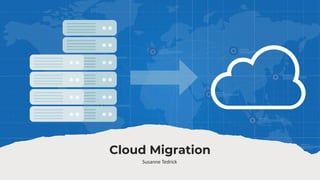
The process of transferring a portion (or all of) an
organization’s IT processes, applications and data into to a
cloud-based environment
Cloud migration types:
• On premises to cloud environment (most common)
• Cloud environment to cloud environment
• Cloud environment to on-premises
Benefits (&
challenges) of
migrating to
cloud
Benefits
• Costs
• Scalability
• Flexibility
• Performance
Challenges
• Developing the right strategy
• Costs
• Security
• Organizational resistance
• Vendor lock-in
Cloud
migration
types
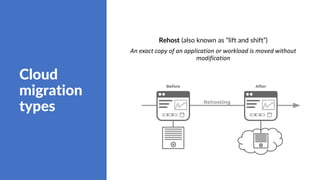
Rehost (also known as “lift and shift”)
An exact copy of an application or workload is moved without
modification
Cloud
migration
types
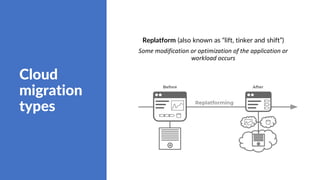
Replatform (also known as “lift, tinker and shift”)
Some modification or optimization of the application or
workload occurs
Cloud
migration
types
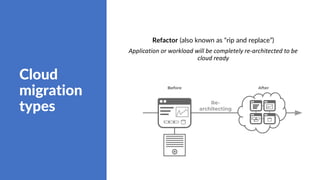
Refactor (also known as “rip and replace”)
Application or workload will be completely re-architected to be
cloud ready
Cloud
migration
types
Repurchase (also known as “drop and shop”)
Used when an on-premises application or workload cannot be
refactored for cloud use
Cloud
migration
types
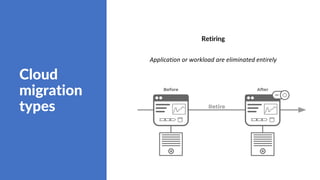
Retiring
Application or workload are eliminated entirely
Cloud
migration
types
Retaining (also known as “revisit”)
Application or workload is kept on-premises, as is
Cloud
migration
types
Hybrid
A combination of two or more migration strategies
Remember…
No “one-size-fits-all”
approach when it comes to
cloud migrations
Some factors that influence cloud migration approach
Age of current
technology
Budget/cost Time Scope of work Regulatory
compliance
People and
culture
Migration best practices
• Develop a migration strategy and plan
• Planned migration process
• Considerations for data migration
• Considerations for storage migration
• Identify migration KPIs
• Start small
• Proof of concept
• Invest in training/skilling
Phased migration process*
*highly recommended
Discovery of resources
Suitability of resources
for cloud deployment
Mapping of applications
and services to cloud
solutions
Migration of servers,
services and
applications to the cloud
Operational support of
cloud services
Considerations for data migration
Considerations for storage migration
Identify migration KPIs
Invest in skilling/training

Cloud Migration