The Complexities of Cloud
Computing: The Rules are
New, But is the Game?

Janine Anthony Bowen, Esq., CIPP/US
jbowen@jack-law.com
(678) 823-6611
June 8, 2012
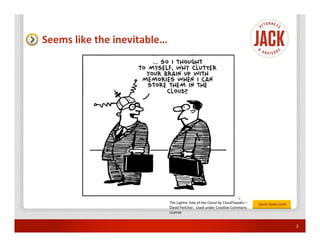
Seems like the inevitable…


                             Source: http://geekandpoke.typepad.com;
                             The Lighter Side of the Cloud by CloudTweaks –
                             David Fletcher. Used under Creative Commons
                             License


                                                                              2
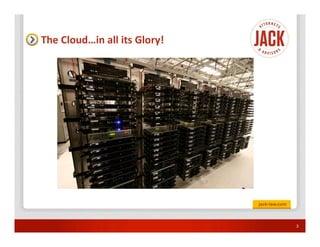
The Cloud…in all its Glory!


                              3
The Hype Then…

• “As enterprises seek to consume their IT services in the most cost-
  effective way, interest is growing in drawing a broad range of services
  (for example, computational power, storage and business
  applications) from the "cloud," rather than from on-premises
  equipment. The levels of hype around cloud computing in the IT
  industry are deafening, with every vendor expounding its cloud
  strategy and variations, such as private cloud computing and hybrid
  approaches, compounding the hype.”
• Gartner Press Release, Gartner’s 2009 Hype Cycle Special Report Evaluates Maturity of
  1,650 Technologies, August 11, 2009 http://www.gartner.com/it/page.jsp?id=1124212


                                                                                          4
And Now…


• According to Forbes…

          “Interest in Cloud Computing Has Peaked”

• But Never Fear…its here to stay (for now anyway)


http://www.forbes.com/sites/reuvencohen/2012/05/24/interest-in-cloud-computing-has-peaked/


                                                                                             5
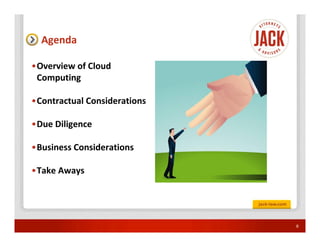
Agenda

•Overview of Cloud
 Computing

•Contractual Considerations

•Due Diligence

•Business Considerations

•Take Aways


                              6
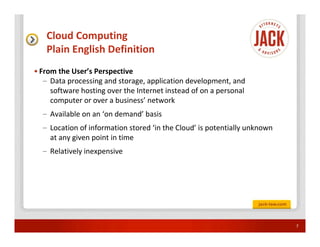
Cloud Computing
   Plain English Definition
• From the User’s Perspective
   – Data processing and storage, application development, and
     software hosting over the Internet instead of on a personal
     computer or over a business’ network
  – Available on an ‘on demand’ basis
  – Location of information stored ‘in the Cloud’ is potentially unknown
    at any given point in time
  – Relatively inexpensive


                                                                           7
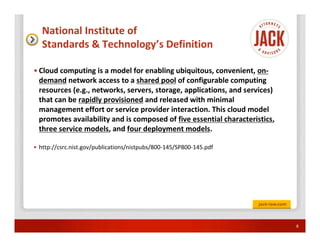
National Institute of
   Standards & Technology’s Definition

• Cloud computing is a model for enabling ubiquitous, convenient, on-
  demand network access to a shared pool of configurable computing
  resources (e.g., networks, servers, storage, applications, and services)
  that can be rapidly provisioned and released with minimal
  management effort or service provider interaction. This cloud model
  promotes availability and is composed of five essential characteristics,
  three service models, and four deployment models.

• http://csrc.nist.gov/publications/nistpubs/800-145/SP800-145.pdf


                                                                             8
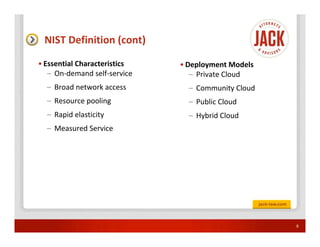
NIST Definition (cont)

• Essential Characteristics   • Deployment Models
   – On-demand self-service      – Private Cloud
  – Broad network access        – Community Cloud
  – Resource pooling            – Public Cloud
  – Rapid elasticity            – Hybrid Cloud
  – Measured Service


                                                    9
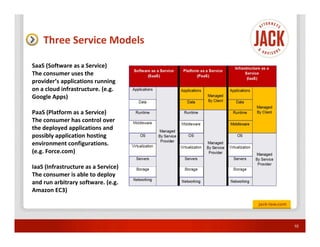
Three Service Models

SaaS (Software as a Service)
The consumer uses the
provider’s applications running
on a cloud infrastructure. (e.g.
Google Apps)

PaaS (Platform as a Service)
The consumer has control over
the deployed applications and
possibly application hosting
environment configurations.
(e.g. Force.com)

IaaS (Infrastructure as a Service)
The consumer is able to deploy
and run arbitrary software. (e.g.
Amazon EC3)


                                     10
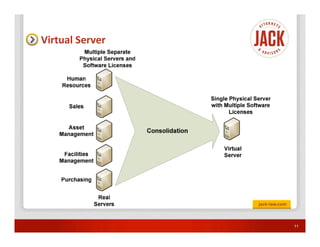
Virtual Server


                 11
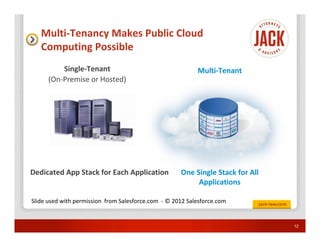
Multi-Tenancy Makes Public Cloud
   Computing Possible
          Single-Tenant                                    Multi-Tenant
      (On-Premise or Hosted)


Dedicated App Stack for Each Application             One Single Stack for All
                                                          Applications

Slide used with permission from Salesforce.com - © 2012 Salesforce.com


                                                                                12
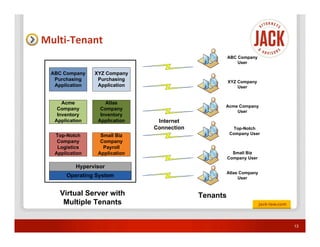
Multi-Tenant
                                                      ABC Company
                                                          User

 ABC Company    XYZ Company
  Purchasing     Purchasing                           XYZ Company
  Application    Application                              User


     Acme           Atlas
                                                  Acme Company
   Company        Company                             User
   Inventory      Inventory
  Application    Application    Internet
                               Connection               Top-Notch
  Top-Notch       Small Biz                            Company User
   Company        Company
   Logistics       Payroll
  Application    Application                            Small Biz
                                                      Company User

          Hypervisor
                                                      Atlas Company
      Operating System                                     User


    Virtual Server with                     Tenants
     Multiple Tenants


                                                                      13
Contractual Considerations


                             14
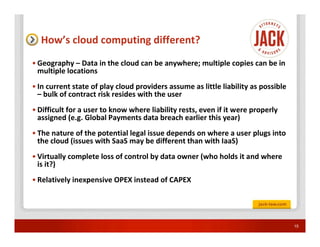
How’s cloud computing different?
• Geography – Data in the cloud can be anywhere; multiple copies can be in
  multiple locations
• In current state of play cloud providers assume as little liability as possible
  – bulk of contract risk resides with the user
• Difficult for a user to know where liability rests, even if it were properly
  assigned (e.g. Global Payments data breach earlier this year)
• The nature of the potential legal issue depends on where a user plugs into
  the cloud (issues with SaaS may be different than with IaaS)
• Virtually complete loss of control by data owner (who holds it and where
  is it?)
• Relatively inexpensive OPEX instead of CAPEX


                                                                                    15
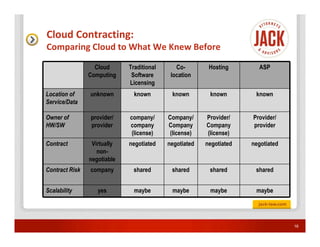
Cloud Contracting:
Comparing Cloud to What We Knew Before

                  Cloud      Traditional      Co-        Hosting       ASP
                Computing     Software      location
                             Licensing
Location of     unknown        known        known        known        known
Service/Data

Owner of        provider/    company/      Company/     Provider/    Provider/
HW/SW           provider     company       Company      Company      provider
                              (license)     (license)   (license)
Contract         Virtually   negotiated    negotiated   negotiated   negotiated
                   non-
                negotiable
Contract Risk   company       shared        shared       shared       shared


Scalability        yes         maybe        maybe        maybe        maybe


                                                                                  16
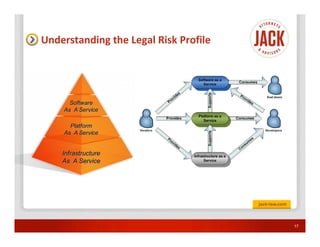
Understanding the Legal Risk Profile


                                       17
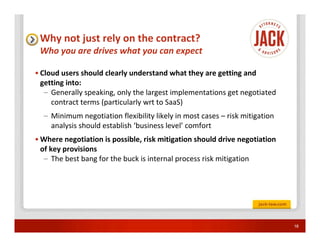
Why not just rely on the contract?
 Who you are drives what you can expect

• Cloud users should clearly understand what they are getting and
  getting into:
   – Generally speaking, only the largest implementations get negotiated
     contract terms (particularly wrt to SaaS)
  – Minimum negotiation flexibility likely in most cases – risk mitigation
    analysis should establish ‘business level’ comfort
• Where negotiation is possible, risk mitigation should drive negotiation
  of key provisions
   – The best bang for the buck is internal process risk mitigation


                                                                             18
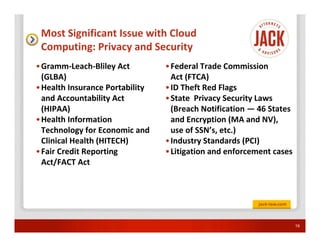
Most Significant Issue with Cloud
 Computing: Privacy and Security
• Gramm-Leach-Bliley Act         • Federal Trade Commission
  (GLBA)                           Act (FTCA)
• Health Insurance Portability   • ID Theft Red Flags
  and Accountability Act         • State Privacy Security Laws
  (HIPAA)                          (Breach Notification — 46 States
• Health Information               and Encryption (MA and NV),
  Technology for Economic and      use of SSN’s, etc.)
  Clinical Health (HITECH)       • Industry Standards (PCI)
• Fair Credit Reporting          • Litigation and enforcement cases
  Act/FACT Act


                                                                      19
Case Study - Contract vs. What They Say


                        •Privacy Policy
                        •Terms of Use
                        •Security FAQ
                        •Pricing


                                          20
Due Diligence


                21
4 Immutable Laws of Cloud Security
• “These are things that will always be, things that will never change,
  and it is a state of being.”
  – First is an understanding that if your data is hosted in the cloud, you no
    longer directly control its privacy and protection.
  – when your data is burst into the cloud, you no longer directly control where
    the data resides or is processed.
  – if your security controls are not contractually committed to, then you may
    not have any legal standing in terms of the control over your data or your
    assets.
  – if you don't extend your current security policies and controls in the cloud
    computing platform, you're more than likely going to be compromised
  – Tari Schreider, HP chief architect of HP Technology Consulting and IT
     Assurance Practice.
  “Security and the Cloud: The Great Reconciliation”, eCommerce Times, 14 May 2012
  http://www.ecommercetimes.com/story/Security-and-the-Cloud-The-Great-
     Reconciliation-75094.html


                                                                                     22
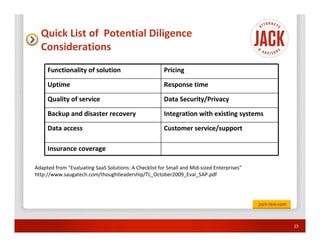
Quick List of Potential Diligence
  Considerations
     Functionality of solution                         Pricing

     Uptime                                            Response time

     Quality of service                                Data Security/Privacy

     Backup and disaster recovery                      Integration with existing systems

     Data access                                       Customer service/support

     Insurance coverage

Adapted from “Evaluating SaaS Solutions: A Checklist for Small and Mid-sized Enterprises”
http://www.saugatech.com/thoughtleadership/TL_October2009_Eval_SAP.pdf


                                                                                            23
Some Areas of Concern

•Service
 quality/SLAs/Availability

•Disaster recovery

•Provider competence

•Provider Viability


                             24
Diligence Considerations:
  SLAs
• Control-oriented
   – System availability
   – System response time
   – Fail-over for disaster recovery

• Operations-oriented
   – Data retrieval
   – Data integrity
   – Transition assistance

• Business-oriented
   – Error resolution time
   – Timeliness re: professional services around cloud solutions


                                                                   25
Diligence Considerations:
  Backup & Disaster Recovery
• How are backup systems architected?
  – Complete redundancy? Multiple redundancies? Duplicate systems? Real-
    time backup?
• Where are backup systems located geographically?

• Are third party backup systems utilized (partially/totally)?

• How long would a catastrophic event at a data center affect system
  availability?

• Concerns for physical assets based on geography (exactly where is
  that data center located?)

• Ultimately, whose responsibility is it anyway?


                                                                           26
Diligence Considerations:
 Competence Issues
• Provider track record of success?
• Views of commentators/bloggers
• Is the pricing right for the breadth of offering?
• Perceived level of sophistication of the vendor
    – Knowledge of industry vertical
    – Mastery of technology
• If vendor is an early stage company, who is supporting it financially?
  (speaks to both competence and viability)
• For SaaS in particular, are there integration partners?


                                                                           27
Diligence Considerations:
  Viability of the Cloud Provider

• Viability matters. Why? A cloud user makes an investment when
  choosing cloud provider. For example:
   – Integrating cloud services into business processes
  – Migrating data from its environment
• Lack of industry standardization makes moving to a new cloud
  provider difficult

• What happens to a cloud user’s data in the event of:
  – Bankruptcy
  – M&A
  – Escrow


                                                                  28
Business Considerations


                          29
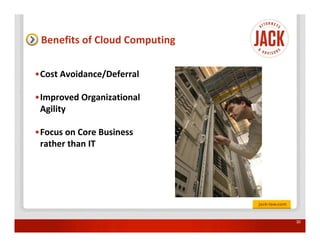
Benefits of Cloud Computing

•Cost Avoidance/Deferral

•Improved Organizational
 Agility

•Focus on Core Business
 rather than IT


                               30
Cost Avoidance/Deferral – You Decide

• Gartner says…IaaS isn’t less expensive, but it increases operational
  agility (1)
• Computerworld says…Prepare for the real costs of cloud computing
  (2)
   – Moving and storing data, integrating apps from multiple vendors,
      testing software, rent & utilities
• CIO says…CFOs and cloud computing have a love-hate relationship (3)
   – Variable pricing messes up cash flow projections
   – Capex vs. Opex
• Booz Allen Hamilton says…savings range from 50% to 75% (4)
• CloudU says…savings from 13% to 25% (5)


                                                                         31
Cost Avoidance/Deferral – You Decide
 (cites)
• (1)     Lydia Leong, research VP at Gartner Group
   – http://www.formtek.com/blog/?p=2696, January 12th, 2012
• (2)      “Preparing for the real costs of cloud computing” Computerworld
  http://www.computerworld.com/s/article/359383/The_Real_Costs_of_Cloud_Com
  puting
• (3)     “Why CFOS and Cloud Computing Have a Love-Hate Relationship” CIO
  Magazine
   – www.cio.com/article/print/702074
• (4)     “The Economics of Cloud Computing”
  http://www.boozallen.com/media/file/Economics-of-Cloud-Computing.pdf
• (5)     “Cloudonomics: The Economics of Cloud Computing”
http://broadcast.rackspace.com/hosting_knowledge/whitepapers/Cloudonomics-
  The_Economics_of_Cloud_Computing.pdf
Improved Organizational Agility

     •Use of Public Clouds or Virtual Private Clouds give
      organizations the ability to scale up or down when
      necessary

     •IT expense can be matched to:
       – Seasonal or cyclical requirements
       – Organizational growth or decline

     •Mobile workforce/workplace solutions may improve
      organizational productivity

     •Cloud environments support experimentation and ability
      to fail with low penalty


33
Focus on Core Business

     •Organizations can focus on building the business they
      know

     •Organizations can leverage the best of breed in IT (and not
      try to be best of breed themselves)

     •Potentially better disaster recovery strategies utilizing
      cloud-based options


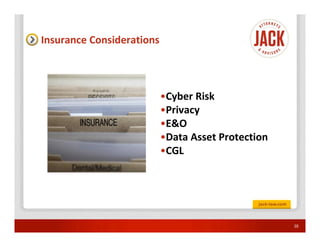
34
Insurance Considerations


                           •Cyber Risk
                           •Privacy
                           •E&O
                           •Data Asset Protection
                           •CGL


                                                    35
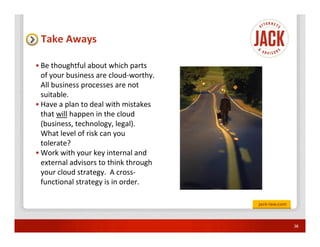
Take Aways

• Be thoughtful about which parts
  of your business are cloud-worthy.
  All business processes are not
  suitable.
• Have a plan to deal with mistakes
  that will happen in the cloud
  (business, technology, legal).
  What level of risk can you
  tolerate?
• Work with your key internal and
  external advisors to think through
  your cloud strategy. A cross-
  functional strategy is in order.


                                       36
Q&A
  Contact Me

•Janine Anthony Bowen, Esq., CIPP/US
 jbowen@jack-law.com
 www.visualcv.com/jdabowen
 www.linkedin.com/in/jdabowen

•678-823-6611

•Twitter - @cloudlawyer

•www.jack-law.com


JACK Attorneys & Advisors: Technology/IP Law & the Business of Technology - Quite Simply, We Get It.   37
The Complexities of Cloud Computing - The Rules are New, But is the Game

The Complexities of Cloud Computing - The Rules are New, But is the Game

  • 1.
    The Complexities ofCloud Computing: The Rules are New, But is the Game? Janine Anthony Bowen, Esq., CIPP/US jbowen@jack-law.com (678) 823-6611 June 8, 2012
  • 2.
    Seems like theinevitable… Source: http://geekandpoke.typepad.com; The Lighter Side of the Cloud by CloudTweaks – David Fletcher. Used under Creative Commons License 2
  • 3.
    The Cloud…in allits Glory! 3
  • 4.
    The Hype Then… •“As enterprises seek to consume their IT services in the most cost- effective way, interest is growing in drawing a broad range of services (for example, computational power, storage and business applications) from the "cloud," rather than from on-premises equipment. The levels of hype around cloud computing in the IT industry are deafening, with every vendor expounding its cloud strategy and variations, such as private cloud computing and hybrid approaches, compounding the hype.” • Gartner Press Release, Gartner’s 2009 Hype Cycle Special Report Evaluates Maturity of 1,650 Technologies, August 11, 2009 http://www.gartner.com/it/page.jsp?id=1124212 4
  • 5.
    And Now… • Accordingto Forbes… “Interest in Cloud Computing Has Peaked” • But Never Fear…its here to stay (for now anyway) http://www.forbes.com/sites/reuvencohen/2012/05/24/interest-in-cloud-computing-has-peaked/ 5
  • 6.
    Agenda •Overview of Cloud Computing •Contractual Considerations •Due Diligence •Business Considerations •Take Aways 6
  • 7.
    Cloud Computing Plain English Definition • From the User’s Perspective – Data processing and storage, application development, and software hosting over the Internet instead of on a personal computer or over a business’ network – Available on an ‘on demand’ basis – Location of information stored ‘in the Cloud’ is potentially unknown at any given point in time – Relatively inexpensive 7
  • 8.
    National Institute of Standards & Technology’s Definition • Cloud computing is a model for enabling ubiquitous, convenient, on- demand network access to a shared pool of configurable computing resources (e.g., networks, servers, storage, applications, and services) that can be rapidly provisioned and released with minimal management effort or service provider interaction. This cloud model promotes availability and is composed of five essential characteristics, three service models, and four deployment models. • http://csrc.nist.gov/publications/nistpubs/800-145/SP800-145.pdf 8
  • 9.
    NIST Definition (cont) •Essential Characteristics • Deployment Models – On-demand self-service – Private Cloud – Broad network access – Community Cloud – Resource pooling – Public Cloud – Rapid elasticity – Hybrid Cloud – Measured Service 9
  • 10.
    Three Service Models SaaS(Software as a Service) The consumer uses the provider’s applications running on a cloud infrastructure. (e.g. Google Apps) PaaS (Platform as a Service) The consumer has control over the deployed applications and possibly application hosting environment configurations. (e.g. Force.com) IaaS (Infrastructure as a Service) The consumer is able to deploy and run arbitrary software. (e.g. Amazon EC3) 10
  • 11.
  • 12.
    Multi-Tenancy Makes PublicCloud Computing Possible Single-Tenant Multi-Tenant (On-Premise or Hosted) Dedicated App Stack for Each Application One Single Stack for All Applications Slide used with permission from Salesforce.com - © 2012 Salesforce.com 12
  • 13.
    Multi-Tenant ABC Company User ABC Company XYZ Company Purchasing Purchasing XYZ Company Application Application User Acme Atlas Acme Company Company Company User Inventory Inventory Application Application Internet Connection Top-Notch Top-Notch Small Biz Company User Company Company Logistics Payroll Application Application Small Biz Company User Hypervisor Atlas Company Operating System User Virtual Server with Tenants Multiple Tenants 13
  • 14.
  • 15.
    How’s cloud computingdifferent? • Geography – Data in the cloud can be anywhere; multiple copies can be in multiple locations • In current state of play cloud providers assume as little liability as possible – bulk of contract risk resides with the user • Difficult for a user to know where liability rests, even if it were properly assigned (e.g. Global Payments data breach earlier this year) • The nature of the potential legal issue depends on where a user plugs into the cloud (issues with SaaS may be different than with IaaS) • Virtually complete loss of control by data owner (who holds it and where is it?) • Relatively inexpensive OPEX instead of CAPEX 15
  • 16.
    Cloud Contracting: Comparing Cloudto What We Knew Before Cloud Traditional Co- Hosting ASP Computing Software location Licensing Location of unknown known known known known Service/Data Owner of provider/ company/ Company/ Provider/ Provider/ HW/SW provider company Company Company provider (license) (license) (license) Contract Virtually negotiated negotiated negotiated negotiated non- negotiable Contract Risk company shared shared shared shared Scalability yes maybe maybe maybe maybe 16
  • 17.
    Understanding the LegalRisk Profile 17
  • 18.
    Why not justrely on the contract? Who you are drives what you can expect • Cloud users should clearly understand what they are getting and getting into: – Generally speaking, only the largest implementations get negotiated contract terms (particularly wrt to SaaS) – Minimum negotiation flexibility likely in most cases – risk mitigation analysis should establish ‘business level’ comfort • Where negotiation is possible, risk mitigation should drive negotiation of key provisions – The best bang for the buck is internal process risk mitigation 18
  • 19.
    Most Significant Issuewith Cloud Computing: Privacy and Security • Gramm-Leach-Bliley Act • Federal Trade Commission (GLBA) Act (FTCA) • Health Insurance Portability • ID Theft Red Flags and Accountability Act • State Privacy Security Laws (HIPAA) (Breach Notification — 46 States • Health Information and Encryption (MA and NV), Technology for Economic and use of SSN’s, etc.) Clinical Health (HITECH) • Industry Standards (PCI) • Fair Credit Reporting • Litigation and enforcement cases Act/FACT Act 19
  • 20.
    Case Study -Contract vs. What They Say •Privacy Policy •Terms of Use •Security FAQ •Pricing 20
  • 21.
  • 22.
    4 Immutable Lawsof Cloud Security • “These are things that will always be, things that will never change, and it is a state of being.” – First is an understanding that if your data is hosted in the cloud, you no longer directly control its privacy and protection. – when your data is burst into the cloud, you no longer directly control where the data resides or is processed. – if your security controls are not contractually committed to, then you may not have any legal standing in terms of the control over your data or your assets. – if you don't extend your current security policies and controls in the cloud computing platform, you're more than likely going to be compromised – Tari Schreider, HP chief architect of HP Technology Consulting and IT Assurance Practice. “Security and the Cloud: The Great Reconciliation”, eCommerce Times, 14 May 2012 http://www.ecommercetimes.com/story/Security-and-the-Cloud-The-Great- Reconciliation-75094.html 22
  • 23.
    Quick List ofPotential Diligence Considerations Functionality of solution Pricing Uptime Response time Quality of service Data Security/Privacy Backup and disaster recovery Integration with existing systems Data access Customer service/support Insurance coverage Adapted from “Evaluating SaaS Solutions: A Checklist for Small and Mid-sized Enterprises” http://www.saugatech.com/thoughtleadership/TL_October2009_Eval_SAP.pdf 23
  • 24.
    Some Areas ofConcern •Service quality/SLAs/Availability •Disaster recovery •Provider competence •Provider Viability 24
  • 25.
    Diligence Considerations: SLAs • Control-oriented – System availability – System response time – Fail-over for disaster recovery • Operations-oriented – Data retrieval – Data integrity – Transition assistance • Business-oriented – Error resolution time – Timeliness re: professional services around cloud solutions 25
  • 26.
    Diligence Considerations: Backup & Disaster Recovery • How are backup systems architected? – Complete redundancy? Multiple redundancies? Duplicate systems? Real- time backup? • Where are backup systems located geographically? • Are third party backup systems utilized (partially/totally)? • How long would a catastrophic event at a data center affect system availability? • Concerns for physical assets based on geography (exactly where is that data center located?) • Ultimately, whose responsibility is it anyway? 26
  • 27.
    Diligence Considerations: CompetenceIssues • Provider track record of success? • Views of commentators/bloggers • Is the pricing right for the breadth of offering? • Perceived level of sophistication of the vendor – Knowledge of industry vertical – Mastery of technology • If vendor is an early stage company, who is supporting it financially? (speaks to both competence and viability) • For SaaS in particular, are there integration partners? 27
  • 28.
    Diligence Considerations: Viability of the Cloud Provider • Viability matters. Why? A cloud user makes an investment when choosing cloud provider. For example: – Integrating cloud services into business processes – Migrating data from its environment • Lack of industry standardization makes moving to a new cloud provider difficult • What happens to a cloud user’s data in the event of: – Bankruptcy – M&A – Escrow 28
  • 29.
  • 30.
    Benefits of CloudComputing •Cost Avoidance/Deferral •Improved Organizational Agility •Focus on Core Business rather than IT 30
  • 31.
    Cost Avoidance/Deferral –You Decide • Gartner says…IaaS isn’t less expensive, but it increases operational agility (1) • Computerworld says…Prepare for the real costs of cloud computing (2) – Moving and storing data, integrating apps from multiple vendors, testing software, rent & utilities • CIO says…CFOs and cloud computing have a love-hate relationship (3) – Variable pricing messes up cash flow projections – Capex vs. Opex • Booz Allen Hamilton says…savings range from 50% to 75% (4) • CloudU says…savings from 13% to 25% (5) 31
  • 32.
    Cost Avoidance/Deferral –You Decide (cites) • (1) Lydia Leong, research VP at Gartner Group – http://www.formtek.com/blog/?p=2696, January 12th, 2012 • (2) “Preparing for the real costs of cloud computing” Computerworld http://www.computerworld.com/s/article/359383/The_Real_Costs_of_Cloud_Com puting • (3) “Why CFOS and Cloud Computing Have a Love-Hate Relationship” CIO Magazine – www.cio.com/article/print/702074 • (4) “The Economics of Cloud Computing” http://www.boozallen.com/media/file/Economics-of-Cloud-Computing.pdf • (5) “Cloudonomics: The Economics of Cloud Computing” http://broadcast.rackspace.com/hosting_knowledge/whitepapers/Cloudonomics- The_Economics_of_Cloud_Computing.pdf
  • 33.
    Improved Organizational Agility •Use of Public Clouds or Virtual Private Clouds give organizations the ability to scale up or down when necessary •IT expense can be matched to: – Seasonal or cyclical requirements – Organizational growth or decline •Mobile workforce/workplace solutions may improve organizational productivity •Cloud environments support experimentation and ability to fail with low penalty 33
  • 34.
    Focus on CoreBusiness •Organizations can focus on building the business they know •Organizations can leverage the best of breed in IT (and not try to be best of breed themselves) •Potentially better disaster recovery strategies utilizing cloud-based options 34
  • 35.
    Insurance Considerations •Cyber Risk •Privacy •E&O •Data Asset Protection •CGL 35
  • 36.
    Take Aways • Bethoughtful about which parts of your business are cloud-worthy. All business processes are not suitable. • Have a plan to deal with mistakes that will happen in the cloud (business, technology, legal). What level of risk can you tolerate? • Work with your key internal and external advisors to think through your cloud strategy. A cross- functional strategy is in order. 36
  • 37.
    Q&A ContactMe •Janine Anthony Bowen, Esq., CIPP/US jbowen@jack-law.com www.visualcv.com/jdabowen www.linkedin.com/in/jdabowen •678-823-6611 •Twitter - @cloudlawyer •www.jack-law.com JACK Attorneys & Advisors: Technology/IP Law & the Business of Technology - Quite Simply, We Get It. 37