Interoperability & Portability for
Cloud Computing: A Guide
http://www.cloud-council.org/deliverables/interoperability-and-portability-for-
cloud-computing-a-guide.htm
November 15, 2016
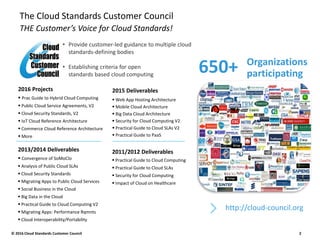
The Cloud Standards Customer Council
• Provide customer-led guidance to multiple cloud
standards-defining bodies
• Establishing criteria for open
standards based cloud computing
650+ Organizations
participating
2011/2012 Deliverables
 Practical Guide to Cloud Computing
 Practical Guide to Cloud SLAs
 Security for Cloud Computing
 Impact of Cloud on Healthcare
2013/2014 Deliverables
 Convergence of SoMoClo
 Analysis of Public Cloud SLAs
 Cloud Security Standards
 Migrating Apps to Public Cloud Services
 Social Business in the Cloud
 Big Data in the Cloud
 Practical Guide to Cloud Computing V2
 Migrating Apps: Performance Rqmnts
 Cloud Interoperability/Portability
http://cloud-council.org
2015 Deliverables
 Web App Hosting Architecture
 Mobile Cloud Architecture
 Big Data Cloud Architecture
 Security for Cloud Computing V2
 Practical Guide to Cloud SLAs V2
 Practical Guide to PaaS
THE Customer’s Voice for Cloud Standards!
2016 Projects
 Prac Guide to Hybrid Cloud Computing
 Public Cloud Service Agreements, V2
 Cloud Security Standards, V2
 IoT Cloud Reference Architecture
 Commerce Cloud Reference Architecture
 More
© 2016 Cloud Standards Customer Council 2
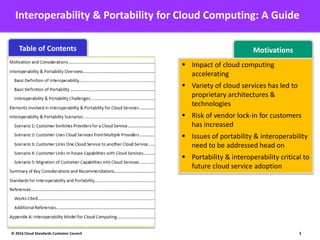
Interoperability & Portability for Cloud Computing: A Guide
Table of Contents Motivations
 Impact of cloud computing
accelerating
 Variety of cloud services has led to
proprietary architectures &
technologies
 Risk of vendor lock-in for customers
has increased
 Issues of portability & interoperability
need to be addressed head on
 Portability & interoperability critical to
future cloud service adoption
© 2016 Cloud Standards Customer Council 3
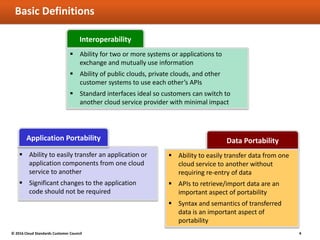
Basic Definitions
 Ability to easily transfer an application or
application components from one cloud
service to another
 Significant changes to the application
code should not be required
Interoperability
 Ability for two or more systems or applications to
exchange and mutually use information
 Ability of public clouds, private clouds, and other
customer systems to use each other’s APIs
 Standard interfaces ideal so customers can switch to
another cloud service provider with minimal impact
Data Portability
 Ability to easily transfer data from one
cloud service to another without
requiring re-entry of data
 APIs to retrieve/import data are an
important aspect of portability
 Syntax and semantics of transferred
data is an important aspect of
portability
© 2016 Cloud Standards Customer Council 4
Application Portability
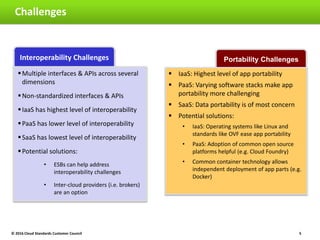
Challenges
Interoperability Challenges
Multiple interfaces & APIs across several
dimensions
Non-standardized interfaces & APIs
IaaS has highest level of interoperability
PaaS has lower level of interoperability
SaaS has lowest level of interoperability
Potential solutions:
• ESBs can help address
interoperability challenges
• Inter-cloud providers (i.e. brokers)
are an option
Portability Challenges
 IaaS: Highest level of app portability
 PaaS: Varying software stacks make app
portability more challenging
 SaaS: Data portability is of most concern
 Potential solutions:
• IaaS: Operating systems like Linux and
standards like OVF ease app portability
• PaaS: Adoption of common open source
platforms helpful (e.g. Cloud Foundry)
• Common container technology allows
independent deployment of app parts (e.g.
Docker)
© 2016 Cloud Standards Customer Council 5
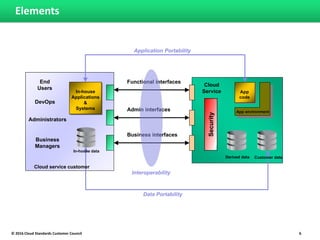
Elements
Derived data
App
code
App environment
Functional interfacesEnd
Users
Admin interfaces
Business interfaces
Business
Managers
Administrators
DevOps
Cloud
Service
Security
In-house
Applications
&
Systems
In-house data
Cloud service customer
Customer data
Application Portability
Data Portability
Interoperability
© 2016 Cloud Standards Customer Council 6
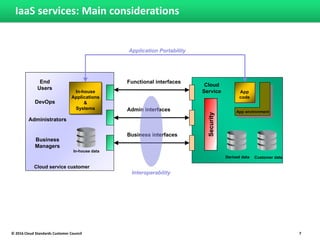
IaaS services: Main considerations
Derived data
App
code
App environment
Functional interfacesEnd
Users
Admin interfaces
Business interfaces
Business
Managers
Administrators
DevOps
Cloud
Service
Security
In-house
Applications
&
Systems
In-house data
Cloud service customer
Customer data
Application Portability
Interoperability
© 2016 Cloud Standards Customer Council 7
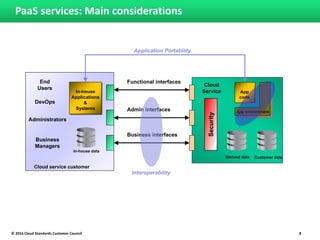
PaaS services: Main considerations
Derived data
App
code
App environment
Functional interfacesEnd
Users
Admin interfaces
Business interfaces
Business
Managers
Administrators
DevOps
Cloud
Service
Security
In-house
Applications
&
Systems
In-house data
Cloud service customer
Customer data
Application Portability
Interoperability
© 2016 Cloud Standards Customer Council 8
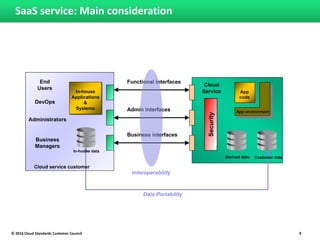
SaaS service: Main consideration
Derived data
App
code
App environment
Functional interfacesEnd
Users
Admin interfaces
Business interfaces
Business
Managers
Administrators
DevOps
Cloud
Service
Security
In-house
Applications
&
Systems
In-house data
Cloud service customer
Customer data
Data Portability
Interoperability
© 2016 Cloud Standards Customer Council 9
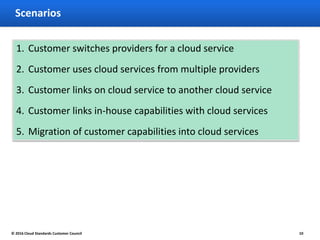
Scenarios
1. Customer switches providers for a cloud service
2. Customer uses cloud services from multiple providers
3. Customer links on cloud service to another cloud service
4. Customer links in-house capabilities with cloud services
5. Migration of customer capabilities into cloud services
© 2016 Cloud Standards Customer Council 10
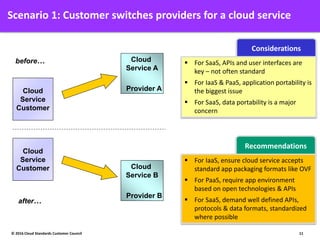
Scenario 1: Customer switches providers for a cloud service
Cloud
Service
Customer
Cloud
Service A
Provider A
Cloud
Service
Customer Cloud
Service B
Provider B
before…
after…
Considerations
 For SaaS, APIs and user interfaces are
key – not often standard
 For IaaS & PaaS, application portability is
the biggest issue
 For SaaS, data portability is a major
concern
Recommendations
 For IaaS, ensure cloud service accepts
standard app packaging formats like OVF
 For PaaS, require app environment
based on open technologies & APIs
 For SaaS, demand well defined APIs,
protocols & data formats, standardized
where possible
© 2016 Cloud Standards Customer Council 11
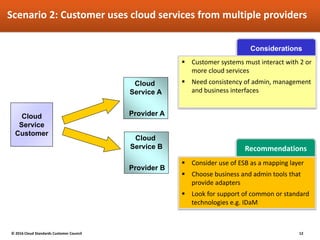
Scenario 2: Customer uses cloud services from multiple providers
Cloud
Service
Customer
Cloud
Service A
Provider A
Cloud
Service B
Provider B
Considerations
 Customer systems must interact with 2 or
more cloud services
 Need consistency of admin, management
and business interfaces
Recommendations
 Consider use of ESB as a mapping layer
 Choose business and admin tools that
provide adapters
 Look for support of common or standard
technologies e.g. IDaM
© 2016 Cloud Standards Customer Council 12
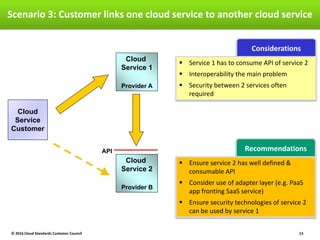
Scenario 3: Customer links one cloud service to another cloud service
Cloud
Service
Customer
Cloud
Service 1
Provider A
Cloud
Service 2
Provider B
API
Considerations
 Service 1 has to consume API of service 2
 Interoperability the main problem
 Security between 2 services often
required
Recommendations
 Ensure service 2 has well defined &
consumable API
 Consider use of adapter layer (e.g. PaaS
app fronting SaaS service)
 Ensure security technologies of service 2
can be used by service 1
© 2016 Cloud Standards Customer Council 13
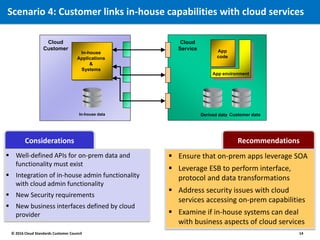
Customer dataDerived data
App
code
App environment
Cloud
Service
In-house data
In-house
Applications
&
Systems
Cloud
Customer
Considerations
 Well-defined APIs for on-prem data and
functionality must exist
 Integration of in-house admin functionality
with cloud admin functionality
 New Security requirements
 New business interfaces defined by cloud
provider
Recommendations
 Ensure that on-prem apps leverage SOA
 Leverage ESB to perform interface,
protocol and data transformations
 Address security issues with cloud
services accessing on-prem capabilities
 Examine if in-house systems can deal
with business aspects of cloud services
© 2016 Cloud Standards Customer Council 14
Scenario 4: Customer links in-house capabilities with cloud services
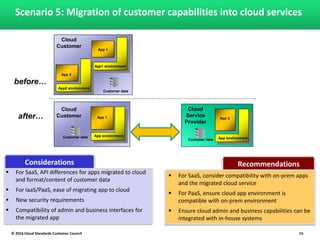
Scenario 5: Migration of customer capabilities into cloud services
before…
after…
Customer data
App 2
App1 environment
Cloud
Customer
Customer data
App 2
App environment
Cloud
Service
Provider
App 1
Customer data App environment
Cloud
Customer App 1
App2 environment
Considerations
 For SaaS, API differences for apps migrated to cloud
and format/content of customer data
 For IaaS/PaaS, ease of migrating app to cloud
 New security requirements
 Compatibility of admin and business interfaces for
the migrated app
Recommendations
 For SaaS, consider compatibility with on-prem apps
and the migrated cloud service
 For PaaS, ensure cloud app environment is
compatible with on-prem environment
 Ensure cloud admin and business capabilities can be
integrated with in-house systems
© 2016 Cloud Standards Customer Council 15
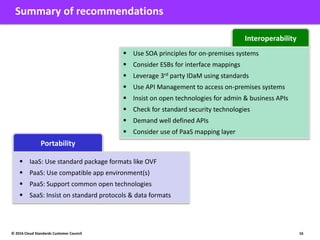
Summary of recommendations
Portability
 IaaS: Use standard package formats like OVF
 PaaS: Use compatible app environment(s)
 PaaS: Support common open technologies
 SaaS: Insist on standard protocols & data formats
Interoperability
 Use SOA principles for on-premises systems
 Consider ESBs for interface mappings
 Leverage 3rd party IDaM using standards
 Use API Management to access on-premises systems
 Insist on open technologies for admin & business APIs
 Check for standard security technologies
 Demand well defined APIs
 Consider use of PaaS mapping layer
© 2016 Cloud Standards Customer Council 16
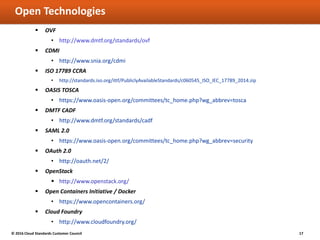
Open Technologies
 OVF
• http://www.dmtf.org/standards/ovf
 CDMI
• http://www.snia.org/cdmi
 ISO 17789 CCRA
• http://standards.iso.org/ittf/PubliclyAvailableStandards/c060545_ISO_IEC_17789_2014.zip
 OASIS TOSCA
• https://www.oasis-open.org/committees/tc_home.php?wg_abbrev=tosca
 DMTF CADF
• http://www.dmtf.org/standards/cadf
 SAML 2.0
• https://www.oasis-open.org/committees/tc_home.php?wg_abbrev=security
 OAuth 2.0
• http://oauth.net/2/
 OpenStack
 http://www.openstack.org/
 Open Containers Initiative / Docker
• https://www.opencontainers.org/
 Cloud Foundry
• http://www.cloudfoundry.org/
© 2016 Cloud Standards Customer Council 17
Call to Action
Join the CSCC Now!
– To have an impact on customer use case based standards requirements
– To learn about all Cloud Standards within one organization
– To help define the CSCC’s future roadmap
– Membership is free & easy: http://www.cloud-council.org/become-a-
member
Get Involved!
– Join one or more of the CSCC Working Groups
http://www.cloud-council.org/workinggroups
Leverage CSCC Collateral
– Visit http://www.cloud-council.org/resource-hub
© 2016 Cloud Standards Customer Council 18
Additional Resources
 Practical Guide to Hybrid Cloud Computing
• http://www.cloud-council.org/deliverables/practical-guide-to-hybrid-cloud-
computing.htm
• Practical Guide to PaaS
• http://www.cloud-council.org/deliverables/practical-guide-to-platform-as-a-service.htm
 Practical Guide to Cloud Computing Version 2.0
• http://www.cloud-council.org/deliverables/practical-guide-to-cloud-computing.htm
 Migrating Applications to Public Cloud Services: Roadmap for Success
• http://www.cloud-council.org/deliverables/migrating-applications-to-public-cloud-
services-roadmap-for-success.htm
 Cloud Security Standards: What to Expect & What to Negotiate Version 2.0
• http://www.cloud-council.org/deliverables/cloud-security-standards-what-to-expect-and-
what-to-negotiate.htm
 Security for Cloud Computing: 10 Steps to Ensure Success Version 2.0
• http://www.cloud-council.org/deliverables/security-for-cloud-computing-10-steps-to-
ensure-success.htm
 Practical Guide to Cloud Service Agreements Version 2.0
• http://www.cloud-council.org/deliverables/practical-guide-to-cloud-service-
agreements.htm
© 2016 Cloud Standards Customer Council 19
Thank You
© 2016 Cloud Standards Customer Council 20

Interoperability and Portability for Cloud Computing: A Guide

  • 1.
    Interoperability & Portabilityfor Cloud Computing: A Guide http://www.cloud-council.org/deliverables/interoperability-and-portability-for- cloud-computing-a-guide.htm November 15, 2016
  • 2.
    The Cloud StandardsCustomer Council • Provide customer-led guidance to multiple cloud standards-defining bodies • Establishing criteria for open standards based cloud computing 650+ Organizations participating 2011/2012 Deliverables  Practical Guide to Cloud Computing  Practical Guide to Cloud SLAs  Security for Cloud Computing  Impact of Cloud on Healthcare 2013/2014 Deliverables  Convergence of SoMoClo  Analysis of Public Cloud SLAs  Cloud Security Standards  Migrating Apps to Public Cloud Services  Social Business in the Cloud  Big Data in the Cloud  Practical Guide to Cloud Computing V2  Migrating Apps: Performance Rqmnts  Cloud Interoperability/Portability http://cloud-council.org 2015 Deliverables  Web App Hosting Architecture  Mobile Cloud Architecture  Big Data Cloud Architecture  Security for Cloud Computing V2  Practical Guide to Cloud SLAs V2  Practical Guide to PaaS THE Customer’s Voice for Cloud Standards! 2016 Projects  Prac Guide to Hybrid Cloud Computing  Public Cloud Service Agreements, V2  Cloud Security Standards, V2  IoT Cloud Reference Architecture  Commerce Cloud Reference Architecture  More © 2016 Cloud Standards Customer Council 2
  • 3.
    Interoperability & Portabilityfor Cloud Computing: A Guide Table of Contents Motivations  Impact of cloud computing accelerating  Variety of cloud services has led to proprietary architectures & technologies  Risk of vendor lock-in for customers has increased  Issues of portability & interoperability need to be addressed head on  Portability & interoperability critical to future cloud service adoption © 2016 Cloud Standards Customer Council 3
  • 4.
    Basic Definitions  Abilityto easily transfer an application or application components from one cloud service to another  Significant changes to the application code should not be required Interoperability  Ability for two or more systems or applications to exchange and mutually use information  Ability of public clouds, private clouds, and other customer systems to use each other’s APIs  Standard interfaces ideal so customers can switch to another cloud service provider with minimal impact Data Portability  Ability to easily transfer data from one cloud service to another without requiring re-entry of data  APIs to retrieve/import data are an important aspect of portability  Syntax and semantics of transferred data is an important aspect of portability © 2016 Cloud Standards Customer Council 4 Application Portability
  • 5.
    Challenges Interoperability Challenges Multiple interfaces& APIs across several dimensions Non-standardized interfaces & APIs IaaS has highest level of interoperability PaaS has lower level of interoperability SaaS has lowest level of interoperability Potential solutions: • ESBs can help address interoperability challenges • Inter-cloud providers (i.e. brokers) are an option Portability Challenges  IaaS: Highest level of app portability  PaaS: Varying software stacks make app portability more challenging  SaaS: Data portability is of most concern  Potential solutions: • IaaS: Operating systems like Linux and standards like OVF ease app portability • PaaS: Adoption of common open source platforms helpful (e.g. Cloud Foundry) • Common container technology allows independent deployment of app parts (e.g. Docker) © 2016 Cloud Standards Customer Council 5
  • 6.
    Elements Derived data App code App environment FunctionalinterfacesEnd Users Admin interfaces Business interfaces Business Managers Administrators DevOps Cloud Service Security In-house Applications & Systems In-house data Cloud service customer Customer data Application Portability Data Portability Interoperability © 2016 Cloud Standards Customer Council 6
  • 7.
    IaaS services: Mainconsiderations Derived data App code App environment Functional interfacesEnd Users Admin interfaces Business interfaces Business Managers Administrators DevOps Cloud Service Security In-house Applications & Systems In-house data Cloud service customer Customer data Application Portability Interoperability © 2016 Cloud Standards Customer Council 7
  • 8.
    PaaS services: Mainconsiderations Derived data App code App environment Functional interfacesEnd Users Admin interfaces Business interfaces Business Managers Administrators DevOps Cloud Service Security In-house Applications & Systems In-house data Cloud service customer Customer data Application Portability Interoperability © 2016 Cloud Standards Customer Council 8
  • 9.
    SaaS service: Mainconsideration Derived data App code App environment Functional interfacesEnd Users Admin interfaces Business interfaces Business Managers Administrators DevOps Cloud Service Security In-house Applications & Systems In-house data Cloud service customer Customer data Data Portability Interoperability © 2016 Cloud Standards Customer Council 9
  • 10.
    Scenarios 1. Customer switchesproviders for a cloud service 2. Customer uses cloud services from multiple providers 3. Customer links on cloud service to another cloud service 4. Customer links in-house capabilities with cloud services 5. Migration of customer capabilities into cloud services © 2016 Cloud Standards Customer Council 10
  • 11.
    Scenario 1: Customerswitches providers for a cloud service Cloud Service Customer Cloud Service A Provider A Cloud Service Customer Cloud Service B Provider B before… after… Considerations  For SaaS, APIs and user interfaces are key – not often standard  For IaaS & PaaS, application portability is the biggest issue  For SaaS, data portability is a major concern Recommendations  For IaaS, ensure cloud service accepts standard app packaging formats like OVF  For PaaS, require app environment based on open technologies & APIs  For SaaS, demand well defined APIs, protocols & data formats, standardized where possible © 2016 Cloud Standards Customer Council 11
  • 12.
    Scenario 2: Customeruses cloud services from multiple providers Cloud Service Customer Cloud Service A Provider A Cloud Service B Provider B Considerations  Customer systems must interact with 2 or more cloud services  Need consistency of admin, management and business interfaces Recommendations  Consider use of ESB as a mapping layer  Choose business and admin tools that provide adapters  Look for support of common or standard technologies e.g. IDaM © 2016 Cloud Standards Customer Council 12
  • 13.
    Scenario 3: Customerlinks one cloud service to another cloud service Cloud Service Customer Cloud Service 1 Provider A Cloud Service 2 Provider B API Considerations  Service 1 has to consume API of service 2  Interoperability the main problem  Security between 2 services often required Recommendations  Ensure service 2 has well defined & consumable API  Consider use of adapter layer (e.g. PaaS app fronting SaaS service)  Ensure security technologies of service 2 can be used by service 1 © 2016 Cloud Standards Customer Council 13
  • 14.
    Customer dataDerived data App code Appenvironment Cloud Service In-house data In-house Applications & Systems Cloud Customer Considerations  Well-defined APIs for on-prem data and functionality must exist  Integration of in-house admin functionality with cloud admin functionality  New Security requirements  New business interfaces defined by cloud provider Recommendations  Ensure that on-prem apps leverage SOA  Leverage ESB to perform interface, protocol and data transformations  Address security issues with cloud services accessing on-prem capabilities  Examine if in-house systems can deal with business aspects of cloud services © 2016 Cloud Standards Customer Council 14 Scenario 4: Customer links in-house capabilities with cloud services
  • 15.
    Scenario 5: Migrationof customer capabilities into cloud services before… after… Customer data App 2 App1 environment Cloud Customer Customer data App 2 App environment Cloud Service Provider App 1 Customer data App environment Cloud Customer App 1 App2 environment Considerations  For SaaS, API differences for apps migrated to cloud and format/content of customer data  For IaaS/PaaS, ease of migrating app to cloud  New security requirements  Compatibility of admin and business interfaces for the migrated app Recommendations  For SaaS, consider compatibility with on-prem apps and the migrated cloud service  For PaaS, ensure cloud app environment is compatible with on-prem environment  Ensure cloud admin and business capabilities can be integrated with in-house systems © 2016 Cloud Standards Customer Council 15
  • 16.
    Summary of recommendations Portability IaaS: Use standard package formats like OVF  PaaS: Use compatible app environment(s)  PaaS: Support common open technologies  SaaS: Insist on standard protocols & data formats Interoperability  Use SOA principles for on-premises systems  Consider ESBs for interface mappings  Leverage 3rd party IDaM using standards  Use API Management to access on-premises systems  Insist on open technologies for admin & business APIs  Check for standard security technologies  Demand well defined APIs  Consider use of PaaS mapping layer © 2016 Cloud Standards Customer Council 16
  • 17.
    Open Technologies  OVF •http://www.dmtf.org/standards/ovf  CDMI • http://www.snia.org/cdmi  ISO 17789 CCRA • http://standards.iso.org/ittf/PubliclyAvailableStandards/c060545_ISO_IEC_17789_2014.zip  OASIS TOSCA • https://www.oasis-open.org/committees/tc_home.php?wg_abbrev=tosca  DMTF CADF • http://www.dmtf.org/standards/cadf  SAML 2.0 • https://www.oasis-open.org/committees/tc_home.php?wg_abbrev=security  OAuth 2.0 • http://oauth.net/2/  OpenStack  http://www.openstack.org/  Open Containers Initiative / Docker • https://www.opencontainers.org/  Cloud Foundry • http://www.cloudfoundry.org/ © 2016 Cloud Standards Customer Council 17
  • 18.
    Call to Action Jointhe CSCC Now! – To have an impact on customer use case based standards requirements – To learn about all Cloud Standards within one organization – To help define the CSCC’s future roadmap – Membership is free & easy: http://www.cloud-council.org/become-a- member Get Involved! – Join one or more of the CSCC Working Groups http://www.cloud-council.org/workinggroups Leverage CSCC Collateral – Visit http://www.cloud-council.org/resource-hub © 2016 Cloud Standards Customer Council 18
  • 19.
    Additional Resources  PracticalGuide to Hybrid Cloud Computing • http://www.cloud-council.org/deliverables/practical-guide-to-hybrid-cloud- computing.htm • Practical Guide to PaaS • http://www.cloud-council.org/deliverables/practical-guide-to-platform-as-a-service.htm  Practical Guide to Cloud Computing Version 2.0 • http://www.cloud-council.org/deliverables/practical-guide-to-cloud-computing.htm  Migrating Applications to Public Cloud Services: Roadmap for Success • http://www.cloud-council.org/deliverables/migrating-applications-to-public-cloud- services-roadmap-for-success.htm  Cloud Security Standards: What to Expect & What to Negotiate Version 2.0 • http://www.cloud-council.org/deliverables/cloud-security-standards-what-to-expect-and- what-to-negotiate.htm  Security for Cloud Computing: 10 Steps to Ensure Success Version 2.0 • http://www.cloud-council.org/deliverables/security-for-cloud-computing-10-steps-to- ensure-success.htm  Practical Guide to Cloud Service Agreements Version 2.0 • http://www.cloud-council.org/deliverables/practical-guide-to-cloud-service- agreements.htm © 2016 Cloud Standards Customer Council 19
  • 20.
    Thank You © 2016Cloud Standards Customer Council 20