Authors: 
Carlo Mastroianni, 
Michela Meo, 
Giuseppe Papuzzo 
Presented By: 
Iffat Anjum 
Rk-554 
Date: 26-10-2014 
1
 
 
 
 
 
 
2
 The design of large and powerful Cloud Data Centers 
mainly depends 
 Power Efficiency. 
 Efficient Virtual Machine (VM) Consolidation. 
 Reduce of over-all power consumption. 
 Avoid low Utilized Servers, also 
 Avoid Over-loaded Servers. 
 Service Level Agreements. 
3
 Virtualization: Many Virtual Machine (VM) instances 
can be executed on the same physical server. 
 Consolidation of the workload: allocating the maximum 
number of VMs in the minimum number of physical 
machines. 
 Allows unneeded servers to be in 
 low-power state, or 
 switched off, or 
 devoted to the execution of incremental workload 
4
 The optimal assignment of VMs to the servers of a data 
center is analogous to the NP-hard “Bin Packing 
Problem” 
 The problem is more complicated by two circumstances: 
 The assignment of VMs should take into account multiple 
server resources at the same time, for example, CPU and RAM, 
(multidimensional bin packing Problem) 
 The VMs continuously modify their hardware requirements, 
potentially baffling the previous assignment decisions in a few 
hours. 
5
 ecoCloud Key characteristics: 
 the use of the swarm intelligence paradigm 
 which allows a complex problem to be solved by 
combining simple operations performed by many 
autonomous actors (the single servers in our case) 
 the use of probabilistic procedures and 
 the self-organizing behavior of the system 
 which ensures that the assignment of VMs to servers 
dynamically adapts to the varying workload 
6
 ecoCloud: an approach for consolidating VMs on a 
multidimensional computing resources. 
 CPU and RAM 
 Two types probabilistic procedures for dynamic 
consolidation and better-utilization of server: 
 Assignment 
 Migration 
 The assignment and migration of VMs are driven by 
probabilistic processes and are based exclusively on local 
information. 
 Data center manager combine local decisions. 
 Single servers take key decisions. 
7
 The assignment and migration procedures aim at 
 increasing the utilization of servers 
 consolidating the workload dynamically 
 with the twofold objective 
 saving electrical costs 
 respecting the Service Level Agreements stipulated 
with users. 
8
9 
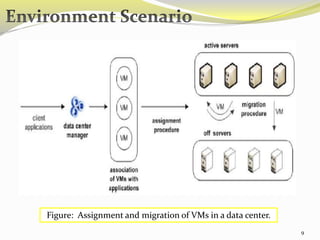
Figure: Assignment and migration of VMs in a data center.
10 
 An Application request: 
 transmitted from a client to the data center manager 
 Data center manager selects a VM that is appropriate for the 
application on the basis of application characteristics: 
 the amount of required resources (CPU, memory, storage 
space) 
 The type of operating system specified by the client. 
 Then, the VM is assigned to one of the available servers 
through the assignment procedure.
 Actually single servers decide whether they should accept or 
reject a VM 
 Data center manager has only a coordinating role 
 It does not need to execute any complex centralized algorithm 
to optimize the mapping of VMs. 
 The workload of each application is dynamic: 
(for example, the CPU demand of a web server depends on 
the workload generated by web users) 
11 
 assignment of VMs is monitored continuously 
 tuned through the migration procedure
12 
 VM Migration occurs: 
 the resources utilization is too low 
 meaning that the server is highly underutilized 
 too high 
 possibly causing overload situations and service level 
agreement violations. 
 The migration procedure consists of two steps: 
 a server requests the migration of a VM, on the basis of its 
CPU/RAM utilization. 
 choose the server that will host the migrating VM
 On a new Application Request: 
 Data Center Manager sends an invitation to all the active 
servers, or to a subset of them. 
 Depending on the data center size and architecture 
 To check if they are available to accept the new VM 
 Servers take its decision whether or not to accept the invitation 
 try to contribute to the consolidation of the workload on as 
few servers as possible 
13
 A server rejects invitation if the server is over-utilized or 
underutilized on either of the two considered resources, CPU 
and RAM 
 the rationale is to: 
 avoid overload situations that can penalize the quality of 
service perceived by users 
 while in the case of underutilization the objective is to put 
the server in a sleep mode and save energy, 
 Underutilized server should refuse new VMs and try to get 
rid of those that are currently running 
 A server with intermediate utilization should accept to foster 
consolidation. 
14
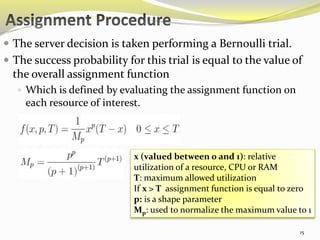
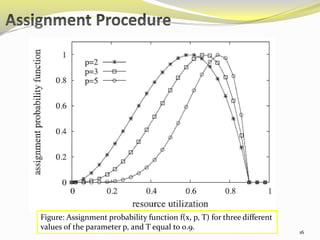
 The server decision is taken performing a Bernoulli trial. 
 The success probability for this trial is equal to the value of 
the overall assignment function 
 Which is defined by evaluating the assignment function on 
each resource of interest. 
x (valued between 0 and 1): relative 
utilization of a resource, CPU or RAM 
T: maximum allowed utilization 
If x > T assignment function is equal to zero 
p: is a shape parameter 
Mp: used to normalize the maximum value to 1 
15
16 
Figure: Assignment probability function f(x, p, T) for three different 
values of the parameter p, and T equal to 0.9.
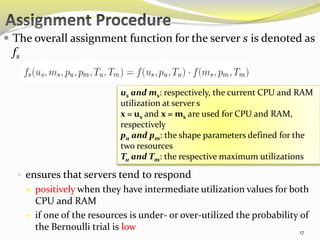
 The overall assignment function for the server s is denoted as 
fs 
us and ms: respectively, the current CPU and RAM 
utilization at server s 
x = us and x = ms are used for CPU and RAM, 
respectively 
pu and pm: the shape parameters defined for the 
two resources 
Tu and Tm: the respective maximum utilizations 
 ensures that servers tend to respond 
 positively when they have intermediate utilization values for both 
CPU and RAM 
 if one of the resources is under- or over-utilized the probability of 
the Bernoulli trial is low 
17
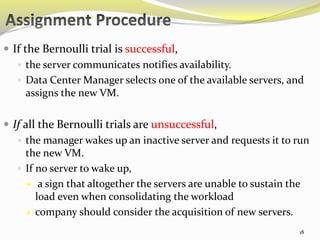
 If the Bernoulli trial is successful, 
 the server communicates notifies availability. 
 Data Center Manager selects one of the available servers, and 
assigns the new VM. 
 If all the Bernoulli trials are unsuccessful, 
 the manager wakes up an inactive server and requests it to run 
the new VM. 
 If no server to wake up, 
 a sign that altogether the servers are unable to sustain the 
load even when consolidating the workload 
 company should consider the acquisition of new servers. 
18
 On underutilization and overutilization of servers 
 some VMs can be profitably migrated to other servers 
 either to switch off a server, or 
 to alleviate its load 
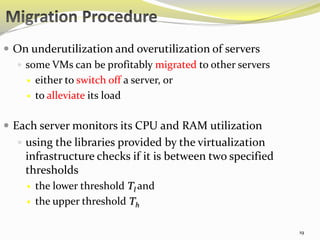
 Each server monitors its CPU and RAM utilization 
 using the libraries provided by the virtualization 
infrastructure checks if it is between two specified 
thresholds 
 the lower threshold Tl and 
 the upper threshold Th 
19
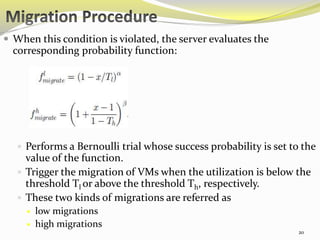
 When this condition is violated, the server evaluates the 
corresponding probability function: 
 Performs a Bernoulli trial whose success probability is set to the 
value of the function. 
 Trigger the migration of VMs when the utilization is below the 
threshold Tl or above the threshold Th, respectively. 
 These two kinds of migrations are referred as 
 low migrations 
 high migrations 
20
21 
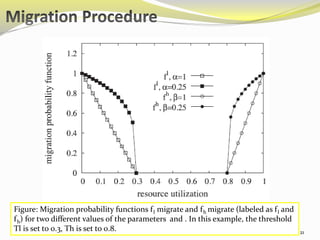
Figure: Migration probability functions fl migrate and fh migrate (labeled as fl and 
fh) for two different values of the parameters and . In this example, the threshold 
Tl is set to 0.3, Th is set to 0.8.
 In the case of high migration, 
 the server focuses on the over-utilized resource (CPU or 
RAM) and 
 considers the VMs for which the utilization of that resource 
is larger than the difference between the current server 
utilization and the threshold Th. 
 Then one of such VMs is randomly selected for migration, as 
this will allow the utilization to go below the threshold. 
 In the case of low migration the choice of the VM to 
migrate is made randomly. 
22
 The choice of the new server made using a variant of the 
assignment procedure, with two main differences. 
 The first one concerns the migration from an overloaded server: 
 the threshold T of the assignment function is set to 0.9 times the 
resource utilization of the server that initiated the procedure , this 
value is sent to servers along with the invitation. 
 This ensures that the VM will migrate to a less loaded server, and 
helps to avoid multiple migrations of the same VM. 
 The second difference concerns the migration from a lightly 
loaded server: 
 When no server is available to run a migrating VM, it would not be 
acceptable to switch on a new server to accommodate the VM. 
23
24 
 The performance of ecoCloud is assessed through the 
following metrics: 
 Resource utilization 
 To foster consolidation and save power, a server should be either 
highly exploited or in a sleep mode. 
 Number of active servers 
 VMs should be clustered into as few servers as possible. 
 Consumed power 
 The ultimate objective is to save electrical power. 
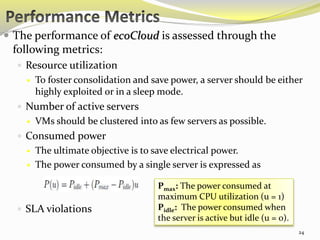
 The power consumed by a single server is expressed as 
 SLA violations 
Pmax: The power consumed at 
maximum CPU utilization (u = 1) 
Pidle: The power consumed when 
the server is active but idle (u = 0).
25 
 Frequency of migrations and server switches 
 Any VM migration causes a slight performance degradation of the 
application. 
 The time needed to transfer the VM memory may vary from a few 
seconds up to two minutes in the worst cases. 
 In this interval, the VM is active on the source server. 
 During the actual handover of the VM, the VM experiences a 
downtime in the order of milliseconds. 
 Analogously, the activation of an off server needs a startup time 
and additional power. 
 Therefore, though migrations and switches are essential for VM 
consolidation and power reduction, it is important to limit their 
frequency.
 tackles the issue of energy-related costs in data 
 centers and Cloud infrastructures, which are the largest 
 contributor to the overall cost of operating such 
environments. 
 The aim is to consolidate the Virtual Machines on as few 
physical servers as possible 
 switch the other servers off 
 minimizing power consumption and 
 carbon emissions 
26
Thank You 
27

Cloud datacenters

  • 1.
    Authors: Carlo Mastroianni, Michela Meo, Giuseppe Papuzzo Presented By: Iffat Anjum Rk-554 Date: 26-10-2014 1
  • 2.
          2
  • 3.
     The designof large and powerful Cloud Data Centers mainly depends  Power Efficiency.  Efficient Virtual Machine (VM) Consolidation.  Reduce of over-all power consumption.  Avoid low Utilized Servers, also  Avoid Over-loaded Servers.  Service Level Agreements. 3
  • 4.
     Virtualization: ManyVirtual Machine (VM) instances can be executed on the same physical server.  Consolidation of the workload: allocating the maximum number of VMs in the minimum number of physical machines.  Allows unneeded servers to be in  low-power state, or  switched off, or  devoted to the execution of incremental workload 4
  • 5.
     The optimalassignment of VMs to the servers of a data center is analogous to the NP-hard “Bin Packing Problem”  The problem is more complicated by two circumstances:  The assignment of VMs should take into account multiple server resources at the same time, for example, CPU and RAM, (multidimensional bin packing Problem)  The VMs continuously modify their hardware requirements, potentially baffling the previous assignment decisions in a few hours. 5
  • 6.
     ecoCloud Keycharacteristics:  the use of the swarm intelligence paradigm  which allows a complex problem to be solved by combining simple operations performed by many autonomous actors (the single servers in our case)  the use of probabilistic procedures and  the self-organizing behavior of the system  which ensures that the assignment of VMs to servers dynamically adapts to the varying workload 6
  • 7.
     ecoCloud: anapproach for consolidating VMs on a multidimensional computing resources.  CPU and RAM  Two types probabilistic procedures for dynamic consolidation and better-utilization of server:  Assignment  Migration  The assignment and migration of VMs are driven by probabilistic processes and are based exclusively on local information.  Data center manager combine local decisions.  Single servers take key decisions. 7
  • 8.
     The assignmentand migration procedures aim at  increasing the utilization of servers  consolidating the workload dynamically  with the twofold objective  saving electrical costs  respecting the Service Level Agreements stipulated with users. 8
  • 9.
    9 Figure: Assignmentand migration of VMs in a data center.
  • 10.
    10  AnApplication request:  transmitted from a client to the data center manager  Data center manager selects a VM that is appropriate for the application on the basis of application characteristics:  the amount of required resources (CPU, memory, storage space)  The type of operating system specified by the client.  Then, the VM is assigned to one of the available servers through the assignment procedure.
  • 11.
     Actually singleservers decide whether they should accept or reject a VM  Data center manager has only a coordinating role  It does not need to execute any complex centralized algorithm to optimize the mapping of VMs.  The workload of each application is dynamic: (for example, the CPU demand of a web server depends on the workload generated by web users) 11  assignment of VMs is monitored continuously  tuned through the migration procedure
  • 12.
    12  VMMigration occurs:  the resources utilization is too low  meaning that the server is highly underutilized  too high  possibly causing overload situations and service level agreement violations.  The migration procedure consists of two steps:  a server requests the migration of a VM, on the basis of its CPU/RAM utilization.  choose the server that will host the migrating VM
  • 13.
     On anew Application Request:  Data Center Manager sends an invitation to all the active servers, or to a subset of them.  Depending on the data center size and architecture  To check if they are available to accept the new VM  Servers take its decision whether or not to accept the invitation  try to contribute to the consolidation of the workload on as few servers as possible 13
  • 14.
     A serverrejects invitation if the server is over-utilized or underutilized on either of the two considered resources, CPU and RAM  the rationale is to:  avoid overload situations that can penalize the quality of service perceived by users  while in the case of underutilization the objective is to put the server in a sleep mode and save energy,  Underutilized server should refuse new VMs and try to get rid of those that are currently running  A server with intermediate utilization should accept to foster consolidation. 14
  • 15.
     The serverdecision is taken performing a Bernoulli trial.  The success probability for this trial is equal to the value of the overall assignment function  Which is defined by evaluating the assignment function on each resource of interest. x (valued between 0 and 1): relative utilization of a resource, CPU or RAM T: maximum allowed utilization If x > T assignment function is equal to zero p: is a shape parameter Mp: used to normalize the maximum value to 1 15
  • 16.
    16 Figure: Assignmentprobability function f(x, p, T) for three different values of the parameter p, and T equal to 0.9.
  • 17.
     The overallassignment function for the server s is denoted as fs us and ms: respectively, the current CPU and RAM utilization at server s x = us and x = ms are used for CPU and RAM, respectively pu and pm: the shape parameters defined for the two resources Tu and Tm: the respective maximum utilizations  ensures that servers tend to respond  positively when they have intermediate utilization values for both CPU and RAM  if one of the resources is under- or over-utilized the probability of the Bernoulli trial is low 17
  • 18.
     If theBernoulli trial is successful,  the server communicates notifies availability.  Data Center Manager selects one of the available servers, and assigns the new VM.  If all the Bernoulli trials are unsuccessful,  the manager wakes up an inactive server and requests it to run the new VM.  If no server to wake up,  a sign that altogether the servers are unable to sustain the load even when consolidating the workload  company should consider the acquisition of new servers. 18
  • 19.
     On underutilizationand overutilization of servers  some VMs can be profitably migrated to other servers  either to switch off a server, or  to alleviate its load  Each server monitors its CPU and RAM utilization  using the libraries provided by the virtualization infrastructure checks if it is between two specified thresholds  the lower threshold Tl and  the upper threshold Th 19
  • 20.
     When thiscondition is violated, the server evaluates the corresponding probability function:  Performs a Bernoulli trial whose success probability is set to the value of the function.  Trigger the migration of VMs when the utilization is below the threshold Tl or above the threshold Th, respectively.  These two kinds of migrations are referred as  low migrations  high migrations 20
  • 21.
    21 Figure: Migrationprobability functions fl migrate and fh migrate (labeled as fl and fh) for two different values of the parameters and . In this example, the threshold Tl is set to 0.3, Th is set to 0.8.
  • 22.
     In thecase of high migration,  the server focuses on the over-utilized resource (CPU or RAM) and  considers the VMs for which the utilization of that resource is larger than the difference between the current server utilization and the threshold Th.  Then one of such VMs is randomly selected for migration, as this will allow the utilization to go below the threshold.  In the case of low migration the choice of the VM to migrate is made randomly. 22
  • 23.
     The choiceof the new server made using a variant of the assignment procedure, with two main differences.  The first one concerns the migration from an overloaded server:  the threshold T of the assignment function is set to 0.9 times the resource utilization of the server that initiated the procedure , this value is sent to servers along with the invitation.  This ensures that the VM will migrate to a less loaded server, and helps to avoid multiple migrations of the same VM.  The second difference concerns the migration from a lightly loaded server:  When no server is available to run a migrating VM, it would not be acceptable to switch on a new server to accommodate the VM. 23
  • 24.
    24  Theperformance of ecoCloud is assessed through the following metrics:  Resource utilization  To foster consolidation and save power, a server should be either highly exploited or in a sleep mode.  Number of active servers  VMs should be clustered into as few servers as possible.  Consumed power  The ultimate objective is to save electrical power.  The power consumed by a single server is expressed as  SLA violations Pmax: The power consumed at maximum CPU utilization (u = 1) Pidle: The power consumed when the server is active but idle (u = 0).
  • 25.
    25  Frequencyof migrations and server switches  Any VM migration causes a slight performance degradation of the application.  The time needed to transfer the VM memory may vary from a few seconds up to two minutes in the worst cases.  In this interval, the VM is active on the source server.  During the actual handover of the VM, the VM experiences a downtime in the order of milliseconds.  Analogously, the activation of an off server needs a startup time and additional power.  Therefore, though migrations and switches are essential for VM consolidation and power reduction, it is important to limit their frequency.
  • 26.
     tackles theissue of energy-related costs in data  centers and Cloud infrastructures, which are the largest  contributor to the overall cost of operating such environments.  The aim is to consolidate the Virtual Machines on as few physical servers as possible  switch the other servers off  minimizing power consumption and  carbon emissions 26
  • 27.

Editor's Notes

  • #14 depending on the data center size and architecture,1 to check if they are available to accept the new VM.
  • #15 depending on the data center size and architecture,1 to check if they are available to accept the new VM.