Challenges in Cloud Computing – VM
Migration
Sarmad Makhdoom
2012-03-0019
Kamran Khalil
2012-03-0012
Hafeez ur Rehman
2012-03-0031
Introduction
Cloud Computing
•

Cloud computing is an umbrella term used to refer to Internet based
development and services

•

A number of characteristics define cloud data, applications services and
infrastructure:
▫
▫
▫

Remotely hosted: Services or data are hosted on remote infrastructure.
Ubiquitous: Services or data are available anywhere.
Commodified: The result is a utility computing model similar to traditional
that of traditional utilities, like gas and electricity - you pay for what you
would want!
Virtual Machines
• A virtual machine provides interface identical to underlying bare
hardware
▫ i.e. all devices, interrupts, memory, page tables etc.

• Applications of Virtual Machines
• Virtualization Software
▫
▫
▫
▫

VMWare
ZAP
Xen
QEMU
Virtual Machines in Cloud
▫ Benefits of Virtual Machines







Virtualization help making efficient use of hardware resources
Facilitates a greater degree of abstraction
Easily move from one piece of hardware to another
Replicate them at will
Create more scalable and flexible infrastructure
Snapshots

▫ Cloud computing has taken that degree of efficiency and agility realized
from virtualization
 Pooled resources
 Geographic diversity
 Universal connectivity
Research Problems
Research Problems
• Automated services provisioning

• Virtual machine migration
•
•
•
•
•
•
•

Server consolidation
Energy management
Traffic management and analysis
Data security
Software frameworks
Storage technology and data management
Novel cloud architecture
Motivation
Motivation
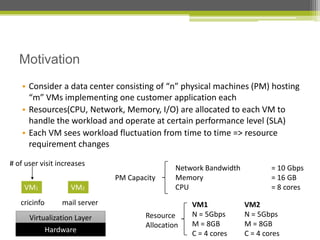
• Consider a data center consisting of “n” physical machines (PM) hosting
“m” VMs implementing one customer application each
• Resources(CPU, Network, Memory, I/O) are allocated to each VM to
handle the workload and operate at certain performance level (SLA)
• Each VM sees workload fluctuation from time to time => resource
requirement changes
# of user visit increases
PM Capacity
VM1

VM2

cricinfo

Network Bandwidth
Memory
CPU

mail server

Virtualization Layer
Hardware

Resource
Allocation

VM1
N = 5Gbps
M = 8GB
C = 4 cores

= 10 Gbps
= 16 GB
= 8 cores
VM2
N = 5Gbps
M = 8GB
C = 4 cores
Motivation
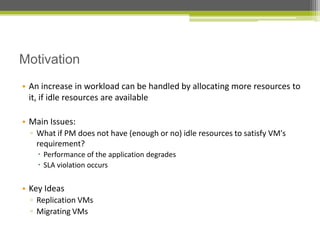
• An increase in workload can be handled by allocating more resources to
it, if idle resources are available
• Main Issues:
▫ What if PM does not have (enough or no) idle resources to satisfy VM's
requirement?
 Performance of the application degrades
 SLA violation occurs

• Key Ideas
▫ Replication VMs
▫ Migrating VMs
Virtual Machine Migration
It is impossible or impractical to bring the data (or devices) close to the computation
engines.
Virtual Machine Migration
• Why we need migration?
• When we need to migrate?
• How migration is done?
• Issues in long distance migration (across data centers)
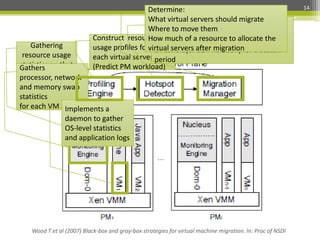
When we need to migrate? [NSDI’ 07]
• Hotspots can cause SLA violations
▫ Burden on some Virtual or Physical Machines are called hotspots

• Hotspot Detection (Sandpiper)
▫ Black-box Monitoring
 CPU (/proc)
 Network (/proc/net/dev)
 Memory (swap)

▫ Gray-box Monitoring
 Gather OS level statistics and application logs

• A hotspot is flagged only if thresholds or SLAs are exceeded for a
sustained time
Wood T et al (2007) Black-box and gray-box strategies for virtual machine migration. In: Proc of NSDI
Gathering
resource usage
statistics
Gathers on that
server
processor, network

Determine:
What virtual servers should migrate
Monitors usage profiles to detect
Where to move them
hotspots.
Construct resource much any resource exceeds a the
How
Hotspot: of a resource to allocate
usage profiles forvirtual servers afterviolation) for a sustain
threshold(or SLA migration
each virtual server period
(Predict PM workload)

and memory swap
statistics
for each VM Implements a
daemon to gather
OS-level statistics
and application logs

Wood T et al (2007) Black-box and gray-box strategies for virtual machine migration. In: Proc of NSDI

14
When we need to migrate? [FGCS’ 12]
• SLA violation detection
▫ Mapping low-level resource metrics to high-level SLAs
▫ Crude data maps to user requirements such as
 CPU speed maps to Response Time
 Occupied memory size maps to number of concurrent clients

▫ Predictive Strategy for detection of possible SLA violations
▫ Detection interval
 Short measurement intervals may degrade performance
 Long measurement intervals may cause ignorance of heavy SLA violations

Towards autonomic detection of SLA violations in Cloud infrastructures, Future Generation Computer Systems, 2012
How migration is done?
• Memory Migration
▫ Pre-copy
 Push phase
 Stop-and-copy phase
 Pull Phase

▫ Pure demand-migration

• File System Migration
▫ In case of distributed file system, there is no need to copy
▫ Alternatively, copy only changed local files to the destination using Virtual
Machine Manager’s API.

S. Venkatesha, S. Sadhu, S. Kintali, and S. Barbara, "Survey of virtual machine migration techniques" - Memory, 2009
How migration is done?
• Network Migration
▫ If both source and destination are on same LAN switch
 an unsolicited ARP reply from the migrating host is provided

▫ Alternatively, on a switched network
 the migrating OS can keep its original Ethernet MAC address, relying on the
network switch to detect its move to a new port

• Device Migration
▫ Three type of device support
 Emulation
 Virtualization
 Non-migratable

S. Venkatesha, S. Sadhu, S. Kintali, and S. Barbara, "Survey of virtual machine migration techniques" - Memory, 2009
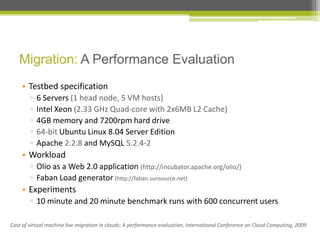
Migration: A Performance Evaluation
• Testbed specification
▫
▫
▫
▫
▫

6 Servers (1 head node, 5 VM hosts)
Intel Xeon (2.33 GHz Quad-core with 2x6MB L2 Cache)
4GB memory and 7200rpm hard drive
64-bit Ubuntu Linux 8.04 Server Edition
Apache 2.2.8 and MySQL 5.2.4-2

• Workload
▫ Olio as a Web 2.0 application (http://incubator.apache.org/olio/)
▫ Faban Load generator (http://faban.sunsource.net)

• Experiments
▫ 10 minute and 20 minute benchmark runs with 600 concurrent users
Cost of virtual machine live migration in clouds: A performance evaluation, International Conference on Cloud Computing, 2009
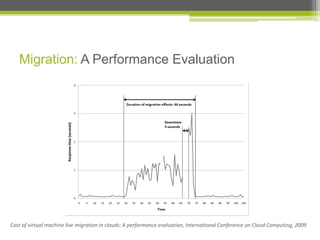
Migration: A Performance Evaluation

Cost of virtual machine live migration in clouds: A performance evaluation, International Conference on Cloud Computing, 2009
Migration across data centers
• Need for VM mobility across data centers
▫
▫
▫
▫

Data center maintenance without downtime
Disaster avoidance
Data center migration/expansion
Workload balancing across multiple sites

• Issues
▫
▫
▫
▫

RTT is 1,000 times greater than sub-networks, ‘word wide wait’
Trust to a remote execution environment
Interoperability at the level of Web Services, Java etc
Migration across multiple domains are vulnerable to security exploits
Related Work: Migration over MAN/WAN
[FGCS’06]
• Introduced an intermediate traffic controller to facilitate migration
which consists of:
▫ VM Traffic Controller
 Provisioning of network resources and the re-provisioning of the IP tunnel to
ensure seamless layer

▫ AAA (Authentication, Authorization and Accounting)
 Pre-allocation of extra VM-resources required for migration

▫ DRAC (Dynamic Resource Allocation Controller)
 Exposes a service-oriented API for coupling with applications

▫ Preservation of TCP and higher-level sessions
 Dynamically configured IP tunnels allow client connectivity

“Seamless Live Migration of Virtual Machines over the MAN/WAN”, Elsevier Future Generation Computer Systems 2006
Related Work: HP Cluster Extension and
Microsoft Hyper-V™
• HP Cluster Extension (CLX) provides flawless mirroring capabilities for
disaster recovery
• VM data is already replicated in single data center cluster
▫ Modifications to spread it across multi-site:
 Multi-site Disaster Recovery solution is implemented
 CLX enables Hyper-V Live Migration across sites

(VMware, Hyper-V, HP-VM and AMD-V)
Our limitation is non-availability of peer referenced or published
material of these architectures to discuss their techniques in detail
Proposed Solution
• Security
▫ Layer 2 Link Encryption (IEEE 802.1AE) may be used to help ensure privacy
and confidentially
▫ Token based security - Authorization message sequence to thwart resource
theft

• 1,000 times rise in RTT doesn’t matter much because
▫ All states will be transferred before the switch
▫ Downtime will be based on the time required in redirection
 Which is only 5-10 times than the intra-LAN setup
Conclusion
Conclusion
• Virtual machine migration provide significant benefits in cloud
computing
• State of the art work is already done on resource monitoring, live VM
migration over the LAN and MAN/WAN
• Downtime is 60ms to 3s which they assume is negligible
• Small transient spikes does not trigger needless migrations, if threshold
or SLAs are exceeded for sustained time
• A slowdown is expected due to cache warm-up at the destination after
migration
• Hybrid approach has been suggested to harness the benefits of all
technqiues
Challenges in Cloud Computing – VM Migration

Challenges in Cloud Computing – VM Migration

  • 1.
    Challenges in CloudComputing – VM Migration Sarmad Makhdoom 2012-03-0019 Kamran Khalil 2012-03-0012 Hafeez ur Rehman 2012-03-0031
  • 2.
  • 3.
    Cloud Computing • Cloud computingis an umbrella term used to refer to Internet based development and services • A number of characteristics define cloud data, applications services and infrastructure: ▫ ▫ ▫ Remotely hosted: Services or data are hosted on remote infrastructure. Ubiquitous: Services or data are available anywhere. Commodified: The result is a utility computing model similar to traditional that of traditional utilities, like gas and electricity - you pay for what you would want!
  • 4.
    Virtual Machines • Avirtual machine provides interface identical to underlying bare hardware ▫ i.e. all devices, interrupts, memory, page tables etc. • Applications of Virtual Machines • Virtualization Software ▫ ▫ ▫ ▫ VMWare ZAP Xen QEMU
  • 5.
    Virtual Machines inCloud ▫ Benefits of Virtual Machines       Virtualization help making efficient use of hardware resources Facilitates a greater degree of abstraction Easily move from one piece of hardware to another Replicate them at will Create more scalable and flexible infrastructure Snapshots ▫ Cloud computing has taken that degree of efficiency and agility realized from virtualization  Pooled resources  Geographic diversity  Universal connectivity
  • 6.
  • 7.
    Research Problems • Automatedservices provisioning • Virtual machine migration • • • • • • • Server consolidation Energy management Traffic management and analysis Data security Software frameworks Storage technology and data management Novel cloud architecture
  • 8.
  • 9.
    Motivation • Consider adata center consisting of “n” physical machines (PM) hosting “m” VMs implementing one customer application each • Resources(CPU, Network, Memory, I/O) are allocated to each VM to handle the workload and operate at certain performance level (SLA) • Each VM sees workload fluctuation from time to time => resource requirement changes # of user visit increases PM Capacity VM1 VM2 cricinfo Network Bandwidth Memory CPU mail server Virtualization Layer Hardware Resource Allocation VM1 N = 5Gbps M = 8GB C = 4 cores = 10 Gbps = 16 GB = 8 cores VM2 N = 5Gbps M = 8GB C = 4 cores
  • 10.
    Motivation • An increasein workload can be handled by allocating more resources to it, if idle resources are available • Main Issues: ▫ What if PM does not have (enough or no) idle resources to satisfy VM's requirement?  Performance of the application degrades  SLA violation occurs • Key Ideas ▫ Replication VMs ▫ Migrating VMs
  • 11.
    Virtual Machine Migration Itis impossible or impractical to bring the data (or devices) close to the computation engines.
  • 12.
    Virtual Machine Migration •Why we need migration? • When we need to migrate? • How migration is done? • Issues in long distance migration (across data centers)
  • 13.
    When we needto migrate? [NSDI’ 07] • Hotspots can cause SLA violations ▫ Burden on some Virtual or Physical Machines are called hotspots • Hotspot Detection (Sandpiper) ▫ Black-box Monitoring  CPU (/proc)  Network (/proc/net/dev)  Memory (swap) ▫ Gray-box Monitoring  Gather OS level statistics and application logs • A hotspot is flagged only if thresholds or SLAs are exceeded for a sustained time Wood T et al (2007) Black-box and gray-box strategies for virtual machine migration. In: Proc of NSDI
  • 14.
    Gathering resource usage statistics Gathers onthat server processor, network Determine: What virtual servers should migrate Monitors usage profiles to detect Where to move them hotspots. Construct resource much any resource exceeds a the How Hotspot: of a resource to allocate usage profiles forvirtual servers afterviolation) for a sustain threshold(or SLA migration each virtual server period (Predict PM workload) and memory swap statistics for each VM Implements a daemon to gather OS-level statistics and application logs Wood T et al (2007) Black-box and gray-box strategies for virtual machine migration. In: Proc of NSDI 14
  • 15.
    When we needto migrate? [FGCS’ 12] • SLA violation detection ▫ Mapping low-level resource metrics to high-level SLAs ▫ Crude data maps to user requirements such as  CPU speed maps to Response Time  Occupied memory size maps to number of concurrent clients ▫ Predictive Strategy for detection of possible SLA violations ▫ Detection interval  Short measurement intervals may degrade performance  Long measurement intervals may cause ignorance of heavy SLA violations Towards autonomic detection of SLA violations in Cloud infrastructures, Future Generation Computer Systems, 2012
  • 16.
    How migration isdone? • Memory Migration ▫ Pre-copy  Push phase  Stop-and-copy phase  Pull Phase ▫ Pure demand-migration • File System Migration ▫ In case of distributed file system, there is no need to copy ▫ Alternatively, copy only changed local files to the destination using Virtual Machine Manager’s API. S. Venkatesha, S. Sadhu, S. Kintali, and S. Barbara, "Survey of virtual machine migration techniques" - Memory, 2009
  • 17.
    How migration isdone? • Network Migration ▫ If both source and destination are on same LAN switch  an unsolicited ARP reply from the migrating host is provided ▫ Alternatively, on a switched network  the migrating OS can keep its original Ethernet MAC address, relying on the network switch to detect its move to a new port • Device Migration ▫ Three type of device support  Emulation  Virtualization  Non-migratable S. Venkatesha, S. Sadhu, S. Kintali, and S. Barbara, "Survey of virtual machine migration techniques" - Memory, 2009
  • 18.
    Migration: A PerformanceEvaluation • Testbed specification ▫ ▫ ▫ ▫ ▫ 6 Servers (1 head node, 5 VM hosts) Intel Xeon (2.33 GHz Quad-core with 2x6MB L2 Cache) 4GB memory and 7200rpm hard drive 64-bit Ubuntu Linux 8.04 Server Edition Apache 2.2.8 and MySQL 5.2.4-2 • Workload ▫ Olio as a Web 2.0 application (http://incubator.apache.org/olio/) ▫ Faban Load generator (http://faban.sunsource.net) • Experiments ▫ 10 minute and 20 minute benchmark runs with 600 concurrent users Cost of virtual machine live migration in clouds: A performance evaluation, International Conference on Cloud Computing, 2009
  • 19.
    Migration: A PerformanceEvaluation Cost of virtual machine live migration in clouds: A performance evaluation, International Conference on Cloud Computing, 2009
  • 20.
    Migration across datacenters • Need for VM mobility across data centers ▫ ▫ ▫ ▫ Data center maintenance without downtime Disaster avoidance Data center migration/expansion Workload balancing across multiple sites • Issues ▫ ▫ ▫ ▫ RTT is 1,000 times greater than sub-networks, ‘word wide wait’ Trust to a remote execution environment Interoperability at the level of Web Services, Java etc Migration across multiple domains are vulnerable to security exploits
  • 21.
    Related Work: Migrationover MAN/WAN [FGCS’06] • Introduced an intermediate traffic controller to facilitate migration which consists of: ▫ VM Traffic Controller  Provisioning of network resources and the re-provisioning of the IP tunnel to ensure seamless layer ▫ AAA (Authentication, Authorization and Accounting)  Pre-allocation of extra VM-resources required for migration ▫ DRAC (Dynamic Resource Allocation Controller)  Exposes a service-oriented API for coupling with applications ▫ Preservation of TCP and higher-level sessions  Dynamically configured IP tunnels allow client connectivity “Seamless Live Migration of Virtual Machines over the MAN/WAN”, Elsevier Future Generation Computer Systems 2006
  • 22.
    Related Work: HPCluster Extension and Microsoft Hyper-V™ • HP Cluster Extension (CLX) provides flawless mirroring capabilities for disaster recovery • VM data is already replicated in single data center cluster ▫ Modifications to spread it across multi-site:  Multi-site Disaster Recovery solution is implemented  CLX enables Hyper-V Live Migration across sites (VMware, Hyper-V, HP-VM and AMD-V) Our limitation is non-availability of peer referenced or published material of these architectures to discuss their techniques in detail
  • 23.
    Proposed Solution • Security ▫Layer 2 Link Encryption (IEEE 802.1AE) may be used to help ensure privacy and confidentially ▫ Token based security - Authorization message sequence to thwart resource theft • 1,000 times rise in RTT doesn’t matter much because ▫ All states will be transferred before the switch ▫ Downtime will be based on the time required in redirection  Which is only 5-10 times than the intra-LAN setup
  • 24.
  • 25.
    Conclusion • Virtual machinemigration provide significant benefits in cloud computing • State of the art work is already done on resource monitoring, live VM migration over the LAN and MAN/WAN • Downtime is 60ms to 3s which they assume is negligible • Small transient spikes does not trigger needless migrations, if threshold or SLAs are exceeded for sustained time • A slowdown is expected due to cache warm-up at the destination after migration • Hybrid approach has been suggested to harness the benefits of all technqiues

Editor's Notes

  • #5 Applications of VMUse different OS’Software testing