





A SECURE MOBILE
MESSAGING APPLICATION
USING IDENTITY-BASED
ENCRYPTION
Master’s Thesis Presentation
by
Ryan Holt
Metropolitan State University
April 24, 2015
OUTLINE
 Introduction
 Background Concepts (IBE, ECC, and the PBC library)
 Project Design and Implementation
 User Experience and Application Performance
 Conclusion
4/27/2015
2
INTRODUCTION
4/27/2015
3
INTRODUCTION
4/27/2015
4
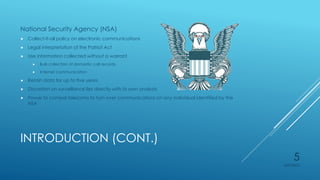
INTRODUCTION (CONT.)
National Security Agency (NSA)
 Collect-it-all policy on electronic communications
 Legal interpretation of the Patriot Act
 Use information collected without a warrant
 Bulk collection of domestic call records
 Internet communication
 Retain data for up to five years
 Discretion on surveillance lies directly with its own analysts
 Power to compel telecoms to turn over communications on any individual identified by the
NSA
4/27/2015
5
INTRODUCTION (CONT.)
Google
 Automated systems analyze your data
 Email, device and location information, local storage
 Customized search results and targeted advertising
 Share aggregated, non-personally identifiable information publicly and with publishers,
advertisers and other websites
 Give up your personal information upon governmental request, leaving you vulnerable to law
enforcement requests or civil subpoenas
 May not immediately delete residual data from servers
 May not ever remove information from their backup systems
4/27/2015
6
INTRODUCTION (CONT.)
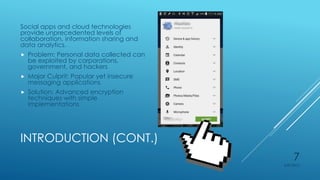
Social apps and cloud technologies
provide unprecedented levels of
collaboration, information sharing and
data analytics.
 Problem: Personal data collected can
be exploited by corporations,
government, and hackers
 Major Culprit: Popular yet insecure
messaging applications
 Solution: Advanced encryption
techniques with simple
implementations
4/27/2015
7
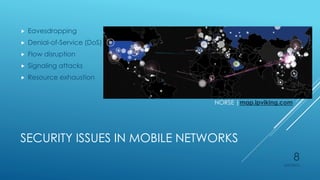
SECURITY ISSUES IN MOBILE NETWORKS
 Eavesdropping
 Denial-of-Service (DoS)
 Flow disruption
 Signaling attacks
 Resource exhaustion
NORSE |map.ipviking.com
4/27/2015
8
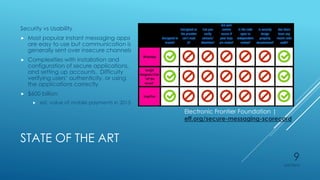
STATE OF THE ART
Security vs Usability
 Most popular instant messaging apps
are easy to use but communication is
generally sent over insecure channels
 Complexities with installation and
configuration of secure applications,
and setting up accounts. Difficulty
verifying users’ authenticity, or using
the applications correctly
 $600 billion
 est. value of mobile payments in 2015
Electronic Frontier Foundation |
eff.org/secure-messaging-scorecard
4/27/2015
9
PROJECT GOALS
This project has three main goals:
1. Show, via a proof-of-concept, that Elliptic Curve Cryptography
(ECC) is a viable security mechanism on modern mobile devices
2. Implement this security mechanism in a way that is user friendly
 Intuitive application user interface
 Transparent security
3. Design a system that is modular and extensible
 Easy to create, extend, and maintain
 Can be added as a security layer atop an existing system
4/27/2015
10
BACKGROUND CONCEPTS
(IBE, ECC, AND THE PBC
LIBRARY)
4/27/2015
11
HISTORY OF IBE
 Identity-Based Encryption (IBE) was first proposed by Adi Shamir in 1984
 Simplify public key and certificate management in a Public Key Infrastructure (PKI)
 Boneh and Franklin introduced the first functional Identity-Based Encryption
scheme in 2001
 Using groups with efficiently computable bilinear maps
 Secure in the random oracle model
 Became Stanford Pairing Based Cryptography (PBC) library
 Boldyreva, Goyal, and Kumar came up with an efficient revocation scheme
for IBE in 2008
 Brent Waters came up with the first Hierarchical IBE (HIBE) scheme and an IBE
system with short parameters in 2009
 De Caro, Iovino, Persiano realized the first Anonymous HIBE protocol in 2010
4/27/2015
12
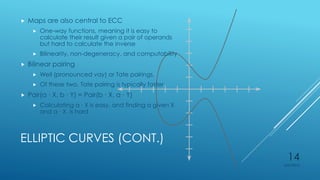
ELLIPTIC CURVES
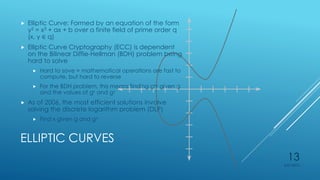
 Elliptic Curve: Formed by an equation of the form
y2 = x3 + ax + b over a finite field of prime order q
(x, y ∈ q)
 Elliptic Curve Cryptography (ECC) is dependent
on the Bilinear Diffie-Hellman (BDH) problem being
hard to solve
 Hard to sove = mathematical operations are fast to
compute, but hard to reverse
 For the BDH problem, this means finding gxy given g
and the values of gx and gy
 As of 2006, the most efficient solutions involve
solving the discrete logarithm problem (DLP)
 Find x given g and gx
4/27/2015
13
ELLIPTIC CURVES (CONT.)
 Maps are also central to ECC
 One-way functions, meaning it is easy to
calculate their result given a pair of operands
but hard to calculate the inverse
 Bilinearity, non-degeneracy, and computability
 Bilinear pairing
 Weil (pronounced vay) or Tate pairings.
 Of these two, Tate pairing is typically faster
 Pair(a ∙ X, b ∙ Y) = Pair(b ∙ X, a ∙ Y)
 Calculating a ∙ X is easy, and finding a given X
and a ∙ X, is hard
4/27/2015
14
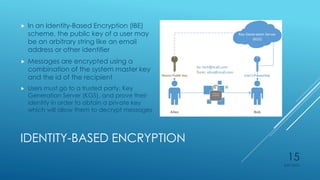
IDENTITY-BASED ENCRYPTION
 In an Identity-Based Encryption (IBE)
scheme, the public key of a user may
be an arbitrary string like an email
address or other identifier
 Messages are encrypted using a
combination of the system master key
and the id of the recipient
 Users must go to a trusted party, Key
Generation Server (KGS), and prove their
identity in order to obtain a private key
which will allow them to decrypt messages
4/27/2015
15
REVIEW OF ALGORITHMS AND THEIR
CLASSIFICATIONS
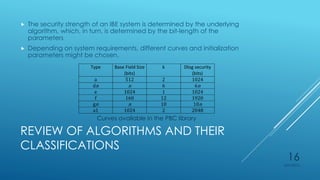
 The security strength of an IBE system is determined by the underlying
algorithm, which, in turn, is determined by the bit-length of the
parameters
 Depending on system requirements, different curves and initialization
parameters might be chosen.
Type Base Field Size
(bits)
k Dlog security
(bits)
a 512 2 1024
dn n 6 6n
e 1024 1 1024
f 160 12 1920
gn n 10 10n
a1 1024 2 2048
Curves available in the PBC library
4/27/2015
16
REVIEW OF ALGORITHMS AND THEIR
CLASSIFICATIONS (CONT.)
 Supersingular curves
 Of the form y2 = x3 + x
 As of 2007 there are no known weaknesses for (carefully selected)
supersingular curves
 Identity-Based Encryption is referenced in several Internet
Engineering Task Force (IETF) draft standards
 RFC 5091 - Identity-Based Cryptography Standard (IBCS) #1:
Supersingular Curve Implementations of the BF and BB1 Cryptosystems
 RFC 5408 - Identity-Based Encryption Architecture and Supporting Data
Structures
 Among others
4/27/2015
17
OTHER INTERESTING THINGS ABOUT IBE
 Secure machine to machine (M2M) scheme in
an Internet-of-Things (IoT)
 Proxy Re-Encryption (PRE)
 Email forwarding
 Distributed file systems
 Digital Rights Management (DRM)
 Attribute-Based Encryption (ABE) is a
generalization of Fuzzy IBE
4/27/2015
18
NOTABLE IMPLEMENTATIONS
 Stanford Pairing Based Cryptography (PBC) Library
 MIRACL
 HP Healthcare
 Voltage security
 Secure plugins for MS Office
 “HP acquires Voltage Security in Big Data encryption push”
siliconangle.com February 2015
 HP Security Voltage
4/27/2015
19
PROS AND CONS
Pros
• Certificate-less
•No complex key
management
infrastructure
• Light-weight
•Small cryptographic
parameters
• Efficient
Cons
• Key Escrow
•Key Generating Server
has access to all private
keys
• Key Revocation
•efficient revocation
difficult
4/27/2015
20
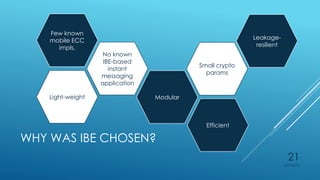
WHY WAS IBE CHOSEN?
Few known
mobile ECC
impls.
No known
IBE-based
instant
messaging
application
Leakage-
resilient
ModularLight-weight
Small crypto
params
Efficient
4/27/2015
21
WHY WAS JPBC CHOSEN?
The Java Pairing-Based Cryptography (JPBC) library was chosen as
the IBE library because it is a Java implementation of the popular
and reputable Stanford PBC library
4/27/2015
22
WHY WAS ANDROID CHOSEN?
 Android ranked the top mobile platform on the market in 2014
 76.6% of smartphones sold globally
 #1 target for malicious hackers
 Threats common to all mobile platforms
 Free
 Open-source
 Java-based
 Many quality development tools and frameworks available
4/27/2015
23
PROJECT DESIGN AND
IMPLEMENTATION
4/27/2015
24
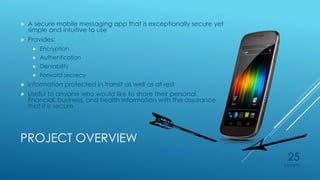
PROJECT OVERVIEW
 A secure mobile messaging app that is exceptionally secure yet
simple and intuitive to use
 Provides:
 Encryption
 Authentication
 Deniability
 Forward secrecy
 Information protected in transit as well as at rest
 Useful to anyone who would like to share their personal,
financial, business, and health information with the assurance
that it is secure
4/27/2015
25
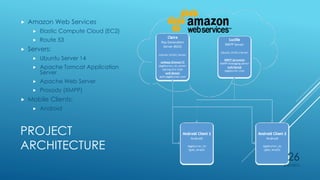
PROJECT
ARCHITECTURE
 Amazon Web Services
 Elastic Compute Cloud (EC2)
 Route 53
 Servers:
 Ubuntu Server 14
 Apache Tomcat Application
Server
 Apache Web Server
 Prosody (XMPP)
 Mobile Clients:
 Android
4/27/2015
26
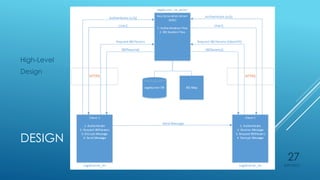
DESIGN
High-Level
Design
4/27/2015
27
DESIGN
(CONT.)
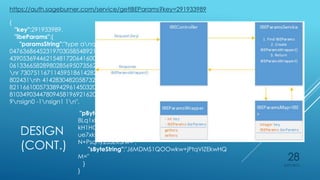
{
"key":291933989,
"ibeParams":{
"paramsString":"type anq 3027378209922339717
047636864523197030585489211533016262964916585
439053694462154817206416003461993685371839546
061336658289802856950735628675952248692458219
nr 730751167114595186142829002853739519958614
802431nh 41428304820587324314159191919242350
821166100573389429614503202187996060553444928
81034903447809458196921620nexp1 138nexp2 15
9nsign0 -1nsign1 1n",
https://auth.sageburner.com/service/getIBEParams?key=291933989
"pByteString":"Nth04o664fvLZK+jxLVE5atrhWMJTMx9l
8Lq1xPBCS3LdK0rpbspAZxKQg9/yQMgy/68hA9dTnw
kH1HQdYYn8zMXySawO+PzY2cPtpLVlcyHOUg1cgH
ue7xkQZfmhkrHl2O8Nh1344enuUckQx2YW5ICHq7U
N+Psqny235ZR3rw=",
"sByteString":"J6MDMS1QOOwkw+jPtqVIZEkwHQ
M="
}
}
4/27/2015
28
DESIGN
(CONT.)
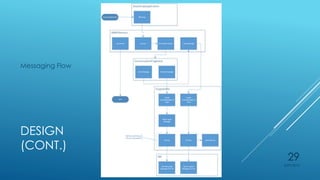
Messaging Flow
4/27/2015
29
IMPLEMENTATION
DETAILS
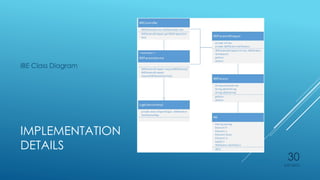
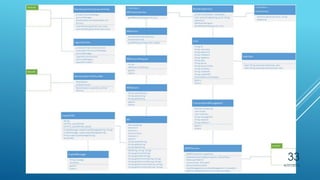
IBE Class Diagram
4/27/2015
30
IMPLEMENTATION
DETAILS (CONT.)
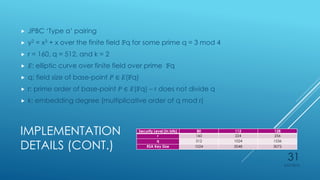
 JPBC ‘Type a’ pairing
 y2 = x3 + x over the finite field 𝔽q for some prime q = 3 mod 4
 r = 160, q = 512, and k = 2
 𝐸: elliptic curve over finite field over prime 𝔽q
 q: field size of base-point 𝑃 ∈ 𝐸(𝔽q)
 r: prime order of base-point 𝑃 ∈ 𝐸(𝔽q) – r does not divide q
 k: embedding degree (multiplicative order of q mod r)
Security Level (in bits) 80 112 128
r 160 224 256
q 512 1024 1536
RSA Key Size 1024 2048 3072
4/27/2015
31
IMPLEMENTATION
DETAILS (CONT.)
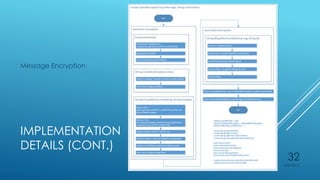
Message Encryption
4/27/2015
32
4/27/2015
33
USER EXPERIENCE AND
APPLICATION PERFORMANCE
4/27/2015
34
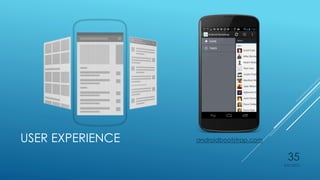
USER EXPERIENCE androidbootstrap.com
4/27/2015
35
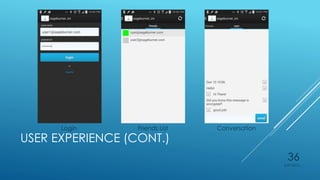
USER EXPERIENCE (CONT.)
Login Friends List Conversation
4/27/2015
36
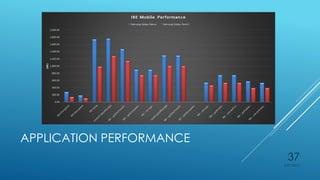
APPLICATION PERFORMANCE
4/27/2015
37
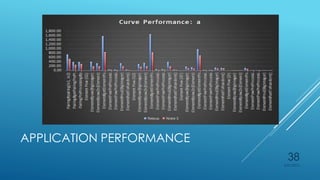
APPLICATION PERFORMANCE
4/27/2015
38
CONCLUSION
4/27/2015
39
CONCLUSION
A mobile user’s privacy is under constant threat of attack from
numerous sources at any given time. Protecting personal and
professional information in such a hostile environment is a
continuous task and one of utmost importance. Taking on such a
challenge requires having the right tools and empowering users to
use them. Along with projects like Off-the-Record, TextSecure, and
Crypto-Book, the secure messaging application developed here is
one of those tools.
4/27/2015
40
FUTURE WORK
 User interface improvements
 Scalability
 Group messaging
 Picture/video messaging
 Conversation history
 Secure file transfer
 Business documents
 Financial records
 Medical records
4/27/2015
41

Ryan_Holt_MS_Thesis_Project_Presentation

  • 1.
    A SECURE MOBILE MESSAGINGAPPLICATION USING IDENTITY-BASED ENCRYPTION Master’s Thesis Presentation by Ryan Holt Metropolitan State University April 24, 2015
  • 2.
    OUTLINE  Introduction  BackgroundConcepts (IBE, ECC, and the PBC library)  Project Design and Implementation  User Experience and Application Performance  Conclusion 4/27/2015 2
  • 3.
  • 4.
  • 5.
    INTRODUCTION (CONT.) National SecurityAgency (NSA)  Collect-it-all policy on electronic communications  Legal interpretation of the Patriot Act  Use information collected without a warrant  Bulk collection of domestic call records  Internet communication  Retain data for up to five years  Discretion on surveillance lies directly with its own analysts  Power to compel telecoms to turn over communications on any individual identified by the NSA 4/27/2015 5
  • 6.
    INTRODUCTION (CONT.) Google  Automatedsystems analyze your data  Email, device and location information, local storage  Customized search results and targeted advertising  Share aggregated, non-personally identifiable information publicly and with publishers, advertisers and other websites  Give up your personal information upon governmental request, leaving you vulnerable to law enforcement requests or civil subpoenas  May not immediately delete residual data from servers  May not ever remove information from their backup systems 4/27/2015 6
  • 7.
    INTRODUCTION (CONT.) Social appsand cloud technologies provide unprecedented levels of collaboration, information sharing and data analytics.  Problem: Personal data collected can be exploited by corporations, government, and hackers  Major Culprit: Popular yet insecure messaging applications  Solution: Advanced encryption techniques with simple implementations 4/27/2015 7
  • 8.
    SECURITY ISSUES INMOBILE NETWORKS  Eavesdropping  Denial-of-Service (DoS)  Flow disruption  Signaling attacks  Resource exhaustion NORSE |map.ipviking.com 4/27/2015 8
  • 9.
    STATE OF THEART Security vs Usability  Most popular instant messaging apps are easy to use but communication is generally sent over insecure channels  Complexities with installation and configuration of secure applications, and setting up accounts. Difficulty verifying users’ authenticity, or using the applications correctly  $600 billion  est. value of mobile payments in 2015 Electronic Frontier Foundation | eff.org/secure-messaging-scorecard 4/27/2015 9
  • 10.
    PROJECT GOALS This projecthas three main goals: 1. Show, via a proof-of-concept, that Elliptic Curve Cryptography (ECC) is a viable security mechanism on modern mobile devices 2. Implement this security mechanism in a way that is user friendly  Intuitive application user interface  Transparent security 3. Design a system that is modular and extensible  Easy to create, extend, and maintain  Can be added as a security layer atop an existing system 4/27/2015 10
  • 11.
    BACKGROUND CONCEPTS (IBE, ECC,AND THE PBC LIBRARY) 4/27/2015 11
  • 12.
    HISTORY OF IBE Identity-Based Encryption (IBE) was first proposed by Adi Shamir in 1984  Simplify public key and certificate management in a Public Key Infrastructure (PKI)  Boneh and Franklin introduced the first functional Identity-Based Encryption scheme in 2001  Using groups with efficiently computable bilinear maps  Secure in the random oracle model  Became Stanford Pairing Based Cryptography (PBC) library  Boldyreva, Goyal, and Kumar came up with an efficient revocation scheme for IBE in 2008  Brent Waters came up with the first Hierarchical IBE (HIBE) scheme and an IBE system with short parameters in 2009  De Caro, Iovino, Persiano realized the first Anonymous HIBE protocol in 2010 4/27/2015 12
  • 13.
    ELLIPTIC CURVES  EllipticCurve: Formed by an equation of the form y2 = x3 + ax + b over a finite field of prime order q (x, y ∈ q)  Elliptic Curve Cryptography (ECC) is dependent on the Bilinear Diffie-Hellman (BDH) problem being hard to solve  Hard to sove = mathematical operations are fast to compute, but hard to reverse  For the BDH problem, this means finding gxy given g and the values of gx and gy  As of 2006, the most efficient solutions involve solving the discrete logarithm problem (DLP)  Find x given g and gx 4/27/2015 13
  • 14.
    ELLIPTIC CURVES (CONT.) Maps are also central to ECC  One-way functions, meaning it is easy to calculate their result given a pair of operands but hard to calculate the inverse  Bilinearity, non-degeneracy, and computability  Bilinear pairing  Weil (pronounced vay) or Tate pairings.  Of these two, Tate pairing is typically faster  Pair(a ∙ X, b ∙ Y) = Pair(b ∙ X, a ∙ Y)  Calculating a ∙ X is easy, and finding a given X and a ∙ X, is hard 4/27/2015 14
  • 15.
    IDENTITY-BASED ENCRYPTION  Inan Identity-Based Encryption (IBE) scheme, the public key of a user may be an arbitrary string like an email address or other identifier  Messages are encrypted using a combination of the system master key and the id of the recipient  Users must go to a trusted party, Key Generation Server (KGS), and prove their identity in order to obtain a private key which will allow them to decrypt messages 4/27/2015 15
  • 16.
    REVIEW OF ALGORITHMSAND THEIR CLASSIFICATIONS  The security strength of an IBE system is determined by the underlying algorithm, which, in turn, is determined by the bit-length of the parameters  Depending on system requirements, different curves and initialization parameters might be chosen. Type Base Field Size (bits) k Dlog security (bits) a 512 2 1024 dn n 6 6n e 1024 1 1024 f 160 12 1920 gn n 10 10n a1 1024 2 2048 Curves available in the PBC library 4/27/2015 16
  • 17.
    REVIEW OF ALGORITHMSAND THEIR CLASSIFICATIONS (CONT.)  Supersingular curves  Of the form y2 = x3 + x  As of 2007 there are no known weaknesses for (carefully selected) supersingular curves  Identity-Based Encryption is referenced in several Internet Engineering Task Force (IETF) draft standards  RFC 5091 - Identity-Based Cryptography Standard (IBCS) #1: Supersingular Curve Implementations of the BF and BB1 Cryptosystems  RFC 5408 - Identity-Based Encryption Architecture and Supporting Data Structures  Among others 4/27/2015 17
  • 18.
    OTHER INTERESTING THINGSABOUT IBE  Secure machine to machine (M2M) scheme in an Internet-of-Things (IoT)  Proxy Re-Encryption (PRE)  Email forwarding  Distributed file systems  Digital Rights Management (DRM)  Attribute-Based Encryption (ABE) is a generalization of Fuzzy IBE 4/27/2015 18
  • 19.
    NOTABLE IMPLEMENTATIONS  StanfordPairing Based Cryptography (PBC) Library  MIRACL  HP Healthcare  Voltage security  Secure plugins for MS Office  “HP acquires Voltage Security in Big Data encryption push” siliconangle.com February 2015  HP Security Voltage 4/27/2015 19
  • 20.
    PROS AND CONS Pros •Certificate-less •No complex key management infrastructure • Light-weight •Small cryptographic parameters • Efficient Cons • Key Escrow •Key Generating Server has access to all private keys • Key Revocation •efficient revocation difficult 4/27/2015 20
  • 21.
    WHY WAS IBECHOSEN? Few known mobile ECC impls. No known IBE-based instant messaging application Leakage- resilient ModularLight-weight Small crypto params Efficient 4/27/2015 21
  • 22.
    WHY WAS JPBCCHOSEN? The Java Pairing-Based Cryptography (JPBC) library was chosen as the IBE library because it is a Java implementation of the popular and reputable Stanford PBC library 4/27/2015 22
  • 23.
    WHY WAS ANDROIDCHOSEN?  Android ranked the top mobile platform on the market in 2014  76.6% of smartphones sold globally  #1 target for malicious hackers  Threats common to all mobile platforms  Free  Open-source  Java-based  Many quality development tools and frameworks available 4/27/2015 23
  • 24.
  • 25.
    PROJECT OVERVIEW  Asecure mobile messaging app that is exceptionally secure yet simple and intuitive to use  Provides:  Encryption  Authentication  Deniability  Forward secrecy  Information protected in transit as well as at rest  Useful to anyone who would like to share their personal, financial, business, and health information with the assurance that it is secure 4/27/2015 25
  • 26.
    PROJECT ARCHITECTURE  Amazon WebServices  Elastic Compute Cloud (EC2)  Route 53  Servers:  Ubuntu Server 14  Apache Tomcat Application Server  Apache Web Server  Prosody (XMPP)  Mobile Clients:  Android 4/27/2015 26
  • 27.
  • 28.
    DESIGN (CONT.) { "key":291933989, "ibeParams":{ "paramsString":"type anq 3027378209922339717 047636864523197030585489211533016262964916585 439053694462154817206416003461993685371839546 061336658289802856950735628675952248692458219 nr730751167114595186142829002853739519958614 802431nh 41428304820587324314159191919242350 821166100573389429614503202187996060553444928 81034903447809458196921620nexp1 138nexp2 15 9nsign0 -1nsign1 1n", https://auth.sageburner.com/service/getIBEParams?key=291933989 "pByteString":"Nth04o664fvLZK+jxLVE5atrhWMJTMx9l 8Lq1xPBCS3LdK0rpbspAZxKQg9/yQMgy/68hA9dTnw kH1HQdYYn8zMXySawO+PzY2cPtpLVlcyHOUg1cgH ue7xkQZfmhkrHl2O8Nh1344enuUckQx2YW5ICHq7U N+Psqny235ZR3rw=", "sByteString":"J6MDMS1QOOwkw+jPtqVIZEkwHQ M=" } } 4/27/2015 28
  • 29.
  • 30.
  • 31.
    IMPLEMENTATION DETAILS (CONT.)  JPBC‘Type a’ pairing  y2 = x3 + x over the finite field 𝔽q for some prime q = 3 mod 4  r = 160, q = 512, and k = 2  𝐸: elliptic curve over finite field over prime 𝔽q  q: field size of base-point 𝑃 ∈ 𝐸(𝔽q)  r: prime order of base-point 𝑃 ∈ 𝐸(𝔽q) – r does not divide q  k: embedding degree (multiplicative order of q mod r) Security Level (in bits) 80 112 128 r 160 224 256 q 512 1024 1536 RSA Key Size 1024 2048 3072 4/27/2015 31
  • 32.
  • 33.
  • 34.
    USER EXPERIENCE AND APPLICATIONPERFORMANCE 4/27/2015 34
  • 35.
  • 36.
    USER EXPERIENCE (CONT.) LoginFriends List Conversation 4/27/2015 36
  • 37.
  • 38.
  • 39.
  • 40.
    CONCLUSION A mobile user’sprivacy is under constant threat of attack from numerous sources at any given time. Protecting personal and professional information in such a hostile environment is a continuous task and one of utmost importance. Taking on such a challenge requires having the right tools and empowering users to use them. Along with projects like Off-the-Record, TextSecure, and Crypto-Book, the secure messaging application developed here is one of those tools. 4/27/2015 40
  • 41.
    FUTURE WORK  Userinterface improvements  Scalability  Group messaging  Picture/video messaging  Conversation history  Secure file transfer  Business documents  Financial records  Medical records 4/27/2015 41