1
Closure Properties of
Regular Languages
Union, Intersection, Difference,
Concatenation, Kleene Closure,
Reversal, Homomorphism,
Inverse Homomorphism
2
Closure Properties
 Recall a closure property is a statement
that a certain operation on languages,
when applied to languages in a class
(e.g., the regular languages), produces
a result that is also in that class.
 For regular languages, we can use any
of its representations to prove a
closure property.
3
Closure Under Union
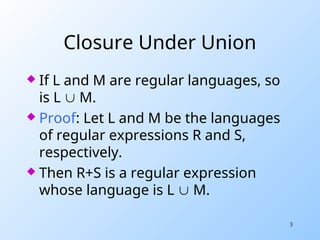
 If L and M are regular languages, so
is L  M.
 Proof: Let L and M be the languages
of regular expressions R and S,
respectively.
 Then R+S is a regular expression
whose language is L  M.
4
Closure Under
Concatenation and Kleene
Closure
 Same idea:
 RS is a regular expression whose
language is LM.
 R* is a regular expression whose
language is L*.
5
Closure Under Intersection
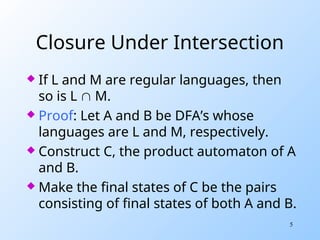
 If L and M are regular languages, then
so is L  M.
 Proof: Let A and B be DFA’s whose
languages are L and M, respectively.
 Construct C, the product automaton of A
and B.
 Make the final states of C be the pairs
consisting of final states of both A and B.
6
Example: Product DFA for
Intersection
A
C
B
D
0
1
0, 1
1
1
0
0
[A,C] [A,D]
0
[B,C]
1
0
1
0
1
[B,D]
0
1
7
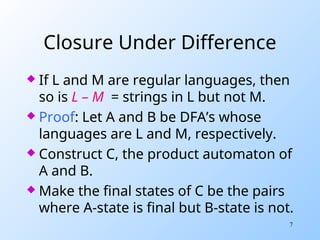
Closure Under Difference
 If L and M are regular languages, then
so is L – M = strings in L but not M.
 Proof: Let A and B be DFA’s whose
languages are L and M, respectively.
 Construct C, the product automaton of
A and B.
 Make the final states of C be the pairs
where A-state is final but B-state is not.
8
Example: Product DFA for
Difference
A
C
B
D
0
1
0, 1
1
1
0
0
[A,C] [A,D]
0
[B,C]
1
0
1
0
1
[B,D]
0
1
Notice: difference
is the empty language
9
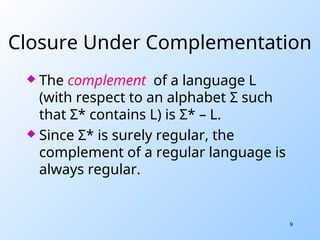
Closure Under Complementation
 The complement of a language L
(with respect to an alphabet Σ such
that Σ* contains L) is Σ* – L.
 Since Σ* is surely regular, the
complement of a regular language is
always regular.
10
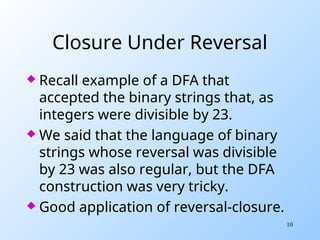
Closure Under Reversal
 Recall example of a DFA that
accepted the binary strings that, as
integers were divisible by 23.
 We said that the language of binary
strings whose reversal was divisible
by 23 was also regular, but the DFA
construction was very tricky.
 Good application of reversal-closure.
11
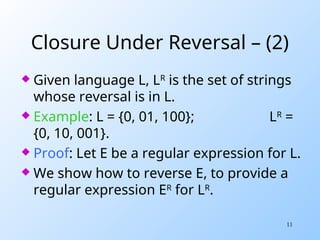
Closure Under Reversal – (2)
 Given language L, LR
is the set of strings
whose reversal is in L.
 Example: L = {0, 01, 100}; LR
=
{0, 10, 001}.
 Proof: Let E be a regular expression for L.
 We show how to reverse E, to provide a
regular expression ER
for LR
.
12
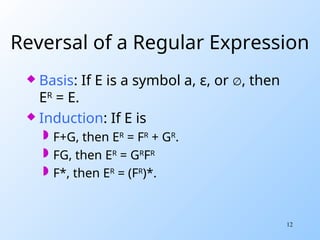
Reversal of a Regular Expression
 Basis: If E is a symbol a, ε, or ∅, then
ER
= E.
 Induction: If E is
 F+G, then ER
= FR
+ GR
.
 FG, then ER
= GR
FR
 F*, then ER
= (FR
)*.
13
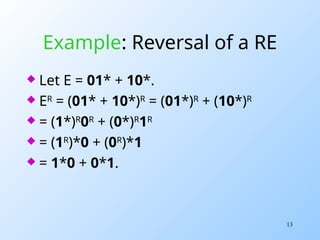
Example: Reversal of a RE
 Let E = 01* + 10*.
 ER
= (01* + 10*)R
= (01*)R
+ (10*)R
 = (1*)R
0R
+ (0*)R
1R
 = (1R
)*0 + (0R
)*1
 = 1*0 + 0*1.
14
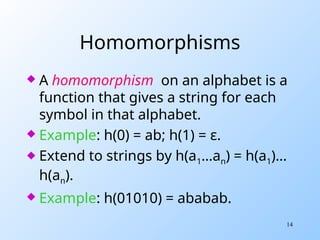
Homomorphisms
 A homomorphism on an alphabet is a
function that gives a string for each
symbol in that alphabet.
 Example: h(0) = ab; h(1) = ε.
 Extend to strings by h(a1…an) = h(a1)…
h(an).
 Example: h(01010) = ababab.
15
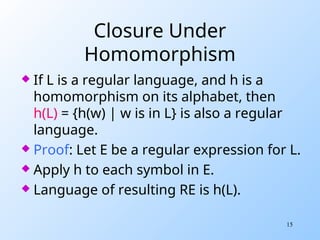
Closure Under
Homomorphism
 If L is a regular language, and h is a
homomorphism on its alphabet, then
h(L) = {h(w) | w is in L} is also a regular
language.
 Proof: Let E be a regular expression for L.
 Apply h to each symbol in E.
 Language of resulting RE is h(L).
16
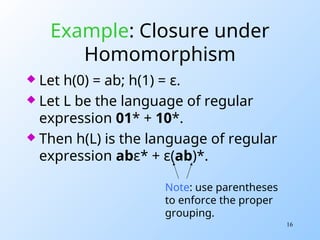
Example: Closure under
Homomorphism
 Let h(0) = ab; h(1) = ε.
 Let L be the language of regular
expression 01* + 10*.
 Then h(L) is the language of regular
expression abε* + ε(ab)*.
Note: use parentheses
to enforce the proper
grouping.
17
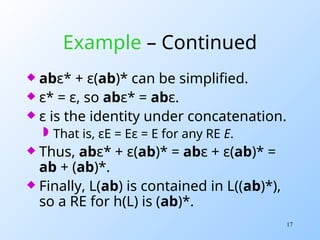
Example – Continued
 abε* + ε(ab)* can be simplified.
 ε* = ε, so abε* = abε.
 ε is the identity under concatenation.
 That is, εE = Eε = E for any RE E.
 Thus, abε* + ε(ab)* = abε + ε(ab)* =
ab + (ab)*.
 Finally, L(ab) is contained in L((ab)*),
so a RE for h(L) is (ab)*.
18
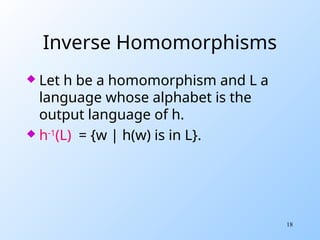
Inverse Homomorphisms
 Let h be a homomorphism and L a
language whose alphabet is the
output language of h.
 h-1
(L) = {w | h(w) is in L}.
19
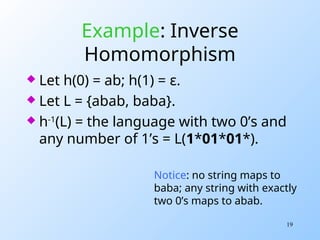
Example: Inverse
Homomorphism
 Let h(0) = ab; h(1) = ε.
 Let L = {abab, baba}.
 h-1
(L) = the language with two 0’s and
any number of 1’s = L(1*01*01*).
Notice: no string maps to
baba; any string with exactly
two 0’s maps to abab.
20
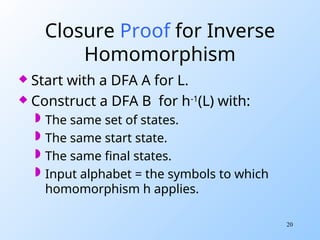
Closure Proof for Inverse
Homomorphism
 Start with a DFA A for L.
 Construct a DFA B for h-1
(L) with:
 The same set of states.
 The same start state.
 The same final states.
 Input alphabet = the symbols to which
homomorphism h applies.
21
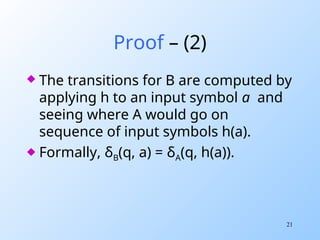
Proof – (2)
 The transitions for B are computed by
applying h to an input symbol a and
seeing where A would go on
sequence of input symbols h(a).
 Formally, δB(q, a) = δA(q, h(a)).
22
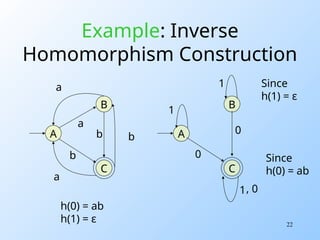
Example: Inverse
Homomorphism Construction
A
C
B
a
a
a
b b
b
C
B
A
h(0) = ab
h(1) = ε
1
1
1 Since
h(1) = ε
0
0
, 0
Since
h(0) = ab
23
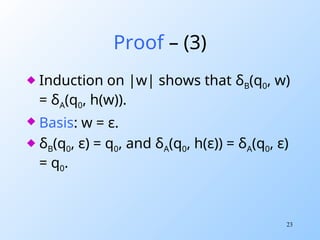
Proof – (3)
 Induction on |w| shows that δB(q0, w)
= δA(q0, h(w)).
 Basis: w = ε.
 δB(q0, ε) = q0, and δA(q0, h(ε)) = δA(q0, ε)
= q0.
24
Proof – (4)
 Induction: Let w = xa; assume IH for x.
 δB(q0, w) = δB(δB(q0, x), a).
 = δB(δA(q0, h(x)), a) by the IH.
 = δA(δA(q0, h(x)), h(a)) by definition of the
DFA B.
 = δA(q0, h(x)h(a)) by definition of the
extended delta.
 = δA(q0, h(w)) by def. of homomorphism.

Closure Properties of Regular Languages.ppt

  • 1.
    1 Closure Properties of RegularLanguages Union, Intersection, Difference, Concatenation, Kleene Closure, Reversal, Homomorphism, Inverse Homomorphism
  • 2.
    2 Closure Properties  Recalla closure property is a statement that a certain operation on languages, when applied to languages in a class (e.g., the regular languages), produces a result that is also in that class.  For regular languages, we can use any of its representations to prove a closure property.
  • 3.
    3 Closure Under Union If L and M are regular languages, so is L  M.  Proof: Let L and M be the languages of regular expressions R and S, respectively.  Then R+S is a regular expression whose language is L  M.
  • 4.
    4 Closure Under Concatenation andKleene Closure  Same idea:  RS is a regular expression whose language is LM.  R* is a regular expression whose language is L*.
  • 5.
    5 Closure Under Intersection If L and M are regular languages, then so is L  M.  Proof: Let A and B be DFA’s whose languages are L and M, respectively.  Construct C, the product automaton of A and B.  Make the final states of C be the pairs consisting of final states of both A and B.
  • 6.
    6 Example: Product DFAfor Intersection A C B D 0 1 0, 1 1 1 0 0 [A,C] [A,D] 0 [B,C] 1 0 1 0 1 [B,D] 0 1
  • 7.
    7 Closure Under Difference If L and M are regular languages, then so is L – M = strings in L but not M.  Proof: Let A and B be DFA’s whose languages are L and M, respectively.  Construct C, the product automaton of A and B.  Make the final states of C be the pairs where A-state is final but B-state is not.
  • 8.
    8 Example: Product DFAfor Difference A C B D 0 1 0, 1 1 1 0 0 [A,C] [A,D] 0 [B,C] 1 0 1 0 1 [B,D] 0 1 Notice: difference is the empty language
  • 9.
    9 Closure Under Complementation The complement of a language L (with respect to an alphabet Σ such that Σ* contains L) is Σ* – L.  Since Σ* is surely regular, the complement of a regular language is always regular.
  • 10.
    10 Closure Under Reversal Recall example of a DFA that accepted the binary strings that, as integers were divisible by 23.  We said that the language of binary strings whose reversal was divisible by 23 was also regular, but the DFA construction was very tricky.  Good application of reversal-closure.
  • 11.
    11 Closure Under Reversal– (2)  Given language L, LR is the set of strings whose reversal is in L.  Example: L = {0, 01, 100}; LR = {0, 10, 001}.  Proof: Let E be a regular expression for L.  We show how to reverse E, to provide a regular expression ER for LR .
  • 12.
    12 Reversal of aRegular Expression  Basis: If E is a symbol a, ε, or ∅, then ER = E.  Induction: If E is  F+G, then ER = FR + GR .  FG, then ER = GR FR  F*, then ER = (FR )*.
  • 13.
    13 Example: Reversal ofa RE  Let E = 01* + 10*.  ER = (01* + 10*)R = (01*)R + (10*)R  = (1*)R 0R + (0*)R 1R  = (1R )*0 + (0R )*1  = 1*0 + 0*1.
  • 14.
    14 Homomorphisms  A homomorphismon an alphabet is a function that gives a string for each symbol in that alphabet.  Example: h(0) = ab; h(1) = ε.  Extend to strings by h(a1…an) = h(a1)… h(an).  Example: h(01010) = ababab.
  • 15.
    15 Closure Under Homomorphism  IfL is a regular language, and h is a homomorphism on its alphabet, then h(L) = {h(w) | w is in L} is also a regular language.  Proof: Let E be a regular expression for L.  Apply h to each symbol in E.  Language of resulting RE is h(L).
  • 16.
    16 Example: Closure under Homomorphism Let h(0) = ab; h(1) = ε.  Let L be the language of regular expression 01* + 10*.  Then h(L) is the language of regular expression abε* + ε(ab)*. Note: use parentheses to enforce the proper grouping.
  • 17.
    17 Example – Continued abε* + ε(ab)* can be simplified.  ε* = ε, so abε* = abε.  ε is the identity under concatenation.  That is, εE = Eε = E for any RE E.  Thus, abε* + ε(ab)* = abε + ε(ab)* = ab + (ab)*.  Finally, L(ab) is contained in L((ab)*), so a RE for h(L) is (ab)*.
  • 18.
    18 Inverse Homomorphisms  Leth be a homomorphism and L a language whose alphabet is the output language of h.  h-1 (L) = {w | h(w) is in L}.
  • 19.
    19 Example: Inverse Homomorphism  Leth(0) = ab; h(1) = ε.  Let L = {abab, baba}.  h-1 (L) = the language with two 0’s and any number of 1’s = L(1*01*01*). Notice: no string maps to baba; any string with exactly two 0’s maps to abab.
  • 20.
    20 Closure Proof forInverse Homomorphism  Start with a DFA A for L.  Construct a DFA B for h-1 (L) with:  The same set of states.  The same start state.  The same final states.  Input alphabet = the symbols to which homomorphism h applies.
  • 21.
    21 Proof – (2) The transitions for B are computed by applying h to an input symbol a and seeing where A would go on sequence of input symbols h(a).  Formally, δB(q, a) = δA(q, h(a)).
  • 22.
    22 Example: Inverse Homomorphism Construction A C B a a a bb b C B A h(0) = ab h(1) = ε 1 1 1 Since h(1) = ε 0 0 , 0 Since h(0) = ab
  • 23.
    23 Proof – (3) Induction on |w| shows that δB(q0, w) = δA(q0, h(w)).  Basis: w = ε.  δB(q0, ε) = q0, and δA(q0, h(ε)) = δA(q0, ε) = q0.
  • 24.
    24 Proof – (4) Induction: Let w = xa; assume IH for x.  δB(q0, w) = δB(δB(q0, x), a).  = δB(δA(q0, h(x)), a) by the IH.  = δA(δA(q0, h(x)), h(a)) by definition of the DFA B.  = δA(q0, h(x)h(a)) by definition of the extended delta.  = δA(q0, h(w)) by def. of homomorphism.