1
Regular Expressions
Definitions
Equivalence to Finite Automata
2
RE’s: Introduction
Regular expressions are an algebraic
way to describe languages.
They describe exactly the regular
languages.
If E is a regular expression, then L(E) is
the language it defines.
We’ll describe RE’s and their languages
recursively.
3
RE’s: Definition
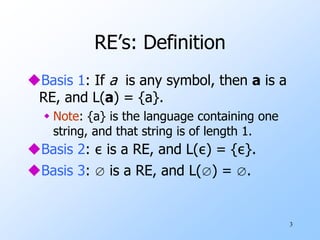
Basis 1: If a is any symbol, then a is a
RE, and L(a) = {a}.
 Note: {a} is the language containing one
string, and that string is of length 1.
Basis 2: ε is a RE, and L(ε) = {ε}.
Basis 3: ∅ is a RE, and L(∅) = ∅.
4
RE’s: Definition – (2)
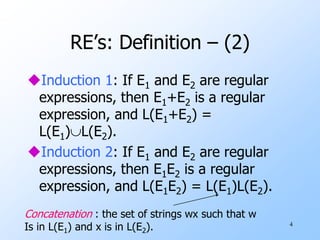
Induction 1: If E1 and E2 are regular
expressions, then E1+E2 is a regular
expression, and L(E1+E2) =
L(E1)L(E2).
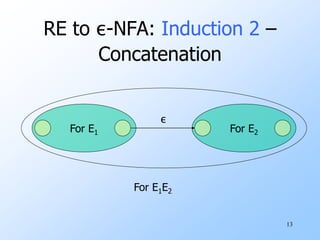
Induction 2: If E1 and E2 are regular
expressions, then E1E2 is a regular
expression, and L(E1E2) = L(E1)L(E2).
Concatenation : the set of strings wx such that w
Is in L(E1) and x is in L(E2).
5
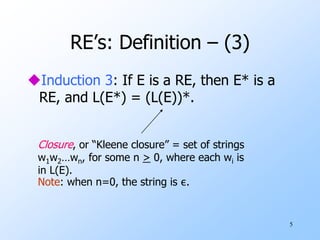
RE’s: Definition – (3)
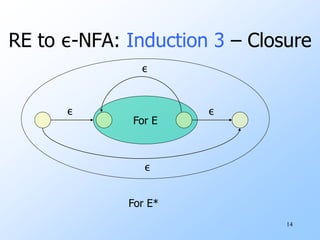
Induction 3: If E is a RE, then E* is a
RE, and L(E*) = (L(E))*.
Closure, or “Kleene closure” = set of strings
w1w2…wn, for some n > 0, where each wi is
in L(E).
Note: when n=0, the string is ε.
6
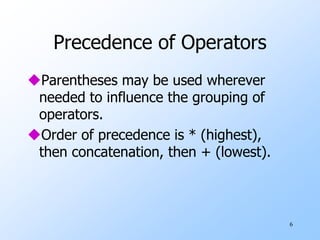
Precedence of Operators
Parentheses may be used wherever
needed to influence the grouping of
operators.
Order of precedence is * (highest),
then concatenation, then + (lowest).
7
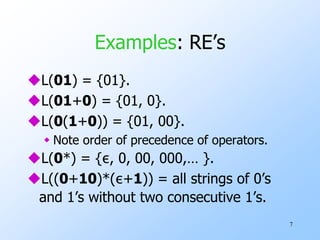
Examples: RE’s
L(01) = {01}.
L(01+0) = {01, 0}.
L(0(1+0)) = {01, 00}.
 Note order of precedence of operators.
L(0*) = {ε, 0, 00, 000,… }.
L((0+10)*(ε+1)) = all strings of 0’s
and 1’s without two consecutive 1’s.
8
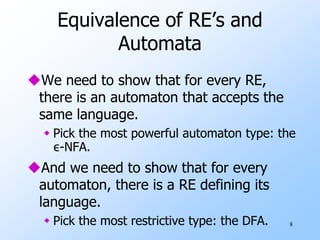
Equivalence of RE’s and
Automata
We need to show that for every RE,
there is an automaton that accepts the
same language.
 Pick the most powerful automaton type: the
ε-NFA.
And we need to show that for every
automaton, there is a RE defining its
language.
 Pick the most restrictive type: the DFA.
9
Converting a RE to an ε-NFA
Proof is an induction on the number of
operators (+, concatenation, *) in the
RE.
We always construct an automaton of a
special form (next slide).
10
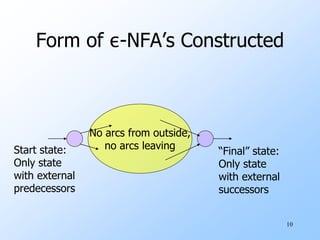
Form of ε-NFA’s Constructed
No arcs from outside,
no arcs leaving
Start state:
Only state
with external
predecessors
“Final” state:
Only state
with external
successors
11
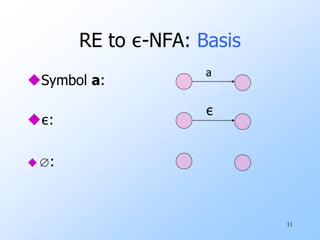
RE to ε-NFA: Basis
Symbol a:
ε:
∅:
a
ε
12
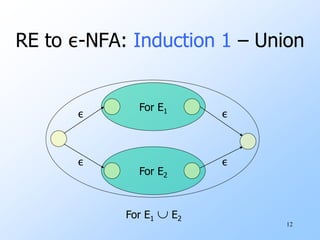
RE to ε-NFA: Induction 1 – Union
For E1
For E2
For E1  E2
ε
ε ε
ε
13
RE to ε-NFA: Induction 2 –
Concatenation
For E1 For E2
For E1E2
ε
14
RE to ε-NFA: Induction 3 – Closure
For E
For E*
ε
ε
ε
ε
15
DFA-to-RE
A strange sort of induction.
States of the DFA are assumed to be
1,2,…,n.
We construct RE’s for the labels of
restricted sets of paths.
 Basis: single arcs or no arc at all.
 Induction: paths that are allowed to
traverse next state in order.
16
k-Paths
A k-path is a path through the graph of
the DFA that goes though no state
numbered higher than k.
Endpoints are not restricted; they can
be any state.
17
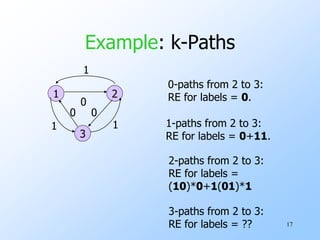
Example: k-Paths
1
3
2
0
0
0
1
1 1
0-paths from 2 to 3:
RE for labels = 0.
1-paths from 2 to 3:
RE for labels = 0+11.
2-paths from 2 to 3:
RE for labels =
(10)*0+1(01)*1
3-paths from 2 to 3:
RE for labels = ??
18
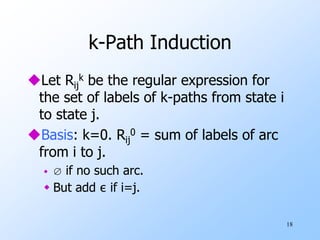
k-Path Induction
Let Rij
k be the regular expression for
the set of labels of k-paths from state i
to state j.
Basis: k=0. Rij
0 = sum of labels of arc
from i to j.
 ∅ if no such arc.
 But add ε if i=j.
19
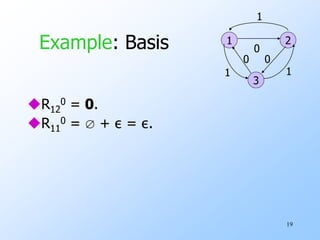
Example: Basis
R12
0 = 0.
R11
0 = ∅ + ε = ε.
1
3
2
0
0
0
1
1 1
20
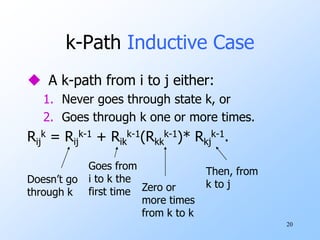
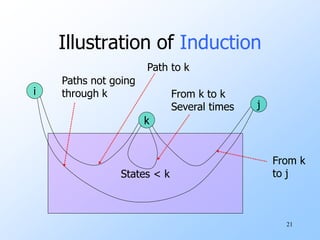
k-Path Inductive Case
 A k-path from i to j either:
1. Never goes through state k, or
2. Goes through k one or more times.
Rij
k = Rij
k-1 + Rik
k-1(Rkk
k-1)* Rkj
k-1.
Doesn’t go
through k
Goes from
i to k the
first time Zero or
more times
from k to k
Then, from
k to j
21
Illustration of Induction
States < k
k
i
j
Paths not going
through k
From k
to j
From k to k
Several times
Path to k
22
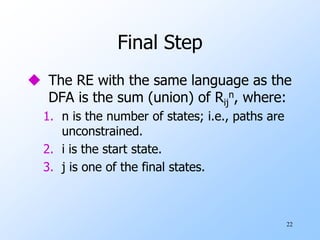
Final Step
 The RE with the same language as the
DFA is the sum (union) of Rij
n, where:
1. n is the number of states; i.e., paths are
unconstrained.
2. i is the start state.
3. j is one of the final states.
23
Example
R23
3 = R23
2 + R23
2(R33
2)*R33
2 =
R23
2(R33
2)*
R23
2 = (10)*0+1(01)*1
R33
2 = 0(01)*(1+00) + 1(10)*(0+11)
R23
3 = [(10)*0+1(01)*1]
[(0(01)*(1+00) + 1(10)*(0+11))]*
1
3
2
0
0
0
1
1 1
24
Summary
Each of the three types of automata
(DFA, NFA, ε-NFA) we discussed, and
regular expressions as well, define
exactly the same set of languages: the
regular languages.
25
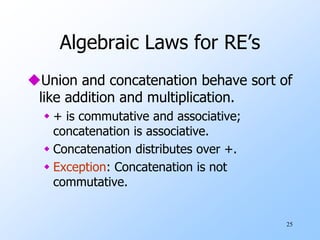
Algebraic Laws for RE’s
Union and concatenation behave sort of
like addition and multiplication.
 + is commutative and associative;
concatenation is associative.
 Concatenation distributes over +.
 Exception: Concatenation is not
commutative.
26
Identities and Annihilators
∅ is the identity for +.
 R + ∅ = R.
 ε is the identity for concatenation.
 εR = Rε = R.
 ∅ is the annihilator for concatenation.
 ∅R = R∅ = ∅.

re1.ppt

  • 1.
  • 2.
    2 RE’s: Introduction Regular expressionsare an algebraic way to describe languages. They describe exactly the regular languages. If E is a regular expression, then L(E) is the language it defines. We’ll describe RE’s and their languages recursively.
  • 3.
    3 RE’s: Definition Basis 1:If a is any symbol, then a is a RE, and L(a) = {a}.  Note: {a} is the language containing one string, and that string is of length 1. Basis 2: ε is a RE, and L(ε) = {ε}. Basis 3: ∅ is a RE, and L(∅) = ∅.
  • 4.
    4 RE’s: Definition –(2) Induction 1: If E1 and E2 are regular expressions, then E1+E2 is a regular expression, and L(E1+E2) = L(E1)L(E2). Induction 2: If E1 and E2 are regular expressions, then E1E2 is a regular expression, and L(E1E2) = L(E1)L(E2). Concatenation : the set of strings wx such that w Is in L(E1) and x is in L(E2).
  • 5.
    5 RE’s: Definition –(3) Induction 3: If E is a RE, then E* is a RE, and L(E*) = (L(E))*. Closure, or “Kleene closure” = set of strings w1w2…wn, for some n > 0, where each wi is in L(E). Note: when n=0, the string is ε.
  • 6.
    6 Precedence of Operators Parenthesesmay be used wherever needed to influence the grouping of operators. Order of precedence is * (highest), then concatenation, then + (lowest).
  • 7.
    7 Examples: RE’s L(01) ={01}. L(01+0) = {01, 0}. L(0(1+0)) = {01, 00}.  Note order of precedence of operators. L(0*) = {ε, 0, 00, 000,… }. L((0+10)*(ε+1)) = all strings of 0’s and 1’s without two consecutive 1’s.
  • 8.
    8 Equivalence of RE’sand Automata We need to show that for every RE, there is an automaton that accepts the same language.  Pick the most powerful automaton type: the ε-NFA. And we need to show that for every automaton, there is a RE defining its language.  Pick the most restrictive type: the DFA.
  • 9.
    9 Converting a REto an ε-NFA Proof is an induction on the number of operators (+, concatenation, *) in the RE. We always construct an automaton of a special form (next slide).
  • 10.
    10 Form of ε-NFA’sConstructed No arcs from outside, no arcs leaving Start state: Only state with external predecessors “Final” state: Only state with external successors
  • 11.
    11 RE to ε-NFA:Basis Symbol a: ε: ∅: a ε
  • 12.
    12 RE to ε-NFA:Induction 1 – Union For E1 For E2 For E1  E2 ε ε ε ε
  • 13.
    13 RE to ε-NFA:Induction 2 – Concatenation For E1 For E2 For E1E2 ε
  • 14.
    14 RE to ε-NFA:Induction 3 – Closure For E For E* ε ε ε ε
  • 15.
    15 DFA-to-RE A strange sortof induction. States of the DFA are assumed to be 1,2,…,n. We construct RE’s for the labels of restricted sets of paths.  Basis: single arcs or no arc at all.  Induction: paths that are allowed to traverse next state in order.
  • 16.
    16 k-Paths A k-path isa path through the graph of the DFA that goes though no state numbered higher than k. Endpoints are not restricted; they can be any state.
  • 17.
    17 Example: k-Paths 1 3 2 0 0 0 1 1 1 0-pathsfrom 2 to 3: RE for labels = 0. 1-paths from 2 to 3: RE for labels = 0+11. 2-paths from 2 to 3: RE for labels = (10)*0+1(01)*1 3-paths from 2 to 3: RE for labels = ??
  • 18.
    18 k-Path Induction Let Rij kbe the regular expression for the set of labels of k-paths from state i to state j. Basis: k=0. Rij 0 = sum of labels of arc from i to j.  ∅ if no such arc.  But add ε if i=j.
  • 19.
    19 Example: Basis R12 0 =0. R11 0 = ∅ + ε = ε. 1 3 2 0 0 0 1 1 1
  • 20.
    20 k-Path Inductive Case A k-path from i to j either: 1. Never goes through state k, or 2. Goes through k one or more times. Rij k = Rij k-1 + Rik k-1(Rkk k-1)* Rkj k-1. Doesn’t go through k Goes from i to k the first time Zero or more times from k to k Then, from k to j
  • 21.
    21 Illustration of Induction States< k k i j Paths not going through k From k to j From k to k Several times Path to k
  • 22.
    22 Final Step  TheRE with the same language as the DFA is the sum (union) of Rij n, where: 1. n is the number of states; i.e., paths are unconstrained. 2. i is the start state. 3. j is one of the final states.
  • 23.
    23 Example R23 3 = R23 2+ R23 2(R33 2)*R33 2 = R23 2(R33 2)* R23 2 = (10)*0+1(01)*1 R33 2 = 0(01)*(1+00) + 1(10)*(0+11) R23 3 = [(10)*0+1(01)*1] [(0(01)*(1+00) + 1(10)*(0+11))]* 1 3 2 0 0 0 1 1 1
  • 24.
    24 Summary Each of thethree types of automata (DFA, NFA, ε-NFA) we discussed, and regular expressions as well, define exactly the same set of languages: the regular languages.
  • 25.
    25 Algebraic Laws forRE’s Union and concatenation behave sort of like addition and multiplication.  + is commutative and associative; concatenation is associative.  Concatenation distributes over +.  Exception: Concatenation is not commutative.
  • 26.
    26 Identities and Annihilators ∅is the identity for +.  R + ∅ = R.  ε is the identity for concatenation.  εR = Rε = R.  ∅ is the annihilator for concatenation.  ∅R = R∅ = ∅.