CHOMSKY
CLASSIFICATION
Of Languages
By DIPANKAR BORUAH(dipankarborua20 twitter)
Topic of Discussion:
 Introduction.
 Chomsky Hierarchy Of Languages.
 Types Of Languages:
 Type - 0
 Type - 1
 Type - 2
 Type - 3
Introduction:
 Noam Chomsky, is an American linguist, philosopher, scientist and social
activist.
 Chomsky hierarchy of grammars was described by Noam Chomsky in 1956.
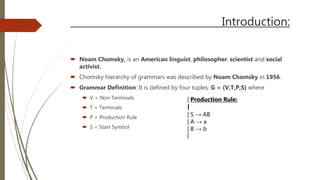
 Grammar Definition: It is defined by four tuples: G = {V,T,P,S} where
 V = Non Terminals
 T = Terminals
 P = Production Rule
 S = Start Symbol
| Production Rule:
|
| S → AB
| A → a
| B → b
|
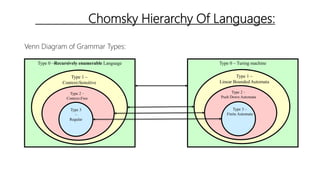
Chomsky Hierarchy Of Languages:
Venn Diagram of Grammar Types:
Type 0 –Recursively enumerable Language
Type 1 –
Context-Sensitive
Type 2 –
Context-Free
Type 3
–
Regular
Type 0 – Turing machine
Type 1 –
Linear Bounded Automata
Type 2 –
Push Down Automata
Type 3 –
Finite Automata
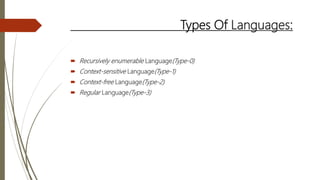
Types Of Languages:
 Recursively enumerable Language(Type-0)
 Context-sensitive Language(Type-1)
 Context-free Language(Type-2)
 Regular Language(Type-3)
Type-
0:
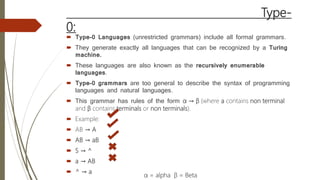
 Type-0 Languages (unrestricted grammars) include all formal grammars.
 They generate exactly all languages that can be recognized by a Turing
machine.
 These languages are also known as the recursively enumerable
languages.
 Type-0 grammars are too general to describe the syntax of programming
languages ​​and natural languages​​.
 This grammar has rules of the form α → β (where a contains non terminal
and β contains terminals or non terminals).
 Example:
 AB → A
 AB → aB
 S → ^
 a → AB
 ^ → a
α = alpha β = Beta
Type-
1:
 Type-1 grammar generate the context-sensitive languages.
 The languages described by these grammars are exactly all languages that can
be recognized by a linear bounded automaton.
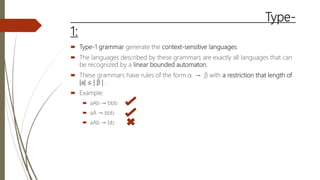
 These grammars have rules of the form α → β with a restriction that length of
|a| ≤ | β | .
 Example:
 aAb → bbb
 aA → bbb
 aAb → bb
Type-
2:
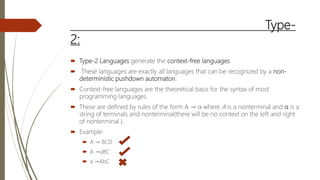
 Type-2 Languages generate the context-free languages.
 These languages are exactly all languages that can be recognized by a non-
deterministic pushdown automaton.
 Context-free languages are the theoretical basis for the syntax of most
programming languages.
 These are defined by rules of the form A → α where A is a nonterminal and α is a
string of terminals and nonterminal(there will be no context on the left and right
of nonterminal ).
 Example:
 A → BCD
 A →aBC
 a →AbC
Type-
3: Type-3 Languages generate the regular languages.
 These languages are exactly all languages that can be decided by a finite state
automaton
 Regular languages are commonly used to define search patterns of
programming languages.
 It can be classified into two types (1)Right Linear (2)Left Linear.
 If we have repetition of non terminals on right side[ A → xB|x] then it is known as
Right Linear.
 If we have repetition of non terminals on left side[ A → Bx|x] then it is known as
Left Linear.(A,B є non terminals and x є Σ*)
 Example:
 S →aS|b
 S →aS|c
 S →Sa|b
 A →ba
Σ* = set of all terminal symbol
Reference:
 https://www.tutorialspoint.com/automata_theory/chomsky_classification_of_gram
mars.htm
 https://www.geeksforgeeks.org/toc-chomsky-hierarchy/
 https://www.youtube.com/watch?v=AlSB2_CehbM
 https://en.wikipedia.org/wiki/Chomsky_hierarchy
THANK YOU

Chomsky classification of Language

  • 1.
    CHOMSKY CLASSIFICATION Of Languages By DIPANKARBORUAH(dipankarborua20 twitter)
  • 2.
    Topic of Discussion: Introduction.  Chomsky Hierarchy Of Languages.  Types Of Languages:  Type - 0  Type - 1  Type - 2  Type - 3
  • 3.
    Introduction:  Noam Chomsky,is an American linguist, philosopher, scientist and social activist.  Chomsky hierarchy of grammars was described by Noam Chomsky in 1956.  Grammar Definition: It is defined by four tuples: G = {V,T,P,S} where  V = Non Terminals  T = Terminals  P = Production Rule  S = Start Symbol | Production Rule: | | S → AB | A → a | B → b |
  • 4.
    Chomsky Hierarchy OfLanguages: Venn Diagram of Grammar Types: Type 0 –Recursively enumerable Language Type 1 – Context-Sensitive Type 2 – Context-Free Type 3 – Regular Type 0 – Turing machine Type 1 – Linear Bounded Automata Type 2 – Push Down Automata Type 3 – Finite Automata
  • 5.
    Types Of Languages: Recursively enumerable Language(Type-0)  Context-sensitive Language(Type-1)  Context-free Language(Type-2)  Regular Language(Type-3)
  • 6.
    Type- 0:  Type-0 Languages(unrestricted grammars) include all formal grammars.  They generate exactly all languages that can be recognized by a Turing machine.  These languages are also known as the recursively enumerable languages.  Type-0 grammars are too general to describe the syntax of programming languages ​​and natural languages​​.  This grammar has rules of the form α → β (where a contains non terminal and β contains terminals or non terminals).  Example:  AB → A  AB → aB  S → ^  a → AB  ^ → a α = alpha β = Beta
  • 7.
    Type- 1:  Type-1 grammargenerate the context-sensitive languages.  The languages described by these grammars are exactly all languages that can be recognized by a linear bounded automaton.  These grammars have rules of the form α → β with a restriction that length of |a| ≤ | β | .  Example:  aAb → bbb  aA → bbb  aAb → bb
  • 8.
    Type- 2:  Type-2 Languagesgenerate the context-free languages.  These languages are exactly all languages that can be recognized by a non- deterministic pushdown automaton.  Context-free languages are the theoretical basis for the syntax of most programming languages.  These are defined by rules of the form A → α where A is a nonterminal and α is a string of terminals and nonterminal(there will be no context on the left and right of nonterminal ).  Example:  A → BCD  A →aBC  a →AbC
  • 9.
    Type- 3: Type-3 Languagesgenerate the regular languages.  These languages are exactly all languages that can be decided by a finite state automaton  Regular languages are commonly used to define search patterns of programming languages.  It can be classified into two types (1)Right Linear (2)Left Linear.  If we have repetition of non terminals on right side[ A → xB|x] then it is known as Right Linear.  If we have repetition of non terminals on left side[ A → Bx|x] then it is known as Left Linear.(A,B є non terminals and x є Σ*)  Example:  S →aS|b  S →aS|c  S →Sa|b  A →ba Σ* = set of all terminal symbol
  • 10.
  • 11.