Creating a Literate EnvironmentSara ShoverWalden University EDUC 6706
Why is creating a literate environment important?A literate environment is important in order to create a classroom of successful and motivated readers and writers.
How did I create a literate environment?Want to know more?Read on!Got to know my studentsAssessed students to determine strengths and weaknessesSelected engaging and challenging textsCreated engaging lessons based on student needsElicited critical thinkingAllowed for reflection and response
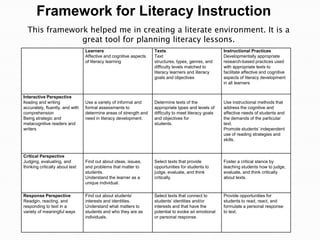
Framework for Literacy InstructionThis framework helped me in creating a literate environment. It is a great tool for planning literacy lessons.
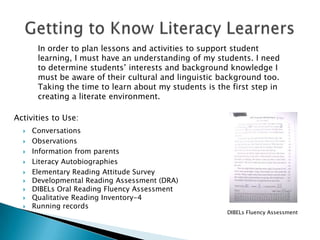
Getting to Know Literacy LearnersIn order to plan lessons and activities to support student learning, I must have an understanding of my students. I need to determine students’ interests and background knowledge I must be aware of their cultural and linguistic background too. Taking the time to learn about my students is the first step in creating a literate environment.Activities to Use:ConversationsObservationsInformation from parentsLiteracy AutobiographiesElementary Reading Attitude SurveyDevelopmental Reading Assessment (DRA)DIBELs Oral Reading Fluency AssessmentQualitative Reading Inventory-4Running recordsDIBELs Fluency Assessment
Selecting Engaging Texts"There is more treasure in books than in all the pirate's loot on Treasure Island." - Walt DisneyAs a teacher, I must help my students discover this treasure. In order to do this, I must select engaging texts. Taking the time to find interesting, relevant, and developmentally appropriate texts is crucial. If texts are too difficult or too easy, it could cause a student to become disengaged or even worse, dislike reading. In my classroom, I spend a great deal of time selecting texts. I try to use “twin texts,” which is combining nonfiction and fiction texts (Camp, 2000).
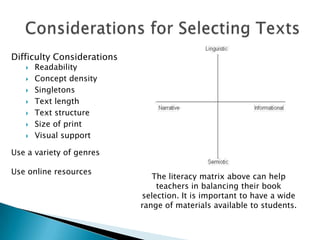
 Considerations for Selecting TextsDifficulty ConsiderationsReadabilityConcept densitySingletonsText lengthText structureSize of printVisual supportUse a variety of genresUse online resources The literacy matrix above can help teachers in balancing their book selection. It is important to have a wide range of materials available to students.
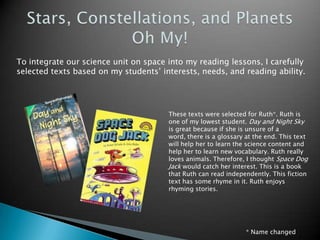
Stars, Constellations, and Planets Oh My!To integrate our science unit on space into my reading lessons, I carefully selected texts based on my students’ interests, needs, and reading ability.These texts were selected for Ruth*. Ruth is one of my lowest student. Day and Night Sky is great because if she is unsure of a word, there is a glossary at the end. This text will help her to learn the science content and help her to learn new vocabulary.Ruth really loves animals. Therefore, I thought Space Dog Jack would catch her interest. This is a book that Ruth can read independently. This fiction text has some rhyme in it. Ruth enjoys rhyming stories.* Name changed
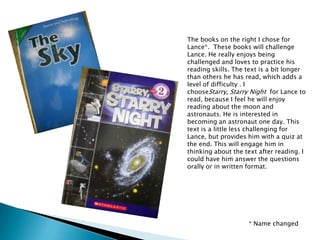
The books on the right I chose for Lance*.  These books will challenge Lance. He really enjoys being challenged and loves to practice his reading skills. The text is a bit longer than others he has read, which adds a level of difficulty . I chooseStarry, Starry Night  for Lance to read, because I feel he will enjoy reading about the moon and astronauts. He is interested in becoming an astronaut one day. This text is a little less challenging for Lance, but provides him with a quiz at the end. This will engage him in thinking about the text after reading. I could have him answer the questions orally or in written format. * Name changed
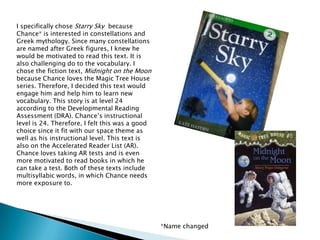
I specifically chose Starry Sky  because Chance* is interested in constellations and Greek mythology. Since many constellations are named after Greek figures, I knew he would be motivated to read this text. It is also challenging do to the vocabulary. I chose the fiction text, Midnight on the Moonbecause Chance loves the Magic Tree House series. Therefore, I decided this text would engage him and help him to learn new vocabulary. This story is at level 24 according to the Developmental Reading Assessment (DRA). Chance’s instructional level is 24. Therefore, I felt this was a good choice since it fit with our space theme as well as his instructional level. This text is also on the Accelerated Reader List (AR). Chance loves taking AR tests and is even more motivated to read books in which he can take a test. Both of these texts include multisyllabic words, in which Chance needs more exposure to. *Name changed
Listening centerSmartBoard LessonsComputersOnline Reading programsStarfall
RAZ Kids
BookFlixOnline Math programsMath Connects
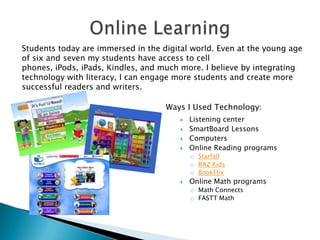
FASTT MathOnline LearningStudents today are immersed in the digital world. Even at the young age of six and seven my students have access to cell phones, iPods, iPads, Kindles, and much more. I believe by integrating technology with literacy, I can engage more students and create more successful readers and writers. Ways I Used Technology:
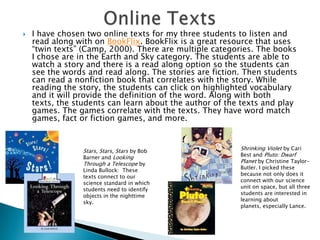
Online TextsI have chosen two online texts for my three students to listen and read along with on BookFlix. BookFlix is a great resource that uses “twin texts” (Camp, 2000). There are multiple categories. The books I chose are in the Earth and Sky category. The students are able to watch a story and there is a read along option so the students can see the words and read along. The stories are fiction. Then students can read a nonfiction book that correlates with the story. While reading the story, the students can click on highlighted vocabulary and it will provide the definition of the word. Along with both texts, the students can learn about the author of the texts and play games. The games correlate with the texts. They have word match games, fact or fiction games, and more. Shrinking Violet by Cari Best and Pluto: Dwarf Planet by Christine Taylor-Butler. I picked these because not only does it connect with our science unit on space, but all three students are interested in learning about planets, especially Lance. Stars, Stars, Stars by Bob Barner and Looking Through a Telescope by Linda Bullock:  These texts connect to our science standard in which students need to identify objects in the nighttime sky.
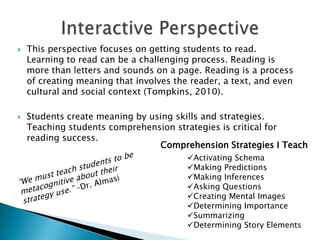
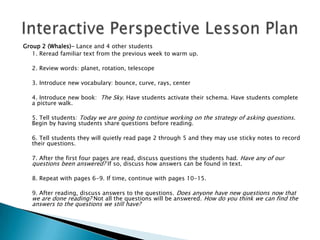
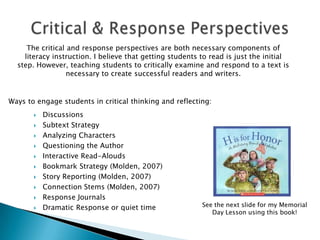
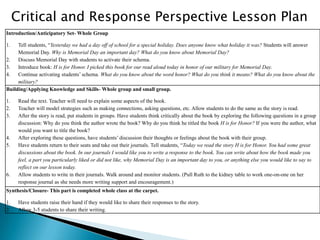
This perspective focuses on getting students to read. Learning to read can be a challenging process. Reading is more than letters and sounds on a page. Reading is a process of creating meaning that involves the reader, a text, and even cultural and social context (Tompkins, 2010).Students create meaning by using skills and strategies. Teaching students comprehension strategies is critical for reading success. Interactive PerspectiveComprehension Strategies I TeachActivating Schema
Making Predictions
Making Inferences
Asking Questions

Creating a Literate Environment

  • 1.
    Creating a LiterateEnvironmentSara ShoverWalden University EDUC 6706
  • 2.
    Why is creatinga literate environment important?A literate environment is important in order to create a classroom of successful and motivated readers and writers.
  • 3.
    How did Icreate a literate environment?Want to know more?Read on!Got to know my studentsAssessed students to determine strengths and weaknessesSelected engaging and challenging textsCreated engaging lessons based on student needsElicited critical thinkingAllowed for reflection and response
  • 4.
    Framework for LiteracyInstructionThis framework helped me in creating a literate environment. It is a great tool for planning literacy lessons.
  • 5.
    Getting to KnowLiteracy LearnersIn order to plan lessons and activities to support student learning, I must have an understanding of my students. I need to determine students’ interests and background knowledge I must be aware of their cultural and linguistic background too. Taking the time to learn about my students is the first step in creating a literate environment.Activities to Use:ConversationsObservationsInformation from parentsLiteracy AutobiographiesElementary Reading Attitude SurveyDevelopmental Reading Assessment (DRA)DIBELs Oral Reading Fluency AssessmentQualitative Reading Inventory-4Running recordsDIBELs Fluency Assessment
  • 6.
    Selecting Engaging Texts"Thereis more treasure in books than in all the pirate's loot on Treasure Island." - Walt DisneyAs a teacher, I must help my students discover this treasure. In order to do this, I must select engaging texts. Taking the time to find interesting, relevant, and developmentally appropriate texts is crucial. If texts are too difficult or too easy, it could cause a student to become disengaged or even worse, dislike reading. In my classroom, I spend a great deal of time selecting texts. I try to use “twin texts,” which is combining nonfiction and fiction texts (Camp, 2000).
  • 7.
    Considerations forSelecting TextsDifficulty ConsiderationsReadabilityConcept densitySingletonsText lengthText structureSize of printVisual supportUse a variety of genresUse online resources The literacy matrix above can help teachers in balancing their book selection. It is important to have a wide range of materials available to students.
  • 8.
    Stars, Constellations, andPlanets Oh My!To integrate our science unit on space into my reading lessons, I carefully selected texts based on my students’ interests, needs, and reading ability.These texts were selected for Ruth*. Ruth is one of my lowest student. Day and Night Sky is great because if she is unsure of a word, there is a glossary at the end. This text will help her to learn the science content and help her to learn new vocabulary.Ruth really loves animals. Therefore, I thought Space Dog Jack would catch her interest. This is a book that Ruth can read independently. This fiction text has some rhyme in it. Ruth enjoys rhyming stories.* Name changed
  • 9.
    The books onthe right I chose for Lance*. These books will challenge Lance. He really enjoys being challenged and loves to practice his reading skills. The text is a bit longer than others he has read, which adds a level of difficulty . I chooseStarry, Starry Night for Lance to read, because I feel he will enjoy reading about the moon and astronauts. He is interested in becoming an astronaut one day. This text is a little less challenging for Lance, but provides him with a quiz at the end. This will engage him in thinking about the text after reading. I could have him answer the questions orally or in written format. * Name changed
  • 10.
    I specifically choseStarry Sky because Chance* is interested in constellations and Greek mythology. Since many constellations are named after Greek figures, I knew he would be motivated to read this text. It is also challenging do to the vocabulary. I chose the fiction text, Midnight on the Moonbecause Chance loves the Magic Tree House series. Therefore, I decided this text would engage him and help him to learn new vocabulary. This story is at level 24 according to the Developmental Reading Assessment (DRA). Chance’s instructional level is 24. Therefore, I felt this was a good choice since it fit with our space theme as well as his instructional level. This text is also on the Accelerated Reader List (AR). Chance loves taking AR tests and is even more motivated to read books in which he can take a test. Both of these texts include multisyllabic words, in which Chance needs more exposure to. *Name changed
  • 11.
  • 12.
  • 13.
  • 14.
    FASTT MathOnline LearningStudentstoday are immersed in the digital world. Even at the young age of six and seven my students have access to cell phones, iPods, iPads, Kindles, and much more. I believe by integrating technology with literacy, I can engage more students and create more successful readers and writers. Ways I Used Technology:
  • 15.
    Online TextsI havechosen two online texts for my three students to listen and read along with on BookFlix. BookFlix is a great resource that uses “twin texts” (Camp, 2000). There are multiple categories. The books I chose are in the Earth and Sky category. The students are able to watch a story and there is a read along option so the students can see the words and read along. The stories are fiction. Then students can read a nonfiction book that correlates with the story. While reading the story, the students can click on highlighted vocabulary and it will provide the definition of the word. Along with both texts, the students can learn about the author of the texts and play games. The games correlate with the texts. They have word match games, fact or fiction games, and more. Shrinking Violet by Cari Best and Pluto: Dwarf Planet by Christine Taylor-Butler. I picked these because not only does it connect with our science unit on space, but all three students are interested in learning about planets, especially Lance. Stars, Stars, Stars by Bob Barner and Looking Through a Telescope by Linda Bullock: These texts connect to our science standard in which students need to identify objects in the nighttime sky.
  • 16.
    This perspective focuseson getting students to read. Learning to read can be a challenging process. Reading is more than letters and sounds on a page. Reading is a process of creating meaning that involves the reader, a text, and even cultural and social context (Tompkins, 2010).Students create meaning by using skills and strategies. Teaching students comprehension strategies is critical for reading success. Interactive PerspectiveComprehension Strategies I TeachActivating Schema
  • 17.
  • 18.
  • 19.