UCSF’s
 Comparative Effectiveness
Large Dataset Analytic Core

                   Janet Coffman, PhD
     Philip R. Lee Institute for Health Policy Studies
          University of California, San Francisco

                   September 7, 2011
Outline
• Overview of CELDAC

• New Medicare data resources

• Discussion


                                2
CELDAC
CELDAC is a partnership at UCSF among the
  –   Philip R Lee Institute for Health Policy Studies
  –   Academic Research Systems
  –   Department of Orthopedic Surgery
  –   Clinical and Translational Science Institute

Funding is from an administrative supplement to
the NCRR grant for UCSF’s Clinical &
Translational Science Institute.

Seeking funding from the California HealthCare
Foundation to sustain once NCRR grant ends.
                                                         3
CELDAC Mission

The mission of CELDAC is to enhance
UCSF's capacity for analysis of large local,
state, and national health datasets to
conduct comparative effectiveness
research and other types of health
services and health policy research.


                                           4
CELDAC Goals
• Accelerate access to and use of local, state, and national
  health datasets, as a model for other CTSAs and health
  research organizations.

• Enhance UCSF researchers’ ability to compete for
  funding to use large data sets to conduct CER.
• Develop procedures and infrastructure by conducting
  pilot studies.
• Support additional studies on the comparative
  effectiveness of clinical interventions.
• Provide consultation to researchers currently working
  with or interested in working with large data sets
                                                           5
CELDAC Team – IHPS Members
  Faculty                Staff
  •   Jim G. Kahn        • Claire Will
  •   Janet Coffman      • Leon Traister
  •   Claire Brindis
  •   Steve Takemoto
  •   Adams Dudley
  •   Kirsten Johansen


                                           6
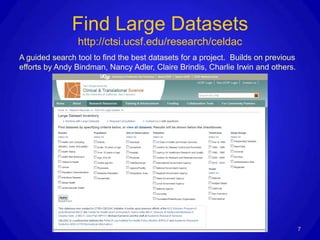
Find Large Datasets
                http://ctsi.ucsf.edu/research/celdac
A guided search tool to find the best datasets for a project. Builds on previous
efforts by Andy Bindman, Nancy Adler, Claire Brindis, Charlie Irwin and others.


                                                                                   7
Analyze Large Data Sets
• CELDAC has partnered with faculty in three
  departments to purchase national data sets and
  make them available to additional faculty at no
  cost.
• These data sets include
  – HCUP National Emergency Department Sample
  – HCUP National Inpatient Sample
  – HCUP Kids Inpatient Databases
  – HCUP State Emergency Department and Inpatient
    Databases (select states)
  – American Hospital Association Annual Survey
  – Area Resource File
                                                    8
Provide Consultation
• Study design/conceptualization
• Identification of relevant datasets
• Assistance with data set acquisition
• Cohort selection
• Data cleaning
• Linking data sets
• Strategies to deal with common methodological
  issues in analysis of observational data
• Programming support for preliminary analyses


                                                  9
Medicare Data:
New Resources


                 10
Existing Medicare Data
         Resources
• Research identifiable files
  – Enrollment
  – Claims
  – Med PAR
• Limited data sets
• Non-identifiable data sets
• Medicare statistical supplement

                                    11
Limitations of Existing Medicare
        Data Resources
• High costs limit number of researchers
  analyzing the data

• Long delays in approving requests make it
  difficult for researchers to conduct
  analyses in a timely manner


                                           12
New Medicare Public Use Files
• In June 2011, CMS released its first public use files
  (PUFs)
• Files available to researchers as free downloads in CSV
  format (https://www.cms.gov/BSAPUFS/)
• Derived from 5% samples de-identified claims from 2008
   –   Inpatient care
   –   Outpatient procedures
   –   Physician services
   –   Prescription drugs
   –   Skilled nursing care
   –   Home health
   –   Hospice
   –   Durable medical equipment
                                                        13
New Medicare Public Use Files
• Strengths
  – Data can be downloaded free of charge at
    any time without prior approval
  – Useful for conducting preliminary analyses


• Limitations
  – Limited number of variables
  – Data sets cannot be linked (i.e., cannot track
    beneficiaries across settings)
  – No information on geographic location
                                                     14
Disclosure Treated Controlled
            Use Files
• Attempt to strike a better balance between protecting
  privacy and analytic utility than public use files
• Encompasses five files that can be linked to one another
  (beneficiary summary data, inpatient claims, outpatient
  claims, physician claims, prescription drug claims)
• Files housed in a secure environment/data enclave to
  improve timeliness of access and review of analysis
  output
• Uses sophisticated methods to simultaneously minimize
  both disclosure risk and information loss


                                                         15
Disclosure Treated Controlled
           Use Files
• CMS and the National Opinion Research
  Center will begin recruiting researchers to
  pilot test the secure environment/data
  enclave during the first quarter of 2012

• Applicants will be selected and given
  access to the data during the second
  quarter of 2012
                                                16
Discussion


             17
Questions for Discussion
• What services relating to large data set
  analysis are likely to be most useful to you
  and your mentees?
• What data sets are of greatest interest to
  you and your mentees?
• How could CELDAC partner effectively
  with researchers based at the SF VA?


                                             18
Contact CELDAC
• Janet Coffman or Claire Will
  <celdac@ucsf.edu>

• http://ctsi.ucsf.edu/research/large-
  datasets

• 415-476-2435


                                         19

Working Effectively with Medicare Data: Limits and Opportunities

  • 1.
    UCSF’s Comparative Effectiveness LargeDataset Analytic Core Janet Coffman, PhD Philip R. Lee Institute for Health Policy Studies University of California, San Francisco September 7, 2011
  • 2.
    Outline • Overview ofCELDAC • New Medicare data resources • Discussion 2
  • 3.
    CELDAC CELDAC is apartnership at UCSF among the – Philip R Lee Institute for Health Policy Studies – Academic Research Systems – Department of Orthopedic Surgery – Clinical and Translational Science Institute Funding is from an administrative supplement to the NCRR grant for UCSF’s Clinical & Translational Science Institute. Seeking funding from the California HealthCare Foundation to sustain once NCRR grant ends. 3
  • 4.
    CELDAC Mission The missionof CELDAC is to enhance UCSF's capacity for analysis of large local, state, and national health datasets to conduct comparative effectiveness research and other types of health services and health policy research. 4
  • 5.
    CELDAC Goals • Accelerateaccess to and use of local, state, and national health datasets, as a model for other CTSAs and health research organizations. • Enhance UCSF researchers’ ability to compete for funding to use large data sets to conduct CER. • Develop procedures and infrastructure by conducting pilot studies. • Support additional studies on the comparative effectiveness of clinical interventions. • Provide consultation to researchers currently working with or interested in working with large data sets 5
  • 6.
    CELDAC Team –IHPS Members Faculty Staff • Jim G. Kahn • Claire Will • Janet Coffman • Leon Traister • Claire Brindis • Steve Takemoto • Adams Dudley • Kirsten Johansen 6
  • 7.
    Find Large Datasets http://ctsi.ucsf.edu/research/celdac A guided search tool to find the best datasets for a project. Builds on previous efforts by Andy Bindman, Nancy Adler, Claire Brindis, Charlie Irwin and others. 7
  • 8.
    Analyze Large DataSets • CELDAC has partnered with faculty in three departments to purchase national data sets and make them available to additional faculty at no cost. • These data sets include – HCUP National Emergency Department Sample – HCUP National Inpatient Sample – HCUP Kids Inpatient Databases – HCUP State Emergency Department and Inpatient Databases (select states) – American Hospital Association Annual Survey – Area Resource File 8
  • 9.
    Provide Consultation • Studydesign/conceptualization • Identification of relevant datasets • Assistance with data set acquisition • Cohort selection • Data cleaning • Linking data sets • Strategies to deal with common methodological issues in analysis of observational data • Programming support for preliminary analyses 9
  • 10.
  • 11.
    Existing Medicare Data Resources • Research identifiable files – Enrollment – Claims – Med PAR • Limited data sets • Non-identifiable data sets • Medicare statistical supplement 11
  • 12.
    Limitations of ExistingMedicare Data Resources • High costs limit number of researchers analyzing the data • Long delays in approving requests make it difficult for researchers to conduct analyses in a timely manner 12
  • 13.
    New Medicare PublicUse Files • In June 2011, CMS released its first public use files (PUFs) • Files available to researchers as free downloads in CSV format (https://www.cms.gov/BSAPUFS/) • Derived from 5% samples de-identified claims from 2008 – Inpatient care – Outpatient procedures – Physician services – Prescription drugs – Skilled nursing care – Home health – Hospice – Durable medical equipment 13
  • 14.
    New Medicare PublicUse Files • Strengths – Data can be downloaded free of charge at any time without prior approval – Useful for conducting preliminary analyses • Limitations – Limited number of variables – Data sets cannot be linked (i.e., cannot track beneficiaries across settings) – No information on geographic location 14
  • 15.
    Disclosure Treated Controlled Use Files • Attempt to strike a better balance between protecting privacy and analytic utility than public use files • Encompasses five files that can be linked to one another (beneficiary summary data, inpatient claims, outpatient claims, physician claims, prescription drug claims) • Files housed in a secure environment/data enclave to improve timeliness of access and review of analysis output • Uses sophisticated methods to simultaneously minimize both disclosure risk and information loss 15
  • 16.
    Disclosure Treated Controlled Use Files • CMS and the National Opinion Research Center will begin recruiting researchers to pilot test the secure environment/data enclave during the first quarter of 2012 • Applicants will be selected and given access to the data during the second quarter of 2012 16
  • 17.
  • 18.
    Questions for Discussion •What services relating to large data set analysis are likely to be most useful to you and your mentees? • What data sets are of greatest interest to you and your mentees? • How could CELDAC partner effectively with researchers based at the SF VA? 18
  • 19.
    Contact CELDAC • JanetCoffman or Claire Will <celdac@ucsf.edu> • http://ctsi.ucsf.edu/research/large- datasets • 415-476-2435 19