Infrastructures for
secure data analytics
Wessel Kraaij
TNO & Leiden University
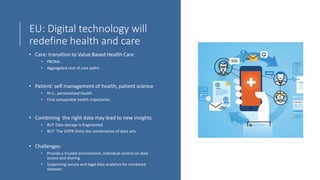
EU: Digital technology will
redefine health and care
• Care: transition to Value Based Health Care
• PROMs
• Aggregated cost of care paths
• Patient: self management of health, patient science
• N=1 , personalized health
• Find comparable health trajectories
• Combining the right data may lead to new insights
• BUT Data storage is fragmented
• BUT The GDPR limits the combination of data sets
• Challenges:
• Provide a trusted environment, individual control on data
access and sharing
• Supporting secure and legal data analytics for combined
datasets
Some barriers for statistical analysis and ML
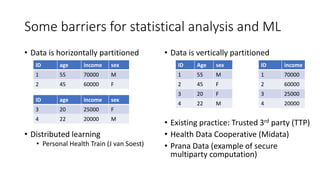
• Data is horizontally partitioned
• Distributed learning
• Personal Health Train (J van Soest)
• Data is vertically partitioned
• Existing practice: Trusted 3rd party (TTP)
• Health Data Cooperative (Midata)
• Prana Data (example of secure
multiparty computation)
ID age income sex
1 55 70000 M
2 45 60000 F
ID Age sex
1 55 M
2 45 F
3 20 F
4 22 M
ID age income sex
3 20 25000 F
4 22 20000 M
ID income
1 70000
2 60000
3 25000
4 20000
Traditional solution –
trusting a third party
• For research:
• create anonymized/ pseudonymized datasets,
possibly using a trusted third party
• Anonymization: remove identifiers
• Export anonymized dataset for research
(academic/ commercial)
Assessment
• The more personal data is combined, the easier it is to re-
identify a profile and the more difficult the anonymization
process is
• E.g. personal well-being data (Fitbit, smartphone apps)
are quite personal and could lead to re-identification
using external data.
• Personal data may seem innocent, but can lead to valuable
insights
• Strict regulation on data processing and storage
• Data leaks can lead to substantial fines
• Professionals are reluctant to use big data approaches
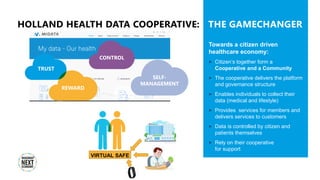
Towards a citizen driven
healthcare economy:
> Citizen’s together form a
Cooperative and a Community
> The cooperative delivers the platform
and governance structure
> Enables individuals to collect their
data (medical and lifestyle)
> Provides services for members and
delivers services to customers
> Data is controlled by citizen and
patients themselves
> Rely on their cooperative
for support
CONTROL
SELF-
MANAGEMENT
HOLLAND HEALTH DATA COOPERATIVE: THE GAMECHANGER
TRUST
REWARD
VIRTUAL SAFE
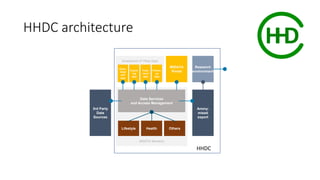
MIDATA Server(s)
Data Services
and Access Management
3rd Party
Data
Sources
Anony-
mised
export
Lifestyle Health Others
Research
environment
Smartphone 3rd Party Apps
MIDATA
Portal
Quan-
tified
self
App
Coach-
ing
App
Treat-
ment
App
Follow-
up
App
HHDC
HHDC architecture
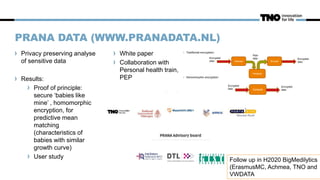
PRANA DATA (WWW.PRANADATA.NL)
Privacy preserving analyse
of sensitive data
Results:
Proof of principle:
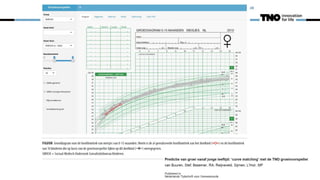
secure ‘babies like
mine’ , homomorphic
encryption, for
predictive mean
matching
(characteristics of
babies with similar
growth curve)
User study
White paper
Collaboration with
Personal health train,
PEP
Follow up in H2020 BigMedilytics
(ErasmusMC, Achmea, TNO and
VWDATA
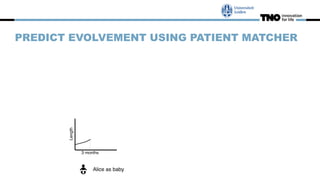
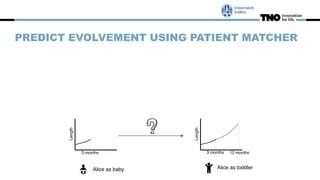
PREDICT EVOLVEMENT USING PATIENT MATCHER
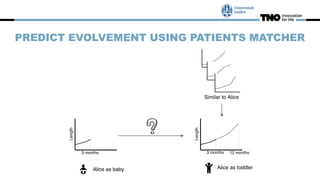
PREDICT EVOLVEMENT USING PATIENTS MATCHER
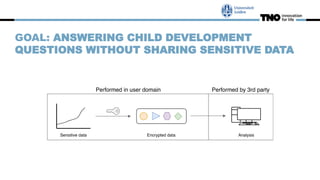
GOAL: ANSWERING CHILD DEVELOPMENT
QUESTIONS WITHOUT SHARING SENSITIVE DATA
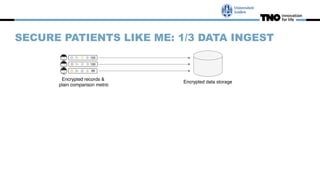
SECURE PATIENTS LIKE ME: 1/3 DATA INGEST
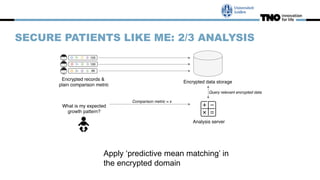
SECURE PATIENTS LIKE ME: 2/3 ANALYSIS
Apply ‘predictive mean matching’ in
the encrypted domain
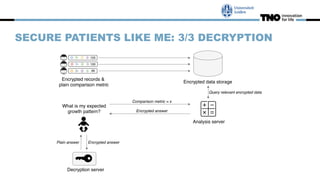
SECURE PATIENTS LIKE ME: 3/3 DECRYPTION
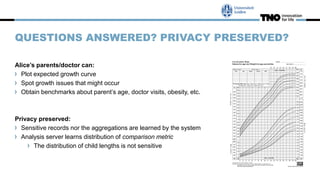
QUESTIONS ANSWERED? PRIVACY PRESERVED?
Alice’s parents/doctor can:
Plot expected growth curve
Spot growth issues that might occur
Obtain benchmarks about parent’s age, doctor visits, obesity, etc.
Privacy preserved:
Sensitive records nor the aggregations are learned by the system
Analysis server learns distribution of comparison metric
The distribution of child lengths is not sensitive

Kraaij infrastructures for secure data analytics def brussel 2017

  • 1.
    Infrastructures for secure dataanalytics Wessel Kraaij TNO & Leiden University
  • 2.
    EU: Digital technologywill redefine health and care • Care: transition to Value Based Health Care • PROMs • Aggregated cost of care paths • Patient: self management of health, patient science • N=1 , personalized health • Find comparable health trajectories • Combining the right data may lead to new insights • BUT Data storage is fragmented • BUT The GDPR limits the combination of data sets • Challenges: • Provide a trusted environment, individual control on data access and sharing • Supporting secure and legal data analytics for combined datasets
  • 3.
    Some barriers forstatistical analysis and ML • Data is horizontally partitioned • Distributed learning • Personal Health Train (J van Soest) • Data is vertically partitioned • Existing practice: Trusted 3rd party (TTP) • Health Data Cooperative (Midata) • Prana Data (example of secure multiparty computation) ID age income sex 1 55 70000 M 2 45 60000 F ID Age sex 1 55 M 2 45 F 3 20 F 4 22 M ID age income sex 3 20 25000 F 4 22 20000 M ID income 1 70000 2 60000 3 25000 4 20000
  • 4.
    Traditional solution – trustinga third party • For research: • create anonymized/ pseudonymized datasets, possibly using a trusted third party • Anonymization: remove identifiers • Export anonymized dataset for research (academic/ commercial)
  • 5.
    Assessment • The morepersonal data is combined, the easier it is to re- identify a profile and the more difficult the anonymization process is • E.g. personal well-being data (Fitbit, smartphone apps) are quite personal and could lead to re-identification using external data. • Personal data may seem innocent, but can lead to valuable insights • Strict regulation on data processing and storage • Data leaks can lead to substantial fines • Professionals are reluctant to use big data approaches
  • 6.
    Towards a citizendriven healthcare economy: > Citizen’s together form a Cooperative and a Community > The cooperative delivers the platform and governance structure > Enables individuals to collect their data (medical and lifestyle) > Provides services for members and delivers services to customers > Data is controlled by citizen and patients themselves > Rely on their cooperative for support CONTROL SELF- MANAGEMENT HOLLAND HEALTH DATA COOPERATIVE: THE GAMECHANGER TRUST REWARD VIRTUAL SAFE
  • 7.
    MIDATA Server(s) Data Services andAccess Management 3rd Party Data Sources Anony- mised export Lifestyle Health Others Research environment Smartphone 3rd Party Apps MIDATA Portal Quan- tified self App Coach- ing App Treat- ment App Follow- up App HHDC HHDC architecture
  • 8.
    PRANA DATA (WWW.PRANADATA.NL) Privacypreserving analyse of sensitive data Results: Proof of principle: secure ‘babies like mine’ , homomorphic encryption, for predictive mean matching (characteristics of babies with similar growth curve) User study White paper Collaboration with Personal health train, PEP Follow up in H2020 BigMedilytics (ErasmusMC, Achmea, TNO and VWDATA
  • 9.
    PREDICT EVOLVEMENT USINGPATIENT MATCHER
  • 10.
    PREDICT EVOLVEMENT USINGPATIENT MATCHER
  • 11.
    PREDICT EVOLVEMENT USINGPATIENTS MATCHER
  • 13.
    GOAL: ANSWERING CHILDDEVELOPMENT QUESTIONS WITHOUT SHARING SENSITIVE DATA
  • 14.
    SECURE PATIENTS LIKEME: 1/3 DATA INGEST
  • 15.
    SECURE PATIENTS LIKEME: 2/3 ANALYSIS Apply ‘predictive mean matching’ in the encrypted domain
  • 16.
    SECURE PATIENTS LIKEME: 3/3 DECRYPTION
  • 17.
    QUESTIONS ANSWERED? PRIVACYPRESERVED? Alice’s parents/doctor can: Plot expected growth curve Spot growth issues that might occur Obtain benchmarks about parent’s age, doctor visits, obesity, etc. Privacy preserved: Sensitive records nor the aggregations are learned by the system Analysis server learns distribution of comparison metric The distribution of child lengths is not sensitive