From Research to Practice: New Models
for Data-sharing and Collaboration to
Improve Health and Healthcare
Joe Selby, MD, MPH, Executive Director, PCORI
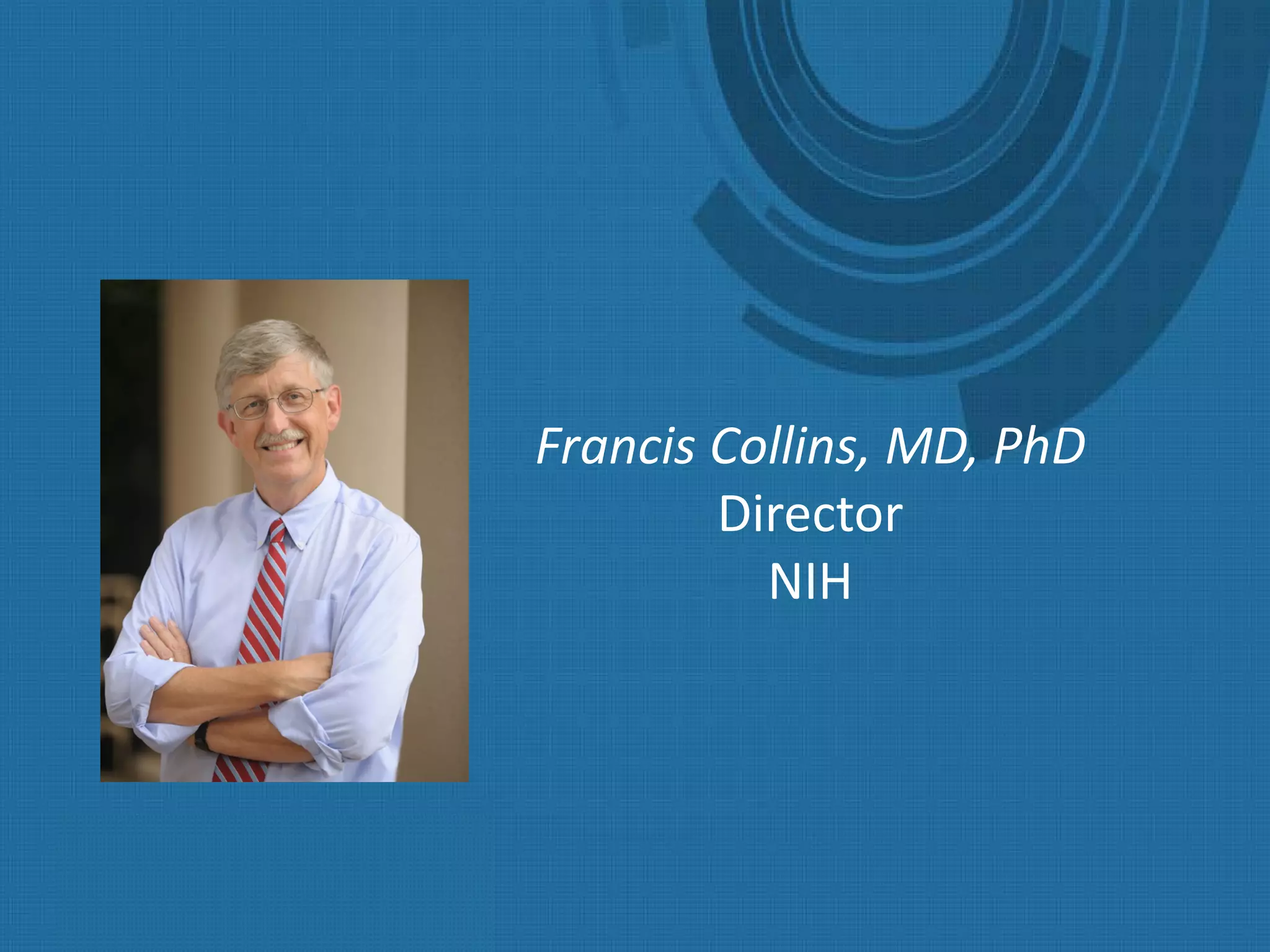
Francis Collins, MD, PhD, Director, National Institutes of Health
Philip Bourne, PhD, Associate Director for Data Science, NIH
Moderator: Dwayne Spradlin, CEO Health Data Consortium
May 28, 2014
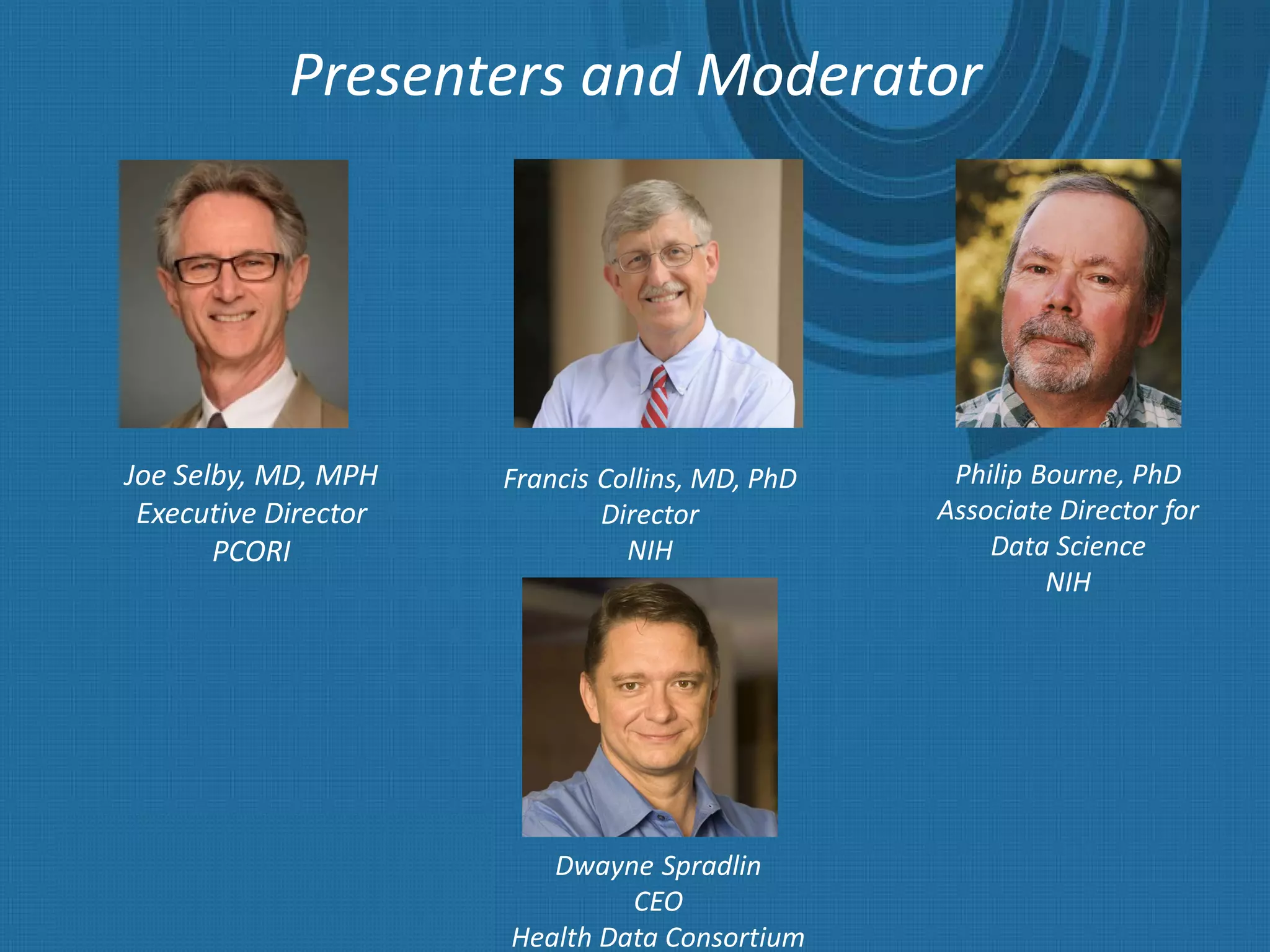
Presenters and Moderator
Joe Selby, MD, MPH
Executive Director
PCORI
Francis Collins, MD, PhD
Director
NIH
Philip Bourne, PhD
Associate Director for
Data Science
NIH
Dwayne Spradlin
CEO
Health Data Consortium
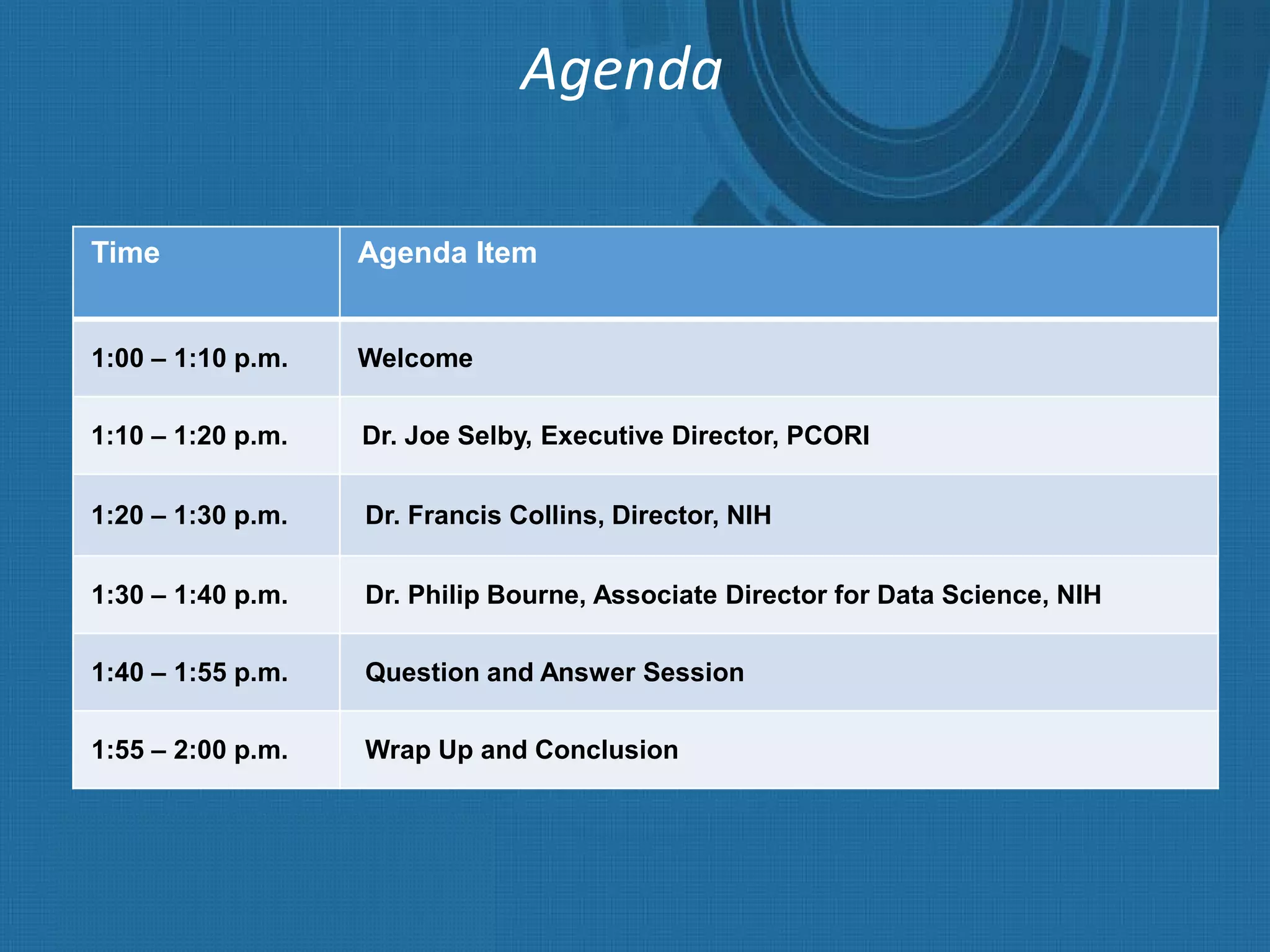
Agenda
Time Agenda Item
1:00 – 1:10 p.m. Welcome
1:10 – 1:20 p.m. Dr. Joe Selby, Executive Director, PCORI
1:20 – 1:30 p.m. Dr. Francis Collins, Director, NIH
1:30 – 1:40 p.m. Dr. Philip Bourne, Associate Director for Data Science, NIH
1:40 – 1:55 p.m. Question and Answer Session
1:55 – 2:00 p.m. Wrap Up and Conclusion
4
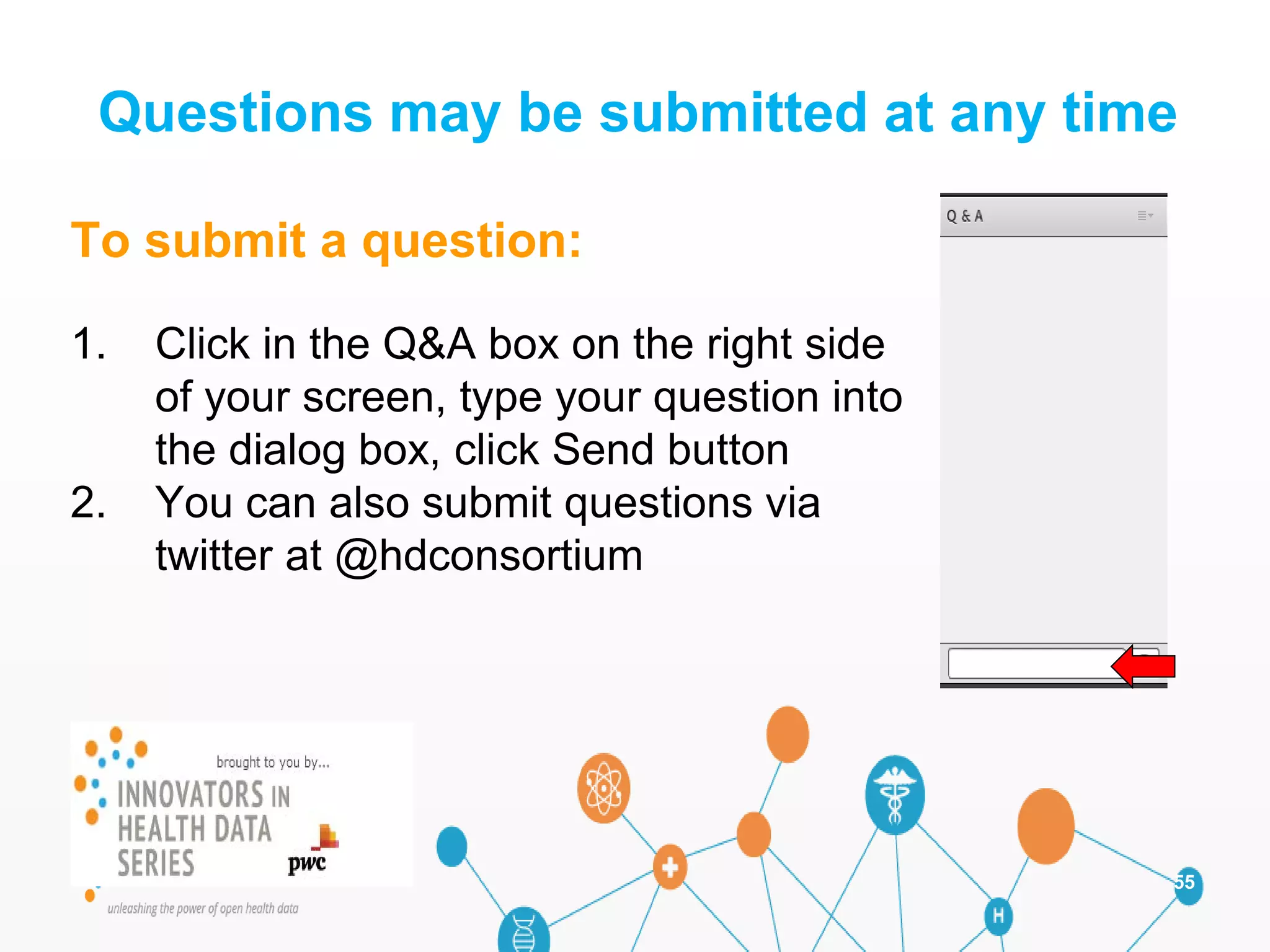
1. Click in the Q&A box on the right side
of your screen, type your question into
the dialog box, click Send button
2. You can also submit questions via
twitter at @hdconsortium
Questions may be submitted at any time
Reminder: for audio, Dial 866-640-4044 - Entry Code: 416641#
Need help? Press *0 on phone to reach the operator
Joe Selby, MD, MPH
Executive Director
PCORI
Joe Selby, MD MPH, Executive Director
PCORI
PCORnet: Harnessing Real-World
Health Data in Patient-Centered Research
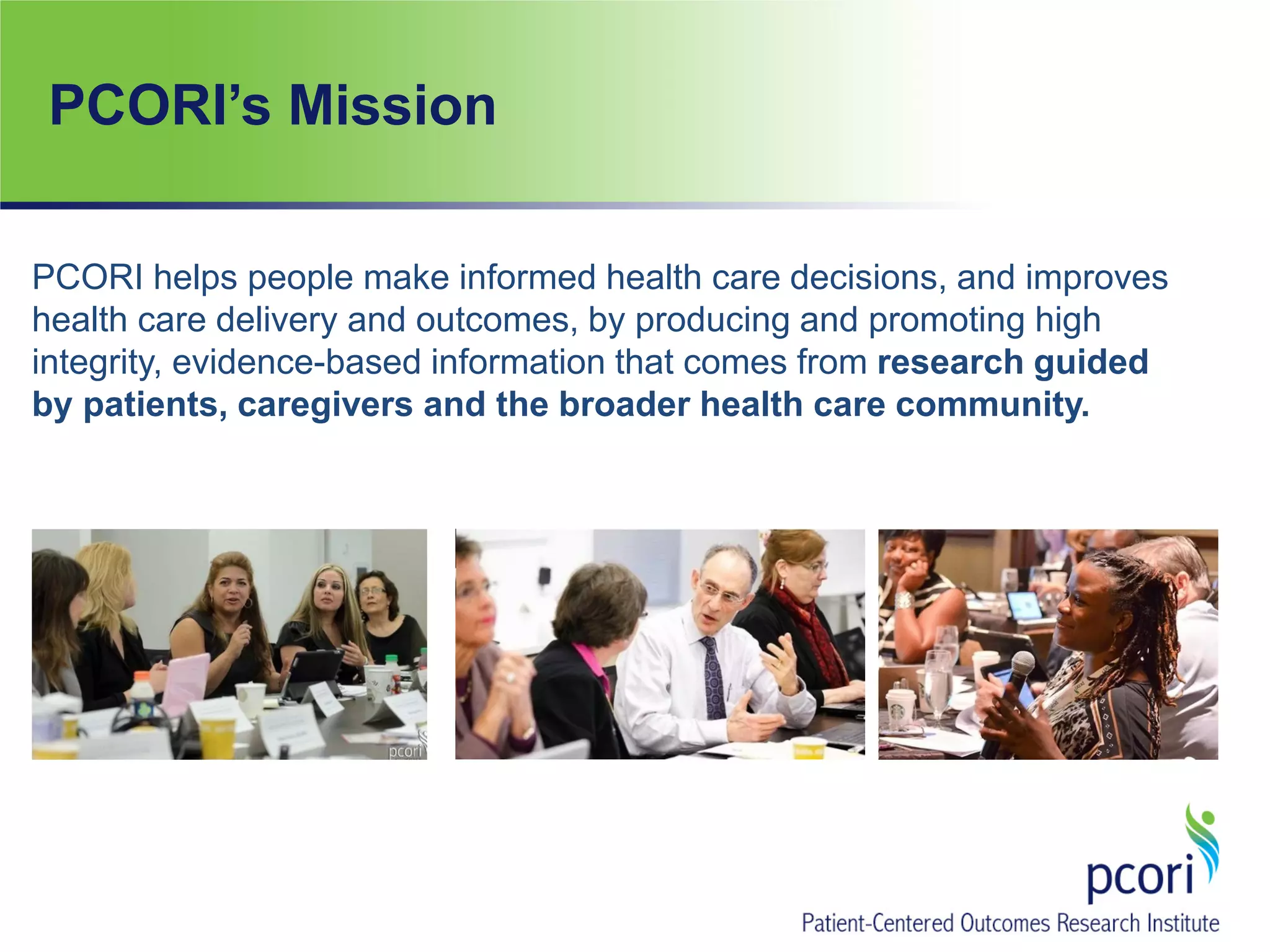
PCORI’s Mission
PCORI helps people make informed health care decisions, and improves
health care delivery and outcomes, by producing and promoting high
integrity, evidence-based information that comes from research guided
by patients, caregivers and the broader health care community.
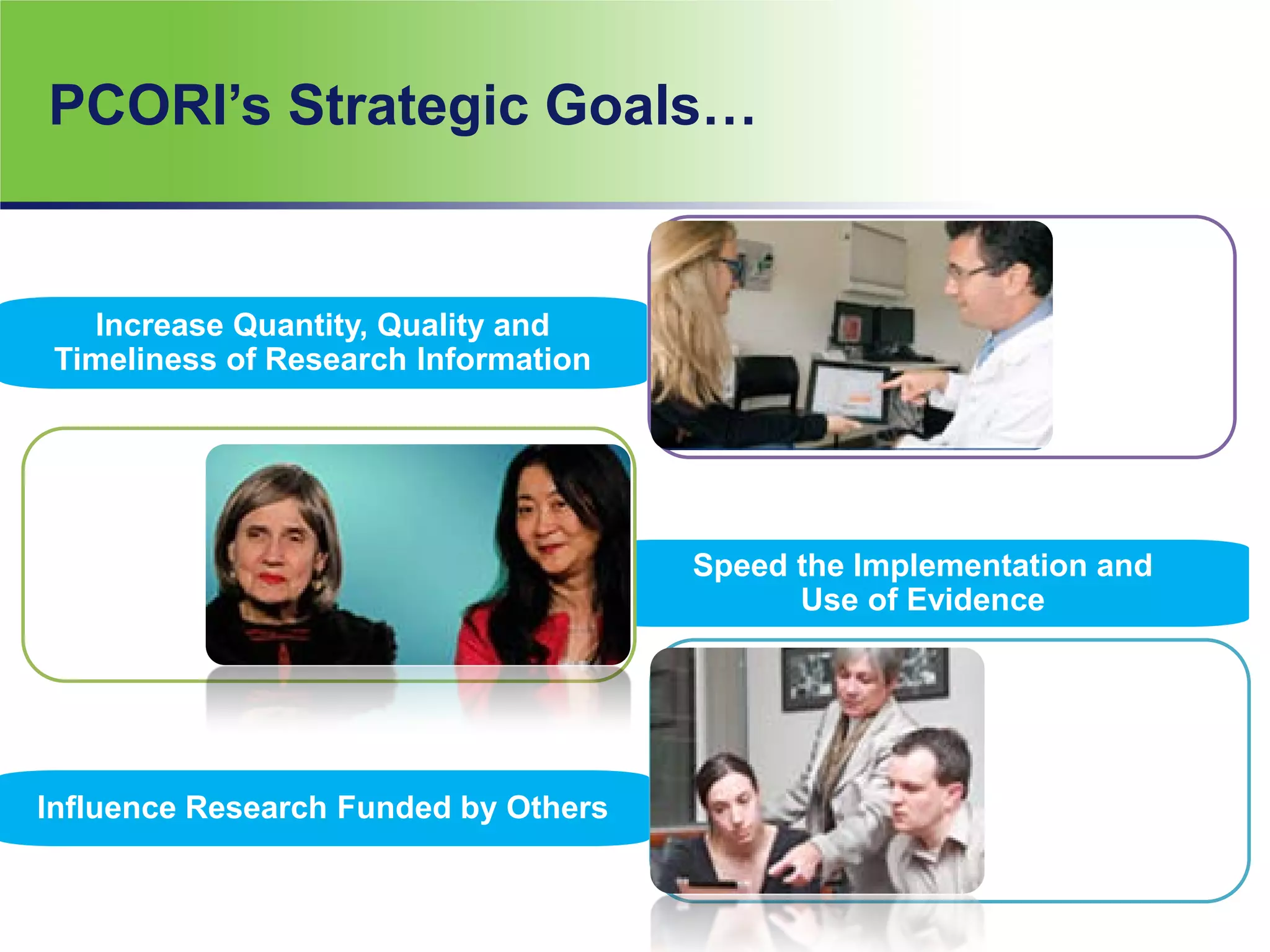
Influence Research Funded by Others
Speed the Implementation and
Use of Evidence
Increase Quantity, Quality and
Timeliness of Research Information
PCORI’s Strategic Goals…
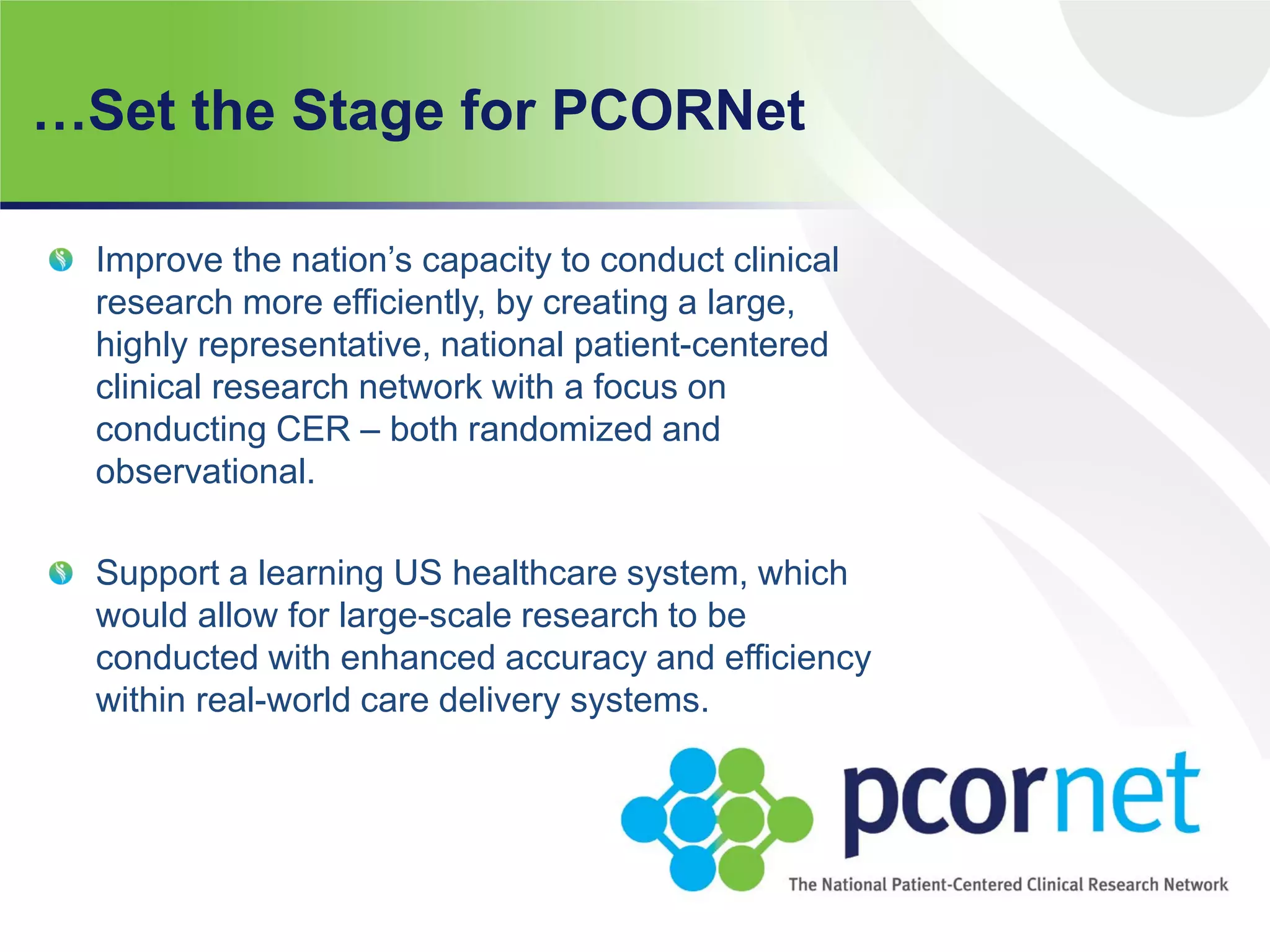
…Set the Stage for PCORNet
Improve the nation’s capacity to conduct clinical
research more efficiently, by creating a large,
highly representative, national patient-centered
clinical research network with a focus on
conducting CER – both randomized and
observational.
Support a learning US healthcare system, which
would allow for large-scale research to be
conducted with enhanced accuracy and efficiency
within real-world care delivery systems.
10
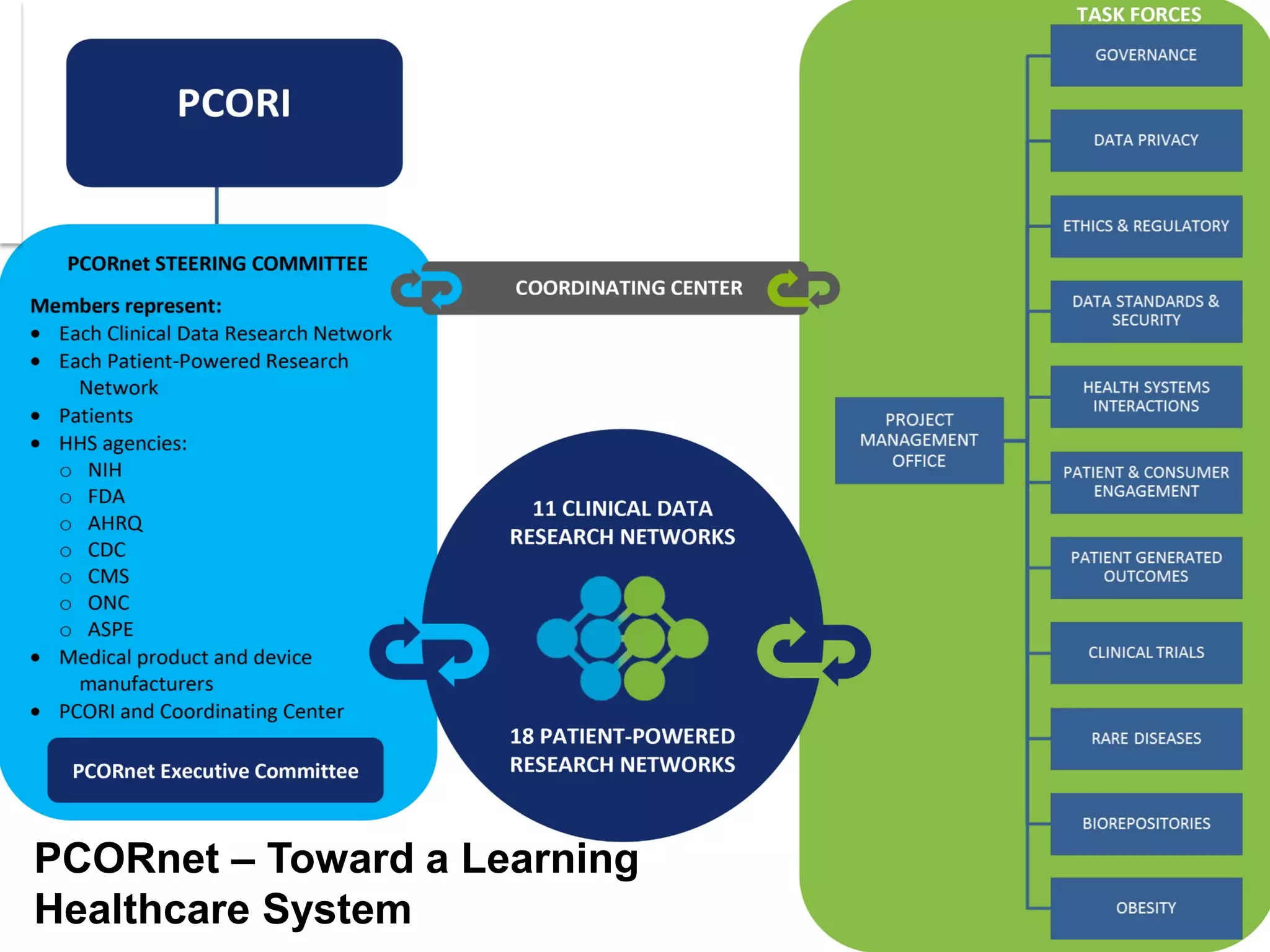
PCORnet – Toward a Learning
Healthcare System
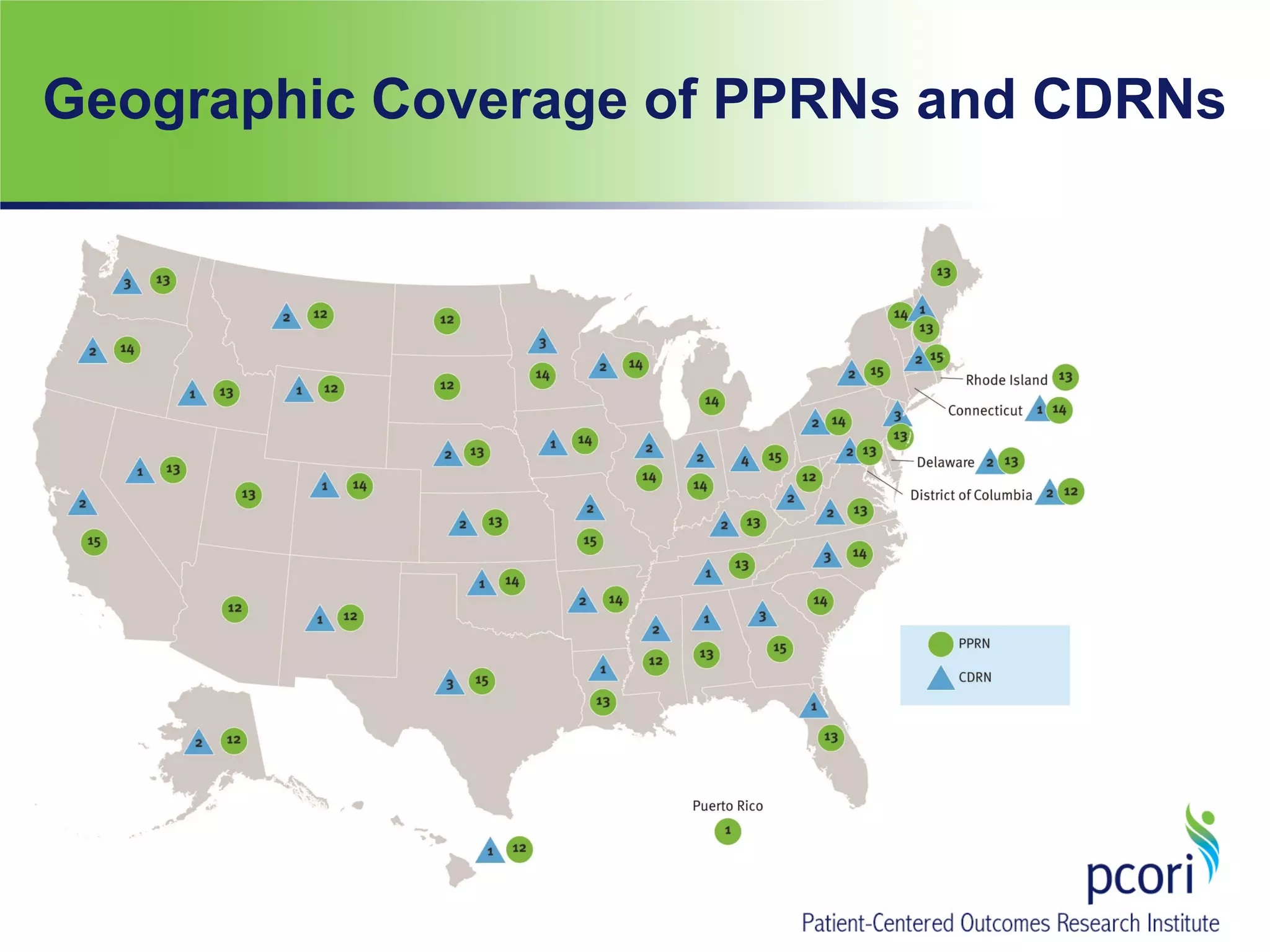
Geographic Coverage of PPRNs and CDRNs
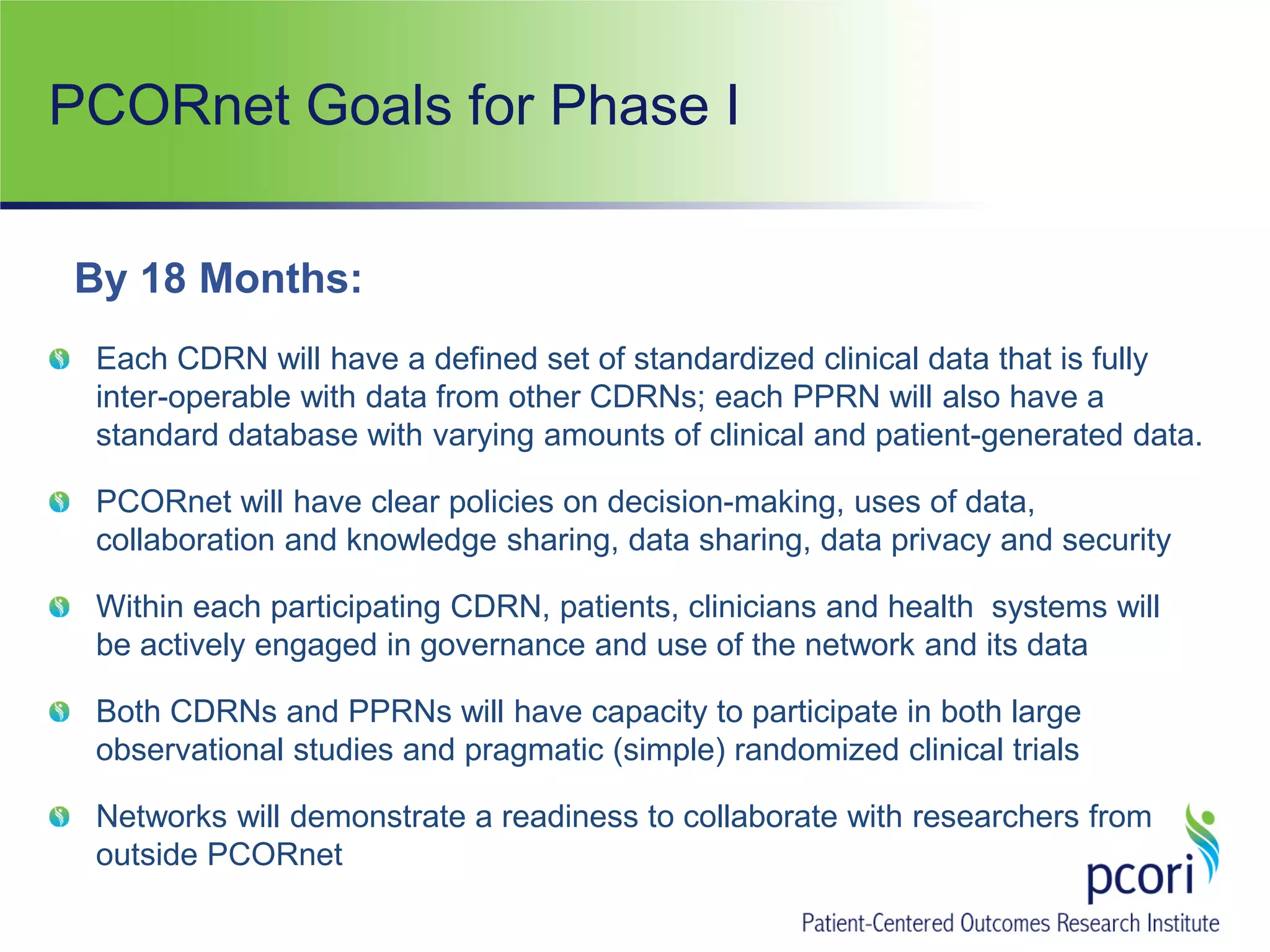
PCORnet Goals for Phase I
Each CDRN will have a defined set of standardized clinical data that is fully
inter-operable with data from other CDRNs; each PPRN will also have a
standard database with varying amounts of clinical and patient-generated data.
PCORnet will have clear policies on decision-making, uses of data,
collaboration and knowledge sharing, data sharing, data privacy and security
Within each participating CDRN, patients, clinicians and health systems will
be actively engaged in governance and use of the network and its data
Both CDRNs and PPRNs will have capacity to participate in both large
observational studies and pragmatic (simple) randomized clinical trials
Networks will demonstrate a readiness to collaborate with researchers from
outside PCORnet
By 18 Months:
Francis Collins, MD, PhD
Director
NIH
NIH: Data Sharing Challenges and Solutions
Francis S. Collins, M.D., Ph.D.
Director, National Institutes of Health
From Research to Practice: New Models for Data Sharing and
Collaboration to Improve Health and Healthcare
May 28, 2014
Value of Data Sharing
 Increases return on investment
 Facilitates additional research
 Helps to validate findings
 Promotes transparency
 Many ongoing efforts to increase and facilitate data
sharing
– Big Data to Knowledge (BD2K)
– Plan for increasing public access to data
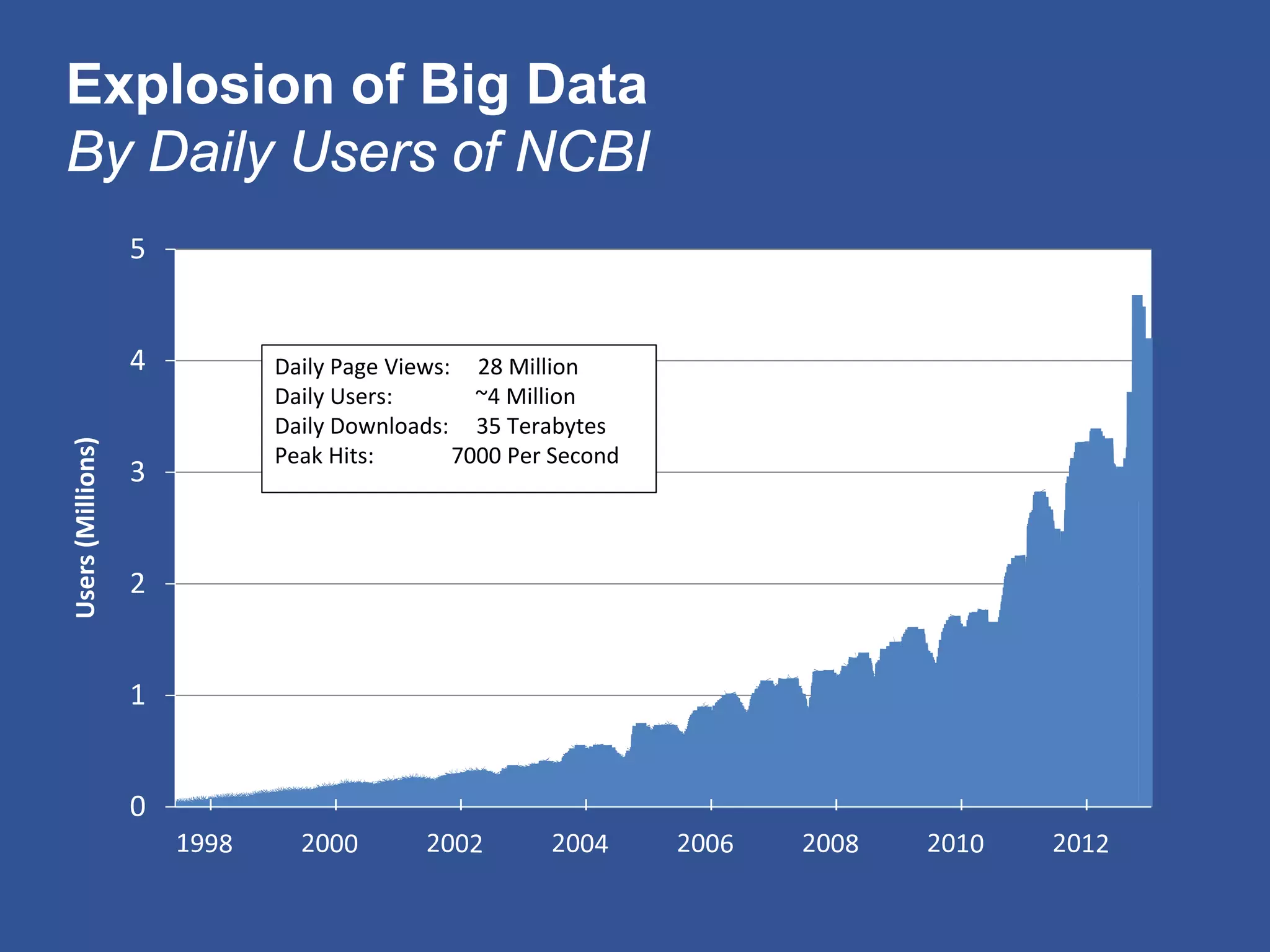
Explosion of Big Data
By Daily Users of NCBI
0
1
2
3
4
5
Users(Millions)
Daily Page Views: 28 Million
Daily Users: ~4 Million
Daily Downloads: 35 Terabytes
Peak Hits: 7000 Per Second
Data Sharing Challenges and Solutions
 Genomic Data Sharing
 Clinical Data Sharing
 Human Subjects Protection
Data Sharing Challenges and Solutions
 Genomic Data Sharing
 Clinical Data Sharing
 Human Subjects Protection
$1,000
$10,000
$100,000
$1,000,000
$10,000,000
$100,000,000
S-01
J-02
M-02
S-02
J-03
M-03
S-03
J-04
M-04
S-04
J-05
M-05
S-05
J-06
M-06
S-06
J-07
M-07
S-07
J-08
M-08
S-08
J-09
M-09
S-09
J-10
M-10
S-10
J-11
M-11
S-11
J-12
M-12
S-12
J-13
M-13
S-13
J-14
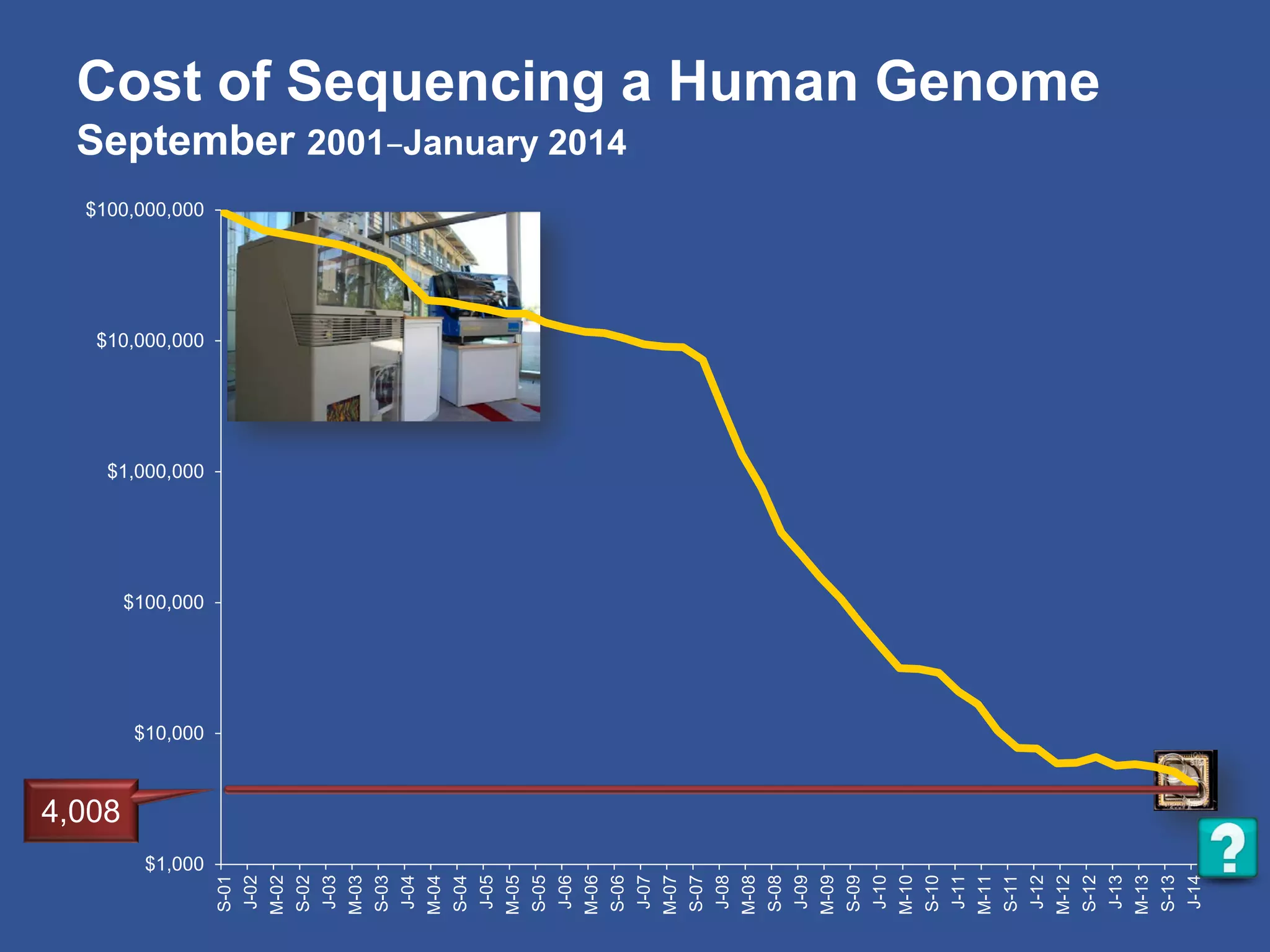
Cost of Sequencing a Human Genome
September 2001–January 2014
4,008
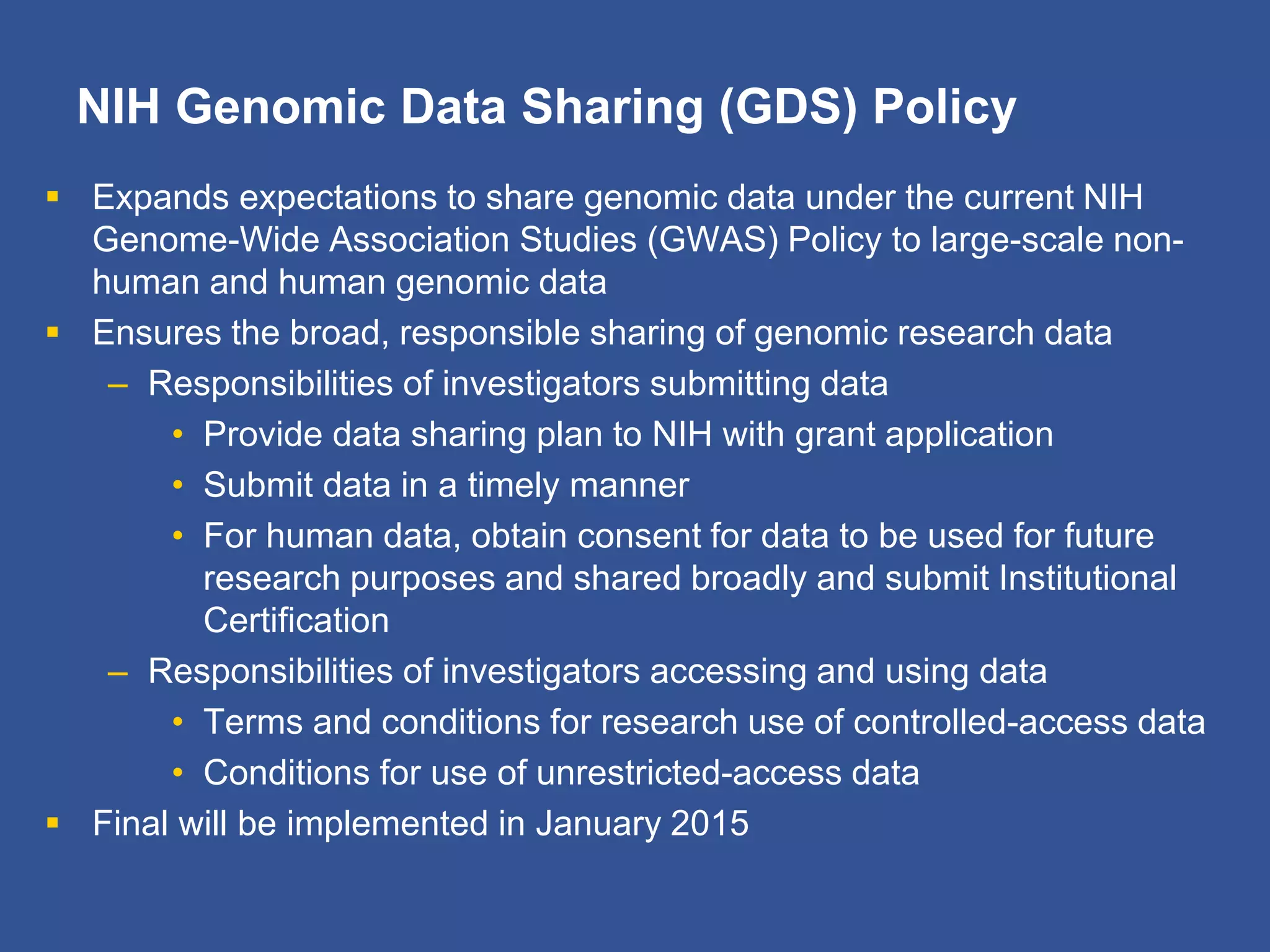
NIH Genomic Data Sharing (GDS) Policy
 Expands expectations to share genomic data under the current NIH
Genome-Wide Association Studies (GWAS) Policy to large-scale non-
human and human genomic data
 Ensures the broad, responsible sharing of genomic research data
– Responsibilities of investigators submitting data
• Provide data sharing plan to NIH with grant application
• Submit data in a timely manner
• For human data, obtain consent for data to be used for future
research purposes and shared broadly and submit Institutional
Certification
– Responsibilities of investigators accessing and using data
• Terms and conditions for research use of controlled-access data
• Conditions for use of unrestricted-access data
 Final will be implemented in January 2015
More to come?
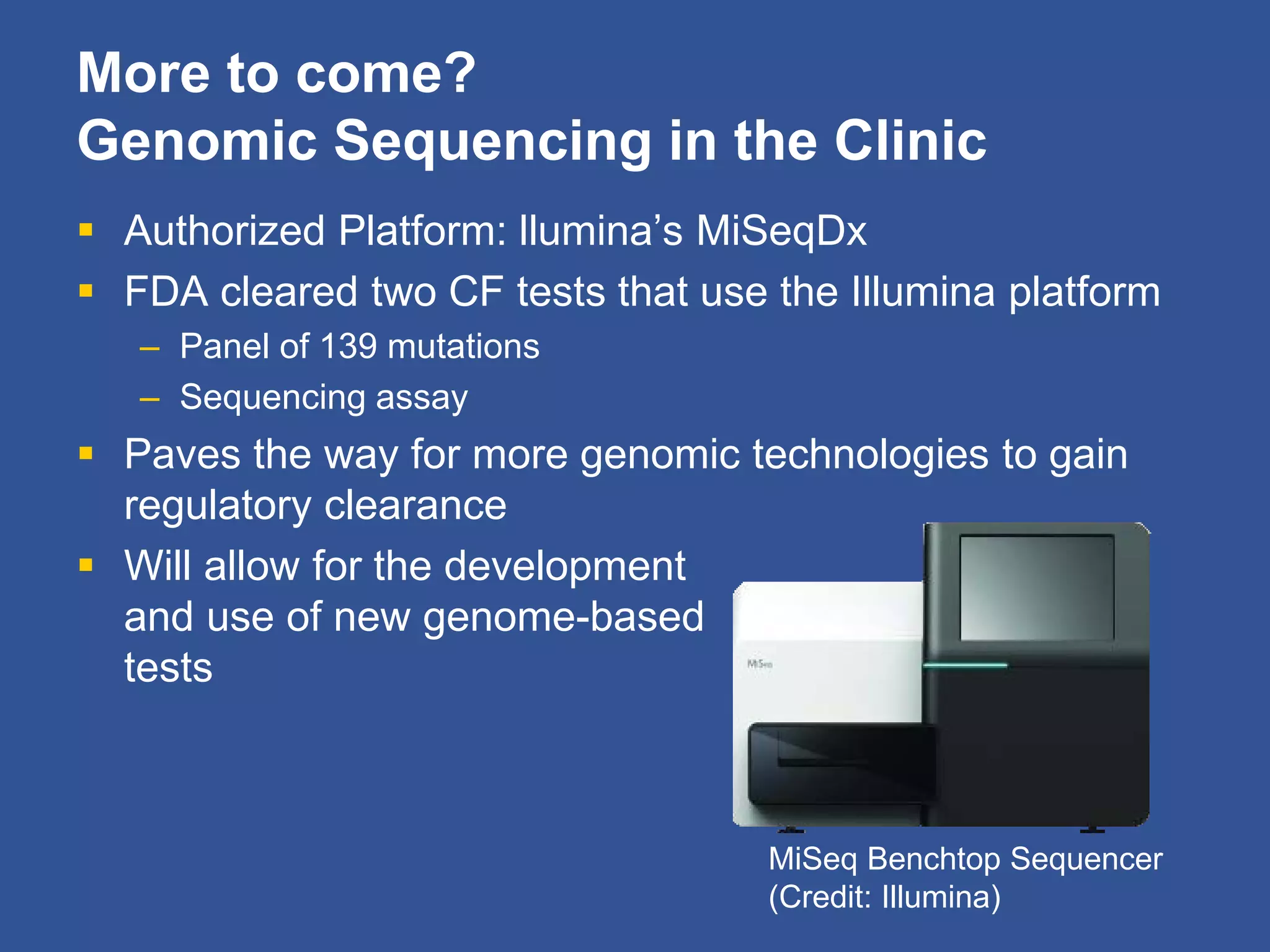
Genomic Sequencing in the Clinic
 Authorized Platform: llumina’s MiSeqDx
 FDA cleared two CF tests that use the Illumina platform
– Panel of 139 mutations
– Sequencing assay
 Paves the way for more genomic technologies to gain
regulatory clearance
 Will allow for the development
and use of new genome-based
tests
MiSeq Benchtop Sequencer
(Credit: Illumina)
Data-sharing Challenges and Solutions
 Genomic Data Sharing
 Clinical Data Sharing
 Human Subjects Protection
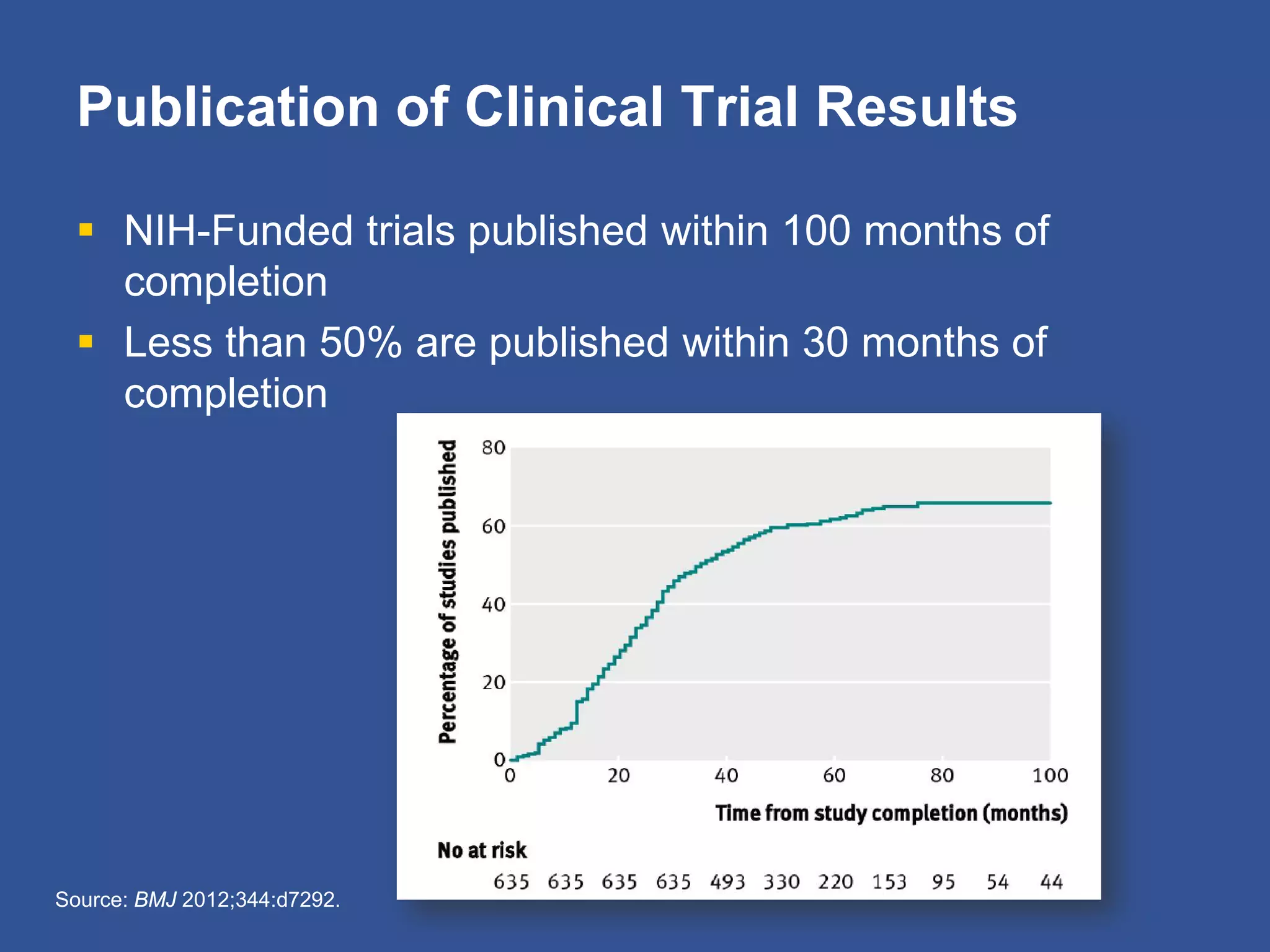
Source: BMJ 2012;344:d7292.
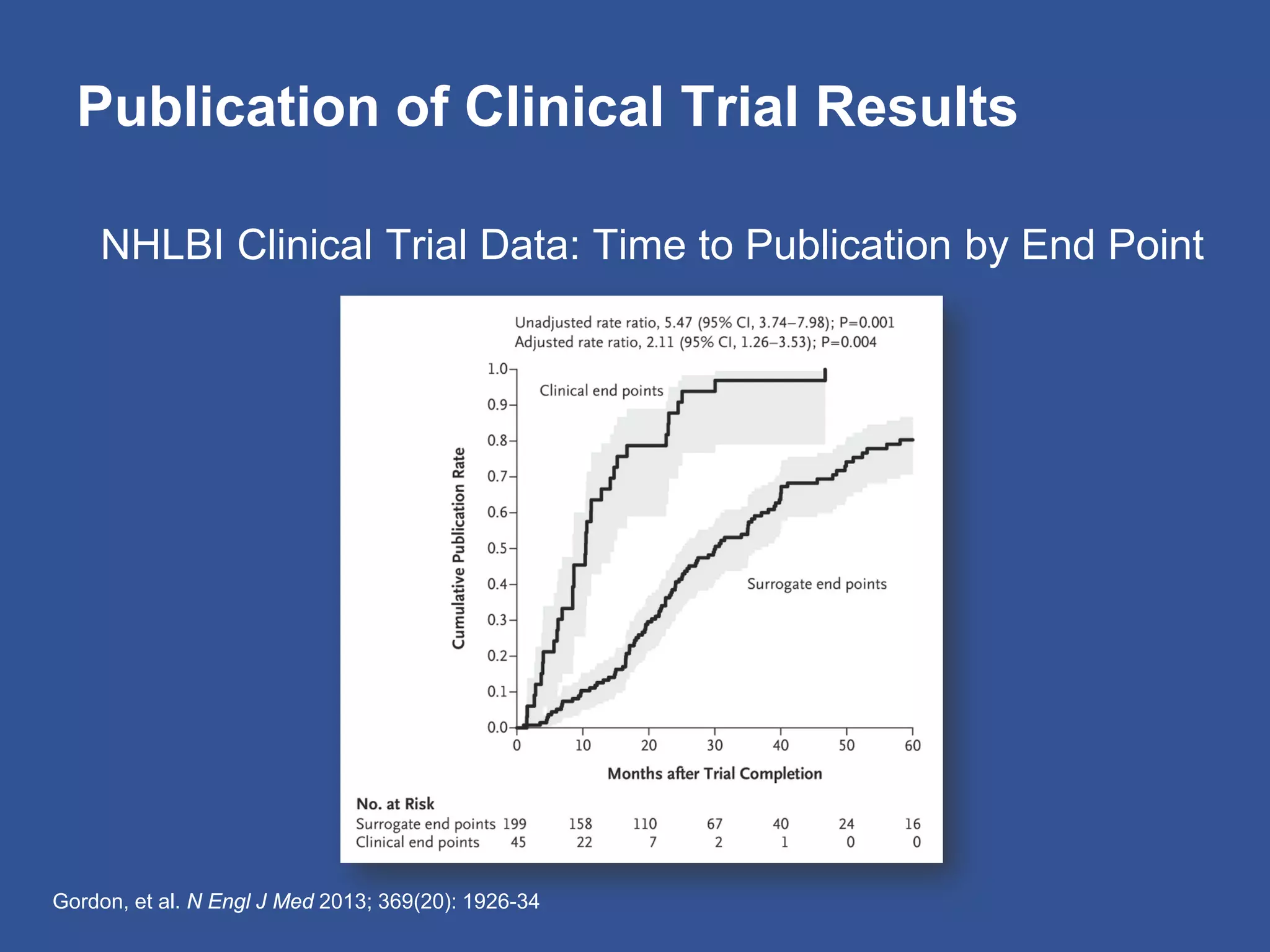
Publication of Clinical Trial Results
 NIH-Funded trials published within 100 months of
completion
 Less than 50% are published within 30 months of
completion
Publication of Clinical Trial Results
NHLBI Clinical Trial Data: Time to Publication by End Point
Gordon, et al. N Engl J Med 2013; 369(20): 1926-34
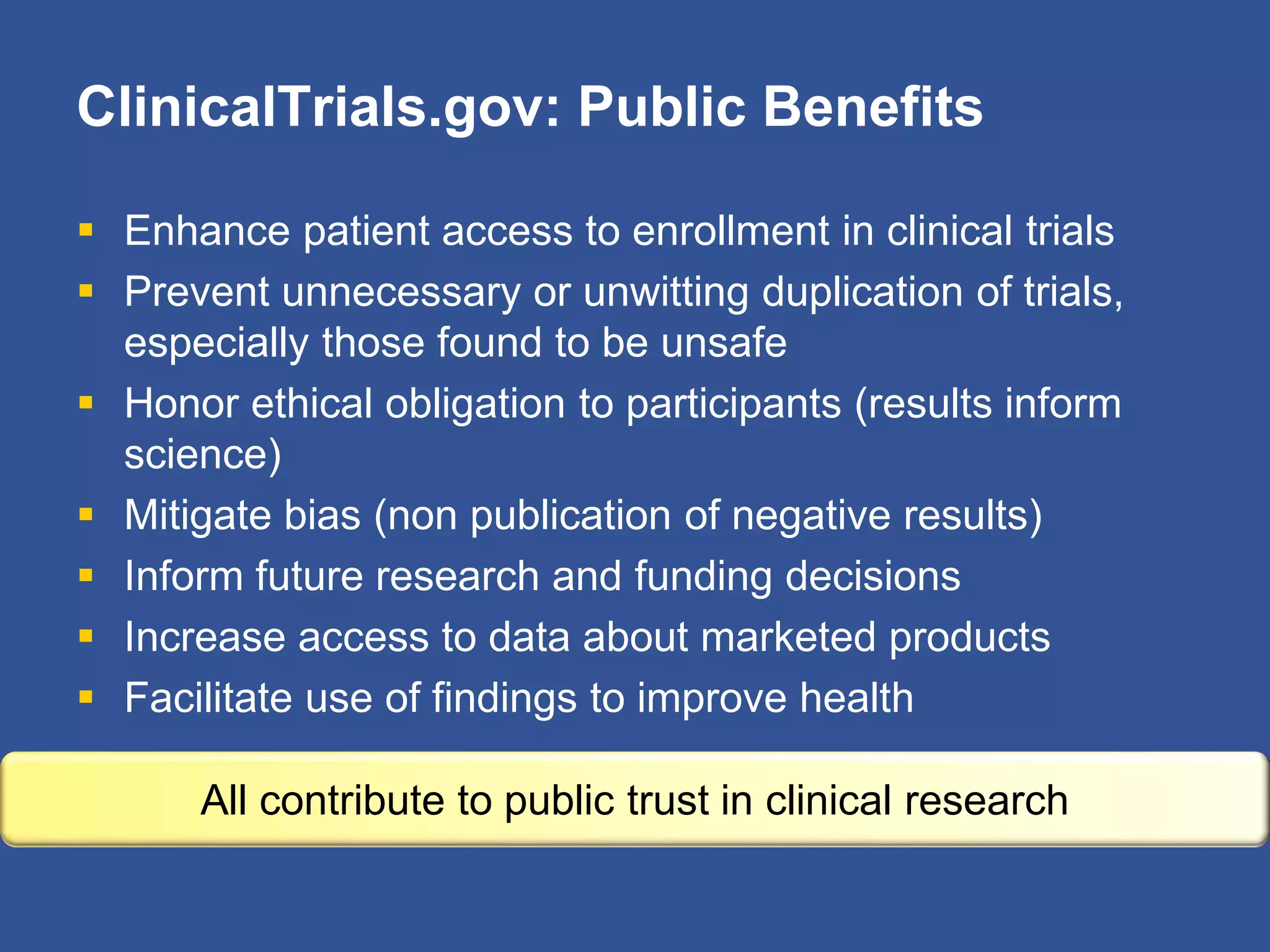
ClinicalTrials.gov: Public Benefits
 Enhance patient access to enrollment in clinical trials
 Prevent unnecessary or unwitting duplication of trials,
especially those found to be unsafe
 Honor ethical obligation to participants (results inform
science)
 Mitigate bias (non publication of negative results)
 Inform future research and funding decisions
 Increase access to data about marketed products
 Facilitate use of findings to improve health
All contribute to public trust in clinical research
Data Sharing Challenges and Solutions
 Genomic Data Sharing
 Clinical Data Sharing
 Human Subjects Protection
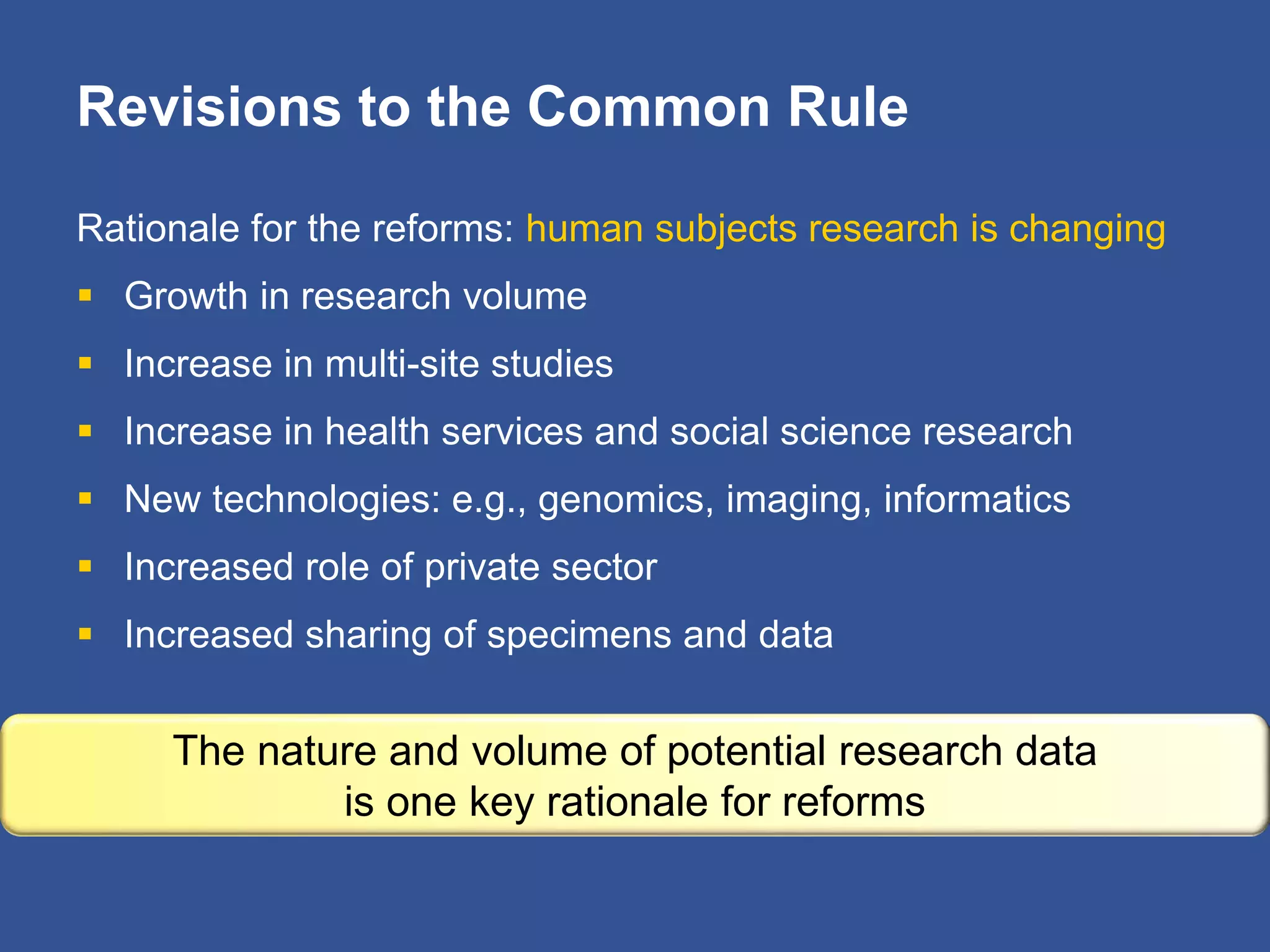
Revisions to the Common Rule
Rationale for the reforms: human subjects research is changing
 Growth in research volume
 Increase in multi-site studies
 Increase in health services and social science research
 New technologies: e.g., genomics, imaging, informatics
 Increased role of private sector
 Increased sharing of specimens and data
The nature and volume of potential research data
is one key rationale for reforms
Common Rule Reforms –
July 2011 ANPRM
Enhancing Protections
 Require consent for
research with
biospecimens/data
 Enhance data security and
information protection
standards
 Extend protections to all
research conducted at
federally-funded institutions
Reducing Burden
 Promote use of broad
consent for future research
with biospecimens/data
 Broaden exemptions for
low risk research
 Eliminate redundant IRB
reviews and reduce impact
of IRB reviews
NIH…
Turning Discovery Into Health
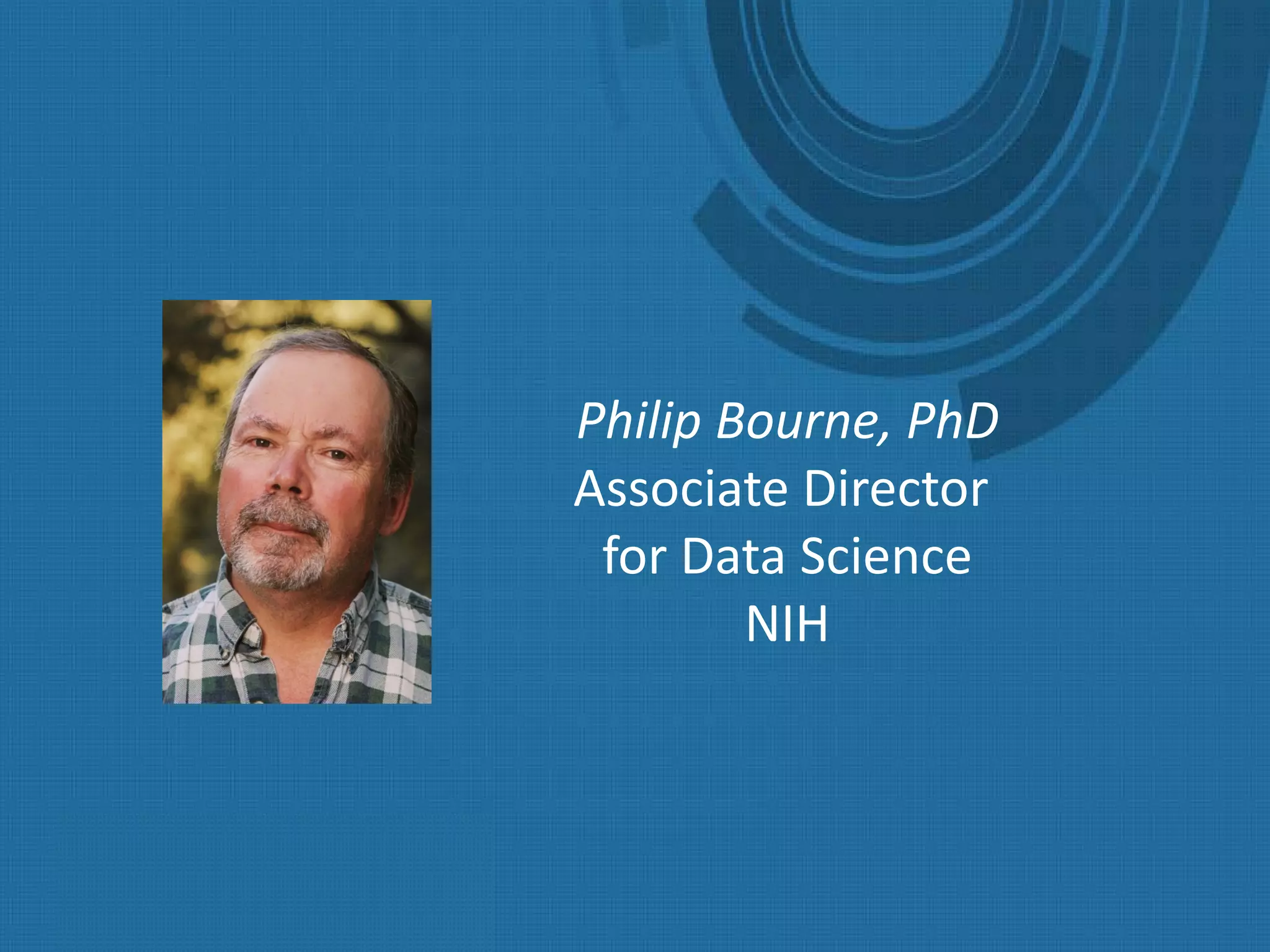
Philip Bourne, PhD
Associate Director
for Data Science
NIH
Towards the NIH as a Digital Enterprise
Philip E. Bourne, Ph.D.
Associate Director for Data Science, National Institutes of Health
From Research to Practice: New Models for Data Sharing and
Collaboration to Improve Health and Healthcare
May 28, 2014
Some Observations
 Good News
– Data sharing offers
unprecedented
opportunities to
improve healthcare
– We have a plan
– We are beginning to
quantify the issues
– We have some of the
best data scientists in
the world to work on
the problems
Some Observations
 Bad News
– Sustainability will not
be possible without
change
– OSTP have defined
the why but not the
how
– We do not know how
the data we currently
have are used
– It is difficult to estimate
supply and demand
 Good News
– Data sharing offers
unprecedented
opportunities to
improve healthcare
– We have a plan
– We are beginning to
quantify the issues
– We have some of the
best data scientists in
the world to work on
the problems
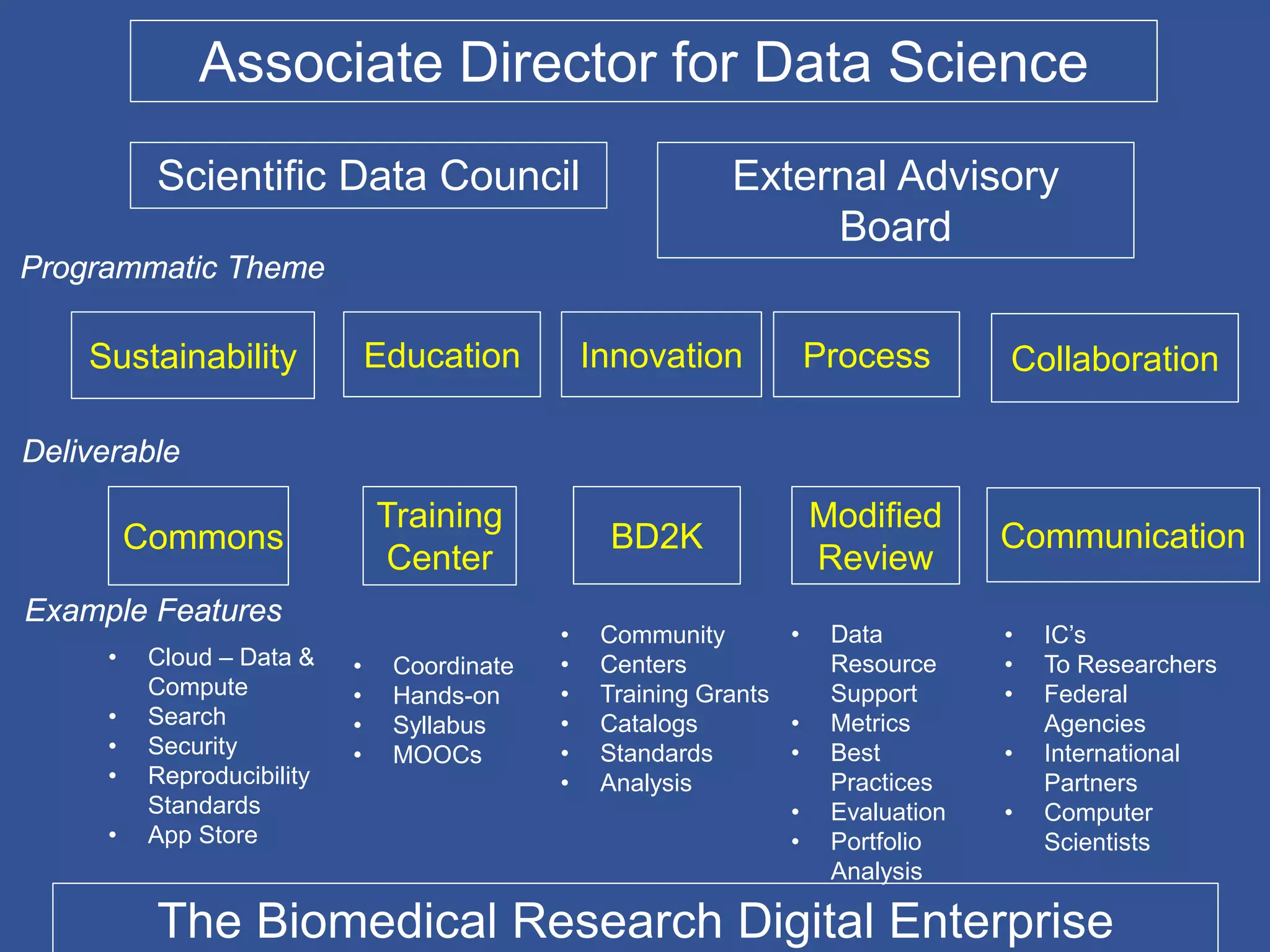
We have identified 5 programmatic
themes and associated deliverables …
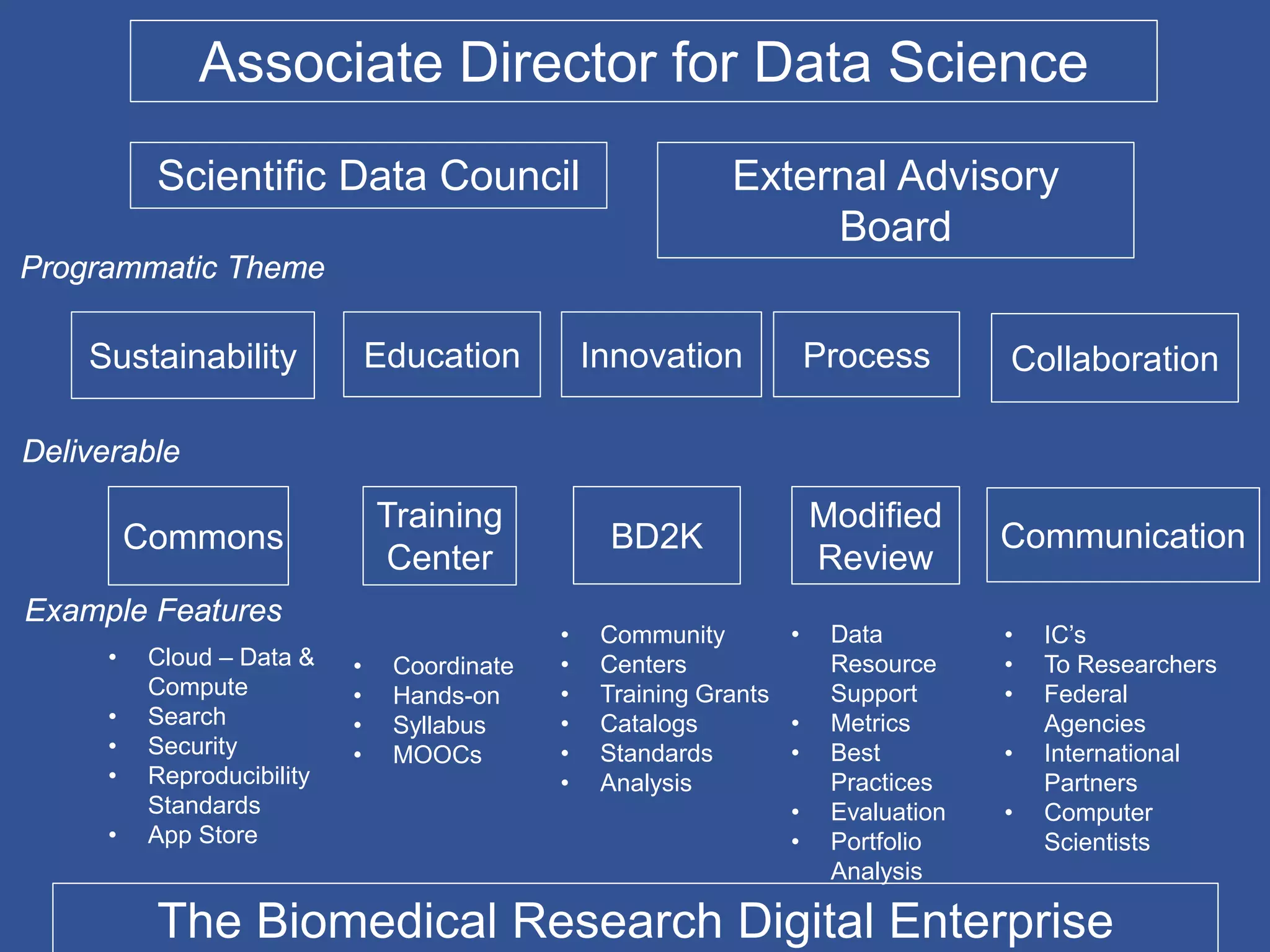
Associate Director for Data Science
Commons
Training
Center
BD2K
Modified
Review
Sustainability Education Innovation Process
• Cloud – Data &
Compute
• Search
• Security
• Reproducibility
Standards
• App Store
• Coordinate
• Hands-on
• Syllabus
• MOOCs
• Community
• Centers
• Training Grants
• Catalogs
• Standards
• Analysis
• Data
Resource
Support
• Metrics
• Best
Practices
• Evaluation
• Portfolio
Analysis
The Biomedical Research Digital Enterprise
Communication
Collaboration
Programmatic Theme
Deliverable
Example Features
• IC’s
• To Researchers
• Federal
Agencies
• International
Partners
• Computer
Scientists
Scientific Data Council External Advisory
Board
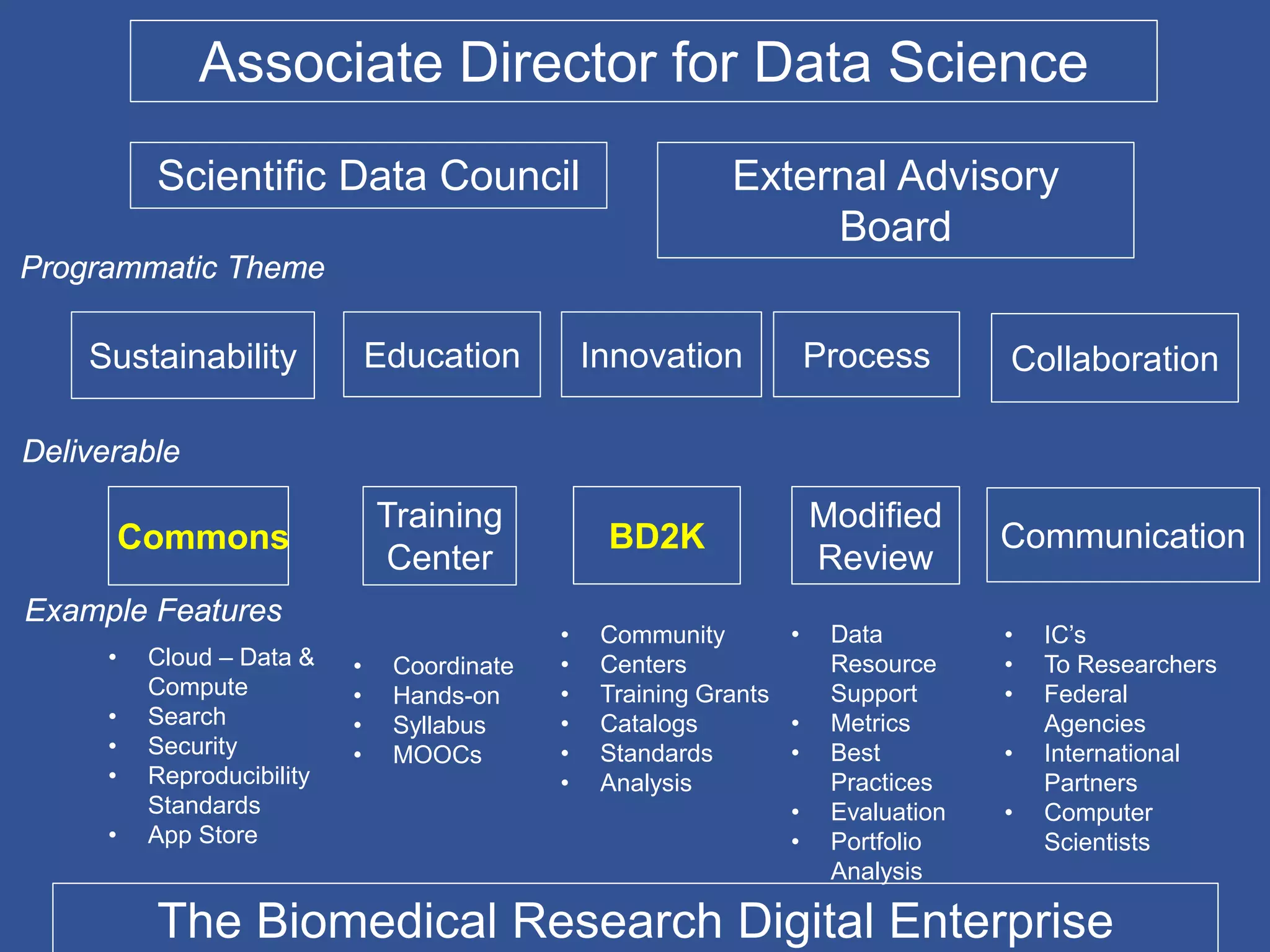
Associate Director for Data Science
Commons
Training
Center
BD2K
Modified
Review
Sustainability Education Innovation Process
• Cloud – Data &
Compute
• Search
• Security
• Reproducibility
Standards
• App Store
• Coordinate
• Hands-on
• Syllabus
• MOOCs
• Community
• Centers
• Training Grants
• Catalogs
• Standards
• Analysis
• Data
Resource
Support
• Metrics
• Best
Practices
• Evaluation
• Portfolio
Analysis
The Biomedical Research Digital Enterprise
Communication
Collaboration
Programmatic Theme
Deliverable
Example Features
• IC’s
• To Researchers
• Federal
Agencies
• International
Partners
• Computer
Scientists
Scientific Data Council External Advisory
Board
Associate Director for Data Science
Commons
Training
Center
BD2K
Modified
Review
Sustainability Education Innovation Process
• Cloud – Data &
Compute
• Search
• Security
• Reproducibility
Standards
• App Store
• Coordinate
• Hands-on
• Syllabus
• MOOCs
• Community
• Centers
• Training Grants
• Catalogs
• Standards
• Analysis
• Data
Resource
Support
• Metrics
• Best
Practices
• Evaluation
• Portfolio
Analysis
The Biomedical Research Digital Enterprise
Communication
Collaboration
Programmatic Theme
Deliverable
Example Features
• IC’s
• To Researchers
• Federal
Agencies
• International
Partners
• Computer
Scientists
Scientific Data Council External Advisory
Board
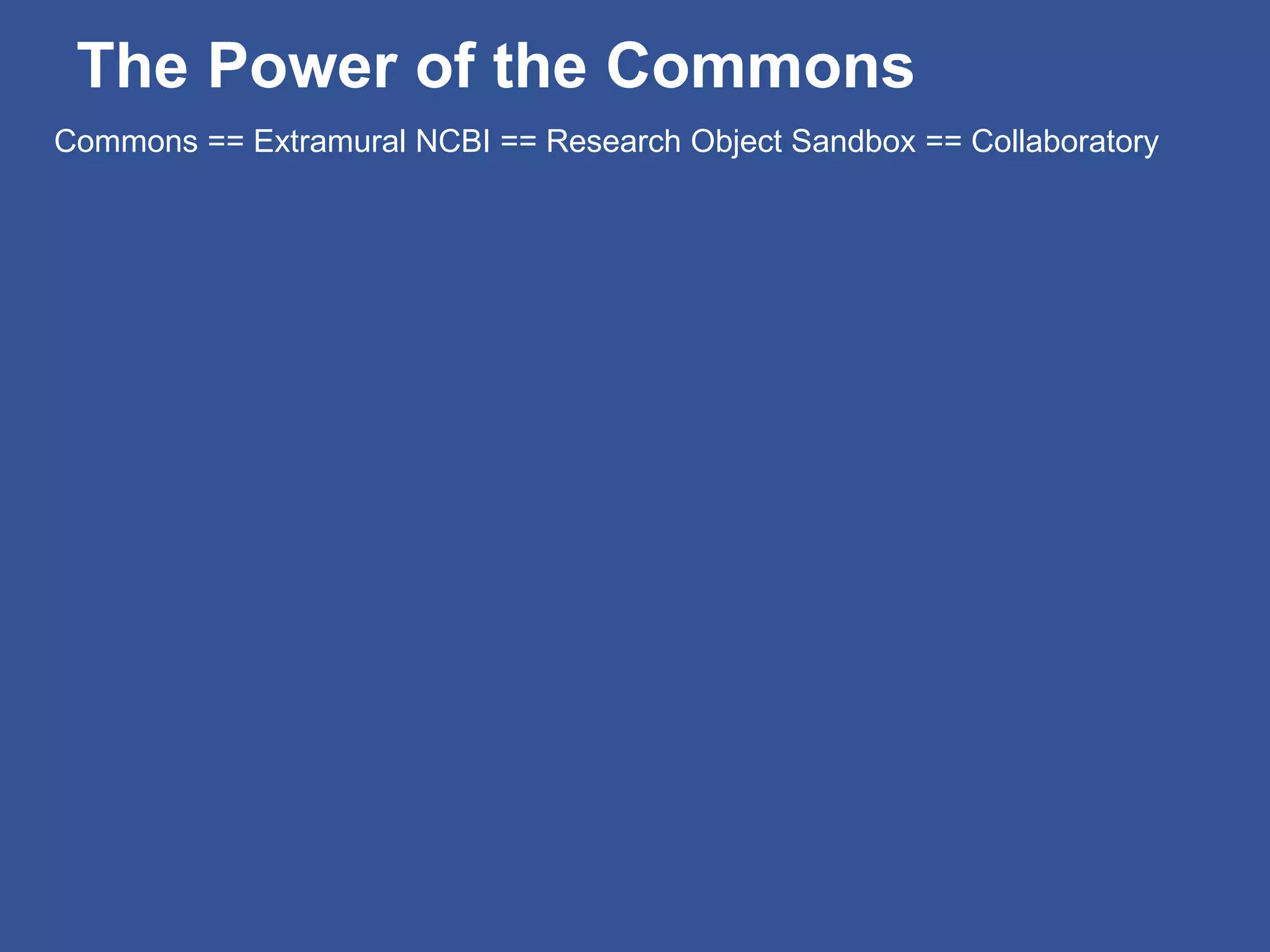
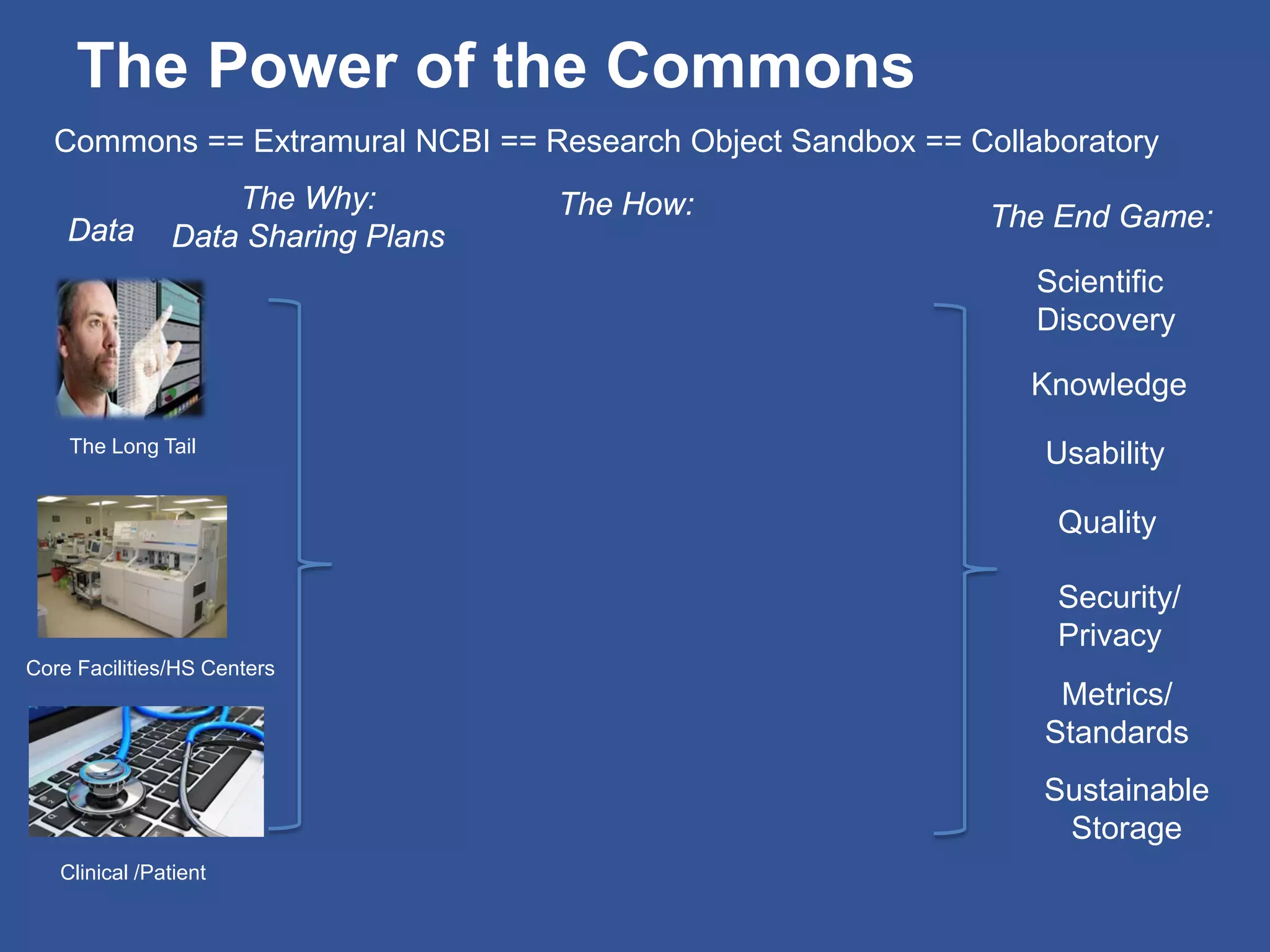
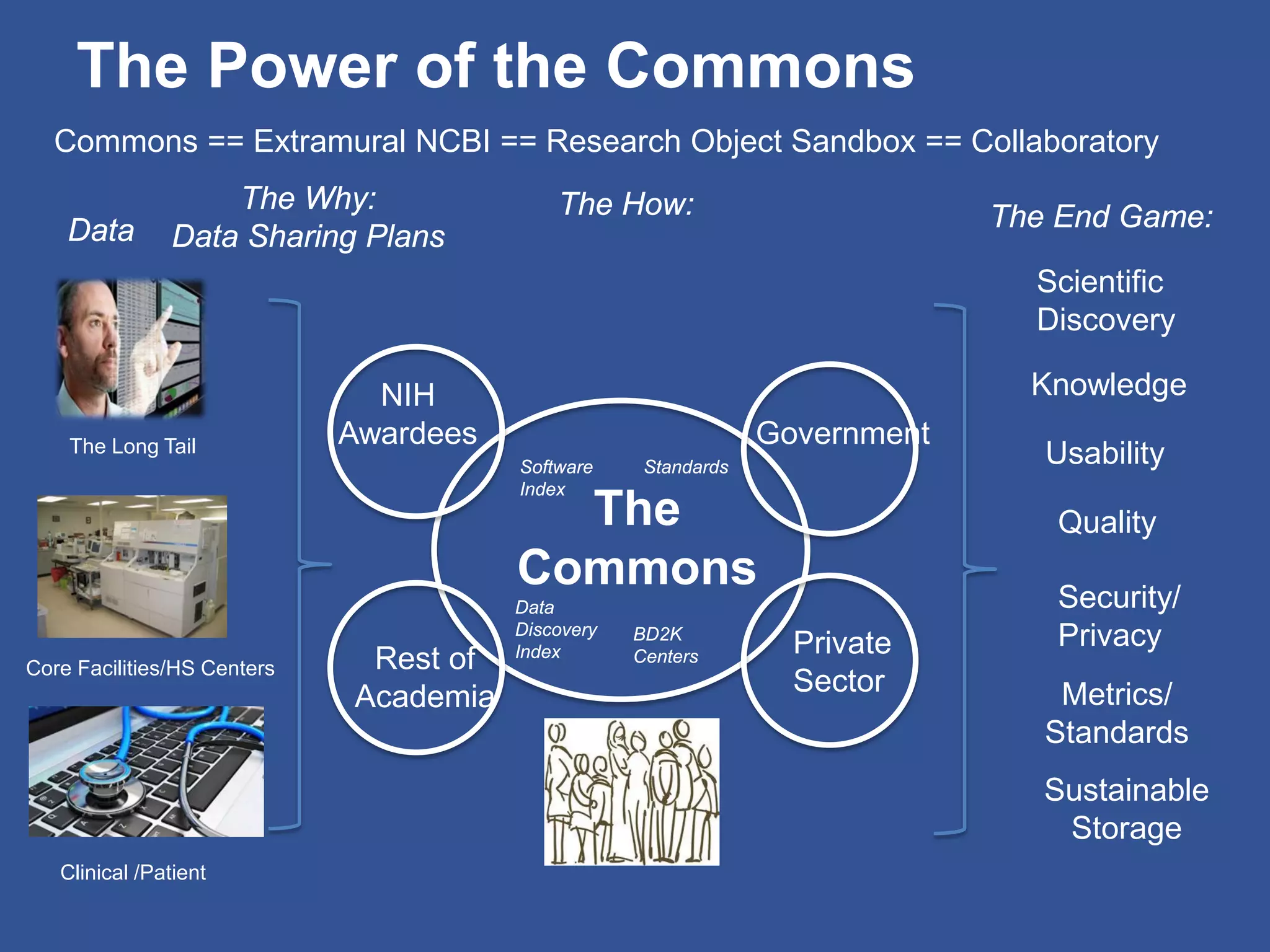
The Power of the Commons
Commons == Extramural NCBI == Research Object Sandbox == Collaboratory
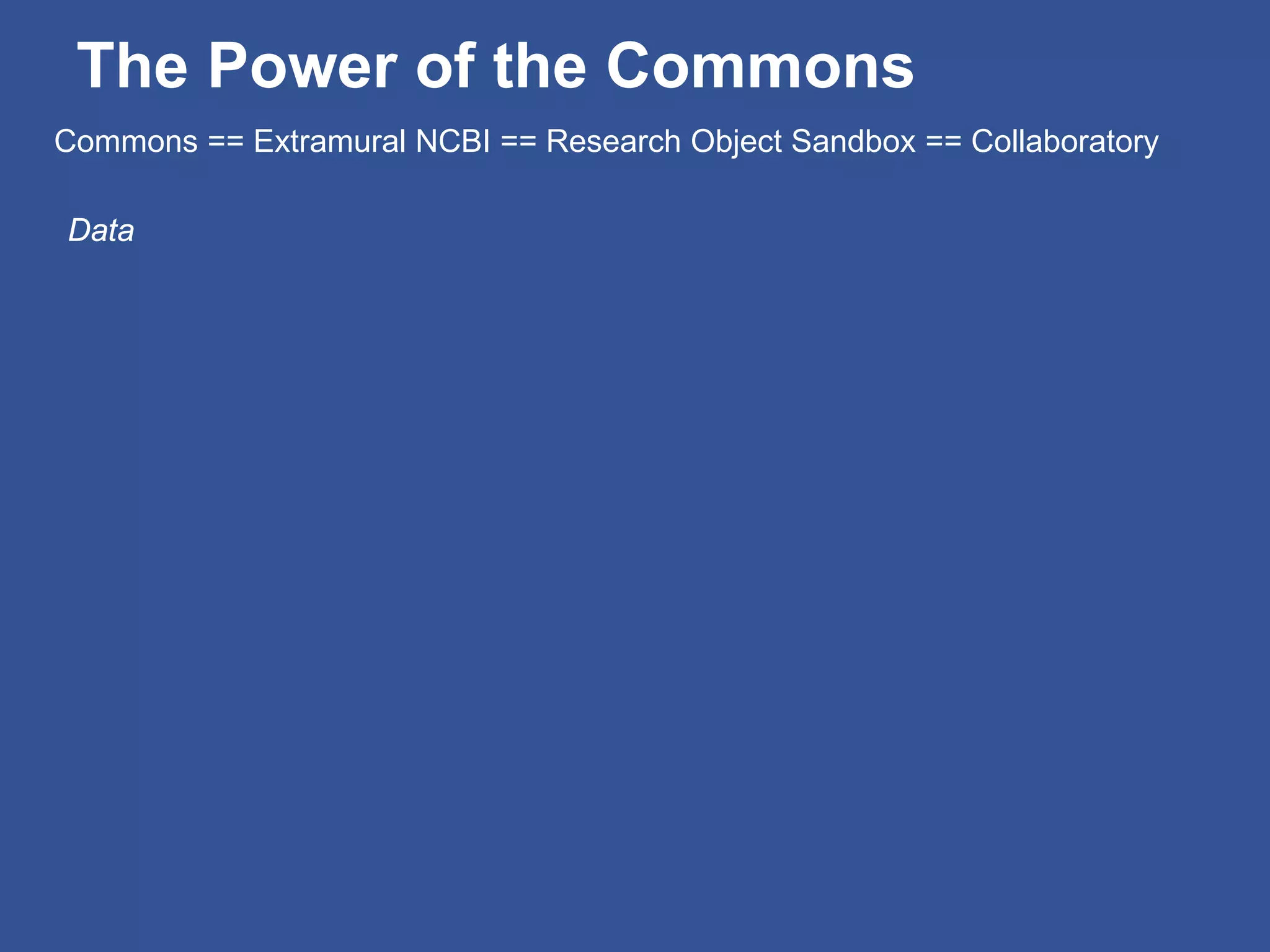
The Power of the Commons
Data
Commons == Extramural NCBI == Research Object Sandbox == Collaboratory
The Power of the Commons
Data
The Why:
Data Sharing Plans
Commons == Extramural NCBI == Research Object Sandbox == Collaboratory
The Power of the Commons
Data
The Why:
Data Sharing Plans
The How:
Commons == Extramural NCBI == Research Object Sandbox == Collaboratory
The Power of the Commons
Data
The Why:
Data Sharing Plans
The How:
Commons == Extramural NCBI == Research Object Sandbox == Collaboratory
The End Game:
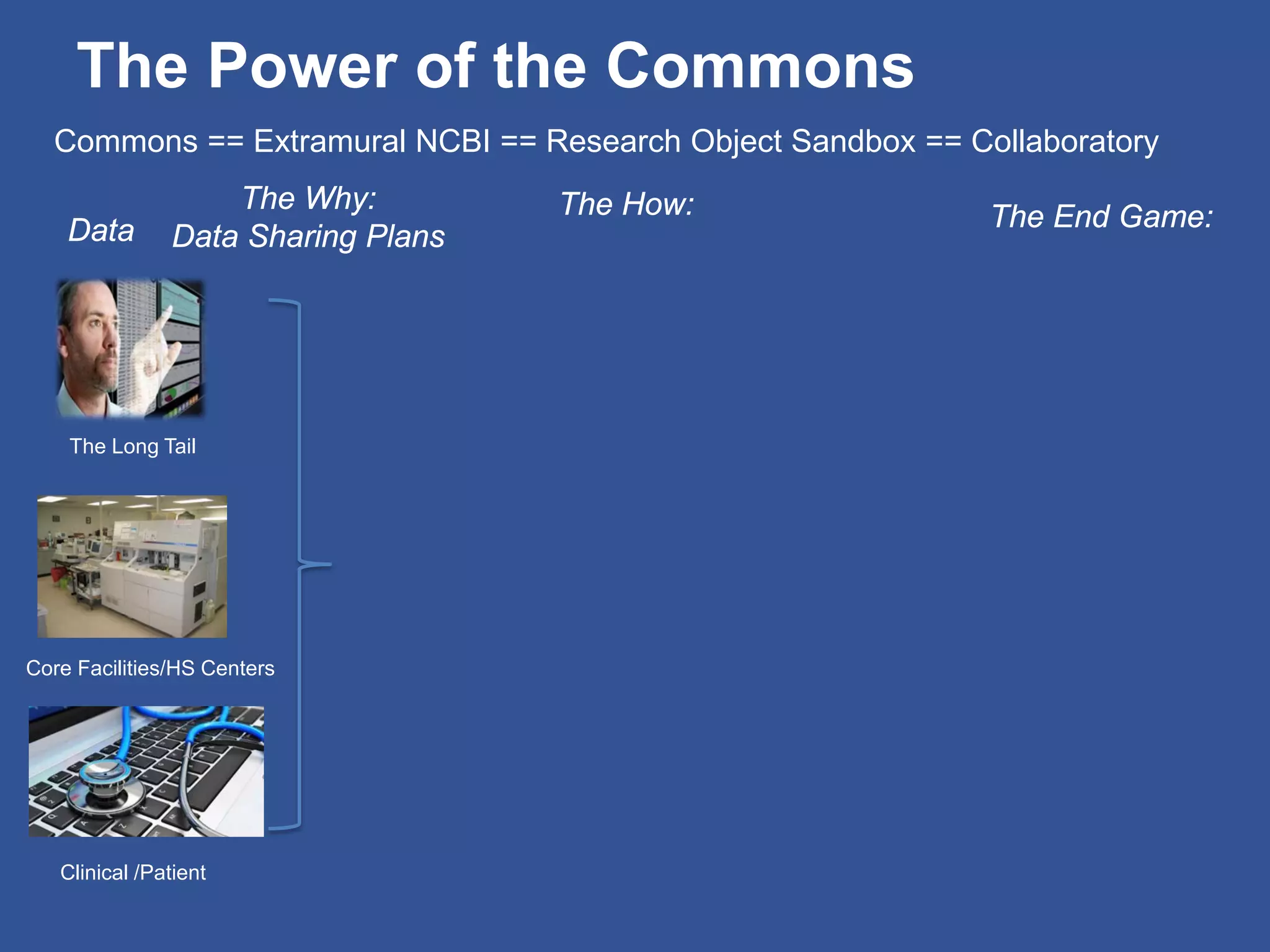
The Power of the Commons
Data
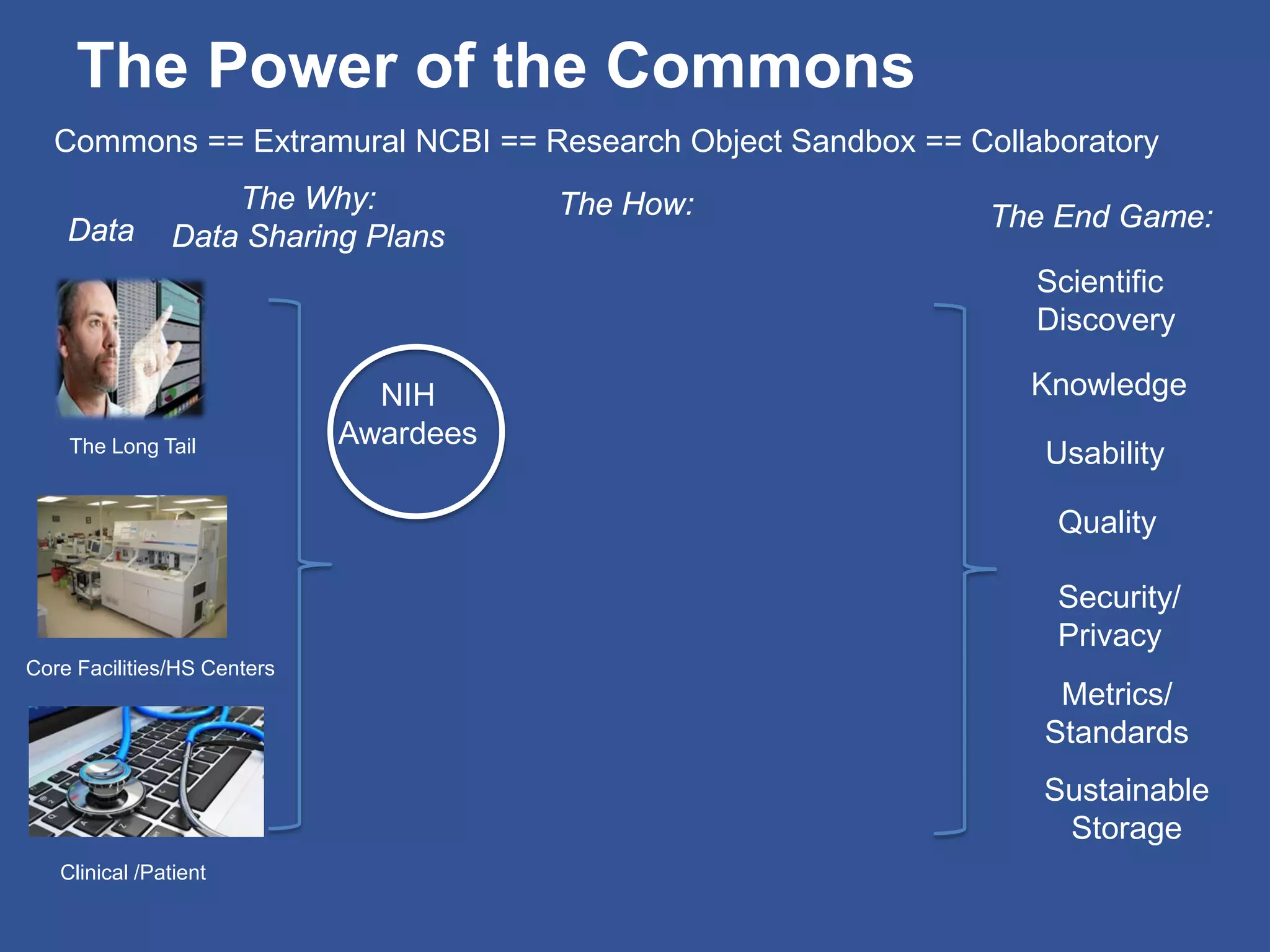
The Long Tail
Core Facilities/HS Centers
Clinical /Patient
The Why:
Data Sharing Plans
The How:
Commons == Extramural NCBI == Research Object Sandbox == Collaboratory
The End Game:
The Power of the Commons
Data
The Long Tail
Core Facilities/HS Centers
Clinical /Patient
The Why:
Data Sharing Plans
The How:
Sustainable
Storage
Quality
Scientific
Discovery
Usability
Security/
Privacy
Commons == Extramural NCBI == Research Object Sandbox == Collaboratory
The End Game:
Knowledge
Metrics/
Standards
The Power of the Commons
Data
The Long Tail
Core Facilities/HS Centers
Clinical /Patient
The Why:
Data Sharing Plans
The How:
Sustainable
Storage
Quality
Scientific
Discovery
Usability
Security/
Privacy
Commons == Extramural NCBI == Research Object Sandbox == Collaboratory
The End Game:
KnowledgeNIH
Awardees
Metrics/
Standards
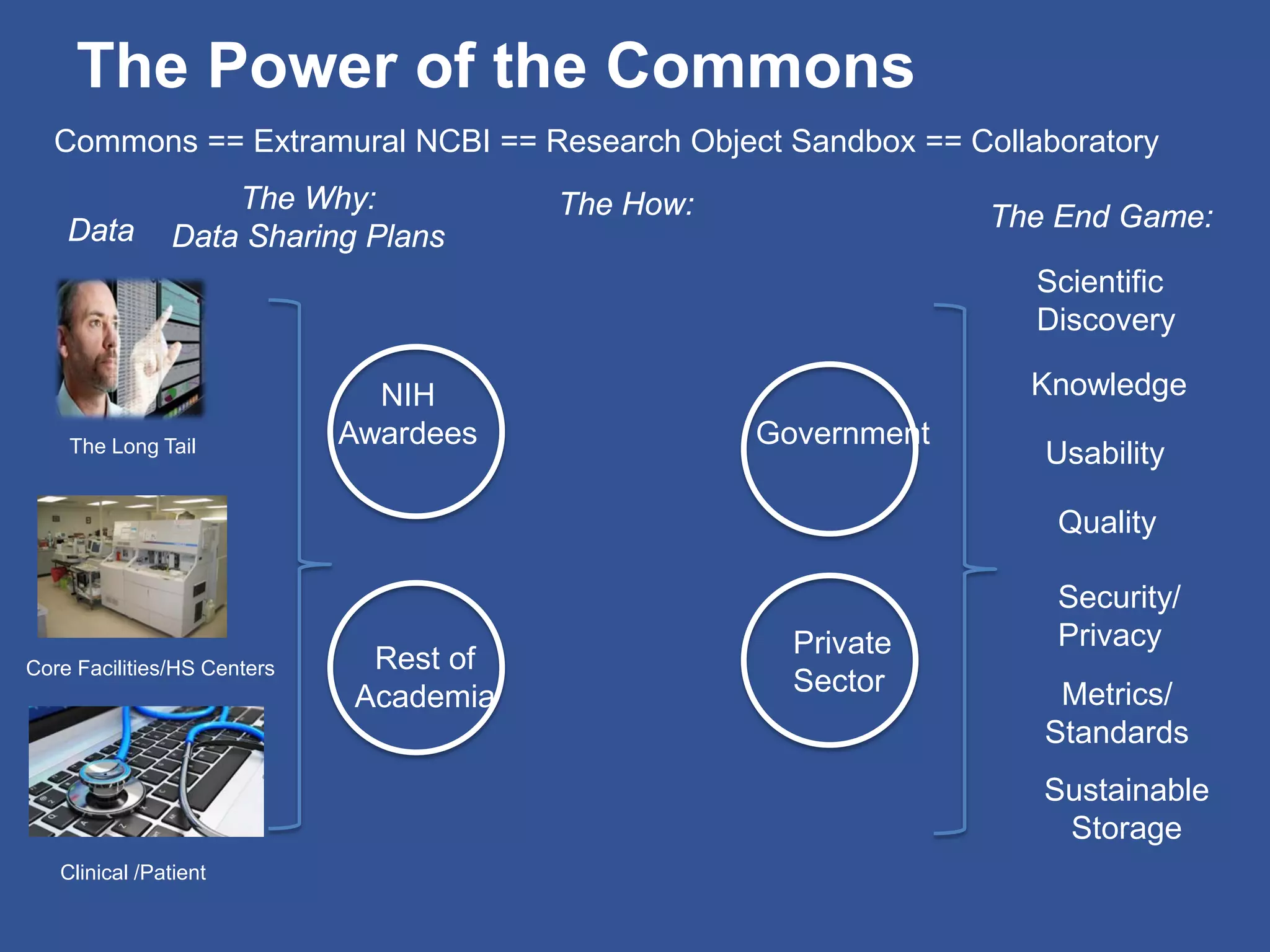
The Power of the Commons
Data
The Long Tail
Core Facilities/HS Centers
Clinical /Patient
The Why:
Data Sharing Plans
Government
The How:
Sustainable
Storage
Quality
Scientific
Discovery
Usability
Security/
Privacy
Commons == Extramural NCBI == Research Object Sandbox == Collaboratory
The End Game:
KnowledgeNIH
Awardees
Private
Sector Metrics/
Standards
Rest of
Academia
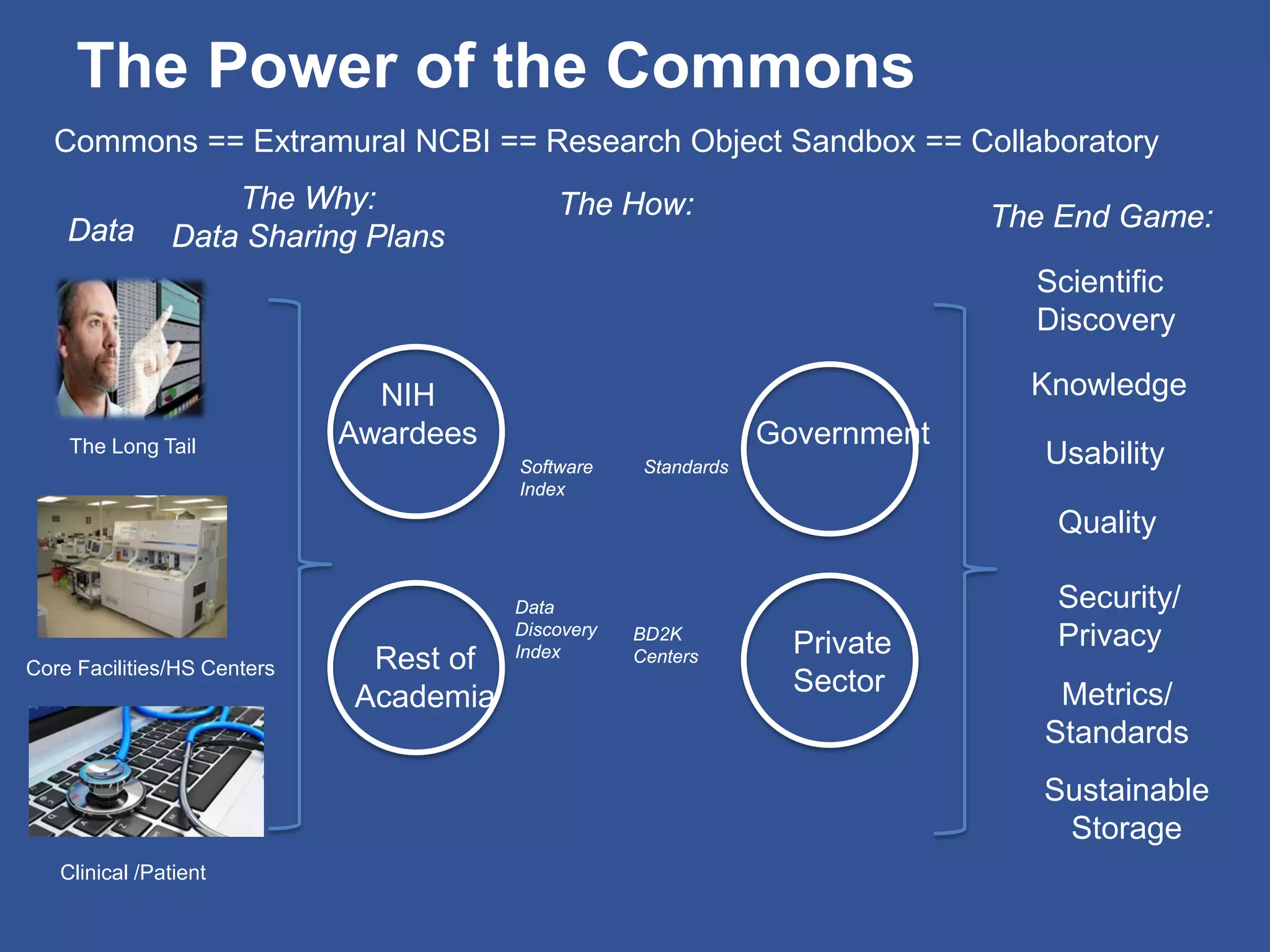
The Power of the Commons
Data
The Long Tail
Core Facilities/HS Centers
Clinical /Patient
The Why:
Data Sharing Plans
Government
The How:
Data
Discovery
Index
Sustainable
Storage
Quality
Scientific
Discovery
Usability
Security/
Privacy
Commons == Extramural NCBI == Research Object Sandbox == Collaboratory
The End Game:
KnowledgeNIH
Awardees
Private
Sector Metrics/
Standards
Rest of
Academia
Software Standards
Index
BD2K
Centers
The Power of the Commons
Data
The Long Tail
Core Facilities/HS Centers
Clinical /Patient
The Why:
Data Sharing Plans
The
Commons
Government
The How:
Data
Discovery
Index
Sustainable
Storage
Quality
Scientific
Discovery
Usability
Security/
Privacy
Commons == Extramural NCBI == Research Object Sandbox == Collaboratory
The End Game:
KnowledgeNIH
Awardees
Private
Sector Metrics/
Standards
Rest of
Academia
Software Standards
Index
BD2K
Centers
The Power of the Commons
Data
The Long Tail
Core Facilities/HS Centers
Clinical /Patient
The Why:
Data Sharing Plans
The
Commons
Government
The How:
Data
Discovery
Index
Sustainable
Storage
Quality
Scientific
Discovery
Usability
Security/
Privacy
Commons == Extramural NCBI == Research Object Sandbox == Collaboratory
The End Game:
KnowledgeNIH
Awardees
Private
Sector Metrics/
Standards
Rest of
Academia
Software Standards
Index
BD2K
Centers
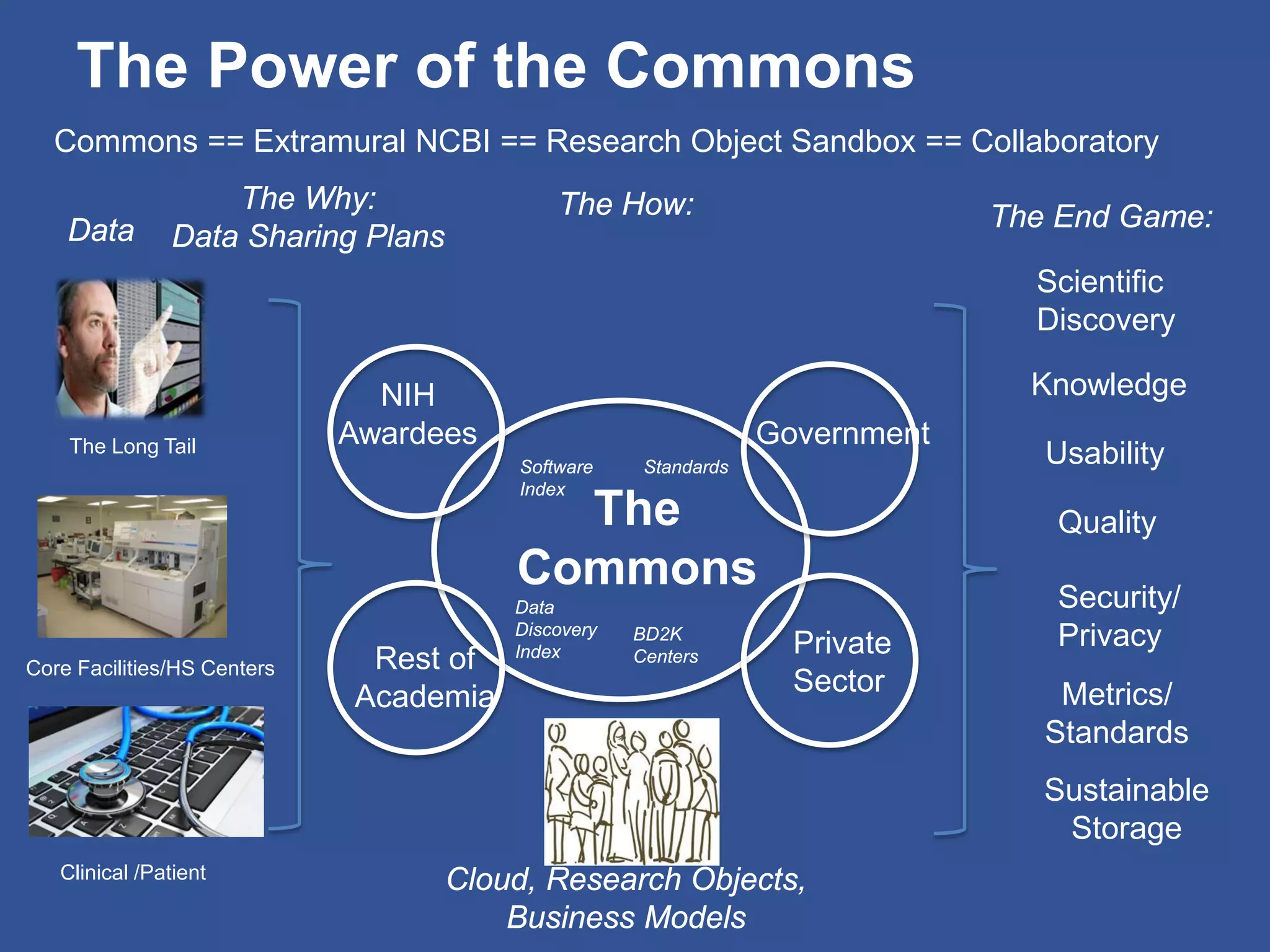
Cloud, Research Objects,
Business Models
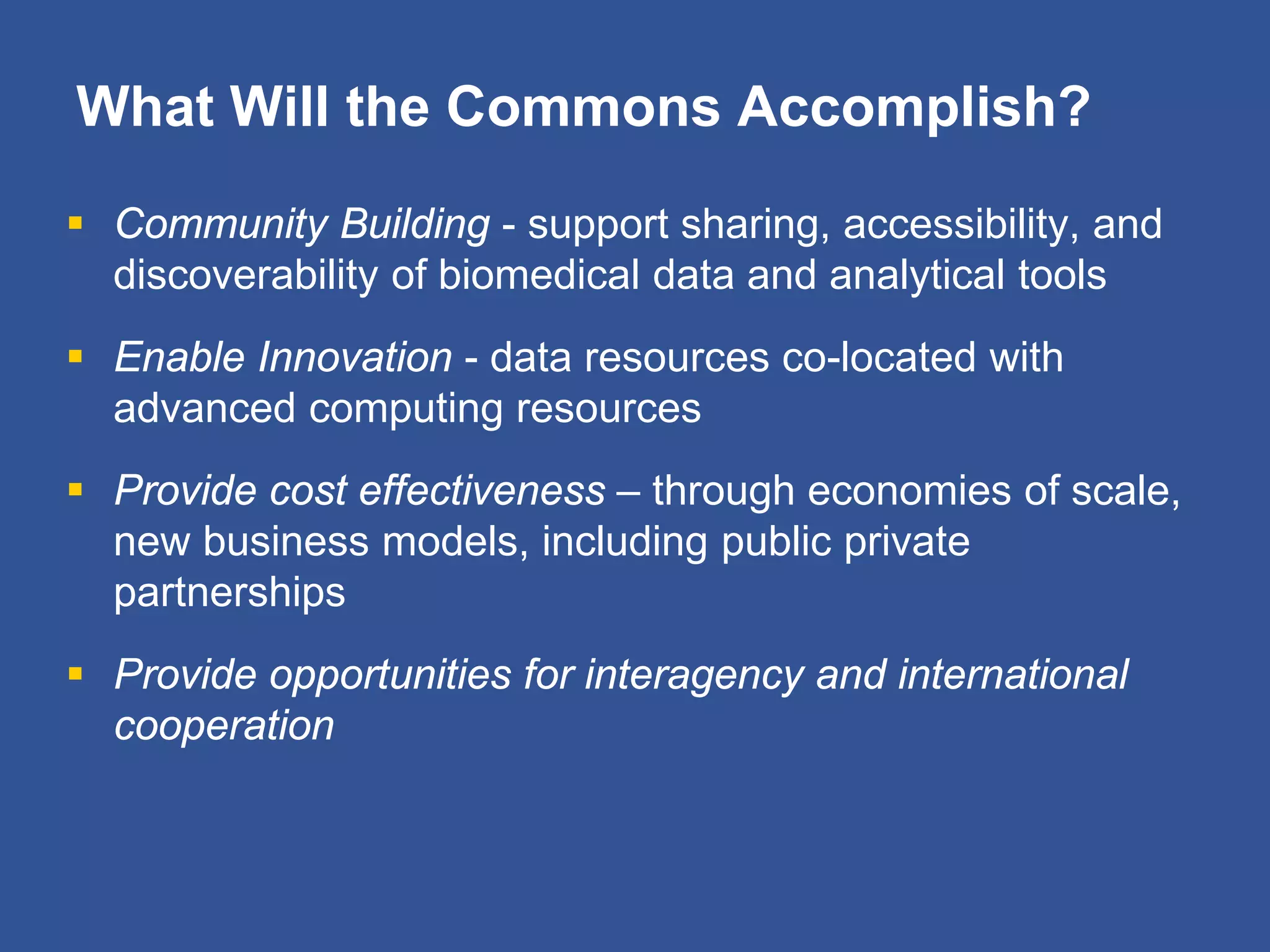
What Will the Commons Accomplish?
 Community Building - support sharing, accessibility, and
discoverability of biomedical data and analytical tools
 Enable Innovation - data resources co-located with
advanced computing resources
 Provide cost effectiveness – through economies of scale,
new business models, including public private
partnerships
 Provide opportunities for interagency and international
cooperation
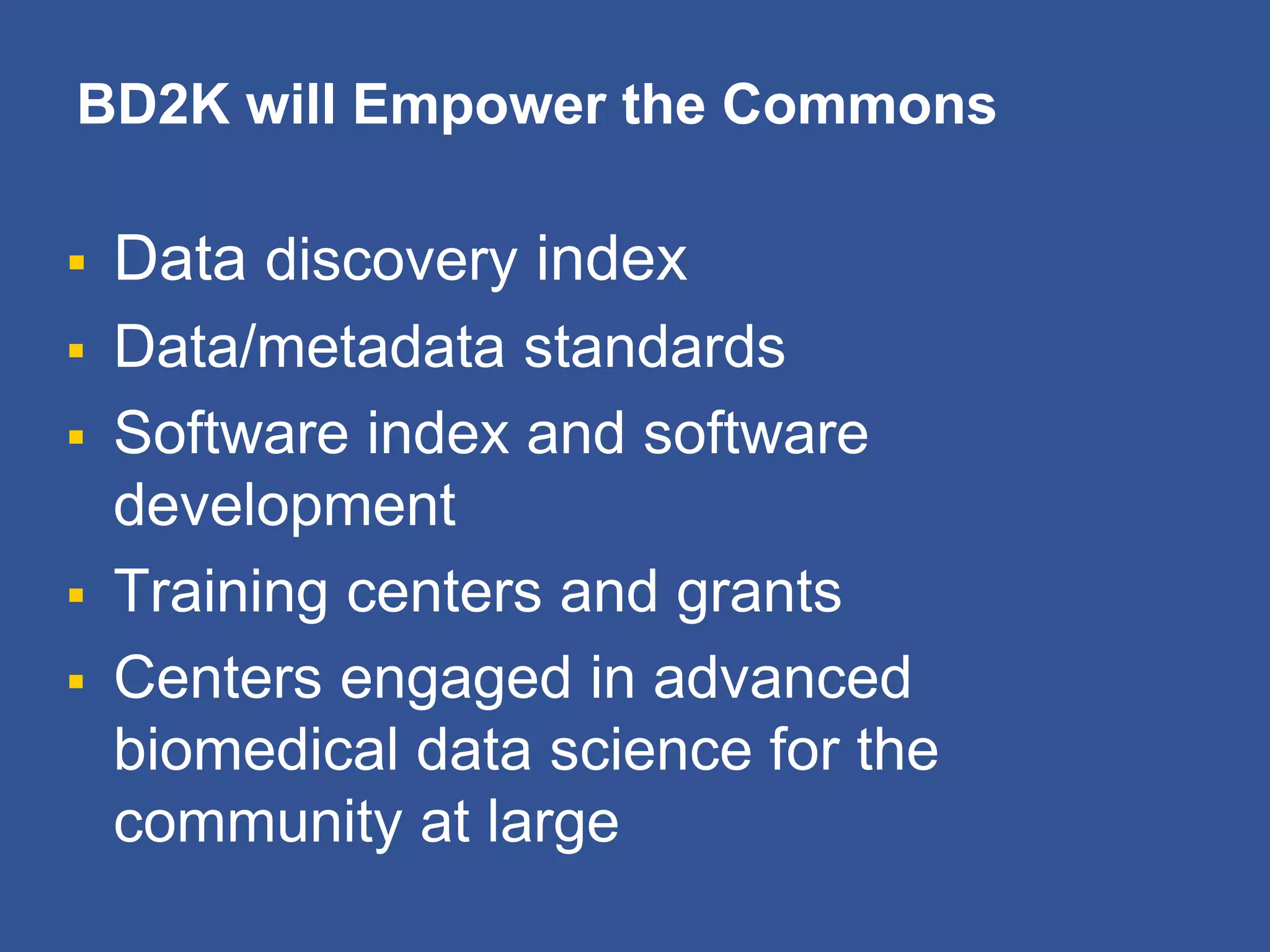
BD2K will Empower the Commons
 Data discovery index
 Data/metadata standards
 Software index and software
development
 Training centers and grants
 Centers engaged in advanced
biomedical data science for the
community at large
NIH…
Turning Discovery Into Health
Q&A
55
To submit a question:
1. Click in the Q&A box on the right side
of your screen, type your question into
the dialog box, click Send button
2. You can also submit questions via
twitter at @hdconsortium
Questions may be submitted at any time
Thank you!

From Research to Practice: New Models for Data-sharing and Collaboration to Improve Health and Healthcare

  • 1.
    From Research toPractice: New Models for Data-sharing and Collaboration to Improve Health and Healthcare Joe Selby, MD, MPH, Executive Director, PCORI Francis Collins, MD, PhD, Director, National Institutes of Health Philip Bourne, PhD, Associate Director for Data Science, NIH Moderator: Dwayne Spradlin, CEO Health Data Consortium May 28, 2014
  • 2.
    Presenters and Moderator JoeSelby, MD, MPH Executive Director PCORI Francis Collins, MD, PhD Director NIH Philip Bourne, PhD Associate Director for Data Science NIH Dwayne Spradlin CEO Health Data Consortium
  • 3.
    Agenda Time Agenda Item 1:00– 1:10 p.m. Welcome 1:10 – 1:20 p.m. Dr. Joe Selby, Executive Director, PCORI 1:20 – 1:30 p.m. Dr. Francis Collins, Director, NIH 1:30 – 1:40 p.m. Dr. Philip Bourne, Associate Director for Data Science, NIH 1:40 – 1:55 p.m. Question and Answer Session 1:55 – 2:00 p.m. Wrap Up and Conclusion
  • 4.
    4 1. Click inthe Q&A box on the right side of your screen, type your question into the dialog box, click Send button 2. You can also submit questions via twitter at @hdconsortium Questions may be submitted at any time Reminder: for audio, Dial 866-640-4044 - Entry Code: 416641# Need help? Press *0 on phone to reach the operator
  • 5.
    Joe Selby, MD,MPH Executive Director PCORI
  • 6.
    Joe Selby, MDMPH, Executive Director PCORI PCORnet: Harnessing Real-World Health Data in Patient-Centered Research
  • 7.
    PCORI’s Mission PCORI helpspeople make informed health care decisions, and improves health care delivery and outcomes, by producing and promoting high integrity, evidence-based information that comes from research guided by patients, caregivers and the broader health care community.
  • 8.
    Influence Research Fundedby Others Speed the Implementation and Use of Evidence Increase Quantity, Quality and Timeliness of Research Information PCORI’s Strategic Goals…
  • 9.
    …Set the Stagefor PCORNet Improve the nation’s capacity to conduct clinical research more efficiently, by creating a large, highly representative, national patient-centered clinical research network with a focus on conducting CER – both randomized and observational. Support a learning US healthcare system, which would allow for large-scale research to be conducted with enhanced accuracy and efficiency within real-world care delivery systems.
  • 10.
    10 PCORnet – Towarda Learning Healthcare System
  • 11.
    Geographic Coverage ofPPRNs and CDRNs
  • 12.
    PCORnet Goals forPhase I Each CDRN will have a defined set of standardized clinical data that is fully inter-operable with data from other CDRNs; each PPRN will also have a standard database with varying amounts of clinical and patient-generated data. PCORnet will have clear policies on decision-making, uses of data, collaboration and knowledge sharing, data sharing, data privacy and security Within each participating CDRN, patients, clinicians and health systems will be actively engaged in governance and use of the network and its data Both CDRNs and PPRNs will have capacity to participate in both large observational studies and pragmatic (simple) randomized clinical trials Networks will demonstrate a readiness to collaborate with researchers from outside PCORnet By 18 Months:
  • 13.
    Francis Collins, MD,PhD Director NIH
  • 14.
    NIH: Data SharingChallenges and Solutions Francis S. Collins, M.D., Ph.D. Director, National Institutes of Health From Research to Practice: New Models for Data Sharing and Collaboration to Improve Health and Healthcare May 28, 2014
  • 15.
    Value of DataSharing  Increases return on investment  Facilitates additional research  Helps to validate findings  Promotes transparency  Many ongoing efforts to increase and facilitate data sharing – Big Data to Knowledge (BD2K) – Plan for increasing public access to data
  • 16.
    Explosion of BigData By Daily Users of NCBI 0 1 2 3 4 5 Users(Millions) Daily Page Views: 28 Million Daily Users: ~4 Million Daily Downloads: 35 Terabytes Peak Hits: 7000 Per Second
  • 17.
    Data Sharing Challengesand Solutions  Genomic Data Sharing  Clinical Data Sharing  Human Subjects Protection
  • 18.
    Data Sharing Challengesand Solutions  Genomic Data Sharing  Clinical Data Sharing  Human Subjects Protection
  • 19.
  • 20.
    NIH Genomic DataSharing (GDS) Policy  Expands expectations to share genomic data under the current NIH Genome-Wide Association Studies (GWAS) Policy to large-scale non- human and human genomic data  Ensures the broad, responsible sharing of genomic research data – Responsibilities of investigators submitting data • Provide data sharing plan to NIH with grant application • Submit data in a timely manner • For human data, obtain consent for data to be used for future research purposes and shared broadly and submit Institutional Certification – Responsibilities of investigators accessing and using data • Terms and conditions for research use of controlled-access data • Conditions for use of unrestricted-access data  Final will be implemented in January 2015
  • 21.
    More to come? GenomicSequencing in the Clinic  Authorized Platform: llumina’s MiSeqDx  FDA cleared two CF tests that use the Illumina platform – Panel of 139 mutations – Sequencing assay  Paves the way for more genomic technologies to gain regulatory clearance  Will allow for the development and use of new genome-based tests MiSeq Benchtop Sequencer (Credit: Illumina)
  • 23.
    Data-sharing Challenges andSolutions  Genomic Data Sharing  Clinical Data Sharing  Human Subjects Protection
  • 24.
    Source: BMJ 2012;344:d7292. Publicationof Clinical Trial Results  NIH-Funded trials published within 100 months of completion  Less than 50% are published within 30 months of completion
  • 25.
    Publication of ClinicalTrial Results NHLBI Clinical Trial Data: Time to Publication by End Point Gordon, et al. N Engl J Med 2013; 369(20): 1926-34
  • 26.
    ClinicalTrials.gov: Public Benefits Enhance patient access to enrollment in clinical trials  Prevent unnecessary or unwitting duplication of trials, especially those found to be unsafe  Honor ethical obligation to participants (results inform science)  Mitigate bias (non publication of negative results)  Inform future research and funding decisions  Increase access to data about marketed products  Facilitate use of findings to improve health All contribute to public trust in clinical research
  • 27.
    Data Sharing Challengesand Solutions  Genomic Data Sharing  Clinical Data Sharing  Human Subjects Protection
  • 28.
    Revisions to theCommon Rule Rationale for the reforms: human subjects research is changing  Growth in research volume  Increase in multi-site studies  Increase in health services and social science research  New technologies: e.g., genomics, imaging, informatics  Increased role of private sector  Increased sharing of specimens and data The nature and volume of potential research data is one key rationale for reforms
  • 29.
    Common Rule Reforms– July 2011 ANPRM Enhancing Protections  Require consent for research with biospecimens/data  Enhance data security and information protection standards  Extend protections to all research conducted at federally-funded institutions Reducing Burden  Promote use of broad consent for future research with biospecimens/data  Broaden exemptions for low risk research  Eliminate redundant IRB reviews and reduce impact of IRB reviews
  • 30.
  • 31.
    Philip Bourne, PhD AssociateDirector for Data Science NIH
  • 32.
    Towards the NIHas a Digital Enterprise Philip E. Bourne, Ph.D. Associate Director for Data Science, National Institutes of Health From Research to Practice: New Models for Data Sharing and Collaboration to Improve Health and Healthcare May 28, 2014
  • 33.
    Some Observations  GoodNews – Data sharing offers unprecedented opportunities to improve healthcare – We have a plan – We are beginning to quantify the issues – We have some of the best data scientists in the world to work on the problems
  • 34.
    Some Observations  BadNews – Sustainability will not be possible without change – OSTP have defined the why but not the how – We do not know how the data we currently have are used – It is difficult to estimate supply and demand  Good News – Data sharing offers unprecedented opportunities to improve healthcare – We have a plan – We are beginning to quantify the issues – We have some of the best data scientists in the world to work on the problems
  • 35.
    We have identified5 programmatic themes and associated deliverables …
  • 36.
    Associate Director forData Science Commons Training Center BD2K Modified Review Sustainability Education Innovation Process • Cloud – Data & Compute • Search • Security • Reproducibility Standards • App Store • Coordinate • Hands-on • Syllabus • MOOCs • Community • Centers • Training Grants • Catalogs • Standards • Analysis • Data Resource Support • Metrics • Best Practices • Evaluation • Portfolio Analysis The Biomedical Research Digital Enterprise Communication Collaboration Programmatic Theme Deliverable Example Features • IC’s • To Researchers • Federal Agencies • International Partners • Computer Scientists Scientific Data Council External Advisory Board
  • 37.
    Associate Director forData Science Commons Training Center BD2K Modified Review Sustainability Education Innovation Process • Cloud – Data & Compute • Search • Security • Reproducibility Standards • App Store • Coordinate • Hands-on • Syllabus • MOOCs • Community • Centers • Training Grants • Catalogs • Standards • Analysis • Data Resource Support • Metrics • Best Practices • Evaluation • Portfolio Analysis The Biomedical Research Digital Enterprise Communication Collaboration Programmatic Theme Deliverable Example Features • IC’s • To Researchers • Federal Agencies • International Partners • Computer Scientists Scientific Data Council External Advisory Board
  • 38.
    Associate Director forData Science Commons Training Center BD2K Modified Review Sustainability Education Innovation Process • Cloud – Data & Compute • Search • Security • Reproducibility Standards • App Store • Coordinate • Hands-on • Syllabus • MOOCs • Community • Centers • Training Grants • Catalogs • Standards • Analysis • Data Resource Support • Metrics • Best Practices • Evaluation • Portfolio Analysis The Biomedical Research Digital Enterprise Communication Collaboration Programmatic Theme Deliverable Example Features • IC’s • To Researchers • Federal Agencies • International Partners • Computer Scientists Scientific Data Council External Advisory Board
  • 39.
    The Power ofthe Commons Commons == Extramural NCBI == Research Object Sandbox == Collaboratory
  • 40.
    The Power ofthe Commons Data Commons == Extramural NCBI == Research Object Sandbox == Collaboratory
  • 41.
    The Power ofthe Commons Data The Why: Data Sharing Plans Commons == Extramural NCBI == Research Object Sandbox == Collaboratory
  • 42.
    The Power ofthe Commons Data The Why: Data Sharing Plans The How: Commons == Extramural NCBI == Research Object Sandbox == Collaboratory
  • 43.
    The Power ofthe Commons Data The Why: Data Sharing Plans The How: Commons == Extramural NCBI == Research Object Sandbox == Collaboratory The End Game:
  • 44.
    The Power ofthe Commons Data The Long Tail Core Facilities/HS Centers Clinical /Patient The Why: Data Sharing Plans The How: Commons == Extramural NCBI == Research Object Sandbox == Collaboratory The End Game:
  • 45.
    The Power ofthe Commons Data The Long Tail Core Facilities/HS Centers Clinical /Patient The Why: Data Sharing Plans The How: Sustainable Storage Quality Scientific Discovery Usability Security/ Privacy Commons == Extramural NCBI == Research Object Sandbox == Collaboratory The End Game: Knowledge Metrics/ Standards
  • 46.
    The Power ofthe Commons Data The Long Tail Core Facilities/HS Centers Clinical /Patient The Why: Data Sharing Plans The How: Sustainable Storage Quality Scientific Discovery Usability Security/ Privacy Commons == Extramural NCBI == Research Object Sandbox == Collaboratory The End Game: KnowledgeNIH Awardees Metrics/ Standards
  • 47.
    The Power ofthe Commons Data The Long Tail Core Facilities/HS Centers Clinical /Patient The Why: Data Sharing Plans Government The How: Sustainable Storage Quality Scientific Discovery Usability Security/ Privacy Commons == Extramural NCBI == Research Object Sandbox == Collaboratory The End Game: KnowledgeNIH Awardees Private Sector Metrics/ Standards Rest of Academia
  • 48.
    The Power ofthe Commons Data The Long Tail Core Facilities/HS Centers Clinical /Patient The Why: Data Sharing Plans Government The How: Data Discovery Index Sustainable Storage Quality Scientific Discovery Usability Security/ Privacy Commons == Extramural NCBI == Research Object Sandbox == Collaboratory The End Game: KnowledgeNIH Awardees Private Sector Metrics/ Standards Rest of Academia Software Standards Index BD2K Centers
  • 49.
    The Power ofthe Commons Data The Long Tail Core Facilities/HS Centers Clinical /Patient The Why: Data Sharing Plans The Commons Government The How: Data Discovery Index Sustainable Storage Quality Scientific Discovery Usability Security/ Privacy Commons == Extramural NCBI == Research Object Sandbox == Collaboratory The End Game: KnowledgeNIH Awardees Private Sector Metrics/ Standards Rest of Academia Software Standards Index BD2K Centers
  • 50.
    The Power ofthe Commons Data The Long Tail Core Facilities/HS Centers Clinical /Patient The Why: Data Sharing Plans The Commons Government The How: Data Discovery Index Sustainable Storage Quality Scientific Discovery Usability Security/ Privacy Commons == Extramural NCBI == Research Object Sandbox == Collaboratory The End Game: KnowledgeNIH Awardees Private Sector Metrics/ Standards Rest of Academia Software Standards Index BD2K Centers Cloud, Research Objects, Business Models
  • 51.
    What Will theCommons Accomplish?  Community Building - support sharing, accessibility, and discoverability of biomedical data and analytical tools  Enable Innovation - data resources co-located with advanced computing resources  Provide cost effectiveness – through economies of scale, new business models, including public private partnerships  Provide opportunities for interagency and international cooperation
  • 52.
    BD2K will Empowerthe Commons  Data discovery index  Data/metadata standards  Software index and software development  Training centers and grants  Centers engaged in advanced biomedical data science for the community at large
  • 53.
  • 54.
  • 55.
    55 To submit aquestion: 1. Click in the Q&A box on the right side of your screen, type your question into the dialog box, click Send button 2. You can also submit questions via twitter at @hdconsortium Questions may be submitted at any time
  • 56.