CLINICAL TRIAL PROTOCOL:
STRATEGY FOR SUCCESS
Natalia Vostokova
Chief Operating Officer
IPHARMA LLC
November 20, 2014
2
3
CLINICAL TRIAL PROTOCOL
• A document that describes the objective(s), design,
methodology, statistical considerations, and
organization of a trial.
ICH GCP, GOST Р 52379-2005 «Good Clinical Practice»
• A document that defines objectives, organization and
methodology of a clinical study, statistical methods
of results analysis and measures to assure safety of
clinical trial subjects.
Russian Federal Law dated April 12, 2010 N 61-ФЗ «On circulation of
medicinal products»
4
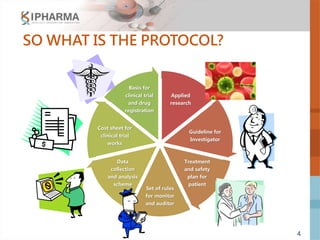
SO WHAT IS THE PROTOCOL?
Applied
research
Guideline for
Investigator
Treatment
and safety
plan for
patient
Set of rules
for monitor
and auditor
Data
collection
and analysis
scheme
Cost sheet for
clinical trial
works
Basis for
clinical trial
and drug
registration
5
THE ESSENCE OF A CLINICAL TRIAL
PROTOCOL
• Form: Clear structured guideline for all parties involved in a
clinical trial
• Objective: To obtain appropriate data on clinical properties of
a drug within the shortest timeline and at minimal cost with
due consideration of the following:
• Medical and scientific relevance and justification
• Treatment and/or safety assurance of patients
• Regulatory requirements and GCP guidelines
• Outcome: Data sufficient to make a decision of drug
registration, shift over to the next phase, additional research
or ending of the clinical program
6
10 ELEMENTS OF A SUCCESSFUL
PROTOCOL
1. Medical expertise
2. Prior experience
3. Hypothesis
4. Endpoints and assessments
5. Safety
6. Credibility
7. Rationality
8. Structure
9. Simplicity
10. Legitimacy
7
1. MEDICAL EXPERTISE
• Standards of care
• International
• Local
• Treatment efficacy assessments
• Treatment schemes
• Basic treatment
• New drugs
• Market features
• Patient population
• Prevalence
• Course of disease: stages,
exacerbations, relapses
• Medical history: concurrent
diseases, conditions,
abnormalities in system organs
• Naïve and on standard treatment
• Sources:
• Key opinion leaders
• Web-sites of European, American, and Russian professional medical
associations
• http://roszdravnadzor.ru «Orders and standards of medical care»
8
2. PRIOR EXPERIENCE
• Previous trials
• International standards for clinical
trials conduct
• Local requirements to specific trials
• Studies of drugs in the same
therapeutic area
• Studies of drugs of the same class
• Competing trials
• Drug properties
• Preclinical data
• Clinical data
• Drugs of the same class
• Sources:
• http://clinicaltrials.gov
• http://grls.rosminzdrav.ru
• http://www.ema.europa.eu/ema/ «Guideline on clinical investigation of
medicinal products in the treatment of …»
• http://www.fda.gov/Drugs/GuidanceComplianceRegulatoryInformation/Guida
nces/ucm064981.htm
9
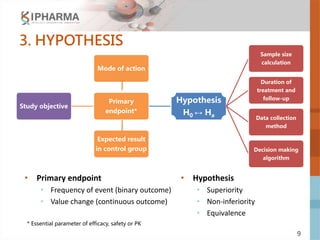
3. HYPOTHESIS
• Primary endpoint
• Frequency of event (binary outcome)
• Value change (continuous outcome)
• Hypothesis
• Superiority
• Non-inferiority
• Equivalence
Study objective
Mode of action
Primary
endpoint*
Hypothesis
Н0 ↔ На
Sample size
calculation
Duration of
treatment and
follow-up
Data collection
method
Decision making
algorithm
Expected result
in control group
* Essential parameter of efficacy, safety or PK
10
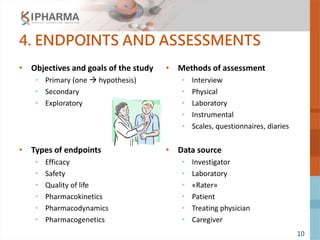
4. ENDPOINTS AND ASSESSMENTS
• Objectives and goals of the study
• Primary (one  hypothesis)
• Secondary
• Exploratory
• Types of endpoints
• Efficacy
• Safety
• Quality of life
• Pharmacokinetics
• Pharmacodynamics
• Pharmacogenetics
• Methods of assessment
• Interview
• Physical
• Laboratory
• Instrumental
• Scales, questionnaires, diaries
• Data source
• Investigator
• Laboratory
• «Rater»
• Patient
• Treating physician
• Caregiver
11
5. SAFETY
• Safety assurance
• Exclusion criteria
• Criteria for early discontinuation
• Concomitant medication
• Rescue therapy
• Prohibited medications
• Food and activity restrictions
• Contraception
• Unscheduled visits
• Follow-up period after the end of
the study treatment
• Safety reporting
• Expected adverse reactions of
the investigational product,
comparator and basic therapy
• AE/SAE/Pregnancy reporting
procedure
• AE of special interest
• Data Safety Monitoring Board
• Unblinding procedure (for
double-blind studies)
12
6. CREDIBILITY
• Control
• Randomization
• Double-blind design
• Placebo control
• Comparison with “gold standard”
• Baseline definition
• Run-in (placebo) period
• Comparable groups
• Homogenous population
• Strict eligibility criteria
• Stable basic treatment
• Instruments
• Central lab
• Validated methods
• Calibration of equipment
• Unified standards and methods of
calculation
• Drug dosing and storage instructions
• Validated scales
• Central rater
• Independent expertise
• Data Monitoring Board
• Training and education
• Site Monitoring
13
7. RATIONALITY
• To implement
• Relevance
• Feasibility
• Consistency
• To save resources
• Cost
• Time
• Efforts
• Price-performance ratio
• To make a decision
• To minimize risks
• To monitor signals
• To stop just in time
14
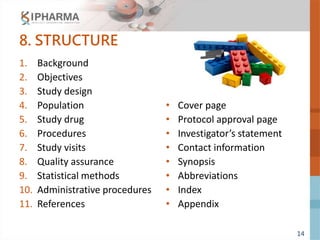
8. STRUCTURE
1. Background
2. Objectives
3. Study design
4. Population
5. Study drug
6. Procedures
7. Study visits
8. Quality assurance
9. Statistical methods
10. Administrative procedures
11. References
• Cover page
• Protocol approval page
• Investigator’s statement
• Contact information
• Synopsis
• Abbreviations
• Index
• Appendix
15
9. SIMPLICITY
• Simple language easy to
understand, definition
of terms and acronyms
• Unambiguous
straightforward wording
• Get to the point, don’t
overburden the text
«…perfection is attained not
when there is nothing more to
add, but when there is nothing
more to remove»
Antoine de Saint Exupéry
16
10. LEGITIMACY
• Regulations
• Ethical aspects
• Distribution of
responsibilities
• Documentation
maintenance
• Quality assurance
• Confidentiality
• References and appendix
• Version and date of the
document
• Signature of Sponsor
and Investigator
17
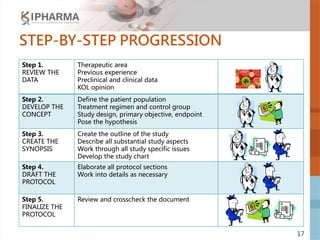
STEP-BY-STEP PROGRESSION
Step 1.
REVIEW THE
DATA
Therapeutic area
Previous experience
Preclinical and clinical data
KOL opinion
Step 2.
DEVELOP THE
CONCEPT
Define the patient population
Treatment regimen and control group
Study design, primary objective, endpoint
Pose the hypothesis
Step 3.
CREATE THE
SYNOPSIS
Create the outline of the study
Describe all substantial study aspects
Work through all study specific issues
Develop the study chart
Step 4.
DRAFT THE
PROTOCOL
Elaborate all protocol sections
Work into details as necessary
Step 5.
FINALIZE THE
PROTOCOL
Review and crosscheck the document
18
THANK YOU FOR YOUR ATTENTION!
Natalia Vostokova
Chief Operating Officer
IPHARMA LLC
2a build. 1, Rabochaya str.
Khimki, Moscow Region
141400, Russia
Phone. +7 (495) 925-3074
Mobile. +7 (926) 098-3633
Email: nv@ipharma.ru
Web-site: www.ipharma.ru
19

Clinical trial protocol: strategy for success

  • 1.
    CLINICAL TRIAL PROTOCOL: STRATEGYFOR SUCCESS Natalia Vostokova Chief Operating Officer IPHARMA LLC November 20, 2014
  • 2.
  • 3.
    3 CLINICAL TRIAL PROTOCOL •A document that describes the objective(s), design, methodology, statistical considerations, and organization of a trial. ICH GCP, GOST Р 52379-2005 «Good Clinical Practice» • A document that defines objectives, organization and methodology of a clinical study, statistical methods of results analysis and measures to assure safety of clinical trial subjects. Russian Federal Law dated April 12, 2010 N 61-ФЗ «On circulation of medicinal products»
  • 4.
    4 SO WHAT ISTHE PROTOCOL? Applied research Guideline for Investigator Treatment and safety plan for patient Set of rules for monitor and auditor Data collection and analysis scheme Cost sheet for clinical trial works Basis for clinical trial and drug registration
  • 5.
    5 THE ESSENCE OFA CLINICAL TRIAL PROTOCOL • Form: Clear structured guideline for all parties involved in a clinical trial • Objective: To obtain appropriate data on clinical properties of a drug within the shortest timeline and at minimal cost with due consideration of the following: • Medical and scientific relevance and justification • Treatment and/or safety assurance of patients • Regulatory requirements and GCP guidelines • Outcome: Data sufficient to make a decision of drug registration, shift over to the next phase, additional research or ending of the clinical program
  • 6.
    6 10 ELEMENTS OFA SUCCESSFUL PROTOCOL 1. Medical expertise 2. Prior experience 3. Hypothesis 4. Endpoints and assessments 5. Safety 6. Credibility 7. Rationality 8. Structure 9. Simplicity 10. Legitimacy
  • 7.
    7 1. MEDICAL EXPERTISE •Standards of care • International • Local • Treatment efficacy assessments • Treatment schemes • Basic treatment • New drugs • Market features • Patient population • Prevalence • Course of disease: stages, exacerbations, relapses • Medical history: concurrent diseases, conditions, abnormalities in system organs • Naïve and on standard treatment • Sources: • Key opinion leaders • Web-sites of European, American, and Russian professional medical associations • http://roszdravnadzor.ru «Orders and standards of medical care»
  • 8.
    8 2. PRIOR EXPERIENCE •Previous trials • International standards for clinical trials conduct • Local requirements to specific trials • Studies of drugs in the same therapeutic area • Studies of drugs of the same class • Competing trials • Drug properties • Preclinical data • Clinical data • Drugs of the same class • Sources: • http://clinicaltrials.gov • http://grls.rosminzdrav.ru • http://www.ema.europa.eu/ema/ «Guideline on clinical investigation of medicinal products in the treatment of …» • http://www.fda.gov/Drugs/GuidanceComplianceRegulatoryInformation/Guida nces/ucm064981.htm
  • 9.
    9 3. HYPOTHESIS • Primaryendpoint • Frequency of event (binary outcome) • Value change (continuous outcome) • Hypothesis • Superiority • Non-inferiority • Equivalence Study objective Mode of action Primary endpoint* Hypothesis Н0 ↔ На Sample size calculation Duration of treatment and follow-up Data collection method Decision making algorithm Expected result in control group * Essential parameter of efficacy, safety or PK
  • 10.
    10 4. ENDPOINTS ANDASSESSMENTS • Objectives and goals of the study • Primary (one  hypothesis) • Secondary • Exploratory • Types of endpoints • Efficacy • Safety • Quality of life • Pharmacokinetics • Pharmacodynamics • Pharmacogenetics • Methods of assessment • Interview • Physical • Laboratory • Instrumental • Scales, questionnaires, diaries • Data source • Investigator • Laboratory • «Rater» • Patient • Treating physician • Caregiver
  • 11.
    11 5. SAFETY • Safetyassurance • Exclusion criteria • Criteria for early discontinuation • Concomitant medication • Rescue therapy • Prohibited medications • Food and activity restrictions • Contraception • Unscheduled visits • Follow-up period after the end of the study treatment • Safety reporting • Expected adverse reactions of the investigational product, comparator and basic therapy • AE/SAE/Pregnancy reporting procedure • AE of special interest • Data Safety Monitoring Board • Unblinding procedure (for double-blind studies)
  • 12.
    12 6. CREDIBILITY • Control •Randomization • Double-blind design • Placebo control • Comparison with “gold standard” • Baseline definition • Run-in (placebo) period • Comparable groups • Homogenous population • Strict eligibility criteria • Stable basic treatment • Instruments • Central lab • Validated methods • Calibration of equipment • Unified standards and methods of calculation • Drug dosing and storage instructions • Validated scales • Central rater • Independent expertise • Data Monitoring Board • Training and education • Site Monitoring
  • 13.
    13 7. RATIONALITY • Toimplement • Relevance • Feasibility • Consistency • To save resources • Cost • Time • Efforts • Price-performance ratio • To make a decision • To minimize risks • To monitor signals • To stop just in time
  • 14.
    14 8. STRUCTURE 1. Background 2.Objectives 3. Study design 4. Population 5. Study drug 6. Procedures 7. Study visits 8. Quality assurance 9. Statistical methods 10. Administrative procedures 11. References • Cover page • Protocol approval page • Investigator’s statement • Contact information • Synopsis • Abbreviations • Index • Appendix
  • 15.
    15 9. SIMPLICITY • Simplelanguage easy to understand, definition of terms and acronyms • Unambiguous straightforward wording • Get to the point, don’t overburden the text «…perfection is attained not when there is nothing more to add, but when there is nothing more to remove» Antoine de Saint Exupéry
  • 16.
    16 10. LEGITIMACY • Regulations •Ethical aspects • Distribution of responsibilities • Documentation maintenance • Quality assurance • Confidentiality • References and appendix • Version and date of the document • Signature of Sponsor and Investigator
  • 17.
    17 STEP-BY-STEP PROGRESSION Step 1. REVIEWTHE DATA Therapeutic area Previous experience Preclinical and clinical data KOL opinion Step 2. DEVELOP THE CONCEPT Define the patient population Treatment regimen and control group Study design, primary objective, endpoint Pose the hypothesis Step 3. CREATE THE SYNOPSIS Create the outline of the study Describe all substantial study aspects Work through all study specific issues Develop the study chart Step 4. DRAFT THE PROTOCOL Elaborate all protocol sections Work into details as necessary Step 5. FINALIZE THE PROTOCOL Review and crosscheck the document
  • 18.
    18 THANK YOU FORYOUR ATTENTION! Natalia Vostokova Chief Operating Officer IPHARMA LLC 2a build. 1, Rabochaya str. Khimki, Moscow Region 141400, Russia Phone. +7 (495) 925-3074 Mobile. +7 (926) 098-3633 Email: nv@ipharma.ru Web-site: www.ipharma.ru
  • 19.

Editor's Notes

  • #10 Binary outcome – risk ratio, relative risk, hazard ration (risk over time)