IJRET: International Journal of Research in Engineering and Technology eISSN: 2319-1163 | PISSN: 2321-7308 
_______________________________________________________________________________________ 
Volume: 03 Special Issue: 07 | May-2014, Available @ http://www.ijret.org 859 
ERROR ENTROPY MINIMIZATION FOR BRAIN IMAGE REGISTRATION USING HILBERT-HUANG TRANSFORM AND ECHO STATE NEURAL NETWORK Rajeswari R1, Anthony Irudhayaraj A2, Purushothaman S3 1Research scholar, Department of computer science, Mother Teresa Women's University, Kodaikanal, India 2Dean, Information Technology, Arupadai Veedu Institute of Technology, Paiyanoor-6031104, India 3Professor, PET Engineering College, Vallioor-627117, India Abstract This paper presents the work on functional magnetic resonance imaging slice registration. Hilbert-Huang transform is used to extract the features of the source image slice and target image slice. The features are used as inputs for the echo state neural network (ESNN) which is recurrent neural network. The training of ESNN is carried out by changing the different number of reservoirs in the hidden layer that result in minimum error between floating and target image slice after registration. Statistical features of the decomposed signals of the source and target image slices are used in the input layer of ESNN. The accuracy of the registration is high. Keywords— Echo state neural network (ESNN), Empirical Mode Decomposition (EMD), Hilbert Transform (HT), Hilbert-Huang transform (HHT), Image alignment, Medical image registration, Processing element 
--------------------------------------------------------------------***------------------------------------------------------------------ 1. INTRODUCTION Image registration is an important requirement in medical imaging. Image registration is the most important step of image fusion task [Yang-Ming Zhu, 14]. Image fusion is used to combine images obtained from different imaging modalities [Woei-Fuh Wang et al., 12]. With increase in a number of imaging techniques and imaging sensors, many modalities are used for image registration. More detailed information can be obtained with many modalities and com- plete characterization of the image anatomies and functional properties are attainable. The analysis of multiple acquisi- tions of the same subject, comparisons of images across sub- jects or groups of subjects are done by the doctors. The medical experts rely on manual comparisons of images, but the abundance of information available makes this task difficult. Automatic processing of the images is required which produce a summary and potentially a visual display of all the available information relevant to the examined body parts. 2 RELATED WORKS The image analysis system is presented [Liao et al., 5] for SPECT images that perform a series of image processing procedures including 3D image registration, gray level nor- malization, and brain extraction, which map all the 3D brain data to the same space for further analysis. 
The aligned images undertake a standard statistical analysis. One such method is a paired t test. This is used to detect the areas in the images with significant deviations. A method is proposed [Cao, 2004] that involves repeated iteration that considers closeness. The algorithm shows closest point map on a regular grid that introduces a registration error. 
Registration is described [Daneshvar and Ghassemian, 2] as a process to align differently acquired images of the same subject. Automated registration of CT and MR head images is studied. It is assumed that images are only of relative translation and rotation. An automatic method to register CT and magnetic resonance (MR) brain images by using first principal directions of feature images is [Lifeng Shang et al., 6] used. The goal of the registration is to find the optimal transformation [Shaoyan sun et al., 8]. Mutual information (MI) is used as a similarity measure when the two images matches [Yongsheng Du et al., 13]. A measure is used and tested on magnetic resonance (MR) and CT images [Dejan Tomazevic et al., 3]. The measure is tested on different im- ages considered for registration. 3. MATERIALS Data has been collected from a standard database available in statistical parametric mapping (SPM) website. The web- site presents Positron emission tomography (PET) and func- tional magnetic resonance imaging (fMRI) data collected for single subject and multiple subjects.
IJRET: International Journal of Research in Engineering and Technology eISSN: 2319-1163 | PISSN: 2321-7308 
_______________________________________________________________________________________ 
Volume: 03 Special Issue: 07 | May-2014, Available @ http://www.ijret.org 860 
4. METHODS 
4.1 Hilbert-Huang Transform (Empirical Mode De-composition 
(EMD) and Hilbert Transform (HT) 
The features of the image slices are extracted using HHT 
[Suganthi and Purushothaman, 7]. These features are used to 
train the ESNN and align the image slices. Instead of taking 
the representative points of the floating image and target 
image, the entire floating image is aligned with the target 
image. 
An image is formed from the quantized values of the conti-nuous 
signals based on the intensity value recognized. The 
details of frequencies, amplitude and phase contents can be 
obtained by decomposition of the signal. This is possible by 
using EMD followed by Hilbert Transform (HT) [Jayashree 
et al., 4] and [Stuti et al., 9]. The EMD produces mono com-ponents 
called intrinsic mode functions (IMFs) from the 
original signal. The signal is the intensity values of a row in 
the image slice. In a 64 X 64 image slice, 64 signals corres-ponding 
to 64 rows and another 64 signals corresponding to 
columns of the image slice are used for alignment. 
Many IMFs can be present in the signal. An IMF represents 
a waveform. The waveform contains a different amplitude. 
Instantaneous frequency (IF) and instantaneous amplitude 
(IA) are obtained by applying HT on an IMF. A signal 
should be symmetric with regard to the local zero mean, and 
should contain the same number of extreme and zero cross-ings. 
The steps involved in EMD of a signal X(t) with harmonics 
(due to the presence of noise in the image slice) into a set of 
IMFs are as follows. 
Step 1: All local maxima of X(t) are identified and the 
points are connected using cubic spline. The interpolated 
curve is obtained. The upper curve is called the upper 
envelope (Maximum_envelope). 
Step 2: All local minima of X(t) are identified and the points 
are connected using cubic spline. The lower curve is called 
the lower envelope (Minimum_envelope) obtained by cubic 
spline. 
Step 3: The average is computed by using equation (1): 
(1) 
where 
a = Maximum_envelope and 
b = Minimum_envelope. 
Step 4: A new signal is obtained by using equation (2) 
(2) 
where 
h11(t) is called first IMF. Subsequent IMF‟s are to be found 
if there are some overshoots and undershoots in the IMF. 
Hence, the envelope mean differs from the true local mean 
and h11(t) becomes asymmetric. 
In order to find the additional IMF‟s, h11(t) is taken as the 
new signal. After nth iteration, we have equation (3): 
(3) 
where 
M1n(t) is the mean envelope after the nth iteration and 
h1(n-1)(t) is the difference between the signal and the mean 
envelope at the (k-1)th iteration. 
Step 5: Coarse to fine (C2F) is calculated by using equations 
(4-6). 
(4) 
where 
n IMF = final IMF obtained 
n IMF 
(5) 
Similarly, 
2 
(a b) 
M 
 
 
h (t) X(t) M (t) 11 11   
h (t) h (t) M (t) 1n 1(n 1) 1n    
1 n C2F  IMF 
2 n (n 1) C2F IMF IMF    
Table 1: Sample image slices used for image 
registration
IJRET: International Journal of Research in Engineering and Technology eISSN: 2319-1163 | PISSN: 2321-7308 
_______________________________________________________________________________________ 
Volume: 03 Special Issue: 07 | May-2014, Available @ http://www.ijret.org 861 
(6) 
where 
C2Fn is the original signal. 
Step 6: Fine to coarse (F2C) is calculated by using equations 
(7-9). 
(7) 
(8) 
(9) 
where 
F2Cn is the original signal. 
Step 7: Hilbert transform is applied for each IMF and ana-lytical 
signal is obtained. A complex signal is obtained from 
each IMF by using equation (10). 
Analytic (IMF) = real(IMF) + imag(IMF) (10) 
Step 8: Instantaneous frequencies are obtained from analyti-cal 
signal by using equation (11) 
IF= [0.5x(angle(-Xanalytic(t+1)*conj(Xanalytic(t-1)))+π]/(2xπ) 
(11) 
Step 9: Instantaneous amplitudes are obtained from the ana-lytical 
signal by using equation (12). 
IA= sqrt(real(IMF)2 + imag(IMF)2 ) (12) 
Feature Extraction from EMD 
Twelve features are extracted: six features from each IF and 
six features from each IA. The features are mean, standard 
deviation, norm, maximum and minimum of IF. Similarly 
mean, standard deviation, norm, maximum and minimum of 
IA and energy of F2C and C2F waveforms of an IMF. 
The features are given in equations (13-25). 
V1=1/d Σ(IF) (13) 
where 
d is samples in a frame and 
V1 is mean value of Instantaneous Frequency. 
V2 =1/d Σ(IF-V1) (14) 
where 
V2 is standard deviation of Instantaneous Frequency. 
V3=maximum (IF) (15) 
V4=minimum (IF) (16) 
V5=norm (IF)2 (17) 
where 
V5 is energy value of frequency. 
V6 = 1/d Σ (IA) (18) 
V7= 1/d Σ(IA-V6) (19) 
where 
V7 is standard deviation of Instantaneous amplitude 
V8=maximum (IA) (20) 
V9=minimum (IA) (21) 
V10=norm (IA) 2 (22) 
where 
V10 is energy value of Amplitude. 
V11= Σ log2 (abs(F2C))2 (23) 
where 
V11 is Log 2 value of F2C 
V12= Σ log2 (abs(C2F))2 (24) 
Where 
V12 is Log 2 value of C2F. (25) 
4.2 Echo State Neural Network 
The ESNN is presented in Figure 1. It possesses highly in-terconnected 
and recurrent topology of nonlinear processing 
element (PEs). The PE contains a reservoir of rich dynamics. 
PE contains information about the history of input and out-put 
patterns. The outputs of the internal PEs (echo states) are 
fed to a memoryless with adaptive readout network. The 
memoryless readout is trained, whereas the recurrent topolo-gy 
has fixed connection weights. This reduces the complexi-ty 
of recurrent neural network (RNN) training to simple li-near 
regression while preserving a recurrent topology. The 
echo state condition is defined in terms of the spectral radius 
(the largest among the absolute values of the eigenvalues of 
a matrix, denoted by (|| ||) of the reservoir‟s weight matrix 
(||W||<1). This condition states that the dynamics of the 
ESNN is uniquely controlled by the input, and the effect of 
the initial states vanishes. The recurrent network is a reser-voir 
of highly interconnected dynamical components, states 
of which are called echo states. The memory less linear rea-dout 
is trained to produce the output. 
By considering the recurrent discrete-time neural network 
given in Figure 1 with „M‟ input units, „N‟ internal PEs, and 
„L‟ output units, the value of the input unit at time „n‟ is u(n) 
= [u1(n), u2(n), . . . , uM(n)]T, 
n n (n 1) 1 C2F  IMF  IMF ....... IMF  
1 1 F2C  IMF 
2 1 2 F2C  IMF  IMF 
n 1 2 n F2C  IMF  IMF ....... IMF
IJRET: International Journal of Research in Engineering and Technology eISSN: 2319-1163 | PISSN: 2321-7308 
_______________________________________________________________________________________ 
Volume: 03 Special Issue: 07 | May-2014, Available @ http://www.ijret.org 862 
The internal units are 
x(n)=[x1(n), x2(n), , xN(n)]T (26) 
Output units are 
y(n) = [y1(n), y2(n),, yL(n)]T (27) 
The connection weights are given 
a) in an (N x M) weight matrix 
back 
ij 
back W  W for 
connections between the input and the internal PEs, 
b) in an N × N matrix 
in 
ij 
in W  W for connections 
between the internal PEs 
c) in an L × N matrix 
out 
ij 
out W  W for connections 
from PEs to the output units and 
d) in an N × L matrix 
back 
ij 
back W  W for the connec-tions 
that project back from the output to the internal 
PEs. 
The activation of the internal PEs (echo state) is updated 
according to equation (28). 
x(n + 1) = f(Win u(n + 1) + W X(n) + 
Wback y(n)), (28) 
where 
f = ( f1, f2, . . . , fN) are the internal PEs‟ activation functions. 
All fi‟s are hyperbolic tangent functions 
x x 
x x 
e e 
e e 
 
 
 
 
. The out-put 
from the readout network is computed according to 
y(n + 1) = fout (Wout x(n + 1)), . (29) 
where 
are the output unit‟s nonli-near 
functions. 
Training ESNN Algorithm 
The algorithm for training the ESNN is as follows: 
Step 1: Read a Pattern (I) (floating image) and its Target (T) 
value. 
Step 2: The number of reservoirs is fixed. 
Step 3: The number of nodes in the input layer = length of 
pattern. 
Step 4: The number of nodes in the output layer = number 
of target values. 
Step 5: Random weights are initialized between input and 
hidden layer (Ih) hidden and output. 
Step 6: Obtain S = tanh(Ih*I + Ho * T + Ho * T). 
Step 7: Obtain a = Pseudo inverse (S). 
Step 8: Obtain Wout = a * T and store Wout for testing. 
The algorithm for testing / registration on image slice is 
as follows: 
Step 1: Read a Pattern (I) (floating image). 
Step 2: Obtain F=Ih*I. 
Step 3: TH = Ho * T. 
Step 4: TT = R*S. 
Step 5: S = tanh(F+TT+TH). 
Step 6: a = Pseudo inverse (S). 
Step 7: Estimated = a * Wout. 
Step 8: Relocate the intensity values. 
5. RESULTS AND DISCUSSIONS 
Images have been collected from the standard database 
available in SPM website. The website presents PET and 
fMRI data collected for single subject and multiple subjects. 
Rest condition and task related images have been presented 
with realignment, co-registration, normalization, smoothing 
wherever applicable. 
Figures (2-11) present plots of the statistical features ob-tained 
through equations (13-22). 
( , ,...., ) 1 2 
out 
L 
out out out f  f f f 
Fig. 1. Schematic diagram for training ESNN with HHT 
features
IJRET: International Journal of Research in Engineering and Technology eISSN: 2319-1163 | PISSN: 2321-7308 
_______________________________________________________________________________________ 
Volume: 03 Special Issue: 07 | May-2014, Available @ http://www.ijret.org 863 
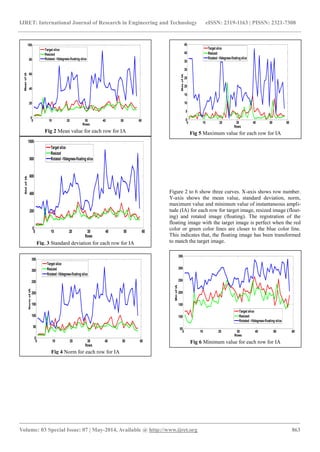
Figure 2 to 6 show three curves. X-axis shows row number. 
Y-axis shows the mean value, standard deviation, norm, 
maximum value and minimum value of instantaneous ampli-tude 
(IA) for each row for target image, resized image (float-ing) 
and rotated image (floating). The registration of the 
floating image with the target image is perfect when the red 
color or green color lines are closer to the blue color line. 
This indicates that, the floating image has been transformed 
to match the target image. 
Fig 2 Mean value for each row for IA 
0 10 20 30 40 50 60 
0 
20 
40 
60 
80 
100 
Rows 
Mean of IA 
Target slice 
Resized 
Rotated -10degrees-floating slice 
Fig. 3 Standard deviation for each row for IA 
0 10 20 30 40 50 60 
0 
200 
400 
600 
800 
1000 
Rows 
Std of IA 
Target slice 
Resized 
Rotated -10degrees-floating slice 
Fig 4 Norm for each row for IA 
0 10 20 30 40 50 60 
0 
50 
100 
150 
200 
250 
300 
350 
Rows 
Norm of IA 
Target slice 
Resized 
Rotated -10degrees-floating slice 
Fig 5 Maximum value for each row for IA 
0 10 20 30 40 50 60 
0 
5 
10 
15 
20 
25 
30 
35 
40 
45 
Rows 
Max of IA 
Target slice 
Resized 
Rotated -10degrees-floating slice 
Fig 6 Minimum value for each row for IA 
0 10 20 30 40 50 60 
50 
100 
150 
200 
250 
300 
350 
Rows 
Min of IA 
Target slice 
Resized 
Rotated -10degrees-floating slice
IJRET: International Journal of Research in Engineering and Technology eISSN: 2319-1163 | PISSN: 2321-7308 
_______________________________________________________________________________________ 
Volume: 03 Special Issue: 07 | May-2014, Available @ http://www.ijret.org 864 
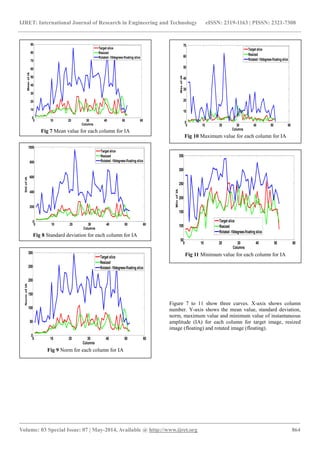
Figure 7 to 11 show three curves. X-axis shows column 
number. Y-axis shows the mean value, standard deviation, 
norm, maximum value and minimum value of instantaneous 
amplitude (IA) for each column for target image, resized 
image (floating) and rotated image (floating). 
Fig 7 Mean value for each column for IA 
0 10 20 30 40 50 60 
0 
10 
20 
30 
40 
50 
60 
70 
80 
90 
Columns 
Mean of IA 
Target slice 
Resized 
Rotated -10degrees-floating slice 
Fig 9 Norm for each column for IA 
0 10 20 30 40 50 60 
0 
50 
100 
150 
200 
250 
300 
Columns 
Norm of IA 
Target slice 
Resized 
Rotated -10degrees-floating slice 
Fig 10 Maximum value for each column for IA 
0 10 20 30 40 50 60 
0 
10 
20 
30 
40 
50 
60 
70 
Columns 
Max of IA 
Target slice 
Resized 
Rotated -10degrees-floating slice 
Fig 11 Minimum value for each column for IA 
0 10 20 30 40 50 60 
50 
100 
150 
200 
250 
300 
350 
Columns 
Min of IA 
Target slice 
Resized 
Rotated -10degrees-floating slice 
Fig 8 Standard deviation for each column for IA 
0 10 20 30 40 50 60 
0 
200 
400 
600 
800 
1000 
Columns 
Std of IA 
Target slice 
Resized 
Rotated -10degrees-floating slice
IJRET: International Journal of Research in Engineering and Technology eISSN: 2319-1163 | PISSN: 2321-7308 
_______________________________________________________________________________________ 
Volume: 03 Special Issue: 07 | May-2014, Available @ http://www.ijret.org 865 
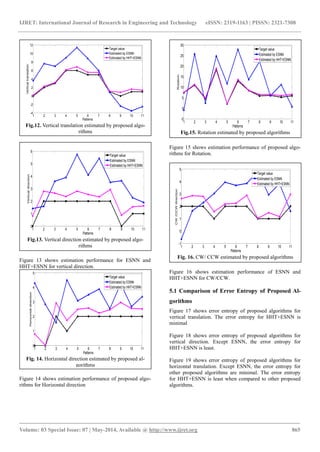
Figure 13 shows estimation performance for ESNN and 
HHT+ESNN for vertical direction. 
Figure 14 shows estimation performance of proposed algo-rithms 
for Horizontal direction 
Figure 15 shows estimation performance of proposed algo-rithms 
for Rotation. 
Figure 16 shows estimation performance of ESNN and 
HHT+ESNN for CW/CCW. 
5.1 Comparison of Error Entropy of Proposed Al-gorithms 
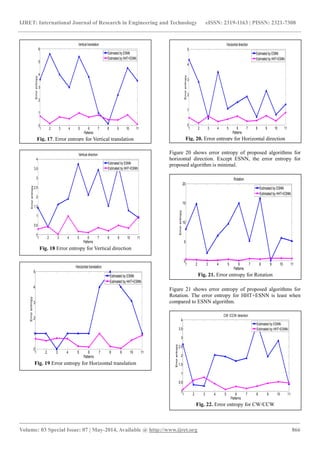
Figure 17 shows error entropy of proposed algorithms for 
vertical translation. The error entropy for HHT+ESNN is 
minimal 
Figure 18 shows error entropy of proposed algorithms for 
vertical direction. Except ESNN, the error entropy for 
HHT+ESNN is least. 
Figure 19 shows error entropy of proposed algorithms for 
horizontal translation. Except ESNN, the error entropy for 
other proposed algorithms are minimal. The error entropy 
for HHT+ESNN is least when compared to other proposed 
algorithms. 
Fig.15. Rotation estimated by proposed algorithms 
1 2 3 4 5 6 7 8 9 10 11 
-5 
0 
5 
10 
15 
20 
25 
30 
Patterns 
Rotation 
Target value 
Estimated by ESNN 
Estimated by HHT+ESNN 
Fig.12. Vertical translation estimated by proposed algo-rithms 
1 2 3 4 5 6 7 8 9 10 11 
-4 
-2 
0 
2 
4 
6 
8 
10 
12 
Patterns 
Vertical translation 
Target value 
Estimated by ESNN 
Estimated by HHT+ESNN 
Fig.13. Vertical direction estimated by proposed algo-rithms 
1 2 3 4 5 6 7 8 9 10 11 
0 
1 
2 
3 
4 
5 
6 
Patterns 
Vertical direction 
Target value 
Estimated by ESNN 
Estimated by HHT+ESNN 
Fig. 14. Horizontal direction estimated by proposed al-gorithms 
1 2 3 4 5 6 7 8 9 10 11 
0 
1 
2 
3 
4 
5 
Patterns 
Horizontal direction 
Target value 
Estimated by ESNN 
Estimated by HHT+ESNN 
Fig. 16. CW/ CCW estimated by proposed algorithms 
1 2 3 4 5 6 7 8 9 10 11 
-1 
0 
1 
2 
3 
4 
5 
Patterns 
CW /CCW direction 
Target value 
Estimated by ESNN 
Estimated by HHT+ESNN
IJRET: International Journal of Research in Engineering and Technology eISSN: 2319-1163 | PISSN: 2321-7308 
_______________________________________________________________________________________ 
Volume: 03 Special Issue: 07 | May-2014, Available @ http://www.ijret.org 866 
Figure 20 shows error entropy of proposed algorithms for 
horizontal direction. Except ESNN, the error entropy for 
proposed algorithm is minimal. 
Figure 21 shows error entropy of proposed algorithms for 
Rotation. The error entropy for HHT+ESNN is least when 
compared to ESNN algorithm. 
Fig. 17. Error entropy for Vertical translation 
1 2 3 4 5 6 7 8 9 10 11 
0 
1 
2 
3 
4 
5 
6 
Patterns 
Error entropy 
Vertical translation 
Estimated by ESNN 
Estimated by HHT+ESNN 
Fig. 18 Error entropy for Vertical direction 
1 2 3 4 5 6 7 8 9 10 11 
0 
0.5 
1 
1.5 
2 
2.5 
3 
3.5 
4 
Patterns 
Error entropy 
Vertical direction 
Estimated by ESNN 
Estimated by HHT+ESNN 
Fig. 19 Error entropy for Horizontal translation 
1 2 3 4 5 6 7 8 9 10 11 
0 
1 
2 
3 
4 
5 
Patterns 
Error entropy 
Horizontal translation 
Estimated by ESNN 
Estimated by HHT+ESNN 
Fig. 20. Error entropy for Horizontal direction 
1 2 3 4 5 6 7 8 9 10 11 
0 
1 
2 
3 
4 
5 
Patterns 
Error entropy 
Horizontal direction 
Estimated by ESNN 
Estimated by HHT+ESNN 
Fig. 21. Error entropy for Rotation 
1 2 3 4 5 6 7 8 9 10 11 
0 
5 
10 
15 
20 
Patterns 
Error entropy 
Rotation 
Estimated by ESNN 
Estimated by HHT+ESNN 
Fig. 22. Error entropy for CW/CCW 
1 2 3 4 5 6 7 8 9 10 11 
0 
0.5 
1 
1.5 
2 
2.5 
3 
3.5 
4 
Patterns 
Error entropy 
CW /CCW direction 
Estimated by ESNN 
Estimated by HHT+ESNN
IJRET: International Journal of Research in Engineering and Technology eISSN: 2319-1163 | PISSN: 2321-7308 
_______________________________________________________________________________________ 
Volume: 03 Special Issue: 07 | May-2014, Available @ http://www.ijret.org 867 
Figure 22 shows error entropy of proposed algorithms for CW/CCW. Except ESNN, the error entropy for proposed algorithm HHT+ESNN is minimal. The figures show HHT+ESNN produce least error entropy which indicates high registration accuracy. 6. CONCLUSIONS Hilbert Huang transform has been used for extracting fea- tures from the fMRI slices. These features are used as inputs for training ESNN algorithm. Using the trained information, registration of fMRI slices are done. The HHT features helps in accuracte image slice registration. REFERENCES 
[1] Z.Cao, S.Pan, R.Li, R.Balachandran, J.M.Fitzpatrick, W.C.Chapman, and B.M.Dawant, “Registration of medical images using an interpo- lated closest point transform Method and valida- tion”, Medical Image Analysis,vol.8,pp.421- 427,2004. 
[2] S.Daneshvar, and H.Ghassemian: A hybrid algo- rithm for medical image registration. IEEE Engi- neering Medicine Biology Society, Conference Pro- ceedings, vol. 3: pp.3272-3275, 2005. 
[3] Dejan Tomazevic, Bostjan Likar, Franjo Pernus: “Multi-feature mutual information image registra- tion”, Image analysis and stereology quantitative methods and applications; vol.31,No.10,pp.43-53, 2012 
[4] T.Jayasree, D.Devaraj, and R.Sukanesh, “Power quality disturbance classification using Hilbert trans- form and RBF networks”, Neuro computing, vol.73, no.9, pp.1451-1456, 2010. 
[5] Y.L.Liao, N.T.Chiu, C.M.Weng, and Y.N.Sun: “Registration and Normalization Techniques for As- sessing Brain Functional Images”, Biomedical Engi- neering applications Basis and Communications; vol.15, pp.87-94, 2003. 
[6] Lifeng Shang, Lv Jian Cheng, Zhang Yi, “Rigid medical image registration using PCA neural net- work”, Neuro computing, vol.69, pp.1717-1722, 2006. 
[7] S.Purushothaman and D.Suganthi, “fMRI segmenta- tion using echo state neural network”, International Journal of Image Processing, vol. 2, no.1, pp.1-9, 2008. 
[8] Shaoyan Sun, Liwei Zhang, and Chonghui Guo: “Medical Image Registration by Minimizing Diver- gence Measure Based on Tsallis Entropy”, World Academy of Science, Engineering and Technology, pp.223-228, 2006. 
[9] Stuti Shukla, S. Mishra, and Bhim Singh: “Empiri- cal-Mode Decomposition with Hilbert Transform for Power-Quality Assessment”, IEEE transactions on power delivery; vol.24,no.4, pp.2159–2165, 2009. 
[10] T.Suganthi and S.Purushothaman, “Segmentation Of Satellite Images Using Fuzzy Logic And Hilbert Huang Transform”, International Journal of Engi- 
neering Research and Applications, vol.2, issue 2, Mar-Apr 2012, pp.1020-1023, 2012. 
[11] Woei-Fuh Wang, Frank Qh Ngo1, Jyh-Cheng Chen, Ray-Ming Huang, Kuo-Liang Chou, and Ren-Shyan Liu, “Pet-Mri Image Registration and Fusion Using Artificial Neural Networks,” Biomedical Engineer- ing applications, Basis and Communications, vol.15, pp.95-99, 2003. 
[12] Yongsheng Du, Anping Song, Lei Zhu, Wu Zhang: “A Mixed-Type Registration Approach in Medical Image Processing”, Biomedical Engineering and In- formatics BMEI '09, pp.1-4, 2009. 
[13] Yang-Ming Zhu, “Volume Image Registration by Cross-Entropy Optimization”, IEEE Transactions on Medical Imaging, vol.21,no.2,pp.174-180,2002.

Error entropy minimization for brain image registration using hilbert huang transform and echo state neural network

  • 1.
    IJRET: International Journalof Research in Engineering and Technology eISSN: 2319-1163 | PISSN: 2321-7308 _______________________________________________________________________________________ Volume: 03 Special Issue: 07 | May-2014, Available @ http://www.ijret.org 859 ERROR ENTROPY MINIMIZATION FOR BRAIN IMAGE REGISTRATION USING HILBERT-HUANG TRANSFORM AND ECHO STATE NEURAL NETWORK Rajeswari R1, Anthony Irudhayaraj A2, Purushothaman S3 1Research scholar, Department of computer science, Mother Teresa Women's University, Kodaikanal, India 2Dean, Information Technology, Arupadai Veedu Institute of Technology, Paiyanoor-6031104, India 3Professor, PET Engineering College, Vallioor-627117, India Abstract This paper presents the work on functional magnetic resonance imaging slice registration. Hilbert-Huang transform is used to extract the features of the source image slice and target image slice. The features are used as inputs for the echo state neural network (ESNN) which is recurrent neural network. The training of ESNN is carried out by changing the different number of reservoirs in the hidden layer that result in minimum error between floating and target image slice after registration. Statistical features of the decomposed signals of the source and target image slices are used in the input layer of ESNN. The accuracy of the registration is high. Keywords— Echo state neural network (ESNN), Empirical Mode Decomposition (EMD), Hilbert Transform (HT), Hilbert-Huang transform (HHT), Image alignment, Medical image registration, Processing element --------------------------------------------------------------------***------------------------------------------------------------------ 1. INTRODUCTION Image registration is an important requirement in medical imaging. Image registration is the most important step of image fusion task [Yang-Ming Zhu, 14]. Image fusion is used to combine images obtained from different imaging modalities [Woei-Fuh Wang et al., 12]. With increase in a number of imaging techniques and imaging sensors, many modalities are used for image registration. More detailed information can be obtained with many modalities and com- plete characterization of the image anatomies and functional properties are attainable. The analysis of multiple acquisi- tions of the same subject, comparisons of images across sub- jects or groups of subjects are done by the doctors. The medical experts rely on manual comparisons of images, but the abundance of information available makes this task difficult. Automatic processing of the images is required which produce a summary and potentially a visual display of all the available information relevant to the examined body parts. 2 RELATED WORKS The image analysis system is presented [Liao et al., 5] for SPECT images that perform a series of image processing procedures including 3D image registration, gray level nor- malization, and brain extraction, which map all the 3D brain data to the same space for further analysis. The aligned images undertake a standard statistical analysis. One such method is a paired t test. This is used to detect the areas in the images with significant deviations. A method is proposed [Cao, 2004] that involves repeated iteration that considers closeness. The algorithm shows closest point map on a regular grid that introduces a registration error. Registration is described [Daneshvar and Ghassemian, 2] as a process to align differently acquired images of the same subject. Automated registration of CT and MR head images is studied. It is assumed that images are only of relative translation and rotation. An automatic method to register CT and magnetic resonance (MR) brain images by using first principal directions of feature images is [Lifeng Shang et al., 6] used. The goal of the registration is to find the optimal transformation [Shaoyan sun et al., 8]. Mutual information (MI) is used as a similarity measure when the two images matches [Yongsheng Du et al., 13]. A measure is used and tested on magnetic resonance (MR) and CT images [Dejan Tomazevic et al., 3]. The measure is tested on different im- ages considered for registration. 3. MATERIALS Data has been collected from a standard database available in statistical parametric mapping (SPM) website. The web- site presents Positron emission tomography (PET) and func- tional magnetic resonance imaging (fMRI) data collected for single subject and multiple subjects.
  • 2.
    IJRET: International Journalof Research in Engineering and Technology eISSN: 2319-1163 | PISSN: 2321-7308 _______________________________________________________________________________________ Volume: 03 Special Issue: 07 | May-2014, Available @ http://www.ijret.org 860 4. METHODS 4.1 Hilbert-Huang Transform (Empirical Mode De-composition (EMD) and Hilbert Transform (HT) The features of the image slices are extracted using HHT [Suganthi and Purushothaman, 7]. These features are used to train the ESNN and align the image slices. Instead of taking the representative points of the floating image and target image, the entire floating image is aligned with the target image. An image is formed from the quantized values of the conti-nuous signals based on the intensity value recognized. The details of frequencies, amplitude and phase contents can be obtained by decomposition of the signal. This is possible by using EMD followed by Hilbert Transform (HT) [Jayashree et al., 4] and [Stuti et al., 9]. The EMD produces mono com-ponents called intrinsic mode functions (IMFs) from the original signal. The signal is the intensity values of a row in the image slice. In a 64 X 64 image slice, 64 signals corres-ponding to 64 rows and another 64 signals corresponding to columns of the image slice are used for alignment. Many IMFs can be present in the signal. An IMF represents a waveform. The waveform contains a different amplitude. Instantaneous frequency (IF) and instantaneous amplitude (IA) are obtained by applying HT on an IMF. A signal should be symmetric with regard to the local zero mean, and should contain the same number of extreme and zero cross-ings. The steps involved in EMD of a signal X(t) with harmonics (due to the presence of noise in the image slice) into a set of IMFs are as follows. Step 1: All local maxima of X(t) are identified and the points are connected using cubic spline. The interpolated curve is obtained. The upper curve is called the upper envelope (Maximum_envelope). Step 2: All local minima of X(t) are identified and the points are connected using cubic spline. The lower curve is called the lower envelope (Minimum_envelope) obtained by cubic spline. Step 3: The average is computed by using equation (1): (1) where a = Maximum_envelope and b = Minimum_envelope. Step 4: A new signal is obtained by using equation (2) (2) where h11(t) is called first IMF. Subsequent IMF‟s are to be found if there are some overshoots and undershoots in the IMF. Hence, the envelope mean differs from the true local mean and h11(t) becomes asymmetric. In order to find the additional IMF‟s, h11(t) is taken as the new signal. After nth iteration, we have equation (3): (3) where M1n(t) is the mean envelope after the nth iteration and h1(n-1)(t) is the difference between the signal and the mean envelope at the (k-1)th iteration. Step 5: Coarse to fine (C2F) is calculated by using equations (4-6). (4) where n IMF = final IMF obtained n IMF (5) Similarly, 2 (a b) M   h (t) X(t) M (t) 11 11   h (t) h (t) M (t) 1n 1(n 1) 1n    1 n C2F  IMF 2 n (n 1) C2F IMF IMF    Table 1: Sample image slices used for image registration
  • 3.
    IJRET: International Journalof Research in Engineering and Technology eISSN: 2319-1163 | PISSN: 2321-7308 _______________________________________________________________________________________ Volume: 03 Special Issue: 07 | May-2014, Available @ http://www.ijret.org 861 (6) where C2Fn is the original signal. Step 6: Fine to coarse (F2C) is calculated by using equations (7-9). (7) (8) (9) where F2Cn is the original signal. Step 7: Hilbert transform is applied for each IMF and ana-lytical signal is obtained. A complex signal is obtained from each IMF by using equation (10). Analytic (IMF) = real(IMF) + imag(IMF) (10) Step 8: Instantaneous frequencies are obtained from analyti-cal signal by using equation (11) IF= [0.5x(angle(-Xanalytic(t+1)*conj(Xanalytic(t-1)))+π]/(2xπ) (11) Step 9: Instantaneous amplitudes are obtained from the ana-lytical signal by using equation (12). IA= sqrt(real(IMF)2 + imag(IMF)2 ) (12) Feature Extraction from EMD Twelve features are extracted: six features from each IF and six features from each IA. The features are mean, standard deviation, norm, maximum and minimum of IF. Similarly mean, standard deviation, norm, maximum and minimum of IA and energy of F2C and C2F waveforms of an IMF. The features are given in equations (13-25). V1=1/d Σ(IF) (13) where d is samples in a frame and V1 is mean value of Instantaneous Frequency. V2 =1/d Σ(IF-V1) (14) where V2 is standard deviation of Instantaneous Frequency. V3=maximum (IF) (15) V4=minimum (IF) (16) V5=norm (IF)2 (17) where V5 is energy value of frequency. V6 = 1/d Σ (IA) (18) V7= 1/d Σ(IA-V6) (19) where V7 is standard deviation of Instantaneous amplitude V8=maximum (IA) (20) V9=minimum (IA) (21) V10=norm (IA) 2 (22) where V10 is energy value of Amplitude. V11= Σ log2 (abs(F2C))2 (23) where V11 is Log 2 value of F2C V12= Σ log2 (abs(C2F))2 (24) Where V12 is Log 2 value of C2F. (25) 4.2 Echo State Neural Network The ESNN is presented in Figure 1. It possesses highly in-terconnected and recurrent topology of nonlinear processing element (PEs). The PE contains a reservoir of rich dynamics. PE contains information about the history of input and out-put patterns. The outputs of the internal PEs (echo states) are fed to a memoryless with adaptive readout network. The memoryless readout is trained, whereas the recurrent topolo-gy has fixed connection weights. This reduces the complexi-ty of recurrent neural network (RNN) training to simple li-near regression while preserving a recurrent topology. The echo state condition is defined in terms of the spectral radius (the largest among the absolute values of the eigenvalues of a matrix, denoted by (|| ||) of the reservoir‟s weight matrix (||W||<1). This condition states that the dynamics of the ESNN is uniquely controlled by the input, and the effect of the initial states vanishes. The recurrent network is a reser-voir of highly interconnected dynamical components, states of which are called echo states. The memory less linear rea-dout is trained to produce the output. By considering the recurrent discrete-time neural network given in Figure 1 with „M‟ input units, „N‟ internal PEs, and „L‟ output units, the value of the input unit at time „n‟ is u(n) = [u1(n), u2(n), . . . , uM(n)]T, n n (n 1) 1 C2F  IMF  IMF ....... IMF  1 1 F2C  IMF 2 1 2 F2C  IMF  IMF n 1 2 n F2C  IMF  IMF ....... IMF
  • 4.
    IJRET: International Journalof Research in Engineering and Technology eISSN: 2319-1163 | PISSN: 2321-7308 _______________________________________________________________________________________ Volume: 03 Special Issue: 07 | May-2014, Available @ http://www.ijret.org 862 The internal units are x(n)=[x1(n), x2(n), , xN(n)]T (26) Output units are y(n) = [y1(n), y2(n),, yL(n)]T (27) The connection weights are given a) in an (N x M) weight matrix back ij back W  W for connections between the input and the internal PEs, b) in an N × N matrix in ij in W  W for connections between the internal PEs c) in an L × N matrix out ij out W  W for connections from PEs to the output units and d) in an N × L matrix back ij back W  W for the connec-tions that project back from the output to the internal PEs. The activation of the internal PEs (echo state) is updated according to equation (28). x(n + 1) = f(Win u(n + 1) + W X(n) + Wback y(n)), (28) where f = ( f1, f2, . . . , fN) are the internal PEs‟ activation functions. All fi‟s are hyperbolic tangent functions x x x x e e e e     . The out-put from the readout network is computed according to y(n + 1) = fout (Wout x(n + 1)), . (29) where are the output unit‟s nonli-near functions. Training ESNN Algorithm The algorithm for training the ESNN is as follows: Step 1: Read a Pattern (I) (floating image) and its Target (T) value. Step 2: The number of reservoirs is fixed. Step 3: The number of nodes in the input layer = length of pattern. Step 4: The number of nodes in the output layer = number of target values. Step 5: Random weights are initialized between input and hidden layer (Ih) hidden and output. Step 6: Obtain S = tanh(Ih*I + Ho * T + Ho * T). Step 7: Obtain a = Pseudo inverse (S). Step 8: Obtain Wout = a * T and store Wout for testing. The algorithm for testing / registration on image slice is as follows: Step 1: Read a Pattern (I) (floating image). Step 2: Obtain F=Ih*I. Step 3: TH = Ho * T. Step 4: TT = R*S. Step 5: S = tanh(F+TT+TH). Step 6: a = Pseudo inverse (S). Step 7: Estimated = a * Wout. Step 8: Relocate the intensity values. 5. RESULTS AND DISCUSSIONS Images have been collected from the standard database available in SPM website. The website presents PET and fMRI data collected for single subject and multiple subjects. Rest condition and task related images have been presented with realignment, co-registration, normalization, smoothing wherever applicable. Figures (2-11) present plots of the statistical features ob-tained through equations (13-22). ( , ,...., ) 1 2 out L out out out f  f f f Fig. 1. Schematic diagram for training ESNN with HHT features
  • 5.
    IJRET: International Journalof Research in Engineering and Technology eISSN: 2319-1163 | PISSN: 2321-7308 _______________________________________________________________________________________ Volume: 03 Special Issue: 07 | May-2014, Available @ http://www.ijret.org 863 Figure 2 to 6 show three curves. X-axis shows row number. Y-axis shows the mean value, standard deviation, norm, maximum value and minimum value of instantaneous ampli-tude (IA) for each row for target image, resized image (float-ing) and rotated image (floating). The registration of the floating image with the target image is perfect when the red color or green color lines are closer to the blue color line. This indicates that, the floating image has been transformed to match the target image. Fig 2 Mean value for each row for IA 0 10 20 30 40 50 60 0 20 40 60 80 100 Rows Mean of IA Target slice Resized Rotated -10degrees-floating slice Fig. 3 Standard deviation for each row for IA 0 10 20 30 40 50 60 0 200 400 600 800 1000 Rows Std of IA Target slice Resized Rotated -10degrees-floating slice Fig 4 Norm for each row for IA 0 10 20 30 40 50 60 0 50 100 150 200 250 300 350 Rows Norm of IA Target slice Resized Rotated -10degrees-floating slice Fig 5 Maximum value for each row for IA 0 10 20 30 40 50 60 0 5 10 15 20 25 30 35 40 45 Rows Max of IA Target slice Resized Rotated -10degrees-floating slice Fig 6 Minimum value for each row for IA 0 10 20 30 40 50 60 50 100 150 200 250 300 350 Rows Min of IA Target slice Resized Rotated -10degrees-floating slice
  • 6.
    IJRET: International Journalof Research in Engineering and Technology eISSN: 2319-1163 | PISSN: 2321-7308 _______________________________________________________________________________________ Volume: 03 Special Issue: 07 | May-2014, Available @ http://www.ijret.org 864 Figure 7 to 11 show three curves. X-axis shows column number. Y-axis shows the mean value, standard deviation, norm, maximum value and minimum value of instantaneous amplitude (IA) for each column for target image, resized image (floating) and rotated image (floating). Fig 7 Mean value for each column for IA 0 10 20 30 40 50 60 0 10 20 30 40 50 60 70 80 90 Columns Mean of IA Target slice Resized Rotated -10degrees-floating slice Fig 9 Norm for each column for IA 0 10 20 30 40 50 60 0 50 100 150 200 250 300 Columns Norm of IA Target slice Resized Rotated -10degrees-floating slice Fig 10 Maximum value for each column for IA 0 10 20 30 40 50 60 0 10 20 30 40 50 60 70 Columns Max of IA Target slice Resized Rotated -10degrees-floating slice Fig 11 Minimum value for each column for IA 0 10 20 30 40 50 60 50 100 150 200 250 300 350 Columns Min of IA Target slice Resized Rotated -10degrees-floating slice Fig 8 Standard deviation for each column for IA 0 10 20 30 40 50 60 0 200 400 600 800 1000 Columns Std of IA Target slice Resized Rotated -10degrees-floating slice
  • 7.
    IJRET: International Journalof Research in Engineering and Technology eISSN: 2319-1163 | PISSN: 2321-7308 _______________________________________________________________________________________ Volume: 03 Special Issue: 07 | May-2014, Available @ http://www.ijret.org 865 Figure 13 shows estimation performance for ESNN and HHT+ESNN for vertical direction. Figure 14 shows estimation performance of proposed algo-rithms for Horizontal direction Figure 15 shows estimation performance of proposed algo-rithms for Rotation. Figure 16 shows estimation performance of ESNN and HHT+ESNN for CW/CCW. 5.1 Comparison of Error Entropy of Proposed Al-gorithms Figure 17 shows error entropy of proposed algorithms for vertical translation. The error entropy for HHT+ESNN is minimal Figure 18 shows error entropy of proposed algorithms for vertical direction. Except ESNN, the error entropy for HHT+ESNN is least. Figure 19 shows error entropy of proposed algorithms for horizontal translation. Except ESNN, the error entropy for other proposed algorithms are minimal. The error entropy for HHT+ESNN is least when compared to other proposed algorithms. Fig.15. Rotation estimated by proposed algorithms 1 2 3 4 5 6 7 8 9 10 11 -5 0 5 10 15 20 25 30 Patterns Rotation Target value Estimated by ESNN Estimated by HHT+ESNN Fig.12. Vertical translation estimated by proposed algo-rithms 1 2 3 4 5 6 7 8 9 10 11 -4 -2 0 2 4 6 8 10 12 Patterns Vertical translation Target value Estimated by ESNN Estimated by HHT+ESNN Fig.13. Vertical direction estimated by proposed algo-rithms 1 2 3 4 5 6 7 8 9 10 11 0 1 2 3 4 5 6 Patterns Vertical direction Target value Estimated by ESNN Estimated by HHT+ESNN Fig. 14. Horizontal direction estimated by proposed al-gorithms 1 2 3 4 5 6 7 8 9 10 11 0 1 2 3 4 5 Patterns Horizontal direction Target value Estimated by ESNN Estimated by HHT+ESNN Fig. 16. CW/ CCW estimated by proposed algorithms 1 2 3 4 5 6 7 8 9 10 11 -1 0 1 2 3 4 5 Patterns CW /CCW direction Target value Estimated by ESNN Estimated by HHT+ESNN
  • 8.
    IJRET: International Journalof Research in Engineering and Technology eISSN: 2319-1163 | PISSN: 2321-7308 _______________________________________________________________________________________ Volume: 03 Special Issue: 07 | May-2014, Available @ http://www.ijret.org 866 Figure 20 shows error entropy of proposed algorithms for horizontal direction. Except ESNN, the error entropy for proposed algorithm is minimal. Figure 21 shows error entropy of proposed algorithms for Rotation. The error entropy for HHT+ESNN is least when compared to ESNN algorithm. Fig. 17. Error entropy for Vertical translation 1 2 3 4 5 6 7 8 9 10 11 0 1 2 3 4 5 6 Patterns Error entropy Vertical translation Estimated by ESNN Estimated by HHT+ESNN Fig. 18 Error entropy for Vertical direction 1 2 3 4 5 6 7 8 9 10 11 0 0.5 1 1.5 2 2.5 3 3.5 4 Patterns Error entropy Vertical direction Estimated by ESNN Estimated by HHT+ESNN Fig. 19 Error entropy for Horizontal translation 1 2 3 4 5 6 7 8 9 10 11 0 1 2 3 4 5 Patterns Error entropy Horizontal translation Estimated by ESNN Estimated by HHT+ESNN Fig. 20. Error entropy for Horizontal direction 1 2 3 4 5 6 7 8 9 10 11 0 1 2 3 4 5 Patterns Error entropy Horizontal direction Estimated by ESNN Estimated by HHT+ESNN Fig. 21. Error entropy for Rotation 1 2 3 4 5 6 7 8 9 10 11 0 5 10 15 20 Patterns Error entropy Rotation Estimated by ESNN Estimated by HHT+ESNN Fig. 22. Error entropy for CW/CCW 1 2 3 4 5 6 7 8 9 10 11 0 0.5 1 1.5 2 2.5 3 3.5 4 Patterns Error entropy CW /CCW direction Estimated by ESNN Estimated by HHT+ESNN
  • 9.
    IJRET: International Journalof Research in Engineering and Technology eISSN: 2319-1163 | PISSN: 2321-7308 _______________________________________________________________________________________ Volume: 03 Special Issue: 07 | May-2014, Available @ http://www.ijret.org 867 Figure 22 shows error entropy of proposed algorithms for CW/CCW. Except ESNN, the error entropy for proposed algorithm HHT+ESNN is minimal. The figures show HHT+ESNN produce least error entropy which indicates high registration accuracy. 6. CONCLUSIONS Hilbert Huang transform has been used for extracting fea- tures from the fMRI slices. These features are used as inputs for training ESNN algorithm. Using the trained information, registration of fMRI slices are done. The HHT features helps in accuracte image slice registration. REFERENCES [1] Z.Cao, S.Pan, R.Li, R.Balachandran, J.M.Fitzpatrick, W.C.Chapman, and B.M.Dawant, “Registration of medical images using an interpo- lated closest point transform Method and valida- tion”, Medical Image Analysis,vol.8,pp.421- 427,2004. [2] S.Daneshvar, and H.Ghassemian: A hybrid algo- rithm for medical image registration. IEEE Engi- neering Medicine Biology Society, Conference Pro- ceedings, vol. 3: pp.3272-3275, 2005. [3] Dejan Tomazevic, Bostjan Likar, Franjo Pernus: “Multi-feature mutual information image registra- tion”, Image analysis and stereology quantitative methods and applications; vol.31,No.10,pp.43-53, 2012 [4] T.Jayasree, D.Devaraj, and R.Sukanesh, “Power quality disturbance classification using Hilbert trans- form and RBF networks”, Neuro computing, vol.73, no.9, pp.1451-1456, 2010. [5] Y.L.Liao, N.T.Chiu, C.M.Weng, and Y.N.Sun: “Registration and Normalization Techniques for As- sessing Brain Functional Images”, Biomedical Engi- neering applications Basis and Communications; vol.15, pp.87-94, 2003. [6] Lifeng Shang, Lv Jian Cheng, Zhang Yi, “Rigid medical image registration using PCA neural net- work”, Neuro computing, vol.69, pp.1717-1722, 2006. [7] S.Purushothaman and D.Suganthi, “fMRI segmenta- tion using echo state neural network”, International Journal of Image Processing, vol. 2, no.1, pp.1-9, 2008. [8] Shaoyan Sun, Liwei Zhang, and Chonghui Guo: “Medical Image Registration by Minimizing Diver- gence Measure Based on Tsallis Entropy”, World Academy of Science, Engineering and Technology, pp.223-228, 2006. [9] Stuti Shukla, S. Mishra, and Bhim Singh: “Empiri- cal-Mode Decomposition with Hilbert Transform for Power-Quality Assessment”, IEEE transactions on power delivery; vol.24,no.4, pp.2159–2165, 2009. [10] T.Suganthi and S.Purushothaman, “Segmentation Of Satellite Images Using Fuzzy Logic And Hilbert Huang Transform”, International Journal of Engi- neering Research and Applications, vol.2, issue 2, Mar-Apr 2012, pp.1020-1023, 2012. [11] Woei-Fuh Wang, Frank Qh Ngo1, Jyh-Cheng Chen, Ray-Ming Huang, Kuo-Liang Chou, and Ren-Shyan Liu, “Pet-Mri Image Registration and Fusion Using Artificial Neural Networks,” Biomedical Engineer- ing applications, Basis and Communications, vol.15, pp.95-99, 2003. [12] Yongsheng Du, Anping Song, Lei Zhu, Wu Zhang: “A Mixed-Type Registration Approach in Medical Image Processing”, Biomedical Engineering and In- formatics BMEI '09, pp.1-4, 2009. [13] Yang-Ming Zhu, “Volume Image Registration by Cross-Entropy Optimization”, IEEE Transactions on Medical Imaging, vol.21,no.2,pp.174-180,2002.