Temporomandibular Joint
Dislocation
Dislocation of Jaws
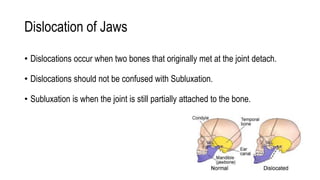
• Dislocations occur when two bones that originally met at the joint detach.
• Dislocations should not be confused with Subluxation.
• Subluxation is when the joint is still partially attached to the bone.
Anatomy of TMJ
Anatomy of TMJ
• The joint involved with jaw dislocation is the TMJ.
• This joint is located where the mandibular condyles and the temporal bones meet.
• For the mouth to close, it requires the masseter, temporalis and medial pterygoid
muscle.
• For the jaw to open, it requires the lateral pterygoid muscle.
Pathophysiology
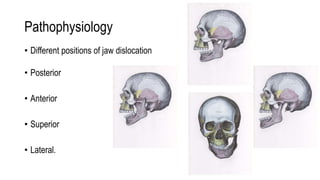
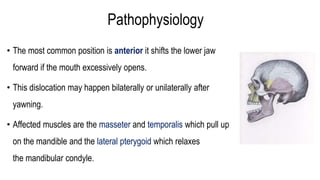
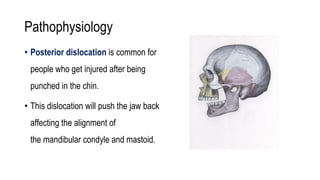
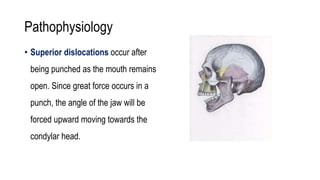
• Different positions of jaw dislocation
• Posterior
• Anterior
• Superior
• Lateral.
Pathophysiology
• The most common position is anterior it shifts the lower jaw
forward if the mouth excessively opens.
• This dislocation may happen bilaterally or unilaterally after
yawning.
• Affected muscles are the masseter and temporalis which pull up
on the mandible and the lateral pterygoid which relaxes
the mandibular condyle.
Pathophysiology
• Posterior dislocation is common for
people who get injured after being
punched in the chin.
• This dislocation will push the jaw back
affecting the alignment of
the mandibular condyle and mastoid.
Pathophysiology
• Superior dislocations occur after
being punched as the mouth remains
open. Since great force occurs in a
punch, the angle of the jaw will be
forced upward moving towards the
condylar head.
Pathophysiology
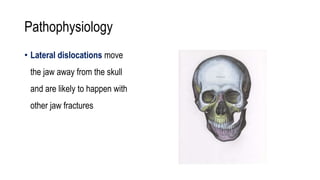
• Lateral dislocations move
the jaw away from the skull
and are likely to happen with
other jaw fractures
Symptoms
• Symptoms depends on the severity of the dislocation injury and how long the person
is inflicted with the injury.
• Symptoms of a dislocated jaw include
• Abnormal bite
• Difficulty in talking or moving jaw
• Not able to close mouth completely
• Drooling due to not being able to shut mouth completely
• Teeth are out of alignment
Symptoms
• Immediate symptom
• A loud crunch noise occurring right up against the ear drum. This is instantly followed
by excruciating pain, particularly in the side where the dislocation occurred.
• Short-term symptoms
• Mild to chronic headaches
• Muscle tension or pain in the face
• Pain in jaw and neck.
Symptoms
Long-term symptoms can result in
• Sleep deprivation
• Tiredness/lethargy
• Frustration
• Bursts of anger
• Depression
• Social issues relating to difficulty talking
• Hearing sensitivity
• Possible causing subsequent facial
asymmetry.
Symptoms
• Symptoms of a fractured jaw include
• bleeding coming from the mouth,
• unable to open the mouth wide without pain,
• bruising and swelling of the face,
• difficulty eating due to the constant pain,
• loss of feeling in the face (more specifically the lower lip)
• lacks full range of motion of the jaw.
Treatment
• Most temporomandibular disorders (TMDs) are self-limiting and do not get
worse.
• Simple treatment, involving self-care practices, rehabilitation aimed at
eliminating muscle spasms, and restoring correct coordination, is all that is
required.
• Nonsteroidal anti inflammatory analgesics (NSAIDs) should be used on a
short-term, regular basis and not on an as needed basis.
Treatment
• Treatment of chronic TMD can be difficult and the condition is best managed
by a team approach; the team consists of a primary care physician, a dentist,
a physiotherapist, a psychologist, a pharmacologist, and a surgeon.
• The different modalities include
• Patient education and self-care practices,
• Medication,
• Physical therapy
• Splints, psychological counselling, relaxation techniques,
Temporomandibular joint dislocation

Temporomandibular joint dislocation

  • 1.
  • 2.
    Dislocation of Jaws •Dislocations occur when two bones that originally met at the joint detach. • Dislocations should not be confused with Subluxation. • Subluxation is when the joint is still partially attached to the bone.
  • 3.
  • 4.
    Anatomy of TMJ •The joint involved with jaw dislocation is the TMJ. • This joint is located where the mandibular condyles and the temporal bones meet. • For the mouth to close, it requires the masseter, temporalis and medial pterygoid muscle. • For the jaw to open, it requires the lateral pterygoid muscle.
  • 5.
    Pathophysiology • Different positionsof jaw dislocation • Posterior • Anterior • Superior • Lateral.
  • 6.
    Pathophysiology • The mostcommon position is anterior it shifts the lower jaw forward if the mouth excessively opens. • This dislocation may happen bilaterally or unilaterally after yawning. • Affected muscles are the masseter and temporalis which pull up on the mandible and the lateral pterygoid which relaxes the mandibular condyle.
  • 7.
    Pathophysiology • Posterior dislocationis common for people who get injured after being punched in the chin. • This dislocation will push the jaw back affecting the alignment of the mandibular condyle and mastoid.
  • 8.
    Pathophysiology • Superior dislocationsoccur after being punched as the mouth remains open. Since great force occurs in a punch, the angle of the jaw will be forced upward moving towards the condylar head.
  • 9.
    Pathophysiology • Lateral dislocationsmove the jaw away from the skull and are likely to happen with other jaw fractures
  • 10.
    Symptoms • Symptoms dependson the severity of the dislocation injury and how long the person is inflicted with the injury. • Symptoms of a dislocated jaw include • Abnormal bite • Difficulty in talking or moving jaw • Not able to close mouth completely • Drooling due to not being able to shut mouth completely • Teeth are out of alignment
  • 11.
    Symptoms • Immediate symptom •A loud crunch noise occurring right up against the ear drum. This is instantly followed by excruciating pain, particularly in the side where the dislocation occurred. • Short-term symptoms • Mild to chronic headaches • Muscle tension or pain in the face • Pain in jaw and neck.
  • 12.
    Symptoms Long-term symptoms canresult in • Sleep deprivation • Tiredness/lethargy • Frustration • Bursts of anger • Depression • Social issues relating to difficulty talking • Hearing sensitivity • Possible causing subsequent facial asymmetry.
  • 13.
    Symptoms • Symptoms ofa fractured jaw include • bleeding coming from the mouth, • unable to open the mouth wide without pain, • bruising and swelling of the face, • difficulty eating due to the constant pain, • loss of feeling in the face (more specifically the lower lip) • lacks full range of motion of the jaw.
  • 14.
    Treatment • Most temporomandibulardisorders (TMDs) are self-limiting and do not get worse. • Simple treatment, involving self-care practices, rehabilitation aimed at eliminating muscle spasms, and restoring correct coordination, is all that is required. • Nonsteroidal anti inflammatory analgesics (NSAIDs) should be used on a short-term, regular basis and not on an as needed basis.
  • 15.
    Treatment • Treatment ofchronic TMD can be difficult and the condition is best managed by a team approach; the team consists of a primary care physician, a dentist, a physiotherapist, a psychologist, a pharmacologist, and a surgeon. • The different modalities include • Patient education and self-care practices, • Medication, • Physical therapy • Splints, psychological counselling, relaxation techniques,