DR. GIUSEPPE BRUNO PITASSI
’’A reminder for non-stomatologists healthcare professionals’’
G.B.Pitassi 2019
Reduction methods vary on the basis of the severity of the injury
and whether it is an acute or chronic dislocation.
Temporomandibular joint (TMJ) dislocation requires prompt medical
attention due to the crucial impact on the airway, nutrition, and
communication.
Recognition of this injury, based on clinical presentation and
history, is paramount for identification, both accurate diagnosis
and prompt treatment.
Preamble
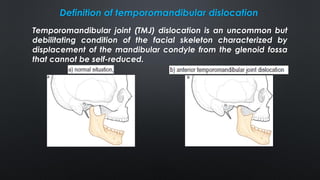
Temporomandibular joint (TMJ) dislocation is an uncommon but
debilitating condition of the facial skeleton characterized by
displacement of the mandibular condyle from the glenoid fossa
that cannot be self-reduced.
Definition of temporomandibular dislocation
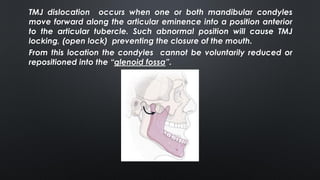
TMJ dislocation occurs when one or both mandibular condyles
move forward along the articular eminence into a position anterior
to the articular tubercle. Such abnormal position will cause TMJ
locking, (open lock) preventing the closure of the mouth.
From this location the condyles cannot be voluntarily reduced or
repositioned into the “glenoid fossa”.
Types of dislocations
Temporomandibular dislocation may be acute or chronic
•Acute TMJ dislocation:
Acute dislocation can usually occur in a hypermobile joint, where the
ligaments are loose and the condyle can move beyond the crest of the
articular eminence, it appearing to jump ″forward into a more wide
open position″.
Is common in clinical practice, occurring more often spontaneously as
”non-traumatic", during yawning, singing, eating in the absence of any
pathologic conditions as well as result of trauma, seizure, medication-
induced dystonia or excessive mouth opening but also during
endoscopy, laryngoscopy or prolonged dental procedures.
The mechanism that would induce an acute dislocation is attributable
to a disruption in the neuromuscolar coordination of the masticatory
muscles.
is a consequence of an acute dislocation that goes
unrecognized or undertreated.
Chronic dislocation is characterized by degenerative
condylar changes, dense periarticular fibrosis, and intra-
articular adhesions.
Chronic dislocation is rare and can require difficult and
invasive surgical intervention to correct the resultant
malocclusion and restore masticatory function.
•Chronic recurrent: dislocation:
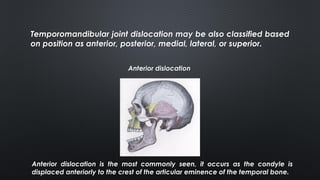
Temporomandibular joint dislocation may be also classified based
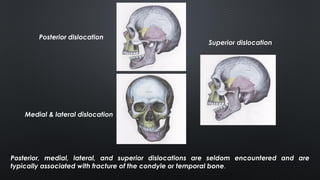
on position as anterior, posterior, medial, lateral, or superior.
Anterior dislocation
Anterior dislocation is the most commonly seen, it occurs as the condyle is
displaced anteriorly to the crest of the articular eminence of the temporal bone.
Posterior dislocation
Medial & lateral dislocation
Superior dislocation
Posterior, medial, lateral, and superior dislocations are seldom encountered and are
typically associated with fracture of the condyle or temporal bone.
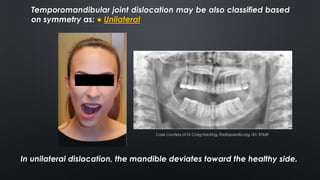
Temporomandibular joint dislocation may be also classified based
on symmetry as: ● Unilateral
In unilateral dislocation, the mandible deviates toward the healthy side.
Case courtesy of Dr Craig Hacking, Radiopaedia.org, rID: 57658
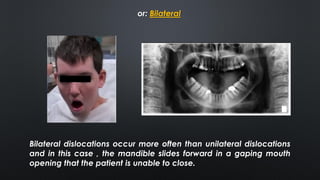
or: Bilateral
Bilateral dislocations occur more often than unilateral dislocations
and in this case , the mandible slides forward in a gaping mouth
opening that the patient is unable to close.
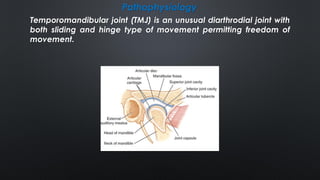
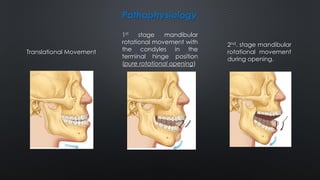
Pathophysiology
Temporomandibular joint (TMJ) is an unusual diarthrodial joint with
both sliding and hinge type of movement permitting freedom of
movement.
Pathophysiology
Translational Movement
1st stage mandibular
rotational movement with
the condyles in the
terminal hinge position
(pure rotational opening)
2nd. stage mandibular
rotational movement
during opening.
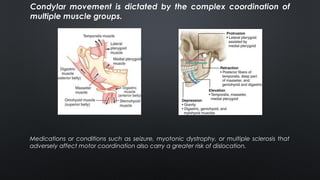
Condylar movement is dictated by the complex coordination of
multiple muscle groups.
Medications or conditions such as seizure, myotonic dystrophy, or multiple sclerosis that
adversely affect motor coordination also carry a greater risk of dislocation.
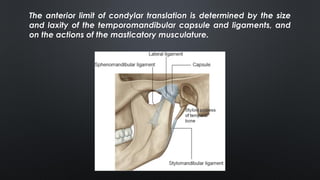
The anterior limit of condylar translation is determined by the size
and laxity of the temporomandibular capsule and ligaments, and
on the actions of the masticatory musculature.
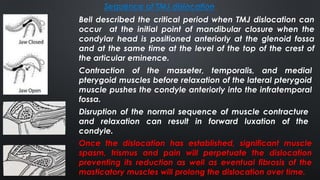
Bell described the critical period when TMJ dislocation can
occur at the initial point of mandibular closure when the
condylar head is positioned anteriorly at the glenoid fossa
and at the same time at the level of the top of the crest of
the articular eminence.
Once the dislocation has established, significant muscle
spasm, trismus and pain will perpetuate the dislocation
preventing its reduction as well as eventual fibrosis of the
masticatory muscles will prolong the dislocation over time.
Contraction of the masseter, temporalis, and medial
pterygoid muscles before relaxation of the lateral pterygoid
muscle pushes the condyle anteriorly into the infratemporal
fossa.
Disruption of the normal sequence of muscle contracture
and relaxation can result in forward luxation of the
condyle.
Sequence of TMJ dislocation
TMJ’s dislocation
signs, clinical presentation and its clinical features
Diagnosis of TMJ dislocation is based on clinical examination and
confirmed by imaging studies.
Any previous history of dislocation or other TMJ pathology should
be established.
Radiographic findings alone are insufficient to diagnose a TMJ
dislocation.
A detailed history should be obtained to determine the duration of
the dislocation and potential inciting cause.
A comprehensive TMJ examination should be completed on any
patient with a suspected dislocation.
Upon physical examination, the patient is unable to close the
mouth.
Acute dislocation is easy to recognize clinically
During anterior dislocation, the mandible protrude forward. The
patient will complain of acute pain in the affected joint and
associated muscles of mastication, masseter muscle spasm and
discomfort.
Because of this, the salivation can be extreme, then drooling occur
and communication (speaking), nutrition etc. etc. will be very
difficult.
Dislocation can be both bilateral and unilateral.
In acute dislocation, pain in the pre-auricular region is present, but
chronic recurrent dislocation is rarely associated with it.
In rare cases, dislocation can be unilateral, in this case, the
practitioner will typically see the chin deviate laterally always to the
contralateral side.
Palpation over the preauricular region may suggest emptiness in
the joint space associated with preauricular depression or dimpling
that can be often be visualized and palpated.
Dislocation may be irreducible and one or two condyles remain
dislocated (luxation).
In the latter condition, the mouth remains open and the front teeth
do not meet, due to the action of the elevator muscles with or
without lateral deviation depending on whether the dislocation is
unilateral or bilateral.
Then the patient will show up in the first aid post, agitated by the
impossibility of closing the mouth, suffering from facial pain and
often drooling as unable to swallow due to forced open bite.
Clinical features
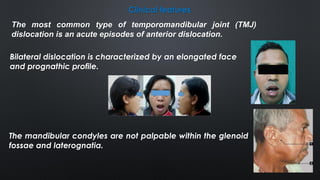
Bilateral dislocation is characterized by an elongated face
and prognathic profile.
The most common type of temporomandibular joint (TMJ)
dislocation is an acute episodes of anterior dislocation.
The mandibular condyles are not palpable within the glenoid
fossae and laterognatia.
Clinical features
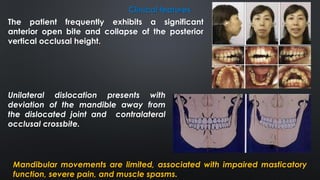
The patient frequently exhibits a significant
anterior open bite and collapse of the posterior
vertical occlusal height.
Unilateral dislocation presents with
deviation of the mandible away from
the dislocated joint and contralateral
occlusal crossbite.
Mandibular movements are limited, associated with impaired masticatory
function, severe pain, and muscle spasms.
Radiological Diagnostics and Imaging
CT imaging of the face can be useful to rule out condylar fracture
in the setting of a traumatic dislocation or to evaluate for
degenerative changes of the condyle with chronic dislocation.
There are a number of techniques available for imaging patients
with temporomandibular joint (TMJ) dislocation.
These techniques include conventional radiography, panoramic
radiography, conventional tomography, arthrography, computed
tomography (CT), ultrasound (US), and magnetic resonance
imaging (MRI).
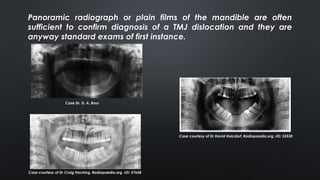
Panoramic radiograph or plain films of the mandible are often
sufficient to confirm diagnosis of a TMJ dislocation and they are
anyway standard exams of first instance.
Case Dr. D. A. Baur
Case courtesy of Dr David Holcdorf, Radiopaedia.org, rID: 53530
Case courtesy of Dr Craig Hacking, Radiopaedia.org, rID: 57658
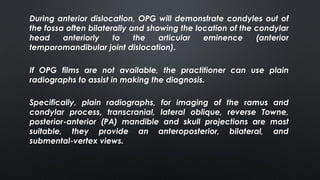
During anterior dislocation, OPG will demonstrate condyles out of
the fossa often bilaterally and showing the location of the condylar
head anteriorly to the articular eminence (anterior
temporomandibular joint dislocation).
If OPG films are not available, the practitioner can use plain
radiographs to assist in making the diagnosis.
Specifically, plain radiographs, for imaging of the ramus and
condylar process, transcranial, lateral oblique, reverse Towne,
posterior-anterior (PA) mandible and skull projections are most
suitable, they provide an anteroposterior, bilateral, and
submental-vertex views.
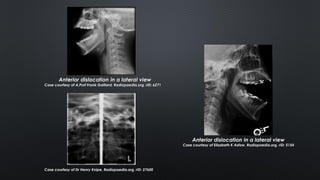
Anterior dislocation in a lateral view
Case courtesy of A.Prof Frank Gaillard, Radiopaedia.org, rID: 6271
Anterior dislocation in a lateral view
Case courtesy of Elizabeth K Asfaw, Radiopaedia.org, rID: 5154
Case courtesy of Dr Henry Knipe, Radiopaedia.org, rID: 27600
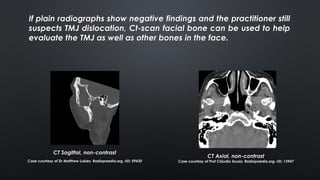
If plain radiographs show negative findings and the practitioner still
suspects TMJ dislocation, Ct-scan facial bone can be used to help
evaluate the TMJ as well as other bones in the face.
CT Sagittal, non-contrast
Case courtesy of Dr Matthew Lukies, Radiopaedia.org, rID: 59430
CT Axial, non-contrast
Case courtesy of Prof Cláudio Souza, Radiopaedia.org, rID: 13947
Both MDCT (Multidetector Helical CT) and CBCT (Cone Beam
Computed Tomography) are excellent techniques for assessing
osseous anatomy and fine bony detail and are widely used for
imaging of the mandible and skull base. However, CBCT images
typically have poorer soft tissue contrast compared to MDCT.
CT assessment is typically performed with the patient in maximum
intercuspation. Additional CT imaging should not be used to assess
the patient in open mouth position, as this increases the radiation
burden for the patient.
CT is frequently the preferred imaging study for evaluating patients
with facial trauma and suspected TMJ dislocation, because it
nicely depicts condylar position and orientation, as well as
associated fractures of the mandible and glenoid fossa.
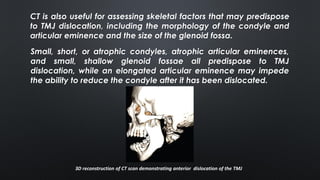
CT is also useful for assessing skeletal factors that may predispose
to TMJ dislocation, including the morphology of the condyle and
articular eminence and the size of the glenoid fossa.
Small, short, or atrophic condyles, atrophic articular eminences,
and small, shallow glenoid fossae all predispose to TMJ
dislocation, while an elongated articular eminence may impede
the ability to reduce the condyle after it has been dislocated.
3D reconstruction of CT scan demonstrating anterior dislocation of the TMJ
MRI
Magnetic Resonance Imaging
MRI is not commonly used to evaluate TMJ dislocation. It is
generally reserved to evaluate chronic TMJ changes and internal
derangement.
Generally speaking, if the primary clinical interest revolves around
the osseous structures, panoramic radiography and CT are the
preferred examinations.
If the primary question is instead related to the soft tissues, including
the articular disc, joint capsule, or surrounding musculature, MRI is
the preferred test.
In the urgent care or emergency department setting, MRI imaging
may be warranted only to confirm the diagnosis of TMJ dislocation
and to search for associated fractures.
Acute TMJ Dislocation and Technique of Manual Reduction
The most popular procedure of reduction is the “Hippocratic
method” also the one used almost exclusively.
Classically, acute anterior-superior dislocations of the TMJ can be
managed conservatively with manual reduction.
Immediate reduction is often easier as there is less time for muscle
spasm to develop which makes the reduction more difficult.
Almost all patients can be successfully reduced without the
adjunctive use of anesthesia or other pharmacotherapies,
especially if reduced immediately.
Some patient, honestly very few, from my point of view, experience
a significant amount of pain from the joint and distress from
masticatory muscle spasm, making the administration of local
anesthesia, IV. sedatives, narcotic or other major pain medication,
necessary to facilitate the reduction maneuver.
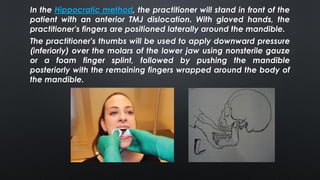
The practitioner's thumbs will be used to apply downward pressure
(inferiorly) over the molars of the lower jaw using nonsterile gauze
or a foam finger splint, followed by pushing the mandible
posteriorly with the remaining fingers wrapped around the body of
the mandible.
In the Hippocratic method, the practitioner will stand in front of the
patient with an anterior TMJ dislocation. With gloved hands, the
practitioner's fingers are positioned laterally around the mandible.
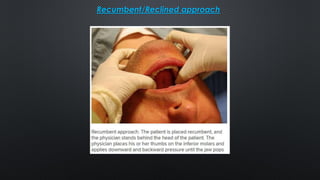
Recumbent/Reclined approach
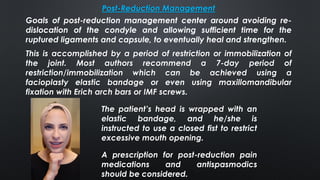
Post-Reduction Management
Goals of post-reduction management center around avoiding re-
dislocation of the condyle and allowing sufficient time for the
ruptured ligaments and capsule, to eventually heal and strengthen.
This is accomplished by a period of restriction or immobilization of
the joint. Most authors recommend a 7-day period of
restriction/immobilization which can be achieved using a
facioplasty elastic bandage or even using maxillomandibular
fixation with Erich arch bars or IMF screws.
The patient’s head is wrapped with an
elastic bandage, and he/she is
instructed to use a closed fist to restrict
excessive mouth opening.
A prescription for post-reduction pain
medications and antispasmodics
should be considered.
Thank you
References
1. Gottlieb O. Long-standing dislocation of the jaw. J Oral Surg. 1952;10(1):25–32.
2. Hammersley N. Chronic bilateral dislocation of the temporomandibular joint. Br J Oral
Maxillofac Surg. 1986;24(5):367–75.
3. Solomon S, Gupta S, Jesudasan J. Temporomandibular dislocation due to aripiprazole
induced dystonia. Br J Clin Pharmacol. 2010;70(6):914–5. https://doi.
org/10.1111/j.1365-2125.2010.03770.x.
4. Akinbami BO. Evaluation of the mechanism and principles of management of temporomandibular
joint dislocation. Systematic review of literature and a proposed new classification of
temporomandibular joint dislocation. Head Face Med. 2011;7:10.
5. Theston A. A case of Ehlers–Danlos syndrome presenting with recurrent dislocation of the
temporomandibular joint. Br J Oral Surg. 1965;3:190–3.
6. Wilson A, Mackay L, Ord RA. Recurrent dislocation of the mandible in a patient with myotonic
dystrophy. J Oral Maxillofac Surg. 1989;47(12):1329–32.
7. Vázquez Bouso O, Forteza González G, Mommsen J, Grau VG, Rodríguez Fernández J,
Mateos MM. Neurogenic temporomandibular joint dislocation treated with botulinum toxin:
report of 4 cases. Oral Surg Oral Med Oral Pathol Oral Radiol Endod. 2010;109(3):e33–7.
8. Mar FGL. Long-standing bilateral dislocation of the jaw. Br J Oral Surg. 1965;3:222–5.
9. Huang IY, Chen CM, Kao YH, Chen CM, Wu CW. Management of long-standing mandibular
dislocation. Int J Oral Maxillofac Surg. 2011;40(8):810–4. https://doi.org/10.1016/j.
ijom.2011.02.031. Epub 2011 Apr.
10. Ugboko VI, Oginni FO, Ajike SO, Olasoji HO, Adebayo ET. A survey of temporomandibular
joint dislocation: aetiology, demographics, risk factors and management in 96 Nigerian cases.
Int J Oral Maxillofac Surg. 2005;34(5):499–502.
11. Wijmenga JP, Boering G, Blankestijn J. Protracted dislocation of the temporomandibular joint.
Int J Oral Maxillofac Surg. 1986;15(4):380–8.
12. Sanders B, Schneider J, Given J. Prolonged dislocation of the mandibular condyle: report of
case. J Oral Surg. 1979;37(5):346–8
13. El-Attar A, Ord RA. Long-standing mandibular dislocations: report of a case, review of the
literature. Br Dent J. 1986;160(3):91–4.
14. Parekh PK, Bhatia IK. Condylectomies for prolonged bilateral temporomandibular dislocation.
Arch Orthop Trauma Surg. 1983;102(2):123–5.
15. Topazian RG, Costich ER. Management of protracted dislocation of the mandible. J Trauma.
1967;7(2):257–64.
16. Baur DA, Jannuzzi JR, Mercan U, Quereshy FA. Treatment of long term anterior dislocation
of the TMJ. Int J Oral Maxillofac Surg. 2013;42(8):1030–3. https://doi.org/10.1016/j.
ijom.2012.11.005.
17. Blank DM, Stein AC, Gold BD, Berger J. Treatment of protracted bilateral mandibular dislocation
with Proplast-Vitallium prostheses. Oral Surg Oral Med Oral Pathol. 1982;53(4):335–9.
18. Chin RS, Gropp H, Beirne OR. Long-standing mandibular dislocation: report of a case. J Oral
Maxillofac Surg. 1988;46(8):693–6.
19. Hayward JR. Prolonged dislocation of the mandible. J Oral Surg. 1965;23(7):585–94.
20). Wolford LM, Mercuri LG, Schneiderman ED, Movahed R, Allen W. Twenty-year follow-up
study on a patient-fitted temporomandibular joint prosthesis: the Techmedica/TMJ Concepts
device. J Oral Maxillofac Surg. 2015;73(5):952–60. https://doi.org/10.1016/j.joms.2014.10.
21. Leandro LF, Ono HY, Loureiro CC, Marinho K, Guevara HA. A ten-year experience and
follow-up of three hundred patients fitted with the Biomet/Lorenz Microfixation TMJ replacement
system. Int J Oral Maxillofac Surg. 2013;42(8):1007–13. https://doi.org/10.1016/j.ij.

Acute Dislocation temporomandibular joint

  • 1.
    DR. GIUSEPPE BRUNOPITASSI ’’A reminder for non-stomatologists healthcare professionals’’ G.B.Pitassi 2019
  • 2.
    Reduction methods varyon the basis of the severity of the injury and whether it is an acute or chronic dislocation. Temporomandibular joint (TMJ) dislocation requires prompt medical attention due to the crucial impact on the airway, nutrition, and communication. Recognition of this injury, based on clinical presentation and history, is paramount for identification, both accurate diagnosis and prompt treatment. Preamble
  • 3.
    Temporomandibular joint (TMJ)dislocation is an uncommon but debilitating condition of the facial skeleton characterized by displacement of the mandibular condyle from the glenoid fossa that cannot be self-reduced. Definition of temporomandibular dislocation
  • 4.
    TMJ dislocation occurswhen one or both mandibular condyles move forward along the articular eminence into a position anterior to the articular tubercle. Such abnormal position will cause TMJ locking, (open lock) preventing the closure of the mouth. From this location the condyles cannot be voluntarily reduced or repositioned into the “glenoid fossa”.
  • 5.
  • 6.
    Temporomandibular dislocation maybe acute or chronic •Acute TMJ dislocation: Acute dislocation can usually occur in a hypermobile joint, where the ligaments are loose and the condyle can move beyond the crest of the articular eminence, it appearing to jump ″forward into a more wide open position″. Is common in clinical practice, occurring more often spontaneously as ”non-traumatic", during yawning, singing, eating in the absence of any pathologic conditions as well as result of trauma, seizure, medication- induced dystonia or excessive mouth opening but also during endoscopy, laryngoscopy or prolonged dental procedures. The mechanism that would induce an acute dislocation is attributable to a disruption in the neuromuscolar coordination of the masticatory muscles.
  • 7.
    is a consequenceof an acute dislocation that goes unrecognized or undertreated. Chronic dislocation is characterized by degenerative condylar changes, dense periarticular fibrosis, and intra- articular adhesions. Chronic dislocation is rare and can require difficult and invasive surgical intervention to correct the resultant malocclusion and restore masticatory function. •Chronic recurrent: dislocation:
  • 8.
    Temporomandibular joint dislocationmay be also classified based on position as anterior, posterior, medial, lateral, or superior. Anterior dislocation Anterior dislocation is the most commonly seen, it occurs as the condyle is displaced anteriorly to the crest of the articular eminence of the temporal bone.
  • 9.
    Posterior dislocation Medial &lateral dislocation Superior dislocation Posterior, medial, lateral, and superior dislocations are seldom encountered and are typically associated with fracture of the condyle or temporal bone.
  • 10.
    Temporomandibular joint dislocationmay be also classified based on symmetry as: ● Unilateral In unilateral dislocation, the mandible deviates toward the healthy side. Case courtesy of Dr Craig Hacking, Radiopaedia.org, rID: 57658
  • 11.
    or: Bilateral Bilateral dislocationsoccur more often than unilateral dislocations and in this case , the mandible slides forward in a gaping mouth opening that the patient is unable to close.
  • 12.
    Pathophysiology Temporomandibular joint (TMJ)is an unusual diarthrodial joint with both sliding and hinge type of movement permitting freedom of movement.
  • 13.
    Pathophysiology Translational Movement 1st stagemandibular rotational movement with the condyles in the terminal hinge position (pure rotational opening) 2nd. stage mandibular rotational movement during opening.
  • 14.
    Condylar movement isdictated by the complex coordination of multiple muscle groups. Medications or conditions such as seizure, myotonic dystrophy, or multiple sclerosis that adversely affect motor coordination also carry a greater risk of dislocation.
  • 15.
    The anterior limitof condylar translation is determined by the size and laxity of the temporomandibular capsule and ligaments, and on the actions of the masticatory musculature.
  • 16.
    Bell described thecritical period when TMJ dislocation can occur at the initial point of mandibular closure when the condylar head is positioned anteriorly at the glenoid fossa and at the same time at the level of the top of the crest of the articular eminence. Once the dislocation has established, significant muscle spasm, trismus and pain will perpetuate the dislocation preventing its reduction as well as eventual fibrosis of the masticatory muscles will prolong the dislocation over time. Contraction of the masseter, temporalis, and medial pterygoid muscles before relaxation of the lateral pterygoid muscle pushes the condyle anteriorly into the infratemporal fossa. Disruption of the normal sequence of muscle contracture and relaxation can result in forward luxation of the condyle. Sequence of TMJ dislocation
  • 17.
    TMJ’s dislocation signs, clinicalpresentation and its clinical features Diagnosis of TMJ dislocation is based on clinical examination and confirmed by imaging studies. Any previous history of dislocation or other TMJ pathology should be established. Radiographic findings alone are insufficient to diagnose a TMJ dislocation. A detailed history should be obtained to determine the duration of the dislocation and potential inciting cause. A comprehensive TMJ examination should be completed on any patient with a suspected dislocation.
  • 18.
    Upon physical examination,the patient is unable to close the mouth. Acute dislocation is easy to recognize clinically During anterior dislocation, the mandible protrude forward. The patient will complain of acute pain in the affected joint and associated muscles of mastication, masseter muscle spasm and discomfort. Because of this, the salivation can be extreme, then drooling occur and communication (speaking), nutrition etc. etc. will be very difficult.
  • 19.
    Dislocation can beboth bilateral and unilateral. In acute dislocation, pain in the pre-auricular region is present, but chronic recurrent dislocation is rarely associated with it. In rare cases, dislocation can be unilateral, in this case, the practitioner will typically see the chin deviate laterally always to the contralateral side. Palpation over the preauricular region may suggest emptiness in the joint space associated with preauricular depression or dimpling that can be often be visualized and palpated.
  • 20.
    Dislocation may beirreducible and one or two condyles remain dislocated (luxation). In the latter condition, the mouth remains open and the front teeth do not meet, due to the action of the elevator muscles with or without lateral deviation depending on whether the dislocation is unilateral or bilateral. Then the patient will show up in the first aid post, agitated by the impossibility of closing the mouth, suffering from facial pain and often drooling as unable to swallow due to forced open bite.
  • 21.
    Clinical features Bilateral dislocationis characterized by an elongated face and prognathic profile. The most common type of temporomandibular joint (TMJ) dislocation is an acute episodes of anterior dislocation. The mandibular condyles are not palpable within the glenoid fossae and laterognatia.
  • 22.
    Clinical features The patientfrequently exhibits a significant anterior open bite and collapse of the posterior vertical occlusal height. Unilateral dislocation presents with deviation of the mandible away from the dislocated joint and contralateral occlusal crossbite. Mandibular movements are limited, associated with impaired masticatory function, severe pain, and muscle spasms.
  • 23.
    Radiological Diagnostics andImaging CT imaging of the face can be useful to rule out condylar fracture in the setting of a traumatic dislocation or to evaluate for degenerative changes of the condyle with chronic dislocation. There are a number of techniques available for imaging patients with temporomandibular joint (TMJ) dislocation. These techniques include conventional radiography, panoramic radiography, conventional tomography, arthrography, computed tomography (CT), ultrasound (US), and magnetic resonance imaging (MRI).
  • 24.
    Panoramic radiograph orplain films of the mandible are often sufficient to confirm diagnosis of a TMJ dislocation and they are anyway standard exams of first instance. Case Dr. D. A. Baur Case courtesy of Dr David Holcdorf, Radiopaedia.org, rID: 53530 Case courtesy of Dr Craig Hacking, Radiopaedia.org, rID: 57658
  • 25.
    During anterior dislocation,OPG will demonstrate condyles out of the fossa often bilaterally and showing the location of the condylar head anteriorly to the articular eminence (anterior temporomandibular joint dislocation). If OPG films are not available, the practitioner can use plain radiographs to assist in making the diagnosis. Specifically, plain radiographs, for imaging of the ramus and condylar process, transcranial, lateral oblique, reverse Towne, posterior-anterior (PA) mandible and skull projections are most suitable, they provide an anteroposterior, bilateral, and submental-vertex views.
  • 26.
    Anterior dislocation ina lateral view Case courtesy of A.Prof Frank Gaillard, Radiopaedia.org, rID: 6271 Anterior dislocation in a lateral view Case courtesy of Elizabeth K Asfaw, Radiopaedia.org, rID: 5154 Case courtesy of Dr Henry Knipe, Radiopaedia.org, rID: 27600
  • 27.
    If plain radiographsshow negative findings and the practitioner still suspects TMJ dislocation, Ct-scan facial bone can be used to help evaluate the TMJ as well as other bones in the face. CT Sagittal, non-contrast Case courtesy of Dr Matthew Lukies, Radiopaedia.org, rID: 59430 CT Axial, non-contrast Case courtesy of Prof Cláudio Souza, Radiopaedia.org, rID: 13947
  • 28.
    Both MDCT (MultidetectorHelical CT) and CBCT (Cone Beam Computed Tomography) are excellent techniques for assessing osseous anatomy and fine bony detail and are widely used for imaging of the mandible and skull base. However, CBCT images typically have poorer soft tissue contrast compared to MDCT. CT assessment is typically performed with the patient in maximum intercuspation. Additional CT imaging should not be used to assess the patient in open mouth position, as this increases the radiation burden for the patient. CT is frequently the preferred imaging study for evaluating patients with facial trauma and suspected TMJ dislocation, because it nicely depicts condylar position and orientation, as well as associated fractures of the mandible and glenoid fossa.
  • 29.
    CT is alsouseful for assessing skeletal factors that may predispose to TMJ dislocation, including the morphology of the condyle and articular eminence and the size of the glenoid fossa. Small, short, or atrophic condyles, atrophic articular eminences, and small, shallow glenoid fossae all predispose to TMJ dislocation, while an elongated articular eminence may impede the ability to reduce the condyle after it has been dislocated. 3D reconstruction of CT scan demonstrating anterior dislocation of the TMJ
  • 30.
    MRI Magnetic Resonance Imaging MRIis not commonly used to evaluate TMJ dislocation. It is generally reserved to evaluate chronic TMJ changes and internal derangement. Generally speaking, if the primary clinical interest revolves around the osseous structures, panoramic radiography and CT are the preferred examinations. If the primary question is instead related to the soft tissues, including the articular disc, joint capsule, or surrounding musculature, MRI is the preferred test. In the urgent care or emergency department setting, MRI imaging may be warranted only to confirm the diagnosis of TMJ dislocation and to search for associated fractures.
  • 31.
    Acute TMJ Dislocationand Technique of Manual Reduction The most popular procedure of reduction is the “Hippocratic method” also the one used almost exclusively. Classically, acute anterior-superior dislocations of the TMJ can be managed conservatively with manual reduction. Immediate reduction is often easier as there is less time for muscle spasm to develop which makes the reduction more difficult. Almost all patients can be successfully reduced without the adjunctive use of anesthesia or other pharmacotherapies, especially if reduced immediately. Some patient, honestly very few, from my point of view, experience a significant amount of pain from the joint and distress from masticatory muscle spasm, making the administration of local anesthesia, IV. sedatives, narcotic or other major pain medication, necessary to facilitate the reduction maneuver.
  • 32.
    The practitioner's thumbswill be used to apply downward pressure (inferiorly) over the molars of the lower jaw using nonsterile gauze or a foam finger splint, followed by pushing the mandible posteriorly with the remaining fingers wrapped around the body of the mandible. In the Hippocratic method, the practitioner will stand in front of the patient with an anterior TMJ dislocation. With gloved hands, the practitioner's fingers are positioned laterally around the mandible.
  • 33.
  • 35.
    Post-Reduction Management Goals ofpost-reduction management center around avoiding re- dislocation of the condyle and allowing sufficient time for the ruptured ligaments and capsule, to eventually heal and strengthen. This is accomplished by a period of restriction or immobilization of the joint. Most authors recommend a 7-day period of restriction/immobilization which can be achieved using a facioplasty elastic bandage or even using maxillomandibular fixation with Erich arch bars or IMF screws. The patient’s head is wrapped with an elastic bandage, and he/she is instructed to use a closed fist to restrict excessive mouth opening. A prescription for post-reduction pain medications and antispasmodics should be considered.
  • 36.
  • 37.
    References 1. Gottlieb O.Long-standing dislocation of the jaw. J Oral Surg. 1952;10(1):25–32. 2. Hammersley N. Chronic bilateral dislocation of the temporomandibular joint. Br J Oral Maxillofac Surg. 1986;24(5):367–75. 3. Solomon S, Gupta S, Jesudasan J. Temporomandibular dislocation due to aripiprazole induced dystonia. Br J Clin Pharmacol. 2010;70(6):914–5. https://doi. org/10.1111/j.1365-2125.2010.03770.x. 4. Akinbami BO. Evaluation of the mechanism and principles of management of temporomandibular joint dislocation. Systematic review of literature and a proposed new classification of temporomandibular joint dislocation. Head Face Med. 2011;7:10. 5. Theston A. A case of Ehlers–Danlos syndrome presenting with recurrent dislocation of the temporomandibular joint. Br J Oral Surg. 1965;3:190–3. 6. Wilson A, Mackay L, Ord RA. Recurrent dislocation of the mandible in a patient with myotonic dystrophy. J Oral Maxillofac Surg. 1989;47(12):1329–32.
  • 38.
    7. Vázquez BousoO, Forteza González G, Mommsen J, Grau VG, Rodríguez Fernández J, Mateos MM. Neurogenic temporomandibular joint dislocation treated with botulinum toxin: report of 4 cases. Oral Surg Oral Med Oral Pathol Oral Radiol Endod. 2010;109(3):e33–7. 8. Mar FGL. Long-standing bilateral dislocation of the jaw. Br J Oral Surg. 1965;3:222–5. 9. Huang IY, Chen CM, Kao YH, Chen CM, Wu CW. Management of long-standing mandibular dislocation. Int J Oral Maxillofac Surg. 2011;40(8):810–4. https://doi.org/10.1016/j. ijom.2011.02.031. Epub 2011 Apr. 10. Ugboko VI, Oginni FO, Ajike SO, Olasoji HO, Adebayo ET. A survey of temporomandibular joint dislocation: aetiology, demographics, risk factors and management in 96 Nigerian cases. Int J Oral Maxillofac Surg. 2005;34(5):499–502. 11. Wijmenga JP, Boering G, Blankestijn J. Protracted dislocation of the temporomandibular joint. Int J Oral Maxillofac Surg. 1986;15(4):380–8. 12. Sanders B, Schneider J, Given J. Prolonged dislocation of the mandibular condyle: report of case. J Oral Surg. 1979;37(5):346–8
  • 39.
    13. El-Attar A,Ord RA. Long-standing mandibular dislocations: report of a case, review of the literature. Br Dent J. 1986;160(3):91–4. 14. Parekh PK, Bhatia IK. Condylectomies for prolonged bilateral temporomandibular dislocation. Arch Orthop Trauma Surg. 1983;102(2):123–5. 15. Topazian RG, Costich ER. Management of protracted dislocation of the mandible. J Trauma. 1967;7(2):257–64. 16. Baur DA, Jannuzzi JR, Mercan U, Quereshy FA. Treatment of long term anterior dislocation of the TMJ. Int J Oral Maxillofac Surg. 2013;42(8):1030–3. https://doi.org/10.1016/j. ijom.2012.11.005. 17. Blank DM, Stein AC, Gold BD, Berger J. Treatment of protracted bilateral mandibular dislocation with Proplast-Vitallium prostheses. Oral Surg Oral Med Oral Pathol. 1982;53(4):335–9. 18. Chin RS, Gropp H, Beirne OR. Long-standing mandibular dislocation: report of a case. J Oral Maxillofac Surg. 1988;46(8):693–6. 19. Hayward JR. Prolonged dislocation of the mandible. J Oral Surg. 1965;23(7):585–94.
  • 40.
    20). Wolford LM,Mercuri LG, Schneiderman ED, Movahed R, Allen W. Twenty-year follow-up study on a patient-fitted temporomandibular joint prosthesis: the Techmedica/TMJ Concepts device. J Oral Maxillofac Surg. 2015;73(5):952–60. https://doi.org/10.1016/j.joms.2014.10. 21. Leandro LF, Ono HY, Loureiro CC, Marinho K, Guevara HA. A ten-year experience and follow-up of three hundred patients fitted with the Biomet/Lorenz Microfixation TMJ replacement system. Int J Oral Maxillofac Surg. 2013;42(8):1007–13. https://doi.org/10.1016/j.ij.