Climate-Smart Agriculture (CSA): What is it? Why is it needed?
Dawit Solomon, Maren Radeny, Catherine Mungai, Anette Friis and Sophia Huyer - CCAFS
Research and Policy: two peas in a pod? A dialogue for food security impact
NWO-WOTRO and the Food & Business Knowledge Platform conference in cooperation with the Dutch Ministries of Foreign and Economic Affairs
Session 7 – Climate Smart Agriculture, December 1, 2017, The Hague, the Netherlands
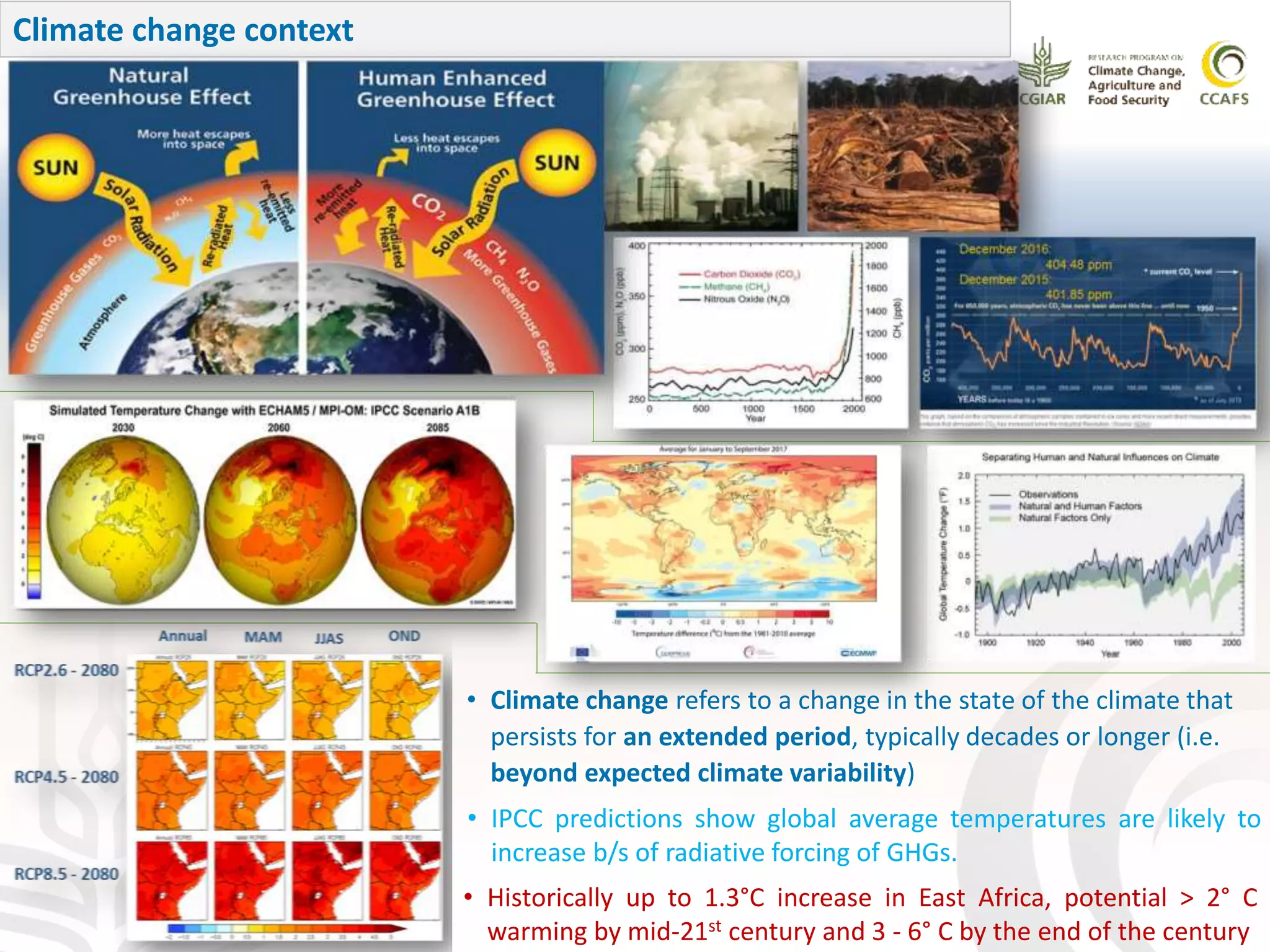
• Climate change refers to a change in the state of the climate that
persists for an extended period, typically decades or longer (i.e.
beyond expected climate variability)
Climate change context
• IPCC predictions show global average temperatures are likely to
increase b/s of radiative forcing of GHGs.
• Historically up to 1.3°C increase in East Africa, potential > 2° C
warming by mid-21st century and 3 - 6° C by the end of the century
Climate change for agriculture and food security – EA context
• To mitigate the effects of CC countries need to implement enabling policies to build safety nets,
targeted invest in climate friendly infrastructure and projects, and promote the adoption of
climate smart agriculture (CSA) as an entry point to support vulnerable populations
• Channels of influence on economic activity are through agricultural output, as well as broader
impacts such as labour productivity,, health, and conflict
• Climate change is expected to increase the frequency and severity of extreme weather events such
as heat stress, drought, and flooding, could cause crop and livestock loss and increase food
insecurity and vulnerability
What is climate smart agriculture (CSA)?
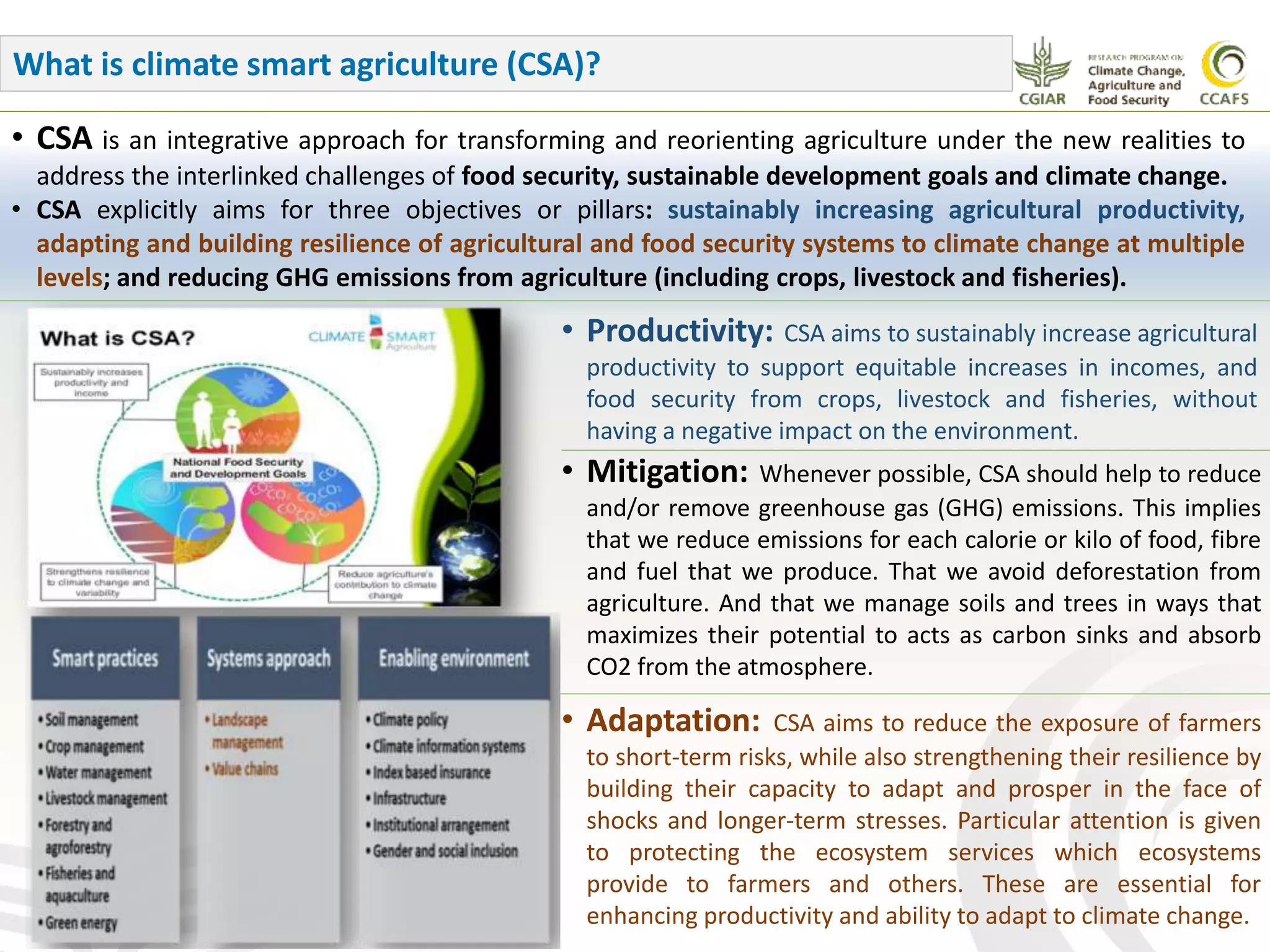
• CSA is an integrative approach for transforming and reorienting agriculture under the new realities to
address the interlinked challenges of food security, sustainable development goals and climate change.
• CSA explicitly aims for three objectives or pillars: sustainably increasing agricultural productivity,
adapting and building resilience of agricultural and food security systems to climate change at multiple
levels; and reducing GHG emissions from agriculture (including crops, livestock and fisheries).
• Adaptation: CSA aims to reduce the exposure of farmers
to short-term risks, while also strengthening their resilience by
building their capacity to adapt and prosper in the face of
shocks and longer-term stresses. Particular attention is given
to protecting the ecosystem services which ecosystems
provide to farmers and others. These are essential for
enhancing productivity and ability to adapt to climate change.
• Mitigation: Whenever possible, CSA should help to reduce
and/or remove greenhouse gas (GHG) emissions. This implies
that we reduce emissions for each calorie or kilo of food, fibre
and fuel that we produce. That we avoid deforestation from
agriculture. And that we manage soils and trees in ways that
maximizes their potential to acts as carbon sinks and absorb
CO2 from the atmosphere.
• Productivity: CSA aims to sustainably increase agricultural
productivity to support equitable increases in incomes, and
food security from crops, livestock and fisheries, without
having a negative impact on the environment.
• A focus on climate change: An explicit consideration of climatic risks that are happening more rapidly and
with greater intensity than in the past. Like other sustainable agricultural approaches, CSA is based on principles of
increased productivity and sustainability. But it is distinguished by a focus on climate change, explicitly addressing
adaptation and mitigation challenges while working towards food security for all. In essence, CSA is sustainable
agriculture that incorporates resilience concerns while at the same time seeking to reduce greenhouse gas emissions.
CSA = Sustainable Agriculture + Resilience – Emissions.
• CSA integrates multiple goals, synergies and manages trade-offs: Ideally, CSA produces
triple-win outcomes: increased productivity, enhanced resilience and reduced emissions. But often it is not possible to
achieve all three. Frequently, when implementing CSA, trade-offs must be made. This requires us to identify synergies
and weigh the costs and benefits of different options based on stakeholder objectives identified through participatory
approaches. CSA focuses on developing metrics and prioritization tools that bring these synergies and trade-offs to the
fore to enable stakeholders on how best to optimize all three outcomes at the most appropriate level.
• New investment opportunities for agriculture: There is an enormous deficit in the investment that
is required to meet food security. By explicitly focusing on climate change, CSA opens up new financing opportunities for
agricultural development, by allowing the sector to tap into climate finance for adaptation and mitigation.
What is different about CSA and why it is needed?
• CSA maintains ecosystems services: Ecosystems provide farmers with essential services, including
clean air, water, food and materials. It is imperative that CSA interventions do not contribute to their degradation. Thus,
CSA adopts a landscape approach and seek to integrate sustainable management of ecosystems and natural resources
with livelihood considerations, recognizing that landscapes are multifunctional, providing benefits and services for a wide
range of ecosystem processes, species and social actors. The main reason for applying landscape approaches is to move
away from narrow sectoral approaches with uncoordinated and competing land uses, to integrated planning and
management where the multiple interests of stakeholders are considered, synergies identified and trade-off among
different uses negotiated that builds upon the principles of sustainable agriculture but goes beyond the narrow sectoral
approaches that result in uncoordinated and competing land uses, to integrated planning and management.
• CSA has multiple entry points at different levels: CSA should not be perceived as a set of practices
and technologies. It has multiple entry points, ranging from the development of technologies and practices to the
elaboration of climate change models and scenarios, information technologies, insurance schemes, value chains and
the strengthening of institutional and political enabling environments. CSA goes beyond single technology at the farm
level and includes the integration of multiple interventions at the food system, landscape, value chain or policy level.
• CSA is context specific: What is climate-smart in one-place may not be climate-smart in another, and no
interventions are climate-smart everywhere or every time. Interventions must take into account how different
elements interact at the landscape level, within or among ecosystems and as a part of different institutional
arrangements and political realities. The fact that CSA often strives to reach multiple objectives at the system level
makes it particularly difficult to transfer experiences from one context to another.
• CSA engages women and marginalized groups: To achieve food security goals and enhance
resilience, CSA approaches involve the poorest and most vulnerable groups. These groups often live on marginal most
vulnerable lands to climate extremes like drought and floods, and most likely to be affected by climate change. Gender is
another central aspect of CSA. Women typically have less access and legal right to the land which they farm, or to other
productive and economic resources which help build their adaptive capacity to cope with events like droughts and floods.
What is different about CSA and why it is needed?
• CSA involve local, regional and national stakeholders in decision-making: CSA employ
participatory bottom up approaches to identify the most appropriate interventions and form partnerships and alliances
needed to enable sustainable development and reduce climatic risks affecting smallholder farmers.
• CSA addresses food security, misdistribution and malnutrition: Despite the attention paid to
agricultural development and food security over the past decades, there are still about 800 million undernourished and 1
billion malnourished people in the world.
• CSA addresses the relationship between agriculture and poverty: Agriculture continues to be the
main source of food, employment and income for many people living in developing countries. About 75% of the world’s
poor live in rural areas, with agriculture being their most important income source. Its growth is thus often the most
effective and equitable strategy for both reducing poverty and increasing food and nutrition security.
• CSA is reincarnation of the ‘Green Revolution’: To the contrary, CSA has much in common with
sustainable agricultural approaches. CSA technologies and practices strive to reduce cost, soil degradation, soil and
groundwater pollution, loss of biodiversity and environment and human health at risk.
• Does CSA promote agroecological practices? Yes. A more efficient use of resources is key to
improving productivity and incomes, while reducing GHG emissions from agroecosystems. Agroecological principles and
practices by enhancing ecosystem services to increase sustainably productivity at landscape level can play a key role in
rehabilitating degraded ecosystems and landscapes. By integrating climate-smart principles and strategies into
agroecological principles, it is possible to strengthening agroecosystems, and develop climate-smart landscapes that
contribute to their resilience, and also contribute to adaptation and mitigation.
• CSA is the same as the sustainable agriculture approach: The CSA approach builds upon the
concepts, technologies and experience of sustainable agriculture, focusing explicitly on integrating the impacts of
unprecedented climate change. CSA is built upon a technical foundation that largely already exists and a range of
sustainable agricultural approaches - such as sustainable agriculture, sustainable intensification and conservation
agriculture - are the cornerstones of implementing CSA in practice. The CSA approach involves assessing sustainable
agricultural practices to determine if and how climate change may affect their intended outcomes of improving
livelihoods, environmental management and adoption/disadoption of agricultural practices. CSA involves building
recommendations and possible options for reorienting existing sustainable agricultural strategies to respond to
climate variabilities and change, as well as to provide innovative policy and financing tools to implement them.
Frequently asked questions and concerns about CSA
• Many organisations are wary of – or even opposed to CSA: Growing concerns that the term is
being used to green-wash practices that are, in fact, damaging for the climate and for farming. Many are worried that
the promotion of CSA could end up doing more harm than good. Loose term that anyone can – and does use to describe
its activities - no matter what the impact! CSA just a clever name with nothing to ensure that the describes practices are
actually smart for the climate or for agriculture.
• Does CSA impose mitigation requirements on developing country agriculture? No.
CSA does not advocate use of a narrow carbon lens to address agricultural and climate change challenges. The CSA
approach calls for a strong focus on identifying potential synergies between food security, adaptation and mitigation, as
well as estimating costs and tradeoffs between mitigation and other objectives to better inform countries on the
potential for capturing mitigation co-benefits and associated financing. CSA clearly recognizes food security as a priority,
integrating needed adaptation and possible mitigation. The CSA approach can support national policy on agricultural
mitigation in the broader context of sustainable development, which is still under preparation in most countries.
• Is financing from carbon markets/climate finance a key element of CSA? No,
carbon markets are only a very small part of the potential climate finance that can be channelled to agriculture with very
limited potential for the smallholder sector. However, linking climate finance to agricultural investments for food
security/development is a key element of CSA. Climate finance includes financing for both adaptation and mitigation,
and it can be channelled through public sector financing such as bilateral donors, multilateral financial institutions, the
Global Environment Facility, the Green Climate Fund, and through nationally-developed instruments such as National
Climate Change Funds, national climate change and agricultural investment plans and more specific instruments such as
National Adaptation Action/National Adaptation Plans and Nationally Appropriate Mitigation Actions.
• Does CSA promote GMOs? No, CSA does not promote GMOs. The CSA approach involves the development of
a set of feasible options for addressing the challenges of climate change for specific locations and conditions in
conjunction with key stakeholders including national governments, agricultural research and development institutions at
international and national levels, and households/communities, civil society and the private sector at the local level. The
use of GMOs is determined by national policies in each country.
Frequently asked questions and concerns about CSA
Thank you!
CSA is not just for smallholder agriculture – it involve innovative
digital systems and solutions for medium and large scale farming
• In a climate change affected context private sector engagement alone will not be
sufficient to develop inclusive small and medium-sized enterprises (SMEs) in the
agriculture, value chain and food sector.
• Current and emerging policies need to include options to facilitate and accelerate
uptake and scaling up strategies of CSA in East Africa, and to be informed by
research to achieve this.
• Without adoption of CSA technologies and innovations farming and pastoral
communities in East Africa will not be able to deal with the effects of climate
variabilities and change.
Theme 7: Climate Smart Agriculture in East Africa – Key statements
• Without innovative finance mechanisms that link and blend climate and agricultural
finance and investments from public and private sectors, National Adaptation Plans
(NAPs) and Nationally Appropriate Mitigation Actions (NAMAs) will not be effective.
Purpose of the session: This session aims to inform Dutch policy representatives that work on
policy/interventions related to CSA on the approaches of the GCP-4 projects. It will highlight key issues and
entry points for consideration with regard to policy and institutional requirements to enable inclusive and
sustainable scaling of CSA for agricultural transformation in East Africa. The session will explore the proposed
approaches of the GCP-4 projects and how these may be fed by, or feedback to, questions in development of
policy on scaling of CSA. Additionally ongoing ARF research around CSA could feed the discussion.

Climate-Smart Agriculture (CSA): What is it? Why is it needed?

  • 1.
    Climate-Smart Agriculture (CSA):What is it? Why is it needed? Dawit Solomon, Maren Radeny, Catherine Mungai, Anette Friis and Sophia Huyer - CCAFS Research and Policy: two peas in a pod? A dialogue for food security impact NWO-WOTRO and the Food & Business Knowledge Platform conference in cooperation with the Dutch Ministries of Foreign and Economic Affairs Session 7 – Climate Smart Agriculture, December 1, 2017, The Hague, the Netherlands
  • 2.
    • Climate changerefers to a change in the state of the climate that persists for an extended period, typically decades or longer (i.e. beyond expected climate variability) Climate change context • IPCC predictions show global average temperatures are likely to increase b/s of radiative forcing of GHGs. • Historically up to 1.3°C increase in East Africa, potential > 2° C warming by mid-21st century and 3 - 6° C by the end of the century
  • 3.
    Climate change foragriculture and food security – EA context • To mitigate the effects of CC countries need to implement enabling policies to build safety nets, targeted invest in climate friendly infrastructure and projects, and promote the adoption of climate smart agriculture (CSA) as an entry point to support vulnerable populations • Channels of influence on economic activity are through agricultural output, as well as broader impacts such as labour productivity,, health, and conflict • Climate change is expected to increase the frequency and severity of extreme weather events such as heat stress, drought, and flooding, could cause crop and livestock loss and increase food insecurity and vulnerability
  • 4.
    What is climatesmart agriculture (CSA)? • CSA is an integrative approach for transforming and reorienting agriculture under the new realities to address the interlinked challenges of food security, sustainable development goals and climate change. • CSA explicitly aims for three objectives or pillars: sustainably increasing agricultural productivity, adapting and building resilience of agricultural and food security systems to climate change at multiple levels; and reducing GHG emissions from agriculture (including crops, livestock and fisheries). • Adaptation: CSA aims to reduce the exposure of farmers to short-term risks, while also strengthening their resilience by building their capacity to adapt and prosper in the face of shocks and longer-term stresses. Particular attention is given to protecting the ecosystem services which ecosystems provide to farmers and others. These are essential for enhancing productivity and ability to adapt to climate change. • Mitigation: Whenever possible, CSA should help to reduce and/or remove greenhouse gas (GHG) emissions. This implies that we reduce emissions for each calorie or kilo of food, fibre and fuel that we produce. That we avoid deforestation from agriculture. And that we manage soils and trees in ways that maximizes their potential to acts as carbon sinks and absorb CO2 from the atmosphere. • Productivity: CSA aims to sustainably increase agricultural productivity to support equitable increases in incomes, and food security from crops, livestock and fisheries, without having a negative impact on the environment.
  • 5.
    • A focuson climate change: An explicit consideration of climatic risks that are happening more rapidly and with greater intensity than in the past. Like other sustainable agricultural approaches, CSA is based on principles of increased productivity and sustainability. But it is distinguished by a focus on climate change, explicitly addressing adaptation and mitigation challenges while working towards food security for all. In essence, CSA is sustainable agriculture that incorporates resilience concerns while at the same time seeking to reduce greenhouse gas emissions. CSA = Sustainable Agriculture + Resilience – Emissions. • CSA integrates multiple goals, synergies and manages trade-offs: Ideally, CSA produces triple-win outcomes: increased productivity, enhanced resilience and reduced emissions. But often it is not possible to achieve all three. Frequently, when implementing CSA, trade-offs must be made. This requires us to identify synergies and weigh the costs and benefits of different options based on stakeholder objectives identified through participatory approaches. CSA focuses on developing metrics and prioritization tools that bring these synergies and trade-offs to the fore to enable stakeholders on how best to optimize all three outcomes at the most appropriate level. • New investment opportunities for agriculture: There is an enormous deficit in the investment that is required to meet food security. By explicitly focusing on climate change, CSA opens up new financing opportunities for agricultural development, by allowing the sector to tap into climate finance for adaptation and mitigation. What is different about CSA and why it is needed? • CSA maintains ecosystems services: Ecosystems provide farmers with essential services, including clean air, water, food and materials. It is imperative that CSA interventions do not contribute to their degradation. Thus, CSA adopts a landscape approach and seek to integrate sustainable management of ecosystems and natural resources with livelihood considerations, recognizing that landscapes are multifunctional, providing benefits and services for a wide range of ecosystem processes, species and social actors. The main reason for applying landscape approaches is to move away from narrow sectoral approaches with uncoordinated and competing land uses, to integrated planning and management where the multiple interests of stakeholders are considered, synergies identified and trade-off among different uses negotiated that builds upon the principles of sustainable agriculture but goes beyond the narrow sectoral approaches that result in uncoordinated and competing land uses, to integrated planning and management.
  • 6.
    • CSA hasmultiple entry points at different levels: CSA should not be perceived as a set of practices and technologies. It has multiple entry points, ranging from the development of technologies and practices to the elaboration of climate change models and scenarios, information technologies, insurance schemes, value chains and the strengthening of institutional and political enabling environments. CSA goes beyond single technology at the farm level and includes the integration of multiple interventions at the food system, landscape, value chain or policy level. • CSA is context specific: What is climate-smart in one-place may not be climate-smart in another, and no interventions are climate-smart everywhere or every time. Interventions must take into account how different elements interact at the landscape level, within or among ecosystems and as a part of different institutional arrangements and political realities. The fact that CSA often strives to reach multiple objectives at the system level makes it particularly difficult to transfer experiences from one context to another. • CSA engages women and marginalized groups: To achieve food security goals and enhance resilience, CSA approaches involve the poorest and most vulnerable groups. These groups often live on marginal most vulnerable lands to climate extremes like drought and floods, and most likely to be affected by climate change. Gender is another central aspect of CSA. Women typically have less access and legal right to the land which they farm, or to other productive and economic resources which help build their adaptive capacity to cope with events like droughts and floods. What is different about CSA and why it is needed? • CSA involve local, regional and national stakeholders in decision-making: CSA employ participatory bottom up approaches to identify the most appropriate interventions and form partnerships and alliances needed to enable sustainable development and reduce climatic risks affecting smallholder farmers. • CSA addresses food security, misdistribution and malnutrition: Despite the attention paid to agricultural development and food security over the past decades, there are still about 800 million undernourished and 1 billion malnourished people in the world. • CSA addresses the relationship between agriculture and poverty: Agriculture continues to be the main source of food, employment and income for many people living in developing countries. About 75% of the world’s poor live in rural areas, with agriculture being their most important income source. Its growth is thus often the most effective and equitable strategy for both reducing poverty and increasing food and nutrition security.
  • 7.
    • CSA isreincarnation of the ‘Green Revolution’: To the contrary, CSA has much in common with sustainable agricultural approaches. CSA technologies and practices strive to reduce cost, soil degradation, soil and groundwater pollution, loss of biodiversity and environment and human health at risk. • Does CSA promote agroecological practices? Yes. A more efficient use of resources is key to improving productivity and incomes, while reducing GHG emissions from agroecosystems. Agroecological principles and practices by enhancing ecosystem services to increase sustainably productivity at landscape level can play a key role in rehabilitating degraded ecosystems and landscapes. By integrating climate-smart principles and strategies into agroecological principles, it is possible to strengthening agroecosystems, and develop climate-smart landscapes that contribute to their resilience, and also contribute to adaptation and mitigation. • CSA is the same as the sustainable agriculture approach: The CSA approach builds upon the concepts, technologies and experience of sustainable agriculture, focusing explicitly on integrating the impacts of unprecedented climate change. CSA is built upon a technical foundation that largely already exists and a range of sustainable agricultural approaches - such as sustainable agriculture, sustainable intensification and conservation agriculture - are the cornerstones of implementing CSA in practice. The CSA approach involves assessing sustainable agricultural practices to determine if and how climate change may affect their intended outcomes of improving livelihoods, environmental management and adoption/disadoption of agricultural practices. CSA involves building recommendations and possible options for reorienting existing sustainable agricultural strategies to respond to climate variabilities and change, as well as to provide innovative policy and financing tools to implement them. Frequently asked questions and concerns about CSA • Many organisations are wary of – or even opposed to CSA: Growing concerns that the term is being used to green-wash practices that are, in fact, damaging for the climate and for farming. Many are worried that the promotion of CSA could end up doing more harm than good. Loose term that anyone can – and does use to describe its activities - no matter what the impact! CSA just a clever name with nothing to ensure that the describes practices are actually smart for the climate or for agriculture.
  • 8.
    • Does CSAimpose mitigation requirements on developing country agriculture? No. CSA does not advocate use of a narrow carbon lens to address agricultural and climate change challenges. The CSA approach calls for a strong focus on identifying potential synergies between food security, adaptation and mitigation, as well as estimating costs and tradeoffs between mitigation and other objectives to better inform countries on the potential for capturing mitigation co-benefits and associated financing. CSA clearly recognizes food security as a priority, integrating needed adaptation and possible mitigation. The CSA approach can support national policy on agricultural mitigation in the broader context of sustainable development, which is still under preparation in most countries. • Is financing from carbon markets/climate finance a key element of CSA? No, carbon markets are only a very small part of the potential climate finance that can be channelled to agriculture with very limited potential for the smallholder sector. However, linking climate finance to agricultural investments for food security/development is a key element of CSA. Climate finance includes financing for both adaptation and mitigation, and it can be channelled through public sector financing such as bilateral donors, multilateral financial institutions, the Global Environment Facility, the Green Climate Fund, and through nationally-developed instruments such as National Climate Change Funds, national climate change and agricultural investment plans and more specific instruments such as National Adaptation Action/National Adaptation Plans and Nationally Appropriate Mitigation Actions. • Does CSA promote GMOs? No, CSA does not promote GMOs. The CSA approach involves the development of a set of feasible options for addressing the challenges of climate change for specific locations and conditions in conjunction with key stakeholders including national governments, agricultural research and development institutions at international and national levels, and households/communities, civil society and the private sector at the local level. The use of GMOs is determined by national policies in each country. Frequently asked questions and concerns about CSA
  • 9.
    Thank you! CSA isnot just for smallholder agriculture – it involve innovative digital systems and solutions for medium and large scale farming
  • 10.
    • In aclimate change affected context private sector engagement alone will not be sufficient to develop inclusive small and medium-sized enterprises (SMEs) in the agriculture, value chain and food sector. • Current and emerging policies need to include options to facilitate and accelerate uptake and scaling up strategies of CSA in East Africa, and to be informed by research to achieve this. • Without adoption of CSA technologies and innovations farming and pastoral communities in East Africa will not be able to deal with the effects of climate variabilities and change. Theme 7: Climate Smart Agriculture in East Africa – Key statements • Without innovative finance mechanisms that link and blend climate and agricultural finance and investments from public and private sectors, National Adaptation Plans (NAPs) and Nationally Appropriate Mitigation Actions (NAMAs) will not be effective. Purpose of the session: This session aims to inform Dutch policy representatives that work on policy/interventions related to CSA on the approaches of the GCP-4 projects. It will highlight key issues and entry points for consideration with regard to policy and institutional requirements to enable inclusive and sustainable scaling of CSA for agricultural transformation in East Africa. The session will explore the proposed approaches of the GCP-4 projects and how these may be fed by, or feedback to, questions in development of policy on scaling of CSA. Additionally ongoing ARF research around CSA could feed the discussion.

Editor's Notes

  • #3 Radiative Forcing (RF) is the measurement of the capacity of a gas or other forcing agents (ozone, aerosols, albedo etc.) to affect that energy balance, thereby contributing to climate change. RF expresses the change in energy in the atmosphere due to GHG emissions.
  • #4 1°C increase in temperature could lower per capita economic output by about 1.2 percent