


Rising to the challenge of establishing 
a climate smart agriculture 
Andy Jarvis, CCAFS
The 
Challenge
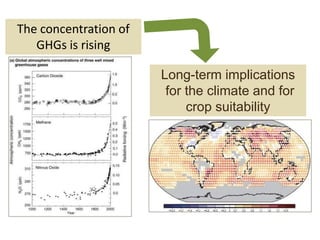
The concentration of 
GHGs is rising 
Long-term implications 
for the climate and for 
crop suitability
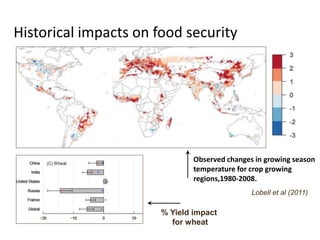
Historical impacts on food security 
Observed changes in growing season 
temperature for crop growing 
regions,1980-2008. 
% Yield impact 
for wheat 
Lobell et al (2011)
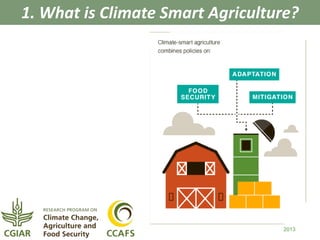
1. What is Climate Smart Agriculture? 
2013
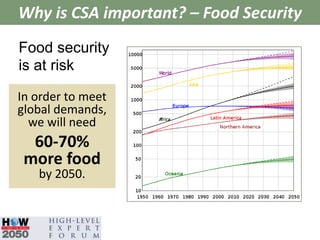
Why is CSA important? – Food Security 
Food security 
is at risk 
In order to meet 
global demands, 
we will need 
60-70% 
more food 
by 2050.
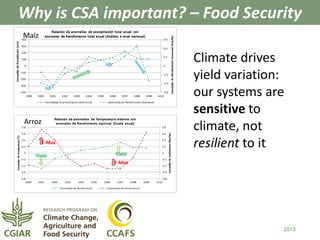
Why is CSA important? – Food Security 
2013 
Maíz 
T-Max 
Yield Yield 
T-Max 
Arroz 
Climate drives 
yield variation: 
our systems are 
sensitive to 
climate, not 
resilient to it
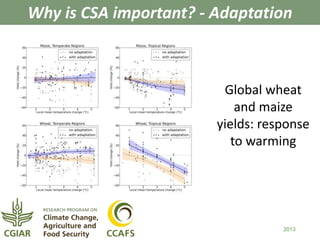
Why is CSA important? - Adaptation 
Global wheat 
and maize 
yields: response 
to warming 
2013
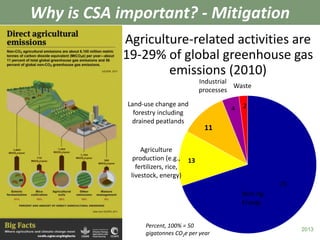
Agriculture-related activities are 
19-29% of global greenhouse gas 
2013 
Why is CSA important? - Mitigation 
emissions (2010) 
Land-use change and 
forestry including 
drained peatlands 
13 
Agriculture 
production (e.g., 
fertilizers, rice, 
livestock, energy) 
Industrial 
processes 
Waste 
Percent, 100% = 50 
gigatonnes CO2e per year 
Non-Ag 
Energy 
70 
11 
4 2
Why is CSA important? - Mitigation 
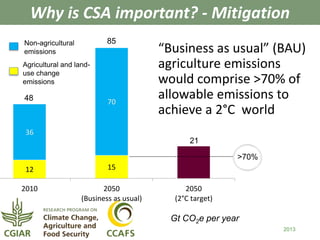
“Business as usual” (BAU) 
agriculture emissions 
would comprise >70% of 
allowable emissions to 
achieve a 2°C world 
2013 
Gt CO2e per year 
36 
70 
12 15 
2010 2050 
(Business as usual) 
2050 
(2°C target) 
Non-agricultural 
emissions 
Agricultural and land-use 
change 
emissions 
>70% 
48 
85 
21
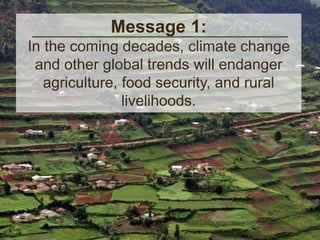
Message 1: 
In the coming decades, climate change 
and other global trends will endanger 
agriculture, food security, and rural 
livelihoods.
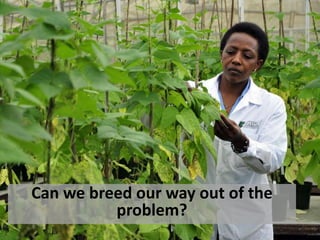
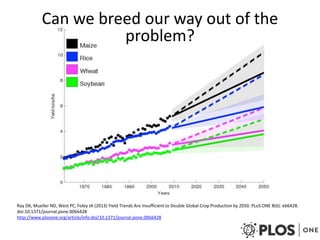
Can we breed our way out of the 
problem?
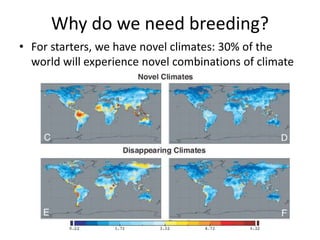
Why do we need breeding? 
• For starters, we have novel climates: 30% of the 
world will experience novel combinations of climate
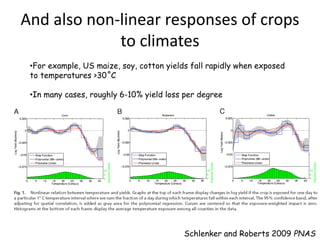
And also non-linear responses of crops 
to climates 
•For example, US maize, soy, cotton yields fall rapidly when exposed 
to temperatures >30˚C 
•In many cases, roughly 6-10% yield loss per degree 
Schlenker and Roberts 2009 PNAS
Can we breed our way out of the 
problem? 
Ray DK, Mueller ND, West PC, Foley JA (2013) Yield Trends Are Insufficient to Double Global Crop Production by 2050. PLoS ONE 8(6): e66428. 
doi:10.1371/journal.pone.0066428 
http://www.plosone.org/article/info:doi/10.1371/journal.pone.0066428
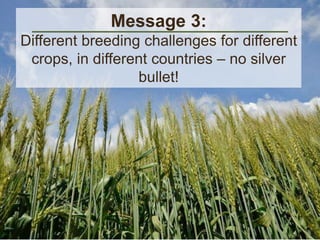
Message 3: 
Different breeding challenges for different 
crops, in different countries – no silver 
bullet!
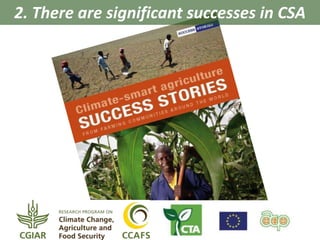
2. There are significant successes in CSA 
2013
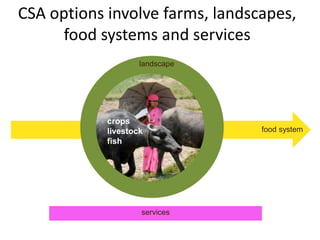
CSA options involve farms, landscapes, 
food systems and services 
landscape 
crops 
livestock 
fish 
food system 
services 
Photo: N. Palmer, CIAT
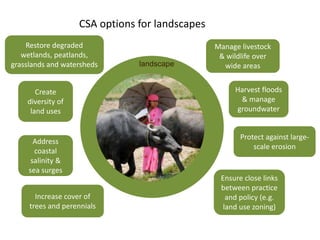
CSA options for landscapes 
landscape 
Manage livestock 
& wildlife over 
wide areas 
Ensure close links 
between practice 
and policy (e.g. 
land use zoning) 
Restore degraded 
wetlands, peatlands, 
grasslands and watersheds 
Create 
diversity of 
land uses 
Increase cover of 
trees and perennials 
Harvest floods 
& manage 
groundwater 
Address 
coastal 
salinity & 
sea surges 
Protect against large-scale 
erosion
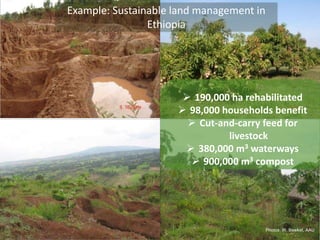
Example: Sustainable land management in 
Ethiopia 
 190,000 ha rehabilitated 
 98,000 households benefit 
 Cut-and-carry feed for 
livestock 
 380,000 m3 waterways 
 900,000 m3 compost 
Photos: W. Bewket, AAU
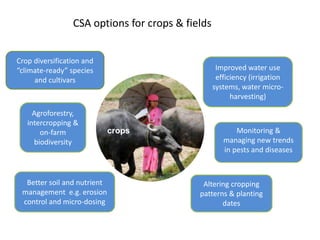
CSA options for crops & fields 
crops 
Crop diversification and 
“climate-ready” species 
and cultivars 
Altering cropping 
patterns & planting 
dates 
Better soil and nutrient 
management e.g. erosion 
control and micro-dosing 
Improved water use 
efficiency (irrigation 
systems, water micro-harvesting) 
Monitoring & 
managing new trends 
in pests and diseases 
Agroforestry, 
intercropping & 
on-farm 
biodiversity
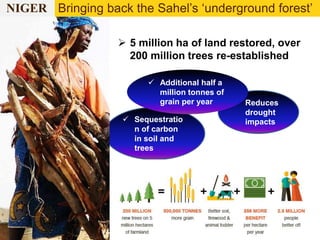
NIGER Bringing back the Sahel’s ‘underground forest’ 
 5 million ha of land restored, over 
200 million trees re-established 
 Sequestratio 
n of carbon 
in soil and 
trees 
 Reduces 
drought 
impacts 
 Additional half a 
million tonnes of 
grain per year
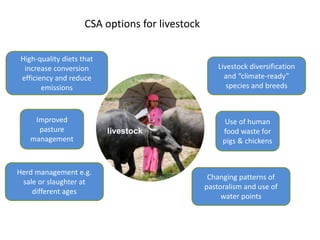
CSA options for livestock 
livestock 
High-quality diets that 
increase conversion 
efficiency and reduce 
emissions 
Herd management e.g. 
sale or slaughter at 
different ages 
Livestock diversification 
and “climate-ready” 
species and breeds 
Changing patterns of 
pastoralism and use of 
water points 
Improved 
pasture 
management 
Use of human 
food waste for 
pigs & chickens
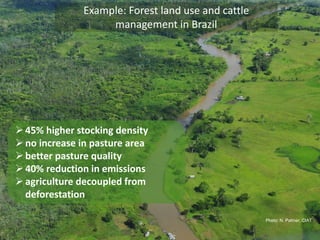
Example: Forest land use and cattle 
management in Brazil 
Photo: N. Palmer, CIAT 
 45% higher stocking density 
 no increase in pasture area 
 better pasture quality 
 40% reduction in emissions 
 agriculture decoupled from 
deforestation
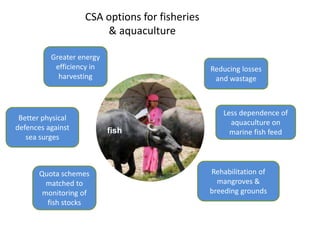
CSA options for fisheries 
& aquaculture 
fish 
Greater energy 
efficiency in 
harvesting 
Better physical 
defences against 
sea surges 
Quota schemes 
matched to 
monitoring of 
fish stocks 
Reducing losses 
and wastage 
Less dependence of 
aquaculture on 
marine fish feed 
Rehabilitation of 
mangroves & 
breeding grounds
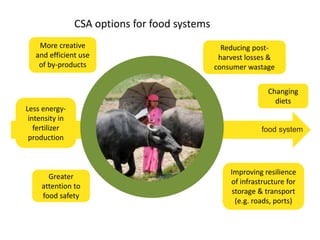
CSA options for food systems 
Changing 
diets 
food system 
More creative 
and efficient use 
of by-products 
Less energy-intensity 
in 
fertilizer 
production 
Improving resilience 
of infrastructure for 
storage & transport 
(e.g. roads, ports) 
Greater 
attention to 
food safety 
Reducing post-harvest 
losses & 
consumer wastage
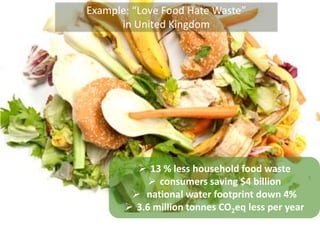
Example: “Love Food Hate Waste” 
in United Kingdom 
 13 % less household food waste 
 consumers saving $4 billion 
 national water footprint down 4% 
 3.6 million tonnes CO2eq less per year
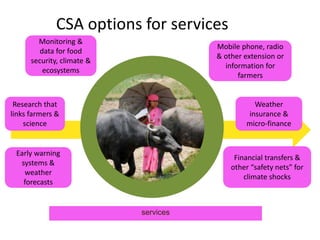
CSA options for services 
services 
Monitoring & 
data for food 
security, climate & 
ecosystems 
Early warning 
systems & 
weather 
forecasts 
Mobile phone, radio 
& other extension or 
information for 
farmers 
Research that 
links farmers & 
science 
Weather 
insurance & 
micro-finance 
Financial transfers & 
other “safety nets” for 
climate shocks
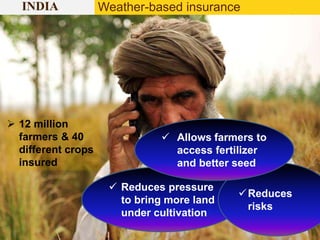
INDIA Weather-based insurance 
 12 million 
farmers & 40 
different crops 
insured 
 Allows farmers to 
access fertilizer 
and better seed 
 Reduces pressure 
to bring more land 
under cultivation 
Reduces 
risks
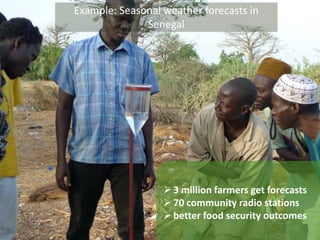
Example: Seasonal weather forecasts in 
Senegal 
 3 million farmers get forecasts 
 70 community radio stations 
 better food security outcomes
2. But major 
scaling up 
is needed
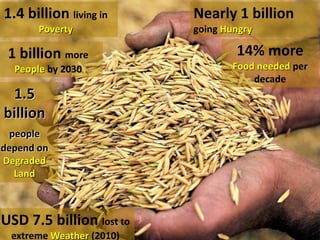
1.4 billion living in 
Poverty 
1 billion more 
People by 2030 
1.5 
billion 
people 
depend on 
Degraded 
Land 
USD 7.5 billion lost to 
extreme Weather (2010) 
Nearly 1 billion 
going Hungry 
14% more 
Food needed per 
decade
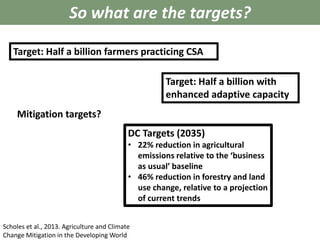
So what are the targets? 
Target: Half a billion farmers practicing CSA 
Mitigation targets? 
Target: Half a billion with 
enhanced adaptive capacity 
DC Targets (2035) 
• 22% reduction in agricultural 
Scholes et al., 2013. Agriculture and Climate 
Change Mitigation in the Developing World 
emissions relative to the ‘business 
as usual’ baseline 
• 46% reduction in forestry and land 
use change, relative to a projection 
of current trends
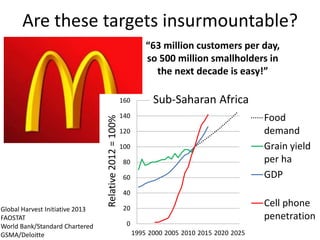
Are these targets insurmountable? 
“63 million customers per day, 
so 500 million smallholders in 
the next decade is easy!” 
160 
140 
120 
100 
80 
60 
40 
20 
0 
1995 2000 2005 2010 2015 2020 2025 
Relative 2012 = 100% 
Food 
demand 
Grain yield 
per ha 
GDP 
Cell phone 
penetration 
Global Harvest Initiative 2013 
FAOSTAT 
World Bank/Standard Chartered 
GSMA/Deloitte 
Sub-Saharan Africa
35 
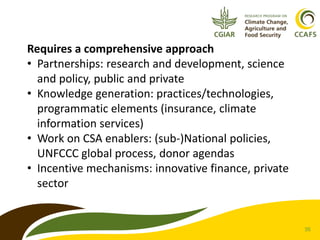
Requires a comprehensive approach 
• Partnerships: research and development, science 
and policy, public and private 
• Knowledge generation: practices/technologies, 
programmatic elements (insurance, climate 
information services) 
• Work on CSA enablers: (sub-)National policies, 
UNFCCC global process, donor agendas 
• Incentive mechanisms: innovative finance, private 
sector
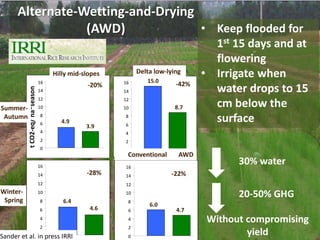
Alternate-Wetting-and-Drying 
(AWD) 
• Keep flooded for 
1st 15 days and at 
flowering 
• Irrigate when 
water drops to 15 
cm below the 
surface 
30% water 
20-50% GHG 
Without compromising 
yield 
Hilly mid-slopes Delta low-lying 
16 15.0 
14 
12 
10 
8 
6 
4 
2 
0 
-42% 
8.7 
16 
14 
12 
10 
8 
6 
4 
2 
0 
t CO2-eq/ ha*season 
4.9 
-20% 
3.9 
16 
14 
12 
10 
8 
6 
4 
2 
0 
16 
14 
12 
10 
8 
6 
4 
2 
0 
-28% -22% 
6.0 
4.7 
6.4 
4.6 
Summer- 
Autumn 
Winter- 
Spring 
Sander et al. in press IRRI 
Conventional AWD
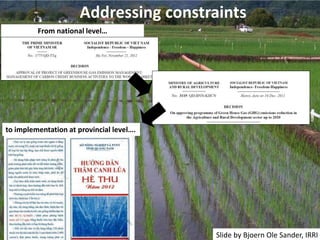
Addressing constraints 
From national level… 
to implementation at provincial level…. 
Slide by Bjoern Ole Sander, IRRI
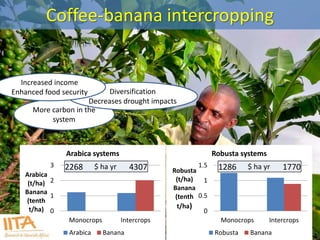
Coffee-banana intercropping 
3 
2 
1 
0 
2268 $ ha yr 4307 1286 $ ha yr 1770 
Monocrops Intercrops 
Arabica 
(t/ha) 
Banana 
(tenth 
t/ha) 
Arabica systems 
Arabica Banana 
1.5 
1 
0.5 
0 
Monocrops Intercrops 
Robusta 
(t/ha) 
Banana 
(tenth 
t/ha) 
Robusta systems 
Robusta Banana 
More carbon in the 
system 
Diversification 
Decreases drought impacts 
Increased income 
Enhanced food security
Leb by 
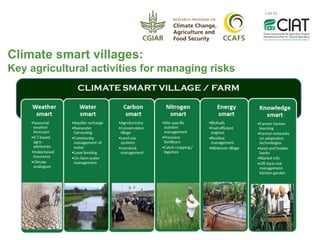
Climate smart villages: 
Key agricultural activities for managing risks
Strong national engagement
www.aclimatecolombia.org
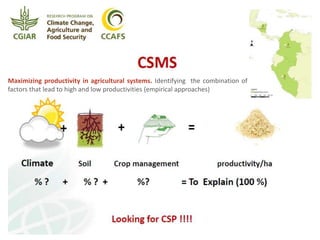
Maximizing productivity in agricultural systems. Identifying the combination of 
factors that lead to high and low productivities (empirical approaches)
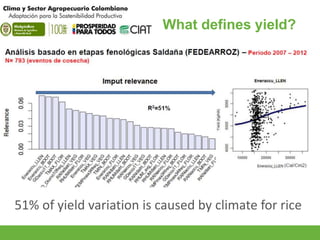
What defines yield? 
51% of yield variation is caused by climate for rice
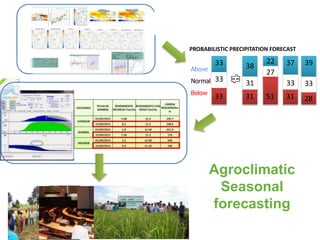
PROBABILISTIC PRECIPITATION FORECAST 
33 
33 
33 
Above 
Normal 
Below 
38 
31 
31 
22 
27 
51 
37 
33 
31 
39 
33 
28 
Agroclimatic 
Seasonal 
forecasting
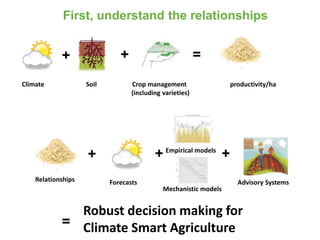
First, understand the relationships 
+ + = 
Climate Soil Crop management productivity/ha 
(including varieties) 
Relationships 
= 
+ 
Forecasts 
+ Empirical models 
+ 
Mechanistic models 
Advisory Systems 
Robust decision making for 
Climate Smart Agriculture
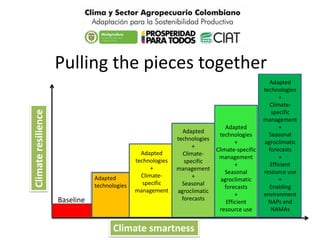
Pulling the pieces together 
Climate resilience 
Baseline 
Adapted 
technologies 
Adapted 
technologies 
+ 
Climate-specific 
management 
Adapted 
technologies 
+ 
Climate-specific 
management 
+ 
Seasonal 
agroclimatic 
forecasts 
Adapted 
technologies 
+ 
Climate-specific 
management 
+ 
Seasonal 
agroclimatic 
forecasts 
+ 
Efficient 
resource use 
+ 
Enabling 
environment 
NAPs and 
NAMAs 
Climate smartness 
Adapted 
technologies 
+ 
Climate-specific 
management 
+ 
Seasonal 
agroclimatic 
forecasts 
+ 
Efficient 
resource use
Global learning
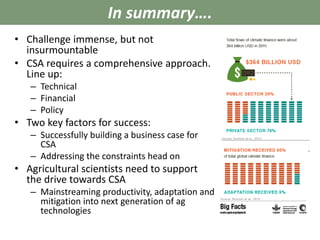
In summary…. 
• Challenge immense, but not 
insurmountable 
• CSA requires a comprehensive approach. 
Line up: 
– Technical 
– Financial 
– Policy 
• Two key factors for success: 
– Successfully building a business case for 
CSA 
– Addressing the constraints head on 
• Agricultural scientists need to support 
the drive towards CSA 
– Mainstreaming productivity, adaptation and 
mitigation into next generation of ag 
technologies
50 
www.ccafs.cgiar.org 
sign up for science, policy and news e-bulletins 
Twitter: @cgiarclimate

Establishing a climate smart agricultural world

  • 1.
    Rising to thechallenge of establishing a climate smart agriculture Andy Jarvis, CCAFS
  • 2.
  • 3.
    The concentration of GHGs is rising Long-term implications for the climate and for crop suitability
  • 4.
    Historical impacts onfood security Observed changes in growing season temperature for crop growing regions,1980-2008. % Yield impact for wheat Lobell et al (2011)
  • 5.
    1. What isClimate Smart Agriculture? 2013
  • 6.
    Why is CSAimportant? – Food Security Food security is at risk In order to meet global demands, we will need 60-70% more food by 2050.
  • 7.
    Why is CSAimportant? – Food Security 2013 Maíz T-Max Yield Yield T-Max Arroz Climate drives yield variation: our systems are sensitive to climate, not resilient to it
  • 8.
    Why is CSAimportant? - Adaptation Global wheat and maize yields: response to warming 2013
  • 9.
    Agriculture-related activities are 19-29% of global greenhouse gas 2013 Why is CSA important? - Mitigation emissions (2010) Land-use change and forestry including drained peatlands 13 Agriculture production (e.g., fertilizers, rice, livestock, energy) Industrial processes Waste Percent, 100% = 50 gigatonnes CO2e per year Non-Ag Energy 70 11 4 2
  • 10.
    Why is CSAimportant? - Mitigation “Business as usual” (BAU) agriculture emissions would comprise >70% of allowable emissions to achieve a 2°C world 2013 Gt CO2e per year 36 70 12 15 2010 2050 (Business as usual) 2050 (2°C target) Non-agricultural emissions Agricultural and land-use change emissions >70% 48 85 21
  • 11.
    Message 1: Inthe coming decades, climate change and other global trends will endanger agriculture, food security, and rural livelihoods.
  • 12.
    Can we breedour way out of the problem?
  • 13.
    Why do weneed breeding? • For starters, we have novel climates: 30% of the world will experience novel combinations of climate
  • 14.
    And also non-linearresponses of crops to climates •For example, US maize, soy, cotton yields fall rapidly when exposed to temperatures >30˚C •In many cases, roughly 6-10% yield loss per degree Schlenker and Roberts 2009 PNAS
  • 15.
    Can we breedour way out of the problem? Ray DK, Mueller ND, West PC, Foley JA (2013) Yield Trends Are Insufficient to Double Global Crop Production by 2050. PLoS ONE 8(6): e66428. doi:10.1371/journal.pone.0066428 http://www.plosone.org/article/info:doi/10.1371/journal.pone.0066428
  • 16.
    Message 3: Differentbreeding challenges for different crops, in different countries – no silver bullet!
  • 17.
    2. There aresignificant successes in CSA 2013
  • 18.
    CSA options involvefarms, landscapes, food systems and services landscape crops livestock fish food system services Photo: N. Palmer, CIAT
  • 19.
    CSA options forlandscapes landscape Manage livestock & wildlife over wide areas Ensure close links between practice and policy (e.g. land use zoning) Restore degraded wetlands, peatlands, grasslands and watersheds Create diversity of land uses Increase cover of trees and perennials Harvest floods & manage groundwater Address coastal salinity & sea surges Protect against large-scale erosion
  • 20.
    Example: Sustainable landmanagement in Ethiopia  190,000 ha rehabilitated  98,000 households benefit  Cut-and-carry feed for livestock  380,000 m3 waterways  900,000 m3 compost Photos: W. Bewket, AAU
  • 21.
    CSA options forcrops & fields crops Crop diversification and “climate-ready” species and cultivars Altering cropping patterns & planting dates Better soil and nutrient management e.g. erosion control and micro-dosing Improved water use efficiency (irrigation systems, water micro-harvesting) Monitoring & managing new trends in pests and diseases Agroforestry, intercropping & on-farm biodiversity
  • 22.
    NIGER Bringing backthe Sahel’s ‘underground forest’  5 million ha of land restored, over 200 million trees re-established  Sequestratio n of carbon in soil and trees  Reduces drought impacts  Additional half a million tonnes of grain per year
  • 23.
    CSA options forlivestock livestock High-quality diets that increase conversion efficiency and reduce emissions Herd management e.g. sale or slaughter at different ages Livestock diversification and “climate-ready” species and breeds Changing patterns of pastoralism and use of water points Improved pasture management Use of human food waste for pigs & chickens
  • 24.
    Example: Forest landuse and cattle management in Brazil Photo: N. Palmer, CIAT  45% higher stocking density  no increase in pasture area  better pasture quality  40% reduction in emissions  agriculture decoupled from deforestation
  • 25.
    CSA options forfisheries & aquaculture fish Greater energy efficiency in harvesting Better physical defences against sea surges Quota schemes matched to monitoring of fish stocks Reducing losses and wastage Less dependence of aquaculture on marine fish feed Rehabilitation of mangroves & breeding grounds
  • 26.
    CSA options forfood systems Changing diets food system More creative and efficient use of by-products Less energy-intensity in fertilizer production Improving resilience of infrastructure for storage & transport (e.g. roads, ports) Greater attention to food safety Reducing post-harvest losses & consumer wastage
  • 27.
    Example: “Love FoodHate Waste” in United Kingdom  13 % less household food waste  consumers saving $4 billion  national water footprint down 4%  3.6 million tonnes CO2eq less per year
  • 28.
    CSA options forservices services Monitoring & data for food security, climate & ecosystems Early warning systems & weather forecasts Mobile phone, radio & other extension or information for farmers Research that links farmers & science Weather insurance & micro-finance Financial transfers & other “safety nets” for climate shocks
  • 29.
    INDIA Weather-based insurance  12 million farmers & 40 different crops insured  Allows farmers to access fertilizer and better seed  Reduces pressure to bring more land under cultivation Reduces risks
  • 30.
    Example: Seasonal weatherforecasts in Senegal  3 million farmers get forecasts  70 community radio stations  better food security outcomes
  • 31.
    2. But major scaling up is needed
  • 32.
    1.4 billion livingin Poverty 1 billion more People by 2030 1.5 billion people depend on Degraded Land USD 7.5 billion lost to extreme Weather (2010) Nearly 1 billion going Hungry 14% more Food needed per decade
  • 33.
    So what arethe targets? Target: Half a billion farmers practicing CSA Mitigation targets? Target: Half a billion with enhanced adaptive capacity DC Targets (2035) • 22% reduction in agricultural Scholes et al., 2013. Agriculture and Climate Change Mitigation in the Developing World emissions relative to the ‘business as usual’ baseline • 46% reduction in forestry and land use change, relative to a projection of current trends
  • 34.
    Are these targetsinsurmountable? “63 million customers per day, so 500 million smallholders in the next decade is easy!” 160 140 120 100 80 60 40 20 0 1995 2000 2005 2010 2015 2020 2025 Relative 2012 = 100% Food demand Grain yield per ha GDP Cell phone penetration Global Harvest Initiative 2013 FAOSTAT World Bank/Standard Chartered GSMA/Deloitte Sub-Saharan Africa
  • 35.
    35 Requires acomprehensive approach • Partnerships: research and development, science and policy, public and private • Knowledge generation: practices/technologies, programmatic elements (insurance, climate information services) • Work on CSA enablers: (sub-)National policies, UNFCCC global process, donor agendas • Incentive mechanisms: innovative finance, private sector
  • 36.
    Alternate-Wetting-and-Drying (AWD) •Keep flooded for 1st 15 days and at flowering • Irrigate when water drops to 15 cm below the surface 30% water 20-50% GHG Without compromising yield Hilly mid-slopes Delta low-lying 16 15.0 14 12 10 8 6 4 2 0 -42% 8.7 16 14 12 10 8 6 4 2 0 t CO2-eq/ ha*season 4.9 -20% 3.9 16 14 12 10 8 6 4 2 0 16 14 12 10 8 6 4 2 0 -28% -22% 6.0 4.7 6.4 4.6 Summer- Autumn Winter- Spring Sander et al. in press IRRI Conventional AWD
  • 37.
    Addressing constraints Fromnational level… to implementation at provincial level…. Slide by Bjoern Ole Sander, IRRI
  • 38.
    Coffee-banana intercropping 3 2 1 0 2268 $ ha yr 4307 1286 $ ha yr 1770 Monocrops Intercrops Arabica (t/ha) Banana (tenth t/ha) Arabica systems Arabica Banana 1.5 1 0.5 0 Monocrops Intercrops Robusta (t/ha) Banana (tenth t/ha) Robusta systems Robusta Banana More carbon in the system Diversification Decreases drought impacts Increased income Enhanced food security
  • 39.
    Leb by Climatesmart villages: Key agricultural activities for managing risks
  • 40.
  • 41.
  • 42.
    Maximizing productivity inagricultural systems. Identifying the combination of factors that lead to high and low productivities (empirical approaches)
  • 43.
    What defines yield? 51% of yield variation is caused by climate for rice
  • 44.
    PROBABILISTIC PRECIPITATION FORECAST 33 33 33 Above Normal Below 38 31 31 22 27 51 37 33 31 39 33 28 Agroclimatic Seasonal forecasting
  • 45.
    First, understand therelationships + + = Climate Soil Crop management productivity/ha (including varieties) Relationships = + Forecasts + Empirical models + Mechanistic models Advisory Systems Robust decision making for Climate Smart Agriculture
  • 46.
    Pulling the piecestogether Climate resilience Baseline Adapted technologies Adapted technologies + Climate-specific management Adapted technologies + Climate-specific management + Seasonal agroclimatic forecasts Adapted technologies + Climate-specific management + Seasonal agroclimatic forecasts + Efficient resource use + Enabling environment NAPs and NAMAs Climate smartness Adapted technologies + Climate-specific management + Seasonal agroclimatic forecasts + Efficient resource use
  • 47.
  • 49.
    In summary…. •Challenge immense, but not insurmountable • CSA requires a comprehensive approach. Line up: – Technical – Financial – Policy • Two key factors for success: – Successfully building a business case for CSA – Addressing the constraints head on • Agricultural scientists need to support the drive towards CSA – Mainstreaming productivity, adaptation and mitigation into next generation of ag technologies
  • 50.
    50 www.ccafs.cgiar.org signup for science, policy and news e-bulletins Twitter: @cgiarclimate