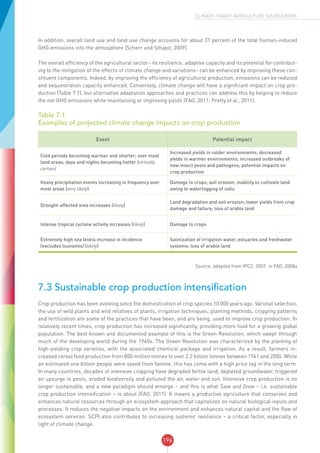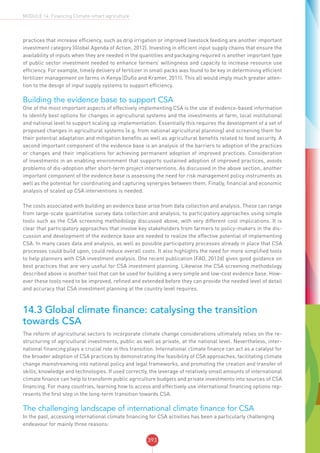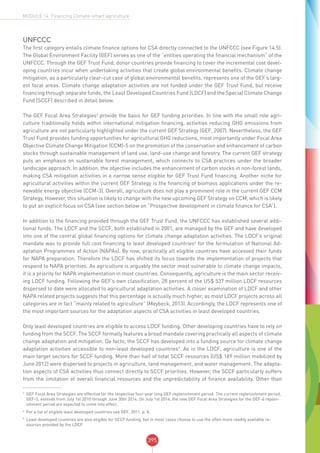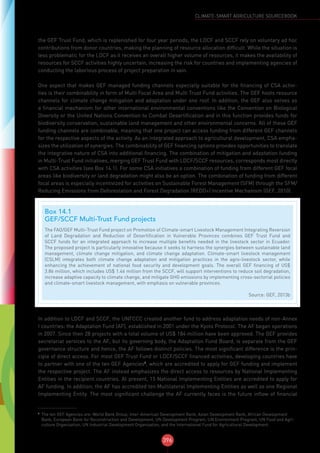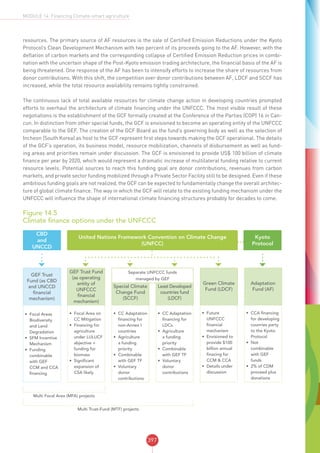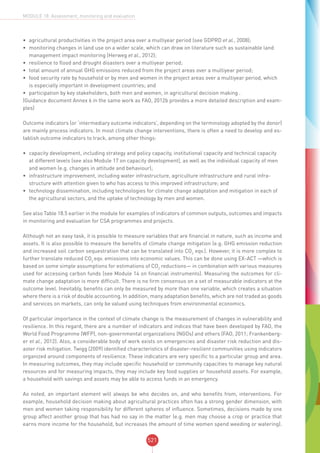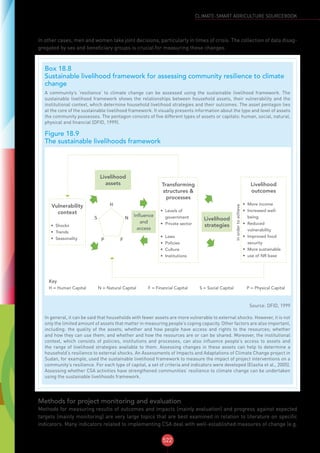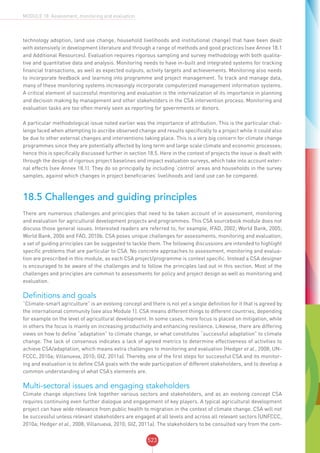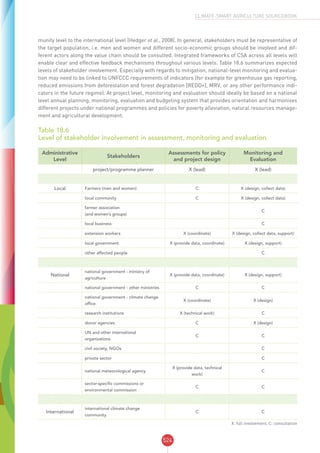






CLIMATE-SMART AGRICULTURE
SourcebookSourcebook
Food and Agriculture Organization of the United Nations
2013
The designations employed and the presentation of material in this
information product do not imply the expression of any opinion whatsoever
on the part of the Food and Agriculture Organization of the United Nations
(FAO) concerning the legal or development status of any country, territory, city
or area or of its authorities, or concerning the delimitation of its frontiers or
boundaries. The mention of specific companies or products of manufacturers,
whether or not these have been patented, does not imply that these have
been endorsed or recommended by FAO in preference to others of a similar
nature that are not mentioned.
The views expressed in this information product are those of the author(s) and
do not necessarily reflect the views or policies of FAO.
ISBN 978-92-5-107720-7 (print)
E-ISBN 978-92-5-107721-4 (PDF)
© FAO 2013
FAO encourages the use, reproduction and dissemination of material in this
information product. Except where otherwise indicated, material may be
copied, downloaded and printed for private study, research and teaching
purposes, or for use in non-commercial products or services, provided that
appropriate acknowledgement of FAO as the source and copyright holder is
given and that FAO’s endorsement of users’ views, products or services is not
implied in any way.
All requests for translation and adaptation rights, and for resale and other
commercial use rights should be made via www.fao.org/contact-us/licencerequest
or addressed to copyright@fao.org.
FAO information products are available on the FAO website (www.fao.org/
publications) and can be purchased through publications-sales@fao.org.
iii
Table of contents
Table of contents
MODULE 1: Why Climate-smart agriculture, forestry and fisheries
Overview and Key messages	 	1
1.1	 Food security and climate change: three intertwined challenges		5
1.2.	 Towards more efficient and resilient systems		8
1.3	 Increase systemic efficiency and resilience: policies, institutions finances		24
1.4	 What’s new with CSA?		27
1.5	 Conclusions and focus of the sourcebook		30
MODULE 2: Managing landscapes for Climate-smart agricultural systems
Overview and Key messages	 	41
2.1	 Why is a landscape approach needed for achieving Climat-smart agriculture?		45
2.2	 How can a landscape approach be implemented?		51
2.3	 Examples of landscape approaches		57
2.4	Conclusions		 	 76
MODULE 3: Water management
Overview and Key messages	 	81
3.1	Introduction		 	 84
3.2	 Water management in agriculture: status and trends		84
3.3	 Potential impacts of climate change on water in agriculture		85
3.4	 Vulnerability to climate change and resilience: a variety of situations		88
3.5	 Assessing risk, preparing responses		89
3.6	 Options for adaptation to climate change		90
3.7	 Prioritizing options with an eye on vulnerable categories of people		95
3.8	 Conditions for successful adaptation		96
3.9	 Water management for climate change mitigation		96
3.10	Conclusions		 	 97
MODULE 4: Soils and their management for Climate-smart agriculture
Overview and Key messages	 	105
4.1	 Principles of soil health, key functions and soil: plant-water interrelations		109
4.2	 Challenges of climate change to soils		111
4.3	 Soil principles for climate change adaptation and mitigation and enhancing
resilience in different contexts		113
4.4	 Successful examples of soil management practices
for climate-smart agriculture with a focus on resilience		120
4.5	Conclusions		 	124
MODULE 5: Sound Management of Energy for Climate-smart agriculture
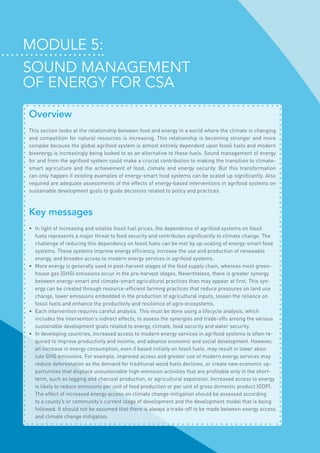
Overview and Key messages	 	139
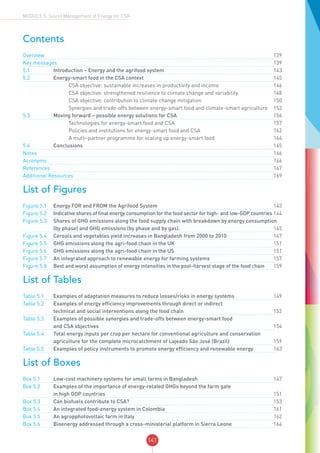
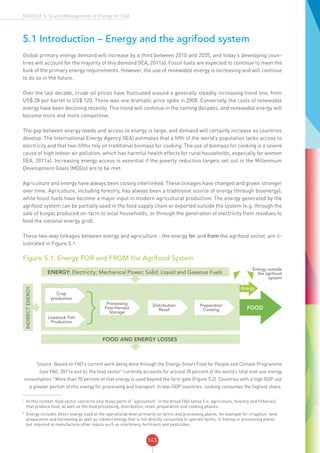
5.1	 Introduction – Energy and the agrifood system		143
5.2	 Energy-smart food in the CSA context		145
5.3 	 Moving forward – possible energy solutions for CSA		156
5.4	Conclusions		 	165
iv
CLIMATE-SMART AGRICULTURE SOURCEBOOK
MODULE 6: Conservation and sustainable use of genetic resources
		 for food and agriculture
Overview and Key messages	 	171
6.1	 Genetic resources for food and agriculture		175
6.2	 Genetic resources for food and agriculture: a prerequisite for climate-smart agriculture		176
6.3	 Concluding remarks		185
MODULE 7: Climate-smart crop production system
Overview and Key messages	 	191
7.1	Introduction		 	195
7.2	 Climate change impacts		195
7.3	 Sustainable crop production intensification		196
7.4	 Underlying principles: management of natural biological processes		198
7.5	 Climate-smart approaches and practices		202
7.6	Conclusions		 	204
MODULE 8: Climate-smart Livestock
Overview and Key messages 211
8.1	Introduction		 	215
8.2	 Adaptation and mitigation needs		216
8.3	 Climate-smart livestock		218
8.4	Conclusions		 	227
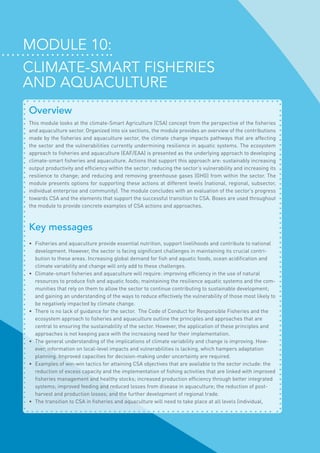
MODULE 9: Climate-smart forestry
Overview and Key messages	 	239
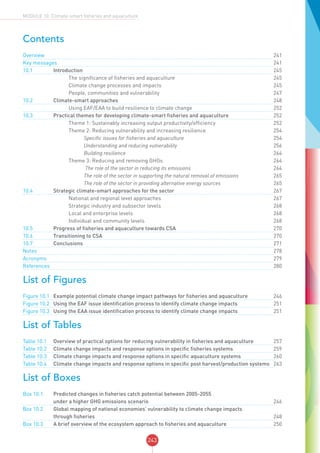
MODULE 10: Climate-smart fisheries and aquaculture
Overview and Key messages	 	241
10.1	Introduction		 	245
10.2 	 Climate-smart approaches		248
10.3	 Practical themes for developing climate-smart fisheries and aquaculture		252
10.4	 Strategic climate-smart approaches for the sector		267
10.5	 Progress of fisheries and aquaculture towards CSA		270
10.6	 Transitioning to CSA		270
10.7	Conclusions		 	271
MODULE 11: Developing sustainable and inclusive food value chains for
Climate-smart agriculture
Overview and Key messages	 	285
11.1	 Introduction to sustainable and inclusive food value chains		289
11.2. 	 Sustainable and inclusive food value chains in practice: the case of food losses and waste		294
11.3	 Step-by-step approach for chain actors to improve their performance
along the sustainable and inclusive food value chain		311
MODULE 12: Local institutions
Overview and Key messages	 	321
12.1	Introduction		 	325
12.2 	 Key institutions for CSA initiatives		328
12.3 	 Building synergies		335
12.4 	 Quick institutional context assessment		342
12.5 	Conclusions		 	345
v
Table of contents
MODULE 13: Mainstreaming Climate-smart agriculture
		 into National Policies and Programmes
Overview and Key messages	 	353
13.1 	 Climate-smart agriculture within larger economic and policy frameworks 	357
13.2 	 Improve market accessibility: policy and financial instruments	361
13.3 	 Improving access to knowledge and monitoring: the role of implementing actors		364
13.4 	Conclusions		 369
MODULE 14: Financing Climate-smart agriculture
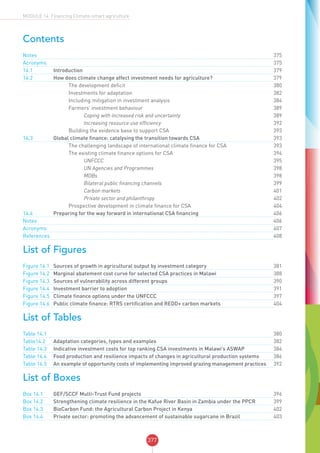
Overview and Key messages	 	375
14.1	Introduction		 	379
14.2	 How does climate change affect investment needs for agriculture?		379
14.3	 Global climate finance: catalysing the transition towards CSA		393
14.4	 Preparing for the way forward in international CSA financing		406
MODULE 15: Disaster Risk Reduction: Strengthening Livelihood Resilience
Overview and Key messages	 	413
15.1	 Disaster risk reduction and climate change adaptation		417
15.2	 Planning for resilience against multiple risks		417
15.3	 Building on community-based approaches to DRR and adaptation		425
15.4	 Scaling up proven technologies and practices for resilient livelihoods		427
15.5	 The enabling framework of DRR to support CSA		434
15.6	 Concluding remarks and recommendations		438
MODULE 16: Making Climate-smart agriculture a work for the most vul-
nerable: the role of safety nets
Overview and Key messages	 	449
16.1	Introduction		 	453
16.2	 Social protection and safety nets – a conceptual overview		453
16.3	 Key functions of safety nets in relation to CSA		454
16.4	 Challenges and lessons learned		459
16.5	Conclusions		 	463
MODULE 17: Capacity development for climate-smart agriculture
Overview and Key messages	 	469
17.1	Introduction		 	473
17.2	 Strategies for improving policy coherence and effectiveness		480
17.3	 Strategies for knowledge sharing and effective learning		481
17.4.	Conclusions		 	487
MODULE 18: Assessment, monitoring and evaluation
Overview and Key messages	 	493
18.1	Introduction		 	497
18.2	 Defining assessment, monitoring and evaluation for CSA:
scope, purposes, frameworks and concepts		497
18.3	 How to conduct assessments for CSA policy and project design		508
18.4	 How to implement monitoring and evaluation for CSA programmes and projects		515
18.5	 Challenges and guiding principles		523
18.6	 Examples of assessment, monitoring and evaluation		529
18.7	Conclusions		 	534
GLOSSARY	 545
vi
CLIMATE-SMART AGRICULTURE SOURCEBOOK
Acknowledgements
The drafting of this Sourcebook on Climate-Smart Agriculture, Forestry and Fisheries has been a collaborative
effort involving professionals from within several departments of FAO and a variety of partner organizations.
Many individuals played a leading role as main authors and coordinators in the preparation of the modules,
while others made written contributions to the Modules’ boxes and case studies.
The conceptualization and production of this sourcebook was coordinated by Lucia Palombi and Reuben Sessa,
under the overall supervision of the Director of the Climate, Energy and Tenure Division of FAO Xiangjun Yao and
the Senior Natural Resources Officer Tiina Vähänen. Editorial support was provided by Denise Martínez Breto,
Kaisa Karttunen, Gordon Ramsay and Alessandra Bresnan while the graphic design was elaborated by Maria
Guardia and Fabrizio Puzzilli.
Module 1 on why climate-smart agriculture, forestry and fisheries was written by Alexandre Meybeck (FAO) and
Vincent Gitz (FAO) with contributions from Richie Ahuja (EDF–India), Kevern Cochrane (FAO), Anette Engelund
Friis (World Farmers Organization), Elwyn Grainger-Jones (IFAD), Hsin Huang (OECD), Chang-Gil Kim (KREI-
South Korea), Atta-Krah Kwesi (Bioversity International), James Lomax (UNEP), Dr B. Mantlana (South Africa),
Hayden Montgomery (New Zealand), Lucia Perugini (University of Perugia) and Dipti Thapa (World Bank). The
module was reviewed by Shivaji Pandey and Wilfrid Legg.
Module 2 on managing landscapes for climate-smart agricultural ecosystems was written by Marja-Liisa Tapio-
Bistrom (FAO), Anne Bogdanski (FAO) and Lisen Runsten (FAO) with contributions from Anni Arial (FAO); Nadine
Azzu (FAO); Sally Bunning (FAO); Christina Seeberg-Elverfeldt (FAO); David Coates (CBD secretariat); Zhijun
Chen (FAO); Cassandra De Young (FAO); Paolo Groppo (FAO); Marc Dumas Johansen (FAO); Damiano Luchetti
(FAO); Sheila Mwanundu (IFAD); Matthias Reiche (FAO); Janie Rioux (FAO); Reuben Sessa (FAO); Kim-Anh Tem-
pelman (FAO); Stephen Twomlow (IFAD); and Tiina Vahanen (FAO). Box 2.4 was written by Maria Nuutinen (FAO).
Case Study 2.1 was written by Richard Hatfield (Natural Capital East Africa). Case Study 2.2 was written by David
Boerma (FAO). Case study 2.3 was written by Doris Soto (FAO). Case Study 2.4 was written by Lisen Runsten
(FAO) and Manuela Vollbrecht (FAO). Case Study 2.5 was written by Pieter Van Lierop (FAO) and Petteri Vuorinen
(FAO). Case Study 2.6 was written by Wu Ning (ICIMOD) and Hans Joosten (University of Greifswald). Case Study
2.7 was written by Sally Bunning (FAO) and Monica Petri (FAO). Case Study 2.8 was written by Tomas Lindemann
(FAO), Paola Palestini (FAO) and Daniela Morra (FAO).
Module 3 on water management was written Jean-Marc Faurès (FAO) with contributions from Devin Bartley (FAO),
Mohamed Bazza (FAO), Jacob Burke (FAO), Jippe Hoogeveen (FAO), Doris Soto (FAO) and Pasquale Steduto (FAO).
Module 4 on soils and their management for CSA was written by Sally Bunning (FAO), Sandra Corsi (FAO) and
Ronald Vargas (FAO).
Module 5 on energy was written by Olivier Dubois (FAO), Alessandro Flammini (FAO), Anne Bogdanski (FAO) and
Jonathan Reeves (FAO).
Module 6 on conservation and sustainable use for genetic resources for food and agriculture was written by
Damiano Luchetti, Ehsan Dulloo, Anna Asfaw and Linda Collette (FAO) with contributions by Devin Bartley, Cas-
sandra De Young, Mary Jane Dela Cruz, Matthias Halwart, Kathrin Hett, Irene Hoffmann, Mario Marino, Albert
Nikiema, Dafydd Pilling, Beate Scherf, Doris Soto, Kim-Anh Tempelman and Álvaro Toledo (FAO) in coordination
with the Secretariat of the Commission on Genetic Resources for Food and Agriculture and FAO’s inter-depart-
mental working group on biodiversity.
Module 7 on crop production systems was written by Nadine Azzu (FAO) and Suzanne Redfern (FAO) with contri-
butions from Theodor Friedrich (FAO), Gualbert Gbehounou (FAO), Amir Kassam (FAO), Chikelu Mba (FAO) and
Cornelis VanDuijvendijk (FAO).
vii
Acknowledgements
Module 8 livestock was written by Pierre Gerber (FAO) with contributions from Benjamin Henderson (FAO)
and Carolyn Opio (FAO). Case study 8.2 was written by Muhammad Ibrahim (IICA-Belize), Cristóbal Villanueva
(CATIE), Claudia Sepúlveda (CATIE), Diego Tobar (CATIE-Costa Rica), Guillermo Chuncho (CATIE).
The key messages for Module 9 on climate-smart forestry were written by Susan Bratz (FAO).
Module 10 on climate-smart fisheries and aquaculture was written by Cassandra De Young (FAO), Doris Soto
(FAO) and James Muir (FAO consultant) with contributions by Randall Brummett (World Bank) and Matthias
Halwart (FAO) and in coordination with the Global Partnership for Climate, Fisheries and Aquaculture (PaCFA).
Box 10.6 on climate-smart tuna fishing was written by Johann Bell (SPC). Box 10.7 on culture based fish-
eries was written by Sena De Silva (Deakin University) and Doris Soto (FAO). Box 10.8 on fuelwood saving
fish processing technology was written by Yvette DieiOuadi (FAO). Box 10.9 on LIFE fishing was written by
Petri Suuronen (FAO) and James Muir (FAO consultant). Box 10.10 on the role of trade was written by Victoria
Chomo (FAO) and Cassandra De Young (FAO). Case study 10.1 on catfish farming was written by Sena De Silva
(Deakin University) and Doris Soto (FAO). Case study 10.2 on integrated multitrophic aquaculture was written
by Changbo Zhu (South China Sea Fisheries Research Institute) and Joao Ferreira (Universidade Nova de Lis-
boa). Case study 10.3 on mussel farming was written by Ana Farias (Universidad Austral), Jose Luis Rodriguez
(Instituto Gallego de Formación en Acuicultura), Doris Soto (FAO) and Iker Uriarte (Universidad Austral).
Module 11 on sustainable and inclusive food value chains was written by Tamara van‘t Wout (FAO) and Reuben
Sessa (FAO) with contributions from Martin Hilmi (FAO), David Neven (FAO), Robert van Otterdijk (FAO), Came-
lia Bucatariu (FAO), Danilo Meja (FAO), Jogeir Toppe (FAO), Lucio Olivero (FAO), Sandra Corsi (FAO) and Alashiya
Gordes (FAO).
Module 12 on local Institutions was written by Patti Kristjanson (CCAFS/CGIAR), Alashiya Gordes (FAO) and
Reuben Sessa (FAO) with contributions from Ademola Braimoh (WB) and Sonja Vermeulen (CCAFS/CGIAR).
Module 13 on national policies and programs was written by Majory-Anne Bromhead (World Bank), and Reu-
ben Sessa (FAO) with contributions from Savis Joze Sadeghian (FAO). The module was reviewed by Leslie Lip-
per (FAO).
Module 14 on financing climate-smart agriculture was written by Leslie Lipper (FAO) and Bjorn Conrad (FAO)
with contributions from World Bank made by Ademola Braimoh, David Treguer and Marco Van der Linden. The
module was reviewed by Elisabeth Barsk-Rundquist, Camilla Nordheim-Larsen and Siv Oystese at the Global
Mechanism of the UNCCD. Additional contributions were also made by Luis Bockel (FAO), Uwe Grewer (FAO)
and Savis Joze Sadeghian (FAO).
Module 15 on disaster risk reduction was written by Monica Trujillo (FAO) with contributions from Stephan
Baas (FAO) and reviewed by Jim Hancock (FAO) and Kennedy Igbokwe (FAO).
Module 16 on safety nets was written by Catherine Zanev (WFP) and Carlo Scaramella (WFP)
with contributions from Ugo Gentilini (WFP) and was reviewed by Niels Balzer (WFP), Volli Carucci (WFP), Al-
exandra Guyetsky (FAO), Nyasha Tirivayi (FAO) and Tamara van‘t Wout (FAO).
Module 17 on capacity development was written by Claudia Hiepe (FAO) and Patrick Kalas (FAO) with contribu-
tions by Federica Matteoli (FAO), Katrin Nichterlein (FAO), Sibyl Nelson (FAO) and Janie Rioux (FAO). Box 17.1
was written by Janie Rioux (FAO). Box 17.5 was written by Sibyl Nelson (FAO). Box 17.8 was written by Karin
Nichterlein and the TECA team (FAO). Box 17.9 was written by the CSDI team at FAO including Mario Acunzo,
Federica Matteoli, Marzia Pafumi and Vanessa Vertiz.
viii
CLIMATE-SMART AGRICULTURE SOURCEBOOK
Module 18 on assessment, monitoring and evaluation was written by Hideki Kanamaru (FAO) and Jim Hancock
(FAO) with contributions from Louis Bockel (FAO), Ademola Braimoh (World Bank), Elisa Distefano (IFAD),
Wiebke Förch (CCAFS), Uwe Grewer (FAO), Claudia Hiepe (FAO), Madeleine Jonsson (Swedish Cooperative
Centre), Krishna Krishnamurthy (WFP), Sarshen Marais (Conservation South Africa), Federica Matteoli (FAO),
Katia Medeiros (FAO), Sibyl Nelson (FAO), Christina Seeberg-Elverfeldt (FAO), Philip Thornton (CCAFS), Ophelie
Touchemoulin (SAUR) and Tamara Vantwout (FAO). Figure 18.8 was created by Uwe Grewer (FAO). Box 18.1 was
written by Hideki Kanamaru (FAO) with material provided by Christina Seeberg-Elverfeldt (FAO). Box 18.2 was
written by Wiebke Förch (CCAFS) and Philip Thornton (CCAFS). Box 18.3 was written by Elisa Distefano (IFAD).
Box 18.5 was written by Uwe Grewer (FAO), Ophelie Touchemoulin (SAUR) and Louis Bockel (FAO). Box 18.6
was written by Kanamaru with material provided by Sarshen Marais (Conservation South Africa). Box 18.7 was
written by Madeleine Jonsson (Swedish Cooperative Centre). Box 18.8 was written by Hideki Kanamaru (FAO)
with material provided by Tamara van‘t Wout (FAO). Box 18.10 was written by Hideki Kanamaru (FAO) with
material provided by Federica Matteoli (FAO) and Madeleine Jonsson (Swedish Cooperative Centre). Box 18.11
was written by Hideki Kanamaru (FAO) with material provided by Christina Seeberg-Elverfeldt (FAO). Case
Study 18.1 was written by Krishna Krishnamurthy (WFP). Case Studies 18.2 and 18.3 were written by Ademola
Braimoh (World Bank).
Many other individuals provided useful materials that were not included in the final version of the Sourcebook.
They are: Nicholas Tyack (Global Crop Diversity Trust); Jody Butterfield (Africa Centre for Holistic Manage-
ment) and Daniela Ibarra-Howell (Africa Centre for Holistic Management); Do Trong Hoan (ICRAF), Delia C.
Catacutan (ICRAF) and Peter Minang (ICRAF); Jesús Quintana (IFAD) and Clarissa Baldin (IFAD).
ix
Executive summary
Executive Summary
Why is climate-smart agriculture needed?
Between now and 2050, the world’s population will increase by one-third. Most of these additional 2 billion
people will live in developing countries. At the same time, more people will be living in cities. If current income
and consumption growth trends continue, FAO estimates that agricultural production will have to increase by
60 percent by 2050 to satisfy the expected demands for food and feed. Agriculture must therefore transform
itself if it is to feed a growing global population and provide the basis for economic growth and poverty reduc-
tion. Climate change will make this task more difficult under a business-as-usual scenario, due to adverse
impacts on agriculture, requiring spiralling adaptation and related costs.
To achieve food security and agricultural development goals, adaptation to climate change and lower emis-
sion intensities per output will be necessary. This transformation must be accomplished without depletion of
the natural resource base. Climate change is already having an impact on agriculture and food security as a
result of increased prevalence of extreme events and increased unpredictability of weather patterns. This can
lead to reductions in production and lower incomes in vulnerable areas. These changes can also affect global
food prices. Developing countries and smallholder farmers and pastoralists in particular are being especially
hard hit by these changes. Many of these small-scale producers are already coping with a degraded natural
resource base. They often lack knowledge about potential options for adapting their production systems and
have limited assets and risk-taking capacity to access and use technologies and financial services.
Enhancing food security while contributing to mitigate climate change and preserving the natural resource
base and vital ecosystem services requires the transition to agricultural production systems that are more
productive, use inputs more efficiently, have less variability and greater stability in their outputs, and are more
resilient to risks, shocks and long-term climate variability. More productive and more resilient agriculture
requires a major shift in the way land, water, soil nutrients and genetic resources are managed to ensure that
these resources are used more efficiently. Making this shift requires considerable changes in national and
local governance, legislation, policies and financial mechanisms. This transformation will also involve improv-
ing producers’ access to markets. By reducing greenhouse gas emissions per unit of land and/or agricultural
product and increasing carbon sinks, these changes will contribute significantly to the mitigation of climate
change.
Defining the concept
Climate-smart agriculture (CSA), as defined and presented by FAO at the Hague Conference on Agriculture,
Food Security and Climate Change in 2010, contributes to the achievement of sustainable development goals.
It integrates the three dimensions of sustainable development (economic, social and environmental) by jointly
addressing food security and climate challenges. It is composed of three main pillars:
1.	sustainably increasing agricultural productivity and incomes;
2.	adapting and building resilience to climate change;
3.	reducing and/or removing greenhouse gases emissions, where possible.
CSA is an approach to developing the technical, policy and investment conditions to achieve sustainable ag-
ricultural development for food security under climate change. The magnitude, immediacy and broad scope
of the effects of climate change on agricultural systems create a compelling need to ensure comprehensive
integration of these effects into national agricultural planning, investments and programs. The CSA approach
is designed to identify and operationalize sustainable agricultural development within the explicit parameters
of climate change.
FAO and its partners are aware that achieving the transformations required for CSA and meeting these mul-
tiple objectives requires an integrated approach that is responsive to specific local conditions. Coordination
across agricultural sectors (e.g. crops, livestock, forestry and fisheries) as well as other sectors, such as with
x
CLIMATE-SMART AGRICULTURE SOURCEBOOK
energy and water sector development is essential to capitalize on potential synergies, reduce trade-offs and
optimize the use of natural resources and ecosystem services. To address this complex task and support mem-
ber countries, FAO’s different departments have worked together to articulate the concept of CSA. In carrying
out this work, the Organization provides guidance about the practices, technologies, policies and financing that
are required to achieve a productive, resilient and sustainable agriculture sector.
This approach also aims to strengthen livelihoods and food security, especially of smallholders, by improving
the management and use of natural resources and adopting appropriate methods and technologies for the
production, processing and marketing of agricultural goods. To maximize the benefits and minimize the trade-
offs, CSA takes into consideration the social, economic, and environmental context where it will be applied.
Repercussions on energy and local resources are also assessed. A key component is the integrated landscape
approach that follows the principles of ecosystem management and sustainable land and water use.
CSA seeks to support countries in putting in place the necessary policy, technical and financial means to main-
stream climate change considerations into agricultural sectors and provide a basis for operationalizing sustain-
able agricultural development under changing conditions. Innovative financing mechanisms that link and blend
climate and agricultural finance from public and private sectors are a key means for implementation, as are the
integration and coordination of relevant policy instruments and institutional arrangements. The scaling up of
climate-smart practices will require appropriate institutional and governance mechanisms to disseminate infor-
mation, ensure broad participation and harmonize policies. It may not be possible to achieve all the CSA objec-
tives at once. Context-specific priorities need to be determined, and benefits and tradeoffs evaluated.
CSA is not a single specific agricultural technology or practice that can be universally applied. It is an approach
that requires site-specific assessments to identify suitable agricultural production technologies and practices.
This approach:
1.	 addresses the complex interrelated challenges of food security, development and climate change, and
identifies integrated options that create synergies and benefits and reduce trade-offs;
2.	 recognizes that these options will be shaped by specific country contexts and capacities and that the
particular social, economic, and environmental situation where it will be applied;
3.	 assesses the interactions between sectors and the needs of different involved stakeholders;
4.	 identifies barriers to adoption, especially among farmers, and provides appropriate solutions in terms of
policies, strategies, actions and incentives;
5.	 seeks to create enabling environments through a greater alignment of policies, financial investments
and institutional arrangements;
6.	 strives to achieve multiple objectives with the understanding that priorities need to be set and collective
decisions made on different benefits and trade-offs;
7.	 should prioritize the strengthening of livelihoods, especially those of smallholders, by improving access
to services, knowledge, resources (including genetic resources), financial products and markets;
8.	 addresses adaptation and builds resilience to shocks, especially those related to climate change, as the
magnitude of the impacts of climate change has major implications for agricultural and rural develop-
ment;
9.	 considers climate change mitigation as a potential secondary co-benefit, especially in low-income,
agricultural-based populations;
10.	 seeks to identify opportunities to access climate-related financing and integrate it with traditional
sources of agricultural investment finance.
xi
Executive summary
CSA brings together practices, policies and institutions that are not necessarily new but are used in the context
of climatic changes, which are unfamiliar to farmers, herders and fishers. What is also new is the fact that
the multiple challenges faced by agriculture and food systems are addressed simultaneously and holistically,
which helps avoid counterproductive policies, legislation or financing.
CSA implementation and the role of the sourcebook
There has been a rapid uptake of the term CSA by the international community, national entities and local
institutions. However, implementing this approach is challenging, partly due to a lack of tools and experience.
Climate-smart interventions are highly location-specific and knowledge-intensive. Considerable efforts are re-
quired to develop the knowledge and capacities to make CSA a reality. In large part, these are the same efforts
required for achieving sustainable agricultural development which have been advocated over past decades,
yet still insufficiently realized on the ground. CSA offers an opportunity to revitalize these efforts, overcome
adoption barriers, while also adjusting them to the new realities of climate change. Organizations, educational
establishments and other entities have started to fill these gaps, but information is still fragmented. A partner-
ship between UN agencies (FAO, IFAD, UNEP, WB, WFP) and other organizations (CGIAR/CCAFS) has been cre-
ated to address knowledge gaps and support countries in the implementation of climate-smart approaches.
The purpose of the sourcebook is to further elaborate the concept of CSA and demonstrate its potential, as
well as limitations. It aims to help decision makers at a number of levels (including political administrators and
natural resource managers) to understand the different options that are available for planning, policies and
investments and the practices that are suitable for making different agricultural sectors, landscapes and food
systems more climate-smart. This sourcebook is a reference tool for planners, practitioners and policy mak-
ers working in agriculture, forestry and fisheries at national and subnational levels. The sourcebook indicates
some of the necessary ingredients required to achieve a climate-smart approach to the agricultural sectors,
including existing options and barriers.
This sourcebook is divided into three main sections, which addresses the main following topics:
•	Section A “The Case for Climate-Smart Agriculture” consists of two modules establishing a concep-
tual framework and is targeted to a broad audience. Module 1 explains the rationale for CSA and module 2
focuses on the adoption of a landscape approach.
•	Section B “Improved Technologies and Approaches for Sustainable Farm Management” is divided in
nine Modules. It is targeted primarily to the needs of planners and practitioners and analyzes what issues
need to be addressed in the different sectors, in terms of water (Module 3), soils (Module 4), energy (Mod-
ule 5) and genetic resources (Module 6) for up-scaling of practices of crop production (Module 7), livestock
(Module 8), forestry (Module 9) and fisheries and aquaculture (Module 10) along sustainable and inclusive
food value chains (Module 11).
•	Section C “Enabling frameworks” encompasses seven Modules, targeted to policy makers, providing
guidance on what institutional (Module 12), policy (Module 13) and finance (Module 14) options are avail-
able. It further provides information on links with disaster risk reduction (Module 15) and utilization of
safety nets (Module 16) and also illustrates the key role of capacity development (Module 17) and assess-
ments and monitoring (Module 18). 
The sourcebook will be first published in a web platform which will also facilitate stakeholders’ access to addi-
tional information, case studies, manuals, practices, and systems. The platform is dynamic and will be updated
on a regular basis and it is available at http://www.climatesmartagriculture.org/72611/en/
Module 1:
Why climate-smart agriculture,
forestry and fisheries
Overview
Agriculture has to address simultaneously three intertwined challenges: ensuring food security
through increased productivity and income, adapting to climate change and contributing to climate
change mitigation (FAO, 2010a; Foresight, 2011a; Beddington et al.., 2012a; Beddington et al., 2012b;
HLPE, 2012a). Addressing these challenges, exacerbating global pressure on natural resources,
especially water, will require radical changes in our food systems. To address these three intertwined
challenges, food systems have to become, at the same time, more efficient and resilient, at every
scale from the farm to the global level. They have to become more efficient in resource use (use less
land, water, and inputs to produce more food sustainably) and become more resilient to changes and
shocks.
It is precisely to articulate these changes that FAO has forged the concept of climate-smart agricul-
ture (CSA) as a way forward for food security in a changing climate. CSA aims to improve food securi-
ty, help communities adapt to climate change and contribute to climate change mitigation by adopting
appropriate practices, developing enabling policies and institutions and mobilizing needed finances.
This module gives an overview of climate smart agriculture, as an approach to address in an inte-
grated way the interlinked challenges of food security and climate change. The first section describes
the challenges to be addressed. It briefly recalls the current state of food insecurity and prospective
of population and food demand growth. The main impacts of climate change on agriculture are sum-
marized as well as the contribution of agriculture to global greenhouse gas emissions. The second
section shows how two joint principles guide the necessary changes of systems: more efficiency in
the use of resources, to increase production while reducing emissions intensity of the food produced
and consumed and more resilience, to get prepared to variability and change. The third section
briefly touches upon some of the issues to be addressed to implement climate-smart agriculture and
progress towards efficient and resilient food systems. It requires comprehensive policies at every
level, adequate institutions and proper governance to make the necessary choices. It also requires
new financing to address the needs in terms of investments and research and to enable the farm-
ers to overcome barriers to adoption of new practices including up-front costs and income foregone
during the transition period. The last section articulates the concept of CSA closely linked issues of
sustainable intensification, green growth and sustainable development.
Key messages
•	 Agriculture and food systems must undergo significant transformations in order to meet the related
challenges of food security and climate change.
•	 Increasing resource efficiency is essential both to increase and ensure food security on the long term
and to contribute to mitigate climate change.
•	 Building resilience to every type of risk is essential to be prepared for uncertainty and change.
•	 Efficiency and resilience have to be considered together, at every scale and from both environmental,
economic and social perspectives.
•	 Implementing climate-smart agriculture can be a major driver of a Green Economy and a concrete
way to operationalize sustainable development.
•	 Addressing food security and climate change requires concerted and coordinated involvement and
action of all stakeholders on a long term perspective.
•	 Climate smart agriculture is not a new agricultural system, nor a set of practices. It is a new ap-
proach, a way to guide the needed changes of agricultural systems, given the necessity to jointly
address food security and climate change.
3
MODULE 1: Why Climate-smart agriculture, forestry and fisheries
Contents
Overview	 		 			5
Key messages	 		 	 5
1.1	 Food security and climate change: three intertwined challenges		5
	 		 Ensuring food security		5
	 		 Impacts of climate change on agriculture		5
	 		 Agriculture’s impact on climate change		7
1.2.	 Towards more efficient and resilient systems		8
			 More efficient systems		 8
				 Increase resource efficiency		8
				 Increase resource efficiency in plant production		9
				 Increase resource efficiency in livestock production		11
				 Integrated systems		13
				 Reduce food losses and waste		14
				 System efficiency		16
			 More resilient systems		16
				 Risks		17
				 Vulnerabilities		18
				 Resilience		19
				 Building resilience		20
			 Efficiency and resilience		22
				 Increasing soil carbon stocks		23
				 Increasing diversity in the field		23
				 Trade		23
1.3	 Increase systemic efficiency and resilience: policies, institutions finances		24
			 Invest in agriculture in developing countries		24
			 Manage risks at local, national, international levels		25
			 Enable farmers to overcome barriers to change		26
			 Need for a systemic approach		26
			 Comprehensive governance, from local to international		27
1.4	 What’s new with CSA?		27
			 Sustainable development and Green Economy		27
			 CSA and Green Economy and Sustainable Development		28
			 Food security and natural resources: sustainable intensification		29
1.5	 Conclusions and focus of the sourcebook		30
Notes	 		 			31
Acronyms	 		 			32
References	 		 			33
Additional Resources	 		40
List of Figures
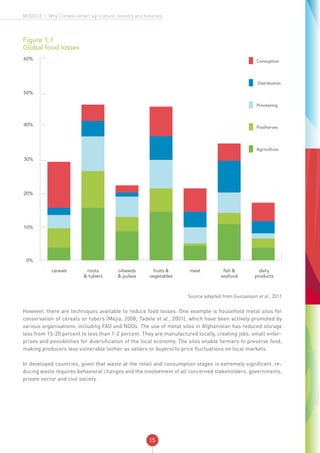
Figure 1.1	 Global food losses		15
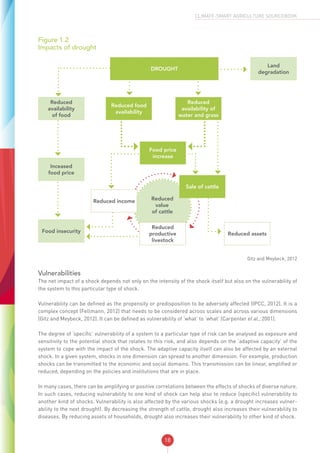
Figure 1.2	 Impacts of drought		18
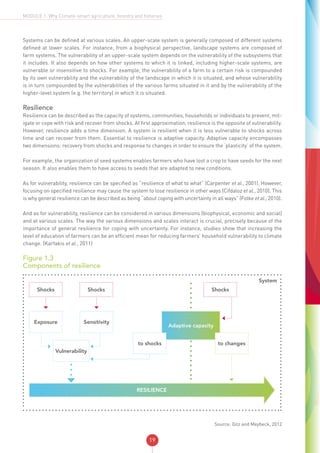
Figure 1.3	 Components of resilience		19
List of Boxes
Box 1.1	 Urea Deep Placement		10
Box 1.2	 Save and Grow – More Sustainable Intensification		11
Box 1.3 	 Partnership on benchmarking and monitoring the environmental performance
of livestock supply chains		13
Box 1.4	 The Save Food Global Initiative		16
Box 1.5 	 Prevention of major Desert Locust upsurges in West and Northwest Africa		20
Box 1.6	 A change of system: from slash and burn to agroforestry in Central America		21
Box 1.7	 Participatory rangeland management in the Syrian Arab Republic		23
5
MODULE 1: Why Climate-smart agriculture, forestry and fisheries
1.1 Food security and climate change: three intertwined
challenges1
Agriculture and food systems must improve and ensure food security, and to do so they need to adapt to
climate change and natural resource pressures, and contribute to mitigating climate change. These chal-
lenges, being interconnected, have to be addressed simultaneously.
Ensuring food security
The world is producing enough food, but in 2010-2012 there were still almost 870 million people estimated to
be undernourished, (FAO et al., 2012). In addition, another billion people are malnourished, lacking essential
micronutrients. The paradox is that at the same time a large number of people – mainly in richer countries
- are over-eating, causing long-term health problems and that 60 percent of the malnourished actually are
food producers, smallholders and pastoralists, with 20 percent living in cities and 20 percent landless rural
people. For the poor producers, food is not only a basic need, it is the single, and often fragile, support they
have for maintaining their livelihood. What is true at the household level is also true at the macroeconomic
level. There are 32 countries, 20 of them in Africa, facing food crises and in need of international emergency
support. In most of these countries, paradoxically, agriculture is an important, if not the major, part of
economy.
The objective is to ensure food and nutrition security, worldwide. Ensuring availability of calories and suffi-
cient global production is not enough; we also need to make sure that enough food is accessible to everyone,
everywhere, physically and economically. In addition, we need to ensure that this food is properly utilized
in the right quality and diversity. The goal is to ensure the stability of these three components of food and
nutrition security: availability, access and utilization.
Between now and 2050, the world’s population will increase by one-third. Most of the additional 2 billion
people will live in developing countries. At the same time, more people will be living in cities (70 percent
against the current 50 percent). Urbanization and rising incomes in developing countries are driving in-
creases in the consumption of animal products (FAO, 2009a). Given these trends, FAO estimates that produc-
tion will have to increase by 60 percent by 2050 to satisfy the expected demands for food and feed (Conforti,
2011). Demand for biofuels, another important factor for the global market, is very dependent on national
policies and global demand is expected to grow. According to the OECD-FAO projections, because of increas-
ing mandates and consumption incentives, biofuel production is expected to double between 2005 and 2019
(OECD and FAO, 2010).
Impacts of climate change on agriculture
Climate change has already significantly impacted agriculture (Lobell et al, 2011) and is expected to further
impact directly and indirectly food production. Increase of mean temperature; changes in rain patterns; in-
creased variability both in temperature and rain patterns; changes in water availability; the frequency and
intensity of ‘extreme events’; sea level rise and salinization; perturbations in ecosystems, all will have pro-
found impacts on agriculture, forestry and fisheries (Gornall, 2010; IPCC, 2007a; Beddington, et al,. 2012b;
HLPE, 2012a; Thornton et al., 2012). The extent of these impacts will depend not only on the intensity and
timing (periodicity) of the changes but also on their combination, which are more uncertain, and on local
conditions. Anticipating appropriately the impacts of climate change on agriculture requires data, tools and
models at the spatial scale of actual production areas. Since the last Intergovernmental Panel on Climate
Change (IPCC) report in 2007, some studies have attempted to anticipate these impacts and provide projec-
tions at such a scale, enabling us to have a more concrete vision of projected changes.
1
This section draws heavily on Meybeck A. Gitz V. Towards Efficiency & Resilience in Agriculture for Food Security in a Changing Climate
presented at the OECD-KREI Expert Meeting on Green Growth and Agriculture and Food in Seoul, Korea 6-8 April 2011
6
CLIMATE-SMART AGRICULTURE SOURCEBOOK
A prospective study in Morocco (World Bank, 2009a) points to gradually increasing aridity due to reduced
rainfall and higher temperatures, with negative effects on agricultural yields, especially from 2030 onwards.
Rainfed crops are expected to be particularly affected. If irrigation water continues to be available in suf-
ficient quantities, crop yields are expected to continue to increase in spite of climate change. However, avail-
ability of water for irrigation is uncertain. In this study, agricultural yields are projected to remain more or
less stable up to 2030, but they are predicted to drop rather quickly beyond that date (see Module 3 on water
management).
A study in Brazil (EMBRAPA, 2008) shows that climate change can have dramatic changes in the potentials
for the various crops analysed and their geographic repartition. Globally, the increase of evapotranspiration
leads to an increase of the areas at high climatic risk for 7 of the 9 crops studied (cotton, rice, coffee, beans,
sunflower, millet, soybean) and a decrease for cassava and sugarcane. It will also cause important displace-
ments in areas suitable for crops, especially for coffee and cassava. In traditional production areas, coffee
would be affected by lack of water or high temperatures. In the States of São Paulo and Minas Gerais coffee
would no longer be cultivated in areas where it is currently cultivated. On the other hand, with the reduc-
tion of the risk of frost, there could be an increase of the production area in Paraná, Santa Catarina and Rio
Grande do Sul. As a result, the global area at low climatic risk for coffee would be reduced by 9.5 percent in
2020, 17 percent in 2050, and 33 percent in 2070. On the other hand, more favourable conditions for sugar-
cane will considerably increase the area of production.
The impacts of climate change will have major effects on agricultural production, with a decrease of produc-
tion in certain areas and increased variability of production to the extent that important changes may need
to be made in the geographic area where crops are cultivated. Local impacts will bring global imbalances.
Broadly speaking, with everything else being equal, climate change may lead to an increase in both crop
and livestock productivity in mid- to high latitudes (IPCC, 2007a) and a decrease in tropical and subtropi-
cal areas. Among the most affected areas are economically vulnerable countries already food insecure and
some important food exporting countries. This will induce significant changes in trade, impacting prices
and the situation of net food importing countries. Consequently, climate change is expected to increase the
gap between developed and developing countries as a result of more severe impacts in already vulnerable
developing regions, exacerbated by their relatively lower technical and economical capacity to respond to
new threats (Padgham, 2009). Smallholders and pastoralists will suffer complex, localized impacts (IPCC,
2007a). According to the International Food Policy Research Institute (IFPRI) (Nelson et al. 2010), it will cause
an increase of between 8.5 and 10.3 percent in the number of malnourished children in all developing coun-
tries, relative to scenarios without climate change.
The models used for such projections neither take into account the impacts of multiple stress induced by
climate change, nor the impacts on the functioning of ecosystems, such as effects on pollinators (FAO,
2011a) and the balance between pests and their predators, nor impacts on animal diseases (FAO-OECD,
2012; HLPE, 2012 a).
It is likely that there will also be important effects on nutrition as a result of climate change. To date, studies
mostly focus on cereals. There is a need to better capture all the nutritional consequences of the effects of
climate change on livestock and on vegetables and wild foods, all of which have an important role in balanced
diets and which are at risk (HLPE, 2012a; Bharucha and Pretty, 2010).
In terms of impacts, it is necessary to distinguish between increased variability and slow onset changes. The
potential impacts of increased variability are often less emphasized than slow onset changes for a variety
of reasons. This is because these impacts are less well known (HLPE 2012a) even though they will be felt
first. The impacts of increased variability are situated between the much emphasized category of ‘extreme
events’, and the much more ‘easier to grasp’ business as usual category of actual variability. What exactly is
an ’extreme event’? What makes an event considered as “extreme”? Is it the intensity, the infrequency of a
meteorological event? Or is it the extent and intensity of its consequences? For agriculture, a slight change
7
MODULE 1: Why Climate-smart agriculture, forestry and fisheries
in temperature at a critical stage of plant growing can compromise a crop. As changes in variability are
easier for farmers to apprehend, they could constitute a first target for early adaptation measures (Padgham,
2009). It is therefore important to distinguish between these two categories of impacts to highlight two ways
to adapt, each with different time ranges: increasing resilience now to be prepared for more variability, and
increasing adaptive capacities and preparedness for slow onset changes. Furthermore, being prepared for
increased variability is also a way to prepare for any other change, whatever it may be.
Agriculture’s impact on climate change
The agriculture sector has to produce more food and it will be certainly impacted by climate change. As an
integral part of the economy, it has also been called upon to contribute to mitigate climate change (UNFCCC
2008). The question is how and to what extent agriculture and food systems can contribute to climate change
mitigation without compromising food and nutrition security.
In 2005, agriculture (crop and livestock) directly accounted for 13.5 percent of global GHG emissions (IPCC,
2007b). This figure is based on activities carried out in the fields and with livestock. But agriculture’s role
in climate change and, importantly, its mitigation potential, should be considered in a wider perspective of
‘food systems’. This includes the impact these systems have on forests, the energy sector and transport.
Expanding our consideration of agriculture’s role in climate change is warranted because some of the on
farm emissions are not included in the 13.5 percent figure, but are grouped in other sectors, such as electric-
ity used in farm buildings and fuel used in farm equipment and food transport. Also, agriculture is a major
driver of deforestation, which roughly accounts for an additional 17 percent of global GHG emissions (IPCC,
2007b). This is why agriculture is included in the study on the drivers of deforestation, which was requested
by the UNFCCC’s 17th Conference of the Parties (COP 17) in Cancun to the Subsidiary Body for Scientific and
Technological Advice (SBSTA). Finally, within food systems, reductions of emissions in some areas could lead
to increases elsewhere. For instance, depending on the efficiency of production systems, shorter food chains
could reduce transport but increase agricultural emissions. Currently, there are no studies that quantify
emissions from the global food system (Garnett, 2011). A study in 2006 estimated that 31 percent of the Euro-
pean Union’s GHG emissions were associated with the food system (European Commission 2006). Therefore,
when looking at challenges and opportunities to reduce GHG emissions using agriculture, it is paramount to
look beyond the farm, vertically into the whole food chain and horizontally across impacted land-uses such
as forests.
The main direct sources of GHG emissions in the agricultural sector are not only carbon dioxide (CO2). Ag-
riculture is a source of nitrous oxide (N2O), accounting for 58 percent of total emissions, mostly by soils and
through the application of fertilizers, and of methane (CH4), accounting for 47 percent of total emissions, es-
sentially from livestock and rice cultivation. These emissions are dependent on natural processes and agri-
cultural practices, which makes them more difficult to control and measure. On the other hand, agriculture is
a key sector that, along with the forestry sector, if managed effectively. can lead to biological carbon capture
and storage in biomass and soil, acting as “sinks”. Their management can play an essential role in managing
climate change (IPCC, 2007b), especially in the long term (Gitz, 2013).
As agricultural production is projected to increase in developing countries, so are agricultural emissions. IPCC
estimates that N2
O emissions will increase by 35 - 60 percent by 2030 and CH4
by 60 percent (IPCC, 2007b). The
IPCC also projects additional land being converted to agriculture.
There are two ways by which agricultural production2
can contribute to mitigate climate change that are in line
with the ‘food security first’ objective. The first way is to improve efficiency by decoupling production growth
from emissions growth. This involves reducing emissions per kilogram of food output (included in this cal-
culation are the effects of emissions from reduced deforestation per kilogram of food). The second way is to
2
A third way, (last section of the module) would be changes in consumption patterns, a subject that will not be touched upon in within
this sourcebook
8
CLIMATE-SMART AGRICULTURE SOURCEBOOK
enhance soil carbon sinks. The IPCC estimates the global technical mitigation potential from agriculture could
reach the equivalent of 5 500-6 000 tonnes of CO2
per year by 2030 (IPCC, 2007b). This is grossly equivalent to
three quarters of the sector’s emissions in 2030 (around 8 200 tonnes of CO2). About 70 percent of this iden-
tified potential lies in developing countries, 20 percent in OECD countries, and 10 percent for EIT countries.
IPCC estimates that nine-tenths of the global mitigation potential of agriculture is linked, not to reduction of
agricultural GHG (mainly CH4
and N2
O) emissions, but to managing land carbon stocks. This involves enhanced
soil carbon sequestration, reduced tillage, improved grazing management, the restoration of organic soils and
restoration of degraded lands.
Reducing emissions per kilogram of a given output3
might well be, for food security and agriculture, one of
the main targets. Direct gains through increased efficiency also imply a series of indirect gains. These indirect
gains include reduced emissions from deforestation (not accounted in IPCC’s calculations of the 90 percent)
as less land is necessary to produce the same amount of food. Indirect gains also include reduced emissions
from the production of fertilizer or energy inputs used on the farm. Everything else being equal, a potential
reduction equivalent to 770 tonnes of CO2
per year by 2030 has been identified from reduction of fossil fuel use
through improved on-farm energy efficiency (IPCC, 2007b). In addition, there are potential reductions through
improved efficiency in food chains, including a reduction of post-harvest losses.
1.2 Towards more efficient and resilient systems
To address these three intertwined challenges, food systems have to become at the same time more efficient
and resilient, at every scale from the farm to the global food system. They have to become more efficient in re-
source use: use less land, water and inputs to produce more food sustainably, and be more resilient to changes
and shocks.
More efficient systems
Increase resource efficiency
Most of the GHG emissions of the agricultural sector are directly driven by the use of resources: new land
being deforested or turned from grassland to crop land, fertilizers, livestock, energy. Increasing efficiency in
the use of resources (i.e. producing more of a given output using less of a given input) is thus key to reducing
emissions intensity per kilog of output. It is also key to improve food security, especially in resource scarce
areas.
Before looking at how resource efficiency in food systems can be improved (by what means), we need to have
a common understanding of what efficiency “means”.
Agriculture and food systems not only utilize a very diverse range of resources but also produce a very diverse
range of outputs. They provide physical products but also income and employment, for farmers, in agro-indus-
try and as a driver of the non-farm rural economy. From a food security perspective, these three outputs are
equally important. It implies a more complex conception of resource efficiency, by which employment, which is
formally an input in pure economic terms, can be seen as a key output. This conception implies a shift from the
classical economic targets of labour productivity towards resource efficiency with labour intensity being pos-
sibly an asset, as a system can be judged superior to another if it uses an equal amount of natural resources
but provides more employment (and not less work related costs), everything else being equal. Agriculture is
also a producer of environmental services at the landscape level: for example, through improved soil manage-
ment practices, agriculture can increase carbon stored in soils. Ultimately the output of agriculture can also
be defined as human diets.
3
Comparing different types of food is extremely difficult as they have very different nutritional value (not only energy or protein content
but also composition and micronutrients).
9
MODULE 1: Why Climate-smart agriculture, forestry and fisheries
The green economy is driven by the idea that, in the long run, given the increasing scarcity of resources, physi-
cal resource efficiency and economic efficiency will become closer, due to market fundamentals and through
policies, which would factor in environmental and social externalities (positive and negative) of input use and
production. Agriculture needs to produce more with resources (land, water, energy and nutrients) that are be-
coming scarcer and thus more expensive. However, given the relative prices of the various inputs, production
factors and outputs, this is not an easy thing to achieve, especially in smallholder farming systems. Evidence
shows that farmers economize in their use of inputs in reaction to increased prices (OECD, 2011). A study of
how US farmers reacted to higher energy and fertilizer prices in 2006 (Harris et al, 2008) showed that 23 per-
cent of commercial farms reduced their usage of both energy and fertilizers. To reduce energy consumption,
they used machines less intensively and serviced engines more frequently. Lower usage of fertilizers was also
achieved through greater use of soil testing, precision application and changes of crops.
Increasing efficiency in the use of resources is also one of the driving principles of CSA. GHG emissions from
agriculture are linked to its use of resources. Three production factors have an important influence on total
agricultural GHG emissions: (i) area, since converting land into cultivations would require either deforestation
or grasslands being converted to croplands, which would induce higher CO2 emissions; (ii) fertilizers, whose
production is an important source of CO2
and which at the field level translate into nitrous oxide emissions;
and (iii) livestock, which is an important source of methane and nitrous oxide emissions. Physical capital,
such as buildings and machines are also a factor, both directly by energy use and indirectly by their produc-
tion. Everything else being equal, increasing the efficiency in the use of one of these production factors de-
creases the emissions intensity of output. As irrigation often demands considerable energy, water efficiency
is another key factor for increasing production, adapting to climate change and reducing emissions.
Resource efficiency needs to be improved in every type of food system. Studies using the results of detailed
on farm energy audits realized in France have shown that energy consumption per kilogram of output can be
extremely variable between farms. It has, for instance, been shown (Bochu et al, 2010) that the most efficient
dairy farms consume per unit of output half of the energy consumed by the less efficient farms. Results of
more than 400 farms have been analysed and categorized according to the importance of corn silage in the
system (1-10 percent, 10-20 percent, 20-30 percent, more than 30 percent of the feed). It appears that vari-
ability within each of these categories is more important than between categories, and that in every category
the more efficient farms use less than half of the energy used by the less efficient ones. This is also true in
organic farms. This means that, no matter what the system, there can be important improvements in man-
agement practices.
Increase resource efficiency in plant production
As agriculture is an important driver of deforestation, reducing agricultural expansion through sustainable
intensification on already cultivated land could have a major mitigation effect. The HLPE considers that ending
most conversion of forest to cultivation should be a mitigation priority.
Studies show that, at the global level, from 1961 to 2005, crop production increased by over 160 percent, mostly
as a result of 135 percent yield increases, with only 27 percent increases in crop area (Burney et al., 2010). This
intensification allowed farmers to increase food production while emitting the equivalent of 590 gigatons of
CO2
less than what would have been emitted by expanding the area under cultivation on the basis of assum-
ing 1961 yields. They conclude that land use change emissions (even avoided ones) are much more important
than direct emissions from agricultural systems. Therefore, improvement of crop yields should be prominent
in any mitigation strategy. Moreover, these improvements will also contribute to preserving forest sinks and
maintaining their capacity to store carbon over the long-term (Gitz and Ciais, 2004).
Other studies show that across the tropics, between 1980 and 2000, more than 55 percent of new agricultural
land came at the expense of intact forests and another 28 percent came from disturbed forests (Gibbs et
al., 2010). Considering the role of agriculture as a driver of deforestation, sustainable intensification should
also play a part in Reducing Emissions from Deforestation and Forest Degradation (REDD) programmes.
10
CLIMATE-SMART AGRICULTURE SOURCEBOOK
Sustainable intensification would be particularly efficient in areas where very low productivity systems, such
as shifting cultivation in the Congo Basin, are replacing forests (Bellassen and Gitz, 2008). West et al. (2010),
comparing worldwide crop yields and carbon stocks, consider that concentrating reforestation and avoided
deforestation in the tropics would have the greatest worldwide carbon sink effect with minimum opportunity
costs in terms of reduced crop yields.
Studies (Fischer et al., 2009) have shown the importance in many developing countries of the yield gap. The
yield gap is the difference between actual farm yields, as represented by the average yield achieved by farm-
ers in a defined region over several seasons, and the potential yields which are the maximum achievable yield
with latest varieties and by removing as much as possible all the constraints as achieved in highly controlled
experimental stations. Reducing this gap is essential to improve food security and reduce deforestation.
Nutrients are essential to increase yields. But production of synthetic fertilizers is energy intensive, with high
CO2
emissions and economic costs. In addition, when applied in the field, these fertilizers contribute to N2
O
emissions. Therefore, there is a need to improve fertilization and to limit the economic costs and the emis-
sions at the same time. Improving fertilizer efficiency is thus essential. This can be done through a variety of
techniques. One way is to match more precisely the nutrients with plant needs during the growing season,
such as by fractioning the total amount in multiple doses. Other techniques include precision farming and
placing nutrients closer to plant roots, such as deep placement of urea for rice (see box 1.1).
Box 1.1
Urea Deep Placement
Urea Deep Placement (UDP) technique, developed by the International Fertilizer Development Center (IFDC), is
a good example of a climate-smart solution for rice systems. The usual technique for applying urea, the main
nitrogen fertilizer for rice, is through a broadcast application. This is a very inefficient practice, with 60 to 70
percent nitrogen losses contributing to GHG emissions and water pollution.
In the UDP technique, urea is made into “briquettes” of 1 to 3 grams that are placed at 7 to 10 cm soil depth after
the paddy is transplanted. This technique decreases nitrogen losses by 40 percent and increases urea efficiency
to 50 percent. It increases yields by 25 percent with an average 25 percent decrease in urea use.
UDP has been actively promoted by the Bangladesh Department of Agricultural Extension with IFDC assistance.
In 2009, UDP was used on half a million hectares by a million farmers and there are plans to expand its use to 2.9
million more families on 1.5 million hectares.
The widespread adoption of the UDP technique in Bangladesh has had several important impacts:
•	 Farmers’ incomes have increased because of both increased yields and reduced fertilizers use.
•	 Jobs have been created locally in small enterprises, often owned by women, to make the briquettes. There are
now 2 500 briquette-making machines in Bangladesh.
•	 On-farm jobs have also been created as the briquettes are placed by hand, which requires 6 to 8 days labour
per hectare. Higher yields and savings on fertilizer expenditures compensate for the additional field labour
expenses.
•	 At the national level, imports of urea have been reduced, with savings in import costs estimated by IFDC at
USD 22 million and in government subsidies of USD 14 million (2008), for an increase of production of 268 000
metric tons.
•	 At a global level UDP has reduced GHG emissions caused by the production and management of fertilizers.
It also increases the agricultural system’s resilience. As fertilizer prices are linked to energy prices, and
consequently very volatile, reducing fertilizer use also increases farm and country’s resilience to economic shocks.
With the effectiveness of the technique now well proven, UDP is being scaled up, partly through South/South
cooperation. For instance, the National Programme for Food Security of Nigeria (NPFS) is supported by South/
South cooperation with China. This support includes the promotion and development of the UDP technique in
several Nigerian states.
Source: Roy & Misra, 2003; Singh et al., 2010; Ladha et al., 2000; IFDC, 2011
11
MODULE 1: Why Climate-smart agriculture, forestry and fisheries
The inclusion of legumes in crop rotations exploits symbiotic microbes to fix nitrogen, which is harvested
in the crop and partly transferred to subsequent crops increasing their yields. In forage legume/grass mix-
tures, nitrogen is also transferred from legume to grass, increasing pasture production. The protein content
of legumes makes them important from a nutritional point of view. When included in livestock feed, legumes
increase the food conversion ratio and decrease methane emissions from ruminants, thus increasing ef-
ficiency and at the same time reducing GHG emissions. By providing proteins and the amino acid lysine, in
which cereals are deficient, legumes complement cereals in human diets and can compensate for the lack of
animal proteins. Unfortunately, the global area under pulses dropped from approximately 5 million hectares
in 1968 to 3.9 million in 2007. Globally, consumption of pulses in terms of kilocalories per capita per day also
dropped from 73 in 1968 to 57 in 2007.
Sustainable intensification of crop production (see box 2) aims to increase yields through the better use of
natural resources and ecosystem functions.
Plant breeding has a crucial role to play to enhance genetic potential both to increase productivity and
thus yields and to improve nutrient and water use as well as resistance to climate variability, diseases and
pests.
Increase resource efficiency in livestock production
The livestock sector has expanded rapidly in recent decades and will continue to do so as demand for meat,
eggs and dairy products is expected to continue to grow, especially in developing countries. Livestock graz-
ing already occupies 26 percent of the earth’s ice-free land surface, and the production of livestock feed uses
33 percent of agricultural cropland (Steinfeld et al., 2006). There is an urgent need to improve the resource
use and production efficiency of livestock production systems, both to improve food security and reduce the
intensity of GHG emissions (FAO, 2009a; HLPE, 2012a). These efforts need to take into account the grow-
ing dichotomy between livestock kept by large numbers of small holders and pastoralists and those kept in
Box 1.2
Save and Grow – More Sustainable Intensification
Sustainable crop production intensification (SCPI) can be summed up in the words “Save and Grow”. Sustainable
intensification means a productive agriculture that conserves and enhances natural resources. It uses
an ecosystem approach that draws on nature’s contribution to crop growth – soil organic matter, water flow
regulation, pollination and natural predation of pests. It applies appropriate external inputs at the right time, in
the right amount to improved crop varieties that are resilient to climate change. It also uses nutrients, water and
external inputs more efficiently.
Increasing the sustainable intensification of crop production is achievable. This can be done through increasing
resource use efficiency and cutting the use of fossil fuels. This saves money for farmers and prevents the negative
effect of over-use of particular inputs. Inefficient fertilizer use is common in many regions. In some cases, this
is a consequence of government subsidies. Yet over-use does not have the intended impact on plant growth
and can result in the contamination of ground and surface water. Inappropriate insecticide use may actually
induce pest outbreaks by disrupting the natural population of predators. Overuse of herbicides can lead to the
emergence of herbicide-tolerant varieties of weeds. Problems of salinization or reduced soil health may also
come from inappropriate management practices, such as irrigating without proper drainage. Better maintenance
of ecosystem services can be accomplished through: adopting agricultural practices that are based on crop
rotations, applying minimum tillage and maintaining soil cover; relying on natural processes of predation or
biocontrol of pest or weed problems; managing pollination services; selecting diverse and appropriate varieties;
and carefully targeting the use of external inputs. These practices are knowledge-intensive and they are often also
interdependent. In the initial stages, encouraging these practices may require public support through targeted
incentives and investment. Ideally, the price of agricultural commodities would increasingly reflect the full cost of
production, including the potential damage done to natural ecosystems, thereby encouraging more sustainable
consumption (FAO, 2011b).
12
CLIMATE-SMART AGRICULTURE SOURCEBOOK
intensive systems4
. A study on cow milk (Gerber et al., 2010) shows that the emissions per litre of milk are
dependent on the efficiency of the cows: the more efficient the cows, the fewer emissions per litre of milk.
This increased efficiency should be pursued in all possible ways, from livestock selection and nutrition to
manure management.
The selection to improve efficiency and thus reduce GHG emission of livestock systems involves numerous
parameters, including productivity per animal, early maturity, fertility, feed conversion ratio and longevity.
In controlled environments, breeding for high performance has already resulted in significant reductions in
the amount of feed per unit of product, especially for monogastrics and dairy cattle. The challenge now is to
also improve productivity in more diverse environments (Hoffmann, 2010).
Improving animal health, including disease prevention and management, has a strong impact on the ef-
ficiency of livestock systems, food security and climate change. Establishing strong veterinary institutions
and policies are essential both to improve livestock efficiency and increase the preparedness against new
risks, including those that result from climate change.
Nutrition plays a critical role in making livestock production systems more efficient. Proper nutrition is
imperative for achieving high reproductive efficiency in animals, protecting them from diseases and making
animal health interventions more effective. Imbalanced feeding leads to productivity losses and increase in
emission of green house gases, either as CH4
from enteric fermentation in ruminants (between 2 - 12 per-
cent of feed energy is lost in the form of methane) or as CH4
and N2
O produced from manure. A balanced diet
enhances animal performance and reduces GHG emissions per unit of animal product. Efficient nutritional
strategies for monogastrics (pigs and chickens) include matching nutrient contents in feeds (taking into
consideration both their level and availability to the animal) to the physiological requirements of animals;
selecting feeds with high nitrogen availability in the animal body; and optimizing proteins and amino acids
in diets to improve the feed conversion to animal products. For ruminants, techniques such as a) feeding
of: diets balanced for nitrogen, energy and minerals - preferably as total mixed rations; chaffed forages,
preferably of high quality; chaffed and water-soaked straws or urea-ammoniated straws; and grains- and
b) use of feed additives, - e.g. ionophores, probiotics, enzymes, oils including essential oils, some tannins
and saponins- can be used either to improve the feed conversion ratio and/or to specifically reduce methane
emission and nitrogen release into manure.
Improving pasture productivity and quality, either by improving the composition of forage, especially in arti-
ficial pastures, and by better pasture management is an important means to improve food security, adapt to
climate change and reduce both direct and indirect GHG emissions. Supplementing poor quality forages with
fodder trees, as in silvo-pastoral systems, or with legumes, increases their digestibility, thereby improving
the production efficiency of livestock and decreasing methane emissions. The introduction of legumes in
pastures also increases forage production and reduces pressure on forests without a corresponding in-
creased use of fertilizers. Improved grazing management could lead to greater forage production, more ef-
ficient use of land resources, enhanced profitability and rehabilitation of degraded lands and the restoration
of ecosystem services. Grazing practices, such as setting aside, postponing grazing while forage species are
growing, or ensuring equal grazing of various species can be used to stimulate diverse grasses; improve
nutrient cycling and plant productivity and the development of healthy root systems; feed both livestock and
soil biota; maintain plant cover at all times; and promote natural soil forming processes.
4
Types of systems and size are not necessarily associated.
13
MODULE 1: Why Climate-smart agriculture, forestry and fisheries
Manure management is important both to increase food security and to mitigate climate change as it can be
used as organic fertilizer and is also a source of CH4
and N2
O emissions. When manure is used as organic
fertilizer it contributes to the productivity and fertility of the soil by adding organic matter and nutrients,
such as nitrogen, which are trapped by bacteria in the soil. It improves productivity and allows for reduc-
tions in use of synthetic fertilizers and the associated direct and indirect GHG emissions. The increasing
geographic concentration of livestock production means that the manure produced by animals often exceeds
the (nitrogen) absorptive capacity of the local area. Manure becomes a waste product rather than being the
valuable resource in less concentrated, mixed production systems. Proper use of technologies can reduce
direct emissions and also transform manure into a valuable resource and lead to a corresponding reduction
in GHG emissions resulting from the use of synthetic fertilizers.
Integrated systems
Crop systems and livestock systems can also be improved by their better integration. Integrated crop and
livestock systems, at various scales (on-farm and area-wide) increase the efficiency and environmental sus-
tainability of both production methods. When livestock and crops are produced together, the waste of one is
a resource for the other. Manure increases crop production and crop residues and by-products feed animals,
improving their productivity. In these systems, livestock is a strategic element for adaptation. The animals
provide an alternative to cropping in areas becoming marginal for cropping, offer a way to escape poverty and
represent a coping mechanism in vulnerable and variable (in particular weather-related) natural environ-
ments. They also constitute a capital that can be converted to cash when needed.
Box 1.3
Partnership on benchmarking and monitoring the environmental performance of
livestock supply chains
Quantitative information on key environmental impacts along livestock supply chains is required to (a) analyse food
systems and inform decisions at the production and processing levels to improve environmental performance; (b)
develop and evaluate corresponding policy decisions (governmental and non-governmental); and (c) inform relevant
stakeholders.
Valuable work aimed at improving the measurement of environmental performance is being carried out by the
livestock industry, governments, academia and non-governmental organizations (NGOs). However, inconsistencies
in the methods used and the one-off nature of many of the studies do not provide consistent guidance on the required
changes in practices and the potential efficiency gains that can be achieved.
Consultations with stakeholders during 2010 and 2011 confirmed that there was demand for a partnership on
benchmarking and monitoring the environmental performance of the livestock sector. A participative formulation
process led to the identification of key functions and deliverables of the Partnership. It was agreed that representatives
of private sector, NGOs, governments, science and international standard organizations should be involved.
The Partnership’s objective is to improve environmental performance of the livestock sector, while considering its
economic and social viability. This will be achieved through support to decision-making and by providing guidance
on performance assessments (metrics and methods) and their use. The partnership was officially launched in July
2012. An important aspect of the work is to assess both negative and positive contributions (e.g. improved carbon
sequestration in soils, soil organic matter, water retention and quality, and biodiversity) Activities are structured
along four components:
•	 Component 1 - Sector-specific guidelines and methods for the life cycle assessment of GHG emissions from
livestock food chains;
•	 Component 2 - Global database of GHG emissions related to feed crops;
•	 Component 3 - Measures of non-GHG environmental performance of livestock food chains; and
•	 Component 4 - Communication strategy.
Source: FAO, 2012e
14
CLIMATE-SMART AGRICULTURE SOURCEBOOK
Rice-Fish integrated systems have been traditionally practiced in many Asian countries, either as concurrent
or alternate cultivation (FAO et al, 2001) and constitute another example of very productive systems that also
provide more balanced diets. They hold great potential to improve food security and nutrition and can be both
improved and up-scaled as shown by recent research in Bangladesh (Ahmed N. and Garnett S., 2011; Dey M
et al., 2012).
Agroforestry is the use of trees and shrubs as part of agricultural systems. It contributes to prevent soil ero-
sion, facilitates water infiltration and diminishes the impacts of extreme weather. Agroforestry also helps
diversify income sources and provides energy and often fodder for livestock. Nitrogen-fixing leguminous
trees, such as Faidherbia albida, increase soil fertility and yields (Bames and Fagg, 2003; Garrity, 2010).
Community-led projects and relaxed forestry measures that enable farmers to manage their trees have led
to considerable development of Faidherbia in Niger through farmer-managed natural regeneration (Garrity
2010). Since 2000, FAO has initiated special programmes for food security with the governments of Guate-
mala, Honduras, Nicaragua and El Salvador among others (see box 6). These programmes work together,
sharing practices, experiences and results to improve and develop agroforestry systems. Agroforestry sys-
tems are promoted in the subregion as a substitute to traditional slash-and-burn systems, particularly on
slopes. Under these systems, productivity of land and labour are increased. Yields are less variable, partly
due to better retention of moisture in the soils. The soil is also protected from hydric erosion. Farm produc-
tion, including wood products, is more diversified, which stabilizes incomes. As they are more efficient in
the use of land, agroforestry reduces the pressure on forests, avoiding deforestation which contributes to
climate change mitigation. As wood is produced in the fields, these systems also contribute to preventing
forest degradation. Agroforestry systems use less fertilizer, reducing the direct emissions of N2O and indi-
rect GHG emissions created through fertilizer production. By increasing biomass above ground and in soils,
they help create carbon sinks.
There is now interest for using carbon projects to facilitate the development of agroforestry. Examples in-
clude the Nhambita community carbon project in Mozambique, initiated in 2003. A small-scale agroforestry-
based carbon sequestration project, registered with the Plan Vivo system aims to sequester carbon through
agroforestry practices, sell carbon credits in international voluntary carbon markets and improve livelihoods
in the local community. The Community Association, the body established in 2002 by the Rural Association
for Mutual Support (ORAM) as a part of a national government programme to regularize traditional commu-
nities’ tenure rights, helps to identify the households that wish to become part of the agroforestry scheme
and is responsible for the management of the carbon payments, which are transferred into a community
fund (Spirik, 2009).
Reduce food losses and waste
Global food losses and waste amount to a third of all food produced (Gustavsson et al., 2011). These losses and
waste also mean that the GHG emitted during their production have served no useful purpose. This is espe-
cially true when the food has reached the end of the food chain, when the embedded emissions for transport
and conservation are very high.
Global differences among regions in food loss and waste for the same type of products indicate potential areas
for improvement (Gustavsson et al., 2011). In Europe, cereal losses and waste are twice as high as in sub-Sa-
haran Africa. On the other hand, in sub-Saharan Africa, milk losses and waste are twice as high as in Europe.
Depending on the products, regions, and levels of economic development, the distribution of the losses along
the food chain is very different. For instance, in Africa cereals are lost in the first stages of the food chain. In
Europe, they are lost mostly at the consumer stage: 25 percent against 1 percent in Africa. For fruits and veg-
etables, the differences between regions are also striking. In Africa, processing and distribution are the weak
links. This highlights the need for investments in these stages of the food chain. In Europe, it is at the produc-
tion and consumption stages where most losses occur.
15
MODULE 1: Why Climate-smart agriculture, forestry and fisheries
Figure 1.1
Global food losses
60%
50%
40%
30%
20%
10%
0%
cereals roots
& tubers
oilseeds
& pulses
fruits &
vegetables
meat fish &
seafood
dairy
products
Consuption
Distribution
Processing
Postharves
Agriculture
Source adapted from Gustavsson et al., 2011
However, there are techniques available to reduce food losses. One example is household metal silos for
conservation of cereals or tubers (Mejia, 2008; Tadele et al., 2001), which have been actively promoted by
various organisations, including FAO and NGOs. The use of metal silos in Afghanistan has reduced storage
loss from 15-20 percent to less than 1-2 percent. They are manufactured locally, creating jobs, small enter-
prises and possibilities for diversification of the local economy. The silos enable farmers to preserve food,
making producers less vulnerable (either as sellers or buyers) to price fluctuations on local markets.
In developed countries, given that waste at the retail and consumption stages is extremely significant, re-
ducing waste requires behavioral changes and the involvement of all concerned stakeholders, governments,
private sector and civil society.
16
CLIMATE-SMART AGRICULTURE SOURCEBOOK
All along food chains, from agricultural production, transport, conservation, processing, cooking and con-
sumption, there are potential areas for improving energy efficiency (FAO, 2011c). In Africa, 90 percent of
the extracted wood is used for domestic purposes, mostly cooking. Improved energy-saving cooking stoves
can contribute to reduce deforestation. However, trade-offs may need to be made between reducing losses
and reducing energy consumption, especially for fresh perishable products, such as meat, dairy products,
fish, fruits and vegetables. Consumption of perishable products, which often require cold chains and rapid
transport, is increasing. Analyses of food losses and waste should therefore encompass the whole food
chain to be able to consider all impacts and all potential solutions. For instance, processing fresh products
transported over long distances into less perishable products can reduce foods losses and GHG emissions
resulting from conservation and transport, as slower methods of transport can be used.
System efficiency
A change of practice in one component of a given system generally impacts the whole system. So it is not
only a single technique or practice that has to be considered but the system as a whole, at the farm and
household level and beyond the farm gate. Box 1.1 provides an example of the various consequences of the
introduction of the UDP technique in Bangladesh.
Most of the changes in resource use of one factor of production impact on the use of other factors. Therefore,
from a ‘GHG efficiency’ perspective, we need to assess the trade-offs between increasing resource efficiency
regarding one or other input, for example, increasing yield per hectare through increased use of fertilizers.
Thus, for improvements involving variations of several ‘emitting’ factors, a comprehensive assessment is
needed, using life cycle analysis methodologies or GHG accounting tools.
As seen in the example of UDP in Bangladesh (Box 1.1), changes towards more resource efficiency, even
through the introduction of a single new technique, can have major economic and social impacts which, in
turn have impacts on food security, especially in terms of access to food. Whatever the ‘efficiency’ consid-
ered, there is a need to look at the allocation of factors and at the issue of scale. Indeed, production effi-
ciency, GHG-efficiency, economic efficiency and food security do not always go hand in hand. For instance, to
increase the workforce in the mix of factors of production might go against economic efficiency at the farm
level, but may have a positive effect on food security. In that respect, efficiency should be assessed inside a
system, at various scales and from various perspectives.
More resilient systems5
Climate change will profoundly affect, in any given place, the conditions under which agricultural activities
are undertaken. It will affect existing risks and add new risks and uncertainties. As pointed out by the High
Level Panel of Experts on Food Security and Nutrition (HLPE, 2012a), models cannot project climate change
5
This section draws heavily on Gitz V. & Meybeck A. 2012. Risks, vulnerabilities and resilience in a context of climate change. FAO/OECD
Workshop: Building Resilience for Adaptation to Climate Change in the Agriculture Sector, Rome, Italy, 23-24 April 2012.
Box 1.4
The Save Food Global Initiative
In May 2011, FAO’s Agriculture & Consumer Protection Department organized the international congress ‘Save
Food!’ in partnership with Interpack/Messe Düsseldorf - a global player on trade fair organization, including the food
and packaging industry. Speakers, stakeholders and high-level policy makers in the agriculture, food and packaging
sectors from across the globe, signed a joint declaration to show their commitment to the goals of Save Food. The
partnership launched the SAVE FOOD Initiative, which is a joint campaign to fight global food losses and waste.
The Initiative aims at networking among stakeholders in industry, politics and research, encouraging dialogue and
helping to develop solutions to food losses and waste along the food value chain. One of its objectives is to enlist the
support of industry in initiating and sponsoring its own SAVE FOOD projects.
Source: Save Food Initiative, 2013
17
MODULE 1: Why Climate-smart agriculture, forestry and fisheries
effects precisely, neither in time nor at the local scale needed for decision makers. Moreover, climate models
do not deal with the consequences of increased variability, the impacts of stress combinations, the effects of
climate change on whole agro-ecosystems, including crops, their pests and predators of these pests. As it
is impossible to predict exactly these changes, it is often difficult to devise and promote precise adaptation
measures. One of the most effective approaches to be prepared for uncertainty and new risks – a ‘no regret’
approach that is valid whatever changes happen – is to reduce vulnerability and increase resilience of a given
system (FAO and OECD, 2012; HLPE, 2012a).
Risks
Agricultural production is subject to risks of various types: economic and price-related risks, climatic, en-
vironmental, pests and diseases, at different scales and, often, political instability. Yield risk in main staple
crops is particularly important for smallholders who tend to consume a large part of their own production.
Farmers are also exposed to economic risks, including land tenure insecurity, variations in access to inputs
(fertilizers, seeds, pesticides, feed) in quantity and quality and variations in access to markets.
‘Risk’ is used here to designate the potential of shocks and stresses that affect, in different ways, the state
of systems, communities, households or individuals. Probability, uncertainty (when probabilities of occur-
rence or even nature of impacts are unknown), severity, economic scale, time scales and direct and indirect
costs are all factors that should be taken into account.
Risks affecting agricultural activities are generally categorized according to the nature of the associated
shocks (e.g. biophysical, economic) (Eldin et Milleville , 1989; Holden et al., 1991; Cordier, 2008; OECD, 2009).
They are also often classified according to the intensity, frequency and predictability (degree of uncertainty)
of the associated shocks. They can be also categorized according to their impacts and their nature, as well
as their importance and scope both in space and time (INEA, 2011). Weather is in itself a major cause of risk
and also has a major influence on other types of risks. Climate change is expected to affect the nature, ex-
tent and intensity of these risks, plant pests, animal diseases, and disruption of ecosystem functions (HLPE,
2012a; FAO and OECD, 2012).
The impact of a risk depends on the shock itself and on the resilience of the system that receives the shock.
Depending on their vulnerability, different systems will be more or less affected by the same shock. Depend-
ing on their resilience, different systems will recover more or less easily.
Food systems are by nature ecological, economic and social (Ericksen, 2008; Fussel and Klein, 2006). Each
dimension has its own organization and interacts with the others. Food systems can be described and ana-
lyzed in each of their dimensions. There are also theories attempting to understand and describe ‘complex
systems’ (Holling, 2001; Gunderson and Holling, 2001) to obtain a better grasp of the concept of sustainability.
Even when considering a single simple farming system, a single stress or shock can have various impacts
of diverse nature and time scale. The global impact of a shock often also depends on the transmission of its
effects from one dimension (biophysical) to the others (economic and social) and from one level (household)
to another (community).
For instance, a drought in livestock grazing systems (see Figure 1.2) reduces the availability of water and grass
– both directly and indirectly because as the watering points are reduced some pastures are no more accessi-
ble- and so increases the demand for feed at the very moment when there is less feed available. Increased de-
mand drives a feed price increase, which forces livestock owners to sell their cattle. Massive sales while there
is a reduced demand push down cattle prices, forcing livestock owners to sell even more to buy feed. These
effects on prices reduce farm and household income and assets. Moreover, they reduce the value of assets
(livestock) and productive capital for the future. Prolonged or repeated drought also has long-lasting degrading
effects on land. The combination of drought and overgrazing, particularly near watering points, destroys the
vegetal cover and increases soil erosion.
18
CLIMATE-SMART AGRICULTURE SOURCEBOOK
Figure 1.2
Impacts of drought
DROUGHT
Land
degradation
Reduced
availability
of food
Reduced food
availability
Food price
increase
Reduced
availability of
water and grass
Inceased
food price
Food insecurity Reduced assets
Reduced
value
of cattle
Sale of cattle
Reduced income
Reduced
productive
livestock
Gitz and Meybeck, 2012
Vulnerabilities
The net impact of a shock depends not only on the intensity of the shock itself but also on the vulnerability of
the system to this particular type of shock.
Vulnerability can be defined as the propensity or predisposition to be adversely affected (IPCC, 2012). It is a
complex concept (Fellmann, 2012) that needs to be considered across scales and across various dimensions
(Gitz and Meybeck, 2012). It can be defined as vulnerability of ‘what’ to ‘what’ (Carpenter et al., 2001).
The degree of ‘specific’ vulnerability of a system to a particular type of risk can be analysed as exposure and
sensitivity to the potential shock that relates to this risk, and also depends on the ‘adaptive capacity’ of the
system to cope with the impact of the shock. The adaptive capacity itself can also be affected by an external
shock. In a given system, shocks in one dimension can spread to another dimension. For example, production
shocks can be transmitted to the economic and social domains. This transmission can be linear, amplified or
reduced, depending on the policies and institutions that are in place.
In many cases, there can be amplifying or positive correlations between the effects of shocks of diverse nature.
In such cases, reducing vulnerability to one kind of shock can help also to reduce (specific) vulnerability to
another kind of shocks. Vulnerability is also affected by the various shocks (e.g. a drought increases vulner-
ability to the next drought). By decreasing the strength of cattle, drought also increases their vulnerability to
diseases. By reducing assets of households, drought also increases their vulnerability to other kind of shock.
19
MODULE 1: Why Climate-smart agriculture, forestry and fisheries
Systems can be defined at various scales. An upper-scale system is generally composed of different systems
defined at lower scales. For instance, from a biophysical perspective, landscape systems are composed of
farm systems. The vulnerability of an upper-scale system depends on the vulnerability of the subsystems that
it includes. It also depends on how other systems to which it is linked, including higher-scale systems, are
vulnerable or insensitive to shocks. For example, the vulnerability of a farm to a certain risk is compounded
by its own vulnerability and the vulnerability of the landscape in which it is situated, and whose vulnerability
is in turn compounded by the vulnerabilities of the various farms situated in it and by the vulnerability of the
higher-level system (e.g. the territory) in which it is situated.
Resilience
Resilience can be described as the capacity of systems, communities, households or individuals to prevent, mit-
igate or cope with risk and recover from shocks. At first approximation, resilience is the opposite of vulnerability.
However, resilience adds a time dimension. A system is resilient when it is less vulnerable to shocks across
time and can recover from them. Essential to resilience is adaptive capacity. Adaptive capacity encompasses
two dimensions: recovery from shocks and response to changes in order to ensure the ‘plasticity’ of the system.
For example, the organization of seed systems enables farmers who have lost a crop to have seeds for the next
season. It also enables them to have access to seeds that are adapted to new conditions.
As for vulnerability, resilience can be specified as “resilience of what to what” (Carpenter et al., 2001). However,
focusing on specified resilience may cause the system to lose resilience in other ways (Cifdaloz et al., 2010). This
is why general resilience can be described as being “about coping with uncertainty in all ways” (Folke et al., 2010).
And as for vulnerability, resilience can be considered in various dimensions (biophysical, economic and social)
and at various scales. The way the various dimensions and scales interact is crucial, precisely because of the
importance of general resilience for coping with uncertainty. For instance, studies show that increasing the
level of education of farmers can be an efficient mean for reducing farmers’ household vulnerability to climate
change. (Karfakis et al., 2011)
Figure 1.3
Components of resilience
RESILIENCE
Adaptive capacity
to shocks
Exposure
Shocks Shocks Shocks
Vulnerability
Sensitivity
to changes
System
Source: Gitz and Meybeck, 2012
20
CLIMATE-SMART AGRICULTURE SOURCEBOOK
Resilience puts a greater emphasis on the capacity of a system to recover and transform itself over the long
term, and adapt to its changing environment in a dynamic perspective. It implies that it is not only shocks, as a
change relative to an average, that have to be considered, but also the change of the average itself. Ultimately,
the question is until what point can a system adapt before changing to another type of system?
Building resilience
To a great extent increasing resilience can be achieved by reducing vulnerabilities and increasing adaptive
capacity. This can be done by reducing exposure to risk, reducing sensitivity and increasing adaptive capacity
for every type of risk. It can act in each domain, either biophysical or economic and social. One way to achieve
better resilience is to reduce transmission of shocks between types of risks, between scales and between do-
mains and to organize compensation between scales (for instance transport of feed) or between domains (for
instance safety nets) to avoid cumulative and long-term effects.
In a first approximation we can identify the following three ways to build resilience:
1.	Reduce exposure. There is a fundamental difference between climatic and non-climatic shocks in this
regard because most of the shocks on farm can be reduced at the source, or limited in their extension,
contrary to climatic shocks. The best example of a non-climatic shock is probably the eradication of Rin-
derpest, which has totally suppressed a major risk for livestock and those depending on it.
2.	Reduce the sensitivity of systems to shocks. Using drought-resistant varieties or keeping adequate stocks
of hay can for instance, reduce sensitivity to drought.
3.	Increase adaptive capacity. This includes considering the modifications of a system and taking into account
all the potential shocks and changes together (to take into account compensating, cumulative or exacer-
bating effects).
Finally, we have to consider that the occurrence of shocks is not certain. The nature of the shock may be un-
certain as well as the nature or size of its impacts. In addition, their occurrence in time is generally unknown.
Box 1.5
Prevention of major Desert Locust upsurges in West and Northwest Africa
Emergency Prevention System for Transboundary Animal and Plant Pests and Diseases (EMPRES Programme)
The Desert Locust is a highly destructive transboundary plant pest that threatens people’s livelihoods, food security,
the environment and economic development in more than 30 countries. In terms of bio-ecology, West and Northwest
Africa (Western Region) is an indivisible distribution area of this pest. In that area more than 8 million people faced
severe food shortage as a result of the 2003-2005 Desert Locust upsurge. It cost the international community and
affected countries over USD 570 million to overcome it and 13 million litres of chemical pesticides were applied. The
Sahelian countries also suffered from high crop losses ranging from 30 to 100 percent. To address the Desert Locust
issue more effectively, the Western Region countries (Algeria, Burkina Faso, Chad, Libya, Mali, Morocco, Mauritania,
Niger, Senegal and Tunisia) set up in 2002 the Commission for Controlling the Desert Locust in the Western Region
(CLCPRO) under the aegis of FAO. To implement a sustainable preventive control strategy, they also joined the FAO
EMPRES Programme, launched in 2006 in the Western Region. The Evaluation Missions of Phase 1 (2006-2010)
of this Programme underlined that substantial progress had been made in achieving the objectives, in particular,
in the frontline countries (Chad, Mali, Mauritania and Niger) in terms of: institutional building with the creation of
autonomous National Locust Control Units (NLCUs); strengthening of locust control capacities and infrastructure;
implementation of early warning systems and rapid interventions, developing health and environmental standards,
and better preparedness to Desert Locust crises (ongoing contingency planning).
The improvement of more effective preventive control strategy became obvious during the control operations against
locust outbreaks in 2006, 2008, 2009 and 2010-2011 in Mauritania and in 2009 in Niger. Also, a gradual funding of the
recurrent costs for preventive control implemented by the NLCUs from the national budgets was observed: from 10
percent in 2006, it reached an average of 60 percent in the frontline countries at the end of 2010. The annual cost of
preventive control in the Western Region is USD 3.3 million, less then 0.6 percent of the expenses incurred during
the 2003-2005 major outbreak.
Source: Brader et al., 2006; Cossée et al., 2009
21
MODULE 1: Why Climate-smart agriculture, forestry and fisheries
Therefore, building resilience goes hand in hand with the need to anticipate within uncertainty, within the sys-
tem, or across scales. In that sense, specific risk monitoring not only reduces vulnerability but also increases
resilience as it allows for the anticipation of risks and their changes.
A good example of actions to build resilience in the face of uncertainties due to climate change can be found
in the domain of genetic resources (HLPE, 2012), which is being considered by the Commission on Genetic
Resources for Food and Agriculture (CGRFA)6
. If climate changes, farmers might need to rely on different
genetic resources, some that are already used elsewhere, or other species or varieties that are now consid-
ered minor but that may be better adapted to new conditions. To do so, access to the largest possible pool of
genetic resources is needed. Genetic resources, which are also threatened by climate change, are crucial for
adaptation (see Module 6 on genetic resources). We need to preserve diverse genetic material, including tradi-
tional and improved crop varieties and their wild relatives. They are adapted to specific conditions, have been
selected for different uses, and constitute the reservoir from which varieties can be developed to cope with
effects of climate change, such as drought, the shortening of the growing season, increased incidence of pests
and diseases. Preserving genetic resources increases the resilience potential of the whole system. To achieve
this, the potential effective genetic resources have to be accessible to farmers where they are needed. It is not
enough to have the appropriate genetic resources in a gene bank or a research centre. They have to be multi-
plied and distributed, which requires plant breeders, seed enterprises and the proper legal system to certify
the quality of the seeds and the accuracy of the genetic information. All these actors and elements constitute
‘seed systems’, which enable farmers to have the seeds they need. Regional harmonization of seed rules and
regulations is also essential, particularly as crops will move to adapt to climate change (Burke et al., 2009).
In agroforestry systems the various dimensions and scales interconnect to increase the resilience of farming systems.
6
The Secretariat of the Commission on Genetic Resources for Food and Agriculture has commissioned and prepared several back-
ground papers (No 48, 53, 54, 55, 56, 57, 60) on climate change and genetic resources available at http://www.fao.org/nr/cgrfa/cgrfa-
back/en/?no_cache=1.
Box 1.6
A change of system: from slash and burn to agroforestry in Central America
Since2000,FAOhasinitiatedspecialprogrammesforfoodsecuritywiththegovernmentsofGuatemala,Honduras,Nicaragua
and El Salvador, among others. To improve and develop agroforestry systems in the sub-region, these programmes worked
together, sharing practices, experiences and results. Agroforestry systems are promoted as a substitute to traditional
slash-and-burn systems, particularly on slopes. They are at the same time more efficient and resilient.
In traditional slash-and-burn systems, a family needs close to 6 hectares to maintain itself on a diet of corn and
beans. The family exploits a plot for two years and then sets it aside for 14 years. In agroforestry systems a plot is
exploited for 10 years, producing, along with corn and beans a variety of other products, often including livestock.
The plot is then set aside for only 5 years. A family thus needs 1.4 hectares to sustain itself and enjoy a more
diverse and balanced diet. Land is therefore almost 4 times more efficient. Efficiency also increases because in
agroforestry systems, yields (which are comparable the first year) do not decline over time as they do very rapidly in
slash-and-burn systems. In fact, yields can even increase slightly over time in agroforestry systems. Productivity of
labour and of capital is also higher in agroforestry systems. Costs are reduced, especially for fertilizers, because of
more organic matter in the soil and better use of nutrients by the plants. At the community level, diversification of
production triggers the development of local markets. Consequently, in terms of resource use, agroforestry systems
are efficient at safeguarding food security and the environment.
Agroforestry systems are also much more resilient:
•	 Yields are less variable, because of better humidity retention.
•	 They provide for more diverse production, which ensures in turn a buffer against both the variability of crop
yields and price volatility.
•	 They offer diversified sources of income, including through selling wood for various uses (and at various time
scales), which can also provide a buffer against some economic shocks.
•	 They protect the soil from erosion, which is a major concern in these areas. Studies have shown that in
agroforestry systems erosion is reduced by a factor of more than 10.
Source: FAO, 2010d
22
CLIMATE-SMART AGRICULTURE SOURCEBOOK
Sustainable management of forests (Braatz, 2012) and sustainable management of fisheries (De Young,
2012) are good examples of where the actions towards increasing resilience in one domain of vulnerability,
starting with the biophysical domain, also have positive effects on the resilience and vulnerability in other
domains (social and economic). Landscape approaches can play an important role in building resilience
(HLPE, 2012a).
Social protection can play an important role in increasing resilience at household and community level. This is
especially true if national systems are designed as comprehensive programmes that exploit the synergies be-
tween various instruments in such a way as to cover the specific needs of various groups, especially the more
vulnerable, and to be easily scaled up to address any kind of shock (HLPE, 2012b).
The notion of resilience is particularly powerful for bringing together interventions that cover different dimen-
sions. Improving the sustainability of forest management not only increases the forest’s resilience, but also
contributes to improving water management, protecting the soil from erosion and to conserving agrobiodiver-
sity (e.g. by providing habitat to pollinators). In this way, improvements in the sustainability of forest manage-
ment contribute to improving the resilience of farming systems. As mentioned earlier, landscape approaches
can play an important role in that respect (HLPE, 2012a). Forestry and fisheries provide complementary food
and income and in so doing contribute to improving the resilience of households and food systems. This no-
tion also helps clarify the relations between ‘specific’ vulnerabilities and resilience and how addressing known
risks can allow for the creation of strategies to build general resilience to cope with uncertainty. As such,
resilience provides an efficient way for implementing ‘no regret’ adaptation. A crucial element would be to
better manage known risks, whether climatic or not, to increase preparedness to future, uncertain risks and
changes.
Efficiency and resilience
Efficiency and resilience should be pursued together and at various scales in different agricultural systems
and food chains. Being efficient without being resilient will not be helpful over the long term, given that shocks
will occur more often due to climate change. Being resilient without being efficient or without allowing for an
increase in production, will pose problems for ensuring food security over the long term and for supporting
livelihoods. In the pursuit of these two goals, there might be trade-offs, but there will also be synergies. In-
creasing efficiency could lead to greater sensitivity to certain shocks. For example, more productive livestock
is more sensitive to heat waves (Hoffmann, 2010). On the other hand, increased efficiency can be a factor in
increasing resilience. For example, increasing production in food importing countries will improve their resil-
ience to price volatility. Increasing soil carbon stocks, enhancing diversity in the field and improving trade are
of particular interest with regard to improving efficiency and resilience of food systems.
Increasing soil carbon stocks
Increasing soil organic carbon improves both efficiency and resilience. It improves nutrient and water intake by
plants, which increases yields and resource efficiency of land, nutrients and water. It also reduces soil erosion
and increases water retention, especially as it is often combined with added soil cover, as in conservation agri-
culture. This combination makes the system more resilient to variability of precipitation and to extreme events.
Increasing carbon sinks in the soils also captures carbon, which contributes to climate change mitigation. For
all these reasons, restoring degraded lands and increasing the level of organic carbon in soils is a priority ac-
tion (IPCC, 2007b; FAO, 2009b; FAO, 2010a; HLPE, 2012a).
23
MODULE 1: Why Climate-smart agriculture, forestry and fisheries
Increasing diversity in the field
Increasing diversity of production at farm and landscape level is an important way to improve the resilience of
agricultural systems (FAO, 2010a; FAO and OECD, 2012; HLPE, 2012a).
Specialized systems are often presented as being more efficient from an economic point of view, as they gener-
ate more income. These systems can benefit from the improved technologies and from economies of scale in
the production and distribution of inputs, machines, and especially processing and trade.
Diversifying production can also improve efficiency in the use of land, as is the case in agroforestry systems
for instance and of nutrients with the introduction of legumes in the rotation or in integrated crop/livestock or
rice/aquaculture systems. Studies show that they can also be more efficient in terms of income (see for in-
stance Box 1.6), especially if this is measured as an average over a period of several years. The Finnish project
ADACAPA aims to identify means for assessing and enhancing the adaptive capacity of the Finnish agricultural
sector to global environmental and socio-economic changes at various decision-making levels (farm, regional,
national). The main hypothesis tested is that increasing diversity enhances resilience and thus adaptive capac-
ity of agrifood systems. Some of the results of studies conducted in the ADACAPA project have shown that di-
versity can increase income (Kahiluoto, 2012). Farms that both grow crops and exploit forest generate a higher
and more stable income. Regions growing more diverse varieties of barley have a higher average yield than
areas growing a single variety. More diversified systems can also spur the development of local markets. An
example of this is agroforestry in Central America (Box 1.6). Finally, systems providing more diverse types of
food are also more efficient from a nutritional point of view as they facilitate more balanced and diverse diets.
Trade
Agriculture is a classical example that illustrates the role of trade to increase global economic efficiency by
exploiting local comparative advantages (Huang et al., 2011). This is, however, being questioned from a GHG
emissions perspective, initially triggered by the promoters of the ‘food miles’ concept who advocate the con-
sumption of local products to reduce GHG emissions. In reality, transport represents only a small part of global
food systems’ emissions. Emissions from transport are estimated to be 11 percent, of which 6 percent results
from consumers’ transport to buy food (Weber and Matthews, 2008). Obviously, these percentages will vary by
distance and the agriculture/food product considered. Life cycle analysis of various products confirms that,
apart from fresh fragile products, such as fish, fruits and vegetables, transport is not the determining factor
of their carbon footprint (FAO, 2012c). In fact, a more efficient production system can more than compensate
for the emissions resulting from transport. The emissions due to transport to retailers should not be isolated
Box 1.7
Participatory rangeland management in the Syrian Arab Republic
In the Syrian steppe (or Badia), IFAD is working on participatory rangeland management with local communities to
reduce herders’ vulnerability to climate change and restore the long-term productivity of rangelands. After years of
severe drought and intensive grazing, rangelands in the Badia were severely degraded.
By reintroducing native plants that help meet fodder requirements, fix the soil and stop sand encroachment,
ecosystems were restored and the local population’s vulnerability to the effects of climatic instability was reduced.
After two years of resting, reseeding and planting, birds, insects and animals returned to the area. The rehabilitated
ecosystems offered further potential for income generation, as truffles grow in some areas of the Badia, and women
could gather them to boost their family incomes. In 2010, a community with a 100 000-ha grazing area could earn up
to USD1 million through the sale of truffles.
Higher household incomes provided a basis for the project to diversify income-earning opportunities for women
through literacy classes and training courses in new skills such as first aid, food processing and sewing. With
households being better off, there is less pressure on young girls to marry early, and as women gain more economic
autonomy, they are finding that gender relations are shifting.
Source: IFAD, 2012a
24
CLIMATE-SMART AGRICULTURE SOURCEBOOK
but considered on a case by case basis in conjunction with the emissions from the production stage as part
of a life cycle analysis. Restricting trade and producing locally may both increase GHG emissions (and other
environmental costs) per unit of output as well as reducing economic efficiency.
International trade is – and has been – an essential factor for the resilience of food systems (Meridian Institute,
2011; Nelson et al., 2010; HLPE, 2012a). As shown above, climate change is expected to have different effects in
various regions of the world. Available research indicates that climate change is expected to lead to important
changes in the geographical distribution of agricultural production potential, with increases in mid to high
latitudes and a decrease in low latitudes. International trade plays an important role in compensating, albeit
partially, for regional changes in productivity that are induced by climate change. Together with productivity
changes, changes in endowments of arable land and usable water, developments in energy markets, popula-
tion growth and government policies, both existing agricultural policies and climate-related policies, all drive
the patterns of regional specialisation and of international trade.
Trade can compensate for local production deficits caused by increased variability and extreme events. How-
ever, recent commodity price volatility has shown that trade does not always buffer local production variations
(HLPE, 2011; MacMahon, 2011; FAO, 2012d). On the contrary, it can exacerbate and transmit the effects of a
local shock, and consequently it can become a factor of systemic risk. In addition, price volatility has hit poor
importing countries especially hard (HLPE, 2011). Trade could then appear as a factor of risk, rather than a
way to cope with shocks. The ability to realize the compensating potential of international trade depends on a
well-functioning international trade architecture. Imposing import restrictions, perhaps motivated by the de-
sire to increase domestic production in the face of declining yields, and hence confounding food security with
food self-sufficiency, is clearly not a sustainable solution. Likewise, imposing export restrictions in surplus
regions, as witnessed during food price spikes in 2007/2008 and motivated by the objective to keep domestic
prices low relative to world prices, creates problems for food importing countries and undermines the trust in
the functioning of the global trade system.
Overdependence on imports to satisfy national needs can lead to severe food crises for the poor during price
upsurges, which are often aggravated by measures to restrict exports. Trade’s role in improving the resilience
of food systems would be enhanced paying greater attention to food security concerns (HLPE, 2011and 2012a).
1.3	 Increase systemic efficiency and resilience:
policies, institutions finances
Appropriate policies, institutions and finances are essential to increase systemic resilience and efficiency at
local, national and international level and to achieve needed changes in agricultural and food systems. These
are detailed below (see also Module 12 on institutions, 13 on policies and 14 on financing CSA).
Invest in agriculture in developing countries
There is already a gap today in funding for investment in developing countries. The needs will increase. FAO
estimated that cumulative gross investment requirements for agriculture in developing countries add up to
nearly US$ 9.2 trillion until 2050 or nearly US$ 210 billion annually (FAO, 2009c). Therefore, the decreasing
trend in funding has to be reversed. It includes increasing the share of Official Development Assistance di-
rected to agriculture. Domestic efforts have to be pursued at the appropriate level.
The needs are even greater when the need to address the challenges of climate change is included (FAO 2010a,
Nelson et al., 2009, Nelson et al. 2010, HLPE 2012). It must be emphasized that the major part of these invest-
ments will be made by the private sector, and most of them by the farmers themselves. Public actors can play
a key role in building an enabling environment, including policies, institutions and key investments. Reducing
risk and improving resilience is key to enabling private actors, especially the more financially vulnerable, to
invest. Often these private actors will also need support, particularly during the transition phase towards new
25
MODULE 1: Why Climate-smart agriculture, forestry and fisheries
systems. Payments for environmental services can play an important role to facilitate this transition (Lipper
and Neves, 2011).
Among the needed investments are important land management schemes and infrastructure, such as local
roads and irrigation systems, which are an important source of job creation in rural areas. These public works
can be supported by social protection schemes in order to provide work, food and income to food-insecure
people. A recent report of the HLPE (2012b) reviews some of these schemes and concludes that public works
programmes have proved to be efficient in dealing with covariate shocks and, if they are well designed, can
contribute to improving food security.
They also include major investments in research (HLPE 2012a, Beddington et al., 2012c). To be able to em-
brace the whole range of issues to be addressed, these investments need to be coordinated at a global scale.
Increased investment in public research is particularly needed in areas where return on investment cannot
immediately benefit the private sector. To address systemic issues to be adapted to local specificities and
needs, research will have to be closely linked to extension services and be open to local knowledge and to the
demands addressed by all stakeholders, including small-scale food producers (HLPE 2012a). The transfer of
technology will also play an important role. It should include the development of the human capacity to accom-
modate the technology and structured partnerships to ensure that it is adapted and established locally.
Manage risks at local, national, international levels
Climate change will add more risks to production and aggravate existing risks, especially for the more vulner-
able. Increased variability and uncertainty make ever more necessary the establishment of risk management
strategies to address every type of risk, whether climate, animal or plant diseases or even economic. Such
strategies should aim to limit losses ex ante by monitoring risks, assessing vulnerability, identifying (ex-ante)
damage reduction measures and acting at the earliest stage of the event. They would include quick reparation
of losses to productive assets in order to avoid long-term consequences.
In doing so, such strategies should combine specific policies targeted to address specific agents and catego-
ries of risks.
Policies targeted at farmers can include measures aiming at building economic resilience at farm level either
by increasing income, enabling saving, by promoting diversification (especially if the risks affecting each activ-
ity are not correlated) or by insurance (in certain cases). They also include measures to reduce or eliminate
specific risks, such as plant pests and animal diseases, including advanced observation networks for quick
response. Other measures either prevent the loss of productive assets, such as feed banks for livestock during
droughts, or enable quick recovery, such as availability of seeds.
Policies should also address risks along the food chain (including for small scale food producers), including
storage, post harvest losses and food safety risks. Prevention of food safety risks or effectiveness to handle
large-scale food safety emergencies will depend on the services available (inspection and analytical capacities,
information sharing, health services) (see Module 11 on sustainable food value chains).
Policies targeted at consumers would use measures specifically designed to address access to food that is
nutritionally adequate, safe and culturally appropriate.
The efficiency of any specific risk management policy is largely dependent on the existence of enabling poli-
cies, institutions, coordination mechanisms, and basic infrastructures. For example, opening markets and
adequate transport systems have an important role in diluting the impact of a shock over greater areas.
26
CLIMATE-SMART AGRICULTURE SOURCEBOOK
Enable farmers to overcome barriers to change
Land use and management play a crucial role in improving agricultural practices to address food security and
climate change. Improving land management, soil fertility, or practices like implementing agro-forestry have
long-term benefits but often imply up front costs either in inputs or labour. Securing land tenure is paramount
to enable farmers to benefit from the value added on the land and to encourage them in adopting a long-term
perspective. The Voluntary Guidelines on the Responsible Governance of Tenure of Land, Fisheries and Forests
in the Context of National Food Security7
recently adopted by the Committee on World Food Security promote
secure tenure rights and equitable access to land, fisheries and forests as a means of eradicating hunger and
poverty, supporting sustainable development and enhancing the environment. They can play an important role.
Whatever the change in farming systems envisaged or implemented, it involves costs. Even if a new practice
will provide the same or an increased income in the long run, there are barriers to adoption: upfront costs, in-
come foregone during the transition period or additional risks during the transition period which all have to be
covered. Take for instance mitigation measures. Mitigation measures in the agricultural sector are considered
among the cheapest, with a quarter of the technical mitigation potential being estimated as costing less than
20$/tCO2
(IPCC, 2007b). But these estimations compare the income with a new practice to the income without
the practice. They do not take into account transition costs, or the costs of the enabling environment, such as
extension services for instance. These costs have to be assessed and taken into account (FAO, 2009a).
The recent report of the High Level Panel of Experts on food security and nutrition on Social Protection for
Food Security (HLPE, 2012b) shows how social protection can be a powerful means to enable farmers, and
especially the more vulnerable, to invest and modify their practices to improve their food security. Many meas-
ures, such as providing inputs or public works to improve infrastructures and landscapes have both direct
short term and longer term impacts. In cash subsidies provided as social protection are often used to invest
for improving livelihoods (HLPE, 2012b). Moreover an integrated and up-scalable social protection system is
essential to enable investment particularly of the more vulnerable.
It is also essential to facilitate access to the needed knowledge, including for local specific practices, through
the development and improvement of extension services and initiatives such as farmer field schools and for-
mal and informal knowledge sharing networks (HLPE, 2012).
Need for a systemic approach
The changes required in agricultural and food systems will require the creation of supporting institutions and
enterprises to provide services and inputs to smallholders, fishermen and pastoralists, and transform and
commercialize their production more efficiently. These changes will also require major investments from both
public and private sector. For this reason, they will drive economic development and create jobs, especially in
rural areas and in countries where agriculture is a major economic sector.
Changes in the field require the introduction of new inputs, techniques and services. Making them accessible
to smallholders, pastoralists, fishermen and foresters, both physically and financially, is a major challenge.
This situation in turn creates opportunities for the development of small local enterprises dedicated to provid-
ing inputs and services to farmers.
Changes in farming systems should be accompanied by changes all along food chains.
For instance, as pointed out by the HLPE (2012) increasing diversity in the field often requires changes in con-
sumption patterns. In fact, diversification often requires changes along the entire food chain, from input pro-
duction and distribution to collection, transformation and commercialization of products. For these reasons,
diversification is often more easily carried out as a collective project. Several diversified farms can realize the
same economies of scale on each of their production systems as a specialized one. This can lead to the crea-
tion of services, for example to share machinery and collect and sell their production.
7
FAO, 2012f.
27
MODULE 1: Why Climate-smart agriculture, forestry and fisheries
The introduction of better processing techniques that are more resource efficient not only reduces expenses
but also often gives the opportunity to improve quality, exploit new markets and increase incomes. This in turn
creates jobs in the agricultural and food sector, as well as in other rural-based sectors.
Comprehensive governance, from local to international
To improve efficiency and resilience of food systems at every scale requires comprehensive governance, at
every level, local, national, regional and international. It shall involve all stakeholders, farmers, agro-industry,
retailers, consumers and public authorities.
At a global scale, there is an urgent necessity to better consider the interrelations between agriculture, food
security and climate change. The international community needs to establish appropriate links between the
international fora discussing food security issues and climate change. Fortunately, this is starting to happen.
Food security and climate change policies have to be better integrated at every level. Implementing CSA, and
particularly adaptation to climate change also requires adequate means to promote collective management of
natural resources, such as water or landscape.
The 47 National Adaptation Programmes of Action (NAPA) prepared by the least developed countries provide a
rich panorama of adaptation priority measures. These projects are of special interest and relevance because
they have been designed and prioritized by the countries themselves. A close analysis of all the categories of
projects (Meybeck et al., 2012) shows that most of these priority projects are linked to agriculture, including
forestry and fisheries.
As pointed out by the High Level Panel of Experts on food security and nutrition (2012a), “addressing food se-
curity and climate change requires concerted and coordinated involvement and action of many actors, farmers,
private sector, and public actors national and international, civil society and NGOs. It is especially challenging
as they are very different, sometimes have conflicting objectives and there is a need to work on a long-term
perspective while most of them have to consider first a short term outcome. This requires the involvement of
all stakeholders.”
Integrating food security and climate change concerns has to be done at every level and pursued at different
scales. It also needs to be done on a day-to-day basis at farm level. But it also must be carried out with a long-
term perspective at the landscape level and country level to design locally specific, coherent, inclusive and
cohesive policy packages.
1.4 What’s new with CSA?
Indeed, what is different about CSA? (Grainger-Jones, 2011) Climate smart agriculture is not a new agricul-
tural system, nor is it a set of practices. It is a new approach, a way to guide the needed changes of agricultural
systems, given the necessity to jointly address food security and climate change. This section aims at clarifying
how CSA relates to some other approaches.
CSA shares with sustainable development and green economy objectives and guiding principles. It aims also
for food security and contributes to preserve natural resources. As such, it has close links with the concept of
sustainable intensification, which has been fully developed by FAO for crop production (FAO, 2011b) and is now
being extended to other sectors and to a food chain approach.
Sustainable development and Green Economy
The concept of sustainable development was given prominence by the Brundtland Commission in Our Com-
mon Future - Report of the World Commission on Environment and Development (1987) as “development
that meets the needs of the present without compromising the ability of future generations to meet their
28
CLIMATE-SMART AGRICULTURE SOURCEBOOK
own needs”. The report’s framing of the concept of sustainable development twinned environmental action
with poverty reduction, and helped set the stage for the 1992 Earth Summit and Rio Declaration. The concept
recognized the value of the environment, extended the time horizon and emphasized the role of equity. The
Brundtland Commission noted that sustainable development embodies two key themes:
•	 The idea of “needs”, in particular the essential needs of the world’s poor, to which overriding priority
should be given; and
•	 The idea of “limitations” imposed by the state of technology and social organization on the environment’s
ability to meet present and future needs.
In 1992, five years after the release of the 1987 Brundtland report, the United Nations Conference on Environ-
ment and Development (UNCED), also known as the “Earth Summit” was held in Rio de Janeiro, Brazil. The
conference articulated the notion of sustainable development and launched milestone international agree-
ments on environment, the “Rio conventions”, including the United Nations Framework Convention on Climate
Change (UNFCCC).
Twenty years after, the United Nations Conference on Sustainable Development, known as Rio+20 or the Rio
Earth Summit 2012, was also held in Rio de Janeiro. While some progress has been made towards sustainable
development between 1992 and 2012, large challenges remain as the human footprint on the planet is increas-
ing and some ‘planetary boundaries’ are (or are close to be) crossed. We are now at a time when it is urgent to
give a new and more concrete expression to the concept of sustainable development, make it more operational,
and pave ways on how to integrate its three (economic, environmental and social) dimensions. This is also why
the concept of the ‘green economy’ was developed.
In its Green Economy Report, UNEP has defined the green economy as follows:
“An economy that results in improved human well-being and social equity,
while significantly reducing environmental risks and ecological scarcities.”
(UNEP, 2010).
Practically speaking, a green economy is one whose growth in income and employment is driven by invest-
ments that simultaneously:
•	 reduce carbon emissions and pollution,
•	 enhance energy and resource-use efficiency; and
•	 prevent the loss of biodiversity and ecosystem services.
As per the definition of the concept, green economy objectives should resonate with sustainable development
agendas, highlighting a concern with human well-being and social equity – both now and for future genera-
tions; as well as balancing risks and scarcities faced by peoples across the globe.
As stated in the outcome document of the Rio + 20 conference the “green economy in the context of sustainable
development and poverty eradication will enhance our ability to manage natural resources sustainably and
with lower negative environmental impacts, increase resource efficiency, and reduce waste.” (United Nations,
2012)
CSA and Green Economy and Sustainable Development
Agriculture, (intended in the FAO sense of ‘agriculture, forestry and fisheries’) is at the nexus of the challenges
that need to be addressed to make sustainable development a reality (FAO, 2012a).
One of the first planetary boundaries, perhaps the most important one, is that the world needs to feed itself.
But today, almost one billion people are hungry. Another billion is malnourished, lacking essential micronu-
29
MODULE 1: Why Climate-smart agriculture, forestry and fisheries
trients. While, globally, enough food is being produced to feed the entire word, one-third of it is lost or wasted,
and low incomes and problems of distribution mean that accessibility to food is still out of reach for one out of
six people on our planet. By 2050, food production has to increase, both in quantity, quality, and diversity, espe-
cially in developing countries. Population and income growth will drive an ever- increasing demand, especially
in developing countries (Lutz and Samir, 2010; Cirera and Masset, 2010; Foresight, 2011a; Foresight, 2011b).
Assuming these trends continue, FAO estimates that production has to increase by 60 percent between now
and 2050, especially in developing countries (Bruinsma, 2009; Conforti, 2011). Agriculture is also an essen-
tial driver of economic growth, particularly in rural areas and least developed countries. At the national level
boosting agricultural production stimulates overall economic growth and development, particularly in those
countries with a high economic dependence on agriculture. According to the World Bank (2008), investment in
agriculture is particularly efficient in creating new jobs. Agricultural and rural development acts as an engine
for sustainable economic development, making an effective contribution to national economic growth. At the
community level, agricultural development increases farm productivity, reduces food deficits, increases food
surpluses and raises incomes. Improved agriculture production provides opportunities to sustainably reduce
poverty, food insecurity and malnutrition and thereby improves livelihoods.
At the same time, food production and consumption already exerts a considerable impact on the environment
(UNEP, 2010; FAO, 2012b). Food systems rely on resources, especially land, water, biodiversity, and fossil fuels,
which are becoming ever more fragile and scarce.
Agriculture is essential for a green economy. In fact, FAO considers that there can be no green economy with-
out agriculture. This is why FAO proposed “Greening Economy with Agriculture” as the basis key message for
Rio+20 (FAO, 2012b).
Climate-smart agriculture contributes to the goals of making sustainable development concrete. It integrates
the three dimensions of sustainable development in addressing food security and climate concerns in a for-
ward-looking perspective. It is guided by the need for more resource efficiency and resilience. These principles
are also central in the Rio + 20 outcome document8
, which recognizes resource efficiency as key to a green
economy and affirms the need to enhance agriculture’s resilience.
The green economy and CSA share the common goal of integrating the three dimensions of sustainable devel-
opment. Both make sustainable development tangible by focusing on issues that can and must be addressed
right now in local communities but that have global, long-term consequences.
CSA brings together global and local concerns, climate change to be addressed globally, climate change to get
adapted to locally; and first of all, food security, which has to be addressed both locally and globally. To do so it
brings together practices, policies and institutions, which are not necessarily new. What is new is the harmo-
nization and synchronization needed of practices and policies in order to address multiple challenges, faced by
agriculture and food systems, now and for the future. What is also new is the objective of avoiding contradictory
and conflicting policies by internally managing trade-offs and synergies in the pursuit of multiple objectives.
Food security and natural resources: sustainable intensification
CSA takes into account the four dimensions of food security, availability, accessibility, utilization and stability9
.
Still, the entry point and the emphasis is on production, on farmers, on increasing productivity and income, and
on ensuring their stability. As such it is centered on the key dimension of food security, - availability, which is
associated with stability. It also has much to do with raising and stabilizing incomes of smallholders, and thus
with accessibility to food. Diversification of production is a powerful way to increase efficiency and resilience;
it is also an essential path towards more balanced and nutritious diets.
8
Id paragraphs 108-118.
9
Food security exists when all people, at all times, have physical and economic access to sufficient, safe and nutritious food that meets
their dietary needs and food preferences for an active and healthy life”. (World Food Summit, 1996)
30
CLIMATE-SMART AGRICULTURE SOURCEBOOK
The emphasis on resource efficiency has obvious environmental co-benefits. It preserves natural resources,
water, resources, both agrobiodiversity and wild biodiversity (by preserving land). The project Enhanced Strate-
gies for Climate-Resilient and Environmentally Sound Agricultural Production (C-RESAP) in the Yellow River
Basin (Licona Manzur and Rhodri, 2011) aiming to contribute to the adaptation of vulnerable communities to
climate change and to reduce the impact of agricultural practices on the environment provides a good example
of these potential synergies. When focussing on a single environmental issue (here climate change) potential
trade-offs with other issues have to be identified and addressed (IFAD, 2012b).
CSA shares objectives and principles with sustainable intensification of crop production. Sustainable crop pro-
duction intensification (SCPI) can be summed up in the words “save and grow”. Sustainable intensification
means a productive agriculture that conserves and enhances natural resources. It uses an ecosystem ap-
proach that draws on nature’s contribution to crop growth – soil organic matter, water flow regulation, pol-
lination and natural predation of pests – and applies appropriate external inputs at the right time, in the right
amount to improved crop varieties that are resilient to climate change and use nutrients, water and external
inputs more efficiently. A CSA approach adds a more forward looking dimension, more concern about future
potential changes and the need to be prepared for them.
1.5	 Conclusions and focus of the sourcebook
Addressing food security and climate change challenges has to be done in an integrated manner. To increase
food production and to reduce emissions intensity, thus contributing to mitigate climate change, food systems
have to be more efficient in the use of resources. To ensure food security and adapt to climate change they have
to become more resilient.
This has to happen globally, worldwide and everywhere. Increased efficiency in one part of the world provides
food and income where it takes place but it also provides more food, globally and thus can provide food else-
where and reduce its cost, globally. With increased risks, increasing resilience of the worldwide food system
also means that efficiency and resilience have to be improved everywhere, so as to spread risk. Therefore CSA
is a dynamic approach that concerns all farmers, all over the world. But developing countries are more at risk
of food insecurity. They are more at risk of climate change. They also have more potential for mitigation (and
adaptation?), because they have to increase their production more, and because there is an important effi-
ciency gap. On the other hand developing countries have less means, policies and institutions to address these
challenges. Therefore, this book will be primarily aimed at developing countries.
The changes outlined in this book have to be supported by efforts to harness consumption. Consumption
patterns play an important role in the increased demand on agriculture, on the impact of food systems on
environment and also on food security. More sustainable patterns of consumption would, in particular, play an
essential role to mitigate climate change (HLPE 2012a). Sustainable diets are defined by FAO as “those diets
with low environmental impacts that contribute to food and nutrition security and to healthy lives for present
and future generations. Sustainable diets are protective and respectful of biodiversity and ecosystems, cultur-
ally acceptable, accessible, economically fair and affordable, nutritionally adequate, safe and healthy, while
optimizing natural and human resources” (FAO, 2010d). But, to a great extent the tools, policies and institu-
tions that could influence consumption and diets, especially in developed countries, are very different from
those that would be used to transform agricultural systems. This is why this book does not address, as such,
the issue of consumption patterns as a driver of environmental impact.
31
MODULE 1: Why Climate-smart agriculture, forestry and fisheries
Notes
This module was written by Alexandre Meybeck (FAO) and Vincent Gitz (FAO) and contributions were made by
Richie Ahuja (EDF–India), Kevern Cochrane (FAO), Anette Engelund Friis (World Farmers Organization), Elwyn
Grainger-Jones (IFAD), Hsin Huang (OECD), Chang-Gil Kim (KREI-South Korea), Atta-Krah Kwesi (Bioversity
International), James Lomax (UNEP), Dr B. Mantlana (South Africa), Hayden Montgomery (New Zealand), Lucia
Perugini (University of Perugia) and Dipti Thapa (World Bank).
32
CLIMATE-SMART AGRICULTURE SOURCEBOOK
Acronyms
CH4
	 methane
CGRFA	 Commission on Genetic Resources for Food and Agriculture
CLCPRO	 Commission for Controlling the Desert Locust in the Western Region
CSA	 climate-smart agriculture
CO2
	 carbon dioxide
EIT	 Economies in Transition
EMBRAPA	 Brazilian Agricultural Research Corporation
EMPRES	 Emergency Prevention System
FAO	 Food and Agriculture Organization of the United Nations
FSCA	 Food Security for Commercialisation for Agriculture
GDP	 gross domestic product
GFFBO	 Good Father Fishery Based Organization
GHG	 greenhouse gas
HLPE	 High Level Panel of Experts on Food Security and Nutrition
IDP	 internally displaced persons
IFAD	 International Fund for Agricultural Development
IFDC	 International Fertilizer Development Center
IFPRI	 International Food Policy Research Institute
IPCC	 Intergovernmental Panel on Climate Change
IRRI	 International Rice Research Institute
N2
O	 nitrous oxide
NAPA	 National Adaptation Programmes of Action
NGO	 non-governmental organization
NLCUs	 National Locust Control Units
NPFS	 National Program for Food Security
OECD	 Organization for Economic Co-operation and Development
ORAM	 Rural Association for Mutual Support
REDD	 Reducing Emission from Deforestation and Forest Degradation
SBSTA	 Subsidiary Body for Scientific and Technological Advice
SCP	 sustainable consumption and production
SCPI	 sustainable crop production intensification
SIDS	 Small Island States
UDP	 urea deep placement
UNCED	 United Nations Conference on Environment and Development
UNCTAD	 United Nations Conference on Trade and Development
UN DESA	 United Nations Department of Economic and Social Affairs
UNEP	 United Nations Environment Programme
UNCSD	 United Nations Conference on Sustainable Development
UNFCCC	 United Nations Framework Convention on Climate Change
UNIDO	 United Nations Industrial Development Organization
33
MODULE 1: Why Climate-smart agriculture, forestry and fisheries
References
Ahmed, N. & Garnett, S.T. 2011. Integrated rice-fish farming in Bangladesh: meeting the challenges of food
security. Food Security.
Barnes, R.D. & Fagg, C.W. 2003. Faidherbia albida: monograph and annotated bibliography. Tropical Forestry
Papers No. 41. Oxford, UK, Oxford Forestry Institute,.
Beddington, J., Asaduzzaman, M., Clark, M., Fernández, A., Guillou, M., Jahn, M., Erda, L., Mamo, T., Van Bo,
N., Nobre, C.A., Scholes, R., Sharmam R. & Wakhungu, J. 2012b. Achieving food security in the face of climate
change: final report from the Commission on Sustainable Agriculture and Climate Change. Copenhagen, Den-
mark, CGIAR Research Program on Climate Change, Agriculture and Food Security (CCAFS). (available at
www.ccafs.cgiar.org/commission)
Beddington, J.R., Asaduzzaman, M., Clark, M.E., Fernández Bremauntz, A., Guillou, M.D., Jahn, M.M., Lin,
E., Mamo, T., Negra, C., Nobre, C.A., Scholes, R.J., Sharma, R., Van Bo, N. & Wakhungu, J. 2012c. The role for
scientists in tackling food insecurity and climate change. Agriculture and Food Security, 1: 10.
Bellassen, V. & Gitz, V. 2008. Reducing emissions from deforestation and degradation in Cameroon: assessing
costs and benefits, Ecological Economics: 68 (1–2): 336–344.
Bharucha, Z. & Pretty, J. 2010. The roles and values of wild foods in agricultural systems. Philosophical Trans-
actions of the Royal Society B-Biological Sciences, 365: 2913–2926.
Bochu, J-L., Bordet, C., Metayer, N. & Trevisiol, A. 2010. Références planete. Fiche 2- Production: Bovins lait
et cultures. Toulouse, SOLAGRO, 25 p.
Braatz, S. 2012. Building resilience to climate change through sustainable forest management. In FAO & OECD
Building Resilience for Adaptation to Climate Change in the Agriculture Sector. Rome.
Brader, L., Djibo, H., Faye, F.G., Ghaout, S., Lazar, M., Luzietoso, P.N. & Ould Babah, M.A. 2006. Évaluation
multilatérale de la campagne 2003–05 contre le criquet pèlerin. Rome, FAO. (avaliable at http://www.clcpro-
empres.org/fr/pdf/Evaluation_compagne200_2005_Fr.pdf).
Brazilian Agricultural Research Corporation (EMBRAPA). 2008. Aquecimento global e a nova geografia da
produção agrícola no Brasil. São Paulo.
Bruinsma, J. 2009. The resource outlook to 2050. Expert Meeting on How to Feed the World in 2050. FAO,
Rome.
Brundtland, G.H. 1987. Report of the World Commission on Environment and Development: our common future.
(available at http://www.un-documents.net/our-common-future.pdf)
Burke, M.B., Lobell, D.B. & Guarino, L. 2009. Shifts in African crop climates by 2050, and the implications for
crop improvement and genetic resources conservation. Global Envt. Change, 19(3): 317–325.
Burney, J.A., Davis, S.J. & Lobell, D.B. 2010. Greenhouse gas mitigation by agricultural intensification. Proceed-
ings of the National Academy of Sciences, 107(26): 12052–12057.
Carpenter, S.R., Walker, B., Anderies, J.M. & Abel, N. 2001. From metaphor to measurement: resilience of what
to what? Ecosystems, 4:765–781.
34
CLIMATE-SMART AGRICULTURE SOURCEBOOK
Cifdaloz, O., Regmi, A., Anderies, J. & Rodriguez, A.A. 2010. Robustness, vulnerability, and adaptive capacity
in small-scale social–ecological systems: the Pumpa Irrigation system in Nepal. Ecology and Society, 15(3): 39.
(available at http://www.ecologyandsociety.org/vol15/iss3/art39/)
Cirera, X. & Masset, E. 2010. Income distribution trends and future food demand. Phil. Trans. R. Soc. B., 365:
2821–2834.
Conforti, P., eds. 2011. Looking ahead in world food and agriculture: perspectives to 2050. Rome, FAO.
Cordier, J. 2008. La gestion des risques en agriculture. De la théorie à la mise en oeuvre: éléments de réflexion
pour l’action publique. Notes et études économiques – No. 30.
Cossée, O., Lazar, M. & Hassane, S. Rapport de l’evaluation à mi-parcours du Programme EMPRES com-
posante Criquet pèlerin en Région occidentale. Rome, FAO. (available at http://www.clcpro-empres.org/fr/
pdf/Rapport_evaluation%20mi_parcourEMPRESro_Fr.pdf)
De Young, C., Soto, D., Bahri, T. & Brown, D. 2012. Building resilience for adaptation to climate change in the
fisheries and aquaculture sector. In FAO & OECD Building Resilience for Adaptation to Climate Change in the
Agriculture Sector. Rome.
Dey, M.M., Spielman, D.J., Mahfuzul Haque, A.B.M., Rahman, Md. S. & Valmonte-Santos, R.A. 2012. Change
and diversity in smallholder rice-fish systems, recent evidence from Bangladesh. International Food Policy Re-
search Institute.
Eldin, M. & Milleville, P., eds. 1989. Le risque en agriculture. Paris, ORSTOM. p. 619.
Ericksen, P.J. 2008. Conceptualizing food systems for global environmental change research. Global Environ-
mental Change, 18(1): 234–245.
European Commission. 2006. Analysis of the life cycle environmental impacts related to the final consumption of
the EU-25. Environmental Impact of Products (EIPRO). (available at http://ec.europa.eu/environment/ipp/pdf/
eipro-report.pdf)
FAO. 2009a. The state of food and agriculture: livestock in the balance. Rome.
FAO. 2009b. Food security and agricultural mitigation in developing countries: options for capturing synergies.
Rome.
FAO. 2009c. The investment imperative. Paper from the FAO High Level Conference on World Food Security:
The Challenges of Climate Change and Bioenergy. Rome.
FAO. 2010a. “Climate-smart” agriculture: policies, practices and financing for food security, adaptation and miti-
gation. Rome.
FAO. 2010c. Promoting the growth and development of smallholder seed enterprises for food security crops, case
studies from Brazil, Côte d’Ivoire and India. FAO Plant production and protection paper No. 201.
FAO. 2010d. Biodiversity and sustainable diets: united against hunger. Rome.
FAO. 2011a. Potential effects of climate change on crop pollination, by M. Kjøhl, A. Nielsen, & N.C. Stenseth.
Rome.
35
MODULE 1: Why Climate-smart agriculture, forestry and fisheries
FAO. 2011b. Save and grow: a policymaker’s guide to the sustainable intensification of smallholder crop produc-
tion. Rome.
FAO. 2011c. Energy-smart food for people and climate. Issue brief. Rome. (available at http://www.fao.org/do-
crep/014/i2454e/i2454e00.pdf).
FAO. 2012a. Improving food systems for sustainable diets. GEA Rio+20 Working Paper No. 4. Rome.
FAO. 2012b. Stability of food security in a green economy environment. FAO GEA Rio+20 Working Paper No. 3. Rome.
FAO. 2012c. Towards the future we want: end hunger and make the transition to sustainable agricultural and food
systems. Rome. (available at http://www.fao.org/docrep/015/an894e/an894e00.pdf)
FAO. 2012d. Greening the economy with agriculture. Rome. (available at http://www.fao.org/docrep/015/i2745e/
i2745e00.pdf)
FAO. 2012e. AGA in acton. Animal Production and Health. (available at http://www.fao.org/ag/againfo/home/
en/news_archive/AGA_in_action/2011_livestock_food_chains.html)
FAO. 2012f. Voluntary guidelines on the responsible governance of tenure of land, fisheries and forests in the con-
text of national food security. (available at http://www.fao.org/docrep/016/i2801e/i2801e.pdf)
FAO, ICLARM & IIRR. 2001. Integrated agriculture-aquaculture: a primer. FAO Fisheries technical paper No.
407. Rome.
FAO & OECD. 2012. Building resilience for adaptation to climate change in the agriculture sector. Proceedings of
a joint FAO & OECD workshop. Rome. (available at http://www.fao.org/agriculture/crops/news-events-bulle-
tins/detail/en/item/134976/)
FAO, WFP & IFAD. 2012. The state of food insecurity in the world 2012: economic growth is necessary but not suf-
ficient to accelerate reduction of hunger and malnutrition. Rome.
Fellmann, T. 2012. The assessment of climate change related vulnerability in the agricultural sector: reviewing
conceptual frameworks. In FAO & OECD Building Resilience for Adaptation to Climate Change in the Agricul-
ture Sector. Rome.
Fischer, R.A., Byerlee, D. & Edmeades, G.O. 2009. Can technology deliver on the yield challenge to 2050? Back-
ground paper to the Expert Meeting on How to feed the World in 2050. Rome, FAO.
Folke, C., Carpenter, S.R., Walker, B., Scheffer, M., Chapin, T. & Rockström, J. 2010. Resilience thinking:
integrating resilience, adaptability and transformability. Ecology and Society, 15(4): 20. (available at http://www.
ecologyandsociety.org/vol15/iss4/art20/)
Foresight. 2011a. The future of food and farming: challenges and choices for global sustainability. Final Project
Report. London, The Government Office for Science.
Foresight. 2011b. Foresight project on global food and farming futures. Synthesis Report C1: Trends in food
demand and production.
Füssel, H.-M. & Klein, R.T.J. 2006. Climate change vulnerability assessments: an evolution of conceptual think-
ing. Climatic Change, 75(3): 301–329.
36
CLIMATE-SMART AGRICULTURE SOURCEBOOK
Garnett. T. 2011. Where are the best opportunities for reducing greenhouse gas emissions in the food system
(including the food chain)? Food Policy, 36(1): S23–S32.
Garrity, D.P., Akinnifesi, F.K., Ajayi, O.C., Weldesemayat, S.G., Mowo, J.G., Kalinganire, A., Larwanou, M. &
Bayala, J. 2010. Evergreen Agriculture : a robust approach to sustainable food security in Africa. Food Security,
2: 197–214.
Gerber, P., Vellinga, T., Opio, C., Henderson, B. & Henning, S. 2010. Greenhouse gas emissions from the
dairy sector a life cycle assessment. FAO Report. Rome. (available at http://www.fao.org/docrep/012/k7930e/
k7930e00.pdf).
Gibbs, H.K., Ruesch, A.S., Achard, F., Clayton, M.K., Holmgren, P., Ramankutty, N. & Foley, J.A. 2010. Tropi-
cal forests were the primary source of new agricultural land in the 1980s and 1990s. Proceedings of the National
Academy of Sciences,107 (37).
Gitz, V. 2013. Usage des terres et politiques climatiques globales: la physique, l’économie et les politiques de
l’usage des puits de carbone pour lutter contre le changement climatique. Presses Académiques Francophones.
Saarbrücken, Germany.
Gitz, V. & Ciais, P. 2004. Future expansion of agriculture and pasture acts to amplify atmospheric CO2
levels in
response to fossil fuel and land-use change emissions. Climatic Change, 67(2–3): 161–184.
Gitz, V. & Meybeck, A. 2012. Risks, vulnerabilities and resilience in a context of climate change. In FAO & OECD
Building Resilience for Adaptation to Climate Change in the Agriculture Sector. Rome.
Gornall, J., Betts, R., Burke, E., Clark, R., Camp, J., Willett, K. & Wiltshire, A. 2010. Implications of climate
change for agricultural productivity in the early twenty-first century. Philosophical Transactions of the Royal
Society B-Biological Sciences, 365: 2973–2989.
Grainger-Jones, E. 2011. Climate-smart smallholder agriculture: what’s different? IFAD occasional paper No.3.
Rome. (available at http://www.ifad.org/pub/op/3.pdf).
Gunderson, L & Holling, C.S., eds. 2001. Panarchy: understanding transformations in human and natural sys-
tems. Island Press, Washington D.C.
Gustavsson, J., Cederberg, C., Sonesson, U., van Otterdijk, R. & Meybeck, A. 2011. Global food losses and food
waste: extent, causes and prevention. Rome, FAO.
Harris, J.M., Erickson, K., Dillard, J., Morehart, M., Strickland, R., Gibbs, R., Ahearn, M., Covey, T., Bagi, F.,
Brown, D., McGath, C., Vogel, S., Williams, B. & Johnson, J. 2008. Agricultural income and finance outlook. AIS
86. Economic Research Service, US Department of Agriculture.
High Level Panel of Experts (HLPE). 2011. Price volatility and food security. A report by the HLPE on Food Se-
curity and Nutrition of the Committee on World Food Security. Rome.
HLPE. 2012a. Food security and climate change. A report by the HLPE on Food Security and Nutrition of the
Committee on World Food Security, Rome.
HLPE. 2012b. Social protection for food security. A report by the High Level Panel of Experts on Food Security
and Nutrition of the Committee on World Food Security, Rome.
37
MODULE 1: Why Climate-smart agriculture, forestry and fisheries
Hoffmann, I. 2010, Climate change and the characterization, breeding and conservation of animal genetic re-
sources. Animal Genetics, 41: 32–46.
Holden, D., Hazell, P. & Pritchard, A., eds. 1991. Risk in agriculture: proceedings of the Tenth Agriculture
Sector Symposium. World Bank.
Holling, C.S. 2001. Understanding the complexity of economic, ecological, and social systems. Ecosystems, 4:
390–405.
Huang, H., von Lampe, M. & van Tongeren, F. 2011. Climate change and trade in agriculture. Food Policy, 36:
S9-S13.
International Fund for Agricultural Development (IFAD). 2012a. Syrian Arab Republic: thematic study on par-
ticipatory rangeland management in the Badia. (available at http://www.ifad.org/pub/pn/badia.pdf).
IFAD. 2012b. Environment and natural resource management policy. Resilient livelihoods through the sustain-
able use of natural assets. (available at http://www.ifad.org/climate/policy/enrm_e.pdf).
International Fertilizer Development Center (IFDC). 2011. Fertilizer Deep Placement (FDP). (available at
http://ifdc.org/getdoc/81fcf68e-c3b8-406a-a252-5148b99d8684/Fertilizer_Deep_Placement_(UDP))
INEA. 2011. Prospettive della gestione del rischio in agricoltura: riflessioni per un sistema integrato per la PAC
post 2013. Roma, Quaderno, Istituto Nazionale di Economia Agraria.
Intergovernmental Panel on Climate Change (IPCC). 2007a. Climate change 2007: impacts, adaptation and
vulnerability, M.L. Parry, O.F. Canziani, J.P. Palutikof, P.J. van der Linder & C.E. Hanson, eds. pp. 869-883.
Contribution of Working Group II to the Fourth Assessment Report of the IPCC. Glossary‖. Cambridge, Cam-
bridge University Press.
IPCC. 2007b. Climate Change 2007: mitigation, B. Metz, O.R. Davidson, P.R. Bosch, R. Dave & L.A. Meyer, eds.
Contribution of Working Group III to the Fourth Assessment Report of the IPCC. Cambridge, United Kingdom
and New York, USA, Cambridge University Press.
IPCC. 2012. Managing the risks of extreme events and disasters to advance climate change adaptation. A Special
Report of Working Groups I and II of the IPCC. Cambridge, UK and New York, USA, Cambridge University
Press. 582 pp.
Kahiluoto, H. 2012. Crop production in a northern climate. In FAO & OECD Building Resilience for Adaptation to
Climate Change in the Agriculture Sector. Rome.
Karfakis, P., Knowles, M., Smulders, M. & Capaldo, J. 2011. Effects of global warming on vulnerability to food
insecurity in rural Nicaragua. ESA-FAO WP series No. 11–18.
Ladha, J.K., Fisher, K.S., Hossain, M., Hobbs, P.R. & Hardy, B. Eds. 2000. Improving the productivity and
sustainability of rice-wheat systems of the Indo-Gangetic plains: a synthesis of NARS-IRRI partnership research.
Discussion Paper No. 40. International Rice Research Institute.
Licona Manzur, C. & Rhodri, P.T. 2011. Climate resilient and environmentally sound agriculture or “climate-
smart” agriculture: an information package for government authorities. Institute of Agricultural Resources and
Regional Planning, Chinese Academy of Agricultural Sciences and Food and Agriculture Organization of the
United Nations.
38
CLIMATE-SMART AGRICULTURE SOURCEBOOK
Lipper, L. & Neves, N. 2011. Payments for environmental services: what role in sustainable agriculture develop-
ment? ESA Working Paper No. 11–20. FAO. (available at http://www.fao.org/docrep/015/an456e/an456e00.pdf).
Lobell, D., Schlenker, W. & Costa-Roberts, J. 2011. Climate trends and global crop production since 1980. Science.
Lutz, W. & Samir, K.C. 2010. Dimensions of global population projections : what do we know about future popula-
tion trends and structures?, Phil. Trans. R. Soc. B, 365: 2779–2791.
MacMahon, P., Barley, D. & Holmes, L. 2011. What price resilience ? Towards sustainable and secure food sys-
tems. London, The Prince’s Charles Charities’ International Sustainability Unit.
Mejia, D. 2008. Household metal silos: key allies in FAO’s fight against hunger. FAO, Rome. (available at http://
www.fao.org/fileadmin/user_upload/ags/publications/silos_E_light.pdf)
Meridian Institute. 2011. Agriculture and climate change: a scoping report. (available at http://www.climate-
agriculture.org/Scoping_Report.aspx)
Meybeck, A., Azzu, N., Doyle, M. & Gitz, V. 2012. Agriculture in National Adaptation Programmes of Action
(NAPA). In FAO & OECD Building Resilience for Adaptation to Climate Change in the Agriculture Sector. Rome.
Nelson, G.C., Rosegrant, M.W., Koo., J., Robertson, R., Sulser, T., Zhu, T., Ringler, C., Msangi, S., Palazzo, A.,
Batka, M., Magalhaes, M., Valmonte-Santos, R., Ewing, M. & Lee, D. 2009. Climate change impact on agricul-
ture and costs of adaptation. International Food Policy Research Institute, Washington D.C.
Nelson, G.C., Rosegrant, M.W., Palazzo, A., Gray, I., Ingersoll, C., Robertson, R., Tokgoz, S., Zhu, T., Sulser,
T., Ringler, C., Msangi, S. & You, L. 2010. Food security, farming, and climate change to 2050: scenarios, results,
policy options. International Food Policy Research Institute, Washington D.C. (available at www.ifpri.org/sites/
default/files/publications/rr172.pdf)
Organization for Economic Co-operation and Development (OECD). 2009. Managing risk in agriculture: a holis-
tic approach. Paris.
OECD. 2011. Joint working party on agriculture and the environment: a green growth strategy for food and agri-
culture. Paris.
OECD & FAO. 2010. Agricultural outlook 2010-2019.
Padgham, J. 2009. Agricultural development under a changing climate: opportunities and challenges for adapta-
tion. Washington D.C., The World Bank.
Roy, R.N. & Misra, R.V. 2003. Economic and environmental impact of improved nitrogen management in Asian
rice-farming systems. In Sustainable rice production for food security.
Proceedings of the 20th Session of the International Rice Commission. Bangkok. International Rice Commis-
sion & FAO.
Save Food Initiative. 2013. Save food solutions for a world aware of its resources. (available at http://www.save-
food.org/)
Singh, U., Wilkens, P., Jahan, I., Sanabria, J. & Kovach, S. 2010. Enhanced efficiency fertilizers, 2010 19th
World Congress of Soil Science. Soil Solutions for a Changing World. Brisbane, Australia. (available at http://
www.iuss.org/19th%20WCSS/Symposium/pdf/1506.pdf)
39
MODULE 1: Why Climate-smart agriculture, forestry and fisheries
Spiric, J. 2009. Investigating the socio-economic impact of REDD scheme implemented in the Nhambita commu-
nity carbon project, Mozambique. Universitat Autònoma de Barcelona. (Master thesis)
Steinfeld, H., Gerber, P., Wassenaar, T., Castel, V., Rosales, M. & de Haan, C. 2006. Livestock’s long shadow.
Environmental issues and options. FAO, Rome.
Tadele, T., Kanampiu, F.K., De Groote, H., Hellin, J.. Mugo, S., Kimenju, S., Beyene, Y., Boddupalli, P.M., Shif-
eraw, B. & Banziger, M. 2011. The metal silo: an effective grain storage technology for reducing post-harvest
insect and pathogen losses in maize while improving smallholder farmers’ food security in developing coun-
tries. Crop Protection, 30(3): 240—245.
Thornton, P. & Cramer, L., eds. 2012. Impacts of climate change on the agricultural and aquatic systems and
natural resources within the CGIAR’s mandate. CCAFS Working Paper No. 23. CCAFS, Copenhagen, Den-
mark:.
United Nations. 2012. The future we want. (available at http://www.uncsd2012.org/thefuturewewant.html)
United Nations Environment Programme (UNEP). 2010. Assessing the environmental impacts of consumption
and production: priority products and materials, by E. Hertwich, E. van der Voet, S. Suh, A. Tukker, M. Huij-
bregts, P. Kazmierczyk, M. Lenzen, J. McNeely & Y. Moriguchi. A Report of the Working Group on the Environ-
mental Impacts of Products and Materials to the International Panel for Sustainable Resource Management.
United Nations Framework Convention on Climate Change (UNFCCC). 2008. Challenges and opportunities for
mitigation in the agricultural sector. Technical paper.
Weber, C.L. & Scott Matthews, H. 2008. Food-miles and the relative climate impacts of food choices in the
United States. Environmental Science & Technology, 42(10): 3508–3513.
World Bank. 2008. World development report 2008: agriculture for development. Washington D.C, The World
Bank.
World Bank. 2009. Morocco study on the impact of climate change on the agricultural sector: impact of climate
change on agricultural yields in Morocco. Washington D.C, The World Bank.
West, P.C., Gibbs, H.K., Monfreda, C., Wagner, J., Barford, C.C., Carpenter, S.R. & Foley, J.A. 2010. Trading
carbon for food: Global comparison of carbon stocks vs. crop yields on agricultural land. Proceedings of the Na-
tional Academy of Sciences of the USA.
40
CLIMATE-SMART AGRICULTURE SOURCEBOOK
Additional Resources
Beddington, J.R., Asaduzzaman, M., Clark, M,E, Fernández Bremauntz, A., Guillou, M.D., Howlett, D.J.B.,
Jahn, M.M., Lin, E., Mamo, T., Negra, C., Nobre, C.A., Scholes, R.J., Van Bo, N. & Wakhungu, J. 2012a. What
next for agriculture after Durban? Science, 335.
FAO. 2010b. Sistemas Agroforestales, Seguridad Alimentaria y Cambio Climático en Centroamérica. Honduras.
(available at http://www.pesacentroamerica.org/boletin/boletin_sistemas_agroforestales.htm)
World Bank. 2012. Inclusive green growth: the pathway to sustainable development. Washington D.C, The World
Bank
Module 2:
MANAGING LANDSCAPES
FOR CLIMATE-SMART
AGRICULTURAL SYSTEMS
Overview
This module describes how a gradual transition to climate-smart agriculture (CSA) can take place. The
first section describes the landscape approach and explains why this approach should be followed when
moving towards CSA. In a landscape approach, the management of production systems and natural re-
sources covers an area large enough to produce vital ecosystem services, but small enough to be man-
aged by the people using the land which is producing those services.
The module’s second section outlines different elements of the landscape approach and offers sugges-
tions about how the approach could be implemented. The approach integrates many different sectors,
engages multiple stakeholders and operates on a number of different scales. The second section also
looks at multistakeholder negotiations and planning. It gives insights into policy and finance options for
promoting integrated landscape governance and highlights the importance of monitoring landscapes.
The third section presents case studies that illustrate what the implementation of a landscape approach
looks like in practice.
Key messages
•	 Managing agriculture, forestry and fisheries at a landscape scale is key to achieving sustainable
development.
•	 Appropriate land-use planning and decision making at the landscape level should be based on a par-
ticipatory, consensus-based and people-centred approach.
•	 Production sectors are often managed in isolation from each other, and this can be counterproduc-
tive. Coordination at the landscape level facilitates the integrated management of production systems
and the natural resources that underpin ecosystem services needed for all sectors. Climate-smart
agriculture, which follows a landscape approach, can address the challenges involved in intersectoral
natural resources management.
•	 Measuring and monitoring the multiple benefits of climate-smart landscapes is essential for tracking
the impact of intersectoral efforts.
•	 Scaling up CSA and moving from pilot projects to large-scale programme and policies by applying
a landscape approach requires a diverse range of strategies and practices. It is important to create
awareness and partnerships between sectors, mainstream CSA into policies and build capacities at
all levels. These activities must be supported by an enabling policy and market environment.
43
MODULE 2: Managing landscapes for Climate-smart agricultural systems
Contents
Overview	 		 			41
Key messages	 		 	41
2.1	 Why is a landscape approach needed for achieving Climate-smart agriculture?		45
	 		 Governing landscapes for the multiple objectives of CSA		45
	 		 Current pressures and constraints of the natural resource base		45
	 		 Climate change threatening ecosystems		46
	 		 Reversing trends through climate-smart agriculture		46
	 		 	 Sustainably increased productivity and income for better livelihoods		46
	 		 	 Resilient systems		48
	 		 	 Mitigation co-benefits		50
2.2	 How can a landscape approach be implemented?		51
	 		 Setting the stage for a landscape approach		51
	 		 Strategic steps towards a landscape approach		52
	 		 	 Land use planning and decision making process		53
	 		 	 Landscape management and implementation		55
	 		 	 Promoting landscape governance through policy and finance options		56
	 		 	 Measuring and monitoring landscapes for multiple objectives		57
2.3	 Examples of landscape approaches		57
2.4	Conclusions		 	76
Notes	 		 			76
Acronyms	 		 			77
Refrences	 		 			78
List of Tables
Table 2.1	 Global status of provisioning, regulating, and cultural ecosystem services		47
Table 2.2	 The various dimensions used by the LADA questioinnaire for mapping method		71
List of Boxes
Box 2.1	 Positive dynamics: re-greening of the Sahel		46
Box 2.2	 Ten guiding principles for protecting biodiversity, ecosystem functioning,
and resilience in commodity production landscapes.		49
Box 2.3	 Climate change impacts on pollination services		50
Box 2.4	 Peatlands as climate change mitigation hotspots – towards wiser management		51
Box 2.5	 Definitions of landscapes		52
Box 2.6	 An example of the assessment approach for landscape planning and management		53
Box 2.7	 Ethekwini Municipality: governance of the ecosystem management		55
List of Case Studies
Case Study 2.1	 Pastoralism in Laikipia, Kenya		58
Case Study 2.2	 Preserving the Kihamba agro-forestry system, Mt. Kilimanjaro		60
Case Study 2.3	 Implementation of the ecosystem approach to fisheries and aquaculture
	 in Estero Real, Nicaragua	 	62
Case Study 2.4	 Preserving forest resources and improving livelihoods
	 through communal tenure rights in the Maya Biosphere Reserve, Guatemala	 	64
Case Study 2.5	 Addressing forest fires by improving livelihoods
	 in the forest-agriculture interface in Syria	 	66
Case Study 2.6	 Ecosystem services of peatlands of the Ruoergai Plateau		68
44
CLIMATE-SMART AGRICULTURE SOURCEBOOK
Case Study 2.7	 Assessing ecosystem services at a territorial scale
	 – options for policy making, planning, and monitoring in the Kagera river basin	 	70
Case Study 2.8	 Planning and management for the hydrological balance
	 of the South American continent – the role of the tropical Andes	 	73
45
MODULE 2: Managing landscapes for Climate-smart agricultural systems
2.1 Why is a landscape approach needed for achieving CSA?
Governing landscapes for the multiple objectives of CSA
CSA provides opportunities, but also presents considerable challenges. To seize these opportunities and meet
these challenges, a more holistic, integrated approach in which all stakeholders participate actively is re-
quired. An integrated approach ensures greater efficiency in the use of resources and more sustainable man-
agement of natural and human-created processes in the landscape. Production systems must be incorporated
into landscapes, in ways that capitalize on natural biological processes, recycle waste and residues and create
integrated and diversified farming systems. This integration can greatly reduce the pressure on the natural
resources and minimize the need for external inputs (e.g. energy, chemical fertilizers and pesticides) and other
management interventions.
The landscape approach is key to achieving the multiple objectives of CSA. In a landscape approach, the man-
agement of production systems and natural resources covers an area large enough to produce vital ecosystem
services and small enough so the action can be carried out by the people using the land and producing those
services.
A landscape approach builds on the principles of natural resource management systems that recognize the
value of ecosystem services to multiple stakeholders. The principles that underpin the landscape approach
provide guidance on how to pursue different land-use objectives and livelihood strategies (MEA, 2005). More
recently, the term ‘landscape approach’ has been redefined to include societal concerns related to conserva-
tion and development trade-offs. It also includes increased integration of poverty alleviation, agricultural pro-
duction and food security. The approach puts the emphasis on adaptive management, stakeholder involvement
and the simultaneous achievement of multiple objectives (Sunderland, 2012).
Experiences have shown that by managing natural resources in a way that ensures the resilience of eco-
systems, it will be possible to reverse natural resource degradation, safeguard agricultural productivity and
maintain ecosystem services (e.g. the provision of water, pests and disease control, pollination and climate
regulation). Healthy ecosystems are the basis for sustainable agriculture, forestry and fisheries. To achieve
healthy ecosystems, participatory and people-centered approaches and management structures are needed.
This approach will simultaneously improve the resilience of production systems and people’s livelihoods.
Current pressures and constraints of the natural resource base
All civilizations are based on human-managed farming, forestry and fishery systems. Converting land from
forests to fields and pastures has on occasion created more diverse ecosystems. In many areas, however,
it has also led to environmental degradation, loss of many vital environmental services and the loss of bio-
diversity. To date, agricultural expansion has cleared or converted 70 percent of grasslands; 50 percent of
savannahs; 45 percent of temperate deciduous forest; and 27 percent of tropical forests (Foley et al., 2011).
Many current agricultural production systems are based on vast monocultures that rely on a small number of
plants and varieties with a very narrow genetic base. The cultivation of these monocultures depends heavily
on the use fossil fuels. These systems also fail to close the nutrient cycles. Many production systems are not
sustainable because of their environmentally-damaging soil management practices and their wasteful use of
water resources. Also, in some agricultural production systems, there is a significant gap between the tech-
nical yield potential and actual yields. Because of this untapped potential, pressure to convert forest land to
fields and pastures continues to increase.
Based on the current trends, food supply will need to grow by another 60 percent by 2050 to meet the demands
of a more populous, more urbanized and more affluent world. At the same time, agricultural production sys-
tems will face increasing competition for resources with other sectors. In fact, expanding cities, infrastructure
and human activities will infringe on fertile agricultural lands.
46
CLIMATE-SMART AGRICULTURE SOURCEBOOK
Climate change threatens ecosystems
Climate change is affecting production systems, disrupting the functioning of ecosystems and increasing the
pressure on ecosystem services. In some areas, climate change may also lead to new production possibilities
as the long-term impacts may open up new options for agriculture. The frequency of extreme weather events,
such as droughts and floods, are predicted to increase. According to the Intergovernmental Panel on Climate
Change (IPCC), the impacts of climate change and associated costs will fall disproportionately on developing
countries and may undermine the achievement of the global goals of reducing poverty and safeguarding food
security (IPCC, 2001). The 2011 drought in the Horn of Africa, which threatened 12 million people with mal-
nutrition, disease and loss of livelihoods, is a recent example of an extreme weather event. As such events
become more frequent, the number of vulnerable or directly affected people will increase.
Reversing trends through CSA
Large-scale environmental degradation is not inevitable and can be reversed (Bai et al., 2008). The Global As-
sessment of Land Degradation and Improvement (FAO and ISRIC, 2008) established that while land degrada-
tion was still spreading between 1991 and 2008, the trend was not clear cut. There are areas where land qual-
ity has been declining (24 percent of the global land surface), but also areas where land quality has improved
(16 percent) (Steenbergen et al., 2011). The reversal from degradation to sustainable production has in some
cases been very rapid, taking only a matter of years. In many cases, these reversals have been made in areas
where populations have increased. There are many examples that illustrate that it is possible to realize the
scenario: ‘more people, more trees, more livestock, more water, better lives and better economies’ (e.g. see
Critchley, 2010 and Box 2.1).
Sustainably increased productivity and income for better livelihoods
The ultimate aim of CSA is to improve livelihoods and sustainably increase productivity through the efficient
use of resources. In management planning at the landscape level, diverse groups and institutions work to-
gether to increase farm incomes and diversify economic opportunities while ensuring that natural resources
are used efficiently and that ecosystem functions and services are protected. One of the primary benefits of
placing efforts on coordination at the landscape level is that sectors and production systems that had previ-
ously been managed separately and often counterproductively can be integrated in ways that maintain vital
ecosystem services needed for all sectors.
Box 2.1
Positive dynamics: re-greening of the Sahel
In the 1970s and 80s, the Sahel region experienced disastrous droughts that caused widespread famine. However, over
the past three decades, helped by moderate increases in rainfall, hundreds of thousands of farmers in Burkina Faso
and Niger have transformed arid landscapes into productive agricultural land by modifying traditional agroforestry,
water and soil management practices. This ‘re-greening’ of the Sahel began when local agricultural practices were
rediscovered and enhanced in simple, low-cost ways by innovative farmers and non-governmental organizations
(NGOs). An evolving coalition of local, national, and international actors promoted the dissemination and continued
use of these improved practices. Policy changes regarding land tenure, and changes in opportunities for off-farm
employment also contributed to the progress.
To improve water availability and soil fertility in Burkina Faso’s Central Plateau, farmers have sown crops in planting
pits and built stone contour bunds. In southern Niger, farmers have developed innovative ways of regenerating and
multiplying valuable trees. These lands now support increasing amounts of trees, crops, and livestock, which has
enhanced the food security of about 3 million people. Water levels in wells has increased significantly, and some
farmers can maintain small vegetable gardens near the wells, which adds to their incomes and improves nutrition.
Although millet and sorghum remain the dominant crops, farmers working on rehabilitated land are also growing
cowpea and sesame. With increased quantities of fodder and crop residues, farmers can keep livestock closer to
their fields in more intensive and profitable livestock production systems. The manure can then be used as fertilizer
to improve soil fertility. These innovations have also greatly improved the supply of fuelwood over the past 20 to 30
years, allowing women to reallocate the time once spent on collecting fuelwood to other activities.
Source: Reij et al., 2009; World Bank, 2011
47
MODULE 2: Managing landscapes for Climate-smart agricultural systems
To achieve food security and better livelihoods in the agricultural sector, ecosystems need to remain in a
productive state. They need to deliver a variety of resources and processes that are crucial for crop, livestock,
forest and aquatic production systems and rural livelihoods. Productivity depends on ecosystem functioning,
which builds on the processes shaped by interactions among biological communities of both wild and domes-
ticated species, and biophysical processes, such as water regulation and nutrient cycling. Ecosystem function-
ing ultimately ensures the delivery of ecosystem services.
Ecosystem services are generally classified according to the benefits that they deliver: provisioning services
(e.g the provision of food, fiber, energy and water); regulating services (e.g. the regulation of pest and disease
outbreaks, the cycling and purification of water or regulation of greenhouse gas [GHG] emissions and car-
bon sequestration); supporting services (e.g. pollination and nutrient recycling); and cultural services (MEA,
2005). The provisioning services depend upon a wide variety of supporting and regulatory services, such as
soil fertility and pollination (MEA, 200) that determine the underlying biophysical capacity of agro-ecosystems.
Biodiversity underpins all ecosystem services. A rich genetic base increases the likelihood that there will be
species present in the system that have the traits necessary to fulfil different functional roles in the ecosystem
and allow the continued delivery of ecosystem services in a changing climate (see also table 2.1 and more on
genetic resources in Module 6).
Sustainable production intensification (SPI) is an important tool for increasing production in climate-smart
systems. SPI saves natural resources, time and money by increasing the efficiency of farming systems. More
is produced with less inputs by applying appropriate inputs at the right time and in the right amount, optimizing
resource use and reducing waste. SPI uses knowledge-intensive approaches, such as conservation agricul-
ture, integrated plant nutrient management, integrated pest management, water management and pollination
management.
Similarily, organic agriculture is a holistic production management system that promotes and enhances agro-
ecosystem health, including biodiversity, biological cycles and soil biological activity (FAO, 2009). It builds on
many of the principles of SPI, but it covers the whole food system, from production to labeling and commerciali-
zation according to precise standards.
The ecosystem approaches to fisheries and aquaculture (EAFA) are holistic strategies for managing capture fish-
eries and aquaculture that integrate ecological, socio-economic and governance dimensions. These strategies
facilitate the sustainable use of natural resources and the integration of fisheries and aquaculture with other
production sectors in coastal ecosystems (also see Case Study 2.3 and Module 10 on fisheries and aquaculture).
Table 2.1
Global status of provisioning, regulating, and cultural ecosystem services
Service Sub-category Status Notes
Provisioning Services
Food
crops substantial production increase
livestock substantial production increase
capture fisheries declining production due to overharvest
aquaculture substantial production increase
wild foods declining production
Fiber
timber +/– forest loss in some regions, growth in others
cotton, hemp, silk +/– declining production of some fibers, growth in others
wood fuel declining production
48
CLIMATE-SMART AGRICULTURE SOURCEBOOK
Service Sub-category Status Notes
Genetic resources lost through extinction and crop genetic resource loss
Biochemicals, natural,
medicines, pharmaceuticals
lost through extinction, overharvest
Fresh water
unsustainable use for drinking, industry, and irrigation;
amount of hydro energy unchanged, but dams
increase ability to use that energy
Regulating Services
Air quality regulation decline in ability of atmosphere to cleanse itself
Climate regulation
global net source of carbon sequestration since mid-century
regional and local preponderance of negative impacts
Water regulation +/– varies depending on ecosystem change and location
Erosion regulation increased soil degradation
Water purification
and waste treatment
declining water quality
Disease regulation +/– varies depending on ecosystem change
Pest regulation natural control degraded through pesticide use
Pollination
a
apparent global decline in abundance of pollinators
Natural hazard regulation loss of natural buffers (wetlands, mangroves)
Cultural Services
Spiritual and religious
values
rapid decline in sacred groves and species
Aesthetic values decline in quantity and quality of natural lands
Recreation and ecotourism +/– more areas accessible but many degraded
Note: For provisioning services, we define enhancement to mean increased production of the service through changes in area over which
the service is provided (e.g., spread of agriculture) or increased production per unit area. We judge the production to be degraded if
the current use exceeds sustainable levels. For regulating and supporting services, enhancement refers to a change in the service
that leads to greater benefits for people (e.g., the service of disease regulation could be improved by eradication of a vector known to
transmit a disease to people). Degradation of regulating and supporting services means a reduction in the benefits obtained from the
service, either through a change in the service (e.g., mangrove loss reducing the storm protection benefits of an ecosystem) or through
human pressures on the service exceeding its limits (e.g., excessive pollution exceeding the capability of ecosystems to maintain water
quality). For cultural services, enhancement refers to a change in the ecosystem features that increase the cultural (recreational,
aesthetic, spiritual, etc.) benefits provided by the ecosystem.
a
Indicates low to medium certainty. All other trends are medium to high certainty.
Source: MEA, 2005
Resilient systems
Greater frequency of extreme events, increased temperatures, changes in rainfall patterns and greater in-
tensity of rainfalls that are expected to result from climate change will increase uncertainty and risk in agri-
cultural production. Long-term changes in temperature will slowly lead to fundamental changes in the plant
and animal species that can be used for agriculture in a particular location. The emergence of new pests and
diseases as well as new trading patterns are likely. To cope with these changes, land users need to be flexible
and develop a learning attitude. The diversification of production and the management of natural resources at
the landscape level provides this flexibility and facilitates risk management.
Improving productivity and livelihoods in a sustainable way can only be achieved by safeguarding the productiv-
ity of the natural resource base on which these livelihoods and production systems depend. For this reason, the
49
MODULE 2: Managing landscapes for Climate-smart agricultural systems
foundation of CSA is resilient livelihoods and ecosystems. Resilience is the capacity to adapt to changes and
disturbances and, at the same time, maintain core functions. Key strategies for ensuring that agriculture can
adapt to change include: sustainable soil and water management practices; the active promotion of biodiver-
sity; and the diversification of income sources inside and outside the farms.
Climate change will have an impact, be it positive or negative, on all production systems. Every system will
have to adapt. This can happen spontaneously by adjusting to the changes as they come or in a planned man-
ner in which the potential impacts are assessed and actions are taken to improve short- and long-term re-
silience. Adapatation efforts must build the capacity to cope with increasingly difficult conditions and gradual
changes in climate (FAO, 2011b).
Management approaches should aim to keep the system in a state that will allow it to continue delivering val-
ued ecosystem goods and services, or if necessary to move towards more resilient, productive systems. Both
risk management and change management form an integral part of these approaches. Disaster risk manage-
ment focuses on preventing, mitigating, preparing for and responding to shocks in short- and medium-time
scales. Change management adds a strategic, long-term objective to policy, legal and research frameworks
(FAO, 2011b). Fisher et al. (2006) outline ten guiding principles for protecting biodiversity, ecosystem function-
ing and resilience in commodity production landscapes (see Box 2.2).
Water management and the efficient use of available water will be of fundamental importance in building
resilient production systems and improving the management of climate change-induced risks (see also Mod-
ule 3 on water management). The efficient and equitable management of water catchments is generally
only possible when done in a landscape context and combined with farm-level water management practices.
Water management requires common agreements on the modalities of use. These agreements will be best
achieved through participatory governance processes related to integrated land-use planning. Large catch-
ments, such as river basins, need layers of nested planning approaches, starting at the river basin scale, with
implementation activities planned in detail on the landscape scale.
Maintaining high levels of genetic diversity is fundamental to decrease risk, ensure multiple needs are met
and maintain stability. This is why many small-scale farmers continue growing traditional crop varieties even
if improved varieties are available (Frison et al., 2011). It is also widely recognized that maintaining crop diver-
sity in production systems is crucial to avoid vulnerability and widespread crop loss resulting from particular
biotic or abiotic threats (Wolfe, 2000). Likewise, the diversity of livestock and soil micro-organisms will improve
the resilience of the farming systems. Promoting genetic diversity and diverse production strategies for risk
management, including climate risks, is a crucial component of promoting CSA (see Module 6 on genetic
resources). Equally important is the biodiversity in the production system and in the landscape. This is also
critical, for example, for pollination services (see Box 2.3).
Box 2.2
Ten guiding principles for protecting biodiversity, ecosystem functioning, and
resilience in commodity production landscapes.
Principles for protecting biodiversity, ecosystem functioning, and resilience in commodity production landscapes
include: pattern-oriented management strategies, such as maintaining and creating large, structurally complex
patches of native vegetation throughout the landscape; creating corridors, stepping stones and buffers around
sensitive areas; and maintaining heterogeneity across environmental gradients. Process-oriented management
strategies to target specific key species or environmental processes are recommended. Strategic activities
include: maintaining key species’ interactions and functional diversity; understanding the impacts that particular
disturbances have on ecosystems; controlling aggressive, over-abundant, and invasive species; minimizing
specific threats, such as chemical pollution or hunting; and maintaining species of particular concern.
Source: Fisher et al., 2006
50
CLIMATE-SMART AGRICULTURE SOURCEBOOK
Successful integration of biodiversity conservation into agricultural production is fundamental to main-
tain functioning ecosystems. For this reason, protected areas are important tools in many landscape and
ecosystem approaches. However, establishing protected areas is often not feasible, especially in densely
populated areas.
Mitigation co-benefits
Many agricultural and land management systems and practices (e.g. sustainable land management, agrofor-
estry and integrated food-energy systems) are climate smart. They increase the carbon content of the soils
and aboveground biomass and enhance productivity and resilience. Mitigation co-benefits can be enhanced
through integrated landscape management by seizing mitigation opportunities of any particular landscape
through increased biomass production.
Sustainably increasing or intensifying productivity offers important opportunities for mitigating climate change
by decreasing deforestation, rehabilitating eroded soils and reducing pressure on surrounding natural eco-
systems. Similarly, holistic management of grassland ecosystems will help to regenerate degraded areas and
improve vegetation cover. Grassland management can also be accompanied by the introduction of trees, which
sequester carbon in the soils and biomass. Improved grazing management (management that increases pro-
duction) can lead to an increase of soil carbon stocks (Conant, 2009) (more on livestock management in Module
8). If their biological processes are preserved, valuable ecosystems like wetlands and peatlands perform im-
portant water regulatory services and constitute a large carbon sink (see Box 2.4). Landscape-level land-use
planning strategies need to identify these kinds of key ecosystems and protect the high value of the ecosystem
services they provide in their natural state. Special attention should also be paid to the management of organic
soils as their emission potential is significant.
Different sectoral policies may have different goals regarding land use. Climate change mitigation policies
aim at reducing emissions from all sectors including land use. Agricultural and national development policies
aim at food security and economic development. At landscape level these policy goals can conflict. CSA and
landscape management help to solve these conflicst by aiming at increasing productivity on cultivated areas, to
relieve pressure on forests through sustainable agricultural intensification and to increase the carbon content
of the landscapes (see also Module 9 on forestry). A transparent, participatory governance system is vital for
arbitrating between these different goals.
Box 2.3
Climate change impacts on pollination services
Pollination is an essential ecosystem service for crop production. Over 75 percent of the leading global food crops are
dependent on pollination services provided by animals. The global monetary value of this service has been estimated
to US$ 214 billion per year. Pollinators, especially bees, affect 35 percent of world crop production. Many pollinators
and the crops that are dependent on them are sensitive to high temperatures and drought. In the tropics, most
pollinators are already living close to their optimal range of temperature tolerance. Temperatures are expected to
increase from 1.1-6.4 °C in the course of the 21st century. Consquently, climate change may have detrimental effects
on pollination. CSA implemented on the landscape level can help protect this vital ecosystem service by building the
agro-ecosystem’s resilience through the protection of the species, resources and processes that control ecosystem
functioning.
Source: FAO, 2011a; IPCC, 2007a
51
MODULE 2: Managing landscapes for Climate-smart agricultural systems
2.2 How can a landscape approach be implemented?
Setting the stage for a landscape approach
In the area of land use-planning and environment policy, there is widespread acceptance that integrating deci-
sions across all land-use sectors (i.e. agriculture, forestry, aquaculture and their supporting ecosystem ser-
vices) is crucial for sustainable development (Geerlinsg and Steed, 2003). This is why the landscape approach
is recommended for implementing CSA. Combining the efforts from different land-use sectors, all of which
are affected by climate change, will lead to greater progress towards reaching sustainable development goals.
This will require a shift from single-objective production systems to the management of the entire landscape to
meet CSA’s multiple objectives. An integrated approach is particularly important as resources are limited and
the demand for goods and services are high. CSA requires cross-sectoral planning and management to make
the most efficient use of valuable natural resources.
Box 2.4
Peatlands as climate change mitigation hotspots – towards wiser management
© Marcel Silvius, Wetlands International
Rising the water levels on drained peatlands by blocking ditches can be done with
low-cost techniques and local materials. Dam in a channel in Mentangai, Indonesia
Peatlands are ecosystems where
GHG emissions can often be reduced
inacost-effectivemanner.Peatlands
or organic soils have a substantial
layer of organic matter near the
surface. Unlike mineral soils, most
pristine peatlands are wet during
most of the year. Peatlands, which
are found in almost every country in
the world, contain 30 percent of the
world’s soil carbon but cover only
three percent of the global land area
(Joosten, 2009; see also Victoria et
al., 2012). Draining a part of a peat
dome or excessive extraction of
irrigation water lowers the water
table in the entire peatland area and
causes GHG emissions. Emissions
from drained peatlands and fires in drained peatlands are responsible for almost one-quarter of carbon emissions
from the land-use sector (Joosten, 2009; Victoria et al., 2012). Over the last few decades, there has been a rapid growth
in emissions from peatlands as they have been drained for forestry, food crops and cash crops, such as for palm oil and
other plantations. The cultivation of peatlands has in many cases lead to their serious degradation, subsidence, and
finally abandonment (e.g. Ukraine and South-East Asia). Abandoning peatlands significantly increases the risk of fires.
To reduce GHG emissions from peatlands it is essential to determine their status: whether they are pristine, drained,
abandoned or in productive use. There are three main approaches for reducing emissions from peatlands:
•	 The undrained peatlands should be conserved to prevent emissions.
•	 The drained peatlands should be rewetted through blocking canals and grids.
•	 When there is pressure to drain peatlands for agriculture or forestry, the first step is to increase the productivity on
the existing farmland. Secondly the land managers should target the conversion of mineral soils to agricultural land
instead of organic soils. If the peatlands cannot be rewetted their management should be adapted to reduce emissions.
Rewetted peatlands can provide income and other benefits to people through agriculture, forestry and cultivation under
wet conditions, a practice known as paludiculture. Paludiculture can be carried out wherever there are marketable
plants and animals living in wet conditions. It can be used to produce biomass for bioenergy, feed for livestock, fibre,
building materials (e.g. for construction) and food, such as berries. In South-East Asia natural rubber is collected from
Jelutung paludicultures. Local communities are earning up to half of their income from raising fish in the blocked grids
alongside the rubber production (FAO and Wetlands International, 2012). Paludicultures represent the only sustainable
mode of agricultural production on peatlands. There are however, technical and socio-economic constraints that can
prevent drained peatlands from being rewetted. In such cases, the negative environmental and socio-economic impacts
of utilization should be restricted, for example, by choosing crops that are adapted to high soil moisture; minimizing
drainage as much as possible to reduce peat oxidation and land degradation; and limiting the use of fertilizers.
52
CLIMATE-SMART AGRICULTURE SOURCEBOOK
In addition, integration across multiple administrative levels (local, subnational, national and international) is
crucial for sustaining landscape interventions. Bottom-up approaches are necessary to ensure local stakehold-
ers have ownership over landscape management, are accountable for the results and are able to reap tangible
benefits. However, the climate-smart management of resources at the local level can only succeed if subnational
and national governments are involved in the process and can create an enabling policy and institutional environ-
ment. Stakeholders at all levels must identify, negotiate, and manage the benefits and impacts of different land
uses to ensure that the envisioned goals materialize at the local level (Scherr et al., 2012). This process must also
recognize the connections that link rural, peri-urban and urban communities, including peri-urban and urban
forests, gardens, farms and open spaces that tie landscapes together in a mosaic of natural green spaces.
Although the landscape approach, which involves multisector and multistakeholder interventions across multi-
ple scales, makes planning and management challenging, there are no other options for achieving CSA’s goals
(Holmgren, 2012).
Strategic steps towards a landscape approach
In a landscape approach, the management of production systems and natural resources covers an area large
enough to produce vital ecosystem services, but small enough to be managed by the people using the land pro-
ducing those services. However, there are many definitions of the term ‘landscape’ (see Box 2.5). It is important
to delineate the common elements of a successful landscape approach and to describe how it can be a viable
strategy for achieving CSA.
Integrated landscape planning and management is an umbrella term for natural resource management that
recognizes the value of various ecosystem services to multiple stakeholders, and how different values can
lead stakeholders to pursue different land-use objectives or livelihood strategies (MEA, 2005). More recent-
ly, the term has been re-defined to also include societal concerns related to conservation and development
trade-offs, including increased integration of poverty alleviation goals, increased integration of agricultural
production and food security with an emphasis on adaptive management, stakeholder involvement and mul-
tiple objectives (Sunderland, 2012). The common underlying philosophy of integrated landscape planning and
Box 2.5
Definitions of landscapes
The Council of Europe (COE) defines a landscape as “an area, as perceived by people, whose character is the result
of the action and interaction of natural and/or human factors” (COE, 2000). Cultural landscapes have been defined
by the World Heritage Committee as “distinct geographical areas or properties uniquely representing the combined
work of nature and of man, illustrative of the evolution of human society and settlement over time, under the
influence of the physical constraints and/or opportunities presented by their natural environment and of successive
social, economic and cultural forces, both external and internal” (WHC 1996). Expanding on this, landscapes may be
defined as the concrete and characteristic products of the interaction between human societies and culture with the
natural environment.
Agricultural landscapes can be described in terms of the three elements: structure, which concerns the interaction
between environmental features, land-use patterns and human-made objects; functions, which are the provision of
environmental services for farmers and society; and the values society puts on agricultural landscapes and the costs
of maintaining and enhancing landscape provisions by agriculture (Jongman, 2004). Because the underlying human
and natural processes are subject to change and evolution, landscapes are ‘dynamic systems’ (Washer et al., 1999).
People have been managing the world’s natural resources and landscapes for generations to meet multiple needs,
including food, fibre, fodder, fuel, building materials, medicinal products and water. Farming, forestry and fisheries
systems have evolved and adapted to variable environmental conditions and population pressures. These systems
have been influenced by other factors, such as settlement patterns, tenure arrangements, labour availability and
resource, credit and market access. Because of these complex interactions, there is a huge diversity of natural,
semi-natural and man-made landscapes that contain many differently sized livelihood systems.
Source: Reiche et al., 2012
53
MODULE 2: Managing landscapes for Climate-smart agricultural systems
management is to find and promote synergies among production systems, livelihoods, biodiversity conserva-
tion and ecosystem services, with the ultimate goal of ensuring sustainability.
This type of planning and management needs to be supported by governace structures, including policies and
financial mechanisms that are all part of a multilevel governance process. This support would be incomplete
without a comprehensive, participatory and user-friendly system for monitoring landscape management and
assessing the progress being made towards reaching different objectives. Indicators in a landcape monitoring
system could include biomass, income, and biodiversity .
Land use planning and decision-making processes
Managing landscapes demands an understanding of how the needs of local communities can be addressed
without eroding biodiversity and disprupting the functioning of ecosystems. To achieve successful outcomes,
the people who have an impact on the landscape must come together to plan and negotiate acceptable prac-
tices and management actions.
Ensuring the participation of all stakeholders is key for sustainably managing landscapes and increasing the
scale of CSA. Facilitating participatory decision-making processes is essential for fostering collaboration and
sharing information among different stakeholders. Often, stakeholders have different visions and understand-
ings of landscape planning and goals. The negotiation of the elements that are to be included in a landscape
management planning process is vital to avoid conflicts and tension as well as create space for dialogue. Ne-
gotiation processes involve taking note of all stakeholders’ interests in the formulation of land-use plans. They
must follow procedures and rules that the stakeholders have agreed upon in advance and that are enforced
by a credible and legitimized third party. The negotiation and planning process can be facilitated through the
development of a database that integrates local and scientific sources of information on the state of land re-
sources (e.g. soil, water and biological resources) and various drivers of change, including climate information
(see Box 2.6 for an example of such an assessment).
Box 2.6
An example of the assessment approach for landscape planning and management
The Land Degradation Assessment in Drylands (LADA) project has developed a methodology and tools for assessing a
number of factors relating to land management, including: the status and trends in land resources; the drivers of land
degradation and sustainable land management (SLM); impacts on ecosystem services and livelihoods; and the effects
of response measures adopted by land users and promoted by different stakeholders. The methodology shifts attention
from the conventional focus, which assesses the biophysical aspects of land degradation, to a balanced assessment
that looks at both negative and positive effects of land management, trends in land use and management of natural
resources, as well as ecosystem services and livelihoods. The methodology integrates socio-economic aspects into
land-use planning and management.
The main emphasis of the assessment is on the current status and dynamics of land resources (e.g. soil, water and
vegetation) and the delivery of the main provisioning services for livelihoods (e.g. food, fodder, fuel, water, income).
A second important consideration is the need to identify and evaluate the significant impacts of land management
practices on the supporting and regulating ecosystem services that determine productivity and ecosystem resilience
(e.g. soil nutrients and organic matter, carbon cycling, maintenance of the hydrological cycle and water supply and the
conservation and sustainable use of biological diversity). Besides income and food security, other socio-cultural factors
(e.g. knowledge management, the capacity of land users to organize themselves and adapt to change) are considered.
The LADA approach is intended to enhance the capacity of users to conduct integrated and participatory assessments of
land degradation, and monitor the impacts of interventions or changes in land management. As it serves as a baseline
diagnostic, the assessment should be undertaken at the beginning of the SLM investment planning for integrated
landscape management. By identifying the most suitable SLM practices for preventing and mitigating degradation
through participatory discussions with the communities and stakeholders, the assessment results can be used to inform
SLM interventions and improve their design, planning and implementation. The assessment can be fed into national
inventories and contribute to national agricultural and environmental strategies and reports to international conventions.
Source: Bunning et al., 2011
54
CLIMATE-SMART AGRICULTURE SOURCEBOOK
Local stakeholders and institutions responsible for coordinating and facilitating landscape management ac-
tivities need to be empowered to make informed decisions with a long-term perspective. Other stakeholders
from the subnational and national level, and occasionally from the international level, will also participate in
the landscape management planning process. It is essential to audit the state of land, water and other natural
resources in a way that quantifies the impacts of climate change. Ideally this should be done at the river basin,
watershed, or agro-ecosystem level. When the impacts of climate change are uncertain, no-regret options
should be proposed based on existing experiences and research.
It is worth investing time and effort early in the participatory process in order to build trust and collaboration
when planning landscapes. It may also be necessary to adopt new practices and ways of thinking at the farm
level and modify governance structures (e.g. land tenure regimes and decentralization).
A participatory process can strengthen stakeholders’ sense of ownership of the objectives of landscape man-
agement and encourage them to engage in defined activities. However, engaging in a participatory process
is often time consuming. Results may not be perceived immediately as processes of social change can take
generations. It is therefore important that stakeholders involved in the process, especially those that do not live
in the area, tolerate uncertainty and see landscape management as a long-term activitiy. However, landscape
management also needs to achieve some short-term results that can provide stakeholders with incentives to
continue the process. In view of limitations in time and resources, external project interventions have to be
catalytic in nature, triggering change while ensuring inclusiveness.
Carrying out interrelated actions at different levels also means making trade-offs. Managing natural resources
and community needs at a landscape level involves linking actions undertaken on smaller land units to land-use
management at the broader landscape level. For example, there are trade-offs that may need to be made be-
tween increasing productivity and reducing GHG emissions, and between different land uses (e.g. harvesting non-
timber products and logging in forests). Defining, evaluating and balancing different legitimate interests and ob-
jectives to create a common vision is central to integrated landscape management. A shared vision ensures that
there is alignment among the various local management and production strategies, national development strate-
gies, climate and environmental strategies, as well as among policies, institutions and other enabling structures.
When discussions about change become the core of the planning process, they are expected to lead to behav-
ioural changes and sustainable outcomes (Sangha Group, 2008). To ensure that they can participate actively in
policy and decision-making processes, local stakeholders should receive the support they need to ensure that
they can protect their rights and livelihood choices.
The contractual agreement emerging from this negotiated process is the result of a participatory process,
which includes plans for local development activities or initiatives (short, medium, and long term) that are de-
fined by different stakeholders in a given landscape. To implement this contractual agreement, external sup-
port may be required to build capacities and create opportunities to access resources. In addition to concrete
agreement on activities, institutional arrangements and the distribution of resources, the negotiated process
also leads to improved social cohesion within the communities in the landscape. The least powerful stakehold-
ers gain increased bargaining power to defend their interests. The process also incorporates the diversity of
stakholders’ interests that might otherwise not be voiced and integrated in decision-making processes (more
on local institutions in Module 12).
Both policy-makers and land users gain from organized and democratic planning that aligns land use with
local and national goals. Ideally, land-use planning is a countrywide effort, from grassroot villages through dis-
tricts and provinces, that harmonizes local needs with national priorities. Relevant stakeholders may include
village and municipal authorities, private sector interests, district authorities and members of the country’s
planning ministry or national planning commission. At the local level, it is important that all community groups
are represented, including men and women, young and old, wealthy and poor, farmers and herders (FAO, 2009).
55
MODULE 2: Managing landscapes for Climate-smart agricultural systems
Many of the factors that drive land-use change operate or interact in different geographic areas and at differ-
ent time scales. It is necessary to apply a planning framework that links these diverse planning processes (for
example see Case Study 2.8 in section 2.3). If planning is made at the national or regional level without the
involvement of local stakeholders, the chances that the implementation of planned activities will not be suc-
cessful or sustainable increase. Conversely, activities planned at the landscape or community level that are not
supported by enabling policies or governmental authorities may struggle to succeed due to a variety of factors,
including, insufficient land tenure, poor infrastructure, and inadequate institutional and market structures.
Policies should be developed to support the planning processes at local levels and allow communities to man-
age and benefit from the resources on the land where they live.
Planning for sustainable management of transboundary resources, such as water and animal species, re-
quires coordination among stakeholders with competing claims, and among the institutions, laws and policies
intended to create incentives for the sustainable use of resources. When land-use planning takes place at both
macro- and micro-levels, national and local goals can be harmonized.
Landscape management and implementation
Adaptive capacity is the key to implementing landscape management plans and strategies. Since landscapes change
and evolve over time, the objective of sustainable management is not to maintain the status quo but to ensure the
continued and growing supply of goods and services by practicing adaptive management (Sangha Group, 2008). In-
stitutional structures and approaches, and the mindset of the stakeholders, need to acknowledge the fact that land-
scapes are dynamic systems: stakeholders come and go, weather and climate patterns change, markets fluctuate.
Adaptive management for climate-smart agricultural landscapes should be characterized by a sound under-
standing of ecosystem dynamics and take a flexible approach to governance that considers policies as works
in progress and management actions as experiments that encourage learning and adjustments. As changes
become apparent, new information is gained and incorporated into management processes. This allows for
the review and revision of objectives and management strategies. The monitoring of drivers of change in the
landscape is crucial for generating the data that can enable robust learning and adaptation.
Gathering information is all the more important considering that local stakeholders face high uncertainties
about the impacts of environmental processes. They are also facing rapid economic and technological changes
that can have dramatic effects on their livelihoods. In addition, local communities may have to react to new
institutional and governance processes, such as more decentralized government administration or the in-
creased involvement of the private sector. Social processes change with economic and institutional change.
Box 2.7 presents a case where local citizens became involved in the discussions and the decision-making pro-
cess regarding ecosystem and landscape management in an urban context.
Box 2.7
Ethekwini Municipality: governance
of the ecosystem management
The Ethekwini Municipality, which governs the city of Durban, is located in
southeast part of South Africa. For the past 25 years, it has been undergoing
a sustainable development transformation that has sought to improve the
local environment and develop plans to establish more open space within
the city. Natural open spaces sustain goods and services, such as water,
erosioncontrol,foodproduction,andtherawmaterialsforfuelandbuilding.
Citizens have engaged with the local government through the Local Agenda
21 Programme to guide the city towards an environmentally sustainable
path. Having a diverse range of citizens with disparate interests, varying
socio-economic and environmental backgrounds involved in discussion
has made the development process challenging, but it is necessary to
ensure that all stakeholders are held accountable.
Source: ICLEI, 2013
Gender relations, demographic
trends (e.g. urban-rural migra-
tions, southern-northern migra-
tions) and cultural identities vary
widely. These social factors need
to be taken into account when con-
sidering how to adapt to complex
changes. Understanding how in-
dividuals and households support
themselves and try to secure and
improve their well-being in the face
of this complexity is a major chal-
lenge. If these social factors are not
acknowledged and monitored in
the management system, they may
56
CLIMATE-SMART AGRICULTURE SOURCEBOOK
cause profoundly negative consequences for long-term sustainability. Empowering rural communities by facili-
tating their organization at the landscape level, through citizen groups or productive institutions (e.g. watershed
committees and rural producers associations), can help these communities plan and manage land use more
sustainably. It also allows them to improve their livelihoods by harnessing new technologies and knowledge.
Landscape management is an iterative and evolving process. Over time, key assumptions underpinning the work
and new elements will need to be re-examined. The participatory process should be a learning process in which
social dialogue is constantly being renewed to bring about negotiated agreements involving all stakeholders. For
the process to be easily understood and to allow stakeholder involvement in all phases, it needs to be coherent
and feasible given the available resources. The process should also be simple and practical and ensure transpar-
ency and accountability, so that all stakeholders can meet their responsibilities.
There can be many reasons why conflicts may arise during policy, programme and project implementation. Some
factors that can lead to disputes include: policies that are imposed without local participation; conflicting inter-
ests among land users; lack of harmony and coordination between legal bodies and procedures; poor identifica-
tion of and inadequate consultation with stakeholders; and uncoordinated planning. In addition, poor information
sharing, limited institutional capacity, inadequate monitoring and evaluation of programmes, and a lack of effec-
tive mechanisms for conflict management are all potential sources for conflict when negotiating and planning
climate-smart agricultural activities at the landscape level with multiple stakeholders. It is essential to have in
place effective conflict management mechanisms that have been agreed upon by stakeholder groups, that are
based on rule of law and supported by institutional structures that everyone recognizes as legitimate.
Promoting landscape governance through policy and finance options
Expanding landscape management approaches so that they become significant on a global scale will require
sharing and expanding the knowledge-base regarding the uses of natural resources and strengthening institu-
tional capacities. An enabling policy and market environment is also needed. As mentioned, achieving multiple
objectives at the landscape level will require harmonizing sectoral policies so that different planning frameworks
are aligned. So far, many policy, legal and institutional frameworks are based on implementing separate actions
for ecosystem management, agricultural productivity, forestry and rural livelihoods. This situation creates prob-
lems for interventions that follow a cross-sectoral approach.
A good example of a harmonized approach is the development of the Reducing Emissions from Deforestation and
Forest Degradation (REDD+) mechanism. REDD+ policies address different drivers of deforestation both within and
outside the forestry sector. When designing national REDD+ strategies, policies, laws and action plans, consideration
should be given to agricultural and rural development goals, and an integrated landscape approach should be adopted.
There is a need for a more supportive policy environment for landscape. In some cases, major policy barriers will
need to be removed (see also Module 13 on policies). Joint planning and coordinated interaction between minis-
tries is essential and can be fostered through mechanisms for cross-sectoral consultations. Core policy needs,
at the local, national and international level are:
•	 compatibility and coordination of policies for agricultural development, forest, water, climate and biodiversity
conservation;
•	 environmental legislation that acknowledges the potential and rights of farming communities; and
•	 the removal of public subsidies and incentives that harm biodiversity.
Achieving financial viability for development initiatives that operate at the landscape level requires that the incomes
of all stakeholders are sufficiently high to prevent them from engaging in activities detrimental to local ecosystems
and sustainable livelihoods. Several possibilities exist for creating these conditions and they are explained in more
detail in Module 14 on financial instruments. Payments for environmental services (PES), a mechanism for com-
pensating farmers and farming communities for maintaining ecosystem services, is an example of a market-based
innovation for scaling up SLM and sustainable forest management. Economic incentives are effective when they
57
MODULE 2: Managing landscapes for Climate-smart agricultural systems
provide financial benefits to producers for their contribution to environmental stewardship. These can come in the
form of payments for conservation efforts, tree planting or improved agricultural management. These incentives
have the added advantage of increasing the financial attractiveness of alternative practices. Several examples of
these incentive mechanisms already exist in developing countries, such as the Pro-poor Rewards for Environmen-
tal Services in Africa Programme and the Rewards for, Use of and Shared Investment in Pro-poor Environmental
Services in Asia. In addition, eco-certification systems for major agricultural commodities, such as coffee and co-
coa, provide economic incentives for investments in agricultural initiatives that protect environmental services.
For climate finance in rural landscapes to be effective, the interventions need to be coordinated with local
rural development activities. For example, REDD funds can be utilized to support CSA and the needed insti-
tutional development.
There are several opportunities for securing private and public climate finance, such as domestic and foreign di-
rect investments, and bilateral and multilateral climate change funds and programmes, including carbon markets
(see Module 14). Policy makers are now faced with the challenge of developing institutional and funding environ-
ments that support integrated landscape climate projects. In light of harmonizing sectoral approaches, climate
finance should be linked to agricultural development finance. Nationally Adaptation programmes (NAPAs), NAPS
(National Adaptation Plans) and Nationally Appropriate Mitigation Actions (NAMAs) and REDD+ are all relevant for
landscape interventions, as they provide the flexibility to fund policy development in support of climate change ad-
aptation and mitigation on a large scale. Another option is to use REDD+ funds for creative agricultural investment
strategies. The redesign of the clean development mechanism (CDM) and other carbon markets mechanisms
could also expand the scope of REDD projects to include integrated landscape carbon projects.
Measuring and monitoring landscapes for multiple objectives
It is necessary to measure and monitor the multiple benefits of interventions designed to establish climate-smart
landscapes. Monitoring objectives must be locally defined, and cover livelihoods, biodiversity and ecosystem ser-
vices. The principles and processes of monitoring should be agreed upon at the beginning of a consultative, par-
ticipatory process when embarking on a landscape plan addressing multiple objectives. Right from the outset, all
stakeholders should have a common understanding about the objectives to be met. The monitoring process also
needs to be user-friedly.
Monitoring becomes especially important if the multiple objectives within the landscape and close relationships
among different users leads to conflict. For example, agriculture is an important driver of deforestation and
needs to be treated in REDD+ policies to address the multiple objectives of the land users. No single strategy
can both protect forest cover over the long-term and support agricultural development. Plans dealing with these
closely related issues must be made on a case-by-case basis and require site-specific analysis to predict the
impact of forest and agricultural interventions.
A landscape approach for measuring and monitoring biodiversity, climate change mitigation, ecosystem health and
local livelihoods, which focuses on large, ecologically and agriculturally diverse areas, can help to ensure that impacts
are truly being felt on the ground and that the tradeoffs being made are acceptable to all stakeholders. The results of
this monitoring, particularly on the status of compensation, the distribution of benefits, and the impacts on rights and
conflict resolution, will need to be transparent and easily accessible to all stakeholders (Shames et al., 2011).
For more details on monitoring CSA in landscapes, see Module18.
2.3. Examples of landscape approaches
Different landscapes will require different approaches, depending on the state and nature of the resources, land
use dynamics, and social and economic contexts. The following case studies illustrate some aspects of a holistic
landscape approach in different contexts.
58
CLIMATE-SMART AGRICULTURE SOURCEBOOK
Case Study 2.1
Pastoralism in Laikipia, Kenya
©FAO/Tony Karumba
Two Maasai livestock owners
Introduction
The Laikipia Wildlife Forum is a 500 member organization that includes pastoralists, commercial ranchers, and small-
and large-scale farmers spread over 10 000 square kilometers in the area surrounding Mt. Kenya. In 2008, the Laikipia
Wildlife Forum initiated a 10-year Rangeland Rehabilitation and Management Programme, which has been implemented
by Natural Capital East Africa. The Programme’s emphasis was on rehabilitating bare land across the district as part of a
strategy to build the region’s resource base and reduce competition for natural resources, which has at times led to fatal
conflicts over pasture and water.
The Il Ngwesi Group Ranch is approximately 200 square kilometers (20 000 hectares or 48 000 acres) of acacia grassland
in northern Kenya, evenly split between the hills of the Mukugodo Forest and flat lowlands. It is jointly occupied by some
550 Maasai families, but there is movement in and out by Maasai neighbours and other groups (e.g. Somali, Turkana and
Samburu).
The landscape approach
The Rangeland Rehabilitation and Management Programme focuses on capacity-building (defined as ‘competence,
confidence and commitment’) and makes use of two well-developed tools: planned grazing and vision setting. Planned
grazing is a technical solution to land degradation while vision setting provides the human or managerial context for
improved practice.
Technical demonstrations proved the value of properly managed animal herds as plant regenerators and led to community
planning and the successful implementation of a grazing plan for 6 000 cattle and 3 000 sheep and goats in their dry season
reserve. The plan’s most important elements involve dividing a controlled area into blocks; calculating the number of
grazing days for the herds in each block based on community-informed forage assessment; and combining animals into
as few herds as possible, which move through the blocks by a pre-determined sequence according to water availability,
grazing competition, distance, and other factors. Most importantly, animals are gathered into tight herds as they graze
59
MODULE 2: Managing landscapes for Climate-smart agricultural systems
to maximize soil disturbance and graze a different section of the block in use each day to eliminate overgrazing. The
immediate results included: improved land health, livestock survival and productivity, youth involvement and community
unity. The successful land restoration can be attributed to the focus on enhancing the four ecosystem processes that
together determine ecosystem health and productivity: water cycle, mineral cycle, energy flow and plant and living
communities. Much of the training focuses on ‘eco-literacy’, combined with techniques for low-stress handling of large
herds. This has restored the traditional value of herding and herders in the eyes of the community. Not only does this
process reverse land degradation, it is also reversing a long-term trend of carbon release from soil to atmosphere. Given
their expanse, the planet’s grasslands hold massive potential for climate change mitigation.
However, the above approach does not guarantee success, as there are a number of social factors that present barriers to
adoption. A major challenge arose when community members resisted their leaders’ decision to adopt the plan throughout
their lands. The goal-setting and future visioning component of the programme was then introduced to the leadership.
This component requires an articulation of the quality of life desired: what needs to be produced or created (tangible
and intangible) to attain that quality of life; and what future resource base is needed to meet these needs. The value
of this exercise is two-fold; it allows deep self-reflection and it guides and encourages more socially, ecologically and
economically-sound decisions.
One startling result of applying the visioning tool was that the leadership realized that current management structures were
producing opposite results than what they desired. It was decided that a reorganization of the community management
structure was necessary. This process resulted in the formation of ‘village’ management forums written into their
constitution, whereby primary responsibility for all management actions was placed in the hands of a Village Forum,
with the overall community management bodies playing a supporting rather than directing role as they had previously
tended to do. This resulted in a shift from a top-down to a bottom-up structure and a pooling of the previously separate
management committees for different issues (e.g. water, education, grazing) under the single village management body. It
all came about when the community identified that the separation of activities that were in fact closely connected, resulted
in activities that were undermining each other.
These changes allowed members to adopt improved practices while the programme continued to focus on facilitating
building capacity of the new Village Forums, with each village forming its own ‘future-vision’ to guide social, economic
and environmentally-related decisions. Challenges (mainly social) constantly arise, but discussions using the visioning
tool usually facilitates appropriate solutions; a process which communities have found empowering. As many elders have
commented: “we never thought we had a choice about our future.”
Lessons learned and recommendations
The following are the most fundamental lessons from Laikipia:
•	 Land degradation is primarily a social issue rather than a technical one.
•	 Creating the ‘transformation process’ involves a number of key, interconnected elements that have at least four
different characteristics: personal; relational; collective, and systemic (structural). Not enough effort is put into the
social aspects and their synchronization with the technical issues.
•	 Social transformation is not something someone else can do for you. This changes the role of interventionists from
solution-providers to problem-posers and also requires that the intervention staff connect psychologically with
communities. In pastoralist settings, it makes sense to have pastoralist intervention staff.
•	 No one issue can be sustainably tackled in isolation. Each situation compromises a complex ‘whole’ composed of
interconnected social, environmental and economic dimensions. Only alignment of all aspects can bring lasting,
positive results: aligning the ‘what’ with the ‘who’, ‘how’, ‘when’ and ‘where.’
•	 Every situation is unique. Common sense principles and processes, rather than off-the-shelf ‘fixes’, put in the hands
of managers rather than experts give the flexible application necessary to respond to each unique situation based on
willingness and ability.
60
CLIMATE-SMART AGRICULTURE SOURCEBOOK
Case Study 2.2
Preserving the Kihamba agro-forestry system, Mt. Kilimanjaro
© FAO/David Boerma
Introduction
The Kihamba system covers 120  000
hectares on the southern slopes of
Mt. Kilimanjaro. The 800 year-old
system stands out among agroforestry
systems as one of the most sustainable
forms of upland farming. Without
undermining sustainability, it has been
able to support one of the highest
rural population densities in Africa,
providing livelihoods for an estimated
one million people. In the world’s other
upland areas expanding populations
have caused serious deforestation and
soil erosion. Only recently, when people
started to abandon their ancestral
farming systems, did this type of land
degradation become a problem in this
area.
The Kihamba system has a
multilayered vegetation structure
similar to a tropical montane forest
and is composed of four main
vegetation layers. The uppermost
layer consists of sparsely spaced trees
which provide shade, medicine, fodder,
fruits, firewood and timber. These
trees also fix nitrogen. Under these
trees, multiple varieties of bananas
are grown as a staple crop. Under the bananas there are coffee shrubs and under these, vegetable plots. This multi-layer
system maximizes the use of limited land and provides a large variety of foods all year around. The Kihamba is irrigated
by a traditional irrigation system complemented by water storage ponds (Nduwas) which help overcome water shortages
in the dry season. The Chagga people who inhabit the Kihamba maintain a high plant biodiversity (higher than the native
forest) with over 500 species, including 400 non-cultivated plants. Farm animals (cows, pigs, chicken and rabbits) provide
valuable proteins and contribute to nutrient cycling. The agroforestry system also provides substantive environmental
services beyond the areas where it is practiced. Because of the high quantities of biomass it produces and its capacity
to recycle organic matter on farms, the agroforestry system contributes significantly to carbon storage, above and below
ground. The trees and dense vegetation help considerably to ensure that Mt. Kilimanjaro can remain the ‘water tower’
for the region. Urban communities and commercial flower and seed farms in the lowlands surrounding Mt. Kilimanjaro
critically depend on this service.
Coffee was incorporated at the end of the 19th century. As an ecologically compatible cash crop, it allowed the Kihamba
system to adapt successfully to the emerging cash economy. However, in the 1990’s, coffee prices on the world market
plummeted at the same time as pests and diseases were increasing. Additionally, many coffee shrubs had reached an
age (over 50 years) when they produce less beans. These factors led to a sharp decline in productivity and profitability
in the Kihamba. Although food security was still not an issue, farmers were unable to meet their cash needs, mainly for
the school fees of their children. As a consequence, farmers began to cut down trees to earn money from timber. They
then grew maize for a couple of cycles until the soil nutrients were depleted. Finally they stopped managing their plots
61
MODULE 2: Managing landscapes for Climate-smart agricultural systems
altogether and the soil was left to erode. It is estimated that 20 percent of the farms in the area have been abandoned. If
this process is allowed to continue, it will have massive environmental and socio-economic implications in the landscape
around Mt. Kilimanjaro in terms of food security, carbon storage, water catchment and soil erosion.
The landscape approach
Under FAO’s Globally Important Agricultural Heritage Systems Initiative, activities were piloted in the 660 households of
Shimbwe Juu village to enhance farmers’ cash income while preserving the ecological and social integrity of the Kihamba
system. The project implemented an action plan, formulated together with the community, with the following key activities:
•	 Rethinking sources of cash income.
Most Kihamba farmers only have 2-3 acres at their disposal. High value, knowledge intensive niche crops that did not
demand much water and land were needed. Three interventions were agreed on:
-- Conversion to certified organic coffee farming. Organic coffee is not only a more stable commodity today, but organic
farming also helps farmers avoid vulnerability to fluctuating agrochemical prices. This activity includes replacement
of ageing coffee trees and establishment of coffee tree nurseries.
-- Introduction of vanilla as a high value additional cash crop since Vanilla grows as a vine, and fits well into the
Kihamba agro-forestry system.
-- Introduction of trout aquaculture along the canals of the irrigation system, which can be sold to hotels in the region.
•	 Rehabilitation of the irrigation system to reduce water loss and expansion of the capacity of storage ponds to cope with
longer dry seasons due to climate change.
•	 Training in sustainable land management.
The interventions in coffee management alone are expected to increase farm cash income by 25 percent in three years. If
the analysis of the project is correct concerning the drivers of change, the expected increase in farm income should be able
to sustain the Kihamba and its environmental services for many years to come.
Since the participation in the project was intended to be a long-term choice for the maintenance of the Kihamba, the
community needed to make an independent and informed choice to ensure its sustainability. Opting to participate meant
that the community, while expecting benefits from such a choice, had to forego other development options, such as the
conversion to less sustainable, but perhaps more immediately profitable uses. To facilitate an informed and independent
decision by the community, the project organized a Free Prior Informed Consent (FPIC) process. All project documentation
was made available to the community. Preparatory consultations were held with local government officials, traditional
elders, and women’s representatives, where the the pros and cons of different development options were discussed.
Local and traditional leaders held internal consultations, in accordance with their local customs. Following this, a day-
long assembly was organized for all community members to raise concerns and reach a decision. During the assembly,
representatives of all project partners were present to respond to queries. Finally, the participation in the project was put
to a vote to all community members. The FPIC process, though time consuming, helped all the stakeholders to align their
goals.
Lessons learned and recommendations
Raising awareness and acceptance among policy makers of the importance of the Kihamba system for the region, and
its future viability, was essential at the beginning of the project. This took nearly a year, partly due to prejudices against
‘backward’ farming practices. A crucial step to build support in the government was to engage focal points in a Project
Facilitating Committee (PFC). Four ministries (agriculture, livestock, natural resources and heritage, and environment),
the district and local authorities, NGO’s, farmer cooperatives, businesses and community leaders were involved in the
planning and execution of the project. To support the Kihamba, it was essential to work across sectors and levels, with
agents with different expertise and government mandates. Because an intervention in one part of the system is likely to
have repercussions in other parts, a sectoral view cannot encompass the full ecology and the human aspects of the farming
system. For example, the choice of coffee variety for replanting affects tree cover and microclimate, which affects other
crops. The various interventions need to be continuously harmonized. This process requires high levels of information
sharing, discussion and cooperation. Frequent joint field visits and community consultations by the PFC proved to be very
effective in creating a common understanding of the linkages in the farming system.
62
CLIMATE-SMART AGRICULTURE SOURCEBOOK
Case Study 2.3
Implementation of the ecosystem approach to fisheries and aquaculture
in Estero Real, Nicaragua
©Doris Soto
Introduction
The EAFA contains holistic strategies for managing capture fisheries and aquaculture that includes ecological, socio-
economic and governance dimensions. The approach facilitates the sustainable use of natural resources and integrates
fisheries and aquaculture with other uses of coastal ecosystems (see also Module 10 on climate-smart fisheries and
aquaculture). These strategies build on three core principles: fisheries and aquaculture should be developed in the
context of ecosystem functions and services with no degradation of these beyond their resilience capacity; fisheries and
aquaculture should improve human well-being and equity for all relevant stakeholders; and fisheries and aquaculture
should be developed in the context of (and integrated with) other relevant sectors, policies and goals. Other important
principles guiding the EAFA are the participation of stakeholders all along the development and implementation of the
management plans and the use of the best available information. The EAFA is considered a relevant strategy to enhance
adoption and implementation of the Code of Conduct for Responsible Fisheries.
The tropical mangrove estuary Estero Real is located along the north Pacific coast of Nicaragua and forms the southernmost
part of the Gulf of Fonseca. Despite the fact that the estuary was declared a protected site in 1983 and recognized by
the Ramsar Convention in 2003 as area of international interest, it is at high risk of degradation partly due to shrimp
fisheries and aquaculture. The Estero Real is also home to some of the country’s poorest communities who depend on local
natural resources for survival and livelihoods. Local communities rely on fishery resources, mangrove products such as
lumber, mangrove clearance for small-scale agriculture and aquaculture activities. Shrimp farming, which has increased
significantly in the area, generates livelihood opportunities but also creates social conflicts and raises environmental
concerns. Large-scale shrimp farming coexists with small-scale farmers organized in cooperatives and small-scale
fishers, some of whom use unsustainable fishing practices, such as the use of fishing bags in the mangrove area. These
bags collect not only small shrimp but also many kinds of fish larvae, which are mostly discarded. The estuary is also coping
with other significant environmental impacts, mainly as a result of agricultural practices, urban waste and deforestation in
the higher parts of the basin. Climate variability and climate change are putting additional pressures on the estuary. Heavy
sedimentation from poor watershed management, the increased use of pesticides and the loss of mangrove forests are
also threatening coastal aquaculture, fisheries and biodiversity in the mangrove ecosystem.
63
MODULE 2: Managing landscapes for Climate-smart agricultural systems
The landscape approach
Implementation of the EAFA through participatory planning and management with an ecosystem perspective, can allow
fishers and fish farmers to maintain and increase food and income from fish products in the Estero Real, while preserving
ecosystem services and increasing community resilience to climate change and other factors. Implementation of the
ecosystem approach in Estero Real has been led by national and local fisheries and aquaculture institutions, with FAO
technical support.
The first stage of the pilot project involved the following steps:
1.	Discussions were held with government authorities to make a first estimate of the goals and scope of the project.
2.	Field visits and participatory workshops were conducted in the closest locality to the Estero Real. They included fisheries
and environment authorities at the national and local level, representatives of fishers, fish farmers, local municipalities,
NGOs, universities and the Ramsar area management authority. The discussions had the following goals:
-- introduce the EAFA’s concepts and methodology to the relevant stakeholders;
-- review information and establish consensus on what are the current social, environmental and governance issues
that need to be addressed in the Estero Real in the fisheries and aquaculture sector and other external factors
affecting the sector.
-- perform a risk-based prioritization exercise using a participatory process based on a description of the key issues
to identify the highest priorities.
The second stage of the pilot implementation involved gathering relevant inputs for the development of an EAFA
implementation plan based on the agreed priorities. This involved collecting the information and resources needed to
address issues identified in the workshops (e.g. clarifying concepts and methodologies to assess the environmental status
of Estero Real). Some of the most important activities in this stage included: carrying capacity estimates of the estuary for
shrimp culture and other fishery activities; designing an improved integrated environmental monitoring programme; and
developing a hydrodynamic model of the estuary. During the second stage, support programmes and instruments were
elaborated. For example, a programme was set up to help people who are practicing unsustainable bag-fishing engage in
other economic activities, such as aquaculture, apiculture and mangrove planting.
The third stage of the project involves the development of the EAFA implementation and management plan and road map that
has been validated with stakeholders. At this stage, a set of indicators is agreed and monitored and human and economic
resources are made available. This is required, for example, to implement the alternative livelihood programme for fishers.
This stage is the most challenging because it requires a profound local engagement, political will and commitment on the
part of national and relevant authorities. There is also a need for negotiations between different institutions and political
will to recognize the social value of the fisheries sector. Often this stage requires external donor support. It is advisable to
streamline such support to capacity development and technical strengthening of relevant stakeholders. The EAFA in Estero
Real is currently going through this stage.
Lessons learned and recommendations
•	 An ecosystem approach to watershed management is needed to address landscape issues, such as sedimentation
and pollution from tributaries. This approach must include and integrate fisheries, aquaculture, agriculture and
forestry. Fragmentation of institutions has so far been an obstacle. The implementation of an EAFA often opens an
opportunity for wider ecosystem approach management in coastal zones and watersheds. The social role of fisheries
and aquaculture must be recognized, especially considering their role in poverty alleviation and food security. This will
become particularly important as the impacts of climate change (e.g. droughts) become more pronounced.
•	 The involvement of national and local authorities and stakeholders from the beginning is fundamental. Establishing
ownership of the process among the stakeholders, building trust among all parties and promoting relevant decision-
making power at different levels is the best way to move forward in implementing an ecosystem approach to fisheries
and aquaculture.
•	 Coastal fishery and aquaculture communities have become better informed and more resilient to the impacts of
climate change and other threats.
•	 Better integration is needed between fisheries, environment, agriculture and resource management institutions.
64
CLIMATE-SMART AGRICULTURE SOURCEBOOK
Case study 2.4
Preserving forest resources and improving livelihoods through communal
tenure rights in the Maya Biosphere Reserve, Guatemala
Introduction
Before1990,thelargesteconomyinGuatemala’sPeténstatewastheextractionoflatex(therawmaterialforthemanufacture
of chewing gum) from the sapodilla tree (Manilkara zapota) and logging of precious wood (cedar and mahogany). The timber
industry had unique access to the forested areas.
In 1990, the government created the Maya Biosphere Reserve, which at 2.1 million hectares covers over 50 percent of Petén
state. Connected with other protected areas in Belize and Mexico, the Maya Biosphere Reserve is one of the largest areas
of tropical forest north of the Amazon. The Reserve is divided into three types of zones with different levels of protection,
according to the United Nations Educational, Scientific and Cultural Organization (UNESCO) criteria for the Biosphere
Reserve Model. It has three core areas of state-owned national parks and wildlife reserves, which are restricted from
harvest activities. One of these areas, the Tikal World Heritage site, now brings many national and international tourists
each year and generates significant revenues to the state. Multiple-use zones under state ownership are dedicated to
regulated harvest of zate palms, chicle gum, allspice and timber. A less regulated buffer zone covering privately owned
land has been rapidly changing from a forested landscape with scattered agricultural patches to an agricultural landscape
with an increasingly fragmented forest.
The landscape approach
Before the creation of the Biosphere Reserve, logging companies operating under concessions for selective harvesting of
timber and aggressive colonization programmes, neither of which had proper management plans and safeguards, were
causing severe degradation of the tropical forest ecosystem. With the establishment of the Maya Biosphere Reserve,
these activities were suspended, pending the development of a Master Plan, and rules and regulations for the use and
management of natural resources.
The early management phase of the multiple-use zones was complicated and conflicted. The logging industry was reluctant
to lose its exclusive rights to the land, and local communities fought hard to prove their management capacity and gain
secure tenure rights. A long-term model had to be found that could both improve local production systems and, at the
same time, guarantee the protection and sustainable management of the natural resources. Even though the creation of
the Biosphere Reserve and the Master Plan, which was approved in 1992, paved the way for the allowance of concessions to
communities, the process remained difficult. The first community concession was granted in 1994. This cleared the way for
other concessions and presented a new alternative of communitarian development. The allocation of management rights
to land-use stakeholders was based on renewable 25 year contracts. The ownership of the forest land within these models
remains with the government, while communities are given management rights.
The communities that lie within the 800 000 hectare multiple-use zones have the possibility to sustainably harvest wood
and non-timber forest products. However, to do so, community operations are required by law to be certified (the Forest
Stewardship Council system has been widely used) and retain the certification throughout the duration of the contract,
proving that they are managing the forests to conserve the integrity of the ecosystem. Currently, 13 forest concessions
covering 500 000 hectares have been granted to local communities, which are organized under different legal configurations
depending on their interests and type of technical support. Two concessions have been granted to the forestry industry.
This system of community forest concessions is unique in the world. It has enhanced the interest of forest resource users
to protect and manage the forest; led to better forest governance; created jobs; increased income from non-timber forest
products; and generated training and technical and organizational revenues. This has encouraged the concession holders
to act as protectors of the forest. By shifting the emphasis on wood products to a combined valuation of timber and non-
timber products and services, the system strengthens the links between forest ecosystem services and the needs and
livelihood strategies of the people.
65
MODULE 2: Managing landscapes for Climate-smart agricultural systems
Lessons learned and recommendations
The community forest concession system has significantly changed the organizational and institutional landscape in
northern Petén and has brought a higher level of sophistication and capability to the forest management regime. Key
challenges for the future include simplification of the certification process and the harmonization of the requirements
between different certification systems.
66
CLIMATE-SMART AGRICULTURE SOURCEBOOK
Case study 2.5
Addressing forest fires by improving livelihoods in the forest-agriculture
interface in Syria
©FAO/Roberto Faidutti
Farming woman with her cows on small holding
Introduction
The forest lands of Syria cover approximately 500 000 hectares, of which 232 000 are natural forest and 268 000 are
plantations. Despite their relatively minor extent, the forests play a significant role in regulating water supply, controlling
desertification, preventing soil erosion and flooding, and providing habitats for biodiversity. Because of high population
pressures and resource use, the forests have become increasingly degraded, particularly by fire. Land tenure plays a large
role in the process of land degradation. All forests have traditionally belonged to the state, with no access rights granted to
the local population. As productivity of agricultural land has decreased due to erosion, and grazing resources are limited,
forests have been illegally exploited and degraded. The key activities that have brought about forest degradation are
burning to promote pasture inside the forest, overgrazing and the extraction of fuelwood. Key underlying drivers of forest
degradation are the lack of legal access rights to resources and the limited number of viable livelihood options in the
farming areas surrounding the forest.
More than timber harvesting, the forest provides economic benefits in the form of grazing land, fuelwood, and the harvest
of non-timber forest products, such as mushrooms, wild herbs and medicinal plants. There is also increasing recognition
among citizens and authorities alike that forests deliver valuable indirect economic benefits by safeguarding the water
supply and protecting against soil erosion. The Participatory and Integrated Forest Fire Management Plan Project promotes
more sustainable uses of the forest, including: controlled grazing; bee-keeping; harvesting of non-timber forest products;
employment of local people in forest management activities, such as pruning; and ecotourism. Controlled grazing allows
a stable source of feed for livestock and has the additional benefit of reducing fuel load in the forest near villages, which
mitigates fire risks.
The landscape approach
In Syria, there is a strong political will to support afforestation and other forestry activities. The main goal of the forestry
policy, which has been committed to at high political levels, is to preserve the existing natural forest and establish new
67
MODULE 2: Managing landscapes for Climate-smart agricultural systems
plantations so that 15 percent of the country’s land area is covered by forest. Currently, forest covers only about 2.7 percent
of the land. Between 2004 and 2012, the Participatory and Integrated Forest Fire Management Plan Project was conducted
in four provinces, an area that included 50 percent of the country’s forest. The project was designed to address the key
underlying drivers of forest degradation and create a greater awareness that forests cannot be managed in isolation from
activities on adjacent land and in a manner that excludes local people. Only by enhancing the perceived value of the forest
to local communities, and supporting livelihood options that do not encourage forest degradation, will forest management
improve and fire regulation be possible.
The project worked on several different levels to build capacities to implement a participatory and integrated fire
management plan for the Syrian forest-agriculture landscape.
•	 National policy
Policies, laws, regulations, strategic and management plans, operational practices and institutional capacities of the
Ministry of Agriculture and Agrarian Reforms were reviewed. There was a particular focus on expanding the forest
access rights of local communities. These rights were strenghtened in Forestry Legislation No. 25, adopted in 2007.
Through the project, community-based approaches were also recognized and incorporated into a national Integrated
Forest Fire Management Strategy. The Strategy was developed by a multidisciplinary team with thorough consultation
among different stakeholders, including numerous government agencies, local NGOs, (e.g. Peasants Union and the
Womens Union) and academic institutions. As this strategy has been signed at the ministerial level, foresters are now
mandated to take local communities into consideration and involve them in wild fire management. The Strategy can be
considered as a substantial step forward for the protection of Syria’s forests and biodiversity.
•	 Capacity development of central and decentralized authorities
In the past, due to local communities’ lack of legal rights to forest resources, staff at the Forestry Department did
not have a collaborative relationship with forest users. Technical forestry staff of the Forestry Directorate, as well
as agricultural extension staff involved in project activities at central and provincial levels, required greater capacity
for developing and implementing integrated management plans together with communities. In addition, the Forest
Fire Management Units were provided with technology, training and institutional strengthening to better address both
fire suppression and fire prevention. The establishment of a Fire Incident Management System was important for
improving the technical execution and coordination of the different stakeholders involved in fire suppression activities.
Previously, fire suppression was disorganized and ineffective, and therefore dangerous.
•	 Strengthening communities
Starting in pilot areas, communities were given support to diversify their livelihood options, increase the empowerment
of women and rehabilitate agricultural land. As mentioned above, suitable forest uses were encouraged. Organic
agriculture was promoted to improve income through the production of high value crops, such as herbs and medicinal
plants. Women were given training in activities that could generate income, including the marketing of handicrafts
and the packaging of cash crops. First aid training was also provided, which was welcomed due to the lack of
access to medical services, which are especially important during wild fires. Villagers were supported in gaining
access to resources in order to create or modernise small enterprises (e.g. small businesses near tourist spots).
Lessons learned and recommendations
By acknowledging the root causes of forest degradation and addressing these drivers in the forest-agriculture landscape in
an integrated way, the project has been able to create a foundation for sustainable forest managment in Syria. At the same
time, it has been able to contribute meeting CSA’s objectives. Fire was a problem due to deliberate burning in the forest and
the negligence of fire control on agricultural land. By giving local communities a stake in the well-being of the forest, the
fires could be prevented and not merely suppressed once the damage was already done. The project directly targeted local
communities to improve their capacity for self-reliant economic development and independence. This was achieved through
education, better access to health services and care, and creating greater awareness in the country of the importance of
resource access rights, rural employment and the role of women as agents for development and social change.
Ongoing processes for reform as a result of the project include: the development of community-based watershed
management programmes; the strengthening of land tenure laws; and additional institutional development.
68
CLIMATE-SMART AGRICULTURE SOURCEBOOK
Case study 2.6
Ecosystem services of peatlands of the Ruoergai Plateau
The Ruoergai peatland pastures on the Tibetan Plateau: a major milk and meat producing
area in China.
Photo: Chen Kelin
Introduction
The extensive Ruoergai peatlands on
the eastern Tibetan Plateau are a major
link between the Tibetan uplands and
large lowland rivers. These peatlands,
which serve as grazing lands, contain
an estimated carbon content of
750 megatonnes (Björk, 1993); a
significant proportion of Chinese peat
carbon resources. Home to numerous
endangered and endemic species, the
peatlands are important reservoirs
of biodiversity (Tsuyuzaki et al., 1990;
Ekstam, 1993; Schaller, 1998).
Throughout history, the peatlands on
the Ruoergai Plateau have acted like
sponges. They absorbed and retained
water during periods when water supplies were abundant and slowly released water when it was scarce. In this way, the
peatlands slowed down peak discharge, prevented erosion, reduced downstream flooding and guaranteed a steady supply
of water to the Huanghe (Yellow) River, a water source that millions of people depend on.
The introduction of livestock grazing 5 000 years ago completely changed the peatlands on the Ruoergai Plateau.
Sedimentation of clay, silt and sand from the grazed mineral uplands combined with the continuous passing of yaks
caused the peatlands to lose their spongy character. As a result, the peat has become more compact and is much more
susceptible to erosion (Joosten et al., 2008). At the same time, herders developed a complex system of land management,
which included sharing grazing lands and their rotational use to prevent overgrazing and erosion. This system of resource
management is part of the unique cultural heritage of communities on the Ruoergai Plateau. Not only in Ruoergai but in the
entire high altitude of the Himalayan region, peatlands still function as grazing pastures for nomadic herders, especially
when the peatlands are frozen or not completely waterlogged. Eighty percent of the peatlands on the Tibetan Plateau are
grazed or browsed by domestic animals in winter and early summer. The herders prefer peatlands because of the early
plant growth, the higher productivity of forage, the better nutrient availability due to the diversity of forage species, and the
availability of water for watering and cooling the livestock.
Peatland degradation increased dramatically with the construction of roads in the 1970s and the rising demand for food,
fuel and rangeland. Overgrazing and the resulting decrease in the quality of pasture fuelled the demand for new rangeland.
This led to increased pressure on untouched peatlands (Wiener et al., 2003; Wang et al., 2006; Gao et al., 2009), of which
almost 50 percent were drained (Yang, 2000).
To increase milk and meat production, traditional husbandry was replaced by a more market-oriented economy. Collective
livestockandpasturesweredividedandallocatedtoindividualhouseholds(YanandWu,2005).Pastureswerefencedandmore
infrastructure was developed. Livestock numbers increased dramatically and migration routes of animals were blocked (Li
et al., 1986; Long and Ma, 1997), which aggravated overgrazing, peatland degradation, erosion and desertification. Peatlands
in Ruoergai were leased to individual Tibetan herders, and this led to long-term conflicts between nature conservation and
livestock grazing (Yan and Wu, 2005). The more sedentary managing system brought about new challenges not only for
pastoral development but also for peatland conservation. Currently, the peatlands provide irreplaceable grazing ground for
thousands of yaks, horses and sheep that are central to the livelihoods of local herder families and provide the country with
animal products. Healthy peatlands can also create employment in other areas, such as tourism.
69
MODULE 2: Managing landscapes for Climate-smart agricultural systems
During the last forty years the area of degraded peatlands has almost doubled, and less than 20 percent of the peatland
remain in good condition (Schumann et al., 2008). Peatland degradation leads to increased GHG emissions. On the other
hand, more moderate grazing may reduce methane emissions and carbon sequestration (Chen et al., 2008 and 2009). For
this reason, peatland restoration is considered an effective low-cost mitigation tool.
The landscape approach
At the farm level, herders fenced parts of the winter pastures near their winter houses to create hay meadows to supply
supplementary fodder to animals and decrease grazing pressures on the peatlands in spring. Some core zones of protected
areas and peatlands that are important as black neck crane habitats were also fenced to prevent direct grazing.
On the community and local level, pilot projects by national and international organizations supported peatland restoration
by replanting vegetation (forage cultivation), rewetting (ditch blocking) and establishing comanagement systems that
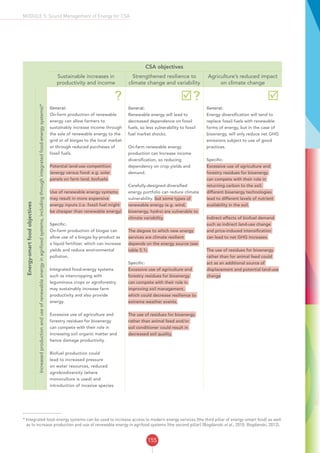
involved multiple stakeholders in the planning and decision making regarding the diverse uses of rangeland resources.
On the regional level, the Provincial People’s Congresses of Gansu and Sichuan approved Wetland Conservation Regulations
in 2007 and 2010 to promote the conservation of biodiversity and enhance the livelihood of local communities. These
regulations prohibit drainage and peat mining, promote the reclamation of peatlands and encourage local people and
organizations to get involved in peatland restoration. The Provincial People’s Congress of Sichuan allocates 0.3 percent
of its yearly budget to peatland restoration. Since 2008, the Chinese government has been working to establish a PES
mechanism to compensate local herders for reducing the number of livestock.
On the national level, during the last decade the government of China has encouraged the ecological restoration of degraded
rangelands and forage cultivation in winter pastures to reduce grazing pressure on peatlands in winter and spring. Since
2009 the programme ‘Returning grazing to grasslands’ (Tui Mu Huan Cao) in the eastern Tibetan Plateau has provided local
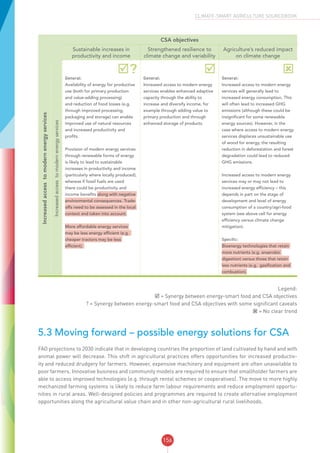
herders with payments for ecosystem services when they decrease the number of livestock and fence pastures for hay
making or restoration.
Lessons learned and recommendations
Human influence on the peatlands and rangelands of the Ruoergai Plateau started long before intensified land use directly
affected the peatlands. Today most peatlands on the Ruoergai Plateau show moderate to severe degradation. Prevention
of any further degradation and strict protection of the hydrologically important untouched peatlands should be the highest
priority.
When they were not backed up by adequate management of grazing intensities, technical approaches to restore peatland
functions showed only minor and ephemeral success. This important precondition for restoration and sustainable peat
and rangeland use can only be achieved by actively involving local people in decision-making processes. Furthermore,
the global benefits for biodiversity conservation and climate change mitigation and the national and regional benefits of
water regulation must be directly linked with the local benefits of sustainable livestock production. Awareness raising
and educational activities are needed to ensure that local communities understand how these different benefits are inter-
related.
The development of an integrated peatland management regime has to respond to the demands of the local population.
The management approach must be acceptable to local communities and be communicated in a comprehensible and
consistent way. In Ruoergai County, for example, peatland conservation is the responsibility of the local forestry bureau,
whereas rangelands (including grazed peatlands) are managed by the animal husbandry bureau. To achieve optimal
landscape management that integrates the interests of all stakeholders, communication and cooperation between the
different responsible organizations should be optimized.
The Ruoergai example shows how sound peatland management may serve multiple goals. By keeping groundwater levels
high, the peatlands support the productivity of the upland rangelands. By reducing the speed of water flow, the peatlands
retain sediments and provide a supply of good quality, well-filtered water. In addition, untouched and restored peatlands
provide important soil carbon storage, whereas reduced degradation leads to significantly less carbon dioxide emissions.
70
CLIMATE-SMART AGRICULTURE SOURCEBOOK
Case Study 2.7
Assessing ecosystem services at a territorial scale – options for
policy making, planning, and monitoring in the Kagera river basin
©FAO/Giulio Napolitano
Lake Burera in Rwanda
Introduction
The goal of the Transboundary Agro-ecosystem Management Project for the Kagera River Basin (Kagera TAMP) (described
at http://www.fao.org/nr/kagera/), which is funded by the Global Environment Facility (GEF) and implemented by FAO, is
to adopt an integrated ecosystem approach for the management of land resources in the Kagera River Basin. The Basin
is shared by Burundi, Rwanda, Uganda and the United Republic of Tanzania. Interventions are being monitored in terms
of the local, national and global benefits that are generated. These benefits include: restoration of degraded lands;
carbon sequestration; climate change adaptation; sustainable use of agricultural biodiversity; and improved agricultural
production and rural livelihoods. Indirect benefits that are being monitored are the project’s contribution to the protection of
international waters and enhanced food security. In the project’s monitoring framework, a participatory multisector process
for assessing and mapping of land degradation and sustainable land management was undertaken for the entire basin.
The landscape approach
There are various land assessment tools that are suitable for application at a landscape scale for planning and management
of natural resources and ecosystems and for supporting CSA interventions. The land degradation and SLM appraisal
was based on a method jointly developed by the LADA project (www.fao.org/nr/lada/). The LADA project was executed by
FAO and supported by GEF/United Nations Environment Programme (UNEP) in collaboration with the World Overview of
Conservation Approaches and Technologies Secretariat. The assessment was conducted across the entire river basin: at
the national level in Burundi and Rwanda, where the basin covers more than 60 percent of the national territories; and in
relevant parts of the Kagera basin in Uganda and the United Republic of Tanzania. A series of participatory meetings were
held that included selected multisectoral experts. Also carried out was an assessment and mapping of the extent, severity
and intensity of various degradation types or processes encountered in the basin, as well as the extent and effectiveness of
various SLM measures that were applied by diverse land users in the basin. The results, built up through consensus among
groups of experts from multiple sectors, provided the baseline information and a harmonized territorial estimation of the
71
MODULE 2: Managing landscapes for Climate-smart agricultural systems
tangible elements of the ecosystem’s good and services (e.g. impacts of land use and management practices on soil, water,
biomass, biodiversity, and its social and economic implications).
The method, which takes into consideration biophysical, social, economic, and ecological dimensions (see Table 2.2), is
cost-effective and can be conducted in a relatively short amount of time. For the Kagera Basin, which covers nearly 60 000
km2, the entire assessment cost around US$ 150 000. Included in these costs was capacity development in methods for the
participatory expert assessment with multiple sectors, quality control, and the validation and finalization of the database
and maps. In this case, six months were sufficient to complete a first draft set of maps. One year should be sufficient
to complete the entire validation process and make available the data set and maps for future planning by districts and
technical sectors.
Table 2.2
The various dimensions used by the LADA questioinnaire for mapping method
Biophysical Use of the land Ecological Socio-Economic
Elevation, slope, hydrology,
land cover soil, soil fertility
Climate: temperature, rainfall
Livestock density, crop type,
land use
Population density, poverty
Direct causes of land degradation or SLM due to land use and management practices
Indirect causes of land
degradation (driving forces)
or SLM
Trend in land-use change and intensity of trend variation
Type, rate, degree, and extent of land degradation
Type, extent, effectiveness of SLM technologies
Impacts on ecological services
(water, soils, biomass,
biodiversity, climate): negative
or positive impact due to land
degradation or SLM
Impacts on productive and
socio-economic services:
negative and positive impact
due to land degradation or SLM
After finalizing the collection and validation process, the data and maps are used to guide the cross-sectoral interventions
at the landscape level so that multiple goals, including those that address specific climate threats, can be reached. In this
way, LADA can be used to promote sustainable and climate-smart land resource management.
Lessons learned and recommendations
An important lesson that has been learned is that the data and maps can be used to: inform the project intervention
strategy; identify best SLM practices for scaling up; and guide effective and responsive interventions at various scales.
This is backed up by SLM implementation at the farm and catchment levels, field assessments of SLM performance and
impacts, and an analysis of constraints to wider uptake.
This process will in turn inform policy making, planning and budgetary allocations by technical sectors at the district and
transboundary levels and will establish a baseline for more integrated landscape management approaches. A handover
and ownership building process is under way to transfer the results to select governmental institutions. Decision makers
in the four countries will be assisted in analysing what type of land degradation processes are occurring, including those
exacerbated by climate change; where they are happening; what are the trends and why; and what are the expected
ecological and socio-economic impacts. An example of the type of issue that could be analysed would be how changes in
carbon storage in soil and biomass resulting from certain land-use practices would affect the supply of food and energy
and agro-ecopological resilience. Decision makers will also be informed about how to analyse current SLM technologies
and approaches in terms of extent and trends, and their effectiveness in reversing land degradation and improving SLM.
For example, a comparison of maps showing degradation and SLM effectiveness will allow decision makers to identify
areas requiring interventions, select good practices that can be scaled up, and choose additional SLM measures that are
needed to address specific degradation problems (see map 1). Policy makers should be informed on the causes of land
degradation (as distinct from poor quality land) such as poor cropland management, the removal of natural vegetation and
72
CLIMATE-SMART AGRICULTURE SOURCEBOOK
deforestation, over-exploitation of vegetation for domestic use, overgrazing, and climate-related factors (e.g. changes in
temperature or seasonal rainfall, extreme rainfall, floods or droughts) (see map 2).
The participatory assessment could be repeated at the basin level (at the end of the project) or preferably at the farm and
catchment level at regular intervals (e.g. mid-term and end of project). These would monitor the impacts of the project in
terms of specific SLM interventions, their impacts at field and farm level, and their combined effects at a wider catchment
and territorial scale.
The method could also be used during project implementation to help identify required improvements to SLM interventions,
determine potential areas for scaling up specific SLM measures and analyse the best practices that deserve wider
investment.
The process can be used by communities and districts to justify and develop proposals for catchment level interventions and
develop more substantive investment programmes requiring external support for landscape or basin-scale interventions.
Information gathered will allow for landscape and territorial management among the various sectors and contribute to
achieving multiple objectives, including sustainable productivity, enhanced resilience to climate variability and change, and
climate change mitigation. This will contribute to the development of more effective synergies among sectoral interventions
and identify trade-offs that need to be addressed by all stakeholders.
73
MODULE 2: Managing landscapes for Climate-smart agricultural systems
Case study 2.8
Planning and management for the hydrological balance of the South
American continent – the role of the tropical Andes
©FAO/I. Velez
Contour terraces in the Peruvian Andes
Introduction
Most of the watersheds of the South American continent, including the Amazon and La Plata river basins, originate in the
tropical Andes mountain range. Water places the tropical Andes in a position of strategic importance for the environmental
stability of the entire South American continent.
Climate change is a significant threat to the functioning of the tropical Andes’ ecosystems. Throughout rural Latin America,
and particularly in the tropical Andes and its related continental watersheds, agriculture and livestock production are the
main livelihoods of most rural populations. As they are currently practiced, agriculture and livestock production have a
huge impact on the hydrological regime and water quality downstream.
The landscape approach
At the farm level, shifting to climate-smart practices, improving market access, and protecting vegetation cover on the
landscape level to stop soil erosion, are some of the key measures that need to be taken across the tropical Andes to avoid
environmental damage and strenthen rural livelihoods.
Policy and institutional reforms are needed to ensure that the high-altitude ecosystems of the topical Andes are managed
to ensure hydrological stability. Planning, development and management of water resources must be governed by an
integrated local and continental perspective, and encompass climate change adaptation, disaster risk management and
natural resource management. Institutions should be adapted to serve the resource, not the other way around.
On the continental scale, a South American plurinational agency that works to clarify roles and responsibilities in relation
to the sustainable water management of the region´s watersheds could be an important positive force for long-term water
security of the region.
On the national level, a basin perspective is often lacking. State authorities usually work in isolation, and there is a repeatedly
acknowledged absence of national policies for water resources in the region. To a large degree, the solutions involve public
policies that encourage the adoption of environmentally sustainable agricultural practices. These practices should be
74
CLIMATE-SMART AGRICULTURE SOURCEBOOK
measured by their ability to achieve high yields per hectare and supported by public investments in physical infrastructure
that is built by local populations. Institutional strengthening is needed especially at the municipal level to improve services.
This could be addressed by municipal taxes. Currently, citizens only pay national taxes, and funds to municipalities are
allocated by the central government. This situation leads to a lack of accountability by municipal officials towards local
populations. Policies for municipal strengthening can enable the active involvement of local populations in policy design,
implementation, monitoring and evaluation, which is important to ensure the effectiveness of efforts on the national scale.
On the subnational level, municipal structures, families, farmers, rural producers and community organizations are key
institutions that need to be engaged to restore the Andean highlands and prevent hydrometeorological emergencies.
Because farmers determine land use and land-use change, they need to play an influential role in constructing institutional
arrangements at all levels of government. This can be done by establishing producer cooperatives (large and small) that
can give farmers a voice and a collective market influence. Cooperatives need to be supported by municipalities. Municipal
government is the appropriate institution to provide a link between the government and civil society organizations in the
region, as they are the only public institutional figures in many remote locations and have a cross-sector organization.
For communities, the key determinant for improved livelihoods is a strong physical connection to markets. Good road
access to nearby rural towns and cities is paramount. Once road access is available, communities can participate in
markets with products for which they have a competitive advantage. A second important intervention that needs to be
planned and organized on the landscape scale is technology and knowledge transfer for more climate-smart and profitable
practices. The adoption of modern sustainable agro-ecological practices (e.g. drip irrigation and micro irrigation systems,
soil fertilization with organic manure, production of food for domestic use in home orchards) and the revival of traditional
sustainable practices (e.g. pre-Hispanic terrace rehabilitation, construction of water infiltration ditches, insect repellent
plants, native Andean crops) contributes to the resilience of landscapes and family farms. These practices are also part of
successful strategies for managing disasters (e.g. protection against soil erosion and soil recuperation, prevention of hydro-
meteorological emergencies). Communities are better positioned to ensure that sustainable practices are undertaken, as it
is only through the full participation of all community members that damage to the vegetation cover can be avoided.
Planning processes for watershed management involving multiple stakeholders, including municipal and regional
governments, can be institutionalized in the tropical Andes using an integrated watershed perspective. This was done in
Peru, where the National Plan for climate change adaptation and disaster risk management (2012-2021) was developed
jointly with regional governments using a watershed approach. Watershed committees (comisiones de cuencas), inter-
municipal commissions (mancomunidades de municipios) and watershed users’ organizations involving rural populations
as well as urban and industry stakeholders can play key roles in such processes. At the landscape level, watersheds can
be favourably managed by intermunicipal commissions that create a chain of municipalities following the flow of water.
Previously, lack of public funding was a major issue for local governments in South America. Money is now flowing in, but it
usually comes with constraints set by the funding source. Most local governments in Latin America heavily depend on fiscal
transfers from central governments that exercise substantial influence over how finances are distributed. Funding is also
commonly available from other sources, such as conditional cash transfer programmes, but these funds are not targeted
to promote sustainable rural livelihoods and natural resources management. Fiscal autonomy of municipal governments
would empower them to finance their own development and should be a long-term goal.
PES schemes (for more information see Module 14 on financing) is a financial mechanism that is playing a leading role
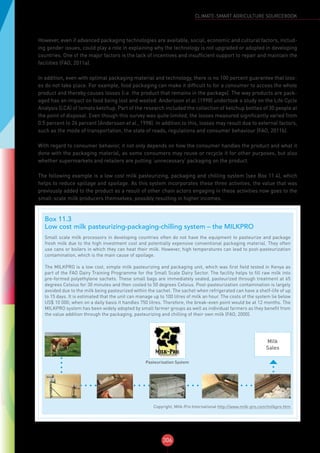
in the improvement of livelihoods of upstream smallholders in the tropical Andes. An example is the Napo Province in
Ecuador where a GEF project is supporting the implementation of a water fund that is operating a PES scheme for the
appropriate management of páramos and catchment areas upstream so that downstream users have enough water for
drinking and producing hydroelectricity. Another financial instrument that can empower citizens and focus public funds on
sustainable natural resource management is participatory budgets, which allow citizens to participate in the planning and
allocation for all or part of the municipal budget. Community involvement in municipal planning and budgeting strengthens
local institutions and can overcome administrative inertia and improve the transparency and accountability of the elected
officials.
75
MODULE 2: Managing landscapes for Climate-smart agricultural systems
Lessons learned and recommendations
1.	Water is the linking thread which connects the tropical Andes to most watersheds in South America, not only those
flowing west to the Pacific Ocean that provide water for cities, such as Lima, Quito and Guayaquil, but also east to the
Atlantic Ocean, by way of the Amazon river basin and the La Plata River basin. As such, the hydrological stability of
most of the continent depends on services provided by micro-ecosystems located above 4 000 metres above sea level
(páramos, wetlands and glaciers).
2.	A strategy for adaptation to climate change, risk management and natural resource management (in the case of South
America) must be addressed with a regional approach that goes beyond national boundaries to become a strategy for
natural resource management in the subcontinent of South America as a territorial unit. The territorial unity of the
continent of South America is determined by hydrological dynamics which, according to the law of gravity, has its origin
in the higher elevations of the Andes, downstream to the Pacific and Atlantic oceans.
3.	Watershed committees allow for the governance of natural resources beyond the political boundaries that may run
through the basin. However, watershed committes have sectorial limitations, as they act in matters only directly
related to the basin. For that reason, it is essential that, whenever posible, watershed committees establish a close
partnership with local government authorities,  including municipalities. It is also important that municipalities
establish intermunicipal alliances to overcome the administrative limits imposed by political borders and allow them
to cover the entire transnational watershed.
4.	Supranational feedback must begin from the communities located in the Andean plateaus, since they act as true
guardians of the water recharge areas that feed the subcontinent’s watersheds.
5.	The focus on existing practices and local knowledge for adaptation to climate risk and conservation of agricultural
biodiversity is the best guarantee for the sustainable management of Andean watersheds. Andean traditional farming
practices, such as the construction of terraces, are well adapted to the conservation of soil organic content and water
retention. The local knowledge of conservation practices in situ and the resilience of some crops and livestock products
should be valued and included in the development of modern institutions.
6.	The creation of synergies between producer organizations and local government institutions is a fundamental element
because it provides the link between local governments and civil society organizations.
76
CLIMATE-SMART AGRICULTURE SOURCEBOOK
Conclusions
The landscape approach has an important role to play in transitioning to CSA. It is an integrated approach that
aims at the sustainable management of natural and human-maintained processes in the landscape. Instead
of separate and often counterproductive management of various sectors, it calls for the alignment of sectoral
policies and their coordinated implementation. Adoption of participatory and people-centred approaches and
management structures contributes to improving the resilisence of the agro-ecosytem and the livelihoods of
the people who depend on it. Scaling up the landscape approach requires an enabling policy and market envi-
ronment, adequate governance structures as well as improved knowledge management and heightened insti-
tutional capacity. Different landscapes require different approaches that will depend on the state and nature of
the resources, current land-use dynamics, and social and economic conditions.
Notes
This module was written by Marja-Liisa Tapio-Bistrom (FAO), Anne Bogdanski (FAO) and Lisen Runsten (FAO)
with contributions from Anni Arial (FAO); Nadine Azzu (FAO); Sally Bunning (FAO); Christina Seeberg-Elverfeldt
(FAO); David Coates (CBD secretariat); Zhijun Chen (FAO); Cassandra De Young (FAO); Paolo Groppo (FAO);
Marc Dumas Johansen (FAO); Damiano Luchetti (FAO); Sheila Mwanundu (IFAD); Matthias Reiche (FAO); Janie
Rioux (FAO); Reuben Sessa (FAO); Kim-Anh Tempelman (FAO); Stephen Twomlow (IFAD); and Tiina Vahanen
(FAO). Box 2.4 was written by Maria Nuutinen (FAO). Case Study 2.1 was written by Richard Hatfield (Natural
Capital East Africa). Case Study 2.2 was written by David Boerma (FAO). Case study 2.3 was written by Doris
Soto (FAO). Case Study 2.4 was written by Lisen Runsten (FAO) and Manuela Vollbrecht (FAO). Case Study 2.5
was written by Pieter Van Lierop (FAO) and Petteri Vuorinen (FAO). Case Study 2.6 was written by Wu Ning
(ICIMOD) and Hans Joosten (University of Greifswald). Case Study 2.7 was written by Sally Bunning (FAO) and
Monica Petri (FAO). Case Study 2.8 was written by Tomas LIndemann (FAO), Paola Palestini (FAO) and Daniela
Morra (FAO).
77
MODULE 2: Managing landscapes for Climate-smart agricultural systems
Acronyms
CDM	 clean development mechanism
COE	 Council of Europe
CSA	 climate-smart agriculture
EAFA	 ecosystem approach to fisheries and aquaculture
FPIC	 Free Prior Informed Consent
GEF	 Global Environment Facility
GHG	 greenhouse gas
ICIMOD	 International Centre for Integrated Mountain Development
ICLEI	 Local Governments for Sustainability
IPCC	 Intergovernmental Panel on Climate Change
ISRIC	 International Soil Reference and Information Centre
LADA	 Land Degradation Assessment in Drylands
NAMA	 Nationally Appropriate Mitigation Actions
NAP	 National Adaptation Plans
NAPA	 National Adaptation Programmes of Action
MEA	 Millenium Ecosystem Assessment
NGO	 non-governmental organization
PFC	 Project Facilitating Committee
PES	 payment for ecosystem services
REDD+	 Reducing Emissions from Deforestation and Forest Degradation
SLM	 sustainable land management
SPI	 sustainable production intensification
TAMP	 Transboundary Agro-ecosystem Management Project, for the Kagera River Basin
UNESCO	 United Nations Educational, Scientific and Cultural Organization
UNEP	 United Nations Environment Programme
WHC	 World Heritage Committee
78
CLIMATE-SMART AGRICULTURE SOURCEBOOK
References
Bai, Z.G., Dent, D.L., Olsson, L. & Schaepman, M.E. 2008. Proxy global assessment of land degradation. Soil
Use and Management, 24: 223–234.
Bunning, S., McDonagh, J. & Rioux, J. 2011. Land degradation assessments in drylands. Rome, FAO.
Chen, H., Yao, S.P., Wu, N., Wang, Y.F., Luo, P., Tian, J.P. & Gao, Y. H. 2008. Determinants influencing seasonal
variations of methane emissions from alpine wetlands in Zoige Plateau and their implications. Journal of Geo-
physical Research-Atmospheres. Vol. 113.
Chen, H., Wu, N., Gao, Y., Wang, Y., Luo, P. & Tian, J. 2009. Spatial variations on methane emissions from Zoige
alpine wetlands of Southwest China. Science of the Total Environment, 407 (3): 1097-1104.
Council of Europe (COE). 2000. The European Landscape Convention. (available at http://www.coe.int/t/dg4/
cultureheritage/heritage/Landscape/default_en.asp)
Conant, R. 2009. Challenges and opportunities for carbon sequestration in grassland systems. Technical report.
Rome, FAO.
Critchley, W. 2010. More people, more trees. Practical Action Publications. International Institute for Environ-
ment and Development. (available at http://www.iied.org/sustainable-markets/blog/more-people-more-
trees)
Ekstam, B. 1993. Peatland restoration and ecosystem services: science, practice, policy. Flora, structure and
regeneration of wetland vegetation in Hongyuan, Sichuan, China. Report from Hongyuan Wetland Research
Project prepared for Sichuan Institute of Natural Resources. University of Lund, Limnology: Department of
Ecology. 47 pp.
FAO & International Soil Reference and Information Centre (ISRIC). 2008. Global assessment of land degrada-
tion and improvement: identification by remote sensing. Global Assessment of Land Degradation and Improve-
ment (GLADA) report No. 5. Wageningen, Netherlands and Rome.
FAO. 2009. Glossary on organic agirculture. (available at http://termportal.fao.org/faooa/oa/pages/pdfFiles/OA-
en-es-fr.pdf)
FAO. 2011a. Potential effects of climate change on crop pollination. Rome. (available at http://www.fao.org/do-
crep/014/i2242e/i2242e00.htm)
FAO. 2011b. Framework programme on climate-change adaptation. FAO Adapt. Rome.
FAO & Wetlands International. 2012. H. Joosten, M.-L. Tapio-Biström & S. Tol, eds. Peatlands— guidance for
climate change mitigation by conservation, rehabilitation and sustainable use. Mitigation of Climate Change
in Agriculture, Series 5.
Fischer, J., Lindenmayer, D.B. & Manning, A.D. 2006. Biodiversity, ecosystem function and resilience: ten guid-
ing principles for commodity production landscapes. Frontiers in Ecology and the Environment, 4: 80–86.
Foley, J. A., Ramankutty, N., Brauman, K. A., Cassidy, E. S., Gerber, J. S., Johnston, M. & Zaks, D. P. M. 2011.
Solutions for a cultivated planet. Nature, 478(7369): 337—342. (available at http://search.proquest.com/docvie
w/907243114?accountid=41827)
79
MODULE 2: Managing landscapes for Climate-smart agricultural systems
Frison E. A. Frison, Cherfas, J. & T. Hodgkin. 2011. Agricultural biodiversity is essential for a sustainable im-
provement in food and nutrition security. Sustainability, 3: 238–256.
Gao, Y., Schumann, M., Chen, H., Wu, N. & Luo, P. 2009. Impacts of grazing intensity on soil carbon and nitrogen
in an alpine meadow on the eastern Tibetan Plateau. Journal of Food, Agriculture & Environment, 7: 749–754.
Geerlings, H., & Stead, D. 2003. The integration of land use planning, transport and environment in European
policy and research. Transport Policy, 10(3): 187–196.
Holmgren, P. 2012. Landscapes for sustainable development. Center for International Forestry Research (CI-
FOR) Forests News Blog. (available at http://blog.cifor.org/12517/landscapes-for-sustainable-development)
Intergovernmental Panel on Climate Change (IPCC). 2001. An Assessment of the IPCC. Synthesis Report –
Summary for policymakers. Cambridge, United Kingdom and New York, USA, Cambridge University Press.
IPCC. 2007a. Climate change 2007: synthesis report. Contribution of Working Groups I, II and III to the Fourth
Assessment Report of the IPCC. Geneva.
IPCC. 2007b. Agriculture. In Climate Change 2007: Mitigation. Contribution of Working Group III to the Fourth
Assessment Report of the IPCC. Cambridge, United Kingdom and New York, USA, Cambridge University
Press. (available at http://www.ipcc.ch/pdf/assessment-report/ar4/wg3/ar4-wg3-chapter8.pdf)
Joosten, H. 2009. The global peatland CO2
picture: peatland status and emissions in all countries of the world.
Ede, Netherlands, Wetlands International. 10 pp. (available at http://tinyurl.com/yaqn5ya)
Jongman, R.H.G. 2004. The new dimension of the European landscape, Dordrecht.
Local Governments for Sustainability (ICLEI). 2013. Ethekwini environmental services management plan/dur-
ban metropolitan open space system. (available at: http://archive.iclei.org/index.php?id=1168)
Long, R. & Ma, Y.S. 1997. Qinghai’s yak production systems. In D.J. Miller, S.R. Craig & G.M. Rana, eds. Conser-
vation and Management of Yak Genetic Diversity. Kathmandu, Nepal. pp. 105–114.
Millennium Ecosystem Assessment (MEA). 2005. Ecosystems and human well-being: synthesis. Washington
D.C., Island Press. 155 pp.
Petter, M., Mooney, S., Maynard, S. M., Davidson, A., Cox, M., & Horosak, I. (2013). A Methodology to Map Eco-
system Functions to Support Ecosystem Services Assessments. Ecology and Society, 18(1).
Reiche, M., Azzu, N., Bogdanski, A., Braatz, S., Bunning, S., Evtimov, V. & Gordes, A. 2012. Mainstreaming
climate-smart agriculture into a broader landscape approach. Background Paper for the Second Global Confer-
ence on Agriculture, Food Security and Climate Change. Hanoi, Vietnam. 26 pp. Rome, FAO.
Reij, C., Tappan, G. & Smale, M. 2009. Re-greening the Sahel: farmer-led innovation in Burkina Faso and Niger.
(available at http://www.ifpri.org/book-5826/millionsfed/cases/innovation)
Sangha Group. 2008. The ‘Sangha guidelines’ for landscape approaches. Learning from Landscapes: The IUCN
Forest Conservation Programme 2008. IUCN & Ecoagriculture Partners. Arborvitaespecial. (available at
http://www.ecoagriculture.org/documents/files/doc_126.pdf)
Schaller, G. B. 1998. Wildlife of the Tibetan Steppe. University of Chicago Press.
80
CLIMATE-SMART AGRICULTURE SOURCEBOOK
Scherr, S.J., Shames, S. & Friedman, R. 2012. From climate-smart agriculture to climate-smart landscapes. Ag-
riculture & Food Security, 1: 1–12. (available at http://www.agricultureandfoodsecurity.com/content/1/1/12)
Schumann, M., Thevs, N. & Joosten, H. 2008. Extent and degradation of peatlands on the Ruoergai Plateau
(Tibet, China) assessed by remote sensing. Proc. Intern. Peat Congress Tullamore. Pristine Mire Landscape,
77–80 pp.
Shames, S., Scherr, S.J., Wallace, C. & Hatcher, J. 2011. Integrating agendas for forests, agriculture and cli-
mate change mitigation: rationale and recommendations for landscape strategies, national policy and international
climate action. Ecoagriculture Discussion Paper No. 7. Washington D.C., EcoAgriculture Partners and Rights
and Resources Initiative.
Steenbergen, F. V., Tuinhof A. & Knoop, L. 2011. Transforming lives, transforming landscapes: the business of
sustainable water buffer management. Wageningen, Netherlands, 3R Water Secretariat.
Sunderland, T. 2012. Landscape guidelines and principles. Presentation at conference. Bogor, Indonesia, CI-
FOR.
Tsuyuzaki, S., Urano, S. I., & Tsujii, T. 1990. Vegetation of alpine marshland and its neighboring areas, northern
part of Sichuan Province, China. Plant Ecology, 88(1): 79–86.
Victoria, R., Banwart, S., Black, H., Ingram, J., Joosten, H., Milne, E., Noellemeyer, E. & Bask, Y. 2012. The
benefits of soil carbon: managing soil for multiple economic, societal and environmental benefits. UNEP: Year-
book 2012. (available at http://www.unep.org/yearbook/2012/pdfs/UYB_2012_CH_2.pdf)
Wang, G., Wang, Y. & Kubota, J. 2006. Land-cover changes and its impacts on ecological variables in the headwa-
ters area of the Yangtze River, China. Environmental Monitoring and Assessment, 120: 361–385.
Wascher, D. M. Múgica, M. Gulinck, H. 1999. Establishing targets to assess agricultural impacts on European
landscapes. Chapter: 6, CABI ebooks.
Wiener, G., Jianlin, H. & Ruijun, L. 2003. The Yak. 2nd ed. Bangkok, FAO. 460 pp.
World Heritage Committee (WHC). 1996. World Heritage Committee, Information Document Glossary of World
Heritage Terms. Paris.
Wolfe, M.S. 2000. Crop strength through diversity. Nature, 406: 681-682.
World Bank. 2011. Climate-smart agriculture: increased productivity and food security, enhancing resilience and
reduced carbon emissions for sustainable development, opportunities and challenges for a converging agenda:
country examples. Washington D.C., The World Bank.
Yan, Z. & Wu, N. 2005. Rangeland privatization and its impacts on the Zoige wetlands on the Eastern Tibetan Pla-
teau. Journal of Mountain Science, 2: 105–115.
Yang, Y. 2000a. Mire conservation in China: the latest research progress and current viewpoints. A. Crowe, S.
Campeau & C. Rubec. Millennium wetland event - Programme with abstracts. 219 pp.
Yang, Y. 2000b. The distribution, degeneration and formation mechanism of peatland in P.R. China. In L. Roche-
fort & J.-Y. Daigle, eds. Sustaining Our Peatlands: Proceedings of the 11th International Peat Congress
Quebec, 1: 162–169.
Module 3:
Water management
Overview
This module examines the overall development context in which water is managed in agriculture and
provides an overview of the current status, trends and challenges. It also reviews the current state of
knowledge of the impact of climate change on water for agriculture and the vulnerability of rural popula-
tions and farming systems to climate change. This is followed by an examination of possible response
options for addressing these impacts. These options can be applied at various scales, on individual farms,
in larger irrigation schemes, throughout entire river basins and at the national level. The module also
presents criteria for prioritizing response options, examines conditions for climate change adaptation
and reviews opportunities for climate change mitigation.
Key messages
•	 Most of the impacts of climate change on agriculture are expected to result from changes in the
water cycle. Because of this, the design of climate-smart agriculture (CSA) strategies will need to be
viewed though a ‘water lens’.
•	 Climate change will affect both rainfed and irrigated agriculture through increased crop evapotran-
spiration, changes in the amount of rainfall, and variations in river runoff and groundwater recharge.
The impact of climate change on water use in agriculture must be considered within a wider context
in which a number of issues are taken into account including: increased water demand by all sectors;
the degradation of water quality; and heightened competition for water at various levels (community,
river basin and aquifer).
•	 Climate change adaptation in water includes a range of response options related to policies, invest-
ments, water management, and institutional and technical factors. These options will need to be
applied at different scales: on fields and farms; in irrigation schemes; in watersheds or aquifers; in
river basins and at the national level.
•	 Climate-proofing will have to become central in the design of future investment plans in water for
agriculture. It will become necessary to maintain a clear perspective on resilience when screening
water development programmes. When designing development policies it will be necessary to sys-
tematically consider how the policies may be affected by climate change. In many cases, the chal-
lenge will be to combine more efficient use of water with increased resilience of production systems.
83
MODULE 3: Water management
Contents
Overview	 		 			81
Key Messages	 		 	 81
3.1	Introduction		 	 84
3.2	 Water management in agriculture: status and trends		84
3.3	 Potential impacts of climate change on water in agriculture		85
	 		 Impact on water supply and demand		86
	 		 Combined effects of climate change and development		87
3.4	 Vulnerability to climate change and resilience: a variety of situations		88
3.5	 Assessing risk, preparing responses		89
3.6	 Options for adaptation to climate change		90
	 		 Coping with water scarcity		92
	 		 Building resilience		92
	 		 Adaptation at field/farm level		93
	 		 Adaptation at irrigation scheme level		93
	 		 Adaptation at watershed, river basin and national levels		94
3.7	 Prioritizing options with an eye on vulnerable categories of people		95
3.8	 Conditions for successful adaptation		96
3.9	 Water management for climate change mitigation		96
3.10	Conclusions		 	 97
Notes	 		 			97
Acronyms	 		 			98
References	 		 			99
Additional Resources	 		101
Annex	 		 			102
A.3.1	 A typology or major agricultural systems at risk and response options		102
List of Figures
Figure 3.1	 How climate change affects all the elements of the water cycle and its impact on agriculture		85
Figure 3.2	 Large-scale relative changes in annual runoff for the period 2090–2099, relative to 1980–1999		86
List of Tables
Table 3.1	 Climate change and development: how they influence water supply and demand		88
Table 3.2	 Options for climate change adaptation in water at different scales		91
List of Boxes
Box 3.1	 Planning under uncertainty		90
Box 3.2	 A continuum of adaptation activities: from development to climate change-specific actions		92
Box 3.3	 Adaptation to climate change in the Huang-Huai-Hai Plain of China		93
84
CLIMATE-SMART AGRICULTURE SOURCEBOOK
3.1 Introduction
It is commonly acknowledged that most of the impacts from climate change will relate to water (UN-Water,
2010). How water is managed will be at the centre of climate change adaptation strategies. This is particularly
true in rural areas and in the agriculture sector, where water plays a critical role in crop and animal production
(including fish), and the management of ecosystems, including forests, rangeland and cropland. There is also
scope for climate change mitigation actions in water management for agriculture.
The most immediate impact of climate change on water for agriculture will be through the increased variability
of rainfall, higher temperatures, and associated extreme weather events, such as droughts and floods. In the
medium to long term, climate change will affect water resources and reduce the availability or reliability of
water supplies in many places already subject to water scarcity. This impact must be considered in the bigger
picture of water scarcity and agricultural development in which other factors are driving changes in water use
at a much faster pace than climate change. Climate change is expected to bring additional burdens on already
stressed systems.
Addressing risks associated with climate change requires an understanding of the potential water-related
impacts of climate change and the vulnerability of rural populations. Vulnerability, sensitivity, adaptability,
resilience and exposure vary depending on the agricultural system and the importance of agriculture for the
national economy. These two factors are reviewed below as a basis for action.
There is a range of possible response options to adapt to climate change. These options can be related to
policies, investments, water management, and institutional and technical factors, both within the water and
agriculture sectors and beyond. To have optimal impact, these options must be used in combinations that are
tailored to different contexts. Focus should be placed on major systems at risk. However, there is also a need
to assess the vulnerability of different categories of rural people to identify priority actions.
3.2 Water management in agriculture: status and trends
Although agriculture is highly dependent on climate, so far evidence of observed changes related to regional
climate changes, and specifically to water, has been difficult to find. One of the reasons for this is that agri-
culture is strongly influenced by factors unrelated to climate, especially management practices, technological
advances, market prices and agricultural policies. These factors have more immediate impacts on water than
those induced by climate change (Bates et al., 2008). For this reason, it is important to understand the current
status of water management in agriculture before assessing the potential impact of climate change.
Over the last 50 years, heightened demand for food, fibers and other agricultural products has been met most-
ly by an increase in agricultural productivity. The expansion of agricultural land has remained relatively limited.
Total cultivated land increased by only 12 percent between 1961 and 2009, but productivity more than doubled.
The amount of land needed to produce food for one person has decreased from 0.45 hectares in 1961 to 0.22
hectares in 2009. During the same period, the extent of irrigated land has more than doubled, increasing from
139 to 301 million hectares (FAO, 2011a). By providing farmers with access to water, irrigation has been a key
factor in agricultural intensification. The expansion of irrigated land is expected to continue in the future as
farmers will increasingly look for greater control over production factors.
With the doubling of irrigated area, water withdrawal for agriculture has been rising sharply. Globally, ag-
ricultural water withdrawal represents 70 percent of all withdrawals. However, as water resources are very
unevenly distributed, the impact of these withdrawals varies substantially between countries and regions. An
increasing number of the world’s river basins have reached conditions of water scarcity through the combined
pressure of agriculture and other sectors. FAO (2011a) estimates that more than 40 percent of the world’s rural
population lives in river basins that are classified as water scarce.
85
MODULE 3: Water management
The high level of pressure on water resources has had serious impacts on water users and the environment.
Competition over water use is growing in river basins where there are no measures in place for arbitrating
conflicts. Evidence shows that biodiversity is declining more rapidly for freshwater-dependent species than for
species from other types of ecosystems (Comprehensive Assessment, 2007). The large-scale public surface
irrigation systems built during the green revolution dominated the landscape until the early 1980s and had a
profound impact on the flow of many rivers. Over the last 30 years, private investments, stimulated by the avail-
ability of cheap pumps and well drilling capacity, have been directed to tapping groundwater. Consequently,
aquifers are being depleted in countries with key agricultural production systems, including China, India, and
the United States.
Water demand from cities and industries has been booming as a result of rapid economic growth in emerg-
ing countries. This growth has put pressure on irrigation schemes to release water for urban and industrial
users. Pollution from agriculture, cities and industries has affected rivers and aquifers and further reduced
the amount of water available for use. The trends towards an increasing demand for water from all sectors is
expected to continue in the coming decades as the population reaches 9 billion people in 2050 and economic
growth increases the consumption of food and manufactured goods.
The role climate change will play with regards to water in agriculture must be considered in this context of
rapid increases in water withdrawals, the degradation of water quality and the competition for water at all
levels. The following sections look at the current state of knowledge about climate change impacts on water
resources and the demand for these resources. These impacts are framed within the overall perspective of the
current status, trends and challenges of water management in agriculture. Of particular interest are aspects
of change that are specific to climate and as such require specific responses.
3.3 Potential impacts of climate change on water in agriculture
Figure 3.1
How climate change affects all the elements of the water cycle and its impact on agriculture
86
CLIMATE-SMART AGRICULTURE SOURCEBOOK
Water is the prime channel through which the impacts of climate change on the world’s ecosystems and on
the livelihoods of societies will be felt. Climate change will have an impact on every element in the water cycle
(UN-Water, 2010). Agriculture will be affected by increased evaporative demand, changes in the amount of
rainfall and variations in river runoff and groundwater recharge, the two sources of water for irrigation (Figure
3.1). These impacts are described in more details below.
Impact on water supply and demand
A global increase in atmospheric temperatures is predicted to affect agricultural productivity. Particularly
affected will be areas in low latitudes, where temperatures are already high. In these areas, heat waves
will affect both crops and animals. An increase in temperatures will trigger increased demand for water for
evapotranspiration by crops and natural vegetation, and will lead to more rapid depletion of soil moisture.
This scenario, combined with changes in rainfall patterns (see below), may lead to more frequent crop
failures.
The hydrological cycle is expected to accelerate as rising temperatures increase evaporation from land and
sea (Turral et al., 2011). Predictions about the patterns of change of annual precipitation are still in their in-
fancy, but models tend to agree that there will be substantial changes at the regional level, including a sharp
reduction of precipitation in already water-scarce areas, including the Mediterranean, Southern Africa, the
Western United States, Mexico and Australia (Figure 3.2).
Figure 3.2
Large-scale relative changes in annual runoff for the period 2090–2099, relative to
1980–1999
White areas indicate where less than 66 percent of the ensemble of 12 models agree on the sign of change (whether there will be more
or less runoff). Hatched areas are where more than 90 percent of models agree on the sign of change.
Source: IPCC, 2008
87
MODULE 3: Water management
Changes in the distribution of precipitation, with longer periods between rainfall events and more intense
precipitation, are expected everywhere. This may lead to increased occurrence of extreme weather events,
including floods and droughts. Dry spells, the short periods of rainfall deficit during the cropping season, are
expected to increase in duration and frequency. This will directly affect soil moisture and the productivity of
rainfed crops. Such changes will be felt mostly in areas already subject to climate variability, such as in the
semi-arid and sub-humid areas of sub-Saharan Africa and South Asia, where, in the absence of alternative
sources of water, the risk of increased frequency of crop failures is high.
Reductions of rainfall in arid and semi-arid areas will translate into a much larger reduction in river runoff
(in relative terms). In Cyprus, for example, analyses have shown that a 13 percent reduction in rainfall trans-
lates into a 34 percent reduction in runoff (Faurès et al., 2010). In rivers receiving their water from glacier or
snow melt (about 40 percent of the world’s irrigation is supported by flows originating in the Himalayas), the
timing of flows will change, with high flows occurring earlier in the year. However, the mean annual runoff
may be less affected.
The impact of climate change on groundwater recharge is difficult to predict. Local recharge will depend on
the characteristics of the aquifer, the recharging processes and changes in rainfall. It is likely, however, that
aquifer recharge will be reduced in arid and semi-arid areas, where runoff will decline (Bates et al., 2008;
Turral et al., 2011).
Finally, the expected rise in sea levels will affect agriculture in coastal areas, particularly river deltas. High-
er sea levels combined with upstream changes (variations in runoff distribution, more frequent floods), will
result in an increased incidence of floods and saltwater intrusion in estuaries and aquifers.
Combined effects of climate change and development
As mentioned above, rapid increases in water use for agriculture and other purposes has modified the wa-
ter balance in many watersheds and aquifers. The combined effects of water withdrawal and pollution are
affecting ecosystems and rural populations in an increasing number of places. The extent to which climate
change will affect the water cycle and agriculture needs to be considered in light of these developments.
In arid and semi-arid areas, climate change will place additional burdens on already stretched water re-
sources. However, agriculture will first need to respond to the challenges posed by increasing human pres-
sures on these resources. In other places, climate change will be the main driver of change and will neces-
sitate specific climate change-related responses. Table 3.1 is an attempt to present the relative importance
of climate change and development on water supply and demand for agriculture. The relative impacts of
climate change will vary from one agricultural system to another, but it is important that adaptation strate-
gies take into account the overall context in which they are to be implemented.
Of particular relevance is the time frame for climate change and its relation to the speed of change driven
by development. Annual changes in runoff and recharge due to climate change are expected to occur at a
slower pace than changes caused by human demands for water. However, changes in variability and extreme
events associated with climate change may already be having impacts and deserve particular attention for
short- to medium-term responses.
88
CLIMATE-SMART AGRICULTURE SOURCEBOOK
Table 3.1
Climate change and development: how they influence water supply and demand
Elements of the
water cycle
Impact from
Development activities Climate change
Annual precipitation No or minor impact
Expected to increase globally during the 21st
Century, with potentially great spatial variations
Interannual variations in
precipitations
No impact Expected to increase everywhere
Seasonal variability of
rainfall
No impact Expected to increase everywhere
Soil moisture stress
(droughts)
Limited impact: some agricultural practices
can deplete soil moisture faster than natural
vegetation
Moisture stress to generally increase as a result
of increasing variability of rainfall distribution
(longer periods without rain) and increasing
temperatures
Floods
Moderate impact: flood intensity and impact
can be exacerbated by changes in land use and
unplanned development in alluvial plains
Increased as a result of increasing frequency and
intensity of extreme rainfall events
Snow and glacier melt
Limited impact through deposit of pollutants and
change in the reflecting power of the surface
(albedo)
Rising temperatures lead to accelerated snow
and glacier melt with initial increases in river
flow followed by decreases
River discharge
High impact in water scarce areas, where
reservoir construction and water diversion for
agriculture and other uses are modifying runoff
regimes and reducing annual flow. Large-scale
water conservation measures also have an impact
on river discharge
Increased variability as a result of changes in
rainfall patterns. Changes in snow and glacier
melt induce changes in seasonal patterns of
runoff. Changes in annual runoff expected to
vary from region to region (see Figure 3.2)
Groundwater
High impact: large-scale development of
groundwater resources in many regions are
already threatening the sustainability of aquifers
in many dry areas
Varies as a function of changes in rainfall
volumes and distribution. Impact is complex,
with floods contributing to increasing recharge,
and droughts leading to increased pumping
Evapotranspiration
Limited impact in agriculture: some crops have
higher evapotranspiration rates than natural
systems, other less
Increases as a function of temperature increases
Water quality (in rivers,
lakes and aquifers)
High impact from pollution in highly developed
areas
Moderate impact through temperature
increases
Salinity in rivers and
aquifers
High impact from water withdrawal in highly
developed areas (mostly in arid regions)
Potentially high impact where sea water level
rise combines with reduced runoff and increased
withdrawal
Source: adapted from a comparative analysis of Turral et al., 2011; Comprehensive Assessment, 2007
3.4 Vulnerability to climate change and resilience:
a variety of situations
The potential impact of climate change on agricultural systems and rural populations depends on a combi-
nation of exposure and sensitivity. It also depends on the level of resilience of these systems in relation to
potential changes in water supply and demand. Climate change-related risk will vary substantially from one
system to the other. The table in the Annex (A.3.1) presents the main agricultural systems at risk, their expo-
sure to climate change, their sensitivity and adaptive capacity, as well as the elements of response strategies
that would be needed as part of any programme designed to strengthen adaptation to climate change. The
89
MODULE 3: Water management
table is based on the section, ‘Land and water systems at risk’, from the State of land and water resources
for food and agriculture (FAO, 2011a).
The table A.3.1 illustrates that a farming system’s vulnerability is directly related to its relative dependency
on elements of the water cycle, and in particular rainfall variability. With or without climate change, agricul-
tural societies most at risk are those that rely exclusively on farming for their livelihood, have little scope for
diversification and are highly exposed to climate variability. Most of the responses that are needed to increase
the resilience of these farmers are not necessarily specific to climate change. Actions that build resilience in-
clude: better conservation of soil moisture (in particular through improved soil water holding capacity or ac-
cess supplementary irrigation); better storage of grain; and better access to markets and to drought protec-
tion schemes. Climate change only represents an additional justification for actions that are already needed.
The distinction between rainfed and irrigated production systems will dictate the impacts and associated
risks related to climate change. Rainfed systems in sub-tropics and semi-arid tropics will be mostly affected
by changes in rainfall patterns and temperatures. These changes will lead to greater frequency of crop fail-
ures as a result of increased variations in soil moisture. In mountainous areas, rainfed farming in marginal
areas will also be affected by the impact of extreme events, including intense rainfalls, floods and erosion.
Pastoral areas will suffer from more frequent drying of water points and greater variability in available ani-
mal feed.
Irrigated systems are better protected against rainfall variability. But these systems will increasingly re-
quire greater storage capacity to respond to more frequent droughts and floods and changes in the annual
distribution of runoff. For surface or groundwater systems already being over-exploited, climate change will
add an extra burden to water management and generally lead to a reduction in the availability of water and
greater competition for water resources.
Aquatic systems and capture fisheries will be affected by changes in quantity and quality of freshwater, which
will have an impact on production. Many aquatic species depend on the timing of rainfall and flood events for
important migrations (e.g. spawning and feeding). Changes in precipitation may disrupt these migrations or
force these species to make adaptations in their life history patterns. Integrated irrigation systems (e.g. rice
and fish) could see changes in system components as climate change alters the suitability of the environ-
ment, (e.g. more or less water may require different species of fish). Increased storage (i.e. more or larger
reservoirs) could promote integration of fish farming through cage culture and enhance the fisheries produc-
tion (see also Module 10 on fisheries and aquaculture).
3.5 Assessing risk, preparing responses
Many governments and development agencies have developed tools to assess the risk associated with cli-
mate change in relation to expected changes and populations’ vulnerability (OECD, 2009). Examples include
Opportunities and Risks of Climate Change and Disasters (ORCHID), Community-based Risk Screening Tool
– Adaptation and Livelihoods (CRisTAL), and tools developed by CARE and the International Federation of
Red Cross and Red Crescent Societies. These tools can be classified by the type of approach they use. There
are two types of approaches: a top down approach focuses on potential changes in the water cycle as a result
of climate change, and designs response options to anticipate and prevent the negative impacts of these
changes. By nature, this approach favours long-term responses. The other approach consists in assess-
ing the vulnerability of rural populations, and designing solutions that helps increasing their resilience to
external shocks. This bottom-up approach is more generic, not specific to climate change (but to any shock
or crisis) and usually considers short- to medium-term responses. Both approaches are necessary when
designing water management responses in relation to climate change. An impact-based approach is needed
to ensure that long-term investments such as irrigation development take into account expected changes in
water supply and demand.
90
CLIMATE-SMART AGRICULTURE SOURCEBOOK
Water infrastructures generally have a lifetime of 30-50 years. New investments or rehabilitation of old
infrastructures are therefore subject to changes in climate. This has serious consequences for people and
finances. In particular, the changing frequency and intensity of droughts, floods, and heat waves will affect
water supply and demand and call for better protection of land and socio-economic assets. Improving the
resilience of water infrastructure to climate change-related shocks and extreme events is a vital part of
any effective water investment planning. The concept of robust decision making in water planning (Groves,
2006) acknowledges that is it very difficult to predict the future, and makes extensive use of scenarios to
work out decisions that are robust under a variety of alternative futures (Box 3.1). In practical terms, resil-
ient coping strategies are those that have the potential to be reasonably effective under the largest possible
range of scenarios. This should be complemented with the adaptive management of existing and future
water infrastructures, which puts the emphasis on flexible responses and requires strong monitoring and
information management systems that allow for periodic upgrading of management plans and activities
(UNDP, 2004).
Bottom-up approaches give the opportunity to address vulnerable populations’ needs for resilience and de-
velopment. By acknowledging that resilience is closely linked to a population’s state of development, level
of economic diversification and the strength of their livelihoods assets, community-based climate change
response programmes offer the opportunity to progressively build a capacity to reduce climate change-
related risks. Most of the options that will be considered on the basis of bottom-up approaches will not differ
from classical agricultural development options for reducing poverty and increasing the standard of living of
rural populations. The challenge in this case is to avoid maladaptation (i.e. designing development actions
that are excessively sensitive to climate change and will therefore increase the vulnerability of beneficiar-
ies). The concept of ‘climate-proof’ investments is central to the design of programmes for reducing climate
change-related risks. It will become necessary to maintain a clear perspective on resilience when screening
water development programmes. When designing development policies it will be necessary to systemati-
cally consider how the policies may be affected by climate change (OECD, 2009).
3.6 Options for adaptation to climate change
Options for adaptation to climate change will necessarily combine investments, improved or adaptive man-
agement, and modifications in or development of policies, institutions and capacity development. Such op-
tions will need to be applied at different scales: on fields and farms; in irrigation schemes (particularly in
large schemes); in watersheds or aquifers; in river basins (including transboundary river basins); and at
the national level. Table 3.2 lists typical response options and indicates their relevance for different scales.
Box 3.1
Planning under uncertainty
The current level of uncertainty associated with the impact of climate change on water availability remains high. The
downscaling of global circulation models and local and regional assessments of precipitation patterns produce large
variations in the assessment of runoff and aquifer recharge. When combined with the different scenarios presented
in the Intergovernmental Panel on Climate Change’s (IPCC) Special Report on Emission Scenarios, the range of
results shows major uncertainties in the prediction of future runoff patterns. A risk-based approach that uses a wide
range of scenarios is needed and must be systematically used in hydrological assessments.
Source: Strzepek and McCluskey, 2010
91
MODULE 3: Water management
Table 3.2
Options for climate change adaptation in water at different scales
Options Field/farm
Irrigation
scheme
Watershed/
aquifer
River basin National
1.Investments
On-farm water storage: water harvesting x
Groundwater development x
Modernisation of irrigation infrastructure x
Breeding for resistance to droughts and floods x
Dam construction/enhancement x x x
Drainage x x x
Introduction of appropriate fish species x x x
2. Land, water and crop management
Enhancing soil moisture retention capacity x
Changing cropping pattern and diversification x
Adapting cropping (and fish harvesting) calendar x
Supplementary irrigation x x
Deficit irrigation x
Alternate wet and dry rice production system x x
Drainage and flood management x x x
Irrigation scheme operation improvement x
Integrated water resources management x
Adaptation of dam operation rules x
Riparian habitat restoration or creation in rivers x
3. Policies, institutions and capacity building
Climate proofing of I&D infrastructure x x x
Reallocation of water (between or within sectors) x x x x x
Strenghtening land/water right access x x x x x
Crop insurances x
Improved weather forecasting capacity x x x x x
Improved hydrological monitoring x x
Development of flood/droughts x x
Review of food storage strategies x
Source: adapted from Turral et al., 2011
Most of these options are not new to development programmes. Options for on-farm water conservation have
been promoted for a long time as a response to water scarcity and climate variability. Options to address in-
creasing water scarcity through better co-management of water at the watershed, aquifer and river basin level
are needed in many water-stressed areas. Although there are overlaps between climate change adaptation and
development, activities with an explicit focus on adaptation and climate change will also be required. Box 3.2,
adapted from OECD (2009) proposes four categories of responses, from development responses to reduce the
overall vulnerability of rural communities to all types of shocks, to targeted climate change adaptation options.
92
CLIMATE-SMART AGRICULTURE SOURCEBOOK
Coping with water scarcity
In many river basins, water scarcity is already the main challenge facing agriculture. In areas where water is
scarce, climate change is expected to exacerbate tensions and increase competition for water. If agriculture
is to continue meeting the demand for food and other commodities, efforts will be needed both on the supply
side and on the demand side. Enhancing supply includes: increased access to and improved management of
conventional water resources; habitat rehabilitation; dam operations; re-use of drainage water and waste-
water; transfer of water between river basins; desalination; and pollution control. Demand management is
defined as a set of actions that control water demand, either by raising the overall economic efficiency of its
use as a natural resource, or operating intra- and intersectoral reallocation of water resources. Options to
cope with water scarcity in agriculture can be seen as running a spectrum from the source of water to the end
user (the farmer and fisher), and beyond, to the consumer of agricultural goods (FAO, 2012 ). A combination
of technical, managerial, legal and investment options are needed to help farmers produce more with less
water. These options need to be backed with a policy and incentive framework that alerts farmers to water
scarcity and rewards more productive use of water at the farm level.
Increasing the reliability and flexibility of access to water for farmers is of prime importance. Many wasteful
behaviours on farms are linked to the uncertainty associated with water distribution practices that do not
allow farmers to optimize water application or raise the productivity of their crops. Water storage, and the
combined use of groundwater and canal irrigation water, can go a long way towards improving the produc-
tivity of water used for irrigation. Economic incentives, in particular the use of subsidies for pumping, must
be designed in a way that promotes the efficient use of water and avoids wastage of both energy and water
resources.
Building resilience
From a livelihood perspective, building resilience involves reducing farmers’ exposure or sensitivity to
shocks, or increasing their capacity to respond. Of prime importance is the ability to increase the farm-
ing systems’ buffering capacity in the face of more variable supplies of rainwater. This necessitates an in-
creased capacity to store water in the soil, in surface reservoirs or in underground reservoirs. Any action
that increases the capacity to access water when needed will increase resilience to climate variability. These
actions include: on-farm water harvesting; the enhancement the soil’s capacity to hold moisture (see also
Module 4 on soils); on-farm water retention and enhanced infiltration; and, where possible, more system-
atic access to groundwater. Supplementary irrigation at critical periods of the cropping season can reduce
losses and boost productivity.
Resilience is closely linked to improved access to land and water. The strengthening of land and water rights
will have a positive impact on resilience as it will encourage farmers and other rural people to invest in their
land and build the assets that are needed for increased productivity and diversification.
Box 3.2
A continuum of adaptation activities: from development to climate change-
specific actions
Adaptation activities that span the continuum from development to climate change can be organized in four
categories. The first category includes activities that are fundamentally about fostering human development. These
activities focus on reducing poverty and addressing factors that make people vulnerable to harm, regardless of
the cause. The second category of activities focuses on building response capacity. Mostly of a capacity-building
nature, these activities tend to involve institution-building and technological approaches adapted from development
efforts. The third category involves activities to manage climate risk. Activities in this category focus specifically on
hazards and impacts and follow the concept of climate risk management. The fourth category involves activities for
confronting climate change. They focus almost exclusively on addressing climate change impacts. Activities in this
category tend to target climate change-related risks that are beyond historic climate variability.
Source: McGray et al., 2007 in OECD, 2009.
93
MODULE 3: Water management
Adaptation at field and farm level
Many farm-level adaptations will be spontaneous and will be done in response to change but not necessarily
designed for climate. Others adaptations will need to be planned, often with external support. Farmers will
favour more efficient irrigation technologies that reduce evaporation losses. These actions can be combined
with deficit irrigation approaches to maximize productivity per volume of water applied rather than per area
of land. Crop selection and changes in crop calendars will help farmers adapt to new temperatures and
rainfall patterns. The use of crops or varieties with better resilience to dry spells will be preferred. (It should
be noted however that there is little prospect for breakthroughs in developing ‘drought resistant’ crops in
the near future.) Increased agricultural diversification, including better integration of trees, crops, fish and
livestock will reduce risk and increase the resilience of farming systems. In particular, the farming and fish-
ing of aquatic species that do not require extensive migrations and that have wide environmental tolerances
will help aquaculture and capture fisheries adapt to new climatic conditions. Farmers will also need to adopt
more systematically measures to respond to increased frequency of floods and more intensive rainfalls. A
combination of erosion control actions and better drainage capacities will be needed.
Adaptation at irrigation scheme level
Actions for adapting to climate change in irrigation schemes need to be considered in the overall context of
irrigation modernization. Modern irrigation systems require better water allocation mechanisms, the clear
transmission of alerts about water scarcity to farmers, and the adaptation of both infrastructure and manage-
ment for more flexible and reliable delivery of water (FAO, 2007). Intermediate storage within the irrigation
scheme and, where possible, access to groundwater are part of the options for building the resilience and
reliability of water supply and must be considered in adaptation plans for irrigation schemes. Water pricing
and the establishment of water markets are often advocated as demand management tools for promoting
better water use and reducing water wastage. While these options have proven effective in some places, they
are often difficult to apply for a combination of technical, institutional and policy reasons. There are other
options, such as limiting seasonal allocations to users or to groups of users, that may be simpler and more
effective for inducing more productive water use behaviour. Box 3.3 provides an example of a climate change
adaptation programme of irrigation in China. It illustrates how adaptation activities are closely linked to over-
all irrigation modernization programmes.
Box 3.3
Adaptation to climate change in the Huang-Huai-Hai Plain of China
The Huang-Huai-Hai Plain of China is critical to the country’s agricultural economy and to national food security.
Future productivity in the area is being jeopardized by higher annual temperatures and reduced rainfall, which has
led to more frequent spring droughts. Combined with increasing industrial and domestic water demands, climate
change will mean that less water will be available for irrigated agriculture. In 2004, a project financed by the World
Bank started working with farmers and technical experts to implement water-saving measures across five provinces.
In 2006, a grant from the Global Environmental Facility (GEF) was added to mainstream adaptation activities into the
project activities.
The overall aims of the project were to reverse the inefficient use of water for farming and increase farmers’ profits.
A range of irrigation-centred engineering, agronomic and management measures were implemented to improve
water management in over half a million hectares and bring benefits to 1.3 million farming families. Research
and demonstration activities focused on the testing of adaptation measures and advanced agriculture and water
saving technologies. Experts also introduced new drought- and pest-resistant wheat varieties that were more closely
matched to expected future growing conditions. New techniques were introduced through pilot programmes to better
manage irrigation water and were widely adopted after farmers saw the benefits in terms of reduced irrigation costs,
reduced groundwater depletion and especially increased water productivity. Critical to the project’s success was
the strong coordination and partnership with leading scientific and agricultural research institutions, as well as the
efforts that were made towards creating joint ownership with farmers.
Source: Qun, 2011 in FAO and World Bank, 2012.
94
CLIMATE-SMART AGRICULTURE SOURCEBOOK
Adaptation at watershed, river basin and national levels
Climate change adaptation at higher levels will involve a combination of policy adjustments and investments
in infrastructure and management. In river basins, increased frequency and intensity of extreme weather
events will require adjustments in the storage capacity and management of dams and river protection works.
More than in the past, flood management plans will need to combine infrastructure upgrades with non-
structural, information-rich approaches that can better mitigate the impact of floods through a combination
of land planning, early warning and insurance schemes. Similarly, there will be a need to shift from drought
emergency response to drought management plans that include prevention, preparedness, relief and reha-
bilitation and long-term measures to mitigate the impacts of droughts (FAO and NDMC, 2008).
In all these cases, adaptation approaches to floods and droughts used by water managers and farming com-
munities should be considered systematically. Examples include flood mitigation through the cultivation of
varieties of rice that respond differently to different levels of flooding, or the combined cropping of bean varie-
ties with varying resistance to droughts. Habitat engineering and rehabilitation will also be needed to reduce
the severity of flood impacts and provide erosion control, nutrients, shade and oxygen. This will also create
suitable environments for fish production.
Integrated water resources management in river basins will become more and more important as the com-
bination of increased water use and the occurrence of extreme events will increase the interdependency of
people and communities living in river basins, and as actions in one part of a basin will have repercussions
for people further downstream. In places where climate change contributes to increased water scarcity, the
whole package of supply enhancement and demand management options will need to be considered (FAO,
2012). Improved governance of land and water use will be required to accommodate the multiple uses of wa-
ter, including for livestock and fish.
Improved weather forecasting and hydrological monitoring will become a critical element of modern ad-
aptation strategies (Faurès et al., 2010). Currently reliable weather forecasting is still limited to a few days.
However, progressive improvements in the timing and reliability of seasonal forecasts offer new opportunities
for farming communities (more on assessments in Module 12). As efforts focus on improving the accuracy of
these forecasts, more emphasis should now be given to improving the way information is conveyed to farm-
ers and building their capacity to make best use of climate information (Gommes et al., 2010). Monitoring and
early warning during the cropping season remain a priority to help farmers make informed decisions.
Insurances represent a potential solution that should also be systematically considered as part of adaptation
strategies. There is a renewed interest in various types of crop insurance, as well as aquaculture and fishing
insurances, that could be adapted to developing countries. National crop insurance schemes have been test-
ed in some countries, but they face substantial challenges in terms of costs and institutional settings. So far,
few commercial insurance companies have found it to be an attractive business opportunity. Roberts (2005)
focused on the need to smooth tensions between insurance that is run as business for commercial profit and
the protection of small farmers that is in the strategic national interest. Insurance companies need to be solid
and well-backed. International reinsurance could play an important stabilizing role and provide backup for
emerging national companies. The role of national governments in promoting crop insurances must reflect
national interests and at the same time ensure the smooth operation of private insurance companies. This
must be based on the concept of shared risk between producers, insurance companies and governments.
A type of insurance which has recently been applied in developing countries is known as index-based insur-
ance. In index-based products, compensation is paid to the insured if the agreed threshold of an index is ex-
ceeded. The indices must be defined in such a way that they bear a direct relationship with the performance
of the product insured. Index-based insurance is difficult to apply to small-scale hazards but seems to have
good potential for hazards with regional impacts like hurricanes or droughts (Gommes et al., 2010).
95
MODULE 3: Water management
3.7 Prioritizing options with an eye on vulnerable
categories of people	
The combination of vulnerability assessments, impact assessments and screening of response options usu-
ally produces a long list of possible actions. USAID (2007) has proposed a screening process for these actions
using a series of criteria. The effectiveness of an option needs to be assessed as a solution to a problem aris-
ing from climate change, and be measured in terms of its cost and the size of the beneficiary group. Where
possible, actions with impacts on large groups, with low costs per beneficiary and high levels of effectiveness
should be selected. Currently, such assessments are rarely done. Adaptation options are often discussed with
no clear understanding of possible tradeoffs between costs and effectiveness. A much more systematic ap-
proach to adaptation will be needed in this field.
Criteria for assessing the impacts of climate change and adaptation options must also include considerations
of equity. Particular focus should be placed on the most vulnerable categories of rural people. Women’s ac-
cess to water must be considered, both in terms of the impact of climate change and response options. Se-
curing water rights in a way that is both effective and equitable will become increasingly important as water
scarcity increases. In irrigation schemes, ‘tail-enders’, farmers located at the end of the irrigation canals,
usually suffer more than other farmers during water shortages and floods. In river basins, downstream water
users suffer from excessive water withdrawal from upstream users. Technologies and policies for climate
change adaptation are not neutral in terms of equity. It is therefore important that they be analysed in terms
of their impact on different groups of vulnerable people and that actions that would increase inequalities be
eliminated from climate change adaptation programmes.
The adoption of a livelihood approach to water-related adaptation is a useful way to ensure that proposed
actions will be beneficial to the people they are supposed to serve. Sullivan et al. (2008) consider four key
dimensions of the water-related conditions of rural livelihoods: access to basic water services; crop and
livestock water security; clean and healthy water environment; and secure and equitable water entitlement.
Using such entry points to screen the impact of adaptation options ensures that they will be assessed in ways
that are in line with the concerns and priorities of rural populations.
Ease of implementation considers possible barriers to the implementation of a given option that could delay
or reduce its impact. Such barriers could be policy-related, structural, institutional or social. Social barriers
are related to the acceptability of proposed actions by local stakeholders. Specific policy or technical assis-
tance may be required to overcome these barriers. Other relevant criteria include technical feasibility and the
time frame for implementation.
Adequacy for the current climate is an important criterion to consider. Here, possible options should be
analysed in terms of their ‘level of regret’. Low-regret or no-regret options are those options that are valid
whether expected climate change impacts occur or not. In general, these options increase the resilience of
rural populations and reduce their vulnerability to water-related shocks. Instead, many options, in particular
options dealing with infrastructure, can be considered high-regret options: they would be valid for future
climate scenarios but not necessarily for the current climate situation. They would therefore involve higher
costs and have possible negative consequences under current climate conditions, and require careful consid-
eration in terms of risk analysis.
All options must be considered in relation with the uncertainty associated with climate change predictions.
Their robustness in terms of the above criteria (in particular effectiveness and adequacy for current climate)
must be assessed against different climate change scenarios and global circulation models (see Module 18
on assessments and monitoring).
96
CLIMATE-SMART AGRICULTURE SOURCEBOOK
3.8 Conditions for successful adaptation
In developing countries, programmes designed to promote sustainable water management face the greatest
number of barriers to the successful adoption of climate change adaptation practices. In most cases, the po-
tential exists to adapt to climate change, improve the livelihood situation of rural communities and promote
sustainable practices. Achieving these goals demands that a certain set of conditions be in place to remove
constraints and build resilience and flexibility (FAO, 2011b), including: improvement of land tenure and se-
cured access to water; strengthened and more collaborative land and water institutions; efficient support
services (including knowledge exchange, adaptive research, rural finance); and changes in incentive frame-
works that remove ineffective subsidies and focus on incentives that promote resilience, improve productivity
and induce sustainable behaviours.
Climate change adaptation must be mainstreamed in both rural development and water scarcity programmes
(FAO, 2011a; FAO, 2011b) and not carried out on a separate track. Water, land and food policies must be more
aligned and viewed through the perspective of climate change. In particular, agriculture and rural develop-
ment goals must be brought into water planning and take into consideration other water use sectors. Links
must also be made with disaster risk management strategies, which are in a large part directly related to
water management (see Module 15 on disaster risk reduction).
3.9 Water management for climate change mitigation
Irrigated agriculture accounts for only 20 percent of the area of global agriculture, but is more intensively
managed. On average, irrigated agriculture uses greater amounts of inorganic fertilizer and other agro-
chemicals than most rainfed systems. Consequently, efforts to reduce greenhouse gases through improved
crop management practices are likely to have more impact in irrigated lands than in rainfed areas.
Groundwater is used for irrigation on 38 percent of all irrigated land. The use of groundwater is expanding
both in absolute and relative terms (Siebert et al., 2010), and this is increasing the use of fossil fuels and rais-
ing the energy costs of water supply. At a regional level, energy consumption for groundwater irrigation can
be significant. In China, energy consumption in this area is significant, accounting for 16–25 million tonnes
of carbon emissions. In India, it is responsible for 4–6 percent of the national total emissions (Shah, 2009).
On balance, the options for direct climate change mitigation through irrigation are the same as those of
agriculture as a whole. There is likely greater potential in areas of intensive groundwater irrigation. The pos-
sibilities are governed mostly by the increased intensity of irrigation, which will allow for a greater potential
for carbon sequestration in tropical conditions and greater productivity, but may be offset by more intensive
use of inputs (Turral et al., 2011).
Agricultural methane (CH4
) emissions account for more than 50 percent of CH4
emissions from hu-
man activities. One-third of these emissions come from flooded rice production (28-44 teragrams
of CH4
per year). More than 90 percent of global rice production is concentrated in the monsoon area of South
and Southeastern Asia. Since the area of irrigated rice is growing relatively slowly, future increases in CH4
emissions from rice fields are expected to be small. Furthermore, rice fields are converted at least partially
from natural wetlands, which also emit CH4
, and extend over a much larger area at the global level. The effec-
tive net emissions growth from transforming wetlands into irrigated rice has not been well studied. However
when emissions from natural wetlands are taken into account, gross emission estimates are probably sub-
stantially smaller than effective net emissions (HLPE, 2012).
Emissions during the growing season can be reduced by using various water management practices, such as
cultivating aerobic rice and, where conditions allow, alternate wetting and drying. Avoiding water saturation
when rice is not grown and shortening the duration of continuous flooding during the rice growing season are
97
MODULE 3: Water management
effective options for mitigating CH4
emissions from rice fields. Currently, true aerobic rice yields tend to be
poor (less than 2 tonnes per hectare), and this is a strong disincentive for adoption even when natural drain-
age conditions are favourable (Comprehensive Assessment, 2007). Promoted in many rice-producing coun-
tries, the System of Rice Intensification (SRI) is a practice that aims to increase the productivity of irrigated
rice by changing the management of plants, soil, water and nutrients. Because SRI reduces the amount of
flooding of irrigated rice, it is also likely to reduce CH4
emissions. It also saves water and may possibly reduce
nitrous oxide emissions (HLPE, 2012). However, well-quantified data on reductions in CH4
emission are not
yet available.
In inland fisheries and aquaculture, riparian habitat restoration or creation can be promoted to absorb carbon
and create suitable environments for capture fish production. The modernization of fishing and aquaculture
facilities also has the potential to contribute towards low impact fuel efficient (LIFE) systems (see Module 10
on fisheries and aquaculture).
Irrigated pastures are important in some areas of the world, and their importance is growing as demand for
animal feed increases. Better pasture management, combined with the use of feed additives that suppress
CH4 fermentation in ruminants, can reduce livestock CH4
emissions substantially (Turral et al., 2011).
3.10 Conclusions
Most of the impacts of climate change agriculture and rural livelihoods are expected to result from changes
in the water cycle. Rainfall variability and the subsequent increase in frequency of extreme weather events,
including droughts and floods, combined with an increasing acceleration of the water cycle through increased
evapotranspiration, will have an impact on every element in agricultural ecosystems: crops, livestock, trees,
fish, rural communities and physical infrastructure. For this reason, climate change adaptation strategies for
agriculture will need to be viewed though a ‘water lens’.
Many of the development activities for improving the socio-economic conditions in rural areas will have a
positive impact on climate change adaptation as they reduce the vulnerability of local communities to shocks
and increase their resilience. However, new programmes must become more strategic. The resilience of
these populations to climate change must be assessed systematically to avoid maladaptation and increase
the robustness of development programmes. In addition, specific climate change adaptation actions will need
to be designed and mainstreamed into development programmes.
Given that most intensive agricultural practices with potential for climate change mitigation use some form of
irrigation, there is some scope for mitigation actions addressing how water is managed in agriculture.
Notes
This Module was written by Jean-Marc Faurès (FAO) with contributions from Devin Bartley (FAO), Mohamed
Bazza (FAO), Jacob Burke (previously FAO, now World Bank), Jippe Hoogeveen (FAO), Doris Soto (FAO) and
Pasquale Steduto (FAO).
98
CLIMATE-SMART AGRICULTURE SOURCEBOOK
Acronyms
CARE	 Cooperative for Assistance and Relief Everywhere
CH4
	 methane
CRisTAL	 Community-based Risk Screening Tool – Adaptation and Livelihoods
CSA	 climate-smart agriculture
GEF	 Global Environmental Facility
HLPE	 High Level Panel of Experts on Food Security and Nutrition
IPCC	 Intergovernmental Panel on Climate Change
LIFE	 low impact fuel efficient
NDMC	 National Drought Mitigation Center
OECD	 Organisation for Economic Co-operation and Development
ORCHID	 Opportunities and Risks for Climate Change and Disasters
SRI	 System of Rice Intensification
UNDP	 United Nations Development Programme
USAID	 United States Agency for International Development
WHO	 World Health Organization
99
MODULE 3: Water management
References
Bates, B.C., Kundzewicz, Z.W., Wu, S. & Palutikof, J.P. 2008. Climate change and water. Technical paper of
the Intergovernmental Panel on Climate Change. Geneva, IPCC Secretariat. 210 pp.
Comprehensive Assessment. 2007. Water for food, water for life: the comprehensive assessment of water
management in agriculture, D. Molden, ed. London, Earthscan and Colombo, International Water Management
Institute.
FAO. 2007. Modernising irrigation management – the MASSCOTE approach. FAO irrigation and drainage paper
No. 63. Rome.
FAO. 2011a. The state of the world’s land and water resources for food and agriculture (SOLAW) – managing sys-
tems at risk. Rome, FAO and London, Earthscan.
FAO. 2011b. FAO-ADAPT. FAO’s framework programme on climate change adaptation. Rome.
FAO. 2012. Coping with water scarcity: an action framework for agriculture and food security. Water report No.
38. Rome.
FAO & National Drought Mitigation Center (NDMC). 2008. The Near East drought planning manual: guidelines
for drought mitigation and preparedness planning. Food and Agriculture Organization of the United Nations Re-
gional Office for the Near East, Cairo and University of Nebraska-Lincoln, National Drought Mitigation Center.
FAO & World Bank. 2012. Climate change adaptation in agricultural investment in East Asia and the Pacific: is-
sues and options. Summary report of an Expert Group Meeting jointly organized by the World Bank and FAO.
Faurès, J.M., Bernardi, M. & Gommes, R. 2010. There is no such thing as an average: how farmers manage
uncertainty related to climate and other factors. International Journal of Water Resources Development, 26:
4, 523—542.
Groves, D.G. 2006. New methods for identifying robust long-term water resources management strategies for
California. Pardee RAND Graduate School (PRGS) Dissertation Series. Santa Monica, USA.
Gommes, R., Acunzo, M., Baas, S., Bernardi, M., Jost, S., Mukhala, E. & Ramasamy, S. 2010. Communication
approaches in applied agrometeorology, In K. Stigter, ed. Applied Agrometeorology, pp. 263–287, Heidelberg, Springer.
High Level Panel of Experts on Food Security and Nutrition (HLPE). 2012. Climate change and food security. A
report by the HLPE of the Committee on World Food Security, Rome.
Intergovernmental Panel on Climate Change (IPCC). 2008. Climate Change and Water. B.C. Bates, Z.W.
Kundzewicz, S. Wu & J.P. Palutikof, eds. IPCC Technical Paper VI. Geneva, IPCC Secretariat. 210 p.
McGray, H., Hammil, A. & Bradley, R. 2007. Weathering the storm: options for framing adaptation and devel-
opment. Washington, World Resources Institute. In OECD, 2009.
Organisation for Economic Co-operation and Development (OECD). 2009. Integrating climate change adapta-
tion into development co-operation. Policy guidance.
Quni, L. 2011. Climate change impact assessment and adaptation in water resources and irrigated agriculture
in 3H region of China. Presentation made at FAO-WB Expert Group meeting on climate change adaptation in
agricultural investment in East Asia and the Pacific. FAO and World Bank.
100
CLIMATE-SMART AGRICULTURE SOURCEBOOK
Roberts, J. 2005. Insurance of crops in developing countries. FAO Agricultural Service Bulletin 159. Rome, FAO.
Shah, T. 2009. Climate change and groundwater: India’s opportunities for mitigation and adaptation. Environmen-
tal Research Letters No. 4. (available at http://www.iop.org/EJ/article/1748-9326/4/3/035005/erl9_3_035005.
html)
Siebert, S., Burke, J., Faures, J. M., Frenken, K., Hoogeveen, J., Döll, P.& Portmann, F. T. 2010. Groundwater
use for irrigation – a global inventory. Hydrology and Earth System Sciences, 14: 1863–1880.
Strzepek, K.M. & Mccluskey, A.L. 2010. Modeling the impact of climate change on global hydrology and water
availability. Development and climate change discussion paper No. 8. Washington D.C., The World Bank.
Sullivan, C.A., Cohen, A., Faurès, J.M. & Santini, G. 2008. The rural water livelihoods index: a tool to prioritize
water-related interventions for poverty reduction. Report for FAO-Water, Rome. (available at http://www.fao.
org/nr/water/docs/FAOW_RWLI_paper.pdf)
Turral, H., Burke, J. & Faurès, J.M. 2011. Climate change, water and food security. FAO Water Report No. 36.
Rome, FAO. (available at http://www.unwater.org/downloads/unw_ccpol_web.pdf)
United Nations Development Programme (UNDP). 2004. Adaptation policy frameworks for climate change:
developing strategies, policies and measures. B. Lim, E. Spanger-Siegfried, I. Burton, E. Malone & S. Huq, eds.
New York, UNDP. (available at http://www.preventionweb.net/files/7995_APF.pdf)
UN-Water. 2010. Climate change adaptation: the pivotal role of water. UN-Water policy brief. (available at http://
www.unwater.org/downloads/unw_ccpol_web.pdf)
United States Agency for International Development (USAID). 2007. Adapting to climate variability and change:
a guidance manual for development planning. Washington D.C. (available at http://pdf.usaid.gov/pdf_docs/PN-
ADJ990.pdf)
101
MODULE 3: Water management
Additional Resources
Parry, M.L., Canziani, O.F., Palutikof, J.P., van der Linden, P.J. & Hanson, C.E., eds. 2007. Contribution of
working group II to the fourth assessment report of the intergovernmental panel on climate change. New
York, USA and Cambridge, United Kingdom, Cambridge University Press.
World Health Organization (WHO). 2010. Vision 2030: The resilience of water supply and sanitation in the face of
climate change, by G. Howard & J. Bartram. Technical report.
102
CLIMATE-SMART AGRICULTURE SOURCEBOOK
Annex
A.3.1
A typology or major agricultural systems at risk and response options
Major
agricultural
systems
Sub-system
and location
Vulnerability
Typical response
optionsMain climate
change exposure Sensitivity Adaptive
capacity
Highlands
Densely populated
highlands in poor
areas: Himalayas,
Andes, Central
American highlands,
Rift Valley, Ethiopian
plateau, Southern
Africa
Rainfall variability,
droughts, floods
High: mostly
rainfed agriculture,
marginal lands,
poor soil moisture
capacity
Low: high prevalence
of poverty, limited
options, knowledge,
social safety nets
and resources
Watershed
management and on-
farm water storage for
water conservation;
integrated
water resources
management in river
basins; investment in
social infrastructures
Semi-arid
tropics
Smallholder farming
in Western, Eastern
and Southern Africa
savannah region
and in Southern
India; agro-pastoral
systems in the Sahel,
Horn of Africa and
Western India
High temperatures,
rainfall variability,
droughts
High: crop and
animal sensitivity to
high temperature
and droughts, high
population density
on marginal lands
Low: high prevalence
of poverty, limited
options, knowledge,
social safety nets
and resources,
limited capacity for
water storage
On-farm water
storage; crop
insurance; increased
productivity through
better crop-livestock
integration; integrated
water resources
management
Sub-tropics
Densely populated
and intensively
cultivated areas,
concentrated
mainly around the
Mediterranean basin
Reduction in annual
rainfall, increased
rainfall variability,
reduction in
runoff and aquifer
recharge, high
temperatures,
higher occurrance of
droughts and floods
Variable, depending
on the region and
level on reliance
on agricultural
activities.
Agricultural systems
highly sensitive
to changes in
temperature and
water availability.
Low adaptive
capacity for
agriculture in water
scarce areas
Water conservation
where possible;
integrated
water resources
management; crop
insurance; improved
floods and drought
management plans;
shifting out of
agriculture
Temperate
areas
Highly intensive
agriculture in
Western Europe.
Intensive farming
in United States,
Eastern China,
Turkey, New Zealand,
parts of India,
Southern Africa,
Brazil
Increased rainfall
variability, reduced
water availability in
places.
Medium to
low. Some high
yielding varieties
more sensitive to
temperature and
water stress
Possibilities to
compensate water
stress through
supplemental
irrigation in many
regions; low capacity
in water scarce areas
On-farm storage
for supplemental
irrigation; integrated
water resources
management at river
basin level
Rice-based
systems
(irrigated)
Southeast and
Eastern Asia, Sub-
Saharan Africa,
Madagascar, Western
Africa, Eastern Africa
Increased rainfall
variability, increased
rainfall, increased
occurrence of
droughts and floods
Medium, depending
on the capacity to
cope with floods
and droughts
Medium, depending
on the capacity to
invest in protection
against droughts
and floods
Increased water
storage for flood
control and for
second and third crop;
alternate wet-dry rice
production systems
where feasible
Large
irrigation
systems in
dry areas
(mostly canal
irrigation)
Colorado River,
Murray Darling,
Krishna, Indo-
Gangetic plains,
Northern China,
Northern Africa and
the Middle East
Change in
seasonality of runoff
and groundwater
recharge and
progressive
reduction in runoff
in snowmelt
systems; reduction
of rainfall and runoff
in Northern Africa
and Middle East,
higher occurrence of
droughts and floods
High sensitivity
to variations and
reduction in water
supply as most
areas are already
under water stress
Low due to already
heavy pressure on
water resources.
Limited possibilities
in places through
increased storage
and increased water
productivity through
conservation
measures
Increased water
storage and drainage;
improved reservoir
operations; changes
in crop and land
use; improved soil
management; water
demand management
including groundwater
management and
salinity control;
revision of flood
management plans
103
MODULE 3: Water management
Major
agricultural
systems
Sub-system
and location
Vulnerability
Typical response
optionsMain climate
change exposure Sensitivity Adaptive
capacity
Groundwater-
based
irrigation
systems in
interior arid
plains
India, China, central
USA, Australia,
North Africa, Middle
East and others
Complex
interactions between
climate change and
groundwater leading
to possibilities of
increase or decrease
of aquifer recharge
High sensitivity
to variations and
reduction in water
supply as most
areas are already
under water stress
Low due to
overexploitation
of aquifers and
competition with
other sectors.
Limited possibilities
in places through
increased water
productivity.
Increased productivity
where possible;
better groundwater
management through
controlled pumping
Rangelands
Pastoral and grazing
lands, including
on fragile soils in
Western Africa
(Sahel), North Africa,
parts of Asia
High temperatures,
rainfall variability,
droughts
High sensitivity
due to reliance on
biomass and water
for livestock
Very low: high
prevalence of
poverty, limited
options, knowledge,
social safety nets
and resources
Where possible,
better integration
of water supply
and grazing land
management;
reduction of livestock
density
Deltas
Nile delta, Red
River delta, Ganges/
Brahmaputra,
Mekong, ect. and
coastal alluvial plains:
Arabian Peninsula,
Eastern China, Bight
of Benin, Gulf of
Mexico
Sea level rise
and salinisation
of aquifers and
estuaries. Higher
frequency of
cyclones (E/SE Asia);
increased frequency
and intensity of
floods
Usually high,
depending on
population density
and the capacity to
cope with floods,
droughts and
salinity levels
Variable Minimise
infrastructure
development; better
conjunctive use
of surface water
and groundwater;
integrated flood
management
plans; improved
management of
coastal aquifers
Small islands
and coastal
alluvial plains
Including Caribbean,
Pacific Islands
Hurricanes, sea-level
rise, floods, changes
in aquifer recharge
High sensitivity due
to fragile aquifers,
saltwater intrusion
Variable Improved
management of
coastal aquifers;
disaster risk reduction
plans; water
conservation
Peri-urban
agriculture
Everywhere Depending on
location
Relatively low Highly adaptive
and dynamic
systems
Climate change is
rarely the prime
source of risk.
Actions would focus
on competition for
water and land
with cities, pollution
control and health
issues
Module 4:
Soils and their management
for Climate-smart Agriculture
Overview
This module looks at soil management in the context of climate change. It begins with an overview of
some of the principles of soil health and the way soils interact with the atmosphere and with terres-
trial and freshwater ecosystems. Sustainable soil management options are presented as “win-win-win”
strategies that sequester carbon in the soil, reduce greenhouse gas (GHG) emissions and help intensify
production, all while enhancing the natural resource base. The module also describes practices that con-
tribute to climate change adaptation and mitigation, and build the resilience of agricultural ecosystems.
Key messages
•	 Knowing the status and condition of soils and their properties is fundamental for making decisions
about sustainable soil management practices that contribute to climate-smart land use.
•	 Soils that have been degraded are at much greater risk from the damaging impacts of climate
change. Degraded soils are vulnerable due to serious losses of soil organic matter (SOM) and soil
biodiversity, greater soil compaction and increased rates of soil erosion and landslides. In addition,
land degradation is itself a major cause of climate change.
•	 Management practices that increase soil organic carbon (SOC) content through organic matter
management rather than depleting it will bring win-win-win benefits. These practices will maintain
productive soils that are rich in carbon, require fewer chemical inputs and sustain vital ecosystem
functions, such as the hydrological and nutrient cycles.
•	 The sound management of the interrelations among soils, crops and water can increase SOM, im-
prove the soil’s capacity to retain nutrients and water, and enhance soil biodiversity. Integrated man-
agement practices can create optimal physical and biological conditions for sustainable agricultural
production (including food, fibre, fodder, bioenergy and tree crops, and livestock).
107
MODULE 4: Soils and their management for CSA
Contents
Overview	 		 			105
Key messages	 		 	105
4.1	 Principles of soil health, key functions and soil: plant-water interrelations		109
4.2	 Challenges of climate change to soils		111
4.3	 Soil principles for climate change adaptation and mitigation and enhancing resilience
	 in different contexts		113
	 		 Assessing the status of soils		115
	 		 Preventing land conversion and protecting vulnerable lands to high SOM losses		115
	 		 Preventing and mitigating land degradation 		116
	 		 Controlling soil erosion		116
	 		 Improving water storage		116
	 		 Improving soil structure with organic matter		117
	 		 Managing soil organic matter for soil carbon sequestration		118
	 		 Boosting nutrient management		118
4.4	 Successful examples of soil management practices
	 for climate-smart agriculture with a focus on resilience 	120
	 		 Integrated soil-crop-water management	 120
	 		 Water use efficiency and irrigation	 121
	 		 Restoring degraded soils for climate change resilience	 123
	 		 Adaptive management capacity 	 123
4.5	Conclusions 	124
Notes	 		 			124
Acronyms	 		 			125
References	 		 			126
Additional Resources	 		131
Annex 	 		 			132
A.4.1 	 Soil management for sustained crop productivity
and climate change adaptation and mitigation		132
List of Figures
Figure 4.1	 Definition of soil. Soils contribute to a range of vital ecosystem services and functions		109
Figure 4.2	 Provision of ecosystem services and functions by soils.		110
Figure 4.3	 Organic matter turnover		110
Figure 4.4	 Estimates of global soil organic carbon (t/ha of carbon)
from amended Harmonized World Soil Database		114
Figure 4.5	 Soil principles for climate change adaptation and mitigation, and enhancing resilience		114
List of Tables
Table 5.1	 Capacity of a soil with a bulk density of 1.2 g/cm3 to store water
as affected by SOC content to 30 cm soil depth.		117
List of Boxes
Box 4.1	 Carbon and SOM		117
Box 4.2	 Inorganic fertilizers		119
Box 4.3	 Honduras: Quesungual Slash and Mulch Agroforestry System (QSMAS)		121
Box 4.4	 The traditional minga system for drought management		122
Box 4.5	Biochar		 	123
109
MODULE 4: Soils and their management for CSA
4.1 Principles of soil health, key functions and soil:
plant-water interrelations
Soils are formed over long periods of time. They are made up of differing proportions of weathered rock,
decayed plant and animal matter and a diversity of living plants and animals. Due to differences in local geol-
ogy, topography, climate, vegetation and human management often over thousands of years, soils are highly
variable, both across landscapes and in depth. The diversity and abundance of life that exists within the soil is
greater than in any other ecosystem. A handful of soil can contain billions of different organisms that play a
critical role in maintaining soil health and ensuring the soil carries out its functions.
Figure 4.1
Definition of soil. Soils contribute to a range of vital ecosystem services
and functions1
1
Ecosystem functions and services are the processes by which the environment produces resources critical to the good functioning of
the Earth’s life-support system and that contribute to human welfare.
Soil is the thin layer of material
(organic and inorganic) on the
Earth’s surface. It is the founda-
tion on which plants establish
themselves and grow, and the
basis for crop, forest and livestock
production. Soil provides nutri-
ents and water that are taken up
through plant roots and contribute
to the regulation of water and
atmospheric gases.
110
CLIMATE-SMART AGRICULTURE SOURCEBOOK
Figure 4.2
Provision of ecosystem services and functions by soils
Life support services
•	 The soil renews, retains,
and delivers plant
nutrients and provides
physical support to
plants.
•	 It sustains biological
activity, diversity and
productivity.
•	 The soil ecosystem
provides habitat for
the dispersion and
dissemination of seeds,
which ensures the
continued evolution of
the gene pool.
Provision services
•	 Soil is the basis for
the provision of food,
fibre, fuel and medicinal
products that sustain life.
•	 It holds and releases
water for plant growth
and water supply.
Regulating services
•	 The soil plays a central
role in buffering, filtering
and moderating the
hydrological cycle.
•	 Soils regulate the carbon,
oxygen and plant nutrient
cycles (e.g. nitrogen,
potassium, phosphorus,
calcium, magnesium
and sulphur) that affect
plant production and the
climate.
•	 Soil biodiversity
contributes to regulating
soil pests and diseases.
Soil micro-organisms
process and break down
wastes and dead organic
matter (e.g. manure,
remains of plants,
fertilizers and pesticides)
preventing them from
building up to toxic levels
and entering the water
supply as pollutants.
Cultural services
•	 Soil provides the
foundation for urban
settlement and
infrastructure.
•	 Soils and their wider
ecosystems provide
spiritual or heritage value.
•	 Soils are the basis for
landscapes that provide
recreation.
Soil health is a function of its capacity to provide the basic services for supporting plant growth and contributing
to the regulation of nutrient, water, carbon and gaseous cycles. Soil health is widely linked to soil biodiversity.
Soil organisms mechanically (comminution) and chemically (mineralization) break down the organic matter so
they can use it as food. Excess nutrients are released into the soil and used by plants. The recalcitrant (indi-
gestible) fraction of the organic matter is reorganized into SOM, which is less decomposable than the original
plant and animal material (Figure 4.3). In turn, SOM content, especially the more stable humus, increases the
soil’s capacity to store water and sequester carbon from the atmosphere (Bot and Benites, 2005).
Figure 4.3
Organic matter turnover
Carbon dioxide
Crop residuesFertilizers
Nitrogen - Fixation
Nutrient Mineralization
Microbial
Biomass
Available
Organic
matter
Resistant
Organic matter
Source: Gupta et al., 1997
111
MODULE 4: Soils and their management for CSA
A soil’s productivity depends on its physical, chemical and biological properties. Of particular importance are
its mineral composition, organic matter content, soil life and associated biological activity. Sandy soils are
the least productive as they do not have the capacity (unlike clay soils and silty soils) to retain moisture and
nutrients through chemical attraction (electrical charge). However, sandy soils can be managed productively
even in hot, dry climates if there is access to required water, organic materials and fertilizers to nourish plant
growth.
4.2 Challenges of climate change to soils
With global warming, rainfall levels are expected to decline in many places, and/or to occur in more intense
events, and evaporation and transpiration rates are projected to increase. These changes will reduce the avail-
ability of soil moisture for plant growth. The higher temperatures will also increase the rate of SOM decompo-
sition (mineralization), especially near the soil surface, which will affect the soil’s potential capacity to seques-
ter carbon and retain water. In the scientific literature, there is common consensus that the effect of higher
concentrations of carbon dioxide (CO2
) in the atmosphere and increases in temperature on photosynthesis and
net primary production, and hence on carbon fixation in the biomass, will not be sufficient to counterbalance
the GHG emissions due to the mineralization of SOM.
In cropping, grazing and forest systems, in particular, climate change and variability may affect soil health for
plant growth through:
•	 reduced or erratic rainfall and more frequent and severe periods of drought that lower the capacity of soils
to make water and nutrients available to plants;
•	 more intense rainfall and storms that increase the risk of soil erosion by water and wind (through rain
splash, accelerated runoff, strong winds); and
•	 increased soil surface temperatures and greater rates of mineralization of SOM.
Some soil properties, such as soil texture2
, cannot be changed. Others can be modified and enhanced to enable
land users to adapt to climate change and mitigate the effects of global warming by increasing the soil’s capac-
ity to store water, supply nutrients to plants, sequester carbon and reduce GHG emissions.
•	 The soil properties and functions that are most important with regard to climate change are: soil struc-
ture3
and texture, organic matter content, nutrients, soil organisms, pH and cation exchange capacity.
These properties allow soils to fulfil their productive functions, especially their capacity to retain water.
Soil texture is the relative share of the different sizes of mineral particles (sand, silt and clay). It influences
the soil’s capacity to retain water and its ability to retain and exchange nutrients. Soil structure is the ar-
rangement of those particles into aggregates and the soil pores between them. Soil porosity depends on
both soil structure and texture and is very important for soil permeability. Unlike texture, soil structure can
be modified by tillage or traffic.
Different soil types and textures have different degrees of water permeability and provide different levels
of protection or bonding for SOM (Six et al., 2002). Sandy soils are highly permeable due to larger sand
grains and pore spaces. Consequently, they have low water retention capacity and offer limited protection
to organic matter compared to soils with a higher proportion of silts and clays, which attract and retain
water and nutrients.
2
Soil texture indicates the relative content of particles of various sizes, such as sand, silt and clay in the soil.
3
Soil structure is defined by the way individual particles of sand, silt, and clay are assembled. When single particles assemble they are
called aggregates. Aggregation of soil particles can occur in different patterns, resulting in different soil structures.
112
CLIMATE-SMART AGRICULTURE SOURCEBOOK
•	 SOM is the organic fraction of the soil that is made up of dead plant and animal materials in various
stages of decomposition. It does not include fresh and undecomposed plant materials lying on the soil
surface which is known as litter. SOM primarily contains organic carbon (on average 58 percent), but
also macro- and micronutrients essential for plant growth and some inorganic carbon. Soil organic
carbon (SOC) has an impact on the overall biological resilience of agro-ecosystems. It is also important
for the soil’s physical properties (e.g. aggregation, water holding capacity, water infiltration and aera-
tion) and chemical fertility (e.g. nutrient availability). SOC also acts as a sink for atmospheric carbon. In
addition, SOC enhances soil structure by binding the soil particles together as stable aggregates.
Part of the biomass that is returned to the soil through processes of decay is converted into carbon
compounds that stay in the soil for a long time (i.e. humus and related organo-mineral complexes). The
amount of this stable fraction of SOM varies depending on the quantity and quality of the biomass and
is higher in ecosystems with high biodiversity (Charman and Roper, 2000). The greater the SOM content,
the greater the soil biodiversity and its activity in breaking down dead and decaying organic matter into
humus and in making nutrients available for plant growth.
•	 Soil carbon stabilization. In most soils, young and unstable macro-aggregates are formed by biological
processes (e.g. growing roots, fungal, bacterial and faunal activity have a primary role in mixing fresh
organic matter with soil particles and root exudates [a complex of compounds secreted from growing
roots and root hairs]). Young macro-aggregates physically protect carbon and nitrogen from mineraliza-
tion by microbial enzymes, but need to be further stabilized for long-term carbon accumulation. In the
carbon stabilization process, micro-aggregates are first formed within the unstable macro-aggregates.
These macro-aggregates are then broken down further with the liberation of the micro-aggregates. The
processes for the stabilization of aggregates mainly involve biological factors (such as ageing4
, as well
as the growth of roots that exert pressure, remove water and produce exudates that have a role both
as cementing agents and as substrate for further microbial activity). Some climate-dependent factors
(such as wet-dry cycles) are also part of stabilization processes. As mechanical soil disturbance (i.e.
ploughing) disrupts these important biological processes, it is particularly detrimental for the build up
of SOM.
•	 Soil nutrients and organisms. While decomposing SOM, the multitude of any organisms in the soil food
web release nitrogen (in the form of ammonia ions), potassium, calcium, magnesium and a range of
other nutrients necessary for plant growth. Many of these plant nutrients exist in the soil in the form of
positively charged ions (i.e. cations). The negative charges on the surfaces of clay particles and SOM at-
tract cations and thus provide a nutrient reserve available to plant roots. Only a small percentage of the
essential plant nutrients remains ‘loose’ in the soil water and directly available for plant uptake. Plants
obtain many of their nutrients from soil by ‘cation exchange’, whereby root hairs exchange hydrogen
ions with the cations adsorbed on the soil particles. Clay soils have a higher cation exchange capacity
and a structurally greater potential fertility than silty and sandy soils.
•	 Nitrogen is a nutrient that deserves special attention as it plays a key role in plant metabolism and
growth but it can also be a cause of pollution when it leaches in the form of nitrates into the water table.
Also, nitrogen can be released from the agro-ecosystem in form of nitrous oxide (N2
0) – a serious GHG
that affects global warming. The atmosphere contains 78 percent nitrogen by volume. But it is the lack
of this element that most often limits plant growth because plants cannot use gaseous nitrogen from
the atmosphere. However atmospheric nitrogen can be converted into nitrate and ammonium ions in the
soil through nitrogen fixation by certain soil micro-organisms (symbiotic Rhizobia bacteria associated
with the roots of legumes and non-symbiotic bacteria Clostridium and Azoterbacter, which are free-living
in the soil).
4
Ageing is the deposition of polysaccharides and other organic cementing agents by microbial activity.
113
MODULE 4: Soils and their management for CSA
•	 Potassium is important in various plant physiological processes, and most crops require it in larger
amounts than any other mineral element, with the exception of nitrogen. The potassium content of dif-
ferent soils is highly variable and depends on the parent material (the underlying bedrock or superficial
deposits from which soils are formed). Unlike nitrogen and phosphorus, potassium is more dependent on
the type and content of minerals than on organic matter. However, usually only less than one percent of the
total potassium is present in water-soluble and exchangeable forms, and readily available for plant uptake.
Potassium uptake by plants is positively related to increasing (yet not exceeding optimum levels of) soil
moisture, aeration and temperature. Suggested management practices for potassium vary with the type of
crop and the potassium status of soils. This status should be regularly monitored with either plant analysis
or routine soil testing procedures. A positive response to potassium fertilization can be expected when soil
test values are in the low range.
•	 Soil pH influences soil nutrient availability and biological activity. A soil pH level of 4 to 7 is acidic, while a
soil pH level from 7 to 9 is alkaline. More fertile soils are usually between pH 6.0 and 7.0. Acidity reduces
bacterial activity and consequently the decomposition of organic matter and nutrient release. Nitrogen-
fixing Rhizobia and legumes generally do not do well in acidic soils. Also, strongly alkaline soils have sup-
pressed biological activity and as a result fewer nutrients are available for plants. Strongly alkaline soils
are also at risk of SOM decomposition, salinity, soil crusting and the accumulation of toxic levels of sodium
and other minerals. Soil salinization is affected by climate change in that higher temperatures and evapo-
ration rates increase the accumulation of salts (including sodium, phosphorus, calcium and magnesium)
in the surface soil layers through capillary action. In addition, climate change may lead to higher rainfall,
which will contribute to leaching out accumulated salts through increased drainage. Salinization is one
of the progressive causes of soil degradation that threatens to limit plant growth and reduce yields on
productive agricultural lands. High levels of soil salinity can only be tolerated if salt-tolerant (halophytic)
plants are grown. Recent data show that globally about 11 percent of irrigated land is salt-affected, and
about 53 percent of the global groundwater is also saline. In almost every irrigated area in the world, the
groundwater is affected to some extent by salinity (Palaniappan and Gleick, 2009; FAO, 2011b). When the
sodium ion predominates, soils can become sodic. This presents particular challenges because sodic soils
tend to have very poor structure that limits or prevents water infiltration and drainage, and exacerbates
the risk of erosion.
4.3 Soil principles for climate change adaptation
and mitigation and enhancing resilience in different contexts
Sustainable crop, grazing and forest systems can sequester substantial and variable amounts of carbon
from the atmosphere and store it in soils and vegetation as indicated in Figure 4.4 (see also Modules 7 on
crops, 8 on livestock and 9 on forests). The carbon sequestration potential of any soil depends on many vari-
ables. When assessing carbon sequestration, rates should always refer to specific carbon pools, as each
carbon category has a very different turnover rate. For instance, carbon accumulated in the first ten years is
young and highly oxidizable. Soil carbon becomes more stable over time. In addition, to assess the effects of
management practices on soils, it is necessary to have some reference base for similar soil types under the
same climatic conditions. Undisturbed soils under natural vegetation should be used as a benchmark and
used when comparing soils disturbed by human activities. In addition, data analysis should be carried out at
the level of agro-ecological zones (Corsi et al., 2012) to take into account the effects of climate.
114
CLIMATE-SMART AGRICULTURE SOURCEBOOK
Figure 4.4 Estimates of global soil organic carbon (t/ha of carbon) from amended Har-
monized World Soil Database
Source: Hieder and Kocky, 2011
Carbon sequestration will not only stabilize climate but will also make agricultural production more sustain-
able, increase the overall resilience of agro-ecosystems and maintain the ecosystem services that are sup-
ported by soils.
There are already proven soil management practices that can help farmers adapt to the likely adverse effects
of increasing weather variability and climate change. These practices also often reduce GHG emissions from
agriculture5
and build resilience in farming systems (see Annex A.4.1). Widespread adoption of these prac-
tices has the potential to make major contributions to the achievement of national food security and develop-
ment goals. There is a need to assess and provide incentives for the adoption of systems with the greatest
production, mitigation and adaptation potential (win-win-win). The following figure (Figure 4.5) provides the
basic soil principles for climate change adaptation and mitigation.
Figure 4.5
Soil principles for climate change adaptation and mitigation, and enhancing resilience
SOIL PRINCIPLES
FOR
CLIMATE CHANGE
ADAPTATION
AND
MITIGATION
Assessing the status of soils
and its properties
Improving soil structure
with organic matter
Managing soil organic matter
for soil carbon sequestration
Boosting nutrient
management
Controlling soil erosion
Improving soil
water storage
5
While other GHGs may be affected, most agricultural land management activities target only one of the three major gases: CO2, by
sequestering carbon in the soil; N2
O, by reducing emissions; and methane (CH4
) by reducing emissions or increasing their uptake in
the system (Eagle et al., 2012).
115
MODULE 4: Soils and their management for CSA
Assessing the status of soils
Knowing the status and condition of soils and their properties is fundamental for making decisions about
sustainable soil management practices that contribute to climate-smart land use. In this respect, it is crucial
to carry out soil assessments and undertake the analysis and mapping of data and information through soil
surveys, including in-situ visual soil assessments (FAO, 2008). These surveys should involve land users and
be supported by technical experts. In addition, they need to be backed up by laboratory testing for specific
properties. Various conventional and digital mapping tools should be used to extrapolate the findings across
a range of soil and terrain units, vegetation types, and/or agro-ecological zones. Ideally, soil information will
be made available as continuous maps that emphasise soil’s attributes. Visual soil assessments should also
involve land users and be supported by technical experts to assess physical properties (texture, structure,
water holding capacity, dispersion) and chemical properties (ph, nutrients, salinity). For quantitative chemical
characterizations soil test kits are available in many countries or can be ordered through the internet. For ex-
ample, the United Sates Department of Agriculture has developed a soil quality test kit for nine soil parameters
(USDA and NRSC, 1998). However, the kit does not include any for the labile SOC fraction – the parts of soil
organic carbon with most rapid turnover through oxidation by microbial activity which releases CO2
into the at-
mosphere. These labile fractions of SOC are important to study in their own right as they fuel the soil food web
and greatly influence nutrient cycles and biologically-related soil properties. The use of dilute, slightly alkaline
potassium permanganate and calcium chloride and a colorimeter represents a simple method of estimating
changes in biologically active SOC that can be conducted in the field and may provide an early indication of soil
degradation or how management practices are affecting soil quality (Weil et al., 2003; FAO, 2012).
Preventing land conversion and protecting vulnerable lands to high SOM losses
Intensive land uses are expanding into areas where SOC stocks are less resilient. For example, semi-arid
savannas and grasslands, tropical rainforests and peat lands are all being converted to arable land at an
increasing rate. Temperate humid grasslands lose about 30 percent of their SOC after 60 years of cultiva-
tion (Tiessen and Stewart, 1983; Guo and Gifford, 2002). Soil carbon stocks in semi-arid environments can
decrease by 30 percent in less than five years when native vegetation or pastures are converted to cropland
(Zach et al., 2006; Noellemeyer et al., 2008). Pastures established on cleared Amazon rainforest emit between
8 and 12 tonnes of carbon per hectare (Fearnside and Barbosa, 1998; Cerri et al., 2007). Cultivation of tropi-
cal forest soils causes losses of more than 60 percent of original SOC stocks in just a few years (Brown and
Lugo, 1990).
Tropical peatlands converted to cropland or plantations are a hotspot of carbon emissions (see examples of
peatland management also in Module 2 on landscape approach). Draining peat soils to introduce commercial
production systems in tropical environments causes ongoing losses of up to 25 tonnes of carbon per hectare
per year (Jauhiainen et al., 2011). In boreal peatlands, emissions from cropland are around 7 tonnes of carbon
per hectare per year (Couwenberg, 2011). Although drylands6
have lower mitigation potential per hectare
than humid lands, their overall contribution could be highly significant since dry and sub-humid lands cover
47 percent of the Earth’s land surface. Moreover, many dryland regions affected by land degradation and are
sub-optimally managed could rapidly respond to improvements in management (Farage et al., 2007).
Assessments of land resources are needed to understand trends in land conversion; the type, extent and
severity of various land degradation processes; and the extent and effectiveness of existing improved or sus-
tainable land management measures. Such assessments will identify hotspots and bright spots in terms of
land degradation (soil, water and biodiversity) and climate change. Land use planning can then be used to
determine suitable land uses and provide policy support or incentives to reduce land conversion and promote
the adoption of sustainable practices, with particular attention given to peatlands and drylands that are more
vulnerable to climate change.
6
Drylands are areas characterized by lack of water, which constrains their two major interlinked services of primary production and
nutrient cycling (FAO, 2005).
116
CLIMATE-SMART AGRICULTURE SOURCEBOOK
Preventing and mitigating land degradation
Soils that have been degraded are at much greater risk from the damaging impacts of climate change. Degrad-
ed soils are vulnerable due to serious losses of SOM and soil biodiversity, greater soil compaction and increased
rates of soil erosion and landslides. In addition, land degradation is itself a major cause of climate change. It is
estimated that overall, land use and land use changes account for around 31 percent of total human-induced
GHG emissions (Scherr and Sthapit, 2009b). In the 1990s, 56 percent of the world’s cropland (65 percent in Af-
rica, 38 percent in Asia and 51 percent in Latin America and the Caribbean) and 73 percent of rangelands were
estimated to be degraded (Oldeman, 1992; Dregne and Chou, 1992). About 22 percent of these lands have been
degraded since the 1950s.
Various sources suggest that about 5-10 million hectares are being lost annually to severe degradation. Declin-
ing yields (or increased input requirements to compensate) can be expected over a much larger area. These
losses results from: physical degradation by water and wind, crusting, sealing and waterlogging; biological
degradation due to the depletion of organic matter depletion and loss of soil flora and fauna; and chemical deg-
radation by acidification, nutrient depletion, pollution from excessive use of pesticides and fertilizers or human
and industrial waste.
Unsustainable land management practices that are degrading soils include: continuous cropping with reduc-
tions in fallow and rotations, repetitive tillage and soil nutrient mining; overstocking, overgrazing and burning of
rangelands; and the overexploitation or clearance of wooded and forest lands. During a time of rising demand
for food, fibre, fuel, freshwater, fodder, timber and household energy, these practices are reducing the produc-
tive capacities of the world’s croplands, rangelands and forests.
There is a need for greater policy support and investment in identifying and promoting appropriate production sys-
tems and management practices that simultaneously reverse or minimize degradation, conserve above- and below-
ground biodiversity, sequester carbon, reduce GHG emissions and at the same time ensure sustained productivity.
Controlling soil erosion
Soil erosion is a widespread and serious degradation process. Intense rains can cause devastating soil erosion
on cultivated lands on moderate to steep slopes where runoff rates are high and the ground has inadequate
vegetative cover. Studies have identified tillage-induced soil erosion as the major cause of the severe soil carbon
loss and soil translocation on upland landscapes (Lobb et al., 1995; Lobb and Lindstrom, 1999; Reicosky et al.,
2005). Even on gradual slopes, alkaline soils may suffer from dispersion or crusting that will increase soil ero-
sion risk. Runoff and resulting soil erosion can be substantially reduced through the adoption of minimum to no-
tillage techniques combined with optimizing soil cover (cover crops, residues, mulch). On steeper slopes, soil
erosion can also be reduced by planting cross-slope vegetation; using soil and water conservation structures,
such as terraces, earth bunds and tied ridges to optimize water capture and infiltration; and creating grassed
waterways to convey excess water safely off the slopes.
Increased incidence of windstorms could also accelerate soil erosion as the blown sand may be deposited on
productive land or sand dunes may encroach on these lands. Measures to reduce erosion by wind include opti-
mizing vegetation cover with drought-resistant species, using rotational grazing to sustain rangeland vegetation
quality, and planting windbreaks perpendicular to the prevailing winds.
Improving water storage
Water storage in the soil depends on many factors, including rainfall, soil depth, soil texture (clay content) and
soil structure. Soil management can influence rainwater infiltration and the capacity of the soil to reduce soil
water evaporation and store water in the soil. Groundcover management can have highly beneficial effects on
soil surface conditions, SOM content, soil structure, porosity, aeration and bulk density. Improvements in these
properties influence infiltration rates, water storage potential and water availability to plants. These improve-
ments also increase the effectiveness of rainfall and enhance productivity. They also reduce rates of erosion,
the dispersion of soil particles and the risks of waterlogging and salinity in drylands.
117
MODULE 4: Soils and their management for CSA
Within the soil matrix, stable forms of organic carbon, such as humus, can hold up to seven times their own
weight in water. Table 4.1 gives an example of how changes in SOC modifies the soil’s capacity to store water.
An increase of 14.4 litres (almost two buckets) of extra water could be stored per square metre in the top
30 cm of soil for every 1 percent increase in the level of SOC. On one hectare that is equivalent to an additional
144 000 litres of water.
Table 4.1
Capacity of a soil with a bulk density of 1.2 g/cm3
to store water
as affected by SOC content to 30 cm soil depth.
The calculation of these figures was based on a conservative estimate that one part of SOC retains four parts of soil water.
Change in SOC
content
Extra SOC Extra water CO2
sequestered
[%] [kg] [litres/m2] [litres/ha] [t/ha]
1 3.6 14.4 144 000 132
2 7.2 28.8 288 000 264
3 10.8 43.2 432 000 396
Source: Jones, 2006 a and b
Sandy soils are inherently permeable and in hot, dry areas, evaporation rates are high and organic matter
breaks down very quickly. For these reasons in drylands and coarse-textured soils the accumulation rate of
organic matter is expected to be lower (Zingore et al., 2005; Chivenge et al., 2006). Crop management systems
that reduce soil disturbance (e.g. ploughing and hoeing) and bring about a high accumulation of organic mat-
ter should be introduced. Mulching is a simple technique that buffers soil temperature and helps the soil-crop
system reduce evaporation and the mineralization of organic matter. Mulching also counteracts the nutrient
loss.
Precision farming is a more sophisticated management strategy based on observing and responding to intra-
field variations to optimize returns on inputs while preserving natural resources. For example, precision agri-
culture is used to optimize the quantities of water and nutrients required by providing these inputs directly to
the plant when needed through scheduled sprinkler irrigation or drip irrigation systems. Implicit in this type
of management is an increased level of knowledge of crop requirements and local soil, terrain and climatic
conditions (e.g. soil, slope, aspect).
Improving soil structure with organic matter
Many clay or loamy soils are compacted due to repetitive hoeing or
ploughing. In mechanized systems, soil compaction is caused by the
passing of heavy machinery through the fields for tillage. In grazing
lands, soil is compacted by the trampling of livestock or wildlife. Com-
paction reduces airspaces in the soil and decreases the penetration of
plant roots. Only stronger roots are able to penetrate the soil. The growth
of lateral roots or fine root hairs, which are important for moisture and
nutrient uptake, is restricted. Compacted soils and shallow soils are se-
riously affected by dry spells that limit root growth and the plant’s access
to moisture and nutrients. Subsoiling7
to break up compacted layers can
have a huge beneficial effect on root growth and soil productivity.
7
Subsoiling, or ripping, is soil preparation treatment done with tined implements to break up hardpans without turning the soil upside
down (see FAO, 2012c for more details).
Box 4.1
Carbon and SOM
The top metre of the world’s soils
holds some 2 200 gigatonnes of
carbon, two-thirds of which is in
the form of SOM (Batjes, 1996).
This is more than three times
the amount of carbon held in the
atmosphere.
118
CLIMATE-SMART AGRICULTURE SOURCEBOOK
Prevention measures should be adopted to avoid soil compaction. An example is controlled traffic systems
that minimize traffic and keep compaction in wheel tracks out of the crop area. Another example is minimum-
tillage in combination with a plant or litter cover. This provides organic matter that enhances the activity of soil
fauna (e.g. earthworms and termites). The burrowing of these soil organisms breaks up compacted layers and
incorporates SOM from the surface into the soil. Also, specific cover crops with strong roots such as radish or
pigeon peas can be used to penetrate and break up compacted soils layers. In time, practices such as conser-
vation agriculture (that combine minimized soil disturbance with increased soil cover and crop diversification)
will allow SOM to build up and increase the soil’s resilience to climate change. Such practices build up a cover
of protective vegetation or litter that foster the biological-tillage activity of macro-fauna (such as earthworms)
that burrow and make channels for air and water. These practices also incorporate and break down organic
matter in the soil.
Managing soil organic matter for soil carbon sequestration
Soil carbon stocks and the mitigation potential they provide depend on the agroclimatic zone, the land use type
and the intensity of use. The rate of SOM decomposition and turnover depends primarily on the combined ef-
fects of the soil biota, temperature, moisture and its chemical and physical composition. It is also affected by
the previous land use and natural resource management practices (particularly the mechanical disturbance
of the soil).
Tillage-based agricultural practices over the last 50 to 100 years, which are associated soil degradation, have
caused SOC levels in many regions to decline by one to three percent. As shown in Table 4.1, a three percent
loss in SOC not only represents a significant loss of water storage (432 000 litres per hectare) but also repre-
sents nearly 400 tonnes of extra CO2
per hectare emitted into the atmosphere. Loss of SOC and water holding
capacity is associated with practices such as the elimination of perennial groundcover, repetitive cultivation or
continuous grazing, bare fallows, removal of crop residues and grassland burning.
The monoculture of cash crops and the high use of external inputs have been an approach farmers have
adopted to achieve the highest possible yields with minimal labour. However, fossil fuel prices have increased,
and the production of energy-intensive mineral fertilizers and pesticides is a major source of GHG emissions.
Moreover, when incorrectly applied, these inputs leach into water resources and the resulting water contami-
nation has serious deleterious effects on ecosystems and human health. Diversified crop rotations and im-
proved techniques for the management of fertilizer, seeds and pesticides can make the application of inputs
more efficient. This reduces the wastage of external inputs and thereby reduces the amount of inputs needed.
Greater efficiency in this area can also potentially lower GHG emissions. By improving soil structure and in-
creasing soil biodiversity, no-till cultivation and the control of soil compaction will also reduce GHG emissions,
which result mainly from anaerobic soil conditions.
Boosting nutrient management
With agricultural intensification, organic fertilizers (manure, compost and plant residues) are increasingly
supplemented by inorganic or synthetic fertilizers, which provide required crop nutrients, including:
•	 Macronutrients (e.g. nitrogen, phosphorus, potassium, calcium, magnesium and sulphur); and
•	 micronutrients (e.g. boron, chlorine, copper, iron, manganese, molybdenum, zinc and nickel).
Mechanized systems emit considerable GHG emissions as does the manufacturing and processing of synthetic
nitrogen fertilizers. In 2007, the global emission of GHGs from the production and application of nitrogen fer-
tilizers amounted to 750 to 1 080 million tonnes of CO2
equivalent, or about one to two percent of total global
GHG emissions (Niggli et al., 2009). The fertilizer industry recognizes that it contributes directly and indirectly
to emissions of GHGs, particularly CO2
and N2
O, through the production, distribution and use of fertilizers.
The industry is encouraging clean technologies and greater efficiencies in the manufacture and application of
fertilizers (IFA, 2009).
119
MODULE 4: Soils and their management for CSA
Nitrogenous fertilizers are the most widely used fertilizers and deliver huge benefits in terms of productivity,
especially in nutrient-depleted soils. However, these fertilizers also have a high potential for environmental
damage in terms of GHG emissions and nitrate pollution:
•	 Through the activity of soil micro-organisms, organically-bound nitrogen in soil is mineralized as ammonia
(NH3
) and ammonium ions (NH4
-) and then transformed (nitrified) into nitrates (Jiang and Bakken, 1999).
Nitrate ions are not attracted to clay and SOM particles (both of which are negatively charged) so they
move freely with the soil water and can be leached from the soil through drainage.
•	 In addition, in oxygen-limited soils, denitrifying organisms will reduce nitrate to nitrous oxide, a GHG with
about 300 times the warming effect of CO2
.
•	 Finally, cultivation (ploughing and hoeing) disturbs the soil and the formation of new aggregates, which
encourages microbial activity and the rapid mineralization of SOM.
Between 79 and 98 percent of the nitrogen loss from agricultural soils is largely determined by the nitrate con-
tent of the soil just before the rainy season starts (i.e. resulting from the mineralization of organic nitrogen in
the post-harvest season when temperatures are high, not from unused fertilizer applied earlier in the year). It
is estimated that fertilized soils release more than 2 billion tonnes (in terms of CO2
equivalents) of GHGs every
year (Scherr and Sthapit, 2009b).
These GHG emissions can be reduced by achieving greater efficiencies in fuel use for mechanical field opera-
tions and irrigation; making changes in the rates, timing and type of nitrogen fertilizer applications; using slow
release fertilizers that control the formation of nitrates; and adding nitrification inhibitors containing ammo-
nium to fertilizer. These practices will help synchronize the demand and supply of nitrogen.
Agronomic management can also control the biological processes that cause nitrate leaching and produce
GHG emissions. Cropping patterns should provide enough structural carbohydrates (e.g. lignin) along with
nitrogen to allow the nitrogen produced from decaying surface residues to be released slowly and contribute
to the growth of the following crop while minimizing losses (Huggins et al., 1998; Gregorich et al., 2001; Gál et
al., 2007).
There is common consensus that zero tillage and conservation agricul-
ture systems will considerably reduce nitrate leaching (Macdonald et al.,
1989). This is because, unlike mechanical tilling practices, zero tillage
and conservation agriculture leave the soil undisturbed, which decreas-
es mineralization and the subsequent production of nitrates. Cover crops
take up the nitrogen and reduce its loss from the soil. At the same time,
unused mineralized nitrogen remains distributed within smaller pores
and is not washed out of the soil (Bergström, 1995; Davies et al., 1996;
Gors et al., 1993). However, where no-till is used without cover crops and
with herbicides to manage weeds, the effects on nitrogen uptake and
reduced leaching, as well as on yields, may be less evident.
The positive effects of the above principles will be optimized and losses minimized by integrating soil-crop-
water management practices, identifying the spatial variability within the given land area and fields, and using
precision-farming techniques to apply fertilizer and water in ways that are highly efficient and site-specific.
Below, Boxes 4.3 and 4.4 illustrate those principles.
Box 4.2
Inorganic fertilizers
Current use of inorganic
fertilizers is estimated at 102
million tonnes worldwide.
Its use is concentrated in
industrial countries and some
irrigated areas of developing
countries.
120
CLIMATE-SMART AGRICULTURE SOURCEBOOK
4.4 Successful examples of soil management practices
for climate-smart agriculture with a focus on resilience
Integrated soil-crop-water management
The sound management of soil-crop-water interrelations can increase SOM levels, improve the soil’s nutri-
ent retention capacity and enhance soil biota. This integrated management can provide optimum physical
and biological conditions for crop production (food, fibre, fodder and trees).
In cropping systems, good management practices would include:
•	 Direct seeding (no-tillage); improved protective soil cover through cover crops, crop residues or mulch;
and crop diversification through rotations (e.g. incorporating deep rooting plants and perennials pasture
leys for integrated crop-livestock systems).
Burning of crop residues should be avoided by all means.
•	 Integrated soil fertility management (inorganic and organic) to alleviate the problem of low nutrient
retention capacity, which is more pronounced in tropical and subtropical soils where there is a quick
turnover of SOM and organic compounds. Agronomic systems should be adopted that increase the
protection of carbon and nitrogen from rapid mineralization. Integrated soil fertility management is a
strategy used worldwide in intensified cropping systems to combine inputs of organic matter (mulch,
compost, crop residues, green manure) with fertilizers to address or prevent macro- and micro-nutrient
deficiencies.
•	 Precise management of nitrogen. The recycling of nitrogen on the farm by using manure and nitrogen
fixing plants is the predominant technique used in organic and low external input agriculture to en-
hance soil quality and provide nutrients. When using this technique, proper timing and management
are essential. Nutrients need to be delivered to the plant in times of peak demand. Organic and green
manures, as well as nitrogen from legumes, can be managed very precisely through crop rotations that
include cover and catch crops (for more details see Thorup-Kristensen et al., 2003).
•	 Herbicides and other weed management options.
•	 Physical conservation structures (such as bunds, drainage).
•	 Irrigation, partial irrigation where needed or possible (see Module 3 on water management).
•	 Robust sources of information and extension that are tailored to local conditions.
In grazing systems, SOM can be increased through controlled grazing, which reduces vegetation degradation
and restores grassland diversity. Reducing burning to the absolute minimum also increases SOM. However,
in common property lands, burning is often a preferred strategy for enhancing phosphorus and encouraging
young growth for grazing animals (also see Module 8 on livestock). Pasture cropping, a practice where an
annual crop is grown out-of-phase with perennial pasture, builds soil at higher rates than perennial pas-
tures alone. This is due to the year-round transfer of soluble carbon to the root-zone and the maintenance
of the humification process in the non-growth period of the perennial (Cluff and Seis, 1997).
121
MODULE 4: Soils and their management for CSA
Water use efficiency and irrigation
As the climate changes, more attention should be placed on using water efficiently, reducing evaporation and
enhancing infiltration and moisture retention in the soil profile through SOM management combined with the
use of more drought-resilient species (see Module 3 on climate-smart water management).
Box 4.3
Honduras: Quesungual Slash and Mulch Agroforestry System
Slash and burn is a traditional form of agriculture practiced by small-scale farmers on around 20 percent of the
tropical land area. Despite the short-term benefits obtained from its use (e.g. firewood, nutrients for crop development
and reduced incidence of pests and diseases), it is recognized as an environmentally unfriendly practice that does not
guarantee food security and exacerbates natural resource degradation and climate change.
In southwest Honduras, in the early 1990s, experts from FAO identified native farming practices and worked
together with farmers to develop a suitable production system to replace the slash-and-burn system. The
‘Quesungual Slash and Mulch Agroforestry System’ (QSMAS) is a smallholder production system that uses a
set of technologies for the sustainable management of vegetation, soil, water and nutrients in drought-prone
areas of the sub-humid tropics. QSMAS can be considered a model system that applies conservation agriculture
principles to achieve sustainable food security and ensure the delivery of other ecosystem services in drought-
prone hillsides that must deal with the impacts of land degradation and climate change.
Quesungual Slash and Mulch Agroforestry System (QSMAS)
Slash and burn is a traditional form of agriculture practiced by small-scale farmers around 20% of the tropical
land area. Despite the short term benefits obtained from its use (i.e. source of firewood, source of nutrients for
crop development, and reduction in incidence of pests and diseases), it is not recognized as an environmentally
unfriendly practice that does not guarantee food security and exacerbate degradation and climate change. In
southwest Honduras, in the early 1990s experts from FAO identified native farming practices and worked together
with farmers to develop a production system suitable to replace the SB system in that eco-region. The Quesungual
Slash and Mulch Agroforestry System is a smallholder production system comprising a group of technologies for
the sustainable management of vegetation, soil, water and nutrients in drought-prone areas of the sub-humid
tropics. (QSMAS) can be a model production system for implementing conservation agriculture principles to achieve
sustainable food security and other ecosystem services in drought-prone areas of hillsides in the sub-humid tropics
in the face of land degradation and climate change.
The basic Principles behind QSMAS success:
1No Slash
& burn
Management (partial,
selective and progressive
slash-and-prune) of
natural vegetation.
2Permanent
soil cover
Continual deposition
of biomass from trees,
shrubs and weeds, and
throgh crop residues.
3Minimal
disturbance of soil
No tillage, direct
seedling and reduced
soil disturbance during
agronomic practices.
4Efficient use
of fertilizer
Appropriate application
(timing, type, amount
and location)
of fertilizers.
1992 2006
Source: Castro et al., 2008 and 2009
122
CLIMATE-SMART AGRICULTURE SOURCEBOOK
Waterlogging from soil compaction, the over-application of irrigation water, inadequate drainage or soil pud-
dling in paddy rice systems produces CH4
emissions. Avoiding these emissions is particularly important as
CH4
is a much more powerful GHG than CO2
. After 20 years, CH4
has a global warming potential 72 times
higher than CO2
.
Irrigation increases crop and grassland productivity, particularly in drylands. The decomposition of roots
and unharvested above-ground plant materials increases SOC, which delivers multiple benefits. The specific
context will determine the most appropriate rainfed or irrigated system, as there are trade-offs that may
need to be made. For example in irrigated systems, a trade-off may need to be made between reducing fos-
sil fuel use and GHG emissions by using a gravity-fed irrigation and optimizing the efficiency of water use by
using sprinkler or drip irrigation that emit more GHGs because they require fossil fuels for pumping water
and transport. Addressing soil and water salinity in agricultural landscapes involves reducing salinity and
using salt-affected soils and saline water through innovative soil and water management technologies and
practices (Sakadevan and Nguyen, 2010). Integrated soil and water management practices for adapting to ex-
isting soil and water salinity and mitigating the potential development of salinity include: accurate irrigation
scheduling (Howell, 2003); permanent raised bed (Akbar et al., 2007); and soil conservation and management
practices, such as reduced tillage, the incorporation of crop residues, gypsum and manure application, crop
rotation and cover crops to increase soil organic matter, soil water holding capacity and infiltration.
Box 4.4
The traditional Minga system for drought management
Twenty-eight years ago, farmers from the Chiquitania region of Santa Cruz, Bolivia established a community adaption
plan for climate change. As part of the plan, they have developed a practice for harvesting rainwater to cope with the
greater fluctuations in rainfall, as well as the increased concentration and high variability of rains. Using a diversified
production system, they grow maize, cassava, peanuts and organic coffee.
The practice consists in digging a row close to the plants, filling it with manure and then covering it with mulch
or vegetation residues. According to the farmers, this technique has increased their yields and kept production
stable even during droughts. The manure improves the soil structure, thereby increasing water storage. It also
increases the soil’s nutrient content. Currently, this technique is being spread by the Instituto Nacional de Innovación
Agropecuaria y Forestal and FAO to other communities to help them cope with water scarcity resulting from climate
change.
Community training Preparing the manure Digging the row
Filling the row with manure Manure-filled row Covering the surface with residues
Source: Hiederer and Köchy, 2011.
123
MODULE 4: Soils and their management for CSA
Restoring degraded soils for climate change resilience
The world’s soils are estimated to have a high potential for carbon sequestration because SOC content can
be effectively conserved and also readily restored or increased through appropriate land uses and agricul-
tural management practices which can potentially be applied at landscape level (Corsi et al., 2012). The
widespread restoration of degraded soils is vital for carbon sequestration and can be achieved by increas-
ing SOM content in the soil and reducing erosion and polluting factors. The highest potential for carbon
sequestration is in degraded soils. However, initiating the process is slower on these soils because the soil
microbial population that drives the SOC and nutrient cycles requires specific nutrient ratios that take time
to achieve (Stevenson, 1986). Soil erosion by water (rainfall and runoff) or wind can be reduced by a range
of soil and water conservation measures, including: maximizing vegetative cover, enhancing soil surface
rugosity (clods, tied ridges); contour farming (bunds; diversion ditches); and reducing the degree and length
of slopes (progressive and bench terracing). Tree planting can have win-win-win benefits in most systems
(apart from light-sensitive crops). Planting trees introduces organic matter at a greater depth in the soil
and can reduce wind erosion (see also Module 8 on forests). Soil carbon can be enriched by minimizing till-
age, using cover crops or mulch, growing and incorporating green manures or applying biochar (see Box 4.5
below).
Green manures boost SOM and labile carbon, but they also disturb soil structure and do not maintain a pro-
tective litter, residue or plant cover.
More research is needed on the potential effects of biochar for reducing soil fertility in the longer term,
binding and reducing the efficacy of some agricultural chemicals, and inhibiting microbial processes due to
production of ethylene. In many contexts, because of the prohibitive cost of biochar, it is not an economically
viable option.
Adaptive management capacity
Climate change impacts are complex and will affect natural resources and ecosystems in different ways in
different places. It is important that communities understand the implications of these potential impacts in
their own areas and are able to adapt. There is a need to build on farmers’ knowledge and innovations and
develop local capacity of land users to manage their soil systems so that they can build resilience and con-
tinue to innovate and adapt to a warming climate and changes in production systems. This requires building
on practical farming skills, observation, personal experience, knowledge sharing and developing local capac-
ity for adapting complex agro-ecosystems to change. Examples include breeding locally adapted seeds and
livestock, producing organic fertilizers on farms (compost, manure, green manure), managing soil moisture
and rainwater harvesting.
Box 4.5
Biochar
Biochar is a stable, carbon-rich form of charcoal that can be applied to agricultural land as an element of agronomic
or environmental management. It can be produced by pyrolysis, where biomass is heated with little or no oxygen
(Sparkes and Stoutjesdijk, 2011). Possible biomass sources for biochar include: milling residues (e.g. rice husks,
sugar cane bagasse); crop and logging residues; biofuel crops; municipal wastes; and animal manure. The suitability
of the biomass for biochar production depends on its lignin content (Eagle et al., 2012).
Biochar, because of its porous nature, high surface area and its ability to absorb soluble organic matter and inorganic
nutrients is thought to have benefits for sustainable agricultural productivity. It increases biological activity and
improves nutrient use efficiency, hence reducing NO2
emissions and carbon sequestration. The use of biochar is
new and more research is needed on the potential benefits and risks of its use in agricultural soils. There is a high
variability in properties and its cost effectiveness depends on the biomass source and distance to the pyrolysis plant.
Also, not all soils or crops show the same improvements when biochar is applied, and there may be risks associated
with increased alkalinity.
124
CLIMATE-SMART AGRICULTURE SOURCEBOOK
4.5 Conclusions
A healthy soil is fundamental for sustained agricultural productivity and the maintenance of vital ecosystem
processes. To cope with climate change, the different types of production systems (crop, livestock and forest)
and the specific practices used to manage them need to be adapted to take into account the diversity and cur-
rent status of soils (e.g. sand, loam and clay soils, peat soils, sodic soils, shallow soils, nutrient depleted soils)
and terrain (e.g. steep and flat lands, wetlands) and climatic conditions (e.g. short rainy seasons, erratic rains,
high temperatures, storms).
Diversified production systems and land uses will conserve the diversity of plant and animal species and va-
rieties in the agro-ecosystem; provide diverse habitats for beneficial predators and pollinators; and reduce
farmers’ risk and vulnerability if one or more crops fail or if other farming enterprises collapse. Management
practices that do not deplete SOC content, but rather increase it from year to year through organic matter
management, will bring win-win-win benefits. They will create productive soils that are rich in carbon, require
fewer chemical inputs and maintain vital ecosystem functions, such as the hydrological and nutrient cycles.
There is a need to shift away from specialized high-input systems towards the design and adoption of more
integrated production systems (crop-livestock, agroforestry, agropastoral) that will reduce inorganic fertilizer
use and the resulting GHG emissions. Integrated production systems also diversify farm outputs, sustain yields
and reduce vulnerability to climate change and other shocks.
Notes
This module was written by Sally Bunning (FAO), Sandra Corsi (FAO) and Ronald Vargas (FAO).
125
MODULE 4: Soils and their management for CSA
Acronyms
C	 carbon
CEH	 Centre for Ecology and Hydrology
CH4
	 methane
CO2
	 carbon dioxide
GHG	 greenhouse gas
IFA	 International Fertilizer Industry Association
INIAF	 National Institute of Agricultural and Forestry Innovation
IPCC	 Intergovernmental Panel on Climate Change
ISFM	 integrated soil fertility management
N	 nitrogen
NH3
	 ammonia
NH4
-	 ammonium ions
N2
0	 nitrous oxide
NRSC	 Natural Resources Conservation Service
SCCC	 Soil Conservation Council of Canada
SOC	 soil organic carbon
SOM 	 soil organic matter
SRI	 Systems of Rice Intensification
USDA	 United States Department of Agriculture
126
CLIMATE-SMART AGRICULTURE SOURCEBOOK
References
Akbar, G., Hamilton, G., Hussain, Z. & Yasin, M. 2007. Problems and potentials of permanent raised bed crop-
ping systems in Pakistan. Pakistan Journal of Water Resources, 11(1): 11–21.
Altieri, M.A., Marcos, L.A., Bittencourt, H.V., Kieling, A.S., Comin, J.J. & Lobsyo, P.E. 2011. Enhancing crop
productivity via weed suppression in organic no-till cropping systems in Santa Catarina, Brazil. Journal of
Sustainable Agriculture, 35 (8): 1–15. Taylor & Francis Group, LLC. 
Batjes, N.H. 1996. Total carbon and nitrogen in soils of the world. European Journal of Soil Science, 47 (2):
151–163.
Bergström, L. 1995. Leaching of dichlorprop and nitrate in structured soil. Environmental Pollution, 87: 189–
195.
Bot, A. & Benites, J. 2005. The importance of soil organic matter key to drought-resistant soil and sustained
food production. FAO Soils Bulletin. No. 80, Rome.
Bouman, B.A.M., Peng, S., Castaňeda, A.R. & Visperas, R.M. 2005. Yield and water use of irrigated tropical
aerobic rice systems. Agricultural Water Management, 74: 87–105.
Brown, S. & Lugo, E. 1990. Tropical secondary forests. Journal of Tropical Ecology, 6: 1–32.
Campbell, C.A. 1998. Possibilities for future carbon sequestration in Canadian agriculture in relation to land use
changes. Climate Changes, 40: 81–103.
Castro, A., Rivera, M., Ferreira, O., Pavón, J., García, E., Amézquita, E., Ayarza, M., Barrios, E., Rondon, M.,
Pauli, N., Baltodano, M.E., Mendoza, B., Wélchez, L.A., Cook, S., Rubiano, J., Johnson, N. & Rao, I.M. 2008.
Dynamics of nitrogen and phosphorous in Quesungual Slash and Mulch Agro-forestry System. Cali, Colombia.
Castro, A., Rivera, M., Ferreira, O., Pavón, J., García, E., Amézquita, E., Ayarza, M., Barrios, E., Rondon, M.,
Pauli, N., Baltodano, M.E., Mendoza, B., Wélchez, L.A., Johnson, N., Rubiano, J., Cook, S. & Rao, I.M. 2009.
Improving the efficiency of rain water use on hillsides in the sub-humid tropics: agricultural & environmental ben-
efits of Quesungual system. Cali, Colombia.
Cerri, C.E.P., Easter, M., Paustian, K., Killian, K., Coleman, K., Bernoux, M., Falloon, P., Powlson, D.S.,
Batjes, N.H., Milne, E. & Cerri, C.C. 2007. Predicted soil organic carbon stocks and changes in the Brazilian
Amazon between 2000 and 2030. Agriculture, Ecosystems and Environment, 122: 58–72.
Charman, P.E.V. & Roper, M.M. 2000. Soil organic matter (SOM). In P.E.V. Charman & B.W. Murphy, eds. Soils:
Their Properties and Management. 2nd Ed. Oxford University Press. 260–270 pp.
Chivenge, P.P., Murwira, H.K., Giller, K.E., Mapfumo, P. & Six, J. 2006. Long-term impact of reduced tillage and
residue management on soil carbon stabilization: implications for conservation agriculture on contrasting soils.
Soil Tillage Res., 94: 328–337.
Cluff, D. & Seis, C. 1997. Should farmers and graziers be garmers and fraziers? In Landcare Best Practice:
22–23. Landcare Changing Australia National Conference, Adelaide.
Cole, C.V., Paustian, K., Elliott, E.T., Metherell, A.K., Ojima, D.S. & Parton, W.J. 1993. Analysis of agroecosys-
tem carbon pools. Water, Air and Soil Pollution, 70: 357–371.
127
MODULE 4: Soils and their management for CSA
Conant, R.T, Paustian, K., Del Grosso, S.J. & Parton, W.J. 2005. Nitrogen pools and fluxes in grassland soils
sequestering carbon. Nutrient Cycling in Agroecosystems, 71: 239–248.
Corsi, S., Friedrich, T., Kassam, A., Pisante, M. & Sà, J.M. 2012. Soil organic carbon accumulation and carbon
budget in conservation agriculture: a review of evidence. Vol. 16. FAO Integrated Crop Management.
Couwenberg, J. 2011. Greenhouse gas emissions from managed peat soils: is the IPCC reporting guidance realis-
tic? Mires and Peat, 8: 1–10. (available at http://www.mires-and-peat.net/)
Davies, D.W., Garwood, T.W.O. & Rochford, A.D.H. 1996. Factors affecting nitrate leaching from a calcareous
loam in east Anglia. Journal of Agric. Science, 126: 75–86. Cambridge University Press.
Derner, J.D. & Schuman, G.E. 2007. Carbon sequestration and rangelands – a synthesis of land management and
precipitation effects. Journal Soil and Water Conservation, 62: 77–85.
Dormaar, J.F. & Carefoot, J.M. 1998. Effect of straw management and nitrogen fertilizer on selected soil proper-
ties as potential soil quality indicators of an irrigated Dark Brown Chernozem. Canadian Journal Soil Science, 78:
511–517.
Dregne, H.E. & Chou, N.T. 1992. Global desertification dimensions and costs. In Degradation and Restoration of
Arid Lands, H.E. Dregne, ed. USA, Lubbock Texas Technical University.
Duiker, W. & Lal, R. 2000. Carbon budget study using CO2
flux measurements from a no till system in central Ohio.
Soil and Tillage Research, 54: 21–30.
Eagle, A.J., Olander, L.P., Henry, L.R., Haugen-Kozyra, K., Millar, N. & Robertson, G.P. 2012. Greenhouse gas
mitigation potential of agricultural land management in the United States: a synthesis of the literature. Technical
Working group on Agricultural Greenhouse Gases Report. Durham, USA, Nicholas Institute for Environmen-
tal Policy Solutions, Duke University.
FAO. 2008. Visual soil assessment (VSA). Field Guides for Annual crops, Olive orchards, Orchards, Vineyards
and Wheat. Rome. (available at http://www.fao.org/docrep/010/i0007e/i0007e00.htm)
FAO. 2011b. The state of the world’s land and water resources for food and agriculture: managing systems at risk.
Rome.
FAO. 2012. LADA local level manual for the assessment of land degradation and sustainable land management (in
publication). Rome. (available at www.fao.org/nr/lada)
Farage, P., Ardö, J., Olsson, L., Rienzi, E., Ball, A. & Pretty, J. 2007. The potential for soil carbon sequestra-
tion in three tropical dryland farming systems of Africa and Latin America: a modelling approach. Soil and Tillage
Research, 94(2): 457–472.
Fearnside, P.M. & Barbosa, R.I. 1998. Soil carbon changes from conversion of forest to pasture in Brazilian Ama-
zonia. Forest Ecology and Management, 108: 147–166.
Fließbach, A. & Mäder, P. 2000. Microbial biomass and size density fractions differ between soils of organic and
conventional agricultural systems. Soil Biology and Biochemistry, 32: 757–768.
Follett, R.F. & Reed, D. 2010. Soil carbon sequestration in grazing lands, societal benefits and policy implications.
Rangeland Ecology & Management, 63: 4–15.
128
CLIMATE-SMART AGRICULTURE SOURCEBOOK
Friedrich, T. & Kassam, A. 2009. Adoption of conservation agriculture technologies: constraints and opportuni-
ties. Invited paper at the IV World Congress on Conservation Agriculture. New Delhi, India.
Gál, A., Vyn, T.J., Michéli, E., Kladivko, E.J. & Mcfee, W.W. 2007. Soil carbon and nitrogen accumulation with
long-term no-till versus moldboard plowing overestimated with tilled-zone sampling depths. Soil and Tillage
Research, 96: 42–51.
Gors, M.J., Howsc, P.W., Lane, P.W., Christian, D.G. & Harris, G.L. 1993. Losses of nitrate-nitrogen in water
draining from under autumn-sown crops established by direct drilling or mouldboard ploughing. Journal of Soil
Science, 44(1): 35–48. (available at http://onlinelibrary.wiley.com/doi/10.1111/j.1365-2389.1993.tb00432.x/
abstract)
Gregorich, E.G., Drury, C.F. & Baldock, J.A. 2001. Changes in soil carbon under long-term maize in monoculture
and legume-based rotation. Canadian Journal of Soil Science, 81(1): 21–31. (available at http://pubs.aic.ca/doi/
abs/10.4141/S00-041)
Guo, L.B. & Gifford, R.M. 2002. Soil carbon stocks and land use change: a meta analysis. Global Change Biology,
8(4): 345–360.
Gupta, V.V.S.R., Neate, S.M. & Leonard, E.C. 1997. Life in the soil. Cooperative Research Centre for Soil &
Land Management.
Hiederer, R. & Kochy, M. 2011. Global soil organic carbon estimates and the harmonized world soil database,
79 p. JRC Scientific and Technical reports. Publications office of the European Union. (available at http://eu-
soils.jrc.ec.europa.eu/esdb_archive/eusoils_docs/other/EUR25225.pdf)
Howell, T.A. 2003. Irrigation efficiency. Encyclopedia of Water Science. New York, USA, Marcel Dekker, Inc.
1076 pp.
Huggins, D.R., Clapp, C.E., Allmaras, R.R., Lamb, J.A. & Layese, M.F. 1998. Carbon dynamics in corn-soybean
sequences as estimated from natural carbon-13 abundance. Soil Science Society of America Journal, 62:
195–203.
IFA (International Fertilizer Industry Association). 2009. Fertilizers, climate change and enhancing ag-
ricultural productivity sustainably. White paper, Paris. (available at www.fertilizer.org/ifa/content/down-
load/23000/329421/)
Intergovernmental Panel on Climate Change (IPCC). 1997. Revised 1996 IPCC guidelines for national green-
house gas inventories. Reference Manual, Vol. 3. J.T. Houghton, L.G. Meira, L.G. Filho, B. Lim, K. Treanton, I.
Mamaty, Y. Bonduki, D.J. Griggs, B.A. Callender, eds.
Jauhiainen, J., Hooijer, A. & Page, S.E. 2011. Carbon dioxide emissions from an Acacia plantation on peatland in
Sumatra, Indonesia. Biogeosciences Discussions, 8: 8269–8302.
Jiang, Q.Q. & Bakken, L.R. 1999. Comparison of Nitrosospira strains isolated from terrestrial environments.
FEMS Microbiol Ecol., 30: 171–186.
Jones, C.E. 2006a. Soil carbon’s impact on water retention. In, Soil, Carbon and Water blog. Border Rivers-
Gwydir CMA, Grain & Graze ‘Practical clues for pasture cropping’ workshops. (available at http://soilcarbon-
water.blogspot.it/)
Jones, C.E. 2006b. Aggregate or aggravate? Creating soil carbon. In, Soil and Carbon Credits blog. YLAD Living
129
MODULE 4: Soils and their management for CSA
Soils Seminars. (available at http://soilcarboncredits.blogspot.it/2006_03_01_archive.html)
Lal, R. 2004. Soil Carbon Sequestration Impacts on Global Climate Change and Food Security. Science, 304:
1623–1627. (available at http://www.sciencemag.org/content/304/5677/1623.abstract)
Lobb, D., Kachanoski, R.G. & Miller, M.H. 1995. Tillage translocation and tillage erosion on shoulder slope land-
scape positions measured using 137Cs as a tracer. Canadian Journal of Soil Sci., 75: 211–218.
Lobb, D. & Lindstrom, M.J. 1999. Tillage translocation and tillage erosion. Poster Presentation at Manitoba Soil
Science Society Meeting. Winnipeg, Canada.
Macdonald, A.J., Powlson, D.S., Poulton, P.R. & Jenkinson, D.S. 1989. Unused fertiliser nitrogen in arable
soils-its contribution to nitrate leaching. Journal of the Science of Food and Agriculture, 46: 407–419.
Nair, P.K.R. & Nair, V.D. 2003. Carbon storage in North Amercian agroforestry systems. In J.M Kimble, L.S
Heath, R.A. Birdsey, & R. Lal, eds. The potential of US forests to sequester carbon and mitigate the green-
house effect. pp. 333-346. CRC Press. Boca Raton.
Niggli, U., Fließbach, A., Hepperly, P. & Scialabba, N. 2009. Low greenhouse gas agriculture: mitigation and
adaptation potential of sustainable farming systems. Rev. 2. FAO. (available at ftp://ftp.fao.org/docrep/fao/010/
ai781e/ai781e00.pdf)
Noellemeyer, E., Frank, F., Alvarez, C., Morazzo, G. & Quiroga, A. 2008. Carbon contents and aggregation relat-
ed to soil physical and biological properties under a land-use sequence in the semiarid region of Central Argentina.
Soil & Tillage Research, 99: 179–190.
Nyborg, M., Solberg, E.D., Malhi, S.S. & Izaurralde, R.C. 1995. Fertilizer N, crop residue, and tillage alter soil
C and N content in a decade. In R. Lal, J. Kimble, E. Levine & B.A. Stewart, eds. Soil Management and Green-
house Effect, pp. 93–99. Boca Raton, USA, Lewis Publishers, CRC Press.
Oldeman, L.R. 1992. The global extent of soil degradation. Biannual report. Wageningen International soil ref-
erence and information centre (ISRIC).
Palaniappan, M. & Gleick, P.H. 2009. Peak Water. In, P.H. Gleick, ed. The World’s Water 2008–2009. The Bien-
nial Report on Fresh Water Resources, 16 p.
Reicosky, D.C., Lindstrom, M.J., Schumacher, T.E., Lobb, D. & Malo, D.D. 2005. Tillage induced CO2
loss across
an eroded landscape. Soil and Tillage Research, 81 (2): 183–194.
Reij, C. & Smaling, E. M. A. 2007. Analyzing successes in agriculture and land management in Sub-Saharan
Africa: is macro-level gloom obscuring positive micro-level change? Land Use Policy, 25: 410–420.
Rice, C.W. & Owensby, C.E. 2001. The potential of U.S. forest soils to sequester carbon and mitigate the green-
house effect, J.M. Kimble, R. Lal, R. Birdsey, & L.S. Heath, eds. Lewis Publishers.
Sakadevan, K. & Nguyen, M.L. 2010. Global response to soil and water salinization in agricultural landscapes.
Valencia, Spain, Global Forum on Salinization and Climate Change. (available at http://www.uv.es/jorba/GF-
SCC2010).
Scherr, S.J. & Sthapit, S. 2009a. State of the world: into a warming world. The World Watch Institute.
Scherr, S.J. & Sthapit, S. 2009b. Sustainable land management in Africa. TerrAfrica Climate Briefs No. 1 & 2.
130
CLIMATE-SMART AGRICULTURE SOURCEBOOK
Washington D.C., Ecoagriculture Partners and World Bank.
Six, J., Conant, R.T., Paul, E.A. & Paustian, K. 2002. Stabilization mechanisms of soil organic matter SOM: impli-
cations for C-saturation of soils: a review. Plant and Soil, 241: 155–176.
Soil Conservation Council of Canada (SCCC). 2001. Global warming and agriculture: fossil fuel. Factsheet, 1 (3).
Solberg, E.D., Nyborg, M., Izaurralde, R.C., Malhi, S.S., Janzen, H.H. & Molina-Ayala, M. 1997. Carbon storage
in soils under continuous cereal grain cropping: N fertilizer and straw. In R. Lal, eds. Management of carbon
sequestration in soil. Boca Raton, USA, CRC Press.
Sparkes, J. & Stoutjesdijk, P. 2011. Biochar: implications for agricultural productivity. ABARES technical report,
11 (6). Australian Bureau.
Stevenson, F.J. 1986. Cycles of soil. New York, USA, John Wiley and Sons Inc.
Stoop, W.A., Uphoff, N. & Kassam, A. 2002. A review of agricultural research raised by the system of rice intensi-
fication (SRI) from Madagascar: opportunities for improving farming systems for resource-poor farmers. Agricul-
tural Systems, 71: 249–274.
Tiessen, H. & Stewart, J. W. B. 1983. Particle-size fractions and their use in studies of soil organic matter: II.
Cultivation effects on organic matter composition in size fractions. Soil Science Society of America Journal,
47(3): 509–514.
United States Department of Agriculture (USDA) & Natural Resources Conservation Service ( NRSC). 1998.
Soil quality test kit guide. Lincoln and Washington D.C., USA, Soil Quality Institute, NRSC, Agricultural Re-
search Service & USDA.
Weil, R., Islam, K., Stine, M., Gruver, J.B. & Samson-Liebig, S. 2003. Estimating active carbon for soil qual-
ity assessment: a simplified method for laboratory and field use. American Journal of Alternative Agriculture,
18(1): 3–17.
Yang, X.M., Bouman, B.A.M., Wang, H., Wang, Z., Zhao, J. & Cehn, B. 2005. Performance of temperate aerobic
rice under different water regimes in North China. Agricultural Water Management, 74: 107–122.
Zach, A., Tiessen, H. & Noellemeyer, E. 2006. Carbon turnover and carbon-13 natural abundance under land
use change in semiarid Savanna soils of La Pampa, Argentina. Soil Science Society of America Journal, 70(5):
1541–1546.
Zingore, S., Manyame, C., Nyamugafata, P. & Giller, K.E. 2005. Long-term changes in organic matter of wood-
land soils cleared for arable cropping in Zimbabwe. European Journal of Soil Science, 56: 727–736.
131
MODULE 4: Soils and their management for CSA
Additional Resources
Centre for Ecology and Hydrology (CEH). 2011. Soil Natural Capital & Ecosystem Services. (available at http://
www.ceh.ac.uk/sci_programmes/soil-capital-ecosystem-services.html)
FAO. 2005. El sistema agroforestal quesungual: una opción para el manejo de suelos en zonas secas de ladera. 49
p. Honduras, Sistema de Extensión Lempira.
FAO. 2011a. Chapter 3, soil health. In, Save and Grow. (available at http://www.fao.org/ag/save-and-grow/en/3/
index.html)
FAO. 2012c. Machinery, tools and equipment. Agriculture and Consumer Protection Department: Conservation
Agriculture. (available at http://www.fao.org/ag/ca/3e.html)
INIAF (National Institute of Agricultural and Forestry Innovation) & FAO. 2011. Captura de agua para cultivos
diversificados. Módulo de conocimiento y comunicación. Serie Agroforesteria para pequeños productores.
Rome.
Morris, G.D. 2004. Sustaining national water supplies by understanding the dynamic capacity that humus has to
increase soil water-holding capacity. University of Sydney. (MA thesis)
Pauli, N., Barrios, E., Conacher, A.J. & Oberthür, T. 2011. Soil macrofauna in agricultural landscapes dominated
by the Quesungual slash-and-mulch agroforestry system, Western Honduras. Applied Soil Ecology, 47: 119–132.
Seis, C. 2005. Pasture cropping: a land management technique with potential to farm carbon. Proceedings of
Managing the Carbon Cycle Forum, Armidale, Australia. 37–39 pp.
Thorup-Kristensen, K. 2003. Catch crops and green manures as biological tools in nitrogen management in tem-
perate zones. Advances in Agronomy, 79: 228–301. (available at http://www.sciencedirect.com/science/article/
pii/S0065211302790056)
132
CLIMATE-SMART AGRICULTURE SOURCEBOOK
Annex
A.4.1
Soil management for sustained crop productivity and climate change adaptation
and mitigation
Conventional practices
Practices to enhance
Productivity and Adaptation
Practices to enhance mitigation
Soil tillage for annual crops:
Hoeing or ploughing improves the
seedbed and uproots weeds. However, it
disturbs microbes, destroys soil drainage
created by soil fauna (e.g. earthworms),
speeds decomposition of organic matter
and releases CO2
. It may develop a
compacted layer or hardpan which
impedes plant root growth and rainwater
percolation.
Conservation agriculture systems are
practiced on around 125 million hectares
of land worldwide. It involves three
principles:
•	 Minimizing soil disturbance (no-tillage)
through digging sticks or jab planter
to plant seeds or mechanized direct
drill systems (mechanized systems
have been developed to drill the seed
through a vegetative layer and may
use herbicides to manage weeds).
•	 Keeping the soil covered with a
protective layer of mulch or crop
residues which reduces weed growth,
reduces moisture loss, keeps the soil
cooler, reduces erosion by water and
wind and restores soil carbon (C)
through decomposition.
•	 Rotating and diversifying crops to
reduce crop pests and diseases and
use leguminous species to replenish
soil nutrients.
In Paraná, Brazil, no-till plots are
reported to yield a third more wheat and
soybean than conventionally ploughed
plots and reduce erosion by up to 90%
(Altieri et al., 2011).
The sequestration potential after
adoption of improved management
practices follows a sigmoid curve: it
attains a maximum level of sequestration
rates in 5 - 20 years (Cole et al., 1993;
Nyborg et al., 1995; Solberg et al.,
1997; Campbell, 1998; Dormaar and
Carefoot, 1998; Duiker and Lal, 2000; Six
et al., 2002; Lal, 2004) and continues at
decreasing rates until SOC stocks reach
a new equilibrium in 20 - 30 years (IPCC,
2007). Emissions reductions are smaller
but a perpetual benefit is achieved.
Conservation agriculture practices
reduce fossil fuel emissions from tractor
use, although there may be slight
negative GHG impacts from application
of additional chemical herbicides for
weed control instead of weed control by
tillage.
133
MODULE 4: Soils and their management for CSA
Conventional practices
Practices to enhance
Productivity and Adaptation
Practices to enhance mitigation
Fertilizer use:
A shortage of any one of the nutrients
required for plant growth can limit crop
yields.
Increased productivity is needed to
meet current and future food demand.
However, fertilizer use efficiency tends
to decrease with increasing applications
as a great part of the nutrients are
not taken up by the crop but released
into water bodies and emitted into the
atmosphere.
Fertilizer manufacture releases GHG into
the atmosphere.
Integrated soil fertility management
(ISFM) aims to make available required
soil nutrients by balancing different on-
farm soil organic sources (amendments)
with nutrients from mineral fertilizers
(to address deficiencies) and reducing
nutrient losses through soil and water
conservation. It aims to:
•	 Maximize the use of organic matter
that provides nutrients, sequesters
C and enhances water storage (e.g.
compost, animal manures or green
manures).
•	 Enhance nutrient efficiency through
crop rotations or intercropping with
nitrogen-fixing crops and judicious/
precision use of inorganic fertilizer to
reduce losses.
•	 Minimize GHGs emissions (reduced
traffic and tillage and efficient use of
organic and inorganic fertilizers).
•	 The timely provision of micronutrients
in “fortified” fertilizers is a potential
source of enhanced crop nutrition
where deficiencies occur (FAO, 2011a).
•	 Leguminous species can fix nitrogen
(N) through symbiotic Rhizobium,
however, they have a lower C/N
ratio than cereals and grasses and
breakdown fast, providing little cover
to protect soils from erosion.
Nitrous oxide emissions are significantly
related to use of organic and inorganic N
fertilizer and legume-derived N.
Nitrate leaching from overuse of mineral
fertilizers also increases the potential for
off-site nitrous oxide emissions.
Options to reduce N losses and
emissions include:
•	 change the N fertilizer source from
ammonium-based to urea, or switching
to slow-release fertilizers;
•	 placement of fertilizer N near the zone
of active root uptake;
•	 synchronise timing of N fertilizer
application with plant N demand to
reduce N losses;
•	 improve manure application rates,
applying solid rather than liquid
manure, and to dry rather than wet
areas when air temperatures are low;
•	 use nitrification inhibitors.
134
CLIMATE-SMART AGRICULTURE SOURCEBOOK
Conventional practices
Practices to enhance
Productivity and Adaptation
Practices to enhance mitigation
Crop specialization
and annual harvesting:
Many crop production systems
progressively decrease SOC as most
plant growth is above ground and is
removed at harvest.
In intensive systems mono-cropping of
cereals use high levels of fertilizers and
pesticides to replace restorative fallows
and rotations with perennial leys or
legumes.
Often crop residues are removed for
fodder, fuel or industrial applications or
are burned for pest control (e.g. cotton).
The global potential of N availability
through recycling and N fixation is far
greater than the current, affected by the
highly energy-intensive production of
synthetic N.
Organic agriculture systems do not
use inorganic fertilizers or pesticides
but use crop rotations and mixed farm
strategies, with mulch / composts /
animal manures /green manures to
replenish soil C, improve nutrient cycling
and use by plants and suppress weeds.
The enhanced biodiversity reduces pest
outbreaks and severity of plant and
animal diseases.
Increasing the use of perennial crops and
maintenance of shrubs and trees in the
farm landscape improves soil resilience
and provides diverse products (food,
fuel, fibre, timber, etc.) while supporting
ecosystem services.
Agroforestry systems that integrate
compatible leguminous shrubs and
trees with crops restore SOM and
N through the leaf litter, help fix N
through symbiotic Rhizobium, they
enhance diversity, build healthier soils,
enhance crop and fodder production.
Some species provide fruits, timber and
fuelwood or bioenergy. They can also
reduce erosion and provide water quality
and habitat benefits through shade and
deep rooting, hence enhancing resilience
to climate change.
Decisions to irrigate should factor in
the consideration of the cost and GHG
implications of mechanized systems.
Perennial crops and trees can sequester
substantial amounts of C and can store
C for longer periods than annuals in
the biomass of roots as well as in stems
and branches. The frequency of tillage
is reduced, protecting SOC and other
soil functions. Other soil management
options in cropping systems include
breeding deep rooted crops and
managing fallow periods to increase soil
C stocks.
The C sequestration potential of
agroforestry varies widely, depending
on the specific practice, individual site
characteristics and the time frame.
135
MODULE 4: Soils and their management for CSA
Conventional practices
Practices to enhance
Productivity and Adaptation
Practices to enhance mitigation
Soil crusting and degradation
in drylands:
This is a severe problem in the Sahel due
to wind erosion and loss of SOM due to
high temperatures and burning. When
rain falls it can no longer infiltrate the
soil and the region becomes increasingly
barren and arid.
Zaï Planting pits and Stone Bunds in
Burkina Faso, Niger and Zambia were
used to rehabilitate bare, crusted
degraded lands. The bunds capture
rainfall and reduce runoff and manure in
pits prior to planting, providing nutrients
and retaining water. Despite the high
labour costs (40-60 days/ hectare in
Burkina) of establishment and the
high recurrent costs for maintenance,
production and transport of manure
or compost, these practices were
spontaneously adopted to expand
cultivated area and reduce pressure on
already-cultivated sandy soils (Reij and
Smalling, 2007).
136
CLIMATE-SMART AGRICULTURE SOURCEBOOK
Conventional practices
Practices to enhance
Productivity and Adaptation
Practices to enhance mitigation
Soil puddling in rice paddy systems:
Creates anaerobic conditions and
increases emissions of GHGs. Flooded
rice fields globally represent one of the
main sources of methane.
Systems of Rice Intensification (SRI),
which are further elaborated in the
column on the right, bring benefits also
in terms of productivity and adaptation,
e.g. by improving the growth and
performance of rice crops and
subsequently increasing yields.
New technologies to reduce the use
of water and GHG emissions in rice
cultivation are now available:
•	 One is SRI, an approach that requires
compliance with the following: i)
moist (but well drained and aerated)
soil conditions; ii) transplanting rice
seedlings at a very young age; iii)
wider spacing of plants; iv) use of
organic matter (i.e. compost made
from any available biomass and
manure if available) and chemical
inputs; and v) frequent weeding.
•	 Another approach is interrupting the
flooding: conventional irrigated rice
systems with high yielding modern rice
cultivars in soils with alternate wetting
or drying and with high external inputs
can achieve medium to high yields
(Stoop et al., 2002; Bouman et al.,
2005; Yang et al., 2005).
However, only timely flooded rice or
rainfed lowland rice in flooded fields with
periods of non-submergence can help to
save water and reduce CH4
emissions,
but they seem to have the potential to
increase the release of N2
O. Given that
irrigated aerobic rice and SRI do not
require anaerobic conditions, it would
appear that both practices can combine
well with climate adaptation (Friedrich
and Kassam, 2009).
137
MODULE 4: Soils and their management for CSA
Conventional practices
Practices to enhance
Productivity and Adaptation
Practices to enhance mitigation
Grazing systems:
Many extensive grazing systems are suffering
from overgrazing and serious reductions in the
biodiversity of the aboveground vegetation,
due to the effects of declining availability of
land and overstocking due to inadequate
livestock management. This is resulting in
a decline in the rangeland soil quality, with
depletion of biomass, erosion of topsoil by
water and wind, loss of SOC and reduction
of ecosystem services. This results in losses
of soil structure and resilience e.g. through
loss of deep rooting species that can cycle
nutrients and water from deep in the soil
profile. Excessive trampling of livestock, in
particular around watering points, further
damages the soil structure and functioning.
•	 Improved grazing management on pastures
or rangelands may involve reducing
stocking rates, avoiding grazing during
drought periods, and improving the
duration and timing of grazing and its
frequency. This increases the soil surface
protection by living and decomposing
vegetation, increases SOC status and
supports wider soil ecosystem services.
Applying fertilizer or other inputs can also
increase annual net primary productivity.
•	 Altering plant species’ composition is
usually beneficial for pasture soils, as
a selective increase in biodiversity can
increase the quality (and usually the
quantity) of SOC, consequently the range of
rooting depths, thus promoting improved
nutrient and water cycling. Introducing
leguminous species is particularly beneficial
to fix atmospheric N and improve soil
fertility.
•	 Rotational grazing through regularly moving
livestock between paddocks intensifies
grazing pressure for a relatively short
period of time (e.g. 1 - 3 days for ultra-high
stocking density or 3 - 14 days for typical
rotational grazing), leaving a rest period for
re-growth in between rotations.
•	 Assisted natural regeneration, leaving land
ungrazed for a period of up to several
years to allow tree seeds already in the
soil seed bank to become established
brings multiple benefits to rangeland soils;
improving nutrient cycling as nutrients are
drawn from deep in the soil, increasing soil
organic carbon (SOC) to the soil surface
as leaves drop and decompose / become
incorporated into the soil. Trees also
offer some protection to soils (as well as
to people and livestock) from periods of
intense heat, which are likely to become
more frequent due to climate change.
•	 Fire management. Periodic burns can
promote the overall health and growth
of rangelands; for example, in tall grass
prairie, increased plant productivity after
it’s burnt more than compensates for the
loss of plant carbon by ignition. Use of trees
also increases production and adaptation.
Compared with more highly productive
pasture, rangelands have low C sequestration
rates on a per unit basis, but because of
their vast area, they could capture 2 - 4 %
of annual anthropogenic GHG emissions on
a global basis (i.e. 20% of the CO2
released
annually from global deforestation and land-
use change) (Derner and Schuman, 2007;
Follett and Reed, 2010). The majority of this
C capture (greater than 90 percent) is in the
form of SOC.
Fire management in rangelands is generally
accepted to have a minimal to detrimental
effect on GHG mitigation. Most studies
found that SOC stays about the same or even
decreases following repeated burns (Rice and
Owensby, 2001). However, other negative
co-effects (methane, smoke, aerosols) are also
linked to climate change, making burning even
less attractive as a GHG mitigation option.
Through soil C and above-ground C storage,
silvopasture (trees planted on grazing land)
may have GHG mitigation potential on up to
70 million hectares of grazing land (Nair and
Nair, 2003). However, with few field research
data, the estimated soil C sequestration rates
of 0.5-3.6 tonnes of CO2
per hectare per year
are largely based on expert opinions.
Compared with conservation activities on
harvested croplands, the above activities on
pasture yield higher soil C sequestration rates.
The difference is due to pastures’ greater
allocation of plant biomass C to below-ground
soil C and the extended growing season,
reduced soil disturbance and better utilization
of soil water. The range in sequestration
rates depends on characteristics such as soil
composition, topography, climate and existing
grass species. The net fluxes of GHGs are also
affected by nitrous oxide, or methane cycles
(Conant et al., 2005).
138
CLIMATE-SMART AGRICULTURE SOURCEBOOK
Conventional practices
Practices to enhance
Productivity and Adaptation
Practices to enhance mitigation
Livestock wastes:
While conventional stockless arable
farms become dependent on the input
of synthetic N fertilizers, manure and
slurry from livestock farms become
an environmental problem. In these
livestock operations, nutrients are
available in excess and over-fertilization
may occur and leaching is likely to lead
to water pollution and high emissions of
CO2
, nitrous oxide and CH4
.
The concept of either mixed farms
or close cooperation between crop
and livestock operations—a common
practice of most forms of sustainable
farming, especially organic ones— can
considerably contribute to mitigation
and adaptation. In addition, different
forms of compost, especially composted
manure, are particularly useful in
stimulating soil microbial processes
and in building up stable forms of SOM
(Fließbach and Mäder, 2000).
On-farm use of farmyard manure (a
practice increasingly abandoned in
conventional production) needs to be
reconsidered in the light of climate
change.
Module 5:
Sound Management
of Energy for CSA
Overview
This section looks at the relationship between food and energy in a world where the climate is changing
and competition for natural resources is increasing. This relationship is becoming stronger and more
complex because the global agrifood system is almost entirely dependent upon fossil fuels and modern
bioenergy is increasingly being looked to as an alternative to these fuels. Sound management of energy
for and from the agrifood system could make a crucial contribution to making the transition to climate-
smart agriculture and the achievement of food, climate and energy security. But this transformation
can only happen if existing examples of energy-smart food systems can be scaled up significantly. Also
required are adequate assessments of the effects of energy-based interventions in agrifood systems on
sustainable development goals to guide decisions related to policy and practices.
Key messages
•	 In light of increasing and volatile fossil fuel prices, the dependence of agrifood systems on fossil
fuels represents a major threat to food security and contributes significantly to climate change. The
challenge of reducing this dependency on fossil fuels can be met by up-scaling of energy-smart food
systems. These systems improve energy efficiency, increase the use and production of renewable
energy, and broaden access to modern energy services in agrifood systems.
•	 More energy is generally used in post-harvest stages of the food supply chain, whereas most green-
house gas (GHG) emissions occur in the pre-harvest stages. Nevertheless, there is greater synergy
between energy-smart and climate-smart agricultural practices than may appear at first. This syn-
ergy can be created through resource-efficient farming practices that reduce pressures on land use
change, lower emissions embedded in the production of agricultural inputs, lessen the reliance on
fossil fuels and enhance the productivity and resilience of agro-ecosystems.
•	 Each intervention requires careful analysis. This must be done using a lifecycle analysis, which
includes the intervention’s indirect effects, to assess the synergies and trade-offs among the various
sustainable development goals related to energy, climate, food security and water security.
•	 In developing countries, increased access to modern energy services in agrifood systems is often re-
quired to improve productivity and income, and advance economic and social development. However,
an increase in energy consumption, even if based initially on fossil fuels, may result in lower abso-
lute GHG emissions. For example, improved access and greater use of modern energy services may
reduce deforestation as the demand for traditional wood fuels declines, or create new economic op-
portunities that displace unsustainable high-emission activities that are profitable only in the short-
term, such as logging and charcoal production, or agricultural expansion. Increased access to energy
is likely to reduce emissions per unit of food production or per unit of gross domestic product (GDP).
The effect of increased energy access on climate change mitigation should be assessed according
to a county’s or community’s current stage of development and the development model that is being
followed. It should not be assumed that there is always a trade-off to be made between energy access
and climate change mitigation.
141
MODULE 5: Sound Management of Energy for CSA
Contents
Overview	 		 			139
Key messages	 	 	 	139
5.1	 Introduction – Energy and the agrifood system	 	143
5.2	 Energy-smart food in the CSA context	 	145
	 		 CSA objective: sustainable increases in productivity and income		146
	 		 CSA objective: strengthened resilience to climate change and variability		148
	 		 CSA objective: contribution to climate change mitigation		150
	 		 Synergies and trade-offs between energy-smart food and climate-smart agriculture		153
5.3 	 Moving forward – possible energy solutions for CSA	 	156
	 		 Technologies for energy-smart food and CSA		157
	 		 Policies and institutions for energy-smart food and CSA		162
	 		 A multi-partner programme for scaling up energy-smart food		164
5.4	 Conclusions		 	165
Notes	 		 			166
Acronyms	 		 			166
References	 		 			167
Additional Resources	 	 	169
List of Figures
Figure 5.1	 Energy FOR and FROM the Agrifood System	 	143
Figure 5.2	 Indicative shares of final energy consumption for the food sector for high- and low-GDP countries		144
Figure 5.3	 Shares of GHG emissions along the food supply chain with breakdown by energy consumption
(by phase) and GHG emissions (by phase and by gas).	 	145
Figure 5.4	 Cereals and vegetables yield increases in Bangladesh from 2000 to 2010	 	147
Figure 5.5	 GHG emissions along the agri-food chain in the UK	 	151
Figure 5.6	 GHG emissions along the agri-food chain in the US	 	151
Figure 5.7	 An integrated approach to renewable energy for farming systems	 	157
Figure 5.8	 Best and worst assumption of energy intensities in the post-harvest stage of the food chain	 	159
List of Tables
Table 5.1	 Examples of adaptation measures to reduce losses/risks in energy systems	 	149
Table 5.2	 Examples of energy efficiency improvements through direct or indirect
technical and social interventions along the food chain	 	152
Table 5.3	 Examples of possible synergies and trade-offs between energy-smart food
and CSA objectives	 	154
Table 5.4	 Total energy inputs per crop per hectare for conventional agriculture and conservation
agriculture for the complete microcatchment of Lajeado São José (Brazil)	 	159
Table 5.5	 Examples of policy instruments to promote energy efficiency and renewable energy	 	163
List of Boxes
Box 5.1	 Low-cost machinery systems for small farms in Bangladesh	 	147
Box 5.2	 Examples of the importance of energy-related GHGs beyond the farm gate
in high GDP countries	 	151
Box 5.3	 Can biofuels contribute to CSA?	 	153
Box 5.4	 An integrated food-energy system in Colombia	 	161
Box 5.5	 An agropphotovoltaic farm in Italy	 	162
Box 5.6	 Bioenergy addressed through a cross-ministerial platform in Sierra Leone	 	164
143
MODULE 5: Sound Management of Energy for CSA
5.1 Introduction – Energy and the agrifood system
Global primary energy demand will increase by a third between 2010 and 2035, and today’s developing coun-
tries will account for the majority of this demand (IEA, 2011a). Fossil fuels are expected to continue to meet the
bulk of the primary energy requirements. However, the use of renewable energy is increasing and will continue
to do so in the future.
Over the last decade, crude oil prices have fluctuated around a generally steadily increasing trend line, from
US$ 28 per barrel to US$ 120. There was one dramatic price spike in 2008. Conversely, the costs of renewable
energy have been declining recently. This trend will continue in the coming decades, and renewable energy will
become more and more competitive.
The gap between energy needs and access to energy is large, and demand will certainly increase as countries
develop. The International Energy Agency (IEA) estimates that a fifth of the world’s population lacks access to
electricity and that two-fifths rely on traditional biomass for cooking. The use of biomass for cooking is a severe
cause of high indoor air pollution, which has harmful health effects for rural households, especially for women
(IEA, 2011a). Increasing energy access is essential if the poverty reduction targets set out in the Millennium
Development Goals (MDGs) are to be met.
Agriculture and energy have always been closely interlinked. These linkages have changed and grown stronger
over time. Agriculture, including forestry, has always been a traditional source of energy (through bioenergy),
while fossil fuels have become a major input in modern agricultural production. The energy generated by the
agrifood system can be partially used in the food supply chain or exported outside the system (e.g. through the
sale of biogas produced on-farm to local households, or through the generation of electricity from residues to
feed the national energy grid).
These two-way linkages between energy and agriculture - the energy for and from the agrifood sector, are il-
lustrated in Figure 5.1.
Figure 5.1: Energy FOR and FROM the Agrifood System
}
ENERGY: Electricity; Mechanical Power; Solid; Liquid and Gaseous Fuels
FOOD AND ENERGY LOSSES
FOOD
Crop
production
Energy
Livestock Fish
Production
Processing
Post-Harvest
Storage
Distribution
Retail
Preparation
Cooking
INDIRECTENERGY
Energy outside
the agrifood
system
Source: Based on FAO’s current work being done through the Energy-Smart Food for People and Climate Programme
(see FAO, 2011a and b), the food sector1
currently accounts for around 30 percent of the world’s total end-use energy
consumption.2
More than 70 percent of that energy is used beyond the farm gate (Figure 5.2). Countries with a high GDP use
a greater portion of this energy for processing and transport. In low-GDP countries, cooking consumes the highest share.
1
In this context, food sector concerns only those parts of “agriculture” in the broad FAO sense (i.e. agriculture, forestry and fisheries)
that produce food, as well as the food processing, distribution, retail, preparation and cooking phases.
2
Energy includes direct energy used at the operational level primarily on farms and processing plants, for example for irrigation, land
preparation and harvesting as well as indirect energy that is not directly consumed to operate farms, in fishing or processing plants
but required to manufacture other inputs such as machinery, fertilizers and pesticides.
144
CLIMATE-SMART AGRICULTURE SOURCEBOOK
Figure 5.2
Indicative shares of final energy consumption for the food sector for high- and low-
GDP countries
0%
10%
20%
30%
40%
50%
60%
70%
80%
90%
100%
~50 EJ/year
High-GDP
countries
~95 EJ/year
Global
~45 EJ/year
Retail, preparation
and cooking
Processing
and distribution
Fisheries production
Livestock production
Cropping production
Low-GDP
countries
On the input side, the linkages between energy and agrifood systems have strengthened as agriculture has
become increasingly reliant on chemical fertilizers, irrigation and machinery. Post-harvest activities, such as
food storage, processing and distribution, are also energy-intensive. Consequently, higher and volatile energy
costs have a direct impact on agricultural production costs and food prices. Over the last decades, the in-
creased use of energy by the agricultural sector has significantly contributed to feeding the world. Energy from
fossil fuels has increased farm mechanization, boosted fertilizer production and improved food processing
and transportation. Between 1900 (when energy inputs were limited to low-level fertilization and rudimentary
mechanization) and 2000, the world’s cultivated area doubled, but the energy used in edible crops expanded
six-fold. This greater productivity was made possible by an 85-fold increase in energy input per hectare (Smil,
2008). This transformation occurred in an area of cheap oil and where there were few concerns about climate
change. However, since then times have changed.
Prices for nitrogen fertilizers and other fossil fuel-dependent inputs are closely related to the price of crude
oil. Rising and volatile oil prices translate into higher and fluctuating food production costs. Farmers, in partic-
ular smallholder farmers, are the first to be affected. As a result, agrifood systems that are highly dependent
upon fossil fuels pose serious challenges to development, and this could hamper food security in the future.
Food losses occur at all stages of the supply chain. About one-third of food produced is lost or wasted (Gustavs-
son et al., 2011). The energy embedded in global annual food losses is thought to be around 38 percent of the
total final energy consumed by the whole food chain (FAO, 2011 a and b).
As stated earlier, one of the greatest challenges the world now faces is to develop global food systems that can
emit fewer GHG emissions, benefit from a secure energy supply, are be resilient to fluctuating energy prices,
and continue to ensure food security and foster sustainable development. This calls for energy-smart food
systems that:
145
MODULE 5: Sound Management of Energy for CSA
1.	improve energy efficiency (measured in food output, preferably measured in nutritional units, per unit
energy input) at all stages of the agrifood chain;
2.	use diverse energy sources with an emphasis on renewable energy and contribute to renewable energy
production through integrated food and renewable energy production; and
3.	require improved access to modern energy services.
Bioenergy has a special role to play in relation to food security. Although biomass is often used in unsustain-
able ways, it is found almost everywhere and is currently, and for the foreseeable future, the most important
source of renewable energy. It is used primarily for cooking and heating. In addition, agrifood systems not only
use bioenergy, they also produce it. One instance is in integrated food-energy systems. However, putting bio-
energy to use in an appropriate manner is more complex than with other types of renewable energy. If it is not
well managed, bioenergy development may jeopardize food security and harm the environment. This is further
discussed in Box 5.3.
5.2 Energy-smart food in the CSA context
The energy sector, which produces nearly 60 percent of carbon dioxide (CO2
) emissions, is the largest contribu-
tor to climate change (FAO, 2011a). The agrifood sector contributes over 20 percent of total GHG emissions,
most of which originates from methane and nitrous oxide (see Figure 5.3). Globally, primary farm and fishery
production3
accounts for around 20 percent of the total energy demand for food, but produces 67 percent of the
GHGs (FAO, 2011 a).
Figure 5.3
Shares of GHG emissions along the food supply chain with breakdown by energy
consumption (by phase) and GHG emissions (by phase and by gas).
Low-GDP countriesHigh-GDP countriesGlobal
0%
10%
20%
30%
40%
50%
60%
70%
80%
90%
100%
~95
EJ/year
~50
EJ/year
~45
EJ/year
~9.7
Gt CO2eq
/year
~3.3
Gt CO2eq
/year
~6.4
Gt CO2eq
/year
Carbon dioxide
Cropping
production
Methane CH
Livestock
production
Nitrous Oxide N
Fisheries
production
Processing
and distribution
Retail, preparation
and cooking
Source: FAO, 2011a
3
Primary production here includes cropping, pastoral and intensive livestock, aquaculture and fishing.
146
CLIMATE-SMART AGRICULTURE SOURCEBOOK
It is important to point out that these facts and figures relate to the entire agrifood chain, from ‘farm’ to ‘fork’.
They do not account for emissions related to land-use change, international trade (transport) or food waste
despite the fact that GHG figures related to agriculture usually concern only behind-the-farm-gate activities
(excluding fuel combustion and sewage waste) and often include land-use change impacts.4
In the following three sub-sections, we explore the potential for energy-smart agrifood systems to also be
climate-smart and examine how it can fit with each dimension of CSA.
CSA objective: sustainable increases in productivity and income
Energy-smart strategies that cover the diverse range of food management options are complex and can in-
volve making trade-offs. In this regard, some key points relating to primary production management practices
should be emphasized.
•	 Methods used to save on inputs that are fossil fuel-dependent but also lower productivity, such as cutting
back rather than optimizing the amount of fertilizer applied, are rarely beneficial and should be avoided.
•	 High-external input production systems do not necessarily have high energy intensities (megajoules per
kilogram (MJ/kg) of product), especially when they lead to increased yields. Conversely, low-input systems
can have relatively high-energy intensities when they produce lower yields.
•	 In promoting energy-smart food, balance needs to be maintained between improving access to energy
sources and increasing the efficiency of available energy, as well as increasing the proportion of renewable
energy. This balance must be based on local conditions and the economic trade-offs between the different
options. Box 5.1 illustrates these trade-offs made in the deployment of machinery systems for small farms
in Bangladesh.
4
Often LULUCF (land use, land use change and forestry) assumed emissions due to agricultural expansion are lumped together with
agriculture sector emissions. In national GHG inventories prepared for reporting under the United Nations Framework Convention
on Climate Change (UNFCCC), important pre-farm gate sources of emissions such as fertilizer production (industrial processes and
energy sectors), on-farm fuel combustion (energy sector) or sewage waste (waste sector) are not included. But if the whole agrifood
chain is considered, other sources of emissions must be added, such as those mentioned above and also post-harvest stages of the
agrifood chain, in particular agro-industrial operations, food distribution, storage and preparation and the food waste component of
landfill.
147
MODULE 5: Sound Management of Energy for CSA
Box 5.1
Low-cost machinery systems for small farms in Bangladesh
The introduction in Bangladesh of small, mobile, diesel engines has increased food production (Steele, 2011). These
demountable engines can be used for a range of applications, including powering small boats, tractors or trucks,
generating electricity, and operating processing equipment and water pumps. Public policy changes enabled the
import of innovative, Chinese-made, farm equipment. The diesel engines could be easily repaired by local mechanics
and were less expensive than more sophisticated and more fuel-efficient machinery manufactured in India. The
introduction of inexpensive Chinese technology led to the ‘agrotractorization’ of Bangladesh.
The extent of mechanization in Bangladesh can also be measured as the level of energy input. The available power in
agriculture over the period of 1960 to 2007 increased by almost 500 percent: from 0.24 kilowatt per hectare (kW/ha)
in 1960, to 0.61 kW/ha at the end of the 1990s, to 1.17 kW/ha in 2007 (Islam and Shirazul, 2009). The available power
gradually increased from 0.24 kW/ha in 1960, grew moderately until the 1980s and then rose sharply in the ‘90s,
reaching 1.17 kW/ha in 2007. Most of the agricultural machinery used in the country is either imported or locally
manufactured. Farm machinery, such as weeders, threshers, winnowers and centrifugal pumps are developed and
manufactured locally with local materials (APCAEM-ESCAP, 2010).
Figure 5.4
Cereals and vegetables yield increases in Bangladesh from 2000 to 2010
Yield(Hg/Ha)
0
10000
20000
30000
40000
50000
60000
70000
80000
2000
2001
2002
2003
2004
2005
2006
2007
2008
2009
2010
Cereals, Total
+ (Total)
Vegetables Primary
+ (Total)
Source: FAOSTAT, 2012
In the early 1970s, when Bangladesh was characterised as a ‘basket case’ by some international development
specialists, no one was forecasting that by 2010 the country would have one of the most mechanized agricultural
economies in South Asia (Islam and Shirazul, 2009). Today 80 percent of primary tillage operations are mechanized.
These operations are performed mainly by 300 000 small two-wheel tractors and a few (3 000) four-wheel tractors.
There is a highly developed market for servicing tractors, pumpsets, threshers and other machinery derived from
the use of small engines (Biggs and Justice, 2011).
The figure above indicates that from 2000 to 2007 external energy subsidies in agriculture increased by 60-70 percent
for cereals and vegetables (per kg of product). However, yields (per unit of cultivated area) also increased by 20-25
percent. This made mechanized agriculture more profitable and gave farmers more time for other activities.
The Bangladesh private sector (as compared to the private sector in Nepal or India) focused on the imports of
smaller-scale machinery. Presently, there are over one million small horsepower diesel irrigation pumpsets and
nearly 400 000 diesel two-wheel tractors. In Bangladesh, the import value of soil machinery is consistently higher
and continues to increase compared to the values of agricultural machinery and equipment such as harvesters
and threshers, milking and dairy machinery and agricultural tractors. In 2007 Bangladesh started exporting some
agricultural machinery, but most machinery is manufactured locally for local use. Seeing these results, Nepalese
and Indian farm machinery manufacturers have recognized a new business opportunity. Small engines are now
being sold mainly into low-cost, farm machinery markets in rural communities. Farm services have expanded as a
result of the versatility and transportability of this equipment.
148
CLIMATE-SMART AGRICULTURE SOURCEBOOK
It is essential to consider affordability and cultural issues when deploying new or improved energy technolo-
gies. Domestic stoves account for a major part of energy consumption in the food chain, especially in develop-
ing countries. The dissemination of improved designs of domestic stoves succeeds mainly when micro-finance
is available for the necessary capital investments. Traditional biomass cooking stoves may be less energy-
efficient, less healthy and more labour-intensive than solar or biogas designs, but they are often more af-
fordable, which is a critical factor for impoverished rural communities (Geoghegan et al., 2008; UNDP, 2009).
New stove designs also need to be culturally acceptable. Compared with open fires, the use of more efficient
biomass cooking stoves can reduce by half the demand for traditional fuelwood (Chum et al., 2011). However,
not all programmes to introduce these more efficient stoves have succeeded. This lack of success is often due
to the informal nature of the fuelwood supply chain and a poor understanding of local cultures and their cook-
ing habits. For example, users may prefer to cook with fuelwood during the cooler evenings rather than cook
in the heat of the day with a solar oven.
CSA objective: strengthened resilience to climate change and variability
As a result of climate change, some farming practices may become less reliable as sources of income. For
some farmers diversification to on-farm energy generation could be a coping strategy. With high and volatile
fossil fuel prices, energy-smart food systems which improve access to modern energy services and increase
energy diversity, contribute to energy security. This is not a climate change adaptation strategy, but it strength-
ens resilience, which is the broader term used in the definition of CSA. Reliance on local energy sources does
not automatically enhance resilience to climate change (see Table 5.1). Tapping into local energy sources can
increase incomes and expand the diversity of energy sources. This increases resilience to climate change. The
use of biogas cookstoves illustrates both types of adaptation. Biogas cookstoves and their liquid fertilizer by-
product can help ensure self reliance in household energy and at the same time they can reduce the amount
spent on woodfuel and chemical fertilizers, as well as make gathering firewood less time consuming.
Although renewable energy plays a key role in future low-carbon plans aimed at limiting global warming, its
dependence on climate conditions also makes it susceptible to climate change. This is also true for energy-
smart food systems. For example, climate change will affect many aspects of renewable energy production,
including: the cultivation of biofuel crops; water availability and seasonality for hydropower; atmospheric con-
ditions for wind and solar energy; and variations in needs of energy for heating and cooling. As these impacts
will increase significantly, the energy sector will have to adapt. The energy supply needs to be ‘climate-proofed’
as much as possible to ensure that energy use in the agrifood system can be climate-smart. Table 5.1 presents
examples of adaptation measures to reduce climate change-related losses and risks in the energy sector.
Several of these measures are similar to those promoted for climate change adaptation in agriculture and
are relevant to CSA. Furthermore, while the table shows adaptation measures for individual energy classes, it
should be noted that a diverse energy portfolio could be a way to reduce climate risk to energy supply.
The World Bank’s Energy Sector Management Assistance Program (ESMAP) has developed a web tool called
the Hands-on Energy Adaptation toolkit (HEAT) to assess the vulnerability of the energy sector to climate
change and other factors (ESMAP, 2013).
149
MODULE 5: Sound Management of Energy for CSA
Table 5.1
Examples of adaptation measures to reduce losses/risks in energy systems
ENERGY
SYSTEM
TECHNOLOGICAL BEHAVIORAL
“Hard”
structural)
“Soft
(technology and
design)
(Re)location Anticipation
Operation and
maintenance
Supply
MINEDRESOURCES
includingoilandgas,thermalpower,nuclearpower
Improve robustness
of installations to
withstand storms
(offshore), and
flooding/drought
(inland)
Replace water
cooling systems
with air cooling,
dry cooling, or
recirculation
systems
Improve design of
gas turbines (inlet
guide vanes, inlet
air fogging, inlet air
filters, compressor
blade washing
techniques, etc.)
Expand strategic
petroleum reserves
Consider
underground
transfers and
transport structures
(Re)locate in areas
with lower risk of
flooding/drought
(Re)locate to safer
areas, build dikes
to contain flooding,
reinforce walls and
roofs
Emergency planning
Manage on-site
drainage and runoff
Changes in coal
handling due to
increased moisture
content
Adapt regulations so
that a higher
discharge temperature
is allowed
Consider water re-
use and integration
technologies at
refineries
HYDROPOWER
Build desilting gates
Increase dam height
Construct small
dams in the upper
basins
Adapt capacity
to flow regime (if
increased)
Change water
reserves and
reservoir
management
Regional
integration through
transmission
connections
(Re)locate based
on changes in flow
regime
Adapt plant
operations to changes
in river flow patterns
Operational
complementarities
with other sources (for
example natural gas)
WIND
Improve design
of turbines to
withstand higher
wind speeds
(Re)locate based on
expected
changes in wind-
speeds
(Re)locate based on
anticipated
sea level rise and
changes in river
flooding
SOLAR
Improve design of
panels to withstand
storm or reduced
loss of efficiency
due to higher
temperatures
(Re)locate based on
expected changes
in cloud cover
Repair plans to
ensure
functioning of
distributed solar
systems after
extreme events
BIOMASS
Build dikes
Improve drainage
Expand/improve
irrigation systems
Improve robustness
of energy plants to
withstand storms
and flooding
Introduce new crops
with higher heat
and water stress
tolerance
Substitute fuel
sources
(Re)locate based on
areas with lower risk
of flooding/storms
Early warning
systems
(temperature and
rainfall)
Support for
emergency
harvesting of
biomass
Adjust crop
management and
rotation schemes
Adjust planting and
harvesting dates
Introduce soil
moisture conservation
practices
Apply conservation
agriculture for better
drought and flood
management
150
CLIMATE-SMART AGRICULTURE SOURCEBOOK
ENERGY
SYSTEM
TECHNOLOGICAL BEHAVIORAL
“Hard”
structural)
“Soft
(technology and
design)
(Re)location Anticipation
Operation and
maintenance
DEMAND
Invest in high-
efficiency
infrastructures and
equipment
Invest in
decentralized
power generation
such as rooftop
PV generators
or household
geothermal units
Efficient use of
energy through
good operating
practice
TRANSMISSIONAND
DISTRIBUTION
Improve robustness
of pipelines and
other transmission
and distribution
infrastructure
Burying or cable re-
rating of the power
grid
Emergency
planning
Regular inspection
of vulnerable
infrastructure such
as wooden utility
poles
Source: Adapted from ESMAP, 2011
CSA objective: contribution to climate change mitigation
Given the facts and figures above, energy-smart food systems may not appear to be very important for the third
pillar of CSA which is GHG emission reduction and carbon sequestration. Primary production is responsible
for most agricultural emissions, but most of the energy used in the agrifood sector is not for primary produc-
tion. This is also true regarding the direct energy used in the agrifood chain. However, there are additional links
that make energy-smart food systems important for CSA. Many of these links become apparent when consid-
ering the mitigation potential rather than current GHG emissions and energy consumption. Reducing energy
use in the food chain will reduce CO2
emissions. Figure 5.2 shows that, globally, these do not represent the
major share of GHG emissions from the agrifood chain. However, there are other considerations that should
be taken into account.
•	 The situation differs between high- and low-GDP countries. In high-GDP countries, post-harvest opera-
tions contribute the most GHG emissions, largely as CO2
. In low-GDP countries, most GHGs, largely meth-
ane and nitrous dioxide, are emitted on the farm.
•	 There is a correlation between nitrous oxide (N2
O) emissions from fertilizer application and energy use
(and hence CO2
emissions) in the production of fertilizer. Precision agriculture, including a more efficient
use of fertilizer, will lower CO2
and N2
O emissions and reduce the consumption of fossil fuels. Methane
emissions can be reduced by using manure for biogas, which may also improve energy access or reduce
the use of fossil fuels on farms. Growing trees on farms for energy purposes can also sequester carbon
and displace fossil fuels. However, increasing energy efficiency in agricultural production may also in-
crease profits, which could lead to agricultural expansion. As such, the resulting land-use change would
lead to higher GHG emissions (even per unit of production). These considerations indicate that there are
many links between energy-smart food systems and CSA beyond the reduction of CO2
emissions from fos-
sil fuels.
151
MODULE 5: Sound Management of Energy for CSA
Efforts to achieve food and energy security in a climate-smart way will be accomplished through low-carbon
approaches. This can be done either directly, through the increased use of renewable energy in the agrifood
sector, or indirectly, through measures to increase energy efficiency (see Table 5.2). It is worth pointing out
that many of these measures, in particular those that are carried out behind the farm gate, involve resource-
efficient farming practices that are part and parcel of CSA. Implementing these measures would be a win-win
solution from the point of view of both CSA and energy-smart food.
Box 5.2
Examples of the importance of energy-related GHGs beyond the farm gate in
high GDP countries
As shown in Figure 5.3, the energy component associated with CO2
emission is most relevant in the agrifood chain’s
post-harvest operations, and accounts for the bulk of emissions in high-GDP countries.
A recent study from the United Kingdom (UK) has shown that around 52 percent of the emissions occur in the post-
farm stages of UK food production (see Figure 5.5). Similar figures can be observed for the United States, where
around 54 percent of GHGs are emitted after the farm-gate (see Figure 5.6).
These results are shaped by a number of factors, including the definition of the boundaries of the food system. The
inclusion of dishwashing or international food trade could significantly change the overall picture. For example, the
net food trade in the UK’s food system is responsible for around 24 percent of total emissions of the food chain, which
lowers the relative proportion of emissions attributable to farming to just 32 percent.
Source: FAO elaboration based on UK DEFRA, 2010.
46%
16%
3%
10%
8%
17%
48%
10%
10%
9%
5%
16%
Primary
production
Processing
and packaging
Transportation Wholesale
and retail
Food
services
Households
Figure 5.5
GHG emissions along the agri-food
chain in the UK
Figure 5.6
GHG emissions along the agri-food
chain in the US
Source: FAO elaboration based on UK DEFRA, 2011 Source: FAO elaboration based on USDA, 2010 and
US EPA, 2009
152
CLIMATE-SMART AGRICULTURE SOURCEBOOK
Table 5.2
Examples of energy efficiency improvements through direct or indirect technical
and social interventions along the food chain
Directly Indirectly
Behind farm
gate
Adopting and maintaining fuel efficient engines
Precise water applications
Precision farming for fertilizers
Adopting no-till practices
Controlled building environments
Heat management of greenhouses
Propeller designs of fishing vessels
Less input-demanding crop varieties and animal
breeds
Reducing soil erosion
Reducing water demand and losses
Using biofertilizers
Efficient machinery manufacture
Information and communication technologies to
identify stock locations and markets
Beyond farm
gate
Truck design and operation
Variable speed electric motors
Better lighting and heating
Insulation of cool stores
Minimizing packaging of food
Improve efficiency of cooking devices and space
heating
Improving road infrastructure
Urban planning to reduce distances travelled to
distribute and buy food
Reducing food losses at all stages
Changing diets away from animal products
Lowering obesity levels
Labeling of food products
Source: adapted from FAO, 2011a
153
MODULE 5: Sound Management of Energy for CSA
Synergies and trade-offs between energy-smart food and climate-smart
agriculture
As there are numerous synergies between CSA and energy-smart food, climate benefits can and do often ac-
crue through the development of energy-smart food systems. However combining these objectives may also
require some trade-offs. Table 5.3 presents examples of such potential synergies and trade-offs. It should be
noted that this table presents a very broad picture and should be considered as a first approximation for sum-
marizing the possible linkages between energy-smart food systems and CSA. These linkages are often quite
complex and context specific, and as such, more research is needed in this area.
Box 5.3
Can biofuels contribute to CSA?
Global liquid biofuel production has increased more than 500 percent since 2000. Production is projected to increase
a further 50 percent by 2020 and increase even more by 2050.
Over the past five or six years policies have played a critical role in the rapid increase in liquid biofuel production,
principally for transport purposes. Policy support for biofuels has been motivated by a desire to strengthen energy
security,reduceGHGemissions,advanceruraldevelopmentandincreasefarmers’incomes.Aftertherapidintroduction
of new and expanded support measures, there is now a better evidence base for reviewing the impacts of increased
biofuel production and reflecting on how policies might be adjusted to address changing goals and concerns.
Listed below are some possible contributions of biofuels to CSA objectives.
•	 Biofuels (in solid, liquid and gaseous forms) can help improve access to modern energy services for household and
productive uses, which contribute to sustainable increases in productivity and income. A recent study on small-scale
bioenergy initiatives (FAO, 2009) shows that this improvement can be achieved with minimum sustainability risks.
•	 Biofuels, especially small-scale production, can strengthen resilience to climate change and variability. However,
they may also bring about their own climate risks by creating a link between energy security and crop yields.
This risk is particularly high where feedstock diversity is low.
•	 The impacts on GHG emissions and carbon sequestration are more complex and the subject of much debate.
Bioenergy is often considered to be CO2
-neutral because the generation of biomass by photosynthesis absorbs
the same amount of CO2
that is released by burning the biomass. However, this fails to consider the linkage
between the carbon cycle and other natural cycles, including those of nitrogen, phosphorus and water. These
elements are also required for photosynthesis and they are consumed whenever biomass is produced. Soil
nutrients are consumed and need to be supplemented. These additions (e.g. fertilizer application) can result
in GHG emissions, especially nitrous oxide. A full life cycle assessment has to be carried out that can take into
account agricultural production and processing, as well as direct and indirect land-use changes.
•	 Some good practices that can improve the performance of biofuels in terms of climate change mitigation include:
-- agroecological zoning, to avoid biofuel development in high carbon areas (e.g. primary forests, peat land)
and only promote it in areas of high land suitability;
-- the use of residues for biofuel production, as long as it does not affect their use for soil management or as
animal feed; and
-- conservation agriculture, which is usually a low-carbon farming practice that can sometimes even sequester
carbon.
More broadly, biofuel policies and programmes should act in synergy with programmes related to agricultural
development rather than with policies that artificially support biofuel demand. A sound and integrated approach to
bioenergy, particularly biofuel development, is required to reduce the risks and harness the opportunities related to
bioenergy development. This approach requires:
•	 an in-depth understanding of the situation and the related opportunities and risks, as well as synergies and
trade-offs;
•	 an enabling policy and institutional environment, with sound and flexible policies (e.g. targets and incentives)
and means to implement these;
•	 implementation of good practices by investors and producers to reduce risks and increase opportunities, along
with appropriate policy instruments to promote these good practices;
•	 proper impact monitoring and evaluation and policy response mechanisms; and
•	 capacity building and good governance in the implementation of the above.
To promote this sound and integrated approach, FAO has been developing a set of instruments which are part of
FAO’s Sustainable Bioenergy Toolkit: Making Bioenergy Work for Climate, Energy and Food Security (FAO, 2013).
154
CLIMATE-SMART AGRICULTURE SOURCEBOOK
Table 5.3
Examples of possible synergies and trade-offs between energy-smart food and CSA
objectives
CSA objectives
Sustainable increases in
productivity and income
Strengthened resilience to
climate change and variability
Agriculture’s reduced impact
on climate change
Energy-smartfoodobjectives
Increasedenergyefficiency
þ
General:
Savings on energy costs (after up-
front costs for technology have been
paid) will result in increased profit
if productivity is not excessively
decreased
Specific:
Practices such as replacement of
synthetic fertilizers with application
of agricultural residues or manure,
which require fewer external inputs
and increase yields, can contribute
to both increased energy efficiency
and sustainable increases in
productivity and income.
Practices that reduce external energy
inputs and (at least) maintain yields,
such as reduced or zero tillage,
will increase energy efficiency and
sustainably increase income. If such
practices are combined with others
that increase yields (such as nitrogen-
fixing cover crops or manure trees),
this can contribute to both energy
efficiency and sustainable increases
in productivity and income.
There is also much scope for
enhanced post-harvest technologies
and practices that contribute to both
energy efficiency and sustainable
increases in productivity and income,
such as improved crop and food
storage, packaging and distribution.
Some high pressure drip irrigation
systems may be less energy efficient
than gravity irrigation for the same
water efficiency: hence trade-offs
between increased energy efficiency
and water efficiency should be taken
into account to ensure sustainability.
þ
General:
Savings in energy costs will result
in increased income available to
enhance adaptive capacity
Decreased dependence on energy
inputs (especially fossil fuels) will
tend to reduce vulnerability to
shocks in energy prices
Some “climate-proof” agricultural
production and energy systems may
result in lower energy efficiency
Specific:
Practices such as conservation
agriculture that enhance crop cover,
soil water retention and soil organic
matter may increase resilience
to drought and extreme weather
events
Irrigation tends to enhance
resilience and may increase energy
efficiency through its impacts on
productivity
þ
General:
Improvements in energy efficiency,
whether due to lower embedded
energy in inputs or on-farm fuel
combustion, will reduce GHG
emissions in the production chain
However, increased energy
efficiency may translate into
greater profits, which may result in
extensification of agriculture (so-
called rebound effect), potentially
bringing about CO2
emissions from
land use change that could even
result in greater GHG emissions per
unit of production
Specific:
Practices such as reduced or
zero tillage, precision agriculture,
replacement of synthetic fertilizers
with agricultural residues or manure,
elimination of pesticides through
integrated pest management or
enhanced distribution logistics that
reduce fossil fuel combustion will
generally lead to reduced GHG
emissions, though full lifecycle
assessment is required. Reduced
or zero tillage, in combination with
permanent crop cover, crop rotation
and elimination of agrochemicals
may also sequester carbon.
155
MODULE 5: Sound Management of Energy for CSA
CSA objectives
Sustainable increases in
productivity and income
Strengthened resilience to
climate change and variability
Agriculture’s reduced impact
on climate change
Energy-smartfoodobjectives
Increasedproductionanduseofrenewableenergyinagrifoodsystems,includingthroughintegratedfood-energysystems)*
?
General:
On-farm production of renewable
energy can allow farmers to
sustainably increase income through
the sale of renewable energy to the
grid or of biogas to the local market
or through reduced purchases of
fossil fuels.
Potential land-use competition
(energy versus food: e.g. solar
panels on farm land, biofuels)
Use of renewable energy systems
may result in more expensive
energy inputs (i.e. fossil fuel might
be cheaper than renewable energy)
Specific:
On-farm production of biogas can
allow use of a biogas by-product as
a liquid fertilizer, which can increase
yields and reduce environmental
pollution.
Integrated food-energy systems
such as intercropping with
leguminous crops or agroforestry
may sustainably increase farm
productivity and also provide
energy.
Excessive use of agriculture and
forestry residues for bioenergy
can compete with their role in
increasing soil organic matter and
hence damage productivity.
Biofuel production could
lead to increased pressure
on water resources, reduced
agrobiodiversity (where
monoculture is used) and
introduction of invasive species.
þ?
General:
Renewable energy will lead to
decreased dependence on fossil
fuels, so less vulnerability to fossil
fuel market shocks.
On-farm renewable energy
production can Increase income
diversification, so reducing
dependency on crop yields and
demand.
Carefully-designed diversified
energy portfolio can reduce climate
vulnerability, but some types of
renewable energy (e.g. wind,
bioenergy, hydro) are vulnerable to
climate variability.
The degree to which new energy
services are climate resilient
depends on the energy source (see
table 5.1).
Specific:
Excessive use of agriculture and
forestry residues for bioenergy
can compete with their role in
improving soil management,
which could decrease resilience to
extreme weather events.
The use of residues for bioenergy
rather than animal feed and/or
soil conditioner could result in
decreased soil quality.
þ
General:
Energy diversification will tend to
replace fossil fuels with renewable
forms of energy, but in the case of
bioenergy, will only reduce net GHG
emissions subject to use of good
practices.
Specific:
Excessive use of agriculture and
forestry residues for bioenergy
can compete with their role in
returning carbon to the soil;
different bioenergy technologies
lead to different levels of nutrient
availability in the soil.
Indirect effects of biofuel demand
such as indirect land-use change
and price-induced intensification
can lead to net GHG increases.
The use of residues for bioenergy
rather than for animal feed could
act as an additional source of
displacement and potential land-use
change
* Integrated food-energy systems can be used to increase access to modern energy services (the third pillar of energy-smart food) as well
as to increase production and use of renewable energy in agrifood systems (the second pillar) (Bogdanski et al., 2010; Bogdanski, 2012).
156
CLIMATE-SMART AGRICULTURE SOURCEBOOK
CSA objectives
Sustainable increases in
productivity and income
Strengthened resilience to
climate change and variability
Agriculture’s reduced impact
on climate change
Increasedaccesstomodernenergyservices
þ?
General:
Availability of energy for productive
use (both for primary production
and value-adding processing)
and reduction of food losses (e.g.
through improved processing,
packaging and storage) can enable
improved use of natural resources
and increased productivity and
profits.
Provision of modern energy services
through renewable forms of energy
is likely to lead to sustainable
increases in productivity and income
(particularly where locally produced),
whereas if fossil fuels are used
there could be productivity and
income benefits along with negative
environmental consequences. Trade-
offs need to be assessed in the local
context and taken into account.
More affordable energy services
may be less energy efficient (e.g.
cheaper tractors may be less
efficient).
þ
General:
Increased access to modern energy
services enables enhanced adaptive
capacity through the ability to
increase and diversify income, for
example through adding value to
primary production and through
enhanced storage of products.
ý
General:
Increased access to modern energy
services will generally lead to
increased energy consumption. This
will often lead to increased GHG
emissions (although these could be
insignificant for some renewable
energy sources). However, in the
case where access to modern energy
services displaces unsustainable use
of wood for energy, the resulting
reduction in deforestation and forest
degradation could lead to reduced
GHG emissions.
Increased access to modern energy
services may or may not lead to
increased energy efficiency – this
depends in part on the stage of
development and level of energy
consumption of a country/agri-food
system (see above cell for energy
efficiency versus climate change
mitigation).
Specific:
Bioenergy technologies that retain
more nutrients (e.g. anaerobic
digestion) versus those that retain
less nutrients (e.g. gasification and
combustion).
Legend:
þ = Synergy between energy-smart food and CSA objectives
? = Synergy between energy-smart food and CSA objectives with some significant caveats
ý = No clear trend
5.3 Moving forward – possible energy solutions for CSA
FAO projections to 2030 indicate that in developing countries the proportion of land cultivated by hand and with
animal power will decrease. This shift in agricultural practices offers opportunities for increased productiv-
ity and reduced drudgery for farmers. However, expensive machinery and equipment are often unavailable to
poor farmers. Innovative business and community models are required to ensure that smallholder farmers are
able to access improved technologies (e.g. through rental schemes or cooperatives). The move to more highly
mechanized farming systems is likely to reduce farm labour requirements and reduce employment opportu-
nities in rural areas. Well-designed policies and programmes are required to create alternative employment
opportunities along the agricultural value chain and in other non-agricultural rural livelihoods.
157
MODULE 5: Sound Management of Energy for CSA
Technologies for energy-smart food and CSA
A mix of appropriate energy technologies, equipment and facilities in farming communities is necessary to
make the gradual shift to energy-smart food systems. The nature of this mix will depend on natural conditions,
infrastructure and skills available in the labour force. There are many technologies that can be part of ener-
gy-smart food systems, including: wind mills, solar collectors, photovoltaic panels, biogas production units,
power generators, equipment for bio-oil extraction and purification, fermentation and distillation facilities for
ethanol production, pyrolysis units, hydrothermal conversion equipment, solar-, wind or bioenergy-operated
water pumps, renewable energy-powered vehicles, monitoring systems, information and communication tech-
nologies (ICT), cooking stoves, equipment for water supply, distribution and purification. These technologies
add value to production near the source of raw materials. They can also be combined on the same farm in
integrated food-energy systems as shown in Figure 5.7.
Figure 5.7
An integrated approach to renewable energy for farming systems
Biomass Wind SunCrop residues
and manure
Biogas plants
and storage
Windmills
Control
equipment
Stirling motor
CHP station
Meters Heat accumulator
Heat for housing
or productive uses
Electricity to the grid
or off-grid installations
PV panels
Solar
collectors
G
G
G
Power
Heat
GeneratorG
It is difficult to identify energy-smart food ‘hot-spots’ and intervention priorities with data that is currently
available. Different food chains are subject to very different processes and require different types of energy
inputs. In particular, more research is required on the relationships between energy use, yields and production
costs in various agricultural systems and settings.
Field efficiencies5
can be up to 90 percent in tilling and cultivating; 65-70 percent in fertilizing and grain harvest-
ing. However, results depend on yields and plot size. Fuel consumption is typically 600-1 200 megajoules per
hectare (MJ/ha) for mouldboard ploughing; 200-4 900 MJ/ha for disking; 80-160 MJ/ha for planting; 150-300 MJ/
ha for ammonia application; 100-200 MJ/ha for cultivating; and 250-500 MJ/ha for grain harvesting (Smil, 2008).
Farming systems where there are typically low energy needs and extensive fields for farming and grazing, like
those in Australia or New Zealand, can operate with energy requirement as low as two or three gigajoules per
hectare (GJ/ha). The energy requirement for input-intensive agriculture in countries such as the Netherlands
or Israel can reach up to 70-80 GJ/ha (Smil, 2008).
5
The work obtained from energy invested.
158
CLIMATE-SMART AGRICULTURE SOURCEBOOK
On a per calorie of food output basis, China, with its high cropping ratio, extensive irrigation and intensive ferti-
lization, now has a more energy-intensive agriculture sector than the United States or the European Union. Af-
ter the farming reforms of 1978 in China, nitrogen (half of which comes from inorganic fertilizers) has provided
about 60 percent of the nutrient in cropping. Over 80 percent of the country’s protein requirement has been
derived from crop production. The agriculture sector is highly dependent on fossil fuels, but has been able to
feed about 8.5 people per hectare and up to 15 people in populous provinces. This result is also attributable to
a national diet with little animal proteins.
Inefficient use of nitrogen fertilizers leads to losses that are usually above 50 percent and sometimes can
amount to 60-70 percent of applied nutrients (Cassman et al., 2002). In many areas, increasing the efficiency of
fertilizer application so that it results in optimal plant growth with minimal inputs would significantly improve
the energy balance of food production. It would also help protect the environment and cut costs for farmers.
However, in some areas, such as in Africa, reaching optimal energy efficiency in food production may require
the application of more fertilizer to increase yields. Curbing soil erosion could be another important method
to reduce fertilizer losses.
Water efficiency is becoming a priority in irrigation. However, achieving greater efficiency in irrigation may re-
quire more energy. Drip irrigation, for example, which increases the efficiency of water use, requires energy to
pressurize the water. Much of the energy needed for irrigation is often used for pumping operations. Extending
irrigation in remote areas requires appropriate energy technologies, such as solar powered pumps that can
save manual labour in off the energy grid rural areas. Irrigation efficiency can be as high as 95 percent; good
field practices have average efficiency rates around 65-75 percent while furrow irrigation can only achieve 30-
40 percent efficiency. In Asia, irrigation efficiency could potentially be doubled (Smil, 2008).
Liquid fuels are usually required for soil preparation. The amount of energy required for this is influenced by
weather conditions (wet or dry soils), soil compaction and other factors. The single most energy-consuming
operation in a cropping cycle is soil tillage for land preparation, particularly ploughing. Consequently, reduced
tillage cropping systems, particularly no-till systems, have become particularly attractive in times of high en-
ergy costs. Practices, such as zero tillage used in conservation agriculture, have the potential to bring about
significant energy savings that can even reach up to 40-50 percent (Doets et al., 2000; SCCA, 2012). An example
from Brazil of these potential savings from conservation agriculture is given in Table 5.4. Energy savings are
primarily due to the reduction of external inputs, which are usually energy-intensive.
159
MODULE 5: Sound Management of Energy for CSA
Table 5.4.
Total energy inputs per crop per hectare for conventional (regular) agriculture (RA)
and conservation agriculture (CA) for the complete microcatchment of Lajeado São
José, Brazil
Conventional Agriculture Conservation Agriculture
Maize Soya Beans Wheat Maize Soya Beans Wheat
Herbicide input (MJ/ha) 1514 1018 254 0 603 603 603 0
Machinery input (MJ/ha) 525 693 227 604 404 513 77 483
Fuel input (MJ/ha) 1625 2167 1673 1450 645 709 454 470
Human labour input (MJ/ha) 0 28 71 0 0 28 71 0
Total input (MJ/ha)* 3664 3906 2226 2054 1653 1854 1205 953
Total input system (MJ/ha)** 2962 1416
*= sum of energy inputs for herbicide, machinery and fuel
**= sum of energy inputs per average hectare
Source: Doets et al., 2000
A number of technological solutions exist to minimize energy use. These solutions include reducing the rolling
resistance and slippage of combine harvesters (e.g. improving tractor tires). Energy conservation in greenhous-
es, animal houses and agricultural buildings is also a major area of intervention. Energy use can be minimized
through a greater deployment of heat pumps (mostly of mechanical compression type, which are driven by electric
motors) and heat recovery systems. Both of them can also provide dehumidification services and cooling. Air-to-
water heat pumps or water-to-water heat pumps, possibly combined with geothermal energy sources can signifi-
cantly increase energy efficiency in all operations that require heat. Pipe heating, heated floors, infrared heating
and air heating are all technological options that can also be considered. The proper construction, insulation and
correct ventilation of buildings and greenhouses are some of the most economic energy-efficient interventions.
A best and worst assumption of energy intensity per unit of produce can be made for all activities that are part
of the agrifood chain. These activities are not included under the agricultural sector in the Intergovernmental
Panel on Climate Change (IPCC) GHG accounting system but instead are under the industrial processes or
energy sectors. These intensities are presented in Figure 5.8.
Figure 5.8
Best and worst assumption of energy intensities in the post-harvest stage of the
food chain
0
20
40
60
80
100
120
140
160
MJ/Kg best assumption MJ/Kg worst assumption
Cooking
Washing up
Shopping
Cooling
Storage
Processing
Source: FAO, 2011a
160
CLIMATE-SMART AGRICULTURE SOURCEBOOK
Important opportunities for reducing energy dependency can be found in the drying, conditioning and storing of
produce and in improving the fuel efficiency of field machinery. For grain drying, modern continuous flow dry-
ers can be operated with much lower levels of energy than conventional dryers. Reduced energy use can also
be achieved through the insulation of dryers, the recirculation of heat recovery of out-going air and improved
instrumentation and automatic control. Combined (warm and cold air) dryers further reduce heat demand,
but require a continuous and reliable electricity source for fans. Also available is dielectric heating technology,
which can significantly reduce the energy needed for processing agricultural products. Typical rates of 600-
750 kilojoule per kilogram (kJ/kg) of dried grain are needed to store products with 14 percent moisture, with
liquefied petroleum gas (LPG) and electricity as the principal energizers. This rate goes up to 3-6 GJ/ha for
corn (Smil, 2008).
Solar power (photovoltaic or solar heaters), wind and geothermal energy are all sources of energy that are
available today for both large and small applications. They are particularly suitable for remote rural areas.
Worldwide, the use of biomass for heat and power could save significant amounts of carbon.
However, the bioenergy would have to be carbon neutral, and there is debate as to whether this would be the
case (see Box 5.3). Co-firing of biomass with coal could save nearly 0.5 gigatonne of carbon (GtC) per year at
fairly modest costs (FAO, 2010). Savings in the traditional biomass and charcoal sectors could amount to an-
other 0.5 GtC. Considerable efforts would be required in this sector to address the higher investments involved,
the complex socio-economic and cultural issues, and the transaction costs associated with equipment and the
reliable supply of biomass (FAO, 2010).
Examples of progress being made to realize the transformation towards energy-smart food include:
Behind the farm gate:
•	 Significant improvement in energy efficiency has been made through precision farming in industrial agri-
culture and through conservation agriculture.
•	 Renewable energy has been used on farms. The increased use of solar pumps in irrigation systems is one
example. In addition, bioenergy is being used in integrated food-energy systems (Bogdanski, 2012). Exam-
ples include: biogas in integrated crop-livestock systems, particularly in Asia; intercropping with peren-
nials such as pigeon peas to produce wood for on-farm energy purposes in Africa (Bogdanski and Roth,
2012); and more complex food-energy systems, such as the Tosoly farm in Colombia (see Box 5.4). Another
example can be found in the use of suspended solar panels in agrophotovoltaic systems (see Box 5.5).
Beyond the farm gate (see also Module 11 on post-harvest management and food chains):
•	 Renewable energy is also being used in food processing activities. For example, in Sri Lanka woody bio-
mass is used to dry spices. This innovation has diversified income streams and has increased revenue for a
range of local operators in the spice market chain. In addition to selling by-product fuel wood from pepper
plants to the dryer operators, small-scale growers are now able to sell mature spices that can be dried
and preserved (FAO, 2009).
•	 The United Kingdom’s ‘war on food waste,’ ‘waste implementation programmes’ (UK DEFRA, 2003) and
similar initiatives have improved the energy efficiency in agrifood systems by reducing food losses.
•	 The promotion of clean cooking stoves in many parts of the world has made food preparation more energy
efficient and healthy.
161
MODULE 5: Sound Management of Energy for CSA
Box 5.4.
An integrated food-energy system in Colombia
TOSOLY Farm in the Colombian foothills north of Bogotá, is a highly integrated farm that produces food and energy
for family consumption and for sale in a crop and livestock system. The cropping is based on sugar cane (feed for
pigs, food and energy), coffee and cocoa (food and energy), and multipurpose trees. Sugar cane is cultivated on 1.5 ha
of the seven ha farm. Tree crops include coffee, cocoa, forage trees and forage plants for timber and fuel, including
for shading the coffee.
The livestock and fuel components are chosen for their capacity to utilize the crops and by-products produced on
the farm. The sugar cane stalk is fractionated into juice and residual bagasse. The tops, including the growing point
and some whole stalk, are the basal diet for cattle and goats. The juice is the energy feed for pigs and the source of
‘sweetener’ for the farm family’s cooking. The bagasse is the fuel source for a gasifier that provides combustible gas
for an internal combustion engine linked to an electric generator. The goats are the means of fractionating the forage
trees, consuming the leaves, fine stems and bark as sources of protein. The residual stems are an additional source
of fuel in the gasifier. The goat unit has ten breeding does and two bucks. There are three pens for two crossbred
cows and their calves, which are kept for the production of milk, meat and manure.
The pig unit has a capacity for 40 growing pigs and five sows. Forty hens and six ducks are raised for eggs and meat in
foraging, semi-confined systems. Rabbit production, a new venture on the farm, applies the principles of 100 percent
forage diets developed in Cambodia, Viet Nam, and the Lao People’s Republic.
A horse transports sugarcane and forages. All high-moisture wastes are recycled through plug-flow, tubular plastic
(Polyethylene) biodigesters. Pig and human excreta are the feedstock for four biodigesters. Waste water from coffee
pulping, washing of dishes and clothes go to a fifth biodigester. Effluents from all eight biodigesters are combined
and recycled to the crops as fertilizer. The pens for the goats and cattle have clay floors covered with a layer of
bagasse to absorb the excreta. Periodically, this manure is applied to the crops as fertilizer and a source of organic
matter.
Most of the energy on the farm (about 100 kilowatt hours per day [kWh/day]) is produced by gasification of the
sugarcane bagasse and the stems from the mulberry and Tithonia forages. The 800 W installed capacity of photovoltaic
panels are estimated to yield 8 kWh daily. The eight biodigesters produce 6m3 daily of biogas, two-thirds of which are
converted to electricity (6 kWh/day) using it as fuel in the same internal combustion motor generator attached to the
gasifier. The remainder is employed for cooking. Low-grade heat energy produced by the solar water heater and the
wood stove are not included in the energy balance.
After deducting the electricity used to drive the farm machinery and to supply the house (11 kWh/day), the potentially
exportable surplus is 104 kWh daily. At the current price of electricity (US$0.20/kWh), this would yield an annual
return of US$7 600. Annually, the gasifier produces 4.4 tonnes of biochar, which is returned to the soil. Assuming
that 65 percent of carbon in the biochar is not oxidized in the soil (Lehmann, 2007), then the effective sequestration
of carbon dioxide is in the order of 11 tonnes annually.
Source: Preston, 2010
162
CLIMATE-SMART AGRICULTURE SOURCEBOOK
These examples show that the transition to energy-smart food practices is already under way. Currently how-
ever, the pace of change is slow. For these practices to have a large-scale impact, significant scaling up is
required.
Policies and institutions for energy-smart food and CSA
The promotion and scaling-up of energy-smart food practices requires innovative supportive policies and insti-
tutions. CSA policies and institutions that promote low-carbon farming practices are relevant to energy-smart
food production, as many of these practices promote energy efficiency and renewable energy. Particular atten-
tion should be paid to ensuring participatory gender-sensitive decision-making processes on issues related
to modern energy services. For bioenergy, it is especially important to consider the security of land tenure for
local farmers. Some examples of policies specifically related to energy efficiency and renewable energy are
summarised in Table 5.5.
Box 5.5.
An agrophotovoltaic farm in Italy
In 2011, an agrovoltaic installation was inaugurated in Mantua, Italy. ‘Agrovoltaic’ technology is a production technique
that uses and integrates existing technologies in new ways. It offers farmers the possibility to continue cultivating
their lands while producing clean energy. This also allows farmers to partially shade their land, which permits the
cultivation of a wider range of crops.
The agrophotovoltaic installation, which makes use of recycled and non-pollutant technologies and materials,
consists of a series of photovoltaic panels suspended 5 meters above the ground. These panels produce renewable
electricity with a power capacity of 2.4 megawatts (MW). The installation, realized by REM (Revolution Energy Maker),
a group of Italian entrepreneurs who operate at the national and international level in the sector of electricity
production, is also equipped with a series of accessories that offer additional useful options. One of these options is
a wireless control system that lets users change the panels’ inclination and monitor ground temperature and relative
humidity.
The installation satisfies energy producers’ needs for photovoltaic units to generate renewable energy and farmers’
needs for arable land. It allows land-owners to diversify their incomes, and preserve and optimize the use of the
landscape. By permitting an automatic and programmed management of water distribution and irrigation, this type
of installation offers significant advantages for agriculture and the environment.
The system requires 4 to 5.5 hectares to produce a peak power of 1 MW to install and occupies at most two percent
of the land. Thanks to the omnidirectional dual-axis tracking of the photovoltaic panels, the agrovoltaic system
increases the production of clean energy by 30 percent, compared with fixed panels. The structure can integrate
new automatic systems that support farming, such as systems for watering, the distribution of fertilizers and
phytosanitary inputs and cultivation protection (e.g. anti-hail and shading nets, anti-frost systems). Each tracker can
be equipped with a valve control system that allows an external source to control spray irrigation. The pumping and
the daily biaxial movement would allow the water to disperse evenly.
©FAO/A.Flammini
©FAO/A.Flammini
163
MODULE 5: Sound Management of Energy for CSA
Table 5.5
Examples of policy instruments to promote energy efficiency and renewable energy
Energy efficiency Renewable energy
The introduction of freight truck fuel economy standards and
payload limits
Minimum energy performance standards (MEPS) for machinery
is used in food systems
Energy performance labels on appliances
Vehicle speed restrictions
Packaging recycling regulations
Higher charges for landfill disposal of organic wastes
Capacity building, research, education and communication
Promotion of renewable energy markets
Financial incentives, such as tax exemption, feed-in tariffs and
tradable certificate-based renewable energy obligations
Standards, permits and building codes
Alternatives to landfill with an energy component (e.g.
incineration with energy recovery methane capture from
landfill)
Capacity building, research, education and communication
Source: FAO, 2011a
Energy-smart food interventions that lead to reduced CO2
emissions (renewable energy or energy efficiency
interventions) can make use of many of the climate change financial mechanisms discussed in Module 14 on
financial instruments and investments. In addition, there are financing sources especially targeted for renew-
able energy use, energy efficiency and increased energy access. These include: innovative business models
like energy service companies (ESCOs)6
; financial instruments, such as feed-in-tariffs; tradable certificates;
integrated municipal arrangements; and public-private funding schemes.
Thailand is a country that has enacted several policies that are favourable to renewable energy. Regulations
were adopted in 2002 to simplify the grid connection requirements for small electricity generators up to 1 meg-
awatt (MW) (World Bank, 2011). This and other policies led to the development of integrated sugarcane and rice
biorefineries that produce food, ethanol, heat and electricity. In addition, organic residues were returned to the
soil, increasing soil fertility. By 2008, 73 biomass projects using a variety of residues, including bagasse and
rice husks, had been developed with an installed capacity of 1 689 MW (IPCC, 2011).
Implementing such policies requires innovative institutional mechanisms. Again, it should be noted that ag-
ricultural institutions that promote low-carbon agriculture also contribute to the production of energy-smart
food. The division of labour and financial instruments are other elements that must be taken into account by
institutional mechanisms that work to promote concern about integrated food-energy systems (FAO, 2011a).
Examples in this are listed below.
•	 In parts of the United Kingdom where farmers are producing wheat, a bioelectricity plant buys the straw
through a subsidiary company that collects the farmers’ straw. Seventy percent of the fuel needed to run
the bioelectricity plant comes from the straw feedstock, the rest from another feedstock and natural gas. In
this system, farmers produce wheat and leave energy matters to more competent players (Bogdanski et al.,
2010).
•	 At the district model biogas farm in China, farmers cultivate crops and are not responsible for raising pigs
and producing the biogas themselves. Instead, the farmers contribute money to the district pig farm for
purchasing the pigs. The district farm is responsible for raising the pigs and generating the energy. The
farmers get in return yearly dividends from any sales of pigs, cheap biogas and cheap liquid fertilizer from
the district farm.
•	 In Bangladesh, two innovative business schemes are tapping into the private sector’s needs for bioferti-
lizer to drive the development of household biomass production for energy (ISD, 2010). One scheme seeks
to create a steady supply of bioenergy through a cattle-leasing programme. Programme participants, who
6
An energy service company is a commercial business providing a broad range of comprehensive energy solutions including designs
and implementation of energy savings projects, energy conservation, power generation and energy supply, energy infrastructure
outsourcing and risk management.
164
CLIMATE-SMART AGRICULTURE SOURCEBOOK
are mainly women, receive funding to purchase a cow and a calf from an organic tea farm. The women
then repay the loan through the sale of milk and dung. In the second scheme, still in its pilot phase, house-
holds receive loans from the organic tea farm to pay for setting up a biogas system. The households repay
the loan by selling dung and/or the slurry to the tea farm. Once the biogas installation has been completely
paid for, the households have the option to continue selling the slurry and dung to the farm.
•	 ‘Fee for service’7
schemes, such as ESCO, leasing or concession arrangements schemes are other options
for financing energy-smart food.
The need for cross-sectoral coordination in bioenergy development is illustrated by the example from Sierra
Leone presented in Box 5.6.
A multi-partner programme for scaling up energy-smart food
Shifting to more energy-smart food systems is an important step towards reaching the broader CSA goals.
Decision-makers need to adopt a long-term view to make the needed paradigm shift to food systems that are
energy-smart and contribute to climate change mitigation and adaptation as well as food security. Although
this shift will not be fully accomplished in the short term, there is no time for delay. The key question at hand
is not, ‘If or when we should we begin the transition to energy-smart food systems?’, but rather ‘How can we
get started and make gradual but steady progress?’ The shift towards energy-smart food systems will be grad-
ual and can only be achieved through sustained efforts. Understanding and implementing energy-smart food
systems is a complex multidisciplinary task that requires a multipartner programme. Towards this end, the
Energy-Smart Food for People and Climate was launched in 2012. It aims to help countries promote energy-
smart agrifood systems through the identification, planning and implementation of climate-smart measures
that integrate energy, water and food security.
7
Fee-for-service (FFS) is a payment model where services are unbundled and paid for separately.
Box 5.6
Bioenergy addressed through a cross-ministerial platform in Sierra Leone
Sierra Leone, a post-conflict resource-rich country, is classified as a low-income food-deficit country. Seventy
percent of the population lives below the poverty line and 35 percent are undernourished. Agriculture is a key
sector of the economy. The country depends heavily on imported fossil fuels, fuelwood and charcoal for household
energy, and the population has minimal access to electricity. Currently, modern bioenergy is not produced in Sierra
Leone, but a number of investors are moving into the country. Bioenergy development in such a fragile environment
can involve major risks, but may represent an opportunity to attract much needed investment in agriculture.
Agriculture-led growth through bioenergy investments could reduce poverty, stimulate the economy and increase
access to energy. However, the process for achieving this needs to be clearly understood and carefully managed.
The inclusion of smallholder farmers, social protection, and sustainable resource management are key elements
in the process.
The Ministry of Energy and Water Resources (MEWR) formally requested the technical support of FAO to assess
the potential for sustainable bioenergy development in the country using the Bioenergy and Food Security (BEFS)
approach. A first step was the establishment of an interministerial working group, the Bioenergy and Food Security
Working Group (BEFS WG). Its first activity was to identify the country’s main concerns and challenges for bioenergy
development as well as the country’s immediate needs and longer-term requirements. One of these immediate
needs is to have information that would allow Sierra Leone to screen and direct investors coming to the country. The
working group is currently developing a set of guidelines for sustainable bioenergy investment. As land grabbing is
becoming a major concern in Sierra Leone, the guidelines will address the issue of community inclusion and conflict
management. In the longer term, there is the need to identify the country’s potential for sustainable bioenergy
development, cover data and information gaps, and address long-term institutional requirements and training needs
both at policy and technical levels.
165
MODULE 5: Sound Management of Energy for CSA
5.4 Conclusions
This module has introduced the concept of energy-smart food system and its important role in transitioning to
climate-smart agriculture. One of its main conclusions is that the dependence of agrifood systems on fossil
fuels represents a major threat to food security and contributes significantly to climate change. The challenge
of reducing this dependency can be met by up-scaling of energy-smart food systems which improve energy
efficiency, increase the use and production of renewable energy, and broaden access to modern energy ser-
vices in agrifood systems. The case studies of the module indicated how different technological solutions and
integrated systems in distinct contexts can be both energy- and climate-smart. They presented e.g. low-cost
machinery, biofuels, integrated food-energy systems, modern technology and new type of cross-sectoral col-
laboration needed for energy-smart food systems. It was emphasized, however, that in addition to synergies
between energy-smart food and CSA objectives there are also possible tradeoffs which need to be recognized.
The module ended by stating that the shift to the new approach requires long-term vision and commitment as
well as multidisciplinary efforts, but there is no time for delay.
Notes
This module was written by Olivier Dubois (FAO), Alessandro Flammini (FAO), Anne Bogdanski (FAO) and Jona-
than Reeves (FAO).
166
CLIMATE-SMART AGRICULTURE SOURCEBOOK
Acronyms
APCAEM	 Asian and Pacific Centre for Agricultural Engineering and Machinery
BEFS	 Bioenergy and Food Security Approach
BEFS WG	 Bioenergy and Food Security Working Group in Sierra Leone
CA	 Conservation agriculture
CO2
	 Carbon dioxide
CSA	 Climate-smart agriculture
ESCAP	 Economic and Social Commission for Asia and the Pacific
ESCO	 Energy Service Company
ESMAP	 Energy Sector Management Assistance Program
FFS	 Fee-for-service
GDP	 Gross Domestic Product
GHG	 Greenhouse gas
GJ	 Gigajoule
GtC	 Gigatonne of carbon
HEAT 	 Hands-on Energy Adaptation toolkit
ICT	 Information and communication technologies
IEA	 International Energy Agency
IPCC	 Intergovernmental Panel on Climate Change
ISD	 Institute for Sustainable Development
Kg	 Kilogram
kj	 Kilojoule
kWh	 Kilowatt hour
LPG	 Liquefied petroleum gas
MDG	 Millennium Development Goal
MEPS	 Minimum energy performance standards
MEWR	 Ministry of Energy and Water Resources in Sierra Leone		
MJ	 Megajoule
MW	 Megawatt
N2
O	 Nitrous oxide
RA	 Conventional (regular) agriculture
REM 	 Revolution Energy Maker
UK DEFRA	 United Kingdom’s Department for Environment, Food and Rural Affairs
UN	 United Nations
UNFCCC	 United Nations Framework Convention on Climate Change
US EPA	 United States Environmental Protection Agency
USDA 	 United States Department of Agriculture
167
MODULE 5: Sound Management of Energy for CSA
References
Asian and Pacific Centre for Agricultural Engineering and Machinery (APCAEM) & Economic and Social Com-
mission for Asia and the Pacific (ESCAP). 2010. Agricultural mechanization at a glance – selected country studies in
Asia on agricultural machinery development. (available at http://www.unapcaem.org/publication/AM_2010_6C.pdf)
Biggs, S. & Justice, S. 2011. Rural development and energy policy: lessons for agricultural mechanization in South
Asia. Occasional paper No. 19. New Delhi, India, Observer Research Foundation. (available at www.observer-
india.com/cms/export/orfonline/modules/occasionalpaper/attachments/occ_rural_1296292421217.pdf)
Bogdanski, A. 2012. Integrated food–energy systems for climate-smart agriculture. Agriculture & Food Security,
1: 9. (available at http://www.agricultureandfoodsecurity.com/content/1/1/9/abstract)
Bogdanski, A., Dubois, O., Jamieson, C. & Krell R. 2010. Making integrated food-energy systems work for peo-
ple and climate. Rome, FAO. (available at http://www.fao.org/docrep/013/i2044e/i2044e.pdf)
Bogdanski, A. & Roth, C. 2012. Integrated food-energy systems: growing fuel wood on farm in Malawi. Nature &
Faune, 26 (2):57–62. (available at http://www.fao.org/docrep/016/ap343e/ap343e.pdf)
Cassman, K. G., Dobermann, A. & Waters, D.T. 2002. Agroecosystems, nitrogen use efficiency, and nitrogen
management. Ambio, 31: 131—140.
Chum, H., Faaij, A., Moreira, J., Berndes, G., Dhamija, P., Dong, H., Gabrielle, B., Goss Eng, A., Lucht, W.,
Mapako, M., Masera Cerutti, O., McIntyre, T., Minowa, T. & Pingoud K. 2011. Bioenergy. IPCC special report
on renewable energy sources and climate change mitigation.
Doets, C.E.M., Best, G. & Friedrich, T. 2000. Energy and conservation agriculture. Internal FAO paper, Rome.
Energy Sector Management Assistance Program (ESMAP). 2011. Climate impacts on energy systems: key
issues for energy sector adaptation. World Bank. (available at https://www.esmap.org/sites/esmap.org/files/
DocumentLibrary/E-Book_Climate%20Impacts%20on%20Energy%20Systems_BOOK_resized.pdf)
ESMAP. 2013. Hands-on Energy Adaptation Toolkit (HEAT). (available at http://esmap.org/esmap/node/312)
FAO. 2009. Small scale bioenergy initiatives – brief description and preliminary lessons on livelihood impacts from
case studies in Asia, Latin America and Africa. 149 pp. Environment and Natural Resources Management work-
ing paper No. 31. Policy Innovation Systems for Clean Energy Security (PISCES), Practical Action, and FAO.
Rome, FAO. (available at http://www.fao.org/docrep/011/aj991e/aj991e00.htm)
FAO. 2010. What woodfuels can do to mitigate climate change. FAO Forestry Paper No. 162. (available at http://
www.fao.org/docrep/013/i1756e/i1756e00.htm)
FAO. 2011a. “Energy-smart “ food for people and climate. Issue paper. (available at http://www.fao.org/do-
crep/014/i2454e/i2454e00.pdf)
FAO. 2011b. The case for “energy-smart” food systems. Policy Brief. (available at http://www.fao.org/do-
crep/014/i2456e/i2456e00.pdf)
FAO. 2013. FAO support to decision-making for sustainable bioenergy. Bioenergy. (available at http://www.fao.
org/bioenergy/28392-0a61de8f511d0a4d08b2137bc929214a7.pdf)
FAOSTAT. 2012. FAO statistical yearbook. (available at http://faostat.fao.org)
168
CLIMATE-SMART AGRICULTURE SOURCEBOOK
Geoghegan, T., Anderson, S., & Dixon, B. 2008. Opportunities to achieve poverty reduction and climate change
benefits through low-carbon energy access programmes. The Ashden Awards for sustainable energy, GVEP
International & IIED. (available at http://www.ashdenawards.org/files/reports/DFID_report.pdf)
Gustavsson J., Cederberg C., Sonesson U., van Otterdijk R. & Meybeck, A. 2011. Global Food Losses and Food
Waste, FAO.
International Energy Agency (IEA). 2011a. World energy outlook 2011. Paris.
Intergovernmental Panel on Climate Change (IPCC). 2011. Special report on renewable energy and climate
change mitigation. Chapter 11. Policy, financing and implementation. Working Group III, Intergovernmental
Panel on Climate Change. (available at http://srren.ipcc-wg3.de/report/IPCC_SRREN_Ch11)
Islam, M. & Shirazul, D. 2009. Farm mechanisation for sustainable agriculture in Bangladesh: problems and
prospects. (available at www.unapcaem.org/Activities%20Files/A09105thTC/PPT/bd-doc.pdf)
Institute for Sustainable Development (ISD). 2010. Increasing access to homestead biogas in Tentulia: pilot pro-
ject. (available at http://www.snvworld.org/en/Documents/Inreasing_access_to_homestead_biogas_in_Ten-
tulia_Bangladesh_2010.pdf)
Preston, R. 2010. The Tosoly farm, Santander, Colombia. Unpublished paper.
Soil Conservation Council of Canada (SCCA). 2012. Producers are finding the reduced tillage zone. (available at
http://www.soilcc.ca/ggmp_region/nb-02.php)
Smil, V. 2008. Energy in nature and society- general energetic of complex systems, 512 pp. Cambridge, Massa-
chusetts, MIT Press.
Steele, P. E. 2011. Agro-mechanization and the information services provided by FAOSTAT. Unpublished internal
report. Rome, FAO.
United Kingdom’s Department for Environment, Food and Rural Affairs (DEFRA). 2003. Waste implementation
programme: fact sheets, November 2003. (available at http://archive.defra.gov.uk/environment/waste/residual/
newtech/documents/factsheet1103.pdf)
UK DEFRA. 2010. Food statistics pocketbook 2010.
UK DEFRA. 2011. Food statistics yearbook 2011.
United Nations Development Programme (UNDP). 2009. The energy access situation in developing countries: a
review focusing on the least developed countries and sub-Saharan Africa. UNDP & WHO. (available at http://con-
tent.undp.org/go/newsroom/publications/environment-energy/www-ee-library/sustainable-energy/undp-
who-report-on-energy-access-in-developing-countries-review-of-ldcs---ssas.en)
United States Department of Agriculture (USDA). 2010. Energy use in the U.S. food system.
United States Environmental Protection Agency (US EPA). 2009. Opportunities to reduce greenhouse gas
emissions through materials and land management practices. (available at http://www.epa.gov/oswer/docs/
ghg_land_and_materials_management.pdf)
World Bank. 2011. One goal, two paths: achieving universal access to modern energy in East Asia and the Pacific.
Washington D.C., the World Bank.
169
MODULE 5: Sound Management of Energy for CSA
Additional Resources
FAO. 2000. The energy and agriculture nexus, environment and natural resources. NRC working paper No. 4.
FAO. 2008. The state of food and agriculture— biofuels: prospects, risks and opportunities. (available at ftp://ftp.
fao.org/docrep/fao/011/i0100e/i0100e.pdf)
FAO. 2012. Energy-smart food at FAO: an overview. Rome. (available at http://www.fao.org/docrep/015/an913e/
an913e00.htm)
Giampietro, M. 2002. Energy use in agriculture. Encyclopedia of Life Sciences, 15 pp. MacMillan Publishers.
Nature Publishing Group. (available at www.els.net)
IEA. 2011b. Technology roadmap – biofuels for transport. (available at http://www.ieabioenergy.com/LibItem.
aspx?id=6826)
Love Food Hate Waste. 2013. Save time and Money. (available at http://england.lovefoodhatewaste.com/con-
tent/save-time-money-0)
OECD & FAO. 2011. OECD-FAO agricultural outlook 2011-2020. (available at http://www.agri-outlook.org/pages/
0,2987,en_36774715_36775671_1_1_1_1_1,00.html)
REN 21. 2011. Renewables 2011 – global status report.
United Nations (UN). 2010. Energy for a sustainable future - The Secretary General’s advisory group on energy
and climate change (AGECC).Summary report and recommendations. New York, USA, UN.
UN. 2011. A vision statement by Ban Ki-moon, Secretary-General of the United Nations. New York, USA, UN.
(available at http://www.sustainableenergyforall.org/resources)
Module 6:
Conservation and sustainable
use of genetic resources
for food and agriculture
Overview
This module describes the nature of genetic resources for food and agriculture and outlines why these
resources are essential for climate-smart agriculture. After a brief description of the expected impacts of
climate change on genetic resources for food and agriculture, the module highlights their role in climate
change adaptation and mitigation.
Examples from around the world are used to demonstrate how the conservation and use of the rich ge-
netic diversity of plants and animals both between and within species used for food and agriculture can
benefit present and future generations.
Key messages
•	 Genetic resources for food and agriculture are the basis for sustainable agriculture and food security.
They are essential elements for increasing the efficiency and resilience of food systems.
•	 Genetic resources are the raw materials that farmers, breeders and researchers rely upon to improve
the quality and the amount of food produced, and to respond to new conditions, including changes in
climate.
•	 The conservation and sustainable use of genetic resources provide important options for adapting
agricultural production to the impacts of climate change. Consequently, any loss of genetic diversity
is a threat to the well-being of present and future generations.
•	 A proper understanding of genetic resources (e.g. inventory, characterization, and monitoring) is a
prerequisite for coping with climate change. A conservation strategy that uses a combination of ex
situ and in situ techniques is most likely to safeguard the genetic diversity required to meet the needs
of present and future generations.
•	 Ensuring that the appropriate genetic resources with the relevant traits for climate change adapta-
tion and mitigation are available and accessible is crucial. In most countries, a significant part of
the genetic diversity used in food and agriculture originates from other countries. Countries, both
developed and developing are thus interdependent, when it comes to getting access to these genetic
resources to safeguard their food security.
173
MODULE 6: Conservation and sustainable use of genetic resources for food and agriculture
Contents
Overview	 		 			171
Key messages	 		 	171
6.1	 Genetic resources for food and agriculture		175
6.2	 Genetic resources for food and agriculture: a prerequisite for climate-smart agriculture		176
	 		 Using and conserving genetic resources for food and agriculture		179
	 		 In situ conservation		181
	 		 Ex situ conservation		182
	 		 Integrating in situ and ex situ conservation		184
6.3	 Concluding remarks		185
Notes	 		 			185
Acronyms	 		 			186
References	 		 			187
List of Boxes
Box 6.1	 Changes in seed transfer guidelines in response to climate change:
	 an example from Canada	177
Box 6.2	 Marketing to promote locally adapted breeds and improve livelihoods		179
Box 6.3	 Rice-fish agriculture systems in China		180
Box 6.4	 Sustainable practices of nomadic pastoralists		180
Box 6.5	 Temperature regulation and soil fertility in the southern Peruvian Andes		181
Box 6.6	 Tilapia Volta Project in West Africa		182
Box 6.7	 Kuttanad below-sea-level farming system		182
Box 6.8	 Seeds for Needs project in Ethiopia		183
Box 6.9	 Potato park in Peru		184
175
MODULE 6: Conservation and sustainable use of genetic resources for food and agriculture
6.1 Genetic resources for food and agriculture
Agriculture, including livestock keeping, forestry, aquaculture and fisheries, depends on the three components
of biodiversity: the diversity of species, the diversity within each species and the diversity of ecosystems. The
diversity of genetic resources for food and agriculture (i.e. plants, animals, aquatic resources, forests, micro-
organisms and invertebrates) plays an essential role in meeting basic human food and nutritional needs and
maintaining essential ecosystem services, such as pest and disease regulation. Genetic diversity gives rise to
the diverse characteristics that enable different plants and animals to fulfill different roles in the environment.
Their genetic make-up also influences how they will respond to environmental challenges, such as extreme
temperatures, drought, flooding and pests and diseases; it also regulates the length of the growing season
and production cycle and the sensitivity of organisms to inputs, such as fertilizer, water and feed. Genetic
resistance to pests, diseases and drought found within crop and animal genepools, have been key priority of
conservation and breeding programmes to improve crops varieties and animal breeds.
High diversity of genetic resources may appear redundant at one point in time, it however may become impor-
tant when the environment changes. Such redundancy will allow for the continued functioning of the ecosys-
tem and the provisioning of ecosystem services because different genotypes perform slightly different roles
and occupy different environmental niches (Lin, 2011). This is why the diversity of genetic resources for food
and agriculture is essential for maintaining and enhancing the efficiency and the resilience of agro-ecosys-
tems and food systems.
Centuries of selection and domestication by farmers and breeders, combined with natural selection, have led
to the development of thousands of varieties of crops. For generations, this rich diversity has allowed people to
obtain food and sustain their livelihoods in difficult terrain and under extreme climatic conditions. It has helped
agricultural communities to cope with unexpected changes. Likewise, rural communities have developed live-
stock breeds that can support livelihoods in some of the most inhospitable areas on Earth, from Arctic tundras
and high mountains to hot dry deserts, where crop production is often difficult or impossible (see also Module
8 on livestock).
However, genetic diversity is being lost at an alarming rate. Among the main threats to biodiversity are climate
change, loss of natural habitats and environmental degradation. Changes in consumer demand and the use of
only a few species, varieties and breeds also contribute to genetic erosion. For example, it is estimated that
currently only 30 crops provide over 90 percent of human food energy needs, and just five of them (rice, wheat,
maize, millet and sorghum) provide about 60 percent of the energy intake of the world’s population (FAO,
2010c). While the number of plant species that supply most of the world’s energy and protein is relatively small,
the diversity within these species is often immense. For example, there are an estimated 100 000 distinct vari-
eties of the rice species Oryza sativa. Farming communities in the Andes cultivate more than 175 locally named
potato varieties (FAO, 2009). In addition there are 50 000 to 60 000 species of crop wild relatives which are po-
tential gene donors for crop im-
provement. It is this diversity with-
in species that allows for the
cultivation of crops across many
different regions and under many
different environmental conditions
(see also Module 7 on crop produc-
tion systems).
Of the approximately 8 300 record-
ed livestock breeds, 22 percent are
at risk of extinction, and 8 percent
have already become extinct (FAO,
2012a). Food production from live-
©FAO/PJ Mahler
176
CLIMATE-SMART AGRICULTURE SOURCEBOOK
stock is also heavily concentrated in a small group of species. While more than 30 mammalian and bird species
have been domesticated, three species (cattle, chickens and pigs) account for about 88 percent of the world’s
annual meat production from livestock, two species (cattle and buffaloes) for about 96 percent of milk produc-
tion and just one species (chickens) for about 92 percent of egg production (figures for 2011 as recorded in
FAO’s statistical database FAOSTAT).
The world’s aquatic ecosystems contain over 175 000 species of fish, molluscs, crustaceans and aquatic plants
(FAO, forthcoming). The widespread domestication and selection in aquatic species has only recently begun, but
rapid progress is being made. FAO estimates that over 350 species of fish and aquatic invertebrates and plants
are farmed around the world. However, only ten species (comprised of shellfish, crustaceans, plants and fin fish)
account for half of the total aquaculture production (FAO, 2013a). The processes of domestication and selection
have created significant inter- and intra-specific diversity (see also Module 10 on fisheries and aquaculture).
Forests are home to over 80 percent of terrestrial biodiversity. Genetic diversity provides the fundamental basis
for evolution of forest tree species, enabling them to adapt to changing and adverse conditions (see also Module
9 on forestry). There are over 80 000 tree species, but less than one percent of these have been studied in any
depth for their present and future potential. As a result of pressure on forest lands and the effects of unsustain-
able use of forest resources, the great potential of forest genetic resources, including their potential for coping
with climate change, is at risk of being lost forever, before it can be identified, let alone utilized (FAO, 2013c).
Micro-organisms (e.g. bacteria and fungi) and invertebrates (e.g. insects, arachnids and earthworms) are the
most numerous groups of species on Earth. They contribute to the delivery of essential ecosystem services, in-
cluding regulating services, such as disease and pest control; and supporting services, such as the decompo-
sition of organic matter and nitrogen fixation, which contribute to maintaining healthy soils. Micro-organisms
and invertebrates are also essential in many food and agro-industrial processes, including fermentation (e.g.
for yoghurt and cheese) and bioremediation, (e.g. the use of micro-organism metabolism to remove pollutants
or other contaminants). Pollination services by animals, especially insects, affect 35 percent of the world’s
crop production and increase the outputs of 87 of the world’s leading food crops (FAO, 2013b).
The exchange of genetic material among farmers, local communities and breeders has been common practice
in the food and agriculture sector. Production systems and technologies, including their associated genetic
diversity, have frequently been transferred to other countries and regions. As a result, a significant part of the
genetic diversity used in food and agriculture today is of exotic origin, and few countries are self-sufficient
in terms of their genetic resources for food and agriculture (Palacios, 1998). Most countries need to access
genetic resources from elsewhere for their agricultural production and food security. Consequently, these
countries should be regarded as interdependent when it comes to genetic resources. In the future, it can be
expected that the challenges posed by climate change will increase the trend towards greater international
exchange of genetic resources for food and agriculture (Schloen et al., 2011).
6.2 Genetic resources for food and agriculture:
a prerequisite for climate-smart agriculture
Climate change and genetic resources for food and agriculture have a two-way relationship. On the one hand,
climate change severely threatens genetic resources. On the other hand, there is a growing recognition that
conserving and using genetic diversity is essential for coping with climate change.
Climate change puts stress on and poses many risks to genetic resources for food and agriculture. In gen-
eral, climate change is expected to change species distribution, population sizes, community composition,
the timing of biological events and the behaviour of many species. Climate change will also affect ecosystem
dynamics in various ways. Potential consequences include asynchrony between crop flowering and the pres-
ence of pollinators, and increasingly favourable conditions for invasive alien species, pests and parasites. As
177
MODULE 6: Conservation and sustainable use of genetic resources for food and agriculture
ecosystems change, the distribution and abundance of disease vectors are likely to be affected, which will have
consequences for the epidemiology of many crop and livestock diseases (Pilling and Hoffmann, 2011; Jarvis
et al., 2009).
Climate change threatens the crop and animal genetic resources that might be used in adapting production
systems to future conditions. On the one hand, extreme weather events (e.g. heat waves, droughts and floods),
which are predicted to increase in frequency because of climate change, can pose an immediate threat to the
survival of breeds and varieties that are only raised in specific and very limited areas. On the other hand, as
conditions change, varieties and breeds may be abandoned by farmers and livestock keepers, and may be lost
forever if steps are not taken to ensure their conservation.
Climate change scenarios also indicate that genetic resources for food and agriculture will need to move geo-
graphically, even from one country to another. The knowledge needed for the most appropriate use of those
genetic resources, whether scientific, traditional or indigenous, will also need to be shared and made available
to new users. The transfer of resources and knowledge will not simply be a natural and spontaneous process.
It will need to be implemented and supported by effective international cooperation.
Natural forests are unlikely to be able to migrate quickly enough to “follow” the climates to which they are
adapted. At least in the short term, natural forests will have to rely on “plasticity”, the peculiar ability of trees
to change their characteristics in response to changes in the environment without changing their genetic
structure. In the future, some assisted migration is likely to be necessary. For example, trees can be grown
in plantations, either as seeds or seedlings, and transported to sites where the future climate is expected to
match their requirements. Although assisted migration of tree species and populations within species is rec-
ognized as a potentially important response to climate change, the approach has not yet been widely used. The
example presented in Box 6.1 is an exception (Loo et al., 2011) (see also Module 9 on forestry).
However, in some cases, moving existing genetic resources for food and agriculture and knowledge will not
be enough. There will be a constant need to improve the level of characterization, selection, reproduction and
deployment in the field of the suitable genetic resources adapted to the new climate. These activities will need
targeted and forward-looking investments. Generating new knowledge in this area will increasingly be essen-
tial to cope with climate change in the future.
Box 6.1
Changes in seed transfer guidelines in response to climate change:
an example from Canada
During the 1980s, the Canadian province of British Columbia adopted the concept of seed zones. Provenance trials
were established for commercially important tree species, and the province’s forest land was classified on the
basis of geography, climate and vegetation. The boundaries of seed zones were identified by relating the adaptive
characteristics of the tree populations to the ecological classification of the land.
Increasing concern about the effects of climate change led to a new approach in which the potential effects of
climate change were assessed using an ecosystem-based climate envelope model. The results predicted that tree
species whose northern range limit lies in British Columbia could gain suitable new habitat at a rate of at least 100
kilometers per decade.
On the basis of this and similar work, seed transfer policies in the province were re-examined and British Columbia
now claims to be the first jurisdiction to have modified seed transfer standards specifically in response to climate
change. The modest modification allows seeds of most species in most areas to be moved 100 to 200 meters upwards
in elevation. The new policy is an implicit recognition of the need for assisted migration to ensure that tree plantations
in the province will be adapted to future climatic changes.
Sources: Ying and Yanchuk, 2006; Hamann and Wang, 2006; Wang et al., 2006;
British Columbia Ministry of Forests, Lands and Natural Resource Operations, 2008
178
CLIMATE-SMART AGRICULTURE SOURCEBOOK
Genetic resources for food and agriculture will continue to represent key resources for building the resilience
of agro-ecosystems and providing suitable varieties and breeding stocks with which to adapt production to
changing conditions, in particular, changing climatic conditions. Crops, animals and other genetic resources
that the world relies on to ensure food security and nutrition will need to adapt to the impacts of climate
change. The conservation and sustainable use of a wide range of genetic diversity are fundamental in develop-
ing resilience to shocks, shortening production cycles and generating higher yields, ideally with better quality
and higher nutritional content. Breeding activities need to continue addressing a variety of factors to ensure
that genetic resources for food and agriculture are able to adapt to new production conditions.
The traits that may be important for climate change adaptation include:
•	 capacity to tolerate high temperatures and droughts;
•	 fire resistance and tolerance, especially for trees;
•	 resistance or tolerance to diseases and parasites;
•	 capacity to utilize scarce and poor quality feed and soil;
•	 tolerance to lower water quality, especially for aquatic organisms (e.g. lack of available oxygen, acidifica-
tion, increased or reduced salinity, increased turbidity and siltation, increased levels of pollutants);
•	 in livestock, capacity to range over harsh terrain in search of feed and water;
•	 phenotypic plasticity; and
•	 fecundity and fertility rates.
The nutrient contents of different varieties and breeds can vary considerably and can play a significant role in
food security and nutrition. Nutritional value should be considered in breeding activities. Commonly consumed
species and varieties are not necessarily the ones with the richest nutrient contents. For example, potato is a
predominant staple in some countries. There are over 5 000 varieties of potatoes, and nutrient contents vary
significantly among these varieties. Iron content of different varieties of potatoes ranges from 0.14 to 10.4 mil-
ligrams per 100 grams edible portion. This wide variation in iron content can lead to significant differences in
the iron nutritional status of consumers (Burlingame et al., 2009).
The use of the appropriate genetic resources for food and agriculture will help farmers, pastoralists, fisher
folk, fish farmers and forest managers to reduce their vulnerability to risks associated with climate change
(e.g. harvest losses due to pests, diseases or droughts) and improve their livelihoods.
Aquatic ecosystems and their biota account for the largest carbon and nitrogen fluxes on the planet and serve
as its largest carbon sinks (Pullin and White, 2011). In addition, the role that natural forests and tree planting
can play in mitigating climate change through carbon sequestration has been widely recognized. However, the
significance of genetic variation within species is less well appreciated. Trees can only provide mitigation ser-
vices if they are well adapted to their surroundings and have the potential to adapt to future changes. Moreover,
in the case of smallholder agro-forestry systems, trees will only become established if they provide clear liveli-
hood benefits. Current payment mechanisms to reward farmers for sequestrating carbon by growing trees are
generally inefficient and provide only limited rewards. The main reason farmers plant trees will continue to be
the desire to obtain the products and services directly provided by the trees. The genetic attributes that enable
the trees to provide these products and services are crucial (Loo et al., 2011).
Micro-organisms play an important role in the sequestration of carbon in soil organic matter. They also release
carbon in the form of carbon dioxide (CO2
) when soil organic matter decomposes. Given the enormous amount
of carbon stored in the world’s soils, micro-organisms are extremely significant to climate change mitigation
(see also Module 4 on soils). Their contribution to carbon sequestration can be promoted by practices such as
amending soil with organic fertilizers, the proper management of crop residues, no-tillage agriculture, main-
taining cover crops on the soil surface, avoiding flood irrigation and carefully managing the use of fertilizers
(Beed et al., 2011).
179
MODULE 6: Conservation and sustainable use of genetic resources for food and agriculture
The report of the Intergovernmental Panel on Climate Change (IPCC) indicates that agriculture contributes
about 47 percent and 58 percent of total anthropogenic emissions of methane (CH4
) and nitrous oxide (N2
O),
respectively. However, there is a range of uncertainty in the estimates. The main sources of non-CO2
emis-
sions from agriculture are CH4
from enteric fermentation (38 percent) and N2
O emissions from soils (32 per-
cent) (IPCC, 2007). Globally, cattle are the major source for enteric CH4
emissions. Dietary manipulation and
improved feeding systems can reduce CH4
emissions and nitrogenous emissions and contribute to climate
change mitigation. A better understanding of the micro-organisms involved in the digestive processes in the
rumen will provide a basis for interventions that improve the efficiency of digestion and reduce the amount of
pollutants produced by ruminant livestock (McSweeney and Mackie, 2012) (see also Module 8 on livestock).
Using and conserving genetic resources for food and agriculture
In agricultural systems, breeds and varieties of livestock and crops that are abandoned by farmers or pasto-
ralists (i.e. are no longer used for production) often face the risk of extinction. The abandonment of particular
genetic resources can be caused by increasing availability and popularity of alternative varieties or breeds
(usually those developed through intensive breeding programmes), changes in consumer demand and chang-
ing agricultural practices and production systems.
When the survival of breeds or varieties is threatened because they are falling out of use, efforts should be
made, where feasible, to promote alternative uses for them. In this regard, there are opportunities, particularly
in developed countries, to develop niche markets for specialized products (see Box 6.2) and to use grazing ani-
mals in the management of landscapes and wildlife habitats.
The use of genetically diverse varieties and breeds should be promoted as it improves the resilience of agro-
ecosystems, preserves future breeding options and helps to reduce genetic erosion. Broadening the accessible
genetic resource base enables more effective management of genetic resources for food and agriculture. For
example, a wide range of accessible plant genetic diversity allows farmers to change crops, varieties and farm-
ing systems to meet changing climate conditions (Asfaw and Lipper, 2011).
A number of traditional production systems increase the diversity of genetic resources and employ specific
techniques for ensuring their optimal use. These systems can influence the agro-ecosystem in such a way
that it becomes more able to cope with some of the expected secondary effects of climate change. Rice-fish
agricultural systems, which co-evolved with wet rice cultivation in China about 2 000 years ago, are an example
(see Box 6.3). These systems are sustainable and can provide a valuable source of protein, especially for sub-
sistence farmers practising rainfed agriculture.
Box 6.2
Marketing to promote locally adapted breeds and improve livelihoods
Throughout the world and over centuries, small-scale livestock keepers and pastoralists have developed animal
breeds that are well-suited to local conditions. Hardy and disease-resistant, many of these breeds can survive on
little water and scant vegetation. They can continue producing meat and milk in areas where modern, imported
breeds cannot survive without expensive housing, feed and veterinary care. Traditional breeds allow people in
inhospitable areas to earn a living and maintain valuable traits for future breeding efforts. However, these breeds are
often in danger of disappearing, pushed out by modern production techniques and more competitive exotic breeds.
Finding niche markets for these products is one way of ensuring the survival of these breeds and enabling the people
who keep them to earn more.
FAO has compiled eight cases from Africa, Asia and Latin America where outside interventions have attempted to
develop markets for specialty products from locally adapted breeds. The products include wool, cashmere, meat,
hides, milk and dairy products, from dromedaries, Bactrian camels, sheep and goats. The countries included in the
case studies are Argentina, India, Kyrgyzstan, Mauritania, Mongolia, Somalia and South Africa. Some of the initiatives
targeted urban markets within the country; others were aimed at export markets.
Source: FAO, 2010a
180
CLIMATE-SMART AGRICULTURE SOURCEBOOK
Farmers and herders interact with the ecosystems in which they live. Similarly, domesticated crops and ani-
mals also interact with species in the wild. Nomadic and semi-nomadic pastoral systems foster particularly
valuable interactions between domestic and wild species.
Box 6.3
Rice-fish agriculture systems in China
The rice-fish cultural system is practised in a mountainous area of the southern Zhejiang province in China, in
Longxian Village in Qingtian County. In this system, rice fields are irrigated using gravity-fed methods that draw
water from streams. Fish swim though the streams and live in the paddies.
The system creates an ecological symbiosis. Fish provide nutrition and fertilizer to rice, regulate micro-climatic
conditions and eat larvae and weeds in the flooded fields. Their presence reduces the cost of labour needed for
fertilization and pest control. The extension of the shallow water surface in rice fields and the disturbances caused
by the activities of the fish help maintain high levels of oxygen in the water, which is essential for fish growth.
Because little or no chemical fertilizers and pesticides are used in the paddy fields, the system also supports the
conservation of agricultural biodiversity, including: traditional rice varieties; native breeds of carps (red, black,
white); and other wild aquatic species, such as frogs, toads, newts, salamanders, snails, rice field eels and loaches.
By enabling communities to sustain themselves, the rice-fish agriculture systems create favourable eco-
environmental conditions that help conserve other crop species cultivated in home gardens (e.g. lotus roots, beans,
taro, eggplant, Chinese plums, mulberry and forest tree species of ethno-botanical and medicinal uses).
All the services provided by the rich biodiversity of the rice-fish agricultural system strengthen the resilience of the
whole wetland ecosystem. The system can help farmers adapt to changing climate conditions and contribute to the
development of climate-smart agriculture. The application of integrated rice-fish farming is now being validated
through field activities in Mali and in Burkina Faso, where there is considerable potential for the integration of
irrigation and aquaculture (reviewed in Halwart and Dam, 2006).
Source: GIAHS, 2013a
Box 6.4
Sustainable practices of nomadic pastoralists
In the Islamic Republic of Iran, the highly diverse vegetation of the rangelands has evolved together with the livestock
and land management systems of pastoralists. Wildlife has also evolved side by side with nomadism. Nomadic
pastoralists describe how throughout time livestock have grazed side by side with wild ungulates.
They speak of “the brotherhood of livestock and wildlife.” The Qashqai nomadic pastoralists have sophisticated
scouting and early warning systems that enable them to predict droughts, take preventive measures and adopt
coping strategies.
Over time, the Qashqai have developed irreplaceable techniques of habitat management and rangeland rehabilitation
for maintaining the diversity of bio-ecological systems. Most Qashqais know the names and properties of every
botanical species on the rangelands. They can provide comprehensive descriptions of their value for medicine, food,
feed and manufacturing, and their place in the ecosystem.
Under the indigenous management systems of the Qashqai, the cutting of living trees, other than in extreme need
and with sustainable use in mind, is prohibited and considered a sin. Sustainable use of non-timber products (e.g.
gums, medicinal and veterinary plants, vegetable dyes, mushrooms and other edible herbs and fruits) are relied on
for subsistence and only occasionally sold at markets.
The Qashqai’s sustainable hunting practices have preserved wildlife for centuries. Adaptive methods for capturing
and storing water in drylands and maintaining springs and water holes for their livestock have also provided water
for wildlife.
Source: GIAHS, 2013c
181
MODULE 6: Conservation and sustainable use of genetic resources for food and agriculture
Mobile systems usually provide pastoralists with the flexibility needed to adapt to changing climatic conditions
and erratic and unpredictable availability of resources. Livestock trampling, browsing and seed dispersal, and
the deposition of manure on grazing lands and along migration routes, help to maintain rangeland productiv-
ity and biodiversity and make the grassland more resilient to changes. The removal or drastic reduction of
grazing often results not only in lower long-term productivity, but also changes the landscape, which becomes
dominated by shrubs.
In situ conservation
The Convention on Biological Diversity defines in situ conservation as the maintenance and recovery of viable
populations of species in their natural surroundings and, in the case of domesticated or cultivated species on-
farm, in the surroundings where they have developed their distinctive properties. This definition encompasses
two distinct concepts, namely in situ conservation sensu strict (in the strict sense), and on-farm conservation.
While in situ conservation primarily deals with wild species in natural habitats and ecosystems, on-farm con-
servation deals with domesticated species in traditional farming systems. However both concepts are gener-
ally referred to as in situ conservation. By managing organisms in their natural state or within their normal
range, in situ conservation maintains both the population and the evolutionary processes that enable the popu-
lation to adapt. In situ conservation of wild relatives is most commonly carried out by protecting the sites where
important populations of the target species are present and designating these sites as genetic reserves.
Forest tree species are typically long-lived, highly genetically diverse organisms that have developed natural
mechanisms (e.g. with huge capacity of dispersal of pollen and of seeds over wide areas) to maintain high lev-
els of intraspecific variation. These mechanisms, combined with native environments that change considerably
over time and across wide areas, have contributed to the evolution of forest tree species into some of the most
genetically variable organisms on Earth. For forest species, the term circa situm (also “circa situ”) has been
used to refer to conservation within altered agricultural landscapes (e.g. agroforestry systems, home gardens)
outside the species’ natural habitat but within its native geographical range (FAO, 2013c).
Genetic resources for food and agriculture play an integral part in agricultural and food production systems.
The maintenance and evolution of these genetic resources strongly depend on continued human intervention
and, in many cases, on traditional knowledge passed from generation to generation over centuries. Box 6.5
provides an example of how an ancient technique has allowed the conservation and sustainable use of genetic
resources essential for food and nutrition security.
Box 6.5
Temperature regulation and soil fertility in the southern Peruvian Andes
©/GIAHS
In the southern Peruvian Andes,
over 4 000 metres above sea level,
farmers cultivate several varieties
of potatoes and other native crops,
such as quinoa. They use “raised
fields” locally known as waru-waru:
a platform of soil surrounded by
ditches filled with water. During
the day, these water-filled trenches
are warmed by sunlight. When
temperatures drop at night, the
water gives off the heat that protects
the crops from frost. The system also helps maintain soil fertility. In the canals, silt, sediment, algae, and plant and
animal residues decay into a nutrient-rich muck which can be dug out seasonally and added to the raised beds. This
productive and inexpensive technique requires no modern tools or fertilizers. However, it is highly specialized and
requires specific expertise and traditional knowledge that has been developed over centuries.
Source: GIAHS, 2013d
182
CLIMATE-SMART AGRICULTURE SOURCEBOOK
Capture fisheries are the only remaining major source of food that is based on wild resources. The sustain-
able management of these wild resources requires in situ conservation. Because they are common property,
unmanaged open-access fisheries tend to be overexploited, which has the potential to drive local species
into extinction. The private sector, national governments, regional fishery management bodies and scientific
institutions are all involved in conserving these resources in their natural environments, so that fisheries can
continue to provide the services that communities and economies depend on. Maintaining the health of wild
aquatic resources, their gene-pool and the ecosystems that support them will allow fisheries systems and
fishers to adapt to new climatic conditions (see also Module 10 on fisheries). Box 6.6 provides an example of
a subregional programme for improving fish for aquaculture and protecting native gene pools.
When managed in an integrated way, entire agro-ecosystems, including useful species (such as cultivated
crops, forages and agroforestry species) and their wild and weedy relatives, can be highly productive and
resilient systems (see more on landscapes in Module 2). For example, the Kuttanad Wetland, the only farm-
ing system in India in which rice is cultivated below sea level (see Box 6.7), contributes to the conservation
of biodiversity and ecosystem services and supports the livelihoods of local communities.
Ex situ conservation
Ex situ conservation is the maintenance of genetic material outside of the natural environment where the
species have evolved. This type of conservation maintains the genetic integrity of the material at the time of
collecting and is a static form of conservation. Gene banks, botanical gardens and zoos are typical examples
of ex situ conservation facilities.
Box 6.6
Tilapia Volta Project in West Africa
The Tilapia Volta Project brings together national fisheries institutions and national environmental institutions from
six West African countries (Benin, Burkina Faso, Côte d’Ivoire, Ghana, Mali and Togo). The project protects native
gene pools of tilapia by characterizing wild genetic resources, which can also serve as a measure for adapting to
climate change, and establishing a conservation plan that includes the identification of conservation zones. At the
same time, the project is developing an improved aquaculture strain of Nile tilapia (the cichlid species Oreochromis
niloticus), which is one of the two principal species used in West African fish culture and is native to the Volta River
Basin. The improved strain will have better production characteristics (e.g. improved growth rates).
Source: FAO, 2010b
Box 6.7
Kuttanad below-sea-level farming system
In India, local people have transformed the swamps located below sea level, which form the Kuttanad Wetland,
into cultivable, fishable and habitable lands. They have done this through the natural reclamation of flood deposits,
sediments, sand, silts and the buried remains of timber of huge trees and natural litters. The Kuttanad agro-
ecosystem can be categorized into three ecosystems: rice fields (Karapadam); wetlands (Kayal); and buried lands
(Kari). The local communities have intelligently and prudently managed these three ecosystems through a farm
system that supports a wide variety of plants (e.g. Oryza sativa, Cocos nucifera, Areca catechu, Mangifera indica,
Artocarpus hirsuitus, Vigna unguiculata, Sesamun orientale, Musa paradisiaca, and some tuber crops), endemic
fish, clams, mangroves and associated species. The rice fields are popularly known as Puncha Vayals, which
traditionally favoured only rice cropping, now have turned into diversified cropping and rotational systems with
inland and estuarine fish cultivation. The Kuttanad below-sea-level farming system has allowed the development of
specific genetic resources that can grow in saline soils and then be conserved on-farm. The sustainable use of these
resources and the knowledge that has been generated to manage them represent a local response to community
needs that can help famers cope with the impact of climate change.
Source: GIAHS, 2013b
183
MODULE 6: Conservation and sustainable use of genetic resources for food and agriculture
When it is not cost-effective or not possible to conserve genetic resources in situ or on-farm, the best option
is to collect these resources and conserve them in gene banks, where their diversity can be easily made ac-
cessible and available. When properly characterised and evaluated, genetic resources from ex situ collections
can reveal valuable genetic characters (adaptive traits) for adapting agriculture to changing climatic condi-
tions and help farmers cope with potential losses (Snook et al., 2011). The Seeds for Needs project in Ethiopia
has demonstrated the value of ex situ collections for climate change adaptation (see Box 6.8).
Around 7.4 million samples of crop diversity are stored in 1 750 gene banks around the world (FAO, 2010c).
Nevertheless, there is a risk that material conserved in gene banks might get lost. One attempt to provide
insurance against the loss of seeds in gene banks, as well as a refuge in which seeds can be safeguarded in
the event of large-scale crises, is the Svalbard Global Seed Vault. The seed vault conserves a wide variety of
plant seeds in a dry and cold underground cavern. These seeds are duplicate samples, or “spare” copies, of
seeds held in gene banks worldwide.
For fish species, techniques and technologies for the maintenance of genetic material are in the early
stages of development. The common carp (Cyprinus carpio) is one of the oldest cultured and most widely
domesticated fish in the world. It has been cultured in China for more than 2 500 years (Zhu et al., 2005).
The species is very adaptable both in the wild and in aquaculture (Bakos and Gorda, 2001). In Hungary, the
genetic improvement of common carp started in 1962 at the Research Institute for Fisheries, Aquaculture
and Irrigation (Bakos, 1964). The Institute presently has a live gene bank that includes 15 Hungarian and
15 foreign carp strains (Bakos et al., 2006). Intense research on cross-breeding has led to the development
of three top productive hybrids for different conditions in fish farms and natural waters (Bakos and Gorda,
1995).
In aquaculture, the domestication of species and the development of breeds suited for aquaculture are of
high importance because they allow for a more efficient utilization of resources. In farm crops and in live-
stock, the process of selecting valuable traits has been going on for centuries. In the aquaculture sector,
however, this process is in its infancy, and selective breeding programmes remain highly dependent on in-
puts from wild genetic resources.
In the case of animal genetic resources, ex situ conservation usually involves in vitro cryoconservation of
gametes or embryos in a gene bank. Cryoconservation can be supported by ex situ – in vivo conservation.
This involves the conservation of a limited number of live animals in a small breeding herd or a zoo. Under
these conditions, animals are kept outside their original production environment and their ability to adapt to
changing conditions is impaired. Ex situ conservation is a cost-intensive process. In most developing coun-
tries, it cannot be undertaken without international support (FAO, 2007).
Box 6.8
Seeds for Needs project in Ethiopia
The Seeds for Needs project in Ethiopia uses ex-situ collections to help farmers, mainly women, cope with climate
change. The project created climate profiles of all the accessions maintained at the Ethiopian National Genebank’s
Institute of Biodiversity and Conservation. The accessions most likely to be adapted to future growing conditions
in areas with similar environmental profiles were identified using the collecting, characterisation and evaluation
data from germplasm collections and Geographic Information System technology. These varieties were then tested
by selected farmers who cultivated them based on their own experience, indigenous knowledge and adaptation
strategies. After the testing process, the best performing and most adaptable varieties were distributed to farming
communities for multiplication with the support of local community gene banks and agribusinesses.
Source: Bioversity International, 2013
184
CLIMATE-SMART AGRICULTURE SOURCEBOOK
Integrating in situ and ex situ conservation
For specific genetic resources, some conservation systems may be more effective than others. However, a
complementary conservation strategy that uses a combination of ex situ and in situ techniques is most likely
to safeguard genetic diversity. In this conservation strategy, the establishment of on-farm conservation pro-
grammes and protected areas is complemented by genebanks and other ex situ conservation systems.
Over the last decade, a number of initiatives at national and international levels have succeeded in promoting
on-farm management in farmers’ fields. They have also identified specific sites and priority activities suited
for the in situ conservation of crop wild relatives where these wild resources are at risk. One of the operational
systems that support such initiatives is the Benefit Sharing Fund of the International Treaty on Plant Genetic
Resources for Food and Agriculture, which was established as a direct international response to the chal-
lenges of climate change and food security. The Treaty’s Multilateral System ensures access to the wide range
of plant genetic diversity needed to respond to the ecological and socio-economic challenges faced by agricul-
ture. In Peru for example, farming communities have established a potato park, where potato genetic diversity
is protected in situ by local indigenous people. These communities have benefited from seed exchange and the
ex situ conservation of many varieties that had disappeared from farmers’ fields (see Box 6.9).
Box 6.9
Potato park in Peru
Peru’s potato park, a unique 12 000 hectare reserve high in the Andes, near Cusco, was established to conserve
the region’s potato biodiversity, a task that has become increasingly difficult as warming climates have altered the
growing patterns of some of the area’s local varieties. The reserve is home to six indigenous Quechua communities
whose 8 000 residents own the land and control access to local resources, but manage their communal lands jointly
for their collective benefit. The communal activities are spearheaded by an organization known as the “guardian of
native potatoes”, the Papa Arariwa Collective.
©FAO/Sandro Cespoli
In the potato park, which is located
within a microcenter of origin for
potatoes, a typical family farm
grows 20 to 80 varieties. Most of
these varieties are grown for local
consumption or regional barter. As
the climate becomes warmer, local
potato farmers have begun
experimenting with different
varieties at higher altitudes where
temperatures are lower. The
farmers are using many varieties
that had disappeared from their
fields but that had been conserved
in the gene bank of the International
Potato Center. The Benefit-sharing
Fund of the International Treaty on
Plant Genetic Resources for Food
and Agriculture is working with the
local farmers to repatriate varieties
from the genebank into their fields.
More than 1 345 varieties can be
found in the Potato Park: 779 were
collected locally; 410 were
repatriated from the International
Potato Center; and 157 were
received through seed exchanges. The fact that these varieties were disease-free helped increase yields. The
popularity of the older potato varieties increased thanks to marketing efforts and the increased attention these
varieties received. The conservation of these potato varieties through in situ utilization will provide invaluable support
to local communities in adapting to climate change.
Source: Farmers’ Rights, 2013
185
MODULE 6: Conservation and sustainable use of genetic resources for food and agriculture
Many plant and animal species found in wild ecosystems are valuable for food and agriculture, or play an
important cultural role in local societies. They can provide a safety net when food is scarce. Moreover, they
are increasingly being marketed locally and internationally, which provides an important contribution to lo-
cal household incomes. Integrating in situ and ex situ conservation techniques is an effective strategy for the
conservation of wild relatives and species harvested from the wild. While in situ conservation is generally the
strategy of choice for these species, this should be backed up by ex situ programmes, which can greatly facili-
tate their use.
6.3 Concluding remarks
The genetic diversity of living species is a precious and irreplaceable resource that humankind needs to contin-
ue valuing, conserving and using. Genetic resources for food and agriculture safeguard agricultural production
and provide options for coping with climate change (e.g. seeds with higher yields, better quality, earlier ma-
turity, better adaptation and higher resistance to diseases, insects, and environmental stress). Domesticated
species, breeds and varieties and their wild relatives will be the main source of genetic resources for adapta-
tion to climate change. In situ and ex situ conservation and sustainable use of genetic resources for food and
agriculture and their wild relatives will be critical for the development of climate-smart agriculture. With the
interdependence of countries increasing, the transfer of genetic resources and the knowledge related to their
use needs to be supported through effective cooperation between countries. The fair and equitable sharing of
benefits arising from the use of genetic resources also needs to be properly addressed.
Notes
This module was written by Damiano Luchetti, Ehsan Dulloo, Anna Asfaw and Linda Collette (FAO) with con-
tributions by Devin Bartley, Cassandra De Young, Mary Jane Dela Cruz, Matthias Halwart, Kathrin Hett, Irene
Hoffmann, Mario Marino, Albert Nikiema, Dafydd Pilling, Beate Scherf, Doris Soto, Kim-Anh Tempelman and
Álvaro Toledo (FAO) in coordination with the Secretariat of the Commission on Genetic Resources for Food and
Agriculture and FAO’s inter-departmental working group on biodiversity.
186
CLIMATE-SMART AGRICULTURE SOURCEBOOK
Acronyms
CO2
	 carbon dioxide
CH4
	 methane
GIAHS	 Globally Important Agricultural Heritage Systems
IPCC	 Intergovernmental Panel on Climate Change
N2
O	 nitrous oxide
187
MODULE 6: Conservation and sustainable use of genetic resources for food and agriculture
References
Asfaw, S. & Lipper, L. 2011. Economics of PGRFA management for adaptation to climate change: a review of select-
ed literature. FAO Commission on Genetic Resources for Food and Agriculture Background Study Paper No. 60.
Bakos, J. 1964. Comparative testing of common carp strains at Fish Culture Research Institute, Szarvas (in Hun-
garian), Halászat.
Bakos, J. & Gorda, S. 1995. Genetic improvement of common carp strains using intraspecific hybridization. Aqua-
culture, 129: 183–186.
Bakos, J. & Gorda, S. 2001. Genetic resources of common carp at the Fish Culture Research Institute. Szar-
vas, Hungary. FAO Fisheries Technical Paper. No. 417. Rome, FAO. 106p.
Bakos J., Varadi, L., Gorda, S. & Jeney, Z. 2006. Lessons from the breeding program on common carp in Hungary.
In R.W. Ponzoni, B.O. Acosta, A.G. Ponniah, eds. Development of aquatic animal genetic improvement and
dissemination programs: current status and action plans, pp. 27–33. WorldFish Center Conferences Proceed-
ings. (available at http://www.worldfishcenter.org/resource_centre/Development%20of%20Aquatic_1.pdf)
Beed, F., Benedetti, A., Cardinali, G., Chakraborty, S., Dubois, T., Garrett, K. & Halewood, M. 2011. Climate
change and micro-organism genetic resources for food and agriculture: state of knowledge, risks and opportuni-
ties. Commission on Genetic Resources for Food and Agriculture Background Study Paper No. 57.
Bioversity International. 2013. Seeds for needs project. (available at http://www.bioversityinternational.org/
research/sustainable_agriculture/seeds_for_needs.html)
British Columbia Ministry of Forests, Lands and Natural Resource Operations. 2008. Amendments to the
standards: climate based upward elevation changes. (available at http://www.for.gov.bc.ca/code/cfstandards/
amendmentNov08.htm)
Burlingame, B., Mouillé, B. & Charrondière, R. 2009. Nutrients, bioactive non-nutrients and anti-nutrients in
potatoes. Journal of Food Composition and Analysis, 22(6): 494–502.
FAO. 2007. The state of the world’s animal genetic resources for food and agriculture, B. Rischkowsky & D. Pill-
ing, eds. FAO Commission on Genetic Resources for Food and Agriculture. Rome.
FAO. 2009. Plant genetic resources: use them or lose them. FAO Commission on Genetic Resources for Food
and Agriculture Factsheet. Rome.
FAO. 2010a. Adding value to livestock diversity: marketing to promote local breeds and improve livelihoods.
League for Pastoral Peoples and Endogenous Livestock Development, Life Network, International Union for
Conservation of Nature & FAO. Rome.
FAO. 2010b. Practical regional concerns involving the development and distribution of improved aquaculture seed.
Committee for Inland Fisheries and Aquaculture of Africa.
FAO. 2010c. Second report on the state of the world’s plant genetic resources for food and agriculture. FAO Com-
mission on Genetic Resources for Food and Agriculture. Rome.
FAO. 2012a. Status and trends of animal genetic resources: 2012. Intergovernmental Technical Working Group
on Animal Genetic Resources for Food and Agriculture. FAO Commission on Genetic Resources for Food and
Agriculture. Rome.
188
CLIMATE-SMART AGRICULTURE SOURCEBOOK
FAO. 2013a. FishStat plus. (available at http://www.fao.org/fishery/statistics/software/fishstat/en)
FAO. 2013b. Pollinators. (available at http://www.fao.org/biodiversity/components/pollinators/en/)
FAO. 2013c. The state of the world’s forest genetic resources. FAO Commission on Genetic Resources for Food
and Agriculture. Rome.
FAO. Forthcoming. Improving the information base for aquatic genetic resources for the state of the world’s
aquatic genetic resources. FAO Expert Workshop, 1-4 March, 2011. Madrid.
Farmers’ Rights. 2013. Best practices: the Peruvian potato park. (avaialble at http://www.farmersrights.org/
bestpractices/success_benefit-sharing_7.html)
Globally Important Agricultural Heritage Systems (GIAHS). 2013a. Favourable eco-environmental conditions
through rice-fish culture in China. (available at http://www.giahs.org/giahs-sites/south-east-asia/rice-fish-
culture-china/en/)
GHIAS. 2013b. Kuttanad below sea-level farming system. (available at http://www.giahs.org/sites/south-east-
asia/kuttanad-below-sea-level-farming-system-india/en)
GIAHS. 2013c. Qashqai nomadic pastoralism, Iran. (available at http://www.giahs.org/sites/middle-east-and-
central-asia/qashqai-nomadic-pastoralism-iran/detailed-information/en/)
GHIAS. 2013d. Temperature regulation and soil fertility in southern Peruvian Andes. (available at http://www.
giahs.org/sites/central-and-south-america/andean-agriculture-peru/en/)
Halwart, M. & Dam, A.A.V. 2006. Integrated irrigation and aquaculture in West Africa: concepts, practices and
potential. Rome, FAO. 181 pp.
Hamann, A. & Wang, T. 2006. Potential effects of climate change on ecosystem and tree species distribution in
British Columbia. Ecology, 87(11): 2773–2786.
Intergovernmental Panel on Climate Change (IPCC). 2007. Climate change 2007: mitigation of climate change.
Contribution of Working Group III to the Fourth Assessment Report of the IPCC.
Jarvis, A., Upadhyaya, H., Gowda, C.L.L., Aggarwal, P.K., Fujisaka, S. & Anderson, B. 2009. Climate change
and its effect on conservation and use of plant genetic resources for food and agriculture and associated biodiver-
sity for food security. FAO Thematic Background Study.
Lin, B.B. 2011. Resilience in agriculture through crop diversification: adaptive management for environmental
change. Bioscience, 61: 183–193. American Institute of Biological Sciences.
Loo, J., Fady, B., Dawson, I., B. Vinceti & G. Baldinelli. 2011. Climate change and forest genetic resources: state
of knowledge, risks and opportunities. FAO Commission on Genetic Resources for Food and Agriculture Back-
ground Study Paper No. 56. Rome.
McSweeney, C., & Mackie, R. 2012. Micro-organisms and ruminant digestion: state of knowledge, trends and
future prospects. FAO Commission on Genetic Resources for Food and Agriculture. CGRFA Background Study
Paper No. 61. Rome.
Palacios, X.F. 1998. Contribution to the estimation of countries’ interdependence in the area of plant genetic resourc-
es. FAO Commission on Genetic Resources for Food and Agriculture Background Study Paper No. 7 rev 1. Rome.
189
MODULE 6: Conservation and sustainable use of genetic resources for food and agriculture
Pilling, D. & Hoffmann, I. 2011. Climate change and animal genetic resources for food and agriculture: state of
knowledge, risks and opportunities. FAO Commission on Genetic Resources for Food and Agriculture Back-
ground Study Paper No. 53. Rome.
Pullin, R. & White, P. 2011. Climate change and aquatic genetic resources for food and agriculture: state of
knowledge, risks and opportunities. FAO Commission on Genetic Resources for Food and Agriculture Back-
ground Study Paper No. 55. Rome.
Schloen, M., Louafi, S. & Dedeurwaerdere, T. 2011. Access and benefit-sharing for genetic resources for food
and agriculture: current use and exchange practices, commonalities, differences and user community needs. Re-
port from a Multi-Stakeholder Expert Dialogue. FAO Commission on Genetic Resources for Food and Agricul-
ture Background Study Paper No. 59. Rome.
Snook, L., Dulloo, M. E., Jarvis, A., Scheldeman, X. & Kneller, M. 2011. Crop germplasm diversity: the role of
gene bank collections in facilitating adaptation to climate change. Chapter 25. In S.S Yadav, R. Redden, J.L. Hat-
field, H. Lotze-Campen and A. Hall, eds. Crop Adaptation to Climate Change. John Wiley & Sons, Inc.
Wang, T., Hamann, A., Yanchuk, A., O’Neill, G. A. & Aitken, S.N. 2006. Use of response functions in selecting
lodgepole pine populations for future climates. Global Change Biology, 12(12): 2404–2416.
Ying, C.C. & Yanchuk, A.D. 2006. The development of British Columbia’s tree seed transfer guidelines: purpose,
concept, methodology, and implementation. Forest Ecology and Management, 227: 1–13.
Zhu, J., Wang, Gong, Y. & Chen, J. 2005. In D.J. Penman, M.V. Gupta & M.M. Dey, eds. Carp genetic resources
for aquaculture in Asia. WorldFish Center Technical Report No. 65. 152 p.
Module 7:
Climate-smart
crop production system
Overview
Climate-smart crop production contributes to food security, by addressing different aspects of current and
projected climate change impacts through adaptation and mitigation actions. While agriculture contributes
significantly to climate change, it also provides opportunities for adapting to, and mitigating, climate change
effects. The first part of this module outlines the impacts of climate change on crop production. The second
part describes the sustainable crop production intensification (SCPI) paradigm and illustrates how sustain-
able agriculture is inherently “climate-smart.” In describing the underlying principles of SCPI, the module
draws heavily on the FAO publication Save and Grow. Save and Grow — a rich source of information, case
studies and technical references — was produced following an Expert Consultation held in 2010: it is a guide
and toolkit of sustainable technologies and practices, but also explores the policies and institutional arrange-
ments for the large-scale implementation of SCPI. The module also describes options for land managers and
farmers to adapt, and contribute to the mitigation of climate change. Text boxes provide examples of sustain-
able crop production practices, techniques and approaches for climate change adaption and mitigation.
Key messages
•	 Unpredictable and erratic climatic patterns resulting from climate change will affect crop production.
This will have an impact on farmer livelihoods and food availability. Climate-smart crop production pro-
vides management options to farmers to both adapt to, and mitigate, climate change.
•	 Climate-smart agriculture (CSA) is sustainable agricultural production “seen from the lens” of climate
change. Sustainable crop production looks at reducing reliance on non-renewable external inputs, and
capitalizing on/enhancing natural biological processes to improve production in a more environmental-
ly-friendly way and avoiding degradation of production relevant natural resources.
•	 To cope with the challenges of climate change, crop production must adapt (e.g. crop varietal selection,
plant breeding, cropping patterns and ecosystem management approaches) and become resilient to
changes (frequency and intensity).
•	 Crop production can contribute to mitigating climate change by reducing greenhouse gas (GHG) emis-
sions - for example by reducing the use of/judiciously using inorganic fertilizers, avoiding soil compac-
tion or flooding to reduce methane emissions (e.g. in paddy rice systems) and sequestering carbon (e.g.
planting perennial crops and grass species).
•	 Farmers are the primary custodians of knowledge about their environment, agro-ecosystems, crops
and cropping patterns, and local climatic patterns. Adapting cropping practices and approaches will be
related to local farmers’ knowledge, requirements and priorities. Sustainable crop production provides
farmers with options for farming sustainably, taking into account the local ecosystem.
•	 Integrated approaches — such as crop-livestock systems, rice-fish systems and agroforestry — diver-
sify food sources and consequently strengthen the resilience of farmers’ livelihoods. They also provide
opportunities for mitigating climate change.
•	 CSA needs to be strongly supported by sub-national and local policies. Agricultural ecosystems are site
specific, with their own environmental, social and economic specificities.
193
MODULE 7: Climate-smart crop production system
Contents
Overview	 		 			191
Key messages	 		 	191
7.1	Introduction		 	195
7.2	 Climate change impacts		195
7.3	 Sustainable crop production intensification		196
7.4	 Underlying principles: management of natural biological processes		198
7.5	 Climate-smart approaches and practices		202
	 		 Adaptation 203
	 		 Mitigation 203
7.6	Conclusions		 	204
Notes	 		 			205
Acronyms	 		 			206
References	 		 			207
List of Figures
Figure 7.1	 Predicted impact of warming on thermal performance of insects in 2100		200
List of Tables
Table 7.1	 Examples of projected climate change impacts on crop production		196
List of Boxes
Box 7.1	 Integrated crop-livestock systems		197
Box 7.2	 System of Rice Intensification in Afghanistan		199
Box 7.3	 Biological nitrogen fixation		199
Box 7.4	 Managing ecosystem services: the case of pollination		200
Box 7.5	 Climate change may influence Striga distribution and invasive potential		201
Box 7.6	 Conservation agriculture with ripper-furrower system in Namibia		202
Box 7.7	 Agricultural approaches and practices that contribute to climate change adaptation		203
Box 7.8	 Agricultural approaches and practices that contribute to climate change mitigation		204
195
MODULE 7: Climate-smart crop production system
7.1 Introduction
Crop production, which is vital to global food security, is being affected by climate change all over the world.
However, the impact is being felt more severely in the more impoverished communities. It has been predicted
that over the next decades, billions of people, especially those living in developing countries, will face short-
ages of water and food and greater risks to health and life because of climate change. With fewer social,
technological and financial resources for adapting to changing conditions, developing countries are the most
vulnerable to the impacts of climate change (UNFCCC, 2007).
Although some crops in some regions of the world may benefit, the overall impacts of climate change on agri-
culture are expected to be negative (IFPRI, 2009). For example, climate variability and the frequency of extreme
climatic events, such as droughts and flooding, will affect precipitation. Higher temperatures may affect yields
in a negative way and favour the growth of weeds and the proliferation of crop pests. In many areas, rising sea
levels also will hamper crop production. Furthermore, crop failures and long-term declines in productions will
occur. The impact of climate change will hit developing countries the hardest, and it is in these countries where
food security will be most threatened.
7.2 Climate change impacts
The successes and failures of crops have always been subject to prevailing environmental factors, and the
mechanisms for managing the stresses created by these factors continue to be the subject of extensive stud-
ies in a variety of disciplines. Crop production is increasingly vulnerable to risks associated with new and
evolving climatic changes. These are variations in environmental conditions that pose significant challenges
to farmers, over and beyond those that are experienced ‘normally.’ The planet is facing more extreme weather
events, such as heavy precipitation, higher coastal waters, geographic shifts in storm and drought patterns,
and warmer temperatures (IPCC, 2012).
Climate change is expected to cause substantial crop reductions in southern Africa (up to 30 percent by 2030
for maize production) and South Asia (up to 10 percent for staples, such as rice, and more than 10 percent for
millet and maize) (Lobell et al., 2008). In mid- to high-latitudes, depending on the crop, productivity may in-
crease slightly with increases in local mean temperatures of up to 1–3 degrees Celsius. At lower latitudes, crop
productivity will decrease even with a relatively minor change in temperature (IPCC, 2007). Localized extreme
events and sudden pest and disease outbreaks are already causing greater unpredictability in production from
season to season and year to year, and require rapid and adaptable management responses (FAO-PAR, 2011).
By 2050, it is predicted that the global population will be over 9 billion people, increasing the demand for food
and other agricultural products. At the same time, the world faces challenges such as land and water scarcity,
increased urbanization, and climate change and volatility. Agricultural production remains the main source of
income for most rural communities (about 86 percent of rural people - 2.5 billion), who depend on agriculture
for their livelihood (World Bank, 2008). Improving adaptation of the agricultural sector to the adverse effects
of climate change will be imperative for protecting and improving the livelihoods of the poor and ensuring food
security (FAO, 2012a). In practical terms, climate change adaptation requires more than simply maintaining
the current levels of performance of the agricultural sector; it requires developing a set of robust and yet flex-
ible responses that will improve the sector’s performance even under the changing conditions brought about
by climate change engenders.
Measures must be devised for reducing the negative impacts of agriculture on the ecosystem. Agriculture ac-
counts for 13.5 percent of GHG emissions, or about 1.8 gigatonnes of carbon equivalent per year (Gt C eqv./year)
(6.6 Gt carbon dioxide [CO2
] eqv./year), mainly in the form of methane (CH4
) and, more pertinent to crop produc-
tion, nitrous oxide (N2
O) from fertilized soils, enteric fermentation, biomass burning, flooded rice production
(paddy) and manure and fertilizer production (IPCC, 2007).
196
CLIMATE-SMART AGRICULTURE SOURCEBOOK
In addition, overall land use and land use change accounts for about 31 percent of the total human-induced
GHG emissions into the atmosphere (Scherr and Sthapit, 2009).
The overall efficiency of the agricultural sector– its resilience, adaptive capacity and its potential for contribut-
ing to the mitigation of the effects of climate change and variations– can be enhanced by improving these con-
stituent components. Indeed, by improving the efficiency of agricultural production, emissions can be reduced
and sequestration capacity enhanced. Conversely, climate change will have a significant impact on crop pro-
duction (Table 7.1), but alternative adaptation approaches and practices can address this by helping to reduce
the net GHG emissions while maintaining or improving yields (FAO, 2011; Pretty et al., 2011).
Table 7.1
Examples of projected climate change impacts on crop production
Event Potential impact
Cold periods becoming warmer and shorter; over most
land areas, days and nights becoming hotter (virtually
certain)
Increased yields in colder environments; decreased
yields in warmer environments; increased outbreaks of
new insect pests and pathogens; potential impacts on
crop production
Heavy precipitation events increasing in frequency over
most areas (very likely)
Damage to crops; soil erosion; inability to cultivate land
owing to waterlogging of soils
Drought-affected area increases (likely)
Land degradation and soil erosion; lower yields from crop
damage and failure; loss of arable land
Intense tropical cyclone activity increases (likely) Damage to crops
Extremely high sea levels increase in incidence
(excludes tsunamis) (likely)
Salinization of irrigation water, estuaries and freshwater
systems; loss of arable land
Source: adapted from IPCC, 2007, in FAO, 2008a
7.3 Sustainable crop production intensification
Crop production has been evolving since the domestication of crop species 10 000 years ago. Varietal selection,
the use of wild plants and wild relatives of plants, irrigation techniques, planting methods, cropping patterns
and fertilization are some of the practices that have been, and are being, used to improve crop production. In
relatively recent times, crop production has increased significantly, providing more food for a growing global
population. The best known and documented example of this is the Green Revolution, which swept through
much of the developing world during the 1960s. The Green Revolution was characterized by the planting of
high-yielding crop varieties, with the associated chemical package and irrigation. As a result, farmers in-
creased cereal food production from 800 million tonnes to over 2.2 billion tonnes between 1961 and 2000. While
an estimated one billion people were saved from famine, this has come with a high price tag in the long term.
In many countries, decades of intensive cropping have degraded fertile land, depleted groundwater, triggered
an upsurge in pests, eroded biodiversity and polluted the air, water and soil. Intensive crop production is no
longer sustainable, and a new paradigm should emerge – and this is what Save and Grow – i.e. sustainable
crop production intensification – is about (FAO, 2011). It means a productive agriculture that conserves and
enhances natural resources through an ecosystem approach that capitalizes on natural biological inputs and
processes. It reduces the negative impacts on the environment and enhances natural capital and the flow of
ecosystem services. SCPI also contributes to increasing systems’ resilience – a critical factor, especially in
light of climate change.
197
MODULE 7: Climate-smart crop production system
SCPI can be achieved through good farming practices that are based on improving efficiencies and man-
aging biological processes. It is based on agricultural production systems and management practices that
include:
•	 maintaining healthy soil to enhance soil-related ecosystem services and crop nutrition;
•	 cultivating a wider range of species and varieties in associations, rotations and sequences;
•	 using quality seeds and planting materials of well adapted, high-yielding varieties;
•	 adopting the integrated management of pests, diseases and weeds; and
•	 managing water efficiently.
SCPI, and the crop production practices and approaches that it entails, is inherently climate smart. The sus-
tainability of crop production systems presupposes that the risks and vulnerabilities arising from climate
change are also addressed.
CSA aims at achieving the same food security objectives as sustainable agriculture, but through the lens of
climate change.
It is important to understand that crop production, from land preparation through planting to the delivery of
produce to the farm gate, constitutes an integral part of a farming system, which in turn is a part of the broader
agro-ecosystem and landscape. The actual crop is but one element of an agro-ecosystem. Other elements
include soil, biodiversity and ecosystem services— but crops can also be integrated within other production
systems, such as agroforestry, integrated crop-livestock and rice-fish systems.
A priori, crop production is aimed at providing food security, contributing to sustainable diets, supplying raw
materials for industries and generally, improving and sustaining livelihoods. The linkages between crop pro-
duction to wider overarching agricultural production systems and its value in socio-economic contexts are
Box 7.1
Integrated crop-livestock systems
In conventional farming systems, there is a clear distinction between arable crops and pastureland. Under SCPI,
this distinction is no longer applicable, since annual crops may be rotated with pasture without the destructive
intervention of soil tillage (FAO, 2011). Practical innovations have harnessed synergies between crop, livestock and
agroforestry production to improve the economic and ecological sustainability of agricultural systems and at the
same time provide a flow of valued ecosystem services. Through increased biological diversity, efficient nutrient
recycling, improved soil health and forest conservation, integrated systems increase environmental resilience and
contribute to climate change adaptation and mitigation. They also enhance livelihood diversification and efficiency
by optimizing production inputs, including labour. In this way, integrated systems also increase producers’ resilience
to economic stresses (FAO, 2011).
Integrated crop-livestock systems imply a diverse range of integrated ecological, biophysical and socio-economic
conditions (FAO, 2010a). They aim to increase profits and sustain production levels while minimizing the negative
effects of intensification and preserving natural resources (IFAD, 2009). They also have environmental, social and
economic benefits. These systems, which enhance the natural biological processes above and below the ground,
represent a synergistic combination that: (a) reduces erosion; (b) increases crop yields, soil biological activity
and nutrient recycling; (c) intensifies land use, improving profits; and (d) can therefore help reduce poverty and
malnutrition and strengthen environmental sustainability (IFAD, 2009).
There are numerous examples of how crop-livestock systems are being implemented. In the Southern Caucasus
region, grain and livestock production have been integrated into a system of mixed farming in which cereals and
pulses are grown in flatter, better-watered lowland soils and sheep and goats graze and browse on rougher upland
terrain (whether locally or by means of seasonal transhumance). This has proven to be effective, both ecologically
and nutritionally, in sustaining the growing number of sedentary villages (FAO, 2010b). Also, in Azerbaijan, near
Xudat, farmers have adapted to the great diversity of land forms, climate and soils by developing a mosaic of crops
and livestock systems. To protect wild biodiversity, soil and water resources, they alternate annual and perennial
crops, and avoid cultivating crops in fragile environments (FAO, 2010b).
198
CLIMATE-SMART AGRICULTURE SOURCEBOOK
part of the Save and Grow paradigm. These relationships and other elements of the production system are
largely covered in other modules (see for example Module 1 on general principles of climate-smart agricul-
ture, Module 3 on water management, Module 4 on soil management, Module 5 on energy systems, Module 6
on genetic resources and Module 8 on livestock and crop-livestock systems).
As climate changes, the resilience and adaptive capacity of agricultural production systems and agricultural
landscapes will become more important (see Module 2 on climate-smart landscapes and production sys-
tems). To become more resilient and better able to adapt to changing conditions, crop production systems
will need to rely more on ecological processes that produce positive feedbacks on sustainability and produc-
tion and ensure improved provision of all ecosystem services (FAO-PAR, 2011). Progress in this area could
be made by adopting existing agricultural practices that have already been proven to have multiple benefits
for food security and environmental health. However, there are barriers to adoption of these practices that
need to be addressed through enabling means (e.g. investments, capacity building, financing, information,
research, incentives and supportive policies).
7.4 Underlying principles: management of natural
biological processes
Sustainable crop production and climate change adaptation and mitigation in agriculture are not distinct
from each other. The management of agro-ecosystems for producing food, fodder and fuel and the manage-
ment of agro-ecosystems to adapt to and mitigate climate change have the same underlying principles and
can work together to achieve the same goal: ensuring that everyone has enough safe, nutritious food now
and in the future. Both crop production and climate change adaptation and mitigation require a resilient
ecosystem, which can be attained through approaches and practices that are based on the sustainable man-
agement of biodiversity and ecosystem services.
Climate-smart crop production is a sustainable crop production system, both of which address climate
change. Sustainable agricultural systems provide opportunities for climate change adaptation and mitiga-
tion by contributing to the delivery and maintenance of a range of public goods, such as clean water, carbon
sequestration, flood protection, groundwater recharge and landscape amenity value. By definition, sustain-
able agricultural systems are less vulnerable to shocks and stresses. In terms of technologies, productive
and sustainable agricultural systems make the best of crop varieties and livestock breeds and their agro-
ecological and agronomic management (Beddington et al., 2012).
The negative effects of climate change on productivity are already being felt by the agriculture sector. For
example, in India, rice production decreased by 23 percent during 2001–2002 (FAOSTAT, 2012) because of
drought. In Indonesia, flooding caused about 1 344 million tonnes of losses in rice production (Redfern et al.,
2012). In Mississippi in the United States of America, flooding before the harvest season caused an estimat-
ed loss of up to US$ 8 billion in 2008 (USGCRP, 2009). To secure future food production, crop production will
need to adapt to and mitigate climate change. To contrast the effects of climate change, there is a need for
a better understanding of the biological processes (below and above ground) involved in farm management
practices. In this regard, ecosystem management must incorporate measures for building resilience and
mitigating risk in agriculture. These elements are becoming increasingly critical under changing climatic
conditions.
199
MODULE 7: Climate-smart crop production system
Biodiversity is necessary to sustain key functions of the ecosystem (its structure and process) and provide es-
sential ecosystem services. It is an important regulator of agro-ecosystem functions, not only in the strictly
biological sense of its impact on production, but also in satisfying a variety of needs of the farmer and society at
large. In particular, biodiversity increases resilience of agro-ecosystems and is, as such, a means for reducing
risk and adapting to climate change. Agro-ecosystem managers, including farmers, can build upon, enhance
and manage the essential ecosystem services provided by biodiversity as a part of their efforts towards sustain-
able agricultural production.
The conservation and enhancement of biodiversity in cropping systems both above and below ground (e.g.
soil biodiversity – see Box 7.3), and the management of ecosystem services underpin sustainable farming
practices. The composition and diversity of planned biodiversity (e.g. selected crops) influences the nature
of the associated diversity (plant, animal, microbial) and consequently the delivery of ecosystem services. An
ecosystem approach is also a means to integrate planned biodiversity that is maintained with the associated
diversity (e.g. wild pollinators – see Box 7.4). For example, greater on-farm diversity of plants, greater soil
coverage and more perennial cultivation may build resilience throughout the agro-ecosystem (e.g. resistance
to noxious species).
Box 7.2
System of Rice Intensification in Afghanistan
The System of Rice Intensification (SRI) is a set of farming practices developed to increase the productivity of land,
water and other resources (see Annex A.4.1 in Module 4 on soils). SRI is based on the principle of developing healthy,
large and deep-root systems that can better resist drought, waterlogging and rainfall variability, all of which are
potential impacts of climate change. It has proved particularly beneficial to some areas worldwide as it requires
only intermittent water application to create wet and dry soil conditions, instead of continuous flood irrigation. The
average increase in income from SRI in eight countries (Bangladesh, Cambodia, China, India, Indonesia, Nepal, Sri
Lanka and Viet Nam) has been shown to be around 68 percent with yield increases of 17 to 105 percent and decreases
in water requirements between 24 and 50 percent (Africare et al., 2010).
Considering the better growth and performance of rice plants and subsequent increase in yields and productivity
of the rice field with SRI elsewhere, in 2011 Afghanistan introduced SRI as an important practice of sustainable rice
intensification to the farmers in Farmer Field Schools (FFS). With SRI, yields of up to 7 tonnes per hectare were
achieved (PIPM, 2012) – double the farmers’ average yields in the area – using 50 percent less water than used in
conventional rice cultivation practices in Afghanistan. It has also reduced the use of chemical fertilizers, and there
has been no insect or disease infestation at all in SRI fields. The use of SRI is now being extended throughout a
number of provinces in Afghanistan as one way to mitigate the effects of unreliable rainfall.
Box 7.3
Biological nitrogen fixation
In agricultural systems, some types of microbes can carry out biological nitrogen fixation (BNF) as free-living
organisms: heterotrophic and autotrophic bacteria and cyanobacteria. Other micro-organisms can only fix nitrogen
through a symbiotic relationship with plants, mainly legume species. In agricultural areas, about 80 percent of
BNF is achieved by the symbiotic association between legumes and the nodule bacteria, rhizobia. Farmers have
some scope to influence BNF, through legume selection, the proportion of legume and grass seed in forage
mixtures, inoculation with bacteria such as rhizobia, crop nutrition (especially nitrogen and phosphorous), weed,
disease and pest controls, planting time, cropping sequence and intensity, and defoliation frequency of forage
swards. However, some factors, including unfavourable temperatures and droughts, that affect BNF cannot be
controlled. Also some legume species are better at fixing nitrogen than others. In perennial temperate forage
legumes, red clover and lucerne can typically fix 200–400 kg of nitrogen per hectare (whole plant fixation, above
and below ground).
Source: FAO, 2009a
200
CLIMATE-SMART AGRICULTURE SOURCEBOOK
Box 7.4
Managing ecosystem services: the case of pollination
Over 75 percent of  the leading global food crops are dependent on pollination services provided by animals.
Pollinators, especially bees, affect 35 percent of the world’s crop production. The global economic value of pollination
services is estimated to be US$ 214 billion per year (Gallai et al., 2009). However, pollinators can be sensitive to rising
temperatures, and crop growth may equally be affected by high temperatures and drought. These changes can
potentially cause dysfunctions in plant-pollinator interactions (Kjøhl et al., 2011).
Figure 7.1
Predicted impact of warming on thermal performance of insects in 2100
On the basis of patterns
in warming tolerance,
climate change is
predicted to be most
deleterious for insects
in tropical zones
Source: Deutsch et al., 2008
In the tropics, most pollinators already live close to their optimal range of temperature tolerance. Increases in
temperature, therefore, could have greater negative impacts in tropics, and thus the developing world.
Although more targeted data sampling is needed to better understand the impacts of climate change on pollinators,
pollination-friendly management practices contribute building resilience in ecosystems (at the landscape level).
In multiple agro-ecosystems and ecologies, pollinator-friendly management practices have been identified that
serve to enhance yields, quality, diversity and resilience of crops and cropping systems. Examples include:
•	 preserving wild habitat;
•	 managing cropping systems, flower-rich field margins, buffer zones and permanent hedgerows to ensure
habitat and forage;
•	 cultivating shade trees;
•	 managing for bee nest sites through such means as leaving standing dead trees and fallen branches undisturbed;
•	 reducing application of pesticides and associated risks; and
•	 establishing landscape configurations that favour pollination services.
Pollination management practices can also be undertaken to explicitly build safeguards in response to climate
change. Examples of how farming communities may best adapt to climate change impacts on pollinators include
giving consideration to the seasonal availability of resources needed by pollinators and ensuring connectivity of
natural habitats in farming areas (allowing easier pollinator dispersal for range shifts in response to changing
climates).
Source: FAO, 2009a
201
MODULE 7: Climate-smart crop production system
Agricultural intensification also requires fertile and healthy soils. Nutrient deficiencies and soil-borne pests
and diseases are major limiting factors for crop production, especially on degraded soils in large areas of Af-
rica and Southeast Asia. For example, the parasitic weed, Striga (Box 7.5), causes less damage when found in
healthy soils. Even the damage caused by pests not found in the soil, such as maize stem borers, is reduced
in healthy soils.
In addition, the maintenance and enhancement of soil health contributes to food security in “more direct
ways.” A large portion of global crop production is taken up by maize, rice, wheat and other crops, such as
oil crops. For human nutrition, however, a healthy diet is based on the variety of crops. These provide a range
of essential nutrients, vitamins and minerals, and fruits and vegetables of high nutritional value. In addition,
crop variety not only provides food, fuel and fibre goods, but also environmental services. For example, pulses
are an important part of local food crops in developing countries and are a key source of protein in the diets of
the world’s poorest countries. In farming systems, pulses represent an input-saving and resource-conserving
technology because they fix nitrogen in the soil and thereby reduce the need for chemical fertilizer. The cultiva-
tion of pulses also reduces soil pathogens (FAO, 2012b).
Conservation agriculture is an example of an approach that manages natural biological processes for resource-
saving agricultural crop production. It aims at achieving competitive agricultural yields while helping to reduce
degradation of natural resources. Undisturbed soil with a sufficient supply of organic matter provides a good
habitat for soil fauna. Avoiding mechanical soil tillage increases the populations of earthworms, millipedes,
Box 7.5
Climate change may influence Striga distribution and invasive potential
© Alain Paul Andrianaivo
Striga, considered to be one of the biggest obstacles to food production in
Africa, includes about 40 species, of which 11 species are parasites on
agricultural crops (FAO, 2003). It is a parasitic weed that enters the roots of
other plants and removes their essential nutrients and reduces their growth.
The weed is one of the major constraints to the production of cereals and
legumes in sub-Saharan Africa. On average, Striga infests as much as 40
million hectares of farmland in sub-Saharan Africa. It can cause yield losses
of up to 100 percent (IAASTD, 2009) and an average reduction in productivity of
12 to 25 percent. In Africa, it affects the livelihoods of about 300 million people
(FAO, 2003).
The monoculture of cereals, in which farmers use continuous cropping and
follow poor agronomic practices such as the lack of crop rotation, promotes
the formation of Striga. This is particularly true in agro-ecosystems where
high human population densities put strong pressures on arable land. Striga
has been known to have devastating effects on many food crops, specifically
maize (Zea mays), sorghum (Sorghum bicolor) and sugar cane (Saccharum
officinarum) (Eplee, 1992) and represents a real threat to cereal production
and food security of affected countries.
To deal with striga, people hand-weed the land, but in extreme cases where there is heavy infestation, the only option
is to abandon the farm land. However, abandonment only increases the parasite pressure in contaminated fields, as
the seed can remain dormant and viable in the soil for at least 5 to 10 years (Parker and Riches, 1993). Farmers use
a variety of pest control methods (organic manure, crop rotation, fallow), but the results can often be unsatisfactory.
A rational combination of pest control methods (cultural, biological and low risk pesticides) prevents spread of
pests, provides better protection for the crops and improves yields. In particular, the introduction of legumes (e.g.
mucuna) into the crop rotation as cover and catch crop tends to suppress the incidence of Striga. Projects have been
implemented in Benin, Burkina-Faso, the Niger, Mali and Senegal to compare different management methods to
alleviate the problem (FAO, 2008b).
Stiga thrives in temperatures of 30 to 35 degrees Celsius under semi-arid conditions. Climate change that leads to
increased temperatures or affects rainfall patterns may influence the geographic distribution and invasive potential
of Striga (Cotter et al., 2012).
202
CLIMATE-SMART AGRICULTURE SOURCEBOOK
mites and other animals living in the soil. This microfauna takes over the task of tillage and builds soil porosity
and structure. It incorporates organic matter from the soil surface; the excrements provide stable soil aggre-
gates and the vertical macro-pores created by worms serve as drainage channels for excess water. This makes
the land less susceptible to flooding and erosion, since it improves the infiltration of water into the ground. The
organic matter incorporated by soil microfauna into the soil improves soil structure and water storage capacity,
which in turn helps plants to survive longer during drought spells. Both are important strategies for farming
adaptations to changing climate effects and contribute to mitigation efforts. By managing biological processes,
conservation agriculture can contribute to climate change adaptation and mitigation by reducing GHG emissions
and sequestering carbon (FAO, 2012c).
Increased levels of organic matter in soil also help mitigate climate change by storing carbon from atmos-
pheric CO2
in soil organic matter. The formation of stable organic matter through the process of humification
is mediated by soil micro-organisms. Another element of biological tillage is the introduction of crops, in-
cluding trees and shrubs, with deep penetrating tap-roots. Some ‘pioneer’ crops, such as lupine, jack-beans
(canavalia) or radish, can break subsoil compactions if, for example, they are planted in the crop rotation or
intercropped as green manure cover crops (FAO, 2009a).
7.5 Climate-smart approaches and practices
To achieve SCPI, all aspects of sustainability (social, economic, political and environmental) must be taken into
consideration in conjunction with the overall context. Global, regional and national instruments, treaties, con-
ventions, codes and policies are an essential component in the enhancement and sustainable use of natural
resources. Policies at, or that impact, the sub-national and local levels— as well as institutional capacity— are
also important for addressing local social, economic and agro-ecological conditions (see Module 12 on institu-
tions and Module 13 on policies). Improving market linkages, reducing post-harvest losses (see Module 11 on
post-harvest practices) and conserving agricultural biodiversity will also contribute to ensuring that improved
farming practices deliver the anticipated benefits.
At the field level, there are a wide range of agricultural practices and approaches that are currently available
that can contribute to increased production while still focusing on environmental sustainability. It needs to be
emphasized that outlining these is not a blueprint of actions that can be undertaken in all agro-ecosystems.
What this module does is present options of management practices and approaches that— considering the
ecological, social, policy and economic dimensions of a specific location— can contribute to climate-smart
crop production. These practices and approaches for crop production can provide adaptation measures and/
or mitigation benefits.
Box 7.6
Conservation agriculture with ripper-furrower system in Namibia
Farmers in the north of Namibia are using conservation agriculture practices to grow drought-tolerant crops,
including millet, sorghum and maize. The farming system uses a tractor-drawn ripper-furrower to rip the hard pan
to a depth of 60 centimetres and to form furrows for in-field rainfall harvesting. The harvested water is concentrated
in the root zone of crops, which are planted in the rip lines together with a mixture of fertilizer and manure. Tractors
are used in the first year to establish the system. From the second year onwards, farmers plant crops directly into
the rip lines using an animal-drawn direct seeder.
Crop residues are consumed mainly by livestock, but the increased biomass produced by the system also provides
some residues for soil cover. Farmers are encouraged to practice crop rotation with legumes. These techniques
lengthen the growing season and improve soil structure, fertility and moisture retention. Average maize yields have
increased from 300 kilograms per hectare to more than 1.5 tonnes.
Source: FAO, 2011
203
MODULE 7: Climate-smart crop production system
Adaptation
Environmental stresses have always had an impact on crop production, and farmers have always looked for
ways to manage these stresses. Climate change adaptation requires more than simply maintaining the current
level of performance from the agricultural sector, it requires developing a set of responses that allow the sec-
tor to improve performance under the changing conditions brought about by climate change. Because agricul-
tural production remains the main source of income for most rural communities, adaptation of the agricultural
sector to the adverse effects of climate change will be imperative for protecting and improving the livelihoods
of the poor and ensuring food security (FAO, 2012a). Some ways of local adaptation to stress is through plant
breeding, pest management strategies, and seed delivery systems, to name a few.
Examples of changes in climatic conditions that influence crop systems include: rain quantity and distribution,
and consequently water availability; extreme events, such as floods and droughts; higher temperatures; and
shifting seasons. The rate of climate change may exceed the rate of adaptation for natural systems, including
crops, and this creates high concern for food availability (Allara et al., 2012). In essence, what this means is that
crops that were usually planted in one area may no longer be able to grow there. In addition, the ecosystem
services that ensure crop growth (e.g. pollination, soil biodiversity) may also be affected. For these reasons, it
is necessary to address crop production at the farming systems level. With appropriate technical, institutional,
socio-economic and policy infrastructure in place, there is a huge potential for crop management practices
and approaches to adapt to, and contribute to, the mitigation of climate change.
While some of these measures can be implemented readily at the level of individual farms or households,
others need broader infrastructural and political support and have much longer timeframes. An example is
with the conservation and management of grasslands, which has an enormous potential to sequester carbon,
provide food and feed (e.g. honey, grazing livestock, wild cereals, hunting, medicinal plants) and energy (e.g.
solar, charcoal, hydropower, wind-power).
Mitigation
Agriculture is a significant source of GHG emissions, but at the same time, it offers tremendous potential for
mitigating climate change. Agricultural production accounts for over a third of global GHG emissions mainly
Box 7.7
Agricultural approaches and practices that contribute to climate change adaptation
Different approaches and practices for sustainable crop production can contribute to climate change adaptation.
They provide options for location-specific contexts and should be adapted with local farmers/farming communities.
Examples include:
•	 ecosystem-based approaches;
•	 conservation agriculture;
•	 integrated nutrient and soil management;
•	 mulch cropping;
•	 cover cropping;
•	 alterations in cropping patterns and rotations;
•	 crop diversification;
•	 using high quality seeds and planting materials of adapted varieties;
•	 integrated pest management;
•	 integrated weed management;
•	 grasslands management;
•	 water and irrigation management;
•	 landscape-level pollination management;
•	 organic agriculture; and
•	 land fragmentation (riparian areas, forest land within the agricultural landscape).
Sources: FAO-PAR, 2011; FAO, 2008a; Lin, 2011; FAO, 2009b; FAO, 2012a
204
CLIMATE-SMART AGRICULTURE SOURCEBOOK
in the form of CH4
and N2
O from fertilized soils, enteric fermentation, biomass burning, paddy rice production,
as well as manure and fertilizer production. In addition, contributors to the release of CO2
into the atmosphere
are land-use changes and soil degradation. Through practices that capitalize on natural biological processes,
crop production can provide an opportunity to mitigate climate change in two ways: by storing carbon and by
reducing GHG emissions.
7.6 Conclusions
Crop production contributes to climate change, but it also presents opportunities for adapting to and mitigat-
ing climate change. The principles underlying SCPI are in line with the practices and approaches available
for climate change adaptation and mitigation. Climate-smart agriculture is agriculture that moves away from
unstable systems and systems that depend mainly on external inputs, towards systems that can be more ef-
ficient and resilient by relying on natural auto-control mechanisms. This is mainly reflected in systems being
managed through an ecosystem approach at the landscape level, as well as in integrated systems. Practices
and approaches can be used by land managers/farmers, but climate change adaptation and mitigation op-
tions cannot be implemented from a “purely technical” standpoint alone— they also rely on the social support
of the population involved. It is crucial that land managers/farmers be supported by being given options and
opportunities, sustained by institutions and policy. Strong policies as well as tools and institutions at country
level are essential to counteract the effects of climate change in agricultural production systems and the
livelihood of the rural population, particularly in developing countries. There is the need for strong govern-
ment commitment to develop and/or adapt agricultural policies to take into consideration climate change, its
potential impact and ways to overcome or minimize its effects. In addition, local expertise offers an immense
repository of knowledge— not only about biophysical aspects of agricultural production, but also of the needs
of communities and farmers. Climate-smart systems are able to respond and adapt to changing climates, par-
ticularly to the increased variability, and can, in targeted instances, contribute to mitigating a further change in
Box 7.8
Agricultural approaches and practices that contribute to climate change
mitigation
There are many different approaches and practices for sustainable crop production that can contribute to climate
change mitigation. As with climate change adaptation, these approaches and practices can provide options for
location-specific contexts and should be adapted with local farmers/farming communities.
Examples include:
•	 conservation agriculture;
•	 soil compaction management;
•	 improved farming systems with several crop rotations;
•	 crop diversification;
•	 promotion of legumes in crop rotations;
•	 growing cover crops;
•	 mulch cropping;
•	 restoration of cultivated peaty soils and degraded lands;
•	 soil management practices that reduce fertilizer use (e.g. urea deep placement);
•	 integrated nutrient management;
•	 growing nutrient-use efficient crop varieties;
•	 integrated crop and livestock systems;
•	 dedicated energy crops to replace fossil fuel use;
•	 emission control and reduction (combustion engines, animal waste);
•	 improved rice cultivation techniques;
•	 water management/conservation, irrigation, water table management; and
•	 agroforestry.
Sources: FAO, 2004; FAO, 2008a; FAO, 2009b; FAO, 2012a; FAO, 2012c
205
MODULE 7: Climate-smart crop production system
the climate. By the very nature of such systems, they need to be efficient, which at the same time makes them
sustainable and productive. Conversely, a production system, which is productive and sustainable at the same
time, can only be so if it is climate-smart. Therefore production systems as reflected in the Save and Grow ap-
proach, are at the same time inherently climate-smart.
Notes
This module was written by Nadine Azzu (FAO) and Suzanne Redfern (FAO) with contributions from Theodor
Friedrich (FAO), Gualbert Gbehounou (FAO), Amir Kassam (FAO), Chikelu Mba (FAO) and Cornelis VanDuijv-
endijk (FAO).
206
CLIMATE-SMART AGRICULTURE SOURCEBOOK
Acronyms
BNF	 biological nitrogen fixation
C	 carbon
CH4
	 methane
CO2
	 carbon dioxide
CO2
eqv.	 carbon dioxide equivalent
CSA	 climate-smart agriculture
FFS	 Farmer Field Schools
GHG	 greenhouse gas
Gt	 gigatonne
IAASTD	 International Assessment of Agricultural Knowledge, Science and Technology for Development
IFAD	 International Fund for Agricultural Development
IFPRI	 International Food Policy Research Institute
IPCC	 Intergovernmental Panel on Climate Change
N2O	 nitrous oxide
PAR	 Platform for Agrobiodiversity Research
PIPM	 Promoting Integrated Pest Management Project
SCPI	 Sustainable Crop Production Intensification
UNFCCC	 United Nations Framework Convention on Climate Change
USGCRP	 United States Global Change Research Program
207
MODULE 7: Climate-smart crop production system
References
Africare, Oxfam America & WWF-ICRISAT Project. 2010. More rice for people, more water for the planet.
Hyderabad, India, WWF-ICRISAT Project. (available at http://www.sri-india.net/documents/More_Water_For_
The_Planet.pdf)
Allara, A., Kugbei, S., Dusunceli, F. & Gbehounou, G. 2012. Coping with changes in cropping systems: plant
pests and seeds. FAO-OECD Workshop on Building Resilience for Adaptation to Climate Change in the Agri-
culture Sector. Rome. (available at http://typo3.fao.org/fileadmin/templates/agphome/documents/faooecd/
PestSeeds.pdf )
Beddington, J., Asaduzzaman, M., Clark, M., Fernandez, A., Guillou, M., Jahn, M., Erda, L., Mamo, T., Van Bo,
N., Nobre, C.A., Scholes ,R., Sharma, R. & Wakhungu, J. 2012. Achieving food security in the face of climate
change. Final report from the Commission on Sustainable Agriculture and Climate Change. Copenhagen,
CGIAR Research Program on Climate Change, Agriculture and Food Security (CCAFS). (available at www.
ccafs.cgiar.org/commission)
Cotter, M., Renzoandre de la Pena-Lavander, R. & Sauerborn, J. 2012. Understanding the present distribution
of the parasitic weed Striga hermonthica and predicting its potential future geographic distribution in the light of
climate change. Braunschweig, Germany, 25th German Conference on Weed Biology and Weed Control. Stutt-
gart, Germany, Universitat Hohenheim.
Deutsch, C.A., Tewksbury J.J., Huey R.B., Sheldon K.S., Ghalambor, C.K., Haak D.C. & Martin P.R. 2008. Im-
pacts of climate warming on terrestrial ecotherms across latitude. Proc. Natl. Acad. Sci. USA, 105: 6668–6672.
Eplee, R.E. 1992. Witchweed (Striga asiatica): an overview of management strategies in the USA. Crop Protec-
tion, 11(1): 3–7.
European Commission. 2011. Climate change. (available at http://ec.europa.eu/dgs/jrc/index.
cfm?id=2290)
FAO. 2003. Weed management for developing countries, R. Labrada, ed. Rome (available at http://www.fao.org/
docrep/006/y5031e/y5031e0j.htm)
FAO. 2004. Carbon sequestration in dryland soils. (available at http://www.fao.org/fileadmin/templates/nr/im-
ages/resources/pdf_documents/wsrr102.pdf )
FAO. 2008a. Climate change adaptation and mitigation in the food and agriculture sector. High-level conference
on food security – the challenges of climate change and bioenergy. (available at ftp://ftp.fao.org/docrep/fao/
meeting/013/ai782e.pdf)
FAO. 2008b. Progress on farmer training in parasitic weed management, R. Labrada, ed. Rome.
FAO. 2009a. Increasing crop production sustainably, the perspective of biological processes. Rome.
FAO. 2009b. Climate change and biodiversity for food and agriculture: taking systemic and second order effects
into account, by M. Flitner & J. Herbeck. Commission on Genetic Resources for Food and Agriculture. (avail-
able at ftp://ftp.fao.org/docrep/fao/meeting/017/ak223e.pdf)
FAO. 2010a. An international consultation on integrated crop-livestock systems for development, the way forward
for sustainable production intensification. Integrated Crop Management. Vol. 13. Rome.
208
CLIMATE-SMART AGRICULTURE SOURCEBOOK
FAO. 2010b. Gardens of biodiversity – conservation of genetic resources and their use in traditional food produc-
tion systems by small farmers of the Southern Caucasus. Rome.
FAO. 2011. Save and grow: a policymaker’s guide to the sustainable intensification of smallholder crop production.
Rome.
FAO. 2012a. Economics of plant genetic resource management for adaptation to climate change. A review of se-
lected literature, by S. Asfaw & L. Lipper. (available at http://www.fao.org/docrep/015/an649e/an649e00.pdf)
FAO. 2012b. FAO statistical yearbook, 2012: world food and agriculture. (available at http://www.fao.org/do-
crep/015/i2490e/i2490e00.htm)
FAO. 2012c. Soil organic carbon accumulation and greenhouse gas emission reductions from conservation agri-
culture: a literature review. (available at http://www.fao.org/fileadmin/user_upload/agp/icm16.pdf)
FAO. 2012d. What is conservation agriculture? (available at http://www.fao.org/ag/ca/1a.html)
FAO-PAR (Platform for Agrobiodiversity). 2011. Biodiversity for food and agriculture: contributing to food securi-
ty and sustainability in a changing world. Rome. (available at http://agrobiodiversityplatform.org/files/2011/04/
PAR-FAO-book_lr.pdf)
FAOSTAT. 2012. FAO statistical yearbook. (available at http://www.fao.org/docrep/015/i2490e/i2490e00.htm)
Gallai, N., Salles, J.M., Settle, J. & Vaissiere, B.E. 2009. Economic valuation of the vulnerability of world agri-
culture confronted with pollinator decline. Ecol. Econom., 68: 810–821.
International Assessment of Agricultural Knowledge, Science and Technology for Development (IAASTD).
2009. Agriculture at a crossroads. Subglobal report, Vol. 5. B.D. McIntyre, H.R. Herren, J. Wakhungu & R.T.
Watson, eds. Washington D.C., IAASTD. (available at http://www.agassessment.org/reports/subglobal/agri-
culture_at_a_crossroads_volume%20v_sub-saharan%20africa_subglobal_report.pdf)
International Fund for Agricultural Development (IFAD). 2009. Integrated crop-livestock farming systems.
Livestock thematic papers, tools for project design. (available at http://www.ifad.org/lrkm/factsheet/inte-
gratedcrop.pdf )
International Food Policy Research Institute (IFPRI). 2009. Climate change: impact on agriculture and costs
of adaptation. (available at http://www.ifpri.org/publication/climate-change-impact-agriculture-and-costs-
adaptation)
Intergovernmental Panel on Climate Change (IPCC) . 2007. Technical Summary. In Climate change 2007: miti-
gation. Contribution of Working Group III to the Fourth Assessment Report of the IPCC. Cambridge, UK, and
New York, USA, Cambridge University Press.
IPCC. 2012. Summary for policy makers. In C.B. Field, V. Barros, T.F. Stocker, D. Qin, D.J. Dokken, K.L. Ebi,
M.D. Mastrandrea, K.J. Mach, G-K. Plattner, S.K. Allen, M. Tignor & P.M. Midgley, eds. Managing the risks of
extreme events and disasters to advance climate change adaptation, pp. 1–19. A special report of Working
Groups I and II of the IPCC. Cambridge, UK, Cambridge University Press.
Kjøhl, M., Nielsen, A. & Stenseth, N.C. 2011. Potential effects of climate change on crop pollination. Rome, FAO.
Lin, B.B. 2011. Resilience in agriculture through crop diversification: adaptive management for environmental change.
BioScience, 61(3): 183—193.(available at http://www.aibs.org/bioscience-press-releases/resources/Lin.pdf)
209
MODULE 7: Climate-smart crop production system
Lobell, D.B., Burke, M.B., Tebaldi, C., Mastrandrea, M.D., Falcon, W.P. & Naylor, R.L. 2008. Prioritizing climate
change adaptation needs for food security in 2030. Science, 319 (5863): 607–610.
Parker, C. & Riches, C.R. 1993. Parasitic weeds of the world: biology and control, 332 pp. Wallington, UK, CAB
International.
PIPM (Promoting Integrated Pest Management) Project. 2012. FFS for building the capacity of farmers for
healthy crops, more yields and more incomes. Bulletin No.2. Kabul, Ministry of Agriculture, Irrigation and Live-
stock, Government of Norway and FAO.  
Pretty, J., Toulmin, C. & Williams, S. 2011. Sustainable intensification in African agriculture. International Jour-
nal of Agricultural Sustainability, 9(1): 5–24.
Redfern, S.K., Azzu, N. & Binamira, J.S. 2012. Rice in Southeast Asia: facing risks and vulnerabilities to respond
to climate change. In Building resilience for adaptation to climate change in the agriculture sector. Proceed-
ings of a Joint FAO-OECD Workshop. Rome, FAO.
Scherr, S.J. & Sthapit, S. 2009. Farming and land use to cool the planet. Module 3. State of the world: into a
warming world. Washington D.C., The Worldwatch Institute.
The World Bank. 2008. Agriculture and poverty. Agriculture for Development Policy Brief. (available at sit-
eresources.worldbank.org/SOUTHASIAEXT/Resources/223546-1171488994713/3455847-1192738003272/
Brief_AgPovRedctn_web.pdf)
United Nations Framework Convention on Climate Change (UNFCCC). 2007. Climate change: impacts, vulner-
abilities and adaptation in developing countries. (available at http://unfccc.int/resource/docs/publications/im-
pacts.pdf)
United States Global Change Research Program (USGCRP). 2009. Global climate change impacts in the United
States . Karl, T.R., J.M. Melillo, and T.C. Peterson, eds. United States Global Change Research Program. New
York, USA, Cambridge University Press.
Module 8:
climate-smart livestock
Overview
This module assesses the role of livestock in climate-smart agriculture (CSA). Adopting a farming system
perspective, it highlights the main climate-smart strategies for the sector. The first section describes
trends in the livestock sector and the contribution it makes to food security. The second section assesses
the impact of climate change on livestock and identifies adaptation and mitigation needs. It also pre-
sents an overview of emissions caused by livestock. The module outlines the principles of climate-smart
livestock, focusing on increased efficiency of resource use and building resilience. The last section gives
insights into main strategies for achieving climate-smart livestock and covers land-based, mixed and
landless systems.
Key messages
•	 Livestock can make a large contribution to climate-smart food supply systems.
•	 Mitigation options are available along the entire supply chain. They are mostly targeted to feed pro-
duction, enteric fermentation and manure management.
•	 Livestock’s role in adaptation practices relates primarily to the management of organic matter and
nutrients, and the diversification of incomes.
•	 Several CSA practices are readily available for implementation. These practices include grassland
restoration and management (e.g. sylvopastoral systems), manure management (e.g. recycling and
biodigestion) and crop-livestock integration.
•	 Barriers to adoption are most often related to a lack of information, limited access to technology and
insufficient capital. Overcoming these barriers requires specific policy interventions, including exten-
sion work and financing mechanisms, such schemes for improving access to credit and payment for
environmental services.
•	 A CSA approach that considers the entire food supply chain is particularly relevant to the livestock
sector, given the sector’s strong interrelationship with crop production.
213
MODULE 8: Climate-smart Livestock
Contents
Overview	 		 			211
Key messages	 		 	211
8.1	Introduction		 	215
	 		 Sector trends 216
	 		 Contribution to food security		216
8.2	 Adaptation and mitigation needs		216
	 		 The impact of climate change on livestock		216
	 		 Overview of emissions		217
8.3	 Climate-smart livestock		218
	 		 Overall principles 218
	 		 	 Resource use efficiency		218
	 		 	 Building resilience: buffering and risk management at farm and system level		218
	 		 Main strategies 219
	 		 	 Land-based systems		219
	 		 	 Mixed systems		220
	 		 	 Landless systems		220
8.4	Conclusions		 	227
Notes	 		 			232
Acronyms	 		 			233
References	 		 			234
References	 		 			238
List of Figures
Figure 8.1	 Per capita consumption of major food items in developing countries		215
List of Tables
Table 8.1	 Direct and indirect impacts of climate change on livestock production systems		217
Table 8.2	 Summary of CSA practices and technologies for land-based systems		219
Table 8.3	 Summary of CSA practices and technologies for mixed farming systems		224
Table 8.4	 Summary of CSA practices and technologies for landless systems		225
Table 8.5	 Summary of climate-smart indicator rankings		229
Table 8.6	 Productive, economic and environmental performance of silvopastoral and traditional cattle
farms in the Central region of Nicaragua		230
Table 8.7	 Response farms with silvopastoral and traditional systems to the CSA approach functions		230
List of Boxes
Box 8.1	 Silvopastoral systems in Central and South America		222
Box 8.2	 Spatial planning and recovery of nutrient and energy from animal manure
— insights from Thailand		226
List of Case Studies
Case Study 8.1	 Range management for mitigation and adaptation,
in the Three Rivers region of Northern China		228
Case study 8.2	 Developing climate-smart cattle ranch in the central region of Nicaragua		230
215
MODULE 8: Climate-smart Livestock
8.1 Introduction
Climate change is having substantial effects on ecosystems and the natural resources upon which the live-
stock sector depends. Climate change will affect the sector directly, through increased temperature, changes
in the amount of rainfall and shifts in precipitation patterns. Indirect impacts will be experienced through
modifications in ecosystems, changes in the yields, quality and type of feed crops, possible increases in animal
diseases and increased competition for resources. At the same time, livestock food chains are major contribu-
tors to greenhouse gas (GHG) emissions (FAO, 2006a).
Sector trends
Global production of meat, milk and eggs has rapidly expanded during the last decades in response to grow-
ing demand for livestock products. This increase in demand, which has been particularly strong in developing
regions, has largely been driven by expanding populations and increasing incomes. For example, between 1960
and 2005 annual per capita consumption of meat more than tripled; consumption of milk almost doubled; and
per capita consumption of eggs increased fivefold in the developing world (see Figure 8.1).
Figure 8.1
Per capita consumption of major food items in developing countries
Index:1961=100
0
100
200
300
400
500
600
1961
1965
1969
1973
1977
1981
1985
1989
1993
1997
2001
2005
Eggs
Milk
Meat
Cereals
Roots & Tubers
Source: FAO, 2009a
The factors that have driven growth in livestock product demand in the developing world (rising incomes,
population growth and urbanization) will continue to be influential over the coming decades, although the ef-
fects will be tempered (FAO, 2006b; FAO, 2009a). Projected declines in the rate of population growth, coupled
with decelerating consumption in the two countries that have mostly driven the global upsurge in consumption
(China and India), are major factors that will influence future aggregate demand. Excluding Brazil and China,
per capita meat consumption in developing countries is expected to increase to 26 kilograms in 2030 and 32
kg in 2050. In terms of future consumption, it is projected that a marked gap will continue to exist between
developed and developing countries. This gap indicates that there is scope for further growth in the livestock
sector. Driven by demand, global production of meat is projected to more than double, from 229 million tonnes
in 1999/2001 to 465 million tonnes in 2050. Milk production is expected to increase from 580 to 1 043 million
tonnes (FAO, 2006b).
216
CLIMATE-SMART AGRICULTURE SOURCEBOOK
Contribution to food security
Livestock make a necessary and important contribution to global calorie and protein supplies. However, live-
stock need to be managed carefully to maximize this contribution. While livestock products are not absolutely
essential to human diets, they are valued and they will continue to be consumed in increasing amounts. Meat,
milk and eggs in appropriate amounts are valuable sources of complete and easily digestible protein and es-
sential micronutrients. Overconsumption causes health problems.
Livestock can increase the world’s edible protein balance by transforming inedible protein found in forage into
forms that people can digest. On the other hand, livestock can also reduce the global edible protein balance
by consuming large amounts edible protein found in cereal grains and soybeans and converting it into small
amounts of animal protein. The choice of production systems and good management practices are important
for optimizing the protein output from livestock. Livestock production and marketing can help stabilize the food
supplies and provide individuals and communities with a buffer against economic shocks and natural disas-
ters. However, the food supply from livestock can be destabilized, particularly by disease outbreaks.
Access to food derived from livestock is affected by income and social customs. Access to livestock as a source
of income, and hence food, is also unequal. Gender dynamics play a part in this inequality, particularly in pasto-
ralist and small-scale farming communities, where female-headed households tend to have fewer resources
and consequently own fewer and smaller livestock, and within families where the larger and more commercial
livestock operations are often controlled by men. These problems are not unique to livestock, but they are
prevalent among both producers and consumers of livestock products and they demand attention.
8.2 Adaptation and mitigation needs
The impact of climate change on livestock
Climate change poses serious threats to livestock production. However, these impacts are difficult to quantify
due to the sector’s uncertain and complex interactions between agriculture, climate, the surrounding environ-
ment and the economy. Increased temperatures, shifts in rainfall distribution and increased frequency of ex-
treme weather events are expected to adversely affect livestock production and productivity around the world.
These adverse impacts can be the direct result of increased heat stress and reduced water availability. Indirect
impacts can result from the reduced quality and availability of feed and fodder, the emergence of livestock
disease and greater competition for resources with other sectors (Thornton, 2010; Thornton and Gerber, 2010;
FAO, 2009b).
The effects of climate change on livestock are likely to be widespread. The most serious impacts are antici-
pated in grazing systems because of their dependence on climatic conditions and the natural resource base,
and their limited adaptation opportunities (Aydinalp and Cresser, 2008). Impacts are expected to be most se-
vere in arid and semi-arid grazing systems at low latitudes, where higher temperatures and lower rainfall are
expected to reduce yields on rangelands and increase land degradation (Hoffmann and Vogel, 2008).
The direct impacts of climate change are likely to be more limited in non-grazing systems mostly because
the housing of animals in buildings allows for greater control of production conditions (Thornton and Ger-
ber, 2010; FAO, 2009b). In non-grazing systems, indirect impacts from lower crop yields, feed scarcity and
higher energy prices will be more significant. Climate change could lead to additional indirect impacts from
the increased emergence of livestock diseases, as higher temperatures and changed rainfall patterns can
alter the abundance, distribution and transmission of animal pathogens (Baylis and Githeko, 2006). How-
ever, the net impacts of climate change are unclear when considered in combination with other important
environmental and socio-economic factors that also affect disease prevalence, such as changes in land use,
host abundance, international trade, migration and public health policy (Randolph, 2008; Kurukulasuriya and
Rosenthal, 2003).
217
MODULE 8: Climate-smart Livestock
Table 8.1
Direct and indirect impacts of climate change on livestock production systems
Grazing system Non-grazing system
Direct
impacts
•	 increased frequency of extreme weather events
•	 increased frequency and magnitude of droughts and floods
•	 productivity losses (physiological stress) due to
temperature increase
•	 change in water availability (may increase or decrease,
according to region)
•	 change in water availability (may increase or
decrease, according to region)
•	 increased frequency of extreme weather events
(impact less acute than for extensive system)
Indirect
impacts
Agro-ecological changes and ecosystem shifts leading to:
•	 alteration in fodder quality and quantity
•	 change in host-pathogen interaction resulting in an
increased incidence of emerging diseases
•	 disease epidemics
•	 increased resource prices (e.g. feed, water and
energy)
•	 disease epidemics
•	 increased cost of animal housing (e.g. cooling
systems)
Overview of emissions
The livestock sector is a major contributor to climate change, generating significant emissions of carbon diox-
ide (CO2
), methane (CH4
) and nitrous oxide (N2
0). Livestock contribute to climate change by emitting GHGs ei-
ther directly (e.g. from enteric fermentation and manure management) or indirectly (e.g. from feed-production
activities, conversion of forest into pasture). Based on a Life Cycle Assessment (LCA), it is estimated that the
sector emits about 7.1 gigatonnes of CO2
equivalent (CO2
eqv.), about 18 percent of the total anthropogenic GHG
emissions (FAO, 2006a).
Along the animal food chain, the major sources of emissions are (FAO, 2006a):
•	 Land use and land-use change: 2.5 gigatonnes of CO2
eqv. (36 percent of the sector’s emissions); including for-
est and other natural vegetation replaced by pasture and feed crops in the neotropics (CO2
) and carbon release
from soils, such as pasture and arable land dedicated to feed production (CO2
).
•	 Feed production (except carbon released from soil): 0.4 gigatonnes CO2
eqv. (6 percent of the sector’s emis-
sions), including fossil fuels used in manufacturing chemical fertilizer for feed crops (CO2) and chemical ferti-
lizer application on feed crops and leguminous feed crop (N2
O, and ammonia [NH3
]).
•	 Animal production: 1.9 gigatonnes CO2
eqv. (27 percent of the sector’s emissions), including enteric fermenta-
tion from ruminants (CH4
) and on-farm fossil fuel use (CO2
).
•	 Manure management: 2.2 gigatonnes CO2
eqv. (31 percent of the sector’s emissions), mainly through manure
storage, application and deposition (CH4
, N2
O, NH3
).
•	 Processing and international transport: 0.03 gigatonnes CO2
eqv. (less than 0.1 percent of the sector’s emissions).
There are striking differences in global emission intensities among commodities. For example, on a global
scale, the emission intensity of meat and milk, measured by output weight, corresponds on average to 46.2
kg CO2
eqv. per kg of carcass weight (CW), 6.1 kg CO2
eqv./kg CW and 5.4 kg CO2
eqv./kg CW for beef, pork and
chicken meat1
, respectively, and 2.8 kg CO2
eqv./kg of milk (FAO, 2013a and b, forthcoming). There is significant
variability in emissions across the different regions. For example, the FAO LCA of GHG emissions from the
global dairy sector, found emissions per unit of milk products varied greatly among different regions. Emis-
sions from Europe and North America range between 1.6 and 1.9 kg CO2
eqv. per kg fat and protein corrected
milk (FPCM) at the farm gate. The highest emissions are estimated for sub-Saharan Africa with an average of
9.0 kg CO2
eqv./kg FPCM at the farm gate. GHG emissions for Latin America and the Caribbean, Near East and
North Africa and South Asia, range between 3 and 5 kg CO2
eqv./kg FPCM at the farm gate. The global average
is estimated at 2.8 kg CO2
eqv. (FAO, 2013a). Results from the same study of the global dairy sector also found
1
Emission intensity estimates for beef, chicken meat and pork are based on FAO’s recent work on the LCA of GHG emissions from the
livestock sector (FAO 2013a and b, forthcoming).
218
CLIMATE-SMART AGRICULTURE SOURCEBOOK
GHG emissions to be inversely related to productivity. At very low levels of milk production (200 kg per cow per
year) emissions were found to be 12 kg CO2
eqv./kg FPCM compared to 1.1 kg CO2
eqv./kg FPCM for high pro-
duction levels (about 8 000 kg of milk). This reflects the strong relationship between livestock intensification
and GHG emissions on a global scale (Gerber et al., 2011).
Climate-smart livestock
Overall principles
Resource use efficiency
Given the current and projected scarcity of resources and the anticipated increase in demand for livestock
products, there is considerable agreement that increasing efficiency in resource use is a key component to
improving the sector’s environmental sustainability. More efficient use of natural resources is a crucial strat-
egy for decoupling growth in the livestock sector from adverse environmental impacts. Efficiency in the use
of natural resources is measured by the ratio between the use of natural resources as input to the production
activities and the output from production (e.g. kg of phosphorus used per unit of meat produced, or hectares of
land mobilized per unit of milk produced). The concept can be extended to the amount of emissions generated
by unit of output (e.g. GHG emissions per unit of eggs produced). Examples of opportunities that fall within this
strategy are higher yields per hectare, higher water productivity, higher feed efficiency, improved management
of manure and fertilizers and reduced losses along the food chain (Westhoek et al., 2011).
Improving the feed-to-food conversion efficiency in animal production systems is a fundamental strategy for
improving the environmental sustainability of the sector. A large volume of food is wasted even before it reach-
es the consumer. A recent FAO (2011) study suggests that about one-third of food produced is wasted. Reduc-
tion of waste along the animal food chain can substantially contribute to reducing the demand for resources,
such as land, water, energy, as well as other inputs, such as nutrients.
The current prices of inputs, such as land, water and feed, used in livestock production often do not reflect true
scarcities. Consequently, there is the overutilization of resources by the sector and inefficiencies in production
processes. Any future policies to protect the environment will have to introduce adequate market pricing for
natural resources. Ensuring effective management rules and liability, under private or communal ownership
of the resources, is a further necessary policy element for improving the use of resources.
Building resilience: buffering and risk management at farm and system level
Traditionally, livestock producers have been able to adapt to various environmental and climatic changes.
Now however, expanding populations, urbanization, economic growth, increased consumption of animal-based
foods and greater commercialisation have made traditional coping mechanisms less effective (Sidahmed,
2008). As a result, the identification of coping and risk management strategies has become very important.
Particularly in pastoral and agro-pastoral systems, livestock are key assets held by poor people and fulfil mul-
tiple economic, social, and risk management functions. Livestock is also a crucial coping mechanism in varia-
ble environments. As this variability increases, livestock will become more valuable. For many poor people, the
loss of livestock assets means a collapse into chronic poverty and has long-term effects on their livelihoods.
A wide array of adaptation options is available (see, for instance, Kurukulasuriya and Rosenthal, 2003; IPCC,
2007). Possible adaptive responses include: technological options (e.g. more drought-tolerant crops); behav-
ioural modifications (e.g. changes in dietary choices); managerial choices (e.g. different farm management
practices); and policy alternatives (e.g. planning regulations and infrastructural development). Some options
may be appropriate for the short-term, others for the long-term (or both). In the short-term, adaptation to cli-
mate change is often framed within the context of risk management (see Module 15 on disaster risk reduction).
Washington et al. (2006) outline an approach for addressing the challenges of climate change that depends on a
219
MODULE 8: Climate-smart Livestock
close engagement with climate variability. Helping decision makers understand and deal with current levels of
climate variability can provide one entry point to the problems posed by increasing variability in the future and
the options that may be needed to build resilience. However, there are still problems to be addressed concern-
ing the uncertainty of climate projections and projected impacts and how this uncertainty can be appropriately
treated when determining response options (Wilby et al., 2009).
Longer-term approaches to adaptation are often described in terms of ‘climate-proofing development’. These
approaches can involve system changes (e.g. a change in the set of commodities produced or the shift from
extensive to mixed systems) or the adoption of new technology that is currently unavailable. There may be
long lag times between the identification of a problem and the development of readily available and appropri-
ate technology. Research carried out today needs to be appropriate to the environment 20-30 years from now.
This has implications for how research is targeted as well as for the design, testing and implementation of the
research. One approach may involve searching for homologues of projected future climate conditions in areas
where similar conditions exist now and where breeding and selection can be carried out (Burke et al., 2009).
Main strategies
This section summarizes the main CSA strategies for dominant livestock production systems: land-based
systems, mixed systems and landless systems.
Land-based systems
While there are several climate-smart options available for land-based grazing systems, their applicability to
low-input systems with infrequent human intervention tends to be quite limited. The main mitigation options
for land-based grazing systems are reductions in enteric CH4
emissions and CO2
removals through soil carbon
sequestration. Manure management mitigation options are much more limited in land-based systems.
The climate-smart options discussed below fall into three categories: those with clear mitigation and adap-
tation synergies; ‘mitigation only’ options; and ‘adaptation only’ options. Options for which there are risks of
tradeoffs between mitigation, food security and adaptation have also been identified. Climate-smart options
deemed suitable for land-based systems, along with their capacities to satisfy multiple climate-smart objec-
tives, are listed in Table 8.2.
Table 8.2
Summary of CSA practices and technologies for land-based systems
Practices and
technologies
Impacton
foodsecurity
Effectiveness:
adaptation
Effectiveness:
mitigation
Main constraints to adoption
Grazing management +/- + ++ technical: especially in extensive systems
Pasture management +   ++ technical and economic in extensive systems
Animal breeding + ++ ++ technical, economic, institutional: especially in developing countries
Animal and herd management + ++ + technical, institutional: especially in developing countries
Animal disease and health ++ ++  + technical, institutional: especially in developing countries
Supplementary feeding + +  ++ easy to implement, but costly
Vaccines against rumen archaea  ++   + not immediately available, may have low acceptability in some countries
Warning systems ++ +   technical, institutional: especially in developing countries
Weather-indexed insurance   +   technical, economic, institutional: especially in developing countries
Agroforestry practices ++ ++  ++ technical and economic
Mitigation/adaptation potential: + = low; ++ = medium
220
CLIMATE-SMART AGRICULTURE SOURCEBOOK
Grazing management
Grazing can be optimized by balancing and adapting grazing pressures on land. This optimization can increase
grassland productivity and deliver mitigation and adaptation benefits. However, the net influence of optimal
grazing is variable and highly dependent on baseline grazing practices, plant species, soils and climatic condi-
tions (Smith et al., 2008).
Perhaps the most clear-cut mitigation benefits arise from soil carbon sequestration that results when grazing
pressure is reduced as a means of stopping land degradation or rehabilitating degraded lands (Conant and
Paustian, 2002). In these cases, enteric emission intensities can also be lowered, because with less grazing
pressure animals have a wider choice of forage, and tend to select more nutritious forage, which is associated
with more rapid rates of live weight gain (LWG) (Rolfe, 2010). By restoring degraded grassland, these meas-
ures can also enhance soil health and water retention, which increases the resilience of the grazing system
to climate variability. However, if grazing pressure is reduced by simply reducing the number of animals, then
total output per hectare may be lower, except in areas where baseline stocking rates are excessively high
(Rolfe, 2010).
One of the main strategies for increasing the efficiency of grazing management is through rotational grazing,
which can be adjusted to the frequency and timing of the livestock’s grazing needs and better matches these
needs with the availability of pasture resources. Rotational grazing allows for the maintenance of forages at a
relatively earlier growth stage. This enhances the quality and digestibility of the forage, improves the produc-
tivity of the system and reduces CH4
emissions per unit of LWG (Eagle et al., 2012). Rotational grazing is more
suited to managed pasture systems, where investment costs for fencing and watering points, additional labour
and more intensive management are more likely to be recouped.
In colder climates, where animals are housed during cold periods, there are also opportunities for controlling
the timing of grazing. For example, early grazing of summer pastures is a major cause of grassland degrada-
tion in Northern China (see Case Study 8.1 for further information). Delaying grazing until the grass sprouts
have reached a more advanced stage of maturity is an important sustainable grazing practice.
Finally, increasing livestock mobility, a traditional strategy of nomadic and transhumant herders in many
parts of Africa for matching animal production needs with changing rangeland resources, can significantly
enhance the resilience of these livestock systems to climate change. Land tenure reforms to deal with the
encroachment of cultivated lands and other land uses that impede livestock mobility will be needed (Morton,
2007).
Pasture management and nutrition
Pasture management measures involve the sowing of improved varieties of pasture, typically the replacement
of native grasses with higher yielding and more digestible forages, including perennial fodders, pastures and
legumes (Bentley et al., 2008). For example, in tropical grazing systems of Latin America, substantial improve-
ments in soil carbon storage and farm productivity, as well as reductions in enteric emission intensities, are
possible by replacing natural cerrado vegetation with deep-rooted pastures such as Brachiaria (Thornton and
Herrero, 2010). However, there are far fewer opportunities for sowing improved pastures in arid and semi-arid
grazing systems.
The intensification of pasture production though fertilization, cutting regimes and irrigation practices may also
enhance productivity, soil carbon, pasture quality and animal performance. These approaches however, may
not always reduce GHG emissions. Improved pasture quality through nitrogen fertilization may involve trade-
offs between lower CH4
emissions and higher N2
O emissions (Bannink et al., 2010). Also, after accounting for
energy-related emissions and N2O emissions associated with irrigation, the net GHG emissions of this practice
may be negative on grazing lands (Eagle et al., 2012). Grass quality can also be improved by chemical and/or
mechanical treatments and ensiling.
221
MODULE 8: Climate-smart Livestock
With increasing variability in climatic conditions (e.g. increasing incidents of drought) due to climate change,
there may be an increase in the frequency of periods where forage availability falls short of animal demands.
In these situations, supplemental feeding can be an important adaptation strategy.
Animal breeding
Animal breeding to select more productive animals is another strategy to enhance productivity and thereby
lower CH4
emission intensities. Research has recently been done on the mitigation benefits of using residual
feed intake as a selection tool for low CH4
emitting animals, but so far findings have been inconclusive (Wag-
horn and Hegarty, 2011).
There is also evidence that cross-breeding programmes can deliver simultaneous adaptation, food security
and mitigation benefits. For example, composite cattle breeds developed in recent decades in tropical grass-
lands of northern Australia have demonstrated greater heat tolerance, disease resistance, fitness and re-
productive traits compared with pure shorthorn breeds that had previously dominated these harsh regions
(Bentley et al., 2008). In general, cross-breeding strategies that make use of locally adapted breeds, which are
not only tolerant to heat and poor nutrition, but also to parasites and diseases (Hoffmann, 2008), may become
more common with climate change.
Adaptation to climate change can also be fostered through the switching of livestock species. For example, the
Samburu of northern Kenya, a traditionally cattle-keeping people, adopted camels as part of their livelihood
strategy. This switch allowed them to overcome a decline in their cattle economy, which, from 1960 onwards,
had been affected by drought, cattle raiding and animal disease (Sperling, 1987).
Animal and herd management, disease control and feeding strategies
As with all livestock production systems, there are a number of animal and herd management options for land-
based systems that can enhance animal productivity, improve feed conversion efficiency and thereby reduce
enteric emission intensities. Better nutrition, improved animal husbandry, the regular maintenance of animal
health and the responsible use of antibiotics can improve reproduction rates, reduce mortality and reduce the
slaughter age. All of these measures will therefore increase the amount of output produced for a given level of
emissions. The impacts of these measures on adaptation are likely to be neutral.
In addition to enhanced animal health management to maintain and improve animal performance, the man-
agement of disease risks may also become increasingly important, as there may be an increase in the emer-
gence of gastro-intestinal parasites due to climate change (Wall and Morgan, 2009). Breeding more disease-
resilient animals is one approach to addressing this issue.
Vaccines
Because of their wide applicability, even for very low-input extensive systems with little human intervention,
vaccines against methanogens (microorganisms that produce methane as a metabolic by-product in low-ox-
ygen conditions) in the rumen are a potentially useful mitigation option for ruminants in land-based grazing
systems. However, more research and development is needed before this option is ready for widespread adop-
tion (Wright and Klieve, 2011).
Early warning systems and insurance
The use of weather information to assist rural communities in managing the risks associated with rainfall
variability is a potentially effective (preventative) option for climate change adaptation. However, there are is-
sues related to the effectiveness of climate forecasts for livestock management that still need to be addressed
(Hellmuth et al., 2007). Livestock insurance schemes that are weather-indexed (i.e. policy holders are paid in
response to ‘trigger events’ such as abnormal rainfall or high local animal mortality rates) may also be effec-
tive where preventative measures fail (Skees and Enkh-Amgala, 2002). There may be limits however to what
private insurance markets can do for large vulnerable populations facing covariate risks linked to climate
change (UNDP, 2008). In situations where risks are unacceptably high for the private sector, recently devel-
222
CLIMATE-SMART AGRICULTURE SOURCEBOOK
oped public-private partnership approaches to index-based livestock insurance, in which the public sector
underwrites a share of these risks, could play an important role. Indexed insurance schemes based on satellite
imagery are being piloted in several areas of drought-prone northern Kenya (Barrett et al., 2008; Mude, 2009).
Agroforestry practices
Agroforestry is an integrated approach to the production of trees and non-tree crops or animals on the same
piece of land. Agroforestry is important both for climate change mitigation (carbon sequestration, improved
feed and consequently reduced enteric methane) and for adaptation in that it improves the resilience of agri-
cultural production to climate variability by using trees to intensify and diversify production and buffer farming
systems against hazards. Shade trees reduce heat stress on animals and help increase productivity. Trees
also improve the supply and quality of forage, which can help reduce overgrazing and curb land degradation
(Thornton and Herrero, 2010).
Mixed systems
Because they serve multiple purposes, mixed livestock systems, if well managed, may be among the most
promising means of adapting to climate change and mitigating the contribution of crop and livestock produc-
tion to GHG emissions. There are a number of agronomic techniques and livestock management practices that
have proven to be effective in delivering multiple benefits (food security, and improved climate change mitiga-
tion and adaptation). The options presented below deal with integrated mixed systems but focus on livestock-
related interventions for CSA.
Integrated soil-crop-water management
Soil and water are intrinsically linked to crop and livestock production. For this reason, an integrated approach
to soil and water management is vital for increasing efficiency in the use of resources, adapting to and miti-
gating climate change, and sustaining productivity. For example, by increasing the organic content of the soil
through conservation tillage, the soil’s water holding capacity increases, which makes yields more resilient
and reduces erosion (Lal, 2009). Existing soil and water adaptation technologies include: minimum or zero till-
age; erosion control; the use of crop residues to conserve soil moisture; and improved soil cover through cover
crops. By increasing water infiltration, reducing evaporation and increasing storage of rainwater in soils, many
crop management practices (e.g. mulching, green manures, conservation tillage and conservation agriculture)
will help land users in areas projected to receive lower levels of precipitation adapt to climate change. Pro-
moting the capture of carbon in the soil also mitigates climate change. Soil management practices that limit
soil compaction, reduce tillage and retain crop residues lower the potential for N2
O loss, increase soil carbon
and at the same time improve yields. In addition, managing pests, diseases or weeds using technologies such
as the ‘pull-and-push technology’ can contribute to improving the availability of food and animal feed in crop-
livestock systems (Lenné and Thomas, 2005).
Box 8.1 Silvopastoral systems in Central and South America
In a Global Environmental Facility (GEF) funded project, the Tropical Agricultural Research and Higher Education
Centre (CATIE) worked with FAO, Nitlapan in Nicaragua and the Fundación Centre for Research on Sustainable
Farming Systems (CIPAV) in Colombia and the World Bank to evaluate the impacts of payment for environmental
services on the adoption of silvopastoral systems. From 2003 to 2006, cattle farmers from Colombia, Costa Rica and
Nicaragua, received between US$ 2 000 and US$ 2 400 per farm (an amount that represents 10 to 15 percent of their
net income) to implement the programme on silvopastoral systems. The programme led to a 60 percent reduction in
degraded pastures in the three countries, and the area of land used for silvopastoral systems (e.g. improved pastures
with high density trees, fodder banks and live fences) increased significantly. The environmental benefits associated
with the project included a 71 percent increase in carbon sequestration (from 27.7 million tonnes of CO2-
eq in 2003 to
47.6 million tonnes CO2-
eq in 2006). Milk production increased by 10 percent, and farm income rose by 115 percent.
Herbicide use dropped by 60 percent, and the practice of using fire to manage pasture is now less frequent.
Source: FAO, 2010a
223
MODULE 8: Climate-smart Livestock
Water use efficiency and management
In the coming decades, water management will be a critical component for adapting to climate change as
well as socio-economic changes. Practices that increase the productivity of water use (defined as crop output
per unit of water) may have significant climate change adaptation potential for all land production systems. A
number of adaptation techniques and approaches that are specific to water management include: cultivation
of crop varieties with increased resistance to extreme conditions; irrigation techniques that maximize wa-
ter use; adoption of supplementary irrigation in rain-fed systems and water-efficient technologies to harvest
water; and the modification of cropping calendars (timing or location) (FAO, 2011a). Descheemaeker et al.
(2010) cite three broad strategies for improving livestock-water productivity in mixed crop-livestock systems:
feed management (e.g. improving feed quality, increasing feed-water productivity, enhancing feed selection,
strengthening grazing management); water management; and animal management (e.g. increasing animal
productivity and health).
Sustainable soil management
Carbon sequestration in soils has the potential to mitigate climate change and bolster climate change ad-
aptation (Pascal and Socolow, 2004). A climate-smart strategy involves creating a positive carbon budget in
soils and ecosystems by using residues as mulch in combination with no-till farming and integrated nutrient
management (i.e. the appropriate application of both synthetic and organic fertilizer). In addition, soil carbon
sequestration delivers numerous ancillary benefits by improving soil quality and other ecosystem services.
Restoration of degraded soils, through increases in soil organic carbon pools, improves production, which
helps foster food security and improves nutrition. Increasing the pool of soil organic carbon is also important
for improving efficiency in the use of nitrogen and potassium. Water quality also improves through a greater
control of non-point source pollution (Lal, 2009).
Feed management
Herrero et al. (2008) estimate that crop residues can represent up to 50 percent of the diet of ruminants in
mixed farming systems. While these feed resources provide an inexpensive feed source, they are usually of
low digestibility and deficient in crude protein, minerals and vitamins. This low digestibility substantially limits
productivity and increases CH4
emissions. Increasing the digestibility of feed rations by improving the quality
of crop residues, or supplementing diets with concentrates will reduce CH4
emissions. Other existing feed
management practices in mixed farming systems include the use of improved grass species and forage leg-
umes. Animal productivity can be improved by using a multidimensional approach for improving the quality
and thereby the utilization of food-feed crops. This can also lead to a reduction in animal numbers, lower feed
requirements and reduced GHG emissions (Blümmel et al., 2009).
Diversification to climate-resilient agricultural production systems
The diversification of sensitive production systems can enhance adaptation to the short- and medium-term
impacts from climate change. Transitions within mixed farming systems are already occurring. In marginal
areas of southern Africa, reductions in length of growing period and increased rainfall variability are leading to
conversions from mixed crop–livestock systems to rangeland-based systems, as farmers find growing crops
too risky in marginal environments (Thornton et al., 2009). Changing the mix of farm products (e.g. proportion
of crops to pastures) is an example of a farm-level adaptation option. Farmers may reassess the crops and
varieties they grow, and shift from growing crops to raising livestock, which can serve as marketable insur-
ance in times of drought. They may also introduce heat-tolerant breeds that are more resistant to drought. In a
case study covering villages in three South African provinces, Thomas et al. (2007) found that during dry spells
farmers tended to reduce their investment in crops or even stop planting altogether and focused instead on
livestock production.
In most cases, these practices deliver multiple benefits. However, before long-term benefits can be reaped,
there are some tradeoffs that need to be made in the short term with respect to emissions, productivity and
food security. Consequently, despite the long-term benefits, poor subsistence farmers may not be willing or
able to accept the short-term losses associated with some of these practices.
224
CLIMATE-SMART AGRICULTURE SOURCEBOOK
Table 8.3
Summary of CSA practices and technologies for mixed farming systems
Management
objective
Practices/technologies
Impactonfood
security
Effectivenessasan
adaptationstrategy
Effectivenessasan
mitigationstrategy
Main constraints to adoption
Cropandgrazinglandmanagement
Improved crop
varieties
conventional breeding (e.g. dual
purpose crops, high yielding crops)
+++ +++ Uncertain
High investment costs; high prices of
improved varieties, high input costs
(e.g. fertilizer)
Modern biotechnology and genetic
engineering (e.g. genetically
modified stress tolerant crops)
++ ++ Uncertain
High investment costs, concerns with
long-term potential impacts (e.g. loss
of crop biodiversity, health concerns,
limited enabling environment to
support transfer of technology)
Crop residue
management
No-till/minimum tillage; cover
cropping; mulching
+++ +++ ++
Competing demands for crop residue
biomass
Nutrient
management
Composting; appropriate fertilizer
and manure use; precision farming
+++ ++ ++
Cost, limited access to technology and
information
Soil
management
Crop rotations, fallowing (green
manures), intercropping with
leguminous plants, conservation
tillage
+++ +++ ++
Minimal gains over short term (e.g.
short term decreases in production due
to reduced cropping intensity)
Grazing
management
Adjust stocking densities to feed
availability
+++ +++ +++ Risk aversion of farmers
Rotational grazing ++ +++ +++
Watermanagement
Water use
efficiency and
management
Supplemental irrigation/water
harvesting
++ ++
Requires investment in infrastructure,
extension, capacity building
Irrigation techniques to maximize
water use (amount, timing,
technology)
++ ++
Modification of cropping calendar ++ ++
Lack of information on seasonal
climatic forecast trends, scenarios
Livestockmanagement
Improved feed
management
Improving feed quality: diet
supplementation; improved
grass species; low cost fodder
conservation technologies (e.g.
baling, silage)
+++ +++ +++ High costs
Altering
integration
within the
system
Alteration of animal species and
breeds; ratio of crop-livestock,
crop-pasture
++ +++ ++
Lack of information on seasonal
climatic forecast trends, scenarios
Livestock
management
Improved breeds and species (e.g.
heat-tolerant breeds)
++ ++ ++
Productivity trade-off: more heat-
tolerant livestock breeds generally
have lower levels of productivity
Infrastructure adaptation
measures (e.g. housing, shade)
++ +++ +
Manure
management
Anaerobic digesters for biogas and
fertilizer
+++ +++ +++ High investment costs
Composting, improved manure
handling and storage, (e.g.
covering manure heaps)
application techniques (e.g. rapid
incorporation)
++ + ++
Mitigation/adaptation potential: + = low; ++ = medium; and +++= high
Source: Adapted from FAO, 2009b; Smith et al., 2008; World Bank, 2008
225
MODULE 8: Climate-smart Livestock
Landless systems
Climate-smart options are also available for intensive systems (Gill et al., 2009; UNFCCC, 2008). These options
mainly relate to manure management (pig, dairy, and feedlots) and enteric fermentation (dairy and feedlots).
Because these systems are generally more standardised than mixed and grazing systems, there are fewer
applicable options.
Table 8.4
Summary of CSA practices and technologies for landless systems
Practices/technologies
Impact
on food
security
Effectiveness
as adaptation
strategy
Effectiveness
as mitigation
strategy
Main constraints to adoption
Anaerobic digesters for biogas and
fertilizer
+++ +++ +++ Investment costs
Composting, improved manure
handling and storage (e.g. covering
manure heaps), application techniques
(e.g. rapid incorporation)
++ + ++
Temperature control systems ++ +++ - High investment and operating costs
Disease surveillance ++ +++ +
Energy use efficiency + +++ Subsidized energy costs
Improved feeding practices (e.g.
precision feeding)
+++ + +++ High operating costs
Building resilience along supply chains ++ +++ -
Requires coordination along the
chains
Mitigation/adaptation potential: + = low; ++ = medium; and +++= high
Improved waste management
Most methane emissions from manure derive from swine and beef cattle feedlots and dairies, where produc-
tion is carried out on a large scale and manure is stored under anaerobic conditions. GHG mitigation options
include the capture of CH4
by covering manure storage facilities (biogas collectors). The captured CH4
can be
flared or used as a source of energy for electric generators, heating or lighting. Energy generated in this way
can offset CO2
emissions from burning fossil fuels.
Anaerobic digestion technology has been shown to be highly profitable in warm climates (Gerber et al., 2008).
Recent developments in energy policy have also enhanced its economic profitability in countries such as Ger-
many and Denmark (AEBIOM, 2009). Manure application practices can also reduce N2
O emissions. Improved
livestock diets, as well as feed additives, can substantially reduce CH4
emissions from enteric fermentation
and manure storage (FAO, 2006a). Energy-saving practices have also been demonstrated to be effective in re-
ducing the dependence of intensive systems on fossil fuels.
226
CLIMATE-SMART AGRICULTURE SOURCEBOOK
Improved feed conversion
Carbon dioxide emissions associated with feed production, especially soybean, are significant (FAO, 2006a).
Improved feed conversion ratios have already greatly reduced the amount of feed required per unit of animal
product. However, there is significant variation between production units and countries. Further progress is
expected to be made in this area through improvements in feed management and livestock breeding. Reducing
the amount of feed required per unit of output (e.g. beef, milk) has the potential to both reduce GHG emissions
and increase farm profits. Feed efficiency can be increased by developing breeds that grow faster, are more
hardy, gain weight more quickly, or produce more milk. Feed efficiency can also be increased by improving herd
health through better veterinary services, preventive health programmes and improved water quality.
Sourcing low-emission feed
Shifting to feed resources with a low-carbon footprint is another way to reduce emissions, especially for con-
centrated pig and poultry production systems. Examples of low-emission feeds include feed crops that have
been produced through conservation agriculture practices or that have been grown in cropping areas that have
not been recently extended into forested land or natural pastures. Crop by-products and co-products from the
agrifood industry are also examples of low-emission feeds.
Improving energy use efficiency
Landless systems generally rely on greater amounts of fossil fuel energy than mixed and grazing systems
(Gerber et al., 2011: FAO, 2009b). Improving energy use efficiency is an effective way to reduce production costs
and lower emissions. Dairy farms are seen as having great potential for energy use efficiency gains. Energy
is used for the milking process, cooling and storing milk, heating water, lighting and ventilation. Cooling milk
generally accounts for most of the electrical energy consumption on a dairy farm in developed countries. Cows
are milked at temperatures around 35 to 37.5 degrees Celsius. To maintain high milk quality, which includes
keeping bacteria counts low, the raw milk temperature needs to be lowered quickly to 3 to 4 degrees Celsius.
Refrigeration systems are usually energy-intensive. Heat exchangers cooled by well water, variable-speed
drives on the milk pump, refrigeration heat recovery units and scroll compressors are all energy conservation
technologies that can reduce the energy consumed in the cooling system. These technologies can reduce GHG
emissions, especially in countries where the energy sector is emission intensive.
Box 8.2
Spatial planning and recovery of nutrient and energy from animal manure -
insights from Thailand
Experience from Thailand shows that improving the spatial distribution of livestock production is a cost-effective
way of fostering better manure management practices. Policy makers need to pay increased attention to the spatial
distribution of livestock production as it creates the right economic conditions for the recycling of manure as an input
to other production activities. Of particular importance are policy instruments that ensure that animal densities
are such that manure can be recycled within a reasonable distance from its production. This would reduce animal
concentrations in areas, such as peri-urban neighbourhoods, with low nutrient absorption capacity.
Better distribution of livestock production increases farm profits and at the same time reduces emissions. However,
relying solely on regional planning does not lead to acceptable levels of emission reductions, except in specific cases.
Better distribution of livestock should be considered a basic, low-cost measure, which should be combined with the
development and enforcement of regulations and communication activities.
The adoption of bio-digestion can increase farm profits by 10 to 20 percent and help reduce the environmental
impact of livestock production.
A cost-efficient reduction of pollution from intensive waste production requires a combination of better spatial
distribution of livestock production and pollution control measures.
Source: more information can be found at FAO, 2010b
227
MODULE 8: Climate-smart Livestock
Building resilience along supply chains
Landless livestock systems rely on purchased inputs. Climate change contributes to increased price volatil-
ity of these inputs, especially feed and energy, which increases the financial risks for stakeholders involved
in the livestock supply chain. This is especially true where commodity stocks of inputs are kept at a minimum
throughout the supply chain and buffering options against price hikes are limited. In addition, the changing
disease patterns caused by climate change can quickly affect landless systems that heavily rely on transport
in the supply chain. Resilience can be achieved either by allowing chains to overcome the crisis or by creating
the conditions for quick recovery after the crisis. Although little experience has yet been developed in this area,
greater coordination among the different stakeholders involved in the supply chain, insurance schemes, buff-
ers and stocks may contribute to a greater resilience of supply chains that rely on landless livestock systems.
Conclusions
Livestock can make a large contribution to climate-smart food supply systems. The sector offers substantial
potential for climate change mitigation and adaptation. Mitigation options are available along the entire supply
chain and are mostly associated with feed production, enteric fermentation and manure management. Live-
stock’s role in adaptation practices relates to organic matter and nutrient management (soil restoration) and
income diversification. Livestock also makes a key contribution to food security, especially in marginal lands
where it represents a unique source of energy, protein and micronutrients. The contribution of the livestock
sector to food security could be strengthened, particularly in areas where current levels of consumption of
livestock products are low.
This module has highlighted how some practices require making tradeoffs between adaptation, mitigation
and food security. However, most practices offer opportunities to exploit synergies in these areas. Several CSA
practices are readily available for implementation, such as sylvopastoral systems, grassland restoration and
management, manure management (recycling and biodigestion) and crop-livestock integration. Barriers to
adoptions are most often related to a lack of information, limited access to technology and insufficient capi-
tal. Overcoming these barriers requires specific policy interventions, including extension work and financing
mechanisms, such schemes for improving access to credit and payment for environmental services (see Mod-
ules 13 on policies and 14 on financing).
Research efforts are also required to identify additional combinations of mitigation and adaptation practices
that are adapted to specific production systems and environments (e.g. combined interventions addressing the
management of feed, genetic resources and manure). The potential aggregated effects that changes in farm-
ing systems may have on food security and the use of natural resources at the regional level also need to be
better understood.
This module has also highlighted that CSA approaches need to take into consideration production systems and
supply chains. This is especially true in the case of livestock, given the strong interrelationships with crops
(feed and manure management) and the wider environment. Addressing mitigation or adaptation issues re-
quires paying attention to spillover and feedback effects along the chain.
228
CLIMATE-SMART AGRICULTURE SOURCEBOOK
Case Study 8.1
Range management for mitigation and adaptation, in the Three Rivers
region of Northern China
Background
The restoration of degraded grasslands through sustainable grazing management (SGM) practices, including: reductions in
grazing pressure on overstocked sites; the sowing of improved pastures; and better pasture management, can lock more carbon
in soils and biomass, increase the water-holding capacity of the soil and enhance grassland biodiversity. More widespread
adoption of SGM practices is currently hindered, in part, by the high costs individual producers face in accessing carbon markets.
The Three Rivers Sustainable Grazing Project is a pilot project in the Qinghai province of China that addresses these
challenges. In the project, which covers a total of 22 615 hectares of lightly to severely degraded grazing land, yak- and
sheep-herding households will select a combination of management options related to grazing intensity, grass cultivation
and animal husbandry. The project’s goal is to restore degraded grazing land, and thereby sequester soil carbon, and at the
same time increase productivity, build resilience and improve livelihoods in smallholder herder communities. The average
annual mitigation potential in the first 10 years of the project were an estimated 63 000 tonnes of CO2
eqv. per year.
Key lessons, constraints and selection criteria
1. Technical mitigation and adaptation potential
The primary selection criteria for this project was its high carbon sequestration potential, which was linked to the prevalence
of heavily degraded grazing land (38 percent of the project area), and the availability of simple and cost-effective restoration
measures. For instance, the average annual sequestration potential per hectare over the entire project is estimated to be
more than 3 tonnes of CO2
eqv., compared with IPCC global estimates of 0.11 to 0.81 CO2
eqv. for grasslands (Smith et al.,
2007). Also, by improving soil moisture and nutrient retention in soils, grassland restoration plays an important role in
building resilience to climate change.
2. Productivity and economic returns
Assessments revealed that restoration of degraded grazing lands would also significantly enhance the productive potential
of the project site. Economic returns to herders will be enhanced by including a package of complementary measures,
such as the introduction of improved feeding, winter housing, post-farm processing and marketing activities. The project’s
capacity to deliver net economic returns is crucial, as it greatly increases the likelihood of voluntary herder enrolment, and
improves the synergy between climate change mitigation and rural development objectives.
3. Carbon crediting methodology and applicability
The project activities are able to enhance the long-term productivity and profitability of the farming system. Nevertheless,
during the first years of the project, carbon finance is critical to help cover the investment costs associated with grass
planting, fencing and animal housing. A key constraint to accessing carbon market finance is the absence of carbon
accounting methodology that is both affordable, but also sufficiently accurate for investors. To address this constraint,
FAO has developed a grassland carbon accounting methodology that is currently being validated under the Verified Carbon
Standard. Instead of relying solely on direct measurement, which is often prohibitively costly, this methodology uses carefully
calibrated biogeochemical models in combination with the monitoring of management activities to estimate soil carbon
pool changes. This important innovation significantly reduces the costs associated with measurement and verification and
greatly facilitates access to carbon markets. While developed as part of the Three Rivers project, the grassland carbon
accounting methodology will be applicable to sustainable grazing projects throughout the world.
4. Institutional constraints
In addition to the barriers related to biophysical and economic measurement and verification, institutional constraints also
need to be considered. The project’s work in this area takes into consideration institutions for monitoring and enforcement,
as well as institutions for marketing livestock products, which is needed to make the SGM practices a profitable option for
herders. A lack of enforcement of laws for the adoption of sustainable stocking levels is common throughout China’s main
grassland areas. It is important for the project to establish community-based monitoring mechanisms and build capacities
to implement and monitor sustainable development in the longer-term.
229
MODULE 10: Climate-smart fisheries and aquaculture
Table 8.5
Summary of climate-smart indicator rankings
Indicators Ranking (-5 to +5)
Food security +2
Productivity +2
Livelihoods +3
Adaptation and resilience +3
Climate change mitigation +5
Water use and retention +2
Biodiversity +2
Source: Smith et al., 2007
230
CLIMATE-SMART AGRICULTURE SOURCEBOOK
Case study 8.2
Developing climate-smart cattle ranch in the central region of Nicaragua
Since 2004, the Livestock and Environmental Management Programme at Tropical Agricultural Research and Higher
Education Centre (CATIE) has been implementing participatory training processes in Central America with cattle producers
using the farmer field school philosophy. This process has promoted the adoption of silvopastoral systems and good
practices to improve income, food security, ecosystem services and adaptation to and mitigation of climate change. Seven
dual-purpose farms (milked cows with calf at foot) were selected for each of the following groups: with silvopastoral system
and traditional system. The first group was predominantly fed with improved pasture with trees, cut and carry fodder
banks of forage grass (Pennisetum purpureum) and woody fodder (Gliricidia sepium and Cratylia argentea). Compared with
traditional farming systems, the silvopastoral system farms had higher milk production per cow during the year. Farmers
also earned more income and more carbon was stored in the soil (Table 8.6). The impacts of silvopastoral system innovations
are clearly visible. However, sustainable participatory training processes (learning by doing) and incentive mechanisms (soft
credits, certification and green markets in value chains) are required to encourage the uptake of these innovative practices.
To meet the goals of CSA, farmers themselves must use their own assessments to develop design proposals that are based
on silvopastoral system and good practices (e.g. efficient use and conservation of water, and manure management) and are
suitable to the farm’s biophysical and socioeconomic conditions. The farmers using silvopastoral system have the potential
to contribute to reaching CSA objectives (Table 8.7) and would improve ecosystem health.
Table 8.6
Productive, economic and environmental performance of silvopastoral and traditional
cattle farms in the Central region of Nicaragua
Indicator
Cattle ranch
with silvopastoral practices
Traditional cattle ranch
Milk production (kg/cow/day)
Rainy season 7.4 4.7
Dry season 4.4 2.9
Rank of income (US$/hectare/year) 346.3 - 519.6 227.7 – 327.8
Carbon sequestration (tonne/hectare) 11.0 5.3
Source: Chuncho, 2010
Table 8.7 Response farms with silvopastoral and traditional systems to the CSA
approach functions
Variable
Cattle ranch
with silvopastoral practices
Traditional cattle ranch
Food security +3 +/-
Productivity +4 +2
Livelihoods +4 +2
Adaptation and resilience +5 -1
Mitigation +5 -1
Water use +2 -1
Energy use +3 -1
External inputs +4 -2
Ranking -5 to +5
231
MODULE 10: Climate-smart fisheries and aquaculture
Source: Chuncho, 2010
© C.Villanueva, CATIE
232
CLIMATE-SMART AGRICULTURE SOURCEBOOK
Notes
This Module was written by Pierre Gerber (FAO) with contributions from Benjamin Henderson (FAO) and Caro-
lyn Opio (FAO). Case study 8.2 was written by Muhammad Ibrahim (IICA-Belize), Cristóbal Villanueva (CATIE),
Claudia Sepúlveda (CATIE), Diego Tobar (CATIE), Guillermo Chuncho (CATIE).
233
MODULE 8: Climate-smart Livestock
Acronyms
AEBIOM	 European Biomass Association
CATIE	 Tropical Agricultural Research and Higher Education Centre
CIPAV	 Centre for Research on Sustainable Farming Systems
CO2
	 carbon dioxide
CO2
eqv.	 carbon dioxide equivalent
CH4
	 methane
CSA 	 climate-smart agriculture
CW 	 carcass weight
FPCM	 fat and protein corrected milk
GEF	 Global Environment Facility
GHG 	 greenhouse gas
IICA 	 Inter-American Institute for Cooperation on Agriculture
IPCC 	 Intergovernmental Panel on Climate Change
kg	 kilogram
LCA	 Life Cycle Assessment
LWG 	 live weight gain
NH3
	 ammonia
N2
0	 nitrous oxide
SGM	 sustainable grazing management
UNDP	 United Nations Development Programme
UNFCCC	 United Nations Framework Convention on Climate Change
234
CLIMATE-SMART AGRICULTURE SOURCEBOOK
References
European Biomass Association (AEBIOM). 2009. European Biomass Association. (available at http://www.
aebiom.org/)
Aydinalp, C. & Cresser, M.S. 2008. The effects of global climate change on agriculture. American–Eurasian jour-
nal of agricultural and environmental science, 3: 672–676.
Bannink, A., Smits, M.C.J., Kebreab, E., Mills, J.A.N., Ellis, J.L , Klop, A., France, J. & Dijkstra, J. 2010. Simu-
lating the effects of grassland management and grass ensiling on methane emission from lactating cows. Journal
of agricultural science, 148:55-72.
Barrett,C.B., Carter, M.R., McPeak, J. & Mude A. 2008. Altering poverty dynamics with index 608 insurance:
Northern Kenya’s HSNP+. BASIS brief 2008-08. Madison, USA, University of Wisconsin. (available at www.basis.
wisc.edu/live/amabrief08-08.pdf)
Baylis, M. & Githeko, A.K. 2006. The effects of climate change on infectious diseases of animals. Report for the
Foresight Project on Detection of Infectious Diseases, Department of Trade and Industry, UK Government.
Bentley, D. & Hegarty, R. 2008. Managing livestock enterprises in Australia’s extensive rangelands for green-
house gas and environmental outcomes: a pastoral company perspective. Australian journal of experimental
agriculture, 48: 60-64.
Blummel, M., Anandan, S. & Prasad, C.S. 2009. Potential and limitations of byproduct based feeding system to
mitigate green house gases for improved livestock productivity. In Proceedings of 13th biennial conference of
Animal Nutrition Society of India, pp. 68–74. Bangalore.
Burke, M.B., Lobell, D.B. & Guarino, L. 2009. Shifts in African crop climates by 2050, and the implications for
crop improvements and genetic resources conservation. Global Environ.Change, 19: 317–325.
Chuncho, G. 2010. Análisis de la percepción y medidas de adaptación al cambio climático que implementan en
la época seca los productores de leche en Río Blanco y Paiwas, Nicaragua. CATIE, Turrialba, CR. 170 p. (MSc.
Thesis)
Conant, R.T. & Paustian, K. 2002. Soil carbon sequestration in overgrazed grassland ecosystems. Global Biogeo-
chemical Cycles, 16: 1143.
Descheemaeker, K., Amede, T. & Haileslassie, A. 2010. Improving water productivity in mixed crop-livestock
farming systems of sub-Saharan Africa. Agricultural water management, 97: 579–586.
Eagle, A.J., Olander, L.P., Henry, L.R., Haugen-Kozyra, K., Millar, N. & Robertson, G.P. 2012. Greenhouse gas
mitigation potential of agricultural land management in the United States: a synthesis of literature. Report NI R
10-04, Third Edition. Durham, USA, Nicholas Institute for Environmental Policy Solutions, Duke University.
FAO. 2006a. Livestock’s long shadow: environmental issues and options. Rome. (available at ftp://ftp.fao.org/
docrep/fao/010/A0701E/A0701E00.pdf)
FAO. 2006b. World agriculture: towards 2030/2050. Rome.
FAO. 2009a. Food security and agricultural mitigation in developing countries: options for capturing synergies.
Rome.
235
MODULE 8: Climate-smart Livestock
FAO. 2009b. State of food and agriculture – livestock in the balance. Rome.
FAO. 2010a. Climate-smart agriculture: policies, practices and financing for food security, adaptation and mitiga-
tion. Report prepared for The Hague Conference on Agriculture, Food Security, and Climate Change. Rome.
FAO. 2010b. Livestock Waste Management in East Asia Project. (available at http://www.fao.org/agriculture/
lead/themes0/pollution/waste/en/ and http://www.fao.org/ag/againfo/home/en/news_archive/AGA_in_ac-
tion/docs/LWMEA-Experience_Note.pdf)
FAO. 2011b. World livestock 2011 – livestock in food security. Rome.
FAO. 2011a. Land and water options for climate change adaptation and mitigation in agriculture. Thematic back-
ground paper for the state of the world’s land and water resources for food and agriculture (SOLAW)— Man-
aging systems at risk. Rome.
FAO. 2013a (forthcoming). Greenhouse gas emissions from ruminant supply chains – a global life cycle assess-
ment. Rome.
FAO. 2013b (forthcoming). Greenhouse gas emissions from pig and chicken supply chains – a global life cycle as-
sessment. Rome.
Gerber, Pierre J.; Carsjens, Gerrit J.; Pak-uthai, Thanee and Robinson, Timothy P. 2008. “Decision support
for spatially targeted livestock policies: Diverse examples from Uganda and Thailand.” Agricultural Systems, 96
(1-3): 37-51.
Gerber, P., Vellinga, T., Opio, C., & Steinfeld, H. 2011. Productivity gains and greenhouse gas intensity in dairy
systems. Livestock Science, 139: 100–108.
Gill, M.P., Smith, P. & Wilkinson, J.M. 2009. Mitigating climate change: the role of domestic livestock. Animal, 4
(3): 321—322.
Hellmuth, M.E., Moorhead, A., Thomson, M. & Williams, J. 2007. Climate risk management in Africa: learning
from practice. Climate and Society, No.1. Palisades, NY, the International Research Institute for Climate and
Society (IRI).
Herrero, M., Thornton, P.K., Kruska, R. & Reid, R.S. 2008. Systems dynamics and the spatial distribution of
methane emissions from African domestic ruminants to 2030. Agriculture, Ecosystems and Environment, 126:
122—137.
Hoffman, M.T. & Vogel, C. 2008. Climate change impacts on African rangelands. Rangelands, 30: 12–17.
Intergovernmental Panel on Climate Change (IPCC). 2007. Climate Change 2007: impacts, adaptation and
vulnerability. Contribution of Working Group II to the Fourth Assessment Report of the IPCC, M.L. Parry, O.F.
Canziani, J.P. Palutikof, P.J. van der Linden and C.E. Hanson, Eds. Cambridge University Press, Cambridge,
UK, 976 pp.
Kurukulasuriya, P. & Rosenthal, S. 2003. Climate change and agriculture: a review of impacts and adaptations.
Climate Change Series Paper No. 91. Washington D.C., World Bank.
Lal, R. 2009. Soil and water management options for adaptation to climate change. Adapting agriculture to cli-
mate change, A. Eaglesham & R.W.F. Hardy, eds. NABC’s twenty-first annual conference, Saskatoon.
236
CLIMATE-SMART AGRICULTURE SOURCEBOOK
Lenné, J. M. & Thomas, D. 2005. Addressing poverty through crop-livestock integration: the contribution of past
research to future challenges. Integrating livestock-crop systems to meet the challenges of globalization, P.
Rowlinson, C. Wachirapakorn, P. Pakdee, & M. Wanapat, eds. AHAT/BSAS International Conference, Khon
Kaen, Thailand, pp. 13-26.
Morton, J.F. 2007. The impact of climate change on smallholder and subsistence agriculture. PNAS, 104: 19680–
19685.
Mude, A. 2009. Index-based livestock insurance for northern Kenya’s arid and semi-arid lands: the Marsabit pilot.
Project document, ILRI, Nairobi, Kenya, 14 pp.
Pascal, S. & Socolow, R. 2004. Stabilization wedges: solving the climate problem for the next 50 years with cur-
rent technologies. Science, 305: 968–972.
Randolph, S.E. 2008. Dynamics of tick-borne disease systems: minor role of recent climate change. Revue Scien-
tifique et Technique. International Office of Epizootics, 27: 367–381.
Rolfe, J. 2010. Economics of reducing grazing emissions from beef cattle in extensive grazing systems in Queens-
land. The Rangeland Journal, 32: 197–204.
Sidahmed, A. 2008. Livestock and climate change: coping and risk management strategies for a sustainable
future. Livestock and Global Climate Change conference proceeding, Tunisia.
Skees. J.R. & Enkh-Amgala, A. 2002. Examining the feasibility of livestock insurance in Mongolia. Policy Re-
search Working Paper 2886, Washington D.C., World Bank.
Smith P., Martino D., Cai Z., Gwary D., Janzen H., Kumar P., McCarl B., Ogle S., O’Mara F., Rice C., Scholes
B., Sirotenko O. 2007. Agriculture. In B. Metz, OR. Davidson, PR. Bosch, R. Dave and L.A. Meyer, eds. Climate
Change 2007: Mitigation. Contribution of Working Group III to the Fourth Assessment Report of the IPCC.
Cambridge University Press, Cambridge, United Kingdom and New York, USA.
Smith, P., Martino, D., Cai, Z., Gwary, D., Janzen, H., Kumar, P., McCarl, B., Ogle, S., O’Mara, F., Rice, C.,
Scholes, B., Sirotenko, O., Howden, M., McAllister, T., Pan, G., Romanenkov, V., Schneider, U., Towprayoon, S.,
Wattenbach M. & Smith, J. 2008. Greenhouse gas mitigation in agriculture. Phil. Trans. R. Soc. B, 363: 789–813.
Sperling, L. 1987. The adoption of camels by Samburu cattle herders. Nomadic Peoples, 23: 1–18.
Thomas, D. S. G., Twyman, C., Osbahr, H. & Hewitson, B. 2007. Adaptation to climate change and variability:
farmer responses to intra-seasonal precipitation trends in South Africa. Climatic Change, 83(3): 301–322.
Thornton, P.K., van de Steeg, J., Notenbaert, A. & Herrero, M. 2009. The impacts of climate change on livestock
and livestock systems in developing countries: a review of what we know and what we need to know. Agricultural
Systems, 101: 113-127.
Thornton, P.K. & Herrero, M. 2010. Potential for reduced methane and carbon dioxide emissions from livestock
and pasture management in the tropics. New York, USA, PNAS.
Thornton, P.K. 2010. Livestock production: recent trends, future prospects. Philosophical Transactions of the
Royal Society B, 365: 2853–2867.
Thornton, P.K. & Gerber, P. 2010. Climate change and the growth of the livestock sector in developing countries.
Mitigation and Adaptation Strategies for Global Change, 15: 169–184.
237
MODULE 8: Climate-smart Livestock
United Nations Development Programme (UNDP). 2008. Human Development Report 792 2007/2008: fighting
climate change: human solidarity in a divided world. New York, USA.
United Nations Framework Convention on Climate Change (UNFCC). 2008. Challenges and opportunities for
mitigation in the agricultural sector. (available at http://unfccc.int/resource/docs/2008/tp/08.pdf)
Waghorn, G.C. & Hegarty, R.S. 2011. Lowering ruminant methane emissions through improved feed conversion
efficiency. Animal Feed Science Technology, 166–167: 291–301.
Wall, R. & Morgan, E. 2009. Veterinary parasitology and climate change. Veterinary Parasitology, 163: 263.
Washington, R., Harrison, M., Conway, D., Black, E., Challinor, A., Grimes, D., Jones, R., Morse, A., Kay, G.
& Todd, M. 2006. African climate change - taking the shorter route. Bulletin Of The American Meteorological
Society, 87 (10): 1355–1366.
Westhoek, H., Rood, T., Van den Berg, M., Janse, J., Nijdam, D., Reudink, M. & Stehfest, E. 2011. The protein
puzzle: the consumption and production of meat, dairy and fish in the European Union. The Hague, PBL Nether-
lands Environmental Assessment Agency. (available at http://www.pbl.nl/sites/default/files/cms/publicaties/
Protein_Puzzle_web_1.pdf)
Wilby, R.L., Troni, J., Biot, Y., Tedd, L., Hewitson, B.C., Smith, D.G. & Sutton, R.T. 2009. A review of climate risk
information for adaptation and development planning. International Journal of Climatology, 29: 1193–1215.
World Bank. 2008. Climate change response strategies for agriculture: challenges and opportunities for the 21st
century. The International Bank for Reconstruction and Development and the World Bank.
Wright, A. D. G. & Klieve, A. V. 2011. Does the complexity of the rumen microbial ecology preclude methane miti-
gation? Animal Feed Science Technology, 166–167: 248–253.
238
CLIMATE-SMART AGRICULTURE SOURCEBOOK
Additional Resources
Bryan, E., Ringler, C., Okaba, B., Koo, J., Herrero, M. & Silvestri, S. 2011. Agricultural land management:
capturing synergies between climate change adaptation, greenhouse gas mitigation and agricultural productivity –
Insights from Kenya. Report to the World Bank. Report 3b of Adaptation of smallholder agriculture to climate
change in Kenya project, 116 p.
Clements, R., Haggar, J., Quezada, A. & Torres, J. 2011. Technologies for climate change adaptation – agricul-
ture sector, X. Zhu, ed. Risø Centre, Roskilde, UNEP.
FAO. 2012. Crop residue based densified total mixed ration – a user-friendly approach to utilise food crop by-
products for ruminant production, by T.K. Walli, M.R. Garg & H.P.S. Makkar. FAO Animal Production and Health
Paper No. 172. Rome. (available at http://www.fao.org/docrep/015/i2728e/i2728e00.pdf)
Gerber, P., Key, N., Portet, F. & Steinfeld, H. 2010. Policy options in addressing livestock’s contribution to climate
change. Animal, 4: 393–406.
Henderson, B., Gerber, P. & Opio, C. 2011. Livestock and Climate Change, Challenges and Options. CAB Re-
views, 6(16).
Kaimowitz, D. & Angelsen, A. 2008. Will livestock intensification help save Latin America’s tropical forests? Jour-
nal of Sustainable Forestry, 27: 1, 6–24.
Opio, C., Gerber,P. & Steinfeld, H. 2012. Livestock and the environment: addressing the consequences of live-
stock sector growth. Advances in Animal Biosciences, 2 (3): 601–607.
Smith, P., Martino, D., Cai, Z., Gwary, D., Janzen, H., Kumar, P., McCarl, B., Ogle, S., O’Mara, F., Rice, C.,
Scholes, B., Sirotenko, O., Howden, M., McAllister, T., Pan, G., Romanenkov, V., Schneider, U., Towprayoon,
S., Wattenbach M. & Smith, J. 2006. Policy and technological constraints to implementation of greenhouse gas
mitigation options in agriculture. Agriculture, Ecosystems and Environment, 118: 6–28.
Van Keulen, H. & Schiere, H. 2004. Crop-livestock systems: old wine in new bottles? New Directions for a Di-
verse Planet: Proceedings of the 4th International Crop Science Congress. Brisbane, Australia.
Vilela, L., Martha, Jr. G.B, Macedo, M.C.M., Marcho, R.L., Guimares, R., Pulrolnik, K. & Maciel, G.A. 2011.
Sistemas de integrao lavoura-pecuria na regio do Cerrado. Pesquisa Agropecuria Brasileira, 46:1127–1138.
Module 9:
Climate-smart forestry
Key messages
•	 Climate change and climate variability jeopardize the delivery of goods and ecosystem services from
forests and trees that are essential to livelihoods and food security, to environmental sustainability,
and to national development.
•	 Sustainable forest management (SFM) provides a fundamental foundation for climate change mitiga-
tion and adaptation and contributes to food security through various means. Climate-smart forestry
will require more widespread application of SFM principles. Mainstreaming climate change into
forest policy and practice will entail capturing synergies and managing tradeoffs with other forest
management objectives.
•	 Because information on local level climate change impacts and vulnerabilities is generally lacking,
strengthening local institutions and governance processes to improve capacities for sound forest-
related decision-making under uncertainty and supporting “no regrets” adaptation actions are
important strategies.
•	 Efforts to transition to climate-smart forestry will need to take place at all levels (individual/en-
terprise, community, national and regional) and time scales. Planning and implementation should
involve all stakeholders, be tailored to the local circumstances, address equity issues and be gender
sensitive.
•	 CSA in the forest sector will entail designing adaptation actions targeted at the most vulnerable com-
munities and sectors of the population (e.g. women, elderly, indigenous people) and forest systems
(e.g. dryland, mountain, coastal forests), focusing on the most efficient and cost-effective mitigation
options and capitalizing on adaptation-mitigation synergies.
•	 Forest and tree ecosystem services are often largely overlooked and undervalued, but will become
increasingly more important for human adaptation to climate change.  Increased understanding of
these services and means to maintain and enhance them and policies to support their delivery will be
of heightened priority.
•	 Climate change responses, particularly mitigation policies, are leading to changes in markets for for-
est products and may drive substitution of forest products for more energy- or carbon-intensive prod-
ucts.  Forest planning and management will have to be sensitive and adjust to such market changes.
•	 Clear definition of forest and tree tenure is important for the achievement of SFM and for adoption of
climate change adaptation and mitigation measures. Clarity of ownership of forest carbon and rights
to trade it will also be important to incentivize forest carbon projects.
•	 Forests and trees provide a range of forest products and ecosystem services. The benefits and costs
of these will accrue differently to different stakeholders, as will the benefits’ costs and benefits asso-
ciated with mitigation and adaptation actions. The costs and benefits associated with mitigation and
adaptation actions must be equitably shared to secure long-term commitment to their implementa-
tion.
•	 Forests are home to an estimated 60 million indigenous peoples who depend on them for their liveli-
hoods and have a wealth of knowledge about the forest resources. When undertaking climate change
mitigation and adaptation actions, it is essential to involve indigenous people in decisions on the
management of the forests and to ensure that their rights are recognized and respected.
Module 10:
Climate-smart fisheries
and aquaculture
Overview
This module looks at the climate-Smart Agriculture (CSA) concept from the perspective of the fisheries
and aquaculture sector. Organized into six sections, the module provides an overview of the contributions
made by the fisheries and aquaculture sector, the climate change impacts pathways that are affecting
the sector and the vulnerabilities currently undermining resilience in aquatic systems. The ecosystem
approach to fisheries and aquaculture (EAF/EAA) is presented as the underlying approach to developing
climate-smart fisheries and aquaculture. Actions that support this approach are: sustainably increasing
output productivity and efficiency within the sector; reducing the sector’s vulnerability and increasing its
resilience to change; and reducing and removing greenhouse gases (GHG) from within the sector. The
module presents options for supporting these actions at different levels (national, regional, subsector,
individual enterprise and community). The module concludes with an evaluation of the sector’s progress
towards CSA and the elements that support the successful transition to CSA. Boxes are used throughout
the module to provide concrete examples of CSA actions and approaches.
Key messages
•	 Fisheries and aquaculture provide essential nutrition, support livelihoods and contribute to national
development. However, the sector is facing significant challenges in maintaining its crucial contri-
bution to these areas. Increasing global demand for fish and aquatic foods, ocean acidification and
climate variability and change will only add to these challenges.
•	 Climate-smart fisheries and aquaculture will require: improving efficiency in the use of natural
resources to produce fish and aquatic foods; maintaining the resilience aquatic systems and the com-
munities that rely on them to allow the sector to continue contributing to sustainable development;
and gaining an understanding of the ways to reduce effectively the vulnerability of those most likely to
be negatively impacted by climate change.
•	 There is no lack of guidance for the sector. The Code of Conduct for Responsible Fisheries and the
ecosystem approach to fisheries and aquaculture outline the principles and approaches that are
central to ensuring the sustainability of the sector. However, the application of these principles and
approaches is not keeping pace with the increasing need for their implementation.
•	 The general understanding of the implications of climate variability and change is improving. How-
ever, information on local-level impacts and vulnerabilities is lacking, which hampers adaptation
planning. Improved capacities for decision-making under uncertainty are required.
•	 Examples of win-win tactics for attaining CSA objectives that are available to the sector include: the
reduction of excess capacity and the implementation of fishing activities that are linked with improved
fisheries management and healthy stocks; increased production efficiency through better integrated
systems; improved feeding and reduced losses from disease in aquaculture; the reduction of post-
harvest and production losses; and the further development of regional trade.
•	 The transition to CSA in fisheries and aquaculture will need to take place at all levels (individual,
business, community, national and regional) and time scales. All stakeholders from private and public
sectors will need to be involved in the development of context-specific options to ensure the fisheries
and aquaculture sector is climate-smart.
•	 To make the transition to CSA in fisheries and aquaculture, it will be necessary to ensure that the
most vulnerable states, production systems, communities and stakeholders have the potential to
develop and apply CSA approaches.
•	 Markets and trade may help buffer the impact of changes in production that affect food security,
consumer prices and supply-demand gaps. However, the implications of climate change impacts and
climate change policies on the entire supply and value chain need to be better understood. Appropri-
ate policy measures need to be defined and implemented.
243
MODULE 10: Climate-smart fisheries and aquaculture
Contents
Overview	 		 			241
Key messages	 		 	241
10.1	Introduction		 	245
	 		 The significance of fisheries and aquaculture		245
	 		 Climate change processes and impacts		245
	 		 People, communities and vulnerability		247
10.2 	 Climate-smart approaches		248
	 		 Using EAF/EAA to build resilience to climate change		252
10.3	 Practical themes for developing climate-smart fisheries and aquaculture		252
	 		 Theme 1: Sustainably increasing output productivity/efficiency		252
	 		 Theme 2: Reducing vulnerability and increasing resilience		254
	 		 	 Specific issues for fisheries and aquaculture		254
	 		 	 Understanding and reducing vulnerability		256
	 		 	 Building resilience		264
	 		 Theme 3: Reducing and removing GHGs		264
	 		 	 The role of the sector in reducing its emissions		264
	 		 	 The role of the sector in supporting the natural removal of emissions		265
	 		 	 The role of the sector in providing alternative energy sources		265
10.4	 Strategic climate-smart approaches for the sector		267
	 		 National and regional level approaches		267
	 		 Strategic industry and subsector levels		268
	 		 Local and enterprise levels		268
	 		 Individual and community levels		268
10.5	 Progress of fisheries and aquaculture towards CSA		270
10.6	 Transitioning to CSA		270
10.7	Conclusions		 	271
Notes	 		 			278
Acronyms	 		 			279
References	 		 			280
List of Figures
Figure 10.1	 Example potential climate change impact pathways for fisheries and aquaculture		246
Figure 10.2	 Using the EAF issue identification process to identify climate change impacts		251
Figure 10.3	 Using the EAA issue identification process to identify climate change impacts		251
List of Tables
Table 10.1	 Overview of practical options for reducing vulnerability in fisheries and aquaculture		257
Table 10.2	 Climate change impacts and response options in specific fisheries systems		259
Table 10.3	 Climate change impacts and response options in specific aquaculture systems		260
Table 10.4	 Climate change impacts and response options in specific post harvest/production systems		263
List of Boxes
Box 10.1.	 Predicted changes in fisheries catch potential between 2005-2055
under a higher GHG emissions scenario		246
Box 10.2	 Global mapping of national economies’ vulnerability to climate change impacts
through fisheries		248
Box 10.3	 A brief overview of the ecosystem approach to fisheries and aquaculture		250
Box 10.4	 The environmental costs of New Zealand food production		253
Box 10.5	 Climate-smart tuna fishing in the western Pacific		255
Box 10.6	 Options for culture based fisheries to improve climate resilience		256
Box 10.7	 Improving small-scale operators’ incomes through the introduction
of fuelwood saving fish processing technology in a FAO programme in Liberia		266
Box 10.8	 LIFE fishing - gaining benefits by reducing footprints?		267
Box 10.9	 Impacts on and the role of trade in supporting climate change adaptation
in the fisheries and aquaculture sector		269
List of Case Studies
Case study 10.1	 Catfish farming in Viet Nam - the challenges of change		272
Case study 10.2	 Integrated multitrophic aquaculture as a means of improving resilience		274
Case study 10.3	 Mussel farming: a food system with minimal GHG emissions		276
245
MODULE 10: Climate-smart fisheries and aquaculture
10. 1 Introduction
This module addresses the following questions: What are the implications of climate change for the sector in
relation to food security, nutrition and livelihoods? How can resilience be built and vulnerability be reduced
within fisheries and aquaculture systems? What role does the sector need to do to reduce its greenhouse gas
(GHG) emissions, provide alternative sources of energy and support aquatic systems’ natural GHG sequestra-
tion and storage services?
The significance of fisheries and aquaculture
Fisheries and aquaculture support the incomes and livelihoods of 660-820 million people, about 10-12 per-
cent of the world’s population. The sector has an important role to play in gender equality, poverty and food
security. With global fish supply over 150 million tonnes, more than 85 percent of this supply is used directly
for food; supplying 15 percent of the world’s protein and essential nutrition for around 4.3 billion consumers
(FAO, 2012). The sector generates first sale values of over US$ 218 billion annually, and about 38 percent of
production is traded internationally (FAO, 2012). Aquatic systems are also associated with rich biological diver-
sity – with at least 27 000 species of fish, shellfish and aquatic plants, in a wide variety of ecosystems, so far
identified (FAO, 2010a).
The global population is expected to increase to 9-10 billion by 2050. Expanding populations will create greater
demand for aquatic foods, and the importance of fisheries resources and production systems will increase.
However, there are significant concerns for the health of these resources with approximately 30 percent of as-
sessed stocks estimated to be overexploited and global fish catches static or even declining (FAO, 2011). Con-
sequently, aquaculture will have to satisfy much of the future demand for aquatic foods. To meet this demand,
the aquaculture sector may need to increase production by 70-100 percent over current levels in the next two
decades. However, aquaculture also faces increasing constraints as competition for land, water, energy and
feed resources becomes more acute. These factors, combined with potential impacts of ocean acidification and
climate change on ecosystems and on dependent communities, present significant challenges to the entire
sector (Brander, 2007). The successful and continued delivery of benefits from fisheries and aquaculture will
require the development of clearly targeted policies, sound management, technical changes and investments.
Climate change processes and impacts
The impacts of the accumulation of GHGs in the atmosphere and water relate to a number of physical phenom-
ena including gradual changes in water temperature, acidification of water bodies, changes in ocean currents
and rising sea levels. These physical changes affect ecological functions within aquatic systems and the fre-
quency, intensity and location of extreme weather events (Cochrane et al., 2009). A range of impacts on fisher-
ies and aquaculture, both direct and indirect, can be expected. These are illustrated in Figure 10.1.
Ecosystem productivity is likely to be reduced in most tropical and subtropical oceans, seas and lakes. In high-
latitude ecosystems, productivity is likely to increase (see Box 10.1). Physiological and behavioral processes of
fish and the organisms they feed on will also be affected. The impacts, both positive and negative, will depend
on the region and latitude. There is increasing evidence that global warming is already modifying the distribu-
tion of marine species. Warm-water species are being displaced towards the poles and experiencing changes
in their size and the productivity of their habitats.
246
CLIMATE-SMART AGRICULTURE SOURCEBOOK
Figure 10.1
Example potential climate change impact pathways for fisheries and aquaculture
Areas affected
Production ecology
Fishing, aquaculture
and post-harvest
operations
Communities and
livelihoods
Wider society and
economy
Impacts
Species composition, Production and yield,
Distribution and seasonality, Disease and other
disruptions, Coral bleaching, Calcification
Safety and security,m Efficiency and costs,
Infrastructure security
Loss and damages to assets, Risks to life
and health, Vulnerability and confidence,
Displacement and conflict
Costs of mitigation and adaptation, Social and
market impacts, Water and other resource
GHG accumulation and
global warming changes
Ocean currents
El Niño–Southern
Oscillation
Sea level rise
Rainfall
River flows
Lake levels
Thermal structure
Storm severity
Storm frequency
Acidification
Source: developed from Badjeck et al., 2010
Box 10.1
Predicted changes in fisheries catch potential between 2005-2055
under a higher GHG emissions scenario
Results of a modeling exercise on the latitudinal shift in catch under different GHG scenarios indicate that there
could be drastic changes in the potential fisheries catch. Tropical countries could face up to a 40 percent drop in
catch potential. High-latitude regions could enjoy as much as a 30 to 70 percent increase in catch potential.
How would the current top fishing countries fare under this scenario? The model predicted that, by 2055, exclusive
economic zones (EEZ) average catch potentials in Nordic countries (such as Greenland [Denmark], Iceland and
Norway) would increase by 18 to 45 percent; in the Alaskan (USA) and Russian Pacific EEZ by around 20 percent. In
most EEZs around the world catch potentials would decline by various degrees, with Indonesia having the largest
projected decline: over 20 percent across the 45 species currently targeted within its EEZ.
Source: Cheung et al., 2009
Change
in catch
potential
(% relative
to 2005)
247
MODULE 10: Climate-smart fisheries and aquaculture
Rising sea levels will displace brackish and fresh waters in delta zones and wipe out a range of productive agri-
cultural practices. This will also destroy wetlands and have an impact on freshwater fisheries and aquaculture.
On the other hand, higher sea levels may also create new environments and opportunities for the fisheries and
aquaculture sector (e.g. for coastal aquaculture and mangrove development). Increased frequency and inten-
sity of storms could directly endanger people and communities on coasts and damage housing, community
facilities and infrastructure used for fisheries and aquaculture. Inland, the impacts on freshwater fisheries
and aquaculture are also expected to be significant with increased variability in rainfall patterns as well as
air and water temperatures affecting the productivity of rivers, lakes and floodplains. These impacts will also
have a critical relationship with the use of freshwater resources for agriculture, industry, energy generation
and urban water supplies (Ficke et al., 2007). For aquaculture, broader changes in hydrological conditions and
seasonal changes in temperature, pH, salinity and ecosystem health are all expected to change productivity
and increase risks. To address these changes, some production systems may need to be relocated. Impacts on
post-harvest activities, on value addition and on the distribution of fish to local, national and global markets
may also be significant, with potential changes in location and variability of supplies, and changes in access to
other key inputs, such as energy and water for processing. All of these quantitative and spatial changes will
occur at the same time as other global socio-economic pressures are exerted on natural resources. All of this
will have wider impacts on food security, habitation and social stability.
People, communities and vulnerability
According to the Intergovernmental Panel on Climate Change (IPCC), vulnerability to change is a function of
the degree of exposure to climate change, the sensitivity of a system to such changes and the adaptive capacity
of the system (IPCC, 2001; more on risks, vulnerabilities and resilience in Module 1). What vulnerability means
to fisheries and aquaculture will depend on a variety of factors including: whose vulnerability is of concern;
the scale at which adaptation planning is to take place; and the availability of data. Thus Allison et al., (2009)
described the vulnerability of national economies through climate change potential impacts arising in their
fisheries (see Box 10.3), while Bell et al., (2011) focused on the vulnerability of species, food webs and ecosys-
tems, and explored the issues related to tunas, their food web, coral reefs, mangroves, freshwater habitats and
fisheries activities in the tropical Pacific islands. Cinner et al. (2012) built upon the IPCC model by imbedding
the vulnerability of coral reef systems to climate change into measures of coral reef-dependent fishing com-
munities’ vulnerability in order to capture the links between the human and aquatic systems.
Fisheries- and aquaculture-dependent economies, as well as coastal and riparian communities, are likely to
experience a range of effects of climate change. Impacts will include those that are associated with changes
in the resource base, such as shifts away from traditional fishing grounds or changes in available fish species.
There will also be direct risks to fishers, farmers and coastal communities due to sea level rise, stronger sea
surges and changes in the frequency, distribution or intensity of tropical storms. Surrounding the changes in
the aquatic food production system will also be a range of other impacts, such as increased risks of human
diseases related to increased air and water temperatures. Climate change will also have an impact on food
security, social services, social cohesion, and human displacement and migration. Many fishing and coastal
communities already subsist in precarious and vulnerable conditions due to poverty and rural underdevelop-
ment. The well-being of these communities is often undermined by poor access to capital, limited skills, the
overexploitation of fish stocks, other natural resources and degraded ecosystems. As noted above, the vulner-
ability of fisheries, aquaculture and fishing communities depends not only on their exposure and sensitivity to
change, but also on the uncertain ability of individuals or systems to anticipate these changes and adapt. The
distribution of the bulk of the world’s aquaculture production in the tropics, where population densities are
high, makes the sector especially vulnerable (De Silva and Soto, 2009).
248
CLIMATE-SMART AGRICULTURE SOURCEBOOK
10.2 Climate-smart approaches
Strategies for developing climate-smart approaches for fisheries and aquaculture are broadly similar to those
for other sectors. As described elsewhere in this sourcebook, these strategies are connected with most, if
not all, of the major cross-cutting themes of development and environment. As in other sectors, a number of
issues need to be recognised and reconciled in order for the ‘climate-smart’ approach to become the default
approach for development. Key considerations include the need to:
•	 respond to considerable increases in global demand for aquatic food in the face of climate change and
other factors, and address specific issues of food access and livelihoods, across the entire supply, value
and benefit chains;
•	 absorb effectively emerging technologies and adapt to market and socially driven changes within and
around the sector;
Box 10.2
Global mapping of national economies’ vulnerability to climate change impacts
through fisheries
Following the IPCC definition of vulnerability and using available data, national economies’ relative vulnerability to
climate change impacts through their fisheries was calculated for 132 countries. The analysis revealed that 16 African
least developed countries (LDC) and three Asian LDC were among the highly vulnerable countries. Unfortunately,
limited data precluded many small island developing states from being included in the analysis. However, given their
high dependence on fisheries, low adaptive capacity and high exposure to extreme events, they are also likely to be
among the more vulnerable countries.
While many African marine coastal fisheries are not likely to face huge physical impacts, the region’s adaptive
capacity to respond to climate change is relatively low and fish consumption high. As a result, economies there
are highly vulnerable even to minor changes in climate and temperature. In the northern hemisphere, Russian and
Ukrainian economies were ranked highly vulnerable due to a predicted high degree of warming impacting fisheries
in this region and low adaptive capacities.
Sources: Allison et al., 2009 and Daw et al., 2009 
249
MODULE 10: Climate-smart fisheries and aquaculture
•	 identify specific gaps in capacity, efficiency, and system resilience for the sector, and particularly those
which are potentially likely to increase under climate stress, and identify generic or specific actions to
address these gaps;
•	 address options for better policy and management integration within and across the sector, in terms of
understanding the function and flows of goods and services from the aquatic systems as well as defining
efficient use of these resources;
•	 connect effectively with related development objectives, such as hunger eradication, poverty alleviation,
resource protection and rehabilitation, nutritional safety and health, personal and community empower-
ment, self-determination and vulnerability reduction; and
•	 develop approaches that are clearly recognizable and actionable by policy agents to work effectively with
practitioners and beneficiaries at all levels and are based on clear evidence of functionality and effec-
tiveness.
•	 In addressing these issues, there are many lessons to be learned from other sectors. However, fisheries
and aquaculture have distinct characteristics, including:
•	 the significant level of social and economic dependence on wild fish stocks in small- and large-scale eco-
systems, which are interacting with a wide range of activities that are driving climate change;
•	 the continued challenge of governance issues, particularly for fisheries resources, including the sub-
stantial levels of IUU (illegal, unreported and unregulated) fisheries, widespread fleet overcapacity in
many fisheries, and potentially conflicted management environments;
•	 the transboundary nature of major resource systems, including areas beyond national jurisdiction
(ABNJ), and the political complexity of resource management systems;
•	 specific issues of ecosystem complexity, with multiple-scale interactions of seascapes, watersheds and
landscapes, uncertainties of change and impacts, and the difficulty of developing robust and practical
models that are accessible to users;
•	 the high concentration of aquaculture around the tropics and in very populated areas;
•	 social issues related to the ‘last-resort’ or emergency uses of fisheries resources1
, as well as the wide-
spread social marginalisation and poverty in fishing communities along many of the supply chains;
•	 the particularly rapid interactions of pollutants and pathogens in aquatic environments that are being
acted upon by various drivers of acidification and climate change and the potential risks to productivity,
stocks and human health;
•	 very limited development of risk and insurance markets for the sector, particularly for capture fisheries,
and few mechanisms for community-based responses to less stable conditions; and
•	 data scarcity and difficulties in obtaining data in complex, highly heterogeneous, social, economic and
ecological systems, and the challenge of creating a common understanding of important issues across
these different systems and stakeholders.
In such a complex environment of human-ecosystem interactions, fully causal and quantitative relationships
between climate variability, climate change and its impacts on fisheries and aquaculture cannot realistically
be established. However, much can be done to reduce vulnerability using practical approaches, and there is
considerable knowledge on how to build and maintain the resilience2
of natural ecosystems and the human
communities that inhabit them. In the fisheries and aquaculture sector, there is no lack of guidance in this area
– the FAO Code of Conduct for Responsible Fisheries demonstrates the principles and standards applicable to
the conservation, management and development of the world’s fisheries, including aquaculture (FAO, 1995).
These principles and standards cover issues such as the prevention of overfishing, the minimization of negative
impacts to aquatic ecosystems and local communities, and the protection of human rights for a secure and
1
In times of drought (emergency in agriculture), fisheries is used as an emergency food security source. Understanding the importance
of this role will be necessary in cross-sectoral adaptation planning.
2
Although the resilience concept is often limited to the ability of a system to ‘bounce back’ to its previous state when faced with a shock,
it is often the case that simply returning to the status quo is not enough and efforts are needed to improve the ecological, social and
economic well-being of the system before and after shocks. Building back better is a term that has been used in DRM to reflect the
need not only to respond to emergencies but to put in place DRM that better prepares for the next potential emergency (FAO, 2009c).
250
CLIMATE-SMART AGRICULTURE SOURCEBOOK
just livelihood. The ecosystem approach to fisheries and aquaculture (EAF/EAA)3
provides the strategies and
tools for implementing the FAO Code and implies a holistic, integrated and participatory approach to managing
fisheries and aquaculture systems (see Box 10.4).
As EAF/EAA calls for a broader and more holistic approach to analysis and management actions (Figures 10.2 and 10.3),
the process itself can assist in monitoring climate change and its impacts.
Using EAF/EAA’s broad and integrated monitoring system would allow for the monitoring of changes in the aquatic
ecosystems and their impacts pathways through the fisheries and aquaculture systems. A key step in any EAF/EAA pro-
cess includes the identification of issues (and their prioritisation through a risk assessment) that need to be addressed
by management, including all direct and indirect impacts of production, processing and supply chains on the broader
aquatic and coastal systems. Also covered in this process is the identification of any non-sector issues (external to the
management system), such as global demand, input prices, climate variability and change, that are affecting, or could
affect in the future, the performance of the system and its management.
3
See FAO 2003, 2009b and 2010b.
Box 10.3
A brief overview of the ecosystem approach to fisheries and aquaculture
The EAF/EAA is a holistic strategy for managing capture fisheries and aquaculture in ways that integrate ecological,
socio-economic and institutional dimensions. The EAF/EAA focuses on fisheries and aquaculture management, but
its perspective covers more than a narrow focus on the production and management of commercially important
species. The EAF/EAA includes interactions between the core of the productive fish system and the people who
depend on it, as well as the system’s other social and ecological elements. It is aligned with more general ecosystem
approaches and supports the sector’s contributions to broader multi-sectoral applications.
The purpose of the EAF/EAA is to plan, develop and manage fisheries and aquaculture in a manner that addresses
different societies’ multiple needs and aspirations, without jeopardizing the options for future generations to benefit
from the full range of goods and services provided by aquatic ecosystems. EAF/EAA strives to balance diverse societal
objectives by taking account of the knowledge and uncertainties of biotic, abiotic and human components of ecosystems
and their interactions and applying an integrated management approach within ecologically meaningful boundaries.
Within the overall objectives of human and ecosystem well-being, the application of the EAF/EAA should address the
following principles:
•	 apply the precautionary approach when faced with uncertainty;
•	 use the best available knowledge, whether scientific or traditional;
•	 acknowledge multiple objectives and values of ecosystem services;
•	 embrace adaptive management;
•	 broaden stakeholder participation with due consideration to gender;
•	 ensure equitable distribution of benefits from resource use; and
•	 promote sectoral integration and interdisciplinarity.
Sources: FAO, 2003 and 2009b
251
MODULE 10: Climate-smart fisheries and aquaculture
Figure 10.2
Using the EAF issue identification process to identify climate change impacts
EXAMPLEIMPACTS
FISHERY SYSTEM
Issues relating to
Human Well-being
Community level
National level
Safety at sea/loss of lives
Changes in fuel price
Increasing demands on
governmentChanges in species
productivity and distribution
Impacts on production costs and revenues
Water allocations modificationsCoral reef distruction
Issues relating to
Ecological Well-being
Land species
Discarded species
Issues relating to
Ecological Well-being
Issues relating to
Ability to Achieve
Governance
Extra fisheries
drivers of change
Biophysical changes stemming from climate change
Figure 10.3
Using the EAA issue identification process to identify climate change impacts
AQUACULTURE
SYSTEM
Issues related to
Human Well-being
Community
National
Diseases
Eutrophication, Acidification,
To, S% changes
Decline in fish meal availability,
water and seeds availability etc
Issues related to
Ecological Well-being
Inputs and
Resource use
Outputs
General
Ecosystems
Issues related to
Governance
Governance
External drivers
Biophysical changes stemming from climate change
Continuous green lines represent similar impacts to those described for fisheries.
252
CLIMATE-SMART AGRICULTURE SOURCEBOOK
Using EAF/EAA to build resilience to climate change
To build the resilience of the fisheries and aquaculture sector to the effects of climate change and to ensure
the sector delivers sustainable benefits, it is essential to adopt and adhere to best practices such as those re-
quested by the FAO Code of Conduct for Responsible Fisheries and whose implementation is facilitated by the
EAF/EAA. Making progress in this direction would contribute to maintaining biodiversity, preserve the resilience
of human and aquatic systems to change, and improve the capacity to anticipate and adapt to climate-induced
changes in ecosystems and fisheries production systems. Direct benefits of implementing the EAF/EAA include:
•	 supporting ecosystems, communities and governance structures that are resilient by: decreasing the
exposure of the sector by increasing the aquatic systems’ potential to absorb and recover from change;
decreasing the human communities’ sensitivities to change; and increasing the sector’s adaptive capacity;
•	 improving the efficient use of natural and human resources for food and livelihood security;
•	 supporting inter-sectoral collaboration (e.g. integrating fisheries and aquaculture into national climate
change adaptation and disaster risk management [DRM] strategies and supporting integrated resource
management, such as integrated coastal zone or watershed management and water planning);
•	 promoting integrated monitoring and information systems that incorporate scientific and local knowledge
sources;
•	 improving general awareness of climate change inside and outside the sector;
•	 promoting context-specific and community-based adaptation strategies;
•	 avoiding ‘maladaptations’ (e.g. overly rigid fishing access regimes that inhibit fisher migrations and adap-
tation actions that would increase fishing in an overfished fishery);
•	 embracing adaptive management, decision-making under uncertainty and the precautionary approach;
and
•	 promoting natural barriers and defences rather than hard barriers that would affect the ecosystem.
Improving the general resilience of fisheries and aquaculture systems will reduce their vulnerability to climate
change. Biodiversity-rich systems may be less sensitive to change than overfished and biodiversity-poor sys-
tems. Healthy coral reef and mangroves systems can provide many benefits, including natural barriers to physi-
cal impacts. Fisheries- and aquaculture-dependent communities with strong social systems and a portfolio of
livelihood options have higher adaptive capacities and lower sensitivities to change. Larger-scale production sys-
tems with effective governance structures and adequate mobility of capital tend to be more resilient to change.
10.3 Practical themes for developing climate-smart
fisheries and aquaculture
Three key interlinking objectives for developing climate-smart fisheries and aquaculture are discussed below.
The first objective is connected closely to the broader food sector goal of sustainable intensification. It concerns
the provision of the primary means by which outputs can be expanded without placing excessive pressure on
fishery resources, including land, water, feed and fertilizing inputs. The second objective focuses on the need
to reduce the vulnerability associated with climate change impacts and to build the resilience required to cope
effectively with potential changes over the longer term. The final area concerns the means by which the sector
can be more strongly engaged in GHG mitigation processes.
Theme 1: Sustainably increasing output productivity/efficiency
There are two principle approaches for increasing productivity and efficiency. For capture fisheries, the essen-
tial issues are the reduction of excess capacity and ensuring the fishing effort is linked with improved fisheries
management and the maintenance of healthy and productive stocks and systems. Though total output might not
be increased to any significant extent, costs could be reduced, particularly fuel costs, and economic efficiency
would improve. Better stock conditions may also improve the catch quality. The better use of by-catch would
also enhance sectoral performance. By applying ecosystem approaches to resource management, climate
change impacts can be better accommodated into management responses. This would reduce the potential
253
MODULE 10: Climate-smart fisheries and aquaculture
risks of overfishing and the collapse of key stocks. For aquaculture the issues of increasing output and efficiency
are more similar to those of agriculture. The primary emphasis is on intensifying production, using better in-
tegrated systems, improving stocks, making feeding more efficient and reducing losses from disease (De Silva
and Soto, 2009). Dependence on fishmeal and oil is often cited as a primary constraint to future outputs and
growth for aquaculture. This dependence is declining as alternative feeds are being developed and as a wider
range of species is being cultivated at lower trophic levels that are closer to the levels of primary production
(Tacon and Metian, 2008). However, it is increasingly likely that there will be constraints related to land and wa-
ter resources in both inland and coastal areas. These constraints are due to competition from other sectors and
changing agro-ecological conditions, which in some cases may lead to the relocation of the production system.
More broadly across the sector, efforts should be made in reducing losses and wastes, increasing yields and
productivity in fish and aquatic food processing and other areas where value can be added, and enhancing effi-
ciencies in product distribution. The overarching principles of sustainable approaches for expanding output are
found in the FAO Code of Conduct for Responsible Fisheries. These principles may be progressively elaborated
upon with more specific guidance as climate-smart experience is gained. Tools and best practices for improv-
ing social, economic and ecological efficiency and sustainability are under development.
Box 10.4
The environmental costs of New Zealand food production
Hilborn and Tellier (2012) offer a comparative environmental overview of fisheries production systems. In New
Zealand, when compared with dairy and meat production, fisheries had a lower impact in terms of water and fertilizer
use, eutrophication potential and antibiotics. Most fisheries also had lower GHG production levels than the meat
industry, and some were lower than those for average dairy production. The dairy and meat industries were more
efficient in energy inputs and production per unit, but the good state of major fish stocks ensured relatively efficient
fuel consumption scores. The New Zealand quota management system also discouraged excessive vessel capacity
and largely eliminated competitive open access fishing, which reduced fuel consumption. The New Zealand dairy and
meat industries were more efficient in energy use and GHG production than comparable industries around the world.
The authors attribute this relative efficiency to high year-round productivity and the ability to raise both dairy animals
and other livestock on pasture for most of the year, which reduces the need to use feed crops.
Environmental indicators per 40 g protein portion in New Zealand food production systems
Inputs Outputs
Energy
Fresh
Water
Fertilizer Pesticides Antibiotics
Surface Area
Impacted
GHG
gases
Eutrophication
potential*
Acidification
potential**
(Megajoules) (litres) (g) (kg) (mg) (m2
) (kg CO2
) (g) (g)
NZ Dairy 1.56 171 26 24 1.17 1.24 0.86 3 8.4
NZ Meat 4.9 262 188 129 1.17 18.14 3.7 13.3 36.8
NZ Squid 7.11 0 0 n/a 0 17 0.62 1.7 3.9
NZ Hoki 7.11 0 0 n/a 0 100 0.64 1.7 4
NZ Jack Mackerel 7.69 0 0 n/a 0 57 0.68 1.8 4.3
NZ Rock Lobster 99.53 0 0 n/a 0 n/a 8.75 23.6 55.1
NZ Orange Roughy 14.4 0 0 n/a 0 104 1.27 3.4 8
NZ Barracouta 5.55 0 0 n/a 0 n/a 0.49 1.3 3.1
NZ Southern Blue
Whiting
5.88 0 0 n/a 0 24 0.52 1.4 3.3
NZ Ling 7.26 0 0 n/a 0 36 0.64 1.7 4
NZ Snapper 12.6 0 0 n/a 0 n/a 1.11 3 7
* Eutrophication potential = measure used in life cycle assessment to calculate impacts due to excessive levels of macronutrients
in the environment caused by emissions of nutrients to air, water and soil. Expressed as equivalent kg of phosphate (PO4).
** Acidification potential = contribution to acidic substances to air, water and soils that are implicated in a range of environmental
threats including acid rain, soil acidification and changing pH of soils and water. Typical substances are: sulphur dioxide (SO2
),
nitrogen oxides (NOx
), ammonia (NH3
). Expressed as tonnes of SO2
equivalents.
Source: Hilborn and Tellier, 2012
254
CLIMATE-SMART AGRICULTURE SOURCEBOOK
Some specific technical and management measures can be identified to improve efficiency and broaden pro-
duction and supply options under changing conditions. However, the potential to apply these measures, and
the context in which the relevant decisions are made, will be strongly influenced by the availability of data and
information, and the means by which these data may be securely interpreted and used. In changing physico-
chemical, bioecological and socioeconomic conditions, making data and information accessible to all stake-
holders in a timely manner becomes a major challenge. This is especially the case in areas with fewer re-
sources, where issues may be more critical and the capacity to address them is more limited. The difficulties
and costs of assessing aquatic systems pose an additional burden. The development of effective adaptive man-
agement strategies in data poor situations is a special challenge that must be overcome across the fisheries
and aquaculture sector.
Theme 2: Reducing vulnerability and increasing resilience
As with other food sectors, there are a number of aspects to vulnerability in the fisheries and aquaculture
sector. These range from the specific issues related to individual households and communities to the more
strategic areas dealing with sustaining industry performance and national food supply. The impacts of climate
change are potentially significant and will require specific responses. These responses will have to address
both the increasing risks of human, physical, social and financial losses associated with short-term events,
and strategic investments and operational changes required to adjust to longer-term change. Social and eco-
nomic vulnerability is already a concern in a number of communities that are dependent on fisheries and
aquaculture, particularly those involved in small-scale production. Building climate-inclusive resilience is a
recognised need. For the commercial sector, increased uncertainties of supply, associated with impacts on
stocks and their distribution and production risks in aquaculture, add to financial vulnerability within the sup-
ply and value chain. These impacts may be felt in the national food supply, food security and trade.
Specific issues for fisheries and aquaculture
There are a range of generic risks for the sector that are associated with climate change. However, the inci-
dence and severity of these risks are yet to be determined. As mentioned above, a range of negative outcomes
are expected. These will involve direct physicochemical and bioecological impacts, as well as social, economic
and political consequences. Effective and well measured protection against these outcomes will be a major
challenge. There may also be positive opportunities in fisheries, as changing conditions may improve ecosys-
tem functions and increase productivity. Rising sea levels could create more opportunities for aquaculture
in salinised coastal margins and higher temperatures could improve conditions for cultivating local stocks.
Climate change may also put stresses on some pathogens or predators, which might also improve productiv-
ity. With regards to the processing of fish and aquatic animals, changing stock or production locations in some
cases might also improve rather than reduce distribution efficiency. Better or more consistent catches of key
species in specific locations could improve local profitability. Consequently, the impact of climate change on
markets and economies may be either negative or positive. However, in most scenarios, even if net outputs
across an ecosystem or region are relatively stable, changing spatial and economic distributions of supply and
demand will create an additional development burden. This burden will be particularly felt by poorer or more
vulnerable groups.
Changing locations, management and data needs, social and policy responses will all require effective insti-
tutional arrangements. Change will also need to be made in current systems, and new systems will need to
be developed. For transboundary resources, changing species mixes and location characteristics may require
new and adaptive systems of management and more effective operational procedures, and the need for effec-
tive resource management in ABNJ will become increasingly important. More generally, the processes cur-
rently being advocated for fisheries reform will need to be taken up to reduce excess fishing pressure, improve
efficiency and returns to fishing enterprises and incorporate uncertainty into decision-making. These actions
would sustain supplies and, at the same time, maintain or enhance the essential human and social capital that
is created through adequate access to food and employment in small-scale fisheries.
255
MODULE 10: Climate-smart fisheries and aquaculture
Box 10.5
Climate-smart tuna fishing in the western Pacific
The industrial purse seine fisheries for skipjack and yellowfin tuna in the equatorial waters of the western Pacific
Ocean make important contributions to global fish supplies. They are also vital to the economies of Pacific Island
countries (PICs). The 1.3 million tonnes of tuna caught each year from the EEZs of PICs supply 25 percent of the
world’s canned tuna. Licence fees from foreign fishing fleets contribute up to 10-40 percent of government revenue
for several small island nations. Locally based tuna fishing vessels and canneries account for as much as 20 percent
of the gross domestic product of some PICs.
The effects of the El Niño Southern Oscillation (ENSO) on the distribution and abundance of these species make it
difficult to know when and where the benefits derived from these fisheries will be greatest. During La Niña events,
tuna catches are highest in the western part of the region. During El Niño episodes, the best catches are made
further east. To keep catches within sustainable bounds, and optimise distribution of economic benefits, the eight
PICs where most of the tuna are caught control and distribute the fishing effort through the ‘vessel day scheme’
(VDS). These eight countries are known as the Parties to the Nauru Agreement (PNA).
The exclusive economic zones of the PNA, which produce 25 percent
of the world’s canned tuna.
PNA members are: Federated States of Micronesia, Kiribati, Marshall Islands,
Nauru, Palau, Papua New Guinea, Solomon Islands and Tuvalu (PNA, 2013)
The VDS sets a total allowable effort within PNA waters. This is allocated among the EEZs of PNA members, based on
historical average patterns of fishing. Members are able to trade fishing days between themselves to accommodate
situations where fish, and hence vessels, are unusually concentrated either in the west or east due to ENSO events.
The VDS is therefore similar to the ‘cap and trade’ schemes designed to limit emissions of carbon dioxide. The
trading component aims to ensure that all PNA members continue to receive some level of benefits from the fishery,
regardless of where tuna are concentrated.
The VDS not only deals with climatic variation, it has the flexibility to allow the fishery to adapt to climate change.
Allocation of vessel days to PNA members based on fishing effort history is adjusted regularly. As the projected
redistribution of tuna to the east occurs under the changing climate, the periodic adjustment of allocated vessel days
will reduce the need for members to trade fishing days.
Source: Bell et al., 2011
256
CLIMATE-SMART AGRICULTURE SOURCEBOOK
In a number of contexts, interactions with other sectors, themselves affected by climate change, are also likely
to be important. Inland fisheries are particularly sensitive to policies and actions outside the sector. In the
same vein, many coastal environments are also increasingly subject to changes in freshwater runoff, agricul-
tural intensification, growth in the industrial and energy sector, expanded urbanization, transport and tourism
development. For aquaculture, there are similar issues of interaction and tradeoffs with other sectors, particu-
larly regarding land and water use, aquatic and terrestrially derived feeds, and the negotiation of coastal space.
Defining and valuing the role and needs of the fisheries and aquaculture sector, raising awareness about the
sector and negotiating balanced outcomes across sectors are key challenges (see Module 2 on landscape
approach). There may also be important issues for GHG mitigation, which would be best addressed through
integrated sectoral approaches.
Understanding and reducing vulnerability
Vulnerability to climate change in the sector is experienced across a range of productive, social and political
dimensions and will also depend on timing and locations of changes. For example, climate risks may be felt
Box 10.6
Options for culture based fisheries to improve climate resilience
Culture-based fisheries (CBF) is typically a perennial and seasonal stock enhancement process. It is practiced
in smaller water bodies that under normal conditions are incapable of supporting a fishery through natural
recruitment. In CBF, the stocked fish are managed communally with ownership rights. It therefore falls within
the realm of aquaculture. Recently, the practice has gained momentum due to the increasing demand for fish
and improvements in seed stock production and availability. CBF has also become a major part of government
strategies to increase food fish production and improve livelihoods, particularly in impoverished rural communities
(Amarasinghe and Nguyen, 2009).
CBF as an environmentally friendly food production system
In many instances, CBF is seen as a practice with a small environmental footprint and a good example of multiple,
effective use of water resources (De Silva, 2003).
CBF does not consume water or external feed resources. The only input is the seed stock. The stocked species
are selected in such a manner that all food niches are filled and that the natural food production is adequate
to maintain growth and well-being of the stock. Consequently, the yields are much less than in most intensive
aquaculture practices. However, CFB is environmentally friendly and the cost input is minimal with no feed related
GHG contribution. This semi-intensive to extensive form of aquaculture often utilizes communal water bodies. For
governments in developing countries, the practice is an attractive means for increasing food fish production and
food security among rural communities.
The possibilities of the stocked fish mingling with wild counterparts are higher than in normal aquaculture practices.
For this reason, whenever possible, indigenous fish species are advised for CBF. Also, hatchery bred stocks should
originate from well managed broodstocks. Ideally, the broodstocks would originate from wild stocks; however,
some form of risk assessment is always recommended before stocking.
In China, it is estimated that in 2008 CBF contributed to a catch increase of 120 000 tonnes, with a value of US$ 225
million. The cost/benefit ratio of resource enhancement is around 1:5. This translates into 1.5 million professional
fishers increasing their profits by US$ 150 per capita. The large-scale jellyfish release programme carried out in
China’s Liaoning Province significantly increased the catch of jellyfish. In 2009, the catch volume reached 23 500
tonnes. As a result, 130 000 fishers increased their profits by nearly US$ 150 per capita (Liu, 2009).
CBF sensitivity to climate change and adaptation potential
The stocking and harvesting in CBF is almost entirely dictated by the elements. Stocking is best done when the
water body is at full supply level, and harvesting takes place when the water level recedes. As a result, the practice
will be affected by climate change, particularly changes in rainfall patterns. Also, in areas where a large number of
water bodies are used for CBF, there could be an unexpected glut in the availability of food fish. Consequently, there
will be a need to put in place strategies to minimize these effects through staggered harvesting and a coordinated
marketing strategy. If done using an ecosystem perspective, good climate forecasting and proper CBF planning are
climate-smart strategies. Watershed authorities or lake and reservoir authorities should be aware of CBF practices
in order to improve water management and ensure the coordinated use of water resources.
257
MODULE 10: Climate-smart fisheries and aquaculture
at a very specific location and in a targeted manner (e.g. through increased storm events in a small fishing
location), or at a broader scale, as in the impacts of a shift in temperature and freshwater balances across a
major river delta and its associated coastal system, or as a range of risks impacting on a range of people and
communities with different capacities to cope with and adapt to the potential impacts. As with other sectors,
vulnerability is also highly connected with other factors, such as the availability of human, social and political
capital, access to services and other resources, and options for alternative livelihoods. Options for reducing
vulnerability are commonly defined by the nature and severity of the risks involved; the comparative costs of
physical and other responses required to reduce impacts by definable amounts; and the capacity of individuals,
communities and organizations to analyse, prioritize and implement the appropriate actions.
Tools and best practices for reducing vulnerability in specific conditions are still being developed and validated
within the fisheries and aquaculture sector. However, in addition to the general resilience-building actions de-
scribed in the following section, a number of practical options can be identified. These are outlined in Table 10.1.
Table 10.1
Overview of practical options for reducing vulnerability in fisheries and aquaculture
Impact area Potential responses
Capture fisheries
Reduced yield
Access higher value markets; shift/widen targeted species; increase fishing capacity/effort;
reduce costs/increase efficiency; diversify livelihoods, exit fishery
Increased yield variability Diversify livelihoods; implement insurance schemes; promote adaptive management frameworks
Change in distribution
Migrate fishing effort/strategies and processing/distribution facilities; implement flexible
allocation and access schemes
Sea level change, flooding,
and surges
New/improved physical defences; managed retreat/accommodation; rehabilitation and disaster
response Integrated coastal management; early warning systems and education
Increased dangers of fishing Weather warning systems; improved vessel stability/safety/communications
Social disruptions/ new fisher
influx
Support existing/develop new local management institutions; diversify livelihoods.
Aquaculture
Extreme weather events
Improve farm siting and design; individual/cluster insurance; use indigenous or non-reproducing
stocks to minimize biodiversity impacts;
Temperature rise
Better water management, feeds, handling; selective breeding/genetic improvements; adjust
harvest and market schedules
Water stress and drought
conditions
Improve efficacy of water usage; shift to coastal aquaculture, culture based fisheries; select for
short-cycle production; improve water sharing; improve seed quality, efficiency,
Sea level rise and other
circulation changes
Shift sensitive species upstream; introduce marine or euryhaline species (wide salinity tolerance);
use hatchery seed, protect broodstock and nursery habitats,
Eutrophication/upwelling,
harmful algal blooms
Better planning; farm siting; regular monitoring; emergency procedures
Increased virulence of
pathogens, new diseases
Better management to reduce stress; biosecurity measures; monitoring; appropriate farm siting;
improved treatments and management strategies; genetic improvement for higher resistance.
Acidification impact on shell
formation
Adapt production and handling techniques; move production zones, species selection
Limits on fish and other meal
and oil supplies/price
Fish meal/oil replacement; better feed management; genetic improvement for alternative feeds;
shift away from carnivorous species; culture of bivalves and seaweeds
258
CLIMATE-SMART AGRICULTURE SOURCEBOOK
Impact area Potential responses
Post-harvest, value addition
Extreme event effects on
infrastructure/ communities
Early warning systems and education; new or improved physical defences; accommodation to
change; rehabilitation and disaster response
Reduced/ more variable
yields, supply timing
Wider sourcing of products, change species, add value, reduce losses, costs; more flexible
location strategies to access materials; improve communications and distribution systems;
diversify livelihoods
Temperature, precipitation,
other effects on processing
Better forecasting, information; change or improve processes and technologies
Trade and market shocks Better information services; diversify markets and products
Source: adapted from Daw et al., 2009; De Silva and Soto, 2009.
Note: Some adaptations to declining and variable yields may directly risk exacerbating overexploitation of fisheries by
increasing fishing pressure or impacting habitats.
Decisions as to which options to select will depend on the location and scale of change; the impacts and the
perception of their effects; and the cost, complexity and time required to implement countermeasures. Priori-
ties may be given to small and inexpensive changes in systems or practices that can bring about additional
risk reduction. However, if larger climate change risks emerge, these actions may quickly become redundant,
or more dangerously, offer a false sense of security. In these circumstances, when time may be required to de-
velop new techniques and/or gain access to investments required, a more strategic approach may be needed.
However, early over-investment in expensive forms of protection may pose dangers in that they may deprive
communities of important financial resources and protect only some sectors of the population. In some cases,
tradeoffs may be required to support decisions to protect and strengthen one area, community or activity, while
leaving others relatively unprotected. Over longer periods, infrastructure development and the relocation of
people towards safer or more attractive areas may be required.
Tables 10.2, 10.3 and 10.4 extend these concepts to show how climate change responses may be developed in
different fisheries, aquaculture and associated sectors, depending on the potential level of severity of change.
The levels of disturbance are categorized as: minor disruptions, which are relatively easily to accommodate
through normal patterns of operations, but may merit some adjustments to reduce risks and impacts; signifi-
cant disruptions, which are sufficient in frequency and magnitude to require adjustments outside the normal
patterns of operations, but usually only require modifications to these familiar patterns; and major disruptions
whose frequency and/or magnitude expose the system to unsupportable levels of risk and for which it is im-
perative to make modifications, some but not all of which could be based on existing systems.
In the broader response to uncertain vectors of change, climate-smart disaster risk management approaches
are also relevant. This approach originated in post-disaster interventions (e.g. storms, floods or tsunamis)
where there was the need to reduce or manage similar risks. However, the approach can be applied much
more proactively and can be used to anticipate and respond to the complete climate change impact profile in a
given context. In this way, better links to response needs can be made in areas where storms are also associ-
ated with sea level surges and salinisation or the destruction of nursery habitats (read more about disaster
risk reduction in Module 10).
259
MODULE 10: Climate-smart fisheries and aquaculture
Table 10.2
Climate change impacts and response options in specific fisheries systems
System
Significance
of system
Climate disturbance level – example issues (I) and responses (R)
Minor* Significant** Major***
Inland/
coastal
casual
fishing,
usually
traps, lines,
gathering
Major importance for
subsistence food and
secondary income;
opportunistic in range
of water bodies; approx
10% global output, 200
million people US$5billion
or more
I - Changing species mix
with differing tolerances,
ecosystem disruptions,
fishing conditions change;
R - Adapt to catch
different species, use
different locations, timing,
possible brood- stock/
nursery areas
I - More flood and drought
impacts, increased die-
offs, some weather risks
possible reduced access
by poorer groups, less
household food
R - more marketing of
output, possible stocking/
restocking
I - Flood, drought,
temperature and salinity
impacts, losses of stocks in
range of locations;
R - fewer substitution
options (species, location)
for local beneficiaries, may
need food security support
measures
Inland/
coastal
recreational
fishing
Fishing for food and/ or
leisure activity in many
areas; strong economic
multipliers in wealthier
markets; approx 10%
output, 200 million people,
US$30billion
I - Changing species mix
with differing tolerances,
shifting locations;
R - adapt to different
practices, places, timing,
adjust stocking/restocking,
improve habitats, adjust
management
I - Wider impacts;
R - more use of stocking,
habitat modification,
protection of key stocks;
political influence to
regulate, invest in eco-
system protection and/
or improvement, reserve
areas, reduce take for
food.
I - Wide range of impacts,
losses of stocks in specific
locations, changes of use
of key water areas;
R - greater development
of designed/ managed
fisheries, limited access to
biodiversity reserves
Small-scale
fishing with
passive
gear – traps,
gill nets,
longlines
Significant global sector;
mainly coastal; major
source of market and
domestic supply; low
capital and energy needs;
around 15% global output,
40 million people, US$25
billion
I - Shift of species mix,
timing, locations;
R -adapt gear, timing,
access/ develop alternative
markets, possibly adjust
management – e.g. size
restrictions, close seasons
I - Larger disruptions to
stocks, locations, timing;
higher fishing risks;
R - further adaptation/
development of gear,
timing, access; possible
advantages to those
with greater research
and development (R&D)
options, more use of
management controls
I - Further disruptions,
higher fishing risks but
low cost, ease of use of
gear maintain its preferred
usage; may become more
significant in e.g. Low
Impact and Fuel Efficient
(LIFE) fishing;
R - further adaptation,
shifting markets, more
management controls
Small-scale
fishing with
active gear
– dredges,
seines,
trawls
Important globally; mainly
coastal; range of fish,
shellfish species, key
source of higher-value
market supply; higher
capital and energy needs;
around 10% global output,
15 million people, US$15
billion
I - Changing species mix,
timing and locations; more
effort required per catch;
R - adapt gear, timing,
adjust management,
reduce energy costs by
improving returns
I - More disruptions
to stocks; higher risks,
poor catches and high
cost may make some
fishing unviable; more
management limits;
R - possible move to
passive fishing options
or need to develop
alternative livelihoods
I -Further disruptions and
higher risks of non-viability
of some systems; greater
pressure on management,
R - alternative fishing
options, develop higher
value markets, move to
alternative livelihoods.
Commercial
driftnet,
long-line
fishing
Key pelagic and other
fisheries/species activity in
some regions, commonly
open seas, international
scope; around 1% global
output, 0.5 million people,
US$ 1.5 billion
I - Changes in distribution
across wider zonal areas,
more effort per catch, time
taken
R - expand gear size;
develop markets for
bycatch
I - Greater disruptions and
unpredictability;
R - extend effort
responses, improve stock
monitoring/location
options, move to higher
values, improve bycatch
options
I - Further disruptions,
greater chance of non-
viability;
R - better targeting
possibly smaller units,
higher value and market
quality;
Commercial
dredge,
trawl fishing
Important demersal and
shellfish species activity
in many regions, more
localized; around 5%
global output, 1 million
people, US$ 7.5 billion
I - Changes in species,
timing, location; more
effort per catch, time
taken;
R - adjust or develop gear,
practices; add value to
product; develop markets
for bycatch
I - Greater disruptions of
stocks, timing, location;
extend responses,
R - improve stock
monitoring/location
options, move to higher
values, improve bycatch
options
I - Further disruptions,
greater chance of non-
viability;
R - better targeting
possibly smaller units,
higher value and market
quality;
260
CLIMATE-SMART AGRICULTURE SOURCEBOOK
System
Significance
of system
Climate disturbance level – example issues (I) and responses (R)
Minor* Significant** Major***
Commercial
purse-seine
fishing
Important for major
pelagic stocks in key
regions, mainly marine,
highly efficient if
effectively targeted;
around 10% global output,
0.1 million people, US$ 0.1
billion.
I - Changes in distribution
across wider zonal areas,
more time to locate catch,
possible dispersal; more
time and effort per catch,
but efficiency still relatively
good;
R - increase stock
protection
I - Further disruptions,
stock unpredictability,
dispersal problems;
R - improve stock
monitoring/location
options, possibly move to
higher market quality and
values,
I - More extensive disrupt-
ions, stock dispersal
issues;
R - increase stock
monitoring/ location
efficiency, move to
higher value and market
quality; greater chance
of non-viability, capacity
reduction;
Freezer/
trawler
/factory
vessel
fishing
Linked to a number of
commercial fishing types,
may also take up small-
scale fishing inputs, in
many areas, around 1%
global output, 0.1 million
people, US$ 0.05 billion
I - Distribution and fishing
activity changes;
R - adjust operations for
changing patterns of
activity/catches, change
trip length, landing
locations
I - Wider disruptions of
species/locations;
R - more flexible
operations, further
develop processing/
product options; possible
reduction in viability
I - Further disruptions for
stocks and catch options,
greater chance of non-
viability;
R - possibly aim for
higher value and market
quality; may need to
decommission.
Notes:
* minor disruptions – relatively easily accommodated within normal pattern of operations,
may merit some adjustments to reduce risks/impacts;
** significant disruptions – sufficient in occurrence/magnitude to require adjustments outside the normal pattern of operations, but
usually only requiring modifications to these
*** major disruptions – occurrence and/or magnitude exposing the system to unsupportable levels of risk, imperative requirement for
modifications, some but not all of which could be based on existing systems.
Table 10.3
Climate change impacts and response options in specific aquaculture systems
System
Significance
of system
Climate disturbance level – example issues (I) and responses (R)
Minor* Significant** Major***
Seabed based
mollusc
culture,
artisanal and
commercial
Traditional in wide range
of coastal areas, some
mechanized, household
consumption or markets;
around 2% global output,
1 million people, US$ 1.5
billion
I -Small changes in
productivity, spatfall,
substrate quality, disease
and predator interactions.
R-adjust seeding locations
(if done) and harvesting
patterns, better health
monitoring
I-Greater changes in
productivity, substrate
quality, ecosystems, etc,
some stocks less viable
R- adjust locations,
manage substrates,
adjust seed options (if
used), change predator
management, harvest
patterns
I-Notable changes in
productivity, greater
damage risks, safety
issues in some sites, stock
viability changes
R-adjust sites, practices,
select better seed,
improve value and
returns, possibly shift to
suspended culture systems
Commercial
suspended
mollusc
culture
Expanded in coastal
zones in many latitudes,
commercial markets;
around 3% global output,
0.5 million people, US$ 3
billion
I-Small changes in
productivity, natural
spatfall, more exposure
risks, change in disease
(inc red tides) and predator
interactions
R-slightly adjust locations,
modify systems, adequate
monitoring and early
warning in place,
management practices,
harvest cycles
I-Greater ecosystem
changes, extreme events,
spatfall, disease and
predator issues; higher
risks, some sites less
viable, others more so;
R- Improve monitoring
systems strengthen
farming systems, adjust
locations, management
practices, ensure reliable
hatchery seed production,
harvesting
I- Much greater ecosystem
changes, damage risks,
safety issues, some areas
become unviable
R- Move to new areas
needed for production,
strengthened systems,
better management
approaches, reliable
seed production from
hatcheries, insurance;
ensure alternative
livelihoods and options
261
MODULE 10: Climate-smart fisheries and aquaculture
System
Significance
of system
Climate disturbance level – example issues (I) and responses (R)
Minor* Significant** Major***
Extensive
warm-water
coastal pond/
lagoons
Traditionally unfed some
fertilisation, wild or
stocked fry, traps or nets;
some molluscs, around
0.5% output, 0.2 million
people, US$ 0.5 billion
I- Slight changes in
productivity, species, temp
ranges, possible runoff,
fertility, some disruption
to natural spawning, algal
biomass
R-change harvesting,
greater inputs/stocking,
management, possible
expansion with sea level
rise
I-More changes, less
predict-ability, runoff,
salinity changes, possible
anoxia, fish kills; other
areas less productive;
some damage risks
R-change harvesting,
where feasible greater
management, stocking,
small cages, other inputs,
water exchange
I-Greater ecosystem
disruptions, flood and
storm damage potential,
productivity risk, species
changes
R-change harvesting, if
feasible greater physical
protection, intensified
management, small cages
and other subsystems,
water exchange
Partially fed
inland/coastal
pond systems
Mainly inland, intensified
with increased stocks and
yields; range of practices
and species mixes, water
exchange, aeration;
around 15% output, 1
million people, US$ 25
billion
I-Slight changes in temp
ranges, salinity, water
exchange, productivity,
species performance,
disease risks;
R- adjust stocking/
feeding/harvest strategies,
more water management /
backup systems, monitor
system/health more
closely,
I- More water quality
changes, less stability,
possible anoxia fishkills,
disease and productivity
loss, some damage risks;
R- change stock/feed/
harvest strategies, more
physical protection, water
management, possible
reuse; possibly intensify
stocking, management,
monitor environmental
conditions and early
warning systems
I-More ecosystem
disrupt-ions, flood and
storm damage potential,
productivity risk;
R-if feasible to continue,
increase physical
protection, Improved
monitoring and early
warning systems, intensify
water management,
production, shorten
production cycles, change
species mix
Integrated
farm units
Usually inland ponds/
paddies, with plants,
animals; range of options;
around 0.5% output, 0.2
million people, US$ 0.5
billion
I- Slight seasonal/
ecosystem changes,
marginal shifts in
productivity, disease risks
in some/all components;
R-adjust integration mix,
possibly increase use;
improve management
I-Greater changes,
temperature and water
balance, greater instability
potential;
R-possible new aquatic/
other species mixes,
timing, consider wider
options for adapting
other systems, monitor
environmental conditions
and early warning systems
I-Larger disruptions, flood
and drought risks,
R-possible relocation/
reorganization, develop
new components and
markets, reduce crop
cycle times, Improved
monitoring and early
warning systems,
Completely
fed inland/
coastal pond
systems
Gradually intensified or
purpose planned; highly
stocked fish, shrimp,
water exchange, aeration,
treatment; around 3%
output, 0.5 million people,
US$ 5 billion
I - Temperature, salinity
and other water quality
instabilities, disease risks;
R - better system
management, backup
systems, adjust species,
possibly intensify and/
or reduce crop cycles,
monitor environmental
conditions and early
warning systems
I - More challenging
instabilities, greater
infrastructure risks;
R - modify structures,
higher levels of feed
and water management,
possible water reuse, link
with integrated systems,
monitor environmental
conditions and early
warning systems
I - Greater risks of physical
and ecological disruptions,
R - possible redesign/
reconstruction/relocations;
possible expansion in
salinised land areas,
improved monitoring and
early warning systems,
Intensive tank
and raceway
systems
Highly intensified,
controlled, high water
exchange, mainly
hatcheries and high value
fish, inland and coastal;
around 0.05% output, 0.02
million people, US$ 0.01
billion
I-Localised management
issues of temperature and
water supply
R- modify production
cycles, feed regimes,
more water treatment;
better health and hygiene
management, possible
species/strain adjustments
I-Possibly greater
challenges of water supply
and quality;
R-greater water( full
recycle) and feed
management, shifts in
species/strains and timing
of production cycles; less
use for ongrowing, mainly
hatcheries and nurseries
I-Much greater potential
disruptions/supply/quality
risks;
R-possible shifts in
species/ seasonal cycles,
Full water recycle; flow-
through ongrowing less
common.
262
CLIMATE-SMART AGRICULTURE SOURCEBOOK
System
Significance
of system
Climate disturbance level – example issues (I) and responses (R)
Minor* Significant** Major***
Intensive cage
systems
Widespread globally inland
and coastal, mainly fish,
intensive fully fed, wide
range of systems, species;
around 5% output, 0.5
million people, US$ 10
billion
I-Temperature, salinity,
oxygen level changes,
possible algal blooms,
pathogen interactions,
marginally increased risks
R-better stock, feed and
disease management,
proper (risk based)
site selection, some
relocations; monitor
environmental conditions
and early warning systems
I- Greater range of
ecosystem variability,
higher risks; also storm
damage, losses.
R- closer monitoring, local/
system-wide early warning;
change species/strains,
short-cycle production,
more relocations
I - Wider range of
disruptive effects, some
areas too risky unless very
short-cycle, high value
crops;
R - possible new areas
in lower-risk zones
with system wide risk
reductions; improved
monitoring and early
warning systems,
IMTA systems
Coastal, linking intensive
fish cages/ ponds with
molluscs and marine plants
at range of scales; <0.05%
output, 0.01 million
people, US$ 0.001 billion
I-Temperature, salinity,
oxygen level changes,
marginally increased risks
R-Some adjustments to
balance components,
timing and outputs, ensure
interacting component
physically secure, avoid
negative environmental
feedbacks
I- Greater range of
ecosystem variability,
higher risks; also storm
damage, losses.
R-Further adjustments
to component mixes,
cycle times, more robust
physical systems, possible
relocations in some areas;
also possible scope for
expansion as risk-reduction
strategy.
I- Increased disruptive
effects
R-More targeted
integrated design and
component choice across
a range of systems to
manage range of risk and
ensure resilience. Could be
expanded further if these
can be better developed.
Recycle
aquaculture
systems
Fresh or salt water, tanks
or ponds with substantial
water treatment/reuse;
mainly hatcheries or high
value species; 0.05%
output, 0.01 million
people, US$ 0.3 billion
I-Relatively small risks
associated with intake
water supplies, power and
infrastructure security
R- may require system/
operating adjustments.
Some open systems
may use more recycle to
stabilize water quality and
supply.
I-Increased risks related
water supply, power and
infrastructure
R-More open systems may
turn into higher water
reuse. Higher external
variability may require
greater system control,
backup provision, high
recycle rates. Tradeoffs
with energy costs likely to
become more important.
I- High risks related
water supply, power and
infrastructure
R-Maximum recycle rates
to maximize independence
from external environment.
External factors such as
site, infrastructure security
more important, possible
relocations to purpose
designed systems.
263
MODULE 10: Climate-smart fisheries and aquaculture
Table 10.4
Climate change impacts and response options in specific post harvest/production
systems
System
Significance
of system
Climate disturbance level – example issues (I) and responses (R)
Minor* Significant** Major***
Small landing
facilities
Inland or coastal, various
small structures, some
with shelter, water, ice,
fish handling areas, cool or
cold storage, some with
vessel/ gear repair/store;
handling some 30% of
global output
I - Possible access
disruptions, risk of physical
damage, breakdown of
facilities, higher costs of
protection, maintenance or
repair; some may become
non-viable if more distant
from fishing areas.
R - options to select and
concentrate landings need
to be investigated.
I - More significant
disruptions with greater
consequences; greater
possibility of dislocation
from fishing areas, higher
costs and lower local value
retention.
R - Investment in facility
upgrades would require
effective climate-proofing.
I - Potentially major
dislocations from resource
areas, greater physical
risks increasing potential
for non-viable operations
R - may need specific
investments in climate-
proofed facilities and
infrastructure networks.
Commercial
port/handling
unit
Larger, more developed,
higher specification
facilities for landing,
marketing, distribution,
normally in cold chain, with
defined standards; services
for vessels/ gear etc; some
70% global output.
I - Risks of resource
access/higher costs of
supply, balanced by
continued potential to add
value, protect investment,
maintain supply chain
expectations; risks of
physical damage and
quality disruptions.
R - Aquaculture may gain
in importance.
I - Greater risks of
disruptions, non-viability,
particularly from reduced
throughput in multiple-
sourced centres;
R - possible greater
aquaculture role;
some relocations, or
more flexible systems/
operations; costs of
improving infrastructure
may need to be recovered
I - More extreme impacts
of resource dislocation,
physical risks,
R - potential shifts to
vessel-based handling and
processing, landing to less
specialized centres. New,
lower-risk centres may also
develop, and numbers of
risks may reduce.
Fresh product
supply systems
Range of inter-connected
storage, handling,
transport elements linking
first sale to markets, retail
outlets; around 30% global
supply
I - Resource access
changes
R - some relocations,
adjustments, potentially
added costs. Impacts of
shifts to aquaculture.
I - Greater disruptions to
supply and quality,
R - reorganization
of elements, more
aquaculture material,
some systems may be less
viable, more processing
needed to protect quality.
I - Further extension of
disruptions,
R - need for relocation,
re-organization, changing
product streams,
markets, process options.
More investment and
competition impacts.
Small-scale
drying/smoking
activities
Primarily linked with
artisanal fishing, simple
racks, kilns, packaging,
local transport; around
10% of global supply
I - Resource access issues,
also water, fuel wood
other inputs
R - some shifts in location,
markets, improved
systems/operating
procedures.
I - Greater impacts in
similar issues/themes
R - greater potential
for change in locations,
supply chains, impacts
on producers and
communities.
I - Further extension of
risks and disruptions,
greater livelihood impacts;
R - options for improving
markets, adding value,
improving prices, more
significant.
Commercial
processing
systems
Wide range of facilities
operating to defined
health/ hygiene standards
meeting market needs;
range of secondary
products; around 30%
supply
I - Resource access and
quality changes
R - some relocations,
adjustments, potential
added costs, possible
shifts to aquaculture.
I - More disruption to
supply and quality, more
aquaculture material, some
systems may be less viable
R - need to develop
wider range of products,
byproducts, other options.
I - Further disruptions,
R - need for relocation,
reorganization, changing
product streams, markets,
process options. More
investment and greater
competition impacts.
Prepared food
manufacturing
and distribution
Specialist food centres
using/adding value to
aquatic products, linking
by range of transport
to highly co-ordinated
distribution systems
I - Resource access/quality
changes; impacts of other
raw material
R - some relocations,
adjustment, potential
added costs, possible
shifts to aquaculture,
changes in product forms
I - More disruption to
supply/ quality, more
aquaculture material, some
units may be less viable;
R - need to develop wider
range of products, adjust
aquatic food content; new
markets.
I - Further disruptions
R - possible need for
relocation, reorganization,
changing process options,
product streams, markets.
More investment and
greater competition
impacts.
264
CLIMATE-SMART AGRICULTURE SOURCEBOOK
Building resilience
By targeting specific areas of vulnerability, the resilience of households, communities and nations can be
increased. However, if these areas of vulnerability are addressed only selectively or partially, remaining vul-
nerabilities may jeopardize or even negate any positive effects. Moreover, in many areas, unresolved issues
outside the fisheries and aquaculture sector may limit the potential for building resilience. In this regard, there
are several key principles on which to base analysis and action, including:
•	 Systems with more diversity tend to have greater resilience.
•	 Initiatives to build resilience can connect across scales. Actions to build resilience at the local-level can
reinforce each other to create greater resilience on a broader scale. National resilience, which can be
improved, for example, through market and economic strategies, can create a more positive environment
for building local resilience.
•	 Perspectives for resilience need to acknowledge all the elements in the impact pathway for development.
Where possible, tradeoffs between the risk to resilience and costs of building resilience should be identified.
•	 Climate change-induced drivers can be important, but they may not be the only factors that need to be ad-
dressed. In some circumstances, they may be relatively insignificant.
Theme 3: Reducing and removing GHGs
As for the terrestrial food systems, fisheries and aquaculture GHG emissions, mainly carbon dioxide (CO2
),
methane (CH4
) and nitrous oxide (N2
O), are associated with various aspects of production and distribution;
while management of the aquatic ecosystem itself has important potential for reducing net GHG flux to the
atmosphere through the natural sequestration of carbon. There are also possible options for aquatic biofuel
production, which could be linked with the fisheries and aquaculture sector. In addition, there may be interac-
tions with GHG mitigation efforts in the energy sector in areas such as hydropower and coastal and offshore
renewable energy generation. Three areas of interaction can be articulated: the sector’s own contribution to
GHGs and the potential for reducing these emissions; the sector’s potential role in supporting the natural sys-
tem’s removal of emissions; and the sector’s role in providing alternative energy sources.
The role of the sector in reducing its emissions
Although there are still substantial areas that need to be addressed, information on GHG emissions and their
potential reductions from aquatic food production and distribution systems is becoming more clearly un-
derstood (Poseidon, 2011; Muir, 2012). For capture fisheries emissions are primarily related to fuel use. The
nature and levels of emissions depend not only on technical aspects, such as types of vessels and gear used
(e.g. active/passive gear, trawl, dredge, seine, gillnet, longline, light-attraction fishing, traps) (Muir, 2013) but
also on driving market forces and management of fishing capacity – too many vessels chasing after fewer and
fewer fish tends to increase fuel use. Emissions of particulate ‘black’ carbon could add significantly to current
estimates, but this issue needs further investigation. For aquaculture, feed is considered to be the primary
determining factor for emission levels and fertilizers are a secondary factor. Therefore, GHG emissions tend
to increase as an aquaculture system moves from being extensive (untreated or partially fertilised), to semi-
intensive (fertilised and/or partially fed) to intensive (completely fed and fertilized). Fuel and energy use for
water exchange and treatment, service vessels and vehicles, and husbandry equipment also add to CO2
emis-
sions, but is usually much less significant. The relatively undetermined effects of CH4
in sediments and N2
O in
sediments and the water column are also potentially important and need to be further defined.
Processing fish and aquatic animals ranges from simple artisanal drying and smoking to highly controlled sea-
food preparation using high-specification packaging and labelling. In this regard, energy use is the primary de-
termining factor for GHG output. There are wide variations in emissions depending on local practices, input varia-
tions (species, sourcing, quantity and quality) and operating efficiency. Water used in food processing and its links
to GHG emissions may also be important. As the most widely traded global food product, aquatic foods may travel
considerable distances in a range of forms and in various states of perishability. In this regard, GHG outputs are
usually directly related to fuel use and to energy use in handling and cold and freezer storage. The specific choice
of refrigerants is also important. Leakage from old or poorly maintained equipment can be critical, as many low
265
MODULE 10: Climate-smart fisheries and aquaculture
ozone depletion gases have significant global warming potential. The most perishable fresh products require
transport methods (e.g. local trucks, live fish vessels and air transport) that emit higher levels of GHG. Cooled
and frozen products require less time-critical transport methods (e.g. ship-borne reefer and freezer containers)
that emit fewer GHGs. More stable products (dried, smoked and salted products), particularly those processed in
artisanal supply chains, require methods for transport that are not time-sensitive and produce low levels of GHGs.
Overall, the ratios of GHG output per tonne of fish and aquatic foods at the production, distribution and retail
stages are similar to those for other foods. GHG levels at first sale accounts for typically 25-40 percent of total
outputs. However, these figures vary widely. Limited numbers of comparative assessments of CO2
equivalents per
kilo across the different food production systems suggest that high fuel-use fisheries (e.g. poorly catching trawl
or dredge fisheries) together with high-energy use post-harvest systems can be among the most GHG-intensive
global food systems. Passive fishing gear systems or low-trophic level aquaculture (e.g. bivalves, seaweeds) can
produce foods at lower GHG levels than most forms of meat or related animal protein production.4
Such systems
have the potential to contribute to strategic shifts in consumption and to reductions in global GHG emissions.
The role of the sector in supporting the natural removal of emissions
The highly significant role of the oceans and coastal margins in capturing and sequestering carbon is becoming
increasingly understood and recognized. Around 93 percent of global carbon is estimated to be stored in aquatic
systems and around 30 percent of annual emissions are estimated to be sequestrated in aquatic environments,
primarily in mangroves, seagrasses, floodplain forests and coastal sediments (Nellemann et al., 2008). To im-
prove the sector’s role in removing emissions, it is of primary importance to halt the disruption of carbon se-
questration caused by habitat destruction and inadequate management of fisheries and aquaculture. Secondly,
there may be valuable prospects for enhancing sequestration through expanding planted areas of mangroves
and floodplain forests. Development of carbon funds to support GHG sequestration in the aquatic systems needs
to ensure fisheries and aquaculture communities are properly represented and able to benefit from such funds.
There is also wider potential for exploring the role of aquaculture in carbon sequestration. Primary options
include integrated multitrophic aquaculture (IMTA), where molluscs and seaweeds are grown as byproducts
using waste inputs from more intensive aquaculture and systems where aquaculture cage or pond sediments
are managed to enhance sequestration. These offer potentially valuable means of storing carbon. However, re-
moving the carbon in longer-term conditions would require more secure means of disposal. This would involve
either a biochar-type system or the disposal of carbon-enriched materials below oceanic thermoclines and
into deep sediments. The physical and economic practicalities of this are yet to be demonstrated.
The role of the sector in providing alternative energy sources
There are major technical and environmental interests in developing the potential of renewable aquatic energy.
This includes aquatic substrate biofuels and creating links to other aquatic-based energy systems that exploit
the energy potential of tides, currents, waves, wind and hydropower. There are also options for physical inte-
gration of aquatic-based energy systems with newly developing infrastructure such as offshore wind and wave
installations. Currently, there is particular interest in algal biofuels, which are based on either microalgae
that are typically cultivated in coastal ponds or intensive stirred tank systems or macroalgae (seaweeds) that
is grown in conventional culture systems. Using microbial enzymes to produce fuels such as bioethanols and
biodiesels is an already established practice, which is increasing in efficiency and yield. This is particularly the
case with genetically engineered (GE) bacterial enzyme systems capable of digesting celluloses and in some
cases providing direct conversion to biofuel. GE algae are also a possibility, but they would require more expen-
sive containment and biosecurity systems. The costs of producing and harvesting algal raw materials are cur-
rently too high to make production viable for any of the proposed systems and fuel routes. However as oil prices
rise and production efficiencies improve, this procedure may become more viable. It should be noted that, as
is the case for terrestrial biofuels, algal biofuels will provide an emission displacement function only and they
will not lead to a net sequestration of carbon (more discussion on energy questions in Module 5 on energy).
4
See De Silva and Soto, 2009 for a comparative description of energy use in aquaculture systems.
266
CLIMATE-SMART AGRICULTURE SOURCEBOOK
Box 10.7
Improving small-scale operators’ incomes through the introduction of fuelwood
saving fish processing technology in a FAO programme in Liberia
Baseline information has shown that post-harvest operations in small-scale fisheries in Liberia are characterized
by mishandling and poor fish processing methods. This was the case in Grand Kru and Montserrado, two fishing
centres that participated in the Food Security through the Commercialization of Agriculture(FSCA) project. The poor
quality products, especially the smoked products, are less competitive and fetch lower prices. Even when wood was
available for smoking, prices for wood had risen significantly. For those who could not afford to buy wood, it has
become necessary to walk much further to gather wood for fish-smoking operations.
In Grand Cess, an important fishing centre on the Western southern coast of Liberia in Grand Kru County, the proximity
of the lucrative border market with Cote D’Ivoire represents a business opportunity. However, the operators who
wanted to tap into this market faced significant challenges as they had to compete with better quality products from
other fishing villages.
Traditional oven uses more fire wood. Women use their fuel-efficient oven to produce good
quality fish products
The FSCA project started its work in Grand Cess in 2009. The project developed post-harvest fish technology platforms,
constructingChorkorfishsmokingovensandinsulatedcontainersforfreshfishstorage.Intotal,241operatorsbenefited
from the project, out of which 179 worked in Grand Kru. The Good Father Fishery Based Organization (GFFBO) was a
successful example of an organization that benefited from project support. This Fishery Based Organization (FBO) has
38 members: 11 men and 27 women. The Chorkor oven is well-known for its fuel efficiency performance, reducing by
two-thirds the ratio of wood used to fish produced compared with traditional ovens. It also produces less smoke and
produces good quality products. In Grand Kru, the Chorkor oven introduced by FSCA is now being widely used as the
best means of fish preservation. This technical intervention, combined with the development of organizational and
entrepreneurial skills, has increased the self-esteem of beneficiaries. They now feel confident in selling their goods at
cross-border markets. In 2011, a report presented at the FAO-organized expert meeting in fish technology, safety and
quality assurance, highlighted the socio-economic improvements that have been achieved through this assistance.
With improved incomes from increased sales and better management, the GFFBO initiated some initiatives to boost
self-reliance. It procured a canoe, a 25 horse power outboard engine and an assortment of fishing gear and met all
other variable costs during one operational year. This FBO then embarked on a plan to construct decent houses for
members, which is in line with their expressed objectives for improved sustainable livelihoods. With training sessions,
practical experience and the outcomes achieved during the project period, members are now waiting to open personal
accounts with local banking institutions as soon as banks are opened in Grand Kru.
267
MODULE 10: Climate-smart fisheries and aquaculture
10.4 Strategic climate-smart approaches for the sector
The previous section has described the three main thematic areas of climate-smart approaches for fisheries and aqua-
culture. To create an effective framework for response, these thematic areas need to be addressed at a range of strategic
scales and levels. The following practical and operational options can be considered, grouped according to their different
entry points and scales. At this stage, the list of options is not exhaustive. They will be developed and detailed further as
experience is gained and as best practices become more clearly established.
National and regional level approaches
•	 Build the capacity for developing strategic national and supranational perspectives on combined mitiga-
tion and adaptation (including disaster risk reduction and management) approaches for the fisheries and
aquaculture sector. Link this work with sectoral and other development programmes, funding mecha-
nisms (including climate change and GHG options). Define the most critical approaches, timelines for
mobilization and indicators of outcome.
•	 Develop clearer perspectives on the tradeoffs between costs and policy related to energy and the profit-
ability, output, competitiveness and trade of the fisheries and aquaculture sector. Explore and define links
between food security and the sector.
•	 Develop practical perspectives on national and regional aquatic food supply potentials under climate
change scenarios to inform economic and trade strategies. This would address the following questions:
Are adaptation costs too high for production and profits to be ensured? Is it strategically more effective
to increase imports or invest in production elsewhere? If supply potential is increased (e.g. movement of
stocks, growth conditions for aquaculture, other locational advantages) what and how much investment is
required to benefit from this, and what might be the trade and value-added opportunities?
•	 Carry out strategic institutional and human capital analyses and development. Identify potential sources
of data and information. Gain a better understanding of decision-making at various levels. Develop
awareness, preparedness and skills. Improve political interactions. Develop risk-related financial instru-
ments with market and product perspectives to increase supply and demand flexibility, and broaden sec-
tor supply resilience.
Box 10.8
LIFE fishing - gaining benefits by reducing footprints?
•	 Low Impact and Fuel Efficient (LIFE) fishing refers to fishing gears and practices that ensure that fish are caught
using the minimal possible amount of fuel with minimal impact on the environment.
•	 The global fishing fleet is estimated to consume some 41 million tonnes of fuel per year at a cost of US$ 33
billion at an average price of US$ 800 per tonne.
•	 Between 2002 and 2008 the price of oil rose from US$ 20 per barrel to over US$ 130, severely affecting the
profitability of the catching sector. Though prices have since fallen, they remain substantially higher, continue to
be volatile and pose further threats to the sector.
•	 Each type of fishing gear and practice has advantages and disadvantages in terms of fishing selection, supply
and energy efficiency.
•	 The suitability of each gear largely depends on fishing area and species, and optimal solutions vary among
fisheries.
•	 Success of transition to LIFE fishing will heavily depend on:
•	 developing acceptable technology for vessels, gear and operating systems;
•	 creating appropriate incentives for change;
•	 avoiding rigid regulatory regimes that can discourage fishers from innovating and adopting new technologies;
•	 developing close cooperation between the fishing industry, managers, scientists and other stakeholders to
develop and introduce cost-effective and practical LIFE-fishing technologies; and
•	 using global research and development to support the development and uptake of LIFE fishing.
Source: Suuronen et al., 2012
268
CLIMATE-SMART AGRICULTURE SOURCEBOOK
Strategic industry and subsector levels
•	 Assess and define strategic investments (e.g. infrastructure for protection and enhancement of production
and supply chain components). Define tradeoffs between ‘hard’ and ‘soft’ engineering strategies (e.g. clas-
sic infrastructure, such as roads, harbours, power, market and processing facilities and the service sector)
and macro-level aquaculture protection, water supply and drainage systems, versus adaptation actions with
minimal infrastructure costs.
•	 Define and develop landscape-level interactions with other sectors that address hydrological planning,
coastal protection works, and their links with aquatic habitats. Define and establish rules, tools and models
for achieving this integration in ways that cover bioecological, physicochemical and sociopolitical issues.
Develop ‘smart’ geo-engineering approaches for building resilience and enabling productive transformation.
•	 Provide strategic opportunities for newer forms of integration, such as managed aquatic systems and habi-
tats that are linked with renewable energy and other forms of energy development.
•	 Undertake subsector initiatives to identify and promote best practices, resilient supply strategies, and fo-
cused R&D to reduce risk.
Local and enterprise levels
•	 Define the local social, economic and policy context (e.g. economic dependence, livelihood options, human,
social and financial capital, institutional context and capacity building options).
•	 Use capital and operating cost models to explore implications of different scenarios (e.g. incidence and
levels of flooding, rainfall and water exchange, temperature, salinity, aquatic system features, such as algal
blooms, and disease transmission on aquaculture production). Generate viability profiles under different sce-
narios, and where relevant, develop locationally based (e.g. geographic information system [GIS]) risk maps
for key aspects.
•	 Identify practical aspects of risk reduction, including physical modifications (e.g. physical structures and
storm and flood protection), changing operating strategies, environmental management, diversified and
segmented supply chains, cross-investments, diversified species mixes, input options and markets. Link old
knowledge to new options and build capacities.
•	 Where necessary, define and specify relocation options, policy and investment opportunities, livelihood alter-
natives and opportunities for diversification.
Individual and community levels
•	 Identify stakeholders and their roles and dependences, key risks and options, and their connections to cur-
rent and emerging development objectives.
•	 Define and develop local learning processes and exchanges of information that can be validated with clear
performance indicators.
•	 Develop and use information and communication technology for specific exchanges of ideas, information
and options. Where possible, establish relationships with other communities to permit comparisons and the
development of good practices.
•	 Support effective participation in cross-sectoral negotiations and planning processes.
•	 Develop external partnerships to provide specific technical and social support investment and resilience
building.
269
MODULE 10: Climate-smart fisheries and aquaculture
Box 10.9
Impacts on and the role of trade in supporting climate change adaptation in the
fisheries and aquaculture sector
The overall implications of climate change for fisheries trade are not well known. However, climate change will
increase uncertainties in the supply of fish from the sector. Climate-induced changes in natural resources used
for fishing and aquaculture will require fishing communities, producers, processors, fish traders and exporters to
adapt. Changes in total fish catch, the composition of the catch, and the distribution of fish resulting from climate
change could affect global import and export patterns. Moreover, fisheries export revenues could be affected as well
as the contribution of fisheries sector exports to total exports. Likewise, the potential occurrence of sea level rise
and greater frequency of extreme events will have an impact on ports and other physical infrastructure that support
trade fisheries operations. These events are likely to add to the costs of fishing and could affect the competitiveness
of exports.
Trade policy can play an important role in reducing vulnerability. Appropriately designed trade policies and rules
can contribute to eliminating economic distortions, such as harmful subsidies, which encourage overcapacity
and overfishing. Such reforms would also enhance the supply-side capacities and competitiveness of sustainably
managed fisheries. Reforms that discourage economically unviable fishery operations can stimulate economic
diversification. Trade policies can equally be important in supporting adaptive capacities.
Trade-related assistance and climate change financing mechanisms could be used in a complementary and
reinforcing manner, as parts of efforts to render developing countries’ fisheries sector and economies more resilient
to climate impacts and other external shocks. For example, assistance to strengthen trade-related infrastructure
could enhance both the trade-related supply-side capacities and the climate change adaptation needs of developing
countries. Key complementary policies should also effectively promote the diversification of production and exports;
foster the production of higher value-added processed goods; and develop the supply-side capacities of small-scale
and artisanal fisheries and other vulnerable actors within the sector.
Developing countries should continue to argue for the elimination of distorting fisheries subsidies and the reduction
of tariff escalation and other barriers to trade. This may promote more efficient use of fisheries resources and
enhance market access for their fisheries products and increase their development opportunities. Moreover, they
should maintain enough policy space that could allow them to adopt measures to restructure their economies. This
will be instrumental to make developing countries’ fisheries and their economies at large more resilient to climate
change and other external shocks.
In addition, some measures being proposed to address climate change may have negative trade implications for
developing countries. Initiatives to reduce carbon emissions and mitigate climate change, like the ‘food miles’
campaign, for instance, may negatively impact developing countries’ fish exports, given their distance from import
markets. Food miles refer to the distance food travels from its production until it reaches the consumer. However,
the concept only centres on one part of the carbon footprint, namely transport, ignoring other parts of the production
process. But if the entire supply chain is considered, fisheries exporters operating in developing countries may
produce goods with a lower carbon footprint. Finally, eco-labelling could provide new market opportunities and
increase the value added to fishery and aquaculture products.
Combined with efforts to reduce overcapacity and overfishing, trade and trade policies could be instrumental to
foster resilience to climate change in developing countries. Appropriately designed trade rules can discourage
economically unviable and environmentally damaging fishing, provide support mechanisms to preserve supply-side
capacity in developing countries and create policy space in support of adaptation to climate change in developing
countries.
Below are some essential steps for supporting the role of trade in climate change adaptation in fisheries and
aquaculture:
•	 Eliminate non-tariff barriers to fish trade that distort world supply and demand.
•	 Eliminate tariff escalation for high-value fisheries imports that distort world supply and demand.
•	 Encourage domestic and regional trade in fish and fisheries products to reduce the carbon imprint of fish trade.
•	 Support research on the impacts of climate change and climate change policies on trade in fish products.
•	 Develop options for product and export diversification through appropriate economic and trade policies.
•	 Market and label goods produced following recognized energy efficient standards (e.g. eco-labelling)
Source: ICTSD, 2009
270
CLIMATE-SMART AGRICULTURE SOURCEBOOK
10.5 Progress of fisheries and aquaculture towards CSA
At this stage, the definition and validation of CSA approaches for fisheries and aquaculture are in early pro-
cesses of development and dissemination. Consequently, there is little experience as yet that can be used as a
widely tested foundation for good practices. However, a number of underlying principles can be identified and
applied, both to define concepts and to measure progress towards meeting agreed aims. To define progress
in meeting CSA criteria, it will be important to select and use practical indicators that address the common
needs of relevance, accuracy, accessibility and cost-effectiveness. Measures of ‘pressure-state-response’ as
developed for sustainability indicators may be useful. These measures would establish connections between
the nature and extent of climate change drivers, the state of the impacted system, and the response generated
and applied through the CSA approach.
It will also be useful to apply generic indicators for CSA that cover such areas as the demonstrated continuation
or expansion of output and quality, resource accessibility, food security, human nutrition and health, together
with direct or indirect measures of GHG impacts. At the subsectoral level, various measures of resource use
and impact efficiency such as fuel, energy, land or water use per unit of output, and GHG emissions per unit of
output will also be applicable. A number of more sector-specific indicators may also be relevant. These may be
used to varying extents in composite indicators, for example in cases where there may be social or environmental
tradeoffs with more conventional production-defined indicators. These indicators would include criteria such as
aquatic biodiversity, ecosystem status, gender equity and social dependence indices. Based on a defined range of
such indicators, normative scenario building will be helpful for specifying the current conditions of the sector and
the desired status over a specified period (assessments, monitoring and evaluation are discussed in Module 12).
Clearer definitions will also be required for the status and function of primary resources and their use in the
fisheries and aquaculture sector. This will serve to determine the current status of the sector, trends, poten-
tial acidification and climate change impacts and how changes in the efficiency of resource use are delivering
social and economic benefits.
10.6 Transitioning to CSA
The current characteristics and vulnerabilities of the aquaculture and fisheries sector to acidification, cli-
mate variability and change can be identified. However, it is less easy to define the broad priority areas for
action based on the potential impacts and adaptive capacity of different systems and the specific pathways
and mechanisms for moving towards more robust and resilient systems. Nonetheless, based to some extent
on equivalent issues in other food production and natural resource sectors, a number of points can be noted:
•	 It will be critical to build capacity and improve performance in basic aquatic resource management to
ensure underlying resilience in the face of uncertainty.
•	 Incentives will be the key to CSA transitioning through social, legal, institutional, or economic and mar-
ket-based incentives. Ideally, financial or other benefits will make CSA self-sustaining so that it will only
require an additional impetus during the transition period. This impetus could be provided through access
to improved fisheries and aquaculture techniques and materials, institutional change and strengthening,
capacity building and the development of participatory monitoring systems.
•	 Some elements necessary for the transition to CSA will require longer-term strategic investments in
infrastructure, productive capacity, and improved products and services, including aquaculture stocks and
feeds. This will be necessary to meet emerging needs and avoid losses. The case for these investments,
and the rate at which these investments need to be deployed, will need to be assessed and tools for doing
so will need to be refined.
•	 Smaller-scale changes and response can be carried out locally with current resources and knowledge.
These changes can be extended relatively simply by supporting the sharing of knowledge and experience
and through additional institutional strengthening.
271
MODULE 10: Climate-smart fisheries and aquaculture
•	 Fisheries and aquaculture are embedded within complex ecosystems, for which it will be very difficult to
predict responses to climate change. Adaptive and low-cost monitoring systems to help define potential
consequences and test responses will be necessary. These systems will need to be interactive and capable
of building a strong and well shared knowledge base across user groups.
•	 Markets and trade may help buffer changes in production that have an impact on food security, consumer
prices and supply-demand gaps. However, implications of climate change impacts and climate change
policies through the supply and value chain need to be better understood. Appropriate policy measures
need to be defined and implemented.
•	 Public and private sector investment and collaboration will be needed to meet future demands and ensure
the sector meets CSA objectives and delivers longer-term benefits. Including multiple stakeholders in CSA
planning will foster creative options for action and help to minimize unintended consequences of chosen
options.
•	 Many of the components of CSA can be strategically matched with broader development objectives, such
as sustainability, social equity and biodiversity. These different goals need to be effectively integrated.
•	 Improved basic fisheries and aquaculture management, including the reduction of overcapacity and over-
fishing, are key to building the resilience of fisheries and aquaculture socio-ecological systems as well as
supporting the sector’s GHG mitigation efforts.
10.7 Conclusions
The issues and practical approaches outlined in this module provide the framework within which the fisher-
ies and aquaculture sector can define and apply climate-smart processes and actions. This will reduce the
impacts of climate change, improve the sector’s mitigation potential and increase the resilience of producers,
supply chains and communities. It should be noted that optimizing all variables of CSA at the same time is not
likely to be a realistic option and may not even be necessary. Prioritizing actions will depend on the context and
objectives for the fisheries and aquaculture sector in a given area and on the production system as a whole.
Developing rapid and effective responses to climate change in the fisheries and aquaculture sector, and main-
streaming climate-responsive approaches within wider development goals represents a significant strategic
and operational challenge. Conventional approaches for building and validating evidence within traditional
disciplines and contexts may not always be feasible. Experience will need to be built up through an adap-
tive management process based on action learning with broad participation and information sharing among
stakeholders. In addition, the nature of climate change vulnerability will need to be further explored. Practical
means need to be developed to ensure that the most vulnerable states, production systems, communities and
people have the potential to develop and apply sound CSA approaches.
272
CLIMATE-SMART AGRICULTURE SOURCEBOOK
Case study 10.1
Catfish farming in Viet Nam – the challenges of change
The farming of catfish (Pangasianodon hypophthalmus), also known as tra, sutchi, Pangasius, and striped catfish in the
Mekong Delta of Viet Nam is hailed as a global success in aquaculture production. The sector currently produces over 1.2
million tonnes in a pond acreage of less than 6 000 ha. It employs over 170 000 people, and in 2009 generated an export
income of over 1.4 billion US$. This success has triggered the development of subsidiary sectors for feed production, food
processing and waste recycling. It is important to note that this boom in production has occurred within a short period of
a decade or less. During this period, traditional backyard farming has been transformed into a highly vibrant commercial
activity, with over 97 percent of the final product destined for export to over 100 nations and territories (De Silva & Phuong,
2011). Catfish production has provided an acceptable alternative ‘white fish’ in the global market place (Duc, 2010; Little
et al., 2012).
An increasingly efficient farming system with a comparatively lower carbon footprint
The catfish farming sector is the highest yielding primary production sector. The global average is 250 to 400 tonnes per
ha/crop. Details on the estimated protein and fish meal usage in the sector are given in the following table. It indicates that
only 146 600 tonnes of fish meal and no fish oil is used in the sector.
Total Production 1,200,000 t De Silva and Phuong, 2011
Average FCR (feed conversion rate) 1.45 Phan et al., 2009
Total feed used 1,740,00 t
Average protein content in feed 26-30%
Total protein used for production 487,200 t
Estimated fish meal used in production 146,160 t If 30% of protein derived from fish meal
From 2005 to 2010, the processing sector improved significantly. About 1 kilogram (kg) of processed product was derived
from 1.69 kg of fresh fish and overall ‘waste’ was reduced. This waste is not put in landfills and other forms of disposal,
but is converted into fish oil and meal. The meal is used as animal feed. At least three of the country’s biggest processing
plants are involved in this activity.
The sector has attracted much criticism from environmentalists who claim that there is an excessive usage of feeds and
effluent discharge. However, this criticism has not been backed by explicit scientific evidence. On the contrary, Little et
al., (2012) shows that from a comparative perspective, catfish farming in Viet Nam has a comparatively low environmental
impact. It has also been demonstrated that the overall emissions from tra catfish farming contributed less than 1 percent
of total suspended solids, nitrogen and phosphorous in the Mekong Delta as whole. For a sector that produces over a
million tonnes of food and generates a revenue in excess of US$ 1 billion, this level of discharge is miniscule (De Silva and
Phuong, 2011).
The mean water consumption was of farm volume of 6.4 ± 0.8 megalitre per tonne (megaL /t) and a discharge of 3.4
megaL/t. This level of water consumption is much lower than in shrimp farming in ponds, which ranges from 11-43
megaL/t) and the tank culture of salmonids, which is 252 megaL/t (Beveridge et al. 1991). Phan et al., (2009) estimated
the total water consumed in 2007 was that 4,371 gigaL of water (based on 683 000 tonnes of catfish production in the
whole of the Mekong delta). Out of this total, 2 754 gigaL was discharged back to the river. The amount of water used
for the production of a tonne of catfish was 4 023 m3, or 4 m3 per kg. Other estimates for water use in pond culture are
around 40 m3 per kilo (catfish farming in North America). The reduction in the case of catfish is due to the intensification
of production. It is interesting to note that water lost through evapotranspiration in rice cultivation is estimated to be
around 1.7 m3 per kg of rice, but productivity of rice is 4.5 tonnes per ha and with an export of 115 kilograms of nitrogen
per hectare.
The water and nutrients lost through drainage from aquaculture ponds can be used to irrigate or fertilize crops, either
273
MODULE 10: Climate-smart fisheries and aquaculture
on the dike or in adjacent fields (Prein, 2002). In stagnant systems, such as ponds that are extensively fed or aerated,
drainage is irregular and limited at maximum to a few days per year. This makes the use of drainage water from such
systems impractical for crop production, unless the drainage water can be stored in a deep reservoir for later use (Mires,
2000). Nevertheless, small-scale farmers often consider their pond primarily as a reservoir, from which daily water is
drawn for crop or animal production and household use (Luu, 1999). By integrating water storage and aquaculture, the
water needs for aquaculture is shared with other on-farm activities, which greatly reduces water use directly related to
aquaculture.
The resilience of this sector has been tested mostly by market forces. As mentioned above, the sector has also faced
criticism about its purported negative environmental impact. This criticism, which has been widely disseminated though
the internet, has so far been shown to have no scientific basis. Nevertheless, the sector continues to thrive. It provides a
classic example of the effective recycling of waste and has a relatively low carbon emission scenario compared to most
primary production sectors.
The Mekong River has the eighth highest discharge of all major rivers in the world. Catfish farming is done in the lower
reaches of the delta, which has plentiful water resources. This enables the sector to operate effectively and reap high
yields. However, further expansion of the farming area and greater intensification of production may not be possible. A
further reduction of the discharge levels to the Mekong River will be the key to the sector’s sustainability.
Is catfish farming in Viet Nam well adapted to climate change?
This very productive aquaculture system may not be well prepared to face climate change. Rising sea levels are a real threat
in the lower Mekong. The catfish farms may be exposed to increased salinity in the mid and long term. In the short term,
catfish farming may be sensitive to some climate change variability and trends. For example, increasing temperatures and
changes in the hydrological patterns may trigger disease outbreaks. A tight biosecurity framework is currently not in place,
and given the high density of farms and very high density of fish production, a disease outbreak could devastate the sector.
Catfish farming can become more climate-smart through better planning of farm locations, improved water and nutrient
management, and enhanced integration with other farming systems. However, a more urgent measure is a tighter
biosecurity framework. Catfish farming can also become more climate-smart by implementing an EAA that would ensure
the participation of all stakeholders and improve their understanding of climate change-related risks and prevention
measures. For example, increasing salinity could be addressed by moving farms upstream, although this is an unlikely
scenario. A more long-term approach to adaptation would to develop catfish varieties that are more resistant to salinity.
274
CLIMATE-SMART AGRICULTURE SOURCEBOOK
Case study 10.2
Integrated multitrophic aquaculture as a means of improving resilience
Integrated aquaculture systems share the management of resources, such as water and feeds with other farming
systems. Usually, a new aquaculture species is integrated into an agricultural or agro-industrial system. Outputs from
one subsystem, which otherwise may have been wasted, become an input to another subsystem. This leads to greater
efficiency in the use of outputs produced from the land and water resources that are under a farmer’s control. Integrated
aquaculture has been widely practiced by small households, mainly in Asia, as a low-cost and efficient food production
system in freshwater environments. In recent years, the idea of integrated aquaculture has been often considered as a
mitigation approach against excess nutrients and organic matter generated by intensive aquaculture activities. This has led
to the emergence of integrated multitrophic aquaculture (IMTA). Multitrophic refers to the explicit incorporation of species
from different trophic positions or nutritional levels in the same system (Chopin and Robinson, 2004).
Two-season farming model of integrated shrimp culture with Manila clam and rabbit fish in Southeast China
This farming system produces two seasons or cycles annually, and is mainly used by shrimp farmers in Fujian and eastern
Guangdong provinces of China. Shrimp (Penaeus monodon in Spring, Marsupenaeus japonicas in Autumn), Manila clams
(Ruditapes philippinarum) and rabbit fish (Siganus fuscescens) are farmed together in the same pond. The pond size
typically ranges from 0.5 to 3 ha, with muddy-sandy sediment and marine water depth of 1.0-1.5 m. Two aerators (1.5 Kw)
are equipped per ha. Only the shrimps are artificially fed with commercial shrimp feed or trash fish. The Manila clam and
rabbit fish eat the byproducts inside the pond (Shao, 2007; Weng, 2006; Feng et al., 2009).
Inputs and yield of the system (according to Shao, 2007; Weng, 2006; and personal survey in 2011)
Table 1.
Seasonal seeding of the farming model
Season Species Seeding amount (/ha) Size
Autumn
(August)
Ruditapes philippinarum 2.6 tonne 1180-1290 ind/Kg
Marsupenaeus japonicus 0.3×10⁶ individuals 0.8~1.0 cm
Siganus fuscescens 15×103 individuals 400 ind/Kg
Spring
(March)
Ruditapes philippinarum 1.9 tonne 400-460 ind/Kg
Penaeus monodon 0.4×10⁶ individuals 0.7-0.9 cm
Siganus fuscescens 15×103 individuals 400 ind/Kg
Table 2.
Annual production* and potential for increasing yield
Species
Average annual yield
(t/ha) in monoculture
Estimated yield in the integrated farming
system (t/ha)
Marsupenaeus japonicus 1.8 2.4 - 3.0 by intensive feeding and disease control
Penaeus monodon 2.2 2.8 - 3.5 by intensive feeding and disease control
Ruditapes philippinarum 14.2 14.6 - 16.0
Siganus fuscescens 1.1 1.4 - 1.8
Penaeus monodon 0.4×10⁶ individuals 0.7-0.9 cm
Siganus fuscescens 15×103 individuals 400 ind/Kg
* The shrimp production in Table 2 represents the average yield in monoculture model for these two species in Southeast China. This
figure could be lower because the possibility for disease outbreaks is much higher than it is for IMTA. However, the production level of
L. vannamei is much higher (average 6-8 tonne/ha) but not included in the current IMTA model.
275
MODULE 10: Climate-smart fisheries and aquaculture
Carbon footprint and
energy use Carbon
input (ton/ha)
Carbon output /
harvest (tonne/ha)
Carbon balance
(tonne/ha)
Energy use (KW*H)
Seeding 0.18
Feeds 0.70
Shrimp & fish 0.35
Manila Clam 0.57
-0.04 900 - 1200
	 Carbon content of fresh Manila clam: 4 percent (Lu et al., 2005); carbon content in shrimp feed: 10 percent; carbon content in shrimp
and fish: 6.8 percent. Energy use according to Shao, 2007. 2005.dile lowing.3.
Ecosystem services
Manila clam filter feeds on phytoplankton and organic detritus. Rabbit fish feed on macroalgae. Because of these feeding
habits the system acts as a carbon sink of 0.04 t/ha. The average electricity use of the farm is about 1 200 kilowatt
hour (kWh). This is equal to about 0.2 tonnes of carbon. Electricity use is much lower than in normal semi-intensive
monoculture of shrimp. There are nearly no organic pollutants and nutrients discharged. To make this IMTA system carbon
neutral, the shrimp stocking intensity could be reduced in favour of increased stocks of bivalve shellfish and integrated with
macroalgae culture. However, current levels of shrimp stocking are determined by the profits that can be earned, which is
the strongest factor for determining the composition of farming systems.
The system employed 0.5 -1 person per ha during routine farm management. But more than 20 persons per ha are
employed during the calm harvest. These figures only take into account direct employment. Indirect employment can be
an order of higher magnitude.
Species Yield (t/ha) Price(US$/kg) Annual value (103
US$/ha)
Marsupenaeus japonicus 1.8 12.7 - 16 26
Penaeus monodon 2.2 4.4 - 8.0 14
Ruditapes philippinarum 14.2 1.0 - 1.2 13.5
Siganus fuscescens 1.1 2.5 - 4.0 3.5
Sum 19.3 - ≈57
276
CLIMATE-SMART AGRICULTURE SOURCEBOOK
Case study 10.3
Mussel farming: a food system with minimal GHG emissions
Cultured filter feeders (e.g. bivalves, such as mussels and oysters, and some echinoderms, such as sea cucumbers) and
algae do not need external feeds. They can live on carbon and other nutrients in the environment. Mussel farming can
be done with no or minimal GHG emissions and low or minimum environmental impacts. The impacts of mussel farming
are most often related to the production of feces or pseudofeces, which when they accumulate in sediments can cause
Hypoxia (lack of oxygen). However, well planned, well situated and appropriately sized shellfish culture seems to have little
effect on the community of organisms which live on, in, or near the seabed (benthos), even when large areas are occupied.
On the other hand, the benefits of biological absorption of nutrients for control of eutrophication5
symptoms have been
documented in many parts of the world. It is clear that the existence of significant filter feeder aquaculture (e.g. in China)
has been instrumental in controlling coastal eutrophication, probably on a national scale (Ferreira et al., 2013).
In countries such as China, mussel farming provides an important source of food and protein and supports associate
livelihoods. In countries with lower seafood consumption, such as Chile, mussel farming provides jobs and livelihoods and
a large proportion of the production is exported. In general, the ecosystem services of extracting nutrients and reducing
eutrophication risks in the water column have not been properly evaluated. However, Bunting and Pretty (2007) build the
case for the culture of mussels (Mytilus edulis) on rafts in Killary Harbour, Ireland, (as described by Rodhouse and Roden,
1987). They estimate that 10.8 tonnes of carbon per year would be assimilated6
in mussel production and that the removal
rate of carbon during harvest was 0.008 tonnes of carbon m-2 per year 1, which is equivalent to 80 tonnes of carbon per
ha per year.
The great majority of mussel farming is carried out in floating or underwater holding systems that facilitate the mussels’
permanent filtration of phytoplankton from the water. These systems use two types of techniques: suspended lines from
a floating tray or individual long lines tied to a weight on the bottom; and a floating system on the surface. Mussel seeds
attach to these lines and individuals grow by feeding on the available phytoplankton. Most bivalve farming can be carbon-
friendly and is comparatively energy efficient. However, these farming systems are sensitive to several threats related to
climate variability and climate change. The most common climate-related threats include changes in water quality (e.g.
temperature and salinity) and increased frequency and prevalence of red tides.
Mussel farming in Galicia and in Southern Chile
Mytilus galloprovincialis is the main species of mussel farmed in the Galicia Rias in Spain. Mussel growth is very fast.
Normally is takes about 18 months for mussels to reach commercial size, but in many cases, mussels can grow to
commercial size in one year. The Ria Arousa is the most productive area for mussel farming. It benefits from an upwelling
system, that regularly contributes cold water and nutrients, which causes exceptional phytoplankton production that can
sustain more than 2 000 floating rafts. The rafts or floating platforms are a rectangular wood frame of about 500 m2.
Usually one raft is one farm and is owned by a single family. Estimated annual yield for the Ria Arousa is about 60 tonnes
per ha without shell. The annual estimated production for Galicia is around 250 000 tonnes (with shell). Current preliminary
estimates of employment indicate that about 10 000 people live directly or indirectly from the mussel farming in Galicia.
In Chile, the most common farmed species is Mytilus chilensis. Farms can be of different size and operate at different scales
of production. The farming is done using long lines. A ‘mother line’ normally about 100 m in length is held by floats and tied
to the bottom. Many vertical lines hang from the mother line. Farming density can range from 10 to 12 long lines per ha in
protected bays, channels or fjords in a water column that can reach from 10 to 40 m in depth. Estimated yield ranges from
60 and 70 tonnes per ha without shell. In 2011, Chile produced 221 000 tonnes of mussels. Although there is no current
available quantitative information, it is claimed that mussel farming activities generate significant local direct and indirect
employment not only through farming but also in the processing, an economic activity that employs mostly women.
5
A condition of excessive algae production due to excessive nutrient availability, which usually leads to a situation of hypoxia and losses
of biodiversity.
6
Mussels feed on particles and assimilate carbon.
277
MODULE 10: Climate-smart fisheries and aquaculture
Mussel farming sensitivity to climate change and adaptation potential
Mussel farming in both southern Chile and Galicia is very sensitive to red tides, which have been increasingly associated
to climate change and climatic variability. The best approach for reducing exposure to red tides is the implementation of
permanent food safety monitoring programmes. These programmes lower health risks and improve preparedness. In
both countries, aquaculture systems have such programmes in place. Since mussel farming tends to be carried out in
more protected coves and bays where higher phytoplankton productivity can be ensured, it is generally less exposed to
weather events than other aquaculture systems. Nevertheless, these farming systems are sensitive to extreme weather
events. Ocean acidification can be a major climate change threat for all bivalve farming as lower levels of pH in the water
can interfere with the formation of the calcium rich valves and other physiological processes in the mussels. Adaptation to
such a threat may involve activities such as selecting resistant strains of mussels and increasing hatchery-produced larvae
under more controlled conditions. Another potential threat is the lack of available wild seeds. The production of wild seed
can be strongly affected by coastal oceanographic conditions and nutrient availability. In this area climate variability and
climate change play key roles. Again the production of larvae in hatcheries and adequate management of the broodstock
are essential adaptation measures.
278
CLIMATE-SMART AGRICULTURE SOURCEBOOK
Notes
This module was written by Cassandra De Young (FAO), Doris Soto (FAO) and James Muir (FAO consultant)
with contributions by Randall Brummett (World Bank) and Matthias Halwart (FAO) and in coordination with the
Global Partnership for Climate, Fisheries and Aquaculture (PaCFA). Box 10.6 on climate-smart tuna fishing
was written by Johann Bell (SPC). Box 10.7 on culture based fisheries was written by Sena De Silva (Deakin
University) and Doris Soto (FAO). Box 10.8 on fuelwood saving fish processing technology was written by Yvette
DieiOuadi (FAO). Box 10.9 on LIFE fishing was written by Petri Suuronen (FAO) and James Muir (FAO consult-
ant). Box 10.10 on the role of trade was written by Victoria Chomo (FAO) and Cassandra De Young (FAO). Case
study 10.1 on catfish farming was written by Sena De Silva (Deakin University) and Doris Soto (FAO). Case study
10.2 on integrated multitrophic aquaculture was written by Changbo Zhu (South China Sea Fisheries Research
Institute) and Joao Ferreira (Universidade Nova de Lisboa). Case study 10.3 on mussel farming was written by
Ana Farias (Universidad Austral), Jose Luis Rodriguez (Instituto Gallego de Formación en Acuicultura), Doris
Soto (FAO) and Iker Uriarte (Universidad Austral).
279
MODULE 10: Climate-smart fisheries and aquaculture
Acronyms
ABNJ	 areas beyond national jurisdiction
CBF	 culture-based fisheries
CH4
	 methane
CO2
	 carbon dioxide
CSA	 climate-smart agriculture
DRM	 disaster risk management
EAA	 ecosystem approach to aquaculture
EAF	 ecosystem approach to fisheries
EEZ	 exclusive economic zone
ENSO	 El Niño Southern Oscillation
FCR	 feed conversion rate
FBO	 Fishery Based Organization
FSCA	 Food Security through the Commercialization of Agriculture
GE	 genetically engineered
GFFBO	 Good Father Fishery Based Organization
GHG	 greenhouse gas
GIS	 geographic information system
ICTSD	 International Centre for Trade and Sustainable Development
IMTA	 integrated multi-trophic aquaculture
IPCC	 Intergovernmental Panel on Climate Change
IUU	 Illegal, unreported and unregulated
kg	 kilogram
kg N/ha	 kilograms of nitrogen per hectare
kWh	 kilowatt hour
LDC	 Least Developed Country
LIFE	 Low Impact and Fuel Efficient
megaL /t	 megalitres per tonne
NH3
	 ammonia
N2
O	 nitrous oxide
NO x	 nitrogen oxides
PIC	 Pacific Island Countries
PNA	 Parties to the Nauru Agreement
PO4
	 phosphate
R&D	 research and development
SO2
	 sulphur dioxide
VDS	 vessel day scheme
280
CLIMATE-SMART AGRICULTURE SOURCEBOOK
References
Allison, E.H., Perry, A.L., Badjeck, M.C., Adger, W.N., Brown, K., Conway, D., Halls, S., Pilling, G.M., Reynolds,
J.D., Andrew, N.L. & Dulvy, N.K. 2009. Vulnerability of national economies to the impacts of climate. Fish and
Fisheries, 24 pp.
Amarasinghe, U.S. & Nguyen, T.T.T. 2009. Enhancing rural farmer income through fish production: secondary
use of water resources in Sri Lanka and elsewhere. In S.S. De Silva & F.B. Davy, eds. Success stories in Asian
aquaculture: 115–133. Doredecht, Springer.
Badjeck M.-C., Allison, E., Halls, A. & Dulvy, N. 2010. Impacts of climate variability and change on fishery-
based livelihoods. Marine Policy, 34: 375–383.
Beveridge, M.C.M., Phillips, M.J. & Clarke, R.M. 1991. A quantitative and qualitative assessment of wastes
from aquatic animal production. In D.E. Brune & J.R. Tomasso, eds. Aquaculture and water quality, 3: 506–
533. Baton Rouge, World Aquaculture Society.
Bell, J., Johnson J. & Hobday, A. 2011. Vulnerability of tropical Pacific fisheries and aquaculture to climate
change. Noumea, New Caledonia, Secretariat of the Pacific Community. (available at http://www.spc.int/
climate-change/fisheries/assessment/e-book/)
Brander, K.M. 2007. Global fish production and climate change. Proceedings of the National Academy of Sci-
ences of the United States of America, 104(50): 19709–19714.
Bunting, S.W. & Pretty, J. 2007. Global carbon budgets and aquaculture: emissions, sequestration and man-
agement options. Centre for Environment and Society Occasional Paper 2007-1. UK, University of Essex.
Cheung, W.W.L., Lam, V.W.Y., Sarmiento, J.L., Kearney, K. Watson, R., Zeller, D. & Pauly, D. 2009. Large-scale
redistribution of maximum fisheries catch potential in the global ocean under climate change. Journal of
Global Change Biology, 16: 24—35.
Chopin, T. & Robinson, S. 2004. Defining the appropriate regulatory and policy framework for the development
of integrated multi-trophic aquaculture practices: introduction to the workshop and positioning of the issues.
Bulletin of the Aquaculture Association of Canada, 104: 4-10.
Cinner, J., McClanahan, T.R., Graham, N.A.J., Daw, T.M., Maina, J., Stead, S.M., Wamukota, A., Brown, K. &
Bodin, O. 2012. Vulnerability of coastal communities to key impacts of climate change on coral reef fisheries.
Global Environmental Change, 22 (1): 12–20.
Cochrane, K., De Young, C., Soto, D. & Bahri, T. 2009. Climate change implications for fisheries and aquacul-
ture: overview of current scientific knowledge. Fisheries and Aquaculture Technical Paper No. 530. Rome,
FAO. 212 pp. (available at ftp://ftp.fao.org/docrep/fao/012/i0994e/i0994e.pdf)
Daw, T., Adger, W.N., Brown, K. & Badjeck, M.-C. 2009. Climate change and capture fisheries: potential
impacts, adaptation and mitigation. In K. Cochrane, C. De Young, D. Soto & T. Bahri, eds. Climate change im-
plications for fisheries and aquaculture: overview of current scientific knowledge. pp. 107–150. FAO Fisheries
and Aquaculture Technical Paper No. 530. Rome, FAO. 212 pp. (available at www.fao.org/docrep/012/i0994e/
i0994e00.htm)
De Silva, S.S. 2003. Culture-based fisheries: an underutilized opportunity in aquaculture. Aquaculture, 221:
221–243.
281
MODULE 10: Climate-smart fisheries and aquaculture
De Silva, S. S. & Phuong, N. T. 2011. Striped catfish farming in the Mekong Delta, Vietnam: a tumultuous path
to a global success. Reviews in Aquaculture, 3: 45–73.
De Silva, S. & Soto, D. 2009. Climate change and aquaculture: potential impacts, adaptation and mitigation. In
K. Cochrane, C. De Young, D. Soto & T. Bahri, eds. Climate change implications for fisheries and aquaculture:
overview of current scientific knowledge, pp. 151–212 FAO Fisheries and Aquaculture Technical Paper No.
530. Rome, FAO. 212 pp. Available at www.fao.org/docrep/012/i0994e/i0994e00.htm
Duc, N.M. 2010. Application of econometric models for price impact assessment of antidumping measures and
labelling laws on global markets: a case study of Vietnamese striped catfish. Reviews in Aquaculture, 2: 86–109
FAO. 1995. Code of conduct for responsible fisheries. Rome, FAO. 41 pp. (available at http://www.fao.org/do-
crep/005/v9878e/v9878e00.htm)
FAO. 2003. The ecosystem approach to fisheries. FAO Technical Guidelines for Responsible Fisheries. No. 4,
Suppl. 2. Rome, FAO. 112 pp. (available at ftp://ftp.fao.org/docrep/fao/005/y4470e/y4470e00.pdf)
FAO. 2008. Report of the FAO Expert Workshop on Climate Change Implications for Fisheries and Aquaculture.
FAO Fisheries Report. No. 870. Rome, FAO. 32 pp. (available at ftp://ftp.fao.org/docrep/fao/010/i0203e/
i0203e00.pdf)
FAO. 2009a. Environmental impact assessment and monitoring in aquaculture. FAO Fisheries and Aquaculture
Technical Paper No. 527. Rome, FAO. 649 pp. (available at http://www.fao.org/docrep/012/i0970e/i0970e00.htm)
FAO. 2009b. Fisheries management. 2. The ecosystem approach to fisheries. 2.2 Human dimensions of the
ecosystem approach to fisheries. FAO Technical Guidelines for Responsible Fisheries. No. 4, Suppl. 2, Add. 2.
Rome, FAO. 88 pp. (available at http://www.fao.org/docrep/012/i1146e/i1146e00.pdf)
FAO. 2009c. Disaster risk management in food and agriculture. (available at http://www.preventionweb.net/
files/13247_i0772e001.pdf)
FAO. 2010a. FAO and aquatic biodiversity. Information brief. (available at ftp://ftp.fao.org/docrep/fao/010/
i0112e/i0112e17.pdf)
FAO. 2010b. Aquaculture development. 4. Ecosystem approach to aquaculture. FAO Technical Guidelines for
Responsible Fisheries. No. 5, Suppl. 4. Rome, FAO. 53 pp. (available at http://www.fao.org/docrep/013/i1750e/
i1750e.pdf)
FAO. 2011. Review of the state of world marine fishery resources. FAO Fisheries and Aquaculture Technical
Paper No. 569. (available at http://www.fao.org/docrep/015/i2389e/i2389e00.htm)
FAO. 2012. SOFIA: the state of world fisheries and aquaculture. FAO, Rome. 209 pp. (available at http://www.fao.
org/docrep/016/i2727e/i2727e00.htm)
Ferreira, J., Ramos, L. & Costa-Pierce, B.A. 2013. Key drivers and issues surrounding carrying capacity and
site selection, with emphasis on environmental components. In L.G. Ross, T.C. Telfer, L. Falconer, D. Soto & J.
Aguilar-Manjarrez, eds. Site selection and carrying capacities for inland and coastal aquaculture, pp. 47–86.
FAO/Institute of Aquaculture, University of Stirling, Expert Workshop. Stirling, UK. FAO Fisheries and Aqua-
culture Proceedings No. 21. Rome, FAO. 282 pp.
Feng, G., Zhang, L., Zhuang, P., Liu, L., Zhao, F. & Yuan, W. 2009. Status quo and prospects of studies on biol-
ogy and aquaculture technology of Siganidae. Fishery Modernization, 36 (2): 43–46 (in Chinese).
282
CLIMATE-SMART AGRICULTURE SOURCEBOOK
Ficke, A.D., Myrick, C.A. & Hansen, L.J. 2007. Potential impacts of global climate change on freshwater fish-
eries. Reviews in Fish Biology and Fisheries, 17(4): 581–613.
Hilborn, R. & P. Tellier. 2012. The environmental cost of New Zealand food production. New Zealand Seafood
Industry Council Ltd Report. (available at www.seafoodindustry.co.nz)
International Centre for Trade and Sustainable Development (ICTSD). 2009. Climate change and fisheries :
policy, trade and sustainable development issues. Information Note No. 15. Geneva.
Intergovernmental Panel on Climate Change (IPCC). 2001. Climate change 2001: impacts, adaptation, and vul-
nerability. IPCC third Assessment Report. (available at http://www.grida.no/publications/other/ipcc_tar/)
Little, D.C., Bush, S.R., Belton, B., Phuong, N.T., Young, J.A. & Murray, F.J. 2012. Whitefish wars: pangasius,
politics and consumer confusion in Europe. Marine Policy, 36: 738–745
Liu, L. 2009. Effects of fishery stock enhancement on China’s small-scale fishing fisheries. APFIC Regional Con-
sultative Workshop: Practical implementation of the ecosystem approach to fisheries and aquaculture in the
APFIC region. Colombo, Sri Lanka.
Lu, Z., Du, Q., Qian, X., Xu, C., Cai, Q., & Fang, M. 2005. Study on the culture capacity of shellfish in Zhaoan
Bay. South China Fisheries Science, 1(5): 1–9.
Luu, L.T. 1999. Status and role of aquaculture in rural development in Viet Nam. FAO
Fisheries Report No. 611, Supplement. Paper presented at the FAO/NACA consultation
on Aquaculture for sustainable rural development. Chiang Rai, Thailand.
Merino, G., Barange, M., Blanchard, J.L., Harle, J., Holmes, R., Allen, I., Allison, E.H, Badjeck, M.-C., Dulvy,
N.K., Holt, J., Jennings, S., Mullon, C. & Rodwell, L.D. 2012. Can marine fisheries and aquaculture meet
fish demand from a growing human population in a changing climate? Global Environmental Change, 22(4):
795—806. (available at http://www.sciencedirect.com/science/article/pii/S0959378012000271)
Mires, D. 2000. Development of inland aquaculture in arid climates: water utilization strategies applied in Israel.
Fish. Manage. Ecol., 7: 189–195.
Muir, J.F. 2012. Typologies for GHG framework and strategy for the aquatic food sector. p. 77 – 84. In FAO Report
of the Expert Workshop on Greenhouse Gas Emissions Strategies and Methods in Seafood. 117 pp. Rome, FAO.
Muir, J. 2013. Fuel and energy use in the fisheries sector: approaches, inventories and strategic implications. FAO
Fisheries and Aquaculture Circular No. 1080. 89 pp.
Nellemann, C., Corcoran, E., Duarte, C. M., Valdés, L., De Young, C., Fonseca, L. & Grimsditch, G. 2009. Blue
carbon: a rapid response assessment. United Nations Environment Programme, GRID-Arendal. (available at
www.grida.no)
Phan, L.T., Bui, T.M., Thuy, T., Nguyen, T., Gooley, G.J., Ingram, B., Nguyen, H.V., Nguyen, P.T. & De Silva,
S.S. 2009. Current status of farming practices of striped catfish, Pangasianodon hypophthalmus in the Me-
kong Delta, Vietnam. Aquaculture, 296: 227–236
Parties to the Nauru Agreement (PNA). 2013. Cooperation through strength. (available at http://www.pna-
tuna.com/)
283
MODULE 10: Climate-smart fisheries and aquaculture
Poseidon. 2011. Lifecycle analysis and greenhouse gas emissions methods in seafood production systems. Back-
ground paper for FAO Expert Workshop on GHG and LCA methodologies in the fisheries sector. Rome, FAO.
Prein, M. 2002. Integration of aquaculture into crop-animal systems in Asia. Agricultural Systems, 71: 127–146.
Rodhouse, P.G. & Roden, C.M. 1987. Carbon budget for a coastal inlet in relation to intensive cultivation of
suspension-feeding bivalve molluscs. Marine Ecology Progress Series, 36: 225-236.
Shao J. 2007. Experimental study on twice-season farming model of integrated shrimp culture with Manila clam
and brown rabbit fish. Journal of Fujian Fisheries, 4: 17–19 (in Chinese).
Suuronen, P., Chopin, F., Christopher, G., Løkkeborgc, S., Matsushitad, Y., Queiroloe, D. & Rihanf, D. 2012.
Low impact and fuel efficient fishing—looking beyond the horizon. Fisheries Research, Vol. 119–120, pp.
135–146.
Tacon, A.G.J. & Metian, M. 2008. Global overview on the use of fish meal and fish oil in industrially compound-
ed aquafeeds: trends and future prospects. Aquaculture: 146–158.
Weng, G. 2006. Study on polyculture technology of Japanese tiger shrimp with Manila clam. Journal of Fujian
Fisheries, 3: 42–44 (in Chinese).
Module 11:
Developing sustainable
and inclusive food value chains
for Climate Smart Agriculture
Overview
More efficient food systems are desirable from an economic, social and environmental perspective. This
module will look at the sustainable and inclusive food value chain concept and framework and how this
approach contributes to climate-smart agriculture (CSA) (section 11.1). Furthermore, information on
possible technologies and practices along the value chain is provided and possible interventions of dif-
ferent stakeholders are outlined (section 11.2). Finally, a step-by-step approach is provided to help chain
actors identify where improvements along the chain can be made to achieve sustainable and inclusive
objectives (section 11.3).
Key messages
•	 The application of the sustainable and inclusive food value chain approach directly links to CSA and
can help to improve performance along the value chain from input supply, to food production, to
post-harvest handling and storage, processing, distribution, marketing and retail, consumption and
disposal patterns of waste.
•	 Value is captured and determined by consumers when they buy the product, which trickles down to
production and support provider levels. In this regard, consumers, in particular those in developed
countries, have a large degree of power. Consumers’ awareness should be raised regarding reduc-
tion, reuse and recycling of foodstuffs that are still fit for human or animal consumption or other
purposes, including waste as compost or to generate energy from, such as biogas.
•	 Public support and investment, as well as public-private partnerships, are needed to ensure that sus-
tainable technologies and practices are adopted. This may be necessary because, for example, green
technologies may not be profitable in the short term, but socially and environmentally beneficial. In
order to overcome these short-term trade-offs, support should be provided to contribute to the trans-
formation towards an agriculture that is climate-smart. Capacity building should also be supported
to help smallholders adopt more sustainable production practices as well as to help them find other
uses (reuse or recycling) for their food waste, which can generate social (i.e. job creation) and envi-
ronmental benefits.
287
MODULE 11: Developing sustainable and inclusive food value chains for Climate-smart agriculture
Table of Contents
Overview	 		 			285
Key messages	 		 	285
11.1	 Introduction to sustainable and inclusive food value chains		289
	 		 The sustainable and inclusive food value chain framework		289
	 		 How does the sustainable and inclusive food value chain contribute to CSA?		290
	 		 Trade-offs and synergies		291
	 		 The sustainable and inclusive food value chain development and its ten basic principles		292
11.2. 	 Sustainable and inclusive food value chains in practice: the case of food losses and waste		294
	 		 Food losses and waste volumes		295
	 		 Causes of food losses and waste		295
	 		 Possible practices and solutions to improve the sustainability along the food value chain	 	298
	 		 Public actions to support food chain interventions to reduce, reuse or recycle food stuffs		310
11.3	 Step-by-step approach for chain actors to improve their performance
along the sustainable and inclusive food value chain		311
Conclusions			 			312
Notes	 		 			312
Acronyms	 		 			313
References	 		 			314
Additional Resources	 		319
List of Figures
Figure 11.1	 The sustainable food value chain framework		289
Figure 11.2	 The three sustainability dimensions in food value chain development		291
Figure 11.3	 The ten principles of SIFVCD		293
Figure 11.4	 Causes of food losses and waste; possible interventions that can be undertaken
by chain actors depicted in a simplified food value chain		296
Figure 11.5	 Step-by-step approach for how to improve performance along the sustainable
and inclusive food value chain		311
List of Tables
Table 11.1	 Market access constraints: physical, structural, information and organization		303
Table 11.2	 Packaging solutions for reducing food losses and waste along the value chain		305
List of Boxes
Box 11.1	 An improved rice thresher cleaner (ASI) technology		300
Box 11.2	 Low cost fish solar dryer		301
Box 11.3	 Low cost milk pasteurizing-packaging-chilling system – the MILKPRO		306
Box 11.4	 Taxes on unhealthy food		308
Box 11.5	 Fermented left-overs and by-products transformed into nutritious food products in Indonesia		309
289
MODULE 11: Developing sustainable and inclusive food value chains for Climate-smart agriculture
11.1 Introduction to sustainable and inclusive
food value chains
This module addresses the following questions: What is a sustainable and inclusive food value chain? How
does this framework contribute to CSA? As food losses and waste occur along the entire chain, how does
analyzing the sustainable and inclusive food value chain help to identify possible interventions to improve the
performance of the chain? Which kind of technologies, practices and interventions by different chain actors can
help to improve the sustainability and inclusiveness of the chain?
The sustainable and inclusive food value chain framework
The sustainable and inclusive food value chain can be defined as:
“the full range of farms and firms and their successive coordinated value-adding activities
that transform raw agricultural materials into food products that are sold to final consumers
and disposed after use, in a manner that is profitable throughout the chain,
has broad-based benefits for society and does not permanently deplete natural resources.”
(FAO, 2013)
One of the characteristics of the sustainable value chain is its inclusiveness, which implies that value chain
development should be inclusive of the poor. However, it does not necessarily mean a focus on the poorest of
the poor, rather smallholder farmers that have the capacity and those that are commercially oriented.
Figure 11.1
The sustainable food value chain framework
Global Enabling Environment
National Enabling Environment
INTERNATIONAL MARKETS
NATIONAL MARKETS
Extended Value Chain
ECONOMIC
Governance
SOCIAL
ENVIRONMENTAL
Natural Elements
Socio Cultural Elements
Organizational Elements
Institutional Elements
Infrastructural Elements
Service provision
Finance
Input provision
Core Value Chain
Production
Aggregation
Processing
Distribution
SUSTAINABILITY
Source: Adapted from FAO, 2013
290
CLIMATE-SMART AGRICULTURE SOURCEBOOK
The sustainable value chain framework (see Figure 11.1 above) consists of the core value chain, which includes:
•	 the value chain actors: these are mainly private sector actors, but can also consist of public sector organi-
zations. They are heterogeneous and vary with regard to size different ways;
•	 four core functions or stages: this includes production (farming), aggregation, processing and distribution
(wholesale, retail). The aggregation stage is where basically post-harvest handling and food storage takes
place; and
•	 governance structure: refers to the government mechanisms and linkages between the different chain
actors in the chain.
The extended value chain includes:
•	 business development support providers: they facilitate the value addition process and can be divided into
three groups: input, service and financial providers.
Another characteristic of the value chain is that value is determined in end markets. This means that if addi-
tional value is added to the product due to, for example, use of a green technology, the value is determined and
captured by the chain actors only when the consumer buys the product. There are different ways in which value
is added to a product, for example when a product is processed or packaged. Value can also be subtracted at
any stage in the value chain, such as when post -harvest losses occur during storage and packing.
Furthermore, value chain actors and business support providers operate in a national and global enabling en-
vironment, which contains social and natural elements. The social elements can be categorised into socio-cul-
tural (e.g. customs, beliefs, values), organizational (e.g. partnerships, cooperatives, associations), institutional
(e.g. laws, regulations, policies) and infrastructural (e.g. roads, rail lines, electrical grids, telecommunications)
issues (see Module 12 for more information on institutional context analysis).
The sustainability of the food value chain revolves around three dimensions.
1.	An economic dimension, which focuses on activities that each actor or service provider provides that is
commercially viable (profitable) or services that are fiscally viable.
2.	A social dimension, which refers to social and cultural aspects regarding societal acceptance of the dis-
tribution of benefits and costs associated with the increased value that has been created. For example, it
takes into account how food is consumed, the amounts of energy and water used when food is prepared or
cooked as well as whether consumers reduce, reuse or recycle their food waste.
3.	An environmental dimension, which refers to the sustainable use of natural inputs and resources through-
out the chain as well as any impact on biodiversity, the amounts of greenhouse gas (GHG) emissions
released, and the carbon sequestration and reduction potential of GHGs in the process of value creation.
How does the sustainable and inclusive food value chain contribute to CSA?
The agricultural sector, including crop and livestock production, fisheries and forestry, must transform and be-
come climate-smart in order to successfully tackle current food security and climate change challenges. The
sustainable and inclusive food value chain approach can be applied for this transition as its three sustainability
dimensions – economic, social and environmental are directly linked to three pillars of CSA.
There are many similarities between the two approaches. Both approaches focus on increasing productiv-
ity, profitability and incomes. The sustainable and inclusive food value chain focuses, in particular, on how
increased value is captured at end markets as consumers are willing to pay for this value addition. Moreover,
it includes a distributional principle, which implies that profits and incomes should be equally distributed,
thereby aiming to increase people’s resilience to shocks and variability, which is the second pillar of CSA. The
only difference between the two approaches is that sustainable and inclusive food value chain looks at envi-
ronmental impacts in a broader sense, for example it also considers the water footprint of food products and
not merely GHG emissions.
291
MODULE 11: Developing sustainable and inclusive food value chains for Climate-smart agriculture
Practices and technologies, many of which already exist, need to be not only profitable, but should also be
socially beneficial and reduce the impact on the environment in order to be sustainable. Sustainability that is
achieved across this triple bottom line can therefore also contribute to reaching the objectives of CSA as the
two approaches are complementary.
Trade-offs and synergies
In the sustainable and inclusive food value chain approach, sustainability is achieved in the overlapping area
indicated with ‘SFVCD’ of the three sustainability dimensions in Figure 11.2
Figure 11.2
The three sustainability dimensions in food value chain development
Economic
Impacts
Profits
Jobs/Incomes
Tax Revenues
Food supply
Eco-Social
Progress
Inclusive
Growth
Green
Growth
Social
Impacts
Added Value Distribution
Inclusiveness
Cultural Traditions
Nutrition & Health
Worker Safety
Animal welfare
Environmental
Impacts
Carbon footprint
Soil Conservation
Biodiversity
Food Waste & Losses
Toxicity
SFVCD
Source: FAO, 2013
Regarding these three dimensions there often are trade-offs, such as between achieving food security, poverty
alleviation and environmental objectives. For example, the transformation of food systems can cause unin-
tended environmental damage and environmental protection policies can have negative impacts on certain
societal groups like the poor. Another example is the introduction of a new technology, which can be environ-
mentally sustainable, but may not be commercially viable in the short run. Or, when consumers decide to buy
more local food instead of imported food, this may result in lower GHG emissions from transport and can result
in increased incomes of local producers, but may erode incomes of producers in developing countries.
Trade-offs exist when components of a system, such as the three sustainability dimensions, are competing with
or are exclusive of each other. In this regard, trade-off decisions do not result in a win-win situation, but rather
result in a win-lose situation. In economics, trade-offs are mostly discussed in the context of the opportunity to
realize different objectives such as economic, societal or environmental objectives. Trade-off analysis helps to
take decisions with information related to economic arguments (‘efficient allocation’), distributional arguments
(‘fair distribution’) and scale arguments (‘sustainable scale’) (Daly, 1992). In economics, trade decisions are
usually supported by a cost-benefit analysis, in which the monetary valuation of costs and benefits is outlined.
292
CLIMATE-SMART AGRICULTURE SOURCEBOOK
In a cost-benefit analysis, costs are analysed, including investment and operating costs, but also opportunity
costs, which may include the income producers forego during the transition to sustainable agricultural devel-
opment practices and approaches. It can take several years until these practices become profitable again and
many producers are not able to bridge the gap in the income that they lost. Moreover, transaction costs, which
are the costs related to transport, communication and coordination should be taken into account as well as
risk, insecure access to resources and uncertainty.
Appropriate institutions and policies can greatly reduce opportunity costs, such as social safety nets and pro-
grammes to reduce risk and strengthen resilience (see also Module 16 on the role of safety nets). Institutions
that promote effective collective action greatly reduce transaction costs in public investment and public-pri-
vate partnerships aimed at expanding agricultural research and improving extension services, combined with
capacity building which helps support smallholders adopt more sustainable production practices (see also
Module 12 on institutions). The costs, as well as the distribution of the benefits, should be equally shared in
order to successfully achieve the transition to sustainable agricultural consumption and production. Multi-
stakeholder and multi-sectoral coordination and cooperation is therefore crucial.
Synergies
The traditional view is that improving the environment often negatively affects a firm’s performance. According
to Clemens (2006), research has shown that this is not the case as a positive relationship between green and
financial performance was found, in particular for small firms, and those that perform better environmentally
were also the most financially successful.
Moreover, improving social and environmental sustainability has increasingly become a strategic issue, be-
cause it determines market access (standards compliance), competitiveness (market differentiation). Further-
more, inclusiveness and greenness are also becoming sources of value creation.
However, there is still the challenge to avoid trade-offs and to capture potential synergies among the three
sustainability dimensions. At times, interventions may need to be planned and implemented in a coordinated
manner to counterbalance these trade-offs.
The sustainable and inclusive food value chain development
and its ten basic principles
As previously mentioned, the sustainable and inclusive food value chain approach and CSA are complementary,
but how are we able to use this approach to contribute to CSA?
It is important to understand what value chain development is. The aim of value chain development is to achieve
a positive or desirable change in a value chain. A value chain development intervention can range from improv-
ing business operations at production, processing, storage level or the relationship between different actors or
the access to knowledge, information and innovation (UNIDO, 2011).
This section takes an in-depth look into the sustainable and inclusive food value chain development (SIFVCD)
framework and the ten basic principles that guide this approach.
The SIFVCD can be divided into three phases:
1.	understanding performance
2.	improving performance
3.	measuring performance
Within each phase different principles apply as shown in Figure 11.3 below.
293
MODULE 11: Developing sustainable and inclusive food value chains for Climate-smart agriculture
Figure 11.3
The ten principles of SIFVCD
Understanding
Performance
1.	 Dynamic system-based
2.	 Governance-centred
3.	 End-market driven
Improving
Performance
4.	 Targeted
5.	 Upgrading focused
6.	 Scalable
7.	 Multilateral
Measuring
Performance
8.	 Economically sustainable (profitable)
9.	 Socially sustainable (inclusive)
10.	Environmentally sustainable (green)
Source: FAO, 2013
Everything in a value chain is directly or indirectly linked. Because of this interdependence between every
activity and actor, the value chain should be understood in a holistic way. Not only is everything linked within
the value chain system, it is also connected to other systems, like market, farming, financial, global trade and
infrastructural systems as well as the natural environment and the political, social, legal and regulatory sys-
tems. As a result, the value chain system may also be influenced by these systems.
Understand performance:
1.	Dynamic systems based
This principle refers to the fact that the value chain is a dynamic system as it evolves over time due to certain
factors, which can result in desirable or undesirable directions. The main factors that can push the system
in certain directions can include changes in profitability, market demand, technology, barriers to entry, risk
and policies.
2.	Governance-centered
Chain actors are linked to each other via various governance mechanisms, which include contracts, agree-
ments and partnerships. These government mechanisms are linked to the firms’ degree of market power
and collective action of chain actors, the type of service providers and the broader enabling environment
(e.g. laws and regulations, policies and public infrastructure). Trust, in both the actors and enabling environ-
ment, can have a positive or negative impact on the performance of the entire value chain.
3.	End-market driven
This principle refers to the fact that value addition is eventually determined in the end-market. It is based
on the consumer’s decision to buy the product. This decision could be based on the price of the product,
intrinsic qualities like physical appearance, nutritional value, attributes of the brand or how the product
was produced taking in considerations such as carbon footprint.
294
CLIMATE-SMART AGRICULTURE SOURCEBOOK
Improve performance:
4.	Targeted (vision, right stakeholders and strategy driven)
This principle refers to strategic actions to improve the performance of the chain, which should firstly
include a vision and have realistic and quantifiable objectives that address the triple bottom line as well
as be in line with national development plans. In addition, these objectives also need to be acceptable and
inspiring to stakeholders as well as to generate buy-in, political will and entrepreneurial drive. Secondly,
the strategy needs to involve the right stakeholders (inclusiveness) so that poverty and hunger can be ad-
dressed not on a short-term basis, but in a sustainable manner. Thirdly, strategic actions need to be under-
taken where the largest impact can be achieved in economic, social and environmental terms.
5.	Upgrading focused
In order to improve the performance of a value chain, upgrading has to be undertaken. The aim of upgrad-
ing is to realise one, two or all of the triple bottom line objectives: 1) increasing profits through efficiency
measures or value addition; 2) increasing inclusiveness by improving social impact; 3) reducing environ-
mental impacts of the entire chain. Upgrading can take place in different forms, e.g. a technology, organi-
zational, network, institutional, process, product/market or a functional upgrade. Successful upgrading
involves the integration of individual upgrades along the chain as well as actions to improve the enabling
environment.
6.	Scalable
This principle aims to achieve impact at scale. Scale is crucial, because a larger impact is highly desirable,
but also because upgrading is often enabled due to an increase in scale.
7.	Multilateral
Improving the entire performance of a value chain requires a coordinated and collaborated effort by the
private sector, as the driver in the value addition process, and the public sector, including donors and civil
society, as facilitators of the enabling environment.
Measure performance:
8.	Economic sustainability
Refers to a value chain performance that provides equal or higher profits or incomes for each stakeholder.
9.	Social sustainability
Refers to a value chain performance where additional value is created (additional profits and wage incomes)
that benefits a large number of poor households, which is equitably distributed along the chain and has no
impacts that would be socially unacceptable, including no socially objectionable practices like unhealthy
work conditions, child labour, violation of strong cultural traditions, etc.
10. Environmental sustainability
Refers to a value chain performance where the additional value created does not permanently deplete natu-
ral resources (water, soil, air, biodiversity).
11.2 Sustainable and inclusive food value chains
in practice: the case of food losses and waste
Foodislostandwastedateverystagewithinthefoodvaluechain.Inmedium-andhigh-incomecountries,food is
largely lost and wasted after the farm gate and in particular at the retail and consumption stage,
while in low-income countries food is mostly lost during the production, post-harvest and processing stages
of the food chain and much less is wasted at the consumer level (FAO, 2011b; Hodges et al., 2010).
One of the major components of SIFVCD is reverse channels or backward channels. Waste streams are cre-
ated at every level of the agri-food value chain and it is important that these are managed appropriately, so
as to reduce the waste stream impact on economic, social and environmental aspects. The strategy of the 3
Rs (reduction, reuse and recycle) is commonly adopted, especially the reduction strategy. As a result of the
large quantities of food loss and waste that occur at many levels of the agri-food value chains, food losses and
waste need to be considered as an integral part of SIFVCD that can successfully lead to CSA.
295
MODULE 11: Developing sustainable and inclusive food value chains for Climate-smart agriculture
It should be kept in mind that while reducing food losses and waste may be desirable from social and en-
vironment points of view, it may not always be economically desirable or feasible as the economic costs of
reduction may be higher than the production costs. An analysis of whether and how food losses and waste
can be sustainably reduced should take into account these three dimensions: economic, social and environ-
mental.
In order to identify opportunities to sustainably reduce food losses and waste along the chain, it is important
to understand the functioning of these chains, in particular how value which can then be captured by the chain
actors is increased.
Food losses and waste volumes
It is estimated that approximately 1.3 billion tonnes a year, which is roughly one-third of the food produced
globally for human consumption, is lost annually (FAO, 2011b). Fresh fruits and vegetables are among the
most lost and wasted food, due to their highly perishable nature (Parfitt et al., 2010). While similar amounts
are disposed of in both developed and developing countries (670 and 630 million tonnes respectively), the per
capita food loss in Europe and North-America (around 280-300 kilograms per year) is more than double that
of Sub-Saharan Africa and South/Southeast Asia (about 120-170 kilograms per year) (FAO, 2011b).
There are currently no published studies available related to the exact amount of food waste in developing
countries, where much less is wasted by consumers compared to developed countries. Various studies have
been undertaken at country level in developed countries, such as in the United Kingdom (Cathcart and Mur-
ray, 1939; Osner, 1982) with food waste estimations as high as 25 percent (WRAP, 2009). Similar figures were
found in other developed countries, around 15 percent in the United States (Kader, 2005) and Australia (Mor-
gan, 2009) and slightly lower numbers ranging from 8 to 11 percent in the Netherlands (Thőnissen, 2009). The
total amount of food wasted by consumers in industrialized countries is nearly as high as the total net food
production in Sub-Saharan Africa.
Causes of food losses and waste
In developing countries, food is mostly lost and wasted, because of the way food is:
•	 produced;
•	 handled after harvest;
•	 stored;
•	 preserved; and
•	 processed.
In addition, food is lost and wasted due to people’s lack of access to food, as a result of:
•	 insufficient income;
•	 lack of or limited markets; and
•	 lack of or inadequate infrastructure, such as roads, railways, waterways, port infrastructure.
In developed countries it is due to among others:
•	 how food is stored;
•	 prepared and cooked; and
•	 the food choices that people make (e.g. people buy more food than they need, put more food on their plates
than what they eat).
Figure 11.4 provides an overview of a simplified food value chain, where the causes of food losses and waste at
the various stages are identified, as are possible interventions by chain actors aimed at increasing efficiency,
sustainability and value addition. The various types of actors that are often involved at the different stages are
also introduced. Note that ‘distribution, transportation and packaging’, may be undertaken at several stages
within the chain, depending on the product. In addition, consumer behaviour can have a certain amount of in-
fluence on the whole chain, as the choices they make feed back into the production stages.
296
CLIMATE-SMART AGRICULTURE SOURCEBOOK
Figure 11.4
Causes of food losses and waste; possible interventions that can be undertaken
by chain actors depicted in a simplified food value chain
Enhancement in value
Distribution, transportation and packaging
Consumer behaviour can influence the whole food chain to a certain extent
Food production
Post-harvest
handling &
food storage
Food processing
Food distribution,
marketing, retail
production
Food
consumption
Disposal of food
Causes of quantitative and qualitative food losses and waste:
Vegetable
commodities and
products e.g.:
•	Poor production
practices;
•	Poor choice of crop
varieties;
•	Pest and disease
damage;
•	Poor ecological
and soil conditions;
•	Poor water
management;
•	Physiological
and mechanical
damage;
•	 Premature
harvesting;
•	Timing of harvest
is not optimal
Livestock and
dairy products
e.g.:
•	Poor feeding or
diseases during
breeding may lead
to animal death;
•	Poor milking
techniques,
diseases affecting
milk production
Fish commodities,
e.g.:
•	Bycatch and
discards during
fishing;
•	Insect infestations
Vegetable
commodities and
products e.g.:
•	Edible crops left in
the field, ploughed
into the soil and/
or eaten by birds/
rodents;
•	Spillage,
degradation and
damage during
handling, i.e.
using poor quality
containers;
•	Poor storage and
cooling conditions
involving pest and
diseases, spillage,
contamination,
drying out of food;
•	Trimming due to
selection products;
•	Lack of or
inadequate
transportation
infrastructure;
Livestock and
dairy products
e.g.:
•	Animal death
during transport to
slaughterhouse;
•	Spillage,
unhygienic milk
handling during
transport and
storage;
•	Inadequate chilling
and storing
of meat after
slaughtering.
Fish commodities
e.g.:
•	Spillage, spoilage
as a result of poor
and inadequate
handling or
mishandling, lack
of storage and
chilling facilities
and transportation
after landing.
Vegetable
commodities and
products e.g.:
•	Spillage or
degradation during
processing, such
as during washing,
peeling, slicing
and boiling of
fruits, vegetables
and due to
packaging;
•	Trimming due
to the selection
of products with
the right shape,
weight, size and
appearance;
•	Physical,
mechanical or
physiological
damage due to
processing or
packaging;
Livestock and
dairy products
e.g.:
•	Trimming,
spillage during
slaughtering,
additional
industrial
processing and
packaging;
•	spillage during
milk treatment, i.e.
pasteurization and
milk processing,
to products
(e.g. cheese and
yoghurt) and
spoilage due to
lack of cooling
facilities.
Fish commodities
e.g.:
•	Poor and
inadequate
industrial
processing, such
as canning or
smoking;
•	Poor and
inadequate
preservation and
trimming.
Vegetable,
livestock and
dairy and fish
commodities and
products e.g.:
Distribution:
•	Poor transport
and marketing
infrastructure;
•	Lack of or
inadequate storage
and cooling
facilities;
•	Lack of or
insufficient access
to markets;
•	 Lack of markets:
supply exceeding
demand;
•	Inadequate market
facilities leading
to unsanitary
and unhygienic
practices,
inadequate proper
garbage disposal,
clogged sewage
vents;
Packaging:
•	Improper and
insufficient
packaging leading
to physical and
chemical damage
during distribution,
transport and
marketing; and
inadequate
protection
against insects,
rodents, and other
contaminants from
entering the food
Retail:
•	Developing
countries:
e.g. poor and
unhygienic
handling; lack
of or inadequate
storage and
cooling conditions.
•	Developed
countries: e.g.
large quantities
and varieties on
display; packages
in large quantities;
high quality and
safety regulations.
Developed
countries:
•	Buying more than
is consumed,
which results
in spoilage and
contamination;
•	Poor storage/
refrigeration
practices;
•	Confusion between
production date
and expiry date
written on the
product.
•	Disposal of food
waste at different
stages of the food
chain due to poor
handling, poor
processing and
poor packaging.
297
MODULE 11: Developing sustainable and inclusive food value chains for Climate-smart agriculture
Enhancement in value
Distribution, transportation and packaging
Consumer behaviour can influence the whole food chain to a certain extent
Food production
Post-harvest
handling &
food storage
Food processing
Food distribution,
marketing, retail
production
Food
consumption
Disposal of food
Possible interventions to reduce food losses and waste:
Vegetable
commodities and
products e.g.:
•	Improvement
in production
and cultivation
practices,
including soil
and water; and
pests and disease
management;
•	Improvement
in harvesting
practices
Livestock and dairy
products e.g.:
•	Improvement
in livestock
production and
dairy farming
practices,
including proper
management and
housing, nutrition,
feed, water,
milking hygiene,
animal health
Fish commodities,
e.g.:
•	Improvement
in bycatch
and discards
management
through input
and control
measures; special
and/or temporal
measures; design
improvements
and use of fishing
gear and bycatch
reduction devices;
use operational
techniques to
reduce bycatch;
use of techniques
to increase
survival rate of
released catches;
use of vessel
and fishing
gear position
monitoring and
habitat mapping
systems.
Vegetable
commodities and
products e.g.:
•	Investment in
storage and
cooling facilities,
e.g. low cost
storage and
cooling structures
for successful
long-term storage;
•	Improvement
in handling to
improve quality
(storing, trimming,
quality grading
and packing in
the field) and
use of improved
containers to
reduce mechanical
damage of
horticultural
crops (plastic
crates, liners in
rough containers,
smaller packages)
Livestock and
dairy products
e.g,:
•	Improvement in
animal handling
during transport;
•	Improvement in
milk handling
during transport
and storage;
•	Improvement
in storage of
chilled meat after
slaughtering
Fish commodities,
e.g.:
•	Improvement
in post-harvest
handling and
transportation
after landing;
•	Investment in
storage and
cooling facilities
Vegetable
commodities and
products e.g.:
•	Improvements
in packaging
and processing
techniques
including
threshing and
solar drying of
produce;
•	Improvements in
cooling through
i.e. low cost
cooling practices
to maintain quality
and extend post-
harvest life;
•	
Livestock and
dairy products
e.g,:
•	Improvement
in slaughtering
techniques,
processing, and
packaging;
•	Improvements
in cooling,
packaging and
milk treatment, i.e.
pasteurization and
milk processing
to products
(e.g. cheese and
yoghurt)
•	
Fish commodities,
e.g.:
•	Improvements
in processing
and preservation
techniques
Developing
countries:
•	Investment
in transport,
infrastructure
and marketing
systems;
•	Investment in
cooling and
storage facilities;
•	Improvement in
hygiene practices;
•	Improvements in
access to markets
through collective
marketing,
increase
accessibility
and availability
of market
information;
•	Exploring possible
‘niche markets’
for product
diversification;
•	Improvement
in packaging
practices
Developed
countries:
•	Offering smaller
packages;
fewer varieties
on shelves;
improvements in
packaging material
to increase shelf
life;
•	Alternative
markets and food
uses;
•	Coordinated
and coherent
regulatory
frameworks (e.g.
policies), including
food labeling and
legislation;
•	Optimized
communication
from producers to
consumers
•	Improvements in-
home food storage,
preparation
and cooking
techniques;
•	Reduction in
the amount that
consumers buy
through awareness
raising, education
(i.e. food litreacy)
•	Improvement in
the separation of
waste,
•	Improvement of
various waste
management
practices, which
results in a higher
efficiency rate
298
CLIMATE-SMART AGRICULTURE SOURCEBOOK
Enhancement in value
Distribution, transportation and packaging
Consumer behaviour can influence the whole food chain to a certain extent
Food production
Post-harvest
handling &
food storage
Food processing
Food distribution,
marketing, retail
production
Food
consumption
Disposal of food
Involved chain actors:
•	Farmers,
agricultural
labourers,
commodity
producers,
livestock holders,
fisherfolk
•	Packers, millers,
crushers, refiners
•	Processed foods
manufacturers,
artisan to global
Importers,
exporters, brokers,
wholesalers, small
grocery shops;
supermarkets,
restaurants, fast
food companies
•	Consumers •	Consumers, waste
management
companies, local
authorities
Source: adapted from IFPRI, 2011; Parfitt et al., 2010
Possible practices and solutions to improve the sustainability
along the food value chain
Food production stage
Vegetable commodities and products
Pre-harvest cultivating and harvesting practices influence the post-harvest life of products due to decisions made
regarding what, when and how to plant and when to harvest (FAO, 1998). Pre-harvest production practices and
factors, including cultivation practices, quantity of water, type of soil used, may all affect post-harvest quality, shelf
life and post-harvest losses. Good post-harvest practices can also prolong the post-harvest life of particular fruits
and vegetables. However, this also depends on the conditions when and how the produce is harvested. In develop-
ing countries and sometimes in developed countries, food may be lost due to premature harvesting as farmers
may decide to harvest crops earlier, because they are food insecure or need to generate income. It may also hap-
pen that harvesting is undertaken too late or that losses occur during harvesting due to damage and/or spillage.
As a result, food may be lost and wasted during the production stage (FAO, 1998; FAO, 2011b; Prusky, 2011).
In the context of food loss and waste reduction, adopting good agricultural practices is key as well as following
specific rules when harvesting crops (see Box 11.1 below).
Good agricultural practices and rules of harvesting
Good agricultural practices involve adequate soil management, including management of weeds, crop protec-
tion and maintenance of crop hygiene. The latter involves the collection and removal of decaying plants, fruits
and wood that can lead to infections in vegetables and fruits, which may result in post-harvest losses and
waste. In addition, the amount of water provided to the plant, the use of fertilizers, pesticides and herbicides
can all influence the post-harvest quality and quantity of the produce and thus provide entry points to reduce
post-harvest losses (FAO, 1998; FAO, 2002).
The basic rules of harvesting with the aim to get the crops in the best possible condition to the market are:
•	 harvest during the lowest temperature of the day: early morning or late afternoon;
•	 do not harvest produce when it is raining or when there is dew, when the produce is wet it is more likely to
decay as well as it is more vulnerable to damage; and
•	 make sure to protect the harvested produce from sunlight if it cannot be immediately transported.
Livestock production and dairy products
Losses and waste in the livestock and dairy production sector may occur due to various reasons. During live-
stock production, losses and waste may occur due to poor feeding or diseases, e.g. swine fevers, tick-borne
and zoonotic diseases during breeding, which may lead to animal death. During dairy production, losses and
299
MODULE 11: Developing sustainable and inclusive food value chains for Climate-smart agriculture
waste may occur due to poor milking techniques, illnesses, infection or diseases, which have a negative impact
on milk production (FAO, 2011b; FAO, 2011d).
Good livestock production and dairy farming practices
Good livestock production and dairy farming practices include proper management and housing, nutrition (ad-
equate and nutritious) of feed and water, milking hygiene and animal health through vaccinations and drugs,
all aimed at minimizing and avoiding food losses and waste. In particular zoonotic diseases, which are dis-
eases that can be passed on from animals to humans, should be controlled in order to prevent animal, and
possible human, death (FAO, 2002; FAO and IDF, 2011).
Fish commodities
Fish losses may occur due to infrastructural inefficiencies, infestation or ‘bycatch’ and discards during fishing
(Cheke and Ward, 1998; Kumolu-Johnson and Ndimele, 2011; see also Module 10 on fisheries and aquaculture).
According to the International Guidelines on bycatch management and reduction of discards, which were en-
dorsed in February 2011 by the Committee on Fisheries, discards are defined as:
“that portion of the total catch, which is thrown away or slipped. They may be comprised
of single or multiple species and may be alive or dead. In the context of these guidelines,
discards refer to the throwing away or slipping of dead fish and fish that may not survive after live release.”
(FAO, 2011c)
It is estimated that around 20 million tonnes of catch a year is discarded at sea (FAO, 2010a).
There is no standard international definition for ‘bycatch’ as the term has different meanings and regulatory
interpretations in different countries. However, bycatch can be understood to mean catch that a fisher did not
intend to catch, but could not avoid.
Good practices to manage and reduce bycatch and discards
Bycatch can be managed and discards can be reduced through, among others:
•	 input and control measures;
•	 special and/or temporal measures;
•	 design improvements and use of fishing gear and bycatch reduction devices (e.g. mesh and hook size,
turtle excluder devices);
•	 use of operational techniques that reduce bycatch (i.e. backdown manoeuvre during purse-seining);
•	 use of techniques that increase the survival rate of the released catches; and
•	 use of vessel and fishing gear position monitoring and habitat mapping systems
(FAO, 2011c).
Post-harvest handling and food storage stage and food processing stage
Vegetable commodities, livestock and dairy products and fish commodities
Food losses and waste of crop, livestock and fish products at the post-harvest handling & storage stages and
at the processing stage may occur due to:
•	 spoilage, as a result of lack of or inadequate cooling facilities and lack of adequate infrastructure for
transportation;
•	 spillage, contamination, and degradation, not only as a result of poor and inadequate handling, such as
during transport and storage and in the case of bovine, pork and poultry meat inadequate slaughtering,
but also due to processing, such as during washing, peeling, slicing and boiling of fruits, vegetables and
during canning or smoking of fish;
•	 inadequate preservation of the products;
•	 trimming, as a result of the selection of products with the right shape, weight, size and appearance;
•	 packaging, as a result of damaging due to use of poor quality containers.
(FAO, 1989; Parfitt et al., 2010; FAO, 2010b; FAO, 2011d)
300
CLIMATE-SMART AGRICULTURE SOURCEBOOK
Good post-harvest handling and storage practices
A variety of practices and technologies are available for reducing post-harvest losses related to post-harvest
handling and storage. Good handling practices in order to avoid mechanical damages include ensuring that:
•	 containers are not too full if they need to be stacked on top of each other;
•	 containers are not dropped or thrown;
•	 produce is not directly put on the soil, in particular soil with a high moisture content;
•	 containers and field containers are clean;
•	 the produce is not brought into contact with oil, gasoline or chemicals that should not be applied;
•	 produce is largely kept in the shade to reduce the temperature of fresh produce;
•	 produce is field packaged, which reduces costs by improving the speed of post-harvest handling and re-
duces losses and waste
(FAO, 1989)
Other possible interventions to reduce food losses include:
•	 immediate transportation after harvesting of crops, and landing in the case of fish;
•	 using improved preservation and processing techniques including threshing and solar drying of produce;
•	 using low cost and efficient storage and cooling structures; and
•	 using practices, i.e. pasteurization and milk processing into cheese and yoghurt, to maintain product qual-
ity and extend post-harvest life.
This section features two case studies, illustrated in Boxes 11.1 and 11.2, of improved post-harvest practices
with regard to post-harvest processing.
The improved rice thresher cleaner (ASI) (see Box 11.1) is an affordable and locally constructed rice thresher
which increases grain quality and therefore product value, which may ultimately lead to additional income for
farmers. It also substantially reduces the amount of labour used and thus increases labour efficiency.
Box 11.1
An improved rice thresher cleaner (ASI) technology
©Marco Wopereis
An ASI rice thresher is being used
in Mali, AfricaRice http://www.
africarice.org/publications/ricetoday/
The_little_machine_that_could.pdf
A successful technology to reduce post-harvest rice losses is the improved rice
thresher cleaner (ASI) which was introduced in the Senegal River Valley in
1997. The rice thresher was developed in collaboration between the Africa Rice
Centre (AfricaRice, previously WARDA) and the International Rice Research
Institute (IRRI), which identified a prototype Asian rice thresher-cleaner.
National researchers from the Senegal River Valley National Development
Agency (SAED) and the Senegalese Institute of Agricultural Research (ISRA) as
well as with other partners including artisans, farmers, farmers’ organizations
and an agricultural machinery factory then developed the first prototype of an
improved rice thresher cleaner (ASI), which was commercially released in
1997. It is an affordable technology, which is locally constructed and accepted
by farmers in rice-growing areas. Field surveys identified that post-harvest
crop losses were estimated to be as high as 35 percent due to the inefficiency
of manual threshing (Africa Rice Centre, 2005). As a result, grain is inefficiently
separated or damaged, which leads to poor grain quality, lower marketable
value or rejection of locally produced rice. The ASI is able to thresh six tonnes
of rice per day, while manual threshing would produce only one tonne per day.
The grain-straw separation is 99 percent and no additional labour is needed for
sifting and winnowing (Africa Rice Centre, 2005; Azouma et al., 2009). The ASI
thresher has been widely adopted in Senegal as it improves the quality and marketability of rice and it increases
productivity by relieving farmers from manual threshing, which is highly time consuming and labour intensive. It is
estimated that currently more than half of total rice produced in Senegal is threshed with the ASI thresher and after
using the thresher for 90 days the benefit cost ratio reaches 2.3 (Africa Rice Centre, 2005; World Bank, 2011). Through
further modification and adaption to other countries it has been successfully transferred to other West African
countries, including Mauritania, Mali, Burkina Faso, Ghana and Côte d’Ivoire (World Bank, 2011). In 2003 the ASI
thresher won the special President of Senegal Prize for Science Research (Diagne et al., 2009).
301
MODULE 11: Developing sustainable and inclusive food value chains for Climate-smart agriculture
As in the previous example, the following low cost, improved and locally produced processing technology (see
Box 11.2) has increased the quantity and quality of the product, thereby increasing incomes. Moreover, due to
the use of solar energy, it does not contribute to the release of GHG emissions (see more on energy-smart food
systems in Module 5).
Food distribution, marketing and retail stage
Distribution and transportation
In developing countries food is lost and wasted throughout the food chain due to distribution and transporta-
tion problems. Issues include whether roads exist at all, whether roads and vehicles are kept in good repair,
whether roads are also accessible during the rainy season and whether roads are passable by large vehicles.
Transportation conditions
Poor transport conditions can easily damage products. For example, vehicles that are overloaded, products
that are poorly packaged or carried in an unsuitable vehicle and insufficient ventilation and cooling all increase
the amount of post-harvest losses. In addition, the amount of time it takes for a product to reach the consumer
contributes to losses, because the longer the product is under the sun or in humid or in other weather condi-
tions, the shorter its life span. This is because fruits and vegetables easily spoil and damage as they contain
65 to 95 percent of water and as soon as their food and water reserves are depleted, the product deteriorates
and perishes and may become inedible before it reaches the consumer. Therefore, they need to be marketed
as soon as they are harvested. Therefore, the transportation of the harvested produce should be planned in
advance so that losses can be minimized (Parfitt et al., 2010; Kitinoja, 2011).
Road infrastructure
Transportation costs as well as the price of products increase with poor road infrastructure. A study by Minten
and Kyle (1999) in Zaire showed that transportation costs made up one-quarter to one-third of the wholesale
price of domestic products due to the poor conditions of rural roads. Increasing efficiency means increasing
the efficiency of infrastructural systems (FAO, 2009). Furthermore, not only limited infrastructure, but also the
lack of transport is one of the barriers that smallholders face. As a result, some smallholder farmers are not
able to access markets and thus are not able to generate income.
Box 11.2
Low cost fish solar dryer
Sun drying is one of the traditional methods to preserve and process fish. During sun drying, moisture is removed
from the produce so that the product can be stored for certain periods of time. Sun drying, which is the most common
form of drying, has some disadvantages, such as direct exposure to adverse weather conditions, generally lower
drying temperatures, longer drying times, poor final quality and the possibility of contamination by insects, birds,
animals. An improved practice of sun drying is solar drying.
Solar drying shortens the drying time due to higher temperatures being generated. The solar dryers do not necessarily
protect the product against the sun, but they protect it against rain, insects, animals and contamination from other
sources. Solar dryers have a simple structure that usually consist of a wooden or bamboo-frame table, which is
covered with plastic or glass or other material that is locally available. The material can be painted black so that
the heat of the sun will be absorbed. The solar dryer has openings at the top and at the bottom of the drier so that
the heated air will flow through the structure and will decrease the moisture content of the fish. Various structures
have been established in different countries, including in Bangladesh, Indonesia, Rwanda, the Philippines and Papua
New Guinea. Studies have shown that solar driers can increase drying rates and produce lower moisture content in
the final products, which results in improvements in fish quality and reduction in losses compared to traditional sun
drying techniques (OIA, 1988; Bala and Janjai, 2009; Davies and Davies, 2009; Sengar et al., 2009).
A study undertaken by Sengar et al. (2009) showed various benefits of the use of a low cost solar dryer compared to
sun drying, including a reduction of the time to reduce the moisture content of prawns by 15 to 16 percent as well as
an improvement in colour and texture. It was estimated that the low cost solar dryer was affordable to local fishers,
who could recover the investment cost of the solar dryer within a period of 0.19 years. In addition, this is a sustainable
method of drying as it does not generate GHG emissions.
302
CLIMATE-SMART AGRICULTURE SOURCEBOOK
Modes of Transportation
Food is transported in many forms, such as in small and palletized field containers, in bulk bins, in hand-
loaded sacks, in wooden or plastic boxes and so on. Furthermore, food is transported by different modes of
transportation, such as in animal-drawn carts, on bikes, by trucks, trains, boats and planes. The most energy
efficient mode of transportation to transport food or other goods is by water, followed by rail, road and air (Pi-
mentel and Pimentel, 1996).
Refrigeration
Food should be adequately refrigerated during transport, this is crucial in terms of reducing losses. Refrigera-
tion helps to reduce the rate that microbiological, physiological, biochemical and/or physical changes occur
in food and thus helps to ensure safety and quality of food as well as the transportation of food over long dis-
tances (Gac, 2002; James et al., 2006; Tassou, 2009; James and James, 2010). At present, less than 10 percent
of all perishable food is refrigerated (Coulomb, 2008). According to the International Institute of Refrigeration
(2009) over 200 million tonnes of perishable foodstuffs could be preserved, which is approximately 14 percent
of the food currently consumed in these developing countries, if they could attain the same amount of refriger-
ated equipment as in developed countries (James and James, 2010).
The level of perishable food that is being transported by air has increased by 10 to 12 percent a year since the
1990s (Stera, 1999). Even though food is able to be transported over vast distances within a shorter period of
time, there are some disadvantages with air freighting of food. Among others, during a large part of the jour-
ney, up to 80 percent of the total transportation time, the food is exposed to temperatures ranging from 15 to
20 degrees Celsius and often unprotected (Dellacasa, 1987).
Carbon dioxide emissions associated with transport
One of the arguments often brought up in relation to reducing carbon emissions is producing food locally,
because the amount of ‘food miles’ (the distance that food is transported from production to consumption) is
reduced (Seyfang, 2006). However, the negative impact of these ‘food miles’ actually varies, depending on the
mode of transportation, conservation and seasonality whether the overall environmental impact is lower for
local foods. Bentley and Barker (2005) compared the transportation distance of seven locally produced foods
with the shipping distance of the same imported food items so that the environmental impact of their trans-
portation could be calculated (DEFRA, 2005). It was estimated that the imported items travelled on average a
distance of 5 364 kilometres, which meant that the imported items travelled 81 times further than the local
foods. As a result, carbon dioxide emissions were higher for the imports than for the locally produced foods.
However, there was one exception: the locally produced food items, which only travelled by truck, generated
more carbon dioxide than the pears and apples from Portugal, which travelled 350 kilometres further by boat
and truck.
If one looks at the whole food chain, the GHG emissions associated with transporting food is quite small com-
pared to the overall GHG emissions generated within the whole food chain. It was calculated that 22 percent of
the United Kingdom’s total GHG emissions was emitted by the commercial food sector, with 1.8 percent of total
emissions accounting for food transport (DEFRA, 2005).
Eating locally and seasonally produced food to reduce GHGs
Eating more locally and seasonally-produced food will reduce the generated GHG gas emissions that result
from food transportation. However, one must not only consider the food travelling distance or the means by
which it was transported, but also how the food was produced, processed, stored and distributed. Food pro-
duced locally may be less economically and environmentally efficient due to less optimal growing conditions
(Fuchs and Lorek, 2000). A study undertaken by Carlsson-Kanyama (1998) shows that tomatoes grown in
greenhouses in Denmark, the Netherlands and Sweden had higher carbon dioxide equivalents than imported
tomatoes grown under the sun in Spain.
303
MODULE 11: Developing sustainable and inclusive food value chains for Climate-smart agriculture
©FAO/Riccardo Gangale
Harvested cassava is transported by cart, Central African Republic
©FAO/Giampiero Diana
Milk is being transported by rickshaws from the countryside to the
milk processing plant, Bangladesh
Market access, lack of markets and inadequate market facilities
Access to markets is essential for producers, in particular smallholder producers, in order to generate in-
come, strengthen food security and contribute to sustainable livelihoods. Improving access to international
and domestic markets helps them to sell more produce. With the income that they earn, they may be able to
invest in their own businesses and increase their production as well as improve the quality of their produce
and/or diversify their production, which contributes to building their resilience. However, besides access to
markets, roads, and affordable transportation, access to market information is also crucial.
Food is lost due to several market related issues. Firstly, some farmers, in particular those in developing
countries, lack or have insufficient access to markets, due to high transport costs, as a result of remoteness
from markets. Therefore, those who live closer to markets or better roads are able to engage more with the
market and thus have a higher chance to generate additional income. Besides these physical barriers to ac-
cess markets, they may also face limitations due to the lack of market information, business and negotiating
experience, etc. (see Table 11.1) (FAO, 2005; FAO, 2011b).
Table 11.1
Market access constraints: physical, structural, information and organization
Constraint Disadvantaged areas
Physical Poor roads, high transport costs, perishable goods, low value/weight produce.
Structural
Asymmetry of market relations: reliance on monopsonistic traders, agro-processors or
marketing boards whose market power allows excess profit shares.
Skills, information and organization Lack of understanding of how markets operate, lack of information, lack of relevant skills.
Source: IFAD, 2001
Lack of markets
Another challenge related to markets is that food gets lost because of the lack of markets. At certain times
there is an oversupply of some crops, such as the seasonal production of many perishable food crops, which
means that there is a temporary oversupply of these crops on the markets. One of the ways to reduce food
losses and to add value to the produce is to process and preserve these foods so that the waste of food is mini-
mized and the loss of income is reduced (FAO, 1998; FAO, 2011b).
304
CLIMATE-SMART AGRICULTURE SOURCEBOOK
Collective marketing as a way to get access to markets
Collective marketing can encourage market access and take different forms, such as through the creation
of a marketing cooperative, which can help to provide smallholder farmers, livestock holders and fishers a
place where produce can be prepared and packed to be transported to markets and other distribution centres.
However, there have been mixed results and challenges related to these organizations, for example the impor-
tance of having good access to transport, a favourable market, marketable products, as well as the need for
accountability and transparency among its members. There are different ways to increase accountability and
transparency, such as through the establishment of a well-functioning record system that is shared among the
members, a dispute system and regular meetings to enhance the exchange of information (ODI, 2005; World
Bank, 2011; FAO, 2012a).
Inadequate market facilities
In addition, food is lost as a result of inadequate market facilities, such as lack of storage and cooling facilities,
unsanitary and unhygienic practices, lack of or inadequate proper garbage disposal, clogged sewage vents and
so on. Improvement of facilities should be supported by appropriate government actions so as to reduce the
inefficiency generated by institutional and physical infrastructure facilities (Barrett and Mutambatsere, 2005;
FAO, 2011b).
Increasing efficiencies related to access to infrastructure and infrastructural facilities is not easy to overcome.
However, addressing these issues can have significant effects on increasing people’s physical and economic
access to food.
Packaging
Depending on the value chain of a product, a product can be packaged and repackaged at various stages of
the food chain. Packaging helps to distribute and transport the product from farm to storage, cooling and pro-
cessing facilities, to wholesalers, retailers and consumers. Besides that, it should provide protection against
physical and chemical damage during distribution, transport and marketing; it should also provide protection
against insects, rodents, and other contaminants from entering the food. As a result, packaging practices and
technologies can ensure quality and safety of food so that quantitative and qualitative post-harvest losses can
be significantly reduced (FAO, 2010b).
However, the type of packaging material used depends on the availability of local materials, which may be
highly limited. In addition, these materials should also be affordable as packaging can represent a substantial
part of the costs for producers (both in developing and developed countries). Paper, fiberboard, plastic, glass,
steel and aluminum are among some of the packaging material that are commonly used. The choice of the
packaging material used is made based on a number of trade-offs between various factors, including econom-
ic costs, protecting goods, public health and the environment, providing presentation, branding, information
about the goods and what consumers need (smaller portions for those who live alone) and the likely product
wastage. In addition, there are also environmental impacts associated with the type of packaging being used,
e.g. the thinner the packaging material, the less landfill space it will take up, some materials are recyclable
(like paper, plastic, glass etc.) and some are not (like the foil-backed wrap).
Knowing the exact causes and the stages of when losses occur within the food chain helps to identify possible
packaging interventions. An overview of various packaging options is shown in Table 11.2.
305
MODULE 11: Developing sustainable and inclusive food value chains for Climate-smart agriculture
Table 11.2
Packaging solutions for reducing food losses and waste along the value chain
Loss situation and causes Selected packaging solutions
At production stage
Unnecessary variety of packaging types •	 Universal packaging design
High amount of GHG emissions per tonne of production
•	 Modified atmosphere packaging
•	 Integrated materials handling and warehouse management
systems
Non-recyclable wax-coated boxes for delicate perishables
•	 Recyclable packages with excellent moisture barrier
•	 Reusable plastic containers
At post harvest stage
Inefficient product insulation
•	 Fibre reduction
•	 Microflute technology
Manual case forming and stretch wrapping •	 Automated processes reducing labour and material costs
Product spoilage and toxicity •	 Anti-microbial packaging
At distribution stage
Damage due to palletizing and strapping
•	 Slip sheets and stretch wrapping in lieu of pallets and
strapping
Damage due to mixed products on pallets •	 Cube utilization via 'pin-wheeled' position
At processing stage
Damage during transport
•	 Leak-resistant packaging
•	 Tough, tear-resistant packaging
Product spoilage and toxicity
•	 Hermetic seals
•	 Vacuum or modified atmosphere packaging
Loss of production
•	 Efficient equipments systems
•	 System integration and automation
At wholesale stage
Inappropriate shipping containers
•	 Optimizing secondary packaging for shipping and shelf
impact/appeal
Damage due to high humidity, storage time and stacking height
•	 Use of new materials with enhanced stacking strength
•	 Modified atmosphere packaging
At retail stage
In-store preparation losses
•	 Centralized food preparation
•	 In the bag merchandizing
Product spoilage and toxicity
•	 Leak-resistant packaging
•	 Vacuum or modified atmosphere packaging
Passed sale date
•	 Shelf-life extension
•	 Freshness preservation
At consumption stage
Too much preparation
•	 Portion control packs
•	 Ready-to-eat entrees
Spoilage
•	 Resealable packaging
•	 Vacuum or modified atmosphere packaging
Not consumed prior to expiration date
•	 Shelf-life extension
•	 Freshness preservation
Source: FAO, 2011a
306
CLIMATE-SMART AGRICULTURE SOURCEBOOK
However, even if advanced packaging technologies are available, social, economic and cultural factors, includ-
ing gender issues, could play a role in explaining why the technology is not upgraded or adopted in developing
countries. One of the major factors is the lack of incentives and insufficient support to repair and maintain the
facilities (FAO, 2011a).
In addition, even with optimal packaging material and technology, there is no 100 percent guarantee that loss-
es do not take place. For example, food packaging can make it difficult to for a consumer to access the whole
product and thereby causes losses (i.e. the product that remains in the package). The way products are pack-
aged has an impact on food being lost and wasted. Andersson et al. (1998) undertook a study on the Life Cycle
Analysis (LCA) of tomato ketchup. Part of the research included the collection of ketchup bottles of 30 people at
the point of disposal. Even though this survey was quite limited, the losses measured significantly varied from
0.5 percent to 26 percent (Andersson et al., 1998). In addition to this, losses may result due to external factors,
such as the mode of transportation, the state of roads, regulations and consumer behaviour (FAO, 2011b).
With regard to consumer behavior, it not only depends on how the consumer handles the product and what it
done with the packaging material, as some consumers may reuse or recycle it for other purposes, but also
whether supermarkets and retailers are putting ‘unnecessary’ packaging on the product.
The following example is a low cost milk pasteurizing, packaging and chilling system (see Box 11.4), which
helps to reduce spillage and spoilage. As this system incorporates these three activities, the value that was
previously added to the product as a result of other chain actors engaging in these activities now goes to the
small-scale milk producers themselves, possibly resulting in higher incomes.
Box 11.3
Low cost milk pasteurizing-packaging-chilling system – the MILKPRO
Small scale milk processors in developing countries often do not have the equipment to pasteurize and package
fresh milk due to the high investment cost and potentially expensive conventional packaging material. They often
use cans or boilers in which they can heat their milk. However, high temperatures can lead to post-pasteurization
contamination, which is the main cause of spoilage.
The MILKPRO is a low cost, simple milk pasteurizing and packaging unit, which was first field tested in Kenya as
part of the FAO Dairy Training Programme for the Small Scale Dairy Sector. The facility helps to fill raw milk into
pre-formed polyethylene sachets. These small bags are immediately sealed, pasteurized through treatment at 65
degrees Celsius for 30 minutes and then cooled to 50 degrees Celsius. Post-pasteurization contamination is largely
avoided due to the milk being pasteurized within the sachet. The sachet when refrigerated can have a shelf-life of up
to 15 days. It is estimated that the unit can manage up to 100 litres of milk an hour. The costs of the system lie below
US$ 10 000; when on a daily basis it handles 750 litres. Therefore, the break-even point would be at 12 months. The
MILKPRO system has been widely adopted by small farmer groups as well as individual farmers as they benefit from
the value addition through the packaging, pasteurizing and chilling of their own milk (FAO, 2000).
Milk
Sales
Pasteurisation System
Copyright, Milk-Pro International http://www.milk-pro.com/milkpro.htm
307
MODULE 11: Developing sustainable and inclusive food value chains for Climate-smart agriculture
Food consumption stage
In developing countries, the amount of food wasted at consumer level is minimal. Poverty, limited income and
smaller amounts being purchased are contributing factors to reduced levels of food being wasted. In developed
countries, however, food is wasted by consumers. This is not only as a result of consumers buying more than
what they can actually consume and inappropriate capacity to correctly interpret date marking, but also due to
consumer behaviour and food choices that are made (Stuart, 2009; European Commission, 2010; FAO, 2011b).
Ultimately it is the consumer that decides whether he or she wants to waste food. The consumer may not be
driven by economic factors to reduce waste. However, it is still throwing away money, food and the inputs that
were used to produce food. Consumer behaviour can be influenced through various means including, for ex-
ample, educational awareness-raising campaigns, labelling schemes, as well as government-led promotion of
making sustainable and healthy food choices through taxation and provision of subsidies.
Consumer interventions to improve efficiency of food systems
Consumers can be agents of change with regards to sustainable consumption and adopting sustainable diets
(Spaargaren and Oosterveer, 2010; Lorek and Fuchs, 2011). They can influence the whole food chain to a cer-
tain degree by making sustainable dietary choices, which will influence what, where and how producers pro-
duce and who produces. In addition, consumer behaviour also contributes to how much food is consumed and
wasted. This is due to the duration that food is kept before it is consumed, and how food is stored, prepared and
cooked, amongst other things. Therefore, possible interventions related to addressing consumer behaviour
include improved planning, in-home food storage, preparation and cooking techniques. Not only the food itself
is lost, but also the amount of land, water and energy used to produce the product is wasted.
Raising consumers’ awareness
In order for consumers to make food choices and change their behaviour, awareness needs to be raised through
provision of information and education. Consumers need to be educated on where their food comes from, how
it was produced, how many and which resources were used and what is the impact on the environment, so that
they are able to make informed choices that are both nutritious and sustainable. Governments should support
educational awareness campaigns (Boer et al., 2007; Tukker et al., 2007).
Labelling schemes
Labelling schemes are needed to guide consumers to make informed choices (Giraud, 2003; Davies, 2011).
The food industry and agribusinesses have a responsibility to provide labels that are clear and easy to read
and understand so that people can make informed choices. Information that consumers would like to know
can be related to production methods, application of pesticides, the distance that food travelled (‘food miles’)
and the carbon footprint. According to a study undertaken by Which? (2010), labels and terms should be used
consistently on different products and brands so that confusion is avoided. The study concluded that labelling
schemes have a wider outreach if they are connected to government campaigns, supported by validated sci-
entific data, and used to provide interpreted data so that consumers are able to make sustainable food choices
(Davies, 2011; Wognum et al., 2011).
There are still certain challenges regarding the development of such labelling schemes, as these schemes
are often competing with one another. Different ways to increase transparency include integrated information
systems, such as certification and branding (Eden et al., 2008). But as was highlighted earlier, these brands
and certification need to be clear and easy for people to understand in order for them to make healthy and
sustainable food choices.
Socio-cultural factors influencing consumers’ behaviour and food choices
Educating people and providing them with information is not sufficient. This is due to the fact that consumers’
attitudes and food choices are formed through their values and beliefs, but also habits, income and knowledge.
Not only personal characteristics play a role, but also social and cultural norms need to be taken into account
(Boer et al., 2007; Eden et al., 2008; Davies, 2011). According to Tukker et al. (2007) the behaviour of consumers
308
CLIMATE-SMART AGRICULTURE SOURCEBOOK
can only change if motivation, ability and opportunity are addressed at the same time. Moreover, there should
be an equally attractive alternative opportunity. Thus, an enabling environment should be created in which
consumers can make choices, this would involve both promoting and supporting healthy food. It requires sup-
portive legislative, regulatory and fiscal policies implemented by governments.
Taxation
An example of what governments can
do with regards to fiscal policies is to
raise taxes regarding food consump-
tion. In order for consumers to make
more healthy food choices, some
governments place taxes on tobacco
and alcohol consumption and more
recently some countries have started
to tax unhealthy food (see Box 11.8).
Raising taxes can have an influence
on consumer spending, but it requires
taxes to be substantially high in order
to be ‘felt’ by consumers. It was estimated that the increase of price on unhealthy food and drinks should be
around 20 percent in order to influence consumer consumption, which should also be supported by subsidies on
healthy food to shift dietary habits (Campbell, 2012). Some concerns were raised regarding this, namely that the
lower income groups spend a relatively larger share of their income on food and thus are more likely to consume
unhealthy foods, which are, in general, cheaper. If this measure is adopted, governments should possibly look
into compensating these lower income groups for these additional taxes enforced on unhealthy food (Witt, 2011).
Subsidies
Governments could also provide subsidies for food that is produced in a resource, energy, water intensive way
and stimulate local food production. The European Commission developed in 2011 a ‘Roadmap to a Resource
Efficient Europe’, which outlined efficiency indicators and targets for all key resources – ecosystem services,
biodiversity, minerals, metals, water, air, land, soil and marine resources across its 27 members states (Euro-
pean Commission, 2011) (see also Module 13 on policy measures supporting transition to CSA).
Other stakeholders
The food industry, packaging industry and retailers also have an important role to play. Public-private col-
laboration and partnerships among all stakeholders in the areas of environment, agriculture, nutrition, health,
education, culture and trade need to be promoted. Cross-sectoral approaches are required to ensure that
programme activities and policies adequately promote sustainable consumption and adoption of sustainable
diets. There is a need for all stakeholders to undertake action.
Disposal of food stage
Adopting a waste management approach is desirable from a food security, economic and environmental per-
spective as waste occurs at all stages of the food chain. Waste management is complementary to the CSA
approach, because if a certain amount of waste is reused and recovered, it may not need to be disposed at
landfills, where the GHG, methane, is produced from waste.
Lansink’s ‘waste management hierarchy’ shows the different types of waste uses. The waste hierarchy includes
waste minimization (reduce), reuse, recover (recycling, composting, energy from waste) and safe disposal. It
aims to reduce the total amount of waste and save energy and resources and thus increase the efficiency of
food systems (Wolsink, 2010; Smith and Ali, 2002).
The following sub-sections focus on reusing waste for human consumption and animal feed, as compost and
for energy generation.
Box 11.4
Taxes on unhealthy food
In 2011, Denmark introduced, as the first country in the world, a tax
on unhealthy foods that have a high content in saturated fats. This ‘fat
tax’ or ‘junk food tax’ was later also introduced by Hungary. Through
this measure governments try to control obesity levels, which are
also increasing rapidly in developing countries. Other countries, like
France, tax their food, such as sweets, chocolates, margarine and
vegetable fat. In Australia, Finland, Norway, Canada and also in some
states of the US, a sales tax is added to soft drinks, sweets and snack
foods (Lorek, 2011).
309
MODULE 11: Developing sustainable and inclusive food value chains for Climate-smart agriculture
Box 11.5
Fermented left-overs and by-products transformed
into nutritious food products in Indonesia
Various waste products are fermented into nutritious food products in
Indonesia. For example, tempe-bongrek, a protein-rich food is made by
fermenting peanut and coconut press cake that remains after oil extraction.
The final product is similar to the traditional tempeh, which is produced
through fermenting soya beans. Another example is ontjom, which is
produced from waste groundnut press cake, tapioca waste and the solid
waste of tahu. Primarily produced in West Java, ontjom is an important
daily food consumed as a side dish especially by the lower income groups
in the form of deep fried slices. In addition, semayi is fermented fresh
coconut residue that is left over from the production of coconut cream or
milk and extensively consumed in Indonesia.
Source: FAO, 1998
Reusing waste for human
consumption and animal feed
Food waste that is discarded may
still be useable for human con-
sumption (see Box 11.5) or as ani-
mal and fish feed. These can be
alternative food and feed sources
that would not require the expan-
sion of current food production
levels. A study undertaken by the
United Kingdom estimates that
through exploring food reusing
possibilities its dependence on
raw material can be reduced by 20
percent by 2020 (WRAP, 2009). In
the context of increasing efficiency
these possible options should be
further explored.
In some countries, developed countries in particular, due to safety and quality concerns, feeding food and
animal waste to animals is highly restricted. In general, there is a high concern of food safety so meat and
bone meal is forbidden to be used in animal feed due to the potential to spread Bovine spongiform encepha-
lopathy (commonly known as mad cow disease). Instead some food waste could be turned into compost or
biogas.
Reusing waste as compost
Waste can be both organic and inorganic. Organic waste can be transformed into compost through a bio-
oxidation process where the organic materials are broken done. The benefits of compost include:
•	 The reduction of soil erosion, especially in areas where soils are exposed;
•	 The increase of water retention in the upper soil layer;
•	 The release of nutrients for plant growth; and
•	 The suppression of soil borne plant pest and diseases.
(FAO, 2007a)
As a result of soil related benefits, the need for water, fertilizers and pesticides is thus reduced. Besides
economic benefits, composting also has environmental benefits as organic material is diverted from land-
fills. At landfills, bacteria break down waste in the absence of oxygen, which results in landfill gas that
contains, among others, methane, a GHG that is more powerful than carbon dioxide in trapping heat in the
atmosphere.
Generating energy from waste
Many items typically thought of as ‘waste’, such as household waste, animal dung, agricultural residues, and
processing water can be used to produce energy. For example, biogas can be produced through a process
whereby organic matter is broken down by microbiological activity in the absence of oxygen. Waste products,
such as used cooking oil and fish waste, can also be used to produce liquid fuels such as biodiesel. There are
additional by-products of biodiesel production, including glycerine which can be used for soap production.
About one litre of biodiesel can be produced from one kilogram of fish waste (FAO, 2010c). The benefits of pro-
ducing energy from products that are typically disposed are the increase in the efficiency of resource use for
production and a potential additional revenue stream for producers (see also Module 5 on energy).
310
CLIMATE-SMART AGRICULTURE SOURCEBOOK
Public actions to support food chain interventions to reduce,
reuse or recycle food stuffs
Public organizations are not able to directly reduce, reuse or recycle food stuffs. The private sector, including
consumers, need to change management practices, technologies and behavior in order to reduce, reuse or re-
cycle food stuffs. However, the public sector needs to create an enabling environment in which companies and
consumers can adopt affordable, feasible practices that allow them to produce and consume sustainably or to
find ways to use waste for other uses.
Creating a policy and institutional enabling environment
An important driver for improved practices along food supply chains is the enabling environment that supports
and motivates the private sector to invest and make changes. Factors that are considered to be crucial for the
success of food loss reduction, reuse and recycling interventions include: public infrastructure, social and cul-
tural suitability, regulations and fiscal policies impacting the feasibility and profitability of required investments,
and provision of long-term support by institutions. Another essential component of the enabling environment is
the adoption of food laws and standards based on sound and common approaches to interpretations of standards
by different actors (officials, food processors, consumers), including their implementation and enforcement. This
would include addressing the issue of national requirements, official controls and industry approaches to date
marking of food products.
Awareness raising and advocacy
A growing majority of consumers are increasingly concerned about many issues surrounding the food they eat, in-
cluding the source of their food, nutritional quality and safety as well as making the best use of the food available to
them (minimizing food waste). This is a positive indication that increasing awareness among retailers and consum-
ers can lead to a reduction of food waste. Therefore both the public and policy makers need to be informed about
the issue, and advised on behavioral change with regard to improved food use. Public awareness can be raised
through education and governmental initiatives, which are possible starting points to change people’s attitudes.
Consumers have the power to influence quality standards and thus, to a certain degree, the whole food supply
chain. Therefore, consumer surveys could be used to show to what extent consumers are willing to buy produce
of heterogeneous appearance as long as the taste is not affected. Evidence-based information should eventually
influence policy makers and institutional strategies.
Building partnerships and alliances
Alliances can be built within the food supply chains between producers, processors, distributors, retailers and
consumers. This could lead, for example, to the development of markets for products that are from a traditional
commercial point of view labeled as ‘sub-standard’, but are nevertheless safe and of good nutritional value. In
addition, finding ways to reuse and recycle waste still has an economic value and can be used for other purposes
including food processing for human or animal consumption, as natural fertilizer or to generate energy (i.e.
biogas). Partnerships should also be formed between food supply chain actors and development organizations,
donors, NGOs, etc. to combine forces for waste management along food value chains.
Supporting product and process innovation
Product and process innovation are crucial factors in facilitating compliance with market requirements on quality
and safety, supporting product diversification, and fostering development of underutilized resources or products.
A key determinant of the ability of value chain actors to undertake innovation are the policies, institutions and
services put in place by the public sector to create a supportive environment.
Capacity development
It is essential to develop knowledge and capacity of small- and medium-scale food chain operators (including
farmers, herders and fishers) to organize themselves in associations, apply quality management systems, and im-
prove business management and marketing. Public services should support agricultural and fisheries producers
and small- and medium-sized enterprise to build their capacity to make business and quality management plans.
311
MODULE 11: Developing sustainable and inclusive food value chains for Climate-smart agriculture
In addition, it is important to develop capacities of regional institutions, national government officials and
development agencies in the use of food loss assessment methodologies and tools, in the establishment and
enforcement of food quality and safety standards, and in the design of policies and strategies targeting food
waste.
11.3 Step-by-step approach for chain actors to improve
their performance along the sustainable and inclusive
food value chain
This section outlines a step-by-step approach for chain actors to sustainably improve their performance along
the sustainable and inclusive food value chain.
The three steps are visually outlined below in Figure 11.5.
Figure 11.5
Step-by-step approach for how to improve performance along the sustainable and
inclusive food value chain
Understand performance
Measure performance Improve performance
Source: FAO, 2013
Step 1:	 Understand performance
The core drivers of performance (or the root causes of underperformance are exposed):
•	 Analyse how value chain stakeholders and their activities are linked to each other and to their economic
and social and natural environment;
•	 Analyse the behaviour of the individual stakeholder in their business interactions; and
•	 Analyse how value is determined in end markets.
Step 2:	 Improve performance
Provide for a realistic strategy that has mutually been agreed upon and selects upgrading activities and multi-
lateral partnerships that can support the strategy:
•	 Develop a core value chain development strategy based on the analysis that is undertaken in step 1 and
develop a vision that stakeholders have agreed upon; and
•	 Select the upgrading activities and multilateral partnerships that support the strategy and reflect the scale
of impact envisioned.
312
CLIMATE-SMART AGRICULTURE SOURCEBOOK
Step 3:	 Measure performance
Measure the impact in terms of economic, social and environmental intended outcomes:
•	 Measure the impact of the development strategy in terms of its economic, social, and environmental out-
comes in relation to the vision developed under step 2.
In this way, the impact assessment then contributes to understanding the performance of the chain in a con-
tinuous development cycle.
Conclusions
This module has described the sustainable and inclusive food value chain approach. This approach can sup-
port the transformation of the agricultural sector to become climate-smart so that current food security and
climate change challenges can be successfully addressed.
The sustainable and inclusive food value chain approach focuses on three sustainability dimensions – econom-
ic, social and environmental— which are directly linked to three pillars of CSA. This approach can contribute
to CSA by helping to identify interventions at every stage of the food value chain to enhance the performance
of the chain.
Through understanding, improving and measuring performance, waste streams that occur along the food val-
ue chain can be analysed. This includes not only reducing food losses and waste, but also looking at reusing
and recycling food stuffs that still have an economic value as they can serve other uses, such as reusing waste
for human consumption or animal feed, as compost or to generate energy. This not only provides economic
benefits, but also social (i.e. employment generation) and environmental benefits.
This module has provided an overview of different practices and technologies that chain actors can adopt along
the chain in order to improve their performance across the triple bottom line. At times, there can be short-term
trade-offs, for example, a green technology may not be profitable in the short run, but it may provide social
and environmental benefits. If this is the case, public sector support and investment as well as public-private
partnerships may be necessary to overcome these trade-offs. Other areas where public intervention may be
needed include awareness raising, agricultural research and development as well as capacity building support
in order to help smallholders adopt more sustainable practices that are climate smart and help consumers to
reduce, reuse or recycle their waste.
Furthermore, this module has outlined a step-by-step approach of how chain actors can analyze their inter-
ventions along the sustainable and inclusive food value chain with the aim to improve their performance in all
three sustainability dimensions—economic, social and environmental.
Notes
This module was written by Tamara van‘t Wout (FAO) and Reuben Sessa (FAO) with contributions from Martin
Hilmi (FAO), David Neven (FAO), Robert van Otterdijk (FAO), Camelia Bucatariu (FAO), Danilo Meja (FAO), Jogeir
Toppe (FAO), Lucio Olivero (FAO), Sandra Corsi (FAO) and Alashiya Gordes (FAO).
313
MODULE 11: Developing sustainable and inclusive food value chains for Climate-smart agriculture
Acronyms
ASI	 improved rice thresher cleaner
CSA	 climate-smart agriculture
DEFRA	 The Department of Environment, Food and Rural Affairs
GHG	 greenhouse gas
IDF	 International Dairy Federation
IFAD	 International Fund for Agricultural Development
IFPRI	 International Food Policy Research Institute
IRRI	 International Rice Research Institute
ISRA	 Senegalese Institute of Agricultural Research
LCA	 Life Cycle Analysis
ODI	 Overseas Development Institute
OIA	 Office of International Affairs
SAED	 Senegal River Valley National Development Agency
SIFVCD	 Sustainable and Inclusive Food Value Chain Development
UNIDO	 United Nations Industrial Development Organization
314
CLIMATE-SMART AGRICULTURE SOURCEBOOK
References
Africa Rice Centre. 2005. Annual report 2004-2005. (available at http://www.warda.cgiar.org/publications/
AR2004-05/ASI.pdf)
Andersson, K., Ohlsson, T. &Olsson, P. 1998. Screening life cycle assessment (LCA) of tomato ketchup: a
case study. Journal of Cleaner Production, 6: 277–288.
Azouma, O.Y., Porosi, M. & Yamaguchi, K. 2009. Design of throw-in type rice thresher for small scale farmers.
Indian Journal of Science and Technology, 2(9): 10–14.
Bala, B.K. & Janjai, S. 2009. Solar drying of fruits, vegetables, spices, medicinal plants and fish: developments
and potentials. International Solar Food Processing Conference.
Barrett, C. B. & Mutambatsere, E. 2005. Agricultural markets in developing countries. (available at http://www.
clas.ufl.edu/users/reneemarie/Removable%20Disk/LIT/Barrett/Barrett%202005%20Agricultural%20mar-
kets%20in%20developing%20countries.pdf)
Bentley, S. & Barker, R. 2005. Fighting global warming at the farmer’s market: the role of local food systems in
reducing greenhouse gas emissions. (available at http://www.foodshare.net/resource/files/foodmilesreport.pdf)
Boer, J. de, Hoogland, C.T. & Boersema, J. J. 2007. Towards more sustainable food choices: value priorities and
motivational orientations. Food Quality and Preference, 18: 985–996.
Carlsson-Kanyama, A. 1998. Food consumption patterns and their influence on climate change. Ambio, 27(7): 528–34.
Cathcart, E. P. & Murray, A. M. 1939. A note on the percentage loss of calories as waste on ordinary mixed diets.
Journal of Hygiene, 39: 45–50.
Cheke, R.A. & Ward, A.R. 1998. A model for evaluating interventions designed to reduce post-harvest fish
losses. Fisheries Research, 35: 219–227. (available at http://www.sciencedirect.com/science/article/pii/
S0165783698000745)
Clemens, B. 2006. Economic incentives and small firms: does it pay to be green? Journal of Business Research,
59: 492–500.
Coulomb, D. 2008. Refrigeration and the cold chain serving the global food industry and creating a better future:
two key IIR challenges for improving health and environment. Trends in Food Science & Technology, 19: 413–417.
Daly, H. 1992. Steady state economics. London, Earthscan Publications.
Davies, S. 2011. Making sustainable choices easier. Nutrition Bulletin, 36: 454–459. British Nutrition Foundation.
Davies, R.M. & Davies, O.A. 2009. Traditional and improved fish processing technologies in Bayelsa State,
Nigeria. European Journal of Scientific Research, 26(4): 539–548.
Dellacasa, A. 1987. Refrigerated transport by sea. International Journal of Refrigeration, 10: 349–352.
Diagne, M., Diagne, A. & Demont, M. 2009. Adoption and impact of an award winning post-harvest technol-
ogy: the ASI rice thresher in Senegal River Valley (SRV). (available at http://ageconsearch.umn.edu/bit-
stream/50323/2/Contributed%20Paper.pdf and http://www.africarice.org/workshop/grisp-mech/PPT/Di-
agne,%20africarice.pdf)
315
MODULE 11: Developing sustainable and inclusive food value chains for Climate-smart agriculture
Eden, S., Bear, C. & Walker, G. 2008. Understanding and (dis)trusting food assurance schemes: consumer confi-
dence and the knowledge fix. Journal of Rural Studies, 24(1): 1–14.
European Commission. 2010. Special Eurobarometer n°342 on consumer empowerment. (available at http://
ec.europa.eu/consumers/consumer_empowerment/docs/report_eurobarometer_342_en.pdf)
European Commission. 2011. Roadmap to a resource efficient Europe. Communication from the Commission to
the European Parliament, the Council, the European Economic and Social Committee and the Committee of
the Regions. (available at http://ec.europa.eu/environment/resource_efficiency/pdf/com2011_571.pdf)
FAO. 1989. Prevention of post-harvest food losses: fruits, vegetables and root crops. Training manual. (available
at http://www.fao.org/docrep/T0073E/T0073E05.htm#10.4%20Storage%20structures)
FAO. 1998. Fermented fruits and vegetables: a global perspective, by M. Battcock & S. Azam-Ali. FAO Agricul-
tural Services Bulletin No. 134. Rome.
FAO. 2000. Post paper: the village milk system. (available at http://www.fao.org/ag/againfo/themes/documents/
LPS/DAIRY/ecs/Papers/pp_vms.htm and http://www.fao.org/AG/AGAINFO/themes/documents/LPS/DAIRY/
MPR/Milkpro/milkpro.htm and http://www.milk-pro.com/milkpro.htm)
FAO. 2002. Good agricultural practices. (available at http://www.fao.org/ag/magazine/GAP-V2-June02.pdf)
FAO. 2005. Types, levels and causes of post-harvest milk and dairy losses in Sub-Saharan Africa and the Near
East.
FAO. 2007a. Waste management opportunities for rural communities: composting as an effective waste manage-
ment strategy for farm households and others. (available at http://www.fao.org/fileadmin/user_upload/ags/
publications/K1455E.pdf)
FAO. 2009. Rural transport and traction enterprises for improved livelihoods.
FAO. 2010a. Fisheries and aquaculture topics: food security and fisheries, by P. Manning. Topics Fact Sheets.
Rome.
FAO. 2010b. Post-harvest losses in small-scale fisheries: case studies in five Sub-Saharan African countries.
(available at http://www.fao.org/docrep/013/i1798e/i1798e.pdf)
FAO. 2010c. Fish waste. (available at http://www.fao.org/bioenergy/aquaticbiofuels/knowledge/fish-waste/en/)
FAO. 2011a. Appropriate food packaging solutions for developing countries. (available at http://www.fao.org/do-
crep/015/mb061e/mb061e00.pdf)
FAO. 2011b. Global food losses and food waste: extent, causes and prevention, by J. Gustavsson, C. Cederberg, U.
Sonesson, R. van Otterdijk & A. Meybeck. Rome.
FAO. 2011c. International guidelines on bycatch management and reduction of discards.
FAO. 2011d. World livestock 2011: livestock in food security. (available at http://www.fao.org/docrep/014/i2373e/
i2373e.pdf)
FAO. 2012a. Smallholders in global bioenergy value chains and certification. (available at http://www.fao.org/
docrep/015/i2597e/i2597e00.pdf)
316
CLIMATE-SMART AGRICULTURE SOURCEBOOK
FAO. 2013. Principles of sustainable food value chain development with a meta guide to value development re-
source materials. Draft.
FAO & International Dairy Federation (IDF). 2011. Guide to good dairy farming practice. (available at http://
www.fao.org/docrep/014/ba0027e/ba0027e00.pdf)
Fuchs, D.A. & Lorek, S. 2000. An inquiry into the impact of globalization on the potential for sustainable consump-
tion in households. Paper presented at Workshop on Sustainable Household Consumption. Enschede, the
Netherlands.
Gac, A. 2002. Refrigerated transport: what’s new? International Journal of Refrigeration, 25: 501–503.
Giraud, 2003. Consumer perception and marketing of origin and organic labelled food products in Europe. 83rd
EAAE (European Association of Agricultural Economics) Seminar. Chania, Crete.
Grolleaud, M. 2002. Post-harvest losses: discovering the full story. Overview of the phenomenon of losses dur-
ing the post-harvest system. Rome, FAO.
Campbell, D. 2012. ‘Fat tax’ on healthy food must raise prices by 20% to have effect, says study. The Guardian.
(available at http://www.guardian.co.uk/society/2012/may/16/fat-tax-unhealthy-food-effect)
Hodges, R.J., Buzby, J.C. & Bennett, B. 2010. Postharvest losses and waste in developed and less developed
countries: opportunities to improve resource use. The Journal of Agricultural Science, 149: 37–45.
International Fund for Agricultural Development (IFAD). 2001. Markets for the rural poor. Chapter 5. Rural pov-
erty report 2001: the challenge of ending rural poverty. (available at http://www.ifad.org/poverty/chapter5.pdf)
International Food Policy Research Institute (IFPRI). 2011. Value chains for nutrition. 2020 Conference Paper
No. 4. (available at http://www.ifpri.org/sites/default/files/publications/2020anhconfpaper04.pdf)
International Institute of Refrigeration. 2009. The role of refrigeration in worldwide nutrition. 5th Informatory
Note on Refrigeration and Food. (available at http://www.iifiir.org/userfiles/file/publications/notes/Note-
Food_05_EN.pdf)
James, S. J., James, C. & Evans, J.A. 2006. Modelling of food transportation systems – a review. International
Journal of Refrigeration, 29(6): 947–957. (available at: http://www.sciencedirect.com/science/article/pii/
S0140700706000995)
James, S. J. & James, C. 2010. The food cold-chain and climate change. Food Research International, 43(7):
1944–1956. (available at http://www.sciencedirect.com/science/article/pii/S0963996910000566)
Kader, A.A. 2005. Increasing food availability by reducing postharvest losses of fresh produce, F. Mencarelli & P.
Tonutti, eds. Proceedings of the 5th International Postharvest Symposium. Acta Horticulturae & ISHS. 682 pp.
Kitinoja, L., Saran, S., Roy, S.K. & Kader, A. A. 2011. Postharvest technology for developing countries: chal-
lenges and opportunities in research, outreach and advocacy. Journal of the Science of Food and Agriculture,
91: 597–603.
Kumolu-Johnson, C.A. & Ndimele, P.E. 2011. A review on post-harvest losses in artisanal fisheries of some
African countries. Journal of Fisheries and Aquatic Science, 6(4): 365–378.
Lorek, S. 2011. Taxes to promote sustainable food.
317
MODULE 11: Developing sustainable and inclusive food value chains for Climate-smart agriculture
Lorek, S. & Fuchs, D. 2011. Strong sustainable consumption governance – precondition for a degrowth path?
Journal of Cleaner Production: 1–8.
Minten, B. & Kyle, S. 1999. The effect of distance and road quality on food collection, marketing margins, and trad-
ers’ wages: evidence from the former Zaire. Journal of Development Economics, 60(2): 467–495.
Morgan, E. 2009. Fruit and vegetable consumption and waste in Australia. Victoria, Australia, State Government
of Victoria, Victorian Health Promotion Foundation.
Overseas Development Institute (ODI). 2005. Walking tightropes: supporting farmer organizations for market
access. (available at http://www.odi.org.uk/resources/docs/1858.pdf)
Office of International Affairs (OIA). 1988. Fisheries technologies for developing countries. (available at http://
www.nap.edu/openbook.php?record_id=1024&page=155)
Osner, R. 1982. Food Wastage. Nutrition and Food Science, 82(4): 13–16.
Parfitt, J., Barthel, M. & Macnaughton, S. 2010. Food waste within food supply chains: quantification and
potential for change to 2050. Philosophical Transactions of the Royal Society of London - Series B: Biological
Sciences, 365: 3065–3081.
Pimentel, D. & Pimentel, M. 1996. Food, energy, and society. Colorado University Press, Niwot. (available at
http://www.ams.usda.gov/AMSv1.0/getfile?dDocName=STELDEV3101478)
Prusky, D. 2011. Reduction of the incidence of postharvest quality losses, and future prospects. Food Security,
3(4): 463–474.
Sengar, S. H., Khandetod, Y. P & Mohod, A. G. 2009. Low cost solar dryer for fish. (available at http://www.ajol.
info/index.php/ajest/article/viewFile/46076/32483)
Seyfang, G. 2006. Ecological citizenship and sustainable consumption: examining local organic food networks.
Journal of Rural Studies, 22: 383–395.
Smith, N. & Ali, M. 2002. Waste from food: review of developing and transitional countries. (available at
http://38.111.46.21/App_Uploads/NE2010010688/Files/Waste_from_Food.pdf)
Spaargaren, G. & Oosterveer, P. 2010. Citizen-consumers as agents of change in globalizing modernity: the
case of sustainable consumption. Sustainability, 2: 1887–1908.
Stera, A.C. 1999. Long distance refrigerated transport into the third millennium. Proceedings of the 20th Inter-
national congress of Refrigeration No. 736. Sydney, Australia, IIF/IIR.
Stuart, T. 2009. Waste: uncovering the global food scandal.
Tassou, S.A., De-Lille, G., Ge, Y.T. 2009. Food transport refrigeration – approaches to reduce energy con-
sumption and environmental impacts of road transport. Applied Thermal Engineering, 29(8-9): 1467–1477.
(available at http://www.sciencedirect.com/science/article/pii/S135943110800286X)
The Department of Environment, Food and Rural Affairs (DEFRA). 2005. The validity of food miles as an indica-
tor of sustainable development. Final report produced for DEFRA. Issue 7. (available at http://archive.defra.gov.
uk/evidence/economics/foodfarm/reports/documents/foodmile.pdf)
318
CLIMATE-SMART AGRICULTURE SOURCEBOOK
Thőnissen, R. 2009. Food waste: the Netherlands. Presentation to the EU Presidency Climate Smart Food Con-
ference. Lund, Sweden.
Tukker, A., Emmert, S., Charter, M., Vezzoli, C., Sto, E., Andersen, M.M, Geerken, T., Tischner, U. & Lahlou, S.
2007. Fostering change to sustainable consumption and production: an evidence based view.
United Nations Industrial Development Organization (UNIDO). 2011. A practitioner’s guide: pro-poor value
chain development. 25 guiding questions for designing and implementing agroindustry projects. (available
at http://www.unido.org/fileadmin/user_media/Services/Agro-Industries/Pro-poor_value_chain_develop-
ment_2011.pdf)
Which? 2010. Making sustainable choices easier. London.
Witt, U. 2011. The dynamics of consumer behavior and the transition to sustainable consumption patterns. Envi-
ronmental Innovations and Societal Transitions, 1(1): 109–114.
Wognum, P.M. 2011. Systems for sustainability and transparency of food supply chains – current status and chal-
lenges.
Wolsink, M. 2010. Contested environmental policy infrastructure: socio-political acceptance of renewable energy,
water and waste facilities. Environmental Impact Assessment Review, 30(5): 302–211. (available at http://www.
sciencedirect.com/science/article/pii/S0195925510000156)
World Bank. 2011. Missing food: the case of post-harvest grain losses in Sub-Saharan Africa. (available at http://
siteresources.worldbank.org/INTARD/Resources/MissingFoods10_web.pdf)
WRAP. 2009. Facts and figures. (available at http://www.wrap.org.uk/content/facts-and-figures)
319
MODULE 11: Developing sustainable and inclusive food value chains for Climate-smart agriculture
Additional Resources
FAO. 2003. Strategies for sustainable animal agriculture in developing countries. (available at http://www.fao.
org/docrep/004/T0582E/T0582E05.htm)
FAO. 2007b. Guidelines for rapid appraisals of agrifood chain performance in developing countries.
FAO. 2011e. Energy-smart food for people and climate. Issue paper. (available at http://www.fao.org/do-
crep/014/i2454e/i2454e00.pdf)
FAO. 2012b. Global initiative on food loss and waste reduction. (available at http://www.fao.org/docrep/015/
i2776e/i2776e00.pdf)
FAO. 2010d. Status of water use efficiency of main crops. SOLAW Background Thematic Report – TR07. (avail-
able at http://www.fao.org/fileadmin/templates/solaw/files/thematic_reports/TR_07_web.pdf)
Foresight. 2011. The future of food and farming: challenges and choices for global sustainability. (available at
http://www.bis.gov.uk/assets/foresight/docs/food-and-farming/11-546-future-of-food-and-farming-report.
pdf)
Gerard, J. & Friedman, D. R. 2002. Ecolabels and the greening of the food market. Conference proceedings.
(available at http://www.ams.usda.gov/AMSv1.0/getfile?dDocName=STELDEV3101478)
International Labour Organization. 2007. An operational guide to local value chain development. (available at
http://www.ilo.org/wcmsp5/groups/public/---ed_emp/---emp_ent/---ifp_seed/documents/instructionalma-
terial/wcms_101319.pdf)
Kader, A.A. & Rolle, R.S. 2004. The role of post-harvest management in assuring the quality and safety of horti-
cultural produce. (available at ftp://ftp.fao.org/docrep/fao/007/y5431e/y5431e00.pdf)
Kaplinsky, R. & Morris, M. 2000. A handbook for value chain research. London, IDRC.
Practical action. 2004. Packaging materials for foods. (available at http://practicalaction.org/docs/technical_
information_service/packaging_materials.pdf)
The Center for Industrial Research and Service. 2012. Sustainable supply chains: a guide for small-to-medium-
sized manufacturers. (available at http://www.ciras.iastate.edu/publications/CIRAS_Supply_Chain_Sustain-
ability-2012.02.29.pdf)
UNIDO. 2009. Agro-value chain analysis and development. The UNIDO Approach. A staff working paper. (avail-
able at http://www.unido.org/fileadmin/user_media/Publications/Pub_free/Agro_value_chain_analysis_and_
development.pdf)
MODULE 12
LOCAL INSTITUTIONS
Overview
Improving smallholder agricultural systems is central to achieving climate-smart agriculture (CSA). This
module focuses on local-level institutions and their role in facilitating the adoption of climate-smart agri-
cultural strategies. The module demonstrates the importance of local institutions for CSA projects (Sec-
tion 12.1); outlines priorities, needs, similarities and differences between key institutions (Section 12.2);
and discusses considerations to bear in mind when building inter-institutional synergies for CSA initia-
tives (Section 12.3). Finally, it offers basic, practical guidelines to help practitioners and policy-makers
build institutional support for CSA (Section 12.4).
Key messages
•	 To enable smallholders to make the transition to CSA, strong institutional support is required to im-
prove the dissemination of information, provide financial support and access to markets, and coordi-
nate the work of a large number of farmers over a wide area.
•	 The needs, priorities and drivers of individual institutions must be understood and managed suitably
to successfully establish the needed CSA collaborations.
•	 Institutional synergies and networks for knowledge exchange are key to establishing, maintaining and
scaling up CSA initiatives.
323
MODULE 12: Local institutions
Contents
Overview	 		 			321
Key messages	 	 	 	321
12.1	 Introduction		 	325
	 		 Definition		325
	 		 Why is paying attention to institutions so crucial to CSA?		 325
	 		 How can institutions support CSA?		 326
12.2 	 Key institutions for CSA initiatives	 	 328
	 		 Services		328
	 		 	 Public sector institutions		329
	 		 	 Civil society		330
	 		 	 Private sector institutions		332
	 		 Stakeholders		334
	 		 	 Producer cooperatives and farmers’ unions and organizations	 	334
	 		 	 Informal, social and cultural institutions		335
12.3 	 Building synergies	 	 335
	 		 Brokering partnerships		 336
	 		 Equity issues		 338
	 		 Cultural considerations		 339
	 		 Networks		340
12.4 	 Quick institutional context assessment	 	 342
12.5 	 Conclusions		 	345
Notes	 		 			346
Acronyms	 		 			347
References	 		 			348
Additional Resources	 	 	 351
List of Tables
Table 12.1 	 Examples of institutions and activities that support CSA	 	 328
Table 12.2 	 Matrix for the Quick Institutional Context Assessment	 	 344
List of Boxes
Box 12.1 	 The Sustainable Agriculture in a Changing Climate (SACC) project	 	 326
Box 12.2 	 Sample CSA actions for local institutions	 	 327
Box 12.3 	 Sharing improved seasonal weather forecasting with farmers in West Africa	 	 329
Box 12.4 	 Civil society policy advocacy: Fisherfolk get organized in the Caribbean	 	 330
Box 12.5 	 The African Farm Radio Research Initiative	 	 331
Box 12.6	 Adapting to climate change by growing medicinal plants:
the Jammu & Kashmir MAP Growers’ Cooperative	 	 332
Box 12.7	 Micro-insurance reduces exposure to weather risk in Andra Pradesh, India	 	 333
Box 12.8	 Uganda National Farmers Federation: climate adaptive approaches to food security workshops		 334
Box 12.9 	 Informal seed systems	 	 335
Box 12.10 	 AdapCC: a climate-smart partnership for coffee and tea production	 	 336
Box 12.11 	 Participatory and negotiated territorial development in Mozambique	 	 337
Box 12.12	 The Challenge Dialogue SystemTM	 	 338
Box 12.13 	 Women in (climate-smart) agriculture	 	 339
Box 12.14 	 Cultural barriers to climate change adaptation in Northern Burkina Faso	 	 340
Box 12.15 	 Examples of CSA platforms	 	 341
Box 12.16 	 Net-Map: a hands-on social networking tool	 	 343
325
MODULE 12: Local institutions
12.1 Introduction
Definition
Many people equate the term ‘institutions’ with ‘organizations’. In reality, institutions signify something broad-
er than organizations. They essentially define the ‘rules of the game’; the way things are and can be done, as
defined by accepted norms, roles and values. Institutions include both formal organizations and contracts as
well as informal social and cultural norms and conventions that operate within and between organizations
(North, 1990; Ostrom, 2005). Section 12.2 describes different types of institutions and provides some examples.
Why is paying attention to institutions so crucial to CSA?
CSA requires changes in farming households’ behaviour and strategies, as well as changes in the usual tim-
ing of agricultural practices. Without appropriate institutional structures in place, the innovations required to
implement CSA may seem overwhelming to smallholder farmers. Successfully managing change demands
accurate and up-to-date information, a degree of financial capacity and, if the changes are to be far-reaching,
the ability to cooperate with others on a broad scale (see Box 12.1 for details for a successful CSA initiative).
Some of the changes CSA requires include:
Adapting management approaches
As populations expand, competition for natural resources will increase. In addition, environmental and cli-
matic factors threaten to degrade these resources. For this reason, CSA centres on finding new methods for
managing soil, water and land. Water tables are dropping considerably in many places (e.g. in parts of India).
Water harvesting and water storage techniques need to be able to deal with the likelihood of increasing rainfall
variability. Land degradation and declining soil fertility are widespread problems. The uptake of new strategies
and approaches are required to improve soil quality (structure, fertility, water regulation) and restore degraded
lands.
Climate-smart crop varieties
As climate change alters rainfall patterns, one CSA approach for adapting to new conditions is to switch crops
(e.g. planting sorghum instead of maize if rainfall decreases or vice versa if it increases). The move to new
crops may involve planting varieties that have a shorter growing cycle, can better tolerate saline soils and ex-
treme weather events (e.g. droughts and floods), and have greater resistance to pest and diseases.
Changing farming schedules
Climate change is forcing farmers to change the schedule of their customary farming activities. In East Africa,
for example, many farmers have already begun to plant earlier than they have traditionally done because of
shifting rainfall patterns (Kristjanson et al., 2012)
Mitigating while adapting to climate change
As the need to mitigate carbon emissions grows, planting trees on farms and improving the management of
livestock and rangelands will also be crucial CSA activities (FAO, 2010). Farmers usually adopt these actions
primarily because they help enhance and diversify incomes, not because they lower emissions. Climate change
mitigation is an added benefit.
326
CLIMATE-SMART AGRICULTURE SOURCEBOOK
How can institutions support CSA?
Institutions can support smallholder farmers in three vital areas:
1. Producing and sharing technical knowledge
For relatively resource-poor smallholder farmers, putting CSA into practice requires knowledge and sup-
port. Farmers, herders and fishing communities need easier and more affordable access to the information
that underpins innovative CSA practices. Institutions that produce and share information and help people
translate this information into knowledge and action are essential. These institutions include: farmer field
schools (or similar approaches that train and enable farmers to adopt new techniques); farm radio shows
that provide easily accessible, useful and useable (i.e. needs-driven) agricultural and weather-related in-
formation to rural households; local agricultural demonstration plots and events; and farmer-to-farmer
exchanges.
2. Providing financial services, credit and access to markets
The benefits gained by adopting sustainable land management techniques usually take time to material-
ize. In the meantime, the farmers must bear the costs in terms of labour, land and cash (McCarthy et al.,
2011). As a result, poor farmers lacking access to credit and markets are unable to adopt these techniques.
This is why strengthening institutions to support agricultural markets, financing mechanisms and insur-
ance schemes are critical for the CSA’s success. These institutions include organizations and institutional
arrangements providing credit, insurance, social safety nets, and payments or rewards for environmental
services. Module 14 addresses in detail the financial instruments and investments that enable CSA.
3. Supporting the coordination of collaborative action
Collective action is critical for managing communal forests and pastures and lowering transactions costs.
Box 12.1
The Sustainable Agriculture in a Changing Climate (SACC) project
The Sustainable Agriculture in a Changing Climate project (SACC), a partnership between CARE, the World
Agroforestry Centre (ICRAF) and the CGIAR Research Program on Climate Change, Agriculture and Food Security
(CCAFS) with funding from the Rockefeller Foundation, began in September 2010. The project was originally
intended to deliver payments to smallholder farmers from carbon markets for carbon stored through the adoption
of agroforestry practices in the Nyando River Basin in Western Kenya, a mixed crop-livestock farming area with high
levels of poverty and significant environmental degradation.
Alongside planting the trees that would generate carbon payments in the long run, the project also introduced
interventions designed to provide immediate short-term income and food benefits, as a way of overcoming
resource constraints and maximizing the participation of resource-poor women. These shorter-term interventions
included: the introduction of early-maturing, drought-resistant and higher-value crops; an emphasis on sustainable
agricultural practices; and the formation of linkages with a complementary project on Village Savings and Loans
Associations (VSLAs, community-based informal financial groups). Based on lessons learned in the first phase,
SACC is transitioning into a ‘climate-smart smallholder agriculture’ approach, with an emphasis on research and
actions aimed at improved agricultural productivity and farm-level adaptation. The income and livelihood benefits
from enhanced knowledge and access to tree seedlings, improved seeds and land management techniques are
proving to provide the key incentives for entering the scheme, rather than carbon sales (Thorlakson and Neufeldt,
2012).
The project relies on institutions which support people in changing their behaviour. These include small savings and
loans groups that help change peoples’ attitudes about money and encourage them to start saving, often for the first
time ever. Village management committees that mobilize farmers, coordinate resource persons, monitor activities
and manage benefit sharing through innovative new means (such as payments via cell phone) are also important.
New institutions providing access to markets and inputs are emerging. A professional independent company is being
formed to manage the programme in the long-run. The success of the new CSA project is highly dependent on an
effective, efficient and equitable governance structure, which will be essential for delivering the product (carbon) to
the client (offset markets).
Source: CCAFS and CGIAR, 2012a
327
MODULE 12: Local institutions
Many CSA activities are only feasible and affordable if people work together (e.g. improved water or range-
land management). Institutional arrangements that make groups function efficiently and effectively are es-
sential. On a larger scale, institutional arrangements are also needed to facilitate coordination across or-
ganizations and sectors (e.g. through networks and knowledge-sharing platforms).
To illustrate these areas, Box 12.2 outlines a range of actions that local organizations and institutions can
pursue to support CSA.
Box 12.2
Sample CSA actions for local institutions
When establishing CSA, local organizations and institutions can play positive roles in:
1. Producing and sharing technical knowledge
•	 Identify the main vulnerabilities in local agricultural and food systems, and the most vulnerable households.
•	 Consider and select the most locally appropriate innovations (both institutional and technical) from the range of
potential climate-smart practices.
•	 Relay rapidly throughout the community new information on weather, climate and options for agriculture.
•	 Improve the quality and relevance of research on CSA through local participation.
2. Providing financial services (including credit) and access to markets
•	 Channel micro-finance effectively, to kick-start new practices, technologies and behaviours among farmers.
•	 Provide credit, insurance, social safety nets, and payments or rewards for environmental services.
•	 Stimulate local markets, build links with national and international markets, and improve market literacy among
smallholder farmers.
3. Supporting the coordination of collaborative action
•	 Encourage new cultural norms for practice in agriculture, food distribution and household food management.
•	 Shift the focus of agricultural extension from delivering technology to working in partnership with local farmers
to develop solutions.
•	 Underpin the sustainability of CSA through locally workable mechanisms for benefit sharing, dispute settlements
and other governance issues.
•	 Protect local interests from potentially discriminatory external pressures associated with climate change policy,
such as ‘land grabbing’.
•	 Include particularly vulnerable social groups, such as women, youth or immigrants, in the benefits of climate-
smart agriculture;
•	 Ensure that disaster relief in response to climate shocks reaches the right people quickly and effectively.
•	 Co-deliver wider services in support of CSA (e.g. health and sanitation services, education and knowledge
exchange).
•	 Provide mechanisms for governments and other agencies to be more accountable to local people in their climate
policies and investments.
328
CLIMATE-SMART AGRICULTURE SOURCEBOOK
Table 12.1
Examples of institutions and activities that support CSA
Institutions and activities
for producing and sharing
knowledge, strengthening
capacities and enhancing
communication
Institutions and activities for
supporting markets, financing
and insurance needs
Institutions and activities for
improving coordination and
collective action
Agricultural business hubs
Weather index-based insurance (crop
and/or livestock) and outgrower
schemes
Water user groups; forest management
groups; etc.
Capacity strengthening for demand-
driven and gender-sensitive agricultural
advisory services (including climate
services)
Investments that support agricultural
marketing and the food system,
including roads and market infrastructure
Brokering links between producer
organizations, research services and
higher education
Use of information and communication
technologies (ICTs), such as cell phones
and the internet to improve agricultural
information access (e.g. market prices,
transportation options, weather
information)
Productive social safety nets (e.g.
cash transfers, food distribution, seed
and tool distribution, conditional cash
transfers, food for work)
Strengthening capacity of agricultural
research systems for linking
with other actors (e.g. through
stakeholder platforms, alliances and
consortia, technology transfer and
commercialization)
Investment in agricultural education and
training institutions and curricula reform,
including at primary and secondary levels
Payments for environmental services,
smallholder agricultural carbon projects
Community-based actions to restore
degraded lands, improve management
of water, communal lands
Innovative governance arrangements
and new regulations regarding quality
and safety of food, intellectual property
and biosafety
Investments in market value chains (e.g.
carbon labels on food from smallholders)
Local seed and genetic diversity fairs,
farmer-based labelling schemes
Strengthening of informal agricultural
markets (e.g. certification and training of
traders)
Strengthening capacity of farmers’
organizations to collaborate
12.2 Key institutions for CSA initiatives
Studies show that agricultural research is more likely to bring about changes in agricultural practices, technol-
ogies or policies when dialogue and cooperation is fostered among all the stakeholders who possess, produce,
or use different kinds of knowledge. The most effective initiatives allow researchers, community members,
private sector actors and policy-makers to jointly define the problems they aim to solve (Kristjanson et al., 2009).
Services
As climate changes so does the role of agricultural advisory and extension services. Demand for new climate
services is increasing. Farmers need wide-ranging advice on how to adapt their farming practices and their en-
tire livelihoods, to take advantage of viable, profitable options with manageable levels of risk. Two types of advice
are needed: firstly, information about available options (e.g. technology and market) to help adapt farming and
livelihood systems; and secondly, information about the climate itself, in the form of weather forecasts, seasonal
forecasts and longer-term climate trends (see Box 12.4).
Different players in the agricultural sector need completely different types of climate advice. Improved exten-
sion services should not provide ‘one-size-fits-all’ solutions or static advice (e.g. generic seed and fertilizer pack-
ages). They should mediate between different possibilities and market actors. Preference should be given to early
warning and early action initiatives that distribute appropriate seeds based on seasonal predictions instead of to
initiatives that try to control the damage caused by droughts or flooding. Institutions providing extension services
should also consider building their own knowledge of weather index-based crop and livestock insurance schemes.
329
MODULE 12: Local institutions
Today, the provision of agricultural research and extension services is spread across diverse public sector, civil
society and private sector institutions. The similarities and differences in such a ‘menu’ of institutional options
(Birner et al., 2009) are explored below.
Public sector institutions
Crucial governmental actions that support CSA include:
•	 the amendment and enforcement of related agricultural policies;
•	 the distribution of incentivizing agricultural subsidies;
•	 the provision of pertinent research and extension services;
•	 the improvement of relevant infrastructure (e.g. building roads); and
•	 the collection of national census data useful to CSA initiatives.
(Reid et al., 2010; Swanson and Rajalahti, 2010)
The institutional structures through which such assistance is delivered stretch from national ministries (pri-
marily Ministries of Agriculture, although ministries with related purviews, such as Fisheries or Land, also
play a role) to regional, subregional and local offices. Top-down in structure, the public sector is less likely to
make use of bottom-up tools to formulate the needs of specific farmer groups. Civil society institutions are
generally well-placed to foster bottom-up engagement.
Public spending on agricultural extension services is justified when the effects of the extension services bring
benefits to more than the recipients of the trainings. In the case of CSA, such wide-reaching benefits are easily
confirmed. Aside from contributing to the universal ‘public good’ of environmental sustainability, CSA increases
food security because it improves adaptive capacity and resilience. Improved food security leads to poverty
reduction and improved health, which in turn fuels economic development, which can ultimately bring about
greater political stability (Anderson and Feder, 2003).
However, the peak of public investment in agricultural extension has now passed. The twentieth century saw no-
table improvements in food security thanks to a heavy government emphasis on the transfer of new agricultural
technologies to farmers. Following this success, public spending has decreased substantially. While there has
been a corresponding rise of private investment, the long-term effects of decreased public involvement are sig-
nificant. The prevalent extension systems tend to favour shorter-term, more localized, project-based approaches.
Given that CSA demands context-specific solutions, this tendency towards localized projects is appropriate.
However, there is a need to ensure wider coherence and long-term continuity across projects. National Adapta-
Box 12.3
Sharing improved seasonal weather forecasting with farmers in West Africa
Seasonal climate forecasts can considerably improve agricultural management and livelihoods for smallholder
farmers (Hansen et al., 2011). Nevertheless, constraints related to the legitimacy, salience, availability, and
understanding of these forecasts, as well as gaps in data and the limited capacity of farmers to respond appropriately,
have so far limited the widespread use of seasonal predictions in the Sahel region. Moreover, better weather forecasts
alone will not spur widespread uptake of climate-smart agricultural practices. Strengthened agricultural advisory
and input supply services are required, as are improved marketing strategies, enhanced safety net policies to ensure
food security, and similar provisions.
There is however potential for making improved weather information accessible to African farmers. For instance,
regional climate outlook forums and national meteorological services have been working together to provide useful
weather forecast information to rural farmers in both Mali and Senegal. Together with researchers and other
stakeholders, farmers are being trained in the use of probabilistic seasonal forecasts. The changes they make as
a result of this knowledge is being evaluated, as are the impacts these changes make to the farmers’ livelihoods.
Source: CCAFS and CGIAR, 2013a
330
CLIMATE-SMART AGRICULTURE SOURCEBOOK
tion Programmes of Actions (NAPAs), National Adaptation Plans (NAPs) and Nationally Appropriate Mitigation
Actions (NAMAs), are intended to provide national frameworks to guide government actions on adaptation and
mitigation under a future international climate agreement. These voluntary proposals to the United Nations
Framework Convention on Climate Change (UNFCCC) are still under development, so their precise roles are
still emerging. The fact that 60 percent of the countries who have submitted NAMAs mention agriculture as a
way to reduce GHG emissions (FAO, 2011) suggests these proposals are pertinent mechanisms for institutional-
izing governmental commitment to CSA projects at the policy level (see Module 13 on policies and programs).
They should continue to be supported.
Civil society
FAO defines ‘civil society’ as ‘the sphere in which citizens and social movements organize themselves around
objectives, constituencies and thematic interests’ (FAO, 1999). ‘Civil society organizations’ include non-govern-
mental organizations (NGOs, ‘not-for-profit actors who are not governmental or intergovernmental’ (ibid.). They
also include trade unions, professional associations, research and educational faculties, private foundations,
religious organizations, issue groups, the media and similar organizations reflecting civic interests, values and
concerns. Such institutions, acting independently of the state:
•	 voice their members’ interests and demands;
•	 defend their members’ rights; and
•	 take action to meet their members’ wishes and needs.
(Uphoff and Krishna, 2004)
Civil society has considerable potential to exercise influence by using its collective political voice to express lo-
cal climate concerns to higher authorities and demand the provision of specific measures or services (see Box
12.4). To best realize this potential, it is crucial to understand the interrelationships between civil society or-
ganizations, the government and the private sector. Though nominally defined as separate from state control,
the effective autonomy of civil society institutions varies depending on a number of factors; (e.g. educational
institutions are often wholly or partially funded by the state, blurring the distinction between the public sector
and civil society). Similarly, the freedom of expression of the media or religious groups may be state-controlled.
A thorough ‘stock-taking’ or ‘mapping’ of the institutions and their interdependencies in a given situation is ad-
visable when identifying entry points for CSA initiatives, opportunities for collaboration and potential tensions
(Section 12.4 provides some guidelines on how such ‘mapping’ can be approached).
Box 12.4
Civil society policy advocacy: Fisherfolk get organized in the Caribbean
Climate change poses a considerable threat to fish-based diets and the livelihoods of fisherfolk in the Caribbean. It
is expected to decrease the types and prevalence of marine species, and tropical cyclones of increasing intensity are
likely to damage fishing boats and infrastructure, resulting in fewer productive days at sea. However, fisherfolk in the
Caribbean have a long history of raising their voices collectively in times of crisis. Building on experiences at national
level, the Caribbean Network of Fisherfolk Organisations (CNFO) was formed in 2004 to empower fisherfolk in the
region to jointly advocate for government action on climate change.
Beyond aiming to secure national and regional fisheries policies which address the current and anticipated effects
of climate change, CNFO seeks to stimulate adaptation planning processes across marine-related sectors. Besides
facilitating capacity building and peer-to-peer support among its constituency, the network’s successes to date
include having gained observer status on the Caribbean Regional Fisheries Mechanism, undertaking activities in
partnership with the fisheries management agencies in many of its member countries and its ongoing contribution
to the drafting of a regional Common Fisheries Policy for the region. These accomplishments indicate a promising
shift towards the institutionalization of more equitable, inclusive and stakeholder-driven working processes in the
region.
Source: Lay et al., 2013
331
MODULE 12: Local institutions
To provide some background, short summaries of the possible services key civil society institutions can offer
are provided below.
Non-governmental organizations
NGOs are typically strong in providing social services, especially when supporting poor communities (Swan-
son and Rajalahti, 2010). For example, building social capital by organizing farmer groups to articulate their
own needs and formulate solutions collaboratively, brings immediate positive effects at the local level. NGOs
can also be valuable partners for implementing projects, conducting research and carrying out outreach
activities.
Universities and research institutions
Universities and research institutions are good providers of pre-training and in-service training for extension
workers. As faculty members often conduct agricultural research of their own, they are obvious focal points for
field staff in need of technical and management backstopping (Swanson and Rajalahti, 2010).
Private foundations
Private foundations rarely aim to organize popular movements. However the funding they offer and the exper-
tise they provide in specific activities are usually not influenced by the public sector and for this reason they
often have scope for greater innovation (Uphoff and Krishna, 2004).
The media
Mass media can reach large audiences with messages about CSA. Broadcast and electronic media include
radio, television, film and the internet; print media includes newspapers, journals, publications; outdoor media
includes posters, billboards and other materials placed in public view. An important channel for disseminat-
ing informative and educational contents, media can both reflect public opinion and shape it. In recent years,
more and more people, even in rural areas have gained access to media hardware such as radios, televisions,
computers and smart phones. Innovative technologies, such as solar-powered electronic devices, are also
becoming increasingly important in mobilizing the media for development purposes.
Religious institutions and communities
The term ‘institutions’ does not merely refer to types of organizations; it also encompasses cultural and social
norms and conventions. An awareness of public opinions and values is therefore important when formulating a
CSA strategy. While religious institutions or issue groups are unlikely to provide CSA-related advisory services,
they can offer indispensable insights into prevailing beliefs and values . They can be mobilized as powerful
tools for advocacy and endorsement.
Box 12.5
The African Farm Radio Research Initiative
Farm Radio International is a Canadian registered charity that combines radio with other ICTs to serve smallholder
farmers across Africa. It transmits information on low-cost methods to improve food security to 360 radio stations
across 39 countries. A recent study assessed the knowledge, attitudes and practices of farmers living in 90
communities across 5 countries (Ghana, Malawi, Mali, Uganda and the United Republic of Tanzania). The study looked
at specific agricultural improvements that had been featured on participatory radio campaigns (PRCs) in their area.
It found that when agricultural producers were actively involved in these radio campaigns, more farmers tested and
adopted new practices than when more traditional top-down, externally driven radio campaigns were carried out.
One in five farmers who listened to the PRCs adopted the agricultural innovation – an adoption rate five times higher
than for farmers not exposed to the radio programme. The cost of a PRC amounts to pennies per farmer reached,
making it a cost-effective information dissemination strategy.
Source: Farm Radio International, 2011
332
CLIMATE-SMART AGRICULTURE SOURCEBOOK
Private sector institutions
As markets become increasingly important in developing economies, private sector actors also become sig-
nificant providers of research and development, education and extension services.
When seeking private sector support for CSA initiatives, it is important to bear in mind that the private sector’s
main priorities are profit and public perception. CSA works to establish a ‘triple win’ scenario in which innova-
tive practices produce higher yields, build resilience to climate change (reducing long-term risks) and lower
carbon emissions all along the supply chain. By contributing to CSA, private businesses can enhance their
brand recognition among key suppliers and consumers. Key private sector actors and the possible support
they might provide to CSA initiatives include:
Individual farmers
Household farms and smallholder farmers are of course private sector actors themselves. As it takes too
much time and too many resources to reach each individual farmer, approaching producer cooperatives is
a good strategy to build a broad base of support for climate-smart practices in the farming community. The
effectiveness of word-of-mouth communication among farmers should not be underestimated. Enlisting and
maintaining the support of individual farmer ‘focal points’ or ‘local champions’ is advisable.
Producer cooperatives
Producers’ cooperatives and unions are intended to reflect producers’ interests. Along with providing or coor-
dinating demand-driven extension to their members, farmer cooperatives and unions also represent stake-
holder interests on a political level. However, such organizations are open to manipulation by governments and
elites. Limited in capacity, most cooperatives have little influence on public policy decisions by their members.
Nevertheless, close collaboration with producers’ cooperatives or unions has high potential payoffs, as their
legitimacy and influential capacity reaches wide networks of farmers (see Box 12.6).
Box 12.6
Adapting to climate change by growing medicinal plants:
the Jammu & Kashmir MAP Growers’ Cooperative
In the Baramulla, Bandipora and Pulwama districts of Kashmir, India, smallholder farmers who traditionally cultivate
maize are facing increasingly unpredictable rains, snowfall, temperatures and humidity. With debt from repeated
crop failures on the rise, and average annual incomes barely totalling 110 USD per hectare, many have been forced
to sell their land to developers and abandon farming.
The Jammu & Kashmir Medicinal and Aromatic Plants Growers’ Cooperative, formed in 2009, has demonstrated
the viability and profitability of growing lavender, which can be grown on what is locally called ‘kandi’ (semi-barren,
rainfed farmland). Lavender can yield USD 4 000 in yearly profit, has a 20-year lifespan and demands minimal input.
It is highly resilient, almost pest-free and unappealing to grazing cattle. Furthermore, legal cultivation of medicinal
and aromatic plants in India is a crucial step towards preserving natural biodiversity. Over 90 percent of medicinal
and aromatic plants currently traded are sourced from the wild, and two-thirds of these are harvested by destructive
methods.
The Cooperative has grown from 30 to 300 farmers since 2009. With government support, the Cooperative delivers
planting materials and provides training. As members, small holder farmers are able to market and even export their
products through the Cooperative and demand fair prices. Since 2009, collective harvests have been steadily rising.
In 2009, the Cooperative set up a half million dollar, aromatic oil distillation plant with a grant from the federal
government. The unit now gets enough flowers to operate through the May-December season. Marketing linkages
have been established within India and in Britain, and the Cooperative is now marketing essential oils of lavender,
rose and geranium under the brand name ‘Pure Aroma’.
The switch to low-risk, high-value aromatic and medicinal crops that thrive in the soil and unpredictable climate
of the Kashmir region has given farmers new market opportunities and provided a more reliable source of income.
Source: UNFCCC, 2013a
333
MODULE 12: Local institutions
National and international agribusinesses
Agribusinesses with supply chains in developing countries are increasingly exploring the potential of buying
climate-smart produce or engaging in climate-smart agricultural practices. They are well placed to promote
market literacy among smallholder farmers. An advantage of corporate advisory services is that these are of-
ten highly specialized, focusing on the specific products being produced in the precise context of their produc-
tion. The advisory personnel work exclusively with the contract farmers (Swanson and Rajalahti, 2010). Though
strongly localized, this focused and in-depth attention cannot often be matched by public sector or civil society
efforts, which usually have broader mandates.
Commercial consultancies
Governments or farmer organizations are increasingly choosing to contract commercial consulting firms
to provide extension services. This is gaining popularity as private sector service is generally identified with
greater efficiency, as the business ethos of providing value for money tends to lead to results-oriented delivery
(Anderson and Feder, 2003).
Banks, credit and savings institutions
Implementing CSA requires a certain amount of capital to manage the transition to the new climate-smart
practices. Liaising with credit-giving institutions to provide appropriate means (e.g. microfinance loans) to
smallholder farmers can enable a wider uptake of CSA practices (see Box 12.7. and module 14 on financial
instruments and investments). Reaching out to inform smallholder farmers about the available funding and
insurance options is essential.
Purchasers of carbon credits
Private sector actors (e.g. multinational businesses) seeking to offset their carbon footprints by purchasing
emissions reductions on the carbon markets represent a viable source of financing for agricultural climate
change mitigation projects, including those that promote agroforestry.
Box 12.7
Micro-insurance reduces exposure to weather risk in Andra Pradesh, India
The changing climate threatens agricultural productivity in Asia. Higher temperatures and increased drought and
flooding, which degrade the soil, can result in large-scale crop failure and decreased productivity over the long term.
For most Indian farmers, traditional crop insurance has not been a viable option for managing such weather risks.
Insurance providers faced high costs of measuring crop damage for large numbers of smallholder farmers, and as
a result, coverage premiums were too expensive for small-scale rural producers.
In 2003, however, a partnership between ICICI Lombard General Insurance and BASIX, a Hyderabad-based
microfinance institution, with technical support from the World Bank, piloted the sale of rainfall index insurance
contracts to smallholder farmers in Andra Pradesh. This project represents the first farmer-level weather index-
based insurance in the developing world.
Contrary to traditional weather insurance, index-based insurance uses the strong correlation between crop yields
and rainfall to trigger insurance payments to policy holders when rainfall falls below a certain level. Indicators can
vary according to the local climatic conditions relevant to the policy holder. The scheme does not require insurance
companies to assess crop damages for individual farmers, and this greatly cuts transaction costs and allows for
more affordable policies.
The scheme began on a small scale with 230 participants and focused only on crop-specific risks. By 2005, the scheme
was considering the risk exposure to climate variations of an entire district. During the 2005 monsoon, BASIX sold
over 7 600 policies to almost 7 000 customers across six states. Complementary partnerships with local organizations
and effective and transparent communications with farmers were crucial to the scheme’s success. Innovative features
like doorstep delivery and quick payouts when index triggers are reached helped build trust and confidence. The
partnership’s communication strategy enabled farmers to understand insurance as a product. The strategy also
channelled customer feedback to ICICI, which adapted its product designs to suit different local conditions and needs.
Source: UNFCCC, 2013b
334
CLIMATE-SMART AGRICULTURE SOURCEBOOK
Stakeholders
The local stakeholders (e.g. farmers and employees of local agriculture-related organizations) who are the
main recipients of the extension training discussed in Section 12.1 are often linked to each other by institutional
arrangements. These may be formal, such as cooperatives and farmer’s unions and organizations1 or informal.
Producer cooperatives and farmers’ unions and organizations
Farmer’s unions, cooperatives and organizations are the most visible stakeholder institutions representing
and supporting local interests at the regional and national levels.
Along with voicing farmers’ interests on a political level, farmers’ organizations also commonly provide or
coordinate demand-driven extension services to their members. Their legitimacy as lobbyists for bottom-up
action makes them important partners for promoting the adoption of CSA-related practices. In bringing about
the transformation to CSA, unions and cooperatives are well-placed to take on key responsibilities, including:
•	 actively leading their members to embrace CSA principles and practices;
•	 becoming stronger information and service providers , serving as ‘CSA knowledge platforms’;
•	 catalyzing carbon fund mobilization and channelling payments for ecosystem services to smallholder farmers;
•	 serving as policy lobbying and advocacy groups to influence national CSA-related policies; and
•	 taking a role as value chain actors in promoting carbon footprint labelling in partnership with private companies.
Partnerships between farmers’ unions and decentralized training institutes need to be strengthened to em-
power national farmers’ federations to act as direct, CSA-specific service providers to farmers. Section 12.3
‘Building synergies’ discusses the support platforms or networks for CSA offered by individual institutions.
1
Private sector actors may be considered local stakeholders as well. However, as corporate willingness to train its producers and staff to maximize
results has already been addressed in the previous section, it will not be repeated in this one.
Box 12.8
Uganda National Farmers Federation: climate adaptive approaches to food
security workshops
The Uganda National Farmers Federation (UNFFE) was established in 1992 as the Uganda National Farmers
Association. Today, over 200 000 individual farmers and more than 70 organizations are members, paying a small
annual fee in return for representation and support. This support comes in a variety of forms: policy advocacy,
agricultural trade fairs, market and climate information or extension services and materials (e.g. the UNFFE’s
quarterly publication ‘The Farmer’s Voice’, radio and cassette training sessions, farmer workshops and study tours).
The increasing hardships brought about by climate change, such as late rainfalls or droughts, that agricultural
producers are facing have not gone unnoticed by the UNFFE. To meet the challenge, UNFFE organized, in
collaboration with the Dutch Farmer’s Organization Noord and the pan-African agricultural company Agriterra, a
national workshop and two regional workshops on ‘Climate Adaptive Approaches to Food Security’ in 2012. The
objectives of the workshops were to:
•	 clarify the link between agricultural development and climate change;
•	 analyse the potential impacts of climate variability and climate change on the livelihoods of farmers in the pilot-
districts Nakasongola and Sironko;
•	 identify appropriate adaptation measures taking into account the differences between short, middle and long-
term approaches; and
•	 optimize communication to members and farmers, by replicating best practices through demonstration farms
and extension services and linking farmers through District Farmers Organizations networks and the UNFFE
national network.
Following discussions of how climate change has been manifesting itself and affecting livelihoods in Uganda, priority
solutions were formulated. These include differentiated directives for government, UNFFE and farm-level actions.
They would also be tested in pilot projects in Nakasongola and Sironko. Once the pilot process has been completed,
the UNFFE intends to mainstream the lessons learned on CSA into its wider support systems.
Source: UNFFE, 2012
335
MODULE 12: Local institutions
Informal, social and cultural institutions
As mentioned earlier, institutions are not only formal organizations. Informal arrangements, common prac-
tices, habits and spoken or unspoken agreements all constitute ‘institutions’. They also shape how things are
done in a community and influence if and how new practices are adopted. The term ‘culture’, signifying ‘the
distinctive ideas, customs, social behaviour, products, or way of life of a particular nation, society, people, or
period’ (Oxford English Dictionary) is often used to broadly describe these informal institutions.
Initiatives, such as CSA, which demand changes in practices and habits, often have cultural implications (see
Box 12.14) that create barriers to adoption. Implementing change is most successful if the informal, social
and cultural arrangements in place are understood, and activities and actions are channelled through the ap-
propriate institutions, including faith groups, women’s groups, ethnic communities or traditional leadership
hierarchies. These institutions can be powerful allies for development projects at the community level and can
bring local knowledge, social legitimacy and established networks to CSA programmes. As many rural people
prefer to undertake collective, rather than individual actions, the importance of local, typically small, groups
for CSA activities should not be underestimated. These collective actions may include tree planting, tree nurs-
eries, water storage and management (e.g. irrigation), and soil improvement (e.g. terracing) (Meinzen-Dick et
al., 2010; Place et al., 2004).
12.3 Building synergies
To facilitate interaction and communication between many individual institutional actors (e.g. agricultural pro-
ducers, traders, community and agricultural producer groups, government agencies, and private food sector
actors), a conducive environment needs to be created. Actors need a place where they can articulate demands,
share lessons and promising solutions, and create the ‘pull’ that elicits innovation (Clark et al., 2011). This
‘institutional interplay’ should not only be ‘horizontal’, taking place on the same organizational level, but also
integrate institutions ‘vertically’, incorporating perspectives across traditional levels and hierarchies (Young,
2002; Lebel, 2005). The scale (national, regional, district, or village) of such efforts depends on the problem
being addressed, its coordination requirements, and the structures of the value chains involved.
This section considers key requirements for setting up such ‘safe spaces’ or platforms for institutional learn-
ing and innovation. These include capable partnership brokers as well as careful consideration of equity is-
sues and cultural institutions. On this basis, networks and CSA platforms are emerging as a kind of ‘umbrella’
Box 12.9
Informal seed systems
A key example of an informal institutional arrangement is ‘informal seed systems’ , which includes all non-certified
seed sources (primarily farmers’ own seed, saved from previous crops, but also seed obtained in exchanges through
social networks or at rural markets). Most farmers in developing countries access the seeds they plant through
the informal seed system. Seeds are cheap and easy to access in this way, which makes the informal seed system
popular.
In traditional systems of seed exchange, the social principles of trust and reciprocity usually serve as an assurance
of quality. In general, these networks are confined to a very local level, with little interchange with outside sources.
This limited opportunity for exchange and a lack of scientific information about the quality and genetic content of the
varieties being exchanged make it difficult for farmers to select appropriate seeds. Climate change is likely to affect
the geographic suitability of crop varieties. For this reason local markets should be used to communicate and collect
relevant information about changing conditions and feed climate-resilient varieties into the informal system, where
seed exchange continues beyond the market between families and neighbours. Further initiatives to help spread CSA
through informal networks include local seed and genetic diversity fairs, alternative labelling systems (e.g. quality
declared seed or farmer-based labelling schemes) and training of traders.
Source: Lipper and Oosterveer, 2011
336
CLIMATE-SMART AGRICULTURE SOURCEBOOK
institution, enabling a lively interaction among communities working on climate-smart agricultural activities
all over the world. Box 12.10 illustrates an example of synergy at the international level in the coffee and tea
industry.
Brokering partnerships
Partnerships, such as joint public-private initiatives, needed to support and catalyse CSA involve diverse sets
of actors with diverse goals, agendas and interests. Because of this, they entail high transaction costs and
require a specific set of skills. Experience shows that brokerage functions are critical in facilitating such part-
nerships (Clark et al., 2011). By definition, these brokers have to be good communicators, skilled at supporting
interactive collaboration between different types of stakeholders. They must be proficient in helping people to
acquire and share different kinds of knowledge. It is also critical that brokers be able to deal with large (and
often hidden) asymmetries of power among actors. Successful cross-institutional interactions rely on clearly
delineated and appropriately assigned responsibilities. This minimizes competition or duplication between
individual entities in favour of harmonized efforts and shared outcomes (Young, 2002).
Depending on the local context and capacities, social capital and legitimacy, the brokering role can be played
by local government, extension services, civil society organizations or national agricultural research systems
(see Box 12.11).
Box 12.10
AdapCC: a climate-smart partnership for coffee and tea production
The ‘Adaptation for Smallholders to Climate Change’ (AdapCC) initiative supports coffee and tea farmers in developing
strategies to cope with the risks and impacts of climate change. The initiative is a public-private partnership by
the leading British Fairtrade  company for hot beverages,  Cafédirect,  and the German Agency for International
Cooperation (GIZ). Financing of the project is shared by Cafédirect (52 percent) and the German Federal Ministry for
Economic Cooperation and Development (BMZ) Public-Private Partnership programme (48 percent).
Six pilot projects in Latin America (Mexico, Nicaragua and Peru) and in East Africa (Kenya, Uganda and the United
Republic of Tanzania) were implemented between April 2007 and February 2010. In Nicaragua, the International
Centre for Tropical Agriculture (CIAT) projected a 2.3°C average temperature increase in certain municipalities by
2050 and 100 to 130 mm decreases in annual rainfall. It was predicted that there would be an overall loss of the
coffee farming areas, coffee production would need to move to higher altitudes, and coffee quality would decline.
Based on a detailed Risk and Opportunity Assessment (ROA), the Nicaraguan pilot group, PROODECOOP (a coffee-
growers’ organization), developed an action plan to manage the risks identified by adapting local production systems.
Some of the outcomes of the action plan are listed below.
•	 A training process for 24 CAFENICA members on climate change and adaptation measures was conducted.
(CAFENICA is an umbrella organization, grouping 12 coffee organizations including PRODECOOP. It represents
over 6300 small-scale coffee growers.)
•	 A small meteorological station to monitor rainfall and temperature was established.
•	 Techniques and methodologies for the fabrication of agricultural organic inputs were validated.
•	 More efficient water use and management techniques (drainage, storage and micro irrigation) were tested and
implemented.
•	 The experiences from the pilot were collected and systematized in order to be transferred to a wider range of
coffee producers.
Following the successful implementation of its six pilot projects, the AdapCC partnership is now due to be scaled up
in and beyond the original pilot countries.
Source: AdapCC, 2010
337
MODULE 12: Local institutions
When establishing or considering support to existing CSA initiatives, it is crucial to prepare key partners to play
their different roles effectively. This is especially true as some of the skills required (e.g. facilitation, synthesis,
stakeholder engagement, monitoring and evaluation, impact assessment) cannot be easily mastered in formal
training alone. These skills require substantial coaching and mentoring on the job. Two vital questions for CSA
project designers to answer are:
1) Who is best placed to play the role of broker?
2) Who should be responsible for individual aspects of the project?
Various tools and approaches have been developed to help with this. One such tool is ‘Outcome mapping’,
which was developed at the Canadian International Development Research Centre to help principal project
partners articulate what they want the project to achieve. Each partner chooses specific metrics to measure
progress towards achieving those outcomes. Articulating the outcomes sought by the different individuals and
organizations at the project outset helps bring the different actors towards a joint understanding of overall
project goals and come up with innovative strategies to achieve them (Kristjanson et al., 2009).
Many CSA initiatives, such as payments for environmental services, have to deal with conflicting viewpoints of
different stakeholders (e.g. upstream versus downstream communities), which require pioneering modes of
engagement. Negotiation support tools can be helpful to project and programme planners (Clark et al., 2011),
as are approaches th
CSA SOURCEBOOK - FAO

CSA SOURCEBOOK - FAO

  • 1.
  • 2.
    Food and AgricultureOrganization of the United Nations 2013
  • 3.
    The designations employedand the presentation of material in this information product do not imply the expression of any opinion whatsoever on the part of the Food and Agriculture Organization of the United Nations (FAO) concerning the legal or development status of any country, territory, city or area or of its authorities, or concerning the delimitation of its frontiers or boundaries. The mention of specific companies or products of manufacturers, whether or not these have been patented, does not imply that these have been endorsed or recommended by FAO in preference to others of a similar nature that are not mentioned. The views expressed in this information product are those of the author(s) and do not necessarily reflect the views or policies of FAO. ISBN 978-92-5-107720-7 (print) E-ISBN 978-92-5-107721-4 (PDF) © FAO 2013 FAO encourages the use, reproduction and dissemination of material in this information product. Except where otherwise indicated, material may be copied, downloaded and printed for private study, research and teaching purposes, or for use in non-commercial products or services, provided that appropriate acknowledgement of FAO as the source and copyright holder is given and that FAO’s endorsement of users’ views, products or services is not implied in any way. All requests for translation and adaptation rights, and for resale and other commercial use rights should be made via www.fao.org/contact-us/licencerequest or addressed to copyright@fao.org. FAO information products are available on the FAO website (www.fao.org/ publications) and can be purchased through publications-sales@fao.org.
  • 4.
    iii Table of contents Tableof contents MODULE 1: Why Climate-smart agriculture, forestry and fisheries Overview and Key messages 1 1.1 Food security and climate change: three intertwined challenges 5 1.2. Towards more efficient and resilient systems 8 1.3 Increase systemic efficiency and resilience: policies, institutions finances 24 1.4 What’s new with CSA? 27 1.5 Conclusions and focus of the sourcebook 30 MODULE 2: Managing landscapes for Climate-smart agricultural systems Overview and Key messages 41 2.1 Why is a landscape approach needed for achieving Climat-smart agriculture? 45 2.2 How can a landscape approach be implemented? 51 2.3 Examples of landscape approaches 57 2.4 Conclusions 76 MODULE 3: Water management Overview and Key messages 81 3.1 Introduction 84 3.2 Water management in agriculture: status and trends 84 3.3 Potential impacts of climate change on water in agriculture 85 3.4 Vulnerability to climate change and resilience: a variety of situations 88 3.5 Assessing risk, preparing responses 89 3.6 Options for adaptation to climate change 90 3.7 Prioritizing options with an eye on vulnerable categories of people 95 3.8 Conditions for successful adaptation 96 3.9 Water management for climate change mitigation 96 3.10 Conclusions 97 MODULE 4: Soils and their management for Climate-smart agriculture Overview and Key messages 105 4.1 Principles of soil health, key functions and soil: plant-water interrelations 109 4.2 Challenges of climate change to soils 111 4.3 Soil principles for climate change adaptation and mitigation and enhancing resilience in different contexts 113 4.4 Successful examples of soil management practices for climate-smart agriculture with a focus on resilience 120 4.5 Conclusions 124 MODULE 5: Sound Management of Energy for Climate-smart agriculture Overview and Key messages 139 5.1 Introduction – Energy and the agrifood system 143 5.2 Energy-smart food in the CSA context 145 5.3 Moving forward – possible energy solutions for CSA 156 5.4 Conclusions 165
  • 5.
    iv CLIMATE-SMART AGRICULTURE SOURCEBOOK MODULE6: Conservation and sustainable use of genetic resources for food and agriculture Overview and Key messages 171 6.1 Genetic resources for food and agriculture 175 6.2 Genetic resources for food and agriculture: a prerequisite for climate-smart agriculture 176 6.3 Concluding remarks 185 MODULE 7: Climate-smart crop production system Overview and Key messages 191 7.1 Introduction 195 7.2 Climate change impacts 195 7.3 Sustainable crop production intensification 196 7.4 Underlying principles: management of natural biological processes 198 7.5 Climate-smart approaches and practices 202 7.6 Conclusions 204 MODULE 8: Climate-smart Livestock Overview and Key messages 211 8.1 Introduction 215 8.2 Adaptation and mitigation needs 216 8.3 Climate-smart livestock 218 8.4 Conclusions 227 MODULE 9: Climate-smart forestry Overview and Key messages 239 MODULE 10: Climate-smart fisheries and aquaculture Overview and Key messages 241 10.1 Introduction 245 10.2 Climate-smart approaches 248 10.3 Practical themes for developing climate-smart fisheries and aquaculture 252 10.4 Strategic climate-smart approaches for the sector 267 10.5 Progress of fisheries and aquaculture towards CSA 270 10.6 Transitioning to CSA 270 10.7 Conclusions 271 MODULE 11: Developing sustainable and inclusive food value chains for Climate-smart agriculture Overview and Key messages 285 11.1 Introduction to sustainable and inclusive food value chains 289 11.2. Sustainable and inclusive food value chains in practice: the case of food losses and waste 294 11.3 Step-by-step approach for chain actors to improve their performance along the sustainable and inclusive food value chain 311 MODULE 12: Local institutions Overview and Key messages 321 12.1 Introduction 325 12.2 Key institutions for CSA initiatives 328 12.3 Building synergies 335 12.4 Quick institutional context assessment 342 12.5 Conclusions 345
  • 6.
    v Table of contents MODULE13: Mainstreaming Climate-smart agriculture into National Policies and Programmes Overview and Key messages 353 13.1 Climate-smart agriculture within larger economic and policy frameworks 357 13.2 Improve market accessibility: policy and financial instruments 361 13.3 Improving access to knowledge and monitoring: the role of implementing actors 364 13.4 Conclusions 369 MODULE 14: Financing Climate-smart agriculture Overview and Key messages 375 14.1 Introduction 379 14.2 How does climate change affect investment needs for agriculture? 379 14.3 Global climate finance: catalysing the transition towards CSA 393 14.4 Preparing for the way forward in international CSA financing 406 MODULE 15: Disaster Risk Reduction: Strengthening Livelihood Resilience Overview and Key messages 413 15.1 Disaster risk reduction and climate change adaptation 417 15.2 Planning for resilience against multiple risks 417 15.3 Building on community-based approaches to DRR and adaptation 425 15.4 Scaling up proven technologies and practices for resilient livelihoods 427 15.5 The enabling framework of DRR to support CSA 434 15.6 Concluding remarks and recommendations 438 MODULE 16: Making Climate-smart agriculture a work for the most vul- nerable: the role of safety nets Overview and Key messages 449 16.1 Introduction 453 16.2 Social protection and safety nets – a conceptual overview 453 16.3 Key functions of safety nets in relation to CSA 454 16.4 Challenges and lessons learned 459 16.5 Conclusions 463 MODULE 17: Capacity development for climate-smart agriculture Overview and Key messages 469 17.1 Introduction 473 17.2 Strategies for improving policy coherence and effectiveness 480 17.3 Strategies for knowledge sharing and effective learning 481 17.4. Conclusions 487 MODULE 18: Assessment, monitoring and evaluation Overview and Key messages 493 18.1 Introduction 497 18.2 Defining assessment, monitoring and evaluation for CSA: scope, purposes, frameworks and concepts 497 18.3 How to conduct assessments for CSA policy and project design 508 18.4 How to implement monitoring and evaluation for CSA programmes and projects 515 18.5 Challenges and guiding principles 523 18.6 Examples of assessment, monitoring and evaluation 529 18.7 Conclusions 534 GLOSSARY 545
  • 7.
    vi CLIMATE-SMART AGRICULTURE SOURCEBOOK Acknowledgements Thedrafting of this Sourcebook on Climate-Smart Agriculture, Forestry and Fisheries has been a collaborative effort involving professionals from within several departments of FAO and a variety of partner organizations. Many individuals played a leading role as main authors and coordinators in the preparation of the modules, while others made written contributions to the Modules’ boxes and case studies. The conceptualization and production of this sourcebook was coordinated by Lucia Palombi and Reuben Sessa, under the overall supervision of the Director of the Climate, Energy and Tenure Division of FAO Xiangjun Yao and the Senior Natural Resources Officer Tiina Vähänen. Editorial support was provided by Denise Martínez Breto, Kaisa Karttunen, Gordon Ramsay and Alessandra Bresnan while the graphic design was elaborated by Maria Guardia and Fabrizio Puzzilli. Module 1 on why climate-smart agriculture, forestry and fisheries was written by Alexandre Meybeck (FAO) and Vincent Gitz (FAO) with contributions from Richie Ahuja (EDF–India), Kevern Cochrane (FAO), Anette Engelund Friis (World Farmers Organization), Elwyn Grainger-Jones (IFAD), Hsin Huang (OECD), Chang-Gil Kim (KREI- South Korea), Atta-Krah Kwesi (Bioversity International), James Lomax (UNEP), Dr B. Mantlana (South Africa), Hayden Montgomery (New Zealand), Lucia Perugini (University of Perugia) and Dipti Thapa (World Bank). The module was reviewed by Shivaji Pandey and Wilfrid Legg. Module 2 on managing landscapes for climate-smart agricultural ecosystems was written by Marja-Liisa Tapio- Bistrom (FAO), Anne Bogdanski (FAO) and Lisen Runsten (FAO) with contributions from Anni Arial (FAO); Nadine Azzu (FAO); Sally Bunning (FAO); Christina Seeberg-Elverfeldt (FAO); David Coates (CBD secretariat); Zhijun Chen (FAO); Cassandra De Young (FAO); Paolo Groppo (FAO); Marc Dumas Johansen (FAO); Damiano Luchetti (FAO); Sheila Mwanundu (IFAD); Matthias Reiche (FAO); Janie Rioux (FAO); Reuben Sessa (FAO); Kim-Anh Tem- pelman (FAO); Stephen Twomlow (IFAD); and Tiina Vahanen (FAO). Box 2.4 was written by Maria Nuutinen (FAO). Case Study 2.1 was written by Richard Hatfield (Natural Capital East Africa). Case Study 2.2 was written by David Boerma (FAO). Case study 2.3 was written by Doris Soto (FAO). Case Study 2.4 was written by Lisen Runsten (FAO) and Manuela Vollbrecht (FAO). Case Study 2.5 was written by Pieter Van Lierop (FAO) and Petteri Vuorinen (FAO). Case Study 2.6 was written by Wu Ning (ICIMOD) and Hans Joosten (University of Greifswald). Case Study 2.7 was written by Sally Bunning (FAO) and Monica Petri (FAO). Case Study 2.8 was written by Tomas Lindemann (FAO), Paola Palestini (FAO) and Daniela Morra (FAO). Module 3 on water management was written Jean-Marc Faurès (FAO) with contributions from Devin Bartley (FAO), Mohamed Bazza (FAO), Jacob Burke (FAO), Jippe Hoogeveen (FAO), Doris Soto (FAO) and Pasquale Steduto (FAO). Module 4 on soils and their management for CSA was written by Sally Bunning (FAO), Sandra Corsi (FAO) and Ronald Vargas (FAO). Module 5 on energy was written by Olivier Dubois (FAO), Alessandro Flammini (FAO), Anne Bogdanski (FAO) and Jonathan Reeves (FAO). Module 6 on conservation and sustainable use for genetic resources for food and agriculture was written by Damiano Luchetti, Ehsan Dulloo, Anna Asfaw and Linda Collette (FAO) with contributions by Devin Bartley, Cas- sandra De Young, Mary Jane Dela Cruz, Matthias Halwart, Kathrin Hett, Irene Hoffmann, Mario Marino, Albert Nikiema, Dafydd Pilling, Beate Scherf, Doris Soto, Kim-Anh Tempelman and Álvaro Toledo (FAO) in coordination with the Secretariat of the Commission on Genetic Resources for Food and Agriculture and FAO’s inter-depart- mental working group on biodiversity. Module 7 on crop production systems was written by Nadine Azzu (FAO) and Suzanne Redfern (FAO) with contri- butions from Theodor Friedrich (FAO), Gualbert Gbehounou (FAO), Amir Kassam (FAO), Chikelu Mba (FAO) and Cornelis VanDuijvendijk (FAO).
  • 8.
    vii Acknowledgements Module 8 livestockwas written by Pierre Gerber (FAO) with contributions from Benjamin Henderson (FAO) and Carolyn Opio (FAO). Case study 8.2 was written by Muhammad Ibrahim (IICA-Belize), Cristóbal Villanueva (CATIE), Claudia Sepúlveda (CATIE), Diego Tobar (CATIE-Costa Rica), Guillermo Chuncho (CATIE). The key messages for Module 9 on climate-smart forestry were written by Susan Bratz (FAO). Module 10 on climate-smart fisheries and aquaculture was written by Cassandra De Young (FAO), Doris Soto (FAO) and James Muir (FAO consultant) with contributions by Randall Brummett (World Bank) and Matthias Halwart (FAO) and in coordination with the Global Partnership for Climate, Fisheries and Aquaculture (PaCFA). Box 10.6 on climate-smart tuna fishing was written by Johann Bell (SPC). Box 10.7 on culture based fish- eries was written by Sena De Silva (Deakin University) and Doris Soto (FAO). Box 10.8 on fuelwood saving fish processing technology was written by Yvette DieiOuadi (FAO). Box 10.9 on LIFE fishing was written by Petri Suuronen (FAO) and James Muir (FAO consultant). Box 10.10 on the role of trade was written by Victoria Chomo (FAO) and Cassandra De Young (FAO). Case study 10.1 on catfish farming was written by Sena De Silva (Deakin University) and Doris Soto (FAO). Case study 10.2 on integrated multitrophic aquaculture was written by Changbo Zhu (South China Sea Fisheries Research Institute) and Joao Ferreira (Universidade Nova de Lis- boa). Case study 10.3 on mussel farming was written by Ana Farias (Universidad Austral), Jose Luis Rodriguez (Instituto Gallego de Formación en Acuicultura), Doris Soto (FAO) and Iker Uriarte (Universidad Austral). Module 11 on sustainable and inclusive food value chains was written by Tamara van‘t Wout (FAO) and Reuben Sessa (FAO) with contributions from Martin Hilmi (FAO), David Neven (FAO), Robert van Otterdijk (FAO), Came- lia Bucatariu (FAO), Danilo Meja (FAO), Jogeir Toppe (FAO), Lucio Olivero (FAO), Sandra Corsi (FAO) and Alashiya Gordes (FAO). Module 12 on local Institutions was written by Patti Kristjanson (CCAFS/CGIAR), Alashiya Gordes (FAO) and Reuben Sessa (FAO) with contributions from Ademola Braimoh (WB) and Sonja Vermeulen (CCAFS/CGIAR). Module 13 on national policies and programs was written by Majory-Anne Bromhead (World Bank), and Reu- ben Sessa (FAO) with contributions from Savis Joze Sadeghian (FAO). The module was reviewed by Leslie Lip- per (FAO). Module 14 on financing climate-smart agriculture was written by Leslie Lipper (FAO) and Bjorn Conrad (FAO) with contributions from World Bank made by Ademola Braimoh, David Treguer and Marco Van der Linden. The module was reviewed by Elisabeth Barsk-Rundquist, Camilla Nordheim-Larsen and Siv Oystese at the Global Mechanism of the UNCCD. Additional contributions were also made by Luis Bockel (FAO), Uwe Grewer (FAO) and Savis Joze Sadeghian (FAO). Module 15 on disaster risk reduction was written by Monica Trujillo (FAO) with contributions from Stephan Baas (FAO) and reviewed by Jim Hancock (FAO) and Kennedy Igbokwe (FAO). Module 16 on safety nets was written by Catherine Zanev (WFP) and Carlo Scaramella (WFP) with contributions from Ugo Gentilini (WFP) and was reviewed by Niels Balzer (WFP), Volli Carucci (WFP), Al- exandra Guyetsky (FAO), Nyasha Tirivayi (FAO) and Tamara van‘t Wout (FAO). Module 17 on capacity development was written by Claudia Hiepe (FAO) and Patrick Kalas (FAO) with contribu- tions by Federica Matteoli (FAO), Katrin Nichterlein (FAO), Sibyl Nelson (FAO) and Janie Rioux (FAO). Box 17.1 was written by Janie Rioux (FAO). Box 17.5 was written by Sibyl Nelson (FAO). Box 17.8 was written by Karin Nichterlein and the TECA team (FAO). Box 17.9 was written by the CSDI team at FAO including Mario Acunzo, Federica Matteoli, Marzia Pafumi and Vanessa Vertiz.
  • 9.
    viii CLIMATE-SMART AGRICULTURE SOURCEBOOK Module18 on assessment, monitoring and evaluation was written by Hideki Kanamaru (FAO) and Jim Hancock (FAO) with contributions from Louis Bockel (FAO), Ademola Braimoh (World Bank), Elisa Distefano (IFAD), Wiebke Förch (CCAFS), Uwe Grewer (FAO), Claudia Hiepe (FAO), Madeleine Jonsson (Swedish Cooperative Centre), Krishna Krishnamurthy (WFP), Sarshen Marais (Conservation South Africa), Federica Matteoli (FAO), Katia Medeiros (FAO), Sibyl Nelson (FAO), Christina Seeberg-Elverfeldt (FAO), Philip Thornton (CCAFS), Ophelie Touchemoulin (SAUR) and Tamara Vantwout (FAO). Figure 18.8 was created by Uwe Grewer (FAO). Box 18.1 was written by Hideki Kanamaru (FAO) with material provided by Christina Seeberg-Elverfeldt (FAO). Box 18.2 was written by Wiebke Förch (CCAFS) and Philip Thornton (CCAFS). Box 18.3 was written by Elisa Distefano (IFAD). Box 18.5 was written by Uwe Grewer (FAO), Ophelie Touchemoulin (SAUR) and Louis Bockel (FAO). Box 18.6 was written by Kanamaru with material provided by Sarshen Marais (Conservation South Africa). Box 18.7 was written by Madeleine Jonsson (Swedish Cooperative Centre). Box 18.8 was written by Hideki Kanamaru (FAO) with material provided by Tamara van‘t Wout (FAO). Box 18.10 was written by Hideki Kanamaru (FAO) with material provided by Federica Matteoli (FAO) and Madeleine Jonsson (Swedish Cooperative Centre). Box 18.11 was written by Hideki Kanamaru (FAO) with material provided by Christina Seeberg-Elverfeldt (FAO). Case Study 18.1 was written by Krishna Krishnamurthy (WFP). Case Studies 18.2 and 18.3 were written by Ademola Braimoh (World Bank). Many other individuals provided useful materials that were not included in the final version of the Sourcebook. They are: Nicholas Tyack (Global Crop Diversity Trust); Jody Butterfield (Africa Centre for Holistic Manage- ment) and Daniela Ibarra-Howell (Africa Centre for Holistic Management); Do Trong Hoan (ICRAF), Delia C. Catacutan (ICRAF) and Peter Minang (ICRAF); Jesús Quintana (IFAD) and Clarissa Baldin (IFAD).
  • 10.
    ix Executive summary Executive Summary Whyis climate-smart agriculture needed? Between now and 2050, the world’s population will increase by one-third. Most of these additional 2 billion people will live in developing countries. At the same time, more people will be living in cities. If current income and consumption growth trends continue, FAO estimates that agricultural production will have to increase by 60 percent by 2050 to satisfy the expected demands for food and feed. Agriculture must therefore transform itself if it is to feed a growing global population and provide the basis for economic growth and poverty reduc- tion. Climate change will make this task more difficult under a business-as-usual scenario, due to adverse impacts on agriculture, requiring spiralling adaptation and related costs. To achieve food security and agricultural development goals, adaptation to climate change and lower emis- sion intensities per output will be necessary. This transformation must be accomplished without depletion of the natural resource base. Climate change is already having an impact on agriculture and food security as a result of increased prevalence of extreme events and increased unpredictability of weather patterns. This can lead to reductions in production and lower incomes in vulnerable areas. These changes can also affect global food prices. Developing countries and smallholder farmers and pastoralists in particular are being especially hard hit by these changes. Many of these small-scale producers are already coping with a degraded natural resource base. They often lack knowledge about potential options for adapting their production systems and have limited assets and risk-taking capacity to access and use technologies and financial services. Enhancing food security while contributing to mitigate climate change and preserving the natural resource base and vital ecosystem services requires the transition to agricultural production systems that are more productive, use inputs more efficiently, have less variability and greater stability in their outputs, and are more resilient to risks, shocks and long-term climate variability. More productive and more resilient agriculture requires a major shift in the way land, water, soil nutrients and genetic resources are managed to ensure that these resources are used more efficiently. Making this shift requires considerable changes in national and local governance, legislation, policies and financial mechanisms. This transformation will also involve improv- ing producers’ access to markets. By reducing greenhouse gas emissions per unit of land and/or agricultural product and increasing carbon sinks, these changes will contribute significantly to the mitigation of climate change. Defining the concept Climate-smart agriculture (CSA), as defined and presented by FAO at the Hague Conference on Agriculture, Food Security and Climate Change in 2010, contributes to the achievement of sustainable development goals. It integrates the three dimensions of sustainable development (economic, social and environmental) by jointly addressing food security and climate challenges. It is composed of three main pillars: 1. sustainably increasing agricultural productivity and incomes; 2. adapting and building resilience to climate change; 3. reducing and/or removing greenhouse gases emissions, where possible. CSA is an approach to developing the technical, policy and investment conditions to achieve sustainable ag- ricultural development for food security under climate change. The magnitude, immediacy and broad scope of the effects of climate change on agricultural systems create a compelling need to ensure comprehensive integration of these effects into national agricultural planning, investments and programs. The CSA approach is designed to identify and operationalize sustainable agricultural development within the explicit parameters of climate change. FAO and its partners are aware that achieving the transformations required for CSA and meeting these mul- tiple objectives requires an integrated approach that is responsive to specific local conditions. Coordination across agricultural sectors (e.g. crops, livestock, forestry and fisheries) as well as other sectors, such as with
  • 11.
    x CLIMATE-SMART AGRICULTURE SOURCEBOOK energyand water sector development is essential to capitalize on potential synergies, reduce trade-offs and optimize the use of natural resources and ecosystem services. To address this complex task and support mem- ber countries, FAO’s different departments have worked together to articulate the concept of CSA. In carrying out this work, the Organization provides guidance about the practices, technologies, policies and financing that are required to achieve a productive, resilient and sustainable agriculture sector. This approach also aims to strengthen livelihoods and food security, especially of smallholders, by improving the management and use of natural resources and adopting appropriate methods and technologies for the production, processing and marketing of agricultural goods. To maximize the benefits and minimize the trade- offs, CSA takes into consideration the social, economic, and environmental context where it will be applied. Repercussions on energy and local resources are also assessed. A key component is the integrated landscape approach that follows the principles of ecosystem management and sustainable land and water use. CSA seeks to support countries in putting in place the necessary policy, technical and financial means to main- stream climate change considerations into agricultural sectors and provide a basis for operationalizing sustain- able agricultural development under changing conditions. Innovative financing mechanisms that link and blend climate and agricultural finance from public and private sectors are a key means for implementation, as are the integration and coordination of relevant policy instruments and institutional arrangements. The scaling up of climate-smart practices will require appropriate institutional and governance mechanisms to disseminate infor- mation, ensure broad participation and harmonize policies. It may not be possible to achieve all the CSA objec- tives at once. Context-specific priorities need to be determined, and benefits and tradeoffs evaluated. CSA is not a single specific agricultural technology or practice that can be universally applied. It is an approach that requires site-specific assessments to identify suitable agricultural production technologies and practices. This approach: 1. addresses the complex interrelated challenges of food security, development and climate change, and identifies integrated options that create synergies and benefits and reduce trade-offs; 2. recognizes that these options will be shaped by specific country contexts and capacities and that the particular social, economic, and environmental situation where it will be applied; 3. assesses the interactions between sectors and the needs of different involved stakeholders; 4. identifies barriers to adoption, especially among farmers, and provides appropriate solutions in terms of policies, strategies, actions and incentives; 5. seeks to create enabling environments through a greater alignment of policies, financial investments and institutional arrangements; 6. strives to achieve multiple objectives with the understanding that priorities need to be set and collective decisions made on different benefits and trade-offs; 7. should prioritize the strengthening of livelihoods, especially those of smallholders, by improving access to services, knowledge, resources (including genetic resources), financial products and markets; 8. addresses adaptation and builds resilience to shocks, especially those related to climate change, as the magnitude of the impacts of climate change has major implications for agricultural and rural develop- ment; 9. considers climate change mitigation as a potential secondary co-benefit, especially in low-income, agricultural-based populations; 10. seeks to identify opportunities to access climate-related financing and integrate it with traditional sources of agricultural investment finance.
  • 12.
    xi Executive summary CSA bringstogether practices, policies and institutions that are not necessarily new but are used in the context of climatic changes, which are unfamiliar to farmers, herders and fishers. What is also new is the fact that the multiple challenges faced by agriculture and food systems are addressed simultaneously and holistically, which helps avoid counterproductive policies, legislation or financing. CSA implementation and the role of the sourcebook There has been a rapid uptake of the term CSA by the international community, national entities and local institutions. However, implementing this approach is challenging, partly due to a lack of tools and experience. Climate-smart interventions are highly location-specific and knowledge-intensive. Considerable efforts are re- quired to develop the knowledge and capacities to make CSA a reality. In large part, these are the same efforts required for achieving sustainable agricultural development which have been advocated over past decades, yet still insufficiently realized on the ground. CSA offers an opportunity to revitalize these efforts, overcome adoption barriers, while also adjusting them to the new realities of climate change. Organizations, educational establishments and other entities have started to fill these gaps, but information is still fragmented. A partner- ship between UN agencies (FAO, IFAD, UNEP, WB, WFP) and other organizations (CGIAR/CCAFS) has been cre- ated to address knowledge gaps and support countries in the implementation of climate-smart approaches. The purpose of the sourcebook is to further elaborate the concept of CSA and demonstrate its potential, as well as limitations. It aims to help decision makers at a number of levels (including political administrators and natural resource managers) to understand the different options that are available for planning, policies and investments and the practices that are suitable for making different agricultural sectors, landscapes and food systems more climate-smart. This sourcebook is a reference tool for planners, practitioners and policy mak- ers working in agriculture, forestry and fisheries at national and subnational levels. The sourcebook indicates some of the necessary ingredients required to achieve a climate-smart approach to the agricultural sectors, including existing options and barriers. This sourcebook is divided into three main sections, which addresses the main following topics: • Section A “The Case for Climate-Smart Agriculture” consists of two modules establishing a concep- tual framework and is targeted to a broad audience. Module 1 explains the rationale for CSA and module 2 focuses on the adoption of a landscape approach. • Section B “Improved Technologies and Approaches for Sustainable Farm Management” is divided in nine Modules. It is targeted primarily to the needs of planners and practitioners and analyzes what issues need to be addressed in the different sectors, in terms of water (Module 3), soils (Module 4), energy (Mod- ule 5) and genetic resources (Module 6) for up-scaling of practices of crop production (Module 7), livestock (Module 8), forestry (Module 9) and fisheries and aquaculture (Module 10) along sustainable and inclusive food value chains (Module 11). • Section C “Enabling frameworks” encompasses seven Modules, targeted to policy makers, providing guidance on what institutional (Module 12), policy (Module 13) and finance (Module 14) options are avail- able. It further provides information on links with disaster risk reduction (Module 15) and utilization of safety nets (Module 16) and also illustrates the key role of capacity development (Module 17) and assess- ments and monitoring (Module 18).  The sourcebook will be first published in a web platform which will also facilitate stakeholders’ access to addi- tional information, case studies, manuals, practices, and systems. The platform is dynamic and will be updated on a regular basis and it is available at http://www.climatesmartagriculture.org/72611/en/
  • 14.
    Module 1: Why climate-smartagriculture, forestry and fisheries Overview Agriculture has to address simultaneously three intertwined challenges: ensuring food security through increased productivity and income, adapting to climate change and contributing to climate change mitigation (FAO, 2010a; Foresight, 2011a; Beddington et al.., 2012a; Beddington et al., 2012b; HLPE, 2012a). Addressing these challenges, exacerbating global pressure on natural resources, especially water, will require radical changes in our food systems. To address these three intertwined challenges, food systems have to become, at the same time, more efficient and resilient, at every scale from the farm to the global level. They have to become more efficient in resource use (use less land, water, and inputs to produce more food sustainably) and become more resilient to changes and shocks. It is precisely to articulate these changes that FAO has forged the concept of climate-smart agricul- ture (CSA) as a way forward for food security in a changing climate. CSA aims to improve food securi- ty, help communities adapt to climate change and contribute to climate change mitigation by adopting appropriate practices, developing enabling policies and institutions and mobilizing needed finances. This module gives an overview of climate smart agriculture, as an approach to address in an inte- grated way the interlinked challenges of food security and climate change. The first section describes the challenges to be addressed. It briefly recalls the current state of food insecurity and prospective of population and food demand growth. The main impacts of climate change on agriculture are sum- marized as well as the contribution of agriculture to global greenhouse gas emissions. The second section shows how two joint principles guide the necessary changes of systems: more efficiency in the use of resources, to increase production while reducing emissions intensity of the food produced and consumed and more resilience, to get prepared to variability and change. The third section briefly touches upon some of the issues to be addressed to implement climate-smart agriculture and progress towards efficient and resilient food systems. It requires comprehensive policies at every level, adequate institutions and proper governance to make the necessary choices. It also requires new financing to address the needs in terms of investments and research and to enable the farm- ers to overcome barriers to adoption of new practices including up-front costs and income foregone during the transition period. The last section articulates the concept of CSA closely linked issues of sustainable intensification, green growth and sustainable development.
  • 15.
    Key messages • Agricultureand food systems must undergo significant transformations in order to meet the related challenges of food security and climate change. • Increasing resource efficiency is essential both to increase and ensure food security on the long term and to contribute to mitigate climate change. • Building resilience to every type of risk is essential to be prepared for uncertainty and change. • Efficiency and resilience have to be considered together, at every scale and from both environmental, economic and social perspectives. • Implementing climate-smart agriculture can be a major driver of a Green Economy and a concrete way to operationalize sustainable development. • Addressing food security and climate change requires concerted and coordinated involvement and action of all stakeholders on a long term perspective. • Climate smart agriculture is not a new agricultural system, nor a set of practices. It is a new ap- proach, a way to guide the needed changes of agricultural systems, given the necessity to jointly address food security and climate change.
  • 16.
    3 MODULE 1: WhyClimate-smart agriculture, forestry and fisheries Contents Overview 5 Key messages 5 1.1 Food security and climate change: three intertwined challenges 5 Ensuring food security 5 Impacts of climate change on agriculture 5 Agriculture’s impact on climate change 7 1.2. Towards more efficient and resilient systems 8 More efficient systems 8 Increase resource efficiency 8 Increase resource efficiency in plant production 9 Increase resource efficiency in livestock production 11 Integrated systems 13 Reduce food losses and waste 14 System efficiency 16 More resilient systems 16 Risks 17 Vulnerabilities 18 Resilience 19 Building resilience 20 Efficiency and resilience 22 Increasing soil carbon stocks 23 Increasing diversity in the field 23 Trade 23 1.3 Increase systemic efficiency and resilience: policies, institutions finances 24 Invest in agriculture in developing countries 24 Manage risks at local, national, international levels 25 Enable farmers to overcome barriers to change 26 Need for a systemic approach 26 Comprehensive governance, from local to international 27 1.4 What’s new with CSA? 27 Sustainable development and Green Economy 27 CSA and Green Economy and Sustainable Development 28 Food security and natural resources: sustainable intensification 29 1.5 Conclusions and focus of the sourcebook 30 Notes 31 Acronyms 32 References 33 Additional Resources 40 List of Figures Figure 1.1 Global food losses 15 Figure 1.2 Impacts of drought 18 Figure 1.3 Components of resilience 19 List of Boxes Box 1.1 Urea Deep Placement 10 Box 1.2 Save and Grow – More Sustainable Intensification 11 Box 1.3 Partnership on benchmarking and monitoring the environmental performance
  • 17.
    of livestock supplychains 13 Box 1.4 The Save Food Global Initiative 16 Box 1.5 Prevention of major Desert Locust upsurges in West and Northwest Africa 20 Box 1.6 A change of system: from slash and burn to agroforestry in Central America 21 Box 1.7 Participatory rangeland management in the Syrian Arab Republic 23
  • 18.
    5 MODULE 1: WhyClimate-smart agriculture, forestry and fisheries 1.1 Food security and climate change: three intertwined challenges1 Agriculture and food systems must improve and ensure food security, and to do so they need to adapt to climate change and natural resource pressures, and contribute to mitigating climate change. These chal- lenges, being interconnected, have to be addressed simultaneously. Ensuring food security The world is producing enough food, but in 2010-2012 there were still almost 870 million people estimated to be undernourished, (FAO et al., 2012). In addition, another billion people are malnourished, lacking essential micronutrients. The paradox is that at the same time a large number of people – mainly in richer countries - are over-eating, causing long-term health problems and that 60 percent of the malnourished actually are food producers, smallholders and pastoralists, with 20 percent living in cities and 20 percent landless rural people. For the poor producers, food is not only a basic need, it is the single, and often fragile, support they have for maintaining their livelihood. What is true at the household level is also true at the macroeconomic level. There are 32 countries, 20 of them in Africa, facing food crises and in need of international emergency support. In most of these countries, paradoxically, agriculture is an important, if not the major, part of economy. The objective is to ensure food and nutrition security, worldwide. Ensuring availability of calories and suffi- cient global production is not enough; we also need to make sure that enough food is accessible to everyone, everywhere, physically and economically. In addition, we need to ensure that this food is properly utilized in the right quality and diversity. The goal is to ensure the stability of these three components of food and nutrition security: availability, access and utilization. Between now and 2050, the world’s population will increase by one-third. Most of the additional 2 billion people will live in developing countries. At the same time, more people will be living in cities (70 percent against the current 50 percent). Urbanization and rising incomes in developing countries are driving in- creases in the consumption of animal products (FAO, 2009a). Given these trends, FAO estimates that produc- tion will have to increase by 60 percent by 2050 to satisfy the expected demands for food and feed (Conforti, 2011). Demand for biofuels, another important factor for the global market, is very dependent on national policies and global demand is expected to grow. According to the OECD-FAO projections, because of increas- ing mandates and consumption incentives, biofuel production is expected to double between 2005 and 2019 (OECD and FAO, 2010). Impacts of climate change on agriculture Climate change has already significantly impacted agriculture (Lobell et al, 2011) and is expected to further impact directly and indirectly food production. Increase of mean temperature; changes in rain patterns; in- creased variability both in temperature and rain patterns; changes in water availability; the frequency and intensity of ‘extreme events’; sea level rise and salinization; perturbations in ecosystems, all will have pro- found impacts on agriculture, forestry and fisheries (Gornall, 2010; IPCC, 2007a; Beddington, et al,. 2012b; HLPE, 2012a; Thornton et al., 2012). The extent of these impacts will depend not only on the intensity and timing (periodicity) of the changes but also on their combination, which are more uncertain, and on local conditions. Anticipating appropriately the impacts of climate change on agriculture requires data, tools and models at the spatial scale of actual production areas. Since the last Intergovernmental Panel on Climate Change (IPCC) report in 2007, some studies have attempted to anticipate these impacts and provide projec- tions at such a scale, enabling us to have a more concrete vision of projected changes. 1 This section draws heavily on Meybeck A. Gitz V. Towards Efficiency & Resilience in Agriculture for Food Security in a Changing Climate presented at the OECD-KREI Expert Meeting on Green Growth and Agriculture and Food in Seoul, Korea 6-8 April 2011
  • 19.
    6 CLIMATE-SMART AGRICULTURE SOURCEBOOK Aprospective study in Morocco (World Bank, 2009a) points to gradually increasing aridity due to reduced rainfall and higher temperatures, with negative effects on agricultural yields, especially from 2030 onwards. Rainfed crops are expected to be particularly affected. If irrigation water continues to be available in suf- ficient quantities, crop yields are expected to continue to increase in spite of climate change. However, avail- ability of water for irrigation is uncertain. In this study, agricultural yields are projected to remain more or less stable up to 2030, but they are predicted to drop rather quickly beyond that date (see Module 3 on water management). A study in Brazil (EMBRAPA, 2008) shows that climate change can have dramatic changes in the potentials for the various crops analysed and their geographic repartition. Globally, the increase of evapotranspiration leads to an increase of the areas at high climatic risk for 7 of the 9 crops studied (cotton, rice, coffee, beans, sunflower, millet, soybean) and a decrease for cassava and sugarcane. It will also cause important displace- ments in areas suitable for crops, especially for coffee and cassava. In traditional production areas, coffee would be affected by lack of water or high temperatures. In the States of São Paulo and Minas Gerais coffee would no longer be cultivated in areas where it is currently cultivated. On the other hand, with the reduc- tion of the risk of frost, there could be an increase of the production area in Paraná, Santa Catarina and Rio Grande do Sul. As a result, the global area at low climatic risk for coffee would be reduced by 9.5 percent in 2020, 17 percent in 2050, and 33 percent in 2070. On the other hand, more favourable conditions for sugar- cane will considerably increase the area of production. The impacts of climate change will have major effects on agricultural production, with a decrease of produc- tion in certain areas and increased variability of production to the extent that important changes may need to be made in the geographic area where crops are cultivated. Local impacts will bring global imbalances. Broadly speaking, with everything else being equal, climate change may lead to an increase in both crop and livestock productivity in mid- to high latitudes (IPCC, 2007a) and a decrease in tropical and subtropi- cal areas. Among the most affected areas are economically vulnerable countries already food insecure and some important food exporting countries. This will induce significant changes in trade, impacting prices and the situation of net food importing countries. Consequently, climate change is expected to increase the gap between developed and developing countries as a result of more severe impacts in already vulnerable developing regions, exacerbated by their relatively lower technical and economical capacity to respond to new threats (Padgham, 2009). Smallholders and pastoralists will suffer complex, localized impacts (IPCC, 2007a). According to the International Food Policy Research Institute (IFPRI) (Nelson et al. 2010), it will cause an increase of between 8.5 and 10.3 percent in the number of malnourished children in all developing coun- tries, relative to scenarios without climate change. The models used for such projections neither take into account the impacts of multiple stress induced by climate change, nor the impacts on the functioning of ecosystems, such as effects on pollinators (FAO, 2011a) and the balance between pests and their predators, nor impacts on animal diseases (FAO-OECD, 2012; HLPE, 2012 a). It is likely that there will also be important effects on nutrition as a result of climate change. To date, studies mostly focus on cereals. There is a need to better capture all the nutritional consequences of the effects of climate change on livestock and on vegetables and wild foods, all of which have an important role in balanced diets and which are at risk (HLPE, 2012a; Bharucha and Pretty, 2010). In terms of impacts, it is necessary to distinguish between increased variability and slow onset changes. The potential impacts of increased variability are often less emphasized than slow onset changes for a variety of reasons. This is because these impacts are less well known (HLPE 2012a) even though they will be felt first. The impacts of increased variability are situated between the much emphasized category of ‘extreme events’, and the much more ‘easier to grasp’ business as usual category of actual variability. What exactly is an ’extreme event’? What makes an event considered as “extreme”? Is it the intensity, the infrequency of a meteorological event? Or is it the extent and intensity of its consequences? For agriculture, a slight change
  • 20.
    7 MODULE 1: WhyClimate-smart agriculture, forestry and fisheries in temperature at a critical stage of plant growing can compromise a crop. As changes in variability are easier for farmers to apprehend, they could constitute a first target for early adaptation measures (Padgham, 2009). It is therefore important to distinguish between these two categories of impacts to highlight two ways to adapt, each with different time ranges: increasing resilience now to be prepared for more variability, and increasing adaptive capacities and preparedness for slow onset changes. Furthermore, being prepared for increased variability is also a way to prepare for any other change, whatever it may be. Agriculture’s impact on climate change The agriculture sector has to produce more food and it will be certainly impacted by climate change. As an integral part of the economy, it has also been called upon to contribute to mitigate climate change (UNFCCC 2008). The question is how and to what extent agriculture and food systems can contribute to climate change mitigation without compromising food and nutrition security. In 2005, agriculture (crop and livestock) directly accounted for 13.5 percent of global GHG emissions (IPCC, 2007b). This figure is based on activities carried out in the fields and with livestock. But agriculture’s role in climate change and, importantly, its mitigation potential, should be considered in a wider perspective of ‘food systems’. This includes the impact these systems have on forests, the energy sector and transport. Expanding our consideration of agriculture’s role in climate change is warranted because some of the on farm emissions are not included in the 13.5 percent figure, but are grouped in other sectors, such as electric- ity used in farm buildings and fuel used in farm equipment and food transport. Also, agriculture is a major driver of deforestation, which roughly accounts for an additional 17 percent of global GHG emissions (IPCC, 2007b). This is why agriculture is included in the study on the drivers of deforestation, which was requested by the UNFCCC’s 17th Conference of the Parties (COP 17) in Cancun to the Subsidiary Body for Scientific and Technological Advice (SBSTA). Finally, within food systems, reductions of emissions in some areas could lead to increases elsewhere. For instance, depending on the efficiency of production systems, shorter food chains could reduce transport but increase agricultural emissions. Currently, there are no studies that quantify emissions from the global food system (Garnett, 2011). A study in 2006 estimated that 31 percent of the Euro- pean Union’s GHG emissions were associated with the food system (European Commission 2006). Therefore, when looking at challenges and opportunities to reduce GHG emissions using agriculture, it is paramount to look beyond the farm, vertically into the whole food chain and horizontally across impacted land-uses such as forests. The main direct sources of GHG emissions in the agricultural sector are not only carbon dioxide (CO2). Ag- riculture is a source of nitrous oxide (N2O), accounting for 58 percent of total emissions, mostly by soils and through the application of fertilizers, and of methane (CH4), accounting for 47 percent of total emissions, es- sentially from livestock and rice cultivation. These emissions are dependent on natural processes and agri- cultural practices, which makes them more difficult to control and measure. On the other hand, agriculture is a key sector that, along with the forestry sector, if managed effectively. can lead to biological carbon capture and storage in biomass and soil, acting as “sinks”. Their management can play an essential role in managing climate change (IPCC, 2007b), especially in the long term (Gitz, 2013). As agricultural production is projected to increase in developing countries, so are agricultural emissions. IPCC estimates that N2 O emissions will increase by 35 - 60 percent by 2030 and CH4 by 60 percent (IPCC, 2007b). The IPCC also projects additional land being converted to agriculture. There are two ways by which agricultural production2 can contribute to mitigate climate change that are in line with the ‘food security first’ objective. The first way is to improve efficiency by decoupling production growth from emissions growth. This involves reducing emissions per kilogram of food output (included in this cal- culation are the effects of emissions from reduced deforestation per kilogram of food). The second way is to 2 A third way, (last section of the module) would be changes in consumption patterns, a subject that will not be touched upon in within this sourcebook
  • 21.
    8 CLIMATE-SMART AGRICULTURE SOURCEBOOK enhancesoil carbon sinks. The IPCC estimates the global technical mitigation potential from agriculture could reach the equivalent of 5 500-6 000 tonnes of CO2 per year by 2030 (IPCC, 2007b). This is grossly equivalent to three quarters of the sector’s emissions in 2030 (around 8 200 tonnes of CO2). About 70 percent of this iden- tified potential lies in developing countries, 20 percent in OECD countries, and 10 percent for EIT countries. IPCC estimates that nine-tenths of the global mitigation potential of agriculture is linked, not to reduction of agricultural GHG (mainly CH4 and N2 O) emissions, but to managing land carbon stocks. This involves enhanced soil carbon sequestration, reduced tillage, improved grazing management, the restoration of organic soils and restoration of degraded lands. Reducing emissions per kilogram of a given output3 might well be, for food security and agriculture, one of the main targets. Direct gains through increased efficiency also imply a series of indirect gains. These indirect gains include reduced emissions from deforestation (not accounted in IPCC’s calculations of the 90 percent) as less land is necessary to produce the same amount of food. Indirect gains also include reduced emissions from the production of fertilizer or energy inputs used on the farm. Everything else being equal, a potential reduction equivalent to 770 tonnes of CO2 per year by 2030 has been identified from reduction of fossil fuel use through improved on-farm energy efficiency (IPCC, 2007b). In addition, there are potential reductions through improved efficiency in food chains, including a reduction of post-harvest losses. 1.2 Towards more efficient and resilient systems To address these three intertwined challenges, food systems have to become at the same time more efficient and resilient, at every scale from the farm to the global food system. They have to become more efficient in re- source use: use less land, water and inputs to produce more food sustainably, and be more resilient to changes and shocks. More efficient systems Increase resource efficiency Most of the GHG emissions of the agricultural sector are directly driven by the use of resources: new land being deforested or turned from grassland to crop land, fertilizers, livestock, energy. Increasing efficiency in the use of resources (i.e. producing more of a given output using less of a given input) is thus key to reducing emissions intensity per kilog of output. It is also key to improve food security, especially in resource scarce areas. Before looking at how resource efficiency in food systems can be improved (by what means), we need to have a common understanding of what efficiency “means”. Agriculture and food systems not only utilize a very diverse range of resources but also produce a very diverse range of outputs. They provide physical products but also income and employment, for farmers, in agro-indus- try and as a driver of the non-farm rural economy. From a food security perspective, these three outputs are equally important. It implies a more complex conception of resource efficiency, by which employment, which is formally an input in pure economic terms, can be seen as a key output. This conception implies a shift from the classical economic targets of labour productivity towards resource efficiency with labour intensity being pos- sibly an asset, as a system can be judged superior to another if it uses an equal amount of natural resources but provides more employment (and not less work related costs), everything else being equal. Agriculture is also a producer of environmental services at the landscape level: for example, through improved soil manage- ment practices, agriculture can increase carbon stored in soils. Ultimately the output of agriculture can also be defined as human diets. 3 Comparing different types of food is extremely difficult as they have very different nutritional value (not only energy or protein content but also composition and micronutrients).
  • 22.
    9 MODULE 1: WhyClimate-smart agriculture, forestry and fisheries The green economy is driven by the idea that, in the long run, given the increasing scarcity of resources, physi- cal resource efficiency and economic efficiency will become closer, due to market fundamentals and through policies, which would factor in environmental and social externalities (positive and negative) of input use and production. Agriculture needs to produce more with resources (land, water, energy and nutrients) that are be- coming scarcer and thus more expensive. However, given the relative prices of the various inputs, production factors and outputs, this is not an easy thing to achieve, especially in smallholder farming systems. Evidence shows that farmers economize in their use of inputs in reaction to increased prices (OECD, 2011). A study of how US farmers reacted to higher energy and fertilizer prices in 2006 (Harris et al, 2008) showed that 23 per- cent of commercial farms reduced their usage of both energy and fertilizers. To reduce energy consumption, they used machines less intensively and serviced engines more frequently. Lower usage of fertilizers was also achieved through greater use of soil testing, precision application and changes of crops. Increasing efficiency in the use of resources is also one of the driving principles of CSA. GHG emissions from agriculture are linked to its use of resources. Three production factors have an important influence on total agricultural GHG emissions: (i) area, since converting land into cultivations would require either deforestation or grasslands being converted to croplands, which would induce higher CO2 emissions; (ii) fertilizers, whose production is an important source of CO2 and which at the field level translate into nitrous oxide emissions; and (iii) livestock, which is an important source of methane and nitrous oxide emissions. Physical capital, such as buildings and machines are also a factor, both directly by energy use and indirectly by their produc- tion. Everything else being equal, increasing the efficiency in the use of one of these production factors de- creases the emissions intensity of output. As irrigation often demands considerable energy, water efficiency is another key factor for increasing production, adapting to climate change and reducing emissions. Resource efficiency needs to be improved in every type of food system. Studies using the results of detailed on farm energy audits realized in France have shown that energy consumption per kilogram of output can be extremely variable between farms. It has, for instance, been shown (Bochu et al, 2010) that the most efficient dairy farms consume per unit of output half of the energy consumed by the less efficient farms. Results of more than 400 farms have been analysed and categorized according to the importance of corn silage in the system (1-10 percent, 10-20 percent, 20-30 percent, more than 30 percent of the feed). It appears that vari- ability within each of these categories is more important than between categories, and that in every category the more efficient farms use less than half of the energy used by the less efficient ones. This is also true in organic farms. This means that, no matter what the system, there can be important improvements in man- agement practices. Increase resource efficiency in plant production As agriculture is an important driver of deforestation, reducing agricultural expansion through sustainable intensification on already cultivated land could have a major mitigation effect. The HLPE considers that ending most conversion of forest to cultivation should be a mitigation priority. Studies show that, at the global level, from 1961 to 2005, crop production increased by over 160 percent, mostly as a result of 135 percent yield increases, with only 27 percent increases in crop area (Burney et al., 2010). This intensification allowed farmers to increase food production while emitting the equivalent of 590 gigatons of CO2 less than what would have been emitted by expanding the area under cultivation on the basis of assum- ing 1961 yields. They conclude that land use change emissions (even avoided ones) are much more important than direct emissions from agricultural systems. Therefore, improvement of crop yields should be prominent in any mitigation strategy. Moreover, these improvements will also contribute to preserving forest sinks and maintaining their capacity to store carbon over the long-term (Gitz and Ciais, 2004). Other studies show that across the tropics, between 1980 and 2000, more than 55 percent of new agricultural land came at the expense of intact forests and another 28 percent came from disturbed forests (Gibbs et al., 2010). Considering the role of agriculture as a driver of deforestation, sustainable intensification should also play a part in Reducing Emissions from Deforestation and Forest Degradation (REDD) programmes.
  • 23.
    10 CLIMATE-SMART AGRICULTURE SOURCEBOOK Sustainableintensification would be particularly efficient in areas where very low productivity systems, such as shifting cultivation in the Congo Basin, are replacing forests (Bellassen and Gitz, 2008). West et al. (2010), comparing worldwide crop yields and carbon stocks, consider that concentrating reforestation and avoided deforestation in the tropics would have the greatest worldwide carbon sink effect with minimum opportunity costs in terms of reduced crop yields. Studies (Fischer et al., 2009) have shown the importance in many developing countries of the yield gap. The yield gap is the difference between actual farm yields, as represented by the average yield achieved by farm- ers in a defined region over several seasons, and the potential yields which are the maximum achievable yield with latest varieties and by removing as much as possible all the constraints as achieved in highly controlled experimental stations. Reducing this gap is essential to improve food security and reduce deforestation. Nutrients are essential to increase yields. But production of synthetic fertilizers is energy intensive, with high CO2 emissions and economic costs. In addition, when applied in the field, these fertilizers contribute to N2 O emissions. Therefore, there is a need to improve fertilization and to limit the economic costs and the emis- sions at the same time. Improving fertilizer efficiency is thus essential. This can be done through a variety of techniques. One way is to match more precisely the nutrients with plant needs during the growing season, such as by fractioning the total amount in multiple doses. Other techniques include precision farming and placing nutrients closer to plant roots, such as deep placement of urea for rice (see box 1.1). Box 1.1 Urea Deep Placement Urea Deep Placement (UDP) technique, developed by the International Fertilizer Development Center (IFDC), is a good example of a climate-smart solution for rice systems. The usual technique for applying urea, the main nitrogen fertilizer for rice, is through a broadcast application. This is a very inefficient practice, with 60 to 70 percent nitrogen losses contributing to GHG emissions and water pollution. In the UDP technique, urea is made into “briquettes” of 1 to 3 grams that are placed at 7 to 10 cm soil depth after the paddy is transplanted. This technique decreases nitrogen losses by 40 percent and increases urea efficiency to 50 percent. It increases yields by 25 percent with an average 25 percent decrease in urea use. UDP has been actively promoted by the Bangladesh Department of Agricultural Extension with IFDC assistance. In 2009, UDP was used on half a million hectares by a million farmers and there are plans to expand its use to 2.9 million more families on 1.5 million hectares. The widespread adoption of the UDP technique in Bangladesh has had several important impacts: • Farmers’ incomes have increased because of both increased yields and reduced fertilizers use. • Jobs have been created locally in small enterprises, often owned by women, to make the briquettes. There are now 2 500 briquette-making machines in Bangladesh. • On-farm jobs have also been created as the briquettes are placed by hand, which requires 6 to 8 days labour per hectare. Higher yields and savings on fertilizer expenditures compensate for the additional field labour expenses. • At the national level, imports of urea have been reduced, with savings in import costs estimated by IFDC at USD 22 million and in government subsidies of USD 14 million (2008), for an increase of production of 268 000 metric tons. • At a global level UDP has reduced GHG emissions caused by the production and management of fertilizers. It also increases the agricultural system’s resilience. As fertilizer prices are linked to energy prices, and consequently very volatile, reducing fertilizer use also increases farm and country’s resilience to economic shocks. With the effectiveness of the technique now well proven, UDP is being scaled up, partly through South/South cooperation. For instance, the National Programme for Food Security of Nigeria (NPFS) is supported by South/ South cooperation with China. This support includes the promotion and development of the UDP technique in several Nigerian states. Source: Roy & Misra, 2003; Singh et al., 2010; Ladha et al., 2000; IFDC, 2011
  • 24.
    11 MODULE 1: WhyClimate-smart agriculture, forestry and fisheries The inclusion of legumes in crop rotations exploits symbiotic microbes to fix nitrogen, which is harvested in the crop and partly transferred to subsequent crops increasing their yields. In forage legume/grass mix- tures, nitrogen is also transferred from legume to grass, increasing pasture production. The protein content of legumes makes them important from a nutritional point of view. When included in livestock feed, legumes increase the food conversion ratio and decrease methane emissions from ruminants, thus increasing ef- ficiency and at the same time reducing GHG emissions. By providing proteins and the amino acid lysine, in which cereals are deficient, legumes complement cereals in human diets and can compensate for the lack of animal proteins. Unfortunately, the global area under pulses dropped from approximately 5 million hectares in 1968 to 3.9 million in 2007. Globally, consumption of pulses in terms of kilocalories per capita per day also dropped from 73 in 1968 to 57 in 2007. Sustainable intensification of crop production (see box 2) aims to increase yields through the better use of natural resources and ecosystem functions. Plant breeding has a crucial role to play to enhance genetic potential both to increase productivity and thus yields and to improve nutrient and water use as well as resistance to climate variability, diseases and pests. Increase resource efficiency in livestock production The livestock sector has expanded rapidly in recent decades and will continue to do so as demand for meat, eggs and dairy products is expected to continue to grow, especially in developing countries. Livestock graz- ing already occupies 26 percent of the earth’s ice-free land surface, and the production of livestock feed uses 33 percent of agricultural cropland (Steinfeld et al., 2006). There is an urgent need to improve the resource use and production efficiency of livestock production systems, both to improve food security and reduce the intensity of GHG emissions (FAO, 2009a; HLPE, 2012a). These efforts need to take into account the grow- ing dichotomy between livestock kept by large numbers of small holders and pastoralists and those kept in Box 1.2 Save and Grow – More Sustainable Intensification Sustainable crop production intensification (SCPI) can be summed up in the words “Save and Grow”. Sustainable intensification means a productive agriculture that conserves and enhances natural resources. It uses an ecosystem approach that draws on nature’s contribution to crop growth – soil organic matter, water flow regulation, pollination and natural predation of pests. It applies appropriate external inputs at the right time, in the right amount to improved crop varieties that are resilient to climate change. It also uses nutrients, water and external inputs more efficiently. Increasing the sustainable intensification of crop production is achievable. This can be done through increasing resource use efficiency and cutting the use of fossil fuels. This saves money for farmers and prevents the negative effect of over-use of particular inputs. Inefficient fertilizer use is common in many regions. In some cases, this is a consequence of government subsidies. Yet over-use does not have the intended impact on plant growth and can result in the contamination of ground and surface water. Inappropriate insecticide use may actually induce pest outbreaks by disrupting the natural population of predators. Overuse of herbicides can lead to the emergence of herbicide-tolerant varieties of weeds. Problems of salinization or reduced soil health may also come from inappropriate management practices, such as irrigating without proper drainage. Better maintenance of ecosystem services can be accomplished through: adopting agricultural practices that are based on crop rotations, applying minimum tillage and maintaining soil cover; relying on natural processes of predation or biocontrol of pest or weed problems; managing pollination services; selecting diverse and appropriate varieties; and carefully targeting the use of external inputs. These practices are knowledge-intensive and they are often also interdependent. In the initial stages, encouraging these practices may require public support through targeted incentives and investment. Ideally, the price of agricultural commodities would increasingly reflect the full cost of production, including the potential damage done to natural ecosystems, thereby encouraging more sustainable consumption (FAO, 2011b).
  • 25.
    12 CLIMATE-SMART AGRICULTURE SOURCEBOOK intensivesystems4 . A study on cow milk (Gerber et al., 2010) shows that the emissions per litre of milk are dependent on the efficiency of the cows: the more efficient the cows, the fewer emissions per litre of milk. This increased efficiency should be pursued in all possible ways, from livestock selection and nutrition to manure management. The selection to improve efficiency and thus reduce GHG emission of livestock systems involves numerous parameters, including productivity per animal, early maturity, fertility, feed conversion ratio and longevity. In controlled environments, breeding for high performance has already resulted in significant reductions in the amount of feed per unit of product, especially for monogastrics and dairy cattle. The challenge now is to also improve productivity in more diverse environments (Hoffmann, 2010). Improving animal health, including disease prevention and management, has a strong impact on the ef- ficiency of livestock systems, food security and climate change. Establishing strong veterinary institutions and policies are essential both to improve livestock efficiency and increase the preparedness against new risks, including those that result from climate change. Nutrition plays a critical role in making livestock production systems more efficient. Proper nutrition is imperative for achieving high reproductive efficiency in animals, protecting them from diseases and making animal health interventions more effective. Imbalanced feeding leads to productivity losses and increase in emission of green house gases, either as CH4 from enteric fermentation in ruminants (between 2 - 12 per- cent of feed energy is lost in the form of methane) or as CH4 and N2 O produced from manure. A balanced diet enhances animal performance and reduces GHG emissions per unit of animal product. Efficient nutritional strategies for monogastrics (pigs and chickens) include matching nutrient contents in feeds (taking into consideration both their level and availability to the animal) to the physiological requirements of animals; selecting feeds with high nitrogen availability in the animal body; and optimizing proteins and amino acids in diets to improve the feed conversion to animal products. For ruminants, techniques such as a) feeding of: diets balanced for nitrogen, energy and minerals - preferably as total mixed rations; chaffed forages, preferably of high quality; chaffed and water-soaked straws or urea-ammoniated straws; and grains- and b) use of feed additives, - e.g. ionophores, probiotics, enzymes, oils including essential oils, some tannins and saponins- can be used either to improve the feed conversion ratio and/or to specifically reduce methane emission and nitrogen release into manure. Improving pasture productivity and quality, either by improving the composition of forage, especially in arti- ficial pastures, and by better pasture management is an important means to improve food security, adapt to climate change and reduce both direct and indirect GHG emissions. Supplementing poor quality forages with fodder trees, as in silvo-pastoral systems, or with legumes, increases their digestibility, thereby improving the production efficiency of livestock and decreasing methane emissions. The introduction of legumes in pastures also increases forage production and reduces pressure on forests without a corresponding in- creased use of fertilizers. Improved grazing management could lead to greater forage production, more ef- ficient use of land resources, enhanced profitability and rehabilitation of degraded lands and the restoration of ecosystem services. Grazing practices, such as setting aside, postponing grazing while forage species are growing, or ensuring equal grazing of various species can be used to stimulate diverse grasses; improve nutrient cycling and plant productivity and the development of healthy root systems; feed both livestock and soil biota; maintain plant cover at all times; and promote natural soil forming processes. 4 Types of systems and size are not necessarily associated.
  • 26.
    13 MODULE 1: WhyClimate-smart agriculture, forestry and fisheries Manure management is important both to increase food security and to mitigate climate change as it can be used as organic fertilizer and is also a source of CH4 and N2 O emissions. When manure is used as organic fertilizer it contributes to the productivity and fertility of the soil by adding organic matter and nutrients, such as nitrogen, which are trapped by bacteria in the soil. It improves productivity and allows for reduc- tions in use of synthetic fertilizers and the associated direct and indirect GHG emissions. The increasing geographic concentration of livestock production means that the manure produced by animals often exceeds the (nitrogen) absorptive capacity of the local area. Manure becomes a waste product rather than being the valuable resource in less concentrated, mixed production systems. Proper use of technologies can reduce direct emissions and also transform manure into a valuable resource and lead to a corresponding reduction in GHG emissions resulting from the use of synthetic fertilizers. Integrated systems Crop systems and livestock systems can also be improved by their better integration. Integrated crop and livestock systems, at various scales (on-farm and area-wide) increase the efficiency and environmental sus- tainability of both production methods. When livestock and crops are produced together, the waste of one is a resource for the other. Manure increases crop production and crop residues and by-products feed animals, improving their productivity. In these systems, livestock is a strategic element for adaptation. The animals provide an alternative to cropping in areas becoming marginal for cropping, offer a way to escape poverty and represent a coping mechanism in vulnerable and variable (in particular weather-related) natural environ- ments. They also constitute a capital that can be converted to cash when needed. Box 1.3 Partnership on benchmarking and monitoring the environmental performance of livestock supply chains Quantitative information on key environmental impacts along livestock supply chains is required to (a) analyse food systems and inform decisions at the production and processing levels to improve environmental performance; (b) develop and evaluate corresponding policy decisions (governmental and non-governmental); and (c) inform relevant stakeholders. Valuable work aimed at improving the measurement of environmental performance is being carried out by the livestock industry, governments, academia and non-governmental organizations (NGOs). However, inconsistencies in the methods used and the one-off nature of many of the studies do not provide consistent guidance on the required changes in practices and the potential efficiency gains that can be achieved. Consultations with stakeholders during 2010 and 2011 confirmed that there was demand for a partnership on benchmarking and monitoring the environmental performance of the livestock sector. A participative formulation process led to the identification of key functions and deliverables of the Partnership. It was agreed that representatives of private sector, NGOs, governments, science and international standard organizations should be involved. The Partnership’s objective is to improve environmental performance of the livestock sector, while considering its economic and social viability. This will be achieved through support to decision-making and by providing guidance on performance assessments (metrics and methods) and their use. The partnership was officially launched in July 2012. An important aspect of the work is to assess both negative and positive contributions (e.g. improved carbon sequestration in soils, soil organic matter, water retention and quality, and biodiversity) Activities are structured along four components: • Component 1 - Sector-specific guidelines and methods for the life cycle assessment of GHG emissions from livestock food chains; • Component 2 - Global database of GHG emissions related to feed crops; • Component 3 - Measures of non-GHG environmental performance of livestock food chains; and • Component 4 - Communication strategy. Source: FAO, 2012e
  • 27.
    14 CLIMATE-SMART AGRICULTURE SOURCEBOOK Rice-Fishintegrated systems have been traditionally practiced in many Asian countries, either as concurrent or alternate cultivation (FAO et al, 2001) and constitute another example of very productive systems that also provide more balanced diets. They hold great potential to improve food security and nutrition and can be both improved and up-scaled as shown by recent research in Bangladesh (Ahmed N. and Garnett S., 2011; Dey M et al., 2012). Agroforestry is the use of trees and shrubs as part of agricultural systems. It contributes to prevent soil ero- sion, facilitates water infiltration and diminishes the impacts of extreme weather. Agroforestry also helps diversify income sources and provides energy and often fodder for livestock. Nitrogen-fixing leguminous trees, such as Faidherbia albida, increase soil fertility and yields (Bames and Fagg, 2003; Garrity, 2010). Community-led projects and relaxed forestry measures that enable farmers to manage their trees have led to considerable development of Faidherbia in Niger through farmer-managed natural regeneration (Garrity 2010). Since 2000, FAO has initiated special programmes for food security with the governments of Guate- mala, Honduras, Nicaragua and El Salvador among others (see box 6). These programmes work together, sharing practices, experiences and results to improve and develop agroforestry systems. Agroforestry sys- tems are promoted in the subregion as a substitute to traditional slash-and-burn systems, particularly on slopes. Under these systems, productivity of land and labour are increased. Yields are less variable, partly due to better retention of moisture in the soils. The soil is also protected from hydric erosion. Farm produc- tion, including wood products, is more diversified, which stabilizes incomes. As they are more efficient in the use of land, agroforestry reduces the pressure on forests, avoiding deforestation which contributes to climate change mitigation. As wood is produced in the fields, these systems also contribute to preventing forest degradation. Agroforestry systems use less fertilizer, reducing the direct emissions of N2O and indi- rect GHG emissions created through fertilizer production. By increasing biomass above ground and in soils, they help create carbon sinks. There is now interest for using carbon projects to facilitate the development of agroforestry. Examples in- clude the Nhambita community carbon project in Mozambique, initiated in 2003. A small-scale agroforestry- based carbon sequestration project, registered with the Plan Vivo system aims to sequester carbon through agroforestry practices, sell carbon credits in international voluntary carbon markets and improve livelihoods in the local community. The Community Association, the body established in 2002 by the Rural Association for Mutual Support (ORAM) as a part of a national government programme to regularize traditional commu- nities’ tenure rights, helps to identify the households that wish to become part of the agroforestry scheme and is responsible for the management of the carbon payments, which are transferred into a community fund (Spirik, 2009). Reduce food losses and waste Global food losses and waste amount to a third of all food produced (Gustavsson et al., 2011). These losses and waste also mean that the GHG emitted during their production have served no useful purpose. This is espe- cially true when the food has reached the end of the food chain, when the embedded emissions for transport and conservation are very high. Global differences among regions in food loss and waste for the same type of products indicate potential areas for improvement (Gustavsson et al., 2011). In Europe, cereal losses and waste are twice as high as in sub-Sa- haran Africa. On the other hand, in sub-Saharan Africa, milk losses and waste are twice as high as in Europe. Depending on the products, regions, and levels of economic development, the distribution of the losses along the food chain is very different. For instance, in Africa cereals are lost in the first stages of the food chain. In Europe, they are lost mostly at the consumer stage: 25 percent against 1 percent in Africa. For fruits and veg- etables, the differences between regions are also striking. In Africa, processing and distribution are the weak links. This highlights the need for investments in these stages of the food chain. In Europe, it is at the produc- tion and consumption stages where most losses occur.
  • 28.
    15 MODULE 1: WhyClimate-smart agriculture, forestry and fisheries Figure 1.1 Global food losses 60% 50% 40% 30% 20% 10% 0% cereals roots & tubers oilseeds & pulses fruits & vegetables meat fish & seafood dairy products Consuption Distribution Processing Postharves Agriculture Source adapted from Gustavsson et al., 2011 However, there are techniques available to reduce food losses. One example is household metal silos for conservation of cereals or tubers (Mejia, 2008; Tadele et al., 2001), which have been actively promoted by various organisations, including FAO and NGOs. The use of metal silos in Afghanistan has reduced storage loss from 15-20 percent to less than 1-2 percent. They are manufactured locally, creating jobs, small enter- prises and possibilities for diversification of the local economy. The silos enable farmers to preserve food, making producers less vulnerable (either as sellers or buyers) to price fluctuations on local markets. In developed countries, given that waste at the retail and consumption stages is extremely significant, re- ducing waste requires behavioral changes and the involvement of all concerned stakeholders, governments, private sector and civil society.
  • 29.
    16 CLIMATE-SMART AGRICULTURE SOURCEBOOK Allalong food chains, from agricultural production, transport, conservation, processing, cooking and con- sumption, there are potential areas for improving energy efficiency (FAO, 2011c). In Africa, 90 percent of the extracted wood is used for domestic purposes, mostly cooking. Improved energy-saving cooking stoves can contribute to reduce deforestation. However, trade-offs may need to be made between reducing losses and reducing energy consumption, especially for fresh perishable products, such as meat, dairy products, fish, fruits and vegetables. Consumption of perishable products, which often require cold chains and rapid transport, is increasing. Analyses of food losses and waste should therefore encompass the whole food chain to be able to consider all impacts and all potential solutions. For instance, processing fresh products transported over long distances into less perishable products can reduce foods losses and GHG emissions resulting from conservation and transport, as slower methods of transport can be used. System efficiency A change of practice in one component of a given system generally impacts the whole system. So it is not only a single technique or practice that has to be considered but the system as a whole, at the farm and household level and beyond the farm gate. Box 1.1 provides an example of the various consequences of the introduction of the UDP technique in Bangladesh. Most of the changes in resource use of one factor of production impact on the use of other factors. Therefore, from a ‘GHG efficiency’ perspective, we need to assess the trade-offs between increasing resource efficiency regarding one or other input, for example, increasing yield per hectare through increased use of fertilizers. Thus, for improvements involving variations of several ‘emitting’ factors, a comprehensive assessment is needed, using life cycle analysis methodologies or GHG accounting tools. As seen in the example of UDP in Bangladesh (Box 1.1), changes towards more resource efficiency, even through the introduction of a single new technique, can have major economic and social impacts which, in turn have impacts on food security, especially in terms of access to food. Whatever the ‘efficiency’ consid- ered, there is a need to look at the allocation of factors and at the issue of scale. Indeed, production effi- ciency, GHG-efficiency, economic efficiency and food security do not always go hand in hand. For instance, to increase the workforce in the mix of factors of production might go against economic efficiency at the farm level, but may have a positive effect on food security. In that respect, efficiency should be assessed inside a system, at various scales and from various perspectives. More resilient systems5 Climate change will profoundly affect, in any given place, the conditions under which agricultural activities are undertaken. It will affect existing risks and add new risks and uncertainties. As pointed out by the High Level Panel of Experts on Food Security and Nutrition (HLPE, 2012a), models cannot project climate change 5 This section draws heavily on Gitz V. & Meybeck A. 2012. Risks, vulnerabilities and resilience in a context of climate change. FAO/OECD Workshop: Building Resilience for Adaptation to Climate Change in the Agriculture Sector, Rome, Italy, 23-24 April 2012. Box 1.4 The Save Food Global Initiative In May 2011, FAO’s Agriculture & Consumer Protection Department organized the international congress ‘Save Food!’ in partnership with Interpack/Messe Düsseldorf - a global player on trade fair organization, including the food and packaging industry. Speakers, stakeholders and high-level policy makers in the agriculture, food and packaging sectors from across the globe, signed a joint declaration to show their commitment to the goals of Save Food. The partnership launched the SAVE FOOD Initiative, which is a joint campaign to fight global food losses and waste. The Initiative aims at networking among stakeholders in industry, politics and research, encouraging dialogue and helping to develop solutions to food losses and waste along the food value chain. One of its objectives is to enlist the support of industry in initiating and sponsoring its own SAVE FOOD projects. Source: Save Food Initiative, 2013
  • 30.
    17 MODULE 1: WhyClimate-smart agriculture, forestry and fisheries effects precisely, neither in time nor at the local scale needed for decision makers. Moreover, climate models do not deal with the consequences of increased variability, the impacts of stress combinations, the effects of climate change on whole agro-ecosystems, including crops, their pests and predators of these pests. As it is impossible to predict exactly these changes, it is often difficult to devise and promote precise adaptation measures. One of the most effective approaches to be prepared for uncertainty and new risks – a ‘no regret’ approach that is valid whatever changes happen – is to reduce vulnerability and increase resilience of a given system (FAO and OECD, 2012; HLPE, 2012a). Risks Agricultural production is subject to risks of various types: economic and price-related risks, climatic, en- vironmental, pests and diseases, at different scales and, often, political instability. Yield risk in main staple crops is particularly important for smallholders who tend to consume a large part of their own production. Farmers are also exposed to economic risks, including land tenure insecurity, variations in access to inputs (fertilizers, seeds, pesticides, feed) in quantity and quality and variations in access to markets. ‘Risk’ is used here to designate the potential of shocks and stresses that affect, in different ways, the state of systems, communities, households or individuals. Probability, uncertainty (when probabilities of occur- rence or even nature of impacts are unknown), severity, economic scale, time scales and direct and indirect costs are all factors that should be taken into account. Risks affecting agricultural activities are generally categorized according to the nature of the associated shocks (e.g. biophysical, economic) (Eldin et Milleville , 1989; Holden et al., 1991; Cordier, 2008; OECD, 2009). They are also often classified according to the intensity, frequency and predictability (degree of uncertainty) of the associated shocks. They can be also categorized according to their impacts and their nature, as well as their importance and scope both in space and time (INEA, 2011). Weather is in itself a major cause of risk and also has a major influence on other types of risks. Climate change is expected to affect the nature, ex- tent and intensity of these risks, plant pests, animal diseases, and disruption of ecosystem functions (HLPE, 2012a; FAO and OECD, 2012). The impact of a risk depends on the shock itself and on the resilience of the system that receives the shock. Depending on their vulnerability, different systems will be more or less affected by the same shock. Depend- ing on their resilience, different systems will recover more or less easily. Food systems are by nature ecological, economic and social (Ericksen, 2008; Fussel and Klein, 2006). Each dimension has its own organization and interacts with the others. Food systems can be described and ana- lyzed in each of their dimensions. There are also theories attempting to understand and describe ‘complex systems’ (Holling, 2001; Gunderson and Holling, 2001) to obtain a better grasp of the concept of sustainability. Even when considering a single simple farming system, a single stress or shock can have various impacts of diverse nature and time scale. The global impact of a shock often also depends on the transmission of its effects from one dimension (biophysical) to the others (economic and social) and from one level (household) to another (community). For instance, a drought in livestock grazing systems (see Figure 1.2) reduces the availability of water and grass – both directly and indirectly because as the watering points are reduced some pastures are no more accessi- ble- and so increases the demand for feed at the very moment when there is less feed available. Increased de- mand drives a feed price increase, which forces livestock owners to sell their cattle. Massive sales while there is a reduced demand push down cattle prices, forcing livestock owners to sell even more to buy feed. These effects on prices reduce farm and household income and assets. Moreover, they reduce the value of assets (livestock) and productive capital for the future. Prolonged or repeated drought also has long-lasting degrading effects on land. The combination of drought and overgrazing, particularly near watering points, destroys the vegetal cover and increases soil erosion.
  • 31.
    18 CLIMATE-SMART AGRICULTURE SOURCEBOOK Figure1.2 Impacts of drought DROUGHT Land degradation Reduced availability of food Reduced food availability Food price increase Reduced availability of water and grass Inceased food price Food insecurity Reduced assets Reduced value of cattle Sale of cattle Reduced income Reduced productive livestock Gitz and Meybeck, 2012 Vulnerabilities The net impact of a shock depends not only on the intensity of the shock itself but also on the vulnerability of the system to this particular type of shock. Vulnerability can be defined as the propensity or predisposition to be adversely affected (IPCC, 2012). It is a complex concept (Fellmann, 2012) that needs to be considered across scales and across various dimensions (Gitz and Meybeck, 2012). It can be defined as vulnerability of ‘what’ to ‘what’ (Carpenter et al., 2001). The degree of ‘specific’ vulnerability of a system to a particular type of risk can be analysed as exposure and sensitivity to the potential shock that relates to this risk, and also depends on the ‘adaptive capacity’ of the system to cope with the impact of the shock. The adaptive capacity itself can also be affected by an external shock. In a given system, shocks in one dimension can spread to another dimension. For example, production shocks can be transmitted to the economic and social domains. This transmission can be linear, amplified or reduced, depending on the policies and institutions that are in place. In many cases, there can be amplifying or positive correlations between the effects of shocks of diverse nature. In such cases, reducing vulnerability to one kind of shock can help also to reduce (specific) vulnerability to another kind of shocks. Vulnerability is also affected by the various shocks (e.g. a drought increases vulner- ability to the next drought). By decreasing the strength of cattle, drought also increases their vulnerability to diseases. By reducing assets of households, drought also increases their vulnerability to other kind of shock.
  • 32.
    19 MODULE 1: WhyClimate-smart agriculture, forestry and fisheries Systems can be defined at various scales. An upper-scale system is generally composed of different systems defined at lower scales. For instance, from a biophysical perspective, landscape systems are composed of farm systems. The vulnerability of an upper-scale system depends on the vulnerability of the subsystems that it includes. It also depends on how other systems to which it is linked, including higher-scale systems, are vulnerable or insensitive to shocks. For example, the vulnerability of a farm to a certain risk is compounded by its own vulnerability and the vulnerability of the landscape in which it is situated, and whose vulnerability is in turn compounded by the vulnerabilities of the various farms situated in it and by the vulnerability of the higher-level system (e.g. the territory) in which it is situated. Resilience Resilience can be described as the capacity of systems, communities, households or individuals to prevent, mit- igate or cope with risk and recover from shocks. At first approximation, resilience is the opposite of vulnerability. However, resilience adds a time dimension. A system is resilient when it is less vulnerable to shocks across time and can recover from them. Essential to resilience is adaptive capacity. Adaptive capacity encompasses two dimensions: recovery from shocks and response to changes in order to ensure the ‘plasticity’ of the system. For example, the organization of seed systems enables farmers who have lost a crop to have seeds for the next season. It also enables them to have access to seeds that are adapted to new conditions. As for vulnerability, resilience can be specified as “resilience of what to what” (Carpenter et al., 2001). However, focusing on specified resilience may cause the system to lose resilience in other ways (Cifdaloz et al., 2010). This is why general resilience can be described as being “about coping with uncertainty in all ways” (Folke et al., 2010). And as for vulnerability, resilience can be considered in various dimensions (biophysical, economic and social) and at various scales. The way the various dimensions and scales interact is crucial, precisely because of the importance of general resilience for coping with uncertainty. For instance, studies show that increasing the level of education of farmers can be an efficient mean for reducing farmers’ household vulnerability to climate change. (Karfakis et al., 2011) Figure 1.3 Components of resilience RESILIENCE Adaptive capacity to shocks Exposure Shocks Shocks Shocks Vulnerability Sensitivity to changes System Source: Gitz and Meybeck, 2012
  • 33.
    20 CLIMATE-SMART AGRICULTURE SOURCEBOOK Resilienceputs a greater emphasis on the capacity of a system to recover and transform itself over the long term, and adapt to its changing environment in a dynamic perspective. It implies that it is not only shocks, as a change relative to an average, that have to be considered, but also the change of the average itself. Ultimately, the question is until what point can a system adapt before changing to another type of system? Building resilience To a great extent increasing resilience can be achieved by reducing vulnerabilities and increasing adaptive capacity. This can be done by reducing exposure to risk, reducing sensitivity and increasing adaptive capacity for every type of risk. It can act in each domain, either biophysical or economic and social. One way to achieve better resilience is to reduce transmission of shocks between types of risks, between scales and between do- mains and to organize compensation between scales (for instance transport of feed) or between domains (for instance safety nets) to avoid cumulative and long-term effects. In a first approximation we can identify the following three ways to build resilience: 1. Reduce exposure. There is a fundamental difference between climatic and non-climatic shocks in this regard because most of the shocks on farm can be reduced at the source, or limited in their extension, contrary to climatic shocks. The best example of a non-climatic shock is probably the eradication of Rin- derpest, which has totally suppressed a major risk for livestock and those depending on it. 2. Reduce the sensitivity of systems to shocks. Using drought-resistant varieties or keeping adequate stocks of hay can for instance, reduce sensitivity to drought. 3. Increase adaptive capacity. This includes considering the modifications of a system and taking into account all the potential shocks and changes together (to take into account compensating, cumulative or exacer- bating effects). Finally, we have to consider that the occurrence of shocks is not certain. The nature of the shock may be un- certain as well as the nature or size of its impacts. In addition, their occurrence in time is generally unknown. Box 1.5 Prevention of major Desert Locust upsurges in West and Northwest Africa Emergency Prevention System for Transboundary Animal and Plant Pests and Diseases (EMPRES Programme) The Desert Locust is a highly destructive transboundary plant pest that threatens people’s livelihoods, food security, the environment and economic development in more than 30 countries. In terms of bio-ecology, West and Northwest Africa (Western Region) is an indivisible distribution area of this pest. In that area more than 8 million people faced severe food shortage as a result of the 2003-2005 Desert Locust upsurge. It cost the international community and affected countries over USD 570 million to overcome it and 13 million litres of chemical pesticides were applied. The Sahelian countries also suffered from high crop losses ranging from 30 to 100 percent. To address the Desert Locust issue more effectively, the Western Region countries (Algeria, Burkina Faso, Chad, Libya, Mali, Morocco, Mauritania, Niger, Senegal and Tunisia) set up in 2002 the Commission for Controlling the Desert Locust in the Western Region (CLCPRO) under the aegis of FAO. To implement a sustainable preventive control strategy, they also joined the FAO EMPRES Programme, launched in 2006 in the Western Region. The Evaluation Missions of Phase 1 (2006-2010) of this Programme underlined that substantial progress had been made in achieving the objectives, in particular, in the frontline countries (Chad, Mali, Mauritania and Niger) in terms of: institutional building with the creation of autonomous National Locust Control Units (NLCUs); strengthening of locust control capacities and infrastructure; implementation of early warning systems and rapid interventions, developing health and environmental standards, and better preparedness to Desert Locust crises (ongoing contingency planning). The improvement of more effective preventive control strategy became obvious during the control operations against locust outbreaks in 2006, 2008, 2009 and 2010-2011 in Mauritania and in 2009 in Niger. Also, a gradual funding of the recurrent costs for preventive control implemented by the NLCUs from the national budgets was observed: from 10 percent in 2006, it reached an average of 60 percent in the frontline countries at the end of 2010. The annual cost of preventive control in the Western Region is USD 3.3 million, less then 0.6 percent of the expenses incurred during the 2003-2005 major outbreak. Source: Brader et al., 2006; Cossée et al., 2009
  • 34.
    21 MODULE 1: WhyClimate-smart agriculture, forestry and fisheries Therefore, building resilience goes hand in hand with the need to anticipate within uncertainty, within the sys- tem, or across scales. In that sense, specific risk monitoring not only reduces vulnerability but also increases resilience as it allows for the anticipation of risks and their changes. A good example of actions to build resilience in the face of uncertainties due to climate change can be found in the domain of genetic resources (HLPE, 2012), which is being considered by the Commission on Genetic Resources for Food and Agriculture (CGRFA)6 . If climate changes, farmers might need to rely on different genetic resources, some that are already used elsewhere, or other species or varieties that are now consid- ered minor but that may be better adapted to new conditions. To do so, access to the largest possible pool of genetic resources is needed. Genetic resources, which are also threatened by climate change, are crucial for adaptation (see Module 6 on genetic resources). We need to preserve diverse genetic material, including tradi- tional and improved crop varieties and their wild relatives. They are adapted to specific conditions, have been selected for different uses, and constitute the reservoir from which varieties can be developed to cope with effects of climate change, such as drought, the shortening of the growing season, increased incidence of pests and diseases. Preserving genetic resources increases the resilience potential of the whole system. To achieve this, the potential effective genetic resources have to be accessible to farmers where they are needed. It is not enough to have the appropriate genetic resources in a gene bank or a research centre. They have to be multi- plied and distributed, which requires plant breeders, seed enterprises and the proper legal system to certify the quality of the seeds and the accuracy of the genetic information. All these actors and elements constitute ‘seed systems’, which enable farmers to have the seeds they need. Regional harmonization of seed rules and regulations is also essential, particularly as crops will move to adapt to climate change (Burke et al., 2009). In agroforestry systems the various dimensions and scales interconnect to increase the resilience of farming systems. 6 The Secretariat of the Commission on Genetic Resources for Food and Agriculture has commissioned and prepared several back- ground papers (No 48, 53, 54, 55, 56, 57, 60) on climate change and genetic resources available at http://www.fao.org/nr/cgrfa/cgrfa- back/en/?no_cache=1. Box 1.6 A change of system: from slash and burn to agroforestry in Central America Since2000,FAOhasinitiatedspecialprogrammesforfoodsecuritywiththegovernmentsofGuatemala,Honduras,Nicaragua and El Salvador, among others. To improve and develop agroforestry systems in the sub-region, these programmes worked together, sharing practices, experiences and results. Agroforestry systems are promoted as a substitute to traditional slash-and-burn systems, particularly on slopes. They are at the same time more efficient and resilient. In traditional slash-and-burn systems, a family needs close to 6 hectares to maintain itself on a diet of corn and beans. The family exploits a plot for two years and then sets it aside for 14 years. In agroforestry systems a plot is exploited for 10 years, producing, along with corn and beans a variety of other products, often including livestock. The plot is then set aside for only 5 years. A family thus needs 1.4 hectares to sustain itself and enjoy a more diverse and balanced diet. Land is therefore almost 4 times more efficient. Efficiency also increases because in agroforestry systems, yields (which are comparable the first year) do not decline over time as they do very rapidly in slash-and-burn systems. In fact, yields can even increase slightly over time in agroforestry systems. Productivity of labour and of capital is also higher in agroforestry systems. Costs are reduced, especially for fertilizers, because of more organic matter in the soil and better use of nutrients by the plants. At the community level, diversification of production triggers the development of local markets. Consequently, in terms of resource use, agroforestry systems are efficient at safeguarding food security and the environment. Agroforestry systems are also much more resilient: • Yields are less variable, because of better humidity retention. • They provide for more diverse production, which ensures in turn a buffer against both the variability of crop yields and price volatility. • They offer diversified sources of income, including through selling wood for various uses (and at various time scales), which can also provide a buffer against some economic shocks. • They protect the soil from erosion, which is a major concern in these areas. Studies have shown that in agroforestry systems erosion is reduced by a factor of more than 10. Source: FAO, 2010d
  • 35.
    22 CLIMATE-SMART AGRICULTURE SOURCEBOOK Sustainablemanagement of forests (Braatz, 2012) and sustainable management of fisheries (De Young, 2012) are good examples of where the actions towards increasing resilience in one domain of vulnerability, starting with the biophysical domain, also have positive effects on the resilience and vulnerability in other domains (social and economic). Landscape approaches can play an important role in building resilience (HLPE, 2012a). Social protection can play an important role in increasing resilience at household and community level. This is especially true if national systems are designed as comprehensive programmes that exploit the synergies be- tween various instruments in such a way as to cover the specific needs of various groups, especially the more vulnerable, and to be easily scaled up to address any kind of shock (HLPE, 2012b). The notion of resilience is particularly powerful for bringing together interventions that cover different dimen- sions. Improving the sustainability of forest management not only increases the forest’s resilience, but also contributes to improving water management, protecting the soil from erosion and to conserving agrobiodiver- sity (e.g. by providing habitat to pollinators). In this way, improvements in the sustainability of forest manage- ment contribute to improving the resilience of farming systems. As mentioned earlier, landscape approaches can play an important role in that respect (HLPE, 2012a). Forestry and fisheries provide complementary food and income and in so doing contribute to improving the resilience of households and food systems. This no- tion also helps clarify the relations between ‘specific’ vulnerabilities and resilience and how addressing known risks can allow for the creation of strategies to build general resilience to cope with uncertainty. As such, resilience provides an efficient way for implementing ‘no regret’ adaptation. A crucial element would be to better manage known risks, whether climatic or not, to increase preparedness to future, uncertain risks and changes. Efficiency and resilience Efficiency and resilience should be pursued together and at various scales in different agricultural systems and food chains. Being efficient without being resilient will not be helpful over the long term, given that shocks will occur more often due to climate change. Being resilient without being efficient or without allowing for an increase in production, will pose problems for ensuring food security over the long term and for supporting livelihoods. In the pursuit of these two goals, there might be trade-offs, but there will also be synergies. In- creasing efficiency could lead to greater sensitivity to certain shocks. For example, more productive livestock is more sensitive to heat waves (Hoffmann, 2010). On the other hand, increased efficiency can be a factor in increasing resilience. For example, increasing production in food importing countries will improve their resil- ience to price volatility. Increasing soil carbon stocks, enhancing diversity in the field and improving trade are of particular interest with regard to improving efficiency and resilience of food systems. Increasing soil carbon stocks Increasing soil organic carbon improves both efficiency and resilience. It improves nutrient and water intake by plants, which increases yields and resource efficiency of land, nutrients and water. It also reduces soil erosion and increases water retention, especially as it is often combined with added soil cover, as in conservation agri- culture. This combination makes the system more resilient to variability of precipitation and to extreme events. Increasing carbon sinks in the soils also captures carbon, which contributes to climate change mitigation. For all these reasons, restoring degraded lands and increasing the level of organic carbon in soils is a priority ac- tion (IPCC, 2007b; FAO, 2009b; FAO, 2010a; HLPE, 2012a).
  • 36.
    23 MODULE 1: WhyClimate-smart agriculture, forestry and fisheries Increasing diversity in the field Increasing diversity of production at farm and landscape level is an important way to improve the resilience of agricultural systems (FAO, 2010a; FAO and OECD, 2012; HLPE, 2012a). Specialized systems are often presented as being more efficient from an economic point of view, as they gener- ate more income. These systems can benefit from the improved technologies and from economies of scale in the production and distribution of inputs, machines, and especially processing and trade. Diversifying production can also improve efficiency in the use of land, as is the case in agroforestry systems for instance and of nutrients with the introduction of legumes in the rotation or in integrated crop/livestock or rice/aquaculture systems. Studies show that they can also be more efficient in terms of income (see for in- stance Box 1.6), especially if this is measured as an average over a period of several years. The Finnish project ADACAPA aims to identify means for assessing and enhancing the adaptive capacity of the Finnish agricultural sector to global environmental and socio-economic changes at various decision-making levels (farm, regional, national). The main hypothesis tested is that increasing diversity enhances resilience and thus adaptive capac- ity of agrifood systems. Some of the results of studies conducted in the ADACAPA project have shown that di- versity can increase income (Kahiluoto, 2012). Farms that both grow crops and exploit forest generate a higher and more stable income. Regions growing more diverse varieties of barley have a higher average yield than areas growing a single variety. More diversified systems can also spur the development of local markets. An example of this is agroforestry in Central America (Box 1.6). Finally, systems providing more diverse types of food are also more efficient from a nutritional point of view as they facilitate more balanced and diverse diets. Trade Agriculture is a classical example that illustrates the role of trade to increase global economic efficiency by exploiting local comparative advantages (Huang et al., 2011). This is, however, being questioned from a GHG emissions perspective, initially triggered by the promoters of the ‘food miles’ concept who advocate the con- sumption of local products to reduce GHG emissions. In reality, transport represents only a small part of global food systems’ emissions. Emissions from transport are estimated to be 11 percent, of which 6 percent results from consumers’ transport to buy food (Weber and Matthews, 2008). Obviously, these percentages will vary by distance and the agriculture/food product considered. Life cycle analysis of various products confirms that, apart from fresh fragile products, such as fish, fruits and vegetables, transport is not the determining factor of their carbon footprint (FAO, 2012c). In fact, a more efficient production system can more than compensate for the emissions resulting from transport. The emissions due to transport to retailers should not be isolated Box 1.7 Participatory rangeland management in the Syrian Arab Republic In the Syrian steppe (or Badia), IFAD is working on participatory rangeland management with local communities to reduce herders’ vulnerability to climate change and restore the long-term productivity of rangelands. After years of severe drought and intensive grazing, rangelands in the Badia were severely degraded. By reintroducing native plants that help meet fodder requirements, fix the soil and stop sand encroachment, ecosystems were restored and the local population’s vulnerability to the effects of climatic instability was reduced. After two years of resting, reseeding and planting, birds, insects and animals returned to the area. The rehabilitated ecosystems offered further potential for income generation, as truffles grow in some areas of the Badia, and women could gather them to boost their family incomes. In 2010, a community with a 100 000-ha grazing area could earn up to USD1 million through the sale of truffles. Higher household incomes provided a basis for the project to diversify income-earning opportunities for women through literacy classes and training courses in new skills such as first aid, food processing and sewing. With households being better off, there is less pressure on young girls to marry early, and as women gain more economic autonomy, they are finding that gender relations are shifting. Source: IFAD, 2012a
  • 37.
    24 CLIMATE-SMART AGRICULTURE SOURCEBOOK butconsidered on a case by case basis in conjunction with the emissions from the production stage as part of a life cycle analysis. Restricting trade and producing locally may both increase GHG emissions (and other environmental costs) per unit of output as well as reducing economic efficiency. International trade is – and has been – an essential factor for the resilience of food systems (Meridian Institute, 2011; Nelson et al., 2010; HLPE, 2012a). As shown above, climate change is expected to have different effects in various regions of the world. Available research indicates that climate change is expected to lead to important changes in the geographical distribution of agricultural production potential, with increases in mid to high latitudes and a decrease in low latitudes. International trade plays an important role in compensating, albeit partially, for regional changes in productivity that are induced by climate change. Together with productivity changes, changes in endowments of arable land and usable water, developments in energy markets, popula- tion growth and government policies, both existing agricultural policies and climate-related policies, all drive the patterns of regional specialisation and of international trade. Trade can compensate for local production deficits caused by increased variability and extreme events. How- ever, recent commodity price volatility has shown that trade does not always buffer local production variations (HLPE, 2011; MacMahon, 2011; FAO, 2012d). On the contrary, it can exacerbate and transmit the effects of a local shock, and consequently it can become a factor of systemic risk. In addition, price volatility has hit poor importing countries especially hard (HLPE, 2011). Trade could then appear as a factor of risk, rather than a way to cope with shocks. The ability to realize the compensating potential of international trade depends on a well-functioning international trade architecture. Imposing import restrictions, perhaps motivated by the de- sire to increase domestic production in the face of declining yields, and hence confounding food security with food self-sufficiency, is clearly not a sustainable solution. Likewise, imposing export restrictions in surplus regions, as witnessed during food price spikes in 2007/2008 and motivated by the objective to keep domestic prices low relative to world prices, creates problems for food importing countries and undermines the trust in the functioning of the global trade system. Overdependence on imports to satisfy national needs can lead to severe food crises for the poor during price upsurges, which are often aggravated by measures to restrict exports. Trade’s role in improving the resilience of food systems would be enhanced paying greater attention to food security concerns (HLPE, 2011and 2012a). 1.3 Increase systemic efficiency and resilience: policies, institutions finances Appropriate policies, institutions and finances are essential to increase systemic resilience and efficiency at local, national and international level and to achieve needed changes in agricultural and food systems. These are detailed below (see also Module 12 on institutions, 13 on policies and 14 on financing CSA). Invest in agriculture in developing countries There is already a gap today in funding for investment in developing countries. The needs will increase. FAO estimated that cumulative gross investment requirements for agriculture in developing countries add up to nearly US$ 9.2 trillion until 2050 or nearly US$ 210 billion annually (FAO, 2009c). Therefore, the decreasing trend in funding has to be reversed. It includes increasing the share of Official Development Assistance di- rected to agriculture. Domestic efforts have to be pursued at the appropriate level. The needs are even greater when the need to address the challenges of climate change is included (FAO 2010a, Nelson et al., 2009, Nelson et al. 2010, HLPE 2012). It must be emphasized that the major part of these invest- ments will be made by the private sector, and most of them by the farmers themselves. Public actors can play a key role in building an enabling environment, including policies, institutions and key investments. Reducing risk and improving resilience is key to enabling private actors, especially the more financially vulnerable, to invest. Often these private actors will also need support, particularly during the transition phase towards new
  • 38.
    25 MODULE 1: WhyClimate-smart agriculture, forestry and fisheries systems. Payments for environmental services can play an important role to facilitate this transition (Lipper and Neves, 2011). Among the needed investments are important land management schemes and infrastructure, such as local roads and irrigation systems, which are an important source of job creation in rural areas. These public works can be supported by social protection schemes in order to provide work, food and income to food-insecure people. A recent report of the HLPE (2012b) reviews some of these schemes and concludes that public works programmes have proved to be efficient in dealing with covariate shocks and, if they are well designed, can contribute to improving food security. They also include major investments in research (HLPE 2012a, Beddington et al., 2012c). To be able to em- brace the whole range of issues to be addressed, these investments need to be coordinated at a global scale. Increased investment in public research is particularly needed in areas where return on investment cannot immediately benefit the private sector. To address systemic issues to be adapted to local specificities and needs, research will have to be closely linked to extension services and be open to local knowledge and to the demands addressed by all stakeholders, including small-scale food producers (HLPE 2012a). The transfer of technology will also play an important role. It should include the development of the human capacity to accom- modate the technology and structured partnerships to ensure that it is adapted and established locally. Manage risks at local, national, international levels Climate change will add more risks to production and aggravate existing risks, especially for the more vulner- able. Increased variability and uncertainty make ever more necessary the establishment of risk management strategies to address every type of risk, whether climate, animal or plant diseases or even economic. Such strategies should aim to limit losses ex ante by monitoring risks, assessing vulnerability, identifying (ex-ante) damage reduction measures and acting at the earliest stage of the event. They would include quick reparation of losses to productive assets in order to avoid long-term consequences. In doing so, such strategies should combine specific policies targeted to address specific agents and catego- ries of risks. Policies targeted at farmers can include measures aiming at building economic resilience at farm level either by increasing income, enabling saving, by promoting diversification (especially if the risks affecting each activ- ity are not correlated) or by insurance (in certain cases). They also include measures to reduce or eliminate specific risks, such as plant pests and animal diseases, including advanced observation networks for quick response. Other measures either prevent the loss of productive assets, such as feed banks for livestock during droughts, or enable quick recovery, such as availability of seeds. Policies should also address risks along the food chain (including for small scale food producers), including storage, post harvest losses and food safety risks. Prevention of food safety risks or effectiveness to handle large-scale food safety emergencies will depend on the services available (inspection and analytical capacities, information sharing, health services) (see Module 11 on sustainable food value chains). Policies targeted at consumers would use measures specifically designed to address access to food that is nutritionally adequate, safe and culturally appropriate. The efficiency of any specific risk management policy is largely dependent on the existence of enabling poli- cies, institutions, coordination mechanisms, and basic infrastructures. For example, opening markets and adequate transport systems have an important role in diluting the impact of a shock over greater areas.
  • 39.
    26 CLIMATE-SMART AGRICULTURE SOURCEBOOK Enablefarmers to overcome barriers to change Land use and management play a crucial role in improving agricultural practices to address food security and climate change. Improving land management, soil fertility, or practices like implementing agro-forestry have long-term benefits but often imply up front costs either in inputs or labour. Securing land tenure is paramount to enable farmers to benefit from the value added on the land and to encourage them in adopting a long-term perspective. The Voluntary Guidelines on the Responsible Governance of Tenure of Land, Fisheries and Forests in the Context of National Food Security7 recently adopted by the Committee on World Food Security promote secure tenure rights and equitable access to land, fisheries and forests as a means of eradicating hunger and poverty, supporting sustainable development and enhancing the environment. They can play an important role. Whatever the change in farming systems envisaged or implemented, it involves costs. Even if a new practice will provide the same or an increased income in the long run, there are barriers to adoption: upfront costs, in- come foregone during the transition period or additional risks during the transition period which all have to be covered. Take for instance mitigation measures. Mitigation measures in the agricultural sector are considered among the cheapest, with a quarter of the technical mitigation potential being estimated as costing less than 20$/tCO2 (IPCC, 2007b). But these estimations compare the income with a new practice to the income without the practice. They do not take into account transition costs, or the costs of the enabling environment, such as extension services for instance. These costs have to be assessed and taken into account (FAO, 2009a). The recent report of the High Level Panel of Experts on food security and nutrition on Social Protection for Food Security (HLPE, 2012b) shows how social protection can be a powerful means to enable farmers, and especially the more vulnerable, to invest and modify their practices to improve their food security. Many meas- ures, such as providing inputs or public works to improve infrastructures and landscapes have both direct short term and longer term impacts. In cash subsidies provided as social protection are often used to invest for improving livelihoods (HLPE, 2012b). Moreover an integrated and up-scalable social protection system is essential to enable investment particularly of the more vulnerable. It is also essential to facilitate access to the needed knowledge, including for local specific practices, through the development and improvement of extension services and initiatives such as farmer field schools and for- mal and informal knowledge sharing networks (HLPE, 2012). Need for a systemic approach The changes required in agricultural and food systems will require the creation of supporting institutions and enterprises to provide services and inputs to smallholders, fishermen and pastoralists, and transform and commercialize their production more efficiently. These changes will also require major investments from both public and private sector. For this reason, they will drive economic development and create jobs, especially in rural areas and in countries where agriculture is a major economic sector. Changes in the field require the introduction of new inputs, techniques and services. Making them accessible to smallholders, pastoralists, fishermen and foresters, both physically and financially, is a major challenge. This situation in turn creates opportunities for the development of small local enterprises dedicated to provid- ing inputs and services to farmers. Changes in farming systems should be accompanied by changes all along food chains. For instance, as pointed out by the HLPE (2012) increasing diversity in the field often requires changes in con- sumption patterns. In fact, diversification often requires changes along the entire food chain, from input pro- duction and distribution to collection, transformation and commercialization of products. For these reasons, diversification is often more easily carried out as a collective project. Several diversified farms can realize the same economies of scale on each of their production systems as a specialized one. This can lead to the crea- tion of services, for example to share machinery and collect and sell their production. 7 FAO, 2012f.
  • 40.
    27 MODULE 1: WhyClimate-smart agriculture, forestry and fisheries The introduction of better processing techniques that are more resource efficient not only reduces expenses but also often gives the opportunity to improve quality, exploit new markets and increase incomes. This in turn creates jobs in the agricultural and food sector, as well as in other rural-based sectors. Comprehensive governance, from local to international To improve efficiency and resilience of food systems at every scale requires comprehensive governance, at every level, local, national, regional and international. It shall involve all stakeholders, farmers, agro-industry, retailers, consumers and public authorities. At a global scale, there is an urgent necessity to better consider the interrelations between agriculture, food security and climate change. The international community needs to establish appropriate links between the international fora discussing food security issues and climate change. Fortunately, this is starting to happen. Food security and climate change policies have to be better integrated at every level. Implementing CSA, and particularly adaptation to climate change also requires adequate means to promote collective management of natural resources, such as water or landscape. The 47 National Adaptation Programmes of Action (NAPA) prepared by the least developed countries provide a rich panorama of adaptation priority measures. These projects are of special interest and relevance because they have been designed and prioritized by the countries themselves. A close analysis of all the categories of projects (Meybeck et al., 2012) shows that most of these priority projects are linked to agriculture, including forestry and fisheries. As pointed out by the High Level Panel of Experts on food security and nutrition (2012a), “addressing food se- curity and climate change requires concerted and coordinated involvement and action of many actors, farmers, private sector, and public actors national and international, civil society and NGOs. It is especially challenging as they are very different, sometimes have conflicting objectives and there is a need to work on a long-term perspective while most of them have to consider first a short term outcome. This requires the involvement of all stakeholders.” Integrating food security and climate change concerns has to be done at every level and pursued at different scales. It also needs to be done on a day-to-day basis at farm level. But it also must be carried out with a long- term perspective at the landscape level and country level to design locally specific, coherent, inclusive and cohesive policy packages. 1.4 What’s new with CSA? Indeed, what is different about CSA? (Grainger-Jones, 2011) Climate smart agriculture is not a new agricul- tural system, nor is it a set of practices. It is a new approach, a way to guide the needed changes of agricultural systems, given the necessity to jointly address food security and climate change. This section aims at clarifying how CSA relates to some other approaches. CSA shares with sustainable development and green economy objectives and guiding principles. It aims also for food security and contributes to preserve natural resources. As such, it has close links with the concept of sustainable intensification, which has been fully developed by FAO for crop production (FAO, 2011b) and is now being extended to other sectors and to a food chain approach. Sustainable development and Green Economy The concept of sustainable development was given prominence by the Brundtland Commission in Our Com- mon Future - Report of the World Commission on Environment and Development (1987) as “development that meets the needs of the present without compromising the ability of future generations to meet their
  • 41.
    28 CLIMATE-SMART AGRICULTURE SOURCEBOOK ownneeds”. The report’s framing of the concept of sustainable development twinned environmental action with poverty reduction, and helped set the stage for the 1992 Earth Summit and Rio Declaration. The concept recognized the value of the environment, extended the time horizon and emphasized the role of equity. The Brundtland Commission noted that sustainable development embodies two key themes: • The idea of “needs”, in particular the essential needs of the world’s poor, to which overriding priority should be given; and • The idea of “limitations” imposed by the state of technology and social organization on the environment’s ability to meet present and future needs. In 1992, five years after the release of the 1987 Brundtland report, the United Nations Conference on Environ- ment and Development (UNCED), also known as the “Earth Summit” was held in Rio de Janeiro, Brazil. The conference articulated the notion of sustainable development and launched milestone international agree- ments on environment, the “Rio conventions”, including the United Nations Framework Convention on Climate Change (UNFCCC). Twenty years after, the United Nations Conference on Sustainable Development, known as Rio+20 or the Rio Earth Summit 2012, was also held in Rio de Janeiro. While some progress has been made towards sustainable development between 1992 and 2012, large challenges remain as the human footprint on the planet is increas- ing and some ‘planetary boundaries’ are (or are close to be) crossed. We are now at a time when it is urgent to give a new and more concrete expression to the concept of sustainable development, make it more operational, and pave ways on how to integrate its three (economic, environmental and social) dimensions. This is also why the concept of the ‘green economy’ was developed. In its Green Economy Report, UNEP has defined the green economy as follows: “An economy that results in improved human well-being and social equity, while significantly reducing environmental risks and ecological scarcities.” (UNEP, 2010). Practically speaking, a green economy is one whose growth in income and employment is driven by invest- ments that simultaneously: • reduce carbon emissions and pollution, • enhance energy and resource-use efficiency; and • prevent the loss of biodiversity and ecosystem services. As per the definition of the concept, green economy objectives should resonate with sustainable development agendas, highlighting a concern with human well-being and social equity – both now and for future genera- tions; as well as balancing risks and scarcities faced by peoples across the globe. As stated in the outcome document of the Rio + 20 conference the “green economy in the context of sustainable development and poverty eradication will enhance our ability to manage natural resources sustainably and with lower negative environmental impacts, increase resource efficiency, and reduce waste.” (United Nations, 2012) CSA and Green Economy and Sustainable Development Agriculture, (intended in the FAO sense of ‘agriculture, forestry and fisheries’) is at the nexus of the challenges that need to be addressed to make sustainable development a reality (FAO, 2012a). One of the first planetary boundaries, perhaps the most important one, is that the world needs to feed itself. But today, almost one billion people are hungry. Another billion is malnourished, lacking essential micronu-
  • 42.
    29 MODULE 1: WhyClimate-smart agriculture, forestry and fisheries trients. While, globally, enough food is being produced to feed the entire word, one-third of it is lost or wasted, and low incomes and problems of distribution mean that accessibility to food is still out of reach for one out of six people on our planet. By 2050, food production has to increase, both in quantity, quality, and diversity, espe- cially in developing countries. Population and income growth will drive an ever- increasing demand, especially in developing countries (Lutz and Samir, 2010; Cirera and Masset, 2010; Foresight, 2011a; Foresight, 2011b). Assuming these trends continue, FAO estimates that production has to increase by 60 percent between now and 2050, especially in developing countries (Bruinsma, 2009; Conforti, 2011). Agriculture is also an essen- tial driver of economic growth, particularly in rural areas and least developed countries. At the national level boosting agricultural production stimulates overall economic growth and development, particularly in those countries with a high economic dependence on agriculture. According to the World Bank (2008), investment in agriculture is particularly efficient in creating new jobs. Agricultural and rural development acts as an engine for sustainable economic development, making an effective contribution to national economic growth. At the community level, agricultural development increases farm productivity, reduces food deficits, increases food surpluses and raises incomes. Improved agriculture production provides opportunities to sustainably reduce poverty, food insecurity and malnutrition and thereby improves livelihoods. At the same time, food production and consumption already exerts a considerable impact on the environment (UNEP, 2010; FAO, 2012b). Food systems rely on resources, especially land, water, biodiversity, and fossil fuels, which are becoming ever more fragile and scarce. Agriculture is essential for a green economy. In fact, FAO considers that there can be no green economy with- out agriculture. This is why FAO proposed “Greening Economy with Agriculture” as the basis key message for Rio+20 (FAO, 2012b). Climate-smart agriculture contributes to the goals of making sustainable development concrete. It integrates the three dimensions of sustainable development in addressing food security and climate concerns in a for- ward-looking perspective. It is guided by the need for more resource efficiency and resilience. These principles are also central in the Rio + 20 outcome document8 , which recognizes resource efficiency as key to a green economy and affirms the need to enhance agriculture’s resilience. The green economy and CSA share the common goal of integrating the three dimensions of sustainable devel- opment. Both make sustainable development tangible by focusing on issues that can and must be addressed right now in local communities but that have global, long-term consequences. CSA brings together global and local concerns, climate change to be addressed globally, climate change to get adapted to locally; and first of all, food security, which has to be addressed both locally and globally. To do so it brings together practices, policies and institutions, which are not necessarily new. What is new is the harmo- nization and synchronization needed of practices and policies in order to address multiple challenges, faced by agriculture and food systems, now and for the future. What is also new is the objective of avoiding contradictory and conflicting policies by internally managing trade-offs and synergies in the pursuit of multiple objectives. Food security and natural resources: sustainable intensification CSA takes into account the four dimensions of food security, availability, accessibility, utilization and stability9 . Still, the entry point and the emphasis is on production, on farmers, on increasing productivity and income, and on ensuring their stability. As such it is centered on the key dimension of food security, - availability, which is associated with stability. It also has much to do with raising and stabilizing incomes of smallholders, and thus with accessibility to food. Diversification of production is a powerful way to increase efficiency and resilience; it is also an essential path towards more balanced and nutritious diets. 8 Id paragraphs 108-118. 9 Food security exists when all people, at all times, have physical and economic access to sufficient, safe and nutritious food that meets their dietary needs and food preferences for an active and healthy life”. (World Food Summit, 1996)
  • 43.
    30 CLIMATE-SMART AGRICULTURE SOURCEBOOK Theemphasis on resource efficiency has obvious environmental co-benefits. It preserves natural resources, water, resources, both agrobiodiversity and wild biodiversity (by preserving land). The project Enhanced Strate- gies for Climate-Resilient and Environmentally Sound Agricultural Production (C-RESAP) in the Yellow River Basin (Licona Manzur and Rhodri, 2011) aiming to contribute to the adaptation of vulnerable communities to climate change and to reduce the impact of agricultural practices on the environment provides a good example of these potential synergies. When focussing on a single environmental issue (here climate change) potential trade-offs with other issues have to be identified and addressed (IFAD, 2012b). CSA shares objectives and principles with sustainable intensification of crop production. Sustainable crop pro- duction intensification (SCPI) can be summed up in the words “save and grow”. Sustainable intensification means a productive agriculture that conserves and enhances natural resources. It uses an ecosystem ap- proach that draws on nature’s contribution to crop growth – soil organic matter, water flow regulation, pol- lination and natural predation of pests – and applies appropriate external inputs at the right time, in the right amount to improved crop varieties that are resilient to climate change and use nutrients, water and external inputs more efficiently. A CSA approach adds a more forward looking dimension, more concern about future potential changes and the need to be prepared for them. 1.5 Conclusions and focus of the sourcebook Addressing food security and climate change challenges has to be done in an integrated manner. To increase food production and to reduce emissions intensity, thus contributing to mitigate climate change, food systems have to be more efficient in the use of resources. To ensure food security and adapt to climate change they have to become more resilient. This has to happen globally, worldwide and everywhere. Increased efficiency in one part of the world provides food and income where it takes place but it also provides more food, globally and thus can provide food else- where and reduce its cost, globally. With increased risks, increasing resilience of the worldwide food system also means that efficiency and resilience have to be improved everywhere, so as to spread risk. Therefore CSA is a dynamic approach that concerns all farmers, all over the world. But developing countries are more at risk of food insecurity. They are more at risk of climate change. They also have more potential for mitigation (and adaptation?), because they have to increase their production more, and because there is an important effi- ciency gap. On the other hand developing countries have less means, policies and institutions to address these challenges. Therefore, this book will be primarily aimed at developing countries. The changes outlined in this book have to be supported by efforts to harness consumption. Consumption patterns play an important role in the increased demand on agriculture, on the impact of food systems on environment and also on food security. More sustainable patterns of consumption would, in particular, play an essential role to mitigate climate change (HLPE 2012a). Sustainable diets are defined by FAO as “those diets with low environmental impacts that contribute to food and nutrition security and to healthy lives for present and future generations. Sustainable diets are protective and respectful of biodiversity and ecosystems, cultur- ally acceptable, accessible, economically fair and affordable, nutritionally adequate, safe and healthy, while optimizing natural and human resources” (FAO, 2010d). But, to a great extent the tools, policies and institu- tions that could influence consumption and diets, especially in developed countries, are very different from those that would be used to transform agricultural systems. This is why this book does not address, as such, the issue of consumption patterns as a driver of environmental impact.
  • 44.
    31 MODULE 1: WhyClimate-smart agriculture, forestry and fisheries Notes This module was written by Alexandre Meybeck (FAO) and Vincent Gitz (FAO) and contributions were made by Richie Ahuja (EDF–India), Kevern Cochrane (FAO), Anette Engelund Friis (World Farmers Organization), Elwyn Grainger-Jones (IFAD), Hsin Huang (OECD), Chang-Gil Kim (KREI-South Korea), Atta-Krah Kwesi (Bioversity International), James Lomax (UNEP), Dr B. Mantlana (South Africa), Hayden Montgomery (New Zealand), Lucia Perugini (University of Perugia) and Dipti Thapa (World Bank).
  • 45.
    32 CLIMATE-SMART AGRICULTURE SOURCEBOOK Acronyms CH4 methane CGRFA Commission on Genetic Resources for Food and Agriculture CLCPRO Commission for Controlling the Desert Locust in the Western Region CSA climate-smart agriculture CO2 carbon dioxide EIT Economies in Transition EMBRAPA Brazilian Agricultural Research Corporation EMPRES Emergency Prevention System FAO Food and Agriculture Organization of the United Nations FSCA Food Security for Commercialisation for Agriculture GDP gross domestic product GFFBO Good Father Fishery Based Organization GHG greenhouse gas HLPE High Level Panel of Experts on Food Security and Nutrition IDP internally displaced persons IFAD International Fund for Agricultural Development IFDC International Fertilizer Development Center IFPRI International Food Policy Research Institute IPCC Intergovernmental Panel on Climate Change IRRI International Rice Research Institute N2 O nitrous oxide NAPA National Adaptation Programmes of Action NGO non-governmental organization NLCUs National Locust Control Units NPFS National Program for Food Security OECD Organization for Economic Co-operation and Development ORAM Rural Association for Mutual Support REDD Reducing Emission from Deforestation and Forest Degradation SBSTA Subsidiary Body for Scientific and Technological Advice SCP sustainable consumption and production SCPI sustainable crop production intensification SIDS Small Island States UDP urea deep placement UNCED United Nations Conference on Environment and Development UNCTAD United Nations Conference on Trade and Development UN DESA United Nations Department of Economic and Social Affairs UNEP United Nations Environment Programme UNCSD United Nations Conference on Sustainable Development UNFCCC United Nations Framework Convention on Climate Change UNIDO United Nations Industrial Development Organization
  • 46.
    33 MODULE 1: WhyClimate-smart agriculture, forestry and fisheries References Ahmed, N. & Garnett, S.T. 2011. Integrated rice-fish farming in Bangladesh: meeting the challenges of food security. Food Security. Barnes, R.D. & Fagg, C.W. 2003. Faidherbia albida: monograph and annotated bibliography. Tropical Forestry Papers No. 41. Oxford, UK, Oxford Forestry Institute,. Beddington, J., Asaduzzaman, M., Clark, M., Fernández, A., Guillou, M., Jahn, M., Erda, L., Mamo, T., Van Bo, N., Nobre, C.A., Scholes, R., Sharmam R. & Wakhungu, J. 2012b. Achieving food security in the face of climate change: final report from the Commission on Sustainable Agriculture and Climate Change. Copenhagen, Den- mark, CGIAR Research Program on Climate Change, Agriculture and Food Security (CCAFS). (available at www.ccafs.cgiar.org/commission) Beddington, J.R., Asaduzzaman, M., Clark, M.E., Fernández Bremauntz, A., Guillou, M.D., Jahn, M.M., Lin, E., Mamo, T., Negra, C., Nobre, C.A., Scholes, R.J., Sharma, R., Van Bo, N. & Wakhungu, J. 2012c. The role for scientists in tackling food insecurity and climate change. Agriculture and Food Security, 1: 10. Bellassen, V. & Gitz, V. 2008. Reducing emissions from deforestation and degradation in Cameroon: assessing costs and benefits, Ecological Economics: 68 (1–2): 336–344. Bharucha, Z. & Pretty, J. 2010. The roles and values of wild foods in agricultural systems. Philosophical Trans- actions of the Royal Society B-Biological Sciences, 365: 2913–2926. Bochu, J-L., Bordet, C., Metayer, N. & Trevisiol, A. 2010. Références planete. Fiche 2- Production: Bovins lait et cultures. Toulouse, SOLAGRO, 25 p. Braatz, S. 2012. Building resilience to climate change through sustainable forest management. In FAO & OECD Building Resilience for Adaptation to Climate Change in the Agriculture Sector. Rome. Brader, L., Djibo, H., Faye, F.G., Ghaout, S., Lazar, M., Luzietoso, P.N. & Ould Babah, M.A. 2006. Évaluation multilatérale de la campagne 2003–05 contre le criquet pèlerin. Rome, FAO. (avaliable at http://www.clcpro- empres.org/fr/pdf/Evaluation_compagne200_2005_Fr.pdf). Brazilian Agricultural Research Corporation (EMBRAPA). 2008. Aquecimento global e a nova geografia da produção agrícola no Brasil. São Paulo. Bruinsma, J. 2009. The resource outlook to 2050. Expert Meeting on How to Feed the World in 2050. FAO, Rome. Brundtland, G.H. 1987. Report of the World Commission on Environment and Development: our common future. (available at http://www.un-documents.net/our-common-future.pdf) Burke, M.B., Lobell, D.B. & Guarino, L. 2009. Shifts in African crop climates by 2050, and the implications for crop improvement and genetic resources conservation. Global Envt. Change, 19(3): 317–325. Burney, J.A., Davis, S.J. & Lobell, D.B. 2010. Greenhouse gas mitigation by agricultural intensification. Proceed- ings of the National Academy of Sciences, 107(26): 12052–12057. Carpenter, S.R., Walker, B., Anderies, J.M. & Abel, N. 2001. From metaphor to measurement: resilience of what to what? Ecosystems, 4:765–781.
  • 47.
    34 CLIMATE-SMART AGRICULTURE SOURCEBOOK Cifdaloz,O., Regmi, A., Anderies, J. & Rodriguez, A.A. 2010. Robustness, vulnerability, and adaptive capacity in small-scale social–ecological systems: the Pumpa Irrigation system in Nepal. Ecology and Society, 15(3): 39. (available at http://www.ecologyandsociety.org/vol15/iss3/art39/) Cirera, X. & Masset, E. 2010. Income distribution trends and future food demand. Phil. Trans. R. Soc. B., 365: 2821–2834. Conforti, P., eds. 2011. Looking ahead in world food and agriculture: perspectives to 2050. Rome, FAO. Cordier, J. 2008. La gestion des risques en agriculture. De la théorie à la mise en oeuvre: éléments de réflexion pour l’action publique. Notes et études économiques – No. 30. Cossée, O., Lazar, M. & Hassane, S. Rapport de l’evaluation à mi-parcours du Programme EMPRES com- posante Criquet pèlerin en Région occidentale. Rome, FAO. (available at http://www.clcpro-empres.org/fr/ pdf/Rapport_evaluation%20mi_parcourEMPRESro_Fr.pdf) De Young, C., Soto, D., Bahri, T. & Brown, D. 2012. Building resilience for adaptation to climate change in the fisheries and aquaculture sector. In FAO & OECD Building Resilience for Adaptation to Climate Change in the Agriculture Sector. Rome. Dey, M.M., Spielman, D.J., Mahfuzul Haque, A.B.M., Rahman, Md. S. & Valmonte-Santos, R.A. 2012. Change and diversity in smallholder rice-fish systems, recent evidence from Bangladesh. International Food Policy Re- search Institute. Eldin, M. & Milleville, P., eds. 1989. Le risque en agriculture. Paris, ORSTOM. p. 619. Ericksen, P.J. 2008. Conceptualizing food systems for global environmental change research. Global Environ- mental Change, 18(1): 234–245. European Commission. 2006. Analysis of the life cycle environmental impacts related to the final consumption of the EU-25. Environmental Impact of Products (EIPRO). (available at http://ec.europa.eu/environment/ipp/pdf/ eipro-report.pdf) FAO. 2009a. The state of food and agriculture: livestock in the balance. Rome. FAO. 2009b. Food security and agricultural mitigation in developing countries: options for capturing synergies. Rome. FAO. 2009c. The investment imperative. Paper from the FAO High Level Conference on World Food Security: The Challenges of Climate Change and Bioenergy. Rome. FAO. 2010a. “Climate-smart” agriculture: policies, practices and financing for food security, adaptation and miti- gation. Rome. FAO. 2010c. Promoting the growth and development of smallholder seed enterprises for food security crops, case studies from Brazil, Côte d’Ivoire and India. FAO Plant production and protection paper No. 201. FAO. 2010d. Biodiversity and sustainable diets: united against hunger. Rome. FAO. 2011a. Potential effects of climate change on crop pollination, by M. Kjøhl, A. Nielsen, & N.C. Stenseth. Rome.
  • 48.
    35 MODULE 1: WhyClimate-smart agriculture, forestry and fisheries FAO. 2011b. Save and grow: a policymaker’s guide to the sustainable intensification of smallholder crop produc- tion. Rome. FAO. 2011c. Energy-smart food for people and climate. Issue brief. Rome. (available at http://www.fao.org/do- crep/014/i2454e/i2454e00.pdf). FAO. 2012a. Improving food systems for sustainable diets. GEA Rio+20 Working Paper No. 4. Rome. FAO. 2012b. Stability of food security in a green economy environment. FAO GEA Rio+20 Working Paper No. 3. Rome. FAO. 2012c. Towards the future we want: end hunger and make the transition to sustainable agricultural and food systems. Rome. (available at http://www.fao.org/docrep/015/an894e/an894e00.pdf) FAO. 2012d. Greening the economy with agriculture. Rome. (available at http://www.fao.org/docrep/015/i2745e/ i2745e00.pdf) FAO. 2012e. AGA in acton. Animal Production and Health. (available at http://www.fao.org/ag/againfo/home/ en/news_archive/AGA_in_action/2011_livestock_food_chains.html) FAO. 2012f. Voluntary guidelines on the responsible governance of tenure of land, fisheries and forests in the con- text of national food security. (available at http://www.fao.org/docrep/016/i2801e/i2801e.pdf) FAO, ICLARM & IIRR. 2001. Integrated agriculture-aquaculture: a primer. FAO Fisheries technical paper No. 407. Rome. FAO & OECD. 2012. Building resilience for adaptation to climate change in the agriculture sector. Proceedings of a joint FAO & OECD workshop. Rome. (available at http://www.fao.org/agriculture/crops/news-events-bulle- tins/detail/en/item/134976/) FAO, WFP & IFAD. 2012. The state of food insecurity in the world 2012: economic growth is necessary but not suf- ficient to accelerate reduction of hunger and malnutrition. Rome. Fellmann, T. 2012. The assessment of climate change related vulnerability in the agricultural sector: reviewing conceptual frameworks. In FAO & OECD Building Resilience for Adaptation to Climate Change in the Agricul- ture Sector. Rome. Fischer, R.A., Byerlee, D. & Edmeades, G.O. 2009. Can technology deliver on the yield challenge to 2050? Back- ground paper to the Expert Meeting on How to feed the World in 2050. Rome, FAO. Folke, C., Carpenter, S.R., Walker, B., Scheffer, M., Chapin, T. & Rockström, J. 2010. Resilience thinking: integrating resilience, adaptability and transformability. Ecology and Society, 15(4): 20. (available at http://www. ecologyandsociety.org/vol15/iss4/art20/) Foresight. 2011a. The future of food and farming: challenges and choices for global sustainability. Final Project Report. London, The Government Office for Science. Foresight. 2011b. Foresight project on global food and farming futures. Synthesis Report C1: Trends in food demand and production. Füssel, H.-M. & Klein, R.T.J. 2006. Climate change vulnerability assessments: an evolution of conceptual think- ing. Climatic Change, 75(3): 301–329.
  • 49.
    36 CLIMATE-SMART AGRICULTURE SOURCEBOOK Garnett.T. 2011. Where are the best opportunities for reducing greenhouse gas emissions in the food system (including the food chain)? Food Policy, 36(1): S23–S32. Garrity, D.P., Akinnifesi, F.K., Ajayi, O.C., Weldesemayat, S.G., Mowo, J.G., Kalinganire, A., Larwanou, M. & Bayala, J. 2010. Evergreen Agriculture : a robust approach to sustainable food security in Africa. Food Security, 2: 197–214. Gerber, P., Vellinga, T., Opio, C., Henderson, B. & Henning, S. 2010. Greenhouse gas emissions from the dairy sector a life cycle assessment. FAO Report. Rome. (available at http://www.fao.org/docrep/012/k7930e/ k7930e00.pdf). Gibbs, H.K., Ruesch, A.S., Achard, F., Clayton, M.K., Holmgren, P., Ramankutty, N. & Foley, J.A. 2010. Tropi- cal forests were the primary source of new agricultural land in the 1980s and 1990s. Proceedings of the National Academy of Sciences,107 (37). Gitz, V. 2013. Usage des terres et politiques climatiques globales: la physique, l’économie et les politiques de l’usage des puits de carbone pour lutter contre le changement climatique. Presses Académiques Francophones. Saarbrücken, Germany. Gitz, V. & Ciais, P. 2004. Future expansion of agriculture and pasture acts to amplify atmospheric CO2 levels in response to fossil fuel and land-use change emissions. Climatic Change, 67(2–3): 161–184. Gitz, V. & Meybeck, A. 2012. Risks, vulnerabilities and resilience in a context of climate change. In FAO & OECD Building Resilience for Adaptation to Climate Change in the Agriculture Sector. Rome. Gornall, J., Betts, R., Burke, E., Clark, R., Camp, J., Willett, K. & Wiltshire, A. 2010. Implications of climate change for agricultural productivity in the early twenty-first century. Philosophical Transactions of the Royal Society B-Biological Sciences, 365: 2973–2989. Grainger-Jones, E. 2011. Climate-smart smallholder agriculture: what’s different? IFAD occasional paper No.3. Rome. (available at http://www.ifad.org/pub/op/3.pdf). Gunderson, L & Holling, C.S., eds. 2001. Panarchy: understanding transformations in human and natural sys- tems. Island Press, Washington D.C. Gustavsson, J., Cederberg, C., Sonesson, U., van Otterdijk, R. & Meybeck, A. 2011. Global food losses and food waste: extent, causes and prevention. Rome, FAO. Harris, J.M., Erickson, K., Dillard, J., Morehart, M., Strickland, R., Gibbs, R., Ahearn, M., Covey, T., Bagi, F., Brown, D., McGath, C., Vogel, S., Williams, B. & Johnson, J. 2008. Agricultural income and finance outlook. AIS 86. Economic Research Service, US Department of Agriculture. High Level Panel of Experts (HLPE). 2011. Price volatility and food security. A report by the HLPE on Food Se- curity and Nutrition of the Committee on World Food Security. Rome. HLPE. 2012a. Food security and climate change. A report by the HLPE on Food Security and Nutrition of the Committee on World Food Security, Rome. HLPE. 2012b. Social protection for food security. A report by the High Level Panel of Experts on Food Security and Nutrition of the Committee on World Food Security, Rome.
  • 50.
    37 MODULE 1: WhyClimate-smart agriculture, forestry and fisheries Hoffmann, I. 2010, Climate change and the characterization, breeding and conservation of animal genetic re- sources. Animal Genetics, 41: 32–46. Holden, D., Hazell, P. & Pritchard, A., eds. 1991. Risk in agriculture: proceedings of the Tenth Agriculture Sector Symposium. World Bank. Holling, C.S. 2001. Understanding the complexity of economic, ecological, and social systems. Ecosystems, 4: 390–405. Huang, H., von Lampe, M. & van Tongeren, F. 2011. Climate change and trade in agriculture. Food Policy, 36: S9-S13. International Fund for Agricultural Development (IFAD). 2012a. Syrian Arab Republic: thematic study on par- ticipatory rangeland management in the Badia. (available at http://www.ifad.org/pub/pn/badia.pdf). IFAD. 2012b. Environment and natural resource management policy. Resilient livelihoods through the sustain- able use of natural assets. (available at http://www.ifad.org/climate/policy/enrm_e.pdf). International Fertilizer Development Center (IFDC). 2011. Fertilizer Deep Placement (FDP). (available at http://ifdc.org/getdoc/81fcf68e-c3b8-406a-a252-5148b99d8684/Fertilizer_Deep_Placement_(UDP)) INEA. 2011. Prospettive della gestione del rischio in agricoltura: riflessioni per un sistema integrato per la PAC post 2013. Roma, Quaderno, Istituto Nazionale di Economia Agraria. Intergovernmental Panel on Climate Change (IPCC). 2007a. Climate change 2007: impacts, adaptation and vulnerability, M.L. Parry, O.F. Canziani, J.P. Palutikof, P.J. van der Linder & C.E. Hanson, eds. pp. 869-883. Contribution of Working Group II to the Fourth Assessment Report of the IPCC. Glossary‖. Cambridge, Cam- bridge University Press. IPCC. 2007b. Climate Change 2007: mitigation, B. Metz, O.R. Davidson, P.R. Bosch, R. Dave & L.A. Meyer, eds. Contribution of Working Group III to the Fourth Assessment Report of the IPCC. Cambridge, United Kingdom and New York, USA, Cambridge University Press. IPCC. 2012. Managing the risks of extreme events and disasters to advance climate change adaptation. A Special Report of Working Groups I and II of the IPCC. Cambridge, UK and New York, USA, Cambridge University Press. 582 pp. Kahiluoto, H. 2012. Crop production in a northern climate. In FAO & OECD Building Resilience for Adaptation to Climate Change in the Agriculture Sector. Rome. Karfakis, P., Knowles, M., Smulders, M. & Capaldo, J. 2011. Effects of global warming on vulnerability to food insecurity in rural Nicaragua. ESA-FAO WP series No. 11–18. Ladha, J.K., Fisher, K.S., Hossain, M., Hobbs, P.R. & Hardy, B. Eds. 2000. Improving the productivity and sustainability of rice-wheat systems of the Indo-Gangetic plains: a synthesis of NARS-IRRI partnership research. Discussion Paper No. 40. International Rice Research Institute. Licona Manzur, C. & Rhodri, P.T. 2011. Climate resilient and environmentally sound agriculture or “climate- smart” agriculture: an information package for government authorities. Institute of Agricultural Resources and Regional Planning, Chinese Academy of Agricultural Sciences and Food and Agriculture Organization of the United Nations.
  • 51.
    38 CLIMATE-SMART AGRICULTURE SOURCEBOOK Lipper,L. & Neves, N. 2011. Payments for environmental services: what role in sustainable agriculture develop- ment? ESA Working Paper No. 11–20. FAO. (available at http://www.fao.org/docrep/015/an456e/an456e00.pdf). Lobell, D., Schlenker, W. & Costa-Roberts, J. 2011. Climate trends and global crop production since 1980. Science. Lutz, W. & Samir, K.C. 2010. Dimensions of global population projections : what do we know about future popula- tion trends and structures?, Phil. Trans. R. Soc. B, 365: 2779–2791. MacMahon, P., Barley, D. & Holmes, L. 2011. What price resilience ? Towards sustainable and secure food sys- tems. London, The Prince’s Charles Charities’ International Sustainability Unit. Mejia, D. 2008. Household metal silos: key allies in FAO’s fight against hunger. FAO, Rome. (available at http:// www.fao.org/fileadmin/user_upload/ags/publications/silos_E_light.pdf) Meridian Institute. 2011. Agriculture and climate change: a scoping report. (available at http://www.climate- agriculture.org/Scoping_Report.aspx) Meybeck, A., Azzu, N., Doyle, M. & Gitz, V. 2012. Agriculture in National Adaptation Programmes of Action (NAPA). In FAO & OECD Building Resilience for Adaptation to Climate Change in the Agriculture Sector. Rome. Nelson, G.C., Rosegrant, M.W., Koo., J., Robertson, R., Sulser, T., Zhu, T., Ringler, C., Msangi, S., Palazzo, A., Batka, M., Magalhaes, M., Valmonte-Santos, R., Ewing, M. & Lee, D. 2009. Climate change impact on agricul- ture and costs of adaptation. International Food Policy Research Institute, Washington D.C. Nelson, G.C., Rosegrant, M.W., Palazzo, A., Gray, I., Ingersoll, C., Robertson, R., Tokgoz, S., Zhu, T., Sulser, T., Ringler, C., Msangi, S. & You, L. 2010. Food security, farming, and climate change to 2050: scenarios, results, policy options. International Food Policy Research Institute, Washington D.C. (available at www.ifpri.org/sites/ default/files/publications/rr172.pdf) Organization for Economic Co-operation and Development (OECD). 2009. Managing risk in agriculture: a holis- tic approach. Paris. OECD. 2011. Joint working party on agriculture and the environment: a green growth strategy for food and agri- culture. Paris. OECD & FAO. 2010. Agricultural outlook 2010-2019. Padgham, J. 2009. Agricultural development under a changing climate: opportunities and challenges for adapta- tion. Washington D.C., The World Bank. Roy, R.N. & Misra, R.V. 2003. Economic and environmental impact of improved nitrogen management in Asian rice-farming systems. In Sustainable rice production for food security. Proceedings of the 20th Session of the International Rice Commission. Bangkok. International Rice Commis- sion & FAO. Save Food Initiative. 2013. Save food solutions for a world aware of its resources. (available at http://www.save- food.org/) Singh, U., Wilkens, P., Jahan, I., Sanabria, J. & Kovach, S. 2010. Enhanced efficiency fertilizers, 2010 19th World Congress of Soil Science. Soil Solutions for a Changing World. Brisbane, Australia. (available at http:// www.iuss.org/19th%20WCSS/Symposium/pdf/1506.pdf)
  • 52.
    39 MODULE 1: WhyClimate-smart agriculture, forestry and fisheries Spiric, J. 2009. Investigating the socio-economic impact of REDD scheme implemented in the Nhambita commu- nity carbon project, Mozambique. Universitat Autònoma de Barcelona. (Master thesis) Steinfeld, H., Gerber, P., Wassenaar, T., Castel, V., Rosales, M. & de Haan, C. 2006. Livestock’s long shadow. Environmental issues and options. FAO, Rome. Tadele, T., Kanampiu, F.K., De Groote, H., Hellin, J.. Mugo, S., Kimenju, S., Beyene, Y., Boddupalli, P.M., Shif- eraw, B. & Banziger, M. 2011. The metal silo: an effective grain storage technology for reducing post-harvest insect and pathogen losses in maize while improving smallholder farmers’ food security in developing coun- tries. Crop Protection, 30(3): 240—245. Thornton, P. & Cramer, L., eds. 2012. Impacts of climate change on the agricultural and aquatic systems and natural resources within the CGIAR’s mandate. CCAFS Working Paper No. 23. CCAFS, Copenhagen, Den- mark:. United Nations. 2012. The future we want. (available at http://www.uncsd2012.org/thefuturewewant.html) United Nations Environment Programme (UNEP). 2010. Assessing the environmental impacts of consumption and production: priority products and materials, by E. Hertwich, E. van der Voet, S. Suh, A. Tukker, M. Huij- bregts, P. Kazmierczyk, M. Lenzen, J. McNeely & Y. Moriguchi. A Report of the Working Group on the Environ- mental Impacts of Products and Materials to the International Panel for Sustainable Resource Management. United Nations Framework Convention on Climate Change (UNFCCC). 2008. Challenges and opportunities for mitigation in the agricultural sector. Technical paper. Weber, C.L. & Scott Matthews, H. 2008. Food-miles and the relative climate impacts of food choices in the United States. Environmental Science & Technology, 42(10): 3508–3513. World Bank. 2008. World development report 2008: agriculture for development. Washington D.C, The World Bank. World Bank. 2009. Morocco study on the impact of climate change on the agricultural sector: impact of climate change on agricultural yields in Morocco. Washington D.C, The World Bank. West, P.C., Gibbs, H.K., Monfreda, C., Wagner, J., Barford, C.C., Carpenter, S.R. & Foley, J.A. 2010. Trading carbon for food: Global comparison of carbon stocks vs. crop yields on agricultural land. Proceedings of the Na- tional Academy of Sciences of the USA.
  • 53.
    40 CLIMATE-SMART AGRICULTURE SOURCEBOOK AdditionalResources Beddington, J.R., Asaduzzaman, M., Clark, M,E, Fernández Bremauntz, A., Guillou, M.D., Howlett, D.J.B., Jahn, M.M., Lin, E., Mamo, T., Negra, C., Nobre, C.A., Scholes, R.J., Van Bo, N. & Wakhungu, J. 2012a. What next for agriculture after Durban? Science, 335. FAO. 2010b. Sistemas Agroforestales, Seguridad Alimentaria y Cambio Climático en Centroamérica. Honduras. (available at http://www.pesacentroamerica.org/boletin/boletin_sistemas_agroforestales.htm) World Bank. 2012. Inclusive green growth: the pathway to sustainable development. Washington D.C, The World Bank
  • 54.
    Module 2: MANAGING LANDSCAPES FORCLIMATE-SMART AGRICULTURAL SYSTEMS Overview This module describes how a gradual transition to climate-smart agriculture (CSA) can take place. The first section describes the landscape approach and explains why this approach should be followed when moving towards CSA. In a landscape approach, the management of production systems and natural re- sources covers an area large enough to produce vital ecosystem services, but small enough to be man- aged by the people using the land which is producing those services. The module’s second section outlines different elements of the landscape approach and offers sugges- tions about how the approach could be implemented. The approach integrates many different sectors, engages multiple stakeholders and operates on a number of different scales. The second section also looks at multistakeholder negotiations and planning. It gives insights into policy and finance options for promoting integrated landscape governance and highlights the importance of monitoring landscapes. The third section presents case studies that illustrate what the implementation of a landscape approach looks like in practice. Key messages • Managing agriculture, forestry and fisheries at a landscape scale is key to achieving sustainable development. • Appropriate land-use planning and decision making at the landscape level should be based on a par- ticipatory, consensus-based and people-centred approach. • Production sectors are often managed in isolation from each other, and this can be counterproduc- tive. Coordination at the landscape level facilitates the integrated management of production systems and the natural resources that underpin ecosystem services needed for all sectors. Climate-smart agriculture, which follows a landscape approach, can address the challenges involved in intersectoral natural resources management. • Measuring and monitoring the multiple benefits of climate-smart landscapes is essential for tracking the impact of intersectoral efforts. • Scaling up CSA and moving from pilot projects to large-scale programme and policies by applying a landscape approach requires a diverse range of strategies and practices. It is important to create awareness and partnerships between sectors, mainstream CSA into policies and build capacities at all levels. These activities must be supported by an enabling policy and market environment.
  • 56.
    43 MODULE 2: Managinglandscapes for Climate-smart agricultural systems Contents Overview 41 Key messages 41 2.1 Why is a landscape approach needed for achieving Climate-smart agriculture? 45 Governing landscapes for the multiple objectives of CSA 45 Current pressures and constraints of the natural resource base 45 Climate change threatening ecosystems 46 Reversing trends through climate-smart agriculture 46 Sustainably increased productivity and income for better livelihoods 46 Resilient systems 48 Mitigation co-benefits 50 2.2 How can a landscape approach be implemented? 51 Setting the stage for a landscape approach 51 Strategic steps towards a landscape approach 52 Land use planning and decision making process 53 Landscape management and implementation 55 Promoting landscape governance through policy and finance options 56 Measuring and monitoring landscapes for multiple objectives 57 2.3 Examples of landscape approaches 57 2.4 Conclusions 76 Notes 76 Acronyms 77 Refrences 78 List of Tables Table 2.1 Global status of provisioning, regulating, and cultural ecosystem services 47 Table 2.2 The various dimensions used by the LADA questioinnaire for mapping method 71 List of Boxes Box 2.1 Positive dynamics: re-greening of the Sahel 46 Box 2.2 Ten guiding principles for protecting biodiversity, ecosystem functioning, and resilience in commodity production landscapes. 49 Box 2.3 Climate change impacts on pollination services 50 Box 2.4 Peatlands as climate change mitigation hotspots – towards wiser management 51 Box 2.5 Definitions of landscapes 52 Box 2.6 An example of the assessment approach for landscape planning and management 53 Box 2.7 Ethekwini Municipality: governance of the ecosystem management 55 List of Case Studies Case Study 2.1 Pastoralism in Laikipia, Kenya 58 Case Study 2.2 Preserving the Kihamba agro-forestry system, Mt. Kilimanjaro 60 Case Study 2.3 Implementation of the ecosystem approach to fisheries and aquaculture in Estero Real, Nicaragua 62 Case Study 2.4 Preserving forest resources and improving livelihoods through communal tenure rights in the Maya Biosphere Reserve, Guatemala 64 Case Study 2.5 Addressing forest fires by improving livelihoods in the forest-agriculture interface in Syria 66 Case Study 2.6 Ecosystem services of peatlands of the Ruoergai Plateau 68
  • 57.
    44 CLIMATE-SMART AGRICULTURE SOURCEBOOK CaseStudy 2.7 Assessing ecosystem services at a territorial scale – options for policy making, planning, and monitoring in the Kagera river basin 70 Case Study 2.8 Planning and management for the hydrological balance of the South American continent – the role of the tropical Andes 73
  • 58.
    45 MODULE 2: Managinglandscapes for Climate-smart agricultural systems 2.1 Why is a landscape approach needed for achieving CSA? Governing landscapes for the multiple objectives of CSA CSA provides opportunities, but also presents considerable challenges. To seize these opportunities and meet these challenges, a more holistic, integrated approach in which all stakeholders participate actively is re- quired. An integrated approach ensures greater efficiency in the use of resources and more sustainable man- agement of natural and human-created processes in the landscape. Production systems must be incorporated into landscapes, in ways that capitalize on natural biological processes, recycle waste and residues and create integrated and diversified farming systems. This integration can greatly reduce the pressure on the natural resources and minimize the need for external inputs (e.g. energy, chemical fertilizers and pesticides) and other management interventions. The landscape approach is key to achieving the multiple objectives of CSA. In a landscape approach, the man- agement of production systems and natural resources covers an area large enough to produce vital ecosystem services and small enough so the action can be carried out by the people using the land and producing those services. A landscape approach builds on the principles of natural resource management systems that recognize the value of ecosystem services to multiple stakeholders. The principles that underpin the landscape approach provide guidance on how to pursue different land-use objectives and livelihood strategies (MEA, 2005). More recently, the term ‘landscape approach’ has been redefined to include societal concerns related to conserva- tion and development trade-offs. It also includes increased integration of poverty alleviation, agricultural pro- duction and food security. The approach puts the emphasis on adaptive management, stakeholder involvement and the simultaneous achievement of multiple objectives (Sunderland, 2012). Experiences have shown that by managing natural resources in a way that ensures the resilience of eco- systems, it will be possible to reverse natural resource degradation, safeguard agricultural productivity and maintain ecosystem services (e.g. the provision of water, pests and disease control, pollination and climate regulation). Healthy ecosystems are the basis for sustainable agriculture, forestry and fisheries. To achieve healthy ecosystems, participatory and people-centered approaches and management structures are needed. This approach will simultaneously improve the resilience of production systems and people’s livelihoods. Current pressures and constraints of the natural resource base All civilizations are based on human-managed farming, forestry and fishery systems. Converting land from forests to fields and pastures has on occasion created more diverse ecosystems. In many areas, however, it has also led to environmental degradation, loss of many vital environmental services and the loss of bio- diversity. To date, agricultural expansion has cleared or converted 70 percent of grasslands; 50 percent of savannahs; 45 percent of temperate deciduous forest; and 27 percent of tropical forests (Foley et al., 2011). Many current agricultural production systems are based on vast monocultures that rely on a small number of plants and varieties with a very narrow genetic base. The cultivation of these monocultures depends heavily on the use fossil fuels. These systems also fail to close the nutrient cycles. Many production systems are not sustainable because of their environmentally-damaging soil management practices and their wasteful use of water resources. Also, in some agricultural production systems, there is a significant gap between the tech- nical yield potential and actual yields. Because of this untapped potential, pressure to convert forest land to fields and pastures continues to increase. Based on the current trends, food supply will need to grow by another 60 percent by 2050 to meet the demands of a more populous, more urbanized and more affluent world. At the same time, agricultural production sys- tems will face increasing competition for resources with other sectors. In fact, expanding cities, infrastructure and human activities will infringe on fertile agricultural lands.
  • 59.
    46 CLIMATE-SMART AGRICULTURE SOURCEBOOK Climatechange threatens ecosystems Climate change is affecting production systems, disrupting the functioning of ecosystems and increasing the pressure on ecosystem services. In some areas, climate change may also lead to new production possibilities as the long-term impacts may open up new options for agriculture. The frequency of extreme weather events, such as droughts and floods, are predicted to increase. According to the Intergovernmental Panel on Climate Change (IPCC), the impacts of climate change and associated costs will fall disproportionately on developing countries and may undermine the achievement of the global goals of reducing poverty and safeguarding food security (IPCC, 2001). The 2011 drought in the Horn of Africa, which threatened 12 million people with mal- nutrition, disease and loss of livelihoods, is a recent example of an extreme weather event. As such events become more frequent, the number of vulnerable or directly affected people will increase. Reversing trends through CSA Large-scale environmental degradation is not inevitable and can be reversed (Bai et al., 2008). The Global As- sessment of Land Degradation and Improvement (FAO and ISRIC, 2008) established that while land degrada- tion was still spreading between 1991 and 2008, the trend was not clear cut. There are areas where land qual- ity has been declining (24 percent of the global land surface), but also areas where land quality has improved (16 percent) (Steenbergen et al., 2011). The reversal from degradation to sustainable production has in some cases been very rapid, taking only a matter of years. In many cases, these reversals have been made in areas where populations have increased. There are many examples that illustrate that it is possible to realize the scenario: ‘more people, more trees, more livestock, more water, better lives and better economies’ (e.g. see Critchley, 2010 and Box 2.1). Sustainably increased productivity and income for better livelihoods The ultimate aim of CSA is to improve livelihoods and sustainably increase productivity through the efficient use of resources. In management planning at the landscape level, diverse groups and institutions work to- gether to increase farm incomes and diversify economic opportunities while ensuring that natural resources are used efficiently and that ecosystem functions and services are protected. One of the primary benefits of placing efforts on coordination at the landscape level is that sectors and production systems that had previ- ously been managed separately and often counterproductively can be integrated in ways that maintain vital ecosystem services needed for all sectors. Box 2.1 Positive dynamics: re-greening of the Sahel In the 1970s and 80s, the Sahel region experienced disastrous droughts that caused widespread famine. However, over the past three decades, helped by moderate increases in rainfall, hundreds of thousands of farmers in Burkina Faso and Niger have transformed arid landscapes into productive agricultural land by modifying traditional agroforestry, water and soil management practices. This ‘re-greening’ of the Sahel began when local agricultural practices were rediscovered and enhanced in simple, low-cost ways by innovative farmers and non-governmental organizations (NGOs). An evolving coalition of local, national, and international actors promoted the dissemination and continued use of these improved practices. Policy changes regarding land tenure, and changes in opportunities for off-farm employment also contributed to the progress. To improve water availability and soil fertility in Burkina Faso’s Central Plateau, farmers have sown crops in planting pits and built stone contour bunds. In southern Niger, farmers have developed innovative ways of regenerating and multiplying valuable trees. These lands now support increasing amounts of trees, crops, and livestock, which has enhanced the food security of about 3 million people. Water levels in wells has increased significantly, and some farmers can maintain small vegetable gardens near the wells, which adds to their incomes and improves nutrition. Although millet and sorghum remain the dominant crops, farmers working on rehabilitated land are also growing cowpea and sesame. With increased quantities of fodder and crop residues, farmers can keep livestock closer to their fields in more intensive and profitable livestock production systems. The manure can then be used as fertilizer to improve soil fertility. These innovations have also greatly improved the supply of fuelwood over the past 20 to 30 years, allowing women to reallocate the time once spent on collecting fuelwood to other activities. Source: Reij et al., 2009; World Bank, 2011
  • 60.
    47 MODULE 2: Managinglandscapes for Climate-smart agricultural systems To achieve food security and better livelihoods in the agricultural sector, ecosystems need to remain in a productive state. They need to deliver a variety of resources and processes that are crucial for crop, livestock, forest and aquatic production systems and rural livelihoods. Productivity depends on ecosystem functioning, which builds on the processes shaped by interactions among biological communities of both wild and domes- ticated species, and biophysical processes, such as water regulation and nutrient cycling. Ecosystem function- ing ultimately ensures the delivery of ecosystem services. Ecosystem services are generally classified according to the benefits that they deliver: provisioning services (e.g the provision of food, fiber, energy and water); regulating services (e.g. the regulation of pest and disease outbreaks, the cycling and purification of water or regulation of greenhouse gas [GHG] emissions and car- bon sequestration); supporting services (e.g. pollination and nutrient recycling); and cultural services (MEA, 2005). The provisioning services depend upon a wide variety of supporting and regulatory services, such as soil fertility and pollination (MEA, 200) that determine the underlying biophysical capacity of agro-ecosystems. Biodiversity underpins all ecosystem services. A rich genetic base increases the likelihood that there will be species present in the system that have the traits necessary to fulfil different functional roles in the ecosystem and allow the continued delivery of ecosystem services in a changing climate (see also table 2.1 and more on genetic resources in Module 6). Sustainable production intensification (SPI) is an important tool for increasing production in climate-smart systems. SPI saves natural resources, time and money by increasing the efficiency of farming systems. More is produced with less inputs by applying appropriate inputs at the right time and in the right amount, optimizing resource use and reducing waste. SPI uses knowledge-intensive approaches, such as conservation agricul- ture, integrated plant nutrient management, integrated pest management, water management and pollination management. Similarily, organic agriculture is a holistic production management system that promotes and enhances agro- ecosystem health, including biodiversity, biological cycles and soil biological activity (FAO, 2009). It builds on many of the principles of SPI, but it covers the whole food system, from production to labeling and commerciali- zation according to precise standards. The ecosystem approaches to fisheries and aquaculture (EAFA) are holistic strategies for managing capture fish- eries and aquaculture that integrate ecological, socio-economic and governance dimensions. These strategies facilitate the sustainable use of natural resources and the integration of fisheries and aquaculture with other production sectors in coastal ecosystems (also see Case Study 2.3 and Module 10 on fisheries and aquaculture). Table 2.1 Global status of provisioning, regulating, and cultural ecosystem services Service Sub-category Status Notes Provisioning Services Food crops substantial production increase livestock substantial production increase capture fisheries declining production due to overharvest aquaculture substantial production increase wild foods declining production Fiber timber +/– forest loss in some regions, growth in others cotton, hemp, silk +/– declining production of some fibers, growth in others wood fuel declining production
  • 61.
    48 CLIMATE-SMART AGRICULTURE SOURCEBOOK ServiceSub-category Status Notes Genetic resources lost through extinction and crop genetic resource loss Biochemicals, natural, medicines, pharmaceuticals lost through extinction, overharvest Fresh water unsustainable use for drinking, industry, and irrigation; amount of hydro energy unchanged, but dams increase ability to use that energy Regulating Services Air quality regulation decline in ability of atmosphere to cleanse itself Climate regulation global net source of carbon sequestration since mid-century regional and local preponderance of negative impacts Water regulation +/– varies depending on ecosystem change and location Erosion regulation increased soil degradation Water purification and waste treatment declining water quality Disease regulation +/– varies depending on ecosystem change Pest regulation natural control degraded through pesticide use Pollination a apparent global decline in abundance of pollinators Natural hazard regulation loss of natural buffers (wetlands, mangroves) Cultural Services Spiritual and religious values rapid decline in sacred groves and species Aesthetic values decline in quantity and quality of natural lands Recreation and ecotourism +/– more areas accessible but many degraded Note: For provisioning services, we define enhancement to mean increased production of the service through changes in area over which the service is provided (e.g., spread of agriculture) or increased production per unit area. We judge the production to be degraded if the current use exceeds sustainable levels. For regulating and supporting services, enhancement refers to a change in the service that leads to greater benefits for people (e.g., the service of disease regulation could be improved by eradication of a vector known to transmit a disease to people). Degradation of regulating and supporting services means a reduction in the benefits obtained from the service, either through a change in the service (e.g., mangrove loss reducing the storm protection benefits of an ecosystem) or through human pressures on the service exceeding its limits (e.g., excessive pollution exceeding the capability of ecosystems to maintain water quality). For cultural services, enhancement refers to a change in the ecosystem features that increase the cultural (recreational, aesthetic, spiritual, etc.) benefits provided by the ecosystem. a Indicates low to medium certainty. All other trends are medium to high certainty. Source: MEA, 2005 Resilient systems Greater frequency of extreme events, increased temperatures, changes in rainfall patterns and greater in- tensity of rainfalls that are expected to result from climate change will increase uncertainty and risk in agri- cultural production. Long-term changes in temperature will slowly lead to fundamental changes in the plant and animal species that can be used for agriculture in a particular location. The emergence of new pests and diseases as well as new trading patterns are likely. To cope with these changes, land users need to be flexible and develop a learning attitude. The diversification of production and the management of natural resources at the landscape level provides this flexibility and facilitates risk management. Improving productivity and livelihoods in a sustainable way can only be achieved by safeguarding the productiv- ity of the natural resource base on which these livelihoods and production systems depend. For this reason, the
  • 62.
    49 MODULE 2: Managinglandscapes for Climate-smart agricultural systems foundation of CSA is resilient livelihoods and ecosystems. Resilience is the capacity to adapt to changes and disturbances and, at the same time, maintain core functions. Key strategies for ensuring that agriculture can adapt to change include: sustainable soil and water management practices; the active promotion of biodiver- sity; and the diversification of income sources inside and outside the farms. Climate change will have an impact, be it positive or negative, on all production systems. Every system will have to adapt. This can happen spontaneously by adjusting to the changes as they come or in a planned man- ner in which the potential impacts are assessed and actions are taken to improve short- and long-term re- silience. Adapatation efforts must build the capacity to cope with increasingly difficult conditions and gradual changes in climate (FAO, 2011b). Management approaches should aim to keep the system in a state that will allow it to continue delivering val- ued ecosystem goods and services, or if necessary to move towards more resilient, productive systems. Both risk management and change management form an integral part of these approaches. Disaster risk manage- ment focuses on preventing, mitigating, preparing for and responding to shocks in short- and medium-time scales. Change management adds a strategic, long-term objective to policy, legal and research frameworks (FAO, 2011b). Fisher et al. (2006) outline ten guiding principles for protecting biodiversity, ecosystem function- ing and resilience in commodity production landscapes (see Box 2.2). Water management and the efficient use of available water will be of fundamental importance in building resilient production systems and improving the management of climate change-induced risks (see also Mod- ule 3 on water management). The efficient and equitable management of water catchments is generally only possible when done in a landscape context and combined with farm-level water management practices. Water management requires common agreements on the modalities of use. These agreements will be best achieved through participatory governance processes related to integrated land-use planning. Large catch- ments, such as river basins, need layers of nested planning approaches, starting at the river basin scale, with implementation activities planned in detail on the landscape scale. Maintaining high levels of genetic diversity is fundamental to decrease risk, ensure multiple needs are met and maintain stability. This is why many small-scale farmers continue growing traditional crop varieties even if improved varieties are available (Frison et al., 2011). It is also widely recognized that maintaining crop diver- sity in production systems is crucial to avoid vulnerability and widespread crop loss resulting from particular biotic or abiotic threats (Wolfe, 2000). Likewise, the diversity of livestock and soil micro-organisms will improve the resilience of the farming systems. Promoting genetic diversity and diverse production strategies for risk management, including climate risks, is a crucial component of promoting CSA (see Module 6 on genetic resources). Equally important is the biodiversity in the production system and in the landscape. This is also critical, for example, for pollination services (see Box 2.3). Box 2.2 Ten guiding principles for protecting biodiversity, ecosystem functioning, and resilience in commodity production landscapes. Principles for protecting biodiversity, ecosystem functioning, and resilience in commodity production landscapes include: pattern-oriented management strategies, such as maintaining and creating large, structurally complex patches of native vegetation throughout the landscape; creating corridors, stepping stones and buffers around sensitive areas; and maintaining heterogeneity across environmental gradients. Process-oriented management strategies to target specific key species or environmental processes are recommended. Strategic activities include: maintaining key species’ interactions and functional diversity; understanding the impacts that particular disturbances have on ecosystems; controlling aggressive, over-abundant, and invasive species; minimizing specific threats, such as chemical pollution or hunting; and maintaining species of particular concern. Source: Fisher et al., 2006
  • 63.
    50 CLIMATE-SMART AGRICULTURE SOURCEBOOK Successfulintegration of biodiversity conservation into agricultural production is fundamental to main- tain functioning ecosystems. For this reason, protected areas are important tools in many landscape and ecosystem approaches. However, establishing protected areas is often not feasible, especially in densely populated areas. Mitigation co-benefits Many agricultural and land management systems and practices (e.g. sustainable land management, agrofor- estry and integrated food-energy systems) are climate smart. They increase the carbon content of the soils and aboveground biomass and enhance productivity and resilience. Mitigation co-benefits can be enhanced through integrated landscape management by seizing mitigation opportunities of any particular landscape through increased biomass production. Sustainably increasing or intensifying productivity offers important opportunities for mitigating climate change by decreasing deforestation, rehabilitating eroded soils and reducing pressure on surrounding natural eco- systems. Similarly, holistic management of grassland ecosystems will help to regenerate degraded areas and improve vegetation cover. Grassland management can also be accompanied by the introduction of trees, which sequester carbon in the soils and biomass. Improved grazing management (management that increases pro- duction) can lead to an increase of soil carbon stocks (Conant, 2009) (more on livestock management in Module 8). If their biological processes are preserved, valuable ecosystems like wetlands and peatlands perform im- portant water regulatory services and constitute a large carbon sink (see Box 2.4). Landscape-level land-use planning strategies need to identify these kinds of key ecosystems and protect the high value of the ecosystem services they provide in their natural state. Special attention should also be paid to the management of organic soils as their emission potential is significant. Different sectoral policies may have different goals regarding land use. Climate change mitigation policies aim at reducing emissions from all sectors including land use. Agricultural and national development policies aim at food security and economic development. At landscape level these policy goals can conflict. CSA and landscape management help to solve these conflicst by aiming at increasing productivity on cultivated areas, to relieve pressure on forests through sustainable agricultural intensification and to increase the carbon content of the landscapes (see also Module 9 on forestry). A transparent, participatory governance system is vital for arbitrating between these different goals. Box 2.3 Climate change impacts on pollination services Pollination is an essential ecosystem service for crop production. Over 75 percent of the leading global food crops are dependent on pollination services provided by animals. The global monetary value of this service has been estimated to US$ 214 billion per year. Pollinators, especially bees, affect 35 percent of world crop production. Many pollinators and the crops that are dependent on them are sensitive to high temperatures and drought. In the tropics, most pollinators are already living close to their optimal range of temperature tolerance. Temperatures are expected to increase from 1.1-6.4 °C in the course of the 21st century. Consquently, climate change may have detrimental effects on pollination. CSA implemented on the landscape level can help protect this vital ecosystem service by building the agro-ecosystem’s resilience through the protection of the species, resources and processes that control ecosystem functioning. Source: FAO, 2011a; IPCC, 2007a
  • 64.
    51 MODULE 2: Managinglandscapes for Climate-smart agricultural systems 2.2 How can a landscape approach be implemented? Setting the stage for a landscape approach In the area of land use-planning and environment policy, there is widespread acceptance that integrating deci- sions across all land-use sectors (i.e. agriculture, forestry, aquaculture and their supporting ecosystem ser- vices) is crucial for sustainable development (Geerlinsg and Steed, 2003). This is why the landscape approach is recommended for implementing CSA. Combining the efforts from different land-use sectors, all of which are affected by climate change, will lead to greater progress towards reaching sustainable development goals. This will require a shift from single-objective production systems to the management of the entire landscape to meet CSA’s multiple objectives. An integrated approach is particularly important as resources are limited and the demand for goods and services are high. CSA requires cross-sectoral planning and management to make the most efficient use of valuable natural resources. Box 2.4 Peatlands as climate change mitigation hotspots – towards wiser management © Marcel Silvius, Wetlands International Rising the water levels on drained peatlands by blocking ditches can be done with low-cost techniques and local materials. Dam in a channel in Mentangai, Indonesia Peatlands are ecosystems where GHG emissions can often be reduced inacost-effectivemanner.Peatlands or organic soils have a substantial layer of organic matter near the surface. Unlike mineral soils, most pristine peatlands are wet during most of the year. Peatlands, which are found in almost every country in the world, contain 30 percent of the world’s soil carbon but cover only three percent of the global land area (Joosten, 2009; see also Victoria et al., 2012). Draining a part of a peat dome or excessive extraction of irrigation water lowers the water table in the entire peatland area and causes GHG emissions. Emissions from drained peatlands and fires in drained peatlands are responsible for almost one-quarter of carbon emissions from the land-use sector (Joosten, 2009; Victoria et al., 2012). Over the last few decades, there has been a rapid growth in emissions from peatlands as they have been drained for forestry, food crops and cash crops, such as for palm oil and other plantations. The cultivation of peatlands has in many cases lead to their serious degradation, subsidence, and finally abandonment (e.g. Ukraine and South-East Asia). Abandoning peatlands significantly increases the risk of fires. To reduce GHG emissions from peatlands it is essential to determine their status: whether they are pristine, drained, abandoned or in productive use. There are three main approaches for reducing emissions from peatlands: • The undrained peatlands should be conserved to prevent emissions. • The drained peatlands should be rewetted through blocking canals and grids. • When there is pressure to drain peatlands for agriculture or forestry, the first step is to increase the productivity on the existing farmland. Secondly the land managers should target the conversion of mineral soils to agricultural land instead of organic soils. If the peatlands cannot be rewetted their management should be adapted to reduce emissions. Rewetted peatlands can provide income and other benefits to people through agriculture, forestry and cultivation under wet conditions, a practice known as paludiculture. Paludiculture can be carried out wherever there are marketable plants and animals living in wet conditions. It can be used to produce biomass for bioenergy, feed for livestock, fibre, building materials (e.g. for construction) and food, such as berries. In South-East Asia natural rubber is collected from Jelutung paludicultures. Local communities are earning up to half of their income from raising fish in the blocked grids alongside the rubber production (FAO and Wetlands International, 2012). Paludicultures represent the only sustainable mode of agricultural production on peatlands. There are however, technical and socio-economic constraints that can prevent drained peatlands from being rewetted. In such cases, the negative environmental and socio-economic impacts of utilization should be restricted, for example, by choosing crops that are adapted to high soil moisture; minimizing drainage as much as possible to reduce peat oxidation and land degradation; and limiting the use of fertilizers.
  • 65.
    52 CLIMATE-SMART AGRICULTURE SOURCEBOOK Inaddition, integration across multiple administrative levels (local, subnational, national and international) is crucial for sustaining landscape interventions. Bottom-up approaches are necessary to ensure local stakehold- ers have ownership over landscape management, are accountable for the results and are able to reap tangible benefits. However, the climate-smart management of resources at the local level can only succeed if subnational and national governments are involved in the process and can create an enabling policy and institutional environ- ment. Stakeholders at all levels must identify, negotiate, and manage the benefits and impacts of different land uses to ensure that the envisioned goals materialize at the local level (Scherr et al., 2012). This process must also recognize the connections that link rural, peri-urban and urban communities, including peri-urban and urban forests, gardens, farms and open spaces that tie landscapes together in a mosaic of natural green spaces. Although the landscape approach, which involves multisector and multistakeholder interventions across multi- ple scales, makes planning and management challenging, there are no other options for achieving CSA’s goals (Holmgren, 2012). Strategic steps towards a landscape approach In a landscape approach, the management of production systems and natural resources covers an area large enough to produce vital ecosystem services, but small enough to be managed by the people using the land pro- ducing those services. However, there are many definitions of the term ‘landscape’ (see Box 2.5). It is important to delineate the common elements of a successful landscape approach and to describe how it can be a viable strategy for achieving CSA. Integrated landscape planning and management is an umbrella term for natural resource management that recognizes the value of various ecosystem services to multiple stakeholders, and how different values can lead stakeholders to pursue different land-use objectives or livelihood strategies (MEA, 2005). More recent- ly, the term has been re-defined to also include societal concerns related to conservation and development trade-offs, including increased integration of poverty alleviation goals, increased integration of agricultural production and food security with an emphasis on adaptive management, stakeholder involvement and mul- tiple objectives (Sunderland, 2012). The common underlying philosophy of integrated landscape planning and Box 2.5 Definitions of landscapes The Council of Europe (COE) defines a landscape as “an area, as perceived by people, whose character is the result of the action and interaction of natural and/or human factors” (COE, 2000). Cultural landscapes have been defined by the World Heritage Committee as “distinct geographical areas or properties uniquely representing the combined work of nature and of man, illustrative of the evolution of human society and settlement over time, under the influence of the physical constraints and/or opportunities presented by their natural environment and of successive social, economic and cultural forces, both external and internal” (WHC 1996). Expanding on this, landscapes may be defined as the concrete and characteristic products of the interaction between human societies and culture with the natural environment. Agricultural landscapes can be described in terms of the three elements: structure, which concerns the interaction between environmental features, land-use patterns and human-made objects; functions, which are the provision of environmental services for farmers and society; and the values society puts on agricultural landscapes and the costs of maintaining and enhancing landscape provisions by agriculture (Jongman, 2004). Because the underlying human and natural processes are subject to change and evolution, landscapes are ‘dynamic systems’ (Washer et al., 1999). People have been managing the world’s natural resources and landscapes for generations to meet multiple needs, including food, fibre, fodder, fuel, building materials, medicinal products and water. Farming, forestry and fisheries systems have evolved and adapted to variable environmental conditions and population pressures. These systems have been influenced by other factors, such as settlement patterns, tenure arrangements, labour availability and resource, credit and market access. Because of these complex interactions, there is a huge diversity of natural, semi-natural and man-made landscapes that contain many differently sized livelihood systems. Source: Reiche et al., 2012
  • 66.
    53 MODULE 2: Managinglandscapes for Climate-smart agricultural systems management is to find and promote synergies among production systems, livelihoods, biodiversity conserva- tion and ecosystem services, with the ultimate goal of ensuring sustainability. This type of planning and management needs to be supported by governace structures, including policies and financial mechanisms that are all part of a multilevel governance process. This support would be incomplete without a comprehensive, participatory and user-friendly system for monitoring landscape management and assessing the progress being made towards reaching different objectives. Indicators in a landcape monitoring system could include biomass, income, and biodiversity . Land use planning and decision-making processes Managing landscapes demands an understanding of how the needs of local communities can be addressed without eroding biodiversity and disprupting the functioning of ecosystems. To achieve successful outcomes, the people who have an impact on the landscape must come together to plan and negotiate acceptable prac- tices and management actions. Ensuring the participation of all stakeholders is key for sustainably managing landscapes and increasing the scale of CSA. Facilitating participatory decision-making processes is essential for fostering collaboration and sharing information among different stakeholders. Often, stakeholders have different visions and understand- ings of landscape planning and goals. The negotiation of the elements that are to be included in a landscape management planning process is vital to avoid conflicts and tension as well as create space for dialogue. Ne- gotiation processes involve taking note of all stakeholders’ interests in the formulation of land-use plans. They must follow procedures and rules that the stakeholders have agreed upon in advance and that are enforced by a credible and legitimized third party. The negotiation and planning process can be facilitated through the development of a database that integrates local and scientific sources of information on the state of land re- sources (e.g. soil, water and biological resources) and various drivers of change, including climate information (see Box 2.6 for an example of such an assessment). Box 2.6 An example of the assessment approach for landscape planning and management The Land Degradation Assessment in Drylands (LADA) project has developed a methodology and tools for assessing a number of factors relating to land management, including: the status and trends in land resources; the drivers of land degradation and sustainable land management (SLM); impacts on ecosystem services and livelihoods; and the effects of response measures adopted by land users and promoted by different stakeholders. The methodology shifts attention from the conventional focus, which assesses the biophysical aspects of land degradation, to a balanced assessment that looks at both negative and positive effects of land management, trends in land use and management of natural resources, as well as ecosystem services and livelihoods. The methodology integrates socio-economic aspects into land-use planning and management. The main emphasis of the assessment is on the current status and dynamics of land resources (e.g. soil, water and vegetation) and the delivery of the main provisioning services for livelihoods (e.g. food, fodder, fuel, water, income). A second important consideration is the need to identify and evaluate the significant impacts of land management practices on the supporting and regulating ecosystem services that determine productivity and ecosystem resilience (e.g. soil nutrients and organic matter, carbon cycling, maintenance of the hydrological cycle and water supply and the conservation and sustainable use of biological diversity). Besides income and food security, other socio-cultural factors (e.g. knowledge management, the capacity of land users to organize themselves and adapt to change) are considered. The LADA approach is intended to enhance the capacity of users to conduct integrated and participatory assessments of land degradation, and monitor the impacts of interventions or changes in land management. As it serves as a baseline diagnostic, the assessment should be undertaken at the beginning of the SLM investment planning for integrated landscape management. By identifying the most suitable SLM practices for preventing and mitigating degradation through participatory discussions with the communities and stakeholders, the assessment results can be used to inform SLM interventions and improve their design, planning and implementation. The assessment can be fed into national inventories and contribute to national agricultural and environmental strategies and reports to international conventions. Source: Bunning et al., 2011
  • 67.
    54 CLIMATE-SMART AGRICULTURE SOURCEBOOK Localstakeholders and institutions responsible for coordinating and facilitating landscape management ac- tivities need to be empowered to make informed decisions with a long-term perspective. Other stakeholders from the subnational and national level, and occasionally from the international level, will also participate in the landscape management planning process. It is essential to audit the state of land, water and other natural resources in a way that quantifies the impacts of climate change. Ideally this should be done at the river basin, watershed, or agro-ecosystem level. When the impacts of climate change are uncertain, no-regret options should be proposed based on existing experiences and research. It is worth investing time and effort early in the participatory process in order to build trust and collaboration when planning landscapes. It may also be necessary to adopt new practices and ways of thinking at the farm level and modify governance structures (e.g. land tenure regimes and decentralization). A participatory process can strengthen stakeholders’ sense of ownership of the objectives of landscape man- agement and encourage them to engage in defined activities. However, engaging in a participatory process is often time consuming. Results may not be perceived immediately as processes of social change can take generations. It is therefore important that stakeholders involved in the process, especially those that do not live in the area, tolerate uncertainty and see landscape management as a long-term activitiy. However, landscape management also needs to achieve some short-term results that can provide stakeholders with incentives to continue the process. In view of limitations in time and resources, external project interventions have to be catalytic in nature, triggering change while ensuring inclusiveness. Carrying out interrelated actions at different levels also means making trade-offs. Managing natural resources and community needs at a landscape level involves linking actions undertaken on smaller land units to land-use management at the broader landscape level. For example, there are trade-offs that may need to be made be- tween increasing productivity and reducing GHG emissions, and between different land uses (e.g. harvesting non- timber products and logging in forests). Defining, evaluating and balancing different legitimate interests and ob- jectives to create a common vision is central to integrated landscape management. A shared vision ensures that there is alignment among the various local management and production strategies, national development strate- gies, climate and environmental strategies, as well as among policies, institutions and other enabling structures. When discussions about change become the core of the planning process, they are expected to lead to behav- ioural changes and sustainable outcomes (Sangha Group, 2008). To ensure that they can participate actively in policy and decision-making processes, local stakeholders should receive the support they need to ensure that they can protect their rights and livelihood choices. The contractual agreement emerging from this negotiated process is the result of a participatory process, which includes plans for local development activities or initiatives (short, medium, and long term) that are de- fined by different stakeholders in a given landscape. To implement this contractual agreement, external sup- port may be required to build capacities and create opportunities to access resources. In addition to concrete agreement on activities, institutional arrangements and the distribution of resources, the negotiated process also leads to improved social cohesion within the communities in the landscape. The least powerful stakehold- ers gain increased bargaining power to defend their interests. The process also incorporates the diversity of stakholders’ interests that might otherwise not be voiced and integrated in decision-making processes (more on local institutions in Module 12). Both policy-makers and land users gain from organized and democratic planning that aligns land use with local and national goals. Ideally, land-use planning is a countrywide effort, from grassroot villages through dis- tricts and provinces, that harmonizes local needs with national priorities. Relevant stakeholders may include village and municipal authorities, private sector interests, district authorities and members of the country’s planning ministry or national planning commission. At the local level, it is important that all community groups are represented, including men and women, young and old, wealthy and poor, farmers and herders (FAO, 2009).
  • 68.
    55 MODULE 2: Managinglandscapes for Climate-smart agricultural systems Many of the factors that drive land-use change operate or interact in different geographic areas and at differ- ent time scales. It is necessary to apply a planning framework that links these diverse planning processes (for example see Case Study 2.8 in section 2.3). If planning is made at the national or regional level without the involvement of local stakeholders, the chances that the implementation of planned activities will not be suc- cessful or sustainable increase. Conversely, activities planned at the landscape or community level that are not supported by enabling policies or governmental authorities may struggle to succeed due to a variety of factors, including, insufficient land tenure, poor infrastructure, and inadequate institutional and market structures. Policies should be developed to support the planning processes at local levels and allow communities to man- age and benefit from the resources on the land where they live. Planning for sustainable management of transboundary resources, such as water and animal species, re- quires coordination among stakeholders with competing claims, and among the institutions, laws and policies intended to create incentives for the sustainable use of resources. When land-use planning takes place at both macro- and micro-levels, national and local goals can be harmonized. Landscape management and implementation Adaptive capacity is the key to implementing landscape management plans and strategies. Since landscapes change and evolve over time, the objective of sustainable management is not to maintain the status quo but to ensure the continued and growing supply of goods and services by practicing adaptive management (Sangha Group, 2008). In- stitutional structures and approaches, and the mindset of the stakeholders, need to acknowledge the fact that land- scapes are dynamic systems: stakeholders come and go, weather and climate patterns change, markets fluctuate. Adaptive management for climate-smart agricultural landscapes should be characterized by a sound under- standing of ecosystem dynamics and take a flexible approach to governance that considers policies as works in progress and management actions as experiments that encourage learning and adjustments. As changes become apparent, new information is gained and incorporated into management processes. This allows for the review and revision of objectives and management strategies. The monitoring of drivers of change in the landscape is crucial for generating the data that can enable robust learning and adaptation. Gathering information is all the more important considering that local stakeholders face high uncertainties about the impacts of environmental processes. They are also facing rapid economic and technological changes that can have dramatic effects on their livelihoods. In addition, local communities may have to react to new institutional and governance processes, such as more decentralized government administration or the in- creased involvement of the private sector. Social processes change with economic and institutional change. Box 2.7 presents a case where local citizens became involved in the discussions and the decision-making pro- cess regarding ecosystem and landscape management in an urban context. Box 2.7 Ethekwini Municipality: governance of the ecosystem management The Ethekwini Municipality, which governs the city of Durban, is located in southeast part of South Africa. For the past 25 years, it has been undergoing a sustainable development transformation that has sought to improve the local environment and develop plans to establish more open space within the city. Natural open spaces sustain goods and services, such as water, erosioncontrol,foodproduction,andtherawmaterialsforfuelandbuilding. Citizens have engaged with the local government through the Local Agenda 21 Programme to guide the city towards an environmentally sustainable path. Having a diverse range of citizens with disparate interests, varying socio-economic and environmental backgrounds involved in discussion has made the development process challenging, but it is necessary to ensure that all stakeholders are held accountable. Source: ICLEI, 2013 Gender relations, demographic trends (e.g. urban-rural migra- tions, southern-northern migra- tions) and cultural identities vary widely. These social factors need to be taken into account when con- sidering how to adapt to complex changes. Understanding how in- dividuals and households support themselves and try to secure and improve their well-being in the face of this complexity is a major chal- lenge. If these social factors are not acknowledged and monitored in the management system, they may
  • 69.
    56 CLIMATE-SMART AGRICULTURE SOURCEBOOK causeprofoundly negative consequences for long-term sustainability. Empowering rural communities by facili- tating their organization at the landscape level, through citizen groups or productive institutions (e.g. watershed committees and rural producers associations), can help these communities plan and manage land use more sustainably. It also allows them to improve their livelihoods by harnessing new technologies and knowledge. Landscape management is an iterative and evolving process. Over time, key assumptions underpinning the work and new elements will need to be re-examined. The participatory process should be a learning process in which social dialogue is constantly being renewed to bring about negotiated agreements involving all stakeholders. For the process to be easily understood and to allow stakeholder involvement in all phases, it needs to be coherent and feasible given the available resources. The process should also be simple and practical and ensure transpar- ency and accountability, so that all stakeholders can meet their responsibilities. There can be many reasons why conflicts may arise during policy, programme and project implementation. Some factors that can lead to disputes include: policies that are imposed without local participation; conflicting inter- ests among land users; lack of harmony and coordination between legal bodies and procedures; poor identifica- tion of and inadequate consultation with stakeholders; and uncoordinated planning. In addition, poor information sharing, limited institutional capacity, inadequate monitoring and evaluation of programmes, and a lack of effec- tive mechanisms for conflict management are all potential sources for conflict when negotiating and planning climate-smart agricultural activities at the landscape level with multiple stakeholders. It is essential to have in place effective conflict management mechanisms that have been agreed upon by stakeholder groups, that are based on rule of law and supported by institutional structures that everyone recognizes as legitimate. Promoting landscape governance through policy and finance options Expanding landscape management approaches so that they become significant on a global scale will require sharing and expanding the knowledge-base regarding the uses of natural resources and strengthening institu- tional capacities. An enabling policy and market environment is also needed. As mentioned, achieving multiple objectives at the landscape level will require harmonizing sectoral policies so that different planning frameworks are aligned. So far, many policy, legal and institutional frameworks are based on implementing separate actions for ecosystem management, agricultural productivity, forestry and rural livelihoods. This situation creates prob- lems for interventions that follow a cross-sectoral approach. A good example of a harmonized approach is the development of the Reducing Emissions from Deforestation and Forest Degradation (REDD+) mechanism. REDD+ policies address different drivers of deforestation both within and outside the forestry sector. When designing national REDD+ strategies, policies, laws and action plans, consideration should be given to agricultural and rural development goals, and an integrated landscape approach should be adopted. There is a need for a more supportive policy environment for landscape. In some cases, major policy barriers will need to be removed (see also Module 13 on policies). Joint planning and coordinated interaction between minis- tries is essential and can be fostered through mechanisms for cross-sectoral consultations. Core policy needs, at the local, national and international level are: • compatibility and coordination of policies for agricultural development, forest, water, climate and biodiversity conservation; • environmental legislation that acknowledges the potential and rights of farming communities; and • the removal of public subsidies and incentives that harm biodiversity. Achieving financial viability for development initiatives that operate at the landscape level requires that the incomes of all stakeholders are sufficiently high to prevent them from engaging in activities detrimental to local ecosystems and sustainable livelihoods. Several possibilities exist for creating these conditions and they are explained in more detail in Module 14 on financial instruments. Payments for environmental services (PES), a mechanism for com- pensating farmers and farming communities for maintaining ecosystem services, is an example of a market-based innovation for scaling up SLM and sustainable forest management. Economic incentives are effective when they
  • 70.
    57 MODULE 2: Managinglandscapes for Climate-smart agricultural systems provide financial benefits to producers for their contribution to environmental stewardship. These can come in the form of payments for conservation efforts, tree planting or improved agricultural management. These incentives have the added advantage of increasing the financial attractiveness of alternative practices. Several examples of these incentive mechanisms already exist in developing countries, such as the Pro-poor Rewards for Environmen- tal Services in Africa Programme and the Rewards for, Use of and Shared Investment in Pro-poor Environmental Services in Asia. In addition, eco-certification systems for major agricultural commodities, such as coffee and co- coa, provide economic incentives for investments in agricultural initiatives that protect environmental services. For climate finance in rural landscapes to be effective, the interventions need to be coordinated with local rural development activities. For example, REDD funds can be utilized to support CSA and the needed insti- tutional development. There are several opportunities for securing private and public climate finance, such as domestic and foreign di- rect investments, and bilateral and multilateral climate change funds and programmes, including carbon markets (see Module 14). Policy makers are now faced with the challenge of developing institutional and funding environ- ments that support integrated landscape climate projects. In light of harmonizing sectoral approaches, climate finance should be linked to agricultural development finance. Nationally Adaptation programmes (NAPAs), NAPS (National Adaptation Plans) and Nationally Appropriate Mitigation Actions (NAMAs) and REDD+ are all relevant for landscape interventions, as they provide the flexibility to fund policy development in support of climate change ad- aptation and mitigation on a large scale. Another option is to use REDD+ funds for creative agricultural investment strategies. The redesign of the clean development mechanism (CDM) and other carbon markets mechanisms could also expand the scope of REDD projects to include integrated landscape carbon projects. Measuring and monitoring landscapes for multiple objectives It is necessary to measure and monitor the multiple benefits of interventions designed to establish climate-smart landscapes. Monitoring objectives must be locally defined, and cover livelihoods, biodiversity and ecosystem ser- vices. The principles and processes of monitoring should be agreed upon at the beginning of a consultative, par- ticipatory process when embarking on a landscape plan addressing multiple objectives. Right from the outset, all stakeholders should have a common understanding about the objectives to be met. The monitoring process also needs to be user-friedly. Monitoring becomes especially important if the multiple objectives within the landscape and close relationships among different users leads to conflict. For example, agriculture is an important driver of deforestation and needs to be treated in REDD+ policies to address the multiple objectives of the land users. No single strategy can both protect forest cover over the long-term and support agricultural development. Plans dealing with these closely related issues must be made on a case-by-case basis and require site-specific analysis to predict the impact of forest and agricultural interventions. A landscape approach for measuring and monitoring biodiversity, climate change mitigation, ecosystem health and local livelihoods, which focuses on large, ecologically and agriculturally diverse areas, can help to ensure that impacts are truly being felt on the ground and that the tradeoffs being made are acceptable to all stakeholders. The results of this monitoring, particularly on the status of compensation, the distribution of benefits, and the impacts on rights and conflict resolution, will need to be transparent and easily accessible to all stakeholders (Shames et al., 2011). For more details on monitoring CSA in landscapes, see Module18. 2.3. Examples of landscape approaches Different landscapes will require different approaches, depending on the state and nature of the resources, land use dynamics, and social and economic contexts. The following case studies illustrate some aspects of a holistic landscape approach in different contexts.
  • 71.
    58 CLIMATE-SMART AGRICULTURE SOURCEBOOK CaseStudy 2.1 Pastoralism in Laikipia, Kenya ©FAO/Tony Karumba Two Maasai livestock owners Introduction The Laikipia Wildlife Forum is a 500 member organization that includes pastoralists, commercial ranchers, and small- and large-scale farmers spread over 10 000 square kilometers in the area surrounding Mt. Kenya. In 2008, the Laikipia Wildlife Forum initiated a 10-year Rangeland Rehabilitation and Management Programme, which has been implemented by Natural Capital East Africa. The Programme’s emphasis was on rehabilitating bare land across the district as part of a strategy to build the region’s resource base and reduce competition for natural resources, which has at times led to fatal conflicts over pasture and water. The Il Ngwesi Group Ranch is approximately 200 square kilometers (20 000 hectares or 48 000 acres) of acacia grassland in northern Kenya, evenly split between the hills of the Mukugodo Forest and flat lowlands. It is jointly occupied by some 550 Maasai families, but there is movement in and out by Maasai neighbours and other groups (e.g. Somali, Turkana and Samburu). The landscape approach The Rangeland Rehabilitation and Management Programme focuses on capacity-building (defined as ‘competence, confidence and commitment’) and makes use of two well-developed tools: planned grazing and vision setting. Planned grazing is a technical solution to land degradation while vision setting provides the human or managerial context for improved practice. Technical demonstrations proved the value of properly managed animal herds as plant regenerators and led to community planning and the successful implementation of a grazing plan for 6 000 cattle and 3 000 sheep and goats in their dry season reserve. The plan’s most important elements involve dividing a controlled area into blocks; calculating the number of grazing days for the herds in each block based on community-informed forage assessment; and combining animals into as few herds as possible, which move through the blocks by a pre-determined sequence according to water availability, grazing competition, distance, and other factors. Most importantly, animals are gathered into tight herds as they graze
  • 72.
    59 MODULE 2: Managinglandscapes for Climate-smart agricultural systems to maximize soil disturbance and graze a different section of the block in use each day to eliminate overgrazing. The immediate results included: improved land health, livestock survival and productivity, youth involvement and community unity. The successful land restoration can be attributed to the focus on enhancing the four ecosystem processes that together determine ecosystem health and productivity: water cycle, mineral cycle, energy flow and plant and living communities. Much of the training focuses on ‘eco-literacy’, combined with techniques for low-stress handling of large herds. This has restored the traditional value of herding and herders in the eyes of the community. Not only does this process reverse land degradation, it is also reversing a long-term trend of carbon release from soil to atmosphere. Given their expanse, the planet’s grasslands hold massive potential for climate change mitigation. However, the above approach does not guarantee success, as there are a number of social factors that present barriers to adoption. A major challenge arose when community members resisted their leaders’ decision to adopt the plan throughout their lands. The goal-setting and future visioning component of the programme was then introduced to the leadership. This component requires an articulation of the quality of life desired: what needs to be produced or created (tangible and intangible) to attain that quality of life; and what future resource base is needed to meet these needs. The value of this exercise is two-fold; it allows deep self-reflection and it guides and encourages more socially, ecologically and economically-sound decisions. One startling result of applying the visioning tool was that the leadership realized that current management structures were producing opposite results than what they desired. It was decided that a reorganization of the community management structure was necessary. This process resulted in the formation of ‘village’ management forums written into their constitution, whereby primary responsibility for all management actions was placed in the hands of a Village Forum, with the overall community management bodies playing a supporting rather than directing role as they had previously tended to do. This resulted in a shift from a top-down to a bottom-up structure and a pooling of the previously separate management committees for different issues (e.g. water, education, grazing) under the single village management body. It all came about when the community identified that the separation of activities that were in fact closely connected, resulted in activities that were undermining each other. These changes allowed members to adopt improved practices while the programme continued to focus on facilitating building capacity of the new Village Forums, with each village forming its own ‘future-vision’ to guide social, economic and environmentally-related decisions. Challenges (mainly social) constantly arise, but discussions using the visioning tool usually facilitates appropriate solutions; a process which communities have found empowering. As many elders have commented: “we never thought we had a choice about our future.” Lessons learned and recommendations The following are the most fundamental lessons from Laikipia: • Land degradation is primarily a social issue rather than a technical one. • Creating the ‘transformation process’ involves a number of key, interconnected elements that have at least four different characteristics: personal; relational; collective, and systemic (structural). Not enough effort is put into the social aspects and their synchronization with the technical issues. • Social transformation is not something someone else can do for you. This changes the role of interventionists from solution-providers to problem-posers and also requires that the intervention staff connect psychologically with communities. In pastoralist settings, it makes sense to have pastoralist intervention staff. • No one issue can be sustainably tackled in isolation. Each situation compromises a complex ‘whole’ composed of interconnected social, environmental and economic dimensions. Only alignment of all aspects can bring lasting, positive results: aligning the ‘what’ with the ‘who’, ‘how’, ‘when’ and ‘where.’ • Every situation is unique. Common sense principles and processes, rather than off-the-shelf ‘fixes’, put in the hands of managers rather than experts give the flexible application necessary to respond to each unique situation based on willingness and ability.
  • 73.
    60 CLIMATE-SMART AGRICULTURE SOURCEBOOK CaseStudy 2.2 Preserving the Kihamba agro-forestry system, Mt. Kilimanjaro © FAO/David Boerma Introduction The Kihamba system covers 120  000 hectares on the southern slopes of Mt. Kilimanjaro. The 800 year-old system stands out among agroforestry systems as one of the most sustainable forms of upland farming. Without undermining sustainability, it has been able to support one of the highest rural population densities in Africa, providing livelihoods for an estimated one million people. In the world’s other upland areas expanding populations have caused serious deforestation and soil erosion. Only recently, when people started to abandon their ancestral farming systems, did this type of land degradation become a problem in this area. The Kihamba system has a multilayered vegetation structure similar to a tropical montane forest and is composed of four main vegetation layers. The uppermost layer consists of sparsely spaced trees which provide shade, medicine, fodder, fruits, firewood and timber. These trees also fix nitrogen. Under these trees, multiple varieties of bananas are grown as a staple crop. Under the bananas there are coffee shrubs and under these, vegetable plots. This multi-layer system maximizes the use of limited land and provides a large variety of foods all year around. The Kihamba is irrigated by a traditional irrigation system complemented by water storage ponds (Nduwas) which help overcome water shortages in the dry season. The Chagga people who inhabit the Kihamba maintain a high plant biodiversity (higher than the native forest) with over 500 species, including 400 non-cultivated plants. Farm animals (cows, pigs, chicken and rabbits) provide valuable proteins and contribute to nutrient cycling. The agroforestry system also provides substantive environmental services beyond the areas where it is practiced. Because of the high quantities of biomass it produces and its capacity to recycle organic matter on farms, the agroforestry system contributes significantly to carbon storage, above and below ground. The trees and dense vegetation help considerably to ensure that Mt. Kilimanjaro can remain the ‘water tower’ for the region. Urban communities and commercial flower and seed farms in the lowlands surrounding Mt. Kilimanjaro critically depend on this service. Coffee was incorporated at the end of the 19th century. As an ecologically compatible cash crop, it allowed the Kihamba system to adapt successfully to the emerging cash economy. However, in the 1990’s, coffee prices on the world market plummeted at the same time as pests and diseases were increasing. Additionally, many coffee shrubs had reached an age (over 50 years) when they produce less beans. These factors led to a sharp decline in productivity and profitability in the Kihamba. Although food security was still not an issue, farmers were unable to meet their cash needs, mainly for the school fees of their children. As a consequence, farmers began to cut down trees to earn money from timber. They then grew maize for a couple of cycles until the soil nutrients were depleted. Finally they stopped managing their plots
  • 74.
    61 MODULE 2: Managinglandscapes for Climate-smart agricultural systems altogether and the soil was left to erode. It is estimated that 20 percent of the farms in the area have been abandoned. If this process is allowed to continue, it will have massive environmental and socio-economic implications in the landscape around Mt. Kilimanjaro in terms of food security, carbon storage, water catchment and soil erosion. The landscape approach Under FAO’s Globally Important Agricultural Heritage Systems Initiative, activities were piloted in the 660 households of Shimbwe Juu village to enhance farmers’ cash income while preserving the ecological and social integrity of the Kihamba system. The project implemented an action plan, formulated together with the community, with the following key activities: • Rethinking sources of cash income. Most Kihamba farmers only have 2-3 acres at their disposal. High value, knowledge intensive niche crops that did not demand much water and land were needed. Three interventions were agreed on: -- Conversion to certified organic coffee farming. Organic coffee is not only a more stable commodity today, but organic farming also helps farmers avoid vulnerability to fluctuating agrochemical prices. This activity includes replacement of ageing coffee trees and establishment of coffee tree nurseries. -- Introduction of vanilla as a high value additional cash crop since Vanilla grows as a vine, and fits well into the Kihamba agro-forestry system. -- Introduction of trout aquaculture along the canals of the irrigation system, which can be sold to hotels in the region. • Rehabilitation of the irrigation system to reduce water loss and expansion of the capacity of storage ponds to cope with longer dry seasons due to climate change. • Training in sustainable land management. The interventions in coffee management alone are expected to increase farm cash income by 25 percent in three years. If the analysis of the project is correct concerning the drivers of change, the expected increase in farm income should be able to sustain the Kihamba and its environmental services for many years to come. Since the participation in the project was intended to be a long-term choice for the maintenance of the Kihamba, the community needed to make an independent and informed choice to ensure its sustainability. Opting to participate meant that the community, while expecting benefits from such a choice, had to forego other development options, such as the conversion to less sustainable, but perhaps more immediately profitable uses. To facilitate an informed and independent decision by the community, the project organized a Free Prior Informed Consent (FPIC) process. All project documentation was made available to the community. Preparatory consultations were held with local government officials, traditional elders, and women’s representatives, where the the pros and cons of different development options were discussed. Local and traditional leaders held internal consultations, in accordance with their local customs. Following this, a day- long assembly was organized for all community members to raise concerns and reach a decision. During the assembly, representatives of all project partners were present to respond to queries. Finally, the participation in the project was put to a vote to all community members. The FPIC process, though time consuming, helped all the stakeholders to align their goals. Lessons learned and recommendations Raising awareness and acceptance among policy makers of the importance of the Kihamba system for the region, and its future viability, was essential at the beginning of the project. This took nearly a year, partly due to prejudices against ‘backward’ farming practices. A crucial step to build support in the government was to engage focal points in a Project Facilitating Committee (PFC). Four ministries (agriculture, livestock, natural resources and heritage, and environment), the district and local authorities, NGO’s, farmer cooperatives, businesses and community leaders were involved in the planning and execution of the project. To support the Kihamba, it was essential to work across sectors and levels, with agents with different expertise and government mandates. Because an intervention in one part of the system is likely to have repercussions in other parts, a sectoral view cannot encompass the full ecology and the human aspects of the farming system. For example, the choice of coffee variety for replanting affects tree cover and microclimate, which affects other crops. The various interventions need to be continuously harmonized. This process requires high levels of information sharing, discussion and cooperation. Frequent joint field visits and community consultations by the PFC proved to be very effective in creating a common understanding of the linkages in the farming system.
  • 75.
    62 CLIMATE-SMART AGRICULTURE SOURCEBOOK CaseStudy 2.3 Implementation of the ecosystem approach to fisheries and aquaculture in Estero Real, Nicaragua ©Doris Soto Introduction The EAFA contains holistic strategies for managing capture fisheries and aquaculture that includes ecological, socio- economic and governance dimensions. The approach facilitates the sustainable use of natural resources and integrates fisheries and aquaculture with other uses of coastal ecosystems (see also Module 10 on climate-smart fisheries and aquaculture). These strategies build on three core principles: fisheries and aquaculture should be developed in the context of ecosystem functions and services with no degradation of these beyond their resilience capacity; fisheries and aquaculture should improve human well-being and equity for all relevant stakeholders; and fisheries and aquaculture should be developed in the context of (and integrated with) other relevant sectors, policies and goals. Other important principles guiding the EAFA are the participation of stakeholders all along the development and implementation of the management plans and the use of the best available information. The EAFA is considered a relevant strategy to enhance adoption and implementation of the Code of Conduct for Responsible Fisheries. The tropical mangrove estuary Estero Real is located along the north Pacific coast of Nicaragua and forms the southernmost part of the Gulf of Fonseca. Despite the fact that the estuary was declared a protected site in 1983 and recognized by the Ramsar Convention in 2003 as area of international interest, it is at high risk of degradation partly due to shrimp fisheries and aquaculture. The Estero Real is also home to some of the country’s poorest communities who depend on local natural resources for survival and livelihoods. Local communities rely on fishery resources, mangrove products such as lumber, mangrove clearance for small-scale agriculture and aquaculture activities. Shrimp farming, which has increased significantly in the area, generates livelihood opportunities but also creates social conflicts and raises environmental concerns. Large-scale shrimp farming coexists with small-scale farmers organized in cooperatives and small-scale fishers, some of whom use unsustainable fishing practices, such as the use of fishing bags in the mangrove area. These bags collect not only small shrimp but also many kinds of fish larvae, which are mostly discarded. The estuary is also coping with other significant environmental impacts, mainly as a result of agricultural practices, urban waste and deforestation in the higher parts of the basin. Climate variability and climate change are putting additional pressures on the estuary. Heavy sedimentation from poor watershed management, the increased use of pesticides and the loss of mangrove forests are also threatening coastal aquaculture, fisheries and biodiversity in the mangrove ecosystem.
  • 76.
    63 MODULE 2: Managinglandscapes for Climate-smart agricultural systems The landscape approach Implementation of the EAFA through participatory planning and management with an ecosystem perspective, can allow fishers and fish farmers to maintain and increase food and income from fish products in the Estero Real, while preserving ecosystem services and increasing community resilience to climate change and other factors. Implementation of the ecosystem approach in Estero Real has been led by national and local fisheries and aquaculture institutions, with FAO technical support. The first stage of the pilot project involved the following steps: 1. Discussions were held with government authorities to make a first estimate of the goals and scope of the project. 2. Field visits and participatory workshops were conducted in the closest locality to the Estero Real. They included fisheries and environment authorities at the national and local level, representatives of fishers, fish farmers, local municipalities, NGOs, universities and the Ramsar area management authority. The discussions had the following goals: -- introduce the EAFA’s concepts and methodology to the relevant stakeholders; -- review information and establish consensus on what are the current social, environmental and governance issues that need to be addressed in the Estero Real in the fisheries and aquaculture sector and other external factors affecting the sector. -- perform a risk-based prioritization exercise using a participatory process based on a description of the key issues to identify the highest priorities. The second stage of the pilot implementation involved gathering relevant inputs for the development of an EAFA implementation plan based on the agreed priorities. This involved collecting the information and resources needed to address issues identified in the workshops (e.g. clarifying concepts and methodologies to assess the environmental status of Estero Real). Some of the most important activities in this stage included: carrying capacity estimates of the estuary for shrimp culture and other fishery activities; designing an improved integrated environmental monitoring programme; and developing a hydrodynamic model of the estuary. During the second stage, support programmes and instruments were elaborated. For example, a programme was set up to help people who are practicing unsustainable bag-fishing engage in other economic activities, such as aquaculture, apiculture and mangrove planting. The third stage of the project involves the development of the EAFA implementation and management plan and road map that has been validated with stakeholders. At this stage, a set of indicators is agreed and monitored and human and economic resources are made available. This is required, for example, to implement the alternative livelihood programme for fishers. This stage is the most challenging because it requires a profound local engagement, political will and commitment on the part of national and relevant authorities. There is also a need for negotiations between different institutions and political will to recognize the social value of the fisheries sector. Often this stage requires external donor support. It is advisable to streamline such support to capacity development and technical strengthening of relevant stakeholders. The EAFA in Estero Real is currently going through this stage. Lessons learned and recommendations • An ecosystem approach to watershed management is needed to address landscape issues, such as sedimentation and pollution from tributaries. This approach must include and integrate fisheries, aquaculture, agriculture and forestry. Fragmentation of institutions has so far been an obstacle. The implementation of an EAFA often opens an opportunity for wider ecosystem approach management in coastal zones and watersheds. The social role of fisheries and aquaculture must be recognized, especially considering their role in poverty alleviation and food security. This will become particularly important as the impacts of climate change (e.g. droughts) become more pronounced. • The involvement of national and local authorities and stakeholders from the beginning is fundamental. Establishing ownership of the process among the stakeholders, building trust among all parties and promoting relevant decision- making power at different levels is the best way to move forward in implementing an ecosystem approach to fisheries and aquaculture. • Coastal fishery and aquaculture communities have become better informed and more resilient to the impacts of climate change and other threats. • Better integration is needed between fisheries, environment, agriculture and resource management institutions.
  • 77.
    64 CLIMATE-SMART AGRICULTURE SOURCEBOOK Casestudy 2.4 Preserving forest resources and improving livelihoods through communal tenure rights in the Maya Biosphere Reserve, Guatemala Introduction Before1990,thelargesteconomyinGuatemala’sPeténstatewastheextractionoflatex(therawmaterialforthemanufacture of chewing gum) from the sapodilla tree (Manilkara zapota) and logging of precious wood (cedar and mahogany). The timber industry had unique access to the forested areas. In 1990, the government created the Maya Biosphere Reserve, which at 2.1 million hectares covers over 50 percent of Petén state. Connected with other protected areas in Belize and Mexico, the Maya Biosphere Reserve is one of the largest areas of tropical forest north of the Amazon. The Reserve is divided into three types of zones with different levels of protection, according to the United Nations Educational, Scientific and Cultural Organization (UNESCO) criteria for the Biosphere Reserve Model. It has three core areas of state-owned national parks and wildlife reserves, which are restricted from harvest activities. One of these areas, the Tikal World Heritage site, now brings many national and international tourists each year and generates significant revenues to the state. Multiple-use zones under state ownership are dedicated to regulated harvest of zate palms, chicle gum, allspice and timber. A less regulated buffer zone covering privately owned land has been rapidly changing from a forested landscape with scattered agricultural patches to an agricultural landscape with an increasingly fragmented forest. The landscape approach Before the creation of the Biosphere Reserve, logging companies operating under concessions for selective harvesting of timber and aggressive colonization programmes, neither of which had proper management plans and safeguards, were causing severe degradation of the tropical forest ecosystem. With the establishment of the Maya Biosphere Reserve, these activities were suspended, pending the development of a Master Plan, and rules and regulations for the use and management of natural resources. The early management phase of the multiple-use zones was complicated and conflicted. The logging industry was reluctant to lose its exclusive rights to the land, and local communities fought hard to prove their management capacity and gain secure tenure rights. A long-term model had to be found that could both improve local production systems and, at the same time, guarantee the protection and sustainable management of the natural resources. Even though the creation of the Biosphere Reserve and the Master Plan, which was approved in 1992, paved the way for the allowance of concessions to communities, the process remained difficult. The first community concession was granted in 1994. This cleared the way for other concessions and presented a new alternative of communitarian development. The allocation of management rights to land-use stakeholders was based on renewable 25 year contracts. The ownership of the forest land within these models remains with the government, while communities are given management rights. The communities that lie within the 800 000 hectare multiple-use zones have the possibility to sustainably harvest wood and non-timber forest products. However, to do so, community operations are required by law to be certified (the Forest Stewardship Council system has been widely used) and retain the certification throughout the duration of the contract, proving that they are managing the forests to conserve the integrity of the ecosystem. Currently, 13 forest concessions covering 500 000 hectares have been granted to local communities, which are organized under different legal configurations depending on their interests and type of technical support. Two concessions have been granted to the forestry industry. This system of community forest concessions is unique in the world. It has enhanced the interest of forest resource users to protect and manage the forest; led to better forest governance; created jobs; increased income from non-timber forest products; and generated training and technical and organizational revenues. This has encouraged the concession holders to act as protectors of the forest. By shifting the emphasis on wood products to a combined valuation of timber and non- timber products and services, the system strengthens the links between forest ecosystem services and the needs and livelihood strategies of the people.
  • 78.
    65 MODULE 2: Managinglandscapes for Climate-smart agricultural systems Lessons learned and recommendations The community forest concession system has significantly changed the organizational and institutional landscape in northern Petén and has brought a higher level of sophistication and capability to the forest management regime. Key challenges for the future include simplification of the certification process and the harmonization of the requirements between different certification systems.
  • 79.
    66 CLIMATE-SMART AGRICULTURE SOURCEBOOK Casestudy 2.5 Addressing forest fires by improving livelihoods in the forest-agriculture interface in Syria ©FAO/Roberto Faidutti Farming woman with her cows on small holding Introduction The forest lands of Syria cover approximately 500 000 hectares, of which 232 000 are natural forest and 268 000 are plantations. Despite their relatively minor extent, the forests play a significant role in regulating water supply, controlling desertification, preventing soil erosion and flooding, and providing habitats for biodiversity. Because of high population pressures and resource use, the forests have become increasingly degraded, particularly by fire. Land tenure plays a large role in the process of land degradation. All forests have traditionally belonged to the state, with no access rights granted to the local population. As productivity of agricultural land has decreased due to erosion, and grazing resources are limited, forests have been illegally exploited and degraded. The key activities that have brought about forest degradation are burning to promote pasture inside the forest, overgrazing and the extraction of fuelwood. Key underlying drivers of forest degradation are the lack of legal access rights to resources and the limited number of viable livelihood options in the farming areas surrounding the forest. More than timber harvesting, the forest provides economic benefits in the form of grazing land, fuelwood, and the harvest of non-timber forest products, such as mushrooms, wild herbs and medicinal plants. There is also increasing recognition among citizens and authorities alike that forests deliver valuable indirect economic benefits by safeguarding the water supply and protecting against soil erosion. The Participatory and Integrated Forest Fire Management Plan Project promotes more sustainable uses of the forest, including: controlled grazing; bee-keeping; harvesting of non-timber forest products; employment of local people in forest management activities, such as pruning; and ecotourism. Controlled grazing allows a stable source of feed for livestock and has the additional benefit of reducing fuel load in the forest near villages, which mitigates fire risks. The landscape approach In Syria, there is a strong political will to support afforestation and other forestry activities. The main goal of the forestry policy, which has been committed to at high political levels, is to preserve the existing natural forest and establish new
  • 80.
    67 MODULE 2: Managinglandscapes for Climate-smart agricultural systems plantations so that 15 percent of the country’s land area is covered by forest. Currently, forest covers only about 2.7 percent of the land. Between 2004 and 2012, the Participatory and Integrated Forest Fire Management Plan Project was conducted in four provinces, an area that included 50 percent of the country’s forest. The project was designed to address the key underlying drivers of forest degradation and create a greater awareness that forests cannot be managed in isolation from activities on adjacent land and in a manner that excludes local people. Only by enhancing the perceived value of the forest to local communities, and supporting livelihood options that do not encourage forest degradation, will forest management improve and fire regulation be possible. The project worked on several different levels to build capacities to implement a participatory and integrated fire management plan for the Syrian forest-agriculture landscape. • National policy Policies, laws, regulations, strategic and management plans, operational practices and institutional capacities of the Ministry of Agriculture and Agrarian Reforms were reviewed. There was a particular focus on expanding the forest access rights of local communities. These rights were strenghtened in Forestry Legislation No. 25, adopted in 2007. Through the project, community-based approaches were also recognized and incorporated into a national Integrated Forest Fire Management Strategy. The Strategy was developed by a multidisciplinary team with thorough consultation among different stakeholders, including numerous government agencies, local NGOs, (e.g. Peasants Union and the Womens Union) and academic institutions. As this strategy has been signed at the ministerial level, foresters are now mandated to take local communities into consideration and involve them in wild fire management. The Strategy can be considered as a substantial step forward for the protection of Syria’s forests and biodiversity. • Capacity development of central and decentralized authorities In the past, due to local communities’ lack of legal rights to forest resources, staff at the Forestry Department did not have a collaborative relationship with forest users. Technical forestry staff of the Forestry Directorate, as well as agricultural extension staff involved in project activities at central and provincial levels, required greater capacity for developing and implementing integrated management plans together with communities. In addition, the Forest Fire Management Units were provided with technology, training and institutional strengthening to better address both fire suppression and fire prevention. The establishment of a Fire Incident Management System was important for improving the technical execution and coordination of the different stakeholders involved in fire suppression activities. Previously, fire suppression was disorganized and ineffective, and therefore dangerous. • Strengthening communities Starting in pilot areas, communities were given support to diversify their livelihood options, increase the empowerment of women and rehabilitate agricultural land. As mentioned above, suitable forest uses were encouraged. Organic agriculture was promoted to improve income through the production of high value crops, such as herbs and medicinal plants. Women were given training in activities that could generate income, including the marketing of handicrafts and the packaging of cash crops. First aid training was also provided, which was welcomed due to the lack of access to medical services, which are especially important during wild fires. Villagers were supported in gaining access to resources in order to create or modernise small enterprises (e.g. small businesses near tourist spots). Lessons learned and recommendations By acknowledging the root causes of forest degradation and addressing these drivers in the forest-agriculture landscape in an integrated way, the project has been able to create a foundation for sustainable forest managment in Syria. At the same time, it has been able to contribute meeting CSA’s objectives. Fire was a problem due to deliberate burning in the forest and the negligence of fire control on agricultural land. By giving local communities a stake in the well-being of the forest, the fires could be prevented and not merely suppressed once the damage was already done. The project directly targeted local communities to improve their capacity for self-reliant economic development and independence. This was achieved through education, better access to health services and care, and creating greater awareness in the country of the importance of resource access rights, rural employment and the role of women as agents for development and social change. Ongoing processes for reform as a result of the project include: the development of community-based watershed management programmes; the strengthening of land tenure laws; and additional institutional development.
  • 81.
    68 CLIMATE-SMART AGRICULTURE SOURCEBOOK Casestudy 2.6 Ecosystem services of peatlands of the Ruoergai Plateau The Ruoergai peatland pastures on the Tibetan Plateau: a major milk and meat producing area in China. Photo: Chen Kelin Introduction The extensive Ruoergai peatlands on the eastern Tibetan Plateau are a major link between the Tibetan uplands and large lowland rivers. These peatlands, which serve as grazing lands, contain an estimated carbon content of 750 megatonnes (Björk, 1993); a significant proportion of Chinese peat carbon resources. Home to numerous endangered and endemic species, the peatlands are important reservoirs of biodiversity (Tsuyuzaki et al., 1990; Ekstam, 1993; Schaller, 1998). Throughout history, the peatlands on the Ruoergai Plateau have acted like sponges. They absorbed and retained water during periods when water supplies were abundant and slowly released water when it was scarce. In this way, the peatlands slowed down peak discharge, prevented erosion, reduced downstream flooding and guaranteed a steady supply of water to the Huanghe (Yellow) River, a water source that millions of people depend on. The introduction of livestock grazing 5 000 years ago completely changed the peatlands on the Ruoergai Plateau. Sedimentation of clay, silt and sand from the grazed mineral uplands combined with the continuous passing of yaks caused the peatlands to lose their spongy character. As a result, the peat has become more compact and is much more susceptible to erosion (Joosten et al., 2008). At the same time, herders developed a complex system of land management, which included sharing grazing lands and their rotational use to prevent overgrazing and erosion. This system of resource management is part of the unique cultural heritage of communities on the Ruoergai Plateau. Not only in Ruoergai but in the entire high altitude of the Himalayan region, peatlands still function as grazing pastures for nomadic herders, especially when the peatlands are frozen or not completely waterlogged. Eighty percent of the peatlands on the Tibetan Plateau are grazed or browsed by domestic animals in winter and early summer. The herders prefer peatlands because of the early plant growth, the higher productivity of forage, the better nutrient availability due to the diversity of forage species, and the availability of water for watering and cooling the livestock. Peatland degradation increased dramatically with the construction of roads in the 1970s and the rising demand for food, fuel and rangeland. Overgrazing and the resulting decrease in the quality of pasture fuelled the demand for new rangeland. This led to increased pressure on untouched peatlands (Wiener et al., 2003; Wang et al., 2006; Gao et al., 2009), of which almost 50 percent were drained (Yang, 2000). To increase milk and meat production, traditional husbandry was replaced by a more market-oriented economy. Collective livestockandpasturesweredividedandallocatedtoindividualhouseholds(YanandWu,2005).Pastureswerefencedandmore infrastructure was developed. Livestock numbers increased dramatically and migration routes of animals were blocked (Li et al., 1986; Long and Ma, 1997), which aggravated overgrazing, peatland degradation, erosion and desertification. Peatlands in Ruoergai were leased to individual Tibetan herders, and this led to long-term conflicts between nature conservation and livestock grazing (Yan and Wu, 2005). The more sedentary managing system brought about new challenges not only for pastoral development but also for peatland conservation. Currently, the peatlands provide irreplaceable grazing ground for thousands of yaks, horses and sheep that are central to the livelihoods of local herder families and provide the country with animal products. Healthy peatlands can also create employment in other areas, such as tourism.
  • 82.
    69 MODULE 2: Managinglandscapes for Climate-smart agricultural systems During the last forty years the area of degraded peatlands has almost doubled, and less than 20 percent of the peatland remain in good condition (Schumann et al., 2008). Peatland degradation leads to increased GHG emissions. On the other hand, more moderate grazing may reduce methane emissions and carbon sequestration (Chen et al., 2008 and 2009). For this reason, peatland restoration is considered an effective low-cost mitigation tool. The landscape approach At the farm level, herders fenced parts of the winter pastures near their winter houses to create hay meadows to supply supplementary fodder to animals and decrease grazing pressures on the peatlands in spring. Some core zones of protected areas and peatlands that are important as black neck crane habitats were also fenced to prevent direct grazing. On the community and local level, pilot projects by national and international organizations supported peatland restoration by replanting vegetation (forage cultivation), rewetting (ditch blocking) and establishing comanagement systems that involved multiple stakeholders in the planning and decision making regarding the diverse uses of rangeland resources. On the regional level, the Provincial People’s Congresses of Gansu and Sichuan approved Wetland Conservation Regulations in 2007 and 2010 to promote the conservation of biodiversity and enhance the livelihood of local communities. These regulations prohibit drainage and peat mining, promote the reclamation of peatlands and encourage local people and organizations to get involved in peatland restoration. The Provincial People’s Congress of Sichuan allocates 0.3 percent of its yearly budget to peatland restoration. Since 2008, the Chinese government has been working to establish a PES mechanism to compensate local herders for reducing the number of livestock. On the national level, during the last decade the government of China has encouraged the ecological restoration of degraded rangelands and forage cultivation in winter pastures to reduce grazing pressure on peatlands in winter and spring. Since 2009 the programme ‘Returning grazing to grasslands’ (Tui Mu Huan Cao) in the eastern Tibetan Plateau has provided local herders with payments for ecosystem services when they decrease the number of livestock and fence pastures for hay making or restoration. Lessons learned and recommendations Human influence on the peatlands and rangelands of the Ruoergai Plateau started long before intensified land use directly affected the peatlands. Today most peatlands on the Ruoergai Plateau show moderate to severe degradation. Prevention of any further degradation and strict protection of the hydrologically important untouched peatlands should be the highest priority. When they were not backed up by adequate management of grazing intensities, technical approaches to restore peatland functions showed only minor and ephemeral success. This important precondition for restoration and sustainable peat and rangeland use can only be achieved by actively involving local people in decision-making processes. Furthermore, the global benefits for biodiversity conservation and climate change mitigation and the national and regional benefits of water regulation must be directly linked with the local benefits of sustainable livestock production. Awareness raising and educational activities are needed to ensure that local communities understand how these different benefits are inter- related. The development of an integrated peatland management regime has to respond to the demands of the local population. The management approach must be acceptable to local communities and be communicated in a comprehensible and consistent way. In Ruoergai County, for example, peatland conservation is the responsibility of the local forestry bureau, whereas rangelands (including grazed peatlands) are managed by the animal husbandry bureau. To achieve optimal landscape management that integrates the interests of all stakeholders, communication and cooperation between the different responsible organizations should be optimized. The Ruoergai example shows how sound peatland management may serve multiple goals. By keeping groundwater levels high, the peatlands support the productivity of the upland rangelands. By reducing the speed of water flow, the peatlands retain sediments and provide a supply of good quality, well-filtered water. In addition, untouched and restored peatlands provide important soil carbon storage, whereas reduced degradation leads to significantly less carbon dioxide emissions.
  • 83.
    70 CLIMATE-SMART AGRICULTURE SOURCEBOOK CaseStudy 2.7 Assessing ecosystem services at a territorial scale – options for policy making, planning, and monitoring in the Kagera river basin ©FAO/Giulio Napolitano Lake Burera in Rwanda Introduction The goal of the Transboundary Agro-ecosystem Management Project for the Kagera River Basin (Kagera TAMP) (described at http://www.fao.org/nr/kagera/), which is funded by the Global Environment Facility (GEF) and implemented by FAO, is to adopt an integrated ecosystem approach for the management of land resources in the Kagera River Basin. The Basin is shared by Burundi, Rwanda, Uganda and the United Republic of Tanzania. Interventions are being monitored in terms of the local, national and global benefits that are generated. These benefits include: restoration of degraded lands; carbon sequestration; climate change adaptation; sustainable use of agricultural biodiversity; and improved agricultural production and rural livelihoods. Indirect benefits that are being monitored are the project’s contribution to the protection of international waters and enhanced food security. In the project’s monitoring framework, a participatory multisector process for assessing and mapping of land degradation and sustainable land management was undertaken for the entire basin. The landscape approach There are various land assessment tools that are suitable for application at a landscape scale for planning and management of natural resources and ecosystems and for supporting CSA interventions. The land degradation and SLM appraisal was based on a method jointly developed by the LADA project (www.fao.org/nr/lada/). The LADA project was executed by FAO and supported by GEF/United Nations Environment Programme (UNEP) in collaboration with the World Overview of Conservation Approaches and Technologies Secretariat. The assessment was conducted across the entire river basin: at the national level in Burundi and Rwanda, where the basin covers more than 60 percent of the national territories; and in relevant parts of the Kagera basin in Uganda and the United Republic of Tanzania. A series of participatory meetings were held that included selected multisectoral experts. Also carried out was an assessment and mapping of the extent, severity and intensity of various degradation types or processes encountered in the basin, as well as the extent and effectiveness of various SLM measures that were applied by diverse land users in the basin. The results, built up through consensus among groups of experts from multiple sectors, provided the baseline information and a harmonized territorial estimation of the
  • 84.
    71 MODULE 2: Managinglandscapes for Climate-smart agricultural systems tangible elements of the ecosystem’s good and services (e.g. impacts of land use and management practices on soil, water, biomass, biodiversity, and its social and economic implications). The method, which takes into consideration biophysical, social, economic, and ecological dimensions (see Table 2.2), is cost-effective and can be conducted in a relatively short amount of time. For the Kagera Basin, which covers nearly 60 000 km2, the entire assessment cost around US$ 150 000. Included in these costs was capacity development in methods for the participatory expert assessment with multiple sectors, quality control, and the validation and finalization of the database and maps. In this case, six months were sufficient to complete a first draft set of maps. One year should be sufficient to complete the entire validation process and make available the data set and maps for future planning by districts and technical sectors. Table 2.2 The various dimensions used by the LADA questioinnaire for mapping method Biophysical Use of the land Ecological Socio-Economic Elevation, slope, hydrology, land cover soil, soil fertility Climate: temperature, rainfall Livestock density, crop type, land use Population density, poverty Direct causes of land degradation or SLM due to land use and management practices Indirect causes of land degradation (driving forces) or SLM Trend in land-use change and intensity of trend variation Type, rate, degree, and extent of land degradation Type, extent, effectiveness of SLM technologies Impacts on ecological services (water, soils, biomass, biodiversity, climate): negative or positive impact due to land degradation or SLM Impacts on productive and socio-economic services: negative and positive impact due to land degradation or SLM After finalizing the collection and validation process, the data and maps are used to guide the cross-sectoral interventions at the landscape level so that multiple goals, including those that address specific climate threats, can be reached. In this way, LADA can be used to promote sustainable and climate-smart land resource management. Lessons learned and recommendations An important lesson that has been learned is that the data and maps can be used to: inform the project intervention strategy; identify best SLM practices for scaling up; and guide effective and responsive interventions at various scales. This is backed up by SLM implementation at the farm and catchment levels, field assessments of SLM performance and impacts, and an analysis of constraints to wider uptake. This process will in turn inform policy making, planning and budgetary allocations by technical sectors at the district and transboundary levels and will establish a baseline for more integrated landscape management approaches. A handover and ownership building process is under way to transfer the results to select governmental institutions. Decision makers in the four countries will be assisted in analysing what type of land degradation processes are occurring, including those exacerbated by climate change; where they are happening; what are the trends and why; and what are the expected ecological and socio-economic impacts. An example of the type of issue that could be analysed would be how changes in carbon storage in soil and biomass resulting from certain land-use practices would affect the supply of food and energy and agro-ecopological resilience. Decision makers will also be informed about how to analyse current SLM technologies and approaches in terms of extent and trends, and their effectiveness in reversing land degradation and improving SLM. For example, a comparison of maps showing degradation and SLM effectiveness will allow decision makers to identify areas requiring interventions, select good practices that can be scaled up, and choose additional SLM measures that are needed to address specific degradation problems (see map 1). Policy makers should be informed on the causes of land degradation (as distinct from poor quality land) such as poor cropland management, the removal of natural vegetation and
  • 85.
    72 CLIMATE-SMART AGRICULTURE SOURCEBOOK deforestation,over-exploitation of vegetation for domestic use, overgrazing, and climate-related factors (e.g. changes in temperature or seasonal rainfall, extreme rainfall, floods or droughts) (see map 2). The participatory assessment could be repeated at the basin level (at the end of the project) or preferably at the farm and catchment level at regular intervals (e.g. mid-term and end of project). These would monitor the impacts of the project in terms of specific SLM interventions, their impacts at field and farm level, and their combined effects at a wider catchment and territorial scale. The method could also be used during project implementation to help identify required improvements to SLM interventions, determine potential areas for scaling up specific SLM measures and analyse the best practices that deserve wider investment. The process can be used by communities and districts to justify and develop proposals for catchment level interventions and develop more substantive investment programmes requiring external support for landscape or basin-scale interventions. Information gathered will allow for landscape and territorial management among the various sectors and contribute to achieving multiple objectives, including sustainable productivity, enhanced resilience to climate variability and change, and climate change mitigation. This will contribute to the development of more effective synergies among sectoral interventions and identify trade-offs that need to be addressed by all stakeholders.
  • 86.
    73 MODULE 2: Managinglandscapes for Climate-smart agricultural systems Case study 2.8 Planning and management for the hydrological balance of the South American continent – the role of the tropical Andes ©FAO/I. Velez Contour terraces in the Peruvian Andes Introduction Most of the watersheds of the South American continent, including the Amazon and La Plata river basins, originate in the tropical Andes mountain range. Water places the tropical Andes in a position of strategic importance for the environmental stability of the entire South American continent. Climate change is a significant threat to the functioning of the tropical Andes’ ecosystems. Throughout rural Latin America, and particularly in the tropical Andes and its related continental watersheds, agriculture and livestock production are the main livelihoods of most rural populations. As they are currently practiced, agriculture and livestock production have a huge impact on the hydrological regime and water quality downstream. The landscape approach At the farm level, shifting to climate-smart practices, improving market access, and protecting vegetation cover on the landscape level to stop soil erosion, are some of the key measures that need to be taken across the tropical Andes to avoid environmental damage and strenthen rural livelihoods. Policy and institutional reforms are needed to ensure that the high-altitude ecosystems of the topical Andes are managed to ensure hydrological stability. Planning, development and management of water resources must be governed by an integrated local and continental perspective, and encompass climate change adaptation, disaster risk management and natural resource management. Institutions should be adapted to serve the resource, not the other way around. On the continental scale, a South American plurinational agency that works to clarify roles and responsibilities in relation to the sustainable water management of the region´s watersheds could be an important positive force for long-term water security of the region. On the national level, a basin perspective is often lacking. State authorities usually work in isolation, and there is a repeatedly acknowledged absence of national policies for water resources in the region. To a large degree, the solutions involve public policies that encourage the adoption of environmentally sustainable agricultural practices. These practices should be
  • 87.
    74 CLIMATE-SMART AGRICULTURE SOURCEBOOK measuredby their ability to achieve high yields per hectare and supported by public investments in physical infrastructure that is built by local populations. Institutional strengthening is needed especially at the municipal level to improve services. This could be addressed by municipal taxes. Currently, citizens only pay national taxes, and funds to municipalities are allocated by the central government. This situation leads to a lack of accountability by municipal officials towards local populations. Policies for municipal strengthening can enable the active involvement of local populations in policy design, implementation, monitoring and evaluation, which is important to ensure the effectiveness of efforts on the national scale. On the subnational level, municipal structures, families, farmers, rural producers and community organizations are key institutions that need to be engaged to restore the Andean highlands and prevent hydrometeorological emergencies. Because farmers determine land use and land-use change, they need to play an influential role in constructing institutional arrangements at all levels of government. This can be done by establishing producer cooperatives (large and small) that can give farmers a voice and a collective market influence. Cooperatives need to be supported by municipalities. Municipal government is the appropriate institution to provide a link between the government and civil society organizations in the region, as they are the only public institutional figures in many remote locations and have a cross-sector organization. For communities, the key determinant for improved livelihoods is a strong physical connection to markets. Good road access to nearby rural towns and cities is paramount. Once road access is available, communities can participate in markets with products for which they have a competitive advantage. A second important intervention that needs to be planned and organized on the landscape scale is technology and knowledge transfer for more climate-smart and profitable practices. The adoption of modern sustainable agro-ecological practices (e.g. drip irrigation and micro irrigation systems, soil fertilization with organic manure, production of food for domestic use in home orchards) and the revival of traditional sustainable practices (e.g. pre-Hispanic terrace rehabilitation, construction of water infiltration ditches, insect repellent plants, native Andean crops) contributes to the resilience of landscapes and family farms. These practices are also part of successful strategies for managing disasters (e.g. protection against soil erosion and soil recuperation, prevention of hydro- meteorological emergencies). Communities are better positioned to ensure that sustainable practices are undertaken, as it is only through the full participation of all community members that damage to the vegetation cover can be avoided. Planning processes for watershed management involving multiple stakeholders, including municipal and regional governments, can be institutionalized in the tropical Andes using an integrated watershed perspective. This was done in Peru, where the National Plan for climate change adaptation and disaster risk management (2012-2021) was developed jointly with regional governments using a watershed approach. Watershed committees (comisiones de cuencas), inter- municipal commissions (mancomunidades de municipios) and watershed users’ organizations involving rural populations as well as urban and industry stakeholders can play key roles in such processes. At the landscape level, watersheds can be favourably managed by intermunicipal commissions that create a chain of municipalities following the flow of water. Previously, lack of public funding was a major issue for local governments in South America. Money is now flowing in, but it usually comes with constraints set by the funding source. Most local governments in Latin America heavily depend on fiscal transfers from central governments that exercise substantial influence over how finances are distributed. Funding is also commonly available from other sources, such as conditional cash transfer programmes, but these funds are not targeted to promote sustainable rural livelihoods and natural resources management. Fiscal autonomy of municipal governments would empower them to finance their own development and should be a long-term goal. PES schemes (for more information see Module 14 on financing) is a financial mechanism that is playing a leading role in the improvement of livelihoods of upstream smallholders in the tropical Andes. An example is the Napo Province in Ecuador where a GEF project is supporting the implementation of a water fund that is operating a PES scheme for the appropriate management of páramos and catchment areas upstream so that downstream users have enough water for drinking and producing hydroelectricity. Another financial instrument that can empower citizens and focus public funds on sustainable natural resource management is participatory budgets, which allow citizens to participate in the planning and allocation for all or part of the municipal budget. Community involvement in municipal planning and budgeting strengthens local institutions and can overcome administrative inertia and improve the transparency and accountability of the elected officials.
  • 88.
    75 MODULE 2: Managinglandscapes for Climate-smart agricultural systems Lessons learned and recommendations 1. Water is the linking thread which connects the tropical Andes to most watersheds in South America, not only those flowing west to the Pacific Ocean that provide water for cities, such as Lima, Quito and Guayaquil, but also east to the Atlantic Ocean, by way of the Amazon river basin and the La Plata River basin. As such, the hydrological stability of most of the continent depends on services provided by micro-ecosystems located above 4 000 metres above sea level (páramos, wetlands and glaciers). 2. A strategy for adaptation to climate change, risk management and natural resource management (in the case of South America) must be addressed with a regional approach that goes beyond national boundaries to become a strategy for natural resource management in the subcontinent of South America as a territorial unit. The territorial unity of the continent of South America is determined by hydrological dynamics which, according to the law of gravity, has its origin in the higher elevations of the Andes, downstream to the Pacific and Atlantic oceans. 3. Watershed committees allow for the governance of natural resources beyond the political boundaries that may run through the basin. However, watershed committes have sectorial limitations, as they act in matters only directly related to the basin. For that reason, it is essential that, whenever posible, watershed committees establish a close partnership with local government authorities,  including municipalities. It is also important that municipalities establish intermunicipal alliances to overcome the administrative limits imposed by political borders and allow them to cover the entire transnational watershed. 4. Supranational feedback must begin from the communities located in the Andean plateaus, since they act as true guardians of the water recharge areas that feed the subcontinent’s watersheds. 5. The focus on existing practices and local knowledge for adaptation to climate risk and conservation of agricultural biodiversity is the best guarantee for the sustainable management of Andean watersheds. Andean traditional farming practices, such as the construction of terraces, are well adapted to the conservation of soil organic content and water retention. The local knowledge of conservation practices in situ and the resilience of some crops and livestock products should be valued and included in the development of modern institutions. 6. The creation of synergies between producer organizations and local government institutions is a fundamental element because it provides the link between local governments and civil society organizations.
  • 89.
    76 CLIMATE-SMART AGRICULTURE SOURCEBOOK Conclusions Thelandscape approach has an important role to play in transitioning to CSA. It is an integrated approach that aims at the sustainable management of natural and human-maintained processes in the landscape. Instead of separate and often counterproductive management of various sectors, it calls for the alignment of sectoral policies and their coordinated implementation. Adoption of participatory and people-centred approaches and management structures contributes to improving the resilisence of the agro-ecosytem and the livelihoods of the people who depend on it. Scaling up the landscape approach requires an enabling policy and market envi- ronment, adequate governance structures as well as improved knowledge management and heightened insti- tutional capacity. Different landscapes require different approaches that will depend on the state and nature of the resources, current land-use dynamics, and social and economic conditions. Notes This module was written by Marja-Liisa Tapio-Bistrom (FAO), Anne Bogdanski (FAO) and Lisen Runsten (FAO) with contributions from Anni Arial (FAO); Nadine Azzu (FAO); Sally Bunning (FAO); Christina Seeberg-Elverfeldt (FAO); David Coates (CBD secretariat); Zhijun Chen (FAO); Cassandra De Young (FAO); Paolo Groppo (FAO); Marc Dumas Johansen (FAO); Damiano Luchetti (FAO); Sheila Mwanundu (IFAD); Matthias Reiche (FAO); Janie Rioux (FAO); Reuben Sessa (FAO); Kim-Anh Tempelman (FAO); Stephen Twomlow (IFAD); and Tiina Vahanen (FAO). Box 2.4 was written by Maria Nuutinen (FAO). Case Study 2.1 was written by Richard Hatfield (Natural Capital East Africa). Case Study 2.2 was written by David Boerma (FAO). Case study 2.3 was written by Doris Soto (FAO). Case Study 2.4 was written by Lisen Runsten (FAO) and Manuela Vollbrecht (FAO). Case Study 2.5 was written by Pieter Van Lierop (FAO) and Petteri Vuorinen (FAO). Case Study 2.6 was written by Wu Ning (ICIMOD) and Hans Joosten (University of Greifswald). Case Study 2.7 was written by Sally Bunning (FAO) and Monica Petri (FAO). Case Study 2.8 was written by Tomas LIndemann (FAO), Paola Palestini (FAO) and Daniela Morra (FAO).
  • 90.
    77 MODULE 2: Managinglandscapes for Climate-smart agricultural systems Acronyms CDM clean development mechanism COE Council of Europe CSA climate-smart agriculture EAFA ecosystem approach to fisheries and aquaculture FPIC Free Prior Informed Consent GEF Global Environment Facility GHG greenhouse gas ICIMOD International Centre for Integrated Mountain Development ICLEI Local Governments for Sustainability IPCC Intergovernmental Panel on Climate Change ISRIC International Soil Reference and Information Centre LADA Land Degradation Assessment in Drylands NAMA Nationally Appropriate Mitigation Actions NAP National Adaptation Plans NAPA National Adaptation Programmes of Action MEA Millenium Ecosystem Assessment NGO non-governmental organization PFC Project Facilitating Committee PES payment for ecosystem services REDD+ Reducing Emissions from Deforestation and Forest Degradation SLM sustainable land management SPI sustainable production intensification TAMP Transboundary Agro-ecosystem Management Project, for the Kagera River Basin UNESCO United Nations Educational, Scientific and Cultural Organization UNEP United Nations Environment Programme WHC World Heritage Committee
  • 91.
    78 CLIMATE-SMART AGRICULTURE SOURCEBOOK References Bai,Z.G., Dent, D.L., Olsson, L. & Schaepman, M.E. 2008. Proxy global assessment of land degradation. Soil Use and Management, 24: 223–234. Bunning, S., McDonagh, J. & Rioux, J. 2011. Land degradation assessments in drylands. Rome, FAO. Chen, H., Yao, S.P., Wu, N., Wang, Y.F., Luo, P., Tian, J.P. & Gao, Y. H. 2008. Determinants influencing seasonal variations of methane emissions from alpine wetlands in Zoige Plateau and their implications. Journal of Geo- physical Research-Atmospheres. Vol. 113. Chen, H., Wu, N., Gao, Y., Wang, Y., Luo, P. & Tian, J. 2009. Spatial variations on methane emissions from Zoige alpine wetlands of Southwest China. Science of the Total Environment, 407 (3): 1097-1104. Council of Europe (COE). 2000. The European Landscape Convention. (available at http://www.coe.int/t/dg4/ cultureheritage/heritage/Landscape/default_en.asp) Conant, R. 2009. Challenges and opportunities for carbon sequestration in grassland systems. Technical report. Rome, FAO. Critchley, W. 2010. More people, more trees. Practical Action Publications. International Institute for Environ- ment and Development. (available at http://www.iied.org/sustainable-markets/blog/more-people-more- trees) Ekstam, B. 1993. Peatland restoration and ecosystem services: science, practice, policy. Flora, structure and regeneration of wetland vegetation in Hongyuan, Sichuan, China. Report from Hongyuan Wetland Research Project prepared for Sichuan Institute of Natural Resources. University of Lund, Limnology: Department of Ecology. 47 pp. FAO & International Soil Reference and Information Centre (ISRIC). 2008. Global assessment of land degrada- tion and improvement: identification by remote sensing. Global Assessment of Land Degradation and Improve- ment (GLADA) report No. 5. Wageningen, Netherlands and Rome. FAO. 2009. Glossary on organic agirculture. (available at http://termportal.fao.org/faooa/oa/pages/pdfFiles/OA- en-es-fr.pdf) FAO. 2011a. Potential effects of climate change on crop pollination. Rome. (available at http://www.fao.org/do- crep/014/i2242e/i2242e00.htm) FAO. 2011b. Framework programme on climate-change adaptation. FAO Adapt. Rome. FAO & Wetlands International. 2012. H. Joosten, M.-L. Tapio-Biström & S. Tol, eds. Peatlands— guidance for climate change mitigation by conservation, rehabilitation and sustainable use. Mitigation of Climate Change in Agriculture, Series 5. Fischer, J., Lindenmayer, D.B. & Manning, A.D. 2006. Biodiversity, ecosystem function and resilience: ten guid- ing principles for commodity production landscapes. Frontiers in Ecology and the Environment, 4: 80–86. Foley, J. A., Ramankutty, N., Brauman, K. A., Cassidy, E. S., Gerber, J. S., Johnston, M. & Zaks, D. P. M. 2011. Solutions for a cultivated planet. Nature, 478(7369): 337—342. (available at http://search.proquest.com/docvie w/907243114?accountid=41827)
  • 92.
    79 MODULE 2: Managinglandscapes for Climate-smart agricultural systems Frison E. A. Frison, Cherfas, J. & T. Hodgkin. 2011. Agricultural biodiversity is essential for a sustainable im- provement in food and nutrition security. Sustainability, 3: 238–256. Gao, Y., Schumann, M., Chen, H., Wu, N. & Luo, P. 2009. Impacts of grazing intensity on soil carbon and nitrogen in an alpine meadow on the eastern Tibetan Plateau. Journal of Food, Agriculture & Environment, 7: 749–754. Geerlings, H., & Stead, D. 2003. The integration of land use planning, transport and environment in European policy and research. Transport Policy, 10(3): 187–196. Holmgren, P. 2012. Landscapes for sustainable development. Center for International Forestry Research (CI- FOR) Forests News Blog. (available at http://blog.cifor.org/12517/landscapes-for-sustainable-development) Intergovernmental Panel on Climate Change (IPCC). 2001. An Assessment of the IPCC. Synthesis Report – Summary for policymakers. Cambridge, United Kingdom and New York, USA, Cambridge University Press. IPCC. 2007a. Climate change 2007: synthesis report. Contribution of Working Groups I, II and III to the Fourth Assessment Report of the IPCC. Geneva. IPCC. 2007b. Agriculture. In Climate Change 2007: Mitigation. Contribution of Working Group III to the Fourth Assessment Report of the IPCC. Cambridge, United Kingdom and New York, USA, Cambridge University Press. (available at http://www.ipcc.ch/pdf/assessment-report/ar4/wg3/ar4-wg3-chapter8.pdf) Joosten, H. 2009. The global peatland CO2 picture: peatland status and emissions in all countries of the world. Ede, Netherlands, Wetlands International. 10 pp. (available at http://tinyurl.com/yaqn5ya) Jongman, R.H.G. 2004. The new dimension of the European landscape, Dordrecht. Local Governments for Sustainability (ICLEI). 2013. Ethekwini environmental services management plan/dur- ban metropolitan open space system. (available at: http://archive.iclei.org/index.php?id=1168) Long, R. & Ma, Y.S. 1997. Qinghai’s yak production systems. In D.J. Miller, S.R. Craig & G.M. Rana, eds. Conser- vation and Management of Yak Genetic Diversity. Kathmandu, Nepal. pp. 105–114. Millennium Ecosystem Assessment (MEA). 2005. Ecosystems and human well-being: synthesis. Washington D.C., Island Press. 155 pp. Petter, M., Mooney, S., Maynard, S. M., Davidson, A., Cox, M., & Horosak, I. (2013). A Methodology to Map Eco- system Functions to Support Ecosystem Services Assessments. Ecology and Society, 18(1). Reiche, M., Azzu, N., Bogdanski, A., Braatz, S., Bunning, S., Evtimov, V. & Gordes, A. 2012. Mainstreaming climate-smart agriculture into a broader landscape approach. Background Paper for the Second Global Confer- ence on Agriculture, Food Security and Climate Change. Hanoi, Vietnam. 26 pp. Rome, FAO. Reij, C., Tappan, G. & Smale, M. 2009. Re-greening the Sahel: farmer-led innovation in Burkina Faso and Niger. (available at http://www.ifpri.org/book-5826/millionsfed/cases/innovation) Sangha Group. 2008. The ‘Sangha guidelines’ for landscape approaches. Learning from Landscapes: The IUCN Forest Conservation Programme 2008. IUCN & Ecoagriculture Partners. Arborvitaespecial. (available at http://www.ecoagriculture.org/documents/files/doc_126.pdf) Schaller, G. B. 1998. Wildlife of the Tibetan Steppe. University of Chicago Press.
  • 93.
    80 CLIMATE-SMART AGRICULTURE SOURCEBOOK Scherr,S.J., Shames, S. & Friedman, R. 2012. From climate-smart agriculture to climate-smart landscapes. Ag- riculture & Food Security, 1: 1–12. (available at http://www.agricultureandfoodsecurity.com/content/1/1/12) Schumann, M., Thevs, N. & Joosten, H. 2008. Extent and degradation of peatlands on the Ruoergai Plateau (Tibet, China) assessed by remote sensing. Proc. Intern. Peat Congress Tullamore. Pristine Mire Landscape, 77–80 pp. Shames, S., Scherr, S.J., Wallace, C. & Hatcher, J. 2011. Integrating agendas for forests, agriculture and cli- mate change mitigation: rationale and recommendations for landscape strategies, national policy and international climate action. Ecoagriculture Discussion Paper No. 7. Washington D.C., EcoAgriculture Partners and Rights and Resources Initiative. Steenbergen, F. V., Tuinhof A. & Knoop, L. 2011. Transforming lives, transforming landscapes: the business of sustainable water buffer management. Wageningen, Netherlands, 3R Water Secretariat. Sunderland, T. 2012. Landscape guidelines and principles. Presentation at conference. Bogor, Indonesia, CI- FOR. Tsuyuzaki, S., Urano, S. I., & Tsujii, T. 1990. Vegetation of alpine marshland and its neighboring areas, northern part of Sichuan Province, China. Plant Ecology, 88(1): 79–86. Victoria, R., Banwart, S., Black, H., Ingram, J., Joosten, H., Milne, E., Noellemeyer, E. & Bask, Y. 2012. The benefits of soil carbon: managing soil for multiple economic, societal and environmental benefits. UNEP: Year- book 2012. (available at http://www.unep.org/yearbook/2012/pdfs/UYB_2012_CH_2.pdf) Wang, G., Wang, Y. & Kubota, J. 2006. Land-cover changes and its impacts on ecological variables in the headwa- ters area of the Yangtze River, China. Environmental Monitoring and Assessment, 120: 361–385. Wascher, D. M. Múgica, M. Gulinck, H. 1999. Establishing targets to assess agricultural impacts on European landscapes. Chapter: 6, CABI ebooks. Wiener, G., Jianlin, H. & Ruijun, L. 2003. The Yak. 2nd ed. Bangkok, FAO. 460 pp. World Heritage Committee (WHC). 1996. World Heritage Committee, Information Document Glossary of World Heritage Terms. Paris. Wolfe, M.S. 2000. Crop strength through diversity. Nature, 406: 681-682. World Bank. 2011. Climate-smart agriculture: increased productivity and food security, enhancing resilience and reduced carbon emissions for sustainable development, opportunities and challenges for a converging agenda: country examples. Washington D.C., The World Bank. Yan, Z. & Wu, N. 2005. Rangeland privatization and its impacts on the Zoige wetlands on the Eastern Tibetan Pla- teau. Journal of Mountain Science, 2: 105–115. Yang, Y. 2000a. Mire conservation in China: the latest research progress and current viewpoints. A. Crowe, S. Campeau & C. Rubec. Millennium wetland event - Programme with abstracts. 219 pp. Yang, Y. 2000b. The distribution, degeneration and formation mechanism of peatland in P.R. China. In L. Roche- fort & J.-Y. Daigle, eds. Sustaining Our Peatlands: Proceedings of the 11th International Peat Congress Quebec, 1: 162–169.
  • 94.
    Module 3: Water management Overview Thismodule examines the overall development context in which water is managed in agriculture and provides an overview of the current status, trends and challenges. It also reviews the current state of knowledge of the impact of climate change on water for agriculture and the vulnerability of rural popula- tions and farming systems to climate change. This is followed by an examination of possible response options for addressing these impacts. These options can be applied at various scales, on individual farms, in larger irrigation schemes, throughout entire river basins and at the national level. The module also presents criteria for prioritizing response options, examines conditions for climate change adaptation and reviews opportunities for climate change mitigation. Key messages • Most of the impacts of climate change on agriculture are expected to result from changes in the water cycle. Because of this, the design of climate-smart agriculture (CSA) strategies will need to be viewed though a ‘water lens’. • Climate change will affect both rainfed and irrigated agriculture through increased crop evapotran- spiration, changes in the amount of rainfall, and variations in river runoff and groundwater recharge. The impact of climate change on water use in agriculture must be considered within a wider context in which a number of issues are taken into account including: increased water demand by all sectors; the degradation of water quality; and heightened competition for water at various levels (community, river basin and aquifer). • Climate change adaptation in water includes a range of response options related to policies, invest- ments, water management, and institutional and technical factors. These options will need to be applied at different scales: on fields and farms; in irrigation schemes; in watersheds or aquifers; in river basins and at the national level. • Climate-proofing will have to become central in the design of future investment plans in water for agriculture. It will become necessary to maintain a clear perspective on resilience when screening water development programmes. When designing development policies it will be necessary to sys- tematically consider how the policies may be affected by climate change. In many cases, the chal- lenge will be to combine more efficient use of water with increased resilience of production systems.
  • 96.
    83 MODULE 3: Watermanagement Contents Overview 81 Key Messages 81 3.1 Introduction 84 3.2 Water management in agriculture: status and trends 84 3.3 Potential impacts of climate change on water in agriculture 85 Impact on water supply and demand 86 Combined effects of climate change and development 87 3.4 Vulnerability to climate change and resilience: a variety of situations 88 3.5 Assessing risk, preparing responses 89 3.6 Options for adaptation to climate change 90 Coping with water scarcity 92 Building resilience 92 Adaptation at field/farm level 93 Adaptation at irrigation scheme level 93 Adaptation at watershed, river basin and national levels 94 3.7 Prioritizing options with an eye on vulnerable categories of people 95 3.8 Conditions for successful adaptation 96 3.9 Water management for climate change mitigation 96 3.10 Conclusions 97 Notes 97 Acronyms 98 References 99 Additional Resources 101 Annex 102 A.3.1 A typology or major agricultural systems at risk and response options 102 List of Figures Figure 3.1 How climate change affects all the elements of the water cycle and its impact on agriculture 85 Figure 3.2 Large-scale relative changes in annual runoff for the period 2090–2099, relative to 1980–1999 86 List of Tables Table 3.1 Climate change and development: how they influence water supply and demand 88 Table 3.2 Options for climate change adaptation in water at different scales 91 List of Boxes Box 3.1 Planning under uncertainty 90 Box 3.2 A continuum of adaptation activities: from development to climate change-specific actions 92 Box 3.3 Adaptation to climate change in the Huang-Huai-Hai Plain of China 93
  • 97.
    84 CLIMATE-SMART AGRICULTURE SOURCEBOOK 3.1Introduction It is commonly acknowledged that most of the impacts from climate change will relate to water (UN-Water, 2010). How water is managed will be at the centre of climate change adaptation strategies. This is particularly true in rural areas and in the agriculture sector, where water plays a critical role in crop and animal production (including fish), and the management of ecosystems, including forests, rangeland and cropland. There is also scope for climate change mitigation actions in water management for agriculture. The most immediate impact of climate change on water for agriculture will be through the increased variability of rainfall, higher temperatures, and associated extreme weather events, such as droughts and floods. In the medium to long term, climate change will affect water resources and reduce the availability or reliability of water supplies in many places already subject to water scarcity. This impact must be considered in the bigger picture of water scarcity and agricultural development in which other factors are driving changes in water use at a much faster pace than climate change. Climate change is expected to bring additional burdens on already stressed systems. Addressing risks associated with climate change requires an understanding of the potential water-related impacts of climate change and the vulnerability of rural populations. Vulnerability, sensitivity, adaptability, resilience and exposure vary depending on the agricultural system and the importance of agriculture for the national economy. These two factors are reviewed below as a basis for action. There is a range of possible response options to adapt to climate change. These options can be related to policies, investments, water management, and institutional and technical factors, both within the water and agriculture sectors and beyond. To have optimal impact, these options must be used in combinations that are tailored to different contexts. Focus should be placed on major systems at risk. However, there is also a need to assess the vulnerability of different categories of rural people to identify priority actions. 3.2 Water management in agriculture: status and trends Although agriculture is highly dependent on climate, so far evidence of observed changes related to regional climate changes, and specifically to water, has been difficult to find. One of the reasons for this is that agri- culture is strongly influenced by factors unrelated to climate, especially management practices, technological advances, market prices and agricultural policies. These factors have more immediate impacts on water than those induced by climate change (Bates et al., 2008). For this reason, it is important to understand the current status of water management in agriculture before assessing the potential impact of climate change. Over the last 50 years, heightened demand for food, fibers and other agricultural products has been met most- ly by an increase in agricultural productivity. The expansion of agricultural land has remained relatively limited. Total cultivated land increased by only 12 percent between 1961 and 2009, but productivity more than doubled. The amount of land needed to produce food for one person has decreased from 0.45 hectares in 1961 to 0.22 hectares in 2009. During the same period, the extent of irrigated land has more than doubled, increasing from 139 to 301 million hectares (FAO, 2011a). By providing farmers with access to water, irrigation has been a key factor in agricultural intensification. The expansion of irrigated land is expected to continue in the future as farmers will increasingly look for greater control over production factors. With the doubling of irrigated area, water withdrawal for agriculture has been rising sharply. Globally, ag- ricultural water withdrawal represents 70 percent of all withdrawals. However, as water resources are very unevenly distributed, the impact of these withdrawals varies substantially between countries and regions. An increasing number of the world’s river basins have reached conditions of water scarcity through the combined pressure of agriculture and other sectors. FAO (2011a) estimates that more than 40 percent of the world’s rural population lives in river basins that are classified as water scarce.
  • 98.
    85 MODULE 3: Watermanagement The high level of pressure on water resources has had serious impacts on water users and the environment. Competition over water use is growing in river basins where there are no measures in place for arbitrating conflicts. Evidence shows that biodiversity is declining more rapidly for freshwater-dependent species than for species from other types of ecosystems (Comprehensive Assessment, 2007). The large-scale public surface irrigation systems built during the green revolution dominated the landscape until the early 1980s and had a profound impact on the flow of many rivers. Over the last 30 years, private investments, stimulated by the avail- ability of cheap pumps and well drilling capacity, have been directed to tapping groundwater. Consequently, aquifers are being depleted in countries with key agricultural production systems, including China, India, and the United States. Water demand from cities and industries has been booming as a result of rapid economic growth in emerg- ing countries. This growth has put pressure on irrigation schemes to release water for urban and industrial users. Pollution from agriculture, cities and industries has affected rivers and aquifers and further reduced the amount of water available for use. The trends towards an increasing demand for water from all sectors is expected to continue in the coming decades as the population reaches 9 billion people in 2050 and economic growth increases the consumption of food and manufactured goods. The role climate change will play with regards to water in agriculture must be considered in this context of rapid increases in water withdrawals, the degradation of water quality and the competition for water at all levels. The following sections look at the current state of knowledge about climate change impacts on water resources and the demand for these resources. These impacts are framed within the overall perspective of the current status, trends and challenges of water management in agriculture. Of particular interest are aspects of change that are specific to climate and as such require specific responses. 3.3 Potential impacts of climate change on water in agriculture Figure 3.1 How climate change affects all the elements of the water cycle and its impact on agriculture
  • 99.
    86 CLIMATE-SMART AGRICULTURE SOURCEBOOK Wateris the prime channel through which the impacts of climate change on the world’s ecosystems and on the livelihoods of societies will be felt. Climate change will have an impact on every element in the water cycle (UN-Water, 2010). Agriculture will be affected by increased evaporative demand, changes in the amount of rainfall and variations in river runoff and groundwater recharge, the two sources of water for irrigation (Figure 3.1). These impacts are described in more details below. Impact on water supply and demand A global increase in atmospheric temperatures is predicted to affect agricultural productivity. Particularly affected will be areas in low latitudes, where temperatures are already high. In these areas, heat waves will affect both crops and animals. An increase in temperatures will trigger increased demand for water for evapotranspiration by crops and natural vegetation, and will lead to more rapid depletion of soil moisture. This scenario, combined with changes in rainfall patterns (see below), may lead to more frequent crop failures. The hydrological cycle is expected to accelerate as rising temperatures increase evaporation from land and sea (Turral et al., 2011). Predictions about the patterns of change of annual precipitation are still in their in- fancy, but models tend to agree that there will be substantial changes at the regional level, including a sharp reduction of precipitation in already water-scarce areas, including the Mediterranean, Southern Africa, the Western United States, Mexico and Australia (Figure 3.2). Figure 3.2 Large-scale relative changes in annual runoff for the period 2090–2099, relative to 1980–1999 White areas indicate where less than 66 percent of the ensemble of 12 models agree on the sign of change (whether there will be more or less runoff). Hatched areas are where more than 90 percent of models agree on the sign of change. Source: IPCC, 2008
  • 100.
    87 MODULE 3: Watermanagement Changes in the distribution of precipitation, with longer periods between rainfall events and more intense precipitation, are expected everywhere. This may lead to increased occurrence of extreme weather events, including floods and droughts. Dry spells, the short periods of rainfall deficit during the cropping season, are expected to increase in duration and frequency. This will directly affect soil moisture and the productivity of rainfed crops. Such changes will be felt mostly in areas already subject to climate variability, such as in the semi-arid and sub-humid areas of sub-Saharan Africa and South Asia, where, in the absence of alternative sources of water, the risk of increased frequency of crop failures is high. Reductions of rainfall in arid and semi-arid areas will translate into a much larger reduction in river runoff (in relative terms). In Cyprus, for example, analyses have shown that a 13 percent reduction in rainfall trans- lates into a 34 percent reduction in runoff (Faurès et al., 2010). In rivers receiving their water from glacier or snow melt (about 40 percent of the world’s irrigation is supported by flows originating in the Himalayas), the timing of flows will change, with high flows occurring earlier in the year. However, the mean annual runoff may be less affected. The impact of climate change on groundwater recharge is difficult to predict. Local recharge will depend on the characteristics of the aquifer, the recharging processes and changes in rainfall. It is likely, however, that aquifer recharge will be reduced in arid and semi-arid areas, where runoff will decline (Bates et al., 2008; Turral et al., 2011). Finally, the expected rise in sea levels will affect agriculture in coastal areas, particularly river deltas. High- er sea levels combined with upstream changes (variations in runoff distribution, more frequent floods), will result in an increased incidence of floods and saltwater intrusion in estuaries and aquifers. Combined effects of climate change and development As mentioned above, rapid increases in water use for agriculture and other purposes has modified the wa- ter balance in many watersheds and aquifers. The combined effects of water withdrawal and pollution are affecting ecosystems and rural populations in an increasing number of places. The extent to which climate change will affect the water cycle and agriculture needs to be considered in light of these developments. In arid and semi-arid areas, climate change will place additional burdens on already stretched water re- sources. However, agriculture will first need to respond to the challenges posed by increasing human pres- sures on these resources. In other places, climate change will be the main driver of change and will neces- sitate specific climate change-related responses. Table 3.1 is an attempt to present the relative importance of climate change and development on water supply and demand for agriculture. The relative impacts of climate change will vary from one agricultural system to another, but it is important that adaptation strate- gies take into account the overall context in which they are to be implemented. Of particular relevance is the time frame for climate change and its relation to the speed of change driven by development. Annual changes in runoff and recharge due to climate change are expected to occur at a slower pace than changes caused by human demands for water. However, changes in variability and extreme events associated with climate change may already be having impacts and deserve particular attention for short- to medium-term responses.
  • 101.
    88 CLIMATE-SMART AGRICULTURE SOURCEBOOK Table3.1 Climate change and development: how they influence water supply and demand Elements of the water cycle Impact from Development activities Climate change Annual precipitation No or minor impact Expected to increase globally during the 21st Century, with potentially great spatial variations Interannual variations in precipitations No impact Expected to increase everywhere Seasonal variability of rainfall No impact Expected to increase everywhere Soil moisture stress (droughts) Limited impact: some agricultural practices can deplete soil moisture faster than natural vegetation Moisture stress to generally increase as a result of increasing variability of rainfall distribution (longer periods without rain) and increasing temperatures Floods Moderate impact: flood intensity and impact can be exacerbated by changes in land use and unplanned development in alluvial plains Increased as a result of increasing frequency and intensity of extreme rainfall events Snow and glacier melt Limited impact through deposit of pollutants and change in the reflecting power of the surface (albedo) Rising temperatures lead to accelerated snow and glacier melt with initial increases in river flow followed by decreases River discharge High impact in water scarce areas, where reservoir construction and water diversion for agriculture and other uses are modifying runoff regimes and reducing annual flow. Large-scale water conservation measures also have an impact on river discharge Increased variability as a result of changes in rainfall patterns. Changes in snow and glacier melt induce changes in seasonal patterns of runoff. Changes in annual runoff expected to vary from region to region (see Figure 3.2) Groundwater High impact: large-scale development of groundwater resources in many regions are already threatening the sustainability of aquifers in many dry areas Varies as a function of changes in rainfall volumes and distribution. Impact is complex, with floods contributing to increasing recharge, and droughts leading to increased pumping Evapotranspiration Limited impact in agriculture: some crops have higher evapotranspiration rates than natural systems, other less Increases as a function of temperature increases Water quality (in rivers, lakes and aquifers) High impact from pollution in highly developed areas Moderate impact through temperature increases Salinity in rivers and aquifers High impact from water withdrawal in highly developed areas (mostly in arid regions) Potentially high impact where sea water level rise combines with reduced runoff and increased withdrawal Source: adapted from a comparative analysis of Turral et al., 2011; Comprehensive Assessment, 2007 3.4 Vulnerability to climate change and resilience: a variety of situations The potential impact of climate change on agricultural systems and rural populations depends on a combi- nation of exposure and sensitivity. It also depends on the level of resilience of these systems in relation to potential changes in water supply and demand. Climate change-related risk will vary substantially from one system to the other. The table in the Annex (A.3.1) presents the main agricultural systems at risk, their expo- sure to climate change, their sensitivity and adaptive capacity, as well as the elements of response strategies that would be needed as part of any programme designed to strengthen adaptation to climate change. The
  • 102.
    89 MODULE 3: Watermanagement table is based on the section, ‘Land and water systems at risk’, from the State of land and water resources for food and agriculture (FAO, 2011a). The table A.3.1 illustrates that a farming system’s vulnerability is directly related to its relative dependency on elements of the water cycle, and in particular rainfall variability. With or without climate change, agricul- tural societies most at risk are those that rely exclusively on farming for their livelihood, have little scope for diversification and are highly exposed to climate variability. Most of the responses that are needed to increase the resilience of these farmers are not necessarily specific to climate change. Actions that build resilience in- clude: better conservation of soil moisture (in particular through improved soil water holding capacity or ac- cess supplementary irrigation); better storage of grain; and better access to markets and to drought protec- tion schemes. Climate change only represents an additional justification for actions that are already needed. The distinction between rainfed and irrigated production systems will dictate the impacts and associated risks related to climate change. Rainfed systems in sub-tropics and semi-arid tropics will be mostly affected by changes in rainfall patterns and temperatures. These changes will lead to greater frequency of crop fail- ures as a result of increased variations in soil moisture. In mountainous areas, rainfed farming in marginal areas will also be affected by the impact of extreme events, including intense rainfalls, floods and erosion. Pastoral areas will suffer from more frequent drying of water points and greater variability in available ani- mal feed. Irrigated systems are better protected against rainfall variability. But these systems will increasingly re- quire greater storage capacity to respond to more frequent droughts and floods and changes in the annual distribution of runoff. For surface or groundwater systems already being over-exploited, climate change will add an extra burden to water management and generally lead to a reduction in the availability of water and greater competition for water resources. Aquatic systems and capture fisheries will be affected by changes in quantity and quality of freshwater, which will have an impact on production. Many aquatic species depend on the timing of rainfall and flood events for important migrations (e.g. spawning and feeding). Changes in precipitation may disrupt these migrations or force these species to make adaptations in their life history patterns. Integrated irrigation systems (e.g. rice and fish) could see changes in system components as climate change alters the suitability of the environ- ment, (e.g. more or less water may require different species of fish). Increased storage (i.e. more or larger reservoirs) could promote integration of fish farming through cage culture and enhance the fisheries produc- tion (see also Module 10 on fisheries and aquaculture). 3.5 Assessing risk, preparing responses Many governments and development agencies have developed tools to assess the risk associated with cli- mate change in relation to expected changes and populations’ vulnerability (OECD, 2009). Examples include Opportunities and Risks of Climate Change and Disasters (ORCHID), Community-based Risk Screening Tool – Adaptation and Livelihoods (CRisTAL), and tools developed by CARE and the International Federation of Red Cross and Red Crescent Societies. These tools can be classified by the type of approach they use. There are two types of approaches: a top down approach focuses on potential changes in the water cycle as a result of climate change, and designs response options to anticipate and prevent the negative impacts of these changes. By nature, this approach favours long-term responses. The other approach consists in assess- ing the vulnerability of rural populations, and designing solutions that helps increasing their resilience to external shocks. This bottom-up approach is more generic, not specific to climate change (but to any shock or crisis) and usually considers short- to medium-term responses. Both approaches are necessary when designing water management responses in relation to climate change. An impact-based approach is needed to ensure that long-term investments such as irrigation development take into account expected changes in water supply and demand.
  • 103.
    90 CLIMATE-SMART AGRICULTURE SOURCEBOOK Waterinfrastructures generally have a lifetime of 30-50 years. New investments or rehabilitation of old infrastructures are therefore subject to changes in climate. This has serious consequences for people and finances. In particular, the changing frequency and intensity of droughts, floods, and heat waves will affect water supply and demand and call for better protection of land and socio-economic assets. Improving the resilience of water infrastructure to climate change-related shocks and extreme events is a vital part of any effective water investment planning. The concept of robust decision making in water planning (Groves, 2006) acknowledges that is it very difficult to predict the future, and makes extensive use of scenarios to work out decisions that are robust under a variety of alternative futures (Box 3.1). In practical terms, resil- ient coping strategies are those that have the potential to be reasonably effective under the largest possible range of scenarios. This should be complemented with the adaptive management of existing and future water infrastructures, which puts the emphasis on flexible responses and requires strong monitoring and information management systems that allow for periodic upgrading of management plans and activities (UNDP, 2004). Bottom-up approaches give the opportunity to address vulnerable populations’ needs for resilience and de- velopment. By acknowledging that resilience is closely linked to a population’s state of development, level of economic diversification and the strength of their livelihoods assets, community-based climate change response programmes offer the opportunity to progressively build a capacity to reduce climate change- related risks. Most of the options that will be considered on the basis of bottom-up approaches will not differ from classical agricultural development options for reducing poverty and increasing the standard of living of rural populations. The challenge in this case is to avoid maladaptation (i.e. designing development actions that are excessively sensitive to climate change and will therefore increase the vulnerability of beneficiar- ies). The concept of ‘climate-proof’ investments is central to the design of programmes for reducing climate change-related risks. It will become necessary to maintain a clear perspective on resilience when screening water development programmes. When designing development policies it will be necessary to systemati- cally consider how the policies may be affected by climate change (OECD, 2009). 3.6 Options for adaptation to climate change Options for adaptation to climate change will necessarily combine investments, improved or adaptive man- agement, and modifications in or development of policies, institutions and capacity development. Such op- tions will need to be applied at different scales: on fields and farms; in irrigation schemes (particularly in large schemes); in watersheds or aquifers; in river basins (including transboundary river basins); and at the national level. Table 3.2 lists typical response options and indicates their relevance for different scales. Box 3.1 Planning under uncertainty The current level of uncertainty associated with the impact of climate change on water availability remains high. The downscaling of global circulation models and local and regional assessments of precipitation patterns produce large variations in the assessment of runoff and aquifer recharge. When combined with the different scenarios presented in the Intergovernmental Panel on Climate Change’s (IPCC) Special Report on Emission Scenarios, the range of results shows major uncertainties in the prediction of future runoff patterns. A risk-based approach that uses a wide range of scenarios is needed and must be systematically used in hydrological assessments. Source: Strzepek and McCluskey, 2010
  • 104.
    91 MODULE 3: Watermanagement Table 3.2 Options for climate change adaptation in water at different scales Options Field/farm Irrigation scheme Watershed/ aquifer River basin National 1.Investments On-farm water storage: water harvesting x Groundwater development x Modernisation of irrigation infrastructure x Breeding for resistance to droughts and floods x Dam construction/enhancement x x x Drainage x x x Introduction of appropriate fish species x x x 2. Land, water and crop management Enhancing soil moisture retention capacity x Changing cropping pattern and diversification x Adapting cropping (and fish harvesting) calendar x Supplementary irrigation x x Deficit irrigation x Alternate wet and dry rice production system x x Drainage and flood management x x x Irrigation scheme operation improvement x Integrated water resources management x Adaptation of dam operation rules x Riparian habitat restoration or creation in rivers x 3. Policies, institutions and capacity building Climate proofing of I&D infrastructure x x x Reallocation of water (between or within sectors) x x x x x Strenghtening land/water right access x x x x x Crop insurances x Improved weather forecasting capacity x x x x x Improved hydrological monitoring x x Development of flood/droughts x x Review of food storage strategies x Source: adapted from Turral et al., 2011 Most of these options are not new to development programmes. Options for on-farm water conservation have been promoted for a long time as a response to water scarcity and climate variability. Options to address in- creasing water scarcity through better co-management of water at the watershed, aquifer and river basin level are needed in many water-stressed areas. Although there are overlaps between climate change adaptation and development, activities with an explicit focus on adaptation and climate change will also be required. Box 3.2, adapted from OECD (2009) proposes four categories of responses, from development responses to reduce the overall vulnerability of rural communities to all types of shocks, to targeted climate change adaptation options.
  • 105.
    92 CLIMATE-SMART AGRICULTURE SOURCEBOOK Copingwith water scarcity In many river basins, water scarcity is already the main challenge facing agriculture. In areas where water is scarce, climate change is expected to exacerbate tensions and increase competition for water. If agriculture is to continue meeting the demand for food and other commodities, efforts will be needed both on the supply side and on the demand side. Enhancing supply includes: increased access to and improved management of conventional water resources; habitat rehabilitation; dam operations; re-use of drainage water and waste- water; transfer of water between river basins; desalination; and pollution control. Demand management is defined as a set of actions that control water demand, either by raising the overall economic efficiency of its use as a natural resource, or operating intra- and intersectoral reallocation of water resources. Options to cope with water scarcity in agriculture can be seen as running a spectrum from the source of water to the end user (the farmer and fisher), and beyond, to the consumer of agricultural goods (FAO, 2012 ). A combination of technical, managerial, legal and investment options are needed to help farmers produce more with less water. These options need to be backed with a policy and incentive framework that alerts farmers to water scarcity and rewards more productive use of water at the farm level. Increasing the reliability and flexibility of access to water for farmers is of prime importance. Many wasteful behaviours on farms are linked to the uncertainty associated with water distribution practices that do not allow farmers to optimize water application or raise the productivity of their crops. Water storage, and the combined use of groundwater and canal irrigation water, can go a long way towards improving the produc- tivity of water used for irrigation. Economic incentives, in particular the use of subsidies for pumping, must be designed in a way that promotes the efficient use of water and avoids wastage of both energy and water resources. Building resilience From a livelihood perspective, building resilience involves reducing farmers’ exposure or sensitivity to shocks, or increasing their capacity to respond. Of prime importance is the ability to increase the farm- ing systems’ buffering capacity in the face of more variable supplies of rainwater. This necessitates an in- creased capacity to store water in the soil, in surface reservoirs or in underground reservoirs. Any action that increases the capacity to access water when needed will increase resilience to climate variability. These actions include: on-farm water harvesting; the enhancement the soil’s capacity to hold moisture (see also Module 4 on soils); on-farm water retention and enhanced infiltration; and, where possible, more system- atic access to groundwater. Supplementary irrigation at critical periods of the cropping season can reduce losses and boost productivity. Resilience is closely linked to improved access to land and water. The strengthening of land and water rights will have a positive impact on resilience as it will encourage farmers and other rural people to invest in their land and build the assets that are needed for increased productivity and diversification. Box 3.2 A continuum of adaptation activities: from development to climate change- specific actions Adaptation activities that span the continuum from development to climate change can be organized in four categories. The first category includes activities that are fundamentally about fostering human development. These activities focus on reducing poverty and addressing factors that make people vulnerable to harm, regardless of the cause. The second category of activities focuses on building response capacity. Mostly of a capacity-building nature, these activities tend to involve institution-building and technological approaches adapted from development efforts. The third category involves activities to manage climate risk. Activities in this category focus specifically on hazards and impacts and follow the concept of climate risk management. The fourth category involves activities for confronting climate change. They focus almost exclusively on addressing climate change impacts. Activities in this category tend to target climate change-related risks that are beyond historic climate variability. Source: McGray et al., 2007 in OECD, 2009.
  • 106.
    93 MODULE 3: Watermanagement Adaptation at field and farm level Many farm-level adaptations will be spontaneous and will be done in response to change but not necessarily designed for climate. Others adaptations will need to be planned, often with external support. Farmers will favour more efficient irrigation technologies that reduce evaporation losses. These actions can be combined with deficit irrigation approaches to maximize productivity per volume of water applied rather than per area of land. Crop selection and changes in crop calendars will help farmers adapt to new temperatures and rainfall patterns. The use of crops or varieties with better resilience to dry spells will be preferred. (It should be noted however that there is little prospect for breakthroughs in developing ‘drought resistant’ crops in the near future.) Increased agricultural diversification, including better integration of trees, crops, fish and livestock will reduce risk and increase the resilience of farming systems. In particular, the farming and fish- ing of aquatic species that do not require extensive migrations and that have wide environmental tolerances will help aquaculture and capture fisheries adapt to new climatic conditions. Farmers will also need to adopt more systematically measures to respond to increased frequency of floods and more intensive rainfalls. A combination of erosion control actions and better drainage capacities will be needed. Adaptation at irrigation scheme level Actions for adapting to climate change in irrigation schemes need to be considered in the overall context of irrigation modernization. Modern irrigation systems require better water allocation mechanisms, the clear transmission of alerts about water scarcity to farmers, and the adaptation of both infrastructure and manage- ment for more flexible and reliable delivery of water (FAO, 2007). Intermediate storage within the irrigation scheme and, where possible, access to groundwater are part of the options for building the resilience and reliability of water supply and must be considered in adaptation plans for irrigation schemes. Water pricing and the establishment of water markets are often advocated as demand management tools for promoting better water use and reducing water wastage. While these options have proven effective in some places, they are often difficult to apply for a combination of technical, institutional and policy reasons. There are other options, such as limiting seasonal allocations to users or to groups of users, that may be simpler and more effective for inducing more productive water use behaviour. Box 3.3 provides an example of a climate change adaptation programme of irrigation in China. It illustrates how adaptation activities are closely linked to over- all irrigation modernization programmes. Box 3.3 Adaptation to climate change in the Huang-Huai-Hai Plain of China The Huang-Huai-Hai Plain of China is critical to the country’s agricultural economy and to national food security. Future productivity in the area is being jeopardized by higher annual temperatures and reduced rainfall, which has led to more frequent spring droughts. Combined with increasing industrial and domestic water demands, climate change will mean that less water will be available for irrigated agriculture. In 2004, a project financed by the World Bank started working with farmers and technical experts to implement water-saving measures across five provinces. In 2006, a grant from the Global Environmental Facility (GEF) was added to mainstream adaptation activities into the project activities. The overall aims of the project were to reverse the inefficient use of water for farming and increase farmers’ profits. A range of irrigation-centred engineering, agronomic and management measures were implemented to improve water management in over half a million hectares and bring benefits to 1.3 million farming families. Research and demonstration activities focused on the testing of adaptation measures and advanced agriculture and water saving technologies. Experts also introduced new drought- and pest-resistant wheat varieties that were more closely matched to expected future growing conditions. New techniques were introduced through pilot programmes to better manage irrigation water and were widely adopted after farmers saw the benefits in terms of reduced irrigation costs, reduced groundwater depletion and especially increased water productivity. Critical to the project’s success was the strong coordination and partnership with leading scientific and agricultural research institutions, as well as the efforts that were made towards creating joint ownership with farmers. Source: Qun, 2011 in FAO and World Bank, 2012.
  • 107.
    94 CLIMATE-SMART AGRICULTURE SOURCEBOOK Adaptationat watershed, river basin and national levels Climate change adaptation at higher levels will involve a combination of policy adjustments and investments in infrastructure and management. In river basins, increased frequency and intensity of extreme weather events will require adjustments in the storage capacity and management of dams and river protection works. More than in the past, flood management plans will need to combine infrastructure upgrades with non- structural, information-rich approaches that can better mitigate the impact of floods through a combination of land planning, early warning and insurance schemes. Similarly, there will be a need to shift from drought emergency response to drought management plans that include prevention, preparedness, relief and reha- bilitation and long-term measures to mitigate the impacts of droughts (FAO and NDMC, 2008). In all these cases, adaptation approaches to floods and droughts used by water managers and farming com- munities should be considered systematically. Examples include flood mitigation through the cultivation of varieties of rice that respond differently to different levels of flooding, or the combined cropping of bean varie- ties with varying resistance to droughts. Habitat engineering and rehabilitation will also be needed to reduce the severity of flood impacts and provide erosion control, nutrients, shade and oxygen. This will also create suitable environments for fish production. Integrated water resources management in river basins will become more and more important as the com- bination of increased water use and the occurrence of extreme events will increase the interdependency of people and communities living in river basins, and as actions in one part of a basin will have repercussions for people further downstream. In places where climate change contributes to increased water scarcity, the whole package of supply enhancement and demand management options will need to be considered (FAO, 2012). Improved governance of land and water use will be required to accommodate the multiple uses of wa- ter, including for livestock and fish. Improved weather forecasting and hydrological monitoring will become a critical element of modern ad- aptation strategies (Faurès et al., 2010). Currently reliable weather forecasting is still limited to a few days. However, progressive improvements in the timing and reliability of seasonal forecasts offer new opportunities for farming communities (more on assessments in Module 12). As efforts focus on improving the accuracy of these forecasts, more emphasis should now be given to improving the way information is conveyed to farm- ers and building their capacity to make best use of climate information (Gommes et al., 2010). Monitoring and early warning during the cropping season remain a priority to help farmers make informed decisions. Insurances represent a potential solution that should also be systematically considered as part of adaptation strategies. There is a renewed interest in various types of crop insurance, as well as aquaculture and fishing insurances, that could be adapted to developing countries. National crop insurance schemes have been test- ed in some countries, but they face substantial challenges in terms of costs and institutional settings. So far, few commercial insurance companies have found it to be an attractive business opportunity. Roberts (2005) focused on the need to smooth tensions between insurance that is run as business for commercial profit and the protection of small farmers that is in the strategic national interest. Insurance companies need to be solid and well-backed. International reinsurance could play an important stabilizing role and provide backup for emerging national companies. The role of national governments in promoting crop insurances must reflect national interests and at the same time ensure the smooth operation of private insurance companies. This must be based on the concept of shared risk between producers, insurance companies and governments. A type of insurance which has recently been applied in developing countries is known as index-based insur- ance. In index-based products, compensation is paid to the insured if the agreed threshold of an index is ex- ceeded. The indices must be defined in such a way that they bear a direct relationship with the performance of the product insured. Index-based insurance is difficult to apply to small-scale hazards but seems to have good potential for hazards with regional impacts like hurricanes or droughts (Gommes et al., 2010).
  • 108.
    95 MODULE 3: Watermanagement 3.7 Prioritizing options with an eye on vulnerable categories of people The combination of vulnerability assessments, impact assessments and screening of response options usu- ally produces a long list of possible actions. USAID (2007) has proposed a screening process for these actions using a series of criteria. The effectiveness of an option needs to be assessed as a solution to a problem aris- ing from climate change, and be measured in terms of its cost and the size of the beneficiary group. Where possible, actions with impacts on large groups, with low costs per beneficiary and high levels of effectiveness should be selected. Currently, such assessments are rarely done. Adaptation options are often discussed with no clear understanding of possible tradeoffs between costs and effectiveness. A much more systematic ap- proach to adaptation will be needed in this field. Criteria for assessing the impacts of climate change and adaptation options must also include considerations of equity. Particular focus should be placed on the most vulnerable categories of rural people. Women’s ac- cess to water must be considered, both in terms of the impact of climate change and response options. Se- curing water rights in a way that is both effective and equitable will become increasingly important as water scarcity increases. In irrigation schemes, ‘tail-enders’, farmers located at the end of the irrigation canals, usually suffer more than other farmers during water shortages and floods. In river basins, downstream water users suffer from excessive water withdrawal from upstream users. Technologies and policies for climate change adaptation are not neutral in terms of equity. It is therefore important that they be analysed in terms of their impact on different groups of vulnerable people and that actions that would increase inequalities be eliminated from climate change adaptation programmes. The adoption of a livelihood approach to water-related adaptation is a useful way to ensure that proposed actions will be beneficial to the people they are supposed to serve. Sullivan et al. (2008) consider four key dimensions of the water-related conditions of rural livelihoods: access to basic water services; crop and livestock water security; clean and healthy water environment; and secure and equitable water entitlement. Using such entry points to screen the impact of adaptation options ensures that they will be assessed in ways that are in line with the concerns and priorities of rural populations. Ease of implementation considers possible barriers to the implementation of a given option that could delay or reduce its impact. Such barriers could be policy-related, structural, institutional or social. Social barriers are related to the acceptability of proposed actions by local stakeholders. Specific policy or technical assis- tance may be required to overcome these barriers. Other relevant criteria include technical feasibility and the time frame for implementation. Adequacy for the current climate is an important criterion to consider. Here, possible options should be analysed in terms of their ‘level of regret’. Low-regret or no-regret options are those options that are valid whether expected climate change impacts occur or not. In general, these options increase the resilience of rural populations and reduce their vulnerability to water-related shocks. Instead, many options, in particular options dealing with infrastructure, can be considered high-regret options: they would be valid for future climate scenarios but not necessarily for the current climate situation. They would therefore involve higher costs and have possible negative consequences under current climate conditions, and require careful consid- eration in terms of risk analysis. All options must be considered in relation with the uncertainty associated with climate change predictions. Their robustness in terms of the above criteria (in particular effectiveness and adequacy for current climate) must be assessed against different climate change scenarios and global circulation models (see Module 18 on assessments and monitoring).
  • 109.
    96 CLIMATE-SMART AGRICULTURE SOURCEBOOK 3.8Conditions for successful adaptation In developing countries, programmes designed to promote sustainable water management face the greatest number of barriers to the successful adoption of climate change adaptation practices. In most cases, the po- tential exists to adapt to climate change, improve the livelihood situation of rural communities and promote sustainable practices. Achieving these goals demands that a certain set of conditions be in place to remove constraints and build resilience and flexibility (FAO, 2011b), including: improvement of land tenure and se- cured access to water; strengthened and more collaborative land and water institutions; efficient support services (including knowledge exchange, adaptive research, rural finance); and changes in incentive frame- works that remove ineffective subsidies and focus on incentives that promote resilience, improve productivity and induce sustainable behaviours. Climate change adaptation must be mainstreamed in both rural development and water scarcity programmes (FAO, 2011a; FAO, 2011b) and not carried out on a separate track. Water, land and food policies must be more aligned and viewed through the perspective of climate change. In particular, agriculture and rural develop- ment goals must be brought into water planning and take into consideration other water use sectors. Links must also be made with disaster risk management strategies, which are in a large part directly related to water management (see Module 15 on disaster risk reduction). 3.9 Water management for climate change mitigation Irrigated agriculture accounts for only 20 percent of the area of global agriculture, but is more intensively managed. On average, irrigated agriculture uses greater amounts of inorganic fertilizer and other agro- chemicals than most rainfed systems. Consequently, efforts to reduce greenhouse gases through improved crop management practices are likely to have more impact in irrigated lands than in rainfed areas. Groundwater is used for irrigation on 38 percent of all irrigated land. The use of groundwater is expanding both in absolute and relative terms (Siebert et al., 2010), and this is increasing the use of fossil fuels and rais- ing the energy costs of water supply. At a regional level, energy consumption for groundwater irrigation can be significant. In China, energy consumption in this area is significant, accounting for 16–25 million tonnes of carbon emissions. In India, it is responsible for 4–6 percent of the national total emissions (Shah, 2009). On balance, the options for direct climate change mitigation through irrigation are the same as those of agriculture as a whole. There is likely greater potential in areas of intensive groundwater irrigation. The pos- sibilities are governed mostly by the increased intensity of irrigation, which will allow for a greater potential for carbon sequestration in tropical conditions and greater productivity, but may be offset by more intensive use of inputs (Turral et al., 2011). Agricultural methane (CH4 ) emissions account for more than 50 percent of CH4 emissions from hu- man activities. One-third of these emissions come from flooded rice production (28-44 teragrams of CH4 per year). More than 90 percent of global rice production is concentrated in the monsoon area of South and Southeastern Asia. Since the area of irrigated rice is growing relatively slowly, future increases in CH4 emissions from rice fields are expected to be small. Furthermore, rice fields are converted at least partially from natural wetlands, which also emit CH4 , and extend over a much larger area at the global level. The effec- tive net emissions growth from transforming wetlands into irrigated rice has not been well studied. However when emissions from natural wetlands are taken into account, gross emission estimates are probably sub- stantially smaller than effective net emissions (HLPE, 2012). Emissions during the growing season can be reduced by using various water management practices, such as cultivating aerobic rice and, where conditions allow, alternate wetting and drying. Avoiding water saturation when rice is not grown and shortening the duration of continuous flooding during the rice growing season are
  • 110.
    97 MODULE 3: Watermanagement effective options for mitigating CH4 emissions from rice fields. Currently, true aerobic rice yields tend to be poor (less than 2 tonnes per hectare), and this is a strong disincentive for adoption even when natural drain- age conditions are favourable (Comprehensive Assessment, 2007). Promoted in many rice-producing coun- tries, the System of Rice Intensification (SRI) is a practice that aims to increase the productivity of irrigated rice by changing the management of plants, soil, water and nutrients. Because SRI reduces the amount of flooding of irrigated rice, it is also likely to reduce CH4 emissions. It also saves water and may possibly reduce nitrous oxide emissions (HLPE, 2012). However, well-quantified data on reductions in CH4 emission are not yet available. In inland fisheries and aquaculture, riparian habitat restoration or creation can be promoted to absorb carbon and create suitable environments for capture fish production. The modernization of fishing and aquaculture facilities also has the potential to contribute towards low impact fuel efficient (LIFE) systems (see Module 10 on fisheries and aquaculture). Irrigated pastures are important in some areas of the world, and their importance is growing as demand for animal feed increases. Better pasture management, combined with the use of feed additives that suppress CH4 fermentation in ruminants, can reduce livestock CH4 emissions substantially (Turral et al., 2011). 3.10 Conclusions Most of the impacts of climate change agriculture and rural livelihoods are expected to result from changes in the water cycle. Rainfall variability and the subsequent increase in frequency of extreme weather events, including droughts and floods, combined with an increasing acceleration of the water cycle through increased evapotranspiration, will have an impact on every element in agricultural ecosystems: crops, livestock, trees, fish, rural communities and physical infrastructure. For this reason, climate change adaptation strategies for agriculture will need to be viewed though a ‘water lens’. Many of the development activities for improving the socio-economic conditions in rural areas will have a positive impact on climate change adaptation as they reduce the vulnerability of local communities to shocks and increase their resilience. However, new programmes must become more strategic. The resilience of these populations to climate change must be assessed systematically to avoid maladaptation and increase the robustness of development programmes. In addition, specific climate change adaptation actions will need to be designed and mainstreamed into development programmes. Given that most intensive agricultural practices with potential for climate change mitigation use some form of irrigation, there is some scope for mitigation actions addressing how water is managed in agriculture. Notes This Module was written by Jean-Marc Faurès (FAO) with contributions from Devin Bartley (FAO), Mohamed Bazza (FAO), Jacob Burke (previously FAO, now World Bank), Jippe Hoogeveen (FAO), Doris Soto (FAO) and Pasquale Steduto (FAO).
  • 111.
    98 CLIMATE-SMART AGRICULTURE SOURCEBOOK Acronyms CARE Cooperative for Assistance and Relief Everywhere CH4 methane CRisTAL Community-based Risk Screening Tool – Adaptation and Livelihoods CSA climate-smart agriculture GEF Global Environmental Facility HLPE High Level Panel of Experts on Food Security and Nutrition IPCC Intergovernmental Panel on Climate Change LIFE low impact fuel efficient NDMC National Drought Mitigation Center OECD Organisation for Economic Co-operation and Development ORCHID Opportunities and Risks for Climate Change and Disasters SRI System of Rice Intensification UNDP United Nations Development Programme USAID United States Agency for International Development WHO World Health Organization
  • 112.
    99 MODULE 3: Watermanagement References Bates, B.C., Kundzewicz, Z.W., Wu, S. & Palutikof, J.P. 2008. Climate change and water. Technical paper of the Intergovernmental Panel on Climate Change. Geneva, IPCC Secretariat. 210 pp. Comprehensive Assessment. 2007. Water for food, water for life: the comprehensive assessment of water management in agriculture, D. Molden, ed. London, Earthscan and Colombo, International Water Management Institute. FAO. 2007. Modernising irrigation management – the MASSCOTE approach. FAO irrigation and drainage paper No. 63. Rome. FAO. 2011a. The state of the world’s land and water resources for food and agriculture (SOLAW) – managing sys- tems at risk. Rome, FAO and London, Earthscan. FAO. 2011b. FAO-ADAPT. FAO’s framework programme on climate change adaptation. Rome. FAO. 2012. Coping with water scarcity: an action framework for agriculture and food security. Water report No. 38. Rome. FAO & National Drought Mitigation Center (NDMC). 2008. The Near East drought planning manual: guidelines for drought mitigation and preparedness planning. Food and Agriculture Organization of the United Nations Re- gional Office for the Near East, Cairo and University of Nebraska-Lincoln, National Drought Mitigation Center. FAO & World Bank. 2012. Climate change adaptation in agricultural investment in East Asia and the Pacific: is- sues and options. Summary report of an Expert Group Meeting jointly organized by the World Bank and FAO. Faurès, J.M., Bernardi, M. & Gommes, R. 2010. There is no such thing as an average: how farmers manage uncertainty related to climate and other factors. International Journal of Water Resources Development, 26: 4, 523—542. Groves, D.G. 2006. New methods for identifying robust long-term water resources management strategies for California. Pardee RAND Graduate School (PRGS) Dissertation Series. Santa Monica, USA. Gommes, R., Acunzo, M., Baas, S., Bernardi, M., Jost, S., Mukhala, E. & Ramasamy, S. 2010. Communication approaches in applied agrometeorology, In K. Stigter, ed. Applied Agrometeorology, pp. 263–287, Heidelberg, Springer. High Level Panel of Experts on Food Security and Nutrition (HLPE). 2012. Climate change and food security. A report by the HLPE of the Committee on World Food Security, Rome. Intergovernmental Panel on Climate Change (IPCC). 2008. Climate Change and Water. B.C. Bates, Z.W. Kundzewicz, S. Wu & J.P. Palutikof, eds. IPCC Technical Paper VI. Geneva, IPCC Secretariat. 210 p. McGray, H., Hammil, A. & Bradley, R. 2007. Weathering the storm: options for framing adaptation and devel- opment. Washington, World Resources Institute. In OECD, 2009. Organisation for Economic Co-operation and Development (OECD). 2009. Integrating climate change adapta- tion into development co-operation. Policy guidance. Quni, L. 2011. Climate change impact assessment and adaptation in water resources and irrigated agriculture in 3H region of China. Presentation made at FAO-WB Expert Group meeting on climate change adaptation in agricultural investment in East Asia and the Pacific. FAO and World Bank.
  • 113.
    100 CLIMATE-SMART AGRICULTURE SOURCEBOOK Roberts,J. 2005. Insurance of crops in developing countries. FAO Agricultural Service Bulletin 159. Rome, FAO. Shah, T. 2009. Climate change and groundwater: India’s opportunities for mitigation and adaptation. Environmen- tal Research Letters No. 4. (available at http://www.iop.org/EJ/article/1748-9326/4/3/035005/erl9_3_035005. html) Siebert, S., Burke, J., Faures, J. M., Frenken, K., Hoogeveen, J., Döll, P.& Portmann, F. T. 2010. Groundwater use for irrigation – a global inventory. Hydrology and Earth System Sciences, 14: 1863–1880. Strzepek, K.M. & Mccluskey, A.L. 2010. Modeling the impact of climate change on global hydrology and water availability. Development and climate change discussion paper No. 8. Washington D.C., The World Bank. Sullivan, C.A., Cohen, A., Faurès, J.M. & Santini, G. 2008. The rural water livelihoods index: a tool to prioritize water-related interventions for poverty reduction. Report for FAO-Water, Rome. (available at http://www.fao. org/nr/water/docs/FAOW_RWLI_paper.pdf) Turral, H., Burke, J. & Faurès, J.M. 2011. Climate change, water and food security. FAO Water Report No. 36. Rome, FAO. (available at http://www.unwater.org/downloads/unw_ccpol_web.pdf) United Nations Development Programme (UNDP). 2004. Adaptation policy frameworks for climate change: developing strategies, policies and measures. B. Lim, E. Spanger-Siegfried, I. Burton, E. Malone & S. Huq, eds. New York, UNDP. (available at http://www.preventionweb.net/files/7995_APF.pdf) UN-Water. 2010. Climate change adaptation: the pivotal role of water. UN-Water policy brief. (available at http:// www.unwater.org/downloads/unw_ccpol_web.pdf) United States Agency for International Development (USAID). 2007. Adapting to climate variability and change: a guidance manual for development planning. Washington D.C. (available at http://pdf.usaid.gov/pdf_docs/PN- ADJ990.pdf)
  • 114.
    101 MODULE 3: Watermanagement Additional Resources Parry, M.L., Canziani, O.F., Palutikof, J.P., van der Linden, P.J. & Hanson, C.E., eds. 2007. Contribution of working group II to the fourth assessment report of the intergovernmental panel on climate change. New York, USA and Cambridge, United Kingdom, Cambridge University Press. World Health Organization (WHO). 2010. Vision 2030: The resilience of water supply and sanitation in the face of climate change, by G. Howard & J. Bartram. Technical report.
  • 115.
    102 CLIMATE-SMART AGRICULTURE SOURCEBOOK Annex A.3.1 Atypology or major agricultural systems at risk and response options Major agricultural systems Sub-system and location Vulnerability Typical response optionsMain climate change exposure Sensitivity Adaptive capacity Highlands Densely populated highlands in poor areas: Himalayas, Andes, Central American highlands, Rift Valley, Ethiopian plateau, Southern Africa Rainfall variability, droughts, floods High: mostly rainfed agriculture, marginal lands, poor soil moisture capacity Low: high prevalence of poverty, limited options, knowledge, social safety nets and resources Watershed management and on- farm water storage for water conservation; integrated water resources management in river basins; investment in social infrastructures Semi-arid tropics Smallholder farming in Western, Eastern and Southern Africa savannah region and in Southern India; agro-pastoral systems in the Sahel, Horn of Africa and Western India High temperatures, rainfall variability, droughts High: crop and animal sensitivity to high temperature and droughts, high population density on marginal lands Low: high prevalence of poverty, limited options, knowledge, social safety nets and resources, limited capacity for water storage On-farm water storage; crop insurance; increased productivity through better crop-livestock integration; integrated water resources management Sub-tropics Densely populated and intensively cultivated areas, concentrated mainly around the Mediterranean basin Reduction in annual rainfall, increased rainfall variability, reduction in runoff and aquifer recharge, high temperatures, higher occurrance of droughts and floods Variable, depending on the region and level on reliance on agricultural activities. Agricultural systems highly sensitive to changes in temperature and water availability. Low adaptive capacity for agriculture in water scarce areas Water conservation where possible; integrated water resources management; crop insurance; improved floods and drought management plans; shifting out of agriculture Temperate areas Highly intensive agriculture in Western Europe. Intensive farming in United States, Eastern China, Turkey, New Zealand, parts of India, Southern Africa, Brazil Increased rainfall variability, reduced water availability in places. Medium to low. Some high yielding varieties more sensitive to temperature and water stress Possibilities to compensate water stress through supplemental irrigation in many regions; low capacity in water scarce areas On-farm storage for supplemental irrigation; integrated water resources management at river basin level Rice-based systems (irrigated) Southeast and Eastern Asia, Sub- Saharan Africa, Madagascar, Western Africa, Eastern Africa Increased rainfall variability, increased rainfall, increased occurrence of droughts and floods Medium, depending on the capacity to cope with floods and droughts Medium, depending on the capacity to invest in protection against droughts and floods Increased water storage for flood control and for second and third crop; alternate wet-dry rice production systems where feasible Large irrigation systems in dry areas (mostly canal irrigation) Colorado River, Murray Darling, Krishna, Indo- Gangetic plains, Northern China, Northern Africa and the Middle East Change in seasonality of runoff and groundwater recharge and progressive reduction in runoff in snowmelt systems; reduction of rainfall and runoff in Northern Africa and Middle East, higher occurrence of droughts and floods High sensitivity to variations and reduction in water supply as most areas are already under water stress Low due to already heavy pressure on water resources. Limited possibilities in places through increased storage and increased water productivity through conservation measures Increased water storage and drainage; improved reservoir operations; changes in crop and land use; improved soil management; water demand management including groundwater management and salinity control; revision of flood management plans
  • 116.
    103 MODULE 3: Watermanagement Major agricultural systems Sub-system and location Vulnerability Typical response optionsMain climate change exposure Sensitivity Adaptive capacity Groundwater- based irrigation systems in interior arid plains India, China, central USA, Australia, North Africa, Middle East and others Complex interactions between climate change and groundwater leading to possibilities of increase or decrease of aquifer recharge High sensitivity to variations and reduction in water supply as most areas are already under water stress Low due to overexploitation of aquifers and competition with other sectors. Limited possibilities in places through increased water productivity. Increased productivity where possible; better groundwater management through controlled pumping Rangelands Pastoral and grazing lands, including on fragile soils in Western Africa (Sahel), North Africa, parts of Asia High temperatures, rainfall variability, droughts High sensitivity due to reliance on biomass and water for livestock Very low: high prevalence of poverty, limited options, knowledge, social safety nets and resources Where possible, better integration of water supply and grazing land management; reduction of livestock density Deltas Nile delta, Red River delta, Ganges/ Brahmaputra, Mekong, ect. and coastal alluvial plains: Arabian Peninsula, Eastern China, Bight of Benin, Gulf of Mexico Sea level rise and salinisation of aquifers and estuaries. Higher frequency of cyclones (E/SE Asia); increased frequency and intensity of floods Usually high, depending on population density and the capacity to cope with floods, droughts and salinity levels Variable Minimise infrastructure development; better conjunctive use of surface water and groundwater; integrated flood management plans; improved management of coastal aquifers Small islands and coastal alluvial plains Including Caribbean, Pacific Islands Hurricanes, sea-level rise, floods, changes in aquifer recharge High sensitivity due to fragile aquifers, saltwater intrusion Variable Improved management of coastal aquifers; disaster risk reduction plans; water conservation Peri-urban agriculture Everywhere Depending on location Relatively low Highly adaptive and dynamic systems Climate change is rarely the prime source of risk. Actions would focus on competition for water and land with cities, pollution control and health issues
  • 118.
    Module 4: Soils andtheir management for Climate-smart Agriculture Overview This module looks at soil management in the context of climate change. It begins with an overview of some of the principles of soil health and the way soils interact with the atmosphere and with terres- trial and freshwater ecosystems. Sustainable soil management options are presented as “win-win-win” strategies that sequester carbon in the soil, reduce greenhouse gas (GHG) emissions and help intensify production, all while enhancing the natural resource base. The module also describes practices that con- tribute to climate change adaptation and mitigation, and build the resilience of agricultural ecosystems. Key messages • Knowing the status and condition of soils and their properties is fundamental for making decisions about sustainable soil management practices that contribute to climate-smart land use. • Soils that have been degraded are at much greater risk from the damaging impacts of climate change. Degraded soils are vulnerable due to serious losses of soil organic matter (SOM) and soil biodiversity, greater soil compaction and increased rates of soil erosion and landslides. In addition, land degradation is itself a major cause of climate change. • Management practices that increase soil organic carbon (SOC) content through organic matter management rather than depleting it will bring win-win-win benefits. These practices will maintain productive soils that are rich in carbon, require fewer chemical inputs and sustain vital ecosystem functions, such as the hydrological and nutrient cycles. • The sound management of the interrelations among soils, crops and water can increase SOM, im- prove the soil’s capacity to retain nutrients and water, and enhance soil biodiversity. Integrated man- agement practices can create optimal physical and biological conditions for sustainable agricultural production (including food, fibre, fodder, bioenergy and tree crops, and livestock).
  • 120.
    107 MODULE 4: Soilsand their management for CSA Contents Overview 105 Key messages 105 4.1 Principles of soil health, key functions and soil: plant-water interrelations 109 4.2 Challenges of climate change to soils 111 4.3 Soil principles for climate change adaptation and mitigation and enhancing resilience in different contexts 113 Assessing the status of soils 115 Preventing land conversion and protecting vulnerable lands to high SOM losses 115 Preventing and mitigating land degradation 116 Controlling soil erosion 116 Improving water storage 116 Improving soil structure with organic matter 117 Managing soil organic matter for soil carbon sequestration 118 Boosting nutrient management 118 4.4 Successful examples of soil management practices for climate-smart agriculture with a focus on resilience 120 Integrated soil-crop-water management 120 Water use efficiency and irrigation 121 Restoring degraded soils for climate change resilience 123 Adaptive management capacity 123 4.5 Conclusions 124 Notes 124 Acronyms 125 References 126 Additional Resources 131 Annex 132 A.4.1 Soil management for sustained crop productivity and climate change adaptation and mitigation 132 List of Figures Figure 4.1 Definition of soil. Soils contribute to a range of vital ecosystem services and functions 109 Figure 4.2 Provision of ecosystem services and functions by soils. 110 Figure 4.3 Organic matter turnover 110 Figure 4.4 Estimates of global soil organic carbon (t/ha of carbon) from amended Harmonized World Soil Database 114 Figure 4.5 Soil principles for climate change adaptation and mitigation, and enhancing resilience 114 List of Tables Table 5.1 Capacity of a soil with a bulk density of 1.2 g/cm3 to store water as affected by SOC content to 30 cm soil depth. 117 List of Boxes Box 4.1 Carbon and SOM 117 Box 4.2 Inorganic fertilizers 119 Box 4.3 Honduras: Quesungual Slash and Mulch Agroforestry System (QSMAS) 121 Box 4.4 The traditional minga system for drought management 122 Box 4.5 Biochar 123
  • 122.
    109 MODULE 4: Soilsand their management for CSA 4.1 Principles of soil health, key functions and soil: plant-water interrelations Soils are formed over long periods of time. They are made up of differing proportions of weathered rock, decayed plant and animal matter and a diversity of living plants and animals. Due to differences in local geol- ogy, topography, climate, vegetation and human management often over thousands of years, soils are highly variable, both across landscapes and in depth. The diversity and abundance of life that exists within the soil is greater than in any other ecosystem. A handful of soil can contain billions of different organisms that play a critical role in maintaining soil health and ensuring the soil carries out its functions. Figure 4.1 Definition of soil. Soils contribute to a range of vital ecosystem services and functions1 1 Ecosystem functions and services are the processes by which the environment produces resources critical to the good functioning of the Earth’s life-support system and that contribute to human welfare. Soil is the thin layer of material (organic and inorganic) on the Earth’s surface. It is the founda- tion on which plants establish themselves and grow, and the basis for crop, forest and livestock production. Soil provides nutri- ents and water that are taken up through plant roots and contribute to the regulation of water and atmospheric gases.
  • 123.
    110 CLIMATE-SMART AGRICULTURE SOURCEBOOK Figure4.2 Provision of ecosystem services and functions by soils Life support services • The soil renews, retains, and delivers plant nutrients and provides physical support to plants. • It sustains biological activity, diversity and productivity. • The soil ecosystem provides habitat for the dispersion and dissemination of seeds, which ensures the continued evolution of the gene pool. Provision services • Soil is the basis for the provision of food, fibre, fuel and medicinal products that sustain life. • It holds and releases water for plant growth and water supply. Regulating services • The soil plays a central role in buffering, filtering and moderating the hydrological cycle. • Soils regulate the carbon, oxygen and plant nutrient cycles (e.g. nitrogen, potassium, phosphorus, calcium, magnesium and sulphur) that affect plant production and the climate. • Soil biodiversity contributes to regulating soil pests and diseases. Soil micro-organisms process and break down wastes and dead organic matter (e.g. manure, remains of plants, fertilizers and pesticides) preventing them from building up to toxic levels and entering the water supply as pollutants. Cultural services • Soil provides the foundation for urban settlement and infrastructure. • Soils and their wider ecosystems provide spiritual or heritage value. • Soils are the basis for landscapes that provide recreation. Soil health is a function of its capacity to provide the basic services for supporting plant growth and contributing to the regulation of nutrient, water, carbon and gaseous cycles. Soil health is widely linked to soil biodiversity. Soil organisms mechanically (comminution) and chemically (mineralization) break down the organic matter so they can use it as food. Excess nutrients are released into the soil and used by plants. The recalcitrant (indi- gestible) fraction of the organic matter is reorganized into SOM, which is less decomposable than the original plant and animal material (Figure 4.3). In turn, SOM content, especially the more stable humus, increases the soil’s capacity to store water and sequester carbon from the atmosphere (Bot and Benites, 2005). Figure 4.3 Organic matter turnover Carbon dioxide Crop residuesFertilizers Nitrogen - Fixation Nutrient Mineralization Microbial Biomass Available Organic matter Resistant Organic matter Source: Gupta et al., 1997
  • 124.
    111 MODULE 4: Soilsand their management for CSA A soil’s productivity depends on its physical, chemical and biological properties. Of particular importance are its mineral composition, organic matter content, soil life and associated biological activity. Sandy soils are the least productive as they do not have the capacity (unlike clay soils and silty soils) to retain moisture and nutrients through chemical attraction (electrical charge). However, sandy soils can be managed productively even in hot, dry climates if there is access to required water, organic materials and fertilizers to nourish plant growth. 4.2 Challenges of climate change to soils With global warming, rainfall levels are expected to decline in many places, and/or to occur in more intense events, and evaporation and transpiration rates are projected to increase. These changes will reduce the avail- ability of soil moisture for plant growth. The higher temperatures will also increase the rate of SOM decompo- sition (mineralization), especially near the soil surface, which will affect the soil’s potential capacity to seques- ter carbon and retain water. In the scientific literature, there is common consensus that the effect of higher concentrations of carbon dioxide (CO2 ) in the atmosphere and increases in temperature on photosynthesis and net primary production, and hence on carbon fixation in the biomass, will not be sufficient to counterbalance the GHG emissions due to the mineralization of SOM. In cropping, grazing and forest systems, in particular, climate change and variability may affect soil health for plant growth through: • reduced or erratic rainfall and more frequent and severe periods of drought that lower the capacity of soils to make water and nutrients available to plants; • more intense rainfall and storms that increase the risk of soil erosion by water and wind (through rain splash, accelerated runoff, strong winds); and • increased soil surface temperatures and greater rates of mineralization of SOM. Some soil properties, such as soil texture2 , cannot be changed. Others can be modified and enhanced to enable land users to adapt to climate change and mitigate the effects of global warming by increasing the soil’s capac- ity to store water, supply nutrients to plants, sequester carbon and reduce GHG emissions. • The soil properties and functions that are most important with regard to climate change are: soil struc- ture3 and texture, organic matter content, nutrients, soil organisms, pH and cation exchange capacity. These properties allow soils to fulfil their productive functions, especially their capacity to retain water. Soil texture is the relative share of the different sizes of mineral particles (sand, silt and clay). It influences the soil’s capacity to retain water and its ability to retain and exchange nutrients. Soil structure is the ar- rangement of those particles into aggregates and the soil pores between them. Soil porosity depends on both soil structure and texture and is very important for soil permeability. Unlike texture, soil structure can be modified by tillage or traffic. Different soil types and textures have different degrees of water permeability and provide different levels of protection or bonding for SOM (Six et al., 2002). Sandy soils are highly permeable due to larger sand grains and pore spaces. Consequently, they have low water retention capacity and offer limited protection to organic matter compared to soils with a higher proportion of silts and clays, which attract and retain water and nutrients. 2 Soil texture indicates the relative content of particles of various sizes, such as sand, silt and clay in the soil. 3 Soil structure is defined by the way individual particles of sand, silt, and clay are assembled. When single particles assemble they are called aggregates. Aggregation of soil particles can occur in different patterns, resulting in different soil structures.
  • 125.
    112 CLIMATE-SMART AGRICULTURE SOURCEBOOK • SOM is the organic fraction of the soil that is made up of dead plant and animal materials in various stages of decomposition. It does not include fresh and undecomposed plant materials lying on the soil surface which is known as litter. SOM primarily contains organic carbon (on average 58 percent), but also macro- and micronutrients essential for plant growth and some inorganic carbon. Soil organic carbon (SOC) has an impact on the overall biological resilience of agro-ecosystems. It is also important for the soil’s physical properties (e.g. aggregation, water holding capacity, water infiltration and aera- tion) and chemical fertility (e.g. nutrient availability). SOC also acts as a sink for atmospheric carbon. In addition, SOC enhances soil structure by binding the soil particles together as stable aggregates. Part of the biomass that is returned to the soil through processes of decay is converted into carbon compounds that stay in the soil for a long time (i.e. humus and related organo-mineral complexes). The amount of this stable fraction of SOM varies depending on the quantity and quality of the biomass and is higher in ecosystems with high biodiversity (Charman and Roper, 2000). The greater the SOM content, the greater the soil biodiversity and its activity in breaking down dead and decaying organic matter into humus and in making nutrients available for plant growth. • Soil carbon stabilization. In most soils, young and unstable macro-aggregates are formed by biological processes (e.g. growing roots, fungal, bacterial and faunal activity have a primary role in mixing fresh organic matter with soil particles and root exudates [a complex of compounds secreted from growing roots and root hairs]). Young macro-aggregates physically protect carbon and nitrogen from mineraliza- tion by microbial enzymes, but need to be further stabilized for long-term carbon accumulation. In the carbon stabilization process, micro-aggregates are first formed within the unstable macro-aggregates. These macro-aggregates are then broken down further with the liberation of the micro-aggregates. The processes for the stabilization of aggregates mainly involve biological factors (such as ageing4 , as well as the growth of roots that exert pressure, remove water and produce exudates that have a role both as cementing agents and as substrate for further microbial activity). Some climate-dependent factors (such as wet-dry cycles) are also part of stabilization processes. As mechanical soil disturbance (i.e. ploughing) disrupts these important biological processes, it is particularly detrimental for the build up of SOM. • Soil nutrients and organisms. While decomposing SOM, the multitude of any organisms in the soil food web release nitrogen (in the form of ammonia ions), potassium, calcium, magnesium and a range of other nutrients necessary for plant growth. Many of these plant nutrients exist in the soil in the form of positively charged ions (i.e. cations). The negative charges on the surfaces of clay particles and SOM at- tract cations and thus provide a nutrient reserve available to plant roots. Only a small percentage of the essential plant nutrients remains ‘loose’ in the soil water and directly available for plant uptake. Plants obtain many of their nutrients from soil by ‘cation exchange’, whereby root hairs exchange hydrogen ions with the cations adsorbed on the soil particles. Clay soils have a higher cation exchange capacity and a structurally greater potential fertility than silty and sandy soils. • Nitrogen is a nutrient that deserves special attention as it plays a key role in plant metabolism and growth but it can also be a cause of pollution when it leaches in the form of nitrates into the water table. Also, nitrogen can be released from the agro-ecosystem in form of nitrous oxide (N2 0) – a serious GHG that affects global warming. The atmosphere contains 78 percent nitrogen by volume. But it is the lack of this element that most often limits plant growth because plants cannot use gaseous nitrogen from the atmosphere. However atmospheric nitrogen can be converted into nitrate and ammonium ions in the soil through nitrogen fixation by certain soil micro-organisms (symbiotic Rhizobia bacteria associated with the roots of legumes and non-symbiotic bacteria Clostridium and Azoterbacter, which are free-living in the soil). 4 Ageing is the deposition of polysaccharides and other organic cementing agents by microbial activity.
  • 126.
    113 MODULE 4: Soilsand their management for CSA • Potassium is important in various plant physiological processes, and most crops require it in larger amounts than any other mineral element, with the exception of nitrogen. The potassium content of dif- ferent soils is highly variable and depends on the parent material (the underlying bedrock or superficial deposits from which soils are formed). Unlike nitrogen and phosphorus, potassium is more dependent on the type and content of minerals than on organic matter. However, usually only less than one percent of the total potassium is present in water-soluble and exchangeable forms, and readily available for plant uptake. Potassium uptake by plants is positively related to increasing (yet not exceeding optimum levels of) soil moisture, aeration and temperature. Suggested management practices for potassium vary with the type of crop and the potassium status of soils. This status should be regularly monitored with either plant analysis or routine soil testing procedures. A positive response to potassium fertilization can be expected when soil test values are in the low range. • Soil pH influences soil nutrient availability and biological activity. A soil pH level of 4 to 7 is acidic, while a soil pH level from 7 to 9 is alkaline. More fertile soils are usually between pH 6.0 and 7.0. Acidity reduces bacterial activity and consequently the decomposition of organic matter and nutrient release. Nitrogen- fixing Rhizobia and legumes generally do not do well in acidic soils. Also, strongly alkaline soils have sup- pressed biological activity and as a result fewer nutrients are available for plants. Strongly alkaline soils are also at risk of SOM decomposition, salinity, soil crusting and the accumulation of toxic levels of sodium and other minerals. Soil salinization is affected by climate change in that higher temperatures and evapo- ration rates increase the accumulation of salts (including sodium, phosphorus, calcium and magnesium) in the surface soil layers through capillary action. In addition, climate change may lead to higher rainfall, which will contribute to leaching out accumulated salts through increased drainage. Salinization is one of the progressive causes of soil degradation that threatens to limit plant growth and reduce yields on productive agricultural lands. High levels of soil salinity can only be tolerated if salt-tolerant (halophytic) plants are grown. Recent data show that globally about 11 percent of irrigated land is salt-affected, and about 53 percent of the global groundwater is also saline. In almost every irrigated area in the world, the groundwater is affected to some extent by salinity (Palaniappan and Gleick, 2009; FAO, 2011b). When the sodium ion predominates, soils can become sodic. This presents particular challenges because sodic soils tend to have very poor structure that limits or prevents water infiltration and drainage, and exacerbates the risk of erosion. 4.3 Soil principles for climate change adaptation and mitigation and enhancing resilience in different contexts Sustainable crop, grazing and forest systems can sequester substantial and variable amounts of carbon from the atmosphere and store it in soils and vegetation as indicated in Figure 4.4 (see also Modules 7 on crops, 8 on livestock and 9 on forests). The carbon sequestration potential of any soil depends on many vari- ables. When assessing carbon sequestration, rates should always refer to specific carbon pools, as each carbon category has a very different turnover rate. For instance, carbon accumulated in the first ten years is young and highly oxidizable. Soil carbon becomes more stable over time. In addition, to assess the effects of management practices on soils, it is necessary to have some reference base for similar soil types under the same climatic conditions. Undisturbed soils under natural vegetation should be used as a benchmark and used when comparing soils disturbed by human activities. In addition, data analysis should be carried out at the level of agro-ecological zones (Corsi et al., 2012) to take into account the effects of climate.
  • 127.
    114 CLIMATE-SMART AGRICULTURE SOURCEBOOK Figure4.4 Estimates of global soil organic carbon (t/ha of carbon) from amended Har- monized World Soil Database Source: Hieder and Kocky, 2011 Carbon sequestration will not only stabilize climate but will also make agricultural production more sustain- able, increase the overall resilience of agro-ecosystems and maintain the ecosystem services that are sup- ported by soils. There are already proven soil management practices that can help farmers adapt to the likely adverse effects of increasing weather variability and climate change. These practices also often reduce GHG emissions from agriculture5 and build resilience in farming systems (see Annex A.4.1). Widespread adoption of these prac- tices has the potential to make major contributions to the achievement of national food security and develop- ment goals. There is a need to assess and provide incentives for the adoption of systems with the greatest production, mitigation and adaptation potential (win-win-win). The following figure (Figure 4.5) provides the basic soil principles for climate change adaptation and mitigation. Figure 4.5 Soil principles for climate change adaptation and mitigation, and enhancing resilience SOIL PRINCIPLES FOR CLIMATE CHANGE ADAPTATION AND MITIGATION Assessing the status of soils and its properties Improving soil structure with organic matter Managing soil organic matter for soil carbon sequestration Boosting nutrient management Controlling soil erosion Improving soil water storage 5 While other GHGs may be affected, most agricultural land management activities target only one of the three major gases: CO2, by sequestering carbon in the soil; N2 O, by reducing emissions; and methane (CH4 ) by reducing emissions or increasing their uptake in the system (Eagle et al., 2012).
  • 128.
    115 MODULE 4: Soilsand their management for CSA Assessing the status of soils Knowing the status and condition of soils and their properties is fundamental for making decisions about sustainable soil management practices that contribute to climate-smart land use. In this respect, it is crucial to carry out soil assessments and undertake the analysis and mapping of data and information through soil surveys, including in-situ visual soil assessments (FAO, 2008). These surveys should involve land users and be supported by technical experts. In addition, they need to be backed up by laboratory testing for specific properties. Various conventional and digital mapping tools should be used to extrapolate the findings across a range of soil and terrain units, vegetation types, and/or agro-ecological zones. Ideally, soil information will be made available as continuous maps that emphasise soil’s attributes. Visual soil assessments should also involve land users and be supported by technical experts to assess physical properties (texture, structure, water holding capacity, dispersion) and chemical properties (ph, nutrients, salinity). For quantitative chemical characterizations soil test kits are available in many countries or can be ordered through the internet. For ex- ample, the United Sates Department of Agriculture has developed a soil quality test kit for nine soil parameters (USDA and NRSC, 1998). However, the kit does not include any for the labile SOC fraction – the parts of soil organic carbon with most rapid turnover through oxidation by microbial activity which releases CO2 into the at- mosphere. These labile fractions of SOC are important to study in their own right as they fuel the soil food web and greatly influence nutrient cycles and biologically-related soil properties. The use of dilute, slightly alkaline potassium permanganate and calcium chloride and a colorimeter represents a simple method of estimating changes in biologically active SOC that can be conducted in the field and may provide an early indication of soil degradation or how management practices are affecting soil quality (Weil et al., 2003; FAO, 2012). Preventing land conversion and protecting vulnerable lands to high SOM losses Intensive land uses are expanding into areas where SOC stocks are less resilient. For example, semi-arid savannas and grasslands, tropical rainforests and peat lands are all being converted to arable land at an increasing rate. Temperate humid grasslands lose about 30 percent of their SOC after 60 years of cultiva- tion (Tiessen and Stewart, 1983; Guo and Gifford, 2002). Soil carbon stocks in semi-arid environments can decrease by 30 percent in less than five years when native vegetation or pastures are converted to cropland (Zach et al., 2006; Noellemeyer et al., 2008). Pastures established on cleared Amazon rainforest emit between 8 and 12 tonnes of carbon per hectare (Fearnside and Barbosa, 1998; Cerri et al., 2007). Cultivation of tropi- cal forest soils causes losses of more than 60 percent of original SOC stocks in just a few years (Brown and Lugo, 1990). Tropical peatlands converted to cropland or plantations are a hotspot of carbon emissions (see examples of peatland management also in Module 2 on landscape approach). Draining peat soils to introduce commercial production systems in tropical environments causes ongoing losses of up to 25 tonnes of carbon per hectare per year (Jauhiainen et al., 2011). In boreal peatlands, emissions from cropland are around 7 tonnes of carbon per hectare per year (Couwenberg, 2011). Although drylands6 have lower mitigation potential per hectare than humid lands, their overall contribution could be highly significant since dry and sub-humid lands cover 47 percent of the Earth’s land surface. Moreover, many dryland regions affected by land degradation and are sub-optimally managed could rapidly respond to improvements in management (Farage et al., 2007). Assessments of land resources are needed to understand trends in land conversion; the type, extent and severity of various land degradation processes; and the extent and effectiveness of existing improved or sus- tainable land management measures. Such assessments will identify hotspots and bright spots in terms of land degradation (soil, water and biodiversity) and climate change. Land use planning can then be used to determine suitable land uses and provide policy support or incentives to reduce land conversion and promote the adoption of sustainable practices, with particular attention given to peatlands and drylands that are more vulnerable to climate change. 6 Drylands are areas characterized by lack of water, which constrains their two major interlinked services of primary production and nutrient cycling (FAO, 2005).
  • 129.
    116 CLIMATE-SMART AGRICULTURE SOURCEBOOK Preventingand mitigating land degradation Soils that have been degraded are at much greater risk from the damaging impacts of climate change. Degrad- ed soils are vulnerable due to serious losses of SOM and soil biodiversity, greater soil compaction and increased rates of soil erosion and landslides. In addition, land degradation is itself a major cause of climate change. It is estimated that overall, land use and land use changes account for around 31 percent of total human-induced GHG emissions (Scherr and Sthapit, 2009b). In the 1990s, 56 percent of the world’s cropland (65 percent in Af- rica, 38 percent in Asia and 51 percent in Latin America and the Caribbean) and 73 percent of rangelands were estimated to be degraded (Oldeman, 1992; Dregne and Chou, 1992). About 22 percent of these lands have been degraded since the 1950s. Various sources suggest that about 5-10 million hectares are being lost annually to severe degradation. Declin- ing yields (or increased input requirements to compensate) can be expected over a much larger area. These losses results from: physical degradation by water and wind, crusting, sealing and waterlogging; biological degradation due to the depletion of organic matter depletion and loss of soil flora and fauna; and chemical deg- radation by acidification, nutrient depletion, pollution from excessive use of pesticides and fertilizers or human and industrial waste. Unsustainable land management practices that are degrading soils include: continuous cropping with reduc- tions in fallow and rotations, repetitive tillage and soil nutrient mining; overstocking, overgrazing and burning of rangelands; and the overexploitation or clearance of wooded and forest lands. During a time of rising demand for food, fibre, fuel, freshwater, fodder, timber and household energy, these practices are reducing the produc- tive capacities of the world’s croplands, rangelands and forests. There is a need for greater policy support and investment in identifying and promoting appropriate production sys- tems and management practices that simultaneously reverse or minimize degradation, conserve above- and below- ground biodiversity, sequester carbon, reduce GHG emissions and at the same time ensure sustained productivity. Controlling soil erosion Soil erosion is a widespread and serious degradation process. Intense rains can cause devastating soil erosion on cultivated lands on moderate to steep slopes where runoff rates are high and the ground has inadequate vegetative cover. Studies have identified tillage-induced soil erosion as the major cause of the severe soil carbon loss and soil translocation on upland landscapes (Lobb et al., 1995; Lobb and Lindstrom, 1999; Reicosky et al., 2005). Even on gradual slopes, alkaline soils may suffer from dispersion or crusting that will increase soil ero- sion risk. Runoff and resulting soil erosion can be substantially reduced through the adoption of minimum to no- tillage techniques combined with optimizing soil cover (cover crops, residues, mulch). On steeper slopes, soil erosion can also be reduced by planting cross-slope vegetation; using soil and water conservation structures, such as terraces, earth bunds and tied ridges to optimize water capture and infiltration; and creating grassed waterways to convey excess water safely off the slopes. Increased incidence of windstorms could also accelerate soil erosion as the blown sand may be deposited on productive land or sand dunes may encroach on these lands. Measures to reduce erosion by wind include opti- mizing vegetation cover with drought-resistant species, using rotational grazing to sustain rangeland vegetation quality, and planting windbreaks perpendicular to the prevailing winds. Improving water storage Water storage in the soil depends on many factors, including rainfall, soil depth, soil texture (clay content) and soil structure. Soil management can influence rainwater infiltration and the capacity of the soil to reduce soil water evaporation and store water in the soil. Groundcover management can have highly beneficial effects on soil surface conditions, SOM content, soil structure, porosity, aeration and bulk density. Improvements in these properties influence infiltration rates, water storage potential and water availability to plants. These improve- ments also increase the effectiveness of rainfall and enhance productivity. They also reduce rates of erosion, the dispersion of soil particles and the risks of waterlogging and salinity in drylands.
  • 130.
    117 MODULE 4: Soilsand their management for CSA Within the soil matrix, stable forms of organic carbon, such as humus, can hold up to seven times their own weight in water. Table 4.1 gives an example of how changes in SOC modifies the soil’s capacity to store water. An increase of 14.4 litres (almost two buckets) of extra water could be stored per square metre in the top 30 cm of soil for every 1 percent increase in the level of SOC. On one hectare that is equivalent to an additional 144 000 litres of water. Table 4.1 Capacity of a soil with a bulk density of 1.2 g/cm3 to store water as affected by SOC content to 30 cm soil depth. The calculation of these figures was based on a conservative estimate that one part of SOC retains four parts of soil water. Change in SOC content Extra SOC Extra water CO2 sequestered [%] [kg] [litres/m2] [litres/ha] [t/ha] 1 3.6 14.4 144 000 132 2 7.2 28.8 288 000 264 3 10.8 43.2 432 000 396 Source: Jones, 2006 a and b Sandy soils are inherently permeable and in hot, dry areas, evaporation rates are high and organic matter breaks down very quickly. For these reasons in drylands and coarse-textured soils the accumulation rate of organic matter is expected to be lower (Zingore et al., 2005; Chivenge et al., 2006). Crop management systems that reduce soil disturbance (e.g. ploughing and hoeing) and bring about a high accumulation of organic mat- ter should be introduced. Mulching is a simple technique that buffers soil temperature and helps the soil-crop system reduce evaporation and the mineralization of organic matter. Mulching also counteracts the nutrient loss. Precision farming is a more sophisticated management strategy based on observing and responding to intra- field variations to optimize returns on inputs while preserving natural resources. For example, precision agri- culture is used to optimize the quantities of water and nutrients required by providing these inputs directly to the plant when needed through scheduled sprinkler irrigation or drip irrigation systems. Implicit in this type of management is an increased level of knowledge of crop requirements and local soil, terrain and climatic conditions (e.g. soil, slope, aspect). Improving soil structure with organic matter Many clay or loamy soils are compacted due to repetitive hoeing or ploughing. In mechanized systems, soil compaction is caused by the passing of heavy machinery through the fields for tillage. In grazing lands, soil is compacted by the trampling of livestock or wildlife. Com- paction reduces airspaces in the soil and decreases the penetration of plant roots. Only stronger roots are able to penetrate the soil. The growth of lateral roots or fine root hairs, which are important for moisture and nutrient uptake, is restricted. Compacted soils and shallow soils are se- riously affected by dry spells that limit root growth and the plant’s access to moisture and nutrients. Subsoiling7 to break up compacted layers can have a huge beneficial effect on root growth and soil productivity. 7 Subsoiling, or ripping, is soil preparation treatment done with tined implements to break up hardpans without turning the soil upside down (see FAO, 2012c for more details). Box 4.1 Carbon and SOM The top metre of the world’s soils holds some 2 200 gigatonnes of carbon, two-thirds of which is in the form of SOM (Batjes, 1996). This is more than three times the amount of carbon held in the atmosphere.
  • 131.
    118 CLIMATE-SMART AGRICULTURE SOURCEBOOK Preventionmeasures should be adopted to avoid soil compaction. An example is controlled traffic systems that minimize traffic and keep compaction in wheel tracks out of the crop area. Another example is minimum- tillage in combination with a plant or litter cover. This provides organic matter that enhances the activity of soil fauna (e.g. earthworms and termites). The burrowing of these soil organisms breaks up compacted layers and incorporates SOM from the surface into the soil. Also, specific cover crops with strong roots such as radish or pigeon peas can be used to penetrate and break up compacted soils layers. In time, practices such as conser- vation agriculture (that combine minimized soil disturbance with increased soil cover and crop diversification) will allow SOM to build up and increase the soil’s resilience to climate change. Such practices build up a cover of protective vegetation or litter that foster the biological-tillage activity of macro-fauna (such as earthworms) that burrow and make channels for air and water. These practices also incorporate and break down organic matter in the soil. Managing soil organic matter for soil carbon sequestration Soil carbon stocks and the mitigation potential they provide depend on the agroclimatic zone, the land use type and the intensity of use. The rate of SOM decomposition and turnover depends primarily on the combined ef- fects of the soil biota, temperature, moisture and its chemical and physical composition. It is also affected by the previous land use and natural resource management practices (particularly the mechanical disturbance of the soil). Tillage-based agricultural practices over the last 50 to 100 years, which are associated soil degradation, have caused SOC levels in many regions to decline by one to three percent. As shown in Table 4.1, a three percent loss in SOC not only represents a significant loss of water storage (432 000 litres per hectare) but also repre- sents nearly 400 tonnes of extra CO2 per hectare emitted into the atmosphere. Loss of SOC and water holding capacity is associated with practices such as the elimination of perennial groundcover, repetitive cultivation or continuous grazing, bare fallows, removal of crop residues and grassland burning. The monoculture of cash crops and the high use of external inputs have been an approach farmers have adopted to achieve the highest possible yields with minimal labour. However, fossil fuel prices have increased, and the production of energy-intensive mineral fertilizers and pesticides is a major source of GHG emissions. Moreover, when incorrectly applied, these inputs leach into water resources and the resulting water contami- nation has serious deleterious effects on ecosystems and human health. Diversified crop rotations and im- proved techniques for the management of fertilizer, seeds and pesticides can make the application of inputs more efficient. This reduces the wastage of external inputs and thereby reduces the amount of inputs needed. Greater efficiency in this area can also potentially lower GHG emissions. By improving soil structure and in- creasing soil biodiversity, no-till cultivation and the control of soil compaction will also reduce GHG emissions, which result mainly from anaerobic soil conditions. Boosting nutrient management With agricultural intensification, organic fertilizers (manure, compost and plant residues) are increasingly supplemented by inorganic or synthetic fertilizers, which provide required crop nutrients, including: • Macronutrients (e.g. nitrogen, phosphorus, potassium, calcium, magnesium and sulphur); and • micronutrients (e.g. boron, chlorine, copper, iron, manganese, molybdenum, zinc and nickel). Mechanized systems emit considerable GHG emissions as does the manufacturing and processing of synthetic nitrogen fertilizers. In 2007, the global emission of GHGs from the production and application of nitrogen fer- tilizers amounted to 750 to 1 080 million tonnes of CO2 equivalent, or about one to two percent of total global GHG emissions (Niggli et al., 2009). The fertilizer industry recognizes that it contributes directly and indirectly to emissions of GHGs, particularly CO2 and N2 O, through the production, distribution and use of fertilizers. The industry is encouraging clean technologies and greater efficiencies in the manufacture and application of fertilizers (IFA, 2009).
  • 132.
    119 MODULE 4: Soilsand their management for CSA Nitrogenous fertilizers are the most widely used fertilizers and deliver huge benefits in terms of productivity, especially in nutrient-depleted soils. However, these fertilizers also have a high potential for environmental damage in terms of GHG emissions and nitrate pollution: • Through the activity of soil micro-organisms, organically-bound nitrogen in soil is mineralized as ammonia (NH3 ) and ammonium ions (NH4 -) and then transformed (nitrified) into nitrates (Jiang and Bakken, 1999). Nitrate ions are not attracted to clay and SOM particles (both of which are negatively charged) so they move freely with the soil water and can be leached from the soil through drainage. • In addition, in oxygen-limited soils, denitrifying organisms will reduce nitrate to nitrous oxide, a GHG with about 300 times the warming effect of CO2 . • Finally, cultivation (ploughing and hoeing) disturbs the soil and the formation of new aggregates, which encourages microbial activity and the rapid mineralization of SOM. Between 79 and 98 percent of the nitrogen loss from agricultural soils is largely determined by the nitrate con- tent of the soil just before the rainy season starts (i.e. resulting from the mineralization of organic nitrogen in the post-harvest season when temperatures are high, not from unused fertilizer applied earlier in the year). It is estimated that fertilized soils release more than 2 billion tonnes (in terms of CO2 equivalents) of GHGs every year (Scherr and Sthapit, 2009b). These GHG emissions can be reduced by achieving greater efficiencies in fuel use for mechanical field opera- tions and irrigation; making changes in the rates, timing and type of nitrogen fertilizer applications; using slow release fertilizers that control the formation of nitrates; and adding nitrification inhibitors containing ammo- nium to fertilizer. These practices will help synchronize the demand and supply of nitrogen. Agronomic management can also control the biological processes that cause nitrate leaching and produce GHG emissions. Cropping patterns should provide enough structural carbohydrates (e.g. lignin) along with nitrogen to allow the nitrogen produced from decaying surface residues to be released slowly and contribute to the growth of the following crop while minimizing losses (Huggins et al., 1998; Gregorich et al., 2001; Gál et al., 2007). There is common consensus that zero tillage and conservation agricul- ture systems will considerably reduce nitrate leaching (Macdonald et al., 1989). This is because, unlike mechanical tilling practices, zero tillage and conservation agriculture leave the soil undisturbed, which decreas- es mineralization and the subsequent production of nitrates. Cover crops take up the nitrogen and reduce its loss from the soil. At the same time, unused mineralized nitrogen remains distributed within smaller pores and is not washed out of the soil (Bergström, 1995; Davies et al., 1996; Gors et al., 1993). However, where no-till is used without cover crops and with herbicides to manage weeds, the effects on nitrogen uptake and reduced leaching, as well as on yields, may be less evident. The positive effects of the above principles will be optimized and losses minimized by integrating soil-crop- water management practices, identifying the spatial variability within the given land area and fields, and using precision-farming techniques to apply fertilizer and water in ways that are highly efficient and site-specific. Below, Boxes 4.3 and 4.4 illustrate those principles. Box 4.2 Inorganic fertilizers Current use of inorganic fertilizers is estimated at 102 million tonnes worldwide. Its use is concentrated in industrial countries and some irrigated areas of developing countries.
  • 133.
    120 CLIMATE-SMART AGRICULTURE SOURCEBOOK 4.4Successful examples of soil management practices for climate-smart agriculture with a focus on resilience Integrated soil-crop-water management The sound management of soil-crop-water interrelations can increase SOM levels, improve the soil’s nutri- ent retention capacity and enhance soil biota. This integrated management can provide optimum physical and biological conditions for crop production (food, fibre, fodder and trees). In cropping systems, good management practices would include: • Direct seeding (no-tillage); improved protective soil cover through cover crops, crop residues or mulch; and crop diversification through rotations (e.g. incorporating deep rooting plants and perennials pasture leys for integrated crop-livestock systems). Burning of crop residues should be avoided by all means. • Integrated soil fertility management (inorganic and organic) to alleviate the problem of low nutrient retention capacity, which is more pronounced in tropical and subtropical soils where there is a quick turnover of SOM and organic compounds. Agronomic systems should be adopted that increase the protection of carbon and nitrogen from rapid mineralization. Integrated soil fertility management is a strategy used worldwide in intensified cropping systems to combine inputs of organic matter (mulch, compost, crop residues, green manure) with fertilizers to address or prevent macro- and micro-nutrient deficiencies. • Precise management of nitrogen. The recycling of nitrogen on the farm by using manure and nitrogen fixing plants is the predominant technique used in organic and low external input agriculture to en- hance soil quality and provide nutrients. When using this technique, proper timing and management are essential. Nutrients need to be delivered to the plant in times of peak demand. Organic and green manures, as well as nitrogen from legumes, can be managed very precisely through crop rotations that include cover and catch crops (for more details see Thorup-Kristensen et al., 2003). • Herbicides and other weed management options. • Physical conservation structures (such as bunds, drainage). • Irrigation, partial irrigation where needed or possible (see Module 3 on water management). • Robust sources of information and extension that are tailored to local conditions. In grazing systems, SOM can be increased through controlled grazing, which reduces vegetation degradation and restores grassland diversity. Reducing burning to the absolute minimum also increases SOM. However, in common property lands, burning is often a preferred strategy for enhancing phosphorus and encouraging young growth for grazing animals (also see Module 8 on livestock). Pasture cropping, a practice where an annual crop is grown out-of-phase with perennial pasture, builds soil at higher rates than perennial pas- tures alone. This is due to the year-round transfer of soluble carbon to the root-zone and the maintenance of the humification process in the non-growth period of the perennial (Cluff and Seis, 1997).
  • 134.
    121 MODULE 4: Soilsand their management for CSA Water use efficiency and irrigation As the climate changes, more attention should be placed on using water efficiently, reducing evaporation and enhancing infiltration and moisture retention in the soil profile through SOM management combined with the use of more drought-resilient species (see Module 3 on climate-smart water management). Box 4.3 Honduras: Quesungual Slash and Mulch Agroforestry System Slash and burn is a traditional form of agriculture practiced by small-scale farmers on around 20 percent of the tropical land area. Despite the short-term benefits obtained from its use (e.g. firewood, nutrients for crop development and reduced incidence of pests and diseases), it is recognized as an environmentally unfriendly practice that does not guarantee food security and exacerbates natural resource degradation and climate change. In southwest Honduras, in the early 1990s, experts from FAO identified native farming practices and worked together with farmers to develop a suitable production system to replace the slash-and-burn system. The ‘Quesungual Slash and Mulch Agroforestry System’ (QSMAS) is a smallholder production system that uses a set of technologies for the sustainable management of vegetation, soil, water and nutrients in drought-prone areas of the sub-humid tropics. QSMAS can be considered a model system that applies conservation agriculture principles to achieve sustainable food security and ensure the delivery of other ecosystem services in drought- prone hillsides that must deal with the impacts of land degradation and climate change. Quesungual Slash and Mulch Agroforestry System (QSMAS) Slash and burn is a traditional form of agriculture practiced by small-scale farmers around 20% of the tropical land area. Despite the short term benefits obtained from its use (i.e. source of firewood, source of nutrients for crop development, and reduction in incidence of pests and diseases), it is not recognized as an environmentally unfriendly practice that does not guarantee food security and exacerbate degradation and climate change. In southwest Honduras, in the early 1990s experts from FAO identified native farming practices and worked together with farmers to develop a production system suitable to replace the SB system in that eco-region. The Quesungual Slash and Mulch Agroforestry System is a smallholder production system comprising a group of technologies for the sustainable management of vegetation, soil, water and nutrients in drought-prone areas of the sub-humid tropics. (QSMAS) can be a model production system for implementing conservation agriculture principles to achieve sustainable food security and other ecosystem services in drought-prone areas of hillsides in the sub-humid tropics in the face of land degradation and climate change. The basic Principles behind QSMAS success: 1No Slash & burn Management (partial, selective and progressive slash-and-prune) of natural vegetation. 2Permanent soil cover Continual deposition of biomass from trees, shrubs and weeds, and throgh crop residues. 3Minimal disturbance of soil No tillage, direct seedling and reduced soil disturbance during agronomic practices. 4Efficient use of fertilizer Appropriate application (timing, type, amount and location) of fertilizers. 1992 2006 Source: Castro et al., 2008 and 2009
  • 135.
    122 CLIMATE-SMART AGRICULTURE SOURCEBOOK Waterloggingfrom soil compaction, the over-application of irrigation water, inadequate drainage or soil pud- dling in paddy rice systems produces CH4 emissions. Avoiding these emissions is particularly important as CH4 is a much more powerful GHG than CO2 . After 20 years, CH4 has a global warming potential 72 times higher than CO2 . Irrigation increases crop and grassland productivity, particularly in drylands. The decomposition of roots and unharvested above-ground plant materials increases SOC, which delivers multiple benefits. The specific context will determine the most appropriate rainfed or irrigated system, as there are trade-offs that may need to be made. For example in irrigated systems, a trade-off may need to be made between reducing fos- sil fuel use and GHG emissions by using a gravity-fed irrigation and optimizing the efficiency of water use by using sprinkler or drip irrigation that emit more GHGs because they require fossil fuels for pumping water and transport. Addressing soil and water salinity in agricultural landscapes involves reducing salinity and using salt-affected soils and saline water through innovative soil and water management technologies and practices (Sakadevan and Nguyen, 2010). Integrated soil and water management practices for adapting to ex- isting soil and water salinity and mitigating the potential development of salinity include: accurate irrigation scheduling (Howell, 2003); permanent raised bed (Akbar et al., 2007); and soil conservation and management practices, such as reduced tillage, the incorporation of crop residues, gypsum and manure application, crop rotation and cover crops to increase soil organic matter, soil water holding capacity and infiltration. Box 4.4 The traditional Minga system for drought management Twenty-eight years ago, farmers from the Chiquitania region of Santa Cruz, Bolivia established a community adaption plan for climate change. As part of the plan, they have developed a practice for harvesting rainwater to cope with the greater fluctuations in rainfall, as well as the increased concentration and high variability of rains. Using a diversified production system, they grow maize, cassava, peanuts and organic coffee. The practice consists in digging a row close to the plants, filling it with manure and then covering it with mulch or vegetation residues. According to the farmers, this technique has increased their yields and kept production stable even during droughts. The manure improves the soil structure, thereby increasing water storage. It also increases the soil’s nutrient content. Currently, this technique is being spread by the Instituto Nacional de Innovación Agropecuaria y Forestal and FAO to other communities to help them cope with water scarcity resulting from climate change. Community training Preparing the manure Digging the row Filling the row with manure Manure-filled row Covering the surface with residues Source: Hiederer and Köchy, 2011.
  • 136.
    123 MODULE 4: Soilsand their management for CSA Restoring degraded soils for climate change resilience The world’s soils are estimated to have a high potential for carbon sequestration because SOC content can be effectively conserved and also readily restored or increased through appropriate land uses and agricul- tural management practices which can potentially be applied at landscape level (Corsi et al., 2012). The widespread restoration of degraded soils is vital for carbon sequestration and can be achieved by increas- ing SOM content in the soil and reducing erosion and polluting factors. The highest potential for carbon sequestration is in degraded soils. However, initiating the process is slower on these soils because the soil microbial population that drives the SOC and nutrient cycles requires specific nutrient ratios that take time to achieve (Stevenson, 1986). Soil erosion by water (rainfall and runoff) or wind can be reduced by a range of soil and water conservation measures, including: maximizing vegetative cover, enhancing soil surface rugosity (clods, tied ridges); contour farming (bunds; diversion ditches); and reducing the degree and length of slopes (progressive and bench terracing). Tree planting can have win-win-win benefits in most systems (apart from light-sensitive crops). Planting trees introduces organic matter at a greater depth in the soil and can reduce wind erosion (see also Module 8 on forests). Soil carbon can be enriched by minimizing till- age, using cover crops or mulch, growing and incorporating green manures or applying biochar (see Box 4.5 below). Green manures boost SOM and labile carbon, but they also disturb soil structure and do not maintain a pro- tective litter, residue or plant cover. More research is needed on the potential effects of biochar for reducing soil fertility in the longer term, binding and reducing the efficacy of some agricultural chemicals, and inhibiting microbial processes due to production of ethylene. In many contexts, because of the prohibitive cost of biochar, it is not an economically viable option. Adaptive management capacity Climate change impacts are complex and will affect natural resources and ecosystems in different ways in different places. It is important that communities understand the implications of these potential impacts in their own areas and are able to adapt. There is a need to build on farmers’ knowledge and innovations and develop local capacity of land users to manage their soil systems so that they can build resilience and con- tinue to innovate and adapt to a warming climate and changes in production systems. This requires building on practical farming skills, observation, personal experience, knowledge sharing and developing local capac- ity for adapting complex agro-ecosystems to change. Examples include breeding locally adapted seeds and livestock, producing organic fertilizers on farms (compost, manure, green manure), managing soil moisture and rainwater harvesting. Box 4.5 Biochar Biochar is a stable, carbon-rich form of charcoal that can be applied to agricultural land as an element of agronomic or environmental management. It can be produced by pyrolysis, where biomass is heated with little or no oxygen (Sparkes and Stoutjesdijk, 2011). Possible biomass sources for biochar include: milling residues (e.g. rice husks, sugar cane bagasse); crop and logging residues; biofuel crops; municipal wastes; and animal manure. The suitability of the biomass for biochar production depends on its lignin content (Eagle et al., 2012). Biochar, because of its porous nature, high surface area and its ability to absorb soluble organic matter and inorganic nutrients is thought to have benefits for sustainable agricultural productivity. It increases biological activity and improves nutrient use efficiency, hence reducing NO2 emissions and carbon sequestration. The use of biochar is new and more research is needed on the potential benefits and risks of its use in agricultural soils. There is a high variability in properties and its cost effectiveness depends on the biomass source and distance to the pyrolysis plant. Also, not all soils or crops show the same improvements when biochar is applied, and there may be risks associated with increased alkalinity.
  • 137.
    124 CLIMATE-SMART AGRICULTURE SOURCEBOOK 4.5Conclusions A healthy soil is fundamental for sustained agricultural productivity and the maintenance of vital ecosystem processes. To cope with climate change, the different types of production systems (crop, livestock and forest) and the specific practices used to manage them need to be adapted to take into account the diversity and cur- rent status of soils (e.g. sand, loam and clay soils, peat soils, sodic soils, shallow soils, nutrient depleted soils) and terrain (e.g. steep and flat lands, wetlands) and climatic conditions (e.g. short rainy seasons, erratic rains, high temperatures, storms). Diversified production systems and land uses will conserve the diversity of plant and animal species and va- rieties in the agro-ecosystem; provide diverse habitats for beneficial predators and pollinators; and reduce farmers’ risk and vulnerability if one or more crops fail or if other farming enterprises collapse. Management practices that do not deplete SOC content, but rather increase it from year to year through organic matter management, will bring win-win-win benefits. They will create productive soils that are rich in carbon, require fewer chemical inputs and maintain vital ecosystem functions, such as the hydrological and nutrient cycles. There is a need to shift away from specialized high-input systems towards the design and adoption of more integrated production systems (crop-livestock, agroforestry, agropastoral) that will reduce inorganic fertilizer use and the resulting GHG emissions. Integrated production systems also diversify farm outputs, sustain yields and reduce vulnerability to climate change and other shocks. Notes This module was written by Sally Bunning (FAO), Sandra Corsi (FAO) and Ronald Vargas (FAO).
  • 138.
    125 MODULE 4: Soilsand their management for CSA Acronyms C carbon CEH Centre for Ecology and Hydrology CH4 methane CO2 carbon dioxide GHG greenhouse gas IFA International Fertilizer Industry Association INIAF National Institute of Agricultural and Forestry Innovation IPCC Intergovernmental Panel on Climate Change ISFM integrated soil fertility management N nitrogen NH3 ammonia NH4 - ammonium ions N2 0 nitrous oxide NRSC Natural Resources Conservation Service SCCC Soil Conservation Council of Canada SOC soil organic carbon SOM soil organic matter SRI Systems of Rice Intensification USDA United States Department of Agriculture
  • 139.
    126 CLIMATE-SMART AGRICULTURE SOURCEBOOK References Akbar,G., Hamilton, G., Hussain, Z. & Yasin, M. 2007. Problems and potentials of permanent raised bed crop- ping systems in Pakistan. Pakistan Journal of Water Resources, 11(1): 11–21. Altieri, M.A., Marcos, L.A., Bittencourt, H.V., Kieling, A.S., Comin, J.J. & Lobsyo, P.E. 2011. Enhancing crop productivity via weed suppression in organic no-till cropping systems in Santa Catarina, Brazil. Journal of Sustainable Agriculture, 35 (8): 1–15. Taylor & Francis Group, LLC.  Batjes, N.H. 1996. Total carbon and nitrogen in soils of the world. European Journal of Soil Science, 47 (2): 151–163. Bergström, L. 1995. Leaching of dichlorprop and nitrate in structured soil. Environmental Pollution, 87: 189– 195. Bot, A. & Benites, J. 2005. The importance of soil organic matter key to drought-resistant soil and sustained food production. FAO Soils Bulletin. No. 80, Rome. Bouman, B.A.M., Peng, S., Castaňeda, A.R. & Visperas, R.M. 2005. Yield and water use of irrigated tropical aerobic rice systems. Agricultural Water Management, 74: 87–105. Brown, S. & Lugo, E. 1990. Tropical secondary forests. Journal of Tropical Ecology, 6: 1–32. Campbell, C.A. 1998. Possibilities for future carbon sequestration in Canadian agriculture in relation to land use changes. Climate Changes, 40: 81–103. Castro, A., Rivera, M., Ferreira, O., Pavón, J., García, E., Amézquita, E., Ayarza, M., Barrios, E., Rondon, M., Pauli, N., Baltodano, M.E., Mendoza, B., Wélchez, L.A., Cook, S., Rubiano, J., Johnson, N. & Rao, I.M. 2008. Dynamics of nitrogen and phosphorous in Quesungual Slash and Mulch Agro-forestry System. Cali, Colombia. Castro, A., Rivera, M., Ferreira, O., Pavón, J., García, E., Amézquita, E., Ayarza, M., Barrios, E., Rondon, M., Pauli, N., Baltodano, M.E., Mendoza, B., Wélchez, L.A., Johnson, N., Rubiano, J., Cook, S. & Rao, I.M. 2009. Improving the efficiency of rain water use on hillsides in the sub-humid tropics: agricultural & environmental ben- efits of Quesungual system. Cali, Colombia. Cerri, C.E.P., Easter, M., Paustian, K., Killian, K., Coleman, K., Bernoux, M., Falloon, P., Powlson, D.S., Batjes, N.H., Milne, E. & Cerri, C.C. 2007. Predicted soil organic carbon stocks and changes in the Brazilian Amazon between 2000 and 2030. Agriculture, Ecosystems and Environment, 122: 58–72. Charman, P.E.V. & Roper, M.M. 2000. Soil organic matter (SOM). In P.E.V. Charman & B.W. Murphy, eds. Soils: Their Properties and Management. 2nd Ed. Oxford University Press. 260–270 pp. Chivenge, P.P., Murwira, H.K., Giller, K.E., Mapfumo, P. & Six, J. 2006. Long-term impact of reduced tillage and residue management on soil carbon stabilization: implications for conservation agriculture on contrasting soils. Soil Tillage Res., 94: 328–337. Cluff, D. & Seis, C. 1997. Should farmers and graziers be garmers and fraziers? In Landcare Best Practice: 22–23. Landcare Changing Australia National Conference, Adelaide. Cole, C.V., Paustian, K., Elliott, E.T., Metherell, A.K., Ojima, D.S. & Parton, W.J. 1993. Analysis of agroecosys- tem carbon pools. Water, Air and Soil Pollution, 70: 357–371.
  • 140.
    127 MODULE 4: Soilsand their management for CSA Conant, R.T, Paustian, K., Del Grosso, S.J. & Parton, W.J. 2005. Nitrogen pools and fluxes in grassland soils sequestering carbon. Nutrient Cycling in Agroecosystems, 71: 239–248. Corsi, S., Friedrich, T., Kassam, A., Pisante, M. & Sà, J.M. 2012. Soil organic carbon accumulation and carbon budget in conservation agriculture: a review of evidence. Vol. 16. FAO Integrated Crop Management. Couwenberg, J. 2011. Greenhouse gas emissions from managed peat soils: is the IPCC reporting guidance realis- tic? Mires and Peat, 8: 1–10. (available at http://www.mires-and-peat.net/) Davies, D.W., Garwood, T.W.O. & Rochford, A.D.H. 1996. Factors affecting nitrate leaching from a calcareous loam in east Anglia. Journal of Agric. Science, 126: 75–86. Cambridge University Press. Derner, J.D. & Schuman, G.E. 2007. Carbon sequestration and rangelands – a synthesis of land management and precipitation effects. Journal Soil and Water Conservation, 62: 77–85. Dormaar, J.F. & Carefoot, J.M. 1998. Effect of straw management and nitrogen fertilizer on selected soil proper- ties as potential soil quality indicators of an irrigated Dark Brown Chernozem. Canadian Journal Soil Science, 78: 511–517. Dregne, H.E. & Chou, N.T. 1992. Global desertification dimensions and costs. In Degradation and Restoration of Arid Lands, H.E. Dregne, ed. USA, Lubbock Texas Technical University. Duiker, W. & Lal, R. 2000. Carbon budget study using CO2 flux measurements from a no till system in central Ohio. Soil and Tillage Research, 54: 21–30. Eagle, A.J., Olander, L.P., Henry, L.R., Haugen-Kozyra, K., Millar, N. & Robertson, G.P. 2012. Greenhouse gas mitigation potential of agricultural land management in the United States: a synthesis of the literature. Technical Working group on Agricultural Greenhouse Gases Report. Durham, USA, Nicholas Institute for Environmen- tal Policy Solutions, Duke University. FAO. 2008. Visual soil assessment (VSA). Field Guides for Annual crops, Olive orchards, Orchards, Vineyards and Wheat. Rome. (available at http://www.fao.org/docrep/010/i0007e/i0007e00.htm) FAO. 2011b. The state of the world’s land and water resources for food and agriculture: managing systems at risk. Rome. FAO. 2012. LADA local level manual for the assessment of land degradation and sustainable land management (in publication). Rome. (available at www.fao.org/nr/lada) Farage, P., Ardö, J., Olsson, L., Rienzi, E., Ball, A. & Pretty, J. 2007. The potential for soil carbon sequestra- tion in three tropical dryland farming systems of Africa and Latin America: a modelling approach. Soil and Tillage Research, 94(2): 457–472. Fearnside, P.M. & Barbosa, R.I. 1998. Soil carbon changes from conversion of forest to pasture in Brazilian Ama- zonia. Forest Ecology and Management, 108: 147–166. Fließbach, A. & Mäder, P. 2000. Microbial biomass and size density fractions differ between soils of organic and conventional agricultural systems. Soil Biology and Biochemistry, 32: 757–768. Follett, R.F. & Reed, D. 2010. Soil carbon sequestration in grazing lands, societal benefits and policy implications. Rangeland Ecology & Management, 63: 4–15.
  • 141.
    128 CLIMATE-SMART AGRICULTURE SOURCEBOOK Friedrich,T. & Kassam, A. 2009. Adoption of conservation agriculture technologies: constraints and opportuni- ties. Invited paper at the IV World Congress on Conservation Agriculture. New Delhi, India. Gál, A., Vyn, T.J., Michéli, E., Kladivko, E.J. & Mcfee, W.W. 2007. Soil carbon and nitrogen accumulation with long-term no-till versus moldboard plowing overestimated with tilled-zone sampling depths. Soil and Tillage Research, 96: 42–51. Gors, M.J., Howsc, P.W., Lane, P.W., Christian, D.G. & Harris, G.L. 1993. Losses of nitrate-nitrogen in water draining from under autumn-sown crops established by direct drilling or mouldboard ploughing. Journal of Soil Science, 44(1): 35–48. (available at http://onlinelibrary.wiley.com/doi/10.1111/j.1365-2389.1993.tb00432.x/ abstract) Gregorich, E.G., Drury, C.F. & Baldock, J.A. 2001. Changes in soil carbon under long-term maize in monoculture and legume-based rotation. Canadian Journal of Soil Science, 81(1): 21–31. (available at http://pubs.aic.ca/doi/ abs/10.4141/S00-041) Guo, L.B. & Gifford, R.M. 2002. Soil carbon stocks and land use change: a meta analysis. Global Change Biology, 8(4): 345–360. Gupta, V.V.S.R., Neate, S.M. & Leonard, E.C. 1997. Life in the soil. Cooperative Research Centre for Soil & Land Management. Hiederer, R. & Kochy, M. 2011. Global soil organic carbon estimates and the harmonized world soil database, 79 p. JRC Scientific and Technical reports. Publications office of the European Union. (available at http://eu- soils.jrc.ec.europa.eu/esdb_archive/eusoils_docs/other/EUR25225.pdf) Howell, T.A. 2003. Irrigation efficiency. Encyclopedia of Water Science. New York, USA, Marcel Dekker, Inc. 1076 pp. Huggins, D.R., Clapp, C.E., Allmaras, R.R., Lamb, J.A. & Layese, M.F. 1998. Carbon dynamics in corn-soybean sequences as estimated from natural carbon-13 abundance. Soil Science Society of America Journal, 62: 195–203. IFA (International Fertilizer Industry Association). 2009. Fertilizers, climate change and enhancing ag- ricultural productivity sustainably. White paper, Paris. (available at www.fertilizer.org/ifa/content/down- load/23000/329421/) Intergovernmental Panel on Climate Change (IPCC). 1997. Revised 1996 IPCC guidelines for national green- house gas inventories. Reference Manual, Vol. 3. J.T. Houghton, L.G. Meira, L.G. Filho, B. Lim, K. Treanton, I. Mamaty, Y. Bonduki, D.J. Griggs, B.A. Callender, eds. Jauhiainen, J., Hooijer, A. & Page, S.E. 2011. Carbon dioxide emissions from an Acacia plantation on peatland in Sumatra, Indonesia. Biogeosciences Discussions, 8: 8269–8302. Jiang, Q.Q. & Bakken, L.R. 1999. Comparison of Nitrosospira strains isolated from terrestrial environments. FEMS Microbiol Ecol., 30: 171–186. Jones, C.E. 2006a. Soil carbon’s impact on water retention. In, Soil, Carbon and Water blog. Border Rivers- Gwydir CMA, Grain & Graze ‘Practical clues for pasture cropping’ workshops. (available at http://soilcarbon- water.blogspot.it/) Jones, C.E. 2006b. Aggregate or aggravate? Creating soil carbon. In, Soil and Carbon Credits blog. YLAD Living
  • 142.
    129 MODULE 4: Soilsand their management for CSA Soils Seminars. (available at http://soilcarboncredits.blogspot.it/2006_03_01_archive.html) Lal, R. 2004. Soil Carbon Sequestration Impacts on Global Climate Change and Food Security. Science, 304: 1623–1627. (available at http://www.sciencemag.org/content/304/5677/1623.abstract) Lobb, D., Kachanoski, R.G. & Miller, M.H. 1995. Tillage translocation and tillage erosion on shoulder slope land- scape positions measured using 137Cs as a tracer. Canadian Journal of Soil Sci., 75: 211–218. Lobb, D. & Lindstrom, M.J. 1999. Tillage translocation and tillage erosion. Poster Presentation at Manitoba Soil Science Society Meeting. Winnipeg, Canada. Macdonald, A.J., Powlson, D.S., Poulton, P.R. & Jenkinson, D.S. 1989. Unused fertiliser nitrogen in arable soils-its contribution to nitrate leaching. Journal of the Science of Food and Agriculture, 46: 407–419. Nair, P.K.R. & Nair, V.D. 2003. Carbon storage in North Amercian agroforestry systems. In J.M Kimble, L.S Heath, R.A. Birdsey, & R. Lal, eds. The potential of US forests to sequester carbon and mitigate the green- house effect. pp. 333-346. CRC Press. Boca Raton. Niggli, U., Fließbach, A., Hepperly, P. & Scialabba, N. 2009. Low greenhouse gas agriculture: mitigation and adaptation potential of sustainable farming systems. Rev. 2. FAO. (available at ftp://ftp.fao.org/docrep/fao/010/ ai781e/ai781e00.pdf) Noellemeyer, E., Frank, F., Alvarez, C., Morazzo, G. & Quiroga, A. 2008. Carbon contents and aggregation relat- ed to soil physical and biological properties under a land-use sequence in the semiarid region of Central Argentina. Soil & Tillage Research, 99: 179–190. Nyborg, M., Solberg, E.D., Malhi, S.S. & Izaurralde, R.C. 1995. Fertilizer N, crop residue, and tillage alter soil C and N content in a decade. In R. Lal, J. Kimble, E. Levine & B.A. Stewart, eds. Soil Management and Green- house Effect, pp. 93–99. Boca Raton, USA, Lewis Publishers, CRC Press. Oldeman, L.R. 1992. The global extent of soil degradation. Biannual report. Wageningen International soil ref- erence and information centre (ISRIC). Palaniappan, M. & Gleick, P.H. 2009. Peak Water. In, P.H. Gleick, ed. The World’s Water 2008–2009. The Bien- nial Report on Fresh Water Resources, 16 p. Reicosky, D.C., Lindstrom, M.J., Schumacher, T.E., Lobb, D. & Malo, D.D. 2005. Tillage induced CO2 loss across an eroded landscape. Soil and Tillage Research, 81 (2): 183–194. Reij, C. & Smaling, E. M. A. 2007. Analyzing successes in agriculture and land management in Sub-Saharan Africa: is macro-level gloom obscuring positive micro-level change? Land Use Policy, 25: 410–420. Rice, C.W. & Owensby, C.E. 2001. The potential of U.S. forest soils to sequester carbon and mitigate the green- house effect, J.M. Kimble, R. Lal, R. Birdsey, & L.S. Heath, eds. Lewis Publishers. Sakadevan, K. & Nguyen, M.L. 2010. Global response to soil and water salinization in agricultural landscapes. Valencia, Spain, Global Forum on Salinization and Climate Change. (available at http://www.uv.es/jorba/GF- SCC2010). Scherr, S.J. & Sthapit, S. 2009a. State of the world: into a warming world. The World Watch Institute. Scherr, S.J. & Sthapit, S. 2009b. Sustainable land management in Africa. TerrAfrica Climate Briefs No. 1 & 2.
  • 143.
    130 CLIMATE-SMART AGRICULTURE SOURCEBOOK WashingtonD.C., Ecoagriculture Partners and World Bank. Six, J., Conant, R.T., Paul, E.A. & Paustian, K. 2002. Stabilization mechanisms of soil organic matter SOM: impli- cations for C-saturation of soils: a review. Plant and Soil, 241: 155–176. Soil Conservation Council of Canada (SCCC). 2001. Global warming and agriculture: fossil fuel. Factsheet, 1 (3). Solberg, E.D., Nyborg, M., Izaurralde, R.C., Malhi, S.S., Janzen, H.H. & Molina-Ayala, M. 1997. Carbon storage in soils under continuous cereal grain cropping: N fertilizer and straw. In R. Lal, eds. Management of carbon sequestration in soil. Boca Raton, USA, CRC Press. Sparkes, J. & Stoutjesdijk, P. 2011. Biochar: implications for agricultural productivity. ABARES technical report, 11 (6). Australian Bureau. Stevenson, F.J. 1986. Cycles of soil. New York, USA, John Wiley and Sons Inc. Stoop, W.A., Uphoff, N. & Kassam, A. 2002. A review of agricultural research raised by the system of rice intensi- fication (SRI) from Madagascar: opportunities for improving farming systems for resource-poor farmers. Agricul- tural Systems, 71: 249–274. Tiessen, H. & Stewart, J. W. B. 1983. Particle-size fractions and their use in studies of soil organic matter: II. Cultivation effects on organic matter composition in size fractions. Soil Science Society of America Journal, 47(3): 509–514. United States Department of Agriculture (USDA) & Natural Resources Conservation Service ( NRSC). 1998. Soil quality test kit guide. Lincoln and Washington D.C., USA, Soil Quality Institute, NRSC, Agricultural Re- search Service & USDA. Weil, R., Islam, K., Stine, M., Gruver, J.B. & Samson-Liebig, S. 2003. Estimating active carbon for soil qual- ity assessment: a simplified method for laboratory and field use. American Journal of Alternative Agriculture, 18(1): 3–17. Yang, X.M., Bouman, B.A.M., Wang, H., Wang, Z., Zhao, J. & Cehn, B. 2005. Performance of temperate aerobic rice under different water regimes in North China. Agricultural Water Management, 74: 107–122. Zach, A., Tiessen, H. & Noellemeyer, E. 2006. Carbon turnover and carbon-13 natural abundance under land use change in semiarid Savanna soils of La Pampa, Argentina. Soil Science Society of America Journal, 70(5): 1541–1546. Zingore, S., Manyame, C., Nyamugafata, P. & Giller, K.E. 2005. Long-term changes in organic matter of wood- land soils cleared for arable cropping in Zimbabwe. European Journal of Soil Science, 56: 727–736.
  • 144.
    131 MODULE 4: Soilsand their management for CSA Additional Resources Centre for Ecology and Hydrology (CEH). 2011. Soil Natural Capital & Ecosystem Services. (available at http:// www.ceh.ac.uk/sci_programmes/soil-capital-ecosystem-services.html) FAO. 2005. El sistema agroforestal quesungual: una opción para el manejo de suelos en zonas secas de ladera. 49 p. Honduras, Sistema de Extensión Lempira. FAO. 2011a. Chapter 3, soil health. In, Save and Grow. (available at http://www.fao.org/ag/save-and-grow/en/3/ index.html) FAO. 2012c. Machinery, tools and equipment. Agriculture and Consumer Protection Department: Conservation Agriculture. (available at http://www.fao.org/ag/ca/3e.html) INIAF (National Institute of Agricultural and Forestry Innovation) & FAO. 2011. Captura de agua para cultivos diversificados. Módulo de conocimiento y comunicación. Serie Agroforesteria para pequeños productores. Rome. Morris, G.D. 2004. Sustaining national water supplies by understanding the dynamic capacity that humus has to increase soil water-holding capacity. University of Sydney. (MA thesis) Pauli, N., Barrios, E., Conacher, A.J. & Oberthür, T. 2011. Soil macrofauna in agricultural landscapes dominated by the Quesungual slash-and-mulch agroforestry system, Western Honduras. Applied Soil Ecology, 47: 119–132. Seis, C. 2005. Pasture cropping: a land management technique with potential to farm carbon. Proceedings of Managing the Carbon Cycle Forum, Armidale, Australia. 37–39 pp. Thorup-Kristensen, K. 2003. Catch crops and green manures as biological tools in nitrogen management in tem- perate zones. Advances in Agronomy, 79: 228–301. (available at http://www.sciencedirect.com/science/article/ pii/S0065211302790056)
  • 145.
    132 CLIMATE-SMART AGRICULTURE SOURCEBOOK Annex A.4.1 Soilmanagement for sustained crop productivity and climate change adaptation and mitigation Conventional practices Practices to enhance Productivity and Adaptation Practices to enhance mitigation Soil tillage for annual crops: Hoeing or ploughing improves the seedbed and uproots weeds. However, it disturbs microbes, destroys soil drainage created by soil fauna (e.g. earthworms), speeds decomposition of organic matter and releases CO2 . It may develop a compacted layer or hardpan which impedes plant root growth and rainwater percolation. Conservation agriculture systems are practiced on around 125 million hectares of land worldwide. It involves three principles: • Minimizing soil disturbance (no-tillage) through digging sticks or jab planter to plant seeds or mechanized direct drill systems (mechanized systems have been developed to drill the seed through a vegetative layer and may use herbicides to manage weeds). • Keeping the soil covered with a protective layer of mulch or crop residues which reduces weed growth, reduces moisture loss, keeps the soil cooler, reduces erosion by water and wind and restores soil carbon (C) through decomposition. • Rotating and diversifying crops to reduce crop pests and diseases and use leguminous species to replenish soil nutrients. In Paraná, Brazil, no-till plots are reported to yield a third more wheat and soybean than conventionally ploughed plots and reduce erosion by up to 90% (Altieri et al., 2011). The sequestration potential after adoption of improved management practices follows a sigmoid curve: it attains a maximum level of sequestration rates in 5 - 20 years (Cole et al., 1993; Nyborg et al., 1995; Solberg et al., 1997; Campbell, 1998; Dormaar and Carefoot, 1998; Duiker and Lal, 2000; Six et al., 2002; Lal, 2004) and continues at decreasing rates until SOC stocks reach a new equilibrium in 20 - 30 years (IPCC, 2007). Emissions reductions are smaller but a perpetual benefit is achieved. Conservation agriculture practices reduce fossil fuel emissions from tractor use, although there may be slight negative GHG impacts from application of additional chemical herbicides for weed control instead of weed control by tillage.
  • 146.
    133 MODULE 4: Soilsand their management for CSA Conventional practices Practices to enhance Productivity and Adaptation Practices to enhance mitigation Fertilizer use: A shortage of any one of the nutrients required for plant growth can limit crop yields. Increased productivity is needed to meet current and future food demand. However, fertilizer use efficiency tends to decrease with increasing applications as a great part of the nutrients are not taken up by the crop but released into water bodies and emitted into the atmosphere. Fertilizer manufacture releases GHG into the atmosphere. Integrated soil fertility management (ISFM) aims to make available required soil nutrients by balancing different on- farm soil organic sources (amendments) with nutrients from mineral fertilizers (to address deficiencies) and reducing nutrient losses through soil and water conservation. It aims to: • Maximize the use of organic matter that provides nutrients, sequesters C and enhances water storage (e.g. compost, animal manures or green manures). • Enhance nutrient efficiency through crop rotations or intercropping with nitrogen-fixing crops and judicious/ precision use of inorganic fertilizer to reduce losses. • Minimize GHGs emissions (reduced traffic and tillage and efficient use of organic and inorganic fertilizers). • The timely provision of micronutrients in “fortified” fertilizers is a potential source of enhanced crop nutrition where deficiencies occur (FAO, 2011a). • Leguminous species can fix nitrogen (N) through symbiotic Rhizobium, however, they have a lower C/N ratio than cereals and grasses and breakdown fast, providing little cover to protect soils from erosion. Nitrous oxide emissions are significantly related to use of organic and inorganic N fertilizer and legume-derived N. Nitrate leaching from overuse of mineral fertilizers also increases the potential for off-site nitrous oxide emissions. Options to reduce N losses and emissions include: • change the N fertilizer source from ammonium-based to urea, or switching to slow-release fertilizers; • placement of fertilizer N near the zone of active root uptake; • synchronise timing of N fertilizer application with plant N demand to reduce N losses; • improve manure application rates, applying solid rather than liquid manure, and to dry rather than wet areas when air temperatures are low; • use nitrification inhibitors.
  • 147.
    134 CLIMATE-SMART AGRICULTURE SOURCEBOOK Conventionalpractices Practices to enhance Productivity and Adaptation Practices to enhance mitigation Crop specialization and annual harvesting: Many crop production systems progressively decrease SOC as most plant growth is above ground and is removed at harvest. In intensive systems mono-cropping of cereals use high levels of fertilizers and pesticides to replace restorative fallows and rotations with perennial leys or legumes. Often crop residues are removed for fodder, fuel or industrial applications or are burned for pest control (e.g. cotton). The global potential of N availability through recycling and N fixation is far greater than the current, affected by the highly energy-intensive production of synthetic N. Organic agriculture systems do not use inorganic fertilizers or pesticides but use crop rotations and mixed farm strategies, with mulch / composts / animal manures /green manures to replenish soil C, improve nutrient cycling and use by plants and suppress weeds. The enhanced biodiversity reduces pest outbreaks and severity of plant and animal diseases. Increasing the use of perennial crops and maintenance of shrubs and trees in the farm landscape improves soil resilience and provides diverse products (food, fuel, fibre, timber, etc.) while supporting ecosystem services. Agroforestry systems that integrate compatible leguminous shrubs and trees with crops restore SOM and N through the leaf litter, help fix N through symbiotic Rhizobium, they enhance diversity, build healthier soils, enhance crop and fodder production. Some species provide fruits, timber and fuelwood or bioenergy. They can also reduce erosion and provide water quality and habitat benefits through shade and deep rooting, hence enhancing resilience to climate change. Decisions to irrigate should factor in the consideration of the cost and GHG implications of mechanized systems. Perennial crops and trees can sequester substantial amounts of C and can store C for longer periods than annuals in the biomass of roots as well as in stems and branches. The frequency of tillage is reduced, protecting SOC and other soil functions. Other soil management options in cropping systems include breeding deep rooted crops and managing fallow periods to increase soil C stocks. The C sequestration potential of agroforestry varies widely, depending on the specific practice, individual site characteristics and the time frame.
  • 148.
    135 MODULE 4: Soilsand their management for CSA Conventional practices Practices to enhance Productivity and Adaptation Practices to enhance mitigation Soil crusting and degradation in drylands: This is a severe problem in the Sahel due to wind erosion and loss of SOM due to high temperatures and burning. When rain falls it can no longer infiltrate the soil and the region becomes increasingly barren and arid. Zaï Planting pits and Stone Bunds in Burkina Faso, Niger and Zambia were used to rehabilitate bare, crusted degraded lands. The bunds capture rainfall and reduce runoff and manure in pits prior to planting, providing nutrients and retaining water. Despite the high labour costs (40-60 days/ hectare in Burkina) of establishment and the high recurrent costs for maintenance, production and transport of manure or compost, these practices were spontaneously adopted to expand cultivated area and reduce pressure on already-cultivated sandy soils (Reij and Smalling, 2007).
  • 149.
    136 CLIMATE-SMART AGRICULTURE SOURCEBOOK Conventionalpractices Practices to enhance Productivity and Adaptation Practices to enhance mitigation Soil puddling in rice paddy systems: Creates anaerobic conditions and increases emissions of GHGs. Flooded rice fields globally represent one of the main sources of methane. Systems of Rice Intensification (SRI), which are further elaborated in the column on the right, bring benefits also in terms of productivity and adaptation, e.g. by improving the growth and performance of rice crops and subsequently increasing yields. New technologies to reduce the use of water and GHG emissions in rice cultivation are now available: • One is SRI, an approach that requires compliance with the following: i) moist (but well drained and aerated) soil conditions; ii) transplanting rice seedlings at a very young age; iii) wider spacing of plants; iv) use of organic matter (i.e. compost made from any available biomass and manure if available) and chemical inputs; and v) frequent weeding. • Another approach is interrupting the flooding: conventional irrigated rice systems with high yielding modern rice cultivars in soils with alternate wetting or drying and with high external inputs can achieve medium to high yields (Stoop et al., 2002; Bouman et al., 2005; Yang et al., 2005). However, only timely flooded rice or rainfed lowland rice in flooded fields with periods of non-submergence can help to save water and reduce CH4 emissions, but they seem to have the potential to increase the release of N2 O. Given that irrigated aerobic rice and SRI do not require anaerobic conditions, it would appear that both practices can combine well with climate adaptation (Friedrich and Kassam, 2009).
  • 150.
    137 MODULE 4: Soilsand their management for CSA Conventional practices Practices to enhance Productivity and Adaptation Practices to enhance mitigation Grazing systems: Many extensive grazing systems are suffering from overgrazing and serious reductions in the biodiversity of the aboveground vegetation, due to the effects of declining availability of land and overstocking due to inadequate livestock management. This is resulting in a decline in the rangeland soil quality, with depletion of biomass, erosion of topsoil by water and wind, loss of SOC and reduction of ecosystem services. This results in losses of soil structure and resilience e.g. through loss of deep rooting species that can cycle nutrients and water from deep in the soil profile. Excessive trampling of livestock, in particular around watering points, further damages the soil structure and functioning. • Improved grazing management on pastures or rangelands may involve reducing stocking rates, avoiding grazing during drought periods, and improving the duration and timing of grazing and its frequency. This increases the soil surface protection by living and decomposing vegetation, increases SOC status and supports wider soil ecosystem services. Applying fertilizer or other inputs can also increase annual net primary productivity. • Altering plant species’ composition is usually beneficial for pasture soils, as a selective increase in biodiversity can increase the quality (and usually the quantity) of SOC, consequently the range of rooting depths, thus promoting improved nutrient and water cycling. Introducing leguminous species is particularly beneficial to fix atmospheric N and improve soil fertility. • Rotational grazing through regularly moving livestock between paddocks intensifies grazing pressure for a relatively short period of time (e.g. 1 - 3 days for ultra-high stocking density or 3 - 14 days for typical rotational grazing), leaving a rest period for re-growth in between rotations. • Assisted natural regeneration, leaving land ungrazed for a period of up to several years to allow tree seeds already in the soil seed bank to become established brings multiple benefits to rangeland soils; improving nutrient cycling as nutrients are drawn from deep in the soil, increasing soil organic carbon (SOC) to the soil surface as leaves drop and decompose / become incorporated into the soil. Trees also offer some protection to soils (as well as to people and livestock) from periods of intense heat, which are likely to become more frequent due to climate change. • Fire management. Periodic burns can promote the overall health and growth of rangelands; for example, in tall grass prairie, increased plant productivity after it’s burnt more than compensates for the loss of plant carbon by ignition. Use of trees also increases production and adaptation. Compared with more highly productive pasture, rangelands have low C sequestration rates on a per unit basis, but because of their vast area, they could capture 2 - 4 % of annual anthropogenic GHG emissions on a global basis (i.e. 20% of the CO2 released annually from global deforestation and land- use change) (Derner and Schuman, 2007; Follett and Reed, 2010). The majority of this C capture (greater than 90 percent) is in the form of SOC. Fire management in rangelands is generally accepted to have a minimal to detrimental effect on GHG mitigation. Most studies found that SOC stays about the same or even decreases following repeated burns (Rice and Owensby, 2001). However, other negative co-effects (methane, smoke, aerosols) are also linked to climate change, making burning even less attractive as a GHG mitigation option. Through soil C and above-ground C storage, silvopasture (trees planted on grazing land) may have GHG mitigation potential on up to 70 million hectares of grazing land (Nair and Nair, 2003). However, with few field research data, the estimated soil C sequestration rates of 0.5-3.6 tonnes of CO2 per hectare per year are largely based on expert opinions. Compared with conservation activities on harvested croplands, the above activities on pasture yield higher soil C sequestration rates. The difference is due to pastures’ greater allocation of plant biomass C to below-ground soil C and the extended growing season, reduced soil disturbance and better utilization of soil water. The range in sequestration rates depends on characteristics such as soil composition, topography, climate and existing grass species. The net fluxes of GHGs are also affected by nitrous oxide, or methane cycles (Conant et al., 2005).
  • 151.
    138 CLIMATE-SMART AGRICULTURE SOURCEBOOK Conventionalpractices Practices to enhance Productivity and Adaptation Practices to enhance mitigation Livestock wastes: While conventional stockless arable farms become dependent on the input of synthetic N fertilizers, manure and slurry from livestock farms become an environmental problem. In these livestock operations, nutrients are available in excess and over-fertilization may occur and leaching is likely to lead to water pollution and high emissions of CO2 , nitrous oxide and CH4 . The concept of either mixed farms or close cooperation between crop and livestock operations—a common practice of most forms of sustainable farming, especially organic ones— can considerably contribute to mitigation and adaptation. In addition, different forms of compost, especially composted manure, are particularly useful in stimulating soil microbial processes and in building up stable forms of SOM (Fließbach and Mäder, 2000). On-farm use of farmyard manure (a practice increasingly abandoned in conventional production) needs to be reconsidered in the light of climate change.
  • 152.
    Module 5: Sound Management ofEnergy for CSA Overview This section looks at the relationship between food and energy in a world where the climate is changing and competition for natural resources is increasing. This relationship is becoming stronger and more complex because the global agrifood system is almost entirely dependent upon fossil fuels and modern bioenergy is increasingly being looked to as an alternative to these fuels. Sound management of energy for and from the agrifood system could make a crucial contribution to making the transition to climate- smart agriculture and the achievement of food, climate and energy security. But this transformation can only happen if existing examples of energy-smart food systems can be scaled up significantly. Also required are adequate assessments of the effects of energy-based interventions in agrifood systems on sustainable development goals to guide decisions related to policy and practices. Key messages • In light of increasing and volatile fossil fuel prices, the dependence of agrifood systems on fossil fuels represents a major threat to food security and contributes significantly to climate change. The challenge of reducing this dependency on fossil fuels can be met by up-scaling of energy-smart food systems. These systems improve energy efficiency, increase the use and production of renewable energy, and broaden access to modern energy services in agrifood systems. • More energy is generally used in post-harvest stages of the food supply chain, whereas most green- house gas (GHG) emissions occur in the pre-harvest stages. Nevertheless, there is greater synergy between energy-smart and climate-smart agricultural practices than may appear at first. This syn- ergy can be created through resource-efficient farming practices that reduce pressures on land use change, lower emissions embedded in the production of agricultural inputs, lessen the reliance on fossil fuels and enhance the productivity and resilience of agro-ecosystems. • Each intervention requires careful analysis. This must be done using a lifecycle analysis, which includes the intervention’s indirect effects, to assess the synergies and trade-offs among the various sustainable development goals related to energy, climate, food security and water security. • In developing countries, increased access to modern energy services in agrifood systems is often re- quired to improve productivity and income, and advance economic and social development. However, an increase in energy consumption, even if based initially on fossil fuels, may result in lower abso- lute GHG emissions. For example, improved access and greater use of modern energy services may reduce deforestation as the demand for traditional wood fuels declines, or create new economic op- portunities that displace unsustainable high-emission activities that are profitable only in the short- term, such as logging and charcoal production, or agricultural expansion. Increased access to energy is likely to reduce emissions per unit of food production or per unit of gross domestic product (GDP). The effect of increased energy access on climate change mitigation should be assessed according to a county’s or community’s current stage of development and the development model that is being followed. It should not be assumed that there is always a trade-off to be made between energy access and climate change mitigation.
  • 154.
    141 MODULE 5: SoundManagement of Energy for CSA Contents Overview 139 Key messages 139 5.1 Introduction – Energy and the agrifood system 143 5.2 Energy-smart food in the CSA context 145 CSA objective: sustainable increases in productivity and income 146 CSA objective: strengthened resilience to climate change and variability 148 CSA objective: contribution to climate change mitigation 150 Synergies and trade-offs between energy-smart food and climate-smart agriculture 153 5.3 Moving forward – possible energy solutions for CSA 156 Technologies for energy-smart food and CSA 157 Policies and institutions for energy-smart food and CSA 162 A multi-partner programme for scaling up energy-smart food 164 5.4 Conclusions 165 Notes 166 Acronyms 166 References 167 Additional Resources 169 List of Figures Figure 5.1 Energy FOR and FROM the Agrifood System 143 Figure 5.2 Indicative shares of final energy consumption for the food sector for high- and low-GDP countries 144 Figure 5.3 Shares of GHG emissions along the food supply chain with breakdown by energy consumption (by phase) and GHG emissions (by phase and by gas). 145 Figure 5.4 Cereals and vegetables yield increases in Bangladesh from 2000 to 2010 147 Figure 5.5 GHG emissions along the agri-food chain in the UK 151 Figure 5.6 GHG emissions along the agri-food chain in the US 151 Figure 5.7 An integrated approach to renewable energy for farming systems 157 Figure 5.8 Best and worst assumption of energy intensities in the post-harvest stage of the food chain 159 List of Tables Table 5.1 Examples of adaptation measures to reduce losses/risks in energy systems 149 Table 5.2 Examples of energy efficiency improvements through direct or indirect technical and social interventions along the food chain 152 Table 5.3 Examples of possible synergies and trade-offs between energy-smart food and CSA objectives 154 Table 5.4 Total energy inputs per crop per hectare for conventional agriculture and conservation agriculture for the complete microcatchment of Lajeado São José (Brazil) 159 Table 5.5 Examples of policy instruments to promote energy efficiency and renewable energy 163 List of Boxes Box 5.1 Low-cost machinery systems for small farms in Bangladesh 147 Box 5.2 Examples of the importance of energy-related GHGs beyond the farm gate in high GDP countries 151 Box 5.3 Can biofuels contribute to CSA? 153 Box 5.4 An integrated food-energy system in Colombia 161 Box 5.5 An agropphotovoltaic farm in Italy 162 Box 5.6 Bioenergy addressed through a cross-ministerial platform in Sierra Leone 164
  • 156.
    143 MODULE 5: SoundManagement of Energy for CSA 5.1 Introduction – Energy and the agrifood system Global primary energy demand will increase by a third between 2010 and 2035, and today’s developing coun- tries will account for the majority of this demand (IEA, 2011a). Fossil fuels are expected to continue to meet the bulk of the primary energy requirements. However, the use of renewable energy is increasing and will continue to do so in the future. Over the last decade, crude oil prices have fluctuated around a generally steadily increasing trend line, from US$ 28 per barrel to US$ 120. There was one dramatic price spike in 2008. Conversely, the costs of renewable energy have been declining recently. This trend will continue in the coming decades, and renewable energy will become more and more competitive. The gap between energy needs and access to energy is large, and demand will certainly increase as countries develop. The International Energy Agency (IEA) estimates that a fifth of the world’s population lacks access to electricity and that two-fifths rely on traditional biomass for cooking. The use of biomass for cooking is a severe cause of high indoor air pollution, which has harmful health effects for rural households, especially for women (IEA, 2011a). Increasing energy access is essential if the poverty reduction targets set out in the Millennium Development Goals (MDGs) are to be met. Agriculture and energy have always been closely interlinked. These linkages have changed and grown stronger over time. Agriculture, including forestry, has always been a traditional source of energy (through bioenergy), while fossil fuels have become a major input in modern agricultural production. The energy generated by the agrifood system can be partially used in the food supply chain or exported outside the system (e.g. through the sale of biogas produced on-farm to local households, or through the generation of electricity from residues to feed the national energy grid). These two-way linkages between energy and agriculture - the energy for and from the agrifood sector, are il- lustrated in Figure 5.1. Figure 5.1: Energy FOR and FROM the Agrifood System } ENERGY: Electricity; Mechanical Power; Solid; Liquid and Gaseous Fuels FOOD AND ENERGY LOSSES FOOD Crop production Energy Livestock Fish Production Processing Post-Harvest Storage Distribution Retail Preparation Cooking INDIRECTENERGY Energy outside the agrifood system Source: Based on FAO’s current work being done through the Energy-Smart Food for People and Climate Programme (see FAO, 2011a and b), the food sector1 currently accounts for around 30 percent of the world’s total end-use energy consumption.2 More than 70 percent of that energy is used beyond the farm gate (Figure 5.2). Countries with a high GDP use a greater portion of this energy for processing and transport. In low-GDP countries, cooking consumes the highest share. 1 In this context, food sector concerns only those parts of “agriculture” in the broad FAO sense (i.e. agriculture, forestry and fisheries) that produce food, as well as the food processing, distribution, retail, preparation and cooking phases. 2 Energy includes direct energy used at the operational level primarily on farms and processing plants, for example for irrigation, land preparation and harvesting as well as indirect energy that is not directly consumed to operate farms, in fishing or processing plants but required to manufacture other inputs such as machinery, fertilizers and pesticides.
  • 157.
    144 CLIMATE-SMART AGRICULTURE SOURCEBOOK Figure5.2 Indicative shares of final energy consumption for the food sector for high- and low- GDP countries 0% 10% 20% 30% 40% 50% 60% 70% 80% 90% 100% ~50 EJ/year High-GDP countries ~95 EJ/year Global ~45 EJ/year Retail, preparation and cooking Processing and distribution Fisheries production Livestock production Cropping production Low-GDP countries On the input side, the linkages between energy and agrifood systems have strengthened as agriculture has become increasingly reliant on chemical fertilizers, irrigation and machinery. Post-harvest activities, such as food storage, processing and distribution, are also energy-intensive. Consequently, higher and volatile energy costs have a direct impact on agricultural production costs and food prices. Over the last decades, the in- creased use of energy by the agricultural sector has significantly contributed to feeding the world. Energy from fossil fuels has increased farm mechanization, boosted fertilizer production and improved food processing and transportation. Between 1900 (when energy inputs were limited to low-level fertilization and rudimentary mechanization) and 2000, the world’s cultivated area doubled, but the energy used in edible crops expanded six-fold. This greater productivity was made possible by an 85-fold increase in energy input per hectare (Smil, 2008). This transformation occurred in an area of cheap oil and where there were few concerns about climate change. However, since then times have changed. Prices for nitrogen fertilizers and other fossil fuel-dependent inputs are closely related to the price of crude oil. Rising and volatile oil prices translate into higher and fluctuating food production costs. Farmers, in partic- ular smallholder farmers, are the first to be affected. As a result, agrifood systems that are highly dependent upon fossil fuels pose serious challenges to development, and this could hamper food security in the future. Food losses occur at all stages of the supply chain. About one-third of food produced is lost or wasted (Gustavs- son et al., 2011). The energy embedded in global annual food losses is thought to be around 38 percent of the total final energy consumed by the whole food chain (FAO, 2011 a and b). As stated earlier, one of the greatest challenges the world now faces is to develop global food systems that can emit fewer GHG emissions, benefit from a secure energy supply, are be resilient to fluctuating energy prices, and continue to ensure food security and foster sustainable development. This calls for energy-smart food systems that:
  • 158.
    145 MODULE 5: SoundManagement of Energy for CSA 1. improve energy efficiency (measured in food output, preferably measured in nutritional units, per unit energy input) at all stages of the agrifood chain; 2. use diverse energy sources with an emphasis on renewable energy and contribute to renewable energy production through integrated food and renewable energy production; and 3. require improved access to modern energy services. Bioenergy has a special role to play in relation to food security. Although biomass is often used in unsustain- able ways, it is found almost everywhere and is currently, and for the foreseeable future, the most important source of renewable energy. It is used primarily for cooking and heating. In addition, agrifood systems not only use bioenergy, they also produce it. One instance is in integrated food-energy systems. However, putting bio- energy to use in an appropriate manner is more complex than with other types of renewable energy. If it is not well managed, bioenergy development may jeopardize food security and harm the environment. This is further discussed in Box 5.3. 5.2 Energy-smart food in the CSA context The energy sector, which produces nearly 60 percent of carbon dioxide (CO2 ) emissions, is the largest contribu- tor to climate change (FAO, 2011a). The agrifood sector contributes over 20 percent of total GHG emissions, most of which originates from methane and nitrous oxide (see Figure 5.3). Globally, primary farm and fishery production3 accounts for around 20 percent of the total energy demand for food, but produces 67 percent of the GHGs (FAO, 2011 a). Figure 5.3 Shares of GHG emissions along the food supply chain with breakdown by energy consumption (by phase) and GHG emissions (by phase and by gas). Low-GDP countriesHigh-GDP countriesGlobal 0% 10% 20% 30% 40% 50% 60% 70% 80% 90% 100% ~95 EJ/year ~50 EJ/year ~45 EJ/year ~9.7 Gt CO2eq /year ~3.3 Gt CO2eq /year ~6.4 Gt CO2eq /year Carbon dioxide Cropping production Methane CH Livestock production Nitrous Oxide N Fisheries production Processing and distribution Retail, preparation and cooking Source: FAO, 2011a 3 Primary production here includes cropping, pastoral and intensive livestock, aquaculture and fishing.
  • 159.
    146 CLIMATE-SMART AGRICULTURE SOURCEBOOK Itis important to point out that these facts and figures relate to the entire agrifood chain, from ‘farm’ to ‘fork’. They do not account for emissions related to land-use change, international trade (transport) or food waste despite the fact that GHG figures related to agriculture usually concern only behind-the-farm-gate activities (excluding fuel combustion and sewage waste) and often include land-use change impacts.4 In the following three sub-sections, we explore the potential for energy-smart agrifood systems to also be climate-smart and examine how it can fit with each dimension of CSA. CSA objective: sustainable increases in productivity and income Energy-smart strategies that cover the diverse range of food management options are complex and can in- volve making trade-offs. In this regard, some key points relating to primary production management practices should be emphasized. • Methods used to save on inputs that are fossil fuel-dependent but also lower productivity, such as cutting back rather than optimizing the amount of fertilizer applied, are rarely beneficial and should be avoided. • High-external input production systems do not necessarily have high energy intensities (megajoules per kilogram (MJ/kg) of product), especially when they lead to increased yields. Conversely, low-input systems can have relatively high-energy intensities when they produce lower yields. • In promoting energy-smart food, balance needs to be maintained between improving access to energy sources and increasing the efficiency of available energy, as well as increasing the proportion of renewable energy. This balance must be based on local conditions and the economic trade-offs between the different options. Box 5.1 illustrates these trade-offs made in the deployment of machinery systems for small farms in Bangladesh. 4 Often LULUCF (land use, land use change and forestry) assumed emissions due to agricultural expansion are lumped together with agriculture sector emissions. In national GHG inventories prepared for reporting under the United Nations Framework Convention on Climate Change (UNFCCC), important pre-farm gate sources of emissions such as fertilizer production (industrial processes and energy sectors), on-farm fuel combustion (energy sector) or sewage waste (waste sector) are not included. But if the whole agrifood chain is considered, other sources of emissions must be added, such as those mentioned above and also post-harvest stages of the agrifood chain, in particular agro-industrial operations, food distribution, storage and preparation and the food waste component of landfill.
  • 160.
    147 MODULE 5: SoundManagement of Energy for CSA Box 5.1 Low-cost machinery systems for small farms in Bangladesh The introduction in Bangladesh of small, mobile, diesel engines has increased food production (Steele, 2011). These demountable engines can be used for a range of applications, including powering small boats, tractors or trucks, generating electricity, and operating processing equipment and water pumps. Public policy changes enabled the import of innovative, Chinese-made, farm equipment. The diesel engines could be easily repaired by local mechanics and were less expensive than more sophisticated and more fuel-efficient machinery manufactured in India. The introduction of inexpensive Chinese technology led to the ‘agrotractorization’ of Bangladesh. The extent of mechanization in Bangladesh can also be measured as the level of energy input. The available power in agriculture over the period of 1960 to 2007 increased by almost 500 percent: from 0.24 kilowatt per hectare (kW/ha) in 1960, to 0.61 kW/ha at the end of the 1990s, to 1.17 kW/ha in 2007 (Islam and Shirazul, 2009). The available power gradually increased from 0.24 kW/ha in 1960, grew moderately until the 1980s and then rose sharply in the ‘90s, reaching 1.17 kW/ha in 2007. Most of the agricultural machinery used in the country is either imported or locally manufactured. Farm machinery, such as weeders, threshers, winnowers and centrifugal pumps are developed and manufactured locally with local materials (APCAEM-ESCAP, 2010). Figure 5.4 Cereals and vegetables yield increases in Bangladesh from 2000 to 2010 Yield(Hg/Ha) 0 10000 20000 30000 40000 50000 60000 70000 80000 2000 2001 2002 2003 2004 2005 2006 2007 2008 2009 2010 Cereals, Total + (Total) Vegetables Primary + (Total) Source: FAOSTAT, 2012 In the early 1970s, when Bangladesh was characterised as a ‘basket case’ by some international development specialists, no one was forecasting that by 2010 the country would have one of the most mechanized agricultural economies in South Asia (Islam and Shirazul, 2009). Today 80 percent of primary tillage operations are mechanized. These operations are performed mainly by 300 000 small two-wheel tractors and a few (3 000) four-wheel tractors. There is a highly developed market for servicing tractors, pumpsets, threshers and other machinery derived from the use of small engines (Biggs and Justice, 2011). The figure above indicates that from 2000 to 2007 external energy subsidies in agriculture increased by 60-70 percent for cereals and vegetables (per kg of product). However, yields (per unit of cultivated area) also increased by 20-25 percent. This made mechanized agriculture more profitable and gave farmers more time for other activities. The Bangladesh private sector (as compared to the private sector in Nepal or India) focused on the imports of smaller-scale machinery. Presently, there are over one million small horsepower diesel irrigation pumpsets and nearly 400 000 diesel two-wheel tractors. In Bangladesh, the import value of soil machinery is consistently higher and continues to increase compared to the values of agricultural machinery and equipment such as harvesters and threshers, milking and dairy machinery and agricultural tractors. In 2007 Bangladesh started exporting some agricultural machinery, but most machinery is manufactured locally for local use. Seeing these results, Nepalese and Indian farm machinery manufacturers have recognized a new business opportunity. Small engines are now being sold mainly into low-cost, farm machinery markets in rural communities. Farm services have expanded as a result of the versatility and transportability of this equipment.
  • 161.
    148 CLIMATE-SMART AGRICULTURE SOURCEBOOK Itis essential to consider affordability and cultural issues when deploying new or improved energy technolo- gies. Domestic stoves account for a major part of energy consumption in the food chain, especially in develop- ing countries. The dissemination of improved designs of domestic stoves succeeds mainly when micro-finance is available for the necessary capital investments. Traditional biomass cooking stoves may be less energy- efficient, less healthy and more labour-intensive than solar or biogas designs, but they are often more af- fordable, which is a critical factor for impoverished rural communities (Geoghegan et al., 2008; UNDP, 2009). New stove designs also need to be culturally acceptable. Compared with open fires, the use of more efficient biomass cooking stoves can reduce by half the demand for traditional fuelwood (Chum et al., 2011). However, not all programmes to introduce these more efficient stoves have succeeded. This lack of success is often due to the informal nature of the fuelwood supply chain and a poor understanding of local cultures and their cook- ing habits. For example, users may prefer to cook with fuelwood during the cooler evenings rather than cook in the heat of the day with a solar oven. CSA objective: strengthened resilience to climate change and variability As a result of climate change, some farming practices may become less reliable as sources of income. For some farmers diversification to on-farm energy generation could be a coping strategy. With high and volatile fossil fuel prices, energy-smart food systems which improve access to modern energy services and increase energy diversity, contribute to energy security. This is not a climate change adaptation strategy, but it strength- ens resilience, which is the broader term used in the definition of CSA. Reliance on local energy sources does not automatically enhance resilience to climate change (see Table 5.1). Tapping into local energy sources can increase incomes and expand the diversity of energy sources. This increases resilience to climate change. The use of biogas cookstoves illustrates both types of adaptation. Biogas cookstoves and their liquid fertilizer by- product can help ensure self reliance in household energy and at the same time they can reduce the amount spent on woodfuel and chemical fertilizers, as well as make gathering firewood less time consuming. Although renewable energy plays a key role in future low-carbon plans aimed at limiting global warming, its dependence on climate conditions also makes it susceptible to climate change. This is also true for energy- smart food systems. For example, climate change will affect many aspects of renewable energy production, including: the cultivation of biofuel crops; water availability and seasonality for hydropower; atmospheric con- ditions for wind and solar energy; and variations in needs of energy for heating and cooling. As these impacts will increase significantly, the energy sector will have to adapt. The energy supply needs to be ‘climate-proofed’ as much as possible to ensure that energy use in the agrifood system can be climate-smart. Table 5.1 presents examples of adaptation measures to reduce climate change-related losses and risks in the energy sector. Several of these measures are similar to those promoted for climate change adaptation in agriculture and are relevant to CSA. Furthermore, while the table shows adaptation measures for individual energy classes, it should be noted that a diverse energy portfolio could be a way to reduce climate risk to energy supply. The World Bank’s Energy Sector Management Assistance Program (ESMAP) has developed a web tool called the Hands-on Energy Adaptation toolkit (HEAT) to assess the vulnerability of the energy sector to climate change and other factors (ESMAP, 2013).
  • 162.
    149 MODULE 5: SoundManagement of Energy for CSA Table 5.1 Examples of adaptation measures to reduce losses/risks in energy systems ENERGY SYSTEM TECHNOLOGICAL BEHAVIORAL “Hard” structural) “Soft (technology and design) (Re)location Anticipation Operation and maintenance Supply MINEDRESOURCES includingoilandgas,thermalpower,nuclearpower Improve robustness of installations to withstand storms (offshore), and flooding/drought (inland) Replace water cooling systems with air cooling, dry cooling, or recirculation systems Improve design of gas turbines (inlet guide vanes, inlet air fogging, inlet air filters, compressor blade washing techniques, etc.) Expand strategic petroleum reserves Consider underground transfers and transport structures (Re)locate in areas with lower risk of flooding/drought (Re)locate to safer areas, build dikes to contain flooding, reinforce walls and roofs Emergency planning Manage on-site drainage and runoff Changes in coal handling due to increased moisture content Adapt regulations so that a higher discharge temperature is allowed Consider water re- use and integration technologies at refineries HYDROPOWER Build desilting gates Increase dam height Construct small dams in the upper basins Adapt capacity to flow regime (if increased) Change water reserves and reservoir management Regional integration through transmission connections (Re)locate based on changes in flow regime Adapt plant operations to changes in river flow patterns Operational complementarities with other sources (for example natural gas) WIND Improve design of turbines to withstand higher wind speeds (Re)locate based on expected changes in wind- speeds (Re)locate based on anticipated sea level rise and changes in river flooding SOLAR Improve design of panels to withstand storm or reduced loss of efficiency due to higher temperatures (Re)locate based on expected changes in cloud cover Repair plans to ensure functioning of distributed solar systems after extreme events BIOMASS Build dikes Improve drainage Expand/improve irrigation systems Improve robustness of energy plants to withstand storms and flooding Introduce new crops with higher heat and water stress tolerance Substitute fuel sources (Re)locate based on areas with lower risk of flooding/storms Early warning systems (temperature and rainfall) Support for emergency harvesting of biomass Adjust crop management and rotation schemes Adjust planting and harvesting dates Introduce soil moisture conservation practices Apply conservation agriculture for better drought and flood management
  • 163.
    150 CLIMATE-SMART AGRICULTURE SOURCEBOOK ENERGY SYSTEM TECHNOLOGICALBEHAVIORAL “Hard” structural) “Soft (technology and design) (Re)location Anticipation Operation and maintenance DEMAND Invest in high- efficiency infrastructures and equipment Invest in decentralized power generation such as rooftop PV generators or household geothermal units Efficient use of energy through good operating practice TRANSMISSIONAND DISTRIBUTION Improve robustness of pipelines and other transmission and distribution infrastructure Burying or cable re- rating of the power grid Emergency planning Regular inspection of vulnerable infrastructure such as wooden utility poles Source: Adapted from ESMAP, 2011 CSA objective: contribution to climate change mitigation Given the facts and figures above, energy-smart food systems may not appear to be very important for the third pillar of CSA which is GHG emission reduction and carbon sequestration. Primary production is responsible for most agricultural emissions, but most of the energy used in the agrifood sector is not for primary produc- tion. This is also true regarding the direct energy used in the agrifood chain. However, there are additional links that make energy-smart food systems important for CSA. Many of these links become apparent when consid- ering the mitigation potential rather than current GHG emissions and energy consumption. Reducing energy use in the food chain will reduce CO2 emissions. Figure 5.2 shows that, globally, these do not represent the major share of GHG emissions from the agrifood chain. However, there are other considerations that should be taken into account. • The situation differs between high- and low-GDP countries. In high-GDP countries, post-harvest opera- tions contribute the most GHG emissions, largely as CO2 . In low-GDP countries, most GHGs, largely meth- ane and nitrous dioxide, are emitted on the farm. • There is a correlation between nitrous oxide (N2 O) emissions from fertilizer application and energy use (and hence CO2 emissions) in the production of fertilizer. Precision agriculture, including a more efficient use of fertilizer, will lower CO2 and N2 O emissions and reduce the consumption of fossil fuels. Methane emissions can be reduced by using manure for biogas, which may also improve energy access or reduce the use of fossil fuels on farms. Growing trees on farms for energy purposes can also sequester carbon and displace fossil fuels. However, increasing energy efficiency in agricultural production may also in- crease profits, which could lead to agricultural expansion. As such, the resulting land-use change would lead to higher GHG emissions (even per unit of production). These considerations indicate that there are many links between energy-smart food systems and CSA beyond the reduction of CO2 emissions from fos- sil fuels.
  • 164.
    151 MODULE 5: SoundManagement of Energy for CSA Efforts to achieve food and energy security in a climate-smart way will be accomplished through low-carbon approaches. This can be done either directly, through the increased use of renewable energy in the agrifood sector, or indirectly, through measures to increase energy efficiency (see Table 5.2). It is worth pointing out that many of these measures, in particular those that are carried out behind the farm gate, involve resource- efficient farming practices that are part and parcel of CSA. Implementing these measures would be a win-win solution from the point of view of both CSA and energy-smart food. Box 5.2 Examples of the importance of energy-related GHGs beyond the farm gate in high GDP countries As shown in Figure 5.3, the energy component associated with CO2 emission is most relevant in the agrifood chain’s post-harvest operations, and accounts for the bulk of emissions in high-GDP countries. A recent study from the United Kingdom (UK) has shown that around 52 percent of the emissions occur in the post- farm stages of UK food production (see Figure 5.5). Similar figures can be observed for the United States, where around 54 percent of GHGs are emitted after the farm-gate (see Figure 5.6). These results are shaped by a number of factors, including the definition of the boundaries of the food system. The inclusion of dishwashing or international food trade could significantly change the overall picture. For example, the net food trade in the UK’s food system is responsible for around 24 percent of total emissions of the food chain, which lowers the relative proportion of emissions attributable to farming to just 32 percent. Source: FAO elaboration based on UK DEFRA, 2010. 46% 16% 3% 10% 8% 17% 48% 10% 10% 9% 5% 16% Primary production Processing and packaging Transportation Wholesale and retail Food services Households Figure 5.5 GHG emissions along the agri-food chain in the UK Figure 5.6 GHG emissions along the agri-food chain in the US Source: FAO elaboration based on UK DEFRA, 2011 Source: FAO elaboration based on USDA, 2010 and US EPA, 2009
  • 165.
    152 CLIMATE-SMART AGRICULTURE SOURCEBOOK Table5.2 Examples of energy efficiency improvements through direct or indirect technical and social interventions along the food chain Directly Indirectly Behind farm gate Adopting and maintaining fuel efficient engines Precise water applications Precision farming for fertilizers Adopting no-till practices Controlled building environments Heat management of greenhouses Propeller designs of fishing vessels Less input-demanding crop varieties and animal breeds Reducing soil erosion Reducing water demand and losses Using biofertilizers Efficient machinery manufacture Information and communication technologies to identify stock locations and markets Beyond farm gate Truck design and operation Variable speed electric motors Better lighting and heating Insulation of cool stores Minimizing packaging of food Improve efficiency of cooking devices and space heating Improving road infrastructure Urban planning to reduce distances travelled to distribute and buy food Reducing food losses at all stages Changing diets away from animal products Lowering obesity levels Labeling of food products Source: adapted from FAO, 2011a
  • 166.
    153 MODULE 5: SoundManagement of Energy for CSA Synergies and trade-offs between energy-smart food and climate-smart agriculture As there are numerous synergies between CSA and energy-smart food, climate benefits can and do often ac- crue through the development of energy-smart food systems. However combining these objectives may also require some trade-offs. Table 5.3 presents examples of such potential synergies and trade-offs. It should be noted that this table presents a very broad picture and should be considered as a first approximation for sum- marizing the possible linkages between energy-smart food systems and CSA. These linkages are often quite complex and context specific, and as such, more research is needed in this area. Box 5.3 Can biofuels contribute to CSA? Global liquid biofuel production has increased more than 500 percent since 2000. Production is projected to increase a further 50 percent by 2020 and increase even more by 2050. Over the past five or six years policies have played a critical role in the rapid increase in liquid biofuel production, principally for transport purposes. Policy support for biofuels has been motivated by a desire to strengthen energy security,reduceGHGemissions,advanceruraldevelopmentandincreasefarmers’incomes.Aftertherapidintroduction of new and expanded support measures, there is now a better evidence base for reviewing the impacts of increased biofuel production and reflecting on how policies might be adjusted to address changing goals and concerns. Listed below are some possible contributions of biofuels to CSA objectives. • Biofuels (in solid, liquid and gaseous forms) can help improve access to modern energy services for household and productive uses, which contribute to sustainable increases in productivity and income. A recent study on small-scale bioenergy initiatives (FAO, 2009) shows that this improvement can be achieved with minimum sustainability risks. • Biofuels, especially small-scale production, can strengthen resilience to climate change and variability. However, they may also bring about their own climate risks by creating a link between energy security and crop yields. This risk is particularly high where feedstock diversity is low. • The impacts on GHG emissions and carbon sequestration are more complex and the subject of much debate. Bioenergy is often considered to be CO2 -neutral because the generation of biomass by photosynthesis absorbs the same amount of CO2 that is released by burning the biomass. However, this fails to consider the linkage between the carbon cycle and other natural cycles, including those of nitrogen, phosphorus and water. These elements are also required for photosynthesis and they are consumed whenever biomass is produced. Soil nutrients are consumed and need to be supplemented. These additions (e.g. fertilizer application) can result in GHG emissions, especially nitrous oxide. A full life cycle assessment has to be carried out that can take into account agricultural production and processing, as well as direct and indirect land-use changes. • Some good practices that can improve the performance of biofuels in terms of climate change mitigation include: -- agroecological zoning, to avoid biofuel development in high carbon areas (e.g. primary forests, peat land) and only promote it in areas of high land suitability; -- the use of residues for biofuel production, as long as it does not affect their use for soil management or as animal feed; and -- conservation agriculture, which is usually a low-carbon farming practice that can sometimes even sequester carbon. More broadly, biofuel policies and programmes should act in synergy with programmes related to agricultural development rather than with policies that artificially support biofuel demand. A sound and integrated approach to bioenergy, particularly biofuel development, is required to reduce the risks and harness the opportunities related to bioenergy development. This approach requires: • an in-depth understanding of the situation and the related opportunities and risks, as well as synergies and trade-offs; • an enabling policy and institutional environment, with sound and flexible policies (e.g. targets and incentives) and means to implement these; • implementation of good practices by investors and producers to reduce risks and increase opportunities, along with appropriate policy instruments to promote these good practices; • proper impact monitoring and evaluation and policy response mechanisms; and • capacity building and good governance in the implementation of the above. To promote this sound and integrated approach, FAO has been developing a set of instruments which are part of FAO’s Sustainable Bioenergy Toolkit: Making Bioenergy Work for Climate, Energy and Food Security (FAO, 2013).
  • 167.
    154 CLIMATE-SMART AGRICULTURE SOURCEBOOK Table5.3 Examples of possible synergies and trade-offs between energy-smart food and CSA objectives CSA objectives Sustainable increases in productivity and income Strengthened resilience to climate change and variability Agriculture’s reduced impact on climate change Energy-smartfoodobjectives Increasedenergyefficiency þ General: Savings on energy costs (after up- front costs for technology have been paid) will result in increased profit if productivity is not excessively decreased Specific: Practices such as replacement of synthetic fertilizers with application of agricultural residues or manure, which require fewer external inputs and increase yields, can contribute to both increased energy efficiency and sustainable increases in productivity and income. Practices that reduce external energy inputs and (at least) maintain yields, such as reduced or zero tillage, will increase energy efficiency and sustainably increase income. If such practices are combined with others that increase yields (such as nitrogen- fixing cover crops or manure trees), this can contribute to both energy efficiency and sustainable increases in productivity and income. There is also much scope for enhanced post-harvest technologies and practices that contribute to both energy efficiency and sustainable increases in productivity and income, such as improved crop and food storage, packaging and distribution. Some high pressure drip irrigation systems may be less energy efficient than gravity irrigation for the same water efficiency: hence trade-offs between increased energy efficiency and water efficiency should be taken into account to ensure sustainability. þ General: Savings in energy costs will result in increased income available to enhance adaptive capacity Decreased dependence on energy inputs (especially fossil fuels) will tend to reduce vulnerability to shocks in energy prices Some “climate-proof” agricultural production and energy systems may result in lower energy efficiency Specific: Practices such as conservation agriculture that enhance crop cover, soil water retention and soil organic matter may increase resilience to drought and extreme weather events Irrigation tends to enhance resilience and may increase energy efficiency through its impacts on productivity þ General: Improvements in energy efficiency, whether due to lower embedded energy in inputs or on-farm fuel combustion, will reduce GHG emissions in the production chain However, increased energy efficiency may translate into greater profits, which may result in extensification of agriculture (so- called rebound effect), potentially bringing about CO2 emissions from land use change that could even result in greater GHG emissions per unit of production Specific: Practices such as reduced or zero tillage, precision agriculture, replacement of synthetic fertilizers with agricultural residues or manure, elimination of pesticides through integrated pest management or enhanced distribution logistics that reduce fossil fuel combustion will generally lead to reduced GHG emissions, though full lifecycle assessment is required. Reduced or zero tillage, in combination with permanent crop cover, crop rotation and elimination of agrochemicals may also sequester carbon.
  • 168.
    155 MODULE 5: SoundManagement of Energy for CSA CSA objectives Sustainable increases in productivity and income Strengthened resilience to climate change and variability Agriculture’s reduced impact on climate change Energy-smartfoodobjectives Increasedproductionanduseofrenewableenergyinagrifoodsystems,includingthroughintegratedfood-energysystems)* ? General: On-farm production of renewable energy can allow farmers to sustainably increase income through the sale of renewable energy to the grid or of biogas to the local market or through reduced purchases of fossil fuels. Potential land-use competition (energy versus food: e.g. solar panels on farm land, biofuels) Use of renewable energy systems may result in more expensive energy inputs (i.e. fossil fuel might be cheaper than renewable energy) Specific: On-farm production of biogas can allow use of a biogas by-product as a liquid fertilizer, which can increase yields and reduce environmental pollution. Integrated food-energy systems such as intercropping with leguminous crops or agroforestry may sustainably increase farm productivity and also provide energy. Excessive use of agriculture and forestry residues for bioenergy can compete with their role in increasing soil organic matter and hence damage productivity. Biofuel production could lead to increased pressure on water resources, reduced agrobiodiversity (where monoculture is used) and introduction of invasive species. þ? General: Renewable energy will lead to decreased dependence on fossil fuels, so less vulnerability to fossil fuel market shocks. On-farm renewable energy production can Increase income diversification, so reducing dependency on crop yields and demand. Carefully-designed diversified energy portfolio can reduce climate vulnerability, but some types of renewable energy (e.g. wind, bioenergy, hydro) are vulnerable to climate variability. The degree to which new energy services are climate resilient depends on the energy source (see table 5.1). Specific: Excessive use of agriculture and forestry residues for bioenergy can compete with their role in improving soil management, which could decrease resilience to extreme weather events. The use of residues for bioenergy rather than animal feed and/or soil conditioner could result in decreased soil quality. þ General: Energy diversification will tend to replace fossil fuels with renewable forms of energy, but in the case of bioenergy, will only reduce net GHG emissions subject to use of good practices. Specific: Excessive use of agriculture and forestry residues for bioenergy can compete with their role in returning carbon to the soil; different bioenergy technologies lead to different levels of nutrient availability in the soil. Indirect effects of biofuel demand such as indirect land-use change and price-induced intensification can lead to net GHG increases. The use of residues for bioenergy rather than for animal feed could act as an additional source of displacement and potential land-use change * Integrated food-energy systems can be used to increase access to modern energy services (the third pillar of energy-smart food) as well as to increase production and use of renewable energy in agrifood systems (the second pillar) (Bogdanski et al., 2010; Bogdanski, 2012).
  • 169.
    156 CLIMATE-SMART AGRICULTURE SOURCEBOOK CSAobjectives Sustainable increases in productivity and income Strengthened resilience to climate change and variability Agriculture’s reduced impact on climate change Increasedaccesstomodernenergyservices Increasedaccesstomodernenergyservices þ? General: Availability of energy for productive use (both for primary production and value-adding processing) and reduction of food losses (e.g. through improved processing, packaging and storage) can enable improved use of natural resources and increased productivity and profits. Provision of modern energy services through renewable forms of energy is likely to lead to sustainable increases in productivity and income (particularly where locally produced), whereas if fossil fuels are used there could be productivity and income benefits along with negative environmental consequences. Trade- offs need to be assessed in the local context and taken into account. More affordable energy services may be less energy efficient (e.g. cheaper tractors may be less efficient). þ General: Increased access to modern energy services enables enhanced adaptive capacity through the ability to increase and diversify income, for example through adding value to primary production and through enhanced storage of products. ý General: Increased access to modern energy services will generally lead to increased energy consumption. This will often lead to increased GHG emissions (although these could be insignificant for some renewable energy sources). However, in the case where access to modern energy services displaces unsustainable use of wood for energy, the resulting reduction in deforestation and forest degradation could lead to reduced GHG emissions. Increased access to modern energy services may or may not lead to increased energy efficiency – this depends in part on the stage of development and level of energy consumption of a country/agri-food system (see above cell for energy efficiency versus climate change mitigation). Specific: Bioenergy technologies that retain more nutrients (e.g. anaerobic digestion) versus those that retain less nutrients (e.g. gasification and combustion). Legend: þ = Synergy between energy-smart food and CSA objectives ? = Synergy between energy-smart food and CSA objectives with some significant caveats ý = No clear trend 5.3 Moving forward – possible energy solutions for CSA FAO projections to 2030 indicate that in developing countries the proportion of land cultivated by hand and with animal power will decrease. This shift in agricultural practices offers opportunities for increased productiv- ity and reduced drudgery for farmers. However, expensive machinery and equipment are often unavailable to poor farmers. Innovative business and community models are required to ensure that smallholder farmers are able to access improved technologies (e.g. through rental schemes or cooperatives). The move to more highly mechanized farming systems is likely to reduce farm labour requirements and reduce employment opportu- nities in rural areas. Well-designed policies and programmes are required to create alternative employment opportunities along the agricultural value chain and in other non-agricultural rural livelihoods.
  • 170.
    157 MODULE 5: SoundManagement of Energy for CSA Technologies for energy-smart food and CSA A mix of appropriate energy technologies, equipment and facilities in farming communities is necessary to make the gradual shift to energy-smart food systems. The nature of this mix will depend on natural conditions, infrastructure and skills available in the labour force. There are many technologies that can be part of ener- gy-smart food systems, including: wind mills, solar collectors, photovoltaic panels, biogas production units, power generators, equipment for bio-oil extraction and purification, fermentation and distillation facilities for ethanol production, pyrolysis units, hydrothermal conversion equipment, solar-, wind or bioenergy-operated water pumps, renewable energy-powered vehicles, monitoring systems, information and communication tech- nologies (ICT), cooking stoves, equipment for water supply, distribution and purification. These technologies add value to production near the source of raw materials. They can also be combined on the same farm in integrated food-energy systems as shown in Figure 5.7. Figure 5.7 An integrated approach to renewable energy for farming systems Biomass Wind SunCrop residues and manure Biogas plants and storage Windmills Control equipment Stirling motor CHP station Meters Heat accumulator Heat for housing or productive uses Electricity to the grid or off-grid installations PV panels Solar collectors G G G Power Heat GeneratorG It is difficult to identify energy-smart food ‘hot-spots’ and intervention priorities with data that is currently available. Different food chains are subject to very different processes and require different types of energy inputs. In particular, more research is required on the relationships between energy use, yields and production costs in various agricultural systems and settings. Field efficiencies5 can be up to 90 percent in tilling and cultivating; 65-70 percent in fertilizing and grain harvest- ing. However, results depend on yields and plot size. Fuel consumption is typically 600-1 200 megajoules per hectare (MJ/ha) for mouldboard ploughing; 200-4 900 MJ/ha for disking; 80-160 MJ/ha for planting; 150-300 MJ/ ha for ammonia application; 100-200 MJ/ha for cultivating; and 250-500 MJ/ha for grain harvesting (Smil, 2008). Farming systems where there are typically low energy needs and extensive fields for farming and grazing, like those in Australia or New Zealand, can operate with energy requirement as low as two or three gigajoules per hectare (GJ/ha). The energy requirement for input-intensive agriculture in countries such as the Netherlands or Israel can reach up to 70-80 GJ/ha (Smil, 2008). 5 The work obtained from energy invested.
  • 171.
    158 CLIMATE-SMART AGRICULTURE SOURCEBOOK Ona per calorie of food output basis, China, with its high cropping ratio, extensive irrigation and intensive ferti- lization, now has a more energy-intensive agriculture sector than the United States or the European Union. Af- ter the farming reforms of 1978 in China, nitrogen (half of which comes from inorganic fertilizers) has provided about 60 percent of the nutrient in cropping. Over 80 percent of the country’s protein requirement has been derived from crop production. The agriculture sector is highly dependent on fossil fuels, but has been able to feed about 8.5 people per hectare and up to 15 people in populous provinces. This result is also attributable to a national diet with little animal proteins. Inefficient use of nitrogen fertilizers leads to losses that are usually above 50 percent and sometimes can amount to 60-70 percent of applied nutrients (Cassman et al., 2002). In many areas, increasing the efficiency of fertilizer application so that it results in optimal plant growth with minimal inputs would significantly improve the energy balance of food production. It would also help protect the environment and cut costs for farmers. However, in some areas, such as in Africa, reaching optimal energy efficiency in food production may require the application of more fertilizer to increase yields. Curbing soil erosion could be another important method to reduce fertilizer losses. Water efficiency is becoming a priority in irrigation. However, achieving greater efficiency in irrigation may re- quire more energy. Drip irrigation, for example, which increases the efficiency of water use, requires energy to pressurize the water. Much of the energy needed for irrigation is often used for pumping operations. Extending irrigation in remote areas requires appropriate energy technologies, such as solar powered pumps that can save manual labour in off the energy grid rural areas. Irrigation efficiency can be as high as 95 percent; good field practices have average efficiency rates around 65-75 percent while furrow irrigation can only achieve 30- 40 percent efficiency. In Asia, irrigation efficiency could potentially be doubled (Smil, 2008). Liquid fuels are usually required for soil preparation. The amount of energy required for this is influenced by weather conditions (wet or dry soils), soil compaction and other factors. The single most energy-consuming operation in a cropping cycle is soil tillage for land preparation, particularly ploughing. Consequently, reduced tillage cropping systems, particularly no-till systems, have become particularly attractive in times of high en- ergy costs. Practices, such as zero tillage used in conservation agriculture, have the potential to bring about significant energy savings that can even reach up to 40-50 percent (Doets et al., 2000; SCCA, 2012). An example from Brazil of these potential savings from conservation agriculture is given in Table 5.4. Energy savings are primarily due to the reduction of external inputs, which are usually energy-intensive.
  • 172.
    159 MODULE 5: SoundManagement of Energy for CSA Table 5.4. Total energy inputs per crop per hectare for conventional (regular) agriculture (RA) and conservation agriculture (CA) for the complete microcatchment of Lajeado São José, Brazil Conventional Agriculture Conservation Agriculture Maize Soya Beans Wheat Maize Soya Beans Wheat Herbicide input (MJ/ha) 1514 1018 254 0 603 603 603 0 Machinery input (MJ/ha) 525 693 227 604 404 513 77 483 Fuel input (MJ/ha) 1625 2167 1673 1450 645 709 454 470 Human labour input (MJ/ha) 0 28 71 0 0 28 71 0 Total input (MJ/ha)* 3664 3906 2226 2054 1653 1854 1205 953 Total input system (MJ/ha)** 2962 1416 *= sum of energy inputs for herbicide, machinery and fuel **= sum of energy inputs per average hectare Source: Doets et al., 2000 A number of technological solutions exist to minimize energy use. These solutions include reducing the rolling resistance and slippage of combine harvesters (e.g. improving tractor tires). Energy conservation in greenhous- es, animal houses and agricultural buildings is also a major area of intervention. Energy use can be minimized through a greater deployment of heat pumps (mostly of mechanical compression type, which are driven by electric motors) and heat recovery systems. Both of them can also provide dehumidification services and cooling. Air-to- water heat pumps or water-to-water heat pumps, possibly combined with geothermal energy sources can signifi- cantly increase energy efficiency in all operations that require heat. Pipe heating, heated floors, infrared heating and air heating are all technological options that can also be considered. The proper construction, insulation and correct ventilation of buildings and greenhouses are some of the most economic energy-efficient interventions. A best and worst assumption of energy intensity per unit of produce can be made for all activities that are part of the agrifood chain. These activities are not included under the agricultural sector in the Intergovernmental Panel on Climate Change (IPCC) GHG accounting system but instead are under the industrial processes or energy sectors. These intensities are presented in Figure 5.8. Figure 5.8 Best and worst assumption of energy intensities in the post-harvest stage of the food chain 0 20 40 60 80 100 120 140 160 MJ/Kg best assumption MJ/Kg worst assumption Cooking Washing up Shopping Cooling Storage Processing Source: FAO, 2011a
  • 173.
    160 CLIMATE-SMART AGRICULTURE SOURCEBOOK Importantopportunities for reducing energy dependency can be found in the drying, conditioning and storing of produce and in improving the fuel efficiency of field machinery. For grain drying, modern continuous flow dry- ers can be operated with much lower levels of energy than conventional dryers. Reduced energy use can also be achieved through the insulation of dryers, the recirculation of heat recovery of out-going air and improved instrumentation and automatic control. Combined (warm and cold air) dryers further reduce heat demand, but require a continuous and reliable electricity source for fans. Also available is dielectric heating technology, which can significantly reduce the energy needed for processing agricultural products. Typical rates of 600- 750 kilojoule per kilogram (kJ/kg) of dried grain are needed to store products with 14 percent moisture, with liquefied petroleum gas (LPG) and electricity as the principal energizers. This rate goes up to 3-6 GJ/ha for corn (Smil, 2008). Solar power (photovoltaic or solar heaters), wind and geothermal energy are all sources of energy that are available today for both large and small applications. They are particularly suitable for remote rural areas. Worldwide, the use of biomass for heat and power could save significant amounts of carbon. However, the bioenergy would have to be carbon neutral, and there is debate as to whether this would be the case (see Box 5.3). Co-firing of biomass with coal could save nearly 0.5 gigatonne of carbon (GtC) per year at fairly modest costs (FAO, 2010). Savings in the traditional biomass and charcoal sectors could amount to an- other 0.5 GtC. Considerable efforts would be required in this sector to address the higher investments involved, the complex socio-economic and cultural issues, and the transaction costs associated with equipment and the reliable supply of biomass (FAO, 2010). Examples of progress being made to realize the transformation towards energy-smart food include: Behind the farm gate: • Significant improvement in energy efficiency has been made through precision farming in industrial agri- culture and through conservation agriculture. • Renewable energy has been used on farms. The increased use of solar pumps in irrigation systems is one example. In addition, bioenergy is being used in integrated food-energy systems (Bogdanski, 2012). Exam- ples include: biogas in integrated crop-livestock systems, particularly in Asia; intercropping with peren- nials such as pigeon peas to produce wood for on-farm energy purposes in Africa (Bogdanski and Roth, 2012); and more complex food-energy systems, such as the Tosoly farm in Colombia (see Box 5.4). Another example can be found in the use of suspended solar panels in agrophotovoltaic systems (see Box 5.5). Beyond the farm gate (see also Module 11 on post-harvest management and food chains): • Renewable energy is also being used in food processing activities. For example, in Sri Lanka woody bio- mass is used to dry spices. This innovation has diversified income streams and has increased revenue for a range of local operators in the spice market chain. In addition to selling by-product fuel wood from pepper plants to the dryer operators, small-scale growers are now able to sell mature spices that can be dried and preserved (FAO, 2009). • The United Kingdom’s ‘war on food waste,’ ‘waste implementation programmes’ (UK DEFRA, 2003) and similar initiatives have improved the energy efficiency in agrifood systems by reducing food losses. • The promotion of clean cooking stoves in many parts of the world has made food preparation more energy efficient and healthy.
  • 174.
    161 MODULE 5: SoundManagement of Energy for CSA Box 5.4. An integrated food-energy system in Colombia TOSOLY Farm in the Colombian foothills north of Bogotá, is a highly integrated farm that produces food and energy for family consumption and for sale in a crop and livestock system. The cropping is based on sugar cane (feed for pigs, food and energy), coffee and cocoa (food and energy), and multipurpose trees. Sugar cane is cultivated on 1.5 ha of the seven ha farm. Tree crops include coffee, cocoa, forage trees and forage plants for timber and fuel, including for shading the coffee. The livestock and fuel components are chosen for their capacity to utilize the crops and by-products produced on the farm. The sugar cane stalk is fractionated into juice and residual bagasse. The tops, including the growing point and some whole stalk, are the basal diet for cattle and goats. The juice is the energy feed for pigs and the source of ‘sweetener’ for the farm family’s cooking. The bagasse is the fuel source for a gasifier that provides combustible gas for an internal combustion engine linked to an electric generator. The goats are the means of fractionating the forage trees, consuming the leaves, fine stems and bark as sources of protein. The residual stems are an additional source of fuel in the gasifier. The goat unit has ten breeding does and two bucks. There are three pens for two crossbred cows and their calves, which are kept for the production of milk, meat and manure. The pig unit has a capacity for 40 growing pigs and five sows. Forty hens and six ducks are raised for eggs and meat in foraging, semi-confined systems. Rabbit production, a new venture on the farm, applies the principles of 100 percent forage diets developed in Cambodia, Viet Nam, and the Lao People’s Republic. A horse transports sugarcane and forages. All high-moisture wastes are recycled through plug-flow, tubular plastic (Polyethylene) biodigesters. Pig and human excreta are the feedstock for four biodigesters. Waste water from coffee pulping, washing of dishes and clothes go to a fifth biodigester. Effluents from all eight biodigesters are combined and recycled to the crops as fertilizer. The pens for the goats and cattle have clay floors covered with a layer of bagasse to absorb the excreta. Periodically, this manure is applied to the crops as fertilizer and a source of organic matter. Most of the energy on the farm (about 100 kilowatt hours per day [kWh/day]) is produced by gasification of the sugarcane bagasse and the stems from the mulberry and Tithonia forages. The 800 W installed capacity of photovoltaic panels are estimated to yield 8 kWh daily. The eight biodigesters produce 6m3 daily of biogas, two-thirds of which are converted to electricity (6 kWh/day) using it as fuel in the same internal combustion motor generator attached to the gasifier. The remainder is employed for cooking. Low-grade heat energy produced by the solar water heater and the wood stove are not included in the energy balance. After deducting the electricity used to drive the farm machinery and to supply the house (11 kWh/day), the potentially exportable surplus is 104 kWh daily. At the current price of electricity (US$0.20/kWh), this would yield an annual return of US$7 600. Annually, the gasifier produces 4.4 tonnes of biochar, which is returned to the soil. Assuming that 65 percent of carbon in the biochar is not oxidized in the soil (Lehmann, 2007), then the effective sequestration of carbon dioxide is in the order of 11 tonnes annually. Source: Preston, 2010
  • 175.
    162 CLIMATE-SMART AGRICULTURE SOURCEBOOK Theseexamples show that the transition to energy-smart food practices is already under way. Currently how- ever, the pace of change is slow. For these practices to have a large-scale impact, significant scaling up is required. Policies and institutions for energy-smart food and CSA The promotion and scaling-up of energy-smart food practices requires innovative supportive policies and insti- tutions. CSA policies and institutions that promote low-carbon farming practices are relevant to energy-smart food production, as many of these practices promote energy efficiency and renewable energy. Particular atten- tion should be paid to ensuring participatory gender-sensitive decision-making processes on issues related to modern energy services. For bioenergy, it is especially important to consider the security of land tenure for local farmers. Some examples of policies specifically related to energy efficiency and renewable energy are summarised in Table 5.5. Box 5.5. An agrophotovoltaic farm in Italy In 2011, an agrovoltaic installation was inaugurated in Mantua, Italy. ‘Agrovoltaic’ technology is a production technique that uses and integrates existing technologies in new ways. It offers farmers the possibility to continue cultivating their lands while producing clean energy. This also allows farmers to partially shade their land, which permits the cultivation of a wider range of crops. The agrophotovoltaic installation, which makes use of recycled and non-pollutant technologies and materials, consists of a series of photovoltaic panels suspended 5 meters above the ground. These panels produce renewable electricity with a power capacity of 2.4 megawatts (MW). The installation, realized by REM (Revolution Energy Maker), a group of Italian entrepreneurs who operate at the national and international level in the sector of electricity production, is also equipped with a series of accessories that offer additional useful options. One of these options is a wireless control system that lets users change the panels’ inclination and monitor ground temperature and relative humidity. The installation satisfies energy producers’ needs for photovoltaic units to generate renewable energy and farmers’ needs for arable land. It allows land-owners to diversify their incomes, and preserve and optimize the use of the landscape. By permitting an automatic and programmed management of water distribution and irrigation, this type of installation offers significant advantages for agriculture and the environment. The system requires 4 to 5.5 hectares to produce a peak power of 1 MW to install and occupies at most two percent of the land. Thanks to the omnidirectional dual-axis tracking of the photovoltaic panels, the agrovoltaic system increases the production of clean energy by 30 percent, compared with fixed panels. The structure can integrate new automatic systems that support farming, such as systems for watering, the distribution of fertilizers and phytosanitary inputs and cultivation protection (e.g. anti-hail and shading nets, anti-frost systems). Each tracker can be equipped with a valve control system that allows an external source to control spray irrigation. The pumping and the daily biaxial movement would allow the water to disperse evenly. ©FAO/A.Flammini ©FAO/A.Flammini
  • 176.
    163 MODULE 5: SoundManagement of Energy for CSA Table 5.5 Examples of policy instruments to promote energy efficiency and renewable energy Energy efficiency Renewable energy The introduction of freight truck fuel economy standards and payload limits Minimum energy performance standards (MEPS) for machinery is used in food systems Energy performance labels on appliances Vehicle speed restrictions Packaging recycling regulations Higher charges for landfill disposal of organic wastes Capacity building, research, education and communication Promotion of renewable energy markets Financial incentives, such as tax exemption, feed-in tariffs and tradable certificate-based renewable energy obligations Standards, permits and building codes Alternatives to landfill with an energy component (e.g. incineration with energy recovery methane capture from landfill) Capacity building, research, education and communication Source: FAO, 2011a Energy-smart food interventions that lead to reduced CO2 emissions (renewable energy or energy efficiency interventions) can make use of many of the climate change financial mechanisms discussed in Module 14 on financial instruments and investments. In addition, there are financing sources especially targeted for renew- able energy use, energy efficiency and increased energy access. These include: innovative business models like energy service companies (ESCOs)6 ; financial instruments, such as feed-in-tariffs; tradable certificates; integrated municipal arrangements; and public-private funding schemes. Thailand is a country that has enacted several policies that are favourable to renewable energy. Regulations were adopted in 2002 to simplify the grid connection requirements for small electricity generators up to 1 meg- awatt (MW) (World Bank, 2011). This and other policies led to the development of integrated sugarcane and rice biorefineries that produce food, ethanol, heat and electricity. In addition, organic residues were returned to the soil, increasing soil fertility. By 2008, 73 biomass projects using a variety of residues, including bagasse and rice husks, had been developed with an installed capacity of 1 689 MW (IPCC, 2011). Implementing such policies requires innovative institutional mechanisms. Again, it should be noted that ag- ricultural institutions that promote low-carbon agriculture also contribute to the production of energy-smart food. The division of labour and financial instruments are other elements that must be taken into account by institutional mechanisms that work to promote concern about integrated food-energy systems (FAO, 2011a). Examples in this are listed below. • In parts of the United Kingdom where farmers are producing wheat, a bioelectricity plant buys the straw through a subsidiary company that collects the farmers’ straw. Seventy percent of the fuel needed to run the bioelectricity plant comes from the straw feedstock, the rest from another feedstock and natural gas. In this system, farmers produce wheat and leave energy matters to more competent players (Bogdanski et al., 2010). • At the district model biogas farm in China, farmers cultivate crops and are not responsible for raising pigs and producing the biogas themselves. Instead, the farmers contribute money to the district pig farm for purchasing the pigs. The district farm is responsible for raising the pigs and generating the energy. The farmers get in return yearly dividends from any sales of pigs, cheap biogas and cheap liquid fertilizer from the district farm. • In Bangladesh, two innovative business schemes are tapping into the private sector’s needs for bioferti- lizer to drive the development of household biomass production for energy (ISD, 2010). One scheme seeks to create a steady supply of bioenergy through a cattle-leasing programme. Programme participants, who 6 An energy service company is a commercial business providing a broad range of comprehensive energy solutions including designs and implementation of energy savings projects, energy conservation, power generation and energy supply, energy infrastructure outsourcing and risk management.
  • 177.
    164 CLIMATE-SMART AGRICULTURE SOURCEBOOK aremainly women, receive funding to purchase a cow and a calf from an organic tea farm. The women then repay the loan through the sale of milk and dung. In the second scheme, still in its pilot phase, house- holds receive loans from the organic tea farm to pay for setting up a biogas system. The households repay the loan by selling dung and/or the slurry to the tea farm. Once the biogas installation has been completely paid for, the households have the option to continue selling the slurry and dung to the farm. • ‘Fee for service’7 schemes, such as ESCO, leasing or concession arrangements schemes are other options for financing energy-smart food. The need for cross-sectoral coordination in bioenergy development is illustrated by the example from Sierra Leone presented in Box 5.6. A multi-partner programme for scaling up energy-smart food Shifting to more energy-smart food systems is an important step towards reaching the broader CSA goals. Decision-makers need to adopt a long-term view to make the needed paradigm shift to food systems that are energy-smart and contribute to climate change mitigation and adaptation as well as food security. Although this shift will not be fully accomplished in the short term, there is no time for delay. The key question at hand is not, ‘If or when we should we begin the transition to energy-smart food systems?’, but rather ‘How can we get started and make gradual but steady progress?’ The shift towards energy-smart food systems will be grad- ual and can only be achieved through sustained efforts. Understanding and implementing energy-smart food systems is a complex multidisciplinary task that requires a multipartner programme. Towards this end, the Energy-Smart Food for People and Climate was launched in 2012. It aims to help countries promote energy- smart agrifood systems through the identification, planning and implementation of climate-smart measures that integrate energy, water and food security. 7 Fee-for-service (FFS) is a payment model where services are unbundled and paid for separately. Box 5.6 Bioenergy addressed through a cross-ministerial platform in Sierra Leone Sierra Leone, a post-conflict resource-rich country, is classified as a low-income food-deficit country. Seventy percent of the population lives below the poverty line and 35 percent are undernourished. Agriculture is a key sector of the economy. The country depends heavily on imported fossil fuels, fuelwood and charcoal for household energy, and the population has minimal access to electricity. Currently, modern bioenergy is not produced in Sierra Leone, but a number of investors are moving into the country. Bioenergy development in such a fragile environment can involve major risks, but may represent an opportunity to attract much needed investment in agriculture. Agriculture-led growth through bioenergy investments could reduce poverty, stimulate the economy and increase access to energy. However, the process for achieving this needs to be clearly understood and carefully managed. The inclusion of smallholder farmers, social protection, and sustainable resource management are key elements in the process. The Ministry of Energy and Water Resources (MEWR) formally requested the technical support of FAO to assess the potential for sustainable bioenergy development in the country using the Bioenergy and Food Security (BEFS) approach. A first step was the establishment of an interministerial working group, the Bioenergy and Food Security Working Group (BEFS WG). Its first activity was to identify the country’s main concerns and challenges for bioenergy development as well as the country’s immediate needs and longer-term requirements. One of these immediate needs is to have information that would allow Sierra Leone to screen and direct investors coming to the country. The working group is currently developing a set of guidelines for sustainable bioenergy investment. As land grabbing is becoming a major concern in Sierra Leone, the guidelines will address the issue of community inclusion and conflict management. In the longer term, there is the need to identify the country’s potential for sustainable bioenergy development, cover data and information gaps, and address long-term institutional requirements and training needs both at policy and technical levels.
  • 178.
    165 MODULE 5: SoundManagement of Energy for CSA 5.4 Conclusions This module has introduced the concept of energy-smart food system and its important role in transitioning to climate-smart agriculture. One of its main conclusions is that the dependence of agrifood systems on fossil fuels represents a major threat to food security and contributes significantly to climate change. The challenge of reducing this dependency can be met by up-scaling of energy-smart food systems which improve energy efficiency, increase the use and production of renewable energy, and broaden access to modern energy ser- vices in agrifood systems. The case studies of the module indicated how different technological solutions and integrated systems in distinct contexts can be both energy- and climate-smart. They presented e.g. low-cost machinery, biofuels, integrated food-energy systems, modern technology and new type of cross-sectoral col- laboration needed for energy-smart food systems. It was emphasized, however, that in addition to synergies between energy-smart food and CSA objectives there are also possible tradeoffs which need to be recognized. The module ended by stating that the shift to the new approach requires long-term vision and commitment as well as multidisciplinary efforts, but there is no time for delay. Notes This module was written by Olivier Dubois (FAO), Alessandro Flammini (FAO), Anne Bogdanski (FAO) and Jona- than Reeves (FAO).
  • 179.
    166 CLIMATE-SMART AGRICULTURE SOURCEBOOK Acronyms APCAEM Asian and Pacific Centre for Agricultural Engineering and Machinery BEFS Bioenergy and Food Security Approach BEFS WG Bioenergy and Food Security Working Group in Sierra Leone CA Conservation agriculture CO2 Carbon dioxide CSA Climate-smart agriculture ESCAP Economic and Social Commission for Asia and the Pacific ESCO Energy Service Company ESMAP Energy Sector Management Assistance Program FFS Fee-for-service GDP Gross Domestic Product GHG Greenhouse gas GJ Gigajoule GtC Gigatonne of carbon HEAT Hands-on Energy Adaptation toolkit ICT Information and communication technologies IEA International Energy Agency IPCC Intergovernmental Panel on Climate Change ISD Institute for Sustainable Development Kg Kilogram kj Kilojoule kWh Kilowatt hour LPG Liquefied petroleum gas MDG Millennium Development Goal MEPS Minimum energy performance standards MEWR Ministry of Energy and Water Resources in Sierra Leone MJ Megajoule MW Megawatt N2 O Nitrous oxide RA Conventional (regular) agriculture REM Revolution Energy Maker UK DEFRA United Kingdom’s Department for Environment, Food and Rural Affairs UN United Nations UNFCCC United Nations Framework Convention on Climate Change US EPA United States Environmental Protection Agency USDA United States Department of Agriculture
  • 180.
    167 MODULE 5: SoundManagement of Energy for CSA References Asian and Pacific Centre for Agricultural Engineering and Machinery (APCAEM) & Economic and Social Com- mission for Asia and the Pacific (ESCAP). 2010. Agricultural mechanization at a glance – selected country studies in Asia on agricultural machinery development. (available at http://www.unapcaem.org/publication/AM_2010_6C.pdf) Biggs, S. & Justice, S. 2011. Rural development and energy policy: lessons for agricultural mechanization in South Asia. Occasional paper No. 19. New Delhi, India, Observer Research Foundation. (available at www.observer- india.com/cms/export/orfonline/modules/occasionalpaper/attachments/occ_rural_1296292421217.pdf) Bogdanski, A. 2012. Integrated food–energy systems for climate-smart agriculture. Agriculture & Food Security, 1: 9. (available at http://www.agricultureandfoodsecurity.com/content/1/1/9/abstract) Bogdanski, A., Dubois, O., Jamieson, C. & Krell R. 2010. Making integrated food-energy systems work for peo- ple and climate. Rome, FAO. (available at http://www.fao.org/docrep/013/i2044e/i2044e.pdf) Bogdanski, A. & Roth, C. 2012. Integrated food-energy systems: growing fuel wood on farm in Malawi. Nature & Faune, 26 (2):57–62. (available at http://www.fao.org/docrep/016/ap343e/ap343e.pdf) Cassman, K. G., Dobermann, A. & Waters, D.T. 2002. Agroecosystems, nitrogen use efficiency, and nitrogen management. Ambio, 31: 131—140. Chum, H., Faaij, A., Moreira, J., Berndes, G., Dhamija, P., Dong, H., Gabrielle, B., Goss Eng, A., Lucht, W., Mapako, M., Masera Cerutti, O., McIntyre, T., Minowa, T. & Pingoud K. 2011. Bioenergy. IPCC special report on renewable energy sources and climate change mitigation. Doets, C.E.M., Best, G. & Friedrich, T. 2000. Energy and conservation agriculture. Internal FAO paper, Rome. Energy Sector Management Assistance Program (ESMAP). 2011. Climate impacts on energy systems: key issues for energy sector adaptation. World Bank. (available at https://www.esmap.org/sites/esmap.org/files/ DocumentLibrary/E-Book_Climate%20Impacts%20on%20Energy%20Systems_BOOK_resized.pdf) ESMAP. 2013. Hands-on Energy Adaptation Toolkit (HEAT). (available at http://esmap.org/esmap/node/312) FAO. 2009. Small scale bioenergy initiatives – brief description and preliminary lessons on livelihood impacts from case studies in Asia, Latin America and Africa. 149 pp. Environment and Natural Resources Management work- ing paper No. 31. Policy Innovation Systems for Clean Energy Security (PISCES), Practical Action, and FAO. Rome, FAO. (available at http://www.fao.org/docrep/011/aj991e/aj991e00.htm) FAO. 2010. What woodfuels can do to mitigate climate change. FAO Forestry Paper No. 162. (available at http:// www.fao.org/docrep/013/i1756e/i1756e00.htm) FAO. 2011a. “Energy-smart “ food for people and climate. Issue paper. (available at http://www.fao.org/do- crep/014/i2454e/i2454e00.pdf) FAO. 2011b. The case for “energy-smart” food systems. Policy Brief. (available at http://www.fao.org/do- crep/014/i2456e/i2456e00.pdf) FAO. 2013. FAO support to decision-making for sustainable bioenergy. Bioenergy. (available at http://www.fao. org/bioenergy/28392-0a61de8f511d0a4d08b2137bc929214a7.pdf) FAOSTAT. 2012. FAO statistical yearbook. (available at http://faostat.fao.org)
  • 181.
    168 CLIMATE-SMART AGRICULTURE SOURCEBOOK Geoghegan,T., Anderson, S., & Dixon, B. 2008. Opportunities to achieve poverty reduction and climate change benefits through low-carbon energy access programmes. The Ashden Awards for sustainable energy, GVEP International & IIED. (available at http://www.ashdenawards.org/files/reports/DFID_report.pdf) Gustavsson J., Cederberg C., Sonesson U., van Otterdijk R. & Meybeck, A. 2011. Global Food Losses and Food Waste, FAO. International Energy Agency (IEA). 2011a. World energy outlook 2011. Paris. Intergovernmental Panel on Climate Change (IPCC). 2011. Special report on renewable energy and climate change mitigation. Chapter 11. Policy, financing and implementation. Working Group III, Intergovernmental Panel on Climate Change. (available at http://srren.ipcc-wg3.de/report/IPCC_SRREN_Ch11) Islam, M. & Shirazul, D. 2009. Farm mechanisation for sustainable agriculture in Bangladesh: problems and prospects. (available at www.unapcaem.org/Activities%20Files/A09105thTC/PPT/bd-doc.pdf) Institute for Sustainable Development (ISD). 2010. Increasing access to homestead biogas in Tentulia: pilot pro- ject. (available at http://www.snvworld.org/en/Documents/Inreasing_access_to_homestead_biogas_in_Ten- tulia_Bangladesh_2010.pdf) Preston, R. 2010. The Tosoly farm, Santander, Colombia. Unpublished paper. Soil Conservation Council of Canada (SCCA). 2012. Producers are finding the reduced tillage zone. (available at http://www.soilcc.ca/ggmp_region/nb-02.php) Smil, V. 2008. Energy in nature and society- general energetic of complex systems, 512 pp. Cambridge, Massa- chusetts, MIT Press. Steele, P. E. 2011. Agro-mechanization and the information services provided by FAOSTAT. Unpublished internal report. Rome, FAO. United Kingdom’s Department for Environment, Food and Rural Affairs (DEFRA). 2003. Waste implementation programme: fact sheets, November 2003. (available at http://archive.defra.gov.uk/environment/waste/residual/ newtech/documents/factsheet1103.pdf) UK DEFRA. 2010. Food statistics pocketbook 2010. UK DEFRA. 2011. Food statistics yearbook 2011. United Nations Development Programme (UNDP). 2009. The energy access situation in developing countries: a review focusing on the least developed countries and sub-Saharan Africa. UNDP & WHO. (available at http://con- tent.undp.org/go/newsroom/publications/environment-energy/www-ee-library/sustainable-energy/undp- who-report-on-energy-access-in-developing-countries-review-of-ldcs---ssas.en) United States Department of Agriculture (USDA). 2010. Energy use in the U.S. food system. United States Environmental Protection Agency (US EPA). 2009. Opportunities to reduce greenhouse gas emissions through materials and land management practices. (available at http://www.epa.gov/oswer/docs/ ghg_land_and_materials_management.pdf) World Bank. 2011. One goal, two paths: achieving universal access to modern energy in East Asia and the Pacific. Washington D.C., the World Bank.
  • 182.
    169 MODULE 5: SoundManagement of Energy for CSA Additional Resources FAO. 2000. The energy and agriculture nexus, environment and natural resources. NRC working paper No. 4. FAO. 2008. The state of food and agriculture— biofuels: prospects, risks and opportunities. (available at ftp://ftp. fao.org/docrep/fao/011/i0100e/i0100e.pdf) FAO. 2012. Energy-smart food at FAO: an overview. Rome. (available at http://www.fao.org/docrep/015/an913e/ an913e00.htm) Giampietro, M. 2002. Energy use in agriculture. Encyclopedia of Life Sciences, 15 pp. MacMillan Publishers. Nature Publishing Group. (available at www.els.net) IEA. 2011b. Technology roadmap – biofuels for transport. (available at http://www.ieabioenergy.com/LibItem. aspx?id=6826) Love Food Hate Waste. 2013. Save time and Money. (available at http://england.lovefoodhatewaste.com/con- tent/save-time-money-0) OECD & FAO. 2011. OECD-FAO agricultural outlook 2011-2020. (available at http://www.agri-outlook.org/pages/ 0,2987,en_36774715_36775671_1_1_1_1_1,00.html) REN 21. 2011. Renewables 2011 – global status report. United Nations (UN). 2010. Energy for a sustainable future - The Secretary General’s advisory group on energy and climate change (AGECC).Summary report and recommendations. New York, USA, UN. UN. 2011. A vision statement by Ban Ki-moon, Secretary-General of the United Nations. New York, USA, UN. (available at http://www.sustainableenergyforall.org/resources)
  • 184.
    Module 6: Conservation andsustainable use of genetic resources for food and agriculture Overview This module describes the nature of genetic resources for food and agriculture and outlines why these resources are essential for climate-smart agriculture. After a brief description of the expected impacts of climate change on genetic resources for food and agriculture, the module highlights their role in climate change adaptation and mitigation. Examples from around the world are used to demonstrate how the conservation and use of the rich ge- netic diversity of plants and animals both between and within species used for food and agriculture can benefit present and future generations. Key messages • Genetic resources for food and agriculture are the basis for sustainable agriculture and food security. They are essential elements for increasing the efficiency and resilience of food systems. • Genetic resources are the raw materials that farmers, breeders and researchers rely upon to improve the quality and the amount of food produced, and to respond to new conditions, including changes in climate. • The conservation and sustainable use of genetic resources provide important options for adapting agricultural production to the impacts of climate change. Consequently, any loss of genetic diversity is a threat to the well-being of present and future generations. • A proper understanding of genetic resources (e.g. inventory, characterization, and monitoring) is a prerequisite for coping with climate change. A conservation strategy that uses a combination of ex situ and in situ techniques is most likely to safeguard the genetic diversity required to meet the needs of present and future generations. • Ensuring that the appropriate genetic resources with the relevant traits for climate change adapta- tion and mitigation are available and accessible is crucial. In most countries, a significant part of the genetic diversity used in food and agriculture originates from other countries. Countries, both developed and developing are thus interdependent, when it comes to getting access to these genetic resources to safeguard their food security.
  • 186.
    173 MODULE 6: Conservationand sustainable use of genetic resources for food and agriculture Contents Overview 171 Key messages 171 6.1 Genetic resources for food and agriculture 175 6.2 Genetic resources for food and agriculture: a prerequisite for climate-smart agriculture 176 Using and conserving genetic resources for food and agriculture 179 In situ conservation 181 Ex situ conservation 182 Integrating in situ and ex situ conservation 184 6.3 Concluding remarks 185 Notes 185 Acronyms 186 References 187 List of Boxes Box 6.1 Changes in seed transfer guidelines in response to climate change: an example from Canada 177 Box 6.2 Marketing to promote locally adapted breeds and improve livelihoods 179 Box 6.3 Rice-fish agriculture systems in China 180 Box 6.4 Sustainable practices of nomadic pastoralists 180 Box 6.5 Temperature regulation and soil fertility in the southern Peruvian Andes 181 Box 6.6 Tilapia Volta Project in West Africa 182 Box 6.7 Kuttanad below-sea-level farming system 182 Box 6.8 Seeds for Needs project in Ethiopia 183 Box 6.9 Potato park in Peru 184
  • 188.
    175 MODULE 6: Conservationand sustainable use of genetic resources for food and agriculture 6.1 Genetic resources for food and agriculture Agriculture, including livestock keeping, forestry, aquaculture and fisheries, depends on the three components of biodiversity: the diversity of species, the diversity within each species and the diversity of ecosystems. The diversity of genetic resources for food and agriculture (i.e. plants, animals, aquatic resources, forests, micro- organisms and invertebrates) plays an essential role in meeting basic human food and nutritional needs and maintaining essential ecosystem services, such as pest and disease regulation. Genetic diversity gives rise to the diverse characteristics that enable different plants and animals to fulfill different roles in the environment. Their genetic make-up also influences how they will respond to environmental challenges, such as extreme temperatures, drought, flooding and pests and diseases; it also regulates the length of the growing season and production cycle and the sensitivity of organisms to inputs, such as fertilizer, water and feed. Genetic resistance to pests, diseases and drought found within crop and animal genepools, have been key priority of conservation and breeding programmes to improve crops varieties and animal breeds. High diversity of genetic resources may appear redundant at one point in time, it however may become impor- tant when the environment changes. Such redundancy will allow for the continued functioning of the ecosys- tem and the provisioning of ecosystem services because different genotypes perform slightly different roles and occupy different environmental niches (Lin, 2011). This is why the diversity of genetic resources for food and agriculture is essential for maintaining and enhancing the efficiency and the resilience of agro-ecosys- tems and food systems. Centuries of selection and domestication by farmers and breeders, combined with natural selection, have led to the development of thousands of varieties of crops. For generations, this rich diversity has allowed people to obtain food and sustain their livelihoods in difficult terrain and under extreme climatic conditions. It has helped agricultural communities to cope with unexpected changes. Likewise, rural communities have developed live- stock breeds that can support livelihoods in some of the most inhospitable areas on Earth, from Arctic tundras and high mountains to hot dry deserts, where crop production is often difficult or impossible (see also Module 8 on livestock). However, genetic diversity is being lost at an alarming rate. Among the main threats to biodiversity are climate change, loss of natural habitats and environmental degradation. Changes in consumer demand and the use of only a few species, varieties and breeds also contribute to genetic erosion. For example, it is estimated that currently only 30 crops provide over 90 percent of human food energy needs, and just five of them (rice, wheat, maize, millet and sorghum) provide about 60 percent of the energy intake of the world’s population (FAO, 2010c). While the number of plant species that supply most of the world’s energy and protein is relatively small, the diversity within these species is often immense. For example, there are an estimated 100 000 distinct vari- eties of the rice species Oryza sativa. Farming communities in the Andes cultivate more than 175 locally named potato varieties (FAO, 2009). In addition there are 50 000 to 60 000 species of crop wild relatives which are po- tential gene donors for crop im- provement. It is this diversity with- in species that allows for the cultivation of crops across many different regions and under many different environmental conditions (see also Module 7 on crop produc- tion systems). Of the approximately 8 300 record- ed livestock breeds, 22 percent are at risk of extinction, and 8 percent have already become extinct (FAO, 2012a). Food production from live- ©FAO/PJ Mahler
  • 189.
    176 CLIMATE-SMART AGRICULTURE SOURCEBOOK stockis also heavily concentrated in a small group of species. While more than 30 mammalian and bird species have been domesticated, three species (cattle, chickens and pigs) account for about 88 percent of the world’s annual meat production from livestock, two species (cattle and buffaloes) for about 96 percent of milk produc- tion and just one species (chickens) for about 92 percent of egg production (figures for 2011 as recorded in FAO’s statistical database FAOSTAT). The world’s aquatic ecosystems contain over 175 000 species of fish, molluscs, crustaceans and aquatic plants (FAO, forthcoming). The widespread domestication and selection in aquatic species has only recently begun, but rapid progress is being made. FAO estimates that over 350 species of fish and aquatic invertebrates and plants are farmed around the world. However, only ten species (comprised of shellfish, crustaceans, plants and fin fish) account for half of the total aquaculture production (FAO, 2013a). The processes of domestication and selection have created significant inter- and intra-specific diversity (see also Module 10 on fisheries and aquaculture). Forests are home to over 80 percent of terrestrial biodiversity. Genetic diversity provides the fundamental basis for evolution of forest tree species, enabling them to adapt to changing and adverse conditions (see also Module 9 on forestry). There are over 80 000 tree species, but less than one percent of these have been studied in any depth for their present and future potential. As a result of pressure on forest lands and the effects of unsustain- able use of forest resources, the great potential of forest genetic resources, including their potential for coping with climate change, is at risk of being lost forever, before it can be identified, let alone utilized (FAO, 2013c). Micro-organisms (e.g. bacteria and fungi) and invertebrates (e.g. insects, arachnids and earthworms) are the most numerous groups of species on Earth. They contribute to the delivery of essential ecosystem services, in- cluding regulating services, such as disease and pest control; and supporting services, such as the decompo- sition of organic matter and nitrogen fixation, which contribute to maintaining healthy soils. Micro-organisms and invertebrates are also essential in many food and agro-industrial processes, including fermentation (e.g. for yoghurt and cheese) and bioremediation, (e.g. the use of micro-organism metabolism to remove pollutants or other contaminants). Pollination services by animals, especially insects, affect 35 percent of the world’s crop production and increase the outputs of 87 of the world’s leading food crops (FAO, 2013b). The exchange of genetic material among farmers, local communities and breeders has been common practice in the food and agriculture sector. Production systems and technologies, including their associated genetic diversity, have frequently been transferred to other countries and regions. As a result, a significant part of the genetic diversity used in food and agriculture today is of exotic origin, and few countries are self-sufficient in terms of their genetic resources for food and agriculture (Palacios, 1998). Most countries need to access genetic resources from elsewhere for their agricultural production and food security. Consequently, these countries should be regarded as interdependent when it comes to genetic resources. In the future, it can be expected that the challenges posed by climate change will increase the trend towards greater international exchange of genetic resources for food and agriculture (Schloen et al., 2011). 6.2 Genetic resources for food and agriculture: a prerequisite for climate-smart agriculture Climate change and genetic resources for food and agriculture have a two-way relationship. On the one hand, climate change severely threatens genetic resources. On the other hand, there is a growing recognition that conserving and using genetic diversity is essential for coping with climate change. Climate change puts stress on and poses many risks to genetic resources for food and agriculture. In gen- eral, climate change is expected to change species distribution, population sizes, community composition, the timing of biological events and the behaviour of many species. Climate change will also affect ecosystem dynamics in various ways. Potential consequences include asynchrony between crop flowering and the pres- ence of pollinators, and increasingly favourable conditions for invasive alien species, pests and parasites. As
  • 190.
    177 MODULE 6: Conservationand sustainable use of genetic resources for food and agriculture ecosystems change, the distribution and abundance of disease vectors are likely to be affected, which will have consequences for the epidemiology of many crop and livestock diseases (Pilling and Hoffmann, 2011; Jarvis et al., 2009). Climate change threatens the crop and animal genetic resources that might be used in adapting production systems to future conditions. On the one hand, extreme weather events (e.g. heat waves, droughts and floods), which are predicted to increase in frequency because of climate change, can pose an immediate threat to the survival of breeds and varieties that are only raised in specific and very limited areas. On the other hand, as conditions change, varieties and breeds may be abandoned by farmers and livestock keepers, and may be lost forever if steps are not taken to ensure their conservation. Climate change scenarios also indicate that genetic resources for food and agriculture will need to move geo- graphically, even from one country to another. The knowledge needed for the most appropriate use of those genetic resources, whether scientific, traditional or indigenous, will also need to be shared and made available to new users. The transfer of resources and knowledge will not simply be a natural and spontaneous process. It will need to be implemented and supported by effective international cooperation. Natural forests are unlikely to be able to migrate quickly enough to “follow” the climates to which they are adapted. At least in the short term, natural forests will have to rely on “plasticity”, the peculiar ability of trees to change their characteristics in response to changes in the environment without changing their genetic structure. In the future, some assisted migration is likely to be necessary. For example, trees can be grown in plantations, either as seeds or seedlings, and transported to sites where the future climate is expected to match their requirements. Although assisted migration of tree species and populations within species is rec- ognized as a potentially important response to climate change, the approach has not yet been widely used. The example presented in Box 6.1 is an exception (Loo et al., 2011) (see also Module 9 on forestry). However, in some cases, moving existing genetic resources for food and agriculture and knowledge will not be enough. There will be a constant need to improve the level of characterization, selection, reproduction and deployment in the field of the suitable genetic resources adapted to the new climate. These activities will need targeted and forward-looking investments. Generating new knowledge in this area will increasingly be essen- tial to cope with climate change in the future. Box 6.1 Changes in seed transfer guidelines in response to climate change: an example from Canada During the 1980s, the Canadian province of British Columbia adopted the concept of seed zones. Provenance trials were established for commercially important tree species, and the province’s forest land was classified on the basis of geography, climate and vegetation. The boundaries of seed zones were identified by relating the adaptive characteristics of the tree populations to the ecological classification of the land. Increasing concern about the effects of climate change led to a new approach in which the potential effects of climate change were assessed using an ecosystem-based climate envelope model. The results predicted that tree species whose northern range limit lies in British Columbia could gain suitable new habitat at a rate of at least 100 kilometers per decade. On the basis of this and similar work, seed transfer policies in the province were re-examined and British Columbia now claims to be the first jurisdiction to have modified seed transfer standards specifically in response to climate change. The modest modification allows seeds of most species in most areas to be moved 100 to 200 meters upwards in elevation. The new policy is an implicit recognition of the need for assisted migration to ensure that tree plantations in the province will be adapted to future climatic changes. Sources: Ying and Yanchuk, 2006; Hamann and Wang, 2006; Wang et al., 2006; British Columbia Ministry of Forests, Lands and Natural Resource Operations, 2008
  • 191.
    178 CLIMATE-SMART AGRICULTURE SOURCEBOOK Geneticresources for food and agriculture will continue to represent key resources for building the resilience of agro-ecosystems and providing suitable varieties and breeding stocks with which to adapt production to changing conditions, in particular, changing climatic conditions. Crops, animals and other genetic resources that the world relies on to ensure food security and nutrition will need to adapt to the impacts of climate change. The conservation and sustainable use of a wide range of genetic diversity are fundamental in develop- ing resilience to shocks, shortening production cycles and generating higher yields, ideally with better quality and higher nutritional content. Breeding activities need to continue addressing a variety of factors to ensure that genetic resources for food and agriculture are able to adapt to new production conditions. The traits that may be important for climate change adaptation include: • capacity to tolerate high temperatures and droughts; • fire resistance and tolerance, especially for trees; • resistance or tolerance to diseases and parasites; • capacity to utilize scarce and poor quality feed and soil; • tolerance to lower water quality, especially for aquatic organisms (e.g. lack of available oxygen, acidifica- tion, increased or reduced salinity, increased turbidity and siltation, increased levels of pollutants); • in livestock, capacity to range over harsh terrain in search of feed and water; • phenotypic plasticity; and • fecundity and fertility rates. The nutrient contents of different varieties and breeds can vary considerably and can play a significant role in food security and nutrition. Nutritional value should be considered in breeding activities. Commonly consumed species and varieties are not necessarily the ones with the richest nutrient contents. For example, potato is a predominant staple in some countries. There are over 5 000 varieties of potatoes, and nutrient contents vary significantly among these varieties. Iron content of different varieties of potatoes ranges from 0.14 to 10.4 mil- ligrams per 100 grams edible portion. This wide variation in iron content can lead to significant differences in the iron nutritional status of consumers (Burlingame et al., 2009). The use of the appropriate genetic resources for food and agriculture will help farmers, pastoralists, fisher folk, fish farmers and forest managers to reduce their vulnerability to risks associated with climate change (e.g. harvest losses due to pests, diseases or droughts) and improve their livelihoods. Aquatic ecosystems and their biota account for the largest carbon and nitrogen fluxes on the planet and serve as its largest carbon sinks (Pullin and White, 2011). In addition, the role that natural forests and tree planting can play in mitigating climate change through carbon sequestration has been widely recognized. However, the significance of genetic variation within species is less well appreciated. Trees can only provide mitigation ser- vices if they are well adapted to their surroundings and have the potential to adapt to future changes. Moreover, in the case of smallholder agro-forestry systems, trees will only become established if they provide clear liveli- hood benefits. Current payment mechanisms to reward farmers for sequestrating carbon by growing trees are generally inefficient and provide only limited rewards. The main reason farmers plant trees will continue to be the desire to obtain the products and services directly provided by the trees. The genetic attributes that enable the trees to provide these products and services are crucial (Loo et al., 2011). Micro-organisms play an important role in the sequestration of carbon in soil organic matter. They also release carbon in the form of carbon dioxide (CO2 ) when soil organic matter decomposes. Given the enormous amount of carbon stored in the world’s soils, micro-organisms are extremely significant to climate change mitigation (see also Module 4 on soils). Their contribution to carbon sequestration can be promoted by practices such as amending soil with organic fertilizers, the proper management of crop residues, no-tillage agriculture, main- taining cover crops on the soil surface, avoiding flood irrigation and carefully managing the use of fertilizers (Beed et al., 2011).
  • 192.
    179 MODULE 6: Conservationand sustainable use of genetic resources for food and agriculture The report of the Intergovernmental Panel on Climate Change (IPCC) indicates that agriculture contributes about 47 percent and 58 percent of total anthropogenic emissions of methane (CH4 ) and nitrous oxide (N2 O), respectively. However, there is a range of uncertainty in the estimates. The main sources of non-CO2 emis- sions from agriculture are CH4 from enteric fermentation (38 percent) and N2 O emissions from soils (32 per- cent) (IPCC, 2007). Globally, cattle are the major source for enteric CH4 emissions. Dietary manipulation and improved feeding systems can reduce CH4 emissions and nitrogenous emissions and contribute to climate change mitigation. A better understanding of the micro-organisms involved in the digestive processes in the rumen will provide a basis for interventions that improve the efficiency of digestion and reduce the amount of pollutants produced by ruminant livestock (McSweeney and Mackie, 2012) (see also Module 8 on livestock). Using and conserving genetic resources for food and agriculture In agricultural systems, breeds and varieties of livestock and crops that are abandoned by farmers or pasto- ralists (i.e. are no longer used for production) often face the risk of extinction. The abandonment of particular genetic resources can be caused by increasing availability and popularity of alternative varieties or breeds (usually those developed through intensive breeding programmes), changes in consumer demand and chang- ing agricultural practices and production systems. When the survival of breeds or varieties is threatened because they are falling out of use, efforts should be made, where feasible, to promote alternative uses for them. In this regard, there are opportunities, particularly in developed countries, to develop niche markets for specialized products (see Box 6.2) and to use grazing ani- mals in the management of landscapes and wildlife habitats. The use of genetically diverse varieties and breeds should be promoted as it improves the resilience of agro- ecosystems, preserves future breeding options and helps to reduce genetic erosion. Broadening the accessible genetic resource base enables more effective management of genetic resources for food and agriculture. For example, a wide range of accessible plant genetic diversity allows farmers to change crops, varieties and farm- ing systems to meet changing climate conditions (Asfaw and Lipper, 2011). A number of traditional production systems increase the diversity of genetic resources and employ specific techniques for ensuring their optimal use. These systems can influence the agro-ecosystem in such a way that it becomes more able to cope with some of the expected secondary effects of climate change. Rice-fish agricultural systems, which co-evolved with wet rice cultivation in China about 2 000 years ago, are an example (see Box 6.3). These systems are sustainable and can provide a valuable source of protein, especially for sub- sistence farmers practising rainfed agriculture. Box 6.2 Marketing to promote locally adapted breeds and improve livelihoods Throughout the world and over centuries, small-scale livestock keepers and pastoralists have developed animal breeds that are well-suited to local conditions. Hardy and disease-resistant, many of these breeds can survive on little water and scant vegetation. They can continue producing meat and milk in areas where modern, imported breeds cannot survive without expensive housing, feed and veterinary care. Traditional breeds allow people in inhospitable areas to earn a living and maintain valuable traits for future breeding efforts. However, these breeds are often in danger of disappearing, pushed out by modern production techniques and more competitive exotic breeds. Finding niche markets for these products is one way of ensuring the survival of these breeds and enabling the people who keep them to earn more. FAO has compiled eight cases from Africa, Asia and Latin America where outside interventions have attempted to develop markets for specialty products from locally adapted breeds. The products include wool, cashmere, meat, hides, milk and dairy products, from dromedaries, Bactrian camels, sheep and goats. The countries included in the case studies are Argentina, India, Kyrgyzstan, Mauritania, Mongolia, Somalia and South Africa. Some of the initiatives targeted urban markets within the country; others were aimed at export markets. Source: FAO, 2010a
  • 193.
    180 CLIMATE-SMART AGRICULTURE SOURCEBOOK Farmersand herders interact with the ecosystems in which they live. Similarly, domesticated crops and ani- mals also interact with species in the wild. Nomadic and semi-nomadic pastoral systems foster particularly valuable interactions between domestic and wild species. Box 6.3 Rice-fish agriculture systems in China The rice-fish cultural system is practised in a mountainous area of the southern Zhejiang province in China, in Longxian Village in Qingtian County. In this system, rice fields are irrigated using gravity-fed methods that draw water from streams. Fish swim though the streams and live in the paddies. The system creates an ecological symbiosis. Fish provide nutrition and fertilizer to rice, regulate micro-climatic conditions and eat larvae and weeds in the flooded fields. Their presence reduces the cost of labour needed for fertilization and pest control. The extension of the shallow water surface in rice fields and the disturbances caused by the activities of the fish help maintain high levels of oxygen in the water, which is essential for fish growth. Because little or no chemical fertilizers and pesticides are used in the paddy fields, the system also supports the conservation of agricultural biodiversity, including: traditional rice varieties; native breeds of carps (red, black, white); and other wild aquatic species, such as frogs, toads, newts, salamanders, snails, rice field eels and loaches. By enabling communities to sustain themselves, the rice-fish agriculture systems create favourable eco- environmental conditions that help conserve other crop species cultivated in home gardens (e.g. lotus roots, beans, taro, eggplant, Chinese plums, mulberry and forest tree species of ethno-botanical and medicinal uses). All the services provided by the rich biodiversity of the rice-fish agricultural system strengthen the resilience of the whole wetland ecosystem. The system can help farmers adapt to changing climate conditions and contribute to the development of climate-smart agriculture. The application of integrated rice-fish farming is now being validated through field activities in Mali and in Burkina Faso, where there is considerable potential for the integration of irrigation and aquaculture (reviewed in Halwart and Dam, 2006). Source: GIAHS, 2013a Box 6.4 Sustainable practices of nomadic pastoralists In the Islamic Republic of Iran, the highly diverse vegetation of the rangelands has evolved together with the livestock and land management systems of pastoralists. Wildlife has also evolved side by side with nomadism. Nomadic pastoralists describe how throughout time livestock have grazed side by side with wild ungulates. They speak of “the brotherhood of livestock and wildlife.” The Qashqai nomadic pastoralists have sophisticated scouting and early warning systems that enable them to predict droughts, take preventive measures and adopt coping strategies. Over time, the Qashqai have developed irreplaceable techniques of habitat management and rangeland rehabilitation for maintaining the diversity of bio-ecological systems. Most Qashqais know the names and properties of every botanical species on the rangelands. They can provide comprehensive descriptions of their value for medicine, food, feed and manufacturing, and their place in the ecosystem. Under the indigenous management systems of the Qashqai, the cutting of living trees, other than in extreme need and with sustainable use in mind, is prohibited and considered a sin. Sustainable use of non-timber products (e.g. gums, medicinal and veterinary plants, vegetable dyes, mushrooms and other edible herbs and fruits) are relied on for subsistence and only occasionally sold at markets. The Qashqai’s sustainable hunting practices have preserved wildlife for centuries. Adaptive methods for capturing and storing water in drylands and maintaining springs and water holes for their livestock have also provided water for wildlife. Source: GIAHS, 2013c
  • 194.
    181 MODULE 6: Conservationand sustainable use of genetic resources for food and agriculture Mobile systems usually provide pastoralists with the flexibility needed to adapt to changing climatic conditions and erratic and unpredictable availability of resources. Livestock trampling, browsing and seed dispersal, and the deposition of manure on grazing lands and along migration routes, help to maintain rangeland productiv- ity and biodiversity and make the grassland more resilient to changes. The removal or drastic reduction of grazing often results not only in lower long-term productivity, but also changes the landscape, which becomes dominated by shrubs. In situ conservation The Convention on Biological Diversity defines in situ conservation as the maintenance and recovery of viable populations of species in their natural surroundings and, in the case of domesticated or cultivated species on- farm, in the surroundings where they have developed their distinctive properties. This definition encompasses two distinct concepts, namely in situ conservation sensu strict (in the strict sense), and on-farm conservation. While in situ conservation primarily deals with wild species in natural habitats and ecosystems, on-farm con- servation deals with domesticated species in traditional farming systems. However both concepts are gener- ally referred to as in situ conservation. By managing organisms in their natural state or within their normal range, in situ conservation maintains both the population and the evolutionary processes that enable the popu- lation to adapt. In situ conservation of wild relatives is most commonly carried out by protecting the sites where important populations of the target species are present and designating these sites as genetic reserves. Forest tree species are typically long-lived, highly genetically diverse organisms that have developed natural mechanisms (e.g. with huge capacity of dispersal of pollen and of seeds over wide areas) to maintain high lev- els of intraspecific variation. These mechanisms, combined with native environments that change considerably over time and across wide areas, have contributed to the evolution of forest tree species into some of the most genetically variable organisms on Earth. For forest species, the term circa situm (also “circa situ”) has been used to refer to conservation within altered agricultural landscapes (e.g. agroforestry systems, home gardens) outside the species’ natural habitat but within its native geographical range (FAO, 2013c). Genetic resources for food and agriculture play an integral part in agricultural and food production systems. The maintenance and evolution of these genetic resources strongly depend on continued human intervention and, in many cases, on traditional knowledge passed from generation to generation over centuries. Box 6.5 provides an example of how an ancient technique has allowed the conservation and sustainable use of genetic resources essential for food and nutrition security. Box 6.5 Temperature regulation and soil fertility in the southern Peruvian Andes ©/GIAHS In the southern Peruvian Andes, over 4 000 metres above sea level, farmers cultivate several varieties of potatoes and other native crops, such as quinoa. They use “raised fields” locally known as waru-waru: a platform of soil surrounded by ditches filled with water. During the day, these water-filled trenches are warmed by sunlight. When temperatures drop at night, the water gives off the heat that protects the crops from frost. The system also helps maintain soil fertility. In the canals, silt, sediment, algae, and plant and animal residues decay into a nutrient-rich muck which can be dug out seasonally and added to the raised beds. This productive and inexpensive technique requires no modern tools or fertilizers. However, it is highly specialized and requires specific expertise and traditional knowledge that has been developed over centuries. Source: GIAHS, 2013d
  • 195.
    182 CLIMATE-SMART AGRICULTURE SOURCEBOOK Capturefisheries are the only remaining major source of food that is based on wild resources. The sustain- able management of these wild resources requires in situ conservation. Because they are common property, unmanaged open-access fisheries tend to be overexploited, which has the potential to drive local species into extinction. The private sector, national governments, regional fishery management bodies and scientific institutions are all involved in conserving these resources in their natural environments, so that fisheries can continue to provide the services that communities and economies depend on. Maintaining the health of wild aquatic resources, their gene-pool and the ecosystems that support them will allow fisheries systems and fishers to adapt to new climatic conditions (see also Module 10 on fisheries). Box 6.6 provides an example of a subregional programme for improving fish for aquaculture and protecting native gene pools. When managed in an integrated way, entire agro-ecosystems, including useful species (such as cultivated crops, forages and agroforestry species) and their wild and weedy relatives, can be highly productive and resilient systems (see more on landscapes in Module 2). For example, the Kuttanad Wetland, the only farm- ing system in India in which rice is cultivated below sea level (see Box 6.7), contributes to the conservation of biodiversity and ecosystem services and supports the livelihoods of local communities. Ex situ conservation Ex situ conservation is the maintenance of genetic material outside of the natural environment where the species have evolved. This type of conservation maintains the genetic integrity of the material at the time of collecting and is a static form of conservation. Gene banks, botanical gardens and zoos are typical examples of ex situ conservation facilities. Box 6.6 Tilapia Volta Project in West Africa The Tilapia Volta Project brings together national fisheries institutions and national environmental institutions from six West African countries (Benin, Burkina Faso, Côte d’Ivoire, Ghana, Mali and Togo). The project protects native gene pools of tilapia by characterizing wild genetic resources, which can also serve as a measure for adapting to climate change, and establishing a conservation plan that includes the identification of conservation zones. At the same time, the project is developing an improved aquaculture strain of Nile tilapia (the cichlid species Oreochromis niloticus), which is one of the two principal species used in West African fish culture and is native to the Volta River Basin. The improved strain will have better production characteristics (e.g. improved growth rates). Source: FAO, 2010b Box 6.7 Kuttanad below-sea-level farming system In India, local people have transformed the swamps located below sea level, which form the Kuttanad Wetland, into cultivable, fishable and habitable lands. They have done this through the natural reclamation of flood deposits, sediments, sand, silts and the buried remains of timber of huge trees and natural litters. The Kuttanad agro- ecosystem can be categorized into three ecosystems: rice fields (Karapadam); wetlands (Kayal); and buried lands (Kari). The local communities have intelligently and prudently managed these three ecosystems through a farm system that supports a wide variety of plants (e.g. Oryza sativa, Cocos nucifera, Areca catechu, Mangifera indica, Artocarpus hirsuitus, Vigna unguiculata, Sesamun orientale, Musa paradisiaca, and some tuber crops), endemic fish, clams, mangroves and associated species. The rice fields are popularly known as Puncha Vayals, which traditionally favoured only rice cropping, now have turned into diversified cropping and rotational systems with inland and estuarine fish cultivation. The Kuttanad below-sea-level farming system has allowed the development of specific genetic resources that can grow in saline soils and then be conserved on-farm. The sustainable use of these resources and the knowledge that has been generated to manage them represent a local response to community needs that can help famers cope with the impact of climate change. Source: GIAHS, 2013b
  • 196.
    183 MODULE 6: Conservationand sustainable use of genetic resources for food and agriculture When it is not cost-effective or not possible to conserve genetic resources in situ or on-farm, the best option is to collect these resources and conserve them in gene banks, where their diversity can be easily made ac- cessible and available. When properly characterised and evaluated, genetic resources from ex situ collections can reveal valuable genetic characters (adaptive traits) for adapting agriculture to changing climatic condi- tions and help farmers cope with potential losses (Snook et al., 2011). The Seeds for Needs project in Ethiopia has demonstrated the value of ex situ collections for climate change adaptation (see Box 6.8). Around 7.4 million samples of crop diversity are stored in 1 750 gene banks around the world (FAO, 2010c). Nevertheless, there is a risk that material conserved in gene banks might get lost. One attempt to provide insurance against the loss of seeds in gene banks, as well as a refuge in which seeds can be safeguarded in the event of large-scale crises, is the Svalbard Global Seed Vault. The seed vault conserves a wide variety of plant seeds in a dry and cold underground cavern. These seeds are duplicate samples, or “spare” copies, of seeds held in gene banks worldwide. For fish species, techniques and technologies for the maintenance of genetic material are in the early stages of development. The common carp (Cyprinus carpio) is one of the oldest cultured and most widely domesticated fish in the world. It has been cultured in China for more than 2 500 years (Zhu et al., 2005). The species is very adaptable both in the wild and in aquaculture (Bakos and Gorda, 2001). In Hungary, the genetic improvement of common carp started in 1962 at the Research Institute for Fisheries, Aquaculture and Irrigation (Bakos, 1964). The Institute presently has a live gene bank that includes 15 Hungarian and 15 foreign carp strains (Bakos et al., 2006). Intense research on cross-breeding has led to the development of three top productive hybrids for different conditions in fish farms and natural waters (Bakos and Gorda, 1995). In aquaculture, the domestication of species and the development of breeds suited for aquaculture are of high importance because they allow for a more efficient utilization of resources. In farm crops and in live- stock, the process of selecting valuable traits has been going on for centuries. In the aquaculture sector, however, this process is in its infancy, and selective breeding programmes remain highly dependent on in- puts from wild genetic resources. In the case of animal genetic resources, ex situ conservation usually involves in vitro cryoconservation of gametes or embryos in a gene bank. Cryoconservation can be supported by ex situ – in vivo conservation. This involves the conservation of a limited number of live animals in a small breeding herd or a zoo. Under these conditions, animals are kept outside their original production environment and their ability to adapt to changing conditions is impaired. Ex situ conservation is a cost-intensive process. In most developing coun- tries, it cannot be undertaken without international support (FAO, 2007). Box 6.8 Seeds for Needs project in Ethiopia The Seeds for Needs project in Ethiopia uses ex-situ collections to help farmers, mainly women, cope with climate change. The project created climate profiles of all the accessions maintained at the Ethiopian National Genebank’s Institute of Biodiversity and Conservation. The accessions most likely to be adapted to future growing conditions in areas with similar environmental profiles were identified using the collecting, characterisation and evaluation data from germplasm collections and Geographic Information System technology. These varieties were then tested by selected farmers who cultivated them based on their own experience, indigenous knowledge and adaptation strategies. After the testing process, the best performing and most adaptable varieties were distributed to farming communities for multiplication with the support of local community gene banks and agribusinesses. Source: Bioversity International, 2013
  • 197.
    184 CLIMATE-SMART AGRICULTURE SOURCEBOOK Integratingin situ and ex situ conservation For specific genetic resources, some conservation systems may be more effective than others. However, a complementary conservation strategy that uses a combination of ex situ and in situ techniques is most likely to safeguard genetic diversity. In this conservation strategy, the establishment of on-farm conservation pro- grammes and protected areas is complemented by genebanks and other ex situ conservation systems. Over the last decade, a number of initiatives at national and international levels have succeeded in promoting on-farm management in farmers’ fields. They have also identified specific sites and priority activities suited for the in situ conservation of crop wild relatives where these wild resources are at risk. One of the operational systems that support such initiatives is the Benefit Sharing Fund of the International Treaty on Plant Genetic Resources for Food and Agriculture, which was established as a direct international response to the chal- lenges of climate change and food security. The Treaty’s Multilateral System ensures access to the wide range of plant genetic diversity needed to respond to the ecological and socio-economic challenges faced by agricul- ture. In Peru for example, farming communities have established a potato park, where potato genetic diversity is protected in situ by local indigenous people. These communities have benefited from seed exchange and the ex situ conservation of many varieties that had disappeared from farmers’ fields (see Box 6.9). Box 6.9 Potato park in Peru Peru’s potato park, a unique 12 000 hectare reserve high in the Andes, near Cusco, was established to conserve the region’s potato biodiversity, a task that has become increasingly difficult as warming climates have altered the growing patterns of some of the area’s local varieties. The reserve is home to six indigenous Quechua communities whose 8 000 residents own the land and control access to local resources, but manage their communal lands jointly for their collective benefit. The communal activities are spearheaded by an organization known as the “guardian of native potatoes”, the Papa Arariwa Collective. ©FAO/Sandro Cespoli In the potato park, which is located within a microcenter of origin for potatoes, a typical family farm grows 20 to 80 varieties. Most of these varieties are grown for local consumption or regional barter. As the climate becomes warmer, local potato farmers have begun experimenting with different varieties at higher altitudes where temperatures are lower. The farmers are using many varieties that had disappeared from their fields but that had been conserved in the gene bank of the International Potato Center. The Benefit-sharing Fund of the International Treaty on Plant Genetic Resources for Food and Agriculture is working with the local farmers to repatriate varieties from the genebank into their fields. More than 1 345 varieties can be found in the Potato Park: 779 were collected locally; 410 were repatriated from the International Potato Center; and 157 were received through seed exchanges. The fact that these varieties were disease-free helped increase yields. The popularity of the older potato varieties increased thanks to marketing efforts and the increased attention these varieties received. The conservation of these potato varieties through in situ utilization will provide invaluable support to local communities in adapting to climate change. Source: Farmers’ Rights, 2013
  • 198.
    185 MODULE 6: Conservationand sustainable use of genetic resources for food and agriculture Many plant and animal species found in wild ecosystems are valuable for food and agriculture, or play an important cultural role in local societies. They can provide a safety net when food is scarce. Moreover, they are increasingly being marketed locally and internationally, which provides an important contribution to lo- cal household incomes. Integrating in situ and ex situ conservation techniques is an effective strategy for the conservation of wild relatives and species harvested from the wild. While in situ conservation is generally the strategy of choice for these species, this should be backed up by ex situ programmes, which can greatly facili- tate their use. 6.3 Concluding remarks The genetic diversity of living species is a precious and irreplaceable resource that humankind needs to contin- ue valuing, conserving and using. Genetic resources for food and agriculture safeguard agricultural production and provide options for coping with climate change (e.g. seeds with higher yields, better quality, earlier ma- turity, better adaptation and higher resistance to diseases, insects, and environmental stress). Domesticated species, breeds and varieties and their wild relatives will be the main source of genetic resources for adapta- tion to climate change. In situ and ex situ conservation and sustainable use of genetic resources for food and agriculture and their wild relatives will be critical for the development of climate-smart agriculture. With the interdependence of countries increasing, the transfer of genetic resources and the knowledge related to their use needs to be supported through effective cooperation between countries. The fair and equitable sharing of benefits arising from the use of genetic resources also needs to be properly addressed. Notes This module was written by Damiano Luchetti, Ehsan Dulloo, Anna Asfaw and Linda Collette (FAO) with con- tributions by Devin Bartley, Cassandra De Young, Mary Jane Dela Cruz, Matthias Halwart, Kathrin Hett, Irene Hoffmann, Mario Marino, Albert Nikiema, Dafydd Pilling, Beate Scherf, Doris Soto, Kim-Anh Tempelman and Álvaro Toledo (FAO) in coordination with the Secretariat of the Commission on Genetic Resources for Food and Agriculture and FAO’s inter-departmental working group on biodiversity.
  • 199.
    186 CLIMATE-SMART AGRICULTURE SOURCEBOOK Acronyms CO2 carbon dioxide CH4 methane GIAHS Globally Important Agricultural Heritage Systems IPCC Intergovernmental Panel on Climate Change N2 O nitrous oxide
  • 200.
    187 MODULE 6: Conservationand sustainable use of genetic resources for food and agriculture References Asfaw, S. & Lipper, L. 2011. Economics of PGRFA management for adaptation to climate change: a review of select- ed literature. FAO Commission on Genetic Resources for Food and Agriculture Background Study Paper No. 60. Bakos, J. 1964. Comparative testing of common carp strains at Fish Culture Research Institute, Szarvas (in Hun- garian), Halászat. Bakos, J. & Gorda, S. 1995. Genetic improvement of common carp strains using intraspecific hybridization. Aqua- culture, 129: 183–186. Bakos, J. & Gorda, S. 2001. Genetic resources of common carp at the Fish Culture Research Institute. Szar- vas, Hungary. FAO Fisheries Technical Paper. No. 417. Rome, FAO. 106p. Bakos J., Varadi, L., Gorda, S. & Jeney, Z. 2006. Lessons from the breeding program on common carp in Hungary. In R.W. Ponzoni, B.O. Acosta, A.G. Ponniah, eds. Development of aquatic animal genetic improvement and dissemination programs: current status and action plans, pp. 27–33. WorldFish Center Conferences Proceed- ings. (available at http://www.worldfishcenter.org/resource_centre/Development%20of%20Aquatic_1.pdf) Beed, F., Benedetti, A., Cardinali, G., Chakraborty, S., Dubois, T., Garrett, K. & Halewood, M. 2011. Climate change and micro-organism genetic resources for food and agriculture: state of knowledge, risks and opportuni- ties. Commission on Genetic Resources for Food and Agriculture Background Study Paper No. 57. Bioversity International. 2013. Seeds for needs project. (available at http://www.bioversityinternational.org/ research/sustainable_agriculture/seeds_for_needs.html) British Columbia Ministry of Forests, Lands and Natural Resource Operations. 2008. Amendments to the standards: climate based upward elevation changes. (available at http://www.for.gov.bc.ca/code/cfstandards/ amendmentNov08.htm) Burlingame, B., Mouillé, B. & Charrondière, R. 2009. Nutrients, bioactive non-nutrients and anti-nutrients in potatoes. Journal of Food Composition and Analysis, 22(6): 494–502. FAO. 2007. The state of the world’s animal genetic resources for food and agriculture, B. Rischkowsky & D. Pill- ing, eds. FAO Commission on Genetic Resources for Food and Agriculture. Rome. FAO. 2009. Plant genetic resources: use them or lose them. FAO Commission on Genetic Resources for Food and Agriculture Factsheet. Rome. FAO. 2010a. Adding value to livestock diversity: marketing to promote local breeds and improve livelihoods. League for Pastoral Peoples and Endogenous Livestock Development, Life Network, International Union for Conservation of Nature & FAO. Rome. FAO. 2010b. Practical regional concerns involving the development and distribution of improved aquaculture seed. Committee for Inland Fisheries and Aquaculture of Africa. FAO. 2010c. Second report on the state of the world’s plant genetic resources for food and agriculture. FAO Com- mission on Genetic Resources for Food and Agriculture. Rome. FAO. 2012a. Status and trends of animal genetic resources: 2012. Intergovernmental Technical Working Group on Animal Genetic Resources for Food and Agriculture. FAO Commission on Genetic Resources for Food and Agriculture. Rome.
  • 201.
    188 CLIMATE-SMART AGRICULTURE SOURCEBOOK FAO.2013a. FishStat plus. (available at http://www.fao.org/fishery/statistics/software/fishstat/en) FAO. 2013b. Pollinators. (available at http://www.fao.org/biodiversity/components/pollinators/en/) FAO. 2013c. The state of the world’s forest genetic resources. FAO Commission on Genetic Resources for Food and Agriculture. Rome. FAO. Forthcoming. Improving the information base for aquatic genetic resources for the state of the world’s aquatic genetic resources. FAO Expert Workshop, 1-4 March, 2011. Madrid. Farmers’ Rights. 2013. Best practices: the Peruvian potato park. (avaialble at http://www.farmersrights.org/ bestpractices/success_benefit-sharing_7.html) Globally Important Agricultural Heritage Systems (GIAHS). 2013a. Favourable eco-environmental conditions through rice-fish culture in China. (available at http://www.giahs.org/giahs-sites/south-east-asia/rice-fish- culture-china/en/) GHIAS. 2013b. Kuttanad below sea-level farming system. (available at http://www.giahs.org/sites/south-east- asia/kuttanad-below-sea-level-farming-system-india/en) GIAHS. 2013c. Qashqai nomadic pastoralism, Iran. (available at http://www.giahs.org/sites/middle-east-and- central-asia/qashqai-nomadic-pastoralism-iran/detailed-information/en/) GHIAS. 2013d. Temperature regulation and soil fertility in southern Peruvian Andes. (available at http://www. giahs.org/sites/central-and-south-america/andean-agriculture-peru/en/) Halwart, M. & Dam, A.A.V. 2006. Integrated irrigation and aquaculture in West Africa: concepts, practices and potential. Rome, FAO. 181 pp. Hamann, A. & Wang, T. 2006. Potential effects of climate change on ecosystem and tree species distribution in British Columbia. Ecology, 87(11): 2773–2786. Intergovernmental Panel on Climate Change (IPCC). 2007. Climate change 2007: mitigation of climate change. Contribution of Working Group III to the Fourth Assessment Report of the IPCC. Jarvis, A., Upadhyaya, H., Gowda, C.L.L., Aggarwal, P.K., Fujisaka, S. & Anderson, B. 2009. Climate change and its effect on conservation and use of plant genetic resources for food and agriculture and associated biodiver- sity for food security. FAO Thematic Background Study. Lin, B.B. 2011. Resilience in agriculture through crop diversification: adaptive management for environmental change. Bioscience, 61: 183–193. American Institute of Biological Sciences. Loo, J., Fady, B., Dawson, I., B. Vinceti & G. Baldinelli. 2011. Climate change and forest genetic resources: state of knowledge, risks and opportunities. FAO Commission on Genetic Resources for Food and Agriculture Back- ground Study Paper No. 56. Rome. McSweeney, C., & Mackie, R. 2012. Micro-organisms and ruminant digestion: state of knowledge, trends and future prospects. FAO Commission on Genetic Resources for Food and Agriculture. CGRFA Background Study Paper No. 61. Rome. Palacios, X.F. 1998. Contribution to the estimation of countries’ interdependence in the area of plant genetic resourc- es. FAO Commission on Genetic Resources for Food and Agriculture Background Study Paper No. 7 rev 1. Rome.
  • 202.
    189 MODULE 6: Conservationand sustainable use of genetic resources for food and agriculture Pilling, D. & Hoffmann, I. 2011. Climate change and animal genetic resources for food and agriculture: state of knowledge, risks and opportunities. FAO Commission on Genetic Resources for Food and Agriculture Back- ground Study Paper No. 53. Rome. Pullin, R. & White, P. 2011. Climate change and aquatic genetic resources for food and agriculture: state of knowledge, risks and opportunities. FAO Commission on Genetic Resources for Food and Agriculture Back- ground Study Paper No. 55. Rome. Schloen, M., Louafi, S. & Dedeurwaerdere, T. 2011. Access and benefit-sharing for genetic resources for food and agriculture: current use and exchange practices, commonalities, differences and user community needs. Re- port from a Multi-Stakeholder Expert Dialogue. FAO Commission on Genetic Resources for Food and Agricul- ture Background Study Paper No. 59. Rome. Snook, L., Dulloo, M. E., Jarvis, A., Scheldeman, X. & Kneller, M. 2011. Crop germplasm diversity: the role of gene bank collections in facilitating adaptation to climate change. Chapter 25. In S.S Yadav, R. Redden, J.L. Hat- field, H. Lotze-Campen and A. Hall, eds. Crop Adaptation to Climate Change. John Wiley & Sons, Inc. Wang, T., Hamann, A., Yanchuk, A., O’Neill, G. A. & Aitken, S.N. 2006. Use of response functions in selecting lodgepole pine populations for future climates. Global Change Biology, 12(12): 2404–2416. Ying, C.C. & Yanchuk, A.D. 2006. The development of British Columbia’s tree seed transfer guidelines: purpose, concept, methodology, and implementation. Forest Ecology and Management, 227: 1–13. Zhu, J., Wang, Gong, Y. & Chen, J. 2005. In D.J. Penman, M.V. Gupta & M.M. Dey, eds. Carp genetic resources for aquaculture in Asia. WorldFish Center Technical Report No. 65. 152 p.
  • 204.
    Module 7: Climate-smart crop productionsystem Overview Climate-smart crop production contributes to food security, by addressing different aspects of current and projected climate change impacts through adaptation and mitigation actions. While agriculture contributes significantly to climate change, it also provides opportunities for adapting to, and mitigating, climate change effects. The first part of this module outlines the impacts of climate change on crop production. The second part describes the sustainable crop production intensification (SCPI) paradigm and illustrates how sustain- able agriculture is inherently “climate-smart.” In describing the underlying principles of SCPI, the module draws heavily on the FAO publication Save and Grow. Save and Grow — a rich source of information, case studies and technical references — was produced following an Expert Consultation held in 2010: it is a guide and toolkit of sustainable technologies and practices, but also explores the policies and institutional arrange- ments for the large-scale implementation of SCPI. The module also describes options for land managers and farmers to adapt, and contribute to the mitigation of climate change. Text boxes provide examples of sustain- able crop production practices, techniques and approaches for climate change adaption and mitigation. Key messages • Unpredictable and erratic climatic patterns resulting from climate change will affect crop production. This will have an impact on farmer livelihoods and food availability. Climate-smart crop production pro- vides management options to farmers to both adapt to, and mitigate, climate change. • Climate-smart agriculture (CSA) is sustainable agricultural production “seen from the lens” of climate change. Sustainable crop production looks at reducing reliance on non-renewable external inputs, and capitalizing on/enhancing natural biological processes to improve production in a more environmental- ly-friendly way and avoiding degradation of production relevant natural resources. • To cope with the challenges of climate change, crop production must adapt (e.g. crop varietal selection, plant breeding, cropping patterns and ecosystem management approaches) and become resilient to changes (frequency and intensity). • Crop production can contribute to mitigating climate change by reducing greenhouse gas (GHG) emis- sions - for example by reducing the use of/judiciously using inorganic fertilizers, avoiding soil compac- tion or flooding to reduce methane emissions (e.g. in paddy rice systems) and sequestering carbon (e.g. planting perennial crops and grass species). • Farmers are the primary custodians of knowledge about their environment, agro-ecosystems, crops and cropping patterns, and local climatic patterns. Adapting cropping practices and approaches will be related to local farmers’ knowledge, requirements and priorities. Sustainable crop production provides farmers with options for farming sustainably, taking into account the local ecosystem. • Integrated approaches — such as crop-livestock systems, rice-fish systems and agroforestry — diver- sify food sources and consequently strengthen the resilience of farmers’ livelihoods. They also provide opportunities for mitigating climate change. • CSA needs to be strongly supported by sub-national and local policies. Agricultural ecosystems are site specific, with their own environmental, social and economic specificities.
  • 206.
    193 MODULE 7: Climate-smartcrop production system Contents Overview 191 Key messages 191 7.1 Introduction 195 7.2 Climate change impacts 195 7.3 Sustainable crop production intensification 196 7.4 Underlying principles: management of natural biological processes 198 7.5 Climate-smart approaches and practices 202 Adaptation 203 Mitigation 203 7.6 Conclusions 204 Notes 205 Acronyms 206 References 207 List of Figures Figure 7.1 Predicted impact of warming on thermal performance of insects in 2100 200 List of Tables Table 7.1 Examples of projected climate change impacts on crop production 196 List of Boxes Box 7.1 Integrated crop-livestock systems 197 Box 7.2 System of Rice Intensification in Afghanistan 199 Box 7.3 Biological nitrogen fixation 199 Box 7.4 Managing ecosystem services: the case of pollination 200 Box 7.5 Climate change may influence Striga distribution and invasive potential 201 Box 7.6 Conservation agriculture with ripper-furrower system in Namibia 202 Box 7.7 Agricultural approaches and practices that contribute to climate change adaptation 203 Box 7.8 Agricultural approaches and practices that contribute to climate change mitigation 204
  • 208.
    195 MODULE 7: Climate-smartcrop production system 7.1 Introduction Crop production, which is vital to global food security, is being affected by climate change all over the world. However, the impact is being felt more severely in the more impoverished communities. It has been predicted that over the next decades, billions of people, especially those living in developing countries, will face short- ages of water and food and greater risks to health and life because of climate change. With fewer social, technological and financial resources for adapting to changing conditions, developing countries are the most vulnerable to the impacts of climate change (UNFCCC, 2007). Although some crops in some regions of the world may benefit, the overall impacts of climate change on agri- culture are expected to be negative (IFPRI, 2009). For example, climate variability and the frequency of extreme climatic events, such as droughts and flooding, will affect precipitation. Higher temperatures may affect yields in a negative way and favour the growth of weeds and the proliferation of crop pests. In many areas, rising sea levels also will hamper crop production. Furthermore, crop failures and long-term declines in productions will occur. The impact of climate change will hit developing countries the hardest, and it is in these countries where food security will be most threatened. 7.2 Climate change impacts The successes and failures of crops have always been subject to prevailing environmental factors, and the mechanisms for managing the stresses created by these factors continue to be the subject of extensive stud- ies in a variety of disciplines. Crop production is increasingly vulnerable to risks associated with new and evolving climatic changes. These are variations in environmental conditions that pose significant challenges to farmers, over and beyond those that are experienced ‘normally.’ The planet is facing more extreme weather events, such as heavy precipitation, higher coastal waters, geographic shifts in storm and drought patterns, and warmer temperatures (IPCC, 2012). Climate change is expected to cause substantial crop reductions in southern Africa (up to 30 percent by 2030 for maize production) and South Asia (up to 10 percent for staples, such as rice, and more than 10 percent for millet and maize) (Lobell et al., 2008). In mid- to high-latitudes, depending on the crop, productivity may in- crease slightly with increases in local mean temperatures of up to 1–3 degrees Celsius. At lower latitudes, crop productivity will decrease even with a relatively minor change in temperature (IPCC, 2007). Localized extreme events and sudden pest and disease outbreaks are already causing greater unpredictability in production from season to season and year to year, and require rapid and adaptable management responses (FAO-PAR, 2011). By 2050, it is predicted that the global population will be over 9 billion people, increasing the demand for food and other agricultural products. At the same time, the world faces challenges such as land and water scarcity, increased urbanization, and climate change and volatility. Agricultural production remains the main source of income for most rural communities (about 86 percent of rural people - 2.5 billion), who depend on agriculture for their livelihood (World Bank, 2008). Improving adaptation of the agricultural sector to the adverse effects of climate change will be imperative for protecting and improving the livelihoods of the poor and ensuring food security (FAO, 2012a). In practical terms, climate change adaptation requires more than simply maintaining the current levels of performance of the agricultural sector; it requires developing a set of robust and yet flex- ible responses that will improve the sector’s performance even under the changing conditions brought about by climate change engenders. Measures must be devised for reducing the negative impacts of agriculture on the ecosystem. Agriculture ac- counts for 13.5 percent of GHG emissions, or about 1.8 gigatonnes of carbon equivalent per year (Gt C eqv./year) (6.6 Gt carbon dioxide [CO2 ] eqv./year), mainly in the form of methane (CH4 ) and, more pertinent to crop produc- tion, nitrous oxide (N2 O) from fertilized soils, enteric fermentation, biomass burning, flooded rice production (paddy) and manure and fertilizer production (IPCC, 2007).
  • 209.
    196 CLIMATE-SMART AGRICULTURE SOURCEBOOK Inaddition, overall land use and land use change accounts for about 31 percent of the total human-induced GHG emissions into the atmosphere (Scherr and Sthapit, 2009). The overall efficiency of the agricultural sector– its resilience, adaptive capacity and its potential for contribut- ing to the mitigation of the effects of climate change and variations– can be enhanced by improving these con- stituent components. Indeed, by improving the efficiency of agricultural production, emissions can be reduced and sequestration capacity enhanced. Conversely, climate change will have a significant impact on crop pro- duction (Table 7.1), but alternative adaptation approaches and practices can address this by helping to reduce the net GHG emissions while maintaining or improving yields (FAO, 2011; Pretty et al., 2011). Table 7.1 Examples of projected climate change impacts on crop production Event Potential impact Cold periods becoming warmer and shorter; over most land areas, days and nights becoming hotter (virtually certain) Increased yields in colder environments; decreased yields in warmer environments; increased outbreaks of new insect pests and pathogens; potential impacts on crop production Heavy precipitation events increasing in frequency over most areas (very likely) Damage to crops; soil erosion; inability to cultivate land owing to waterlogging of soils Drought-affected area increases (likely) Land degradation and soil erosion; lower yields from crop damage and failure; loss of arable land Intense tropical cyclone activity increases (likely) Damage to crops Extremely high sea levels increase in incidence (excludes tsunamis) (likely) Salinization of irrigation water, estuaries and freshwater systems; loss of arable land Source: adapted from IPCC, 2007, in FAO, 2008a 7.3 Sustainable crop production intensification Crop production has been evolving since the domestication of crop species 10 000 years ago. Varietal selection, the use of wild plants and wild relatives of plants, irrigation techniques, planting methods, cropping patterns and fertilization are some of the practices that have been, and are being, used to improve crop production. In relatively recent times, crop production has increased significantly, providing more food for a growing global population. The best known and documented example of this is the Green Revolution, which swept through much of the developing world during the 1960s. The Green Revolution was characterized by the planting of high-yielding crop varieties, with the associated chemical package and irrigation. As a result, farmers in- creased cereal food production from 800 million tonnes to over 2.2 billion tonnes between 1961 and 2000. While an estimated one billion people were saved from famine, this has come with a high price tag in the long term. In many countries, decades of intensive cropping have degraded fertile land, depleted groundwater, triggered an upsurge in pests, eroded biodiversity and polluted the air, water and soil. Intensive crop production is no longer sustainable, and a new paradigm should emerge – and this is what Save and Grow – i.e. sustainable crop production intensification – is about (FAO, 2011). It means a productive agriculture that conserves and enhances natural resources through an ecosystem approach that capitalizes on natural biological inputs and processes. It reduces the negative impacts on the environment and enhances natural capital and the flow of ecosystem services. SCPI also contributes to increasing systems’ resilience – a critical factor, especially in light of climate change.
  • 210.
    197 MODULE 7: Climate-smartcrop production system SCPI can be achieved through good farming practices that are based on improving efficiencies and man- aging biological processes. It is based on agricultural production systems and management practices that include: • maintaining healthy soil to enhance soil-related ecosystem services and crop nutrition; • cultivating a wider range of species and varieties in associations, rotations and sequences; • using quality seeds and planting materials of well adapted, high-yielding varieties; • adopting the integrated management of pests, diseases and weeds; and • managing water efficiently. SCPI, and the crop production practices and approaches that it entails, is inherently climate smart. The sus- tainability of crop production systems presupposes that the risks and vulnerabilities arising from climate change are also addressed. CSA aims at achieving the same food security objectives as sustainable agriculture, but through the lens of climate change. It is important to understand that crop production, from land preparation through planting to the delivery of produce to the farm gate, constitutes an integral part of a farming system, which in turn is a part of the broader agro-ecosystem and landscape. The actual crop is but one element of an agro-ecosystem. Other elements include soil, biodiversity and ecosystem services— but crops can also be integrated within other production systems, such as agroforestry, integrated crop-livestock and rice-fish systems. A priori, crop production is aimed at providing food security, contributing to sustainable diets, supplying raw materials for industries and generally, improving and sustaining livelihoods. The linkages between crop pro- duction to wider overarching agricultural production systems and its value in socio-economic contexts are Box 7.1 Integrated crop-livestock systems In conventional farming systems, there is a clear distinction between arable crops and pastureland. Under SCPI, this distinction is no longer applicable, since annual crops may be rotated with pasture without the destructive intervention of soil tillage (FAO, 2011). Practical innovations have harnessed synergies between crop, livestock and agroforestry production to improve the economic and ecological sustainability of agricultural systems and at the same time provide a flow of valued ecosystem services. Through increased biological diversity, efficient nutrient recycling, improved soil health and forest conservation, integrated systems increase environmental resilience and contribute to climate change adaptation and mitigation. They also enhance livelihood diversification and efficiency by optimizing production inputs, including labour. In this way, integrated systems also increase producers’ resilience to economic stresses (FAO, 2011). Integrated crop-livestock systems imply a diverse range of integrated ecological, biophysical and socio-economic conditions (FAO, 2010a). They aim to increase profits and sustain production levels while minimizing the negative effects of intensification and preserving natural resources (IFAD, 2009). They also have environmental, social and economic benefits. These systems, which enhance the natural biological processes above and below the ground, represent a synergistic combination that: (a) reduces erosion; (b) increases crop yields, soil biological activity and nutrient recycling; (c) intensifies land use, improving profits; and (d) can therefore help reduce poverty and malnutrition and strengthen environmental sustainability (IFAD, 2009). There are numerous examples of how crop-livestock systems are being implemented. In the Southern Caucasus region, grain and livestock production have been integrated into a system of mixed farming in which cereals and pulses are grown in flatter, better-watered lowland soils and sheep and goats graze and browse on rougher upland terrain (whether locally or by means of seasonal transhumance). This has proven to be effective, both ecologically and nutritionally, in sustaining the growing number of sedentary villages (FAO, 2010b). Also, in Azerbaijan, near Xudat, farmers have adapted to the great diversity of land forms, climate and soils by developing a mosaic of crops and livestock systems. To protect wild biodiversity, soil and water resources, they alternate annual and perennial crops, and avoid cultivating crops in fragile environments (FAO, 2010b).
  • 211.
    198 CLIMATE-SMART AGRICULTURE SOURCEBOOK partof the Save and Grow paradigm. These relationships and other elements of the production system are largely covered in other modules (see for example Module 1 on general principles of climate-smart agricul- ture, Module 3 on water management, Module 4 on soil management, Module 5 on energy systems, Module 6 on genetic resources and Module 8 on livestock and crop-livestock systems). As climate changes, the resilience and adaptive capacity of agricultural production systems and agricultural landscapes will become more important (see Module 2 on climate-smart landscapes and production sys- tems). To become more resilient and better able to adapt to changing conditions, crop production systems will need to rely more on ecological processes that produce positive feedbacks on sustainability and produc- tion and ensure improved provision of all ecosystem services (FAO-PAR, 2011). Progress in this area could be made by adopting existing agricultural practices that have already been proven to have multiple benefits for food security and environmental health. However, there are barriers to adoption of these practices that need to be addressed through enabling means (e.g. investments, capacity building, financing, information, research, incentives and supportive policies). 7.4 Underlying principles: management of natural biological processes Sustainable crop production and climate change adaptation and mitigation in agriculture are not distinct from each other. The management of agro-ecosystems for producing food, fodder and fuel and the manage- ment of agro-ecosystems to adapt to and mitigate climate change have the same underlying principles and can work together to achieve the same goal: ensuring that everyone has enough safe, nutritious food now and in the future. Both crop production and climate change adaptation and mitigation require a resilient ecosystem, which can be attained through approaches and practices that are based on the sustainable man- agement of biodiversity and ecosystem services. Climate-smart crop production is a sustainable crop production system, both of which address climate change. Sustainable agricultural systems provide opportunities for climate change adaptation and mitiga- tion by contributing to the delivery and maintenance of a range of public goods, such as clean water, carbon sequestration, flood protection, groundwater recharge and landscape amenity value. By definition, sustain- able agricultural systems are less vulnerable to shocks and stresses. In terms of technologies, productive and sustainable agricultural systems make the best of crop varieties and livestock breeds and their agro- ecological and agronomic management (Beddington et al., 2012). The negative effects of climate change on productivity are already being felt by the agriculture sector. For example, in India, rice production decreased by 23 percent during 2001–2002 (FAOSTAT, 2012) because of drought. In Indonesia, flooding caused about 1 344 million tonnes of losses in rice production (Redfern et al., 2012). In Mississippi in the United States of America, flooding before the harvest season caused an estimat- ed loss of up to US$ 8 billion in 2008 (USGCRP, 2009). To secure future food production, crop production will need to adapt to and mitigate climate change. To contrast the effects of climate change, there is a need for a better understanding of the biological processes (below and above ground) involved in farm management practices. In this regard, ecosystem management must incorporate measures for building resilience and mitigating risk in agriculture. These elements are becoming increasingly critical under changing climatic conditions.
  • 212.
    199 MODULE 7: Climate-smartcrop production system Biodiversity is necessary to sustain key functions of the ecosystem (its structure and process) and provide es- sential ecosystem services. It is an important regulator of agro-ecosystem functions, not only in the strictly biological sense of its impact on production, but also in satisfying a variety of needs of the farmer and society at large. In particular, biodiversity increases resilience of agro-ecosystems and is, as such, a means for reducing risk and adapting to climate change. Agro-ecosystem managers, including farmers, can build upon, enhance and manage the essential ecosystem services provided by biodiversity as a part of their efforts towards sustain- able agricultural production. The conservation and enhancement of biodiversity in cropping systems both above and below ground (e.g. soil biodiversity – see Box 7.3), and the management of ecosystem services underpin sustainable farming practices. The composition and diversity of planned biodiversity (e.g. selected crops) influences the nature of the associated diversity (plant, animal, microbial) and consequently the delivery of ecosystem services. An ecosystem approach is also a means to integrate planned biodiversity that is maintained with the associated diversity (e.g. wild pollinators – see Box 7.4). For example, greater on-farm diversity of plants, greater soil coverage and more perennial cultivation may build resilience throughout the agro-ecosystem (e.g. resistance to noxious species). Box 7.2 System of Rice Intensification in Afghanistan The System of Rice Intensification (SRI) is a set of farming practices developed to increase the productivity of land, water and other resources (see Annex A.4.1 in Module 4 on soils). SRI is based on the principle of developing healthy, large and deep-root systems that can better resist drought, waterlogging and rainfall variability, all of which are potential impacts of climate change. It has proved particularly beneficial to some areas worldwide as it requires only intermittent water application to create wet and dry soil conditions, instead of continuous flood irrigation. The average increase in income from SRI in eight countries (Bangladesh, Cambodia, China, India, Indonesia, Nepal, Sri Lanka and Viet Nam) has been shown to be around 68 percent with yield increases of 17 to 105 percent and decreases in water requirements between 24 and 50 percent (Africare et al., 2010). Considering the better growth and performance of rice plants and subsequent increase in yields and productivity of the rice field with SRI elsewhere, in 2011 Afghanistan introduced SRI as an important practice of sustainable rice intensification to the farmers in Farmer Field Schools (FFS). With SRI, yields of up to 7 tonnes per hectare were achieved (PIPM, 2012) – double the farmers’ average yields in the area – using 50 percent less water than used in conventional rice cultivation practices in Afghanistan. It has also reduced the use of chemical fertilizers, and there has been no insect or disease infestation at all in SRI fields. The use of SRI is now being extended throughout a number of provinces in Afghanistan as one way to mitigate the effects of unreliable rainfall. Box 7.3 Biological nitrogen fixation In agricultural systems, some types of microbes can carry out biological nitrogen fixation (BNF) as free-living organisms: heterotrophic and autotrophic bacteria and cyanobacteria. Other micro-organisms can only fix nitrogen through a symbiotic relationship with plants, mainly legume species. In agricultural areas, about 80 percent of BNF is achieved by the symbiotic association between legumes and the nodule bacteria, rhizobia. Farmers have some scope to influence BNF, through legume selection, the proportion of legume and grass seed in forage mixtures, inoculation with bacteria such as rhizobia, crop nutrition (especially nitrogen and phosphorous), weed, disease and pest controls, planting time, cropping sequence and intensity, and defoliation frequency of forage swards. However, some factors, including unfavourable temperatures and droughts, that affect BNF cannot be controlled. Also some legume species are better at fixing nitrogen than others. In perennial temperate forage legumes, red clover and lucerne can typically fix 200–400 kg of nitrogen per hectare (whole plant fixation, above and below ground). Source: FAO, 2009a
  • 213.
    200 CLIMATE-SMART AGRICULTURE SOURCEBOOK Box7.4 Managing ecosystem services: the case of pollination Over 75 percent of  the leading global food crops are dependent on pollination services provided by animals. Pollinators, especially bees, affect 35 percent of the world’s crop production. The global economic value of pollination services is estimated to be US$ 214 billion per year (Gallai et al., 2009). However, pollinators can be sensitive to rising temperatures, and crop growth may equally be affected by high temperatures and drought. These changes can potentially cause dysfunctions in plant-pollinator interactions (Kjøhl et al., 2011). Figure 7.1 Predicted impact of warming on thermal performance of insects in 2100 On the basis of patterns in warming tolerance, climate change is predicted to be most deleterious for insects in tropical zones Source: Deutsch et al., 2008 In the tropics, most pollinators already live close to their optimal range of temperature tolerance. Increases in temperature, therefore, could have greater negative impacts in tropics, and thus the developing world. Although more targeted data sampling is needed to better understand the impacts of climate change on pollinators, pollination-friendly management practices contribute building resilience in ecosystems (at the landscape level). In multiple agro-ecosystems and ecologies, pollinator-friendly management practices have been identified that serve to enhance yields, quality, diversity and resilience of crops and cropping systems. Examples include: • preserving wild habitat; • managing cropping systems, flower-rich field margins, buffer zones and permanent hedgerows to ensure habitat and forage; • cultivating shade trees; • managing for bee nest sites through such means as leaving standing dead trees and fallen branches undisturbed; • reducing application of pesticides and associated risks; and • establishing landscape configurations that favour pollination services. Pollination management practices can also be undertaken to explicitly build safeguards in response to climate change. Examples of how farming communities may best adapt to climate change impacts on pollinators include giving consideration to the seasonal availability of resources needed by pollinators and ensuring connectivity of natural habitats in farming areas (allowing easier pollinator dispersal for range shifts in response to changing climates). Source: FAO, 2009a
  • 214.
    201 MODULE 7: Climate-smartcrop production system Agricultural intensification also requires fertile and healthy soils. Nutrient deficiencies and soil-borne pests and diseases are major limiting factors for crop production, especially on degraded soils in large areas of Af- rica and Southeast Asia. For example, the parasitic weed, Striga (Box 7.5), causes less damage when found in healthy soils. Even the damage caused by pests not found in the soil, such as maize stem borers, is reduced in healthy soils. In addition, the maintenance and enhancement of soil health contributes to food security in “more direct ways.” A large portion of global crop production is taken up by maize, rice, wheat and other crops, such as oil crops. For human nutrition, however, a healthy diet is based on the variety of crops. These provide a range of essential nutrients, vitamins and minerals, and fruits and vegetables of high nutritional value. In addition, crop variety not only provides food, fuel and fibre goods, but also environmental services. For example, pulses are an important part of local food crops in developing countries and are a key source of protein in the diets of the world’s poorest countries. In farming systems, pulses represent an input-saving and resource-conserving technology because they fix nitrogen in the soil and thereby reduce the need for chemical fertilizer. The cultiva- tion of pulses also reduces soil pathogens (FAO, 2012b). Conservation agriculture is an example of an approach that manages natural biological processes for resource- saving agricultural crop production. It aims at achieving competitive agricultural yields while helping to reduce degradation of natural resources. Undisturbed soil with a sufficient supply of organic matter provides a good habitat for soil fauna. Avoiding mechanical soil tillage increases the populations of earthworms, millipedes, Box 7.5 Climate change may influence Striga distribution and invasive potential © Alain Paul Andrianaivo Striga, considered to be one of the biggest obstacles to food production in Africa, includes about 40 species, of which 11 species are parasites on agricultural crops (FAO, 2003). It is a parasitic weed that enters the roots of other plants and removes their essential nutrients and reduces their growth. The weed is one of the major constraints to the production of cereals and legumes in sub-Saharan Africa. On average, Striga infests as much as 40 million hectares of farmland in sub-Saharan Africa. It can cause yield losses of up to 100 percent (IAASTD, 2009) and an average reduction in productivity of 12 to 25 percent. In Africa, it affects the livelihoods of about 300 million people (FAO, 2003). The monoculture of cereals, in which farmers use continuous cropping and follow poor agronomic practices such as the lack of crop rotation, promotes the formation of Striga. This is particularly true in agro-ecosystems where high human population densities put strong pressures on arable land. Striga has been known to have devastating effects on many food crops, specifically maize (Zea mays), sorghum (Sorghum bicolor) and sugar cane (Saccharum officinarum) (Eplee, 1992) and represents a real threat to cereal production and food security of affected countries. To deal with striga, people hand-weed the land, but in extreme cases where there is heavy infestation, the only option is to abandon the farm land. However, abandonment only increases the parasite pressure in contaminated fields, as the seed can remain dormant and viable in the soil for at least 5 to 10 years (Parker and Riches, 1993). Farmers use a variety of pest control methods (organic manure, crop rotation, fallow), but the results can often be unsatisfactory. A rational combination of pest control methods (cultural, biological and low risk pesticides) prevents spread of pests, provides better protection for the crops and improves yields. In particular, the introduction of legumes (e.g. mucuna) into the crop rotation as cover and catch crop tends to suppress the incidence of Striga. Projects have been implemented in Benin, Burkina-Faso, the Niger, Mali and Senegal to compare different management methods to alleviate the problem (FAO, 2008b). Stiga thrives in temperatures of 30 to 35 degrees Celsius under semi-arid conditions. Climate change that leads to increased temperatures or affects rainfall patterns may influence the geographic distribution and invasive potential of Striga (Cotter et al., 2012).
  • 215.
    202 CLIMATE-SMART AGRICULTURE SOURCEBOOK mitesand other animals living in the soil. This microfauna takes over the task of tillage and builds soil porosity and structure. It incorporates organic matter from the soil surface; the excrements provide stable soil aggre- gates and the vertical macro-pores created by worms serve as drainage channels for excess water. This makes the land less susceptible to flooding and erosion, since it improves the infiltration of water into the ground. The organic matter incorporated by soil microfauna into the soil improves soil structure and water storage capacity, which in turn helps plants to survive longer during drought spells. Both are important strategies for farming adaptations to changing climate effects and contribute to mitigation efforts. By managing biological processes, conservation agriculture can contribute to climate change adaptation and mitigation by reducing GHG emissions and sequestering carbon (FAO, 2012c). Increased levels of organic matter in soil also help mitigate climate change by storing carbon from atmos- pheric CO2 in soil organic matter. The formation of stable organic matter through the process of humification is mediated by soil micro-organisms. Another element of biological tillage is the introduction of crops, in- cluding trees and shrubs, with deep penetrating tap-roots. Some ‘pioneer’ crops, such as lupine, jack-beans (canavalia) or radish, can break subsoil compactions if, for example, they are planted in the crop rotation or intercropped as green manure cover crops (FAO, 2009a). 7.5 Climate-smart approaches and practices To achieve SCPI, all aspects of sustainability (social, economic, political and environmental) must be taken into consideration in conjunction with the overall context. Global, regional and national instruments, treaties, con- ventions, codes and policies are an essential component in the enhancement and sustainable use of natural resources. Policies at, or that impact, the sub-national and local levels— as well as institutional capacity— are also important for addressing local social, economic and agro-ecological conditions (see Module 12 on institu- tions and Module 13 on policies). Improving market linkages, reducing post-harvest losses (see Module 11 on post-harvest practices) and conserving agricultural biodiversity will also contribute to ensuring that improved farming practices deliver the anticipated benefits. At the field level, there are a wide range of agricultural practices and approaches that are currently available that can contribute to increased production while still focusing on environmental sustainability. It needs to be emphasized that outlining these is not a blueprint of actions that can be undertaken in all agro-ecosystems. What this module does is present options of management practices and approaches that— considering the ecological, social, policy and economic dimensions of a specific location— can contribute to climate-smart crop production. These practices and approaches for crop production can provide adaptation measures and/ or mitigation benefits. Box 7.6 Conservation agriculture with ripper-furrower system in Namibia Farmers in the north of Namibia are using conservation agriculture practices to grow drought-tolerant crops, including millet, sorghum and maize. The farming system uses a tractor-drawn ripper-furrower to rip the hard pan to a depth of 60 centimetres and to form furrows for in-field rainfall harvesting. The harvested water is concentrated in the root zone of crops, which are planted in the rip lines together with a mixture of fertilizer and manure. Tractors are used in the first year to establish the system. From the second year onwards, farmers plant crops directly into the rip lines using an animal-drawn direct seeder. Crop residues are consumed mainly by livestock, but the increased biomass produced by the system also provides some residues for soil cover. Farmers are encouraged to practice crop rotation with legumes. These techniques lengthen the growing season and improve soil structure, fertility and moisture retention. Average maize yields have increased from 300 kilograms per hectare to more than 1.5 tonnes. Source: FAO, 2011
  • 216.
    203 MODULE 7: Climate-smartcrop production system Adaptation Environmental stresses have always had an impact on crop production, and farmers have always looked for ways to manage these stresses. Climate change adaptation requires more than simply maintaining the current level of performance from the agricultural sector, it requires developing a set of responses that allow the sec- tor to improve performance under the changing conditions brought about by climate change. Because agricul- tural production remains the main source of income for most rural communities, adaptation of the agricultural sector to the adverse effects of climate change will be imperative for protecting and improving the livelihoods of the poor and ensuring food security (FAO, 2012a). Some ways of local adaptation to stress is through plant breeding, pest management strategies, and seed delivery systems, to name a few. Examples of changes in climatic conditions that influence crop systems include: rain quantity and distribution, and consequently water availability; extreme events, such as floods and droughts; higher temperatures; and shifting seasons. The rate of climate change may exceed the rate of adaptation for natural systems, including crops, and this creates high concern for food availability (Allara et al., 2012). In essence, what this means is that crops that were usually planted in one area may no longer be able to grow there. In addition, the ecosystem services that ensure crop growth (e.g. pollination, soil biodiversity) may also be affected. For these reasons, it is necessary to address crop production at the farming systems level. With appropriate technical, institutional, socio-economic and policy infrastructure in place, there is a huge potential for crop management practices and approaches to adapt to, and contribute to, the mitigation of climate change. While some of these measures can be implemented readily at the level of individual farms or households, others need broader infrastructural and political support and have much longer timeframes. An example is with the conservation and management of grasslands, which has an enormous potential to sequester carbon, provide food and feed (e.g. honey, grazing livestock, wild cereals, hunting, medicinal plants) and energy (e.g. solar, charcoal, hydropower, wind-power). Mitigation Agriculture is a significant source of GHG emissions, but at the same time, it offers tremendous potential for mitigating climate change. Agricultural production accounts for over a third of global GHG emissions mainly Box 7.7 Agricultural approaches and practices that contribute to climate change adaptation Different approaches and practices for sustainable crop production can contribute to climate change adaptation. They provide options for location-specific contexts and should be adapted with local farmers/farming communities. Examples include: • ecosystem-based approaches; • conservation agriculture; • integrated nutrient and soil management; • mulch cropping; • cover cropping; • alterations in cropping patterns and rotations; • crop diversification; • using high quality seeds and planting materials of adapted varieties; • integrated pest management; • integrated weed management; • grasslands management; • water and irrigation management; • landscape-level pollination management; • organic agriculture; and • land fragmentation (riparian areas, forest land within the agricultural landscape). Sources: FAO-PAR, 2011; FAO, 2008a; Lin, 2011; FAO, 2009b; FAO, 2012a
  • 217.
    204 CLIMATE-SMART AGRICULTURE SOURCEBOOK inthe form of CH4 and N2 O from fertilized soils, enteric fermentation, biomass burning, paddy rice production, as well as manure and fertilizer production. In addition, contributors to the release of CO2 into the atmosphere are land-use changes and soil degradation. Through practices that capitalize on natural biological processes, crop production can provide an opportunity to mitigate climate change in two ways: by storing carbon and by reducing GHG emissions. 7.6 Conclusions Crop production contributes to climate change, but it also presents opportunities for adapting to and mitigat- ing climate change. The principles underlying SCPI are in line with the practices and approaches available for climate change adaptation and mitigation. Climate-smart agriculture is agriculture that moves away from unstable systems and systems that depend mainly on external inputs, towards systems that can be more ef- ficient and resilient by relying on natural auto-control mechanisms. This is mainly reflected in systems being managed through an ecosystem approach at the landscape level, as well as in integrated systems. Practices and approaches can be used by land managers/farmers, but climate change adaptation and mitigation op- tions cannot be implemented from a “purely technical” standpoint alone— they also rely on the social support of the population involved. It is crucial that land managers/farmers be supported by being given options and opportunities, sustained by institutions and policy. Strong policies as well as tools and institutions at country level are essential to counteract the effects of climate change in agricultural production systems and the livelihood of the rural population, particularly in developing countries. There is the need for strong govern- ment commitment to develop and/or adapt agricultural policies to take into consideration climate change, its potential impact and ways to overcome or minimize its effects. In addition, local expertise offers an immense repository of knowledge— not only about biophysical aspects of agricultural production, but also of the needs of communities and farmers. Climate-smart systems are able to respond and adapt to changing climates, par- ticularly to the increased variability, and can, in targeted instances, contribute to mitigating a further change in Box 7.8 Agricultural approaches and practices that contribute to climate change mitigation There are many different approaches and practices for sustainable crop production that can contribute to climate change mitigation. As with climate change adaptation, these approaches and practices can provide options for location-specific contexts and should be adapted with local farmers/farming communities. Examples include: • conservation agriculture; • soil compaction management; • improved farming systems with several crop rotations; • crop diversification; • promotion of legumes in crop rotations; • growing cover crops; • mulch cropping; • restoration of cultivated peaty soils and degraded lands; • soil management practices that reduce fertilizer use (e.g. urea deep placement); • integrated nutrient management; • growing nutrient-use efficient crop varieties; • integrated crop and livestock systems; • dedicated energy crops to replace fossil fuel use; • emission control and reduction (combustion engines, animal waste); • improved rice cultivation techniques; • water management/conservation, irrigation, water table management; and • agroforestry. Sources: FAO, 2004; FAO, 2008a; FAO, 2009b; FAO, 2012a; FAO, 2012c
  • 218.
    205 MODULE 7: Climate-smartcrop production system the climate. By the very nature of such systems, they need to be efficient, which at the same time makes them sustainable and productive. Conversely, a production system, which is productive and sustainable at the same time, can only be so if it is climate-smart. Therefore production systems as reflected in the Save and Grow ap- proach, are at the same time inherently climate-smart. Notes This module was written by Nadine Azzu (FAO) and Suzanne Redfern (FAO) with contributions from Theodor Friedrich (FAO), Gualbert Gbehounou (FAO), Amir Kassam (FAO), Chikelu Mba (FAO) and Cornelis VanDuijv- endijk (FAO).
  • 219.
    206 CLIMATE-SMART AGRICULTURE SOURCEBOOK Acronyms BNF biological nitrogen fixation C carbon CH4 methane CO2 carbon dioxide CO2 eqv. carbon dioxide equivalent CSA climate-smart agriculture FFS Farmer Field Schools GHG greenhouse gas Gt gigatonne IAASTD International Assessment of Agricultural Knowledge, Science and Technology for Development IFAD International Fund for Agricultural Development IFPRI International Food Policy Research Institute IPCC Intergovernmental Panel on Climate Change N2O nitrous oxide PAR Platform for Agrobiodiversity Research PIPM Promoting Integrated Pest Management Project SCPI Sustainable Crop Production Intensification UNFCCC United Nations Framework Convention on Climate Change USGCRP United States Global Change Research Program
  • 220.
    207 MODULE 7: Climate-smartcrop production system References Africare, Oxfam America & WWF-ICRISAT Project. 2010. More rice for people, more water for the planet. Hyderabad, India, WWF-ICRISAT Project. (available at http://www.sri-india.net/documents/More_Water_For_ The_Planet.pdf) Allara, A., Kugbei, S., Dusunceli, F. & Gbehounou, G. 2012. Coping with changes in cropping systems: plant pests and seeds. FAO-OECD Workshop on Building Resilience for Adaptation to Climate Change in the Agri- culture Sector. Rome. (available at http://typo3.fao.org/fileadmin/templates/agphome/documents/faooecd/ PestSeeds.pdf ) Beddington, J., Asaduzzaman, M., Clark, M., Fernandez, A., Guillou, M., Jahn, M., Erda, L., Mamo, T., Van Bo, N., Nobre, C.A., Scholes ,R., Sharma, R. & Wakhungu, J. 2012. Achieving food security in the face of climate change. Final report from the Commission on Sustainable Agriculture and Climate Change. Copenhagen, CGIAR Research Program on Climate Change, Agriculture and Food Security (CCAFS). (available at www. ccafs.cgiar.org/commission) Cotter, M., Renzoandre de la Pena-Lavander, R. & Sauerborn, J. 2012. Understanding the present distribution of the parasitic weed Striga hermonthica and predicting its potential future geographic distribution in the light of climate change. Braunschweig, Germany, 25th German Conference on Weed Biology and Weed Control. Stutt- gart, Germany, Universitat Hohenheim. Deutsch, C.A., Tewksbury J.J., Huey R.B., Sheldon K.S., Ghalambor, C.K., Haak D.C. & Martin P.R. 2008. Im- pacts of climate warming on terrestrial ecotherms across latitude. Proc. Natl. Acad. Sci. USA, 105: 6668–6672. Eplee, R.E. 1992. Witchweed (Striga asiatica): an overview of management strategies in the USA. Crop Protec- tion, 11(1): 3–7. European Commission. 2011. Climate change. (available at http://ec.europa.eu/dgs/jrc/index. cfm?id=2290) FAO. 2003. Weed management for developing countries, R. Labrada, ed. Rome (available at http://www.fao.org/ docrep/006/y5031e/y5031e0j.htm) FAO. 2004. Carbon sequestration in dryland soils. (available at http://www.fao.org/fileadmin/templates/nr/im- ages/resources/pdf_documents/wsrr102.pdf ) FAO. 2008a. Climate change adaptation and mitigation in the food and agriculture sector. High-level conference on food security – the challenges of climate change and bioenergy. (available at ftp://ftp.fao.org/docrep/fao/ meeting/013/ai782e.pdf) FAO. 2008b. Progress on farmer training in parasitic weed management, R. Labrada, ed. Rome. FAO. 2009a. Increasing crop production sustainably, the perspective of biological processes. Rome. FAO. 2009b. Climate change and biodiversity for food and agriculture: taking systemic and second order effects into account, by M. Flitner & J. Herbeck. Commission on Genetic Resources for Food and Agriculture. (avail- able at ftp://ftp.fao.org/docrep/fao/meeting/017/ak223e.pdf) FAO. 2010a. An international consultation on integrated crop-livestock systems for development, the way forward for sustainable production intensification. Integrated Crop Management. Vol. 13. Rome.
  • 221.
    208 CLIMATE-SMART AGRICULTURE SOURCEBOOK FAO.2010b. Gardens of biodiversity – conservation of genetic resources and their use in traditional food produc- tion systems by small farmers of the Southern Caucasus. Rome. FAO. 2011. Save and grow: a policymaker’s guide to the sustainable intensification of smallholder crop production. Rome. FAO. 2012a. Economics of plant genetic resource management for adaptation to climate change. A review of se- lected literature, by S. Asfaw & L. Lipper. (available at http://www.fao.org/docrep/015/an649e/an649e00.pdf) FAO. 2012b. FAO statistical yearbook, 2012: world food and agriculture. (available at http://www.fao.org/do- crep/015/i2490e/i2490e00.htm) FAO. 2012c. Soil organic carbon accumulation and greenhouse gas emission reductions from conservation agri- culture: a literature review. (available at http://www.fao.org/fileadmin/user_upload/agp/icm16.pdf) FAO. 2012d. What is conservation agriculture? (available at http://www.fao.org/ag/ca/1a.html) FAO-PAR (Platform for Agrobiodiversity). 2011. Biodiversity for food and agriculture: contributing to food securi- ty and sustainability in a changing world. Rome. (available at http://agrobiodiversityplatform.org/files/2011/04/ PAR-FAO-book_lr.pdf) FAOSTAT. 2012. FAO statistical yearbook. (available at http://www.fao.org/docrep/015/i2490e/i2490e00.htm) Gallai, N., Salles, J.M., Settle, J. & Vaissiere, B.E. 2009. Economic valuation of the vulnerability of world agri- culture confronted with pollinator decline. Ecol. Econom., 68: 810–821. International Assessment of Agricultural Knowledge, Science and Technology for Development (IAASTD). 2009. Agriculture at a crossroads. Subglobal report, Vol. 5. B.D. McIntyre, H.R. Herren, J. Wakhungu & R.T. Watson, eds. Washington D.C., IAASTD. (available at http://www.agassessment.org/reports/subglobal/agri- culture_at_a_crossroads_volume%20v_sub-saharan%20africa_subglobal_report.pdf) International Fund for Agricultural Development (IFAD). 2009. Integrated crop-livestock farming systems. Livestock thematic papers, tools for project design. (available at http://www.ifad.org/lrkm/factsheet/inte- gratedcrop.pdf ) International Food Policy Research Institute (IFPRI). 2009. Climate change: impact on agriculture and costs of adaptation. (available at http://www.ifpri.org/publication/climate-change-impact-agriculture-and-costs- adaptation) Intergovernmental Panel on Climate Change (IPCC) . 2007. Technical Summary. In Climate change 2007: miti- gation. Contribution of Working Group III to the Fourth Assessment Report of the IPCC. Cambridge, UK, and New York, USA, Cambridge University Press. IPCC. 2012. Summary for policy makers. In C.B. Field, V. Barros, T.F. Stocker, D. Qin, D.J. Dokken, K.L. Ebi, M.D. Mastrandrea, K.J. Mach, G-K. Plattner, S.K. Allen, M. Tignor & P.M. Midgley, eds. Managing the risks of extreme events and disasters to advance climate change adaptation, pp. 1–19. A special report of Working Groups I and II of the IPCC. Cambridge, UK, Cambridge University Press. Kjøhl, M., Nielsen, A. & Stenseth, N.C. 2011. Potential effects of climate change on crop pollination. Rome, FAO. Lin, B.B. 2011. Resilience in agriculture through crop diversification: adaptive management for environmental change. BioScience, 61(3): 183—193.(available at http://www.aibs.org/bioscience-press-releases/resources/Lin.pdf)
  • 222.
    209 MODULE 7: Climate-smartcrop production system Lobell, D.B., Burke, M.B., Tebaldi, C., Mastrandrea, M.D., Falcon, W.P. & Naylor, R.L. 2008. Prioritizing climate change adaptation needs for food security in 2030. Science, 319 (5863): 607–610. Parker, C. & Riches, C.R. 1993. Parasitic weeds of the world: biology and control, 332 pp. Wallington, UK, CAB International. PIPM (Promoting Integrated Pest Management) Project. 2012. FFS for building the capacity of farmers for healthy crops, more yields and more incomes. Bulletin No.2. Kabul, Ministry of Agriculture, Irrigation and Live- stock, Government of Norway and FAO.   Pretty, J., Toulmin, C. & Williams, S. 2011. Sustainable intensification in African agriculture. International Jour- nal of Agricultural Sustainability, 9(1): 5–24. Redfern, S.K., Azzu, N. & Binamira, J.S. 2012. Rice in Southeast Asia: facing risks and vulnerabilities to respond to climate change. In Building resilience for adaptation to climate change in the agriculture sector. Proceed- ings of a Joint FAO-OECD Workshop. Rome, FAO. Scherr, S.J. & Sthapit, S. 2009. Farming and land use to cool the planet. Module 3. State of the world: into a warming world. Washington D.C., The Worldwatch Institute. The World Bank. 2008. Agriculture and poverty. Agriculture for Development Policy Brief. (available at sit- eresources.worldbank.org/SOUTHASIAEXT/Resources/223546-1171488994713/3455847-1192738003272/ Brief_AgPovRedctn_web.pdf) United Nations Framework Convention on Climate Change (UNFCCC). 2007. Climate change: impacts, vulner- abilities and adaptation in developing countries. (available at http://unfccc.int/resource/docs/publications/im- pacts.pdf) United States Global Change Research Program (USGCRP). 2009. Global climate change impacts in the United States . Karl, T.R., J.M. Melillo, and T.C. Peterson, eds. United States Global Change Research Program. New York, USA, Cambridge University Press.
  • 224.
    Module 8: climate-smart livestock Overview Thismodule assesses the role of livestock in climate-smart agriculture (CSA). Adopting a farming system perspective, it highlights the main climate-smart strategies for the sector. The first section describes trends in the livestock sector and the contribution it makes to food security. The second section assesses the impact of climate change on livestock and identifies adaptation and mitigation needs. It also pre- sents an overview of emissions caused by livestock. The module outlines the principles of climate-smart livestock, focusing on increased efficiency of resource use and building resilience. The last section gives insights into main strategies for achieving climate-smart livestock and covers land-based, mixed and landless systems. Key messages • Livestock can make a large contribution to climate-smart food supply systems. • Mitigation options are available along the entire supply chain. They are mostly targeted to feed pro- duction, enteric fermentation and manure management. • Livestock’s role in adaptation practices relates primarily to the management of organic matter and nutrients, and the diversification of incomes. • Several CSA practices are readily available for implementation. These practices include grassland restoration and management (e.g. sylvopastoral systems), manure management (e.g. recycling and biodigestion) and crop-livestock integration. • Barriers to adoption are most often related to a lack of information, limited access to technology and insufficient capital. Overcoming these barriers requires specific policy interventions, including exten- sion work and financing mechanisms, such schemes for improving access to credit and payment for environmental services. • A CSA approach that considers the entire food supply chain is particularly relevant to the livestock sector, given the sector’s strong interrelationship with crop production.
  • 226.
    213 MODULE 8: Climate-smartLivestock Contents Overview 211 Key messages 211 8.1 Introduction 215 Sector trends 216 Contribution to food security 216 8.2 Adaptation and mitigation needs 216 The impact of climate change on livestock 216 Overview of emissions 217 8.3 Climate-smart livestock 218 Overall principles 218 Resource use efficiency 218 Building resilience: buffering and risk management at farm and system level 218 Main strategies 219 Land-based systems 219 Mixed systems 220 Landless systems 220 8.4 Conclusions 227 Notes 232 Acronyms 233 References 234 References 238 List of Figures Figure 8.1 Per capita consumption of major food items in developing countries 215 List of Tables Table 8.1 Direct and indirect impacts of climate change on livestock production systems 217 Table 8.2 Summary of CSA practices and technologies for land-based systems 219 Table 8.3 Summary of CSA practices and technologies for mixed farming systems 224 Table 8.4 Summary of CSA practices and technologies for landless systems 225 Table 8.5 Summary of climate-smart indicator rankings 229 Table 8.6 Productive, economic and environmental performance of silvopastoral and traditional cattle farms in the Central region of Nicaragua 230 Table 8.7 Response farms with silvopastoral and traditional systems to the CSA approach functions 230 List of Boxes Box 8.1 Silvopastoral systems in Central and South America 222 Box 8.2 Spatial planning and recovery of nutrient and energy from animal manure — insights from Thailand 226 List of Case Studies Case Study 8.1 Range management for mitigation and adaptation, in the Three Rivers region of Northern China 228 Case study 8.2 Developing climate-smart cattle ranch in the central region of Nicaragua 230
  • 228.
    215 MODULE 8: Climate-smartLivestock 8.1 Introduction Climate change is having substantial effects on ecosystems and the natural resources upon which the live- stock sector depends. Climate change will affect the sector directly, through increased temperature, changes in the amount of rainfall and shifts in precipitation patterns. Indirect impacts will be experienced through modifications in ecosystems, changes in the yields, quality and type of feed crops, possible increases in animal diseases and increased competition for resources. At the same time, livestock food chains are major contribu- tors to greenhouse gas (GHG) emissions (FAO, 2006a). Sector trends Global production of meat, milk and eggs has rapidly expanded during the last decades in response to grow- ing demand for livestock products. This increase in demand, which has been particularly strong in developing regions, has largely been driven by expanding populations and increasing incomes. For example, between 1960 and 2005 annual per capita consumption of meat more than tripled; consumption of milk almost doubled; and per capita consumption of eggs increased fivefold in the developing world (see Figure 8.1). Figure 8.1 Per capita consumption of major food items in developing countries Index:1961=100 0 100 200 300 400 500 600 1961 1965 1969 1973 1977 1981 1985 1989 1993 1997 2001 2005 Eggs Milk Meat Cereals Roots & Tubers Source: FAO, 2009a The factors that have driven growth in livestock product demand in the developing world (rising incomes, population growth and urbanization) will continue to be influential over the coming decades, although the ef- fects will be tempered (FAO, 2006b; FAO, 2009a). Projected declines in the rate of population growth, coupled with decelerating consumption in the two countries that have mostly driven the global upsurge in consumption (China and India), are major factors that will influence future aggregate demand. Excluding Brazil and China, per capita meat consumption in developing countries is expected to increase to 26 kilograms in 2030 and 32 kg in 2050. In terms of future consumption, it is projected that a marked gap will continue to exist between developed and developing countries. This gap indicates that there is scope for further growth in the livestock sector. Driven by demand, global production of meat is projected to more than double, from 229 million tonnes in 1999/2001 to 465 million tonnes in 2050. Milk production is expected to increase from 580 to 1 043 million tonnes (FAO, 2006b).
  • 229.
    216 CLIMATE-SMART AGRICULTURE SOURCEBOOK Contributionto food security Livestock make a necessary and important contribution to global calorie and protein supplies. However, live- stock need to be managed carefully to maximize this contribution. While livestock products are not absolutely essential to human diets, they are valued and they will continue to be consumed in increasing amounts. Meat, milk and eggs in appropriate amounts are valuable sources of complete and easily digestible protein and es- sential micronutrients. Overconsumption causes health problems. Livestock can increase the world’s edible protein balance by transforming inedible protein found in forage into forms that people can digest. On the other hand, livestock can also reduce the global edible protein balance by consuming large amounts edible protein found in cereal grains and soybeans and converting it into small amounts of animal protein. The choice of production systems and good management practices are important for optimizing the protein output from livestock. Livestock production and marketing can help stabilize the food supplies and provide individuals and communities with a buffer against economic shocks and natural disas- ters. However, the food supply from livestock can be destabilized, particularly by disease outbreaks. Access to food derived from livestock is affected by income and social customs. Access to livestock as a source of income, and hence food, is also unequal. Gender dynamics play a part in this inequality, particularly in pasto- ralist and small-scale farming communities, where female-headed households tend to have fewer resources and consequently own fewer and smaller livestock, and within families where the larger and more commercial livestock operations are often controlled by men. These problems are not unique to livestock, but they are prevalent among both producers and consumers of livestock products and they demand attention. 8.2 Adaptation and mitigation needs The impact of climate change on livestock Climate change poses serious threats to livestock production. However, these impacts are difficult to quantify due to the sector’s uncertain and complex interactions between agriculture, climate, the surrounding environ- ment and the economy. Increased temperatures, shifts in rainfall distribution and increased frequency of ex- treme weather events are expected to adversely affect livestock production and productivity around the world. These adverse impacts can be the direct result of increased heat stress and reduced water availability. Indirect impacts can result from the reduced quality and availability of feed and fodder, the emergence of livestock disease and greater competition for resources with other sectors (Thornton, 2010; Thornton and Gerber, 2010; FAO, 2009b). The effects of climate change on livestock are likely to be widespread. The most serious impacts are antici- pated in grazing systems because of their dependence on climatic conditions and the natural resource base, and their limited adaptation opportunities (Aydinalp and Cresser, 2008). Impacts are expected to be most se- vere in arid and semi-arid grazing systems at low latitudes, where higher temperatures and lower rainfall are expected to reduce yields on rangelands and increase land degradation (Hoffmann and Vogel, 2008). The direct impacts of climate change are likely to be more limited in non-grazing systems mostly because the housing of animals in buildings allows for greater control of production conditions (Thornton and Ger- ber, 2010; FAO, 2009b). In non-grazing systems, indirect impacts from lower crop yields, feed scarcity and higher energy prices will be more significant. Climate change could lead to additional indirect impacts from the increased emergence of livestock diseases, as higher temperatures and changed rainfall patterns can alter the abundance, distribution and transmission of animal pathogens (Baylis and Githeko, 2006). How- ever, the net impacts of climate change are unclear when considered in combination with other important environmental and socio-economic factors that also affect disease prevalence, such as changes in land use, host abundance, international trade, migration and public health policy (Randolph, 2008; Kurukulasuriya and Rosenthal, 2003).
  • 230.
    217 MODULE 8: Climate-smartLivestock Table 8.1 Direct and indirect impacts of climate change on livestock production systems Grazing system Non-grazing system Direct impacts • increased frequency of extreme weather events • increased frequency and magnitude of droughts and floods • productivity losses (physiological stress) due to temperature increase • change in water availability (may increase or decrease, according to region) • change in water availability (may increase or decrease, according to region) • increased frequency of extreme weather events (impact less acute than for extensive system) Indirect impacts Agro-ecological changes and ecosystem shifts leading to: • alteration in fodder quality and quantity • change in host-pathogen interaction resulting in an increased incidence of emerging diseases • disease epidemics • increased resource prices (e.g. feed, water and energy) • disease epidemics • increased cost of animal housing (e.g. cooling systems) Overview of emissions The livestock sector is a major contributor to climate change, generating significant emissions of carbon diox- ide (CO2 ), methane (CH4 ) and nitrous oxide (N2 0). Livestock contribute to climate change by emitting GHGs ei- ther directly (e.g. from enteric fermentation and manure management) or indirectly (e.g. from feed-production activities, conversion of forest into pasture). Based on a Life Cycle Assessment (LCA), it is estimated that the sector emits about 7.1 gigatonnes of CO2 equivalent (CO2 eqv.), about 18 percent of the total anthropogenic GHG emissions (FAO, 2006a). Along the animal food chain, the major sources of emissions are (FAO, 2006a): • Land use and land-use change: 2.5 gigatonnes of CO2 eqv. (36 percent of the sector’s emissions); including for- est and other natural vegetation replaced by pasture and feed crops in the neotropics (CO2 ) and carbon release from soils, such as pasture and arable land dedicated to feed production (CO2 ). • Feed production (except carbon released from soil): 0.4 gigatonnes CO2 eqv. (6 percent of the sector’s emis- sions), including fossil fuels used in manufacturing chemical fertilizer for feed crops (CO2) and chemical ferti- lizer application on feed crops and leguminous feed crop (N2 O, and ammonia [NH3 ]). • Animal production: 1.9 gigatonnes CO2 eqv. (27 percent of the sector’s emissions), including enteric fermenta- tion from ruminants (CH4 ) and on-farm fossil fuel use (CO2 ). • Manure management: 2.2 gigatonnes CO2 eqv. (31 percent of the sector’s emissions), mainly through manure storage, application and deposition (CH4 , N2 O, NH3 ). • Processing and international transport: 0.03 gigatonnes CO2 eqv. (less than 0.1 percent of the sector’s emissions). There are striking differences in global emission intensities among commodities. For example, on a global scale, the emission intensity of meat and milk, measured by output weight, corresponds on average to 46.2 kg CO2 eqv. per kg of carcass weight (CW), 6.1 kg CO2 eqv./kg CW and 5.4 kg CO2 eqv./kg CW for beef, pork and chicken meat1 , respectively, and 2.8 kg CO2 eqv./kg of milk (FAO, 2013a and b, forthcoming). There is significant variability in emissions across the different regions. For example, the FAO LCA of GHG emissions from the global dairy sector, found emissions per unit of milk products varied greatly among different regions. Emis- sions from Europe and North America range between 1.6 and 1.9 kg CO2 eqv. per kg fat and protein corrected milk (FPCM) at the farm gate. The highest emissions are estimated for sub-Saharan Africa with an average of 9.0 kg CO2 eqv./kg FPCM at the farm gate. GHG emissions for Latin America and the Caribbean, Near East and North Africa and South Asia, range between 3 and 5 kg CO2 eqv./kg FPCM at the farm gate. The global average is estimated at 2.8 kg CO2 eqv. (FAO, 2013a). Results from the same study of the global dairy sector also found 1 Emission intensity estimates for beef, chicken meat and pork are based on FAO’s recent work on the LCA of GHG emissions from the livestock sector (FAO 2013a and b, forthcoming).
  • 231.
    218 CLIMATE-SMART AGRICULTURE SOURCEBOOK GHGemissions to be inversely related to productivity. At very low levels of milk production (200 kg per cow per year) emissions were found to be 12 kg CO2 eqv./kg FPCM compared to 1.1 kg CO2 eqv./kg FPCM for high pro- duction levels (about 8 000 kg of milk). This reflects the strong relationship between livestock intensification and GHG emissions on a global scale (Gerber et al., 2011). Climate-smart livestock Overall principles Resource use efficiency Given the current and projected scarcity of resources and the anticipated increase in demand for livestock products, there is considerable agreement that increasing efficiency in resource use is a key component to improving the sector’s environmental sustainability. More efficient use of natural resources is a crucial strat- egy for decoupling growth in the livestock sector from adverse environmental impacts. Efficiency in the use of natural resources is measured by the ratio between the use of natural resources as input to the production activities and the output from production (e.g. kg of phosphorus used per unit of meat produced, or hectares of land mobilized per unit of milk produced). The concept can be extended to the amount of emissions generated by unit of output (e.g. GHG emissions per unit of eggs produced). Examples of opportunities that fall within this strategy are higher yields per hectare, higher water productivity, higher feed efficiency, improved management of manure and fertilizers and reduced losses along the food chain (Westhoek et al., 2011). Improving the feed-to-food conversion efficiency in animal production systems is a fundamental strategy for improving the environmental sustainability of the sector. A large volume of food is wasted even before it reach- es the consumer. A recent FAO (2011) study suggests that about one-third of food produced is wasted. Reduc- tion of waste along the animal food chain can substantially contribute to reducing the demand for resources, such as land, water, energy, as well as other inputs, such as nutrients. The current prices of inputs, such as land, water and feed, used in livestock production often do not reflect true scarcities. Consequently, there is the overutilization of resources by the sector and inefficiencies in production processes. Any future policies to protect the environment will have to introduce adequate market pricing for natural resources. Ensuring effective management rules and liability, under private or communal ownership of the resources, is a further necessary policy element for improving the use of resources. Building resilience: buffering and risk management at farm and system level Traditionally, livestock producers have been able to adapt to various environmental and climatic changes. Now however, expanding populations, urbanization, economic growth, increased consumption of animal-based foods and greater commercialisation have made traditional coping mechanisms less effective (Sidahmed, 2008). As a result, the identification of coping and risk management strategies has become very important. Particularly in pastoral and agro-pastoral systems, livestock are key assets held by poor people and fulfil mul- tiple economic, social, and risk management functions. Livestock is also a crucial coping mechanism in varia- ble environments. As this variability increases, livestock will become more valuable. For many poor people, the loss of livestock assets means a collapse into chronic poverty and has long-term effects on their livelihoods. A wide array of adaptation options is available (see, for instance, Kurukulasuriya and Rosenthal, 2003; IPCC, 2007). Possible adaptive responses include: technological options (e.g. more drought-tolerant crops); behav- ioural modifications (e.g. changes in dietary choices); managerial choices (e.g. different farm management practices); and policy alternatives (e.g. planning regulations and infrastructural development). Some options may be appropriate for the short-term, others for the long-term (or both). In the short-term, adaptation to cli- mate change is often framed within the context of risk management (see Module 15 on disaster risk reduction). Washington et al. (2006) outline an approach for addressing the challenges of climate change that depends on a
  • 232.
    219 MODULE 8: Climate-smartLivestock close engagement with climate variability. Helping decision makers understand and deal with current levels of climate variability can provide one entry point to the problems posed by increasing variability in the future and the options that may be needed to build resilience. However, there are still problems to be addressed concern- ing the uncertainty of climate projections and projected impacts and how this uncertainty can be appropriately treated when determining response options (Wilby et al., 2009). Longer-term approaches to adaptation are often described in terms of ‘climate-proofing development’. These approaches can involve system changes (e.g. a change in the set of commodities produced or the shift from extensive to mixed systems) or the adoption of new technology that is currently unavailable. There may be long lag times between the identification of a problem and the development of readily available and appropri- ate technology. Research carried out today needs to be appropriate to the environment 20-30 years from now. This has implications for how research is targeted as well as for the design, testing and implementation of the research. One approach may involve searching for homologues of projected future climate conditions in areas where similar conditions exist now and where breeding and selection can be carried out (Burke et al., 2009). Main strategies This section summarizes the main CSA strategies for dominant livestock production systems: land-based systems, mixed systems and landless systems. Land-based systems While there are several climate-smart options available for land-based grazing systems, their applicability to low-input systems with infrequent human intervention tends to be quite limited. The main mitigation options for land-based grazing systems are reductions in enteric CH4 emissions and CO2 removals through soil carbon sequestration. Manure management mitigation options are much more limited in land-based systems. The climate-smart options discussed below fall into three categories: those with clear mitigation and adap- tation synergies; ‘mitigation only’ options; and ‘adaptation only’ options. Options for which there are risks of tradeoffs between mitigation, food security and adaptation have also been identified. Climate-smart options deemed suitable for land-based systems, along with their capacities to satisfy multiple climate-smart objec- tives, are listed in Table 8.2. Table 8.2 Summary of CSA practices and technologies for land-based systems Practices and technologies Impacton foodsecurity Effectiveness: adaptation Effectiveness: mitigation Main constraints to adoption Grazing management +/- + ++ technical: especially in extensive systems Pasture management +   ++ technical and economic in extensive systems Animal breeding + ++ ++ technical, economic, institutional: especially in developing countries Animal and herd management + ++ + technical, institutional: especially in developing countries Animal disease and health ++ ++  + technical, institutional: especially in developing countries Supplementary feeding + +  ++ easy to implement, but costly Vaccines against rumen archaea  ++   + not immediately available, may have low acceptability in some countries Warning systems ++ +   technical, institutional: especially in developing countries Weather-indexed insurance   +   technical, economic, institutional: especially in developing countries Agroforestry practices ++ ++  ++ technical and economic Mitigation/adaptation potential: + = low; ++ = medium
  • 233.
    220 CLIMATE-SMART AGRICULTURE SOURCEBOOK Grazingmanagement Grazing can be optimized by balancing and adapting grazing pressures on land. This optimization can increase grassland productivity and deliver mitigation and adaptation benefits. However, the net influence of optimal grazing is variable and highly dependent on baseline grazing practices, plant species, soils and climatic condi- tions (Smith et al., 2008). Perhaps the most clear-cut mitigation benefits arise from soil carbon sequestration that results when grazing pressure is reduced as a means of stopping land degradation or rehabilitating degraded lands (Conant and Paustian, 2002). In these cases, enteric emission intensities can also be lowered, because with less grazing pressure animals have a wider choice of forage, and tend to select more nutritious forage, which is associated with more rapid rates of live weight gain (LWG) (Rolfe, 2010). By restoring degraded grassland, these meas- ures can also enhance soil health and water retention, which increases the resilience of the grazing system to climate variability. However, if grazing pressure is reduced by simply reducing the number of animals, then total output per hectare may be lower, except in areas where baseline stocking rates are excessively high (Rolfe, 2010). One of the main strategies for increasing the efficiency of grazing management is through rotational grazing, which can be adjusted to the frequency and timing of the livestock’s grazing needs and better matches these needs with the availability of pasture resources. Rotational grazing allows for the maintenance of forages at a relatively earlier growth stage. This enhances the quality and digestibility of the forage, improves the produc- tivity of the system and reduces CH4 emissions per unit of LWG (Eagle et al., 2012). Rotational grazing is more suited to managed pasture systems, where investment costs for fencing and watering points, additional labour and more intensive management are more likely to be recouped. In colder climates, where animals are housed during cold periods, there are also opportunities for controlling the timing of grazing. For example, early grazing of summer pastures is a major cause of grassland degrada- tion in Northern China (see Case Study 8.1 for further information). Delaying grazing until the grass sprouts have reached a more advanced stage of maturity is an important sustainable grazing practice. Finally, increasing livestock mobility, a traditional strategy of nomadic and transhumant herders in many parts of Africa for matching animal production needs with changing rangeland resources, can significantly enhance the resilience of these livestock systems to climate change. Land tenure reforms to deal with the encroachment of cultivated lands and other land uses that impede livestock mobility will be needed (Morton, 2007). Pasture management and nutrition Pasture management measures involve the sowing of improved varieties of pasture, typically the replacement of native grasses with higher yielding and more digestible forages, including perennial fodders, pastures and legumes (Bentley et al., 2008). For example, in tropical grazing systems of Latin America, substantial improve- ments in soil carbon storage and farm productivity, as well as reductions in enteric emission intensities, are possible by replacing natural cerrado vegetation with deep-rooted pastures such as Brachiaria (Thornton and Herrero, 2010). However, there are far fewer opportunities for sowing improved pastures in arid and semi-arid grazing systems. The intensification of pasture production though fertilization, cutting regimes and irrigation practices may also enhance productivity, soil carbon, pasture quality and animal performance. These approaches however, may not always reduce GHG emissions. Improved pasture quality through nitrogen fertilization may involve trade- offs between lower CH4 emissions and higher N2 O emissions (Bannink et al., 2010). Also, after accounting for energy-related emissions and N2O emissions associated with irrigation, the net GHG emissions of this practice may be negative on grazing lands (Eagle et al., 2012). Grass quality can also be improved by chemical and/or mechanical treatments and ensiling.
  • 234.
    221 MODULE 8: Climate-smartLivestock With increasing variability in climatic conditions (e.g. increasing incidents of drought) due to climate change, there may be an increase in the frequency of periods where forage availability falls short of animal demands. In these situations, supplemental feeding can be an important adaptation strategy. Animal breeding Animal breeding to select more productive animals is another strategy to enhance productivity and thereby lower CH4 emission intensities. Research has recently been done on the mitigation benefits of using residual feed intake as a selection tool for low CH4 emitting animals, but so far findings have been inconclusive (Wag- horn and Hegarty, 2011). There is also evidence that cross-breeding programmes can deliver simultaneous adaptation, food security and mitigation benefits. For example, composite cattle breeds developed in recent decades in tropical grass- lands of northern Australia have demonstrated greater heat tolerance, disease resistance, fitness and re- productive traits compared with pure shorthorn breeds that had previously dominated these harsh regions (Bentley et al., 2008). In general, cross-breeding strategies that make use of locally adapted breeds, which are not only tolerant to heat and poor nutrition, but also to parasites and diseases (Hoffmann, 2008), may become more common with climate change. Adaptation to climate change can also be fostered through the switching of livestock species. For example, the Samburu of northern Kenya, a traditionally cattle-keeping people, adopted camels as part of their livelihood strategy. This switch allowed them to overcome a decline in their cattle economy, which, from 1960 onwards, had been affected by drought, cattle raiding and animal disease (Sperling, 1987). Animal and herd management, disease control and feeding strategies As with all livestock production systems, there are a number of animal and herd management options for land- based systems that can enhance animal productivity, improve feed conversion efficiency and thereby reduce enteric emission intensities. Better nutrition, improved animal husbandry, the regular maintenance of animal health and the responsible use of antibiotics can improve reproduction rates, reduce mortality and reduce the slaughter age. All of these measures will therefore increase the amount of output produced for a given level of emissions. The impacts of these measures on adaptation are likely to be neutral. In addition to enhanced animal health management to maintain and improve animal performance, the man- agement of disease risks may also become increasingly important, as there may be an increase in the emer- gence of gastro-intestinal parasites due to climate change (Wall and Morgan, 2009). Breeding more disease- resilient animals is one approach to addressing this issue. Vaccines Because of their wide applicability, even for very low-input extensive systems with little human intervention, vaccines against methanogens (microorganisms that produce methane as a metabolic by-product in low-ox- ygen conditions) in the rumen are a potentially useful mitigation option for ruminants in land-based grazing systems. However, more research and development is needed before this option is ready for widespread adop- tion (Wright and Klieve, 2011). Early warning systems and insurance The use of weather information to assist rural communities in managing the risks associated with rainfall variability is a potentially effective (preventative) option for climate change adaptation. However, there are is- sues related to the effectiveness of climate forecasts for livestock management that still need to be addressed (Hellmuth et al., 2007). Livestock insurance schemes that are weather-indexed (i.e. policy holders are paid in response to ‘trigger events’ such as abnormal rainfall or high local animal mortality rates) may also be effec- tive where preventative measures fail (Skees and Enkh-Amgala, 2002). There may be limits however to what private insurance markets can do for large vulnerable populations facing covariate risks linked to climate change (UNDP, 2008). In situations where risks are unacceptably high for the private sector, recently devel-
  • 235.
    222 CLIMATE-SMART AGRICULTURE SOURCEBOOK opedpublic-private partnership approaches to index-based livestock insurance, in which the public sector underwrites a share of these risks, could play an important role. Indexed insurance schemes based on satellite imagery are being piloted in several areas of drought-prone northern Kenya (Barrett et al., 2008; Mude, 2009). Agroforestry practices Agroforestry is an integrated approach to the production of trees and non-tree crops or animals on the same piece of land. Agroforestry is important both for climate change mitigation (carbon sequestration, improved feed and consequently reduced enteric methane) and for adaptation in that it improves the resilience of agri- cultural production to climate variability by using trees to intensify and diversify production and buffer farming systems against hazards. Shade trees reduce heat stress on animals and help increase productivity. Trees also improve the supply and quality of forage, which can help reduce overgrazing and curb land degradation (Thornton and Herrero, 2010). Mixed systems Because they serve multiple purposes, mixed livestock systems, if well managed, may be among the most promising means of adapting to climate change and mitigating the contribution of crop and livestock produc- tion to GHG emissions. There are a number of agronomic techniques and livestock management practices that have proven to be effective in delivering multiple benefits (food security, and improved climate change mitiga- tion and adaptation). The options presented below deal with integrated mixed systems but focus on livestock- related interventions for CSA. Integrated soil-crop-water management Soil and water are intrinsically linked to crop and livestock production. For this reason, an integrated approach to soil and water management is vital for increasing efficiency in the use of resources, adapting to and miti- gating climate change, and sustaining productivity. For example, by increasing the organic content of the soil through conservation tillage, the soil’s water holding capacity increases, which makes yields more resilient and reduces erosion (Lal, 2009). Existing soil and water adaptation technologies include: minimum or zero till- age; erosion control; the use of crop residues to conserve soil moisture; and improved soil cover through cover crops. By increasing water infiltration, reducing evaporation and increasing storage of rainwater in soils, many crop management practices (e.g. mulching, green manures, conservation tillage and conservation agriculture) will help land users in areas projected to receive lower levels of precipitation adapt to climate change. Pro- moting the capture of carbon in the soil also mitigates climate change. Soil management practices that limit soil compaction, reduce tillage and retain crop residues lower the potential for N2 O loss, increase soil carbon and at the same time improve yields. In addition, managing pests, diseases or weeds using technologies such as the ‘pull-and-push technology’ can contribute to improving the availability of food and animal feed in crop- livestock systems (Lenné and Thomas, 2005). Box 8.1 Silvopastoral systems in Central and South America In a Global Environmental Facility (GEF) funded project, the Tropical Agricultural Research and Higher Education Centre (CATIE) worked with FAO, Nitlapan in Nicaragua and the Fundación Centre for Research on Sustainable Farming Systems (CIPAV) in Colombia and the World Bank to evaluate the impacts of payment for environmental services on the adoption of silvopastoral systems. From 2003 to 2006, cattle farmers from Colombia, Costa Rica and Nicaragua, received between US$ 2 000 and US$ 2 400 per farm (an amount that represents 10 to 15 percent of their net income) to implement the programme on silvopastoral systems. The programme led to a 60 percent reduction in degraded pastures in the three countries, and the area of land used for silvopastoral systems (e.g. improved pastures with high density trees, fodder banks and live fences) increased significantly. The environmental benefits associated with the project included a 71 percent increase in carbon sequestration (from 27.7 million tonnes of CO2- eq in 2003 to 47.6 million tonnes CO2- eq in 2006). Milk production increased by 10 percent, and farm income rose by 115 percent. Herbicide use dropped by 60 percent, and the practice of using fire to manage pasture is now less frequent. Source: FAO, 2010a
  • 236.
    223 MODULE 8: Climate-smartLivestock Water use efficiency and management In the coming decades, water management will be a critical component for adapting to climate change as well as socio-economic changes. Practices that increase the productivity of water use (defined as crop output per unit of water) may have significant climate change adaptation potential for all land production systems. A number of adaptation techniques and approaches that are specific to water management include: cultivation of crop varieties with increased resistance to extreme conditions; irrigation techniques that maximize wa- ter use; adoption of supplementary irrigation in rain-fed systems and water-efficient technologies to harvest water; and the modification of cropping calendars (timing or location) (FAO, 2011a). Descheemaeker et al. (2010) cite three broad strategies for improving livestock-water productivity in mixed crop-livestock systems: feed management (e.g. improving feed quality, increasing feed-water productivity, enhancing feed selection, strengthening grazing management); water management; and animal management (e.g. increasing animal productivity and health). Sustainable soil management Carbon sequestration in soils has the potential to mitigate climate change and bolster climate change ad- aptation (Pascal and Socolow, 2004). A climate-smart strategy involves creating a positive carbon budget in soils and ecosystems by using residues as mulch in combination with no-till farming and integrated nutrient management (i.e. the appropriate application of both synthetic and organic fertilizer). In addition, soil carbon sequestration delivers numerous ancillary benefits by improving soil quality and other ecosystem services. Restoration of degraded soils, through increases in soil organic carbon pools, improves production, which helps foster food security and improves nutrition. Increasing the pool of soil organic carbon is also important for improving efficiency in the use of nitrogen and potassium. Water quality also improves through a greater control of non-point source pollution (Lal, 2009). Feed management Herrero et al. (2008) estimate that crop residues can represent up to 50 percent of the diet of ruminants in mixed farming systems. While these feed resources provide an inexpensive feed source, they are usually of low digestibility and deficient in crude protein, minerals and vitamins. This low digestibility substantially limits productivity and increases CH4 emissions. Increasing the digestibility of feed rations by improving the quality of crop residues, or supplementing diets with concentrates will reduce CH4 emissions. Other existing feed management practices in mixed farming systems include the use of improved grass species and forage leg- umes. Animal productivity can be improved by using a multidimensional approach for improving the quality and thereby the utilization of food-feed crops. This can also lead to a reduction in animal numbers, lower feed requirements and reduced GHG emissions (Blümmel et al., 2009). Diversification to climate-resilient agricultural production systems The diversification of sensitive production systems can enhance adaptation to the short- and medium-term impacts from climate change. Transitions within mixed farming systems are already occurring. In marginal areas of southern Africa, reductions in length of growing period and increased rainfall variability are leading to conversions from mixed crop–livestock systems to rangeland-based systems, as farmers find growing crops too risky in marginal environments (Thornton et al., 2009). Changing the mix of farm products (e.g. proportion of crops to pastures) is an example of a farm-level adaptation option. Farmers may reassess the crops and varieties they grow, and shift from growing crops to raising livestock, which can serve as marketable insur- ance in times of drought. They may also introduce heat-tolerant breeds that are more resistant to drought. In a case study covering villages in three South African provinces, Thomas et al. (2007) found that during dry spells farmers tended to reduce their investment in crops or even stop planting altogether and focused instead on livestock production. In most cases, these practices deliver multiple benefits. However, before long-term benefits can be reaped, there are some tradeoffs that need to be made in the short term with respect to emissions, productivity and food security. Consequently, despite the long-term benefits, poor subsistence farmers may not be willing or able to accept the short-term losses associated with some of these practices.
  • 237.
    224 CLIMATE-SMART AGRICULTURE SOURCEBOOK Table8.3 Summary of CSA practices and technologies for mixed farming systems Management objective Practices/technologies Impactonfood security Effectivenessasan adaptationstrategy Effectivenessasan mitigationstrategy Main constraints to adoption Cropandgrazinglandmanagement Improved crop varieties conventional breeding (e.g. dual purpose crops, high yielding crops) +++ +++ Uncertain High investment costs; high prices of improved varieties, high input costs (e.g. fertilizer) Modern biotechnology and genetic engineering (e.g. genetically modified stress tolerant crops) ++ ++ Uncertain High investment costs, concerns with long-term potential impacts (e.g. loss of crop biodiversity, health concerns, limited enabling environment to support transfer of technology) Crop residue management No-till/minimum tillage; cover cropping; mulching +++ +++ ++ Competing demands for crop residue biomass Nutrient management Composting; appropriate fertilizer and manure use; precision farming +++ ++ ++ Cost, limited access to technology and information Soil management Crop rotations, fallowing (green manures), intercropping with leguminous plants, conservation tillage +++ +++ ++ Minimal gains over short term (e.g. short term decreases in production due to reduced cropping intensity) Grazing management Adjust stocking densities to feed availability +++ +++ +++ Risk aversion of farmers Rotational grazing ++ +++ +++ Watermanagement Water use efficiency and management Supplemental irrigation/water harvesting ++ ++ Requires investment in infrastructure, extension, capacity building Irrigation techniques to maximize water use (amount, timing, technology) ++ ++ Modification of cropping calendar ++ ++ Lack of information on seasonal climatic forecast trends, scenarios Livestockmanagement Improved feed management Improving feed quality: diet supplementation; improved grass species; low cost fodder conservation technologies (e.g. baling, silage) +++ +++ +++ High costs Altering integration within the system Alteration of animal species and breeds; ratio of crop-livestock, crop-pasture ++ +++ ++ Lack of information on seasonal climatic forecast trends, scenarios Livestock management Improved breeds and species (e.g. heat-tolerant breeds) ++ ++ ++ Productivity trade-off: more heat- tolerant livestock breeds generally have lower levels of productivity Infrastructure adaptation measures (e.g. housing, shade) ++ +++ + Manure management Anaerobic digesters for biogas and fertilizer +++ +++ +++ High investment costs Composting, improved manure handling and storage, (e.g. covering manure heaps) application techniques (e.g. rapid incorporation) ++ + ++ Mitigation/adaptation potential: + = low; ++ = medium; and +++= high Source: Adapted from FAO, 2009b; Smith et al., 2008; World Bank, 2008
  • 238.
    225 MODULE 8: Climate-smartLivestock Landless systems Climate-smart options are also available for intensive systems (Gill et al., 2009; UNFCCC, 2008). These options mainly relate to manure management (pig, dairy, and feedlots) and enteric fermentation (dairy and feedlots). Because these systems are generally more standardised than mixed and grazing systems, there are fewer applicable options. Table 8.4 Summary of CSA practices and technologies for landless systems Practices/technologies Impact on food security Effectiveness as adaptation strategy Effectiveness as mitigation strategy Main constraints to adoption Anaerobic digesters for biogas and fertilizer +++ +++ +++ Investment costs Composting, improved manure handling and storage (e.g. covering manure heaps), application techniques (e.g. rapid incorporation) ++ + ++ Temperature control systems ++ +++ - High investment and operating costs Disease surveillance ++ +++ + Energy use efficiency + +++ Subsidized energy costs Improved feeding practices (e.g. precision feeding) +++ + +++ High operating costs Building resilience along supply chains ++ +++ - Requires coordination along the chains Mitigation/adaptation potential: + = low; ++ = medium; and +++= high Improved waste management Most methane emissions from manure derive from swine and beef cattle feedlots and dairies, where produc- tion is carried out on a large scale and manure is stored under anaerobic conditions. GHG mitigation options include the capture of CH4 by covering manure storage facilities (biogas collectors). The captured CH4 can be flared or used as a source of energy for electric generators, heating or lighting. Energy generated in this way can offset CO2 emissions from burning fossil fuels. Anaerobic digestion technology has been shown to be highly profitable in warm climates (Gerber et al., 2008). Recent developments in energy policy have also enhanced its economic profitability in countries such as Ger- many and Denmark (AEBIOM, 2009). Manure application practices can also reduce N2 O emissions. Improved livestock diets, as well as feed additives, can substantially reduce CH4 emissions from enteric fermentation and manure storage (FAO, 2006a). Energy-saving practices have also been demonstrated to be effective in re- ducing the dependence of intensive systems on fossil fuels.
  • 239.
    226 CLIMATE-SMART AGRICULTURE SOURCEBOOK Improvedfeed conversion Carbon dioxide emissions associated with feed production, especially soybean, are significant (FAO, 2006a). Improved feed conversion ratios have already greatly reduced the amount of feed required per unit of animal product. However, there is significant variation between production units and countries. Further progress is expected to be made in this area through improvements in feed management and livestock breeding. Reducing the amount of feed required per unit of output (e.g. beef, milk) has the potential to both reduce GHG emissions and increase farm profits. Feed efficiency can be increased by developing breeds that grow faster, are more hardy, gain weight more quickly, or produce more milk. Feed efficiency can also be increased by improving herd health through better veterinary services, preventive health programmes and improved water quality. Sourcing low-emission feed Shifting to feed resources with a low-carbon footprint is another way to reduce emissions, especially for con- centrated pig and poultry production systems. Examples of low-emission feeds include feed crops that have been produced through conservation agriculture practices or that have been grown in cropping areas that have not been recently extended into forested land or natural pastures. Crop by-products and co-products from the agrifood industry are also examples of low-emission feeds. Improving energy use efficiency Landless systems generally rely on greater amounts of fossil fuel energy than mixed and grazing systems (Gerber et al., 2011: FAO, 2009b). Improving energy use efficiency is an effective way to reduce production costs and lower emissions. Dairy farms are seen as having great potential for energy use efficiency gains. Energy is used for the milking process, cooling and storing milk, heating water, lighting and ventilation. Cooling milk generally accounts for most of the electrical energy consumption on a dairy farm in developed countries. Cows are milked at temperatures around 35 to 37.5 degrees Celsius. To maintain high milk quality, which includes keeping bacteria counts low, the raw milk temperature needs to be lowered quickly to 3 to 4 degrees Celsius. Refrigeration systems are usually energy-intensive. Heat exchangers cooled by well water, variable-speed drives on the milk pump, refrigeration heat recovery units and scroll compressors are all energy conservation technologies that can reduce the energy consumed in the cooling system. These technologies can reduce GHG emissions, especially in countries where the energy sector is emission intensive. Box 8.2 Spatial planning and recovery of nutrient and energy from animal manure - insights from Thailand Experience from Thailand shows that improving the spatial distribution of livestock production is a cost-effective way of fostering better manure management practices. Policy makers need to pay increased attention to the spatial distribution of livestock production as it creates the right economic conditions for the recycling of manure as an input to other production activities. Of particular importance are policy instruments that ensure that animal densities are such that manure can be recycled within a reasonable distance from its production. This would reduce animal concentrations in areas, such as peri-urban neighbourhoods, with low nutrient absorption capacity. Better distribution of livestock production increases farm profits and at the same time reduces emissions. However, relying solely on regional planning does not lead to acceptable levels of emission reductions, except in specific cases. Better distribution of livestock should be considered a basic, low-cost measure, which should be combined with the development and enforcement of regulations and communication activities. The adoption of bio-digestion can increase farm profits by 10 to 20 percent and help reduce the environmental impact of livestock production. A cost-efficient reduction of pollution from intensive waste production requires a combination of better spatial distribution of livestock production and pollution control measures. Source: more information can be found at FAO, 2010b
  • 240.
    227 MODULE 8: Climate-smartLivestock Building resilience along supply chains Landless livestock systems rely on purchased inputs. Climate change contributes to increased price volatil- ity of these inputs, especially feed and energy, which increases the financial risks for stakeholders involved in the livestock supply chain. This is especially true where commodity stocks of inputs are kept at a minimum throughout the supply chain and buffering options against price hikes are limited. In addition, the changing disease patterns caused by climate change can quickly affect landless systems that heavily rely on transport in the supply chain. Resilience can be achieved either by allowing chains to overcome the crisis or by creating the conditions for quick recovery after the crisis. Although little experience has yet been developed in this area, greater coordination among the different stakeholders involved in the supply chain, insurance schemes, buff- ers and stocks may contribute to a greater resilience of supply chains that rely on landless livestock systems. Conclusions Livestock can make a large contribution to climate-smart food supply systems. The sector offers substantial potential for climate change mitigation and adaptation. Mitigation options are available along the entire supply chain and are mostly associated with feed production, enteric fermentation and manure management. Live- stock’s role in adaptation practices relates to organic matter and nutrient management (soil restoration) and income diversification. Livestock also makes a key contribution to food security, especially in marginal lands where it represents a unique source of energy, protein and micronutrients. The contribution of the livestock sector to food security could be strengthened, particularly in areas where current levels of consumption of livestock products are low. This module has highlighted how some practices require making tradeoffs between adaptation, mitigation and food security. However, most practices offer opportunities to exploit synergies in these areas. Several CSA practices are readily available for implementation, such as sylvopastoral systems, grassland restoration and management, manure management (recycling and biodigestion) and crop-livestock integration. Barriers to adoptions are most often related to a lack of information, limited access to technology and insufficient capi- tal. Overcoming these barriers requires specific policy interventions, including extension work and financing mechanisms, such schemes for improving access to credit and payment for environmental services (see Mod- ules 13 on policies and 14 on financing). Research efforts are also required to identify additional combinations of mitigation and adaptation practices that are adapted to specific production systems and environments (e.g. combined interventions addressing the management of feed, genetic resources and manure). The potential aggregated effects that changes in farm- ing systems may have on food security and the use of natural resources at the regional level also need to be better understood. This module has also highlighted that CSA approaches need to take into consideration production systems and supply chains. This is especially true in the case of livestock, given the strong interrelationships with crops (feed and manure management) and the wider environment. Addressing mitigation or adaptation issues re- quires paying attention to spillover and feedback effects along the chain.
  • 241.
    228 CLIMATE-SMART AGRICULTURE SOURCEBOOK CaseStudy 8.1 Range management for mitigation and adaptation, in the Three Rivers region of Northern China Background The restoration of degraded grasslands through sustainable grazing management (SGM) practices, including: reductions in grazing pressure on overstocked sites; the sowing of improved pastures; and better pasture management, can lock more carbon in soils and biomass, increase the water-holding capacity of the soil and enhance grassland biodiversity. More widespread adoption of SGM practices is currently hindered, in part, by the high costs individual producers face in accessing carbon markets. The Three Rivers Sustainable Grazing Project is a pilot project in the Qinghai province of China that addresses these challenges. In the project, which covers a total of 22 615 hectares of lightly to severely degraded grazing land, yak- and sheep-herding households will select a combination of management options related to grazing intensity, grass cultivation and animal husbandry. The project’s goal is to restore degraded grazing land, and thereby sequester soil carbon, and at the same time increase productivity, build resilience and improve livelihoods in smallholder herder communities. The average annual mitigation potential in the first 10 years of the project were an estimated 63 000 tonnes of CO2 eqv. per year. Key lessons, constraints and selection criteria 1. Technical mitigation and adaptation potential The primary selection criteria for this project was its high carbon sequestration potential, which was linked to the prevalence of heavily degraded grazing land (38 percent of the project area), and the availability of simple and cost-effective restoration measures. For instance, the average annual sequestration potential per hectare over the entire project is estimated to be more than 3 tonnes of CO2 eqv., compared with IPCC global estimates of 0.11 to 0.81 CO2 eqv. for grasslands (Smith et al., 2007). Also, by improving soil moisture and nutrient retention in soils, grassland restoration plays an important role in building resilience to climate change. 2. Productivity and economic returns Assessments revealed that restoration of degraded grazing lands would also significantly enhance the productive potential of the project site. Economic returns to herders will be enhanced by including a package of complementary measures, such as the introduction of improved feeding, winter housing, post-farm processing and marketing activities. The project’s capacity to deliver net economic returns is crucial, as it greatly increases the likelihood of voluntary herder enrolment, and improves the synergy between climate change mitigation and rural development objectives. 3. Carbon crediting methodology and applicability The project activities are able to enhance the long-term productivity and profitability of the farming system. Nevertheless, during the first years of the project, carbon finance is critical to help cover the investment costs associated with grass planting, fencing and animal housing. A key constraint to accessing carbon market finance is the absence of carbon accounting methodology that is both affordable, but also sufficiently accurate for investors. To address this constraint, FAO has developed a grassland carbon accounting methodology that is currently being validated under the Verified Carbon Standard. Instead of relying solely on direct measurement, which is often prohibitively costly, this methodology uses carefully calibrated biogeochemical models in combination with the monitoring of management activities to estimate soil carbon pool changes. This important innovation significantly reduces the costs associated with measurement and verification and greatly facilitates access to carbon markets. While developed as part of the Three Rivers project, the grassland carbon accounting methodology will be applicable to sustainable grazing projects throughout the world. 4. Institutional constraints In addition to the barriers related to biophysical and economic measurement and verification, institutional constraints also need to be considered. The project’s work in this area takes into consideration institutions for monitoring and enforcement, as well as institutions for marketing livestock products, which is needed to make the SGM practices a profitable option for herders. A lack of enforcement of laws for the adoption of sustainable stocking levels is common throughout China’s main grassland areas. It is important for the project to establish community-based monitoring mechanisms and build capacities to implement and monitor sustainable development in the longer-term.
  • 242.
    229 MODULE 10: Climate-smartfisheries and aquaculture Table 8.5 Summary of climate-smart indicator rankings Indicators Ranking (-5 to +5) Food security +2 Productivity +2 Livelihoods +3 Adaptation and resilience +3 Climate change mitigation +5 Water use and retention +2 Biodiversity +2 Source: Smith et al., 2007
  • 243.
    230 CLIMATE-SMART AGRICULTURE SOURCEBOOK Casestudy 8.2 Developing climate-smart cattle ranch in the central region of Nicaragua Since 2004, the Livestock and Environmental Management Programme at Tropical Agricultural Research and Higher Education Centre (CATIE) has been implementing participatory training processes in Central America with cattle producers using the farmer field school philosophy. This process has promoted the adoption of silvopastoral systems and good practices to improve income, food security, ecosystem services and adaptation to and mitigation of climate change. Seven dual-purpose farms (milked cows with calf at foot) were selected for each of the following groups: with silvopastoral system and traditional system. The first group was predominantly fed with improved pasture with trees, cut and carry fodder banks of forage grass (Pennisetum purpureum) and woody fodder (Gliricidia sepium and Cratylia argentea). Compared with traditional farming systems, the silvopastoral system farms had higher milk production per cow during the year. Farmers also earned more income and more carbon was stored in the soil (Table 8.6). The impacts of silvopastoral system innovations are clearly visible. However, sustainable participatory training processes (learning by doing) and incentive mechanisms (soft credits, certification and green markets in value chains) are required to encourage the uptake of these innovative practices. To meet the goals of CSA, farmers themselves must use their own assessments to develop design proposals that are based on silvopastoral system and good practices (e.g. efficient use and conservation of water, and manure management) and are suitable to the farm’s biophysical and socioeconomic conditions. The farmers using silvopastoral system have the potential to contribute to reaching CSA objectives (Table 8.7) and would improve ecosystem health. Table 8.6 Productive, economic and environmental performance of silvopastoral and traditional cattle farms in the Central region of Nicaragua Indicator Cattle ranch with silvopastoral practices Traditional cattle ranch Milk production (kg/cow/day) Rainy season 7.4 4.7 Dry season 4.4 2.9 Rank of income (US$/hectare/year) 346.3 - 519.6 227.7 – 327.8 Carbon sequestration (tonne/hectare) 11.0 5.3 Source: Chuncho, 2010 Table 8.7 Response farms with silvopastoral and traditional systems to the CSA approach functions Variable Cattle ranch with silvopastoral practices Traditional cattle ranch Food security +3 +/- Productivity +4 +2 Livelihoods +4 +2 Adaptation and resilience +5 -1 Mitigation +5 -1 Water use +2 -1 Energy use +3 -1 External inputs +4 -2 Ranking -5 to +5
  • 244.
    231 MODULE 10: Climate-smartfisheries and aquaculture Source: Chuncho, 2010 © C.Villanueva, CATIE
  • 245.
    232 CLIMATE-SMART AGRICULTURE SOURCEBOOK Notes ThisModule was written by Pierre Gerber (FAO) with contributions from Benjamin Henderson (FAO) and Caro- lyn Opio (FAO). Case study 8.2 was written by Muhammad Ibrahim (IICA-Belize), Cristóbal Villanueva (CATIE), Claudia Sepúlveda (CATIE), Diego Tobar (CATIE), Guillermo Chuncho (CATIE).
  • 246.
    233 MODULE 8: Climate-smartLivestock Acronyms AEBIOM European Biomass Association CATIE Tropical Agricultural Research and Higher Education Centre CIPAV Centre for Research on Sustainable Farming Systems CO2 carbon dioxide CO2 eqv. carbon dioxide equivalent CH4 methane CSA climate-smart agriculture CW carcass weight FPCM fat and protein corrected milk GEF Global Environment Facility GHG greenhouse gas IICA Inter-American Institute for Cooperation on Agriculture IPCC Intergovernmental Panel on Climate Change kg kilogram LCA Life Cycle Assessment LWG live weight gain NH3 ammonia N2 0 nitrous oxide SGM sustainable grazing management UNDP United Nations Development Programme UNFCCC United Nations Framework Convention on Climate Change
  • 247.
    234 CLIMATE-SMART AGRICULTURE SOURCEBOOK References EuropeanBiomass Association (AEBIOM). 2009. European Biomass Association. (available at http://www. aebiom.org/) Aydinalp, C. & Cresser, M.S. 2008. The effects of global climate change on agriculture. American–Eurasian jour- nal of agricultural and environmental science, 3: 672–676. Bannink, A., Smits, M.C.J., Kebreab, E., Mills, J.A.N., Ellis, J.L , Klop, A., France, J. & Dijkstra, J. 2010. Simu- lating the effects of grassland management and grass ensiling on methane emission from lactating cows. Journal of agricultural science, 148:55-72. Barrett,C.B., Carter, M.R., McPeak, J. & Mude A. 2008. Altering poverty dynamics with index 608 insurance: Northern Kenya’s HSNP+. BASIS brief 2008-08. Madison, USA, University of Wisconsin. (available at www.basis. wisc.edu/live/amabrief08-08.pdf) Baylis, M. & Githeko, A.K. 2006. The effects of climate change on infectious diseases of animals. Report for the Foresight Project on Detection of Infectious Diseases, Department of Trade and Industry, UK Government. Bentley, D. & Hegarty, R. 2008. Managing livestock enterprises in Australia’s extensive rangelands for green- house gas and environmental outcomes: a pastoral company perspective. Australian journal of experimental agriculture, 48: 60-64. Blummel, M., Anandan, S. & Prasad, C.S. 2009. Potential and limitations of byproduct based feeding system to mitigate green house gases for improved livestock productivity. In Proceedings of 13th biennial conference of Animal Nutrition Society of India, pp. 68–74. Bangalore. Burke, M.B., Lobell, D.B. & Guarino, L. 2009. Shifts in African crop climates by 2050, and the implications for crop improvements and genetic resources conservation. Global Environ.Change, 19: 317–325. Chuncho, G. 2010. Análisis de la percepción y medidas de adaptación al cambio climático que implementan en la época seca los productores de leche en Río Blanco y Paiwas, Nicaragua. CATIE, Turrialba, CR. 170 p. (MSc. Thesis) Conant, R.T. & Paustian, K. 2002. Soil carbon sequestration in overgrazed grassland ecosystems. Global Biogeo- chemical Cycles, 16: 1143. Descheemaeker, K., Amede, T. & Haileslassie, A. 2010. Improving water productivity in mixed crop-livestock farming systems of sub-Saharan Africa. Agricultural water management, 97: 579–586. Eagle, A.J., Olander, L.P., Henry, L.R., Haugen-Kozyra, K., Millar, N. & Robertson, G.P. 2012. Greenhouse gas mitigation potential of agricultural land management in the United States: a synthesis of literature. Report NI R 10-04, Third Edition. Durham, USA, Nicholas Institute for Environmental Policy Solutions, Duke University. FAO. 2006a. Livestock’s long shadow: environmental issues and options. Rome. (available at ftp://ftp.fao.org/ docrep/fao/010/A0701E/A0701E00.pdf) FAO. 2006b. World agriculture: towards 2030/2050. Rome. FAO. 2009a. Food security and agricultural mitigation in developing countries: options for capturing synergies. Rome.
  • 248.
    235 MODULE 8: Climate-smartLivestock FAO. 2009b. State of food and agriculture – livestock in the balance. Rome. FAO. 2010a. Climate-smart agriculture: policies, practices and financing for food security, adaptation and mitiga- tion. Report prepared for The Hague Conference on Agriculture, Food Security, and Climate Change. Rome. FAO. 2010b. Livestock Waste Management in East Asia Project. (available at http://www.fao.org/agriculture/ lead/themes0/pollution/waste/en/ and http://www.fao.org/ag/againfo/home/en/news_archive/AGA_in_ac- tion/docs/LWMEA-Experience_Note.pdf) FAO. 2011b. World livestock 2011 – livestock in food security. Rome. FAO. 2011a. Land and water options for climate change adaptation and mitigation in agriculture. Thematic back- ground paper for the state of the world’s land and water resources for food and agriculture (SOLAW)— Man- aging systems at risk. Rome. FAO. 2013a (forthcoming). Greenhouse gas emissions from ruminant supply chains – a global life cycle assess- ment. Rome. FAO. 2013b (forthcoming). Greenhouse gas emissions from pig and chicken supply chains – a global life cycle as- sessment. Rome. Gerber, Pierre J.; Carsjens, Gerrit J.; Pak-uthai, Thanee and Robinson, Timothy P. 2008. “Decision support for spatially targeted livestock policies: Diverse examples from Uganda and Thailand.” Agricultural Systems, 96 (1-3): 37-51. Gerber, P., Vellinga, T., Opio, C., & Steinfeld, H. 2011. Productivity gains and greenhouse gas intensity in dairy systems. Livestock Science, 139: 100–108. Gill, M.P., Smith, P. & Wilkinson, J.M. 2009. Mitigating climate change: the role of domestic livestock. Animal, 4 (3): 321—322. Hellmuth, M.E., Moorhead, A., Thomson, M. & Williams, J. 2007. Climate risk management in Africa: learning from practice. Climate and Society, No.1. Palisades, NY, the International Research Institute for Climate and Society (IRI). Herrero, M., Thornton, P.K., Kruska, R. & Reid, R.S. 2008. Systems dynamics and the spatial distribution of methane emissions from African domestic ruminants to 2030. Agriculture, Ecosystems and Environment, 126: 122—137. Hoffman, M.T. & Vogel, C. 2008. Climate change impacts on African rangelands. Rangelands, 30: 12–17. Intergovernmental Panel on Climate Change (IPCC). 2007. Climate Change 2007: impacts, adaptation and vulnerability. Contribution of Working Group II to the Fourth Assessment Report of the IPCC, M.L. Parry, O.F. Canziani, J.P. Palutikof, P.J. van der Linden and C.E. Hanson, Eds. Cambridge University Press, Cambridge, UK, 976 pp. Kurukulasuriya, P. & Rosenthal, S. 2003. Climate change and agriculture: a review of impacts and adaptations. Climate Change Series Paper No. 91. Washington D.C., World Bank. Lal, R. 2009. Soil and water management options for adaptation to climate change. Adapting agriculture to cli- mate change, A. Eaglesham & R.W.F. Hardy, eds. NABC’s twenty-first annual conference, Saskatoon.
  • 249.
    236 CLIMATE-SMART AGRICULTURE SOURCEBOOK Lenné,J. M. & Thomas, D. 2005. Addressing poverty through crop-livestock integration: the contribution of past research to future challenges. Integrating livestock-crop systems to meet the challenges of globalization, P. Rowlinson, C. Wachirapakorn, P. Pakdee, & M. Wanapat, eds. AHAT/BSAS International Conference, Khon Kaen, Thailand, pp. 13-26. Morton, J.F. 2007. The impact of climate change on smallholder and subsistence agriculture. PNAS, 104: 19680– 19685. Mude, A. 2009. Index-based livestock insurance for northern Kenya’s arid and semi-arid lands: the Marsabit pilot. Project document, ILRI, Nairobi, Kenya, 14 pp. Pascal, S. & Socolow, R. 2004. Stabilization wedges: solving the climate problem for the next 50 years with cur- rent technologies. Science, 305: 968–972. Randolph, S.E. 2008. Dynamics of tick-borne disease systems: minor role of recent climate change. Revue Scien- tifique et Technique. International Office of Epizootics, 27: 367–381. Rolfe, J. 2010. Economics of reducing grazing emissions from beef cattle in extensive grazing systems in Queens- land. The Rangeland Journal, 32: 197–204. Sidahmed, A. 2008. Livestock and climate change: coping and risk management strategies for a sustainable future. Livestock and Global Climate Change conference proceeding, Tunisia. Skees. J.R. & Enkh-Amgala, A. 2002. Examining the feasibility of livestock insurance in Mongolia. Policy Re- search Working Paper 2886, Washington D.C., World Bank. Smith P., Martino D., Cai Z., Gwary D., Janzen H., Kumar P., McCarl B., Ogle S., O’Mara F., Rice C., Scholes B., Sirotenko O. 2007. Agriculture. In B. Metz, OR. Davidson, PR. Bosch, R. Dave and L.A. Meyer, eds. Climate Change 2007: Mitigation. Contribution of Working Group III to the Fourth Assessment Report of the IPCC. Cambridge University Press, Cambridge, United Kingdom and New York, USA. Smith, P., Martino, D., Cai, Z., Gwary, D., Janzen, H., Kumar, P., McCarl, B., Ogle, S., O’Mara, F., Rice, C., Scholes, B., Sirotenko, O., Howden, M., McAllister, T., Pan, G., Romanenkov, V., Schneider, U., Towprayoon, S., Wattenbach M. & Smith, J. 2008. Greenhouse gas mitigation in agriculture. Phil. Trans. R. Soc. B, 363: 789–813. Sperling, L. 1987. The adoption of camels by Samburu cattle herders. Nomadic Peoples, 23: 1–18. Thomas, D. S. G., Twyman, C., Osbahr, H. & Hewitson, B. 2007. Adaptation to climate change and variability: farmer responses to intra-seasonal precipitation trends in South Africa. Climatic Change, 83(3): 301–322. Thornton, P.K., van de Steeg, J., Notenbaert, A. & Herrero, M. 2009. The impacts of climate change on livestock and livestock systems in developing countries: a review of what we know and what we need to know. Agricultural Systems, 101: 113-127. Thornton, P.K. & Herrero, M. 2010. Potential for reduced methane and carbon dioxide emissions from livestock and pasture management in the tropics. New York, USA, PNAS. Thornton, P.K. 2010. Livestock production: recent trends, future prospects. Philosophical Transactions of the Royal Society B, 365: 2853–2867. Thornton, P.K. & Gerber, P. 2010. Climate change and the growth of the livestock sector in developing countries. Mitigation and Adaptation Strategies for Global Change, 15: 169–184.
  • 250.
    237 MODULE 8: Climate-smartLivestock United Nations Development Programme (UNDP). 2008. Human Development Report 792 2007/2008: fighting climate change: human solidarity in a divided world. New York, USA. United Nations Framework Convention on Climate Change (UNFCC). 2008. Challenges and opportunities for mitigation in the agricultural sector. (available at http://unfccc.int/resource/docs/2008/tp/08.pdf) Waghorn, G.C. & Hegarty, R.S. 2011. Lowering ruminant methane emissions through improved feed conversion efficiency. Animal Feed Science Technology, 166–167: 291–301. Wall, R. & Morgan, E. 2009. Veterinary parasitology and climate change. Veterinary Parasitology, 163: 263. Washington, R., Harrison, M., Conway, D., Black, E., Challinor, A., Grimes, D., Jones, R., Morse, A., Kay, G. & Todd, M. 2006. African climate change - taking the shorter route. Bulletin Of The American Meteorological Society, 87 (10): 1355–1366. Westhoek, H., Rood, T., Van den Berg, M., Janse, J., Nijdam, D., Reudink, M. & Stehfest, E. 2011. The protein puzzle: the consumption and production of meat, dairy and fish in the European Union. The Hague, PBL Nether- lands Environmental Assessment Agency. (available at http://www.pbl.nl/sites/default/files/cms/publicaties/ Protein_Puzzle_web_1.pdf) Wilby, R.L., Troni, J., Biot, Y., Tedd, L., Hewitson, B.C., Smith, D.G. & Sutton, R.T. 2009. A review of climate risk information for adaptation and development planning. International Journal of Climatology, 29: 1193–1215. World Bank. 2008. Climate change response strategies for agriculture: challenges and opportunities for the 21st century. The International Bank for Reconstruction and Development and the World Bank. Wright, A. D. G. & Klieve, A. V. 2011. Does the complexity of the rumen microbial ecology preclude methane miti- gation? Animal Feed Science Technology, 166–167: 248–253.
  • 251.
    238 CLIMATE-SMART AGRICULTURE SOURCEBOOK AdditionalResources Bryan, E., Ringler, C., Okaba, B., Koo, J., Herrero, M. & Silvestri, S. 2011. Agricultural land management: capturing synergies between climate change adaptation, greenhouse gas mitigation and agricultural productivity – Insights from Kenya. Report to the World Bank. Report 3b of Adaptation of smallholder agriculture to climate change in Kenya project, 116 p. Clements, R., Haggar, J., Quezada, A. & Torres, J. 2011. Technologies for climate change adaptation – agricul- ture sector, X. Zhu, ed. Risø Centre, Roskilde, UNEP. FAO. 2012. Crop residue based densified total mixed ration – a user-friendly approach to utilise food crop by- products for ruminant production, by T.K. Walli, M.R. Garg & H.P.S. Makkar. FAO Animal Production and Health Paper No. 172. Rome. (available at http://www.fao.org/docrep/015/i2728e/i2728e00.pdf) Gerber, P., Key, N., Portet, F. & Steinfeld, H. 2010. Policy options in addressing livestock’s contribution to climate change. Animal, 4: 393–406. Henderson, B., Gerber, P. & Opio, C. 2011. Livestock and Climate Change, Challenges and Options. CAB Re- views, 6(16). Kaimowitz, D. & Angelsen, A. 2008. Will livestock intensification help save Latin America’s tropical forests? Jour- nal of Sustainable Forestry, 27: 1, 6–24. Opio, C., Gerber,P. & Steinfeld, H. 2012. Livestock and the environment: addressing the consequences of live- stock sector growth. Advances in Animal Biosciences, 2 (3): 601–607. Smith, P., Martino, D., Cai, Z., Gwary, D., Janzen, H., Kumar, P., McCarl, B., Ogle, S., O’Mara, F., Rice, C., Scholes, B., Sirotenko, O., Howden, M., McAllister, T., Pan, G., Romanenkov, V., Schneider, U., Towprayoon, S., Wattenbach M. & Smith, J. 2006. Policy and technological constraints to implementation of greenhouse gas mitigation options in agriculture. Agriculture, Ecosystems and Environment, 118: 6–28. Van Keulen, H. & Schiere, H. 2004. Crop-livestock systems: old wine in new bottles? New Directions for a Di- verse Planet: Proceedings of the 4th International Crop Science Congress. Brisbane, Australia. Vilela, L., Martha, Jr. G.B, Macedo, M.C.M., Marcho, R.L., Guimares, R., Pulrolnik, K. & Maciel, G.A. 2011. Sistemas de integrao lavoura-pecuria na regio do Cerrado. Pesquisa Agropecuria Brasileira, 46:1127–1138.
  • 252.
    Module 9: Climate-smart forestry Keymessages • Climate change and climate variability jeopardize the delivery of goods and ecosystem services from forests and trees that are essential to livelihoods and food security, to environmental sustainability, and to national development. • Sustainable forest management (SFM) provides a fundamental foundation for climate change mitiga- tion and adaptation and contributes to food security through various means. Climate-smart forestry will require more widespread application of SFM principles. Mainstreaming climate change into forest policy and practice will entail capturing synergies and managing tradeoffs with other forest management objectives. • Because information on local level climate change impacts and vulnerabilities is generally lacking, strengthening local institutions and governance processes to improve capacities for sound forest- related decision-making under uncertainty and supporting “no regrets” adaptation actions are important strategies. • Efforts to transition to climate-smart forestry will need to take place at all levels (individual/en- terprise, community, national and regional) and time scales. Planning and implementation should involve all stakeholders, be tailored to the local circumstances, address equity issues and be gender sensitive. • CSA in the forest sector will entail designing adaptation actions targeted at the most vulnerable com- munities and sectors of the population (e.g. women, elderly, indigenous people) and forest systems (e.g. dryland, mountain, coastal forests), focusing on the most efficient and cost-effective mitigation options and capitalizing on adaptation-mitigation synergies. • Forest and tree ecosystem services are often largely overlooked and undervalued, but will become increasingly more important for human adaptation to climate change. Increased understanding of these services and means to maintain and enhance them and policies to support their delivery will be of heightened priority. • Climate change responses, particularly mitigation policies, are leading to changes in markets for for- est products and may drive substitution of forest products for more energy- or carbon-intensive prod- ucts. Forest planning and management will have to be sensitive and adjust to such market changes. • Clear definition of forest and tree tenure is important for the achievement of SFM and for adoption of climate change adaptation and mitigation measures. Clarity of ownership of forest carbon and rights to trade it will also be important to incentivize forest carbon projects. • Forests and trees provide a range of forest products and ecosystem services. The benefits and costs of these will accrue differently to different stakeholders, as will the benefits’ costs and benefits asso- ciated with mitigation and adaptation actions. The costs and benefits associated with mitigation and adaptation actions must be equitably shared to secure long-term commitment to their implementa- tion. • Forests are home to an estimated 60 million indigenous peoples who depend on them for their liveli- hoods and have a wealth of knowledge about the forest resources. When undertaking climate change mitigation and adaptation actions, it is essential to involve indigenous people in decisions on the management of the forests and to ensure that their rights are recognized and respected.
  • 254.
    Module 10: Climate-smart fisheries andaquaculture Overview This module looks at the climate-Smart Agriculture (CSA) concept from the perspective of the fisheries and aquaculture sector. Organized into six sections, the module provides an overview of the contributions made by the fisheries and aquaculture sector, the climate change impacts pathways that are affecting the sector and the vulnerabilities currently undermining resilience in aquatic systems. The ecosystem approach to fisheries and aquaculture (EAF/EAA) is presented as the underlying approach to developing climate-smart fisheries and aquaculture. Actions that support this approach are: sustainably increasing output productivity and efficiency within the sector; reducing the sector’s vulnerability and increasing its resilience to change; and reducing and removing greenhouse gases (GHG) from within the sector. The module presents options for supporting these actions at different levels (national, regional, subsector, individual enterprise and community). The module concludes with an evaluation of the sector’s progress towards CSA and the elements that support the successful transition to CSA. Boxes are used throughout the module to provide concrete examples of CSA actions and approaches. Key messages • Fisheries and aquaculture provide essential nutrition, support livelihoods and contribute to national development. However, the sector is facing significant challenges in maintaining its crucial contri- bution to these areas. Increasing global demand for fish and aquatic foods, ocean acidification and climate variability and change will only add to these challenges. • Climate-smart fisheries and aquaculture will require: improving efficiency in the use of natural resources to produce fish and aquatic foods; maintaining the resilience aquatic systems and the com- munities that rely on them to allow the sector to continue contributing to sustainable development; and gaining an understanding of the ways to reduce effectively the vulnerability of those most likely to be negatively impacted by climate change. • There is no lack of guidance for the sector. The Code of Conduct for Responsible Fisheries and the ecosystem approach to fisheries and aquaculture outline the principles and approaches that are central to ensuring the sustainability of the sector. However, the application of these principles and approaches is not keeping pace with the increasing need for their implementation. • The general understanding of the implications of climate variability and change is improving. How- ever, information on local-level impacts and vulnerabilities is lacking, which hampers adaptation planning. Improved capacities for decision-making under uncertainty are required. • Examples of win-win tactics for attaining CSA objectives that are available to the sector include: the reduction of excess capacity and the implementation of fishing activities that are linked with improved fisheries management and healthy stocks; increased production efficiency through better integrated systems; improved feeding and reduced losses from disease in aquaculture; the reduction of post- harvest and production losses; and the further development of regional trade. • The transition to CSA in fisheries and aquaculture will need to take place at all levels (individual,
  • 255.
    business, community, nationaland regional) and time scales. All stakeholders from private and public sectors will need to be involved in the development of context-specific options to ensure the fisheries and aquaculture sector is climate-smart. • To make the transition to CSA in fisheries and aquaculture, it will be necessary to ensure that the most vulnerable states, production systems, communities and stakeholders have the potential to develop and apply CSA approaches. • Markets and trade may help buffer the impact of changes in production that affect food security, consumer prices and supply-demand gaps. However, the implications of climate change impacts and climate change policies on the entire supply and value chain need to be better understood. Appropri- ate policy measures need to be defined and implemented.
  • 256.
    243 MODULE 10: Climate-smartfisheries and aquaculture Contents Overview 241 Key messages 241 10.1 Introduction 245 The significance of fisheries and aquaculture 245 Climate change processes and impacts 245 People, communities and vulnerability 247 10.2 Climate-smart approaches 248 Using EAF/EAA to build resilience to climate change 252 10.3 Practical themes for developing climate-smart fisheries and aquaculture 252 Theme 1: Sustainably increasing output productivity/efficiency 252 Theme 2: Reducing vulnerability and increasing resilience 254 Specific issues for fisheries and aquaculture 254 Understanding and reducing vulnerability 256 Building resilience 264 Theme 3: Reducing and removing GHGs 264 The role of the sector in reducing its emissions 264 The role of the sector in supporting the natural removal of emissions 265 The role of the sector in providing alternative energy sources 265 10.4 Strategic climate-smart approaches for the sector 267 National and regional level approaches 267 Strategic industry and subsector levels 268 Local and enterprise levels 268 Individual and community levels 268 10.5 Progress of fisheries and aquaculture towards CSA 270 10.6 Transitioning to CSA 270 10.7 Conclusions 271 Notes 278 Acronyms 279 References 280 List of Figures Figure 10.1 Example potential climate change impact pathways for fisheries and aquaculture 246 Figure 10.2 Using the EAF issue identification process to identify climate change impacts 251 Figure 10.3 Using the EAA issue identification process to identify climate change impacts 251 List of Tables Table 10.1 Overview of practical options for reducing vulnerability in fisheries and aquaculture 257 Table 10.2 Climate change impacts and response options in specific fisheries systems 259 Table 10.3 Climate change impacts and response options in specific aquaculture systems 260 Table 10.4 Climate change impacts and response options in specific post harvest/production systems 263 List of Boxes Box 10.1. Predicted changes in fisheries catch potential between 2005-2055 under a higher GHG emissions scenario 246 Box 10.2 Global mapping of national economies’ vulnerability to climate change impacts through fisheries 248 Box 10.3 A brief overview of the ecosystem approach to fisheries and aquaculture 250
  • 257.
    Box 10.4 Theenvironmental costs of New Zealand food production 253 Box 10.5 Climate-smart tuna fishing in the western Pacific 255 Box 10.6 Options for culture based fisheries to improve climate resilience 256 Box 10.7 Improving small-scale operators’ incomes through the introduction of fuelwood saving fish processing technology in a FAO programme in Liberia 266 Box 10.8 LIFE fishing - gaining benefits by reducing footprints? 267 Box 10.9 Impacts on and the role of trade in supporting climate change adaptation in the fisheries and aquaculture sector 269 List of Case Studies Case study 10.1 Catfish farming in Viet Nam - the challenges of change 272 Case study 10.2 Integrated multitrophic aquaculture as a means of improving resilience 274 Case study 10.3 Mussel farming: a food system with minimal GHG emissions 276
  • 258.
    245 MODULE 10: Climate-smartfisheries and aquaculture 10. 1 Introduction This module addresses the following questions: What are the implications of climate change for the sector in relation to food security, nutrition and livelihoods? How can resilience be built and vulnerability be reduced within fisheries and aquaculture systems? What role does the sector need to do to reduce its greenhouse gas (GHG) emissions, provide alternative sources of energy and support aquatic systems’ natural GHG sequestra- tion and storage services? The significance of fisheries and aquaculture Fisheries and aquaculture support the incomes and livelihoods of 660-820 million people, about 10-12 per- cent of the world’s population. The sector has an important role to play in gender equality, poverty and food security. With global fish supply over 150 million tonnes, more than 85 percent of this supply is used directly for food; supplying 15 percent of the world’s protein and essential nutrition for around 4.3 billion consumers (FAO, 2012). The sector generates first sale values of over US$ 218 billion annually, and about 38 percent of production is traded internationally (FAO, 2012). Aquatic systems are also associated with rich biological diver- sity – with at least 27 000 species of fish, shellfish and aquatic plants, in a wide variety of ecosystems, so far identified (FAO, 2010a). The global population is expected to increase to 9-10 billion by 2050. Expanding populations will create greater demand for aquatic foods, and the importance of fisheries resources and production systems will increase. However, there are significant concerns for the health of these resources with approximately 30 percent of as- sessed stocks estimated to be overexploited and global fish catches static or even declining (FAO, 2011). Con- sequently, aquaculture will have to satisfy much of the future demand for aquatic foods. To meet this demand, the aquaculture sector may need to increase production by 70-100 percent over current levels in the next two decades. However, aquaculture also faces increasing constraints as competition for land, water, energy and feed resources becomes more acute. These factors, combined with potential impacts of ocean acidification and climate change on ecosystems and on dependent communities, present significant challenges to the entire sector (Brander, 2007). The successful and continued delivery of benefits from fisheries and aquaculture will require the development of clearly targeted policies, sound management, technical changes and investments. Climate change processes and impacts The impacts of the accumulation of GHGs in the atmosphere and water relate to a number of physical phenom- ena including gradual changes in water temperature, acidification of water bodies, changes in ocean currents and rising sea levels. These physical changes affect ecological functions within aquatic systems and the fre- quency, intensity and location of extreme weather events (Cochrane et al., 2009). A range of impacts on fisher- ies and aquaculture, both direct and indirect, can be expected. These are illustrated in Figure 10.1. Ecosystem productivity is likely to be reduced in most tropical and subtropical oceans, seas and lakes. In high- latitude ecosystems, productivity is likely to increase (see Box 10.1). Physiological and behavioral processes of fish and the organisms they feed on will also be affected. The impacts, both positive and negative, will depend on the region and latitude. There is increasing evidence that global warming is already modifying the distribu- tion of marine species. Warm-water species are being displaced towards the poles and experiencing changes in their size and the productivity of their habitats.
  • 259.
    246 CLIMATE-SMART AGRICULTURE SOURCEBOOK Figure10.1 Example potential climate change impact pathways for fisheries and aquaculture Areas affected Production ecology Fishing, aquaculture and post-harvest operations Communities and livelihoods Wider society and economy Impacts Species composition, Production and yield, Distribution and seasonality, Disease and other disruptions, Coral bleaching, Calcification Safety and security,m Efficiency and costs, Infrastructure security Loss and damages to assets, Risks to life and health, Vulnerability and confidence, Displacement and conflict Costs of mitigation and adaptation, Social and market impacts, Water and other resource GHG accumulation and global warming changes Ocean currents El Niño–Southern Oscillation Sea level rise Rainfall River flows Lake levels Thermal structure Storm severity Storm frequency Acidification Source: developed from Badjeck et al., 2010 Box 10.1 Predicted changes in fisheries catch potential between 2005-2055 under a higher GHG emissions scenario Results of a modeling exercise on the latitudinal shift in catch under different GHG scenarios indicate that there could be drastic changes in the potential fisheries catch. Tropical countries could face up to a 40 percent drop in catch potential. High-latitude regions could enjoy as much as a 30 to 70 percent increase in catch potential. How would the current top fishing countries fare under this scenario? The model predicted that, by 2055, exclusive economic zones (EEZ) average catch potentials in Nordic countries (such as Greenland [Denmark], Iceland and Norway) would increase by 18 to 45 percent; in the Alaskan (USA) and Russian Pacific EEZ by around 20 percent. In most EEZs around the world catch potentials would decline by various degrees, with Indonesia having the largest projected decline: over 20 percent across the 45 species currently targeted within its EEZ. Source: Cheung et al., 2009 Change in catch potential (% relative to 2005)
  • 260.
    247 MODULE 10: Climate-smartfisheries and aquaculture Rising sea levels will displace brackish and fresh waters in delta zones and wipe out a range of productive agri- cultural practices. This will also destroy wetlands and have an impact on freshwater fisheries and aquaculture. On the other hand, higher sea levels may also create new environments and opportunities for the fisheries and aquaculture sector (e.g. for coastal aquaculture and mangrove development). Increased frequency and inten- sity of storms could directly endanger people and communities on coasts and damage housing, community facilities and infrastructure used for fisheries and aquaculture. Inland, the impacts on freshwater fisheries and aquaculture are also expected to be significant with increased variability in rainfall patterns as well as air and water temperatures affecting the productivity of rivers, lakes and floodplains. These impacts will also have a critical relationship with the use of freshwater resources for agriculture, industry, energy generation and urban water supplies (Ficke et al., 2007). For aquaculture, broader changes in hydrological conditions and seasonal changes in temperature, pH, salinity and ecosystem health are all expected to change productivity and increase risks. To address these changes, some production systems may need to be relocated. Impacts on post-harvest activities, on value addition and on the distribution of fish to local, national and global markets may also be significant, with potential changes in location and variability of supplies, and changes in access to other key inputs, such as energy and water for processing. All of these quantitative and spatial changes will occur at the same time as other global socio-economic pressures are exerted on natural resources. All of this will have wider impacts on food security, habitation and social stability. People, communities and vulnerability According to the Intergovernmental Panel on Climate Change (IPCC), vulnerability to change is a function of the degree of exposure to climate change, the sensitivity of a system to such changes and the adaptive capacity of the system (IPCC, 2001; more on risks, vulnerabilities and resilience in Module 1). What vulnerability means to fisheries and aquaculture will depend on a variety of factors including: whose vulnerability is of concern; the scale at which adaptation planning is to take place; and the availability of data. Thus Allison et al., (2009) described the vulnerability of national economies through climate change potential impacts arising in their fisheries (see Box 10.3), while Bell et al., (2011) focused on the vulnerability of species, food webs and ecosys- tems, and explored the issues related to tunas, their food web, coral reefs, mangroves, freshwater habitats and fisheries activities in the tropical Pacific islands. Cinner et al. (2012) built upon the IPCC model by imbedding the vulnerability of coral reef systems to climate change into measures of coral reef-dependent fishing com- munities’ vulnerability in order to capture the links between the human and aquatic systems. Fisheries- and aquaculture-dependent economies, as well as coastal and riparian communities, are likely to experience a range of effects of climate change. Impacts will include those that are associated with changes in the resource base, such as shifts away from traditional fishing grounds or changes in available fish species. There will also be direct risks to fishers, farmers and coastal communities due to sea level rise, stronger sea surges and changes in the frequency, distribution or intensity of tropical storms. Surrounding the changes in the aquatic food production system will also be a range of other impacts, such as increased risks of human diseases related to increased air and water temperatures. Climate change will also have an impact on food security, social services, social cohesion, and human displacement and migration. Many fishing and coastal communities already subsist in precarious and vulnerable conditions due to poverty and rural underdevelop- ment. The well-being of these communities is often undermined by poor access to capital, limited skills, the overexploitation of fish stocks, other natural resources and degraded ecosystems. As noted above, the vulner- ability of fisheries, aquaculture and fishing communities depends not only on their exposure and sensitivity to change, but also on the uncertain ability of individuals or systems to anticipate these changes and adapt. The distribution of the bulk of the world’s aquaculture production in the tropics, where population densities are high, makes the sector especially vulnerable (De Silva and Soto, 2009).
  • 261.
    248 CLIMATE-SMART AGRICULTURE SOURCEBOOK 10.2Climate-smart approaches Strategies for developing climate-smart approaches for fisheries and aquaculture are broadly similar to those for other sectors. As described elsewhere in this sourcebook, these strategies are connected with most, if not all, of the major cross-cutting themes of development and environment. As in other sectors, a number of issues need to be recognised and reconciled in order for the ‘climate-smart’ approach to become the default approach for development. Key considerations include the need to: • respond to considerable increases in global demand for aquatic food in the face of climate change and other factors, and address specific issues of food access and livelihoods, across the entire supply, value and benefit chains; • absorb effectively emerging technologies and adapt to market and socially driven changes within and around the sector; Box 10.2 Global mapping of national economies’ vulnerability to climate change impacts through fisheries Following the IPCC definition of vulnerability and using available data, national economies’ relative vulnerability to climate change impacts through their fisheries was calculated for 132 countries. The analysis revealed that 16 African least developed countries (LDC) and three Asian LDC were among the highly vulnerable countries. Unfortunately, limited data precluded many small island developing states from being included in the analysis. However, given their high dependence on fisheries, low adaptive capacity and high exposure to extreme events, they are also likely to be among the more vulnerable countries. While many African marine coastal fisheries are not likely to face huge physical impacts, the region’s adaptive capacity to respond to climate change is relatively low and fish consumption high. As a result, economies there are highly vulnerable even to minor changes in climate and temperature. In the northern hemisphere, Russian and Ukrainian economies were ranked highly vulnerable due to a predicted high degree of warming impacting fisheries in this region and low adaptive capacities. Sources: Allison et al., 2009 and Daw et al., 2009 
  • 262.
    249 MODULE 10: Climate-smartfisheries and aquaculture • identify specific gaps in capacity, efficiency, and system resilience for the sector, and particularly those which are potentially likely to increase under climate stress, and identify generic or specific actions to address these gaps; • address options for better policy and management integration within and across the sector, in terms of understanding the function and flows of goods and services from the aquatic systems as well as defining efficient use of these resources; • connect effectively with related development objectives, such as hunger eradication, poverty alleviation, resource protection and rehabilitation, nutritional safety and health, personal and community empower- ment, self-determination and vulnerability reduction; and • develop approaches that are clearly recognizable and actionable by policy agents to work effectively with practitioners and beneficiaries at all levels and are based on clear evidence of functionality and effec- tiveness. • In addressing these issues, there are many lessons to be learned from other sectors. However, fisheries and aquaculture have distinct characteristics, including: • the significant level of social and economic dependence on wild fish stocks in small- and large-scale eco- systems, which are interacting with a wide range of activities that are driving climate change; • the continued challenge of governance issues, particularly for fisheries resources, including the sub- stantial levels of IUU (illegal, unreported and unregulated) fisheries, widespread fleet overcapacity in many fisheries, and potentially conflicted management environments; • the transboundary nature of major resource systems, including areas beyond national jurisdiction (ABNJ), and the political complexity of resource management systems; • specific issues of ecosystem complexity, with multiple-scale interactions of seascapes, watersheds and landscapes, uncertainties of change and impacts, and the difficulty of developing robust and practical models that are accessible to users; • the high concentration of aquaculture around the tropics and in very populated areas; • social issues related to the ‘last-resort’ or emergency uses of fisheries resources1 , as well as the wide- spread social marginalisation and poverty in fishing communities along many of the supply chains; • the particularly rapid interactions of pollutants and pathogens in aquatic environments that are being acted upon by various drivers of acidification and climate change and the potential risks to productivity, stocks and human health; • very limited development of risk and insurance markets for the sector, particularly for capture fisheries, and few mechanisms for community-based responses to less stable conditions; and • data scarcity and difficulties in obtaining data in complex, highly heterogeneous, social, economic and ecological systems, and the challenge of creating a common understanding of important issues across these different systems and stakeholders. In such a complex environment of human-ecosystem interactions, fully causal and quantitative relationships between climate variability, climate change and its impacts on fisheries and aquaculture cannot realistically be established. However, much can be done to reduce vulnerability using practical approaches, and there is considerable knowledge on how to build and maintain the resilience2 of natural ecosystems and the human communities that inhabit them. In the fisheries and aquaculture sector, there is no lack of guidance in this area – the FAO Code of Conduct for Responsible Fisheries demonstrates the principles and standards applicable to the conservation, management and development of the world’s fisheries, including aquaculture (FAO, 1995). These principles and standards cover issues such as the prevention of overfishing, the minimization of negative impacts to aquatic ecosystems and local communities, and the protection of human rights for a secure and 1 In times of drought (emergency in agriculture), fisheries is used as an emergency food security source. Understanding the importance of this role will be necessary in cross-sectoral adaptation planning. 2 Although the resilience concept is often limited to the ability of a system to ‘bounce back’ to its previous state when faced with a shock, it is often the case that simply returning to the status quo is not enough and efforts are needed to improve the ecological, social and economic well-being of the system before and after shocks. Building back better is a term that has been used in DRM to reflect the need not only to respond to emergencies but to put in place DRM that better prepares for the next potential emergency (FAO, 2009c).
  • 263.
    250 CLIMATE-SMART AGRICULTURE SOURCEBOOK justlivelihood. The ecosystem approach to fisheries and aquaculture (EAF/EAA)3 provides the strategies and tools for implementing the FAO Code and implies a holistic, integrated and participatory approach to managing fisheries and aquaculture systems (see Box 10.4). As EAF/EAA calls for a broader and more holistic approach to analysis and management actions (Figures 10.2 and 10.3), the process itself can assist in monitoring climate change and its impacts. Using EAF/EAA’s broad and integrated monitoring system would allow for the monitoring of changes in the aquatic ecosystems and their impacts pathways through the fisheries and aquaculture systems. A key step in any EAF/EAA pro- cess includes the identification of issues (and their prioritisation through a risk assessment) that need to be addressed by management, including all direct and indirect impacts of production, processing and supply chains on the broader aquatic and coastal systems. Also covered in this process is the identification of any non-sector issues (external to the management system), such as global demand, input prices, climate variability and change, that are affecting, or could affect in the future, the performance of the system and its management. 3 See FAO 2003, 2009b and 2010b. Box 10.3 A brief overview of the ecosystem approach to fisheries and aquaculture The EAF/EAA is a holistic strategy for managing capture fisheries and aquaculture in ways that integrate ecological, socio-economic and institutional dimensions. The EAF/EAA focuses on fisheries and aquaculture management, but its perspective covers more than a narrow focus on the production and management of commercially important species. The EAF/EAA includes interactions between the core of the productive fish system and the people who depend on it, as well as the system’s other social and ecological elements. It is aligned with more general ecosystem approaches and supports the sector’s contributions to broader multi-sectoral applications. The purpose of the EAF/EAA is to plan, develop and manage fisheries and aquaculture in a manner that addresses different societies’ multiple needs and aspirations, without jeopardizing the options for future generations to benefit from the full range of goods and services provided by aquatic ecosystems. EAF/EAA strives to balance diverse societal objectives by taking account of the knowledge and uncertainties of biotic, abiotic and human components of ecosystems and their interactions and applying an integrated management approach within ecologically meaningful boundaries. Within the overall objectives of human and ecosystem well-being, the application of the EAF/EAA should address the following principles: • apply the precautionary approach when faced with uncertainty; • use the best available knowledge, whether scientific or traditional; • acknowledge multiple objectives and values of ecosystem services; • embrace adaptive management; • broaden stakeholder participation with due consideration to gender; • ensure equitable distribution of benefits from resource use; and • promote sectoral integration and interdisciplinarity. Sources: FAO, 2003 and 2009b
  • 264.
    251 MODULE 10: Climate-smartfisheries and aquaculture Figure 10.2 Using the EAF issue identification process to identify climate change impacts EXAMPLEIMPACTS FISHERY SYSTEM Issues relating to Human Well-being Community level National level Safety at sea/loss of lives Changes in fuel price Increasing demands on governmentChanges in species productivity and distribution Impacts on production costs and revenues Water allocations modificationsCoral reef distruction Issues relating to Ecological Well-being Land species Discarded species Issues relating to Ecological Well-being Issues relating to Ability to Achieve Governance Extra fisheries drivers of change Biophysical changes stemming from climate change Figure 10.3 Using the EAA issue identification process to identify climate change impacts AQUACULTURE SYSTEM Issues related to Human Well-being Community National Diseases Eutrophication, Acidification, To, S% changes Decline in fish meal availability, water and seeds availability etc Issues related to Ecological Well-being Inputs and Resource use Outputs General Ecosystems Issues related to Governance Governance External drivers Biophysical changes stemming from climate change Continuous green lines represent similar impacts to those described for fisheries.
  • 265.
    252 CLIMATE-SMART AGRICULTURE SOURCEBOOK UsingEAF/EAA to build resilience to climate change To build the resilience of the fisheries and aquaculture sector to the effects of climate change and to ensure the sector delivers sustainable benefits, it is essential to adopt and adhere to best practices such as those re- quested by the FAO Code of Conduct for Responsible Fisheries and whose implementation is facilitated by the EAF/EAA. Making progress in this direction would contribute to maintaining biodiversity, preserve the resilience of human and aquatic systems to change, and improve the capacity to anticipate and adapt to climate-induced changes in ecosystems and fisheries production systems. Direct benefits of implementing the EAF/EAA include: • supporting ecosystems, communities and governance structures that are resilient by: decreasing the exposure of the sector by increasing the aquatic systems’ potential to absorb and recover from change; decreasing the human communities’ sensitivities to change; and increasing the sector’s adaptive capacity; • improving the efficient use of natural and human resources for food and livelihood security; • supporting inter-sectoral collaboration (e.g. integrating fisheries and aquaculture into national climate change adaptation and disaster risk management [DRM] strategies and supporting integrated resource management, such as integrated coastal zone or watershed management and water planning); • promoting integrated monitoring and information systems that incorporate scientific and local knowledge sources; • improving general awareness of climate change inside and outside the sector; • promoting context-specific and community-based adaptation strategies; • avoiding ‘maladaptations’ (e.g. overly rigid fishing access regimes that inhibit fisher migrations and adap- tation actions that would increase fishing in an overfished fishery); • embracing adaptive management, decision-making under uncertainty and the precautionary approach; and • promoting natural barriers and defences rather than hard barriers that would affect the ecosystem. Improving the general resilience of fisheries and aquaculture systems will reduce their vulnerability to climate change. Biodiversity-rich systems may be less sensitive to change than overfished and biodiversity-poor sys- tems. Healthy coral reef and mangroves systems can provide many benefits, including natural barriers to physi- cal impacts. Fisheries- and aquaculture-dependent communities with strong social systems and a portfolio of livelihood options have higher adaptive capacities and lower sensitivities to change. Larger-scale production sys- tems with effective governance structures and adequate mobility of capital tend to be more resilient to change. 10.3 Practical themes for developing climate-smart fisheries and aquaculture Three key interlinking objectives for developing climate-smart fisheries and aquaculture are discussed below. The first objective is connected closely to the broader food sector goal of sustainable intensification. It concerns the provision of the primary means by which outputs can be expanded without placing excessive pressure on fishery resources, including land, water, feed and fertilizing inputs. The second objective focuses on the need to reduce the vulnerability associated with climate change impacts and to build the resilience required to cope effectively with potential changes over the longer term. The final area concerns the means by which the sector can be more strongly engaged in GHG mitigation processes. Theme 1: Sustainably increasing output productivity/efficiency There are two principle approaches for increasing productivity and efficiency. For capture fisheries, the essen- tial issues are the reduction of excess capacity and ensuring the fishing effort is linked with improved fisheries management and the maintenance of healthy and productive stocks and systems. Though total output might not be increased to any significant extent, costs could be reduced, particularly fuel costs, and economic efficiency would improve. Better stock conditions may also improve the catch quality. The better use of by-catch would also enhance sectoral performance. By applying ecosystem approaches to resource management, climate change impacts can be better accommodated into management responses. This would reduce the potential
  • 266.
    253 MODULE 10: Climate-smartfisheries and aquaculture risks of overfishing and the collapse of key stocks. For aquaculture the issues of increasing output and efficiency are more similar to those of agriculture. The primary emphasis is on intensifying production, using better in- tegrated systems, improving stocks, making feeding more efficient and reducing losses from disease (De Silva and Soto, 2009). Dependence on fishmeal and oil is often cited as a primary constraint to future outputs and growth for aquaculture. This dependence is declining as alternative feeds are being developed and as a wider range of species is being cultivated at lower trophic levels that are closer to the levels of primary production (Tacon and Metian, 2008). However, it is increasingly likely that there will be constraints related to land and wa- ter resources in both inland and coastal areas. These constraints are due to competition from other sectors and changing agro-ecological conditions, which in some cases may lead to the relocation of the production system. More broadly across the sector, efforts should be made in reducing losses and wastes, increasing yields and productivity in fish and aquatic food processing and other areas where value can be added, and enhancing effi- ciencies in product distribution. The overarching principles of sustainable approaches for expanding output are found in the FAO Code of Conduct for Responsible Fisheries. These principles may be progressively elaborated upon with more specific guidance as climate-smart experience is gained. Tools and best practices for improv- ing social, economic and ecological efficiency and sustainability are under development. Box 10.4 The environmental costs of New Zealand food production Hilborn and Tellier (2012) offer a comparative environmental overview of fisheries production systems. In New Zealand, when compared with dairy and meat production, fisheries had a lower impact in terms of water and fertilizer use, eutrophication potential and antibiotics. Most fisheries also had lower GHG production levels than the meat industry, and some were lower than those for average dairy production. The dairy and meat industries were more efficient in energy inputs and production per unit, but the good state of major fish stocks ensured relatively efficient fuel consumption scores. The New Zealand quota management system also discouraged excessive vessel capacity and largely eliminated competitive open access fishing, which reduced fuel consumption. The New Zealand dairy and meat industries were more efficient in energy use and GHG production than comparable industries around the world. The authors attribute this relative efficiency to high year-round productivity and the ability to raise both dairy animals and other livestock on pasture for most of the year, which reduces the need to use feed crops. Environmental indicators per 40 g protein portion in New Zealand food production systems Inputs Outputs Energy Fresh Water Fertilizer Pesticides Antibiotics Surface Area Impacted GHG gases Eutrophication potential* Acidification potential** (Megajoules) (litres) (g) (kg) (mg) (m2 ) (kg CO2 ) (g) (g) NZ Dairy 1.56 171 26 24 1.17 1.24 0.86 3 8.4 NZ Meat 4.9 262 188 129 1.17 18.14 3.7 13.3 36.8 NZ Squid 7.11 0 0 n/a 0 17 0.62 1.7 3.9 NZ Hoki 7.11 0 0 n/a 0 100 0.64 1.7 4 NZ Jack Mackerel 7.69 0 0 n/a 0 57 0.68 1.8 4.3 NZ Rock Lobster 99.53 0 0 n/a 0 n/a 8.75 23.6 55.1 NZ Orange Roughy 14.4 0 0 n/a 0 104 1.27 3.4 8 NZ Barracouta 5.55 0 0 n/a 0 n/a 0.49 1.3 3.1 NZ Southern Blue Whiting 5.88 0 0 n/a 0 24 0.52 1.4 3.3 NZ Ling 7.26 0 0 n/a 0 36 0.64 1.7 4 NZ Snapper 12.6 0 0 n/a 0 n/a 1.11 3 7 * Eutrophication potential = measure used in life cycle assessment to calculate impacts due to excessive levels of macronutrients in the environment caused by emissions of nutrients to air, water and soil. Expressed as equivalent kg of phosphate (PO4). ** Acidification potential = contribution to acidic substances to air, water and soils that are implicated in a range of environmental threats including acid rain, soil acidification and changing pH of soils and water. Typical substances are: sulphur dioxide (SO2 ), nitrogen oxides (NOx ), ammonia (NH3 ). Expressed as tonnes of SO2 equivalents. Source: Hilborn and Tellier, 2012
  • 267.
    254 CLIMATE-SMART AGRICULTURE SOURCEBOOK Somespecific technical and management measures can be identified to improve efficiency and broaden pro- duction and supply options under changing conditions. However, the potential to apply these measures, and the context in which the relevant decisions are made, will be strongly influenced by the availability of data and information, and the means by which these data may be securely interpreted and used. In changing physico- chemical, bioecological and socioeconomic conditions, making data and information accessible to all stake- holders in a timely manner becomes a major challenge. This is especially the case in areas with fewer re- sources, where issues may be more critical and the capacity to address them is more limited. The difficulties and costs of assessing aquatic systems pose an additional burden. The development of effective adaptive man- agement strategies in data poor situations is a special challenge that must be overcome across the fisheries and aquaculture sector. Theme 2: Reducing vulnerability and increasing resilience As with other food sectors, there are a number of aspects to vulnerability in the fisheries and aquaculture sector. These range from the specific issues related to individual households and communities to the more strategic areas dealing with sustaining industry performance and national food supply. The impacts of climate change are potentially significant and will require specific responses. These responses will have to address both the increasing risks of human, physical, social and financial losses associated with short-term events, and strategic investments and operational changes required to adjust to longer-term change. Social and eco- nomic vulnerability is already a concern in a number of communities that are dependent on fisheries and aquaculture, particularly those involved in small-scale production. Building climate-inclusive resilience is a recognised need. For the commercial sector, increased uncertainties of supply, associated with impacts on stocks and their distribution and production risks in aquaculture, add to financial vulnerability within the sup- ply and value chain. These impacts may be felt in the national food supply, food security and trade. Specific issues for fisheries and aquaculture There are a range of generic risks for the sector that are associated with climate change. However, the inci- dence and severity of these risks are yet to be determined. As mentioned above, a range of negative outcomes are expected. These will involve direct physicochemical and bioecological impacts, as well as social, economic and political consequences. Effective and well measured protection against these outcomes will be a major challenge. There may also be positive opportunities in fisheries, as changing conditions may improve ecosys- tem functions and increase productivity. Rising sea levels could create more opportunities for aquaculture in salinised coastal margins and higher temperatures could improve conditions for cultivating local stocks. Climate change may also put stresses on some pathogens or predators, which might also improve productiv- ity. With regards to the processing of fish and aquatic animals, changing stock or production locations in some cases might also improve rather than reduce distribution efficiency. Better or more consistent catches of key species in specific locations could improve local profitability. Consequently, the impact of climate change on markets and economies may be either negative or positive. However, in most scenarios, even if net outputs across an ecosystem or region are relatively stable, changing spatial and economic distributions of supply and demand will create an additional development burden. This burden will be particularly felt by poorer or more vulnerable groups. Changing locations, management and data needs, social and policy responses will all require effective insti- tutional arrangements. Change will also need to be made in current systems, and new systems will need to be developed. For transboundary resources, changing species mixes and location characteristics may require new and adaptive systems of management and more effective operational procedures, and the need for effec- tive resource management in ABNJ will become increasingly important. More generally, the processes cur- rently being advocated for fisheries reform will need to be taken up to reduce excess fishing pressure, improve efficiency and returns to fishing enterprises and incorporate uncertainty into decision-making. These actions would sustain supplies and, at the same time, maintain or enhance the essential human and social capital that is created through adequate access to food and employment in small-scale fisheries.
  • 268.
    255 MODULE 10: Climate-smartfisheries and aquaculture Box 10.5 Climate-smart tuna fishing in the western Pacific The industrial purse seine fisheries for skipjack and yellowfin tuna in the equatorial waters of the western Pacific Ocean make important contributions to global fish supplies. They are also vital to the economies of Pacific Island countries (PICs). The 1.3 million tonnes of tuna caught each year from the EEZs of PICs supply 25 percent of the world’s canned tuna. Licence fees from foreign fishing fleets contribute up to 10-40 percent of government revenue for several small island nations. Locally based tuna fishing vessels and canneries account for as much as 20 percent of the gross domestic product of some PICs. The effects of the El Niño Southern Oscillation (ENSO) on the distribution and abundance of these species make it difficult to know when and where the benefits derived from these fisheries will be greatest. During La Niña events, tuna catches are highest in the western part of the region. During El Niño episodes, the best catches are made further east. To keep catches within sustainable bounds, and optimise distribution of economic benefits, the eight PICs where most of the tuna are caught control and distribute the fishing effort through the ‘vessel day scheme’ (VDS). These eight countries are known as the Parties to the Nauru Agreement (PNA). The exclusive economic zones of the PNA, which produce 25 percent of the world’s canned tuna. PNA members are: Federated States of Micronesia, Kiribati, Marshall Islands, Nauru, Palau, Papua New Guinea, Solomon Islands and Tuvalu (PNA, 2013) The VDS sets a total allowable effort within PNA waters. This is allocated among the EEZs of PNA members, based on historical average patterns of fishing. Members are able to trade fishing days between themselves to accommodate situations where fish, and hence vessels, are unusually concentrated either in the west or east due to ENSO events. The VDS is therefore similar to the ‘cap and trade’ schemes designed to limit emissions of carbon dioxide. The trading component aims to ensure that all PNA members continue to receive some level of benefits from the fishery, regardless of where tuna are concentrated. The VDS not only deals with climatic variation, it has the flexibility to allow the fishery to adapt to climate change. Allocation of vessel days to PNA members based on fishing effort history is adjusted regularly. As the projected redistribution of tuna to the east occurs under the changing climate, the periodic adjustment of allocated vessel days will reduce the need for members to trade fishing days. Source: Bell et al., 2011
  • 269.
    256 CLIMATE-SMART AGRICULTURE SOURCEBOOK Ina number of contexts, interactions with other sectors, themselves affected by climate change, are also likely to be important. Inland fisheries are particularly sensitive to policies and actions outside the sector. In the same vein, many coastal environments are also increasingly subject to changes in freshwater runoff, agricul- tural intensification, growth in the industrial and energy sector, expanded urbanization, transport and tourism development. For aquaculture, there are similar issues of interaction and tradeoffs with other sectors, particu- larly regarding land and water use, aquatic and terrestrially derived feeds, and the negotiation of coastal space. Defining and valuing the role and needs of the fisheries and aquaculture sector, raising awareness about the sector and negotiating balanced outcomes across sectors are key challenges (see Module 2 on landscape approach). There may also be important issues for GHG mitigation, which would be best addressed through integrated sectoral approaches. Understanding and reducing vulnerability Vulnerability to climate change in the sector is experienced across a range of productive, social and political dimensions and will also depend on timing and locations of changes. For example, climate risks may be felt Box 10.6 Options for culture based fisheries to improve climate resilience Culture-based fisheries (CBF) is typically a perennial and seasonal stock enhancement process. It is practiced in smaller water bodies that under normal conditions are incapable of supporting a fishery through natural recruitment. In CBF, the stocked fish are managed communally with ownership rights. It therefore falls within the realm of aquaculture. Recently, the practice has gained momentum due to the increasing demand for fish and improvements in seed stock production and availability. CBF has also become a major part of government strategies to increase food fish production and improve livelihoods, particularly in impoverished rural communities (Amarasinghe and Nguyen, 2009). CBF as an environmentally friendly food production system In many instances, CBF is seen as a practice with a small environmental footprint and a good example of multiple, effective use of water resources (De Silva, 2003). CBF does not consume water or external feed resources. The only input is the seed stock. The stocked species are selected in such a manner that all food niches are filled and that the natural food production is adequate to maintain growth and well-being of the stock. Consequently, the yields are much less than in most intensive aquaculture practices. However, CFB is environmentally friendly and the cost input is minimal with no feed related GHG contribution. This semi-intensive to extensive form of aquaculture often utilizes communal water bodies. For governments in developing countries, the practice is an attractive means for increasing food fish production and food security among rural communities. The possibilities of the stocked fish mingling with wild counterparts are higher than in normal aquaculture practices. For this reason, whenever possible, indigenous fish species are advised for CBF. Also, hatchery bred stocks should originate from well managed broodstocks. Ideally, the broodstocks would originate from wild stocks; however, some form of risk assessment is always recommended before stocking. In China, it is estimated that in 2008 CBF contributed to a catch increase of 120 000 tonnes, with a value of US$ 225 million. The cost/benefit ratio of resource enhancement is around 1:5. This translates into 1.5 million professional fishers increasing their profits by US$ 150 per capita. The large-scale jellyfish release programme carried out in China’s Liaoning Province significantly increased the catch of jellyfish. In 2009, the catch volume reached 23 500 tonnes. As a result, 130 000 fishers increased their profits by nearly US$ 150 per capita (Liu, 2009). CBF sensitivity to climate change and adaptation potential The stocking and harvesting in CBF is almost entirely dictated by the elements. Stocking is best done when the water body is at full supply level, and harvesting takes place when the water level recedes. As a result, the practice will be affected by climate change, particularly changes in rainfall patterns. Also, in areas where a large number of water bodies are used for CBF, there could be an unexpected glut in the availability of food fish. Consequently, there will be a need to put in place strategies to minimize these effects through staggered harvesting and a coordinated marketing strategy. If done using an ecosystem perspective, good climate forecasting and proper CBF planning are climate-smart strategies. Watershed authorities or lake and reservoir authorities should be aware of CBF practices in order to improve water management and ensure the coordinated use of water resources.
  • 270.
    257 MODULE 10: Climate-smartfisheries and aquaculture at a very specific location and in a targeted manner (e.g. through increased storm events in a small fishing location), or at a broader scale, as in the impacts of a shift in temperature and freshwater balances across a major river delta and its associated coastal system, or as a range of risks impacting on a range of people and communities with different capacities to cope with and adapt to the potential impacts. As with other sectors, vulnerability is also highly connected with other factors, such as the availability of human, social and political capital, access to services and other resources, and options for alternative livelihoods. Options for reducing vulnerability are commonly defined by the nature and severity of the risks involved; the comparative costs of physical and other responses required to reduce impacts by definable amounts; and the capacity of individuals, communities and organizations to analyse, prioritize and implement the appropriate actions. Tools and best practices for reducing vulnerability in specific conditions are still being developed and validated within the fisheries and aquaculture sector. However, in addition to the general resilience-building actions de- scribed in the following section, a number of practical options can be identified. These are outlined in Table 10.1. Table 10.1 Overview of practical options for reducing vulnerability in fisheries and aquaculture Impact area Potential responses Capture fisheries Reduced yield Access higher value markets; shift/widen targeted species; increase fishing capacity/effort; reduce costs/increase efficiency; diversify livelihoods, exit fishery Increased yield variability Diversify livelihoods; implement insurance schemes; promote adaptive management frameworks Change in distribution Migrate fishing effort/strategies and processing/distribution facilities; implement flexible allocation and access schemes Sea level change, flooding, and surges New/improved physical defences; managed retreat/accommodation; rehabilitation and disaster response Integrated coastal management; early warning systems and education Increased dangers of fishing Weather warning systems; improved vessel stability/safety/communications Social disruptions/ new fisher influx Support existing/develop new local management institutions; diversify livelihoods. Aquaculture Extreme weather events Improve farm siting and design; individual/cluster insurance; use indigenous or non-reproducing stocks to minimize biodiversity impacts; Temperature rise Better water management, feeds, handling; selective breeding/genetic improvements; adjust harvest and market schedules Water stress and drought conditions Improve efficacy of water usage; shift to coastal aquaculture, culture based fisheries; select for short-cycle production; improve water sharing; improve seed quality, efficiency, Sea level rise and other circulation changes Shift sensitive species upstream; introduce marine or euryhaline species (wide salinity tolerance); use hatchery seed, protect broodstock and nursery habitats, Eutrophication/upwelling, harmful algal blooms Better planning; farm siting; regular monitoring; emergency procedures Increased virulence of pathogens, new diseases Better management to reduce stress; biosecurity measures; monitoring; appropriate farm siting; improved treatments and management strategies; genetic improvement for higher resistance. Acidification impact on shell formation Adapt production and handling techniques; move production zones, species selection Limits on fish and other meal and oil supplies/price Fish meal/oil replacement; better feed management; genetic improvement for alternative feeds; shift away from carnivorous species; culture of bivalves and seaweeds
  • 271.
    258 CLIMATE-SMART AGRICULTURE SOURCEBOOK Impactarea Potential responses Post-harvest, value addition Extreme event effects on infrastructure/ communities Early warning systems and education; new or improved physical defences; accommodation to change; rehabilitation and disaster response Reduced/ more variable yields, supply timing Wider sourcing of products, change species, add value, reduce losses, costs; more flexible location strategies to access materials; improve communications and distribution systems; diversify livelihoods Temperature, precipitation, other effects on processing Better forecasting, information; change or improve processes and technologies Trade and market shocks Better information services; diversify markets and products Source: adapted from Daw et al., 2009; De Silva and Soto, 2009. Note: Some adaptations to declining and variable yields may directly risk exacerbating overexploitation of fisheries by increasing fishing pressure or impacting habitats. Decisions as to which options to select will depend on the location and scale of change; the impacts and the perception of their effects; and the cost, complexity and time required to implement countermeasures. Priori- ties may be given to small and inexpensive changes in systems or practices that can bring about additional risk reduction. However, if larger climate change risks emerge, these actions may quickly become redundant, or more dangerously, offer a false sense of security. In these circumstances, when time may be required to de- velop new techniques and/or gain access to investments required, a more strategic approach may be needed. However, early over-investment in expensive forms of protection may pose dangers in that they may deprive communities of important financial resources and protect only some sectors of the population. In some cases, tradeoffs may be required to support decisions to protect and strengthen one area, community or activity, while leaving others relatively unprotected. Over longer periods, infrastructure development and the relocation of people towards safer or more attractive areas may be required. Tables 10.2, 10.3 and 10.4 extend these concepts to show how climate change responses may be developed in different fisheries, aquaculture and associated sectors, depending on the potential level of severity of change. The levels of disturbance are categorized as: minor disruptions, which are relatively easily to accommodate through normal patterns of operations, but may merit some adjustments to reduce risks and impacts; signifi- cant disruptions, which are sufficient in frequency and magnitude to require adjustments outside the normal patterns of operations, but usually only require modifications to these familiar patterns; and major disruptions whose frequency and/or magnitude expose the system to unsupportable levels of risk and for which it is im- perative to make modifications, some but not all of which could be based on existing systems. In the broader response to uncertain vectors of change, climate-smart disaster risk management approaches are also relevant. This approach originated in post-disaster interventions (e.g. storms, floods or tsunamis) where there was the need to reduce or manage similar risks. However, the approach can be applied much more proactively and can be used to anticipate and respond to the complete climate change impact profile in a given context. In this way, better links to response needs can be made in areas where storms are also associ- ated with sea level surges and salinisation or the destruction of nursery habitats (read more about disaster risk reduction in Module 10).
  • 272.
    259 MODULE 10: Climate-smartfisheries and aquaculture Table 10.2 Climate change impacts and response options in specific fisheries systems System Significance of system Climate disturbance level – example issues (I) and responses (R) Minor* Significant** Major*** Inland/ coastal casual fishing, usually traps, lines, gathering Major importance for subsistence food and secondary income; opportunistic in range of water bodies; approx 10% global output, 200 million people US$5billion or more I - Changing species mix with differing tolerances, ecosystem disruptions, fishing conditions change; R - Adapt to catch different species, use different locations, timing, possible brood- stock/ nursery areas I - More flood and drought impacts, increased die- offs, some weather risks possible reduced access by poorer groups, less household food R - more marketing of output, possible stocking/ restocking I - Flood, drought, temperature and salinity impacts, losses of stocks in range of locations; R - fewer substitution options (species, location) for local beneficiaries, may need food security support measures Inland/ coastal recreational fishing Fishing for food and/ or leisure activity in many areas; strong economic multipliers in wealthier markets; approx 10% output, 200 million people, US$30billion I - Changing species mix with differing tolerances, shifting locations; R - adapt to different practices, places, timing, adjust stocking/restocking, improve habitats, adjust management I - Wider impacts; R - more use of stocking, habitat modification, protection of key stocks; political influence to regulate, invest in eco- system protection and/ or improvement, reserve areas, reduce take for food. I - Wide range of impacts, losses of stocks in specific locations, changes of use of key water areas; R - greater development of designed/ managed fisheries, limited access to biodiversity reserves Small-scale fishing with passive gear – traps, gill nets, longlines Significant global sector; mainly coastal; major source of market and domestic supply; low capital and energy needs; around 15% global output, 40 million people, US$25 billion I - Shift of species mix, timing, locations; R -adapt gear, timing, access/ develop alternative markets, possibly adjust management – e.g. size restrictions, close seasons I - Larger disruptions to stocks, locations, timing; higher fishing risks; R - further adaptation/ development of gear, timing, access; possible advantages to those with greater research and development (R&D) options, more use of management controls I - Further disruptions, higher fishing risks but low cost, ease of use of gear maintain its preferred usage; may become more significant in e.g. Low Impact and Fuel Efficient (LIFE) fishing; R - further adaptation, shifting markets, more management controls Small-scale fishing with active gear – dredges, seines, trawls Important globally; mainly coastal; range of fish, shellfish species, key source of higher-value market supply; higher capital and energy needs; around 10% global output, 15 million people, US$15 billion I - Changing species mix, timing and locations; more effort required per catch; R - adapt gear, timing, adjust management, reduce energy costs by improving returns I - More disruptions to stocks; higher risks, poor catches and high cost may make some fishing unviable; more management limits; R - possible move to passive fishing options or need to develop alternative livelihoods I -Further disruptions and higher risks of non-viability of some systems; greater pressure on management, R - alternative fishing options, develop higher value markets, move to alternative livelihoods. Commercial driftnet, long-line fishing Key pelagic and other fisheries/species activity in some regions, commonly open seas, international scope; around 1% global output, 0.5 million people, US$ 1.5 billion I - Changes in distribution across wider zonal areas, more effort per catch, time taken R - expand gear size; develop markets for bycatch I - Greater disruptions and unpredictability; R - extend effort responses, improve stock monitoring/location options, move to higher values, improve bycatch options I - Further disruptions, greater chance of non- viability; R - better targeting possibly smaller units, higher value and market quality; Commercial dredge, trawl fishing Important demersal and shellfish species activity in many regions, more localized; around 5% global output, 1 million people, US$ 7.5 billion I - Changes in species, timing, location; more effort per catch, time taken; R - adjust or develop gear, practices; add value to product; develop markets for bycatch I - Greater disruptions of stocks, timing, location; extend responses, R - improve stock monitoring/location options, move to higher values, improve bycatch options I - Further disruptions, greater chance of non- viability; R - better targeting possibly smaller units, higher value and market quality;
  • 273.
    260 CLIMATE-SMART AGRICULTURE SOURCEBOOK System Significance ofsystem Climate disturbance level – example issues (I) and responses (R) Minor* Significant** Major*** Commercial purse-seine fishing Important for major pelagic stocks in key regions, mainly marine, highly efficient if effectively targeted; around 10% global output, 0.1 million people, US$ 0.1 billion. I - Changes in distribution across wider zonal areas, more time to locate catch, possible dispersal; more time and effort per catch, but efficiency still relatively good; R - increase stock protection I - Further disruptions, stock unpredictability, dispersal problems; R - improve stock monitoring/location options, possibly move to higher market quality and values, I - More extensive disrupt- ions, stock dispersal issues; R - increase stock monitoring/ location efficiency, move to higher value and market quality; greater chance of non-viability, capacity reduction; Freezer/ trawler /factory vessel fishing Linked to a number of commercial fishing types, may also take up small- scale fishing inputs, in many areas, around 1% global output, 0.1 million people, US$ 0.05 billion I - Distribution and fishing activity changes; R - adjust operations for changing patterns of activity/catches, change trip length, landing locations I - Wider disruptions of species/locations; R - more flexible operations, further develop processing/ product options; possible reduction in viability I - Further disruptions for stocks and catch options, greater chance of non- viability; R - possibly aim for higher value and market quality; may need to decommission. Notes: * minor disruptions – relatively easily accommodated within normal pattern of operations, may merit some adjustments to reduce risks/impacts; ** significant disruptions – sufficient in occurrence/magnitude to require adjustments outside the normal pattern of operations, but usually only requiring modifications to these *** major disruptions – occurrence and/or magnitude exposing the system to unsupportable levels of risk, imperative requirement for modifications, some but not all of which could be based on existing systems. Table 10.3 Climate change impacts and response options in specific aquaculture systems System Significance of system Climate disturbance level – example issues (I) and responses (R) Minor* Significant** Major*** Seabed based mollusc culture, artisanal and commercial Traditional in wide range of coastal areas, some mechanized, household consumption or markets; around 2% global output, 1 million people, US$ 1.5 billion I -Small changes in productivity, spatfall, substrate quality, disease and predator interactions. R-adjust seeding locations (if done) and harvesting patterns, better health monitoring I-Greater changes in productivity, substrate quality, ecosystems, etc, some stocks less viable R- adjust locations, manage substrates, adjust seed options (if used), change predator management, harvest patterns I-Notable changes in productivity, greater damage risks, safety issues in some sites, stock viability changes R-adjust sites, practices, select better seed, improve value and returns, possibly shift to suspended culture systems Commercial suspended mollusc culture Expanded in coastal zones in many latitudes, commercial markets; around 3% global output, 0.5 million people, US$ 3 billion I-Small changes in productivity, natural spatfall, more exposure risks, change in disease (inc red tides) and predator interactions R-slightly adjust locations, modify systems, adequate monitoring and early warning in place, management practices, harvest cycles I-Greater ecosystem changes, extreme events, spatfall, disease and predator issues; higher risks, some sites less viable, others more so; R- Improve monitoring systems strengthen farming systems, adjust locations, management practices, ensure reliable hatchery seed production, harvesting I- Much greater ecosystem changes, damage risks, safety issues, some areas become unviable R- Move to new areas needed for production, strengthened systems, better management approaches, reliable seed production from hatcheries, insurance; ensure alternative livelihoods and options
  • 274.
    261 MODULE 10: Climate-smartfisheries and aquaculture System Significance of system Climate disturbance level – example issues (I) and responses (R) Minor* Significant** Major*** Extensive warm-water coastal pond/ lagoons Traditionally unfed some fertilisation, wild or stocked fry, traps or nets; some molluscs, around 0.5% output, 0.2 million people, US$ 0.5 billion I- Slight changes in productivity, species, temp ranges, possible runoff, fertility, some disruption to natural spawning, algal biomass R-change harvesting, greater inputs/stocking, management, possible expansion with sea level rise I-More changes, less predict-ability, runoff, salinity changes, possible anoxia, fish kills; other areas less productive; some damage risks R-change harvesting, where feasible greater management, stocking, small cages, other inputs, water exchange I-Greater ecosystem disruptions, flood and storm damage potential, productivity risk, species changes R-change harvesting, if feasible greater physical protection, intensified management, small cages and other subsystems, water exchange Partially fed inland/coastal pond systems Mainly inland, intensified with increased stocks and yields; range of practices and species mixes, water exchange, aeration; around 15% output, 1 million people, US$ 25 billion I-Slight changes in temp ranges, salinity, water exchange, productivity, species performance, disease risks; R- adjust stocking/ feeding/harvest strategies, more water management / backup systems, monitor system/health more closely, I- More water quality changes, less stability, possible anoxia fishkills, disease and productivity loss, some damage risks; R- change stock/feed/ harvest strategies, more physical protection, water management, possible reuse; possibly intensify stocking, management, monitor environmental conditions and early warning systems I-More ecosystem disrupt-ions, flood and storm damage potential, productivity risk; R-if feasible to continue, increase physical protection, Improved monitoring and early warning systems, intensify water management, production, shorten production cycles, change species mix Integrated farm units Usually inland ponds/ paddies, with plants, animals; range of options; around 0.5% output, 0.2 million people, US$ 0.5 billion I- Slight seasonal/ ecosystem changes, marginal shifts in productivity, disease risks in some/all components; R-adjust integration mix, possibly increase use; improve management I-Greater changes, temperature and water balance, greater instability potential; R-possible new aquatic/ other species mixes, timing, consider wider options for adapting other systems, monitor environmental conditions and early warning systems I-Larger disruptions, flood and drought risks, R-possible relocation/ reorganization, develop new components and markets, reduce crop cycle times, Improved monitoring and early warning systems, Completely fed inland/ coastal pond systems Gradually intensified or purpose planned; highly stocked fish, shrimp, water exchange, aeration, treatment; around 3% output, 0.5 million people, US$ 5 billion I - Temperature, salinity and other water quality instabilities, disease risks; R - better system management, backup systems, adjust species, possibly intensify and/ or reduce crop cycles, monitor environmental conditions and early warning systems I - More challenging instabilities, greater infrastructure risks; R - modify structures, higher levels of feed and water management, possible water reuse, link with integrated systems, monitor environmental conditions and early warning systems I - Greater risks of physical and ecological disruptions, R - possible redesign/ reconstruction/relocations; possible expansion in salinised land areas, improved monitoring and early warning systems, Intensive tank and raceway systems Highly intensified, controlled, high water exchange, mainly hatcheries and high value fish, inland and coastal; around 0.05% output, 0.02 million people, US$ 0.01 billion I-Localised management issues of temperature and water supply R- modify production cycles, feed regimes, more water treatment; better health and hygiene management, possible species/strain adjustments I-Possibly greater challenges of water supply and quality; R-greater water( full recycle) and feed management, shifts in species/strains and timing of production cycles; less use for ongrowing, mainly hatcheries and nurseries I-Much greater potential disruptions/supply/quality risks; R-possible shifts in species/ seasonal cycles, Full water recycle; flow- through ongrowing less common.
  • 275.
    262 CLIMATE-SMART AGRICULTURE SOURCEBOOK System Significance ofsystem Climate disturbance level – example issues (I) and responses (R) Minor* Significant** Major*** Intensive cage systems Widespread globally inland and coastal, mainly fish, intensive fully fed, wide range of systems, species; around 5% output, 0.5 million people, US$ 10 billion I-Temperature, salinity, oxygen level changes, possible algal blooms, pathogen interactions, marginally increased risks R-better stock, feed and disease management, proper (risk based) site selection, some relocations; monitor environmental conditions and early warning systems I- Greater range of ecosystem variability, higher risks; also storm damage, losses. R- closer monitoring, local/ system-wide early warning; change species/strains, short-cycle production, more relocations I - Wider range of disruptive effects, some areas too risky unless very short-cycle, high value crops; R - possible new areas in lower-risk zones with system wide risk reductions; improved monitoring and early warning systems, IMTA systems Coastal, linking intensive fish cages/ ponds with molluscs and marine plants at range of scales; <0.05% output, 0.01 million people, US$ 0.001 billion I-Temperature, salinity, oxygen level changes, marginally increased risks R-Some adjustments to balance components, timing and outputs, ensure interacting component physically secure, avoid negative environmental feedbacks I- Greater range of ecosystem variability, higher risks; also storm damage, losses. R-Further adjustments to component mixes, cycle times, more robust physical systems, possible relocations in some areas; also possible scope for expansion as risk-reduction strategy. I- Increased disruptive effects R-More targeted integrated design and component choice across a range of systems to manage range of risk and ensure resilience. Could be expanded further if these can be better developed. Recycle aquaculture systems Fresh or salt water, tanks or ponds with substantial water treatment/reuse; mainly hatcheries or high value species; 0.05% output, 0.01 million people, US$ 0.3 billion I-Relatively small risks associated with intake water supplies, power and infrastructure security R- may require system/ operating adjustments. Some open systems may use more recycle to stabilize water quality and supply. I-Increased risks related water supply, power and infrastructure R-More open systems may turn into higher water reuse. Higher external variability may require greater system control, backup provision, high recycle rates. Tradeoffs with energy costs likely to become more important. I- High risks related water supply, power and infrastructure R-Maximum recycle rates to maximize independence from external environment. External factors such as site, infrastructure security more important, possible relocations to purpose designed systems.
  • 276.
    263 MODULE 10: Climate-smartfisheries and aquaculture Table 10.4 Climate change impacts and response options in specific post harvest/production systems System Significance of system Climate disturbance level – example issues (I) and responses (R) Minor* Significant** Major*** Small landing facilities Inland or coastal, various small structures, some with shelter, water, ice, fish handling areas, cool or cold storage, some with vessel/ gear repair/store; handling some 30% of global output I - Possible access disruptions, risk of physical damage, breakdown of facilities, higher costs of protection, maintenance or repair; some may become non-viable if more distant from fishing areas. R - options to select and concentrate landings need to be investigated. I - More significant disruptions with greater consequences; greater possibility of dislocation from fishing areas, higher costs and lower local value retention. R - Investment in facility upgrades would require effective climate-proofing. I - Potentially major dislocations from resource areas, greater physical risks increasing potential for non-viable operations R - may need specific investments in climate- proofed facilities and infrastructure networks. Commercial port/handling unit Larger, more developed, higher specification facilities for landing, marketing, distribution, normally in cold chain, with defined standards; services for vessels/ gear etc; some 70% global output. I - Risks of resource access/higher costs of supply, balanced by continued potential to add value, protect investment, maintain supply chain expectations; risks of physical damage and quality disruptions. R - Aquaculture may gain in importance. I - Greater risks of disruptions, non-viability, particularly from reduced throughput in multiple- sourced centres; R - possible greater aquaculture role; some relocations, or more flexible systems/ operations; costs of improving infrastructure may need to be recovered I - More extreme impacts of resource dislocation, physical risks, R - potential shifts to vessel-based handling and processing, landing to less specialized centres. New, lower-risk centres may also develop, and numbers of risks may reduce. Fresh product supply systems Range of inter-connected storage, handling, transport elements linking first sale to markets, retail outlets; around 30% global supply I - Resource access changes R - some relocations, adjustments, potentially added costs. Impacts of shifts to aquaculture. I - Greater disruptions to supply and quality, R - reorganization of elements, more aquaculture material, some systems may be less viable, more processing needed to protect quality. I - Further extension of disruptions, R - need for relocation, re-organization, changing product streams, markets, process options. More investment and competition impacts. Small-scale drying/smoking activities Primarily linked with artisanal fishing, simple racks, kilns, packaging, local transport; around 10% of global supply I - Resource access issues, also water, fuel wood other inputs R - some shifts in location, markets, improved systems/operating procedures. I - Greater impacts in similar issues/themes R - greater potential for change in locations, supply chains, impacts on producers and communities. I - Further extension of risks and disruptions, greater livelihood impacts; R - options for improving markets, adding value, improving prices, more significant. Commercial processing systems Wide range of facilities operating to defined health/ hygiene standards meeting market needs; range of secondary products; around 30% supply I - Resource access and quality changes R - some relocations, adjustments, potential added costs, possible shifts to aquaculture. I - More disruption to supply and quality, more aquaculture material, some systems may be less viable R - need to develop wider range of products, byproducts, other options. I - Further disruptions, R - need for relocation, reorganization, changing product streams, markets, process options. More investment and greater competition impacts. Prepared food manufacturing and distribution Specialist food centres using/adding value to aquatic products, linking by range of transport to highly co-ordinated distribution systems I - Resource access/quality changes; impacts of other raw material R - some relocations, adjustment, potential added costs, possible shifts to aquaculture, changes in product forms I - More disruption to supply/ quality, more aquaculture material, some units may be less viable; R - need to develop wider range of products, adjust aquatic food content; new markets. I - Further disruptions R - possible need for relocation, reorganization, changing process options, product streams, markets. More investment and greater competition impacts.
  • 277.
    264 CLIMATE-SMART AGRICULTURE SOURCEBOOK Buildingresilience By targeting specific areas of vulnerability, the resilience of households, communities and nations can be increased. However, if these areas of vulnerability are addressed only selectively or partially, remaining vul- nerabilities may jeopardize or even negate any positive effects. Moreover, in many areas, unresolved issues outside the fisheries and aquaculture sector may limit the potential for building resilience. In this regard, there are several key principles on which to base analysis and action, including: • Systems with more diversity tend to have greater resilience. • Initiatives to build resilience can connect across scales. Actions to build resilience at the local-level can reinforce each other to create greater resilience on a broader scale. National resilience, which can be improved, for example, through market and economic strategies, can create a more positive environment for building local resilience. • Perspectives for resilience need to acknowledge all the elements in the impact pathway for development. Where possible, tradeoffs between the risk to resilience and costs of building resilience should be identified. • Climate change-induced drivers can be important, but they may not be the only factors that need to be ad- dressed. In some circumstances, they may be relatively insignificant. Theme 3: Reducing and removing GHGs As for the terrestrial food systems, fisheries and aquaculture GHG emissions, mainly carbon dioxide (CO2 ), methane (CH4 ) and nitrous oxide (N2 O), are associated with various aspects of production and distribution; while management of the aquatic ecosystem itself has important potential for reducing net GHG flux to the atmosphere through the natural sequestration of carbon. There are also possible options for aquatic biofuel production, which could be linked with the fisheries and aquaculture sector. In addition, there may be interac- tions with GHG mitigation efforts in the energy sector in areas such as hydropower and coastal and offshore renewable energy generation. Three areas of interaction can be articulated: the sector’s own contribution to GHGs and the potential for reducing these emissions; the sector’s potential role in supporting the natural sys- tem’s removal of emissions; and the sector’s role in providing alternative energy sources. The role of the sector in reducing its emissions Although there are still substantial areas that need to be addressed, information on GHG emissions and their potential reductions from aquatic food production and distribution systems is becoming more clearly un- derstood (Poseidon, 2011; Muir, 2012). For capture fisheries emissions are primarily related to fuel use. The nature and levels of emissions depend not only on technical aspects, such as types of vessels and gear used (e.g. active/passive gear, trawl, dredge, seine, gillnet, longline, light-attraction fishing, traps) (Muir, 2013) but also on driving market forces and management of fishing capacity – too many vessels chasing after fewer and fewer fish tends to increase fuel use. Emissions of particulate ‘black’ carbon could add significantly to current estimates, but this issue needs further investigation. For aquaculture, feed is considered to be the primary determining factor for emission levels and fertilizers are a secondary factor. Therefore, GHG emissions tend to increase as an aquaculture system moves from being extensive (untreated or partially fertilised), to semi- intensive (fertilised and/or partially fed) to intensive (completely fed and fertilized). Fuel and energy use for water exchange and treatment, service vessels and vehicles, and husbandry equipment also add to CO2 emis- sions, but is usually much less significant. The relatively undetermined effects of CH4 in sediments and N2 O in sediments and the water column are also potentially important and need to be further defined. Processing fish and aquatic animals ranges from simple artisanal drying and smoking to highly controlled sea- food preparation using high-specification packaging and labelling. In this regard, energy use is the primary de- termining factor for GHG output. There are wide variations in emissions depending on local practices, input varia- tions (species, sourcing, quantity and quality) and operating efficiency. Water used in food processing and its links to GHG emissions may also be important. As the most widely traded global food product, aquatic foods may travel considerable distances in a range of forms and in various states of perishability. In this regard, GHG outputs are usually directly related to fuel use and to energy use in handling and cold and freezer storage. The specific choice of refrigerants is also important. Leakage from old or poorly maintained equipment can be critical, as many low
  • 278.
    265 MODULE 10: Climate-smartfisheries and aquaculture ozone depletion gases have significant global warming potential. The most perishable fresh products require transport methods (e.g. local trucks, live fish vessels and air transport) that emit higher levels of GHG. Cooled and frozen products require less time-critical transport methods (e.g. ship-borne reefer and freezer containers) that emit fewer GHGs. More stable products (dried, smoked and salted products), particularly those processed in artisanal supply chains, require methods for transport that are not time-sensitive and produce low levels of GHGs. Overall, the ratios of GHG output per tonne of fish and aquatic foods at the production, distribution and retail stages are similar to those for other foods. GHG levels at first sale accounts for typically 25-40 percent of total outputs. However, these figures vary widely. Limited numbers of comparative assessments of CO2 equivalents per kilo across the different food production systems suggest that high fuel-use fisheries (e.g. poorly catching trawl or dredge fisheries) together with high-energy use post-harvest systems can be among the most GHG-intensive global food systems. Passive fishing gear systems or low-trophic level aquaculture (e.g. bivalves, seaweeds) can produce foods at lower GHG levels than most forms of meat or related animal protein production.4 Such systems have the potential to contribute to strategic shifts in consumption and to reductions in global GHG emissions. The role of the sector in supporting the natural removal of emissions The highly significant role of the oceans and coastal margins in capturing and sequestering carbon is becoming increasingly understood and recognized. Around 93 percent of global carbon is estimated to be stored in aquatic systems and around 30 percent of annual emissions are estimated to be sequestrated in aquatic environments, primarily in mangroves, seagrasses, floodplain forests and coastal sediments (Nellemann et al., 2008). To im- prove the sector’s role in removing emissions, it is of primary importance to halt the disruption of carbon se- questration caused by habitat destruction and inadequate management of fisheries and aquaculture. Secondly, there may be valuable prospects for enhancing sequestration through expanding planted areas of mangroves and floodplain forests. Development of carbon funds to support GHG sequestration in the aquatic systems needs to ensure fisheries and aquaculture communities are properly represented and able to benefit from such funds. There is also wider potential for exploring the role of aquaculture in carbon sequestration. Primary options include integrated multitrophic aquaculture (IMTA), where molluscs and seaweeds are grown as byproducts using waste inputs from more intensive aquaculture and systems where aquaculture cage or pond sediments are managed to enhance sequestration. These offer potentially valuable means of storing carbon. However, re- moving the carbon in longer-term conditions would require more secure means of disposal. This would involve either a biochar-type system or the disposal of carbon-enriched materials below oceanic thermoclines and into deep sediments. The physical and economic practicalities of this are yet to be demonstrated. The role of the sector in providing alternative energy sources There are major technical and environmental interests in developing the potential of renewable aquatic energy. This includes aquatic substrate biofuels and creating links to other aquatic-based energy systems that exploit the energy potential of tides, currents, waves, wind and hydropower. There are also options for physical inte- gration of aquatic-based energy systems with newly developing infrastructure such as offshore wind and wave installations. Currently, there is particular interest in algal biofuels, which are based on either microalgae that are typically cultivated in coastal ponds or intensive stirred tank systems or macroalgae (seaweeds) that is grown in conventional culture systems. Using microbial enzymes to produce fuels such as bioethanols and biodiesels is an already established practice, which is increasing in efficiency and yield. This is particularly the case with genetically engineered (GE) bacterial enzyme systems capable of digesting celluloses and in some cases providing direct conversion to biofuel. GE algae are also a possibility, but they would require more expen- sive containment and biosecurity systems. The costs of producing and harvesting algal raw materials are cur- rently too high to make production viable for any of the proposed systems and fuel routes. However as oil prices rise and production efficiencies improve, this procedure may become more viable. It should be noted that, as is the case for terrestrial biofuels, algal biofuels will provide an emission displacement function only and they will not lead to a net sequestration of carbon (more discussion on energy questions in Module 5 on energy). 4 See De Silva and Soto, 2009 for a comparative description of energy use in aquaculture systems.
  • 279.
    266 CLIMATE-SMART AGRICULTURE SOURCEBOOK Box10.7 Improving small-scale operators’ incomes through the introduction of fuelwood saving fish processing technology in a FAO programme in Liberia Baseline information has shown that post-harvest operations in small-scale fisheries in Liberia are characterized by mishandling and poor fish processing methods. This was the case in Grand Kru and Montserrado, two fishing centres that participated in the Food Security through the Commercialization of Agriculture(FSCA) project. The poor quality products, especially the smoked products, are less competitive and fetch lower prices. Even when wood was available for smoking, prices for wood had risen significantly. For those who could not afford to buy wood, it has become necessary to walk much further to gather wood for fish-smoking operations. In Grand Cess, an important fishing centre on the Western southern coast of Liberia in Grand Kru County, the proximity of the lucrative border market with Cote D’Ivoire represents a business opportunity. However, the operators who wanted to tap into this market faced significant challenges as they had to compete with better quality products from other fishing villages. Traditional oven uses more fire wood. Women use their fuel-efficient oven to produce good quality fish products The FSCA project started its work in Grand Cess in 2009. The project developed post-harvest fish technology platforms, constructingChorkorfishsmokingovensandinsulatedcontainersforfreshfishstorage.Intotal,241operatorsbenefited from the project, out of which 179 worked in Grand Kru. The Good Father Fishery Based Organization (GFFBO) was a successful example of an organization that benefited from project support. This Fishery Based Organization (FBO) has 38 members: 11 men and 27 women. The Chorkor oven is well-known for its fuel efficiency performance, reducing by two-thirds the ratio of wood used to fish produced compared with traditional ovens. It also produces less smoke and produces good quality products. In Grand Kru, the Chorkor oven introduced by FSCA is now being widely used as the best means of fish preservation. This technical intervention, combined with the development of organizational and entrepreneurial skills, has increased the self-esteem of beneficiaries. They now feel confident in selling their goods at cross-border markets. In 2011, a report presented at the FAO-organized expert meeting in fish technology, safety and quality assurance, highlighted the socio-economic improvements that have been achieved through this assistance. With improved incomes from increased sales and better management, the GFFBO initiated some initiatives to boost self-reliance. It procured a canoe, a 25 horse power outboard engine and an assortment of fishing gear and met all other variable costs during one operational year. This FBO then embarked on a plan to construct decent houses for members, which is in line with their expressed objectives for improved sustainable livelihoods. With training sessions, practical experience and the outcomes achieved during the project period, members are now waiting to open personal accounts with local banking institutions as soon as banks are opened in Grand Kru.
  • 280.
    267 MODULE 10: Climate-smartfisheries and aquaculture 10.4 Strategic climate-smart approaches for the sector The previous section has described the three main thematic areas of climate-smart approaches for fisheries and aqua- culture. To create an effective framework for response, these thematic areas need to be addressed at a range of strategic scales and levels. The following practical and operational options can be considered, grouped according to their different entry points and scales. At this stage, the list of options is not exhaustive. They will be developed and detailed further as experience is gained and as best practices become more clearly established. National and regional level approaches • Build the capacity for developing strategic national and supranational perspectives on combined mitiga- tion and adaptation (including disaster risk reduction and management) approaches for the fisheries and aquaculture sector. Link this work with sectoral and other development programmes, funding mecha- nisms (including climate change and GHG options). Define the most critical approaches, timelines for mobilization and indicators of outcome. • Develop clearer perspectives on the tradeoffs between costs and policy related to energy and the profit- ability, output, competitiveness and trade of the fisheries and aquaculture sector. Explore and define links between food security and the sector. • Develop practical perspectives on national and regional aquatic food supply potentials under climate change scenarios to inform economic and trade strategies. This would address the following questions: Are adaptation costs too high for production and profits to be ensured? Is it strategically more effective to increase imports or invest in production elsewhere? If supply potential is increased (e.g. movement of stocks, growth conditions for aquaculture, other locational advantages) what and how much investment is required to benefit from this, and what might be the trade and value-added opportunities? • Carry out strategic institutional and human capital analyses and development. Identify potential sources of data and information. Gain a better understanding of decision-making at various levels. Develop awareness, preparedness and skills. Improve political interactions. Develop risk-related financial instru- ments with market and product perspectives to increase supply and demand flexibility, and broaden sec- tor supply resilience. Box 10.8 LIFE fishing - gaining benefits by reducing footprints? • Low Impact and Fuel Efficient (LIFE) fishing refers to fishing gears and practices that ensure that fish are caught using the minimal possible amount of fuel with minimal impact on the environment. • The global fishing fleet is estimated to consume some 41 million tonnes of fuel per year at a cost of US$ 33 billion at an average price of US$ 800 per tonne. • Between 2002 and 2008 the price of oil rose from US$ 20 per barrel to over US$ 130, severely affecting the profitability of the catching sector. Though prices have since fallen, they remain substantially higher, continue to be volatile and pose further threats to the sector. • Each type of fishing gear and practice has advantages and disadvantages in terms of fishing selection, supply and energy efficiency. • The suitability of each gear largely depends on fishing area and species, and optimal solutions vary among fisheries. • Success of transition to LIFE fishing will heavily depend on: • developing acceptable technology for vessels, gear and operating systems; • creating appropriate incentives for change; • avoiding rigid regulatory regimes that can discourage fishers from innovating and adopting new technologies; • developing close cooperation between the fishing industry, managers, scientists and other stakeholders to develop and introduce cost-effective and practical LIFE-fishing technologies; and • using global research and development to support the development and uptake of LIFE fishing. Source: Suuronen et al., 2012
  • 281.
    268 CLIMATE-SMART AGRICULTURE SOURCEBOOK Strategicindustry and subsector levels • Assess and define strategic investments (e.g. infrastructure for protection and enhancement of production and supply chain components). Define tradeoffs between ‘hard’ and ‘soft’ engineering strategies (e.g. clas- sic infrastructure, such as roads, harbours, power, market and processing facilities and the service sector) and macro-level aquaculture protection, water supply and drainage systems, versus adaptation actions with minimal infrastructure costs. • Define and develop landscape-level interactions with other sectors that address hydrological planning, coastal protection works, and their links with aquatic habitats. Define and establish rules, tools and models for achieving this integration in ways that cover bioecological, physicochemical and sociopolitical issues. Develop ‘smart’ geo-engineering approaches for building resilience and enabling productive transformation. • Provide strategic opportunities for newer forms of integration, such as managed aquatic systems and habi- tats that are linked with renewable energy and other forms of energy development. • Undertake subsector initiatives to identify and promote best practices, resilient supply strategies, and fo- cused R&D to reduce risk. Local and enterprise levels • Define the local social, economic and policy context (e.g. economic dependence, livelihood options, human, social and financial capital, institutional context and capacity building options). • Use capital and operating cost models to explore implications of different scenarios (e.g. incidence and levels of flooding, rainfall and water exchange, temperature, salinity, aquatic system features, such as algal blooms, and disease transmission on aquaculture production). Generate viability profiles under different sce- narios, and where relevant, develop locationally based (e.g. geographic information system [GIS]) risk maps for key aspects. • Identify practical aspects of risk reduction, including physical modifications (e.g. physical structures and storm and flood protection), changing operating strategies, environmental management, diversified and segmented supply chains, cross-investments, diversified species mixes, input options and markets. Link old knowledge to new options and build capacities. • Where necessary, define and specify relocation options, policy and investment opportunities, livelihood alter- natives and opportunities for diversification. Individual and community levels • Identify stakeholders and their roles and dependences, key risks and options, and their connections to cur- rent and emerging development objectives. • Define and develop local learning processes and exchanges of information that can be validated with clear performance indicators. • Develop and use information and communication technology for specific exchanges of ideas, information and options. Where possible, establish relationships with other communities to permit comparisons and the development of good practices. • Support effective participation in cross-sectoral negotiations and planning processes. • Develop external partnerships to provide specific technical and social support investment and resilience building.
  • 282.
    269 MODULE 10: Climate-smartfisheries and aquaculture Box 10.9 Impacts on and the role of trade in supporting climate change adaptation in the fisheries and aquaculture sector The overall implications of climate change for fisheries trade are not well known. However, climate change will increase uncertainties in the supply of fish from the sector. Climate-induced changes in natural resources used for fishing and aquaculture will require fishing communities, producers, processors, fish traders and exporters to adapt. Changes in total fish catch, the composition of the catch, and the distribution of fish resulting from climate change could affect global import and export patterns. Moreover, fisheries export revenues could be affected as well as the contribution of fisheries sector exports to total exports. Likewise, the potential occurrence of sea level rise and greater frequency of extreme events will have an impact on ports and other physical infrastructure that support trade fisheries operations. These events are likely to add to the costs of fishing and could affect the competitiveness of exports. Trade policy can play an important role in reducing vulnerability. Appropriately designed trade policies and rules can contribute to eliminating economic distortions, such as harmful subsidies, which encourage overcapacity and overfishing. Such reforms would also enhance the supply-side capacities and competitiveness of sustainably managed fisheries. Reforms that discourage economically unviable fishery operations can stimulate economic diversification. Trade policies can equally be important in supporting adaptive capacities. Trade-related assistance and climate change financing mechanisms could be used in a complementary and reinforcing manner, as parts of efforts to render developing countries’ fisheries sector and economies more resilient to climate impacts and other external shocks. For example, assistance to strengthen trade-related infrastructure could enhance both the trade-related supply-side capacities and the climate change adaptation needs of developing countries. Key complementary policies should also effectively promote the diversification of production and exports; foster the production of higher value-added processed goods; and develop the supply-side capacities of small-scale and artisanal fisheries and other vulnerable actors within the sector. Developing countries should continue to argue for the elimination of distorting fisheries subsidies and the reduction of tariff escalation and other barriers to trade. This may promote more efficient use of fisheries resources and enhance market access for their fisheries products and increase their development opportunities. Moreover, they should maintain enough policy space that could allow them to adopt measures to restructure their economies. This will be instrumental to make developing countries’ fisheries and their economies at large more resilient to climate change and other external shocks. In addition, some measures being proposed to address climate change may have negative trade implications for developing countries. Initiatives to reduce carbon emissions and mitigate climate change, like the ‘food miles’ campaign, for instance, may negatively impact developing countries’ fish exports, given their distance from import markets. Food miles refer to the distance food travels from its production until it reaches the consumer. However, the concept only centres on one part of the carbon footprint, namely transport, ignoring other parts of the production process. But if the entire supply chain is considered, fisheries exporters operating in developing countries may produce goods with a lower carbon footprint. Finally, eco-labelling could provide new market opportunities and increase the value added to fishery and aquaculture products. Combined with efforts to reduce overcapacity and overfishing, trade and trade policies could be instrumental to foster resilience to climate change in developing countries. Appropriately designed trade rules can discourage economically unviable and environmentally damaging fishing, provide support mechanisms to preserve supply-side capacity in developing countries and create policy space in support of adaptation to climate change in developing countries. Below are some essential steps for supporting the role of trade in climate change adaptation in fisheries and aquaculture: • Eliminate non-tariff barriers to fish trade that distort world supply and demand. • Eliminate tariff escalation for high-value fisheries imports that distort world supply and demand. • Encourage domestic and regional trade in fish and fisheries products to reduce the carbon imprint of fish trade. • Support research on the impacts of climate change and climate change policies on trade in fish products. • Develop options for product and export diversification through appropriate economic and trade policies. • Market and label goods produced following recognized energy efficient standards (e.g. eco-labelling) Source: ICTSD, 2009
  • 283.
    270 CLIMATE-SMART AGRICULTURE SOURCEBOOK 10.5Progress of fisheries and aquaculture towards CSA At this stage, the definition and validation of CSA approaches for fisheries and aquaculture are in early pro- cesses of development and dissemination. Consequently, there is little experience as yet that can be used as a widely tested foundation for good practices. However, a number of underlying principles can be identified and applied, both to define concepts and to measure progress towards meeting agreed aims. To define progress in meeting CSA criteria, it will be important to select and use practical indicators that address the common needs of relevance, accuracy, accessibility and cost-effectiveness. Measures of ‘pressure-state-response’ as developed for sustainability indicators may be useful. These measures would establish connections between the nature and extent of climate change drivers, the state of the impacted system, and the response generated and applied through the CSA approach. It will also be useful to apply generic indicators for CSA that cover such areas as the demonstrated continuation or expansion of output and quality, resource accessibility, food security, human nutrition and health, together with direct or indirect measures of GHG impacts. At the subsectoral level, various measures of resource use and impact efficiency such as fuel, energy, land or water use per unit of output, and GHG emissions per unit of output will also be applicable. A number of more sector-specific indicators may also be relevant. These may be used to varying extents in composite indicators, for example in cases where there may be social or environmental tradeoffs with more conventional production-defined indicators. These indicators would include criteria such as aquatic biodiversity, ecosystem status, gender equity and social dependence indices. Based on a defined range of such indicators, normative scenario building will be helpful for specifying the current conditions of the sector and the desired status over a specified period (assessments, monitoring and evaluation are discussed in Module 12). Clearer definitions will also be required for the status and function of primary resources and their use in the fisheries and aquaculture sector. This will serve to determine the current status of the sector, trends, poten- tial acidification and climate change impacts and how changes in the efficiency of resource use are delivering social and economic benefits. 10.6 Transitioning to CSA The current characteristics and vulnerabilities of the aquaculture and fisheries sector to acidification, cli- mate variability and change can be identified. However, it is less easy to define the broad priority areas for action based on the potential impacts and adaptive capacity of different systems and the specific pathways and mechanisms for moving towards more robust and resilient systems. Nonetheless, based to some extent on equivalent issues in other food production and natural resource sectors, a number of points can be noted: • It will be critical to build capacity and improve performance in basic aquatic resource management to ensure underlying resilience in the face of uncertainty. • Incentives will be the key to CSA transitioning through social, legal, institutional, or economic and mar- ket-based incentives. Ideally, financial or other benefits will make CSA self-sustaining so that it will only require an additional impetus during the transition period. This impetus could be provided through access to improved fisheries and aquaculture techniques and materials, institutional change and strengthening, capacity building and the development of participatory monitoring systems. • Some elements necessary for the transition to CSA will require longer-term strategic investments in infrastructure, productive capacity, and improved products and services, including aquaculture stocks and feeds. This will be necessary to meet emerging needs and avoid losses. The case for these investments, and the rate at which these investments need to be deployed, will need to be assessed and tools for doing so will need to be refined. • Smaller-scale changes and response can be carried out locally with current resources and knowledge. These changes can be extended relatively simply by supporting the sharing of knowledge and experience and through additional institutional strengthening.
  • 284.
    271 MODULE 10: Climate-smartfisheries and aquaculture • Fisheries and aquaculture are embedded within complex ecosystems, for which it will be very difficult to predict responses to climate change. Adaptive and low-cost monitoring systems to help define potential consequences and test responses will be necessary. These systems will need to be interactive and capable of building a strong and well shared knowledge base across user groups. • Markets and trade may help buffer changes in production that have an impact on food security, consumer prices and supply-demand gaps. However, implications of climate change impacts and climate change policies through the supply and value chain need to be better understood. Appropriate policy measures need to be defined and implemented. • Public and private sector investment and collaboration will be needed to meet future demands and ensure the sector meets CSA objectives and delivers longer-term benefits. Including multiple stakeholders in CSA planning will foster creative options for action and help to minimize unintended consequences of chosen options. • Many of the components of CSA can be strategically matched with broader development objectives, such as sustainability, social equity and biodiversity. These different goals need to be effectively integrated. • Improved basic fisheries and aquaculture management, including the reduction of overcapacity and over- fishing, are key to building the resilience of fisheries and aquaculture socio-ecological systems as well as supporting the sector’s GHG mitigation efforts. 10.7 Conclusions The issues and practical approaches outlined in this module provide the framework within which the fisher- ies and aquaculture sector can define and apply climate-smart processes and actions. This will reduce the impacts of climate change, improve the sector’s mitigation potential and increase the resilience of producers, supply chains and communities. It should be noted that optimizing all variables of CSA at the same time is not likely to be a realistic option and may not even be necessary. Prioritizing actions will depend on the context and objectives for the fisheries and aquaculture sector in a given area and on the production system as a whole. Developing rapid and effective responses to climate change in the fisheries and aquaculture sector, and main- streaming climate-responsive approaches within wider development goals represents a significant strategic and operational challenge. Conventional approaches for building and validating evidence within traditional disciplines and contexts may not always be feasible. Experience will need to be built up through an adap- tive management process based on action learning with broad participation and information sharing among stakeholders. In addition, the nature of climate change vulnerability will need to be further explored. Practical means need to be developed to ensure that the most vulnerable states, production systems, communities and people have the potential to develop and apply sound CSA approaches.
  • 285.
    272 CLIMATE-SMART AGRICULTURE SOURCEBOOK Casestudy 10.1 Catfish farming in Viet Nam – the challenges of change The farming of catfish (Pangasianodon hypophthalmus), also known as tra, sutchi, Pangasius, and striped catfish in the Mekong Delta of Viet Nam is hailed as a global success in aquaculture production. The sector currently produces over 1.2 million tonnes in a pond acreage of less than 6 000 ha. It employs over 170 000 people, and in 2009 generated an export income of over 1.4 billion US$. This success has triggered the development of subsidiary sectors for feed production, food processing and waste recycling. It is important to note that this boom in production has occurred within a short period of a decade or less. During this period, traditional backyard farming has been transformed into a highly vibrant commercial activity, with over 97 percent of the final product destined for export to over 100 nations and territories (De Silva & Phuong, 2011). Catfish production has provided an acceptable alternative ‘white fish’ in the global market place (Duc, 2010; Little et al., 2012). An increasingly efficient farming system with a comparatively lower carbon footprint The catfish farming sector is the highest yielding primary production sector. The global average is 250 to 400 tonnes per ha/crop. Details on the estimated protein and fish meal usage in the sector are given in the following table. It indicates that only 146 600 tonnes of fish meal and no fish oil is used in the sector. Total Production 1,200,000 t De Silva and Phuong, 2011 Average FCR (feed conversion rate) 1.45 Phan et al., 2009 Total feed used 1,740,00 t Average protein content in feed 26-30% Total protein used for production 487,200 t Estimated fish meal used in production 146,160 t If 30% of protein derived from fish meal From 2005 to 2010, the processing sector improved significantly. About 1 kilogram (kg) of processed product was derived from 1.69 kg of fresh fish and overall ‘waste’ was reduced. This waste is not put in landfills and other forms of disposal, but is converted into fish oil and meal. The meal is used as animal feed. At least three of the country’s biggest processing plants are involved in this activity. The sector has attracted much criticism from environmentalists who claim that there is an excessive usage of feeds and effluent discharge. However, this criticism has not been backed by explicit scientific evidence. On the contrary, Little et al., (2012) shows that from a comparative perspective, catfish farming in Viet Nam has a comparatively low environmental impact. It has also been demonstrated that the overall emissions from tra catfish farming contributed less than 1 percent of total suspended solids, nitrogen and phosphorous in the Mekong Delta as whole. For a sector that produces over a million tonnes of food and generates a revenue in excess of US$ 1 billion, this level of discharge is miniscule (De Silva and Phuong, 2011). The mean water consumption was of farm volume of 6.4 ± 0.8 megalitre per tonne (megaL /t) and a discharge of 3.4 megaL/t. This level of water consumption is much lower than in shrimp farming in ponds, which ranges from 11-43 megaL/t) and the tank culture of salmonids, which is 252 megaL/t (Beveridge et al. 1991). Phan et al., (2009) estimated the total water consumed in 2007 was that 4,371 gigaL of water (based on 683 000 tonnes of catfish production in the whole of the Mekong delta). Out of this total, 2 754 gigaL was discharged back to the river. The amount of water used for the production of a tonne of catfish was 4 023 m3, or 4 m3 per kg. Other estimates for water use in pond culture are around 40 m3 per kilo (catfish farming in North America). The reduction in the case of catfish is due to the intensification of production. It is interesting to note that water lost through evapotranspiration in rice cultivation is estimated to be around 1.7 m3 per kg of rice, but productivity of rice is 4.5 tonnes per ha and with an export of 115 kilograms of nitrogen per hectare. The water and nutrients lost through drainage from aquaculture ponds can be used to irrigate or fertilize crops, either
  • 286.
    273 MODULE 10: Climate-smartfisheries and aquaculture on the dike or in adjacent fields (Prein, 2002). In stagnant systems, such as ponds that are extensively fed or aerated, drainage is irregular and limited at maximum to a few days per year. This makes the use of drainage water from such systems impractical for crop production, unless the drainage water can be stored in a deep reservoir for later use (Mires, 2000). Nevertheless, small-scale farmers often consider their pond primarily as a reservoir, from which daily water is drawn for crop or animal production and household use (Luu, 1999). By integrating water storage and aquaculture, the water needs for aquaculture is shared with other on-farm activities, which greatly reduces water use directly related to aquaculture. The resilience of this sector has been tested mostly by market forces. As mentioned above, the sector has also faced criticism about its purported negative environmental impact. This criticism, which has been widely disseminated though the internet, has so far been shown to have no scientific basis. Nevertheless, the sector continues to thrive. It provides a classic example of the effective recycling of waste and has a relatively low carbon emission scenario compared to most primary production sectors. The Mekong River has the eighth highest discharge of all major rivers in the world. Catfish farming is done in the lower reaches of the delta, which has plentiful water resources. This enables the sector to operate effectively and reap high yields. However, further expansion of the farming area and greater intensification of production may not be possible. A further reduction of the discharge levels to the Mekong River will be the key to the sector’s sustainability. Is catfish farming in Viet Nam well adapted to climate change? This very productive aquaculture system may not be well prepared to face climate change. Rising sea levels are a real threat in the lower Mekong. The catfish farms may be exposed to increased salinity in the mid and long term. In the short term, catfish farming may be sensitive to some climate change variability and trends. For example, increasing temperatures and changes in the hydrological patterns may trigger disease outbreaks. A tight biosecurity framework is currently not in place, and given the high density of farms and very high density of fish production, a disease outbreak could devastate the sector. Catfish farming can become more climate-smart through better planning of farm locations, improved water and nutrient management, and enhanced integration with other farming systems. However, a more urgent measure is a tighter biosecurity framework. Catfish farming can also become more climate-smart by implementing an EAA that would ensure the participation of all stakeholders and improve their understanding of climate change-related risks and prevention measures. For example, increasing salinity could be addressed by moving farms upstream, although this is an unlikely scenario. A more long-term approach to adaptation would to develop catfish varieties that are more resistant to salinity.
  • 287.
    274 CLIMATE-SMART AGRICULTURE SOURCEBOOK Casestudy 10.2 Integrated multitrophic aquaculture as a means of improving resilience Integrated aquaculture systems share the management of resources, such as water and feeds with other farming systems. Usually, a new aquaculture species is integrated into an agricultural or agro-industrial system. Outputs from one subsystem, which otherwise may have been wasted, become an input to another subsystem. This leads to greater efficiency in the use of outputs produced from the land and water resources that are under a farmer’s control. Integrated aquaculture has been widely practiced by small households, mainly in Asia, as a low-cost and efficient food production system in freshwater environments. In recent years, the idea of integrated aquaculture has been often considered as a mitigation approach against excess nutrients and organic matter generated by intensive aquaculture activities. This has led to the emergence of integrated multitrophic aquaculture (IMTA). Multitrophic refers to the explicit incorporation of species from different trophic positions or nutritional levels in the same system (Chopin and Robinson, 2004). Two-season farming model of integrated shrimp culture with Manila clam and rabbit fish in Southeast China This farming system produces two seasons or cycles annually, and is mainly used by shrimp farmers in Fujian and eastern Guangdong provinces of China. Shrimp (Penaeus monodon in Spring, Marsupenaeus japonicas in Autumn), Manila clams (Ruditapes philippinarum) and rabbit fish (Siganus fuscescens) are farmed together in the same pond. The pond size typically ranges from 0.5 to 3 ha, with muddy-sandy sediment and marine water depth of 1.0-1.5 m. Two aerators (1.5 Kw) are equipped per ha. Only the shrimps are artificially fed with commercial shrimp feed or trash fish. The Manila clam and rabbit fish eat the byproducts inside the pond (Shao, 2007; Weng, 2006; Feng et al., 2009). Inputs and yield of the system (according to Shao, 2007; Weng, 2006; and personal survey in 2011) Table 1. Seasonal seeding of the farming model Season Species Seeding amount (/ha) Size Autumn (August) Ruditapes philippinarum 2.6 tonne 1180-1290 ind/Kg Marsupenaeus japonicus 0.3×10⁶ individuals 0.8~1.0 cm Siganus fuscescens 15×103 individuals 400 ind/Kg Spring (March) Ruditapes philippinarum 1.9 tonne 400-460 ind/Kg Penaeus monodon 0.4×10⁶ individuals 0.7-0.9 cm Siganus fuscescens 15×103 individuals 400 ind/Kg Table 2. Annual production* and potential for increasing yield Species Average annual yield (t/ha) in monoculture Estimated yield in the integrated farming system (t/ha) Marsupenaeus japonicus 1.8 2.4 - 3.0 by intensive feeding and disease control Penaeus monodon 2.2 2.8 - 3.5 by intensive feeding and disease control Ruditapes philippinarum 14.2 14.6 - 16.0 Siganus fuscescens 1.1 1.4 - 1.8 Penaeus monodon 0.4×10⁶ individuals 0.7-0.9 cm Siganus fuscescens 15×103 individuals 400 ind/Kg * The shrimp production in Table 2 represents the average yield in monoculture model for these two species in Southeast China. This figure could be lower because the possibility for disease outbreaks is much higher than it is for IMTA. However, the production level of L. vannamei is much higher (average 6-8 tonne/ha) but not included in the current IMTA model.
  • 288.
    275 MODULE 10: Climate-smartfisheries and aquaculture Carbon footprint and energy use Carbon input (ton/ha) Carbon output / harvest (tonne/ha) Carbon balance (tonne/ha) Energy use (KW*H) Seeding 0.18 Feeds 0.70 Shrimp & fish 0.35 Manila Clam 0.57 -0.04 900 - 1200 Carbon content of fresh Manila clam: 4 percent (Lu et al., 2005); carbon content in shrimp feed: 10 percent; carbon content in shrimp and fish: 6.8 percent. Energy use according to Shao, 2007. 2005.dile lowing.3. Ecosystem services Manila clam filter feeds on phytoplankton and organic detritus. Rabbit fish feed on macroalgae. Because of these feeding habits the system acts as a carbon sink of 0.04 t/ha. The average electricity use of the farm is about 1 200 kilowatt hour (kWh). This is equal to about 0.2 tonnes of carbon. Electricity use is much lower than in normal semi-intensive monoculture of shrimp. There are nearly no organic pollutants and nutrients discharged. To make this IMTA system carbon neutral, the shrimp stocking intensity could be reduced in favour of increased stocks of bivalve shellfish and integrated with macroalgae culture. However, current levels of shrimp stocking are determined by the profits that can be earned, which is the strongest factor for determining the composition of farming systems. The system employed 0.5 -1 person per ha during routine farm management. But more than 20 persons per ha are employed during the calm harvest. These figures only take into account direct employment. Indirect employment can be an order of higher magnitude. Species Yield (t/ha) Price(US$/kg) Annual value (103 US$/ha) Marsupenaeus japonicus 1.8 12.7 - 16 26 Penaeus monodon 2.2 4.4 - 8.0 14 Ruditapes philippinarum 14.2 1.0 - 1.2 13.5 Siganus fuscescens 1.1 2.5 - 4.0 3.5 Sum 19.3 - ≈57
  • 289.
    276 CLIMATE-SMART AGRICULTURE SOURCEBOOK Casestudy 10.3 Mussel farming: a food system with minimal GHG emissions Cultured filter feeders (e.g. bivalves, such as mussels and oysters, and some echinoderms, such as sea cucumbers) and algae do not need external feeds. They can live on carbon and other nutrients in the environment. Mussel farming can be done with no or minimal GHG emissions and low or minimum environmental impacts. The impacts of mussel farming are most often related to the production of feces or pseudofeces, which when they accumulate in sediments can cause Hypoxia (lack of oxygen). However, well planned, well situated and appropriately sized shellfish culture seems to have little effect on the community of organisms which live on, in, or near the seabed (benthos), even when large areas are occupied. On the other hand, the benefits of biological absorption of nutrients for control of eutrophication5 symptoms have been documented in many parts of the world. It is clear that the existence of significant filter feeder aquaculture (e.g. in China) has been instrumental in controlling coastal eutrophication, probably on a national scale (Ferreira et al., 2013). In countries such as China, mussel farming provides an important source of food and protein and supports associate livelihoods. In countries with lower seafood consumption, such as Chile, mussel farming provides jobs and livelihoods and a large proportion of the production is exported. In general, the ecosystem services of extracting nutrients and reducing eutrophication risks in the water column have not been properly evaluated. However, Bunting and Pretty (2007) build the case for the culture of mussels (Mytilus edulis) on rafts in Killary Harbour, Ireland, (as described by Rodhouse and Roden, 1987). They estimate that 10.8 tonnes of carbon per year would be assimilated6 in mussel production and that the removal rate of carbon during harvest was 0.008 tonnes of carbon m-2 per year 1, which is equivalent to 80 tonnes of carbon per ha per year. The great majority of mussel farming is carried out in floating or underwater holding systems that facilitate the mussels’ permanent filtration of phytoplankton from the water. These systems use two types of techniques: suspended lines from a floating tray or individual long lines tied to a weight on the bottom; and a floating system on the surface. Mussel seeds attach to these lines and individuals grow by feeding on the available phytoplankton. Most bivalve farming can be carbon- friendly and is comparatively energy efficient. However, these farming systems are sensitive to several threats related to climate variability and climate change. The most common climate-related threats include changes in water quality (e.g. temperature and salinity) and increased frequency and prevalence of red tides. Mussel farming in Galicia and in Southern Chile Mytilus galloprovincialis is the main species of mussel farmed in the Galicia Rias in Spain. Mussel growth is very fast. Normally is takes about 18 months for mussels to reach commercial size, but in many cases, mussels can grow to commercial size in one year. The Ria Arousa is the most productive area for mussel farming. It benefits from an upwelling system, that regularly contributes cold water and nutrients, which causes exceptional phytoplankton production that can sustain more than 2 000 floating rafts. The rafts or floating platforms are a rectangular wood frame of about 500 m2. Usually one raft is one farm and is owned by a single family. Estimated annual yield for the Ria Arousa is about 60 tonnes per ha without shell. The annual estimated production for Galicia is around 250 000 tonnes (with shell). Current preliminary estimates of employment indicate that about 10 000 people live directly or indirectly from the mussel farming in Galicia. In Chile, the most common farmed species is Mytilus chilensis. Farms can be of different size and operate at different scales of production. The farming is done using long lines. A ‘mother line’ normally about 100 m in length is held by floats and tied to the bottom. Many vertical lines hang from the mother line. Farming density can range from 10 to 12 long lines per ha in protected bays, channels or fjords in a water column that can reach from 10 to 40 m in depth. Estimated yield ranges from 60 and 70 tonnes per ha without shell. In 2011, Chile produced 221 000 tonnes of mussels. Although there is no current available quantitative information, it is claimed that mussel farming activities generate significant local direct and indirect employment not only through farming but also in the processing, an economic activity that employs mostly women. 5 A condition of excessive algae production due to excessive nutrient availability, which usually leads to a situation of hypoxia and losses of biodiversity. 6 Mussels feed on particles and assimilate carbon.
  • 290.
    277 MODULE 10: Climate-smartfisheries and aquaculture Mussel farming sensitivity to climate change and adaptation potential Mussel farming in both southern Chile and Galicia is very sensitive to red tides, which have been increasingly associated to climate change and climatic variability. The best approach for reducing exposure to red tides is the implementation of permanent food safety monitoring programmes. These programmes lower health risks and improve preparedness. In both countries, aquaculture systems have such programmes in place. Since mussel farming tends to be carried out in more protected coves and bays where higher phytoplankton productivity can be ensured, it is generally less exposed to weather events than other aquaculture systems. Nevertheless, these farming systems are sensitive to extreme weather events. Ocean acidification can be a major climate change threat for all bivalve farming as lower levels of pH in the water can interfere with the formation of the calcium rich valves and other physiological processes in the mussels. Adaptation to such a threat may involve activities such as selecting resistant strains of mussels and increasing hatchery-produced larvae under more controlled conditions. Another potential threat is the lack of available wild seeds. The production of wild seed can be strongly affected by coastal oceanographic conditions and nutrient availability. In this area climate variability and climate change play key roles. Again the production of larvae in hatcheries and adequate management of the broodstock are essential adaptation measures.
  • 291.
    278 CLIMATE-SMART AGRICULTURE SOURCEBOOK Notes Thismodule was written by Cassandra De Young (FAO), Doris Soto (FAO) and James Muir (FAO consultant) with contributions by Randall Brummett (World Bank) and Matthias Halwart (FAO) and in coordination with the Global Partnership for Climate, Fisheries and Aquaculture (PaCFA). Box 10.6 on climate-smart tuna fishing was written by Johann Bell (SPC). Box 10.7 on culture based fisheries was written by Sena De Silva (Deakin University) and Doris Soto (FAO). Box 10.8 on fuelwood saving fish processing technology was written by Yvette DieiOuadi (FAO). Box 10.9 on LIFE fishing was written by Petri Suuronen (FAO) and James Muir (FAO consult- ant). Box 10.10 on the role of trade was written by Victoria Chomo (FAO) and Cassandra De Young (FAO). Case study 10.1 on catfish farming was written by Sena De Silva (Deakin University) and Doris Soto (FAO). Case study 10.2 on integrated multitrophic aquaculture was written by Changbo Zhu (South China Sea Fisheries Research Institute) and Joao Ferreira (Universidade Nova de Lisboa). Case study 10.3 on mussel farming was written by Ana Farias (Universidad Austral), Jose Luis Rodriguez (Instituto Gallego de Formación en Acuicultura), Doris Soto (FAO) and Iker Uriarte (Universidad Austral).
  • 292.
    279 MODULE 10: Climate-smartfisheries and aquaculture Acronyms ABNJ areas beyond national jurisdiction CBF culture-based fisheries CH4 methane CO2 carbon dioxide CSA climate-smart agriculture DRM disaster risk management EAA ecosystem approach to aquaculture EAF ecosystem approach to fisheries EEZ exclusive economic zone ENSO El Niño Southern Oscillation FCR feed conversion rate FBO Fishery Based Organization FSCA Food Security through the Commercialization of Agriculture GE genetically engineered GFFBO Good Father Fishery Based Organization GHG greenhouse gas GIS geographic information system ICTSD International Centre for Trade and Sustainable Development IMTA integrated multi-trophic aquaculture IPCC Intergovernmental Panel on Climate Change IUU Illegal, unreported and unregulated kg kilogram kg N/ha kilograms of nitrogen per hectare kWh kilowatt hour LDC Least Developed Country LIFE Low Impact and Fuel Efficient megaL /t megalitres per tonne NH3 ammonia N2 O nitrous oxide NO x nitrogen oxides PIC Pacific Island Countries PNA Parties to the Nauru Agreement PO4 phosphate R&D research and development SO2 sulphur dioxide VDS vessel day scheme
  • 293.
    280 CLIMATE-SMART AGRICULTURE SOURCEBOOK References Allison,E.H., Perry, A.L., Badjeck, M.C., Adger, W.N., Brown, K., Conway, D., Halls, S., Pilling, G.M., Reynolds, J.D., Andrew, N.L. & Dulvy, N.K. 2009. Vulnerability of national economies to the impacts of climate. Fish and Fisheries, 24 pp. Amarasinghe, U.S. & Nguyen, T.T.T. 2009. Enhancing rural farmer income through fish production: secondary use of water resources in Sri Lanka and elsewhere. In S.S. De Silva & F.B. Davy, eds. Success stories in Asian aquaculture: 115–133. Doredecht, Springer. Badjeck M.-C., Allison, E., Halls, A. & Dulvy, N. 2010. Impacts of climate variability and change on fishery- based livelihoods. Marine Policy, 34: 375–383. Beveridge, M.C.M., Phillips, M.J. & Clarke, R.M. 1991. A quantitative and qualitative assessment of wastes from aquatic animal production. In D.E. Brune & J.R. Tomasso, eds. Aquaculture and water quality, 3: 506– 533. Baton Rouge, World Aquaculture Society. Bell, J., Johnson J. & Hobday, A. 2011. Vulnerability of tropical Pacific fisheries and aquaculture to climate change. Noumea, New Caledonia, Secretariat of the Pacific Community. (available at http://www.spc.int/ climate-change/fisheries/assessment/e-book/) Brander, K.M. 2007. Global fish production and climate change. Proceedings of the National Academy of Sci- ences of the United States of America, 104(50): 19709–19714. Bunting, S.W. & Pretty, J. 2007. Global carbon budgets and aquaculture: emissions, sequestration and man- agement options. Centre for Environment and Society Occasional Paper 2007-1. UK, University of Essex. Cheung, W.W.L., Lam, V.W.Y., Sarmiento, J.L., Kearney, K. Watson, R., Zeller, D. & Pauly, D. 2009. Large-scale redistribution of maximum fisheries catch potential in the global ocean under climate change. Journal of Global Change Biology, 16: 24—35. Chopin, T. & Robinson, S. 2004. Defining the appropriate regulatory and policy framework for the development of integrated multi-trophic aquaculture practices: introduction to the workshop and positioning of the issues. Bulletin of the Aquaculture Association of Canada, 104: 4-10. Cinner, J., McClanahan, T.R., Graham, N.A.J., Daw, T.M., Maina, J., Stead, S.M., Wamukota, A., Brown, K. & Bodin, O. 2012. Vulnerability of coastal communities to key impacts of climate change on coral reef fisheries. Global Environmental Change, 22 (1): 12–20. Cochrane, K., De Young, C., Soto, D. & Bahri, T. 2009. Climate change implications for fisheries and aquacul- ture: overview of current scientific knowledge. Fisheries and Aquaculture Technical Paper No. 530. Rome, FAO. 212 pp. (available at ftp://ftp.fao.org/docrep/fao/012/i0994e/i0994e.pdf) Daw, T., Adger, W.N., Brown, K. & Badjeck, M.-C. 2009. Climate change and capture fisheries: potential impacts, adaptation and mitigation. In K. Cochrane, C. De Young, D. Soto & T. Bahri, eds. Climate change im- plications for fisheries and aquaculture: overview of current scientific knowledge. pp. 107–150. FAO Fisheries and Aquaculture Technical Paper No. 530. Rome, FAO. 212 pp. (available at www.fao.org/docrep/012/i0994e/ i0994e00.htm) De Silva, S.S. 2003. Culture-based fisheries: an underutilized opportunity in aquaculture. Aquaculture, 221: 221–243.
  • 294.
    281 MODULE 10: Climate-smartfisheries and aquaculture De Silva, S. S. & Phuong, N. T. 2011. Striped catfish farming in the Mekong Delta, Vietnam: a tumultuous path to a global success. Reviews in Aquaculture, 3: 45–73. De Silva, S. & Soto, D. 2009. Climate change and aquaculture: potential impacts, adaptation and mitigation. In K. Cochrane, C. De Young, D. Soto & T. Bahri, eds. Climate change implications for fisheries and aquaculture: overview of current scientific knowledge, pp. 151–212 FAO Fisheries and Aquaculture Technical Paper No. 530. Rome, FAO. 212 pp. Available at www.fao.org/docrep/012/i0994e/i0994e00.htm Duc, N.M. 2010. Application of econometric models for price impact assessment of antidumping measures and labelling laws on global markets: a case study of Vietnamese striped catfish. Reviews in Aquaculture, 2: 86–109 FAO. 1995. Code of conduct for responsible fisheries. Rome, FAO. 41 pp. (available at http://www.fao.org/do- crep/005/v9878e/v9878e00.htm) FAO. 2003. The ecosystem approach to fisheries. FAO Technical Guidelines for Responsible Fisheries. No. 4, Suppl. 2. Rome, FAO. 112 pp. (available at ftp://ftp.fao.org/docrep/fao/005/y4470e/y4470e00.pdf) FAO. 2008. Report of the FAO Expert Workshop on Climate Change Implications for Fisheries and Aquaculture. FAO Fisheries Report. No. 870. Rome, FAO. 32 pp. (available at ftp://ftp.fao.org/docrep/fao/010/i0203e/ i0203e00.pdf) FAO. 2009a. Environmental impact assessment and monitoring in aquaculture. FAO Fisheries and Aquaculture Technical Paper No. 527. Rome, FAO. 649 pp. (available at http://www.fao.org/docrep/012/i0970e/i0970e00.htm) FAO. 2009b. Fisheries management. 2. The ecosystem approach to fisheries. 2.2 Human dimensions of the ecosystem approach to fisheries. FAO Technical Guidelines for Responsible Fisheries. No. 4, Suppl. 2, Add. 2. Rome, FAO. 88 pp. (available at http://www.fao.org/docrep/012/i1146e/i1146e00.pdf) FAO. 2009c. Disaster risk management in food and agriculture. (available at http://www.preventionweb.net/ files/13247_i0772e001.pdf) FAO. 2010a. FAO and aquatic biodiversity. Information brief. (available at ftp://ftp.fao.org/docrep/fao/010/ i0112e/i0112e17.pdf) FAO. 2010b. Aquaculture development. 4. Ecosystem approach to aquaculture. FAO Technical Guidelines for Responsible Fisheries. No. 5, Suppl. 4. Rome, FAO. 53 pp. (available at http://www.fao.org/docrep/013/i1750e/ i1750e.pdf) FAO. 2011. Review of the state of world marine fishery resources. FAO Fisheries and Aquaculture Technical Paper No. 569. (available at http://www.fao.org/docrep/015/i2389e/i2389e00.htm) FAO. 2012. SOFIA: the state of world fisheries and aquaculture. FAO, Rome. 209 pp. (available at http://www.fao. org/docrep/016/i2727e/i2727e00.htm) Ferreira, J., Ramos, L. & Costa-Pierce, B.A. 2013. Key drivers and issues surrounding carrying capacity and site selection, with emphasis on environmental components. In L.G. Ross, T.C. Telfer, L. Falconer, D. Soto & J. Aguilar-Manjarrez, eds. Site selection and carrying capacities for inland and coastal aquaculture, pp. 47–86. FAO/Institute of Aquaculture, University of Stirling, Expert Workshop. Stirling, UK. FAO Fisheries and Aqua- culture Proceedings No. 21. Rome, FAO. 282 pp. Feng, G., Zhang, L., Zhuang, P., Liu, L., Zhao, F. & Yuan, W. 2009. Status quo and prospects of studies on biol- ogy and aquaculture technology of Siganidae. Fishery Modernization, 36 (2): 43–46 (in Chinese).
  • 295.
    282 CLIMATE-SMART AGRICULTURE SOURCEBOOK Ficke,A.D., Myrick, C.A. & Hansen, L.J. 2007. Potential impacts of global climate change on freshwater fish- eries. Reviews in Fish Biology and Fisheries, 17(4): 581–613. Hilborn, R. & P. Tellier. 2012. The environmental cost of New Zealand food production. New Zealand Seafood Industry Council Ltd Report. (available at www.seafoodindustry.co.nz) International Centre for Trade and Sustainable Development (ICTSD). 2009. Climate change and fisheries : policy, trade and sustainable development issues. Information Note No. 15. Geneva. Intergovernmental Panel on Climate Change (IPCC). 2001. Climate change 2001: impacts, adaptation, and vul- nerability. IPCC third Assessment Report. (available at http://www.grida.no/publications/other/ipcc_tar/) Little, D.C., Bush, S.R., Belton, B., Phuong, N.T., Young, J.A. & Murray, F.J. 2012. Whitefish wars: pangasius, politics and consumer confusion in Europe. Marine Policy, 36: 738–745 Liu, L. 2009. Effects of fishery stock enhancement on China’s small-scale fishing fisheries. APFIC Regional Con- sultative Workshop: Practical implementation of the ecosystem approach to fisheries and aquaculture in the APFIC region. Colombo, Sri Lanka. Lu, Z., Du, Q., Qian, X., Xu, C., Cai, Q., & Fang, M. 2005. Study on the culture capacity of shellfish in Zhaoan Bay. South China Fisheries Science, 1(5): 1–9. Luu, L.T. 1999. Status and role of aquaculture in rural development in Viet Nam. FAO Fisheries Report No. 611, Supplement. Paper presented at the FAO/NACA consultation on Aquaculture for sustainable rural development. Chiang Rai, Thailand. Merino, G., Barange, M., Blanchard, J.L., Harle, J., Holmes, R., Allen, I., Allison, E.H, Badjeck, M.-C., Dulvy, N.K., Holt, J., Jennings, S., Mullon, C. & Rodwell, L.D. 2012. Can marine fisheries and aquaculture meet fish demand from a growing human population in a changing climate? Global Environmental Change, 22(4): 795—806. (available at http://www.sciencedirect.com/science/article/pii/S0959378012000271) Mires, D. 2000. Development of inland aquaculture in arid climates: water utilization strategies applied in Israel. Fish. Manage. Ecol., 7: 189–195. Muir, J.F. 2012. Typologies for GHG framework and strategy for the aquatic food sector. p. 77 – 84. In FAO Report of the Expert Workshop on Greenhouse Gas Emissions Strategies and Methods in Seafood. 117 pp. Rome, FAO. Muir, J. 2013. Fuel and energy use in the fisheries sector: approaches, inventories and strategic implications. FAO Fisheries and Aquaculture Circular No. 1080. 89 pp. Nellemann, C., Corcoran, E., Duarte, C. M., Valdés, L., De Young, C., Fonseca, L. & Grimsditch, G. 2009. Blue carbon: a rapid response assessment. United Nations Environment Programme, GRID-Arendal. (available at www.grida.no) Phan, L.T., Bui, T.M., Thuy, T., Nguyen, T., Gooley, G.J., Ingram, B., Nguyen, H.V., Nguyen, P.T. & De Silva, S.S. 2009. Current status of farming practices of striped catfish, Pangasianodon hypophthalmus in the Me- kong Delta, Vietnam. Aquaculture, 296: 227–236 Parties to the Nauru Agreement (PNA). 2013. Cooperation through strength. (available at http://www.pna- tuna.com/)
  • 296.
    283 MODULE 10: Climate-smartfisheries and aquaculture Poseidon. 2011. Lifecycle analysis and greenhouse gas emissions methods in seafood production systems. Back- ground paper for FAO Expert Workshop on GHG and LCA methodologies in the fisheries sector. Rome, FAO. Prein, M. 2002. Integration of aquaculture into crop-animal systems in Asia. Agricultural Systems, 71: 127–146. Rodhouse, P.G. & Roden, C.M. 1987. Carbon budget for a coastal inlet in relation to intensive cultivation of suspension-feeding bivalve molluscs. Marine Ecology Progress Series, 36: 225-236. Shao J. 2007. Experimental study on twice-season farming model of integrated shrimp culture with Manila clam and brown rabbit fish. Journal of Fujian Fisheries, 4: 17–19 (in Chinese). Suuronen, P., Chopin, F., Christopher, G., Løkkeborgc, S., Matsushitad, Y., Queiroloe, D. & Rihanf, D. 2012. Low impact and fuel efficient fishing—looking beyond the horizon. Fisheries Research, Vol. 119–120, pp. 135–146. Tacon, A.G.J. & Metian, M. 2008. Global overview on the use of fish meal and fish oil in industrially compound- ed aquafeeds: trends and future prospects. Aquaculture: 146–158. Weng, G. 2006. Study on polyculture technology of Japanese tiger shrimp with Manila clam. Journal of Fujian Fisheries, 3: 42–44 (in Chinese).
  • 298.
    Module 11: Developing sustainable andinclusive food value chains for Climate Smart Agriculture Overview More efficient food systems are desirable from an economic, social and environmental perspective. This module will look at the sustainable and inclusive food value chain concept and framework and how this approach contributes to climate-smart agriculture (CSA) (section 11.1). Furthermore, information on possible technologies and practices along the value chain is provided and possible interventions of dif- ferent stakeholders are outlined (section 11.2). Finally, a step-by-step approach is provided to help chain actors identify where improvements along the chain can be made to achieve sustainable and inclusive objectives (section 11.3). Key messages • The application of the sustainable and inclusive food value chain approach directly links to CSA and can help to improve performance along the value chain from input supply, to food production, to post-harvest handling and storage, processing, distribution, marketing and retail, consumption and disposal patterns of waste. • Value is captured and determined by consumers when they buy the product, which trickles down to production and support provider levels. In this regard, consumers, in particular those in developed countries, have a large degree of power. Consumers’ awareness should be raised regarding reduc- tion, reuse and recycling of foodstuffs that are still fit for human or animal consumption or other purposes, including waste as compost or to generate energy from, such as biogas. • Public support and investment, as well as public-private partnerships, are needed to ensure that sus- tainable technologies and practices are adopted. This may be necessary because, for example, green technologies may not be profitable in the short term, but socially and environmentally beneficial. In order to overcome these short-term trade-offs, support should be provided to contribute to the trans- formation towards an agriculture that is climate-smart. Capacity building should also be supported to help smallholders adopt more sustainable production practices as well as to help them find other uses (reuse or recycling) for their food waste, which can generate social (i.e. job creation) and envi- ronmental benefits.
  • 300.
    287 MODULE 11: Developingsustainable and inclusive food value chains for Climate-smart agriculture Table of Contents Overview 285 Key messages 285 11.1 Introduction to sustainable and inclusive food value chains 289 The sustainable and inclusive food value chain framework 289 How does the sustainable and inclusive food value chain contribute to CSA? 290 Trade-offs and synergies 291 The sustainable and inclusive food value chain development and its ten basic principles 292 11.2. Sustainable and inclusive food value chains in practice: the case of food losses and waste 294 Food losses and waste volumes 295 Causes of food losses and waste 295 Possible practices and solutions to improve the sustainability along the food value chain 298 Public actions to support food chain interventions to reduce, reuse or recycle food stuffs 310 11.3 Step-by-step approach for chain actors to improve their performance along the sustainable and inclusive food value chain 311 Conclusions 312 Notes 312 Acronyms 313 References 314 Additional Resources 319 List of Figures Figure 11.1 The sustainable food value chain framework 289 Figure 11.2 The three sustainability dimensions in food value chain development 291 Figure 11.3 The ten principles of SIFVCD 293 Figure 11.4 Causes of food losses and waste; possible interventions that can be undertaken by chain actors depicted in a simplified food value chain 296 Figure 11.5 Step-by-step approach for how to improve performance along the sustainable and inclusive food value chain 311 List of Tables Table 11.1 Market access constraints: physical, structural, information and organization 303 Table 11.2 Packaging solutions for reducing food losses and waste along the value chain 305 List of Boxes Box 11.1 An improved rice thresher cleaner (ASI) technology 300 Box 11.2 Low cost fish solar dryer 301 Box 11.3 Low cost milk pasteurizing-packaging-chilling system – the MILKPRO 306 Box 11.4 Taxes on unhealthy food 308 Box 11.5 Fermented left-overs and by-products transformed into nutritious food products in Indonesia 309
  • 302.
    289 MODULE 11: Developingsustainable and inclusive food value chains for Climate-smart agriculture 11.1 Introduction to sustainable and inclusive food value chains This module addresses the following questions: What is a sustainable and inclusive food value chain? How does this framework contribute to CSA? As food losses and waste occur along the entire chain, how does analyzing the sustainable and inclusive food value chain help to identify possible interventions to improve the performance of the chain? Which kind of technologies, practices and interventions by different chain actors can help to improve the sustainability and inclusiveness of the chain? The sustainable and inclusive food value chain framework The sustainable and inclusive food value chain can be defined as: “the full range of farms and firms and their successive coordinated value-adding activities that transform raw agricultural materials into food products that are sold to final consumers and disposed after use, in a manner that is profitable throughout the chain, has broad-based benefits for society and does not permanently deplete natural resources.” (FAO, 2013) One of the characteristics of the sustainable value chain is its inclusiveness, which implies that value chain development should be inclusive of the poor. However, it does not necessarily mean a focus on the poorest of the poor, rather smallholder farmers that have the capacity and those that are commercially oriented. Figure 11.1 The sustainable food value chain framework Global Enabling Environment National Enabling Environment INTERNATIONAL MARKETS NATIONAL MARKETS Extended Value Chain ECONOMIC Governance SOCIAL ENVIRONMENTAL Natural Elements Socio Cultural Elements Organizational Elements Institutional Elements Infrastructural Elements Service provision Finance Input provision Core Value Chain Production Aggregation Processing Distribution SUSTAINABILITY Source: Adapted from FAO, 2013
  • 303.
    290 CLIMATE-SMART AGRICULTURE SOURCEBOOK Thesustainable value chain framework (see Figure 11.1 above) consists of the core value chain, which includes: • the value chain actors: these are mainly private sector actors, but can also consist of public sector organi- zations. They are heterogeneous and vary with regard to size different ways; • four core functions or stages: this includes production (farming), aggregation, processing and distribution (wholesale, retail). The aggregation stage is where basically post-harvest handling and food storage takes place; and • governance structure: refers to the government mechanisms and linkages between the different chain actors in the chain. The extended value chain includes: • business development support providers: they facilitate the value addition process and can be divided into three groups: input, service and financial providers. Another characteristic of the value chain is that value is determined in end markets. This means that if addi- tional value is added to the product due to, for example, use of a green technology, the value is determined and captured by the chain actors only when the consumer buys the product. There are different ways in which value is added to a product, for example when a product is processed or packaged. Value can also be subtracted at any stage in the value chain, such as when post -harvest losses occur during storage and packing. Furthermore, value chain actors and business support providers operate in a national and global enabling en- vironment, which contains social and natural elements. The social elements can be categorised into socio-cul- tural (e.g. customs, beliefs, values), organizational (e.g. partnerships, cooperatives, associations), institutional (e.g. laws, regulations, policies) and infrastructural (e.g. roads, rail lines, electrical grids, telecommunications) issues (see Module 12 for more information on institutional context analysis). The sustainability of the food value chain revolves around three dimensions. 1. An economic dimension, which focuses on activities that each actor or service provider provides that is commercially viable (profitable) or services that are fiscally viable. 2. A social dimension, which refers to social and cultural aspects regarding societal acceptance of the dis- tribution of benefits and costs associated with the increased value that has been created. For example, it takes into account how food is consumed, the amounts of energy and water used when food is prepared or cooked as well as whether consumers reduce, reuse or recycle their food waste. 3. An environmental dimension, which refers to the sustainable use of natural inputs and resources through- out the chain as well as any impact on biodiversity, the amounts of greenhouse gas (GHG) emissions released, and the carbon sequestration and reduction potential of GHGs in the process of value creation. How does the sustainable and inclusive food value chain contribute to CSA? The agricultural sector, including crop and livestock production, fisheries and forestry, must transform and be- come climate-smart in order to successfully tackle current food security and climate change challenges. The sustainable and inclusive food value chain approach can be applied for this transition as its three sustainability dimensions – economic, social and environmental are directly linked to three pillars of CSA. There are many similarities between the two approaches. Both approaches focus on increasing productiv- ity, profitability and incomes. The sustainable and inclusive food value chain focuses, in particular, on how increased value is captured at end markets as consumers are willing to pay for this value addition. Moreover, it includes a distributional principle, which implies that profits and incomes should be equally distributed, thereby aiming to increase people’s resilience to shocks and variability, which is the second pillar of CSA. The only difference between the two approaches is that sustainable and inclusive food value chain looks at envi- ronmental impacts in a broader sense, for example it also considers the water footprint of food products and not merely GHG emissions.
  • 304.
    291 MODULE 11: Developingsustainable and inclusive food value chains for Climate-smart agriculture Practices and technologies, many of which already exist, need to be not only profitable, but should also be socially beneficial and reduce the impact on the environment in order to be sustainable. Sustainability that is achieved across this triple bottom line can therefore also contribute to reaching the objectives of CSA as the two approaches are complementary. Trade-offs and synergies In the sustainable and inclusive food value chain approach, sustainability is achieved in the overlapping area indicated with ‘SFVCD’ of the three sustainability dimensions in Figure 11.2 Figure 11.2 The three sustainability dimensions in food value chain development Economic Impacts Profits Jobs/Incomes Tax Revenues Food supply Eco-Social Progress Inclusive Growth Green Growth Social Impacts Added Value Distribution Inclusiveness Cultural Traditions Nutrition & Health Worker Safety Animal welfare Environmental Impacts Carbon footprint Soil Conservation Biodiversity Food Waste & Losses Toxicity SFVCD Source: FAO, 2013 Regarding these three dimensions there often are trade-offs, such as between achieving food security, poverty alleviation and environmental objectives. For example, the transformation of food systems can cause unin- tended environmental damage and environmental protection policies can have negative impacts on certain societal groups like the poor. Another example is the introduction of a new technology, which can be environ- mentally sustainable, but may not be commercially viable in the short run. Or, when consumers decide to buy more local food instead of imported food, this may result in lower GHG emissions from transport and can result in increased incomes of local producers, but may erode incomes of producers in developing countries. Trade-offs exist when components of a system, such as the three sustainability dimensions, are competing with or are exclusive of each other. In this regard, trade-off decisions do not result in a win-win situation, but rather result in a win-lose situation. In economics, trade-offs are mostly discussed in the context of the opportunity to realize different objectives such as economic, societal or environmental objectives. Trade-off analysis helps to take decisions with information related to economic arguments (‘efficient allocation’), distributional arguments (‘fair distribution’) and scale arguments (‘sustainable scale’) (Daly, 1992). In economics, trade decisions are usually supported by a cost-benefit analysis, in which the monetary valuation of costs and benefits is outlined.
  • 305.
    292 CLIMATE-SMART AGRICULTURE SOURCEBOOK Ina cost-benefit analysis, costs are analysed, including investment and operating costs, but also opportunity costs, which may include the income producers forego during the transition to sustainable agricultural devel- opment practices and approaches. It can take several years until these practices become profitable again and many producers are not able to bridge the gap in the income that they lost. Moreover, transaction costs, which are the costs related to transport, communication and coordination should be taken into account as well as risk, insecure access to resources and uncertainty. Appropriate institutions and policies can greatly reduce opportunity costs, such as social safety nets and pro- grammes to reduce risk and strengthen resilience (see also Module 16 on the role of safety nets). Institutions that promote effective collective action greatly reduce transaction costs in public investment and public-pri- vate partnerships aimed at expanding agricultural research and improving extension services, combined with capacity building which helps support smallholders adopt more sustainable production practices (see also Module 12 on institutions). The costs, as well as the distribution of the benefits, should be equally shared in order to successfully achieve the transition to sustainable agricultural consumption and production. Multi- stakeholder and multi-sectoral coordination and cooperation is therefore crucial. Synergies The traditional view is that improving the environment often negatively affects a firm’s performance. According to Clemens (2006), research has shown that this is not the case as a positive relationship between green and financial performance was found, in particular for small firms, and those that perform better environmentally were also the most financially successful. Moreover, improving social and environmental sustainability has increasingly become a strategic issue, be- cause it determines market access (standards compliance), competitiveness (market differentiation). Further- more, inclusiveness and greenness are also becoming sources of value creation. However, there is still the challenge to avoid trade-offs and to capture potential synergies among the three sustainability dimensions. At times, interventions may need to be planned and implemented in a coordinated manner to counterbalance these trade-offs. The sustainable and inclusive food value chain development and its ten basic principles As previously mentioned, the sustainable and inclusive food value chain approach and CSA are complementary, but how are we able to use this approach to contribute to CSA? It is important to understand what value chain development is. The aim of value chain development is to achieve a positive or desirable change in a value chain. A value chain development intervention can range from improv- ing business operations at production, processing, storage level or the relationship between different actors or the access to knowledge, information and innovation (UNIDO, 2011). This section takes an in-depth look into the sustainable and inclusive food value chain development (SIFVCD) framework and the ten basic principles that guide this approach. The SIFVCD can be divided into three phases: 1. understanding performance 2. improving performance 3. measuring performance Within each phase different principles apply as shown in Figure 11.3 below.
  • 306.
    293 MODULE 11: Developingsustainable and inclusive food value chains for Climate-smart agriculture Figure 11.3 The ten principles of SIFVCD Understanding Performance 1. Dynamic system-based 2. Governance-centred 3. End-market driven Improving Performance 4. Targeted 5. Upgrading focused 6. Scalable 7. Multilateral Measuring Performance 8. Economically sustainable (profitable) 9. Socially sustainable (inclusive) 10. Environmentally sustainable (green) Source: FAO, 2013 Everything in a value chain is directly or indirectly linked. Because of this interdependence between every activity and actor, the value chain should be understood in a holistic way. Not only is everything linked within the value chain system, it is also connected to other systems, like market, farming, financial, global trade and infrastructural systems as well as the natural environment and the political, social, legal and regulatory sys- tems. As a result, the value chain system may also be influenced by these systems. Understand performance: 1. Dynamic systems based This principle refers to the fact that the value chain is a dynamic system as it evolves over time due to certain factors, which can result in desirable or undesirable directions. The main factors that can push the system in certain directions can include changes in profitability, market demand, technology, barriers to entry, risk and policies. 2. Governance-centered Chain actors are linked to each other via various governance mechanisms, which include contracts, agree- ments and partnerships. These government mechanisms are linked to the firms’ degree of market power and collective action of chain actors, the type of service providers and the broader enabling environment (e.g. laws and regulations, policies and public infrastructure). Trust, in both the actors and enabling environ- ment, can have a positive or negative impact on the performance of the entire value chain. 3. End-market driven This principle refers to the fact that value addition is eventually determined in the end-market. It is based on the consumer’s decision to buy the product. This decision could be based on the price of the product, intrinsic qualities like physical appearance, nutritional value, attributes of the brand or how the product was produced taking in considerations such as carbon footprint.
  • 307.
    294 CLIMATE-SMART AGRICULTURE SOURCEBOOK Improveperformance: 4. Targeted (vision, right stakeholders and strategy driven) This principle refers to strategic actions to improve the performance of the chain, which should firstly include a vision and have realistic and quantifiable objectives that address the triple bottom line as well as be in line with national development plans. In addition, these objectives also need to be acceptable and inspiring to stakeholders as well as to generate buy-in, political will and entrepreneurial drive. Secondly, the strategy needs to involve the right stakeholders (inclusiveness) so that poverty and hunger can be ad- dressed not on a short-term basis, but in a sustainable manner. Thirdly, strategic actions need to be under- taken where the largest impact can be achieved in economic, social and environmental terms. 5. Upgrading focused In order to improve the performance of a value chain, upgrading has to be undertaken. The aim of upgrad- ing is to realise one, two or all of the triple bottom line objectives: 1) increasing profits through efficiency measures or value addition; 2) increasing inclusiveness by improving social impact; 3) reducing environ- mental impacts of the entire chain. Upgrading can take place in different forms, e.g. a technology, organi- zational, network, institutional, process, product/market or a functional upgrade. Successful upgrading involves the integration of individual upgrades along the chain as well as actions to improve the enabling environment. 6. Scalable This principle aims to achieve impact at scale. Scale is crucial, because a larger impact is highly desirable, but also because upgrading is often enabled due to an increase in scale. 7. Multilateral Improving the entire performance of a value chain requires a coordinated and collaborated effort by the private sector, as the driver in the value addition process, and the public sector, including donors and civil society, as facilitators of the enabling environment. Measure performance: 8. Economic sustainability Refers to a value chain performance that provides equal or higher profits or incomes for each stakeholder. 9. Social sustainability Refers to a value chain performance where additional value is created (additional profits and wage incomes) that benefits a large number of poor households, which is equitably distributed along the chain and has no impacts that would be socially unacceptable, including no socially objectionable practices like unhealthy work conditions, child labour, violation of strong cultural traditions, etc. 10. Environmental sustainability Refers to a value chain performance where the additional value created does not permanently deplete natu- ral resources (water, soil, air, biodiversity). 11.2 Sustainable and inclusive food value chains in practice: the case of food losses and waste Foodislostandwastedateverystagewithinthefoodvaluechain.Inmedium-andhigh-incomecountries,food is largely lost and wasted after the farm gate and in particular at the retail and consumption stage, while in low-income countries food is mostly lost during the production, post-harvest and processing stages of the food chain and much less is wasted at the consumer level (FAO, 2011b; Hodges et al., 2010). One of the major components of SIFVCD is reverse channels or backward channels. Waste streams are cre- ated at every level of the agri-food value chain and it is important that these are managed appropriately, so as to reduce the waste stream impact on economic, social and environmental aspects. The strategy of the 3 Rs (reduction, reuse and recycle) is commonly adopted, especially the reduction strategy. As a result of the large quantities of food loss and waste that occur at many levels of the agri-food value chains, food losses and waste need to be considered as an integral part of SIFVCD that can successfully lead to CSA.
  • 308.
    295 MODULE 11: Developingsustainable and inclusive food value chains for Climate-smart agriculture It should be kept in mind that while reducing food losses and waste may be desirable from social and en- vironment points of view, it may not always be economically desirable or feasible as the economic costs of reduction may be higher than the production costs. An analysis of whether and how food losses and waste can be sustainably reduced should take into account these three dimensions: economic, social and environ- mental. In order to identify opportunities to sustainably reduce food losses and waste along the chain, it is important to understand the functioning of these chains, in particular how value which can then be captured by the chain actors is increased. Food losses and waste volumes It is estimated that approximately 1.3 billion tonnes a year, which is roughly one-third of the food produced globally for human consumption, is lost annually (FAO, 2011b). Fresh fruits and vegetables are among the most lost and wasted food, due to their highly perishable nature (Parfitt et al., 2010). While similar amounts are disposed of in both developed and developing countries (670 and 630 million tonnes respectively), the per capita food loss in Europe and North-America (around 280-300 kilograms per year) is more than double that of Sub-Saharan Africa and South/Southeast Asia (about 120-170 kilograms per year) (FAO, 2011b). There are currently no published studies available related to the exact amount of food waste in developing countries, where much less is wasted by consumers compared to developed countries. Various studies have been undertaken at country level in developed countries, such as in the United Kingdom (Cathcart and Mur- ray, 1939; Osner, 1982) with food waste estimations as high as 25 percent (WRAP, 2009). Similar figures were found in other developed countries, around 15 percent in the United States (Kader, 2005) and Australia (Mor- gan, 2009) and slightly lower numbers ranging from 8 to 11 percent in the Netherlands (Thőnissen, 2009). The total amount of food wasted by consumers in industrialized countries is nearly as high as the total net food production in Sub-Saharan Africa. Causes of food losses and waste In developing countries, food is mostly lost and wasted, because of the way food is: • produced; • handled after harvest; • stored; • preserved; and • processed. In addition, food is lost and wasted due to people’s lack of access to food, as a result of: • insufficient income; • lack of or limited markets; and • lack of or inadequate infrastructure, such as roads, railways, waterways, port infrastructure. In developed countries it is due to among others: • how food is stored; • prepared and cooked; and • the food choices that people make (e.g. people buy more food than they need, put more food on their plates than what they eat). Figure 11.4 provides an overview of a simplified food value chain, where the causes of food losses and waste at the various stages are identified, as are possible interventions by chain actors aimed at increasing efficiency, sustainability and value addition. The various types of actors that are often involved at the different stages are also introduced. Note that ‘distribution, transportation and packaging’, may be undertaken at several stages within the chain, depending on the product. In addition, consumer behaviour can have a certain amount of in- fluence on the whole chain, as the choices they make feed back into the production stages.
  • 309.
    296 CLIMATE-SMART AGRICULTURE SOURCEBOOK Figure11.4 Causes of food losses and waste; possible interventions that can be undertaken by chain actors depicted in a simplified food value chain Enhancement in value Distribution, transportation and packaging Consumer behaviour can influence the whole food chain to a certain extent Food production Post-harvest handling & food storage Food processing Food distribution, marketing, retail production Food consumption Disposal of food Causes of quantitative and qualitative food losses and waste: Vegetable commodities and products e.g.: • Poor production practices; • Poor choice of crop varieties; • Pest and disease damage; • Poor ecological and soil conditions; • Poor water management; • Physiological and mechanical damage; • Premature harvesting; • Timing of harvest is not optimal Livestock and dairy products e.g.: • Poor feeding or diseases during breeding may lead to animal death; • Poor milking techniques, diseases affecting milk production Fish commodities, e.g.: • Bycatch and discards during fishing; • Insect infestations Vegetable commodities and products e.g.: • Edible crops left in the field, ploughed into the soil and/ or eaten by birds/ rodents; • Spillage, degradation and damage during handling, i.e. using poor quality containers; • Poor storage and cooling conditions involving pest and diseases, spillage, contamination, drying out of food; • Trimming due to selection products; • Lack of or inadequate transportation infrastructure; Livestock and dairy products e.g.: • Animal death during transport to slaughterhouse; • Spillage, unhygienic milk handling during transport and storage; • Inadequate chilling and storing of meat after slaughtering. Fish commodities e.g.: • Spillage, spoilage as a result of poor and inadequate handling or mishandling, lack of storage and chilling facilities and transportation after landing. Vegetable commodities and products e.g.: • Spillage or degradation during processing, such as during washing, peeling, slicing and boiling of fruits, vegetables and due to packaging; • Trimming due to the selection of products with the right shape, weight, size and appearance; • Physical, mechanical or physiological damage due to processing or packaging; Livestock and dairy products e.g.: • Trimming, spillage during slaughtering, additional industrial processing and packaging; • spillage during milk treatment, i.e. pasteurization and milk processing, to products (e.g. cheese and yoghurt) and spoilage due to lack of cooling facilities. Fish commodities e.g.: • Poor and inadequate industrial processing, such as canning or smoking; • Poor and inadequate preservation and trimming. Vegetable, livestock and dairy and fish commodities and products e.g.: Distribution: • Poor transport and marketing infrastructure; • Lack of or inadequate storage and cooling facilities; • Lack of or insufficient access to markets; • Lack of markets: supply exceeding demand; • Inadequate market facilities leading to unsanitary and unhygienic practices, inadequate proper garbage disposal, clogged sewage vents; Packaging: • Improper and insufficient packaging leading to physical and chemical damage during distribution, transport and marketing; and inadequate protection against insects, rodents, and other contaminants from entering the food Retail: • Developing countries: e.g. poor and unhygienic handling; lack of or inadequate storage and cooling conditions. • Developed countries: e.g. large quantities and varieties on display; packages in large quantities; high quality and safety regulations. Developed countries: • Buying more than is consumed, which results in spoilage and contamination; • Poor storage/ refrigeration practices; • Confusion between production date and expiry date written on the product. • Disposal of food waste at different stages of the food chain due to poor handling, poor processing and poor packaging.
  • 310.
    297 MODULE 11: Developingsustainable and inclusive food value chains for Climate-smart agriculture Enhancement in value Distribution, transportation and packaging Consumer behaviour can influence the whole food chain to a certain extent Food production Post-harvest handling & food storage Food processing Food distribution, marketing, retail production Food consumption Disposal of food Possible interventions to reduce food losses and waste: Vegetable commodities and products e.g.: • Improvement in production and cultivation practices, including soil and water; and pests and disease management; • Improvement in harvesting practices Livestock and dairy products e.g.: • Improvement in livestock production and dairy farming practices, including proper management and housing, nutrition, feed, water, milking hygiene, animal health Fish commodities, e.g.: • Improvement in bycatch and discards management through input and control measures; special and/or temporal measures; design improvements and use of fishing gear and bycatch reduction devices; use operational techniques to reduce bycatch; use of techniques to increase survival rate of released catches; use of vessel and fishing gear position monitoring and habitat mapping systems. Vegetable commodities and products e.g.: • Investment in storage and cooling facilities, e.g. low cost storage and cooling structures for successful long-term storage; • Improvement in handling to improve quality (storing, trimming, quality grading and packing in the field) and use of improved containers to reduce mechanical damage of horticultural crops (plastic crates, liners in rough containers, smaller packages) Livestock and dairy products e.g,: • Improvement in animal handling during transport; • Improvement in milk handling during transport and storage; • Improvement in storage of chilled meat after slaughtering Fish commodities, e.g.: • Improvement in post-harvest handling and transportation after landing; • Investment in storage and cooling facilities Vegetable commodities and products e.g.: • Improvements in packaging and processing techniques including threshing and solar drying of produce; • Improvements in cooling through i.e. low cost cooling practices to maintain quality and extend post- harvest life; • Livestock and dairy products e.g,: • Improvement in slaughtering techniques, processing, and packaging; • Improvements in cooling, packaging and milk treatment, i.e. pasteurization and milk processing to products (e.g. cheese and yoghurt) • Fish commodities, e.g.: • Improvements in processing and preservation techniques Developing countries: • Investment in transport, infrastructure and marketing systems; • Investment in cooling and storage facilities; • Improvement in hygiene practices; • Improvements in access to markets through collective marketing, increase accessibility and availability of market information; • Exploring possible ‘niche markets’ for product diversification; • Improvement in packaging practices Developed countries: • Offering smaller packages; fewer varieties on shelves; improvements in packaging material to increase shelf life; • Alternative markets and food uses; • Coordinated and coherent regulatory frameworks (e.g. policies), including food labeling and legislation; • Optimized communication from producers to consumers • Improvements in- home food storage, preparation and cooking techniques; • Reduction in the amount that consumers buy through awareness raising, education (i.e. food litreacy) • Improvement in the separation of waste, • Improvement of various waste management practices, which results in a higher efficiency rate
  • 311.
    298 CLIMATE-SMART AGRICULTURE SOURCEBOOK Enhancementin value Distribution, transportation and packaging Consumer behaviour can influence the whole food chain to a certain extent Food production Post-harvest handling & food storage Food processing Food distribution, marketing, retail production Food consumption Disposal of food Involved chain actors: • Farmers, agricultural labourers, commodity producers, livestock holders, fisherfolk • Packers, millers, crushers, refiners • Processed foods manufacturers, artisan to global Importers, exporters, brokers, wholesalers, small grocery shops; supermarkets, restaurants, fast food companies • Consumers • Consumers, waste management companies, local authorities Source: adapted from IFPRI, 2011; Parfitt et al., 2010 Possible practices and solutions to improve the sustainability along the food value chain Food production stage Vegetable commodities and products Pre-harvest cultivating and harvesting practices influence the post-harvest life of products due to decisions made regarding what, when and how to plant and when to harvest (FAO, 1998). Pre-harvest production practices and factors, including cultivation practices, quantity of water, type of soil used, may all affect post-harvest quality, shelf life and post-harvest losses. Good post-harvest practices can also prolong the post-harvest life of particular fruits and vegetables. However, this also depends on the conditions when and how the produce is harvested. In develop- ing countries and sometimes in developed countries, food may be lost due to premature harvesting as farmers may decide to harvest crops earlier, because they are food insecure or need to generate income. It may also hap- pen that harvesting is undertaken too late or that losses occur during harvesting due to damage and/or spillage. As a result, food may be lost and wasted during the production stage (FAO, 1998; FAO, 2011b; Prusky, 2011). In the context of food loss and waste reduction, adopting good agricultural practices is key as well as following specific rules when harvesting crops (see Box 11.1 below). Good agricultural practices and rules of harvesting Good agricultural practices involve adequate soil management, including management of weeds, crop protec- tion and maintenance of crop hygiene. The latter involves the collection and removal of decaying plants, fruits and wood that can lead to infections in vegetables and fruits, which may result in post-harvest losses and waste. In addition, the amount of water provided to the plant, the use of fertilizers, pesticides and herbicides can all influence the post-harvest quality and quantity of the produce and thus provide entry points to reduce post-harvest losses (FAO, 1998; FAO, 2002). The basic rules of harvesting with the aim to get the crops in the best possible condition to the market are: • harvest during the lowest temperature of the day: early morning or late afternoon; • do not harvest produce when it is raining or when there is dew, when the produce is wet it is more likely to decay as well as it is more vulnerable to damage; and • make sure to protect the harvested produce from sunlight if it cannot be immediately transported. Livestock production and dairy products Losses and waste in the livestock and dairy production sector may occur due to various reasons. During live- stock production, losses and waste may occur due to poor feeding or diseases, e.g. swine fevers, tick-borne and zoonotic diseases during breeding, which may lead to animal death. During dairy production, losses and
  • 312.
    299 MODULE 11: Developingsustainable and inclusive food value chains for Climate-smart agriculture waste may occur due to poor milking techniques, illnesses, infection or diseases, which have a negative impact on milk production (FAO, 2011b; FAO, 2011d). Good livestock production and dairy farming practices Good livestock production and dairy farming practices include proper management and housing, nutrition (ad- equate and nutritious) of feed and water, milking hygiene and animal health through vaccinations and drugs, all aimed at minimizing and avoiding food losses and waste. In particular zoonotic diseases, which are dis- eases that can be passed on from animals to humans, should be controlled in order to prevent animal, and possible human, death (FAO, 2002; FAO and IDF, 2011). Fish commodities Fish losses may occur due to infrastructural inefficiencies, infestation or ‘bycatch’ and discards during fishing (Cheke and Ward, 1998; Kumolu-Johnson and Ndimele, 2011; see also Module 10 on fisheries and aquaculture). According to the International Guidelines on bycatch management and reduction of discards, which were en- dorsed in February 2011 by the Committee on Fisheries, discards are defined as: “that portion of the total catch, which is thrown away or slipped. They may be comprised of single or multiple species and may be alive or dead. In the context of these guidelines, discards refer to the throwing away or slipping of dead fish and fish that may not survive after live release.” (FAO, 2011c) It is estimated that around 20 million tonnes of catch a year is discarded at sea (FAO, 2010a). There is no standard international definition for ‘bycatch’ as the term has different meanings and regulatory interpretations in different countries. However, bycatch can be understood to mean catch that a fisher did not intend to catch, but could not avoid. Good practices to manage and reduce bycatch and discards Bycatch can be managed and discards can be reduced through, among others: • input and control measures; • special and/or temporal measures; • design improvements and use of fishing gear and bycatch reduction devices (e.g. mesh and hook size, turtle excluder devices); • use of operational techniques that reduce bycatch (i.e. backdown manoeuvre during purse-seining); • use of techniques that increase the survival rate of the released catches; and • use of vessel and fishing gear position monitoring and habitat mapping systems (FAO, 2011c). Post-harvest handling and food storage stage and food processing stage Vegetable commodities, livestock and dairy products and fish commodities Food losses and waste of crop, livestock and fish products at the post-harvest handling & storage stages and at the processing stage may occur due to: • spoilage, as a result of lack of or inadequate cooling facilities and lack of adequate infrastructure for transportation; • spillage, contamination, and degradation, not only as a result of poor and inadequate handling, such as during transport and storage and in the case of bovine, pork and poultry meat inadequate slaughtering, but also due to processing, such as during washing, peeling, slicing and boiling of fruits, vegetables and during canning or smoking of fish; • inadequate preservation of the products; • trimming, as a result of the selection of products with the right shape, weight, size and appearance; • packaging, as a result of damaging due to use of poor quality containers. (FAO, 1989; Parfitt et al., 2010; FAO, 2010b; FAO, 2011d)
  • 313.
    300 CLIMATE-SMART AGRICULTURE SOURCEBOOK Goodpost-harvest handling and storage practices A variety of practices and technologies are available for reducing post-harvest losses related to post-harvest handling and storage. Good handling practices in order to avoid mechanical damages include ensuring that: • containers are not too full if they need to be stacked on top of each other; • containers are not dropped or thrown; • produce is not directly put on the soil, in particular soil with a high moisture content; • containers and field containers are clean; • the produce is not brought into contact with oil, gasoline or chemicals that should not be applied; • produce is largely kept in the shade to reduce the temperature of fresh produce; • produce is field packaged, which reduces costs by improving the speed of post-harvest handling and re- duces losses and waste (FAO, 1989) Other possible interventions to reduce food losses include: • immediate transportation after harvesting of crops, and landing in the case of fish; • using improved preservation and processing techniques including threshing and solar drying of produce; • using low cost and efficient storage and cooling structures; and • using practices, i.e. pasteurization and milk processing into cheese and yoghurt, to maintain product qual- ity and extend post-harvest life. This section features two case studies, illustrated in Boxes 11.1 and 11.2, of improved post-harvest practices with regard to post-harvest processing. The improved rice thresher cleaner (ASI) (see Box 11.1) is an affordable and locally constructed rice thresher which increases grain quality and therefore product value, which may ultimately lead to additional income for farmers. It also substantially reduces the amount of labour used and thus increases labour efficiency. Box 11.1 An improved rice thresher cleaner (ASI) technology ©Marco Wopereis An ASI rice thresher is being used in Mali, AfricaRice http://www. africarice.org/publications/ricetoday/ The_little_machine_that_could.pdf A successful technology to reduce post-harvest rice losses is the improved rice thresher cleaner (ASI) which was introduced in the Senegal River Valley in 1997. The rice thresher was developed in collaboration between the Africa Rice Centre (AfricaRice, previously WARDA) and the International Rice Research Institute (IRRI), which identified a prototype Asian rice thresher-cleaner. National researchers from the Senegal River Valley National Development Agency (SAED) and the Senegalese Institute of Agricultural Research (ISRA) as well as with other partners including artisans, farmers, farmers’ organizations and an agricultural machinery factory then developed the first prototype of an improved rice thresher cleaner (ASI), which was commercially released in 1997. It is an affordable technology, which is locally constructed and accepted by farmers in rice-growing areas. Field surveys identified that post-harvest crop losses were estimated to be as high as 35 percent due to the inefficiency of manual threshing (Africa Rice Centre, 2005). As a result, grain is inefficiently separated or damaged, which leads to poor grain quality, lower marketable value or rejection of locally produced rice. The ASI is able to thresh six tonnes of rice per day, while manual threshing would produce only one tonne per day. The grain-straw separation is 99 percent and no additional labour is needed for sifting and winnowing (Africa Rice Centre, 2005; Azouma et al., 2009). The ASI thresher has been widely adopted in Senegal as it improves the quality and marketability of rice and it increases productivity by relieving farmers from manual threshing, which is highly time consuming and labour intensive. It is estimated that currently more than half of total rice produced in Senegal is threshed with the ASI thresher and after using the thresher for 90 days the benefit cost ratio reaches 2.3 (Africa Rice Centre, 2005; World Bank, 2011). Through further modification and adaption to other countries it has been successfully transferred to other West African countries, including Mauritania, Mali, Burkina Faso, Ghana and Côte d’Ivoire (World Bank, 2011). In 2003 the ASI thresher won the special President of Senegal Prize for Science Research (Diagne et al., 2009).
  • 314.
    301 MODULE 11: Developingsustainable and inclusive food value chains for Climate-smart agriculture As in the previous example, the following low cost, improved and locally produced processing technology (see Box 11.2) has increased the quantity and quality of the product, thereby increasing incomes. Moreover, due to the use of solar energy, it does not contribute to the release of GHG emissions (see more on energy-smart food systems in Module 5). Food distribution, marketing and retail stage Distribution and transportation In developing countries food is lost and wasted throughout the food chain due to distribution and transporta- tion problems. Issues include whether roads exist at all, whether roads and vehicles are kept in good repair, whether roads are also accessible during the rainy season and whether roads are passable by large vehicles. Transportation conditions Poor transport conditions can easily damage products. For example, vehicles that are overloaded, products that are poorly packaged or carried in an unsuitable vehicle and insufficient ventilation and cooling all increase the amount of post-harvest losses. In addition, the amount of time it takes for a product to reach the consumer contributes to losses, because the longer the product is under the sun or in humid or in other weather condi- tions, the shorter its life span. This is because fruits and vegetables easily spoil and damage as they contain 65 to 95 percent of water and as soon as their food and water reserves are depleted, the product deteriorates and perishes and may become inedible before it reaches the consumer. Therefore, they need to be marketed as soon as they are harvested. Therefore, the transportation of the harvested produce should be planned in advance so that losses can be minimized (Parfitt et al., 2010; Kitinoja, 2011). Road infrastructure Transportation costs as well as the price of products increase with poor road infrastructure. A study by Minten and Kyle (1999) in Zaire showed that transportation costs made up one-quarter to one-third of the wholesale price of domestic products due to the poor conditions of rural roads. Increasing efficiency means increasing the efficiency of infrastructural systems (FAO, 2009). Furthermore, not only limited infrastructure, but also the lack of transport is one of the barriers that smallholders face. As a result, some smallholder farmers are not able to access markets and thus are not able to generate income. Box 11.2 Low cost fish solar dryer Sun drying is one of the traditional methods to preserve and process fish. During sun drying, moisture is removed from the produce so that the product can be stored for certain periods of time. Sun drying, which is the most common form of drying, has some disadvantages, such as direct exposure to adverse weather conditions, generally lower drying temperatures, longer drying times, poor final quality and the possibility of contamination by insects, birds, animals. An improved practice of sun drying is solar drying. Solar drying shortens the drying time due to higher temperatures being generated. The solar dryers do not necessarily protect the product against the sun, but they protect it against rain, insects, animals and contamination from other sources. Solar dryers have a simple structure that usually consist of a wooden or bamboo-frame table, which is covered with plastic or glass or other material that is locally available. The material can be painted black so that the heat of the sun will be absorbed. The solar dryer has openings at the top and at the bottom of the drier so that the heated air will flow through the structure and will decrease the moisture content of the fish. Various structures have been established in different countries, including in Bangladesh, Indonesia, Rwanda, the Philippines and Papua New Guinea. Studies have shown that solar driers can increase drying rates and produce lower moisture content in the final products, which results in improvements in fish quality and reduction in losses compared to traditional sun drying techniques (OIA, 1988; Bala and Janjai, 2009; Davies and Davies, 2009; Sengar et al., 2009). A study undertaken by Sengar et al. (2009) showed various benefits of the use of a low cost solar dryer compared to sun drying, including a reduction of the time to reduce the moisture content of prawns by 15 to 16 percent as well as an improvement in colour and texture. It was estimated that the low cost solar dryer was affordable to local fishers, who could recover the investment cost of the solar dryer within a period of 0.19 years. In addition, this is a sustainable method of drying as it does not generate GHG emissions.
  • 315.
    302 CLIMATE-SMART AGRICULTURE SOURCEBOOK Modesof Transportation Food is transported in many forms, such as in small and palletized field containers, in bulk bins, in hand- loaded sacks, in wooden or plastic boxes and so on. Furthermore, food is transported by different modes of transportation, such as in animal-drawn carts, on bikes, by trucks, trains, boats and planes. The most energy efficient mode of transportation to transport food or other goods is by water, followed by rail, road and air (Pi- mentel and Pimentel, 1996). Refrigeration Food should be adequately refrigerated during transport, this is crucial in terms of reducing losses. Refrigera- tion helps to reduce the rate that microbiological, physiological, biochemical and/or physical changes occur in food and thus helps to ensure safety and quality of food as well as the transportation of food over long dis- tances (Gac, 2002; James et al., 2006; Tassou, 2009; James and James, 2010). At present, less than 10 percent of all perishable food is refrigerated (Coulomb, 2008). According to the International Institute of Refrigeration (2009) over 200 million tonnes of perishable foodstuffs could be preserved, which is approximately 14 percent of the food currently consumed in these developing countries, if they could attain the same amount of refriger- ated equipment as in developed countries (James and James, 2010). The level of perishable food that is being transported by air has increased by 10 to 12 percent a year since the 1990s (Stera, 1999). Even though food is able to be transported over vast distances within a shorter period of time, there are some disadvantages with air freighting of food. Among others, during a large part of the jour- ney, up to 80 percent of the total transportation time, the food is exposed to temperatures ranging from 15 to 20 degrees Celsius and often unprotected (Dellacasa, 1987). Carbon dioxide emissions associated with transport One of the arguments often brought up in relation to reducing carbon emissions is producing food locally, because the amount of ‘food miles’ (the distance that food is transported from production to consumption) is reduced (Seyfang, 2006). However, the negative impact of these ‘food miles’ actually varies, depending on the mode of transportation, conservation and seasonality whether the overall environmental impact is lower for local foods. Bentley and Barker (2005) compared the transportation distance of seven locally produced foods with the shipping distance of the same imported food items so that the environmental impact of their trans- portation could be calculated (DEFRA, 2005). It was estimated that the imported items travelled on average a distance of 5 364 kilometres, which meant that the imported items travelled 81 times further than the local foods. As a result, carbon dioxide emissions were higher for the imports than for the locally produced foods. However, there was one exception: the locally produced food items, which only travelled by truck, generated more carbon dioxide than the pears and apples from Portugal, which travelled 350 kilometres further by boat and truck. If one looks at the whole food chain, the GHG emissions associated with transporting food is quite small com- pared to the overall GHG emissions generated within the whole food chain. It was calculated that 22 percent of the United Kingdom’s total GHG emissions was emitted by the commercial food sector, with 1.8 percent of total emissions accounting for food transport (DEFRA, 2005). Eating locally and seasonally produced food to reduce GHGs Eating more locally and seasonally-produced food will reduce the generated GHG gas emissions that result from food transportation. However, one must not only consider the food travelling distance or the means by which it was transported, but also how the food was produced, processed, stored and distributed. Food pro- duced locally may be less economically and environmentally efficient due to less optimal growing conditions (Fuchs and Lorek, 2000). A study undertaken by Carlsson-Kanyama (1998) shows that tomatoes grown in greenhouses in Denmark, the Netherlands and Sweden had higher carbon dioxide equivalents than imported tomatoes grown under the sun in Spain.
  • 316.
    303 MODULE 11: Developingsustainable and inclusive food value chains for Climate-smart agriculture ©FAO/Riccardo Gangale Harvested cassava is transported by cart, Central African Republic ©FAO/Giampiero Diana Milk is being transported by rickshaws from the countryside to the milk processing plant, Bangladesh Market access, lack of markets and inadequate market facilities Access to markets is essential for producers, in particular smallholder producers, in order to generate in- come, strengthen food security and contribute to sustainable livelihoods. Improving access to international and domestic markets helps them to sell more produce. With the income that they earn, they may be able to invest in their own businesses and increase their production as well as improve the quality of their produce and/or diversify their production, which contributes to building their resilience. However, besides access to markets, roads, and affordable transportation, access to market information is also crucial. Food is lost due to several market related issues. Firstly, some farmers, in particular those in developing countries, lack or have insufficient access to markets, due to high transport costs, as a result of remoteness from markets. Therefore, those who live closer to markets or better roads are able to engage more with the market and thus have a higher chance to generate additional income. Besides these physical barriers to ac- cess markets, they may also face limitations due to the lack of market information, business and negotiating experience, etc. (see Table 11.1) (FAO, 2005; FAO, 2011b). Table 11.1 Market access constraints: physical, structural, information and organization Constraint Disadvantaged areas Physical Poor roads, high transport costs, perishable goods, low value/weight produce. Structural Asymmetry of market relations: reliance on monopsonistic traders, agro-processors or marketing boards whose market power allows excess profit shares. Skills, information and organization Lack of understanding of how markets operate, lack of information, lack of relevant skills. Source: IFAD, 2001 Lack of markets Another challenge related to markets is that food gets lost because of the lack of markets. At certain times there is an oversupply of some crops, such as the seasonal production of many perishable food crops, which means that there is a temporary oversupply of these crops on the markets. One of the ways to reduce food losses and to add value to the produce is to process and preserve these foods so that the waste of food is mini- mized and the loss of income is reduced (FAO, 1998; FAO, 2011b).
  • 317.
    304 CLIMATE-SMART AGRICULTURE SOURCEBOOK Collectivemarketing as a way to get access to markets Collective marketing can encourage market access and take different forms, such as through the creation of a marketing cooperative, which can help to provide smallholder farmers, livestock holders and fishers a place where produce can be prepared and packed to be transported to markets and other distribution centres. However, there have been mixed results and challenges related to these organizations, for example the impor- tance of having good access to transport, a favourable market, marketable products, as well as the need for accountability and transparency among its members. There are different ways to increase accountability and transparency, such as through the establishment of a well-functioning record system that is shared among the members, a dispute system and regular meetings to enhance the exchange of information (ODI, 2005; World Bank, 2011; FAO, 2012a). Inadequate market facilities In addition, food is lost as a result of inadequate market facilities, such as lack of storage and cooling facilities, unsanitary and unhygienic practices, lack of or inadequate proper garbage disposal, clogged sewage vents and so on. Improvement of facilities should be supported by appropriate government actions so as to reduce the inefficiency generated by institutional and physical infrastructure facilities (Barrett and Mutambatsere, 2005; FAO, 2011b). Increasing efficiencies related to access to infrastructure and infrastructural facilities is not easy to overcome. However, addressing these issues can have significant effects on increasing people’s physical and economic access to food. Packaging Depending on the value chain of a product, a product can be packaged and repackaged at various stages of the food chain. Packaging helps to distribute and transport the product from farm to storage, cooling and pro- cessing facilities, to wholesalers, retailers and consumers. Besides that, it should provide protection against physical and chemical damage during distribution, transport and marketing; it should also provide protection against insects, rodents, and other contaminants from entering the food. As a result, packaging practices and technologies can ensure quality and safety of food so that quantitative and qualitative post-harvest losses can be significantly reduced (FAO, 2010b). However, the type of packaging material used depends on the availability of local materials, which may be highly limited. In addition, these materials should also be affordable as packaging can represent a substantial part of the costs for producers (both in developing and developed countries). Paper, fiberboard, plastic, glass, steel and aluminum are among some of the packaging material that are commonly used. The choice of the packaging material used is made based on a number of trade-offs between various factors, including econom- ic costs, protecting goods, public health and the environment, providing presentation, branding, information about the goods and what consumers need (smaller portions for those who live alone) and the likely product wastage. In addition, there are also environmental impacts associated with the type of packaging being used, e.g. the thinner the packaging material, the less landfill space it will take up, some materials are recyclable (like paper, plastic, glass etc.) and some are not (like the foil-backed wrap). Knowing the exact causes and the stages of when losses occur within the food chain helps to identify possible packaging interventions. An overview of various packaging options is shown in Table 11.2.
  • 318.
    305 MODULE 11: Developingsustainable and inclusive food value chains for Climate-smart agriculture Table 11.2 Packaging solutions for reducing food losses and waste along the value chain Loss situation and causes Selected packaging solutions At production stage Unnecessary variety of packaging types • Universal packaging design High amount of GHG emissions per tonne of production • Modified atmosphere packaging • Integrated materials handling and warehouse management systems Non-recyclable wax-coated boxes for delicate perishables • Recyclable packages with excellent moisture barrier • Reusable plastic containers At post harvest stage Inefficient product insulation • Fibre reduction • Microflute technology Manual case forming and stretch wrapping • Automated processes reducing labour and material costs Product spoilage and toxicity • Anti-microbial packaging At distribution stage Damage due to palletizing and strapping • Slip sheets and stretch wrapping in lieu of pallets and strapping Damage due to mixed products on pallets • Cube utilization via 'pin-wheeled' position At processing stage Damage during transport • Leak-resistant packaging • Tough, tear-resistant packaging Product spoilage and toxicity • Hermetic seals • Vacuum or modified atmosphere packaging Loss of production • Efficient equipments systems • System integration and automation At wholesale stage Inappropriate shipping containers • Optimizing secondary packaging for shipping and shelf impact/appeal Damage due to high humidity, storage time and stacking height • Use of new materials with enhanced stacking strength • Modified atmosphere packaging At retail stage In-store preparation losses • Centralized food preparation • In the bag merchandizing Product spoilage and toxicity • Leak-resistant packaging • Vacuum or modified atmosphere packaging Passed sale date • Shelf-life extension • Freshness preservation At consumption stage Too much preparation • Portion control packs • Ready-to-eat entrees Spoilage • Resealable packaging • Vacuum or modified atmosphere packaging Not consumed prior to expiration date • Shelf-life extension • Freshness preservation Source: FAO, 2011a
  • 319.
    306 CLIMATE-SMART AGRICULTURE SOURCEBOOK However,even if advanced packaging technologies are available, social, economic and cultural factors, includ- ing gender issues, could play a role in explaining why the technology is not upgraded or adopted in developing countries. One of the major factors is the lack of incentives and insufficient support to repair and maintain the facilities (FAO, 2011a). In addition, even with optimal packaging material and technology, there is no 100 percent guarantee that loss- es do not take place. For example, food packaging can make it difficult to for a consumer to access the whole product and thereby causes losses (i.e. the product that remains in the package). The way products are pack- aged has an impact on food being lost and wasted. Andersson et al. (1998) undertook a study on the Life Cycle Analysis (LCA) of tomato ketchup. Part of the research included the collection of ketchup bottles of 30 people at the point of disposal. Even though this survey was quite limited, the losses measured significantly varied from 0.5 percent to 26 percent (Andersson et al., 1998). In addition to this, losses may result due to external factors, such as the mode of transportation, the state of roads, regulations and consumer behaviour (FAO, 2011b). With regard to consumer behavior, it not only depends on how the consumer handles the product and what it done with the packaging material, as some consumers may reuse or recycle it for other purposes, but also whether supermarkets and retailers are putting ‘unnecessary’ packaging on the product. The following example is a low cost milk pasteurizing, packaging and chilling system (see Box 11.4), which helps to reduce spillage and spoilage. As this system incorporates these three activities, the value that was previously added to the product as a result of other chain actors engaging in these activities now goes to the small-scale milk producers themselves, possibly resulting in higher incomes. Box 11.3 Low cost milk pasteurizing-packaging-chilling system – the MILKPRO Small scale milk processors in developing countries often do not have the equipment to pasteurize and package fresh milk due to the high investment cost and potentially expensive conventional packaging material. They often use cans or boilers in which they can heat their milk. However, high temperatures can lead to post-pasteurization contamination, which is the main cause of spoilage. The MILKPRO is a low cost, simple milk pasteurizing and packaging unit, which was first field tested in Kenya as part of the FAO Dairy Training Programme for the Small Scale Dairy Sector. The facility helps to fill raw milk into pre-formed polyethylene sachets. These small bags are immediately sealed, pasteurized through treatment at 65 degrees Celsius for 30 minutes and then cooled to 50 degrees Celsius. Post-pasteurization contamination is largely avoided due to the milk being pasteurized within the sachet. The sachet when refrigerated can have a shelf-life of up to 15 days. It is estimated that the unit can manage up to 100 litres of milk an hour. The costs of the system lie below US$ 10 000; when on a daily basis it handles 750 litres. Therefore, the break-even point would be at 12 months. The MILKPRO system has been widely adopted by small farmer groups as well as individual farmers as they benefit from the value addition through the packaging, pasteurizing and chilling of their own milk (FAO, 2000). Milk Sales Pasteurisation System Copyright, Milk-Pro International http://www.milk-pro.com/milkpro.htm
  • 320.
    307 MODULE 11: Developingsustainable and inclusive food value chains for Climate-smart agriculture Food consumption stage In developing countries, the amount of food wasted at consumer level is minimal. Poverty, limited income and smaller amounts being purchased are contributing factors to reduced levels of food being wasted. In developed countries, however, food is wasted by consumers. This is not only as a result of consumers buying more than what they can actually consume and inappropriate capacity to correctly interpret date marking, but also due to consumer behaviour and food choices that are made (Stuart, 2009; European Commission, 2010; FAO, 2011b). Ultimately it is the consumer that decides whether he or she wants to waste food. The consumer may not be driven by economic factors to reduce waste. However, it is still throwing away money, food and the inputs that were used to produce food. Consumer behaviour can be influenced through various means including, for ex- ample, educational awareness-raising campaigns, labelling schemes, as well as government-led promotion of making sustainable and healthy food choices through taxation and provision of subsidies. Consumer interventions to improve efficiency of food systems Consumers can be agents of change with regards to sustainable consumption and adopting sustainable diets (Spaargaren and Oosterveer, 2010; Lorek and Fuchs, 2011). They can influence the whole food chain to a cer- tain degree by making sustainable dietary choices, which will influence what, where and how producers pro- duce and who produces. In addition, consumer behaviour also contributes to how much food is consumed and wasted. This is due to the duration that food is kept before it is consumed, and how food is stored, prepared and cooked, amongst other things. Therefore, possible interventions related to addressing consumer behaviour include improved planning, in-home food storage, preparation and cooking techniques. Not only the food itself is lost, but also the amount of land, water and energy used to produce the product is wasted. Raising consumers’ awareness In order for consumers to make food choices and change their behaviour, awareness needs to be raised through provision of information and education. Consumers need to be educated on where their food comes from, how it was produced, how many and which resources were used and what is the impact on the environment, so that they are able to make informed choices that are both nutritious and sustainable. Governments should support educational awareness campaigns (Boer et al., 2007; Tukker et al., 2007). Labelling schemes Labelling schemes are needed to guide consumers to make informed choices (Giraud, 2003; Davies, 2011). The food industry and agribusinesses have a responsibility to provide labels that are clear and easy to read and understand so that people can make informed choices. Information that consumers would like to know can be related to production methods, application of pesticides, the distance that food travelled (‘food miles’) and the carbon footprint. According to a study undertaken by Which? (2010), labels and terms should be used consistently on different products and brands so that confusion is avoided. The study concluded that labelling schemes have a wider outreach if they are connected to government campaigns, supported by validated sci- entific data, and used to provide interpreted data so that consumers are able to make sustainable food choices (Davies, 2011; Wognum et al., 2011). There are still certain challenges regarding the development of such labelling schemes, as these schemes are often competing with one another. Different ways to increase transparency include integrated information systems, such as certification and branding (Eden et al., 2008). But as was highlighted earlier, these brands and certification need to be clear and easy for people to understand in order for them to make healthy and sustainable food choices. Socio-cultural factors influencing consumers’ behaviour and food choices Educating people and providing them with information is not sufficient. This is due to the fact that consumers’ attitudes and food choices are formed through their values and beliefs, but also habits, income and knowledge. Not only personal characteristics play a role, but also social and cultural norms need to be taken into account (Boer et al., 2007; Eden et al., 2008; Davies, 2011). According to Tukker et al. (2007) the behaviour of consumers
  • 321.
    308 CLIMATE-SMART AGRICULTURE SOURCEBOOK canonly change if motivation, ability and opportunity are addressed at the same time. Moreover, there should be an equally attractive alternative opportunity. Thus, an enabling environment should be created in which consumers can make choices, this would involve both promoting and supporting healthy food. It requires sup- portive legislative, regulatory and fiscal policies implemented by governments. Taxation An example of what governments can do with regards to fiscal policies is to raise taxes regarding food consump- tion. In order for consumers to make more healthy food choices, some governments place taxes on tobacco and alcohol consumption and more recently some countries have started to tax unhealthy food (see Box 11.8). Raising taxes can have an influence on consumer spending, but it requires taxes to be substantially high in order to be ‘felt’ by consumers. It was estimated that the increase of price on unhealthy food and drinks should be around 20 percent in order to influence consumer consumption, which should also be supported by subsidies on healthy food to shift dietary habits (Campbell, 2012). Some concerns were raised regarding this, namely that the lower income groups spend a relatively larger share of their income on food and thus are more likely to consume unhealthy foods, which are, in general, cheaper. If this measure is adopted, governments should possibly look into compensating these lower income groups for these additional taxes enforced on unhealthy food (Witt, 2011). Subsidies Governments could also provide subsidies for food that is produced in a resource, energy, water intensive way and stimulate local food production. The European Commission developed in 2011 a ‘Roadmap to a Resource Efficient Europe’, which outlined efficiency indicators and targets for all key resources – ecosystem services, biodiversity, minerals, metals, water, air, land, soil and marine resources across its 27 members states (Euro- pean Commission, 2011) (see also Module 13 on policy measures supporting transition to CSA). Other stakeholders The food industry, packaging industry and retailers also have an important role to play. Public-private col- laboration and partnerships among all stakeholders in the areas of environment, agriculture, nutrition, health, education, culture and trade need to be promoted. Cross-sectoral approaches are required to ensure that programme activities and policies adequately promote sustainable consumption and adoption of sustainable diets. There is a need for all stakeholders to undertake action. Disposal of food stage Adopting a waste management approach is desirable from a food security, economic and environmental per- spective as waste occurs at all stages of the food chain. Waste management is complementary to the CSA approach, because if a certain amount of waste is reused and recovered, it may not need to be disposed at landfills, where the GHG, methane, is produced from waste. Lansink’s ‘waste management hierarchy’ shows the different types of waste uses. The waste hierarchy includes waste minimization (reduce), reuse, recover (recycling, composting, energy from waste) and safe disposal. It aims to reduce the total amount of waste and save energy and resources and thus increase the efficiency of food systems (Wolsink, 2010; Smith and Ali, 2002). The following sub-sections focus on reusing waste for human consumption and animal feed, as compost and for energy generation. Box 11.4 Taxes on unhealthy food In 2011, Denmark introduced, as the first country in the world, a tax on unhealthy foods that have a high content in saturated fats. This ‘fat tax’ or ‘junk food tax’ was later also introduced by Hungary. Through this measure governments try to control obesity levels, which are also increasing rapidly in developing countries. Other countries, like France, tax their food, such as sweets, chocolates, margarine and vegetable fat. In Australia, Finland, Norway, Canada and also in some states of the US, a sales tax is added to soft drinks, sweets and snack foods (Lorek, 2011).
  • 322.
    309 MODULE 11: Developingsustainable and inclusive food value chains for Climate-smart agriculture Box 11.5 Fermented left-overs and by-products transformed into nutritious food products in Indonesia Various waste products are fermented into nutritious food products in Indonesia. For example, tempe-bongrek, a protein-rich food is made by fermenting peanut and coconut press cake that remains after oil extraction. The final product is similar to the traditional tempeh, which is produced through fermenting soya beans. Another example is ontjom, which is produced from waste groundnut press cake, tapioca waste and the solid waste of tahu. Primarily produced in West Java, ontjom is an important daily food consumed as a side dish especially by the lower income groups in the form of deep fried slices. In addition, semayi is fermented fresh coconut residue that is left over from the production of coconut cream or milk and extensively consumed in Indonesia. Source: FAO, 1998 Reusing waste for human consumption and animal feed Food waste that is discarded may still be useable for human con- sumption (see Box 11.5) or as ani- mal and fish feed. These can be alternative food and feed sources that would not require the expan- sion of current food production levels. A study undertaken by the United Kingdom estimates that through exploring food reusing possibilities its dependence on raw material can be reduced by 20 percent by 2020 (WRAP, 2009). In the context of increasing efficiency these possible options should be further explored. In some countries, developed countries in particular, due to safety and quality concerns, feeding food and animal waste to animals is highly restricted. In general, there is a high concern of food safety so meat and bone meal is forbidden to be used in animal feed due to the potential to spread Bovine spongiform encepha- lopathy (commonly known as mad cow disease). Instead some food waste could be turned into compost or biogas. Reusing waste as compost Waste can be both organic and inorganic. Organic waste can be transformed into compost through a bio- oxidation process where the organic materials are broken done. The benefits of compost include: • The reduction of soil erosion, especially in areas where soils are exposed; • The increase of water retention in the upper soil layer; • The release of nutrients for plant growth; and • The suppression of soil borne plant pest and diseases. (FAO, 2007a) As a result of soil related benefits, the need for water, fertilizers and pesticides is thus reduced. Besides economic benefits, composting also has environmental benefits as organic material is diverted from land- fills. At landfills, bacteria break down waste in the absence of oxygen, which results in landfill gas that contains, among others, methane, a GHG that is more powerful than carbon dioxide in trapping heat in the atmosphere. Generating energy from waste Many items typically thought of as ‘waste’, such as household waste, animal dung, agricultural residues, and processing water can be used to produce energy. For example, biogas can be produced through a process whereby organic matter is broken down by microbiological activity in the absence of oxygen. Waste products, such as used cooking oil and fish waste, can also be used to produce liquid fuels such as biodiesel. There are additional by-products of biodiesel production, including glycerine which can be used for soap production. About one litre of biodiesel can be produced from one kilogram of fish waste (FAO, 2010c). The benefits of pro- ducing energy from products that are typically disposed are the increase in the efficiency of resource use for production and a potential additional revenue stream for producers (see also Module 5 on energy).
  • 323.
    310 CLIMATE-SMART AGRICULTURE SOURCEBOOK Publicactions to support food chain interventions to reduce, reuse or recycle food stuffs Public organizations are not able to directly reduce, reuse or recycle food stuffs. The private sector, including consumers, need to change management practices, technologies and behavior in order to reduce, reuse or re- cycle food stuffs. However, the public sector needs to create an enabling environment in which companies and consumers can adopt affordable, feasible practices that allow them to produce and consume sustainably or to find ways to use waste for other uses. Creating a policy and institutional enabling environment An important driver for improved practices along food supply chains is the enabling environment that supports and motivates the private sector to invest and make changes. Factors that are considered to be crucial for the success of food loss reduction, reuse and recycling interventions include: public infrastructure, social and cul- tural suitability, regulations and fiscal policies impacting the feasibility and profitability of required investments, and provision of long-term support by institutions. Another essential component of the enabling environment is the adoption of food laws and standards based on sound and common approaches to interpretations of standards by different actors (officials, food processors, consumers), including their implementation and enforcement. This would include addressing the issue of national requirements, official controls and industry approaches to date marking of food products. Awareness raising and advocacy A growing majority of consumers are increasingly concerned about many issues surrounding the food they eat, in- cluding the source of their food, nutritional quality and safety as well as making the best use of the food available to them (minimizing food waste). This is a positive indication that increasing awareness among retailers and consum- ers can lead to a reduction of food waste. Therefore both the public and policy makers need to be informed about the issue, and advised on behavioral change with regard to improved food use. Public awareness can be raised through education and governmental initiatives, which are possible starting points to change people’s attitudes. Consumers have the power to influence quality standards and thus, to a certain degree, the whole food supply chain. Therefore, consumer surveys could be used to show to what extent consumers are willing to buy produce of heterogeneous appearance as long as the taste is not affected. Evidence-based information should eventually influence policy makers and institutional strategies. Building partnerships and alliances Alliances can be built within the food supply chains between producers, processors, distributors, retailers and consumers. This could lead, for example, to the development of markets for products that are from a traditional commercial point of view labeled as ‘sub-standard’, but are nevertheless safe and of good nutritional value. In addition, finding ways to reuse and recycle waste still has an economic value and can be used for other purposes including food processing for human or animal consumption, as natural fertilizer or to generate energy (i.e. biogas). Partnerships should also be formed between food supply chain actors and development organizations, donors, NGOs, etc. to combine forces for waste management along food value chains. Supporting product and process innovation Product and process innovation are crucial factors in facilitating compliance with market requirements on quality and safety, supporting product diversification, and fostering development of underutilized resources or products. A key determinant of the ability of value chain actors to undertake innovation are the policies, institutions and services put in place by the public sector to create a supportive environment. Capacity development It is essential to develop knowledge and capacity of small- and medium-scale food chain operators (including farmers, herders and fishers) to organize themselves in associations, apply quality management systems, and im- prove business management and marketing. Public services should support agricultural and fisheries producers and small- and medium-sized enterprise to build their capacity to make business and quality management plans.
  • 324.
    311 MODULE 11: Developingsustainable and inclusive food value chains for Climate-smart agriculture In addition, it is important to develop capacities of regional institutions, national government officials and development agencies in the use of food loss assessment methodologies and tools, in the establishment and enforcement of food quality and safety standards, and in the design of policies and strategies targeting food waste. 11.3 Step-by-step approach for chain actors to improve their performance along the sustainable and inclusive food value chain This section outlines a step-by-step approach for chain actors to sustainably improve their performance along the sustainable and inclusive food value chain. The three steps are visually outlined below in Figure 11.5. Figure 11.5 Step-by-step approach for how to improve performance along the sustainable and inclusive food value chain Understand performance Measure performance Improve performance Source: FAO, 2013 Step 1: Understand performance The core drivers of performance (or the root causes of underperformance are exposed): • Analyse how value chain stakeholders and their activities are linked to each other and to their economic and social and natural environment; • Analyse the behaviour of the individual stakeholder in their business interactions; and • Analyse how value is determined in end markets. Step 2: Improve performance Provide for a realistic strategy that has mutually been agreed upon and selects upgrading activities and multi- lateral partnerships that can support the strategy: • Develop a core value chain development strategy based on the analysis that is undertaken in step 1 and develop a vision that stakeholders have agreed upon; and • Select the upgrading activities and multilateral partnerships that support the strategy and reflect the scale of impact envisioned.
  • 325.
    312 CLIMATE-SMART AGRICULTURE SOURCEBOOK Step3: Measure performance Measure the impact in terms of economic, social and environmental intended outcomes: • Measure the impact of the development strategy in terms of its economic, social, and environmental out- comes in relation to the vision developed under step 2. In this way, the impact assessment then contributes to understanding the performance of the chain in a con- tinuous development cycle. Conclusions This module has described the sustainable and inclusive food value chain approach. This approach can sup- port the transformation of the agricultural sector to become climate-smart so that current food security and climate change challenges can be successfully addressed. The sustainable and inclusive food value chain approach focuses on three sustainability dimensions – econom- ic, social and environmental— which are directly linked to three pillars of CSA. This approach can contribute to CSA by helping to identify interventions at every stage of the food value chain to enhance the performance of the chain. Through understanding, improving and measuring performance, waste streams that occur along the food val- ue chain can be analysed. This includes not only reducing food losses and waste, but also looking at reusing and recycling food stuffs that still have an economic value as they can serve other uses, such as reusing waste for human consumption or animal feed, as compost or to generate energy. This not only provides economic benefits, but also social (i.e. employment generation) and environmental benefits. This module has provided an overview of different practices and technologies that chain actors can adopt along the chain in order to improve their performance across the triple bottom line. At times, there can be short-term trade-offs, for example, a green technology may not be profitable in the short run, but it may provide social and environmental benefits. If this is the case, public sector support and investment as well as public-private partnerships may be necessary to overcome these trade-offs. Other areas where public intervention may be needed include awareness raising, agricultural research and development as well as capacity building support in order to help smallholders adopt more sustainable practices that are climate smart and help consumers to reduce, reuse or recycle their waste. Furthermore, this module has outlined a step-by-step approach of how chain actors can analyze their inter- ventions along the sustainable and inclusive food value chain with the aim to improve their performance in all three sustainability dimensions—economic, social and environmental. Notes This module was written by Tamara van‘t Wout (FAO) and Reuben Sessa (FAO) with contributions from Martin Hilmi (FAO), David Neven (FAO), Robert van Otterdijk (FAO), Camelia Bucatariu (FAO), Danilo Meja (FAO), Jogeir Toppe (FAO), Lucio Olivero (FAO), Sandra Corsi (FAO) and Alashiya Gordes (FAO).
  • 326.
    313 MODULE 11: Developingsustainable and inclusive food value chains for Climate-smart agriculture Acronyms ASI improved rice thresher cleaner CSA climate-smart agriculture DEFRA The Department of Environment, Food and Rural Affairs GHG greenhouse gas IDF International Dairy Federation IFAD International Fund for Agricultural Development IFPRI International Food Policy Research Institute IRRI International Rice Research Institute ISRA Senegalese Institute of Agricultural Research LCA Life Cycle Analysis ODI Overseas Development Institute OIA Office of International Affairs SAED Senegal River Valley National Development Agency SIFVCD Sustainable and Inclusive Food Value Chain Development UNIDO United Nations Industrial Development Organization
  • 327.
    314 CLIMATE-SMART AGRICULTURE SOURCEBOOK References AfricaRice Centre. 2005. Annual report 2004-2005. (available at http://www.warda.cgiar.org/publications/ AR2004-05/ASI.pdf) Andersson, K., Ohlsson, T. &Olsson, P. 1998. Screening life cycle assessment (LCA) of tomato ketchup: a case study. Journal of Cleaner Production, 6: 277–288. Azouma, O.Y., Porosi, M. & Yamaguchi, K. 2009. Design of throw-in type rice thresher for small scale farmers. Indian Journal of Science and Technology, 2(9): 10–14. Bala, B.K. & Janjai, S. 2009. Solar drying of fruits, vegetables, spices, medicinal plants and fish: developments and potentials. International Solar Food Processing Conference. Barrett, C. B. & Mutambatsere, E. 2005. Agricultural markets in developing countries. (available at http://www. clas.ufl.edu/users/reneemarie/Removable%20Disk/LIT/Barrett/Barrett%202005%20Agricultural%20mar- kets%20in%20developing%20countries.pdf) Bentley, S. & Barker, R. 2005. Fighting global warming at the farmer’s market: the role of local food systems in reducing greenhouse gas emissions. (available at http://www.foodshare.net/resource/files/foodmilesreport.pdf) Boer, J. de, Hoogland, C.T. & Boersema, J. J. 2007. Towards more sustainable food choices: value priorities and motivational orientations. Food Quality and Preference, 18: 985–996. Carlsson-Kanyama, A. 1998. Food consumption patterns and their influence on climate change. Ambio, 27(7): 528–34. Cathcart, E. P. & Murray, A. M. 1939. A note on the percentage loss of calories as waste on ordinary mixed diets. Journal of Hygiene, 39: 45–50. Cheke, R.A. & Ward, A.R. 1998. A model for evaluating interventions designed to reduce post-harvest fish losses. Fisheries Research, 35: 219–227. (available at http://www.sciencedirect.com/science/article/pii/ S0165783698000745) Clemens, B. 2006. Economic incentives and small firms: does it pay to be green? Journal of Business Research, 59: 492–500. Coulomb, D. 2008. Refrigeration and the cold chain serving the global food industry and creating a better future: two key IIR challenges for improving health and environment. Trends in Food Science & Technology, 19: 413–417. Daly, H. 1992. Steady state economics. London, Earthscan Publications. Davies, S. 2011. Making sustainable choices easier. Nutrition Bulletin, 36: 454–459. British Nutrition Foundation. Davies, R.M. & Davies, O.A. 2009. Traditional and improved fish processing technologies in Bayelsa State, Nigeria. European Journal of Scientific Research, 26(4): 539–548. Dellacasa, A. 1987. Refrigerated transport by sea. International Journal of Refrigeration, 10: 349–352. Diagne, M., Diagne, A. & Demont, M. 2009. Adoption and impact of an award winning post-harvest technol- ogy: the ASI rice thresher in Senegal River Valley (SRV). (available at http://ageconsearch.umn.edu/bit- stream/50323/2/Contributed%20Paper.pdf and http://www.africarice.org/workshop/grisp-mech/PPT/Di- agne,%20africarice.pdf)
  • 328.
    315 MODULE 11: Developingsustainable and inclusive food value chains for Climate-smart agriculture Eden, S., Bear, C. & Walker, G. 2008. Understanding and (dis)trusting food assurance schemes: consumer confi- dence and the knowledge fix. Journal of Rural Studies, 24(1): 1–14. European Commission. 2010. Special Eurobarometer n°342 on consumer empowerment. (available at http:// ec.europa.eu/consumers/consumer_empowerment/docs/report_eurobarometer_342_en.pdf) European Commission. 2011. Roadmap to a resource efficient Europe. Communication from the Commission to the European Parliament, the Council, the European Economic and Social Committee and the Committee of the Regions. (available at http://ec.europa.eu/environment/resource_efficiency/pdf/com2011_571.pdf) FAO. 1989. Prevention of post-harvest food losses: fruits, vegetables and root crops. Training manual. (available at http://www.fao.org/docrep/T0073E/T0073E05.htm#10.4%20Storage%20structures) FAO. 1998. Fermented fruits and vegetables: a global perspective, by M. Battcock & S. Azam-Ali. FAO Agricul- tural Services Bulletin No. 134. Rome. FAO. 2000. Post paper: the village milk system. (available at http://www.fao.org/ag/againfo/themes/documents/ LPS/DAIRY/ecs/Papers/pp_vms.htm and http://www.fao.org/AG/AGAINFO/themes/documents/LPS/DAIRY/ MPR/Milkpro/milkpro.htm and http://www.milk-pro.com/milkpro.htm) FAO. 2002. Good agricultural practices. (available at http://www.fao.org/ag/magazine/GAP-V2-June02.pdf) FAO. 2005. Types, levels and causes of post-harvest milk and dairy losses in Sub-Saharan Africa and the Near East. FAO. 2007a. Waste management opportunities for rural communities: composting as an effective waste manage- ment strategy for farm households and others. (available at http://www.fao.org/fileadmin/user_upload/ags/ publications/K1455E.pdf) FAO. 2009. Rural transport and traction enterprises for improved livelihoods. FAO. 2010a. Fisheries and aquaculture topics: food security and fisheries, by P. Manning. Topics Fact Sheets. Rome. FAO. 2010b. Post-harvest losses in small-scale fisheries: case studies in five Sub-Saharan African countries. (available at http://www.fao.org/docrep/013/i1798e/i1798e.pdf) FAO. 2010c. Fish waste. (available at http://www.fao.org/bioenergy/aquaticbiofuels/knowledge/fish-waste/en/) FAO. 2011a. Appropriate food packaging solutions for developing countries. (available at http://www.fao.org/do- crep/015/mb061e/mb061e00.pdf) FAO. 2011b. Global food losses and food waste: extent, causes and prevention, by J. Gustavsson, C. Cederberg, U. Sonesson, R. van Otterdijk & A. Meybeck. Rome. FAO. 2011c. International guidelines on bycatch management and reduction of discards. FAO. 2011d. World livestock 2011: livestock in food security. (available at http://www.fao.org/docrep/014/i2373e/ i2373e.pdf) FAO. 2012a. Smallholders in global bioenergy value chains and certification. (available at http://www.fao.org/ docrep/015/i2597e/i2597e00.pdf)
  • 329.
    316 CLIMATE-SMART AGRICULTURE SOURCEBOOK FAO.2013. Principles of sustainable food value chain development with a meta guide to value development re- source materials. Draft. FAO & International Dairy Federation (IDF). 2011. Guide to good dairy farming practice. (available at http:// www.fao.org/docrep/014/ba0027e/ba0027e00.pdf) Fuchs, D.A. & Lorek, S. 2000. An inquiry into the impact of globalization on the potential for sustainable consump- tion in households. Paper presented at Workshop on Sustainable Household Consumption. Enschede, the Netherlands. Gac, A. 2002. Refrigerated transport: what’s new? International Journal of Refrigeration, 25: 501–503. Giraud, 2003. Consumer perception and marketing of origin and organic labelled food products in Europe. 83rd EAAE (European Association of Agricultural Economics) Seminar. Chania, Crete. Grolleaud, M. 2002. Post-harvest losses: discovering the full story. Overview of the phenomenon of losses dur- ing the post-harvest system. Rome, FAO. Campbell, D. 2012. ‘Fat tax’ on healthy food must raise prices by 20% to have effect, says study. The Guardian. (available at http://www.guardian.co.uk/society/2012/may/16/fat-tax-unhealthy-food-effect) Hodges, R.J., Buzby, J.C. & Bennett, B. 2010. Postharvest losses and waste in developed and less developed countries: opportunities to improve resource use. The Journal of Agricultural Science, 149: 37–45. International Fund for Agricultural Development (IFAD). 2001. Markets for the rural poor. Chapter 5. Rural pov- erty report 2001: the challenge of ending rural poverty. (available at http://www.ifad.org/poverty/chapter5.pdf) International Food Policy Research Institute (IFPRI). 2011. Value chains for nutrition. 2020 Conference Paper No. 4. (available at http://www.ifpri.org/sites/default/files/publications/2020anhconfpaper04.pdf) International Institute of Refrigeration. 2009. The role of refrigeration in worldwide nutrition. 5th Informatory Note on Refrigeration and Food. (available at http://www.iifiir.org/userfiles/file/publications/notes/Note- Food_05_EN.pdf) James, S. J., James, C. & Evans, J.A. 2006. Modelling of food transportation systems – a review. International Journal of Refrigeration, 29(6): 947–957. (available at: http://www.sciencedirect.com/science/article/pii/ S0140700706000995) James, S. J. & James, C. 2010. The food cold-chain and climate change. Food Research International, 43(7): 1944–1956. (available at http://www.sciencedirect.com/science/article/pii/S0963996910000566) Kader, A.A. 2005. Increasing food availability by reducing postharvest losses of fresh produce, F. Mencarelli & P. Tonutti, eds. Proceedings of the 5th International Postharvest Symposium. Acta Horticulturae & ISHS. 682 pp. Kitinoja, L., Saran, S., Roy, S.K. & Kader, A. A. 2011. Postharvest technology for developing countries: chal- lenges and opportunities in research, outreach and advocacy. Journal of the Science of Food and Agriculture, 91: 597–603. Kumolu-Johnson, C.A. & Ndimele, P.E. 2011. A review on post-harvest losses in artisanal fisheries of some African countries. Journal of Fisheries and Aquatic Science, 6(4): 365–378. Lorek, S. 2011. Taxes to promote sustainable food.
  • 330.
    317 MODULE 11: Developingsustainable and inclusive food value chains for Climate-smart agriculture Lorek, S. & Fuchs, D. 2011. Strong sustainable consumption governance – precondition for a degrowth path? Journal of Cleaner Production: 1–8. Minten, B. & Kyle, S. 1999. The effect of distance and road quality on food collection, marketing margins, and trad- ers’ wages: evidence from the former Zaire. Journal of Development Economics, 60(2): 467–495. Morgan, E. 2009. Fruit and vegetable consumption and waste in Australia. Victoria, Australia, State Government of Victoria, Victorian Health Promotion Foundation. Overseas Development Institute (ODI). 2005. Walking tightropes: supporting farmer organizations for market access. (available at http://www.odi.org.uk/resources/docs/1858.pdf) Office of International Affairs (OIA). 1988. Fisheries technologies for developing countries. (available at http:// www.nap.edu/openbook.php?record_id=1024&page=155) Osner, R. 1982. Food Wastage. Nutrition and Food Science, 82(4): 13–16. Parfitt, J., Barthel, M. & Macnaughton, S. 2010. Food waste within food supply chains: quantification and potential for change to 2050. Philosophical Transactions of the Royal Society of London - Series B: Biological Sciences, 365: 3065–3081. Pimentel, D. & Pimentel, M. 1996. Food, energy, and society. Colorado University Press, Niwot. (available at http://www.ams.usda.gov/AMSv1.0/getfile?dDocName=STELDEV3101478) Prusky, D. 2011. Reduction of the incidence of postharvest quality losses, and future prospects. Food Security, 3(4): 463–474. Sengar, S. H., Khandetod, Y. P & Mohod, A. G. 2009. Low cost solar dryer for fish. (available at http://www.ajol. info/index.php/ajest/article/viewFile/46076/32483) Seyfang, G. 2006. Ecological citizenship and sustainable consumption: examining local organic food networks. Journal of Rural Studies, 22: 383–395. Smith, N. & Ali, M. 2002. Waste from food: review of developing and transitional countries. (available at http://38.111.46.21/App_Uploads/NE2010010688/Files/Waste_from_Food.pdf) Spaargaren, G. & Oosterveer, P. 2010. Citizen-consumers as agents of change in globalizing modernity: the case of sustainable consumption. Sustainability, 2: 1887–1908. Stera, A.C. 1999. Long distance refrigerated transport into the third millennium. Proceedings of the 20th Inter- national congress of Refrigeration No. 736. Sydney, Australia, IIF/IIR. Stuart, T. 2009. Waste: uncovering the global food scandal. Tassou, S.A., De-Lille, G., Ge, Y.T. 2009. Food transport refrigeration – approaches to reduce energy con- sumption and environmental impacts of road transport. Applied Thermal Engineering, 29(8-9): 1467–1477. (available at http://www.sciencedirect.com/science/article/pii/S135943110800286X) The Department of Environment, Food and Rural Affairs (DEFRA). 2005. The validity of food miles as an indica- tor of sustainable development. Final report produced for DEFRA. Issue 7. (available at http://archive.defra.gov. uk/evidence/economics/foodfarm/reports/documents/foodmile.pdf)
  • 331.
    318 CLIMATE-SMART AGRICULTURE SOURCEBOOK Thőnissen,R. 2009. Food waste: the Netherlands. Presentation to the EU Presidency Climate Smart Food Con- ference. Lund, Sweden. Tukker, A., Emmert, S., Charter, M., Vezzoli, C., Sto, E., Andersen, M.M, Geerken, T., Tischner, U. & Lahlou, S. 2007. Fostering change to sustainable consumption and production: an evidence based view. United Nations Industrial Development Organization (UNIDO). 2011. A practitioner’s guide: pro-poor value chain development. 25 guiding questions for designing and implementing agroindustry projects. (available at http://www.unido.org/fileadmin/user_media/Services/Agro-Industries/Pro-poor_value_chain_develop- ment_2011.pdf) Which? 2010. Making sustainable choices easier. London. Witt, U. 2011. The dynamics of consumer behavior and the transition to sustainable consumption patterns. Envi- ronmental Innovations and Societal Transitions, 1(1): 109–114. Wognum, P.M. 2011. Systems for sustainability and transparency of food supply chains – current status and chal- lenges. Wolsink, M. 2010. Contested environmental policy infrastructure: socio-political acceptance of renewable energy, water and waste facilities. Environmental Impact Assessment Review, 30(5): 302–211. (available at http://www. sciencedirect.com/science/article/pii/S0195925510000156) World Bank. 2011. Missing food: the case of post-harvest grain losses in Sub-Saharan Africa. (available at http:// siteresources.worldbank.org/INTARD/Resources/MissingFoods10_web.pdf) WRAP. 2009. Facts and figures. (available at http://www.wrap.org.uk/content/facts-and-figures)
  • 332.
    319 MODULE 11: Developingsustainable and inclusive food value chains for Climate-smart agriculture Additional Resources FAO. 2003. Strategies for sustainable animal agriculture in developing countries. (available at http://www.fao. org/docrep/004/T0582E/T0582E05.htm) FAO. 2007b. Guidelines for rapid appraisals of agrifood chain performance in developing countries. FAO. 2011e. Energy-smart food for people and climate. Issue paper. (available at http://www.fao.org/do- crep/014/i2454e/i2454e00.pdf) FAO. 2012b. Global initiative on food loss and waste reduction. (available at http://www.fao.org/docrep/015/ i2776e/i2776e00.pdf) FAO. 2010d. Status of water use efficiency of main crops. SOLAW Background Thematic Report – TR07. (avail- able at http://www.fao.org/fileadmin/templates/solaw/files/thematic_reports/TR_07_web.pdf) Foresight. 2011. The future of food and farming: challenges and choices for global sustainability. (available at http://www.bis.gov.uk/assets/foresight/docs/food-and-farming/11-546-future-of-food-and-farming-report. pdf) Gerard, J. & Friedman, D. R. 2002. Ecolabels and the greening of the food market. Conference proceedings. (available at http://www.ams.usda.gov/AMSv1.0/getfile?dDocName=STELDEV3101478) International Labour Organization. 2007. An operational guide to local value chain development. (available at http://www.ilo.org/wcmsp5/groups/public/---ed_emp/---emp_ent/---ifp_seed/documents/instructionalma- terial/wcms_101319.pdf) Kader, A.A. & Rolle, R.S. 2004. The role of post-harvest management in assuring the quality and safety of horti- cultural produce. (available at ftp://ftp.fao.org/docrep/fao/007/y5431e/y5431e00.pdf) Kaplinsky, R. & Morris, M. 2000. A handbook for value chain research. London, IDRC. Practical action. 2004. Packaging materials for foods. (available at http://practicalaction.org/docs/technical_ information_service/packaging_materials.pdf) The Center for Industrial Research and Service. 2012. Sustainable supply chains: a guide for small-to-medium- sized manufacturers. (available at http://www.ciras.iastate.edu/publications/CIRAS_Supply_Chain_Sustain- ability-2012.02.29.pdf) UNIDO. 2009. Agro-value chain analysis and development. The UNIDO Approach. A staff working paper. (avail- able at http://www.unido.org/fileadmin/user_media/Publications/Pub_free/Agro_value_chain_analysis_and_ development.pdf)
  • 334.
    MODULE 12 LOCAL INSTITUTIONS Overview Improvingsmallholder agricultural systems is central to achieving climate-smart agriculture (CSA). This module focuses on local-level institutions and their role in facilitating the adoption of climate-smart agri- cultural strategies. The module demonstrates the importance of local institutions for CSA projects (Sec- tion 12.1); outlines priorities, needs, similarities and differences between key institutions (Section 12.2); and discusses considerations to bear in mind when building inter-institutional synergies for CSA initia- tives (Section 12.3). Finally, it offers basic, practical guidelines to help practitioners and policy-makers build institutional support for CSA (Section 12.4). Key messages • To enable smallholders to make the transition to CSA, strong institutional support is required to im- prove the dissemination of information, provide financial support and access to markets, and coordi- nate the work of a large number of farmers over a wide area. • The needs, priorities and drivers of individual institutions must be understood and managed suitably to successfully establish the needed CSA collaborations. • Institutional synergies and networks for knowledge exchange are key to establishing, maintaining and scaling up CSA initiatives.
  • 336.
    323 MODULE 12: Localinstitutions Contents Overview 321 Key messages 321 12.1 Introduction 325 Definition 325 Why is paying attention to institutions so crucial to CSA? 325 How can institutions support CSA? 326 12.2 Key institutions for CSA initiatives 328 Services 328 Public sector institutions 329 Civil society 330 Private sector institutions 332 Stakeholders 334 Producer cooperatives and farmers’ unions and organizations 334 Informal, social and cultural institutions 335 12.3 Building synergies 335 Brokering partnerships 336 Equity issues 338 Cultural considerations 339 Networks 340 12.4 Quick institutional context assessment 342 12.5 Conclusions 345 Notes 346 Acronyms 347 References 348 Additional Resources 351 List of Tables Table 12.1 Examples of institutions and activities that support CSA 328 Table 12.2 Matrix for the Quick Institutional Context Assessment 344 List of Boxes Box 12.1 The Sustainable Agriculture in a Changing Climate (SACC) project 326 Box 12.2 Sample CSA actions for local institutions 327 Box 12.3 Sharing improved seasonal weather forecasting with farmers in West Africa 329 Box 12.4 Civil society policy advocacy: Fisherfolk get organized in the Caribbean 330 Box 12.5 The African Farm Radio Research Initiative 331 Box 12.6 Adapting to climate change by growing medicinal plants: the Jammu & Kashmir MAP Growers’ Cooperative 332 Box 12.7 Micro-insurance reduces exposure to weather risk in Andra Pradesh, India 333 Box 12.8 Uganda National Farmers Federation: climate adaptive approaches to food security workshops 334 Box 12.9 Informal seed systems 335 Box 12.10 AdapCC: a climate-smart partnership for coffee and tea production 336 Box 12.11 Participatory and negotiated territorial development in Mozambique 337 Box 12.12 The Challenge Dialogue SystemTM 338 Box 12.13 Women in (climate-smart) agriculture 339 Box 12.14 Cultural barriers to climate change adaptation in Northern Burkina Faso 340 Box 12.15 Examples of CSA platforms 341 Box 12.16 Net-Map: a hands-on social networking tool 343
  • 338.
    325 MODULE 12: Localinstitutions 12.1 Introduction Definition Many people equate the term ‘institutions’ with ‘organizations’. In reality, institutions signify something broad- er than organizations. They essentially define the ‘rules of the game’; the way things are and can be done, as defined by accepted norms, roles and values. Institutions include both formal organizations and contracts as well as informal social and cultural norms and conventions that operate within and between organizations (North, 1990; Ostrom, 2005). Section 12.2 describes different types of institutions and provides some examples. Why is paying attention to institutions so crucial to CSA? CSA requires changes in farming households’ behaviour and strategies, as well as changes in the usual tim- ing of agricultural practices. Without appropriate institutional structures in place, the innovations required to implement CSA may seem overwhelming to smallholder farmers. Successfully managing change demands accurate and up-to-date information, a degree of financial capacity and, if the changes are to be far-reaching, the ability to cooperate with others on a broad scale (see Box 12.1 for details for a successful CSA initiative). Some of the changes CSA requires include: Adapting management approaches As populations expand, competition for natural resources will increase. In addition, environmental and cli- matic factors threaten to degrade these resources. For this reason, CSA centres on finding new methods for managing soil, water and land. Water tables are dropping considerably in many places (e.g. in parts of India). Water harvesting and water storage techniques need to be able to deal with the likelihood of increasing rainfall variability. Land degradation and declining soil fertility are widespread problems. The uptake of new strategies and approaches are required to improve soil quality (structure, fertility, water regulation) and restore degraded lands. Climate-smart crop varieties As climate change alters rainfall patterns, one CSA approach for adapting to new conditions is to switch crops (e.g. planting sorghum instead of maize if rainfall decreases or vice versa if it increases). The move to new crops may involve planting varieties that have a shorter growing cycle, can better tolerate saline soils and ex- treme weather events (e.g. droughts and floods), and have greater resistance to pest and diseases. Changing farming schedules Climate change is forcing farmers to change the schedule of their customary farming activities. In East Africa, for example, many farmers have already begun to plant earlier than they have traditionally done because of shifting rainfall patterns (Kristjanson et al., 2012) Mitigating while adapting to climate change As the need to mitigate carbon emissions grows, planting trees on farms and improving the management of livestock and rangelands will also be crucial CSA activities (FAO, 2010). Farmers usually adopt these actions primarily because they help enhance and diversify incomes, not because they lower emissions. Climate change mitigation is an added benefit.
  • 339.
    326 CLIMATE-SMART AGRICULTURE SOURCEBOOK Howcan institutions support CSA? Institutions can support smallholder farmers in three vital areas: 1. Producing and sharing technical knowledge For relatively resource-poor smallholder farmers, putting CSA into practice requires knowledge and sup- port. Farmers, herders and fishing communities need easier and more affordable access to the information that underpins innovative CSA practices. Institutions that produce and share information and help people translate this information into knowledge and action are essential. These institutions include: farmer field schools (or similar approaches that train and enable farmers to adopt new techniques); farm radio shows that provide easily accessible, useful and useable (i.e. needs-driven) agricultural and weather-related in- formation to rural households; local agricultural demonstration plots and events; and farmer-to-farmer exchanges. 2. Providing financial services, credit and access to markets The benefits gained by adopting sustainable land management techniques usually take time to material- ize. In the meantime, the farmers must bear the costs in terms of labour, land and cash (McCarthy et al., 2011). As a result, poor farmers lacking access to credit and markets are unable to adopt these techniques. This is why strengthening institutions to support agricultural markets, financing mechanisms and insur- ance schemes are critical for the CSA’s success. These institutions include organizations and institutional arrangements providing credit, insurance, social safety nets, and payments or rewards for environmental services. Module 14 addresses in detail the financial instruments and investments that enable CSA. 3. Supporting the coordination of collaborative action Collective action is critical for managing communal forests and pastures and lowering transactions costs. Box 12.1 The Sustainable Agriculture in a Changing Climate (SACC) project The Sustainable Agriculture in a Changing Climate project (SACC), a partnership between CARE, the World Agroforestry Centre (ICRAF) and the CGIAR Research Program on Climate Change, Agriculture and Food Security (CCAFS) with funding from the Rockefeller Foundation, began in September 2010. The project was originally intended to deliver payments to smallholder farmers from carbon markets for carbon stored through the adoption of agroforestry practices in the Nyando River Basin in Western Kenya, a mixed crop-livestock farming area with high levels of poverty and significant environmental degradation. Alongside planting the trees that would generate carbon payments in the long run, the project also introduced interventions designed to provide immediate short-term income and food benefits, as a way of overcoming resource constraints and maximizing the participation of resource-poor women. These shorter-term interventions included: the introduction of early-maturing, drought-resistant and higher-value crops; an emphasis on sustainable agricultural practices; and the formation of linkages with a complementary project on Village Savings and Loans Associations (VSLAs, community-based informal financial groups). Based on lessons learned in the first phase, SACC is transitioning into a ‘climate-smart smallholder agriculture’ approach, with an emphasis on research and actions aimed at improved agricultural productivity and farm-level adaptation. The income and livelihood benefits from enhanced knowledge and access to tree seedlings, improved seeds and land management techniques are proving to provide the key incentives for entering the scheme, rather than carbon sales (Thorlakson and Neufeldt, 2012). The project relies on institutions which support people in changing their behaviour. These include small savings and loans groups that help change peoples’ attitudes about money and encourage them to start saving, often for the first time ever. Village management committees that mobilize farmers, coordinate resource persons, monitor activities and manage benefit sharing through innovative new means (such as payments via cell phone) are also important. New institutions providing access to markets and inputs are emerging. A professional independent company is being formed to manage the programme in the long-run. The success of the new CSA project is highly dependent on an effective, efficient and equitable governance structure, which will be essential for delivering the product (carbon) to the client (offset markets). Source: CCAFS and CGIAR, 2012a
  • 340.
    327 MODULE 12: Localinstitutions Many CSA activities are only feasible and affordable if people work together (e.g. improved water or range- land management). Institutional arrangements that make groups function efficiently and effectively are es- sential. On a larger scale, institutional arrangements are also needed to facilitate coordination across or- ganizations and sectors (e.g. through networks and knowledge-sharing platforms). To illustrate these areas, Box 12.2 outlines a range of actions that local organizations and institutions can pursue to support CSA. Box 12.2 Sample CSA actions for local institutions When establishing CSA, local organizations and institutions can play positive roles in: 1. Producing and sharing technical knowledge • Identify the main vulnerabilities in local agricultural and food systems, and the most vulnerable households. • Consider and select the most locally appropriate innovations (both institutional and technical) from the range of potential climate-smart practices. • Relay rapidly throughout the community new information on weather, climate and options for agriculture. • Improve the quality and relevance of research on CSA through local participation. 2. Providing financial services (including credit) and access to markets • Channel micro-finance effectively, to kick-start new practices, technologies and behaviours among farmers. • Provide credit, insurance, social safety nets, and payments or rewards for environmental services. • Stimulate local markets, build links with national and international markets, and improve market literacy among smallholder farmers. 3. Supporting the coordination of collaborative action • Encourage new cultural norms for practice in agriculture, food distribution and household food management. • Shift the focus of agricultural extension from delivering technology to working in partnership with local farmers to develop solutions. • Underpin the sustainability of CSA through locally workable mechanisms for benefit sharing, dispute settlements and other governance issues. • Protect local interests from potentially discriminatory external pressures associated with climate change policy, such as ‘land grabbing’. • Include particularly vulnerable social groups, such as women, youth or immigrants, in the benefits of climate- smart agriculture; • Ensure that disaster relief in response to climate shocks reaches the right people quickly and effectively. • Co-deliver wider services in support of CSA (e.g. health and sanitation services, education and knowledge exchange). • Provide mechanisms for governments and other agencies to be more accountable to local people in their climate policies and investments.
  • 341.
    328 CLIMATE-SMART AGRICULTURE SOURCEBOOK Table12.1 Examples of institutions and activities that support CSA Institutions and activities for producing and sharing knowledge, strengthening capacities and enhancing communication Institutions and activities for supporting markets, financing and insurance needs Institutions and activities for improving coordination and collective action Agricultural business hubs Weather index-based insurance (crop and/or livestock) and outgrower schemes Water user groups; forest management groups; etc. Capacity strengthening for demand- driven and gender-sensitive agricultural advisory services (including climate services) Investments that support agricultural marketing and the food system, including roads and market infrastructure Brokering links between producer organizations, research services and higher education Use of information and communication technologies (ICTs), such as cell phones and the internet to improve agricultural information access (e.g. market prices, transportation options, weather information) Productive social safety nets (e.g. cash transfers, food distribution, seed and tool distribution, conditional cash transfers, food for work) Strengthening capacity of agricultural research systems for linking with other actors (e.g. through stakeholder platforms, alliances and consortia, technology transfer and commercialization) Investment in agricultural education and training institutions and curricula reform, including at primary and secondary levels Payments for environmental services, smallholder agricultural carbon projects Community-based actions to restore degraded lands, improve management of water, communal lands Innovative governance arrangements and new regulations regarding quality and safety of food, intellectual property and biosafety Investments in market value chains (e.g. carbon labels on food from smallholders) Local seed and genetic diversity fairs, farmer-based labelling schemes Strengthening of informal agricultural markets (e.g. certification and training of traders) Strengthening capacity of farmers’ organizations to collaborate 12.2 Key institutions for CSA initiatives Studies show that agricultural research is more likely to bring about changes in agricultural practices, technol- ogies or policies when dialogue and cooperation is fostered among all the stakeholders who possess, produce, or use different kinds of knowledge. The most effective initiatives allow researchers, community members, private sector actors and policy-makers to jointly define the problems they aim to solve (Kristjanson et al., 2009). Services As climate changes so does the role of agricultural advisory and extension services. Demand for new climate services is increasing. Farmers need wide-ranging advice on how to adapt their farming practices and their en- tire livelihoods, to take advantage of viable, profitable options with manageable levels of risk. Two types of advice are needed: firstly, information about available options (e.g. technology and market) to help adapt farming and livelihood systems; and secondly, information about the climate itself, in the form of weather forecasts, seasonal forecasts and longer-term climate trends (see Box 12.4). Different players in the agricultural sector need completely different types of climate advice. Improved exten- sion services should not provide ‘one-size-fits-all’ solutions or static advice (e.g. generic seed and fertilizer pack- ages). They should mediate between different possibilities and market actors. Preference should be given to early warning and early action initiatives that distribute appropriate seeds based on seasonal predictions instead of to initiatives that try to control the damage caused by droughts or flooding. Institutions providing extension services should also consider building their own knowledge of weather index-based crop and livestock insurance schemes.
  • 342.
    329 MODULE 12: Localinstitutions Today, the provision of agricultural research and extension services is spread across diverse public sector, civil society and private sector institutions. The similarities and differences in such a ‘menu’ of institutional options (Birner et al., 2009) are explored below. Public sector institutions Crucial governmental actions that support CSA include: • the amendment and enforcement of related agricultural policies; • the distribution of incentivizing agricultural subsidies; • the provision of pertinent research and extension services; • the improvement of relevant infrastructure (e.g. building roads); and • the collection of national census data useful to CSA initiatives. (Reid et al., 2010; Swanson and Rajalahti, 2010) The institutional structures through which such assistance is delivered stretch from national ministries (pri- marily Ministries of Agriculture, although ministries with related purviews, such as Fisheries or Land, also play a role) to regional, subregional and local offices. Top-down in structure, the public sector is less likely to make use of bottom-up tools to formulate the needs of specific farmer groups. Civil society institutions are generally well-placed to foster bottom-up engagement. Public spending on agricultural extension services is justified when the effects of the extension services bring benefits to more than the recipients of the trainings. In the case of CSA, such wide-reaching benefits are easily confirmed. Aside from contributing to the universal ‘public good’ of environmental sustainability, CSA increases food security because it improves adaptive capacity and resilience. Improved food security leads to poverty reduction and improved health, which in turn fuels economic development, which can ultimately bring about greater political stability (Anderson and Feder, 2003). However, the peak of public investment in agricultural extension has now passed. The twentieth century saw no- table improvements in food security thanks to a heavy government emphasis on the transfer of new agricultural technologies to farmers. Following this success, public spending has decreased substantially. While there has been a corresponding rise of private investment, the long-term effects of decreased public involvement are sig- nificant. The prevalent extension systems tend to favour shorter-term, more localized, project-based approaches. Given that CSA demands context-specific solutions, this tendency towards localized projects is appropriate. However, there is a need to ensure wider coherence and long-term continuity across projects. National Adapta- Box 12.3 Sharing improved seasonal weather forecasting with farmers in West Africa Seasonal climate forecasts can considerably improve agricultural management and livelihoods for smallholder farmers (Hansen et al., 2011). Nevertheless, constraints related to the legitimacy, salience, availability, and understanding of these forecasts, as well as gaps in data and the limited capacity of farmers to respond appropriately, have so far limited the widespread use of seasonal predictions in the Sahel region. Moreover, better weather forecasts alone will not spur widespread uptake of climate-smart agricultural practices. Strengthened agricultural advisory and input supply services are required, as are improved marketing strategies, enhanced safety net policies to ensure food security, and similar provisions. There is however potential for making improved weather information accessible to African farmers. For instance, regional climate outlook forums and national meteorological services have been working together to provide useful weather forecast information to rural farmers in both Mali and Senegal. Together with researchers and other stakeholders, farmers are being trained in the use of probabilistic seasonal forecasts. The changes they make as a result of this knowledge is being evaluated, as are the impacts these changes make to the farmers’ livelihoods. Source: CCAFS and CGIAR, 2013a
  • 343.
    330 CLIMATE-SMART AGRICULTURE SOURCEBOOK tionProgrammes of Actions (NAPAs), National Adaptation Plans (NAPs) and Nationally Appropriate Mitigation Actions (NAMAs), are intended to provide national frameworks to guide government actions on adaptation and mitigation under a future international climate agreement. These voluntary proposals to the United Nations Framework Convention on Climate Change (UNFCCC) are still under development, so their precise roles are still emerging. The fact that 60 percent of the countries who have submitted NAMAs mention agriculture as a way to reduce GHG emissions (FAO, 2011) suggests these proposals are pertinent mechanisms for institutional- izing governmental commitment to CSA projects at the policy level (see Module 13 on policies and programs). They should continue to be supported. Civil society FAO defines ‘civil society’ as ‘the sphere in which citizens and social movements organize themselves around objectives, constituencies and thematic interests’ (FAO, 1999). ‘Civil society organizations’ include non-govern- mental organizations (NGOs, ‘not-for-profit actors who are not governmental or intergovernmental’ (ibid.). They also include trade unions, professional associations, research and educational faculties, private foundations, religious organizations, issue groups, the media and similar organizations reflecting civic interests, values and concerns. Such institutions, acting independently of the state: • voice their members’ interests and demands; • defend their members’ rights; and • take action to meet their members’ wishes and needs. (Uphoff and Krishna, 2004) Civil society has considerable potential to exercise influence by using its collective political voice to express lo- cal climate concerns to higher authorities and demand the provision of specific measures or services (see Box 12.4). To best realize this potential, it is crucial to understand the interrelationships between civil society or- ganizations, the government and the private sector. Though nominally defined as separate from state control, the effective autonomy of civil society institutions varies depending on a number of factors; (e.g. educational institutions are often wholly or partially funded by the state, blurring the distinction between the public sector and civil society). Similarly, the freedom of expression of the media or religious groups may be state-controlled. A thorough ‘stock-taking’ or ‘mapping’ of the institutions and their interdependencies in a given situation is ad- visable when identifying entry points for CSA initiatives, opportunities for collaboration and potential tensions (Section 12.4 provides some guidelines on how such ‘mapping’ can be approached). Box 12.4 Civil society policy advocacy: Fisherfolk get organized in the Caribbean Climate change poses a considerable threat to fish-based diets and the livelihoods of fisherfolk in the Caribbean. It is expected to decrease the types and prevalence of marine species, and tropical cyclones of increasing intensity are likely to damage fishing boats and infrastructure, resulting in fewer productive days at sea. However, fisherfolk in the Caribbean have a long history of raising their voices collectively in times of crisis. Building on experiences at national level, the Caribbean Network of Fisherfolk Organisations (CNFO) was formed in 2004 to empower fisherfolk in the region to jointly advocate for government action on climate change. Beyond aiming to secure national and regional fisheries policies which address the current and anticipated effects of climate change, CNFO seeks to stimulate adaptation planning processes across marine-related sectors. Besides facilitating capacity building and peer-to-peer support among its constituency, the network’s successes to date include having gained observer status on the Caribbean Regional Fisheries Mechanism, undertaking activities in partnership with the fisheries management agencies in many of its member countries and its ongoing contribution to the drafting of a regional Common Fisheries Policy for the region. These accomplishments indicate a promising shift towards the institutionalization of more equitable, inclusive and stakeholder-driven working processes in the region. Source: Lay et al., 2013
  • 344.
    331 MODULE 12: Localinstitutions To provide some background, short summaries of the possible services key civil society institutions can offer are provided below. Non-governmental organizations NGOs are typically strong in providing social services, especially when supporting poor communities (Swan- son and Rajalahti, 2010). For example, building social capital by organizing farmer groups to articulate their own needs and formulate solutions collaboratively, brings immediate positive effects at the local level. NGOs can also be valuable partners for implementing projects, conducting research and carrying out outreach activities. Universities and research institutions Universities and research institutions are good providers of pre-training and in-service training for extension workers. As faculty members often conduct agricultural research of their own, they are obvious focal points for field staff in need of technical and management backstopping (Swanson and Rajalahti, 2010). Private foundations Private foundations rarely aim to organize popular movements. However the funding they offer and the exper- tise they provide in specific activities are usually not influenced by the public sector and for this reason they often have scope for greater innovation (Uphoff and Krishna, 2004). The media Mass media can reach large audiences with messages about CSA. Broadcast and electronic media include radio, television, film and the internet; print media includes newspapers, journals, publications; outdoor media includes posters, billboards and other materials placed in public view. An important channel for disseminat- ing informative and educational contents, media can both reflect public opinion and shape it. In recent years, more and more people, even in rural areas have gained access to media hardware such as radios, televisions, computers and smart phones. Innovative technologies, such as solar-powered electronic devices, are also becoming increasingly important in mobilizing the media for development purposes. Religious institutions and communities The term ‘institutions’ does not merely refer to types of organizations; it also encompasses cultural and social norms and conventions. An awareness of public opinions and values is therefore important when formulating a CSA strategy. While religious institutions or issue groups are unlikely to provide CSA-related advisory services, they can offer indispensable insights into prevailing beliefs and values . They can be mobilized as powerful tools for advocacy and endorsement. Box 12.5 The African Farm Radio Research Initiative Farm Radio International is a Canadian registered charity that combines radio with other ICTs to serve smallholder farmers across Africa. It transmits information on low-cost methods to improve food security to 360 radio stations across 39 countries. A recent study assessed the knowledge, attitudes and practices of farmers living in 90 communities across 5 countries (Ghana, Malawi, Mali, Uganda and the United Republic of Tanzania). The study looked at specific agricultural improvements that had been featured on participatory radio campaigns (PRCs) in their area. It found that when agricultural producers were actively involved in these radio campaigns, more farmers tested and adopted new practices than when more traditional top-down, externally driven radio campaigns were carried out. One in five farmers who listened to the PRCs adopted the agricultural innovation – an adoption rate five times higher than for farmers not exposed to the radio programme. The cost of a PRC amounts to pennies per farmer reached, making it a cost-effective information dissemination strategy. Source: Farm Radio International, 2011
  • 345.
    332 CLIMATE-SMART AGRICULTURE SOURCEBOOK Privatesector institutions As markets become increasingly important in developing economies, private sector actors also become sig- nificant providers of research and development, education and extension services. When seeking private sector support for CSA initiatives, it is important to bear in mind that the private sector’s main priorities are profit and public perception. CSA works to establish a ‘triple win’ scenario in which innova- tive practices produce higher yields, build resilience to climate change (reducing long-term risks) and lower carbon emissions all along the supply chain. By contributing to CSA, private businesses can enhance their brand recognition among key suppliers and consumers. Key private sector actors and the possible support they might provide to CSA initiatives include: Individual farmers Household farms and smallholder farmers are of course private sector actors themselves. As it takes too much time and too many resources to reach each individual farmer, approaching producer cooperatives is a good strategy to build a broad base of support for climate-smart practices in the farming community. The effectiveness of word-of-mouth communication among farmers should not be underestimated. Enlisting and maintaining the support of individual farmer ‘focal points’ or ‘local champions’ is advisable. Producer cooperatives Producers’ cooperatives and unions are intended to reflect producers’ interests. Along with providing or coor- dinating demand-driven extension to their members, farmer cooperatives and unions also represent stake- holder interests on a political level. However, such organizations are open to manipulation by governments and elites. Limited in capacity, most cooperatives have little influence on public policy decisions by their members. Nevertheless, close collaboration with producers’ cooperatives or unions has high potential payoffs, as their legitimacy and influential capacity reaches wide networks of farmers (see Box 12.6). Box 12.6 Adapting to climate change by growing medicinal plants: the Jammu & Kashmir MAP Growers’ Cooperative In the Baramulla, Bandipora and Pulwama districts of Kashmir, India, smallholder farmers who traditionally cultivate maize are facing increasingly unpredictable rains, snowfall, temperatures and humidity. With debt from repeated crop failures on the rise, and average annual incomes barely totalling 110 USD per hectare, many have been forced to sell their land to developers and abandon farming. The Jammu & Kashmir Medicinal and Aromatic Plants Growers’ Cooperative, formed in 2009, has demonstrated the viability and profitability of growing lavender, which can be grown on what is locally called ‘kandi’ (semi-barren, rainfed farmland). Lavender can yield USD 4 000 in yearly profit, has a 20-year lifespan and demands minimal input. It is highly resilient, almost pest-free and unappealing to grazing cattle. Furthermore, legal cultivation of medicinal and aromatic plants in India is a crucial step towards preserving natural biodiversity. Over 90 percent of medicinal and aromatic plants currently traded are sourced from the wild, and two-thirds of these are harvested by destructive methods. The Cooperative has grown from 30 to 300 farmers since 2009. With government support, the Cooperative delivers planting materials and provides training. As members, small holder farmers are able to market and even export their products through the Cooperative and demand fair prices. Since 2009, collective harvests have been steadily rising. In 2009, the Cooperative set up a half million dollar, aromatic oil distillation plant with a grant from the federal government. The unit now gets enough flowers to operate through the May-December season. Marketing linkages have been established within India and in Britain, and the Cooperative is now marketing essential oils of lavender, rose and geranium under the brand name ‘Pure Aroma’. The switch to low-risk, high-value aromatic and medicinal crops that thrive in the soil and unpredictable climate of the Kashmir region has given farmers new market opportunities and provided a more reliable source of income. Source: UNFCCC, 2013a
  • 346.
    333 MODULE 12: Localinstitutions National and international agribusinesses Agribusinesses with supply chains in developing countries are increasingly exploring the potential of buying climate-smart produce or engaging in climate-smart agricultural practices. They are well placed to promote market literacy among smallholder farmers. An advantage of corporate advisory services is that these are of- ten highly specialized, focusing on the specific products being produced in the precise context of their produc- tion. The advisory personnel work exclusively with the contract farmers (Swanson and Rajalahti, 2010). Though strongly localized, this focused and in-depth attention cannot often be matched by public sector or civil society efforts, which usually have broader mandates. Commercial consultancies Governments or farmer organizations are increasingly choosing to contract commercial consulting firms to provide extension services. This is gaining popularity as private sector service is generally identified with greater efficiency, as the business ethos of providing value for money tends to lead to results-oriented delivery (Anderson and Feder, 2003). Banks, credit and savings institutions Implementing CSA requires a certain amount of capital to manage the transition to the new climate-smart practices. Liaising with credit-giving institutions to provide appropriate means (e.g. microfinance loans) to smallholder farmers can enable a wider uptake of CSA practices (see Box 12.7. and module 14 on financial instruments and investments). Reaching out to inform smallholder farmers about the available funding and insurance options is essential. Purchasers of carbon credits Private sector actors (e.g. multinational businesses) seeking to offset their carbon footprints by purchasing emissions reductions on the carbon markets represent a viable source of financing for agricultural climate change mitigation projects, including those that promote agroforestry. Box 12.7 Micro-insurance reduces exposure to weather risk in Andra Pradesh, India The changing climate threatens agricultural productivity in Asia. Higher temperatures and increased drought and flooding, which degrade the soil, can result in large-scale crop failure and decreased productivity over the long term. For most Indian farmers, traditional crop insurance has not been a viable option for managing such weather risks. Insurance providers faced high costs of measuring crop damage for large numbers of smallholder farmers, and as a result, coverage premiums were too expensive for small-scale rural producers. In 2003, however, a partnership between ICICI Lombard General Insurance and BASIX, a Hyderabad-based microfinance institution, with technical support from the World Bank, piloted the sale of rainfall index insurance contracts to smallholder farmers in Andra Pradesh. This project represents the first farmer-level weather index- based insurance in the developing world. Contrary to traditional weather insurance, index-based insurance uses the strong correlation between crop yields and rainfall to trigger insurance payments to policy holders when rainfall falls below a certain level. Indicators can vary according to the local climatic conditions relevant to the policy holder. The scheme does not require insurance companies to assess crop damages for individual farmers, and this greatly cuts transaction costs and allows for more affordable policies. The scheme began on a small scale with 230 participants and focused only on crop-specific risks. By 2005, the scheme was considering the risk exposure to climate variations of an entire district. During the 2005 monsoon, BASIX sold over 7 600 policies to almost 7 000 customers across six states. Complementary partnerships with local organizations and effective and transparent communications with farmers were crucial to the scheme’s success. Innovative features like doorstep delivery and quick payouts when index triggers are reached helped build trust and confidence. The partnership’s communication strategy enabled farmers to understand insurance as a product. The strategy also channelled customer feedback to ICICI, which adapted its product designs to suit different local conditions and needs. Source: UNFCCC, 2013b
  • 347.
    334 CLIMATE-SMART AGRICULTURE SOURCEBOOK Stakeholders Thelocal stakeholders (e.g. farmers and employees of local agriculture-related organizations) who are the main recipients of the extension training discussed in Section 12.1 are often linked to each other by institutional arrangements. These may be formal, such as cooperatives and farmer’s unions and organizations1 or informal. Producer cooperatives and farmers’ unions and organizations Farmer’s unions, cooperatives and organizations are the most visible stakeholder institutions representing and supporting local interests at the regional and national levels. Along with voicing farmers’ interests on a political level, farmers’ organizations also commonly provide or coordinate demand-driven extension services to their members. Their legitimacy as lobbyists for bottom-up action makes them important partners for promoting the adoption of CSA-related practices. In bringing about the transformation to CSA, unions and cooperatives are well-placed to take on key responsibilities, including: • actively leading their members to embrace CSA principles and practices; • becoming stronger information and service providers , serving as ‘CSA knowledge platforms’; • catalyzing carbon fund mobilization and channelling payments for ecosystem services to smallholder farmers; • serving as policy lobbying and advocacy groups to influence national CSA-related policies; and • taking a role as value chain actors in promoting carbon footprint labelling in partnership with private companies. Partnerships between farmers’ unions and decentralized training institutes need to be strengthened to em- power national farmers’ federations to act as direct, CSA-specific service providers to farmers. Section 12.3 ‘Building synergies’ discusses the support platforms or networks for CSA offered by individual institutions. 1 Private sector actors may be considered local stakeholders as well. However, as corporate willingness to train its producers and staff to maximize results has already been addressed in the previous section, it will not be repeated in this one. Box 12.8 Uganda National Farmers Federation: climate adaptive approaches to food security workshops The Uganda National Farmers Federation (UNFFE) was established in 1992 as the Uganda National Farmers Association. Today, over 200 000 individual farmers and more than 70 organizations are members, paying a small annual fee in return for representation and support. This support comes in a variety of forms: policy advocacy, agricultural trade fairs, market and climate information or extension services and materials (e.g. the UNFFE’s quarterly publication ‘The Farmer’s Voice’, radio and cassette training sessions, farmer workshops and study tours). The increasing hardships brought about by climate change, such as late rainfalls or droughts, that agricultural producers are facing have not gone unnoticed by the UNFFE. To meet the challenge, UNFFE organized, in collaboration with the Dutch Farmer’s Organization Noord and the pan-African agricultural company Agriterra, a national workshop and two regional workshops on ‘Climate Adaptive Approaches to Food Security’ in 2012. The objectives of the workshops were to: • clarify the link between agricultural development and climate change; • analyse the potential impacts of climate variability and climate change on the livelihoods of farmers in the pilot- districts Nakasongola and Sironko; • identify appropriate adaptation measures taking into account the differences between short, middle and long- term approaches; and • optimize communication to members and farmers, by replicating best practices through demonstration farms and extension services and linking farmers through District Farmers Organizations networks and the UNFFE national network. Following discussions of how climate change has been manifesting itself and affecting livelihoods in Uganda, priority solutions were formulated. These include differentiated directives for government, UNFFE and farm-level actions. They would also be tested in pilot projects in Nakasongola and Sironko. Once the pilot process has been completed, the UNFFE intends to mainstream the lessons learned on CSA into its wider support systems. Source: UNFFE, 2012
  • 348.
    335 MODULE 12: Localinstitutions Informal, social and cultural institutions As mentioned earlier, institutions are not only formal organizations. Informal arrangements, common prac- tices, habits and spoken or unspoken agreements all constitute ‘institutions’. They also shape how things are done in a community and influence if and how new practices are adopted. The term ‘culture’, signifying ‘the distinctive ideas, customs, social behaviour, products, or way of life of a particular nation, society, people, or period’ (Oxford English Dictionary) is often used to broadly describe these informal institutions. Initiatives, such as CSA, which demand changes in practices and habits, often have cultural implications (see Box 12.14) that create barriers to adoption. Implementing change is most successful if the informal, social and cultural arrangements in place are understood, and activities and actions are channelled through the ap- propriate institutions, including faith groups, women’s groups, ethnic communities or traditional leadership hierarchies. These institutions can be powerful allies for development projects at the community level and can bring local knowledge, social legitimacy and established networks to CSA programmes. As many rural people prefer to undertake collective, rather than individual actions, the importance of local, typically small, groups for CSA activities should not be underestimated. These collective actions may include tree planting, tree nurs- eries, water storage and management (e.g. irrigation), and soil improvement (e.g. terracing) (Meinzen-Dick et al., 2010; Place et al., 2004). 12.3 Building synergies To facilitate interaction and communication between many individual institutional actors (e.g. agricultural pro- ducers, traders, community and agricultural producer groups, government agencies, and private food sector actors), a conducive environment needs to be created. Actors need a place where they can articulate demands, share lessons and promising solutions, and create the ‘pull’ that elicits innovation (Clark et al., 2011). This ‘institutional interplay’ should not only be ‘horizontal’, taking place on the same organizational level, but also integrate institutions ‘vertically’, incorporating perspectives across traditional levels and hierarchies (Young, 2002; Lebel, 2005). The scale (national, regional, district, or village) of such efforts depends on the problem being addressed, its coordination requirements, and the structures of the value chains involved. This section considers key requirements for setting up such ‘safe spaces’ or platforms for institutional learn- ing and innovation. These include capable partnership brokers as well as careful consideration of equity is- sues and cultural institutions. On this basis, networks and CSA platforms are emerging as a kind of ‘umbrella’ Box 12.9 Informal seed systems A key example of an informal institutional arrangement is ‘informal seed systems’ , which includes all non-certified seed sources (primarily farmers’ own seed, saved from previous crops, but also seed obtained in exchanges through social networks or at rural markets). Most farmers in developing countries access the seeds they plant through the informal seed system. Seeds are cheap and easy to access in this way, which makes the informal seed system popular. In traditional systems of seed exchange, the social principles of trust and reciprocity usually serve as an assurance of quality. In general, these networks are confined to a very local level, with little interchange with outside sources. This limited opportunity for exchange and a lack of scientific information about the quality and genetic content of the varieties being exchanged make it difficult for farmers to select appropriate seeds. Climate change is likely to affect the geographic suitability of crop varieties. For this reason local markets should be used to communicate and collect relevant information about changing conditions and feed climate-resilient varieties into the informal system, where seed exchange continues beyond the market between families and neighbours. Further initiatives to help spread CSA through informal networks include local seed and genetic diversity fairs, alternative labelling systems (e.g. quality declared seed or farmer-based labelling schemes) and training of traders. Source: Lipper and Oosterveer, 2011
  • 349.
    336 CLIMATE-SMART AGRICULTURE SOURCEBOOK institution,enabling a lively interaction among communities working on climate-smart agricultural activities all over the world. Box 12.10 illustrates an example of synergy at the international level in the coffee and tea industry. Brokering partnerships Partnerships, such as joint public-private initiatives, needed to support and catalyse CSA involve diverse sets of actors with diverse goals, agendas and interests. Because of this, they entail high transaction costs and require a specific set of skills. Experience shows that brokerage functions are critical in facilitating such part- nerships (Clark et al., 2011). By definition, these brokers have to be good communicators, skilled at supporting interactive collaboration between different types of stakeholders. They must be proficient in helping people to acquire and share different kinds of knowledge. It is also critical that brokers be able to deal with large (and often hidden) asymmetries of power among actors. Successful cross-institutional interactions rely on clearly delineated and appropriately assigned responsibilities. This minimizes competition or duplication between individual entities in favour of harmonized efforts and shared outcomes (Young, 2002). Depending on the local context and capacities, social capital and legitimacy, the brokering role can be played by local government, extension services, civil society organizations or national agricultural research systems (see Box 12.11). Box 12.10 AdapCC: a climate-smart partnership for coffee and tea production The ‘Adaptation for Smallholders to Climate Change’ (AdapCC) initiative supports coffee and tea farmers in developing strategies to cope with the risks and impacts of climate change. The initiative is a public-private partnership by the leading British Fairtrade  company for hot beverages,  Cafédirect,  and the German Agency for International Cooperation (GIZ). Financing of the project is shared by Cafédirect (52 percent) and the German Federal Ministry for Economic Cooperation and Development (BMZ) Public-Private Partnership programme (48 percent). Six pilot projects in Latin America (Mexico, Nicaragua and Peru) and in East Africa (Kenya, Uganda and the United Republic of Tanzania) were implemented between April 2007 and February 2010. In Nicaragua, the International Centre for Tropical Agriculture (CIAT) projected a 2.3°C average temperature increase in certain municipalities by 2050 and 100 to 130 mm decreases in annual rainfall. It was predicted that there would be an overall loss of the coffee farming areas, coffee production would need to move to higher altitudes, and coffee quality would decline. Based on a detailed Risk and Opportunity Assessment (ROA), the Nicaraguan pilot group, PROODECOOP (a coffee- growers’ organization), developed an action plan to manage the risks identified by adapting local production systems. Some of the outcomes of the action plan are listed below. • A training process for 24 CAFENICA members on climate change and adaptation measures was conducted. (CAFENICA is an umbrella organization, grouping 12 coffee organizations including PRODECOOP. It represents over 6300 small-scale coffee growers.) • A small meteorological station to monitor rainfall and temperature was established. • Techniques and methodologies for the fabrication of agricultural organic inputs were validated. • More efficient water use and management techniques (drainage, storage and micro irrigation) were tested and implemented. • The experiences from the pilot were collected and systematized in order to be transferred to a wider range of coffee producers. Following the successful implementation of its six pilot projects, the AdapCC partnership is now due to be scaled up in and beyond the original pilot countries. Source: AdapCC, 2010
  • 350.
    337 MODULE 12: Localinstitutions When establishing or considering support to existing CSA initiatives, it is crucial to prepare key partners to play their different roles effectively. This is especially true as some of the skills required (e.g. facilitation, synthesis, stakeholder engagement, monitoring and evaluation, impact assessment) cannot be easily mastered in formal training alone. These skills require substantial coaching and mentoring on the job. Two vital questions for CSA project designers to answer are: 1) Who is best placed to play the role of broker? 2) Who should be responsible for individual aspects of the project? Various tools and approaches have been developed to help with this. One such tool is ‘Outcome mapping’, which was developed at the Canadian International Development Research Centre to help principal project partners articulate what they want the project to achieve. Each partner chooses specific metrics to measure progress towards achieving those outcomes. Articulating the outcomes sought by the different individuals and organizations at the project outset helps bring the different actors towards a joint understanding of overall project goals and come up with innovative strategies to achieve them (Kristjanson et al., 2009). Many CSA initiatives, such as payments for environmental services, have to deal with conflicting viewpoints of different stakeholders (e.g. upstream versus downstream communities), which require pioneering modes of engagement. Negotiation support tools can be helpful to project and programme planners (Clark et al., 2011), as are approaches th