The Implications of Psychological Limitations
for the Ethics of Climate Change
T.J. Kasperbauer, 06/30/13
Texas A&M University
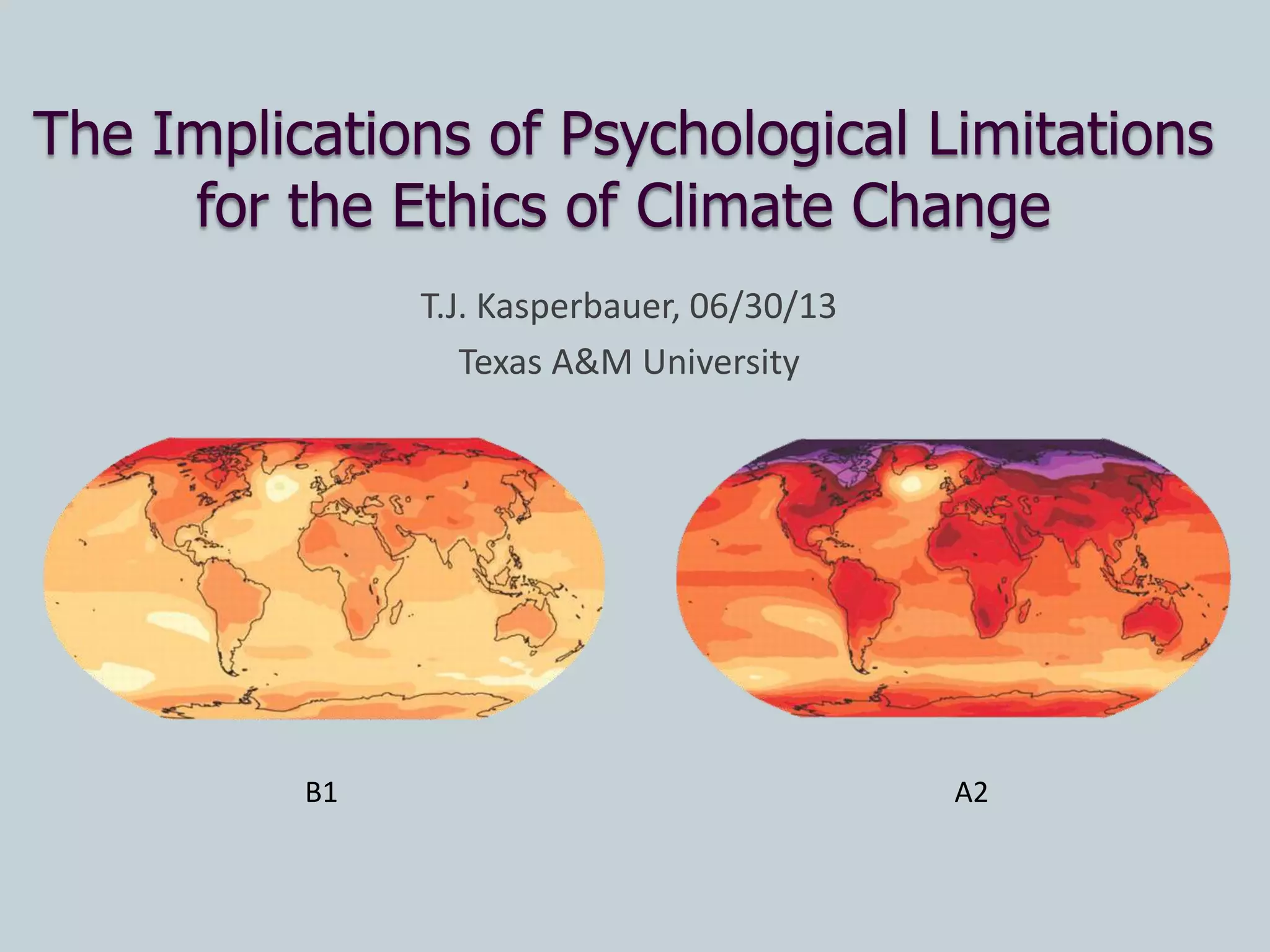
B1 A2
Grasping Problem
“our psychologies prevent us from
processing climate change as an
ethical issue in the right way.”
-Stephen Gardiner (2011)
Addressing the Grasping Problem
1) Justifying Reasons:
- “the underlying reason for moral complaint”
2) Motivating Reasons:
- “the underlying motive for action”
Addressing the Grasping Problem
1) Justifying Reasons:
- “the underlying reason for moral complaint”
2) Motivating Reasons:
- “the underlying motive for action”
Addressing the Grasping Problem
1) Justifying Reasons:
- “the underlying reason for moral complaint”
2) Motivating Reasons:
- “the underlying motive for action”
• How do people understand and process the relevant
justifying reasons?
• Should the barriers to proper motivation change our
ethical approach to climate change?
The Grasping Problem is More
Broadly Psychological
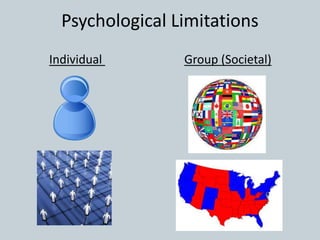
Psychological Limitations
Individual Group (Societal)
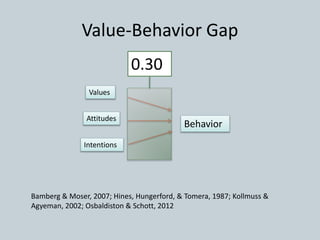
Value-Behavior Gap
Bamberg & Moser, 2007; Hines, Hungerford, & Tomera, 1987; Kollmuss &
Agyeman, 2002; Osbaldiston & Schott, 2012
Values
Attitudes
Intentions
Behavior
0.30
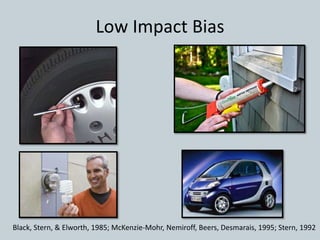
Low Impact Bias
Black, Stern, & Elworth, 1985; McKenzie-Mohr, Nemiroff, Beers, Desmarais, 1995; Stern, 1992
Single Action Bias
Weber, 2006
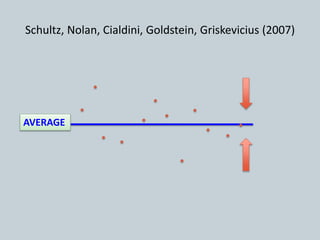
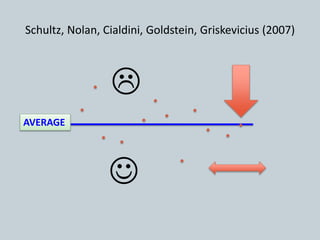
Conformity
Schultz, Nolan, Cialdini, Goldstein, Griskevicius (2007)

Schultz, Nolan, Cialdini, Goldstein, Griskevicius (2007)
AVERAGE
Schultz, Nolan, Cialdini, Goldstein, Griskevicius (2007)


AVERAGE
Summary of Individual Limitations
1) Knowledge and endorsement of proenvironment
values tend not to lead to behavior change.
2) Behaviors that are adopted are usually low impact
and short-lived.
3) Any changes that are made are likely to recidivate
unless the surrounding society approves of the
changes.
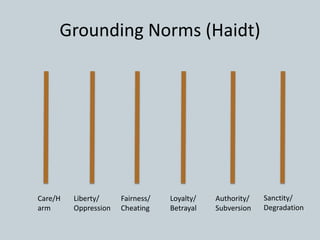
Grounding Norms (Haidt)
Care/H
arm
Liberty/
Oppression
Fairness/
Cheating
Loyalty/
Betrayal
Authority/
Subversion
Sanctity/
Degradation
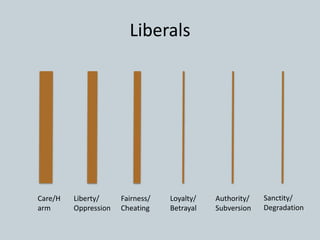
Liberals
Care/H
arm
Liberty/
Oppression
Fairness/
Cheating
Loyalty/
Betrayal
Authority/
Subversion
Sanctity/
Degradation
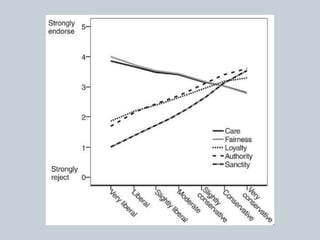
Grounding Norms and Climate Change
•People with egalitarian values tend to see global warming as a
risk while those with individualistic or hierarchical values do not
(Heath & Gifford, 2006; Leiserowitz, 2006).
•Hierarchical attitudes across a wide variety of countries predicts
generally negative views towards the environment (Kasser,
2011).
•Social dominance orientation and authoritarianism also predict
negative views towards the environment (Son Hing, Bobocel,
Zanna, & McBride, 2007).
•Conservatives score higher in “system justification,” which
predicts denial of climate change (Feygina, Jost, & Goldsmith,
2010).
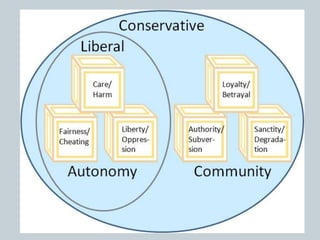
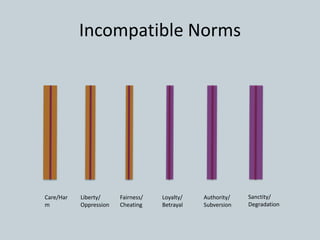
Incompatible Norms
Care/Har
m
Liberty/
Oppression
Fairness/
Cheating
Loyalty/
Betrayal
Authority/
Subversion
Sanctity/
Degradation
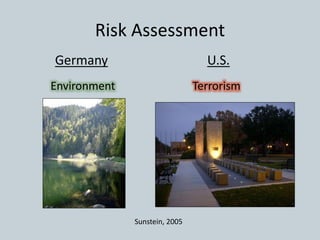
Risk Assessment
Germany U.S.
Sunstein, 2005
Environment Terrorism
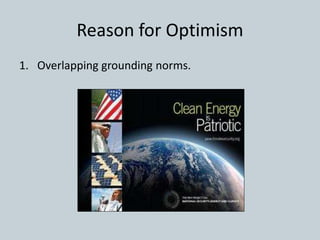
Reason for Optimism
1. Overlapping grounding norms.
Conclusions
1. Grasping problem is broadly psychological.
2. Focus on policy, not individual behaviors.
3. Policy will be limited by incompatible grounding
norms.

Climate Ethics and Psychology

Editor's Notes

  • #3 Gardiner and Jamieson. Distant in both space and time. Causal complexity Not individual agents
  • #4 JR: domestic issues, discount for the future, MR: know I should help distant people, but I just can’t get myself to do it--domestic issues
  • #10 The low impact bias refers to people’s tendency to adopt only low-impact proenvironmental behaviors
  • #11 The single action bias refers to the phenomenon whereby taking a single action causes a reduction in motivation to take further actions, even when it is acknowledged that these actions are necessary to reach a certain goal.
  • #14 Also mention like me bias
  • #15 The best predictors of energy use tend to be nonpsychological factors, such as household income, geographic location, and other sociodemographic factors (Abrahamse & Steg, 2009; Gatersleben, Steg, & Vlek, 2002; Hunecke, Haustein, Grischkat, & Böhler, 2007; Whitmarsh, 2009).
  • #17 2011. More than 130,000 participants.
  • #20 Leiserowitz: Ask people whether they agree with various mitigation and adaptation measures. Son Hing: Ask people whether they would be willing to pollute the environment to obtain profit for one’s company. SDO and A predict yes. Feygina: ask whether American society works, whether people get what they deserve. If yes, ppl more likely to deny that global warming is a threat.
  • #21 Incompatible norms will influence moral judgments even when there is overlap (e.g., what types of harm are most risky).