Naturalizing Sentimentalism for
Environmental Values
T.J. Kasperbauer, 7/23/15
Callicott (1985, 1986, 1987, 1992)
McShane (2007, 2011)
Sentimentalism for the Environment
1. Responses to the environment itself
• Pro- and anti-environmental attitudes
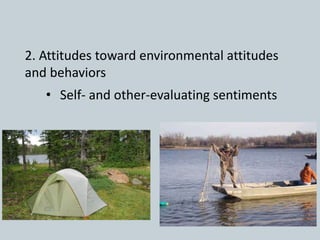
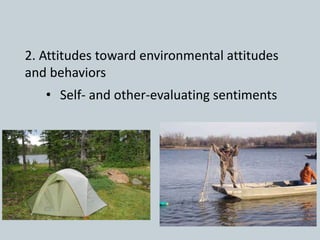
2. Attitudes toward environmental attitudes
and behaviors
• Self- and other-evaluating sentiments
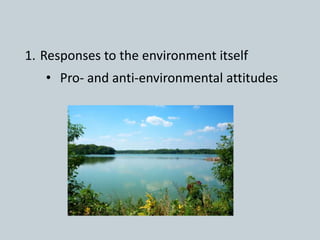
1. Responses to the environment itself
• Pro- and anti-environmental attitudes
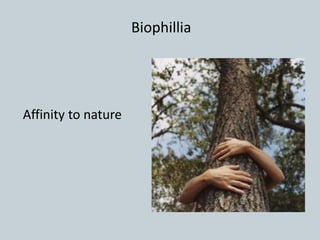
Affinity to nature
Biophillia
Problems:
• Not a discrete emotion
• Being attentive to nature more likely to
produce biophobia
Biophillia
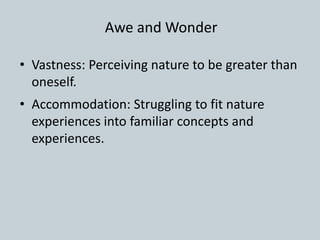
• Vastness: Perceiving nature to be greater than
oneself.
• Accommodation: Struggling to fit nature
experiences into familiar concepts and
experiences.
Awe and Wonder
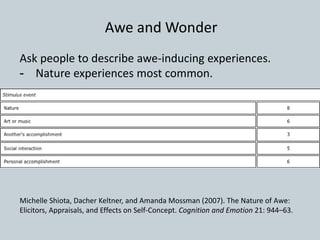
Ask people to describe awe-inducing experiences.
- Nature experiences most common.
Michelle Shiota, Dacher Keltner, and Amanda Mossman (2007). The Nature of Awe:
Elicitors, Appraisals, and Effects on Self-Concept. Cognition and Emotion 21: 944–63.
Awe and Wonder
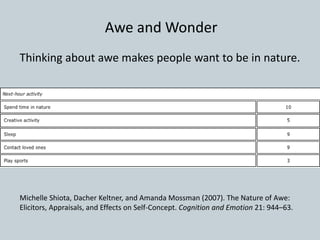
Thinking about awe makes people want to be in nature.
Michelle Shiota, Dacher Keltner, and Amanda Mossman (2007). The Nature of Awe:
Elicitors, Appraisals, and Effects on Self-Concept. Cognition and Emotion 21: 944–63.
Awe and Wonder
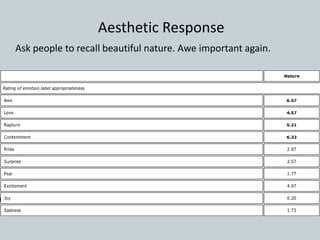
Ask people to recall beautiful nature. Awe important again.
Aesthetic Response
• Ask people to describe fearful events in nature.
• 40% included negative emotions and positive
emotions
• 19% of the events featured positive emotions
- E.g., happiness, curiosity, fascination
• Awe helps explain this.
- E.g., vastness
Agnes van den Berg and Marlien ter Heijne (2005). Fear Versus Fascination: An
Exploration of Emotional Responses to Natural Threats. Journal of Environmental
Psychology 25: 261–72.
Awe and Wonder
Biophobia
• Disgust
• Fear
Disgusted by Nature
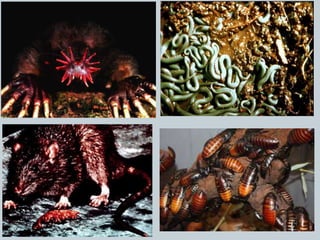
• Core disgust
Disgusted by Nature
• Core disgust
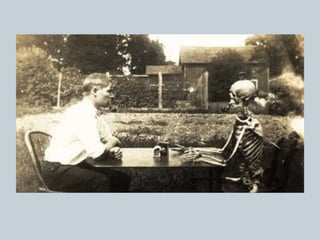
• Animal reminder (or mortality salience)
Mortality Salience
• Increased thoughts of death when in wild
nature compared to managed nature.
Sander Poole and Agnes Van den Berg, “Lost in the Wilderness,” Journal of
Personality and Social Psychology 88 (2005): 1013–28.
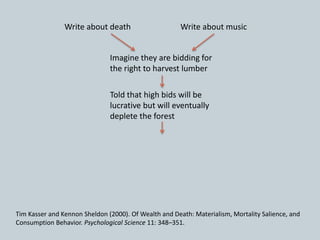
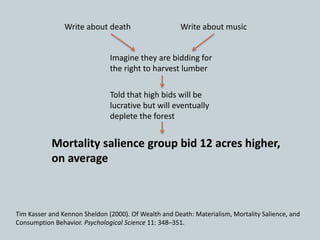
Write about death Write about music
Imagine they are bidding for
the right to harvest lumber
Told that high bids will be
lucrative but will eventually
deplete the forest
Tim Kasser and Kennon Sheldon (2000). Of Wealth and Death: Materialism, Mortality Salience, and
Consumption Behavior. Psychological Science 11: 348–351.
Write about death Write about music
Imagine they are bidding for
the right to harvest lumber
Told that high bids will be
lucrative but will eventually
deplete the forest
Mortality salience group bid 12 acres higher,
on average
Tim Kasser and Kennon Sheldon (2000). Of Wealth and Death: Materialism, Mortality Salience, and
Consumption Behavior. Psychological Science 11: 348–351.
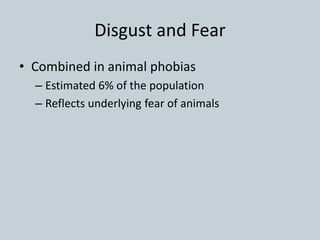
Disgust and Fear
• Combined in animal phobias
– Estimated 6% of the population
– Reflects underlying fear of animals
2. Attitudes toward environmental attitudes
and behaviors
• Self- and other-evaluating sentiments
Self-Evaluating Sentiments
• Shame
• Guilt
Guilt
• Feeling responsible for wrong-doing
Guilt and Climate Change
Mark Ferguson and Nyla Branscombe (2010). Collective Guilt Mediates the Effect of
Beliefs About Climate Change on Willingness to Engage in Mitigation Behavior. Journal
of Environmental Psychology 30: 135–42.
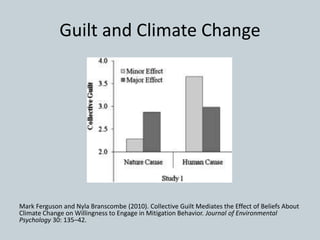
Guilt and Climate Change
Mark Ferguson and Nyla Branscombe (2010). Collective Guilt Mediates the Effect of Beliefs About
Climate Change on Willingness to Engage in Mitigation Behavior. Journal of Environmental
Psychology 30: 135–42.
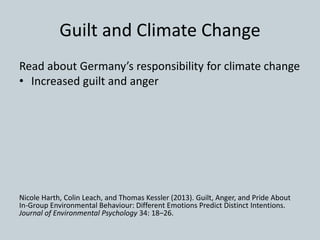
Guilt and Climate Change
Read about Germany’s responsibility for climate change
• Increased guilt and anger
Nicole Harth, Colin Leach, and Thomas Kessler (2013). Guilt, Anger, and Pride About
In-Group Environmental Behaviour: Different Emotions Predict Distinct Intentions.
Journal of Environmental Psychology 34: 18–26.
Guilt and Climate Change
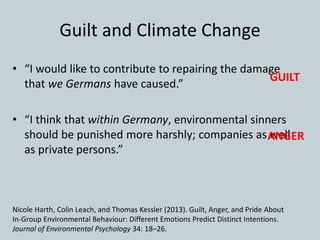
• “I would like to contribute to repairing the damage
that we Germans have caused.”
• “I think that within Germany, environmental sinners
should be punished more harshly; companies as well
as private persons.”
Nicole Harth, Colin Leach, and Thomas Kessler (2013). Guilt, Anger, and Pride About
In-Group Environmental Behaviour: Different Emotions Predict Distinct Intentions.
Journal of Environmental Psychology 34: 18–26.
GUILT
ANGER
Other-Evaluating Sentiments
• Contempt
• Anger
• Disgust
CAD
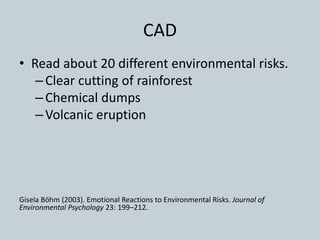
• Read about 20 different environmental risks.
–Clear cutting of rainforest
–Chemical dumps
–Volcanic eruption
Gisela Böhm (2003). Emotional Reactions to Environmental Risks. Journal of
Environmental Psychology 23: 199–212.
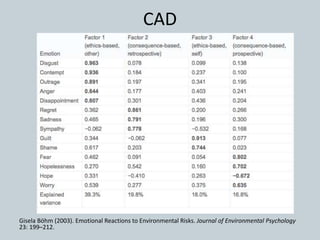
CAD
Gisela Böhm (2003). Emotional Reactions to Environmental Risks. Journal of Environmental Psychology
23: 199–212.
CAD
Contagion scale
• “It really bothers me when people sneeze
without covering their mouths.”
• “If land was owned in a single family for
generations, there would always be something
of their ancestors on that land, even after it
has changed ownership.”
Paul Rozin and Sharon Wolf (2008). Attachment to Land: The Case of the Land of Israel
for American and Israeli Jews and the Role of Contagion. Judgment and Decision
Making 3: 325–34.
CAD
Asked Americans and Israelis whether they
would trade valued land.
- “Is there any piece of land in Israel that you
would never be willing to trade under any
circumstance?”
Contagion sensitivity positively correlated with
land values.
1. Responses to the environment itself
• Pro- and anti-environmental attitudes
2. Attitudes toward environmental attitudes
and behaviors
• Self- and other-evaluating sentiments
Conclusions
• Environmental values are largely based in
emotions.
Conclusions
• Environmental values are largely based in
emotions.
• More speculative: a sentimentalist meta-ethic
could also serve normative aims.
– Improved diagnosis of the emotional basis for
proenvironmental behaviors will lead to improved
suggestions for producing action

Emotions and Environmental Values

  • 1.
    Naturalizing Sentimentalism for EnvironmentalValues T.J. Kasperbauer, 7/23/15
  • 3.
    Callicott (1985, 1986,1987, 1992) McShane (2007, 2011) Sentimentalism for the Environment
  • 4.
    1. Responses tothe environment itself • Pro- and anti-environmental attitudes
  • 5.
    2. Attitudes towardenvironmental attitudes and behaviors • Self- and other-evaluating sentiments
  • 6.
    1. Responses tothe environment itself • Pro- and anti-environmental attitudes
  • 7.
  • 8.
    Problems: • Not adiscrete emotion • Being attentive to nature more likely to produce biophobia Biophillia
  • 9.
    • Vastness: Perceivingnature to be greater than oneself. • Accommodation: Struggling to fit nature experiences into familiar concepts and experiences. Awe and Wonder
  • 11.
    Ask people todescribe awe-inducing experiences. - Nature experiences most common. Michelle Shiota, Dacher Keltner, and Amanda Mossman (2007). The Nature of Awe: Elicitors, Appraisals, and Effects on Self-Concept. Cognition and Emotion 21: 944–63. Awe and Wonder
  • 12.
    Thinking about awemakes people want to be in nature. Michelle Shiota, Dacher Keltner, and Amanda Mossman (2007). The Nature of Awe: Elicitors, Appraisals, and Effects on Self-Concept. Cognition and Emotion 21: 944–63. Awe and Wonder
  • 13.
    Ask people torecall beautiful nature. Awe important again. Aesthetic Response
  • 14.
    • Ask peopleto describe fearful events in nature. • 40% included negative emotions and positive emotions • 19% of the events featured positive emotions - E.g., happiness, curiosity, fascination • Awe helps explain this. - E.g., vastness Agnes van den Berg and Marlien ter Heijne (2005). Fear Versus Fascination: An Exploration of Emotional Responses to Natural Threats. Journal of Environmental Psychology 25: 261–72. Awe and Wonder
  • 15.
  • 16.
  • 18.
    Disgusted by Nature •Core disgust • Animal reminder (or mortality salience)
  • 20.
    Mortality Salience • Increasedthoughts of death when in wild nature compared to managed nature. Sander Poole and Agnes Van den Berg, “Lost in the Wilderness,” Journal of Personality and Social Psychology 88 (2005): 1013–28.
  • 21.
    Write about deathWrite about music Imagine they are bidding for the right to harvest lumber Told that high bids will be lucrative but will eventually deplete the forest Tim Kasser and Kennon Sheldon (2000). Of Wealth and Death: Materialism, Mortality Salience, and Consumption Behavior. Psychological Science 11: 348–351.
  • 22.
    Write about deathWrite about music Imagine they are bidding for the right to harvest lumber Told that high bids will be lucrative but will eventually deplete the forest Mortality salience group bid 12 acres higher, on average Tim Kasser and Kennon Sheldon (2000). Of Wealth and Death: Materialism, Mortality Salience, and Consumption Behavior. Psychological Science 11: 348–351.
  • 23.
    Disgust and Fear •Combined in animal phobias – Estimated 6% of the population – Reflects underlying fear of animals
  • 24.
    2. Attitudes towardenvironmental attitudes and behaviors • Self- and other-evaluating sentiments
  • 25.
  • 26.
  • 27.
    Guilt and ClimateChange Mark Ferguson and Nyla Branscombe (2010). Collective Guilt Mediates the Effect of Beliefs About Climate Change on Willingness to Engage in Mitigation Behavior. Journal of Environmental Psychology 30: 135–42.
  • 28.
    Guilt and ClimateChange Mark Ferguson and Nyla Branscombe (2010). Collective Guilt Mediates the Effect of Beliefs About Climate Change on Willingness to Engage in Mitigation Behavior. Journal of Environmental Psychology 30: 135–42.
  • 29.
    Guilt and ClimateChange Read about Germany’s responsibility for climate change • Increased guilt and anger Nicole Harth, Colin Leach, and Thomas Kessler (2013). Guilt, Anger, and Pride About In-Group Environmental Behaviour: Different Emotions Predict Distinct Intentions. Journal of Environmental Psychology 34: 18–26.
  • 30.
    Guilt and ClimateChange • “I would like to contribute to repairing the damage that we Germans have caused.” • “I think that within Germany, environmental sinners should be punished more harshly; companies as well as private persons.” Nicole Harth, Colin Leach, and Thomas Kessler (2013). Guilt, Anger, and Pride About In-Group Environmental Behaviour: Different Emotions Predict Distinct Intentions. Journal of Environmental Psychology 34: 18–26. GUILT ANGER
  • 31.
  • 32.
    CAD • Read about20 different environmental risks. –Clear cutting of rainforest –Chemical dumps –Volcanic eruption Gisela Böhm (2003). Emotional Reactions to Environmental Risks. Journal of Environmental Psychology 23: 199–212.
  • 33.
    CAD Gisela Böhm (2003).Emotional Reactions to Environmental Risks. Journal of Environmental Psychology 23: 199–212.
  • 34.
    CAD Contagion scale • “Itreally bothers me when people sneeze without covering their mouths.” • “If land was owned in a single family for generations, there would always be something of their ancestors on that land, even after it has changed ownership.” Paul Rozin and Sharon Wolf (2008). Attachment to Land: The Case of the Land of Israel for American and Israeli Jews and the Role of Contagion. Judgment and Decision Making 3: 325–34.
  • 35.
    CAD Asked Americans andIsraelis whether they would trade valued land. - “Is there any piece of land in Israel that you would never be willing to trade under any circumstance?” Contagion sensitivity positively correlated with land values.
  • 36.
    1. Responses tothe environment itself • Pro- and anti-environmental attitudes
  • 37.
    2. Attitudes towardenvironmental attitudes and behaviors • Self- and other-evaluating sentiments
  • 38.
    Conclusions • Environmental valuesare largely based in emotions.
  • 39.
    Conclusions • Environmental valuesare largely based in emotions. • More speculative: a sentimentalist meta-ethic could also serve normative aims. – Improved diagnosis of the emotional basis for proenvironmental behaviors will lead to improved suggestions for producing action

Editor's Notes

  • #15 Ask people from Netherlands to describe fearful events in nature (in their own country). Common themes Thunder, darkness, animals, water
  • #16  Interacts with fear and judgments of ugliness
  • #17  Interacts with fear and judgments of ugliness
  • #19  Interacts with fear and judgments of ugliness
  • #22 Kasser and Sheldon (2000) Interacts with fear and judgments of ugliness
  • #23 Kasser and Sheldon (2000) Interacts with fear and judgments of ugliness
  • #28 asked the extent to which they felt guilty (regretful, remorseful) that Americans today produce greenhouse gas emissions (by driving automobiles and consuming electricity). Responses were provided on scales ranging from 1 (not at all) to 5 (extremely). When people reported feeling guilt, they were sub- sequently more willing to reduce their personal greenhouse gas emissions.
  • #29 asked the extent to which they felt guilty (regretful, remorseful) that Americans today produce greenhouse gas emissions (by driving automobiles and consuming electricity). Responses were provided on scales ranging from 1 (not at all) to 5 (extremely). When people reported feeling guilt, they were sub- sequently more willing to reduce their personal greenhouse gas emissions.
  • #30 two items measured guilt (I feel guilty, I am regretful about Germans' environmental behaviour, r = .61. p < .001), two items measured anger (I am angry at Germans, I resent Germans' environmental behaviour, r = .28, p = .03)
  • #31 two items measured guilt (I feel guilty, I am regretful about Germans' environmental behaviour, r = .61. p < .001), two items measured anger (I am angry at Germans, I resent Germans' environmental behaviour, r = .28, p = .03)
  • #34 For each risk, participants indicated on 7-point rating scales, ranging from 1 (not at all) to 7 (very much), how intensely they felt each of the 14 specific emotions.
  • #39 (e.g., feeling guilt about one’s littering or failing to reduce one’s carbon emissions)
  • #40 (e.g., feeling guilt about one’s littering or failing to reduce one’s carbon emissions)