Dias 1
Explanatory Unification in
Consciousness Research
T.J. Kasperbauer, 6/11/2015
University of Copenhagen
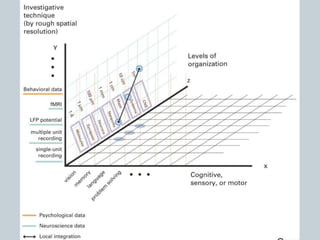
Explanatory Unification
Philip Kitcher (1981, 1989)
Account for more phenomena with increasingly
simple explanations
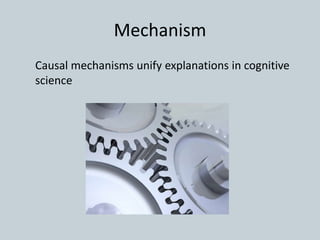
Mechanism
Causal mechanisms unify explanations in cognitive
science
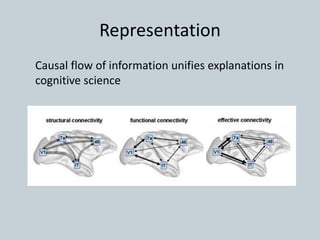
Representation
Causal flow of information unifies explanations in
cognitive science
Neural Synchrony
• Two or more neurons firing at the same
frequency
Solves Two Problems
1.Resolving competition between stimuli
2.Long-distance communication in the
brain
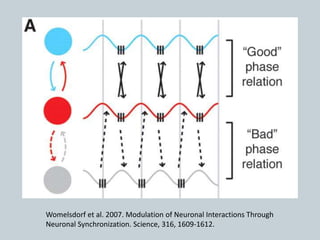
Womelsdorf et al. 2007. Modulation of Neuronal Interactions Through
Neuronal Synchronization. Science, 316, 1609-1612.
Neural Synchrony
Gray et al. (1989)
Singer (1999)
Fries (2005)
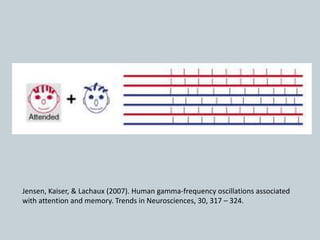
Jensen, Kaiser, & Lachaux (2007). Human gamma-frequency oscillations associated
with attention and memory. Trends in Neurosciences, 30, 317 – 324.
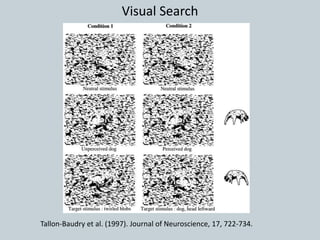
Visual Search
Tallon-Baudry et al. (1997). Journal of Neuroscience, 17, 722-734.
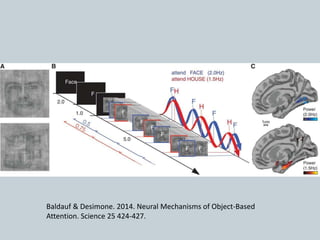
Baldauf & Desimone. 2014. Neural Mechanisms of Object-Based
Attention. Science 25 424-427.
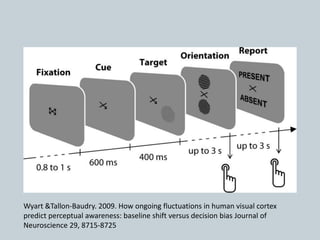
Wyart &Tallon-Baudry. 2009. How ongoing fluctuations in human visual cortex
predict perceptual awareness: baseline shift versus decision bias Journal of
Neuroscience 29, 8715-8725
Binocular Rivalry
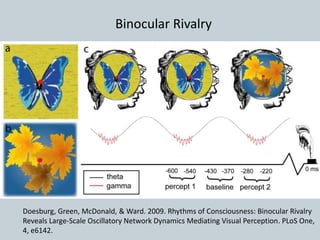
Doesburg, Green, McDonald, & Ward. 2009. Rhythms of Consciousness: Binocular Rivalry
Reveals Large-Scale Oscillatory Network Dynamics Mediating Visual Perception. PLoS One,
4, e6142.
Attentional Blink
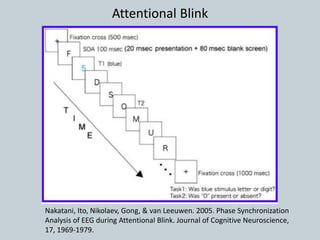
Nakatani, Ito, Nikolaev, Gong, & van Leeuwen. 2005. Phase Synchronization
Analysis of EEG during Attentional Blink. Journal of Cognitive Neuroscience,
17, 1969-1979.
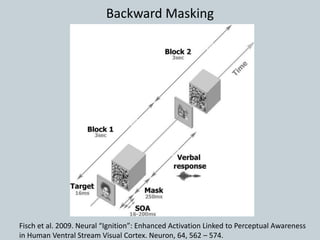
Fisch et al. 2009. Neural “Ignition”: Enhanced Activation Linked to Perceptual Awareness
in Human Ventral Stream Visual Cortex. Neuron, 64, 562 – 574.
Backward Masking
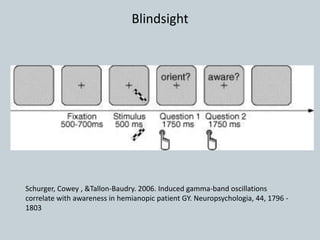
Schurger, Cowey , &Tallon-Baudry. 2006. Induced gamma-band oscillations
correlate with awareness in hemianopic patient GY. Neuropsychologia, 44, 1796 -
1803
Blindsight
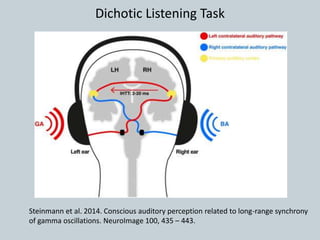
Steinmann et al. 2014. Conscious auditory perception related to long-range synchrony
of gamma oscillations. NeuroImage 100, 435 – 443.
Dichotic Listening Task
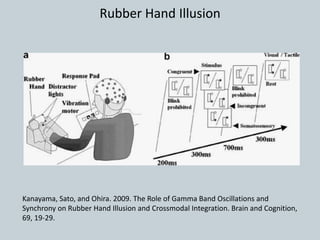
Kanayama, Sato, and Ohira. 2009. The Role of Gamma Band Oscillations and
Synchrony on Rubber Hand Illusion and Crossmodal Integration. Brain and Cognition,
69, 19-29.
Rubber Hand Illusion
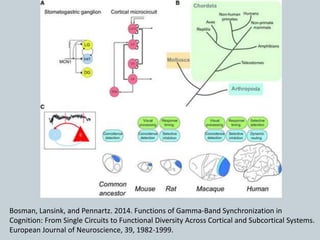
Bosman, Lansink, and Pennartz. 2014. Functions of Gamma-Band Synchronization in
Cognition: From Single Circuits to Functional Diversity Across Cortical and Subcortical Systems.
European Journal of Neuroscience, 39, 1982-1999.
Conclusions
• Mechanistic and representational explanations
likely to continue to unify in consciousness
research.
• Neural synchrony is one such mechanistic and
representational explanation.
• Neural synchrony, especially in the gamma range,
is currently a key unifier.
• This could change!

Consciousness Research and Explanations

  • 1.
    Dias 1 Explanatory Unificationin Consciousness Research T.J. Kasperbauer, 6/11/2015 University of Copenhagen
  • 3.
    Explanatory Unification Philip Kitcher(1981, 1989) Account for more phenomena with increasingly simple explanations
  • 4.
    Mechanism Causal mechanisms unifyexplanations in cognitive science
  • 5.
    Representation Causal flow ofinformation unifies explanations in cognitive science
  • 6.
    Neural Synchrony • Twoor more neurons firing at the same frequency Solves Two Problems 1.Resolving competition between stimuli 2.Long-distance communication in the brain
  • 7.
    Womelsdorf et al.2007. Modulation of Neuronal Interactions Through Neuronal Synchronization. Science, 316, 1609-1612.
  • 8.
    Neural Synchrony Gray etal. (1989) Singer (1999) Fries (2005)
  • 12.
    Jensen, Kaiser, &Lachaux (2007). Human gamma-frequency oscillations associated with attention and memory. Trends in Neurosciences, 30, 317 – 324.
  • 13.
    Visual Search Tallon-Baudry etal. (1997). Journal of Neuroscience, 17, 722-734.
  • 14.
    Baldauf & Desimone.2014. Neural Mechanisms of Object-Based Attention. Science 25 424-427.
  • 15.
    Wyart &Tallon-Baudry. 2009.How ongoing fluctuations in human visual cortex predict perceptual awareness: baseline shift versus decision bias Journal of Neuroscience 29, 8715-8725
  • 16.
    Binocular Rivalry Doesburg, Green,McDonald, & Ward. 2009. Rhythms of Consciousness: Binocular Rivalry Reveals Large-Scale Oscillatory Network Dynamics Mediating Visual Perception. PLoS One, 4, e6142.
  • 17.
    Attentional Blink Nakatani, Ito,Nikolaev, Gong, & van Leeuwen. 2005. Phase Synchronization Analysis of EEG during Attentional Blink. Journal of Cognitive Neuroscience, 17, 1969-1979.
  • 18.
    Fisch et al.2009. Neural “Ignition”: Enhanced Activation Linked to Perceptual Awareness in Human Ventral Stream Visual Cortex. Neuron, 64, 562 – 574. Backward Masking
  • 19.
    Schurger, Cowey ,&Tallon-Baudry. 2006. Induced gamma-band oscillations correlate with awareness in hemianopic patient GY. Neuropsychologia, 44, 1796 - 1803 Blindsight
  • 20.
    Steinmann et al.2014. Conscious auditory perception related to long-range synchrony of gamma oscillations. NeuroImage 100, 435 – 443. Dichotic Listening Task
  • 21.
    Kanayama, Sato, andOhira. 2009. The Role of Gamma Band Oscillations and Synchrony on Rubber Hand Illusion and Crossmodal Integration. Brain and Cognition, 69, 19-29. Rubber Hand Illusion
  • 22.
    Bosman, Lansink, andPennartz. 2014. Functions of Gamma-Band Synchronization in Cognition: From Single Circuits to Functional Diversity Across Cortical and Subcortical Systems. European Journal of Neuroscience, 39, 1982-1999.
  • 23.
    Conclusions • Mechanistic andrepresentational explanations likely to continue to unify in consciousness research. • Neural synchrony is one such mechanistic and representational explanation. • Neural synchrony, especially in the gamma range, is currently a key unifier. • This could change!
Editor's Notes

  • #5 knowing the mechanistic details of a certain psychological function allows us to predict how that function will operate in a wide variety of circumstances (e.g., when an organism utilizing that function is placed in ecologically abnormal situations). Knowing such details also enables the diagnosis of defects in a function, according to what is causing the problem structurally. Shared causal mechanisms could help explain how, on the Kitcherian account, apparently disparate phenomena can eventually come to be understood as quite similar.
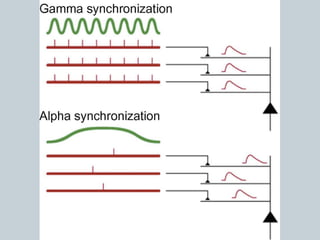
  • #8 Precise timing between rhythmic neuronal activities determines the strength of their mutual influence. (A) Sketch of three groups of neurons, each rhythmically active (LFP oscillations with spikes in troughs). Time windows for effective communication are either aligned (red and blue group) or not aligned (red and gray group).
  • #12 Jensen et al. 2007. Attention and gamma
  • #13 Specific tactile stimuli were presented simultaneously to both index fingers and subjects were asked to identify, and thereby attend to, stimuli on either the left or the right finger. Short-lasting stimuli were delivered every 1 s using a Braille device. Brain activity was recorded using a whole-head MEG system.
  • #14 The six stimuli used. In the first condition (left column), subjects were presented three types of stimuli: a neutral stimulus (meaningless blobs), an unperceived dog (Dalmatian, with its head to the right and tail to the left, unperceived as a dog because subjects were not instructed of its presence), and a target stimulus, made of meaningless twirled blobs. Before the beginning of the second recording session (Condition 2, right column), subjects were trained to perceive the Dalmatian with its head turned either to the right or to the left (the hidden outlines of the dogs are given on theright). In both conditions, the task of the subjects was to silently count the occurrences of the target stimulus.
  • #15 Baldauf & Desimone. 2015. Inferior frontal junction to FFA and PPA, depending on object
  • #16 Experimental design. Temporal structure of a trial, from left to right. After a variable fixation period of 0.8–1 s, participants were cued by a predictive central arrow to covertly attend either to their left or right lower visual field. After 600 ms, a low-contrast grating at detection threshold appeared for 400 ms either at the cued or uncued location, or occasionally did not appear at all. Participants first selected the orientation of the grating among two choices and then reported whether they believed a grating was presented during the trial, by pressing one of two buttons with their right hand.
  • #17 . gamma is correlated with conscious selection in binocular rivalry, where different images are shown to each eye. For example, a picture of a leaf might be shown to the left eye while a butterfly is shown to the right eye. Typically the images oscillate in consciousness during binocular rivalry, and in Doesburg et al.’s experiments gamma shifted immediately prior to subjective reports of the images’ shift in consciousness
  • #18 From Nakatani et al.’s research. Attentional blink task. Practice improves over time and is correlated with gamma.
  • #19  Figure 3 The Backward Masking Experiment Figure depicts the images and time sequence used in the Backward Masking experiment. In each trial, a face or object image (including a fixation spot), the “target,” was presented for 16 ms, followed by a fixation-...
  • #20 GY, the blindsight guy, reported on stimuli presented just at threshold of consciousness. Had to say orientation of a bar and whether he was aware of it. Gamma correlated with awareness but not accuracy. Alpha was not correlated. Fig. 1 Trial sequence. Each trial began with a fixation cross for a variable 500–700 ms interval, followed immediately by the appearance of the stimulus, always in the lower-right quadrant (GY's blind hemifield), for 500 ms. Stimuli were oriented random ch...
  • #21  Fig. 1 Schematic illustration of the dichotic listening procedure in which two different syllables are presented simultaneously: one to the right ear (BA) and one to the left ear (GA). Although both ears are connected anatomically via ipsilateral and contr... dichotic listening task. They exploited a widely observed phenomenon with this task, where people perceive what comes in the right ear and not the left. Because the brain is biased in this way, conscious perception of audio messages in the left ear require additional brain regions to be recruited. They thus hypothesized that the region of the brain that is responsible for cross-hemispheric communication would show increased gamma activity. That’s indeed what they found. WHen people reported hearing soudns in the left ear, aactivation in the gamma range was observed in the parts of the brain taht would be responsible.