Ethics and Risk Management
T.J. Kasperbauer
Department of Food and Resource Economics, KU
1
2
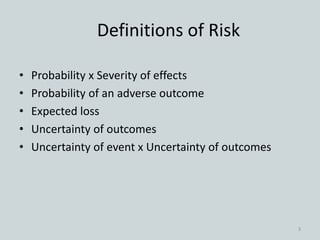
Definitions of Risk
• Probability x Severity of effects
• Probability of an adverse outcome
• Expected loss
• Uncertainty of outcomes
• Uncertainty of event x Uncertainty of outcomes
3
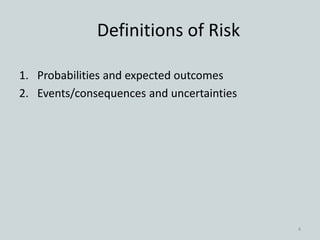
Definitions of Risk
1. Probabilities and expected outcomes
2. Events/consequences and uncertainties
4
Definition for Chemicals
• Hazard + Exposure
5
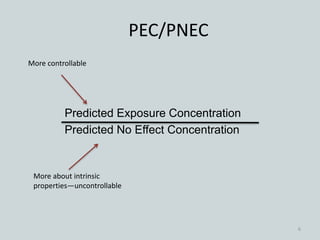
PEC/PNEC
Predicted Exposure Concentration
Predicted No Effect Concentration
6
More controllable
More about intrinsic
properties—uncontrollable
PEC/PNEC
• Risk manager can reduce PEC or increase
PNEC (or both).
• Reducing exposure usually the go-to.
7
Consequences and Principles
• Utilitarianism: main ethical tradition associated
with consequentialism
• Theories about rights and/or duties emphasize
principles
8
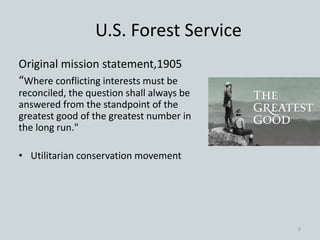
U.S. Forest Service
Original mission statement,1905
“Where conflicting interests must be
reconciled, the question shall always be
answered from the standpoint of the
greatest good of the greatest number in
the long run."
• Utilitarian conservation movement
9
• There are constraints on our actions – some
things we should never do (even if good
consequences would result overall)
• We don’t always have to maximize good
outcomes
Principles
10
Rights
• Often thought of as claims or entitlements against
others.
• Strong version: rights as “trumps”
– Overriding consideration
– Shouldn’t violate, even to bring about best consequences
11
Precautionary Principle
Regulation (EC) No. 1907/2006 (REACH):
“the need to do more to protect public health
and the environment in accordance with the
precautionary principle.”
12
13
Precautionary Principle
1992 Rio Declaration on Environment and
Development:
“where there are threats of serious or
irreversible environmental damage, lack of full
scientific certainty shall not be used as a reason
for postponing cost effective measures to
prevent degradation.”
14
Rio Definition
• This seems somewhat trivial.
• Who thinks full certainty is required?
15
Consolidated version of the treaty establishing
the European Community. Official Journal of the
European Commission:
“precaution means that regulatory actions may
be taken in situations where potentially
hazardous agents might induce harm to humans
or the environment, even if conclusive evidence
about the potential harmful effects is not (yet)
available”
EU Definition
16
• Seems irrational
• Potential harms? Potential hazards?
EU Definition
17
Precautionary Principle
European Commission communication on the
precautionary principle, 2 February 2000:
“The precautionary principle applies where
scientific evidence is insufficient, inconclusive or
uncertain and preliminary scientific evaluation
indicates that there are reasonable grounds for
concern that the potentially dangerous effects on
the environment, human, animal or plant health
may be inconsistent with the high level of
protection chosen by the EU.”
18
Precautionary Principle
• If there is evidence of harm, but the causal
mechanisms are unknown.
• If the causal mechanisms capable of producing
harm are known, but there is no evidence of
actual harm.
19
ALARP
• As Low as Reasonably Practicable
• Implement risk reduction measures unless it
can be demonstrated that the costs greatly
outweigh the benefits.
20
21
Exercise
• Discuss cases where the PP has been applied.
• What conception of the PP was used?
• Was it a good idea?
22
Deca-BDE
• Widely used flame retardant
• Bans in various countries
• Debate over importance of fire safety
• Not clear whether bans have increased fire
risks
23
Neonicotinoids
• Widely used insecticide
• Used as seed treatments, not sprayed
• Relatively safe for humans and other
vertebrates
• Dangerous for bees
• Question of lab studies applied to realistic
scenarios
• Question of studies included in analysis
24
Mercury
• Bad for human and nonhuman animals
• Consuming fish has health benefits
• Important to various cultures
25
Bisphenol A
• Some studies found adverse effects even at
lower levels (and EFSA-approved)
• Disputes over whether standard tests are
sufficiently sensitive.
• Has effects on mammary glands and nervous
system—often not part of standard tests.
• EFSA has dismissed most of these concerns.
26
Precautionary Principle
1. It is seen as anti-science – doesn’t wait for
evidence, and frequently acts against the
advice of scientists.
2. It is seen as having unintended side effects
(e.g., increasing other risks).
3. It is seen to be subject to political or
economic pressure.
4. It is seen to be driven by public fear and
outrage.
27
PP and Management
• Must still ask if prohibiting a product is
necessary for PP
• Also ask if it is proportional—who bears the
costs of precaution, and does that create
other risks
28
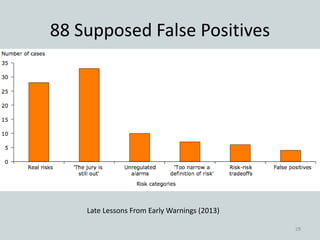
88 Supposed False Positives
29
Late Lessons From Early Warnings (2013)
False Positive
“scientific evidence must exist showing that a
perceived risk is actually non-existent and this
evidence must be generally accepted in the
scientific and regulatory communities.”
1. Southern corn leaf blight
2. Saccharin
3. Swine flu
4. Food irradiation
30

Ethics and risk management

  • 1.
    Ethics and RiskManagement T.J. Kasperbauer Department of Food and Resource Economics, KU 1
  • 2.
  • 3.
    Definitions of Risk •Probability x Severity of effects • Probability of an adverse outcome • Expected loss • Uncertainty of outcomes • Uncertainty of event x Uncertainty of outcomes 3
  • 4.
    Definitions of Risk 1.Probabilities and expected outcomes 2. Events/consequences and uncertainties 4
  • 5.
    Definition for Chemicals •Hazard + Exposure 5
  • 6.
    PEC/PNEC Predicted Exposure Concentration PredictedNo Effect Concentration 6 More controllable More about intrinsic properties—uncontrollable
  • 7.
    PEC/PNEC • Risk managercan reduce PEC or increase PNEC (or both). • Reducing exposure usually the go-to. 7
  • 8.
    Consequences and Principles •Utilitarianism: main ethical tradition associated with consequentialism • Theories about rights and/or duties emphasize principles 8
  • 9.
    U.S. Forest Service Originalmission statement,1905 “Where conflicting interests must be reconciled, the question shall always be answered from the standpoint of the greatest good of the greatest number in the long run." • Utilitarian conservation movement 9
  • 10.
    • There areconstraints on our actions – some things we should never do (even if good consequences would result overall) • We don’t always have to maximize good outcomes Principles 10
  • 11.
    Rights • Often thoughtof as claims or entitlements against others. • Strong version: rights as “trumps” – Overriding consideration – Shouldn’t violate, even to bring about best consequences 11
  • 12.
    Precautionary Principle Regulation (EC)No. 1907/2006 (REACH): “the need to do more to protect public health and the environment in accordance with the precautionary principle.” 12
  • 13.
  • 14.
    Precautionary Principle 1992 RioDeclaration on Environment and Development: “where there are threats of serious or irreversible environmental damage, lack of full scientific certainty shall not be used as a reason for postponing cost effective measures to prevent degradation.” 14
  • 15.
    Rio Definition • Thisseems somewhat trivial. • Who thinks full certainty is required? 15
  • 16.
    Consolidated version ofthe treaty establishing the European Community. Official Journal of the European Commission: “precaution means that regulatory actions may be taken in situations where potentially hazardous agents might induce harm to humans or the environment, even if conclusive evidence about the potential harmful effects is not (yet) available” EU Definition 16
  • 17.
    • Seems irrational •Potential harms? Potential hazards? EU Definition 17
  • 18.
    Precautionary Principle European Commissioncommunication on the precautionary principle, 2 February 2000: “The precautionary principle applies where scientific evidence is insufficient, inconclusive or uncertain and preliminary scientific evaluation indicates that there are reasonable grounds for concern that the potentially dangerous effects on the environment, human, animal or plant health may be inconsistent with the high level of protection chosen by the EU.” 18
  • 19.
    Precautionary Principle • Ifthere is evidence of harm, but the causal mechanisms are unknown. • If the causal mechanisms capable of producing harm are known, but there is no evidence of actual harm. 19
  • 20.
    ALARP • As Lowas Reasonably Practicable • Implement risk reduction measures unless it can be demonstrated that the costs greatly outweigh the benefits. 20
  • 21.
  • 22.
    Exercise • Discuss caseswhere the PP has been applied. • What conception of the PP was used? • Was it a good idea? 22
  • 23.
    Deca-BDE • Widely usedflame retardant • Bans in various countries • Debate over importance of fire safety • Not clear whether bans have increased fire risks 23
  • 24.
    Neonicotinoids • Widely usedinsecticide • Used as seed treatments, not sprayed • Relatively safe for humans and other vertebrates • Dangerous for bees • Question of lab studies applied to realistic scenarios • Question of studies included in analysis 24
  • 25.
    Mercury • Bad forhuman and nonhuman animals • Consuming fish has health benefits • Important to various cultures 25
  • 26.
    Bisphenol A • Somestudies found adverse effects even at lower levels (and EFSA-approved) • Disputes over whether standard tests are sufficiently sensitive. • Has effects on mammary glands and nervous system—often not part of standard tests. • EFSA has dismissed most of these concerns. 26
  • 27.
    Precautionary Principle 1. Itis seen as anti-science – doesn’t wait for evidence, and frequently acts against the advice of scientists. 2. It is seen as having unintended side effects (e.g., increasing other risks). 3. It is seen to be subject to political or economic pressure. 4. It is seen to be driven by public fear and outrage. 27
  • 28.
    PP and Management •Must still ask if prohibiting a product is necessary for PP • Also ask if it is proportional—who bears the costs of precaution, and does that create other risks 28
  • 29.
    88 Supposed FalsePositives 29 Late Lessons From Early Warnings (2013)
  • 30.
    False Positive “scientific evidencemust exist showing that a perceived risk is actually non-existent and this evidence must be generally accepted in the scientific and regulatory communities.” 1. Southern corn leaf blight 2. Saccharin 3. Swine flu 4. Food irradiation 30

Editor's Notes

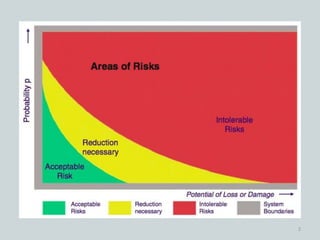
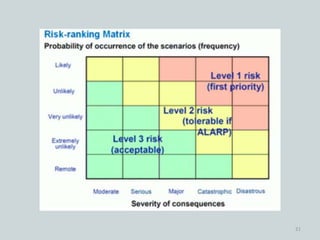
  • #3 Risk map. From Renn 2008 Risk Governance
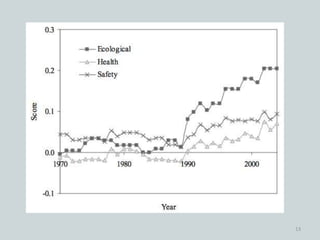
  • #13 Also in many other foundational EU documents Also really unclear: Article 69: “To ensure a sufficiently high level of protection for human health, including having regard to relevant human population groups and possibly to certain vulnerable sub-populations, and the environment, substances of very high concern should, in accordance with the precautionary principle, be subject to careful attention.”
  • #14 James K. Hammitt, Jonathan B. Wiener, Brendon Swedlow, Denise Kall, & Zheng Zhou, "Precautionary Regulation in Europe and the United States: A Quantitative Comparison," Risk Analysis 25: 1215-1228 (2005) Measured precaution by two components: earliness and stringency. The apparent trend is strongest for ecological risks, where the mean weighted score increased by 0.19 between 1970–1974 and 2000–2004. For health and safety risks, the corresponding changes are 0.07 and 0.05, respectively.
  • #15 4 dimensions: (1) the threat dimension, (2) the uncertainty dimension, (3) the action dimension, and (4) the command dimension
  • #17 Conclusive evidence is a lower standard ok. But potential harm? Potential hazards?
  • #18 Conclusive evidence is a lower standard ok. But potential harm? Potential hazards?
  • #19 Can also find uncertainty emphasized in Regulation (EC) No 178/2002 establishing the European Food Safety Authority and procedures in matters of food safety: Article 7: “In specific circumstances where, following an assessment of available information, the possibility of harmful effects on health is identified but scientific uncertainty persists, provisional risk management measures necessary to ensure the high level of health protection chosen in the Community may be adopted, pending further scientific information for a more comprehensive risk assessment.”
  • #20 Can also find uncertainty emphasized in Regulation (EC) No 178/2002 establishing the European Food Safety Authority and procedures in matters of food safety: Article 7: “In specific circumstances where, following an assessment of available information, the possibility of harmful effects on health is identified but scientific uncertainty persists, provisional risk management measures necessary to ensure the high level of health protection chosen in the Community may be adopted, pending further scientific information for a more comprehensive risk assessment.”
  • #21 Another precautionary method, but not exactly the PP
  • #22 while in most circumstances risk can be reduced, beyond some point further risk-reduction is increasingly costly to implement
  • #24 Mainly used in electronic appliances. Also furniture. Partly about risk-risk tradeoffs. Sure it’s risky, but is it more risky than what happens if you use other substances? 2012 UK submitted it as a substance of high concern, due to environmental effects
  • #25 Precautionary principle led to ban among some member states Problem is that alternative approaches are potentially even worse.
  • #27 Left out 800 studies in risk assessment because they did not meet certain guidelines. The FDA and EFSA relied exclusively on a handful of GLP multi-generational studies done in contract laboratories that assessed only reproduction, body and organ weights, clinical chemistry and organ histopathology using H&E staining. The same endpoints had been used for the past 50 years: before endocrine disruptors were known, before the developmental basis of disease and gene expression and epigenetics were known, and before low-dose and non-monotonic dose responses were known 2010 debate in Toxicological Sciences 2010 Denmark ban on BPA products for children. Questioned EFSA rulings.
  • #28 More about risk management then assessment, one might think. But it seems like something we should implement early in the process. Chlorination possible example of going against scientists advice
  • #30 Late Lessons From Early Warnings 2013 Real risk: acid rain Jury still out: cell phones