SB62 IPCC Side Event - Informing Climate Action: The science & cross-cutting topics of IPCC’s Seventh Assessment Report
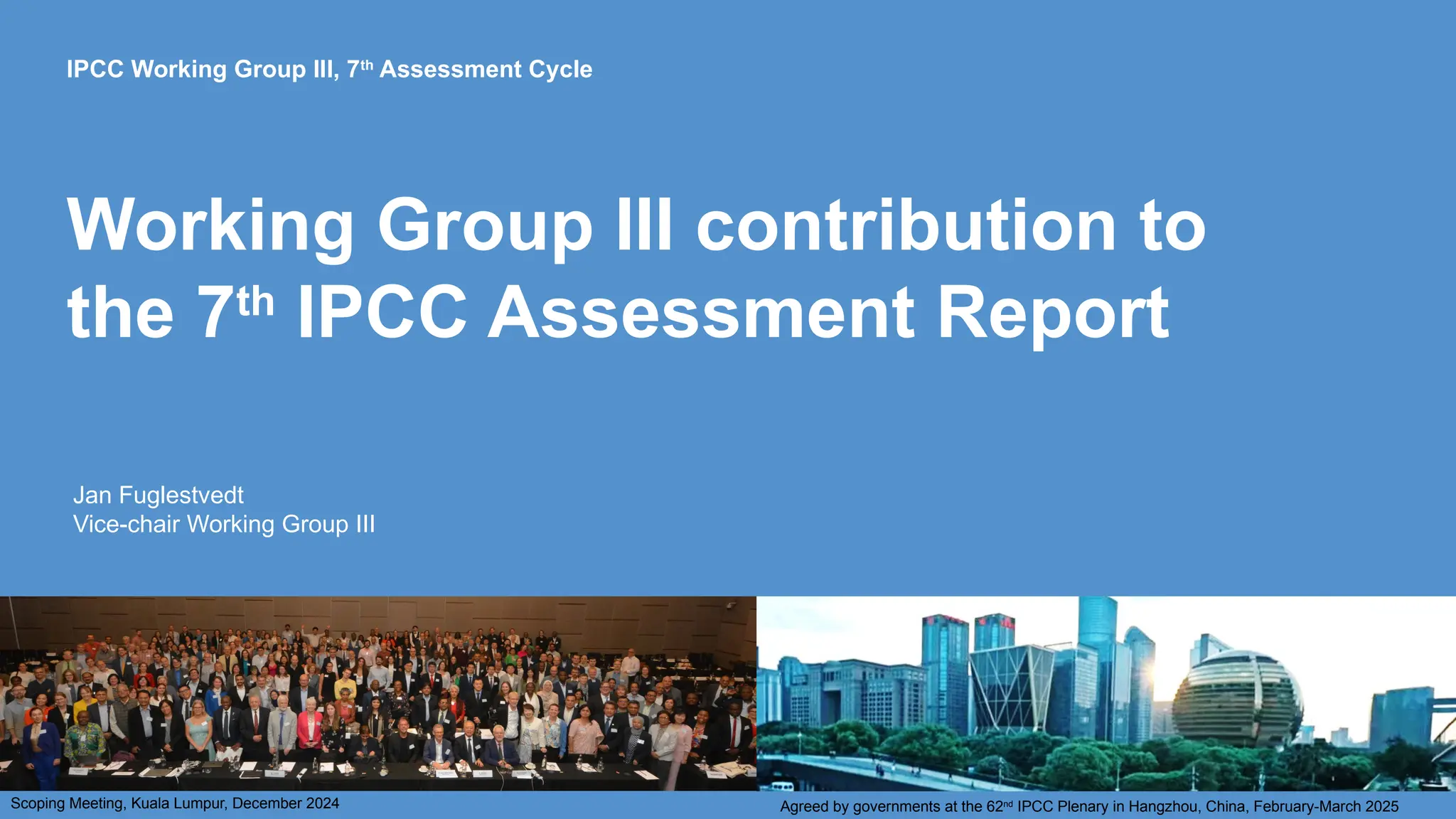
Working Group III contribution to the 7th IPCC Assessment Report
Jan Fuglestvedt
Vice-chair Working Group III
IPCC Working GroupIII, 7th
Assessment Cycle
Working Group III contribution to
the 7th
IPCC Assessment Report
Jan Fuglestvedt
Vice-chair Working Group III
Scoping Meeting, Kuala Lumpur, December 2024 Agreed by governments at the 62nd
IPCC Plenary in Hangzhou, China, February-March 2025
2.
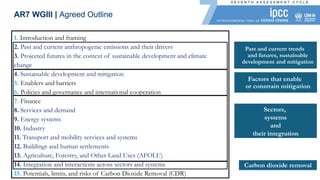
1. Introduction andframing
2. Past and current anthropogenic emissions and their drivers
3. Projected futures in the context of sustainable development and climate
change
4. Sustainable development and mitigation
5. Enablers and barriers
6. Policies and governance and international cooperation
7. Finance
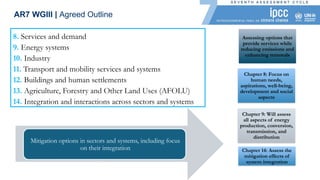
8. Services and demand
9. Energy systems
10. Industry
11. Transport and mobility services and systems
12. Buildings and human settlements
13. Agriculture, Forestry, and Other Land Uses (AFOLU)
14. Integration and interactions across sectors and systems
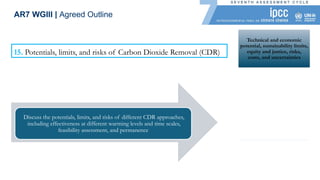
15. Potentials, limits, and risks of Carbon Dioxide Removal (CDR)
Past and current trends
and futures, sustainable
development and mitigation
Factors that enable
or constrain mitigation
Sectors, systems and
their integration
Carbon dioxide removal
Sectors,
systems
and
their integration
AR7 WGIII | Agreed Outline
3.
1. Introduction andframing
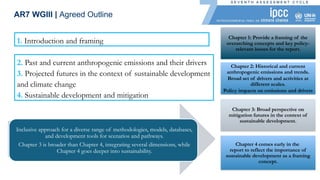
Inclusive approach for a diverse range of methodologies, models, databases,
and development tools for scenarios and pathways.
Chapter 3 is broader than Chapter 4, integrating several dimensions, while
Chapter 4 goes deeper into sustainability.
2. Past and current anthropogenic emissions and their drivers
3. Projected futures in the context of sustainable development
and climate change
4. Sustainable development and mitigation
AR7 WGIII | Agreed Outline
Chapter 2: Historical and current
anthropogenic emissions and trends.
Broad set of drivers and activities at
different scales.
Policy impacts on emissions and drivers
Chapter 1: Provide a framing of the
overarching concepts and key policy-
relevant issues for the report.
Chapter 3: Broad perspective on
mitigation futures in the context of
sustainable development.
Chapter 4 comes early in the
report to reflect the importance of
sustainable development as a framing
concept.
4.
5. Enablers andbarriers
6. Policies and governance and international cooperation
7. Finance
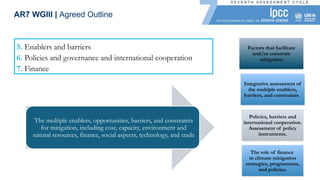
The multiple enablers, opportunities, barriers, and constraints
for mitigation, including cost, capacity, environment and
natural resources, finance, social aspects, technology, and trade
AR7 WGIII | Agreed Outline
Factors that facilitate
and/or constrain
mitigation
Integrative assessment of
the multiple enablers,
barriers, and constraints.
Policies, barriers and
international cooperation.
Assessment of policy
instruments.
The role of finance
in climate mitigation
strategies, programmes,
and policies.
5.
8. Services anddemand
9. Energy systems
10. Industry
11. Transport and mobility services and systems
12. Buildings and human settlements
13. Agriculture, Forestry and Other Land Uses (AFOLU)
14. Integration and interactions across sectors and systems
Assessing options that
provide services while
reducing emissions and
enhancing removals
Chapter 8: Focus on
human needs,
aspirations, well-being,
development and social
aspects
Chapter 9: Will assess
all aspects of energy
production, conversion,
transmission, and
distribution
Chapter 14: Assess the
mitigation effects of
system integration
Mitigation options in sectors and systems, including focus
on their integration
AR7 WGIII | Agreed Outline
6.
Technical and economic
potential,sustainability limits,
equity and justice, risks,
costs, and uncertainties
Explore the minimum levels
of residual emissions
achievable in different climate
development futures
Geophysical, environmental-
ecological, technological,
economic, institutional, and
sociocultural dimensions
Effectiveness of CDR
approaches before, during,
and after a period of
overshoot
15. Potentials, limits, and risks of Carbon Dioxide Removal (CDR)
Discuss the potentials, limits, and risks of different CDR approaches,
including effectiveness at different warming levels and time scales,
feasibility assessment, and permanence
AR7 WGIII | Agreed Outline
THANK YOU FOR
YOURATTENTION
STAY IN TOUCH STAY CONNECTED
ipcc-media@wmo.int
ipcc.ch
ipcc-sec@wmo.int
ipcc
@ipcc
ipcc
Editor's Notes
#3 Inclusive approach for the incorporation of and assessment of a diverse range of methodologies, models, databases, and development tools for scenarios and pathways.
#5 Mitigation options for services and demand, energy systems, industry, transport and mobility services and systems, buildings and human settlements, and AFOLU with a focus on sectors, systems, and their integration