Climate Change in Africa:
Findings from IPCC’s Sixth Assessment Report
Prof. Şiir KILKIŞ, IPCC AR7 WGIII Vice-Chair
The Scientific and Technological Research Council of
Türkiye (TÜBİTAK) Ankara, Türkiye
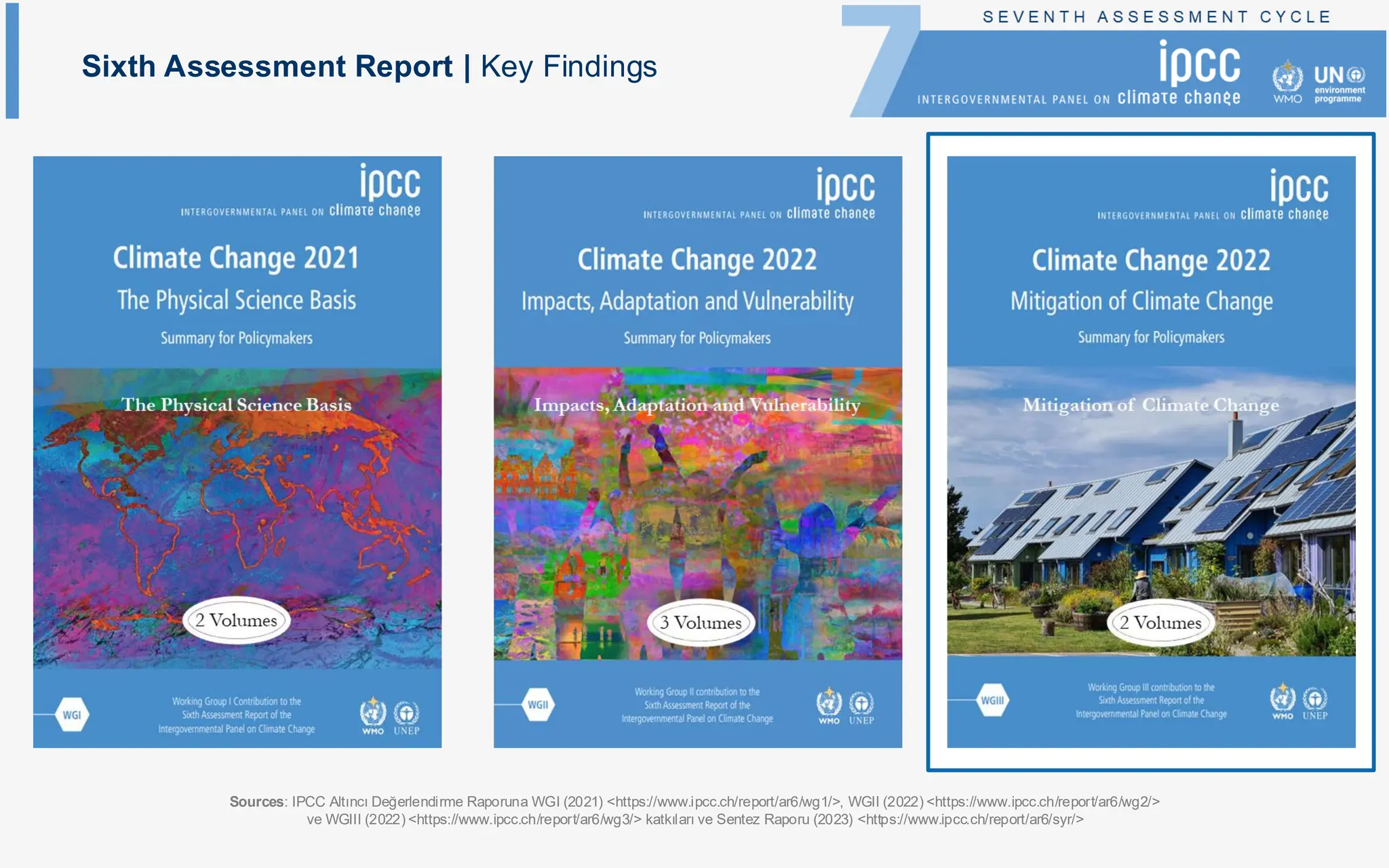
Sixth Assessment Report | Key Findings
Sources: IPCC Altıncı Değerlendirme Raporuna WGI (2021) <https://www.ipcc.ch/report/ar6/wg1/>, WGII (2022) <https://www.ipcc.ch/report/ar6/wg2/>
ve WGIII (2022) <https://www.ipcc.ch/report/ar6/wg3/> katkıları ve Sentez Raporu (2023) <https://www.ipcc.ch/report/ar6/syr/>
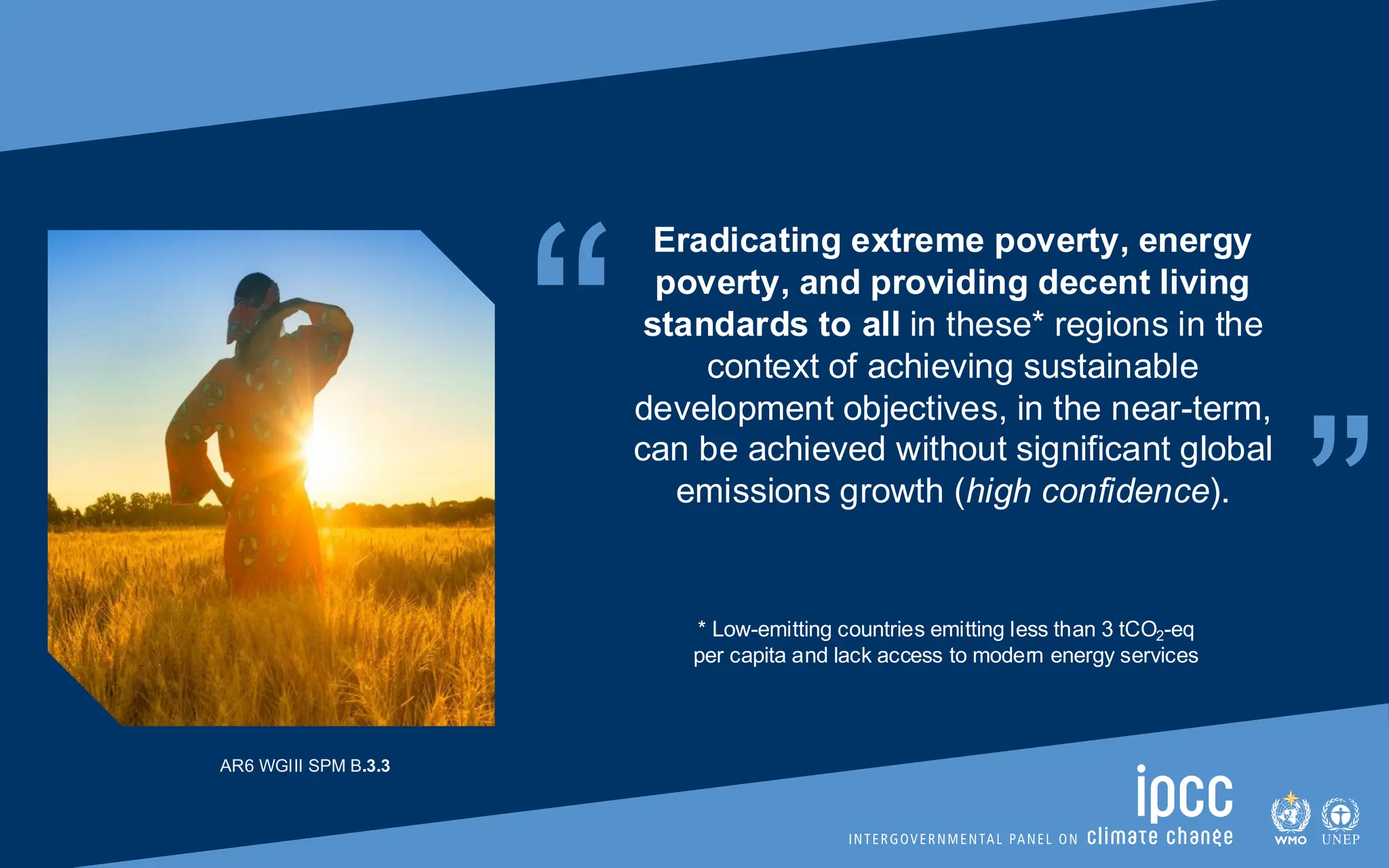
“ “
Eradicating extreme poverty, energy
poverty, and providing decent living
standards to all in these* regions in the
context of achieving sustainable
development objectives, in the near-term,
can be achieved without significant global
emissions growth (high confidence).
AR6 WGIII SPM B.3.3
* Low-emitting countries emitting less than 3 tCO2-eq
per capita and lack access to modern energy services
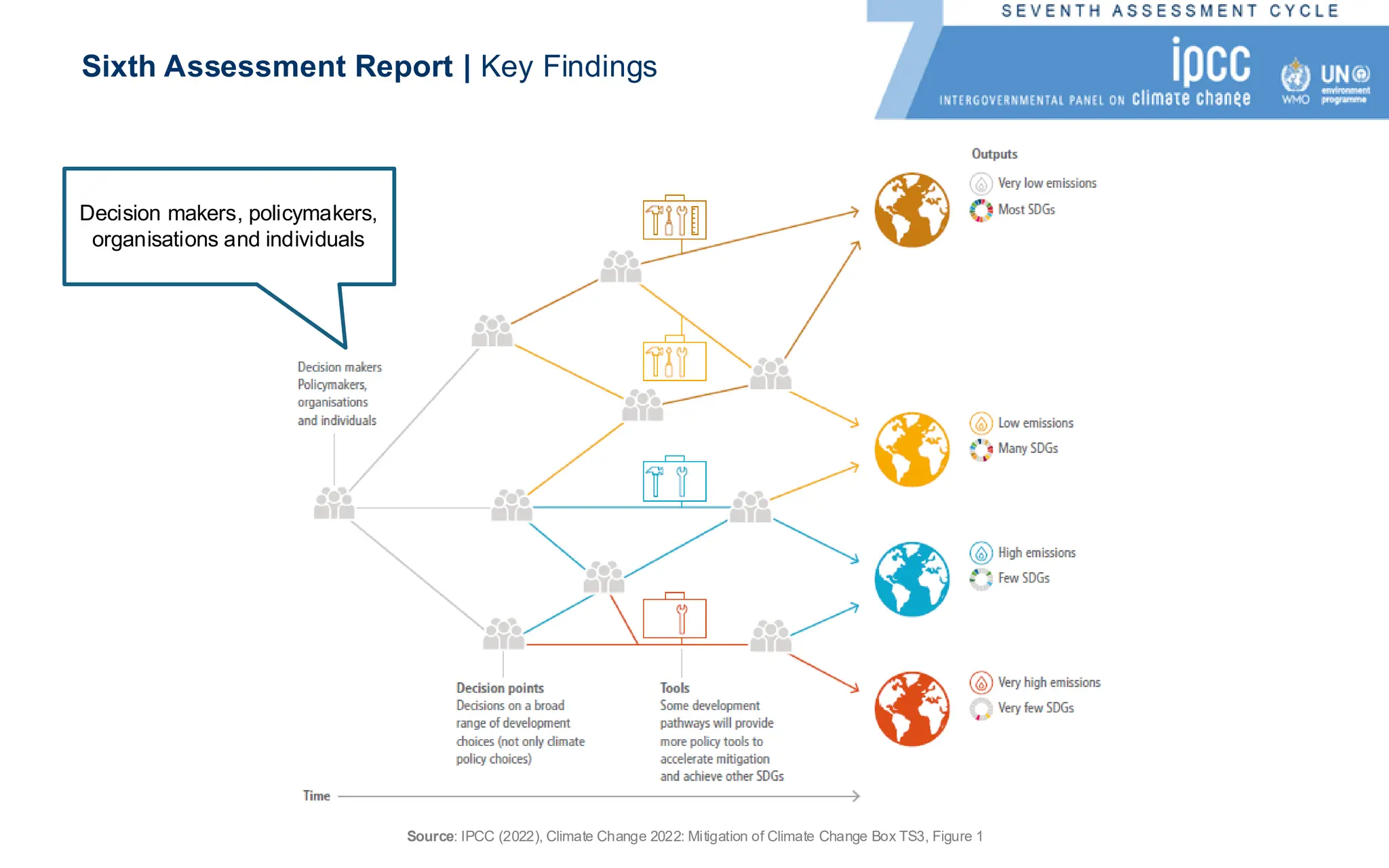
Source: IPCC (2022), Climate Change 2022: Mitigation of Climate Change Box TS3, Figure 1
Sixth Assessment Report | Key Findings
Decision makers, policymakers,
organisations and individuals
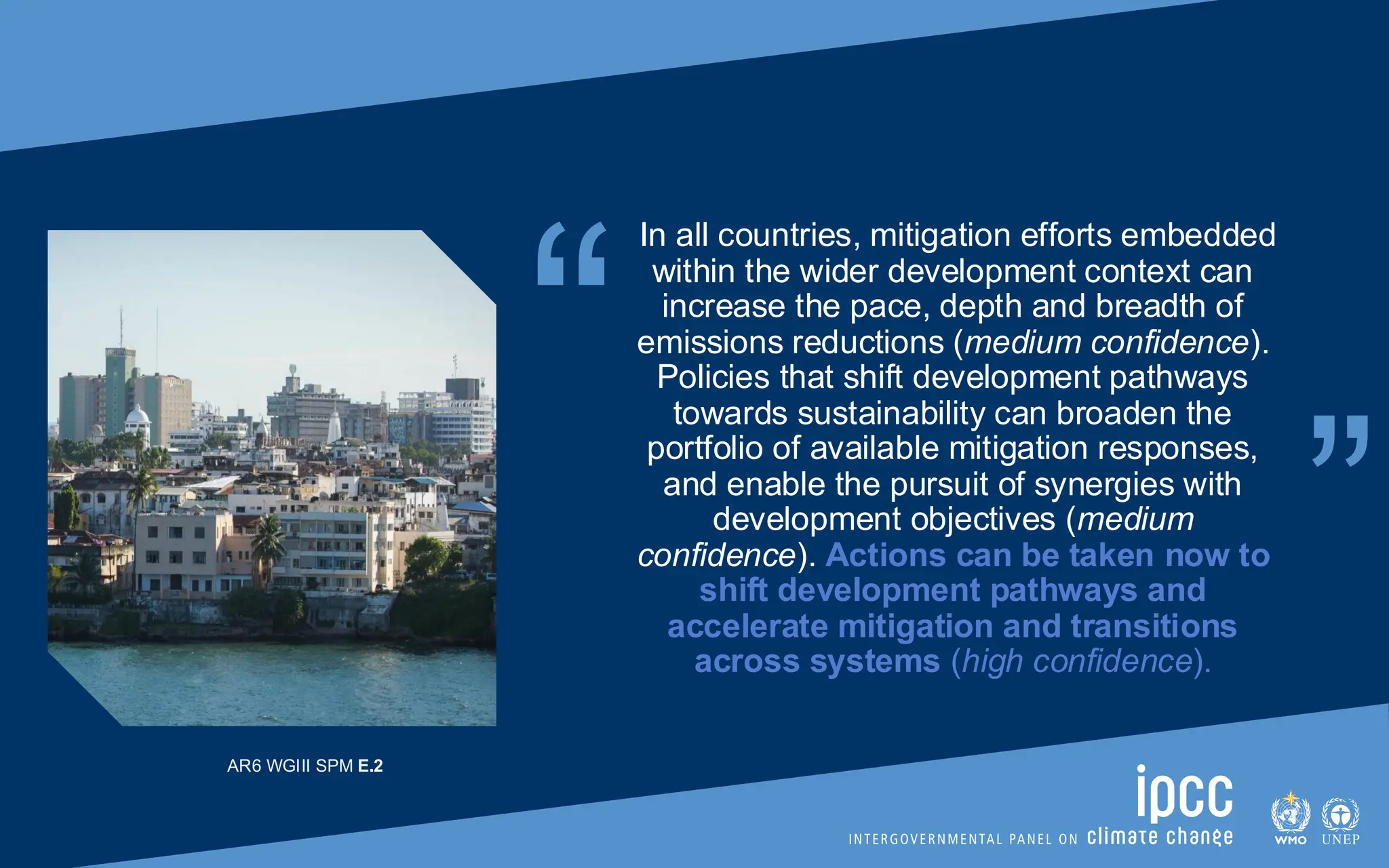
“ “
In all countries, mitigation efforts embedded
within the wider development context can
increase the pace, depth and breadth of
emissions reductions (medium confidence).
Policies that shift development pathways
towards sustainability can broaden the
portfolio of available mitigation responses,
and enable the pursuit of synergies with
development objectives (medium
confidence). Actions can be taken now to
shift development pathways and
accelerate mitigation and transitions
across systems (high confidence).
AR6 WGIII SPM E.2
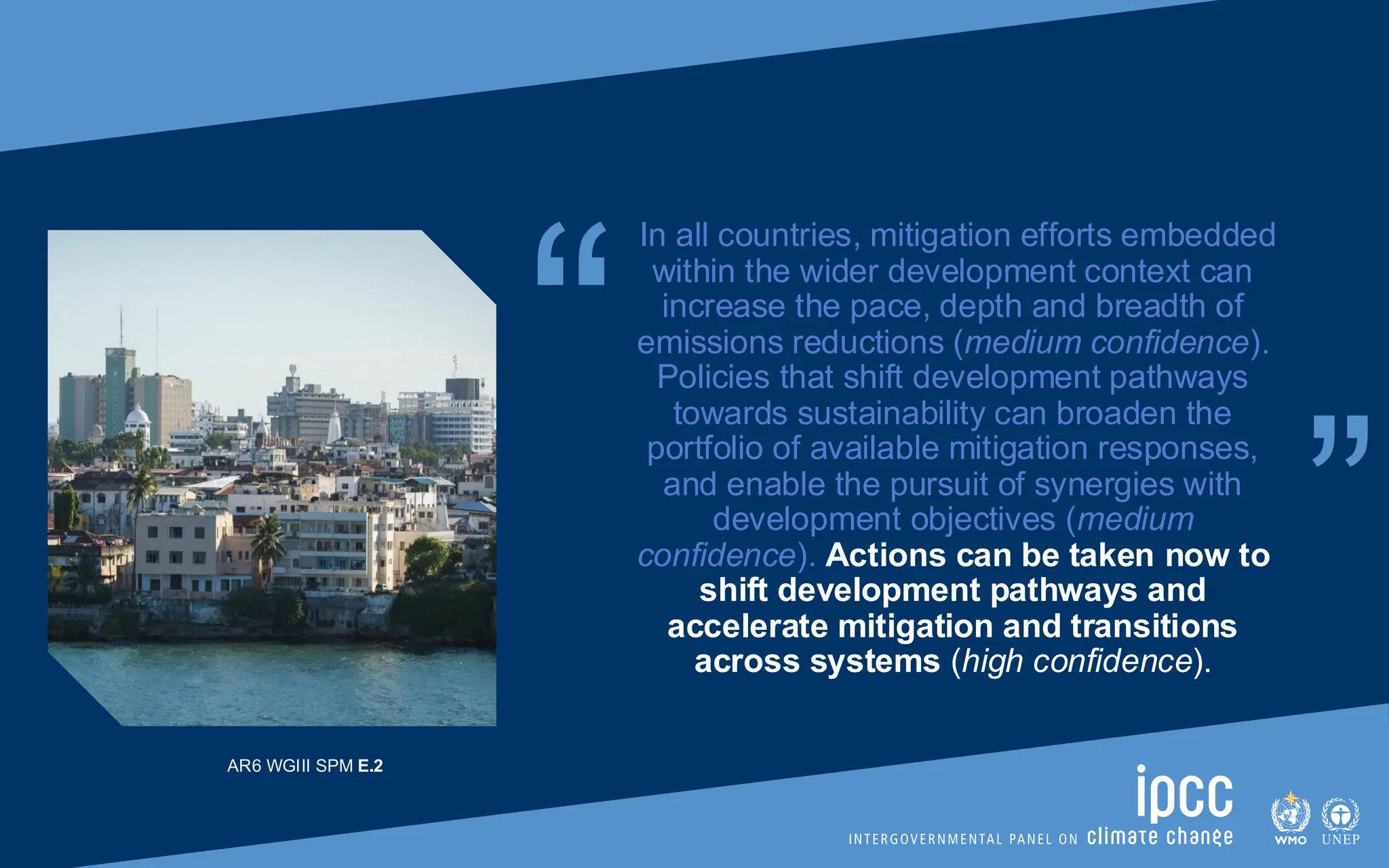
“ “
In all countries, mitigation efforts embedded
within the wider development context can
increase the pace, depth and breadth of
emissions reductions (medium confidence).
Policies that shift development pathways
towards sustainability can broaden the
portfolio of available mitigation responses,
and enable the pursuit of synergies with
development objectives (medium
confidence). Actions can be taken now to
shift development pathways and
accelerate mitigation and transitions
across systems (high confidence).
AR6 WGIII SPM E.2
Sixth Assessment Report | Key Findings
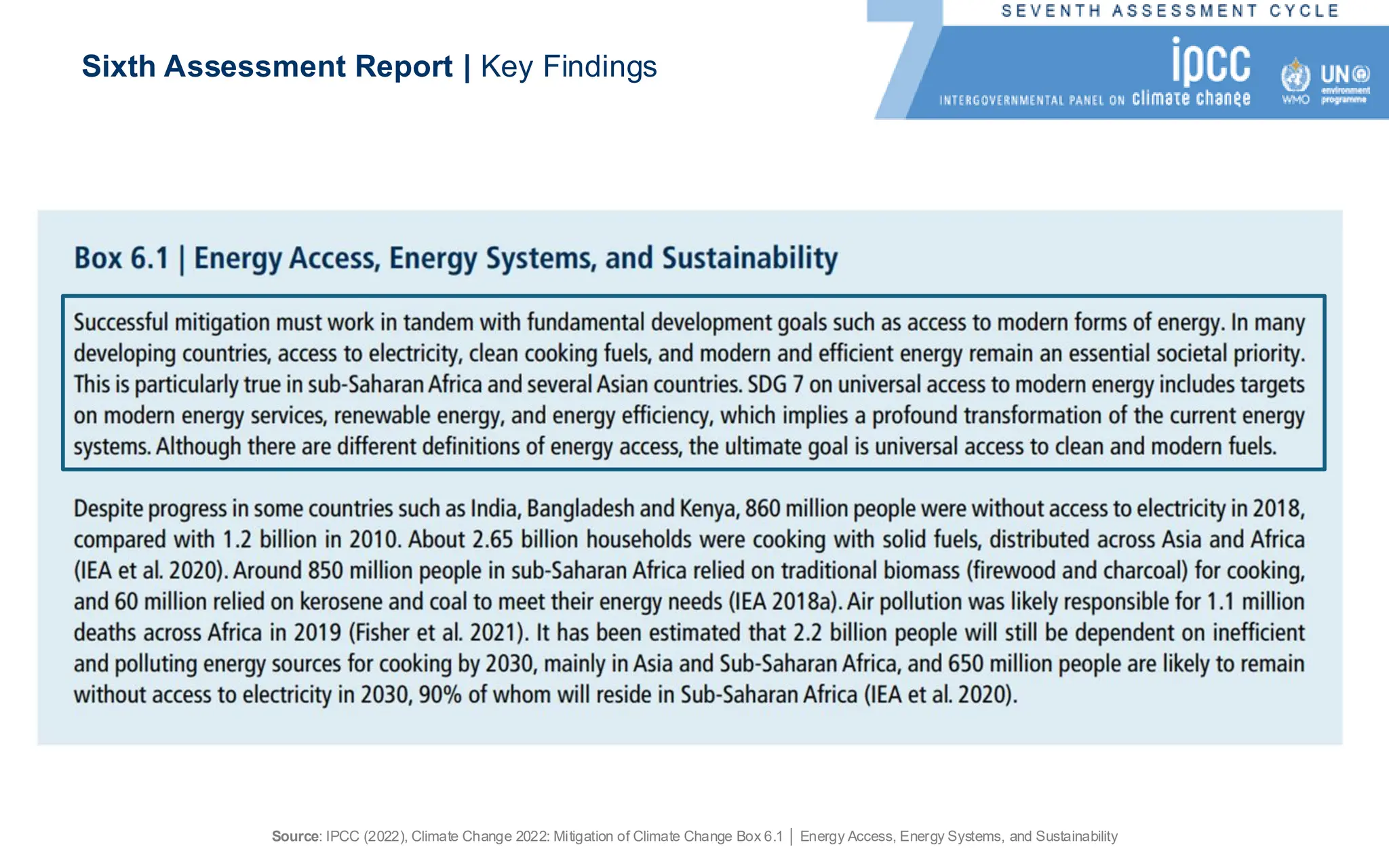
Source: IPCC (2022), Climate Change 2022: Mitigation of Climate Change Box 6.1 │ Energy Access, Energy Systems, and Sustainability
“ “
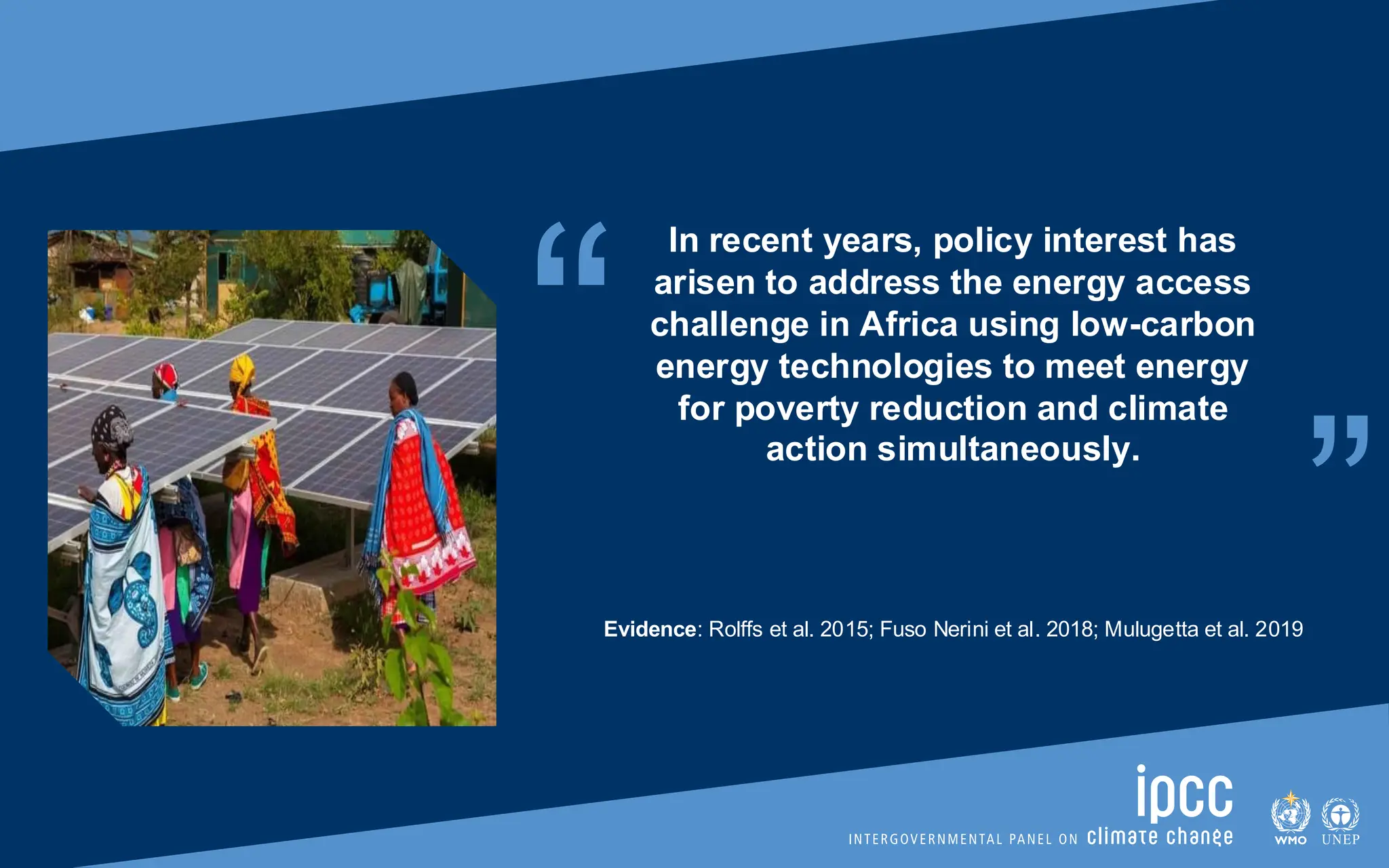
In recent years, policy interest has
arisen to address the energy access
challenge in Africa using low-carbon
energy technologies to meet energy
for poverty reduction and climate
action simultaneously.
Evidence: Rolffs et al. 2015; Fuso Nerini et al. 2018; Mulugetta et al. 2019
Sixth Assessment Report | Key Findings
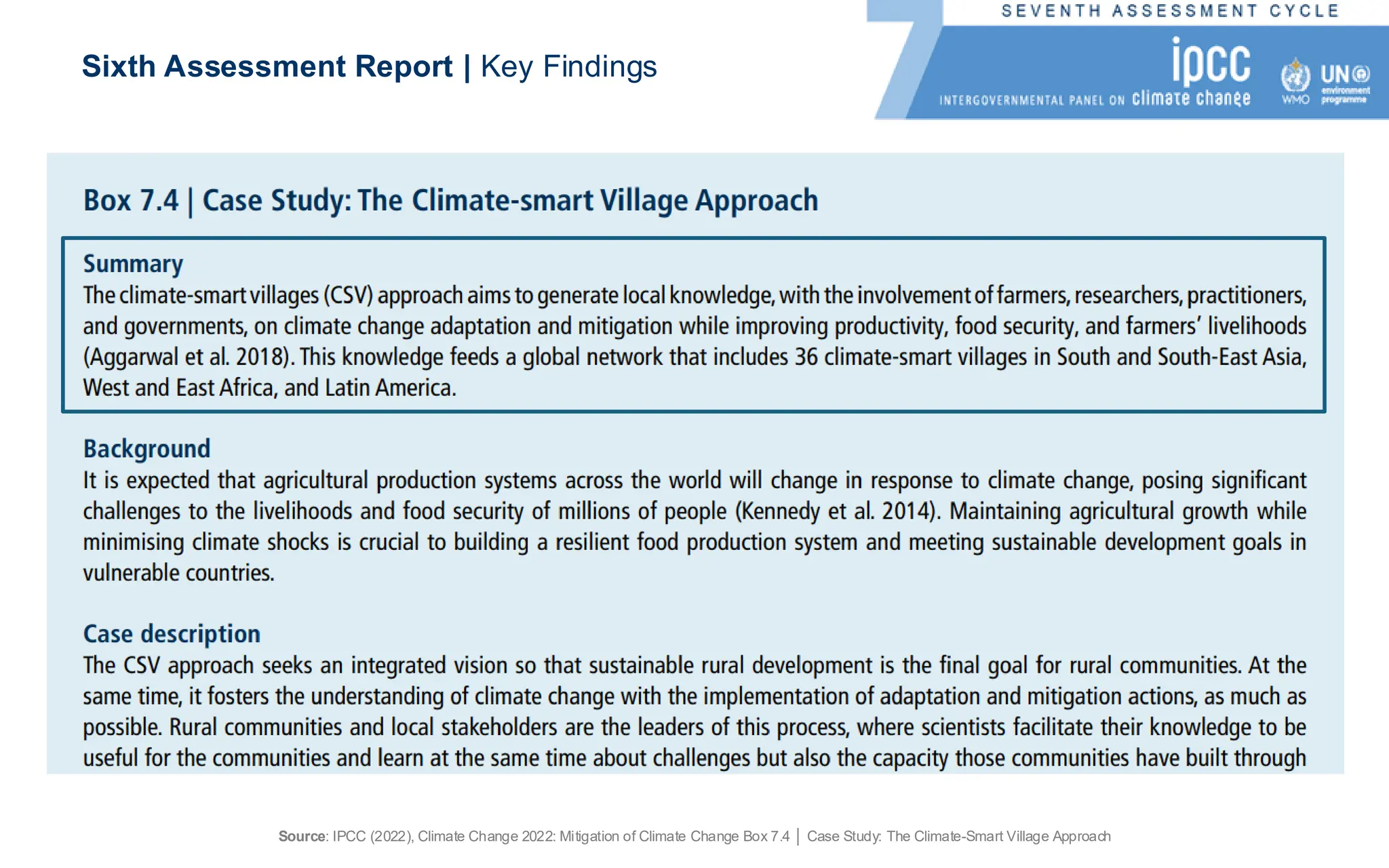
Source: IPCC (2022), Climate Change 2022: Mitigation of Climate Change Box 7.4 │ Case Study: The Climate-Smart Village Approach
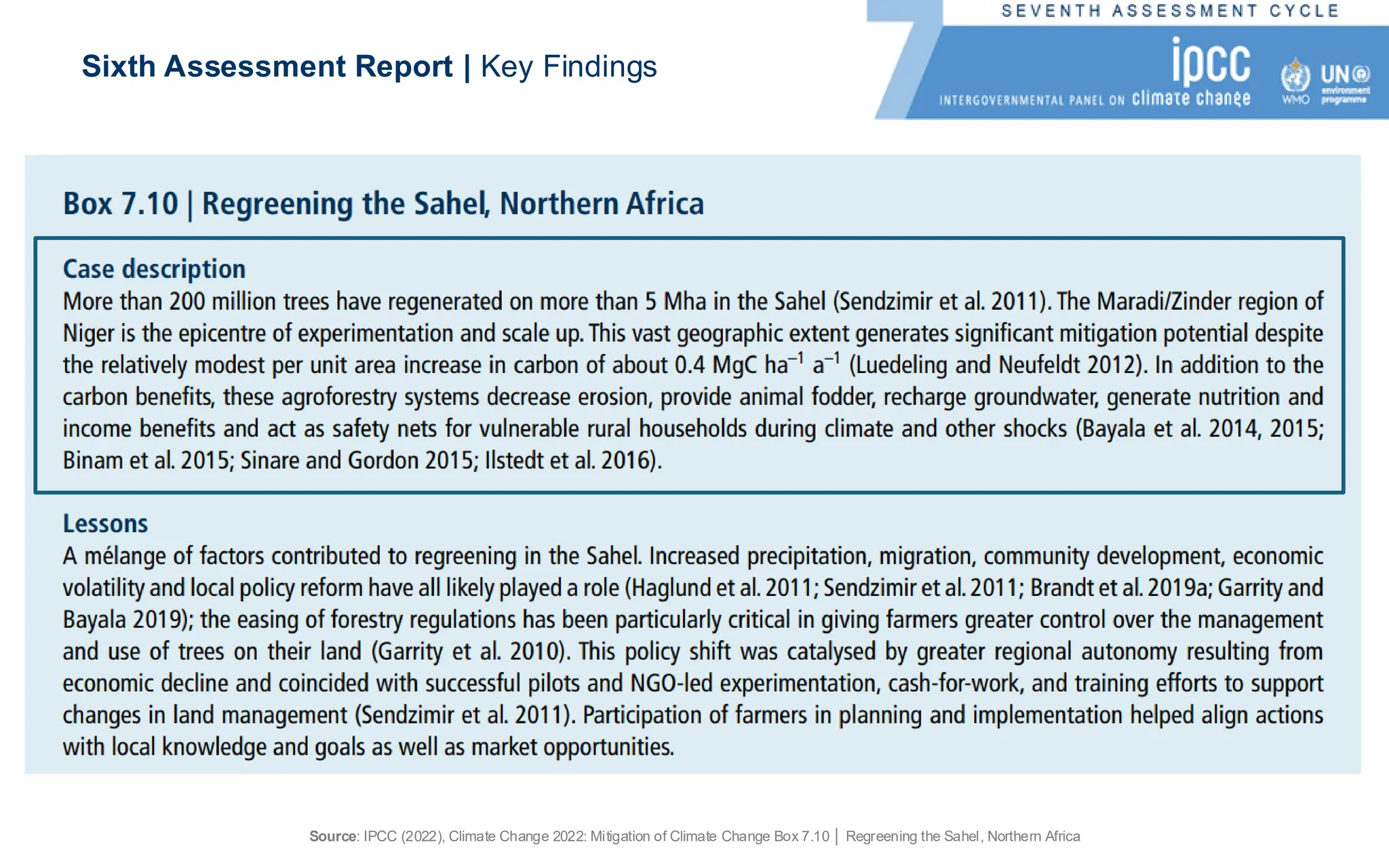
Source: IPCC (2022), Climate Change 2022: Mitigation of Climate Change Box 7.10 │ Regreening the Sahel, Northern Africa
Sixth Assessment Report | Key Findings
Source: IPCC (2022), Climate Change 2022: Mitigation of Climate Change Box 7.13 │ Case Study: Climate-Smart Cocoa Production in Ghana
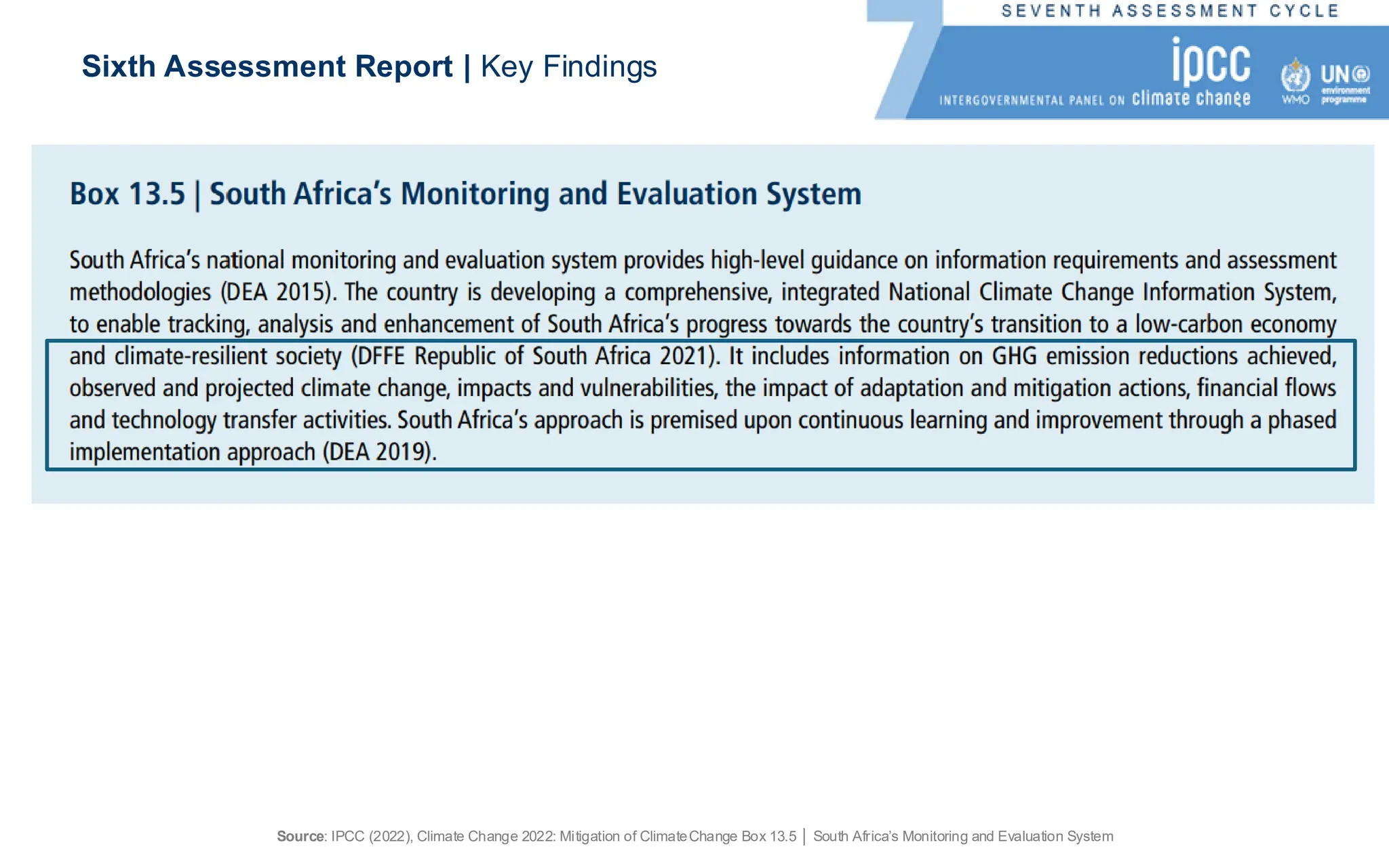
Source: IPCC (2022), Climate Change 2022: Mitigation of ClimateChange Box 13.5 │ South Africa’s Monitoring and Evaluation System
Sixth Assessment Report | Key Findings
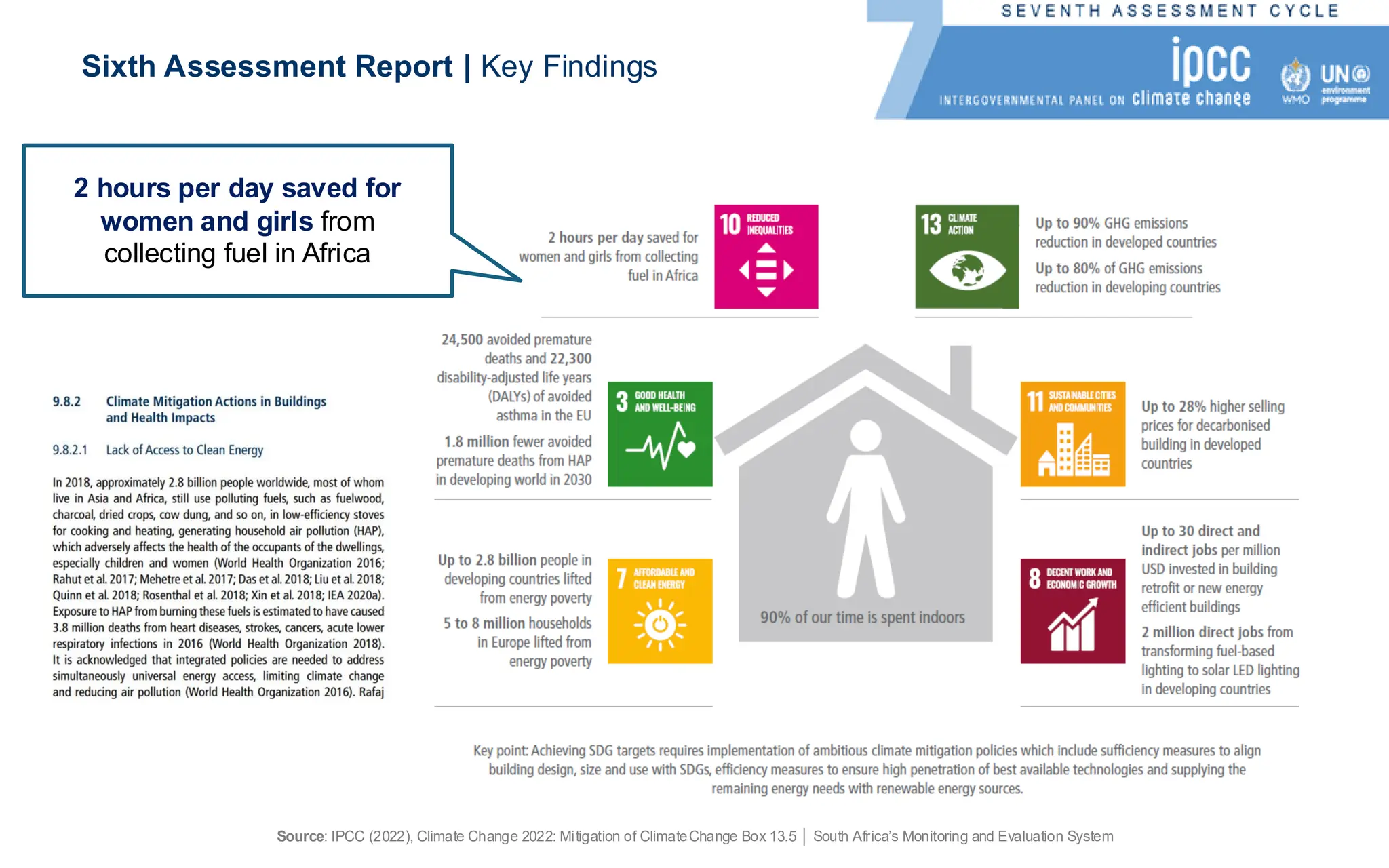
2 hours per day saved for
women and girls from
collecting fuel in Africa
Sixth Assessment Report | Key Findings
Source: IPCC (2022), Climate Change 2022: Mitigation of ClimateChange Box 13.5 │ South Africa’s Monitoring and Evaluation System
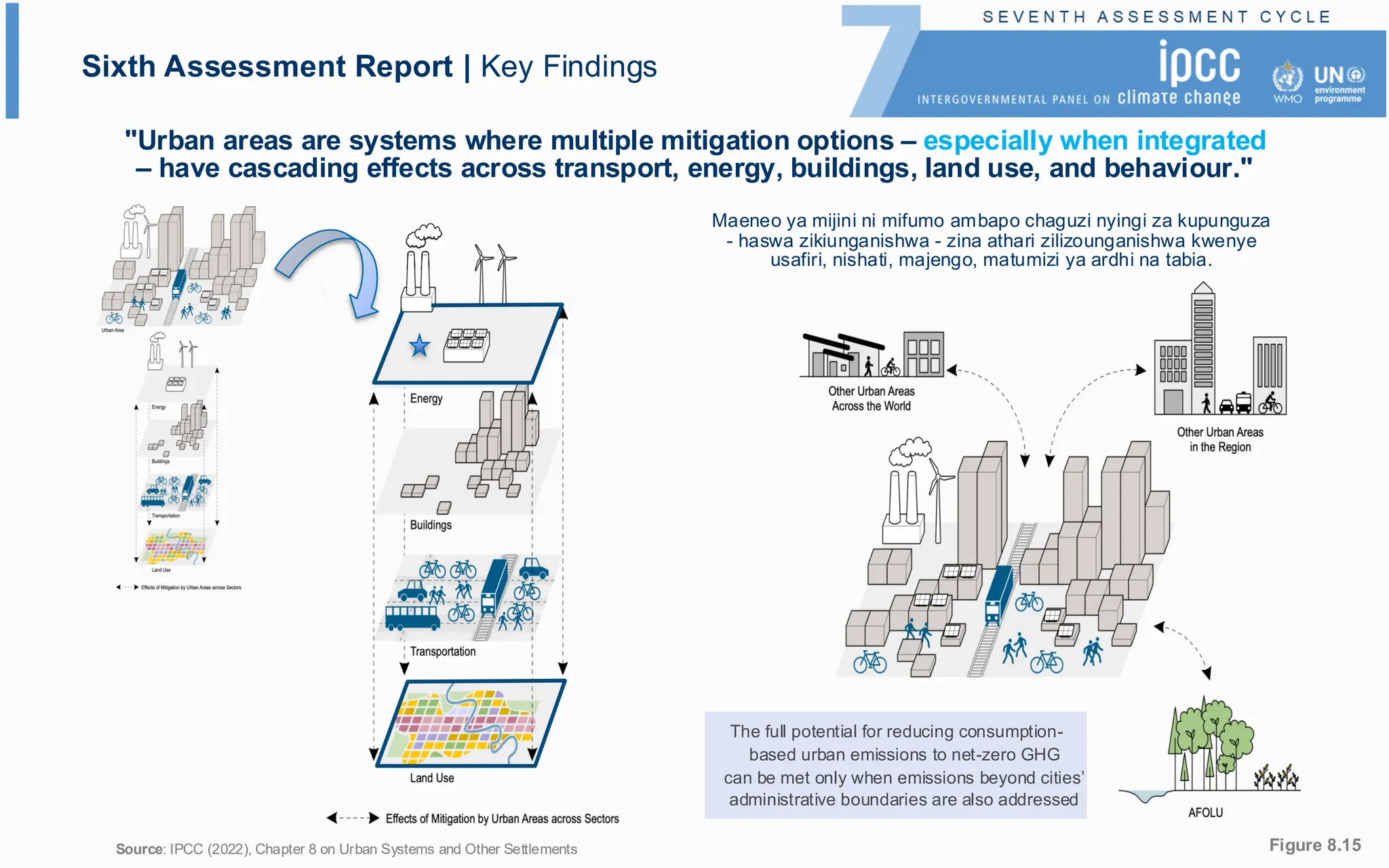
"Urban areas are systems where multiple mitigation options – especially when integrated
– have cascading effects across transport, energy, buildings, land use, and behaviour."
The full potential for reducing consumption-
based urban emissions to net-zero GHG
can be met only when emissions beyond cities’
administrative boundaries are also addressed
Source: IPCC (2022), Chapter 8 on Urban Systems and Other Settlements
Maeneo ya mijini ni mifumo ambapo chaguzi nyingi za kupunguza
- haswa zikiunganishwa - zina athari zilizounganishwa kwenye
usafiri, nishati, majengo, matumizi ya ardhi na tabia.
Figure 8.15
Sixth Assessment Report | Key Findings
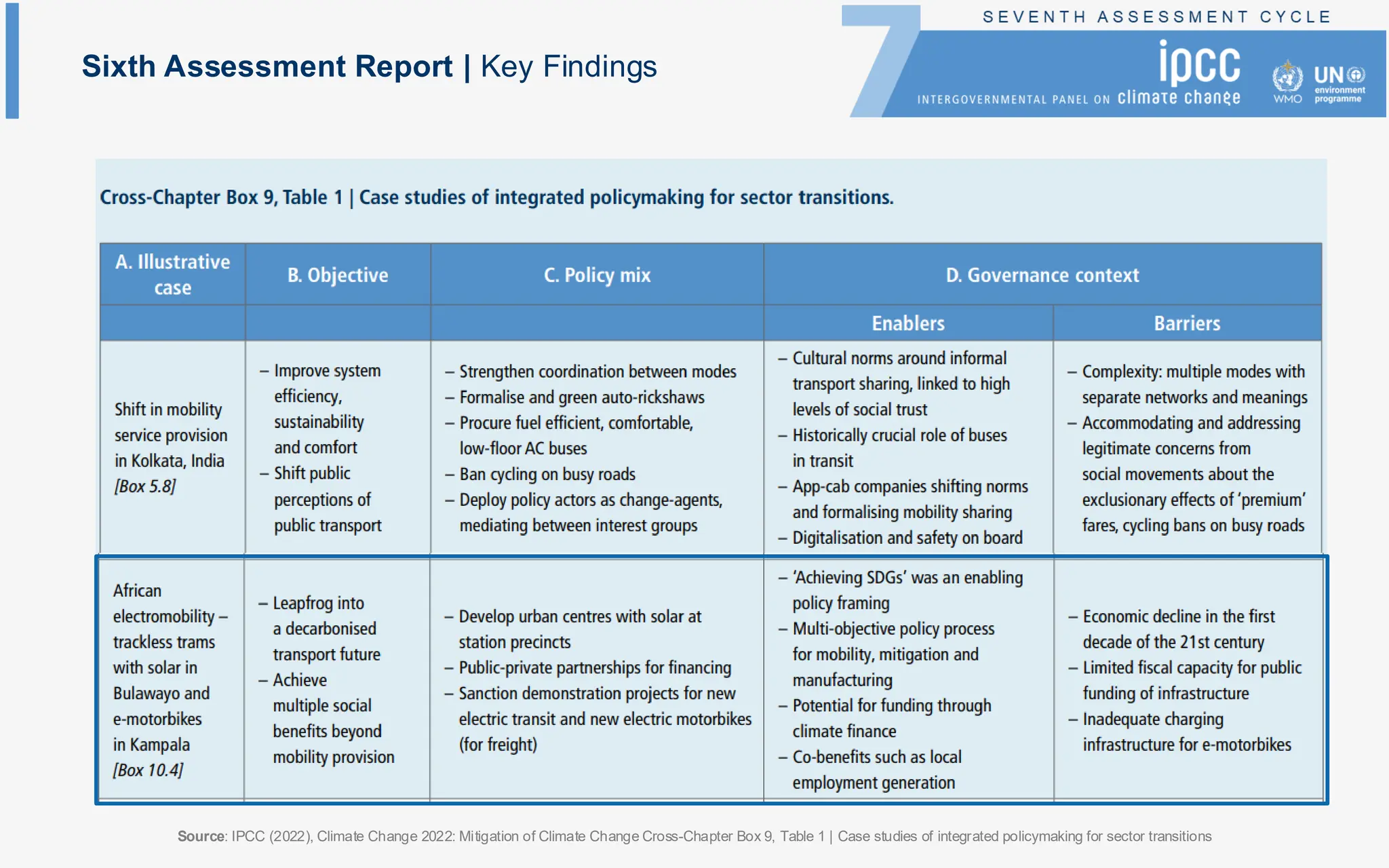
Source: IPCC (2022), Climate Change 2022: Mitigation of Climate Change Cross-Chapter Box 9, Table 1 | Case studies of integrated policymaking for sector transitions
Sixth Assessment Report | Key Findings
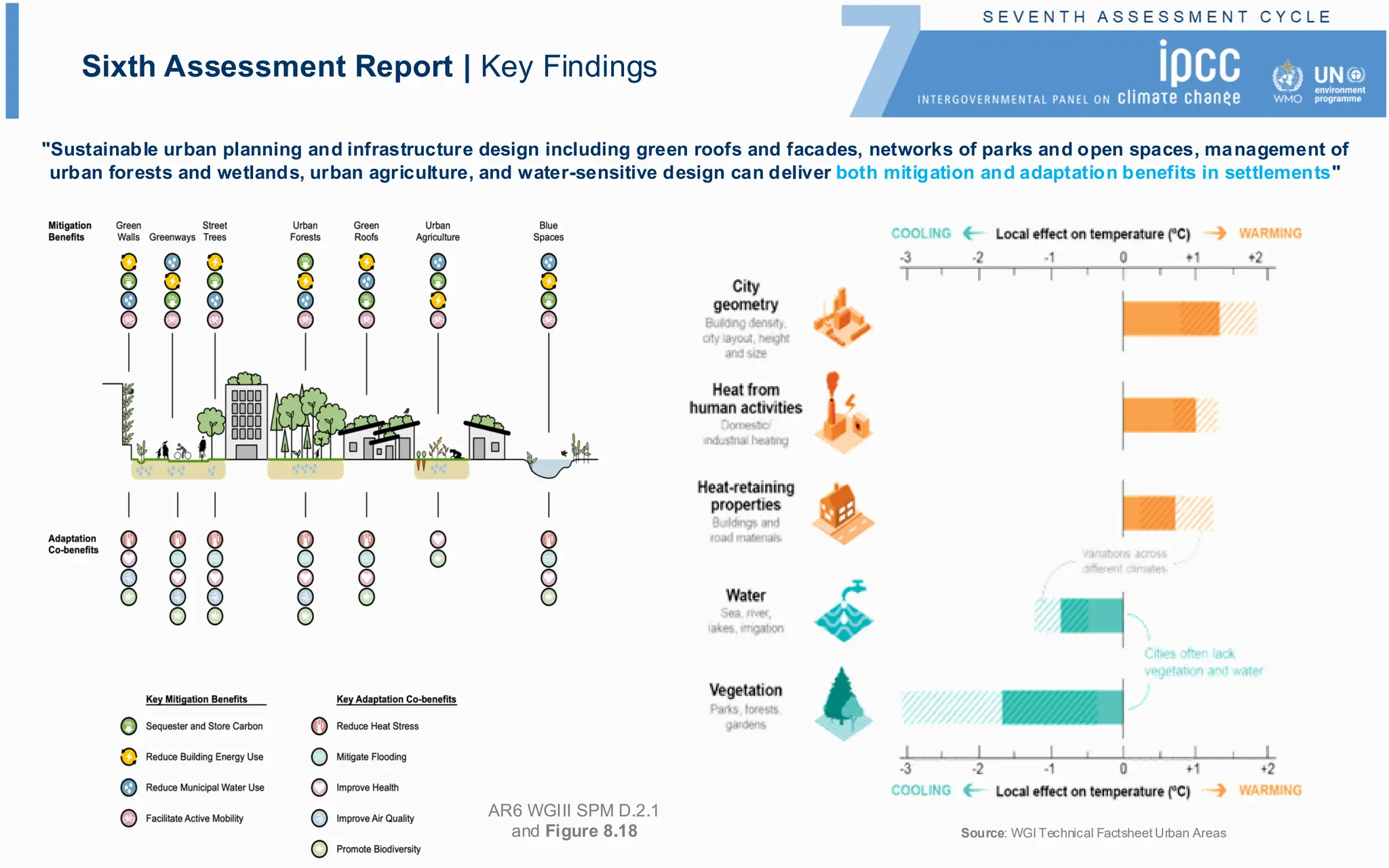
"Sustainable urban planning and infrastructure design including green roofs and facades, networks of parks and open spaces, management of
urban forests and wetlands, urban agriculture, and water-sensitive design can deliver both mitigation and adaptation benefits in settlements"
Source: WGI Technical Factsheet Urban Areas
AR6 WGIII SPM D.2.1
and Figure 8.18
Sixth Assessment Report | Key Findings
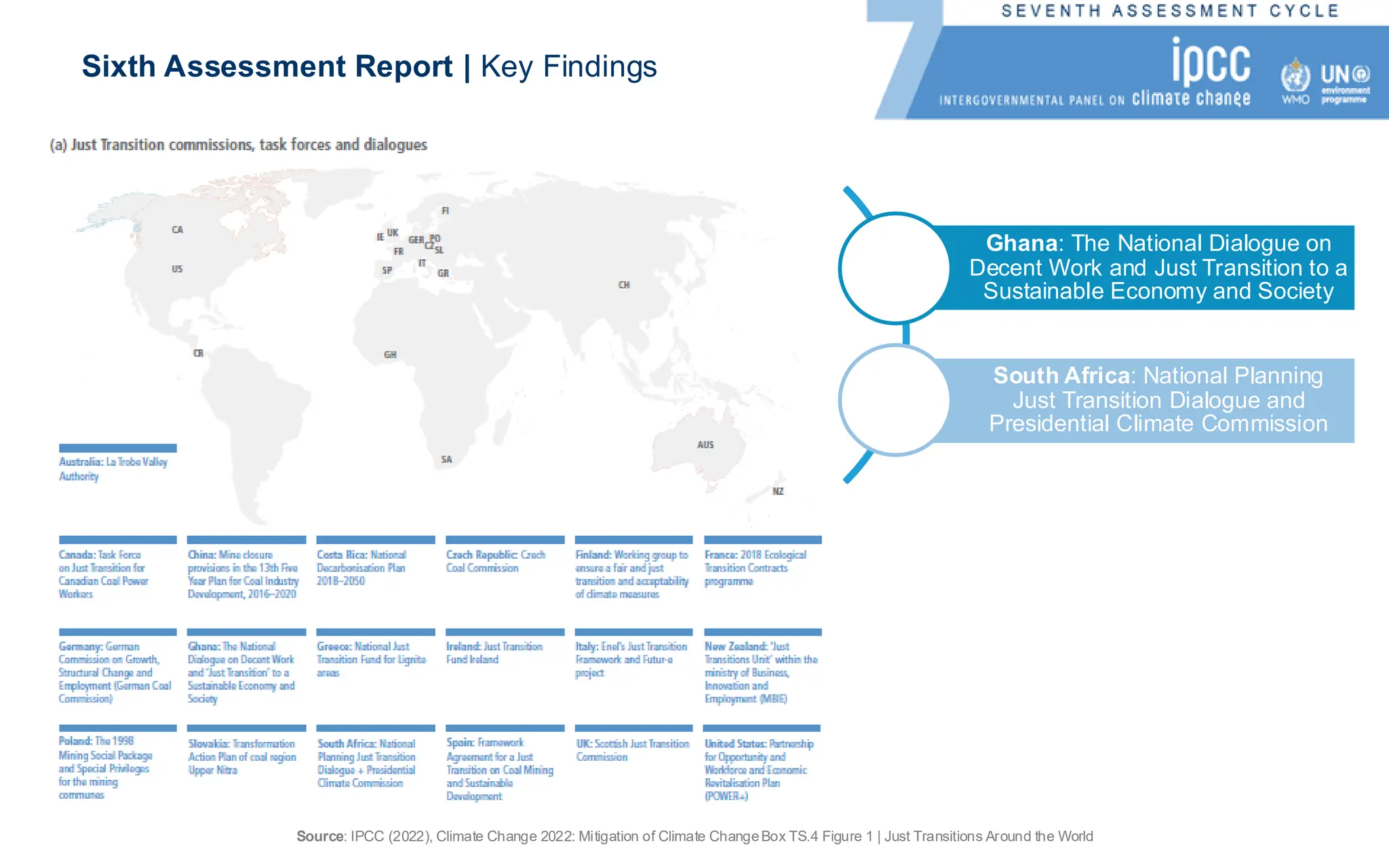
Source: IPCC (2022), Climate Change 2022: Mitigation of Climate ChangeBox TS.4 Figure 1 | Just Transitions Around the World
Ghana: The National Dialogue on
Decent Work and Just Transition to a
Sustainable Economy and Society
South Africa: National Planning
Just Transition Dialogue and
Presidential Climate Commission
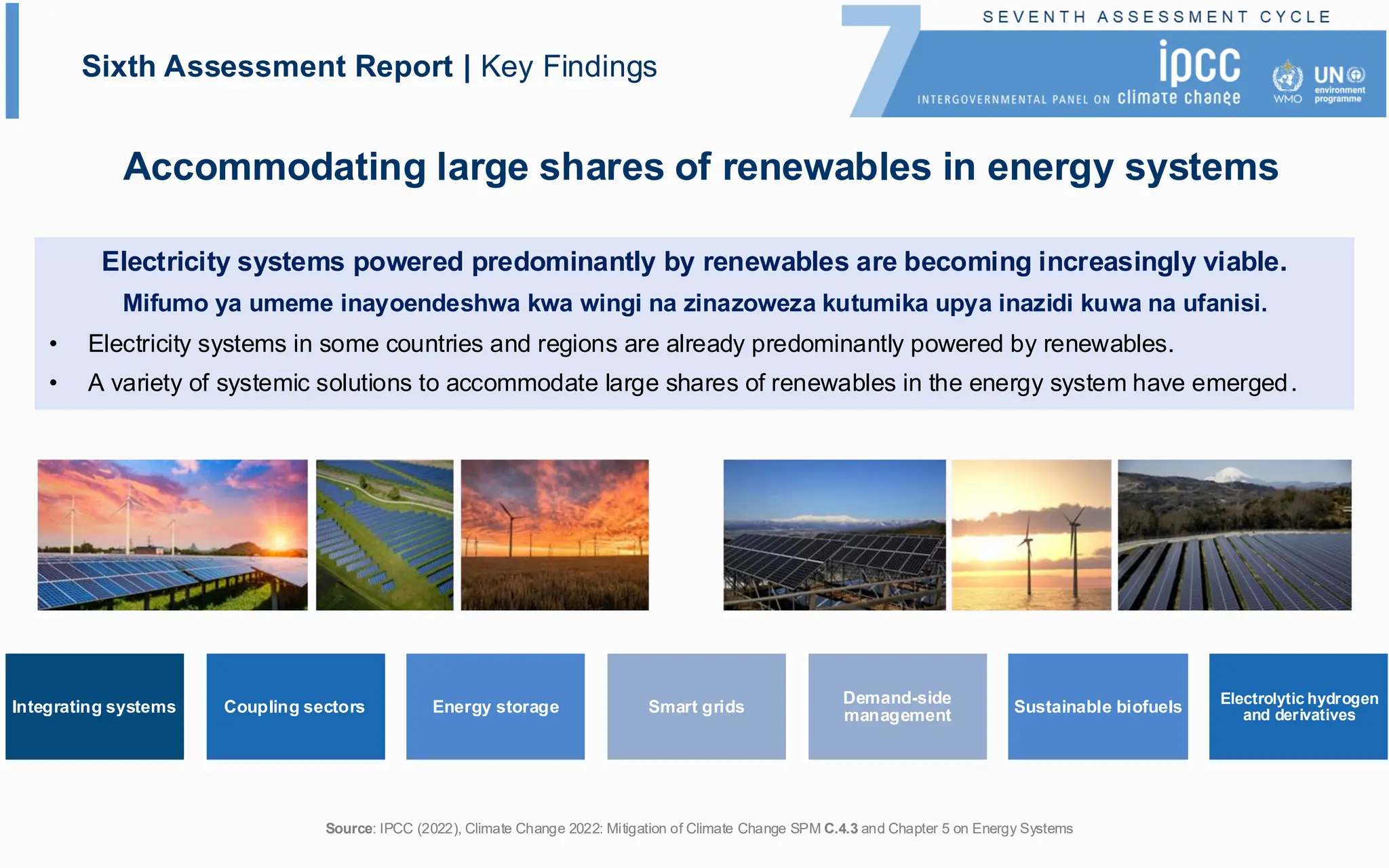
Integrating systems Coupling sectors Energy storage Smart grids
Demand-side
management Sustainable biofuels Electrolytic hydrogen
and derivatives
Accommodating large shares of renewables in energy systems
Electricity systems powered predominantly by renewables are becoming increasingly viable.
Mifumo ya umeme inayoendeshwa kwa wingi na zinazoweza kutumika upya inazidi kuwa na ufanisi.
• Electricity systems in some countries and regions are already predominantly powered by renewables.
• A variety of systemic solutions to accommodate large shares of renewables in the energy system have emerged.
Source: IPCC (2022), Climate Change 2022: Mitigation of Climate Change SPM C.4.3 and Chapter 5 on Energy Systems
Sixth Assessment Report | Key Findings
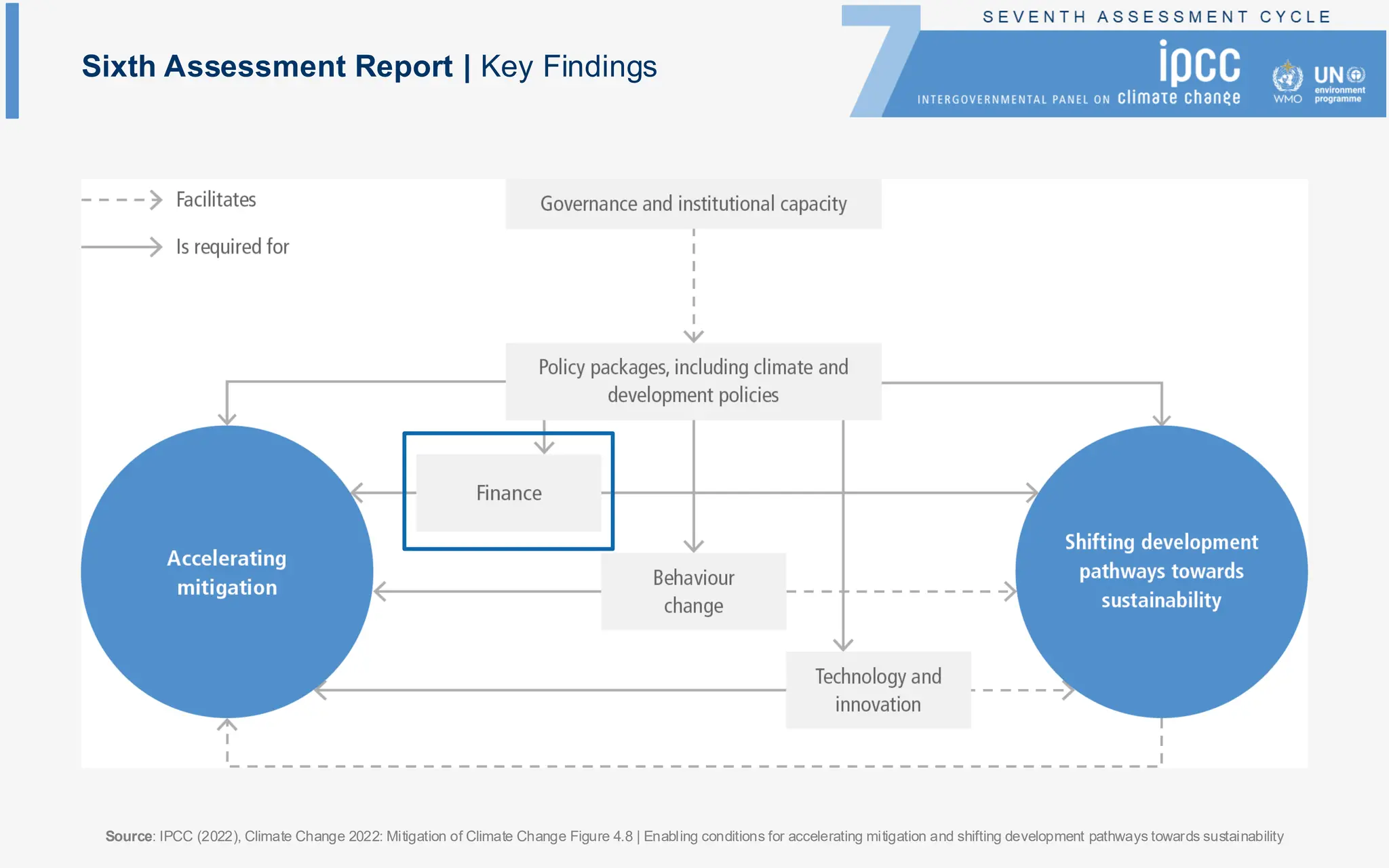
Source: IPCC (2022), Climate Change 2022: Mitigation of Climate Change Figure 4.8 | Enabling conditions for accelerating mitigation and shifting development pathways towards sustainability
“ “
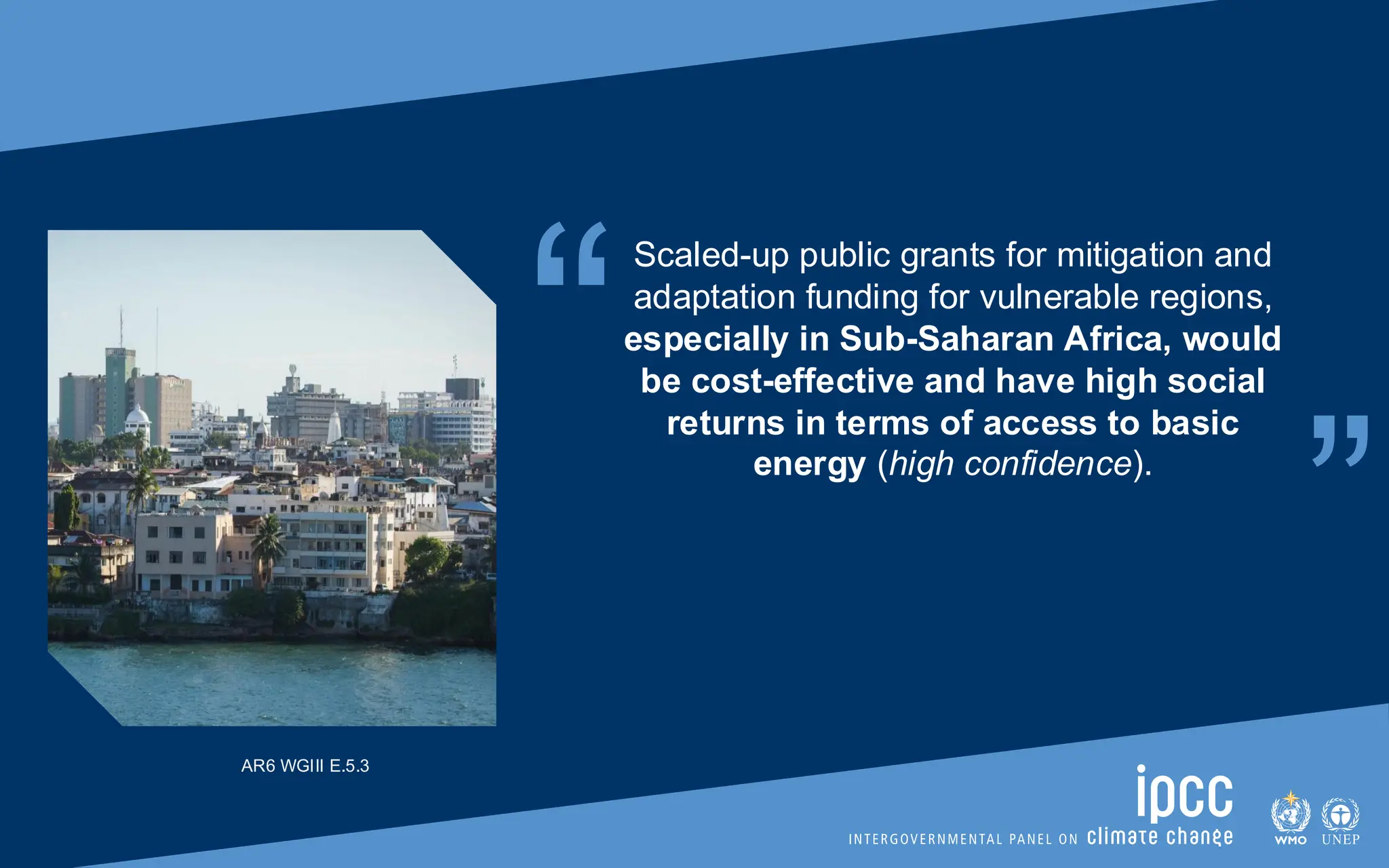
Scaled-up public grants for mitigation and
adaptation funding for vulnerable regions,
especially in Sub-Saharan Africa, would
be cost-effective and have high social
returns in terms of access to basic
energy (high confidence).
AR6 WGIII E.5.3
Sixth Assessment Report | Key Findings
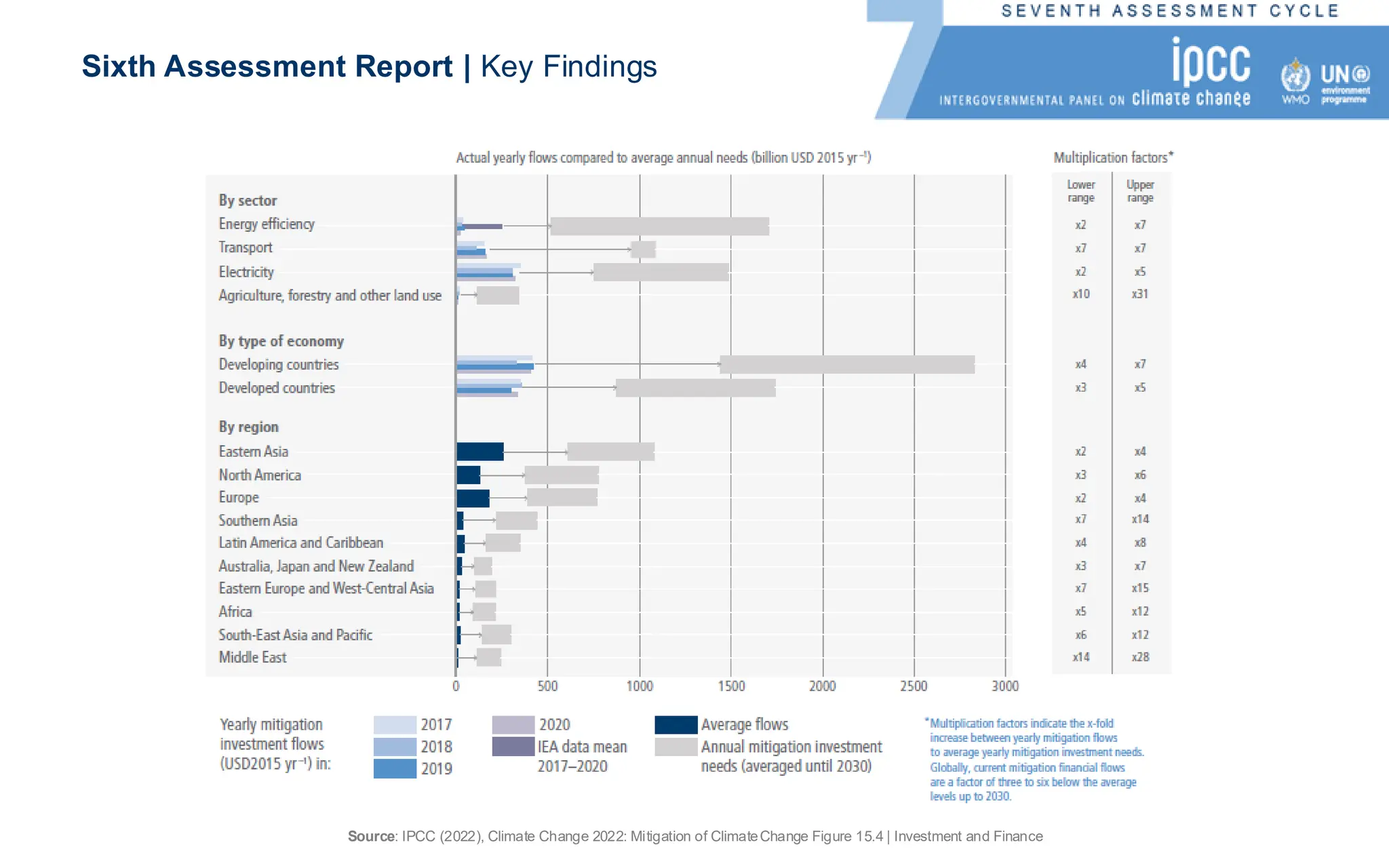
Source: IPCC (2022), Climate Change 2022: Mitigation of ClimateChange Figure 15.4 | Investment and Finance
“ “
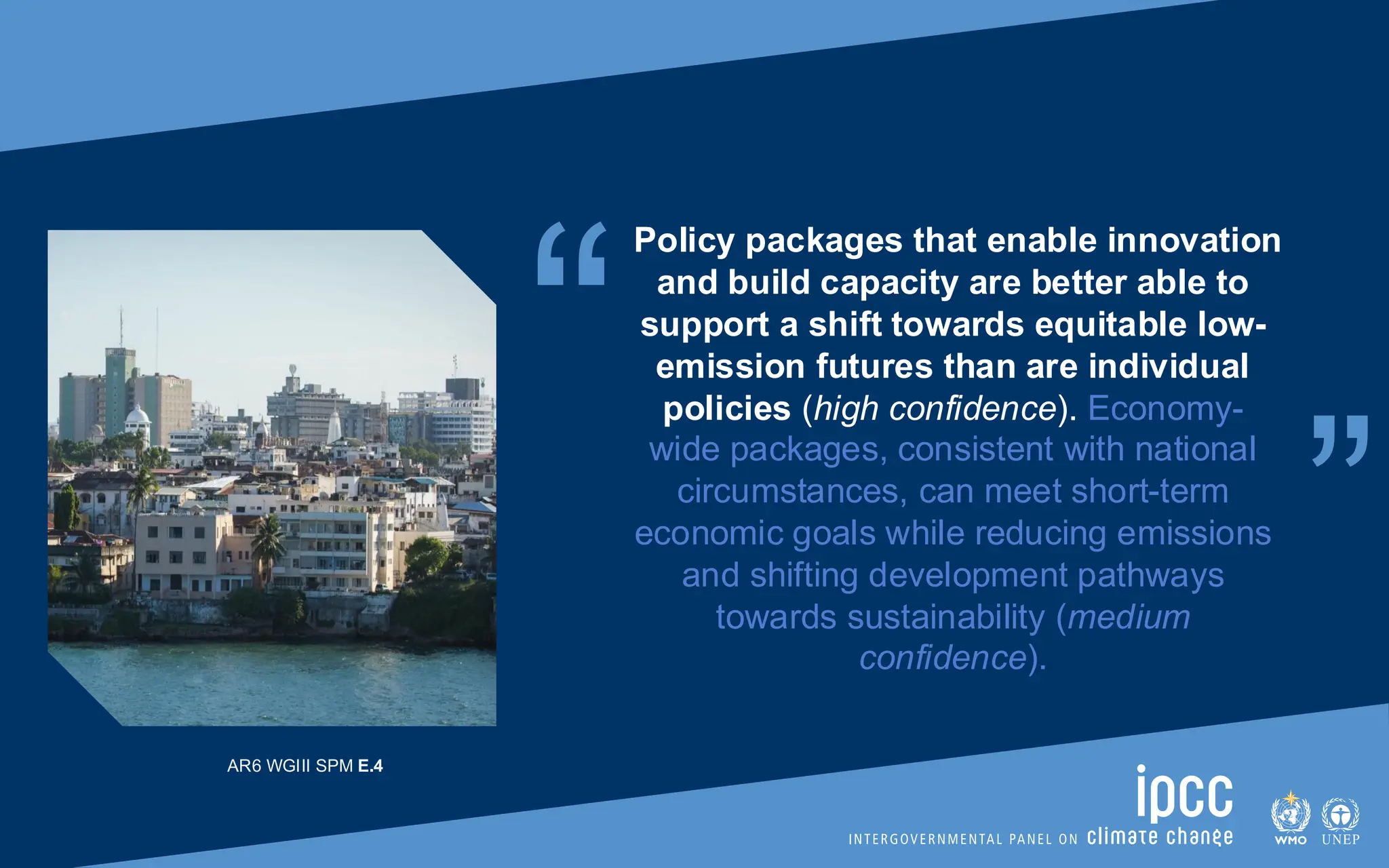
Policy packages that enable innovation
and build capacity are better able to
support a shift towards equitable low-
emission futures than are individual
policies (high confidence). Economy-
wide packages, consistent with national
circumstances, can meet short-term
economic goals while reducing emissions
and shifting development pathways
towards sustainability (medium
confidence).
AR6 WGIII SPM E.4
“ “
Policy packages that enable innovation
and build capacity are better able to
support a shift towards equitable low-
emission futures than are individual
policies (high confidence). Economy-
wide packages, consistent with national
circumstances, can meet short-term
economic goals while reducing emissions
and shifting development pathways
towards sustainability (medium
confidence).
AR6 WGIII SPM E.4
S E V E N T H A S S E S S M E N T C Y C L E
THANK YOU
FOR YOUR ATTENTION
STAY IN TOUCH STAY CONNECTED
ipcc.ch ipcc-sec@wmo.int
ipcc-media@wmo.int
ipcc_ch ipcc @ipcc ipcc
ipccGeneva
Thank You / Asante Sana
Session 8a Sixth Assessment Report Findings

  • 1.
    Climate Change inAfrica: Findings from IPCC’s Sixth Assessment Report Prof. Şiir KILKIŞ, IPCC AR7 WGIII Vice-Chair The Scientific and Technological Research Council of Türkiye (TÜBİTAK) Ankara, Türkiye
  • 2.
    Sixth Assessment Report| Key Findings Sources: IPCC Altıncı Değerlendirme Raporuna WGI (2021) <https://www.ipcc.ch/report/ar6/wg1/>, WGII (2022) <https://www.ipcc.ch/report/ar6/wg2/> ve WGIII (2022) <https://www.ipcc.ch/report/ar6/wg3/> katkıları ve Sentez Raporu (2023) <https://www.ipcc.ch/report/ar6/syr/>
  • 3.
    “ “ Eradicating extremepoverty, energy poverty, and providing decent living standards to all in these* regions in the context of achieving sustainable development objectives, in the near-term, can be achieved without significant global emissions growth (high confidence). AR6 WGIII SPM B.3.3 * Low-emitting countries emitting less than 3 tCO2-eq per capita and lack access to modern energy services
  • 4.
    Source: IPCC (2022),Climate Change 2022: Mitigation of Climate Change Box TS3, Figure 1 Sixth Assessment Report | Key Findings Decision makers, policymakers, organisations and individuals
  • 5.
    “ “ In allcountries, mitigation efforts embedded within the wider development context can increase the pace, depth and breadth of emissions reductions (medium confidence). Policies that shift development pathways towards sustainability can broaden the portfolio of available mitigation responses, and enable the pursuit of synergies with development objectives (medium confidence). Actions can be taken now to shift development pathways and accelerate mitigation and transitions across systems (high confidence). AR6 WGIII SPM E.2
  • 6.
    “ “ In allcountries, mitigation efforts embedded within the wider development context can increase the pace, depth and breadth of emissions reductions (medium confidence). Policies that shift development pathways towards sustainability can broaden the portfolio of available mitigation responses, and enable the pursuit of synergies with development objectives (medium confidence). Actions can be taken now to shift development pathways and accelerate mitigation and transitions across systems (high confidence). AR6 WGIII SPM E.2
  • 7.
    Sixth Assessment Report| Key Findings Source: IPCC (2022), Climate Change 2022: Mitigation of Climate Change Box 6.1 │ Energy Access, Energy Systems, and Sustainability
  • 8.
    “ “ In recentyears, policy interest has arisen to address the energy access challenge in Africa using low-carbon energy technologies to meet energy for poverty reduction and climate action simultaneously. Evidence: Rolffs et al. 2015; Fuso Nerini et al. 2018; Mulugetta et al. 2019
  • 9.
    Sixth Assessment Report| Key Findings Source: IPCC (2022), Climate Change 2022: Mitigation of Climate Change Box 7.4 │ Case Study: The Climate-Smart Village Approach
  • 10.
    Source: IPCC (2022),Climate Change 2022: Mitigation of Climate Change Box 7.10 │ Regreening the Sahel, Northern Africa Sixth Assessment Report | Key Findings
  • 11.
    Sixth Assessment Report| Key Findings Source: IPCC (2022), Climate Change 2022: Mitigation of Climate Change Box 7.13 │ Case Study: Climate-Smart Cocoa Production in Ghana
  • 12.
    Source: IPCC (2022),Climate Change 2022: Mitigation of ClimateChange Box 13.5 │ South Africa’s Monitoring and Evaluation System Sixth Assessment Report | Key Findings
  • 13.
    2 hours perday saved for women and girls from collecting fuel in Africa Sixth Assessment Report | Key Findings Source: IPCC (2022), Climate Change 2022: Mitigation of ClimateChange Box 13.5 │ South Africa’s Monitoring and Evaluation System
  • 14.
    "Urban areas aresystems where multiple mitigation options – especially when integrated – have cascading effects across transport, energy, buildings, land use, and behaviour." The full potential for reducing consumption- based urban emissions to net-zero GHG can be met only when emissions beyond cities’ administrative boundaries are also addressed Source: IPCC (2022), Chapter 8 on Urban Systems and Other Settlements Maeneo ya mijini ni mifumo ambapo chaguzi nyingi za kupunguza - haswa zikiunganishwa - zina athari zilizounganishwa kwenye usafiri, nishati, majengo, matumizi ya ardhi na tabia. Figure 8.15 Sixth Assessment Report | Key Findings
  • 15.
    Source: IPCC (2022),Climate Change 2022: Mitigation of Climate Change Cross-Chapter Box 9, Table 1 | Case studies of integrated policymaking for sector transitions Sixth Assessment Report | Key Findings
  • 16.
    "Sustainable urban planningand infrastructure design including green roofs and facades, networks of parks and open spaces, management of urban forests and wetlands, urban agriculture, and water-sensitive design can deliver both mitigation and adaptation benefits in settlements" Source: WGI Technical Factsheet Urban Areas AR6 WGIII SPM D.2.1 and Figure 8.18 Sixth Assessment Report | Key Findings
  • 17.
    Sixth Assessment Report| Key Findings Source: IPCC (2022), Climate Change 2022: Mitigation of Climate ChangeBox TS.4 Figure 1 | Just Transitions Around the World Ghana: The National Dialogue on Decent Work and Just Transition to a Sustainable Economy and Society South Africa: National Planning Just Transition Dialogue and Presidential Climate Commission
  • 18.
    Integrating systems Couplingsectors Energy storage Smart grids Demand-side management Sustainable biofuels Electrolytic hydrogen and derivatives Accommodating large shares of renewables in energy systems Electricity systems powered predominantly by renewables are becoming increasingly viable. Mifumo ya umeme inayoendeshwa kwa wingi na zinazoweza kutumika upya inazidi kuwa na ufanisi. • Electricity systems in some countries and regions are already predominantly powered by renewables. • A variety of systemic solutions to accommodate large shares of renewables in the energy system have emerged. Source: IPCC (2022), Climate Change 2022: Mitigation of Climate Change SPM C.4.3 and Chapter 5 on Energy Systems Sixth Assessment Report | Key Findings
  • 19.
    Sixth Assessment Report| Key Findings Source: IPCC (2022), Climate Change 2022: Mitigation of Climate Change Figure 4.8 | Enabling conditions for accelerating mitigation and shifting development pathways towards sustainability
  • 20.
    “ “ Scaled-up publicgrants for mitigation and adaptation funding for vulnerable regions, especially in Sub-Saharan Africa, would be cost-effective and have high social returns in terms of access to basic energy (high confidence). AR6 WGIII E.5.3
  • 21.
    Sixth Assessment Report| Key Findings Source: IPCC (2022), Climate Change 2022: Mitigation of ClimateChange Figure 15.4 | Investment and Finance
  • 22.
    “ “ Policy packagesthat enable innovation and build capacity are better able to support a shift towards equitable low- emission futures than are individual policies (high confidence). Economy- wide packages, consistent with national circumstances, can meet short-term economic goals while reducing emissions and shifting development pathways towards sustainability (medium confidence). AR6 WGIII SPM E.4
  • 23.
    “ “ Policy packagesthat enable innovation and build capacity are better able to support a shift towards equitable low- emission futures than are individual policies (high confidence). Economy- wide packages, consistent with national circumstances, can meet short-term economic goals while reducing emissions and shifting development pathways towards sustainability (medium confidence). AR6 WGIII SPM E.4
  • 24.
    S E VE N T H A S S E S S M E N T C Y C L E THANK YOU FOR YOUR ATTENTION STAY IN TOUCH STAY CONNECTED ipcc.ch ipcc-sec@wmo.int ipcc-media@wmo.int ipcc_ch ipcc @ipcc ipcc ipccGeneva Thank You / Asante Sana