Client Guide
 Research
 Client Brief
 Treatment (how, why, selling doc)
 Scipt
 Pre-production paper work
 Financial considerations
 Production (recording)
 Post Production –mixing and screen grabs.
 Recording Nick
 Conclusion
Research
I was given the task to create a radio advert for commercial radio. Before starting this task I
had to do some primary research, and listen to some successful commercial radio adverts.
This was so I had an understanding of what style and techniques work well. I analysed 3
different radio adverts, 1 for Nando’s, 1 for Frank the drugs advice company and 1 for
McDonalds. They each had their own style and techniques, which obviously depended on
the type of advert. The way they spoke varied and the music that was used was different for
each advert. For example, for the Nando’s advert, upbeat music was used as well as a
stereotypical Mexican voice. This added a good effect to the advert. I realised I would have
to use this for my Sprite advert to make it successful. I knew I had to target the younger
adults age range.
ASA
I also looked at ASA and how they play a role in the
radio industry. They are the UK’s independent
regulator for all aspects of media. I read through the
rules they set out to ensure I followed them within
my own advert. I chose to do Sprite as it was a
decision made by the group that it was something
we all like, and their product appeals to a similar
age range to us, as well as same demographic. I felt I could produce a good advert for them.
Treatment & Pre-production Paper Work
My advert will be aired on Future Skills Radio, which is the radio station for the college I
study at. This would be good for Sprite as it’s a good age range within the college, as well as
a place to sell their product. Lots of students will use vending machines within college, and
hearing this advert may put Sprite in their head, which leads to them buying a bottle. I tried
to make my advert funny, whilst at the same time following the techniques that would be
used by Sprite. This would be good for an advert being aired in a college too. Sprite haven’t
tended to make any radio adverts, so there is nothing to compare my advert too. This
meant it was difficult for me to gather ideas from previous adverts. The treatment I made fit
the brief and I thought that the company would like the advert I created.
Script
After creating a
treatment, I had to
go ahead and start
creating my advert.
This started with a
script for the advert.
I wanted to keep it
short and sweet, as
well as funny and clever. There was only 1 actor used within the advert which was myself,
the rest would be imported music and sound effects.
Financial Considerations & Interview
I also had to consider other factors when creating my advert, including cost. I didn’t have to
pay for anything to create my advert as it was done within college, using all their
equipment. This obviously wouldn’t be the same for anyone doing it outside of college,
especially the larger companies. They would be struck with costs such as studio hire,
royalties for music and then wages for the people involved. This is before deciding how
much air time it needs and during what time of the day. I also interview Nick the technician
at Salford City College. I recorded the interview in a question and answer based interview.
The questions involved were about the type of hardware and software available within the
college. Nick also showed us how to use the recording equipment for myself to record my
advert.
Production & PostProduction
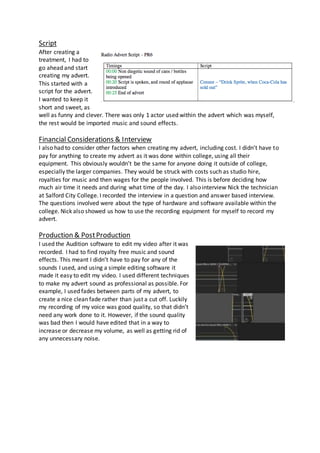
I used the Audition software to edit my video after it was
recorded. I had to find royalty free music and sound
effects. This meant I didn’t have to pay for any of the
sounds I used, and using a simple editing software it
made it easy to edit my video. I used different techniques
to make my advert sound as professional as possible. For
example, I used fades between parts of my advert, to
create a nice clean fade rather than just a cut off. Luckily
my recording of my voice was good quality, so that didn’t
need any work done to it. However, if the sound quality
was bad then I would have edited that in a way to
increase or decrease my volume, as well as getting rid of
any unnecessary noise.
Conclusion
I started the advert with a sound effect of lots of fizzy drinks being opened. This is a
common theme within drink adverts, as it makes the listeners help image the taste of the
drink. I could have recorded this myself in a studio, but I didn’t think the quality would be so
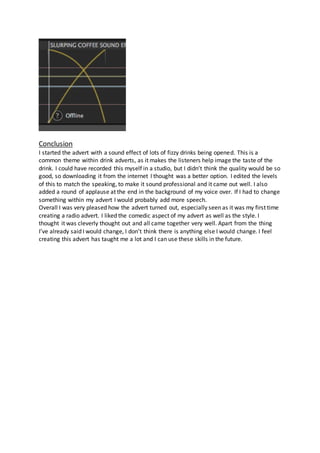
good, so downloading it from the internet I thought was a better option. I edited the levels
of this to match the speaking, to make it sound professional and it came out well. I also
added a round of applause at the end in the background of my voice over. If I had to change
something within my advert I would probably add more speech.
Overall I was very pleased how the advert turned out, especially seen as it was my first time
creating a radio advert. I liked the comedic aspect of my advert as well as the style. I
thought it was cleverly thought out and all came together very well. Apart from the thing
I’ve already said I would change, I don’t think there is anything else I would change. I feel
creating this advert has taught me a lot and I can use these skills in the future.

Client guide

  • 1.
    Client Guide  Research Client Brief  Treatment (how, why, selling doc)  Scipt  Pre-production paper work  Financial considerations  Production (recording)  Post Production –mixing and screen grabs.  Recording Nick  Conclusion Research I was given the task to create a radio advert for commercial radio. Before starting this task I had to do some primary research, and listen to some successful commercial radio adverts. This was so I had an understanding of what style and techniques work well. I analysed 3 different radio adverts, 1 for Nando’s, 1 for Frank the drugs advice company and 1 for McDonalds. They each had their own style and techniques, which obviously depended on the type of advert. The way they spoke varied and the music that was used was different for each advert. For example, for the Nando’s advert, upbeat music was used as well as a stereotypical Mexican voice. This added a good effect to the advert. I realised I would have to use this for my Sprite advert to make it successful. I knew I had to target the younger adults age range. ASA I also looked at ASA and how they play a role in the radio industry. They are the UK’s independent regulator for all aspects of media. I read through the rules they set out to ensure I followed them within my own advert. I chose to do Sprite as it was a decision made by the group that it was something we all like, and their product appeals to a similar age range to us, as well as same demographic. I felt I could produce a good advert for them. Treatment & Pre-production Paper Work My advert will be aired on Future Skills Radio, which is the radio station for the college I study at. This would be good for Sprite as it’s a good age range within the college, as well as a place to sell their product. Lots of students will use vending machines within college, and hearing this advert may put Sprite in their head, which leads to them buying a bottle. I tried to make my advert funny, whilst at the same time following the techniques that would be used by Sprite. This would be good for an advert being aired in a college too. Sprite haven’t tended to make any radio adverts, so there is nothing to compare my advert too. This meant it was difficult for me to gather ideas from previous adverts. The treatment I made fit the brief and I thought that the company would like the advert I created.
  • 2.
    Script After creating a treatment,I had to go ahead and start creating my advert. This started with a script for the advert. I wanted to keep it short and sweet, as well as funny and clever. There was only 1 actor used within the advert which was myself, the rest would be imported music and sound effects. Financial Considerations & Interview I also had to consider other factors when creating my advert, including cost. I didn’t have to pay for anything to create my advert as it was done within college, using all their equipment. This obviously wouldn’t be the same for anyone doing it outside of college, especially the larger companies. They would be struck with costs such as studio hire, royalties for music and then wages for the people involved. This is before deciding how much air time it needs and during what time of the day. I also interview Nick the technician at Salford City College. I recorded the interview in a question and answer based interview. The questions involved were about the type of hardware and software available within the college. Nick also showed us how to use the recording equipment for myself to record my advert. Production & PostProduction I used the Audition software to edit my video after it was recorded. I had to find royalty free music and sound effects. This meant I didn’t have to pay for any of the sounds I used, and using a simple editing software it made it easy to edit my video. I used different techniques to make my advert sound as professional as possible. For example, I used fades between parts of my advert, to create a nice clean fade rather than just a cut off. Luckily my recording of my voice was good quality, so that didn’t need any work done to it. However, if the sound quality was bad then I would have edited that in a way to increase or decrease my volume, as well as getting rid of any unnecessary noise.
  • 3.
    Conclusion I started theadvert with a sound effect of lots of fizzy drinks being opened. This is a common theme within drink adverts, as it makes the listeners help image the taste of the drink. I could have recorded this myself in a studio, but I didn’t think the quality would be so good, so downloading it from the internet I thought was a better option. I edited the levels of this to match the speaking, to make it sound professional and it came out well. I also added a round of applause at the end in the background of my voice over. If I had to change something within my advert I would probably add more speech. Overall I was very pleased how the advert turned out, especially seen as it was my first time creating a radio advert. I liked the comedic aspect of my advert as well as the style. I thought it was cleverly thought out and all came together very well. Apart from the thing I’ve already said I would change, I don’t think there is anything else I would change. I feel creating this advert has taught me a lot and I can use these skills in the future.