Why Is It Important To You?
Warm up . . .
• What is the leading cause of preventable death in the
World ?
• If you go out to eat and sit in a typical non-smoking
section of a restaurant for 2 hours, how much
secondhand smoke do you inhale?
• True or False? Even half an hour of secondhand smoke
exposure causes heart damage similar to that of habitual
smokers
Our purpose in this presentation:
• To educate our peers on the hazards of
secondhand smoke
• To promote respect & understanding on this
issue
• To promote clean smoke free air
One of the largest interferences with clean air.
What does cigarette smoke contain?
• Cigarette smoke contains about 4000
chemical agents including 60
carcinogens
• carbon monoxide
• tar
• Arsenic
• Cyanide
• Benzene
• Formaldehyde
• Methanol
• Acetylene
• Ammonia
• Lead
The Life Cost
• Globally, 1 person dies every 7 seconds from
smoking related diseases
• A smoker loses an average of 13.8 years of life
• From 1000 young smokers, the risks of dying are
that 1 will be murdered, 6 will die in car accidents,
and 500 will die from diseases caused by smoking
• Figuring that a pack of cigarettes
costs about $3, and if you smoke a
pack a day for your entire college
career, you’ve just spent $4380 on
cigs. That’s the price equivalent
of…
• 5 Xbox game systems
• 100 6” subway sandwiches
• 200 gallons of gas
• 1 semester’s worth of textbooks
• 4 IPODs
The Monetary Cost
But why is this important if I don’t smoke?
• There is still a life cost that can affect you - secondhand
smoke causes 53,000 premature deaths per year
• Studies have shown that after exposure to secondhand smoke
your blood flow is more restricted like that of a smoker
• You are daily exposed to secondhand smoke – walking across
campus, working at a restaurant, going out downtown with
your friends. . .
Some effects of Smoking
(first or secondhand)
• Brain- cerebrovascular disease
• Heart-cardiovascular disease
• Lung- chronic obstructive
pulmonary disease and cancer
• Stomach and intestines-ulcers and
cancers
• Increase bone loss and fracture
• Premature wrinkling
• Periodontal disease
• Reduced stamina
• Chronic hoarseness and laryngeal
polyps
• Erectile dysfunction
• Impotence
• Reduced fertility
• Low birth weight babies
So how cool is smoking?
A Pack of Lies Really, smoking gives you:
• Stained teeth & bad breath
• More wrinkles
• Smelly clothes
• False sense of security
• A pawn in the tobacco industry
• High price of cigarettes
• Less money
• An addiction
• Long-term negative health
consequences
• Who wants to kiss a smoker?
How Much Is Too Much?
• In a study, published in the Archives of Pediatric and Adolescent
Medicine, the researchers found that 10% of youth become addicted to
nicotine within two days of first inhaling from a cigarette, and 25% are
addicted within a month.
• The researchers noted that of the students who were hooked on
cigarettes, half were already addicted by the time they were smoking
seven cigarettes per month. Some youth found that they were unable
to quit smoking after just a few cigarettes.
• “Nobody expects to get addicted from smoking one cigarette”
• quote from lead researcher Dr. Joseph R. DiFranza
Benefits of Quitting
• 20 min. – blood pressure and pulse return to normal, circulation
improves to make hands & feet warmer
• 24 hours – carbon monoxide is eliminated from the body and the
lungs start to clear out mucus
• 72 hours – breathing becomes easier and energy levels increase
• 2-12 weeks – circulation improves through the body, exercise is
easier
• 5 years – risk of heart attack falls to half that of a smoker (and you
save $5,000!)
• 10 years – risk of lung cancer falls to about half that of a smoker;
risk of heart attack now similar to someone who has never smoke
What is Really Safe?
But I don’t smoke so I’m safe to be around smokers. .
.right?
• Actually, no.
• For every eight smokers that
die from tobacco-caused
diseases, one nonsmoker will
also die due to exposure to
secondhand smoke
• Smoke-filled rooms can have
up to 6 times the air pollution
as a busy highway
What about Separation?
Studies have shown that
separating smokers from
nonsmokers,
cleaning the air,
and ventilating buildings
cannot eliminate exposure of
nonsmokers to secondhand
smoke
What Is Secondhand Smoke?
• Secondhand smoke, also known as environmental
tobacco smoke (ETS) or passive smoke, is a mixture
of 2 forms of smoke from burning tobacco products:
• Sidestream smoke: smoke that comes from the end
of a lighted cigarette, pipe, or cigar
• Mainstream: smoke that is exhaled by a smoker
Why Is It A Problem?
• Secondhand smoke is classified as a “known human
carcinogen”(cancer causing agent) by the EPA
• In his 2006 report, the Surgeon General has said that “no risk-
free level of exposure to secondhand smoke exists”*
• Secondhand smoke is harmful in many ways:
• 35,000 deaths from heart disease in people who live with
smokers but are not current smokers
• 3,400 lung cancer deaths in nonsmoking adults
• Respiratory problems in nonsmokers (including children), such
as coughing, phlegm, chest discomfort, and reduced lung
function
Where Is It A Problem?
• 3 MAIN LOCATIONS to be concerned about exposure to
secondhand smoke
• Your workplace Secondhand smoke meets the criteria
to be classified as a potential cancer causing agent *
• Public Places Everyone is vulnerable to secondhand
smoke exposure in public places, such as restaurants,
shopping centers, public transportation, daycare centers,
and university campuses
• Your home Making your home smoke free is perhaps
one of the most important things you can do for the
health of your family
How Many Cigarettes Have You Smoked Without
Knowing It?
If you have been. . . it’s like you’ve smoked. . .
• In a smoky bar for 2 hrs =
• In a nonsmoking section for 2 hrs
=
• In a car with someone, windows
closed for 1 hr =
• In a smoker’s home (smoking a
pack a day) for 24 hrs =
• 15 min. walk to class behind
someone smoking over the course
of 2.5 weeks =
What about work examples?
• Waiters and waitresses have
almost twice the risk of lung
cancer due to involuntary
exposure to secondhand smoke
• In a typical 8 hour shift, a
restaurant worker will breathe in
enough secondhand smoke to
equal half a pack of cigarettes
• Studies have shown that
restaurants that go smoke-free
don’t lose business, in fact, most
actually increase their profit
.
Diseases
• We are going to look at the main types of diseases which
you can get from smoking, which are:
• Bronchitis
• Emphysema
• Heart disease
• cancer
Bronchitis
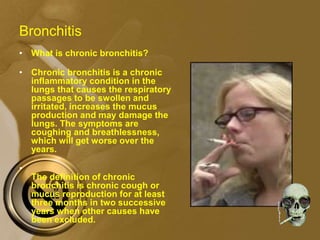
• What is chronic bronchitis?
• Chronic bronchitis is a chronic
inflammatory condition in the
lungs that causes the respiratory
passages to be swollen and
irritated, increases the mucus
production and may damage the
lungs. The symptoms are
coughing and breathlessness,
which will get worse over the
years.
•
The definition of chronic
bronchitis is chronic cough or
mucus reproduction for at least
three months in two successive
years when other causes have
been excluded.
Emphysema
• Effects the alveoli
• The smokers cough weekens the walls of the alveoli,
therefore the lungs can not take in enough oxygen which
leads to breathlessness.
Cancer
• Increased risk of developing lung cancer
• Number of cigarettes smoked per day Annual death
rate per 100,000 men
• 10-14 (8 times that of non-smokers)
• 15-25 (13 times that of non-smokers)
• 25 or more25 (25 times that of non-smokers)
Lung Cancer
• Lung cancer kills more people than any other type of
cancer and at least 80% of these deaths are caused by
smoking. In 1999, 29,406 people in England and Wales
died of lung cancer.[
• It is the tar in the `cigarettes which contain the
carcinogenic “cancer causing” substances
• Not only are you susceptible to lung cancer, but also:
mouth, throat, stomach cancer. Cigarette tars contain
some of the most carcinogenic chemicals known to
man. Consider this when watching people smoking and
exhaling only 10% of the tars they actually take in. Not
only are these chemicals being painted into the lung, but
smoker are also constantly painting them up on their lips,
tongue, larynx, swallowing some and thus painting it in
the Oesophagus and throughout the digestive
tract. Smokers have increased incidents of cancer in all
of these exposed sites.
Heart Disease
• The role of smoking in Coronary Heart Disease
• Inhaling tobacco smoke causes several immediate
responses within the heart and its blood vessels. Within
one minute of starting to smoke, the heart rate begins to
rise: it may increase by as much as 30 percent during
the first 10 minutes of smoking.
• Nicotine raises blood pressure: blood vessels constrict
which forces the heart to work harder to deliver oxygen
to the rest of the body. Meanwhile,
• carbon monoxide in tobacco smoke exerts a negative
effect on the heart by reducing the blood’s ability to carry
oxygen.
Heart Disease
• Smoking tends to increase blood cholesterol levels.
• Carbon monoxide attaches itself to haemoglobin (the
oxygen-carrying pigment in red blood cells) much more
easily than oxygen does. This reduces the amount of
oxygen available to the tissues. This again will put
pressure on the heart!
Healthy Lungs
• You can see how the lung
looks without the effects of
inhalation of smoke.
• Note black specks throughout
indicative of carbon deposits
from pollution.
Lung after smoking
• Smokers lung with
cancer. White area on top is
the cancer, this is what killed
the person. The blackened
area is just the deposit of tars
that all smokers paint into their
lungs with every puff they take.
 clean air for every one
 clean air for every one

clean air for every one

  • 1.
    Why Is ItImportant To You?
  • 2.
    Warm up .. . • What is the leading cause of preventable death in the World ? • If you go out to eat and sit in a typical non-smoking section of a restaurant for 2 hours, how much secondhand smoke do you inhale? • True or False? Even half an hour of secondhand smoke exposure causes heart damage similar to that of habitual smokers
  • 3.
    Our purpose inthis presentation: • To educate our peers on the hazards of secondhand smoke • To promote respect & understanding on this issue • To promote clean smoke free air
  • 4.
    One of thelargest interferences with clean air.
  • 5.
    What does cigarettesmoke contain? • Cigarette smoke contains about 4000 chemical agents including 60 carcinogens • carbon monoxide • tar • Arsenic • Cyanide • Benzene • Formaldehyde • Methanol • Acetylene • Ammonia • Lead
  • 6.
    The Life Cost •Globally, 1 person dies every 7 seconds from smoking related diseases • A smoker loses an average of 13.8 years of life • From 1000 young smokers, the risks of dying are that 1 will be murdered, 6 will die in car accidents, and 500 will die from diseases caused by smoking
  • 7.
    • Figuring thata pack of cigarettes costs about $3, and if you smoke a pack a day for your entire college career, you’ve just spent $4380 on cigs. That’s the price equivalent of… • 5 Xbox game systems • 100 6” subway sandwiches • 200 gallons of gas • 1 semester’s worth of textbooks • 4 IPODs The Monetary Cost
  • 8.
    But why isthis important if I don’t smoke? • There is still a life cost that can affect you - secondhand smoke causes 53,000 premature deaths per year • Studies have shown that after exposure to secondhand smoke your blood flow is more restricted like that of a smoker • You are daily exposed to secondhand smoke – walking across campus, working at a restaurant, going out downtown with your friends. . .
  • 9.
    Some effects ofSmoking (first or secondhand) • Brain- cerebrovascular disease • Heart-cardiovascular disease • Lung- chronic obstructive pulmonary disease and cancer • Stomach and intestines-ulcers and cancers • Increase bone loss and fracture • Premature wrinkling • Periodontal disease • Reduced stamina • Chronic hoarseness and laryngeal polyps • Erectile dysfunction • Impotence • Reduced fertility • Low birth weight babies
  • 10.
    So how coolis smoking? A Pack of Lies Really, smoking gives you: • Stained teeth & bad breath • More wrinkles • Smelly clothes • False sense of security • A pawn in the tobacco industry • High price of cigarettes • Less money • An addiction • Long-term negative health consequences • Who wants to kiss a smoker?
  • 11.
    How Much IsToo Much? • In a study, published in the Archives of Pediatric and Adolescent Medicine, the researchers found that 10% of youth become addicted to nicotine within two days of first inhaling from a cigarette, and 25% are addicted within a month. • The researchers noted that of the students who were hooked on cigarettes, half were already addicted by the time they were smoking seven cigarettes per month. Some youth found that they were unable to quit smoking after just a few cigarettes. • “Nobody expects to get addicted from smoking one cigarette” • quote from lead researcher Dr. Joseph R. DiFranza
  • 12.
    Benefits of Quitting •20 min. – blood pressure and pulse return to normal, circulation improves to make hands & feet warmer • 24 hours – carbon monoxide is eliminated from the body and the lungs start to clear out mucus • 72 hours – breathing becomes easier and energy levels increase • 2-12 weeks – circulation improves through the body, exercise is easier • 5 years – risk of heart attack falls to half that of a smoker (and you save $5,000!) • 10 years – risk of lung cancer falls to about half that of a smoker; risk of heart attack now similar to someone who has never smoke
  • 13.
  • 14.
    But I don’tsmoke so I’m safe to be around smokers. . .right? • Actually, no. • For every eight smokers that die from tobacco-caused diseases, one nonsmoker will also die due to exposure to secondhand smoke • Smoke-filled rooms can have up to 6 times the air pollution as a busy highway
  • 15.
    What about Separation? Studieshave shown that separating smokers from nonsmokers, cleaning the air, and ventilating buildings cannot eliminate exposure of nonsmokers to secondhand smoke
  • 16.
    What Is SecondhandSmoke? • Secondhand smoke, also known as environmental tobacco smoke (ETS) or passive smoke, is a mixture of 2 forms of smoke from burning tobacco products: • Sidestream smoke: smoke that comes from the end of a lighted cigarette, pipe, or cigar • Mainstream: smoke that is exhaled by a smoker
  • 17.
    Why Is ItA Problem? • Secondhand smoke is classified as a “known human carcinogen”(cancer causing agent) by the EPA • In his 2006 report, the Surgeon General has said that “no risk- free level of exposure to secondhand smoke exists”* • Secondhand smoke is harmful in many ways: • 35,000 deaths from heart disease in people who live with smokers but are not current smokers • 3,400 lung cancer deaths in nonsmoking adults • Respiratory problems in nonsmokers (including children), such as coughing, phlegm, chest discomfort, and reduced lung function
  • 18.
    Where Is ItA Problem? • 3 MAIN LOCATIONS to be concerned about exposure to secondhand smoke • Your workplace Secondhand smoke meets the criteria to be classified as a potential cancer causing agent * • Public Places Everyone is vulnerable to secondhand smoke exposure in public places, such as restaurants, shopping centers, public transportation, daycare centers, and university campuses • Your home Making your home smoke free is perhaps one of the most important things you can do for the health of your family
  • 19.
    How Many CigarettesHave You Smoked Without Knowing It? If you have been. . . it’s like you’ve smoked. . . • In a smoky bar for 2 hrs = • In a nonsmoking section for 2 hrs = • In a car with someone, windows closed for 1 hr = • In a smoker’s home (smoking a pack a day) for 24 hrs = • 15 min. walk to class behind someone smoking over the course of 2.5 weeks =
  • 20.
    What about workexamples? • Waiters and waitresses have almost twice the risk of lung cancer due to involuntary exposure to secondhand smoke • In a typical 8 hour shift, a restaurant worker will breathe in enough secondhand smoke to equal half a pack of cigarettes • Studies have shown that restaurants that go smoke-free don’t lose business, in fact, most actually increase their profit
  • 21.
    . Diseases • We aregoing to look at the main types of diseases which you can get from smoking, which are: • Bronchitis • Emphysema • Heart disease • cancer
  • 22.
    Bronchitis • What ischronic bronchitis? • Chronic bronchitis is a chronic inflammatory condition in the lungs that causes the respiratory passages to be swollen and irritated, increases the mucus production and may damage the lungs. The symptoms are coughing and breathlessness, which will get worse over the years. • The definition of chronic bronchitis is chronic cough or mucus reproduction for at least three months in two successive years when other causes have been excluded.
  • 23.
    Emphysema • Effects thealveoli • The smokers cough weekens the walls of the alveoli, therefore the lungs can not take in enough oxygen which leads to breathlessness.
  • 24.
    Cancer • Increased riskof developing lung cancer • Number of cigarettes smoked per day Annual death rate per 100,000 men • 10-14 (8 times that of non-smokers) • 15-25 (13 times that of non-smokers) • 25 or more25 (25 times that of non-smokers)
  • 25.
    Lung Cancer • Lungcancer kills more people than any other type of cancer and at least 80% of these deaths are caused by smoking. In 1999, 29,406 people in England and Wales died of lung cancer.[ • It is the tar in the `cigarettes which contain the carcinogenic “cancer causing” substances • Not only are you susceptible to lung cancer, but also: mouth, throat, stomach cancer. Cigarette tars contain some of the most carcinogenic chemicals known to man. Consider this when watching people smoking and exhaling only 10% of the tars they actually take in. Not only are these chemicals being painted into the lung, but smoker are also constantly painting them up on their lips, tongue, larynx, swallowing some and thus painting it in the Oesophagus and throughout the digestive tract. Smokers have increased incidents of cancer in all of these exposed sites.
  • 26.
    Heart Disease • Therole of smoking in Coronary Heart Disease • Inhaling tobacco smoke causes several immediate responses within the heart and its blood vessels. Within one minute of starting to smoke, the heart rate begins to rise: it may increase by as much as 30 percent during the first 10 minutes of smoking. • Nicotine raises blood pressure: blood vessels constrict which forces the heart to work harder to deliver oxygen to the rest of the body. Meanwhile, • carbon monoxide in tobacco smoke exerts a negative effect on the heart by reducing the blood’s ability to carry oxygen.
  • 27.
    Heart Disease • Smokingtends to increase blood cholesterol levels. • Carbon monoxide attaches itself to haemoglobin (the oxygen-carrying pigment in red blood cells) much more easily than oxygen does. This reduces the amount of oxygen available to the tissues. This again will put pressure on the heart!
  • 28.
    Healthy Lungs • Youcan see how the lung looks without the effects of inhalation of smoke. • Note black specks throughout indicative of carbon deposits from pollution.
  • 29.
    Lung after smoking •Smokers lung with cancer. White area on top is the cancer, this is what killed the person. The blackened area is just the deposit of tars that all smokers paint into their lungs with every puff they take.