[Insert your name
and information here]
1
Tobacco 101
Overview
Traditional tobacco
Commercial tobacco
Smokeless tobacco
Tobacco & Cancer
Tobacco & Diabetes
Tobacco & Secondhand smoke
2
Traditional Tobacco
Stories
Many indigenous nations have traditional
stories of how tobacco was introduced to
their communities.
Many stories emphasized the sacredness
of the plant and its powers to both heal if
used properly and to harm us if used
improperly!
Some say that the original tobacco was
discovered about 18,000 years ago.
3
Traditional Tobacco
Uses
Tobacco was used by our Medicine
People for both healing and blessings.
Used as a smudge… to ward off pests
when the people went out to hunt and
gather (the original version of “OFF”)
because it contains nicotine, a natural
pesticide.
Given as a gift when welcoming guests to
the community & as an offering to those
requested to pray or share their wisdom. 4
Traditional Vs. Commercial
Tobacco
TRADITIONAL COMMERCIAL
Smoked in a pipe for
ceremonial purposes
Used as an offering to a
healer, elder or other
person as a sign of
respect or thanks
Medicinal tobacco was
often used as a
painkiller
Deliberate targeting of
specific consumer
groups
Premeditated and
conscious addition of
chemicals that lead to
addiction
Scarcely contains actual
tobacco
5
Commercial Tobacco
Contents
4000 Chemicals
40 Cancer causing agents
500 Poisons
6
Nicotine
Poisonous
More addictive than cocaine and heroine
So powerful that farmers can’t use it to kill
insects
Legal addiction
Use results in emotional dependence
 Mood leveler
 Users rely on it to control emotional
responses to everyday life 7
Carbon Monoxide
The compound in car exhaust that
causes death
Causes shortness of breath
Reduces the amount of oxygen
blood can carry
8
Tar
Sticky Residue that stains the
fingers and teeth.
Contains benzopyrene, one of
the deadliest cancer causing
agents known.
9
Chemicals
Acetone: fingernail polish remover
Ammonia: floor/toilet cleaner
Cadmium: batteries
Arsenic: rat poison
Methane: cow manure fumes
Formaldehyde: preserver of dead bodies
10
Metals
Aluminum
Magnesium
Zinc
Silicon
Titanium
Silver
Lead
Copper
Mercury
Heavy metals
11
Nicotine
Hard Habit to Quit
On a milligram for milligram basis, is 10 times
more potent than heroin as an addictive substance
Smoking is an over-learned behavior
Pack/day smoker estimates
 6 doses (puffs)/cigarette
 20 cigarettes per day
 = 43,800 doses per year!
Few behaviors occur more often. . .
 Breathing
 Blinking 12
Nicotine
Hard Habit to Quit
Withdrawal Symptoms
Anxiety 87% * Irritability 80% *
Difficulty
Concentrating 73% *
Restlessness 71%
Tobacco
Cravings 62%
Gastrointestinal
Problems 33%
Headaches 24% Drowsiness 22%
13
Tobacco
Health Effects
14
Tobacco
Health Effects
15
Tobacco
Facts & Stats
40% of all AN/AN deaths can be attributed
to commercial tobacco use
50% of AI/AN teens reported some type of
cigarette use (highest rate in the nation, out
of all ethnic populations and age groups)
21% of AI/AN teens reported using
smokeless tobacco
Teens are 3 times more likely to smoke if
parent or sibling smokes
16
Tobacco
Facts & Stats
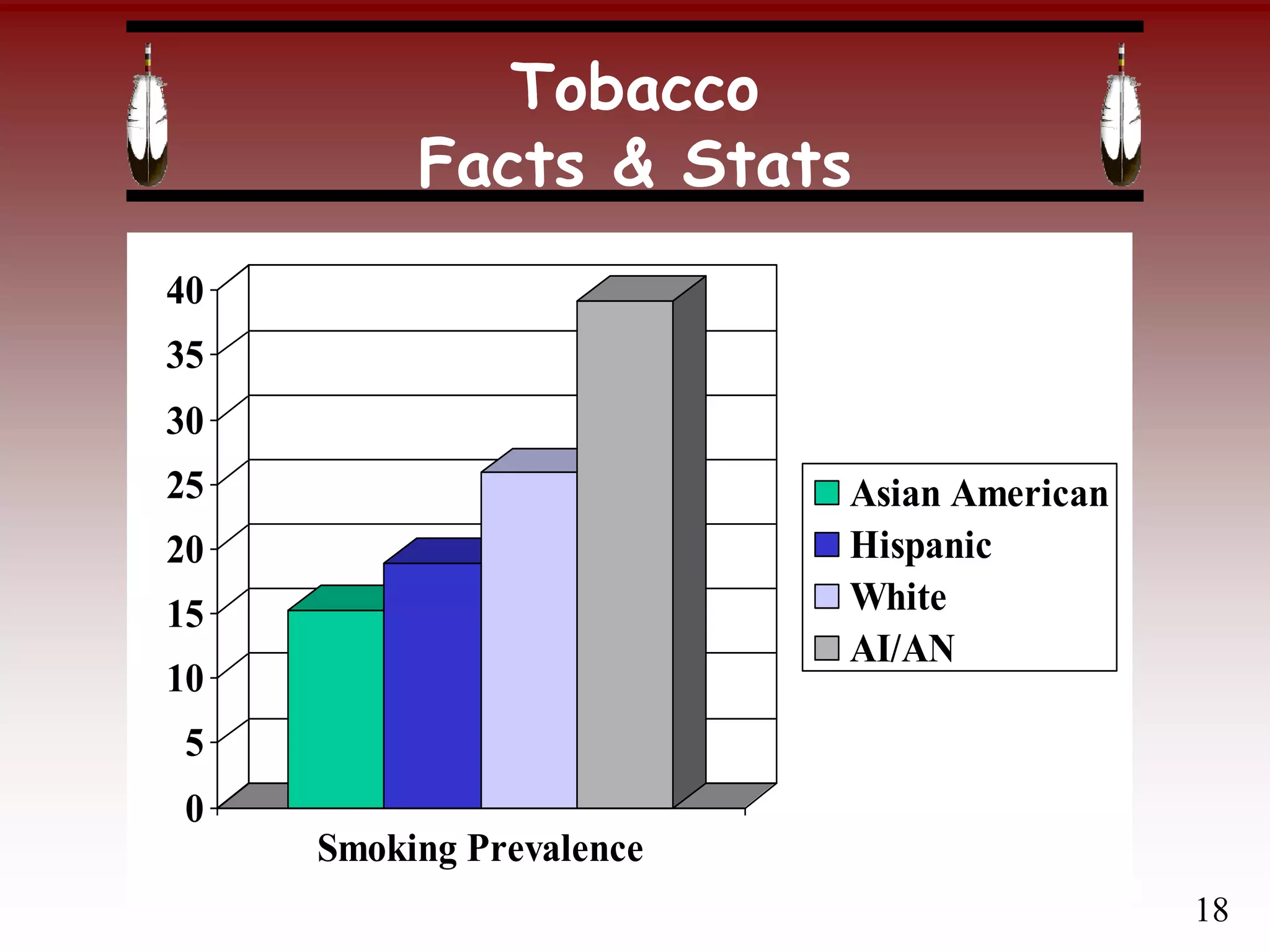
AI/AN’s 40.8%
African Americans 22.4%
Whites 23.6%
Hispanics 16.7%
Asian American/ 13.3%
Pacific Islanders
17
Tobacco
Facts & Stats
0
5
10
15
20
25
30
35
40
Smoking Prevalence
Asian American
Hispanic
White
AI/AN
18
Tobacco
Facts & Stats
85% of teenagers who smoke two or more
cigarettes completely, and overcome the
initial discomforts of smoking, will
become regular smokers.
In a study of high school seniors, only 5%
of those who smoked believed they would
still be smoking two years after graduation.
In fact, 75% were still smoking eight years
later.
One-third to one-half of young people who
try cigarettes go on to be daily smokers.
19
Tobacco
Costs
Every pack of cigarettes sold in the U.S.
costs the community $7.18 in medical
care costs and lost productivity
IHS estimates $200 million is spent each
year to treat tobacco related diseases
$75 billion in direct medical costs
associated with tobacco use each year in
U.S.
$82 billion unrealized due to loss of
productivity as a result of tobacco abuse
20
Tobacco
Individual Costs
A pack a day habit…
1 Year = $1,680
10 Years = $16,800
20 Years = $33,600
21
Tobacco
Facts & Stats
“If not one single young person
started smoking from this day
forward these losses [more than
400,000 deaths per year] would still
continue unabated for 30 years.”
C. Everett Koop (US Surgeon
General 1981-1989)
22
Chew, Snuff, plug, leaf, and dip are all
forms of smokeless tobacco
If you hold the average-sized dip in your
mouth for 30 minutes you get as much
nicotine as you would from 2-3 cigarettes
American Indian teenage girls have the
highest prevalence rates of spit tobacco
43 % of Indian youth in the Northwest use
spit tobacco
Smokeless Tobacco
Facts & Stats
23
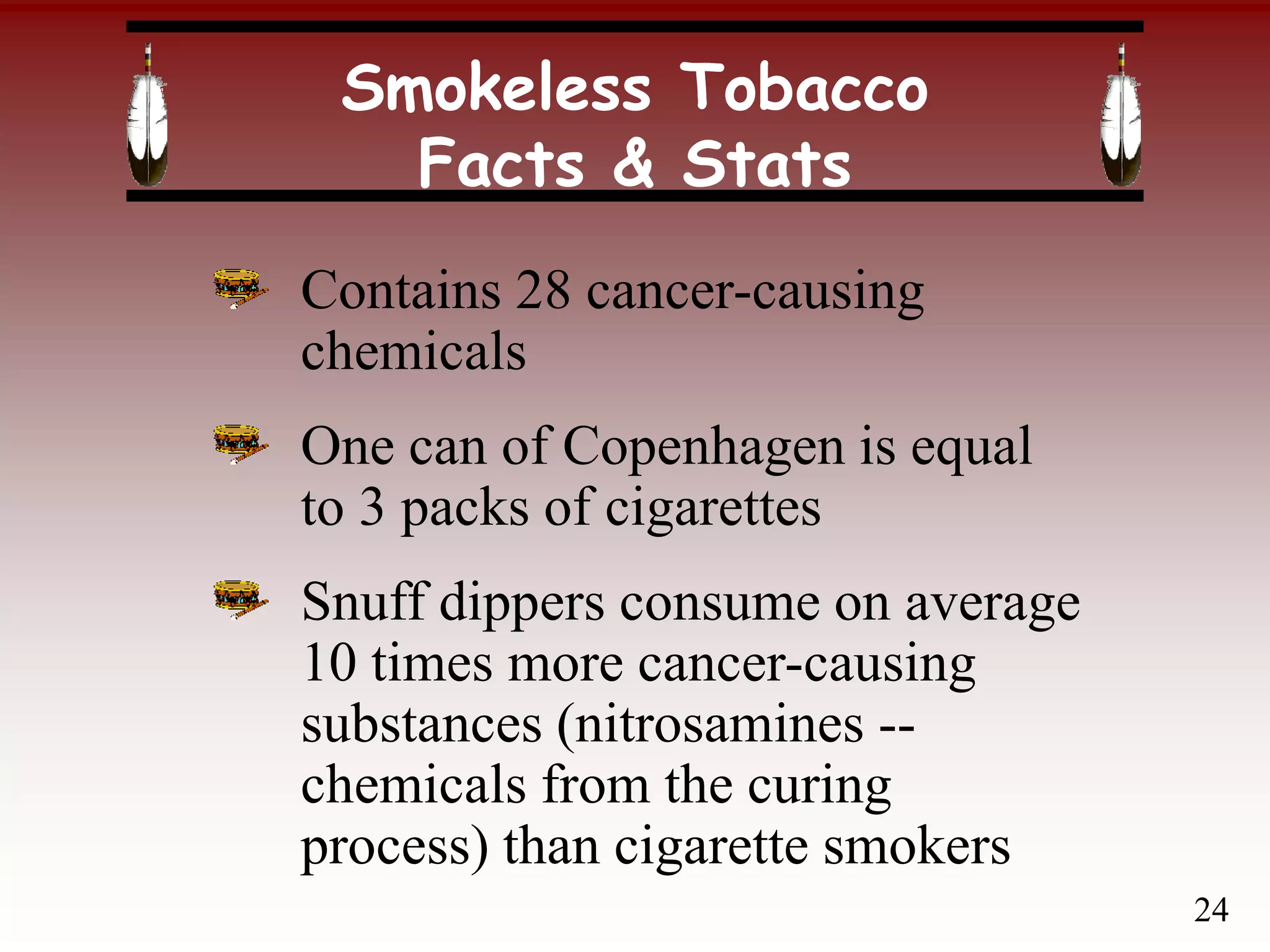
Contains 28 cancer-causing
chemicals
One can of Copenhagen is equal
to 3 packs of cigarettes
Snuff dippers consume on average
10 times more cancer-causing
substances (nitrosamines --
chemicals from the curing
process) than cigarette smokers
Smokeless Tobacco
Facts & Stats
24
Effects of
Smokeless Tobacco
Tooth Abrasion
Gum Disease
Gum Recession
Heart Disease and Stroke
Cancer in the mouth, pharynx
(voice box), esophagus and
pancreas.
25
Effects of
Smokeless Tobacco
Increased heart rate
Increased blood pressure
Bad breath
Reduced sense of smell
26
Tobacco & Cancer
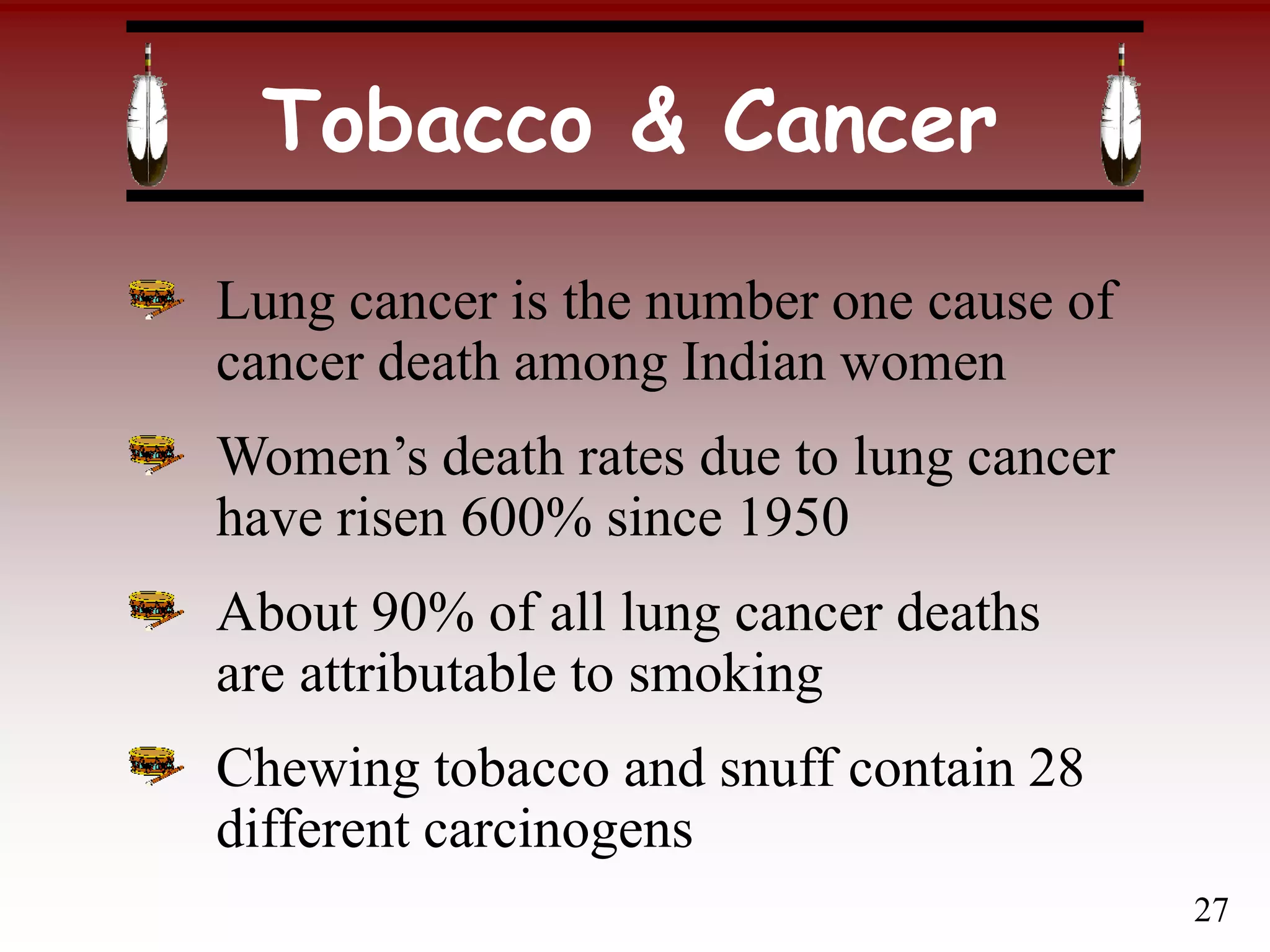
Lung cancer is the number one cause of
cancer death among Indian women
Women’s death rates due to lung cancer
have risen 600% since 1950
About 90% of all lung cancer deaths
are attributable to smoking
Chewing tobacco and snuff contain 28
different carcinogens
27
Tobacco & Cancer
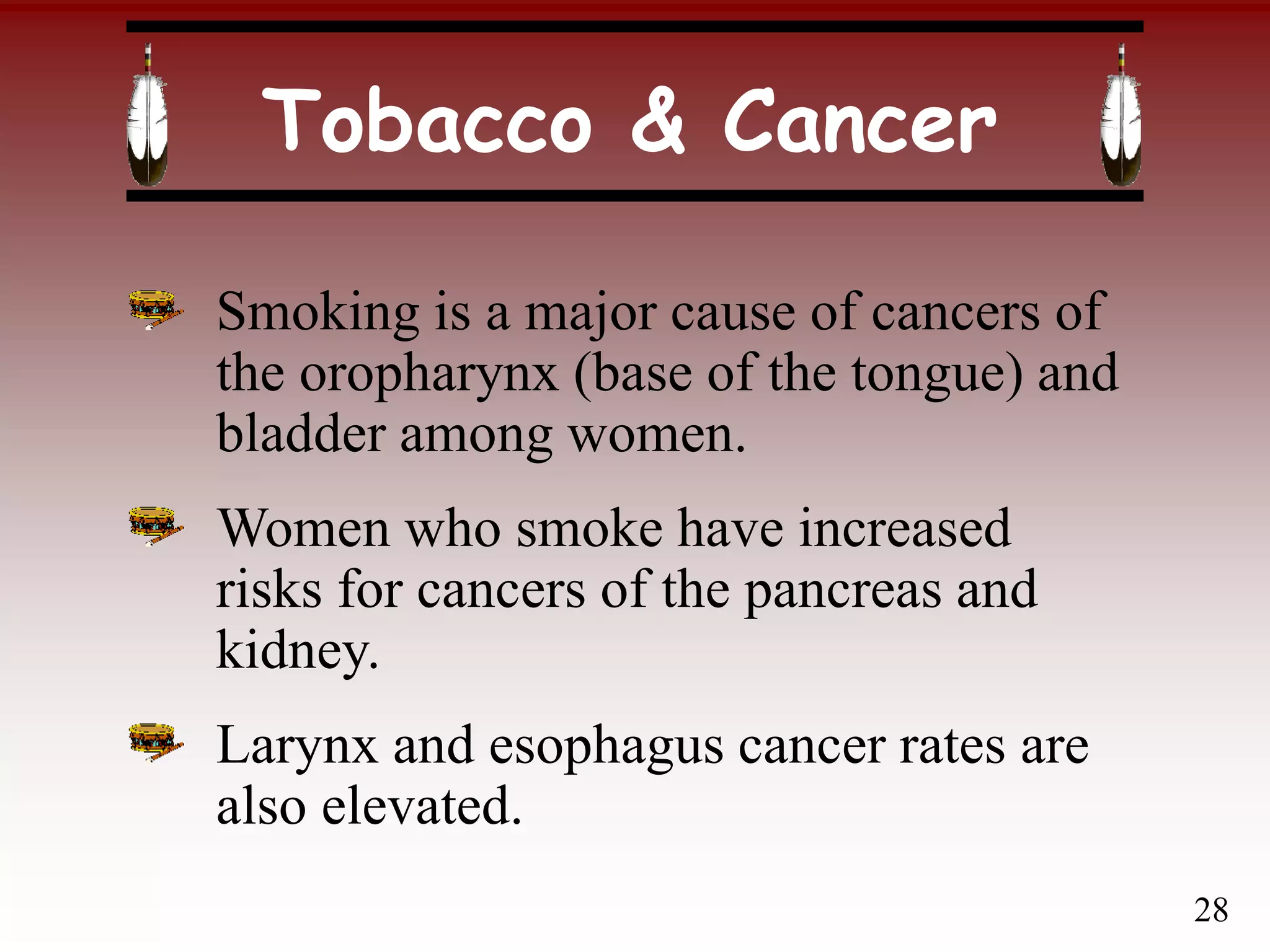
Smoking is a major cause of cancers of
the oropharynx (base of the tongue) and
bladder among women.
Women who smoke have increased
risks for cancers of the pancreas and
kidney.
Larynx and esophagus cancer rates are
also elevated.
28
Tobacco & Cancer
Cancerous tumor
in the lung
Small cell
cancer in
Smoker’s
lung
Healthy
lungs
29
Tobacco & Cancer
Research shows that smokers infected
with human papillomavirus have greater
risk of developing invasive cervical
cancer than nonsmokers with the virus.
Indian women have cervical cancer rates
3.5 times the national average. Tobacco is
one of the behavioral factors considered to
elevate the risk of cervical cancer.
30
Tobacco & Diabetes
Smoking and Diabetes both
reduce the amount of oxygen
reaching your bodily tissues,
resulting in poor circulation.
Smoking raises your blood
sugar level making it harder
to control your diabetes.
Of people with diabetes who
need amputations, 95% are
smokers.
31
Tobacco & Diabetes
Nicotine is a vessel constrictor, reducing
the body’s blood flow. Smoking increases
cholesterol levels and hardens arteries.
Diabetes increases cholesterol levels and
the levels of some other fats in your
blood.
The combined cardiovascular risks of
smoking and diabetes is as high as 14
times those of either smoking or diabetes
alone.
32
Tobacco & Diabetes
Together, diabetes and tobacco use make it
twice as likely that you will develop heart
and blood vessel disease.
People with diabetes who smoke are 3
times more likely to die of cardiovascular
disease than are other people with diabetes.
Deaths from heart disease in women with
diabetes have increased 23% over the past
30 years compared to a 27% decrease in
women without diabetes.
33
Secondhand Smoke
Smoke breathed out by a smoker and
smoke from the burning end of cigarettes,
cigars, pipes
Composed of nearly 4,000 different
chemicals and over 150 toxins including
carbon monoxide
34
Children &
Secondhand Smoke
38% of children aged 2 months to 5 years are
exposed to SHS in the home.
Up to 2,000,000 ear infections each year
Nearly 530,000 doctor visits for asthma
Up to 436,000 episodes of bronchitis in
children under five
Up to 190,000 cases of pneumonia in children
under five
35
Children &
Secondhand Smoke
Coughing and wheezing
Asthma
Sore throats and colds
Eye irritation
Hoarseness
36
Pregnancy &
Secondhand Smoke
Pregnant women
exposed to ETS 6
hours a day pass
carcinogens to the
blood of unborn
ETS for 2 hours a day
causes 2 times risk of
low birth weight
Miscarriage
Prematurity
Low birth weight
Sudden Infant
Death Syndrome
(SIDS)
37
What You Can Do…
If you smoke quit as soon as
possible!
Do not allow smoking inside your
home or car – protect others from
Secondhand smoke.
Get involved with tobacco
awareness campaigns – let others
know about the risk!
38
When You Quit…
Within 20 Minutes:
 Blood pressure drops to normal
 Pulse rate returns to normal
 Body temperature of hands and feet increases to normal
Within 8 Hours:
 Carbon Monoxide level in blood drops to normal
 Oxygen level in blood increases to normal
 Smoker's breath disappears
Within 24 Hours:
 Your chance of a heart attack decreases.
Within 48 Hours:
Nerve endings start to re-grow
Your ability to smell and taste is enhanced 39
When You Quit…
Within 72 Hours:
 Bronchial tubes relax making it easier to breathe.
 Lung capacity increases making it easier to do physical
activities
 Within 2 weeks - 3 months:
 Circulation improves
 Walking becomes easier
 Lung function increases up to 30 %
Within 1 - 9 months:
 Coughing, sinus congestion, fatigue, shortness of breath
decrease
 Energy level increases
 Cilia re-grow in lungs, increasing the ability to handle
mucus, clean lungs, reduce infection 40
When You Quit…
Within One Year:
 Risk of coronary heart disease is half that of a
smoker
Within Two Years:
 Heart attack risk drops to near normal
Within 5 Years:
 Lung cancer death rate for average pack-a-day
smoker decreases by almost half
 Stroke risk is reduced
 Risk of mouth, throat and esophageal cancer is
half that of a smoker 41
When You Quit…
Within 10 Years:
 Lung cancer death rate is similar to
that of a person who does not smoke.
 The pre-cancerous cells are replaced.
Within 15 Years:
 Risk of coronary heart disease is the
same as a person who has never
smoked.
42
Thank you!
Questions
Comments
Stories
43

Tobacco 101.ppt

  • 1.
    [Insert your name andinformation here] 1 Tobacco 101
  • 2.
    Overview Traditional tobacco Commercial tobacco Smokelesstobacco Tobacco & Cancer Tobacco & Diabetes Tobacco & Secondhand smoke 2
  • 3.
    Traditional Tobacco Stories Many indigenousnations have traditional stories of how tobacco was introduced to their communities. Many stories emphasized the sacredness of the plant and its powers to both heal if used properly and to harm us if used improperly! Some say that the original tobacco was discovered about 18,000 years ago. 3
  • 4.
    Traditional Tobacco Uses Tobacco wasused by our Medicine People for both healing and blessings. Used as a smudge… to ward off pests when the people went out to hunt and gather (the original version of “OFF”) because it contains nicotine, a natural pesticide. Given as a gift when welcoming guests to the community & as an offering to those requested to pray or share their wisdom. 4
  • 5.
    Traditional Vs. Commercial Tobacco TRADITIONALCOMMERCIAL Smoked in a pipe for ceremonial purposes Used as an offering to a healer, elder or other person as a sign of respect or thanks Medicinal tobacco was often used as a painkiller Deliberate targeting of specific consumer groups Premeditated and conscious addition of chemicals that lead to addiction Scarcely contains actual tobacco 5
  • 6.
    Commercial Tobacco Contents 4000 Chemicals 40Cancer causing agents 500 Poisons 6
  • 7.
    Nicotine Poisonous More addictive thancocaine and heroine So powerful that farmers can’t use it to kill insects Legal addiction Use results in emotional dependence  Mood leveler  Users rely on it to control emotional responses to everyday life 7
  • 8.
    Carbon Monoxide The compoundin car exhaust that causes death Causes shortness of breath Reduces the amount of oxygen blood can carry 8
  • 9.
    Tar Sticky Residue thatstains the fingers and teeth. Contains benzopyrene, one of the deadliest cancer causing agents known. 9
  • 10.
    Chemicals Acetone: fingernail polishremover Ammonia: floor/toilet cleaner Cadmium: batteries Arsenic: rat poison Methane: cow manure fumes Formaldehyde: preserver of dead bodies 10
  • 11.
  • 12.
    Nicotine Hard Habit toQuit On a milligram for milligram basis, is 10 times more potent than heroin as an addictive substance Smoking is an over-learned behavior Pack/day smoker estimates  6 doses (puffs)/cigarette  20 cigarettes per day  = 43,800 doses per year! Few behaviors occur more often. . .  Breathing  Blinking 12
  • 13.
    Nicotine Hard Habit toQuit Withdrawal Symptoms Anxiety 87% * Irritability 80% * Difficulty Concentrating 73% * Restlessness 71% Tobacco Cravings 62% Gastrointestinal Problems 33% Headaches 24% Drowsiness 22% 13
  • 14.
  • 15.
  • 16.
    Tobacco Facts & Stats 40%of all AN/AN deaths can be attributed to commercial tobacco use 50% of AI/AN teens reported some type of cigarette use (highest rate in the nation, out of all ethnic populations and age groups) 21% of AI/AN teens reported using smokeless tobacco Teens are 3 times more likely to smoke if parent or sibling smokes 16
  • 17.
    Tobacco Facts & Stats AI/AN’s40.8% African Americans 22.4% Whites 23.6% Hispanics 16.7% Asian American/ 13.3% Pacific Islanders 17
  • 18.
    Tobacco Facts & Stats 0 5 10 15 20 25 30 35 40 SmokingPrevalence Asian American Hispanic White AI/AN 18
  • 19.
    Tobacco Facts & Stats 85%of teenagers who smoke two or more cigarettes completely, and overcome the initial discomforts of smoking, will become regular smokers. In a study of high school seniors, only 5% of those who smoked believed they would still be smoking two years after graduation. In fact, 75% were still smoking eight years later. One-third to one-half of young people who try cigarettes go on to be daily smokers. 19
  • 20.
    Tobacco Costs Every pack ofcigarettes sold in the U.S. costs the community $7.18 in medical care costs and lost productivity IHS estimates $200 million is spent each year to treat tobacco related diseases $75 billion in direct medical costs associated with tobacco use each year in U.S. $82 billion unrealized due to loss of productivity as a result of tobacco abuse 20
  • 21.
    Tobacco Individual Costs A packa day habit… 1 Year = $1,680 10 Years = $16,800 20 Years = $33,600 21
  • 22.
    Tobacco Facts & Stats “Ifnot one single young person started smoking from this day forward these losses [more than 400,000 deaths per year] would still continue unabated for 30 years.” C. Everett Koop (US Surgeon General 1981-1989) 22
  • 23.
    Chew, Snuff, plug,leaf, and dip are all forms of smokeless tobacco If you hold the average-sized dip in your mouth for 30 minutes you get as much nicotine as you would from 2-3 cigarettes American Indian teenage girls have the highest prevalence rates of spit tobacco 43 % of Indian youth in the Northwest use spit tobacco Smokeless Tobacco Facts & Stats 23
  • 24.
    Contains 28 cancer-causing chemicals Onecan of Copenhagen is equal to 3 packs of cigarettes Snuff dippers consume on average 10 times more cancer-causing substances (nitrosamines -- chemicals from the curing process) than cigarette smokers Smokeless Tobacco Facts & Stats 24
  • 25.
    Effects of Smokeless Tobacco ToothAbrasion Gum Disease Gum Recession Heart Disease and Stroke Cancer in the mouth, pharynx (voice box), esophagus and pancreas. 25
  • 26.
    Effects of Smokeless Tobacco Increasedheart rate Increased blood pressure Bad breath Reduced sense of smell 26
  • 27.
    Tobacco & Cancer Lungcancer is the number one cause of cancer death among Indian women Women’s death rates due to lung cancer have risen 600% since 1950 About 90% of all lung cancer deaths are attributable to smoking Chewing tobacco and snuff contain 28 different carcinogens 27
  • 28.
    Tobacco & Cancer Smokingis a major cause of cancers of the oropharynx (base of the tongue) and bladder among women. Women who smoke have increased risks for cancers of the pancreas and kidney. Larynx and esophagus cancer rates are also elevated. 28
  • 29.
    Tobacco & Cancer Canceroustumor in the lung Small cell cancer in Smoker’s lung Healthy lungs 29
  • 30.
    Tobacco & Cancer Researchshows that smokers infected with human papillomavirus have greater risk of developing invasive cervical cancer than nonsmokers with the virus. Indian women have cervical cancer rates 3.5 times the national average. Tobacco is one of the behavioral factors considered to elevate the risk of cervical cancer. 30
  • 31.
    Tobacco & Diabetes Smokingand Diabetes both reduce the amount of oxygen reaching your bodily tissues, resulting in poor circulation. Smoking raises your blood sugar level making it harder to control your diabetes. Of people with diabetes who need amputations, 95% are smokers. 31
  • 32.
    Tobacco & Diabetes Nicotineis a vessel constrictor, reducing the body’s blood flow. Smoking increases cholesterol levels and hardens arteries. Diabetes increases cholesterol levels and the levels of some other fats in your blood. The combined cardiovascular risks of smoking and diabetes is as high as 14 times those of either smoking or diabetes alone. 32
  • 33.
    Tobacco & Diabetes Together,diabetes and tobacco use make it twice as likely that you will develop heart and blood vessel disease. People with diabetes who smoke are 3 times more likely to die of cardiovascular disease than are other people with diabetes. Deaths from heart disease in women with diabetes have increased 23% over the past 30 years compared to a 27% decrease in women without diabetes. 33
  • 34.
    Secondhand Smoke Smoke breathedout by a smoker and smoke from the burning end of cigarettes, cigars, pipes Composed of nearly 4,000 different chemicals and over 150 toxins including carbon monoxide 34
  • 35.
    Children & Secondhand Smoke 38%of children aged 2 months to 5 years are exposed to SHS in the home. Up to 2,000,000 ear infections each year Nearly 530,000 doctor visits for asthma Up to 436,000 episodes of bronchitis in children under five Up to 190,000 cases of pneumonia in children under five 35
  • 36.
    Children & Secondhand Smoke Coughingand wheezing Asthma Sore throats and colds Eye irritation Hoarseness 36
  • 37.
    Pregnancy & Secondhand Smoke Pregnantwomen exposed to ETS 6 hours a day pass carcinogens to the blood of unborn ETS for 2 hours a day causes 2 times risk of low birth weight Miscarriage Prematurity Low birth weight Sudden Infant Death Syndrome (SIDS) 37
  • 38.
    What You CanDo… If you smoke quit as soon as possible! Do not allow smoking inside your home or car – protect others from Secondhand smoke. Get involved with tobacco awareness campaigns – let others know about the risk! 38
  • 39.
    When You Quit… Within20 Minutes:  Blood pressure drops to normal  Pulse rate returns to normal  Body temperature of hands and feet increases to normal Within 8 Hours:  Carbon Monoxide level in blood drops to normal  Oxygen level in blood increases to normal  Smoker's breath disappears Within 24 Hours:  Your chance of a heart attack decreases. Within 48 Hours: Nerve endings start to re-grow Your ability to smell and taste is enhanced 39
  • 40.
    When You Quit… Within72 Hours:  Bronchial tubes relax making it easier to breathe.  Lung capacity increases making it easier to do physical activities  Within 2 weeks - 3 months:  Circulation improves  Walking becomes easier  Lung function increases up to 30 % Within 1 - 9 months:  Coughing, sinus congestion, fatigue, shortness of breath decrease  Energy level increases  Cilia re-grow in lungs, increasing the ability to handle mucus, clean lungs, reduce infection 40
  • 41.
    When You Quit… WithinOne Year:  Risk of coronary heart disease is half that of a smoker Within Two Years:  Heart attack risk drops to near normal Within 5 Years:  Lung cancer death rate for average pack-a-day smoker decreases by almost half  Stroke risk is reduced  Risk of mouth, throat and esophageal cancer is half that of a smoker 41
  • 42.
    When You Quit… Within10 Years:  Lung cancer death rate is similar to that of a person who does not smoke.  The pre-cancerous cells are replaced. Within 15 Years:  Risk of coronary heart disease is the same as a person who has never smoked. 42
  • 43.