Smoking Fábio Simões 
Ana Silva 
Mariana Carnim
Smoking – Introduction 
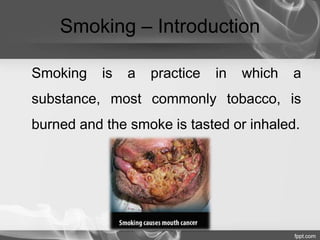
Smoking is a practice in which a 
substance, most commonly tobacco, is 
burned and the smoke is tasted or inhaled.
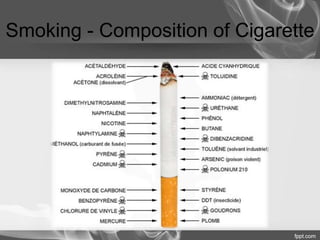
Smoking - Composition of Cigarette
Smoking 
This is primarily practised as a route of 
administration for recreational drug use, 
as combustion releases the active 
substances in drugs such as nicotine and 
makes them available for absorption 
through the lungs.
Smoking 
Smoking is one of the most common forms 
of recreational drug use. Tobacco 
smoking is today by far the most popular 
form of smoking and is practiced by over 
one billion people in the majority of all 
human societies.
Smoking 
Less common drugs for smoking 
include cannabis and opium. Some of the 
substances are classified as 
hard narcotics, like heroin.
Smoking 
The history of smoking can be dated to as 
early as 5000 BC, and has been recorded 
in many different cultures across the 
world.
Smoking 
Early smoking evolved in association with 
religious ceremonies; as offerings to 
deities, in cleansing rituals or to 
allow shamans and priests to alter their 
minds for purposes of divination or 
spiritual enlightenment.
Smoking 
Today medical studies have proven that 
smoking tobacco is among the leading 
causes of many diseases such as lung 
cancer, heart attacks, erectile 
dysfunction and can also lead to birth 
defects.
Smoking 
The inherent health hazards of smoking 
have caused many countries such as 
Singapore to institute high taxes on 
tobacco products and anti-smoking 
campaigns are launched every year in an 
attempt to curb tobacco smoking.
Smoking - History 
The history of smoking dates back to as early 
as 5000 BC in shamanistic rituals. Many 
ancient civilizations, such as the Babylonians, 
Indians and Chinese, burnt incense as a part 
of religious rituals, as did the Israelites and the 
later Catholic and Orthodox Christian 
churches.
Smoking - History 
Smoking in the Americas probably had its origins 
in the incense-burning ceremonies 
of shamans but was later adopted for pleasure, 
or as a social tool. The smoking of tobacco, as 
well as various hallucinogenic drugs was used to 
achieve trances and to come into contact with 
the spirit world.
Smoking - History 
Aztec women are 
handed flowers and 
smoking tubes before 
eating at a banquet, 
Florentine Codex, 
1500.
Smoking - History 
Substances such as Cannabis, clarified 
butter (ghee), fish offal, dried snake skins 
and various pastes molded 
around incense sticks dates back at least 
2000 years.
Smoking - History 
Before modern times these substances 
have been consumed through pipes, with 
stems of various lengths or chillums.
Smoking - History 
Reports from the first European explorers 
and conquistadors to reach the Americas 
tell of rituals where native priests smoked 
themselves into such high degrees of 
intoxication that it is unlikely that the rituals 
were limited to just tobacco.
Smoking - Popularization 
In order to meet demands from the old 
world, tobacco was grown in succession, 
quickly depleting the land. This became a 
motivator to settle west into the unknown 
continent, and likewise an expansion of 
tobacco production.
Smoking - Popularization 
Like tea, coffee and opium, tobacco was 
just one of many intoxicants that was 
originally used as a form of 
medicine. Tobacco was introduced around 
1600 by French merchants in what today 
is modern-day Gambia and Senegal.
Smoking - Popularization 
Bonsack's cigarette 
rolling machine, as 
shown on U.S. patent 
238,640.
Smoking - Opium 
In the 19th century the practice of smoking 
opium became common. Previously it had only 
been eaten, and then primarily for its medical 
properties. A massive increase in opium 
smoking in China was more or less directly 
instigated by the British trade deficit with Qing 
dynasty China.
Smoking - Opium 
As a way to amend this problem, the British 
began exporting large amounts of opium 
grown in the Indian colonies. The social 
problems and the large net loss of currency 
led to several Chinese attempts to stop the 
imports which eventually culminated in 
the Opium Wars.
Smoking - Opium 
An illustration of 
an opium den on the 
cover of Le Petit 
Journal, July 5, 1903
Smoking - Opium 
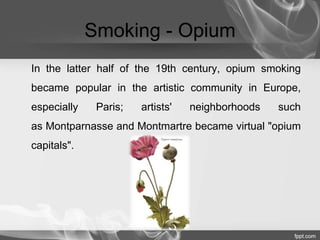
In the latter half of the 19th century, opium smoking 
became popular in the artistic community in Europe, 
especially Paris; artists' neighborhoods such 
as Montparnasse and Montmartre became virtual "opium 
capitals".
Smoking - Opium 
While opium dens that catered primarily to 
emigrant Chinese continued to exist in China 
Towns around the world, the trend among the 
European artists largely abated after the 
outbreak of World War I. The consumption of 
Opium abated in China during the Cultural 
revolution in the 1960s and 1970s.
Smoking: Substances and equipment 
The most popular type of substance that is 
smoked is tobacco. There are many different 
tobacco cultivars which are made into a wide 
variety of mixtures and brands. Tobacco is often 
sold flavored, often with various fruit aromas, 
something which is especially popular for use 
with water pipes, such as hookahs.
Smoking: Substances and equipment 
The second most common substance that is 
smoked is cannabis, made from the flowers or 
leaves of Cannabis sativa or Cannabis indica. 
The substance is considered illegal in most 
countries in the world and in those countries 
that tolerate public consumption, it is usually 
only pseudo-legal.
Smoking: Substances and equipment 
Other than actual smoking equipment, many other items 
are associated with smoking; cigarette cases, cigar 
boxes, lighters, matchboxes, cigarette holders, cigar 
holders, ashtrays, silent butlers, pipe cleaners, tobacco 
cutters, match stands, pipe tampers, cigarette 
companions and so on. Many of these have become 
valuable collector items and particularly ornate and antique 
items can fetch high prices at the finest auction houses.
Smoking: Substances and equipment 
Sebsi (Morocco).
Smoking: Substances and equipment 
An 
elaborately 
decorated 
pipe.
Smoking – Health Effects 
Male and female smokers lose an average of 
13.2 and 14.5 years of life, respectively. At least 
half of all lifelong smokers die earlier as a result 
of smoking. The risk of dying from lung cancer 
before age 85 is 22.1% for a male smoker and 
11.9% for a female current smoker, in the 
absence of competing causes of death.
Smoking – Health Effects 
Smoking can damage 
every part of the body
Smoking – Health Effects 
Smoking is a risk factor in Alzheimer's 
disease. While smoking more than 15 
cigarettes per day has been shown to worsen 
the symptoms of Crohn's disease, smoking 
has been shown to actually lower the 
prevalence of ulcerative colitis.
Smoking - Psychology 
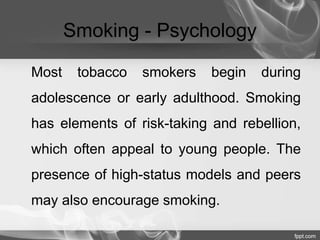
Most tobacco smokers begin during 
adolescence or early adulthood. Smoking 
has elements of risk-taking and rebellion, 
which often appeal to young people. The 
presence of high-status models and peers 
may also encourage smoking.
Smoking - Psychology 
Because teenagers are influenced more 
by their peers than by adults, attempts by 
parents, schools, and health professionals 
at preventing people from trying cigarettes 
are often unsuccessful.
Smoking - Psychology 
Sigmund Freud, whose 
doctor assisted his 
suicide because of 
oral cancer caused by 
smoking.
Smoking – Film 
Since World War II, smoking has gradually become less 
frequent on screen as the obvious health hazards of 
smoking have become more widely known. With the anti-smoking 
movement gaining greater respect and 
influence, conscious attempts not to show smoking on 
screen are now undertaken in order to avoid 
encouraging smoking or giving it positive associations, 
particularly for family films.
Smoking – Film 
Smoking on screen is more common today 
among characters who are portrayed as 
anti-social or even criminal.
Smoking – Film 
Film star and iconic 
smoker Humphrey 
Bogart.
Smoking – Economics 
Estimates claim that smokers cost the 
U.S. economy $97.6 billion a year in lost 
productivity, and that an additional $96.7 
billion is spent on public and private health 
care combined. This is over 1% of 
the gross domestic product.
Smoking – Economics 
A male smoker in the United States that smokes 
more than one pack a day can expect an 
average increase of $19,000 just in medical 
expenses over the course of his lifetime. A U.S. 
female smoker that also smokes more than a 
pack a day can expect an average of $25,800 
additional healthcare costs over her lifetime.
Smoking – Consequences 
• Heart 
– Your heart begins to beat faster as soon as you light up, as much as 
10 to 25 beats per minute. The mixture of nicotine and carbon 
monoxide in each cigarette you smoke temporarily increases your 
heart rate and blood pressure, straining your heart and blood 
vessels; is directly responsible for at least 20% of all deaths from 
heart disease; that’s because smoking is a major cause of coronary 
artery disease; causes fat deposits to narrow and block blood 
vessels which leads to heart attack. Smokers are also two to four 
times more likely to develop coronary heart disease.
Smoking – Consequences 
• Lungs 
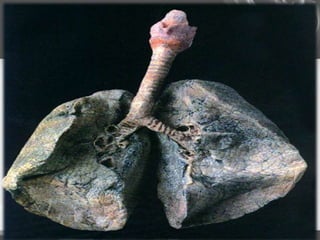
– Smoking causes injury to the airways and lungs, 
leading to a deadly lung condition. Smokers are 
more likely than nonsmokers to have upper and 
lower breathing tract infections. Smoking is related 
to chronic coughing, wheezing, and asthma among 
children and teens. Smoking is related to chronic 
coughing and wheezing among adults.
Smoking – Consequences 
• Cancer 
– Lung cancer is just one of the serious health risks 
caused by smoking. Men who smoke are ten 
times more likely to die from lung cancer than 
non-smokers. Smokers are also susceptible to 
cancers of the larynx, mouth, esophagus, 
bladder, pancreas, kidney, cervix and stomach.
Smoking – Consequences 
• Eyes 
– Smoking causes physical changes in the eyes that can 
threaten your eyesight. Nicotine from cigarettes restricts the 
production of a chemical necessary for you to be able to see 
at night; smoking increases your risk of developing cataracts 
and macular degeneration Research has shown that smokers 
are about three times more likely to develop cataracts; a 
gradual thickening that develops in the lens of the eye. 
Smoke can also cause serious irritation for those who wear 
soft contact lenses
Smoking – Consequences 
• Nose and Throat 
– Irritating gases in cigarette smoke, such as formaldehyde, 
ammonia, hydrogen sulfide and others, can cause serious 
irritation to the sensitive membranes in the nose and 
throat. The results: a runny nose and the proverbial 
smoker's cough. Continued exposure can produce 
abnormal thickening in the throat lining, a condition, when 
accompanied with cellular changes, that has been linked 
to throat cancer.
Smoking – Consequences 
• Mouth 
– Stained yellow teeth, bad breath and an acute loss in your 
sense of taste are just some of the less serious 
consequences of smoking. Smoking as well as the use of spit 
tobacco or "chew" can also contribute to cancer of the lips, 
gums and throat. Smokers have more oral health problems 
than non-smokers, like mouth sores, ulcers and gum disease. 
You are more likely to have cavities and lose your teeth at a 
younger age. You are also more likely to get cancers of the 
mouth and throat.
Smoking – Consequences 
• Skin 
– The blood vessels in the skin constrict when you light up, 
limiting the amount of oxygen the skin gets. "Smoker's 
face" is a condition long-term smokers suffer from. Deep, 
dark lines around the eyes and the corners of the mouth, 
for starters. The skin may also appear gray in color, and 
facial features may appear gaunt. Not a pretty sight. One 
study shows that nearly half of all smokers get smoker's 
face.
Smoking – Consequences 
• Male Reproductive System 
– Smoking increases the risk of erectile 
dysfunction - the inability to get or keep and 
erection. Toxins from cigarette smoke can 
also damage the genetic material in sperm, 
which can cause infertility or genetic defects 
in your children.
Smoking – Consequences 
• Female Reproductive System 
– Women who smoke have a harder time getting pregnant and 
having a healthy baby. Cigarette smoking increases the risk 
for infertility, preterm delivery, stillbirth, low birth weight, and 
sudden infant death syndrome (SIDS). The nicotine in 
cigarette smoke reduces the amount of oxygen reaching the 
fetus. Smoking can also lead to early menopause, which 
increases your risk of developing certain diseases (like heart 
disease).
Smoking – Consequences 
• Breast Cancer 
– Research is finding a connection between the 
risk of developing breast cancer and smoking.
Smoking – Consequences 
• Bones 
– Smokers have a higher risk of developing 
osteoporosis, a condition that involves bone 
thinning. The loss of bone tissue, more prevalent 
among women, can result in an increase of bone 
fractures and an increased risk for hip fracture 
than women who never smoked.
Smoking – Consequences 
• Blood 
– Smoking causes your blood pressure rises by about 10 to 15 percent. 
High blood pressure means you have an increased risk of heart attack 
and stroke. Smoking not only affects the pressure, but it also damages 
the blood itself. Carbon monoxide (CO) is created and ingested - so 
much that smokers have about 4 to 15 times the amount of CO in the 
body than non-smokers. Carbon monoxide also is the same stuff that 
comes out of your car's tailpipe. When you smoke, it stays in your 
bloodstream for about six hours. This harmful chemical compound does 
its best to rob every cell in your body of oxygen, something cells need to 
function.
Smoking – Consequences 
• Digestive System 
– Smoking can harm all parts of the digestive system, 
contributing to such common disorders as heartburn and 
peptic ulcers. Smoking increases the risk of Crohn's disease, 
and possibly gallstones, which form when liquid stored in the 
gallbladder hardens into pieces of stone-like material. 
Smoking also damages the liver. Smoking also affects the 
way the liver operates, particularly in terms of how it 
processes alcohol.
Now if you excuse me I'll 
just smoke a cigarette ;)
Smoking

Smoking

  • 1.
    Smoking Fábio Simões Ana Silva Mariana Carnim
  • 2.
    Smoking – Introduction Smoking is a practice in which a substance, most commonly tobacco, is burned and the smoke is tasted or inhaled.
  • 3.
  • 4.
    Smoking This isprimarily practised as a route of administration for recreational drug use, as combustion releases the active substances in drugs such as nicotine and makes them available for absorption through the lungs.
  • 5.
    Smoking Smoking isone of the most common forms of recreational drug use. Tobacco smoking is today by far the most popular form of smoking and is practiced by over one billion people in the majority of all human societies.
  • 6.
    Smoking Less commondrugs for smoking include cannabis and opium. Some of the substances are classified as hard narcotics, like heroin.
  • 7.
    Smoking The historyof smoking can be dated to as early as 5000 BC, and has been recorded in many different cultures across the world.
  • 8.
    Smoking Early smokingevolved in association with religious ceremonies; as offerings to deities, in cleansing rituals or to allow shamans and priests to alter their minds for purposes of divination or spiritual enlightenment.
  • 9.
    Smoking Today medicalstudies have proven that smoking tobacco is among the leading causes of many diseases such as lung cancer, heart attacks, erectile dysfunction and can also lead to birth defects.
  • 10.
    Smoking The inherenthealth hazards of smoking have caused many countries such as Singapore to institute high taxes on tobacco products and anti-smoking campaigns are launched every year in an attempt to curb tobacco smoking.
  • 12.
    Smoking - History The history of smoking dates back to as early as 5000 BC in shamanistic rituals. Many ancient civilizations, such as the Babylonians, Indians and Chinese, burnt incense as a part of religious rituals, as did the Israelites and the later Catholic and Orthodox Christian churches.
  • 13.
    Smoking - History Smoking in the Americas probably had its origins in the incense-burning ceremonies of shamans but was later adopted for pleasure, or as a social tool. The smoking of tobacco, as well as various hallucinogenic drugs was used to achieve trances and to come into contact with the spirit world.
  • 14.
    Smoking - History Aztec women are handed flowers and smoking tubes before eating at a banquet, Florentine Codex, 1500.
  • 15.
    Smoking - History Substances such as Cannabis, clarified butter (ghee), fish offal, dried snake skins and various pastes molded around incense sticks dates back at least 2000 years.
  • 16.
    Smoking - History Before modern times these substances have been consumed through pipes, with stems of various lengths or chillums.
  • 17.
    Smoking - History Reports from the first European explorers and conquistadors to reach the Americas tell of rituals where native priests smoked themselves into such high degrees of intoxication that it is unlikely that the rituals were limited to just tobacco.
  • 19.
    Smoking - Popularization In order to meet demands from the old world, tobacco was grown in succession, quickly depleting the land. This became a motivator to settle west into the unknown continent, and likewise an expansion of tobacco production.
  • 20.
    Smoking - Popularization Like tea, coffee and opium, tobacco was just one of many intoxicants that was originally used as a form of medicine. Tobacco was introduced around 1600 by French merchants in what today is modern-day Gambia and Senegal.
  • 21.
    Smoking - Popularization Bonsack's cigarette rolling machine, as shown on U.S. patent 238,640.
  • 22.
    Smoking - Opium In the 19th century the practice of smoking opium became common. Previously it had only been eaten, and then primarily for its medical properties. A massive increase in opium smoking in China was more or less directly instigated by the British trade deficit with Qing dynasty China.
  • 23.
    Smoking - Opium As a way to amend this problem, the British began exporting large amounts of opium grown in the Indian colonies. The social problems and the large net loss of currency led to several Chinese attempts to stop the imports which eventually culminated in the Opium Wars.
  • 24.
    Smoking - Opium An illustration of an opium den on the cover of Le Petit Journal, July 5, 1903
  • 25.
    Smoking - Opium In the latter half of the 19th century, opium smoking became popular in the artistic community in Europe, especially Paris; artists' neighborhoods such as Montparnasse and Montmartre became virtual "opium capitals".
  • 26.
    Smoking - Opium While opium dens that catered primarily to emigrant Chinese continued to exist in China Towns around the world, the trend among the European artists largely abated after the outbreak of World War I. The consumption of Opium abated in China during the Cultural revolution in the 1960s and 1970s.
  • 28.
    Smoking: Substances andequipment The most popular type of substance that is smoked is tobacco. There are many different tobacco cultivars which are made into a wide variety of mixtures and brands. Tobacco is often sold flavored, often with various fruit aromas, something which is especially popular for use with water pipes, such as hookahs.
  • 29.
    Smoking: Substances andequipment The second most common substance that is smoked is cannabis, made from the flowers or leaves of Cannabis sativa or Cannabis indica. The substance is considered illegal in most countries in the world and in those countries that tolerate public consumption, it is usually only pseudo-legal.
  • 30.
    Smoking: Substances andequipment Other than actual smoking equipment, many other items are associated with smoking; cigarette cases, cigar boxes, lighters, matchboxes, cigarette holders, cigar holders, ashtrays, silent butlers, pipe cleaners, tobacco cutters, match stands, pipe tampers, cigarette companions and so on. Many of these have become valuable collector items and particularly ornate and antique items can fetch high prices at the finest auction houses.
  • 31.
    Smoking: Substances andequipment Sebsi (Morocco).
  • 32.
    Smoking: Substances andequipment An elaborately decorated pipe.
  • 33.
    Smoking – HealthEffects Male and female smokers lose an average of 13.2 and 14.5 years of life, respectively. At least half of all lifelong smokers die earlier as a result of smoking. The risk of dying from lung cancer before age 85 is 22.1% for a male smoker and 11.9% for a female current smoker, in the absence of competing causes of death.
  • 35.
    Smoking – HealthEffects Smoking can damage every part of the body
  • 36.
    Smoking – HealthEffects Smoking is a risk factor in Alzheimer's disease. While smoking more than 15 cigarettes per day has been shown to worsen the symptoms of Crohn's disease, smoking has been shown to actually lower the prevalence of ulcerative colitis.
  • 38.
    Smoking - Psychology Most tobacco smokers begin during adolescence or early adulthood. Smoking has elements of risk-taking and rebellion, which often appeal to young people. The presence of high-status models and peers may also encourage smoking.
  • 39.
    Smoking - Psychology Because teenagers are influenced more by their peers than by adults, attempts by parents, schools, and health professionals at preventing people from trying cigarettes are often unsuccessful.
  • 40.
    Smoking - Psychology Sigmund Freud, whose doctor assisted his suicide because of oral cancer caused by smoking.
  • 42.
    Smoking – Film Since World War II, smoking has gradually become less frequent on screen as the obvious health hazards of smoking have become more widely known. With the anti-smoking movement gaining greater respect and influence, conscious attempts not to show smoking on screen are now undertaken in order to avoid encouraging smoking or giving it positive associations, particularly for family films.
  • 43.
    Smoking – Film Smoking on screen is more common today among characters who are portrayed as anti-social or even criminal.
  • 44.
    Smoking – Film Film star and iconic smoker Humphrey Bogart.
  • 45.
    Smoking – Economics Estimates claim that smokers cost the U.S. economy $97.6 billion a year in lost productivity, and that an additional $96.7 billion is spent on public and private health care combined. This is over 1% of the gross domestic product.
  • 46.
    Smoking – Economics A male smoker in the United States that smokes more than one pack a day can expect an average increase of $19,000 just in medical expenses over the course of his lifetime. A U.S. female smoker that also smokes more than a pack a day can expect an average of $25,800 additional healthcare costs over her lifetime.
  • 48.
    Smoking – Consequences • Heart – Your heart begins to beat faster as soon as you light up, as much as 10 to 25 beats per minute. The mixture of nicotine and carbon monoxide in each cigarette you smoke temporarily increases your heart rate and blood pressure, straining your heart and blood vessels; is directly responsible for at least 20% of all deaths from heart disease; that’s because smoking is a major cause of coronary artery disease; causes fat deposits to narrow and block blood vessels which leads to heart attack. Smokers are also two to four times more likely to develop coronary heart disease.
  • 50.
    Smoking – Consequences • Lungs – Smoking causes injury to the airways and lungs, leading to a deadly lung condition. Smokers are more likely than nonsmokers to have upper and lower breathing tract infections. Smoking is related to chronic coughing, wheezing, and asthma among children and teens. Smoking is related to chronic coughing and wheezing among adults.
  • 51.
    Smoking – Consequences • Cancer – Lung cancer is just one of the serious health risks caused by smoking. Men who smoke are ten times more likely to die from lung cancer than non-smokers. Smokers are also susceptible to cancers of the larynx, mouth, esophagus, bladder, pancreas, kidney, cervix and stomach.
  • 53.
    Smoking – Consequences • Eyes – Smoking causes physical changes in the eyes that can threaten your eyesight. Nicotine from cigarettes restricts the production of a chemical necessary for you to be able to see at night; smoking increases your risk of developing cataracts and macular degeneration Research has shown that smokers are about three times more likely to develop cataracts; a gradual thickening that develops in the lens of the eye. Smoke can also cause serious irritation for those who wear soft contact lenses
  • 54.
    Smoking – Consequences • Nose and Throat – Irritating gases in cigarette smoke, such as formaldehyde, ammonia, hydrogen sulfide and others, can cause serious irritation to the sensitive membranes in the nose and throat. The results: a runny nose and the proverbial smoker's cough. Continued exposure can produce abnormal thickening in the throat lining, a condition, when accompanied with cellular changes, that has been linked to throat cancer.
  • 55.
    Smoking – Consequences • Mouth – Stained yellow teeth, bad breath and an acute loss in your sense of taste are just some of the less serious consequences of smoking. Smoking as well as the use of spit tobacco or "chew" can also contribute to cancer of the lips, gums and throat. Smokers have more oral health problems than non-smokers, like mouth sores, ulcers and gum disease. You are more likely to have cavities and lose your teeth at a younger age. You are also more likely to get cancers of the mouth and throat.
  • 57.
    Smoking – Consequences • Skin – The blood vessels in the skin constrict when you light up, limiting the amount of oxygen the skin gets. "Smoker's face" is a condition long-term smokers suffer from. Deep, dark lines around the eyes and the corners of the mouth, for starters. The skin may also appear gray in color, and facial features may appear gaunt. Not a pretty sight. One study shows that nearly half of all smokers get smoker's face.
  • 58.
    Smoking – Consequences • Male Reproductive System – Smoking increases the risk of erectile dysfunction - the inability to get or keep and erection. Toxins from cigarette smoke can also damage the genetic material in sperm, which can cause infertility or genetic defects in your children.
  • 59.
    Smoking – Consequences • Female Reproductive System – Women who smoke have a harder time getting pregnant and having a healthy baby. Cigarette smoking increases the risk for infertility, preterm delivery, stillbirth, low birth weight, and sudden infant death syndrome (SIDS). The nicotine in cigarette smoke reduces the amount of oxygen reaching the fetus. Smoking can also lead to early menopause, which increases your risk of developing certain diseases (like heart disease).
  • 60.
    Smoking – Consequences • Breast Cancer – Research is finding a connection between the risk of developing breast cancer and smoking.
  • 62.
    Smoking – Consequences • Bones – Smokers have a higher risk of developing osteoporosis, a condition that involves bone thinning. The loss of bone tissue, more prevalent among women, can result in an increase of bone fractures and an increased risk for hip fracture than women who never smoked.
  • 63.
    Smoking – Consequences • Blood – Smoking causes your blood pressure rises by about 10 to 15 percent. High blood pressure means you have an increased risk of heart attack and stroke. Smoking not only affects the pressure, but it also damages the blood itself. Carbon monoxide (CO) is created and ingested - so much that smokers have about 4 to 15 times the amount of CO in the body than non-smokers. Carbon monoxide also is the same stuff that comes out of your car's tailpipe. When you smoke, it stays in your bloodstream for about six hours. This harmful chemical compound does its best to rob every cell in your body of oxygen, something cells need to function.
  • 64.
    Smoking – Consequences • Digestive System – Smoking can harm all parts of the digestive system, contributing to such common disorders as heartburn and peptic ulcers. Smoking increases the risk of Crohn's disease, and possibly gallstones, which form when liquid stored in the gallbladder hardens into pieces of stone-like material. Smoking also damages the liver. Smoking also affects the way the liver operates, particularly in terms of how it processes alcohol.
  • 66.
    Now if youexcuse me I'll just smoke a cigarette ;)