CIGARETTE SMOKING AND
ITS ILL EFFECTS
- BY AJITA SADHUKHAN
Facts about smoking
 1/3rd of world population-Smoker
Males: > 1 billion
Females: > 250 million
 Industrialized Countries
% of Male smokers: 50%
% of Female smokers 22%
 Developing countries
Males 35%
Females 9%
(Source: World Health Report)
2
Facts about smoking
Three million deaths annually because
of smoking – means one death after
every 8 seconds.
Ten million deaths annually expected by
2020 - means one death after every
three seconds.
Developed countries have reduced
smoking by 10% while developing
countries have increased by 60% after
1970.
3
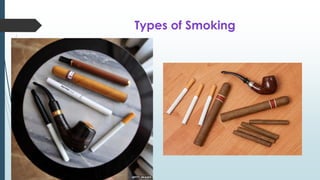
Types of tobacco smoking
 Cigarette - Most common and most harmful (a small cylinder of finely cut
tobacco leaves rolled in thin paper for smoking)
 Bidi(a type of cheap cigarette made of unprocessed tobacco wrapped in
leaves)
 Tobacco chewing(a type of smokeless tobacco product consumed by
placing a portion of the tobacco between the cheek and gum or upper lip
teeth)
 Hookah(Hubble bubble)(single or multi-stemmed instrument for vaporizing
and smoking flavoured tobacco, or sometimes cannabis, whose vapor or
smoke is passed through a water basin—often glass-based—before
inhalation)
 Cigar(a tightly-rolled bundle of dried and fermented tobacco leaf, rolled in a series of types and sizes)
 Snuff – Moist & Dry (fine-ground tobacco, intended for consumption by being inhaled or sniffed into
the nose)
 E-cigarette( a handheld electronic device that vaporizes a flavored liquid. The user inhales the vapor.)
4
Types of Smoking
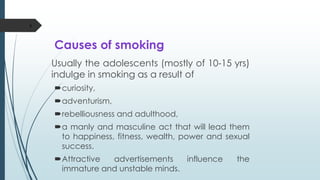
Causes of smoking
Usually the adolescents (mostly of 10-15 yrs)
indulge in smoking as a result of
curiosity,
adventurism,
rebelliousness and adulthood,
a manly and masculine act that will lead them
to happiness, fitness, wealth, power and sexual
success.
Attractive advertisements influence the
immature and unstable minds.
6
Smoking a cigarette gives you:
 Nicotine
 Carbon monoxide
 Tar
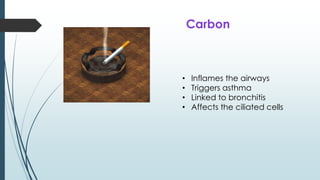
 Carbon
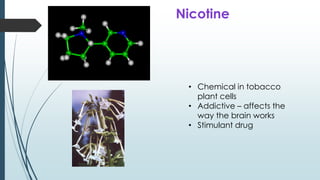
• Chemical in tobacco
plant cells
• Addictive – affects the
way the brain works
• Stimulant drug
Nicotine
Effects of Nicotine
 Smokers have to maintain a level of nicotine in
the blood for normal working.
 Smokers have to smoke to avoid the discomfort
experienced while not smoking.
9
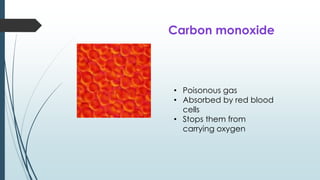
• Poisonous gas
• Absorbed by red blood
cells
• Stops them from
carrying oxygen
Carbon monoxide
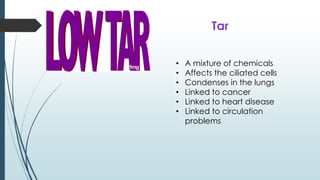
• A mixture of chemicals
• Affects the ciliated cells
• Condenses in the lungs
• Linked to cancer
• Linked to heart disease
• Linked to circulation
problems
Tar
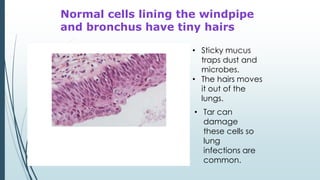
Normal cells lining the windpipe
and bronchus have tiny hairs
• Tar can
damage
these cells so
lung
infections are
common.
• Sticky mucus
traps dust and
microbes.
• The hairs moves
it out of the
lungs.
• Inflames the airways
• Triggers asthma
• Linked to bronchitis
• Affects the ciliated cells
Carbon
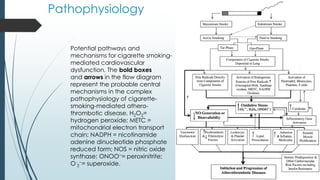
Pathophysiology
Potential pathways and
mechanisms for cigarette smoking-
mediated cardiovascular
dysfunction. The bold boxes
and arrows in the flow diagram
represent the probable central
mechanisms in the complex
pathophysiology of cigarette-
smoking-mediated athero-
thrombotic disease. H2O2=
hydrogen peroxide; METC =
mitochondrial electron transport
chain; NADPH = nicotinamide
adenine dinucleotide phosphate
reduced form; NOS = nitric oxide
synthase; ONOO−= peroxinitrite;
O·
2
−= superoxide.
Consequences of smoking
 Economic loss
 Health loss
 Socio-cultural loss
 Psychological loss
15
Smoking and Diseases
 An important causative/risk factor for various diseases.
 About 25 diseases caused/aggravated by smoking. e.g.
 Lung cancer: 80-90% deaths due to smoking. Incidence 10 times more than non-smokers.
 Chronic bronchitis
 Emphysema: 80- 95%
 Ischaemic heart disease: 20-30% deaths . Risk is twice than non-smokers
 Obstructive peripheral vascular disease
Cerebrovascular disease
Cancer of tongue, oesophagus, larynx & pancreas, Gastro-
duodenal ulcers
Cancer of the cervix and endometrium
Cancer of the urinary bladder
Still births, abortions
Neonatal deaths
Fracture of hip, wrist and vertebrae
16
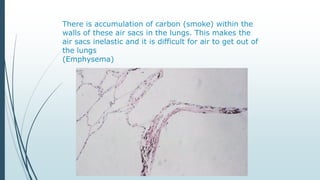
There is accumulation of carbon (smoke) within the
walls of these air sacs in the lungs. This makes the
air sacs inelastic and it is difficult for air to get out of
the lungs
(Emphysema)
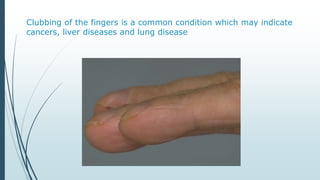
Clubbing of the fingers is a common condition which may indicate
cancers, liver diseases and lung disease
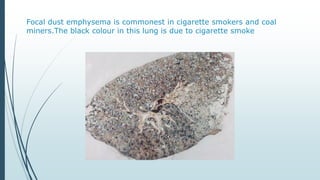
Focal dust emphysema is commonest in cigarette smokers and coal
miners.The black colour in this lung is due to cigarette smoke
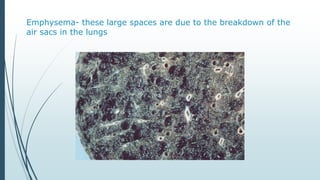
Emphysema- these large spaces are due to the breakdown of the
air sacs in the lungs
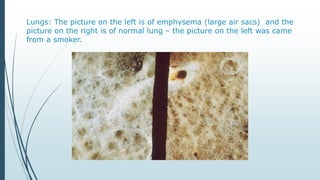
Lungs: The picture on the left is of emphysema (large air sacs) and the
picture on the right is of normal lung – the picture on the left was came
from a smoker.
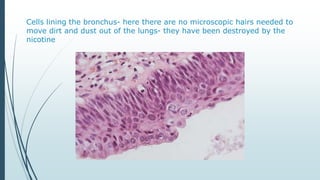
Cells lining the bronchus- here there are no microscopic hairs needed to
move dirt and dust out of the lungs- they have been destroyed by the
nicotine
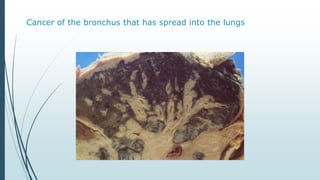
Cancer of the bronchus that has spread into the lungs
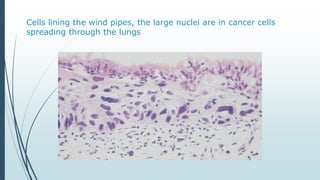
Cells lining the wind pipes, the large nuclei are in cancer cells
spreading through the lungs
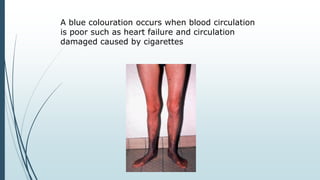
A blue colouration occurs when blood circulation
is poor such as heart failure and circulation
damaged caused by cigarettes
Most amputations
in the United
Kingdom are a
direct result of
smoking
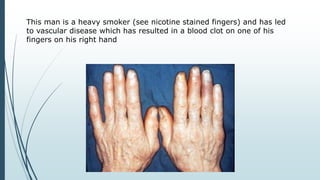
This man is a heavy smoker (see nicotine stained fingers) and has led
to vascular disease which has resulted in a blood clot on one of his
fingers on his right hand
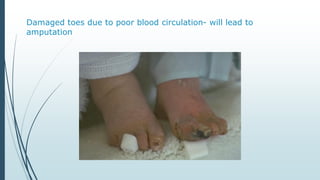
Damaged toes due to poor blood circulation- will lead to
amputation
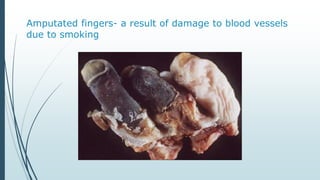
Amputated fingers- a result of damage to blood vessels
due to smoking
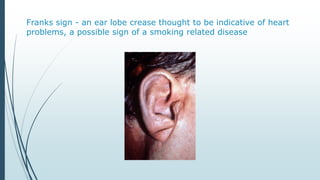
Franks sign - an ear lobe crease thought to be indicative of heart
problems, a possible sign of a smoking related disease
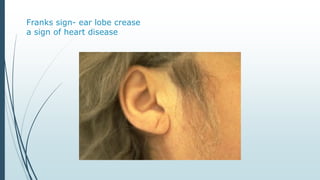
Franks sign- ear lobe crease
a sign of heart disease
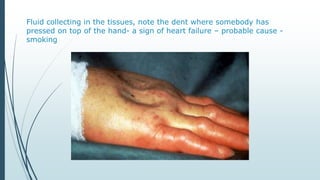
Fluid collecting in the tissues, note the dent where somebody has
pressed on top of the hand- a sign of heart failure – probable cause -
smoking
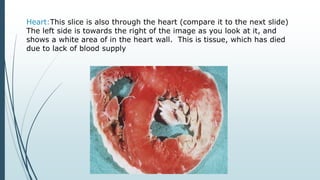
Heart:This slice is also through the heart (compare it to the next slide)
The left side is towards the right of the image as you look at it, and
shows a white area of in the heart wall. This is tissue, which has died
due to lack of blood supply
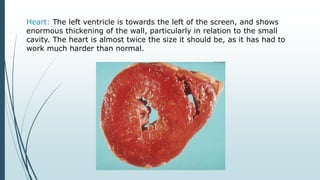
Heart: The left ventricle is towards the left of the screen, and shows
enormous thickening of the wall, particularly in relation to the small
cavity. The heart is almost twice the size it should be, as it has had to
work much harder than normal.
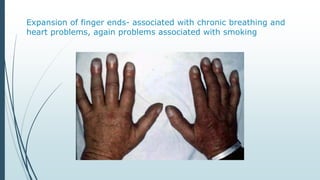
Expansion of finger ends- associated with chronic breathing and
heart problems, again problems associated with smoking
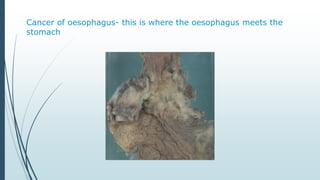
Cancer of oesophagus- this is where the oesophagus meets the
stomach
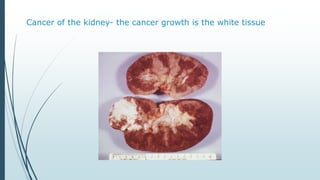
Cancer of the kidney- the cancer growth is the white tissue
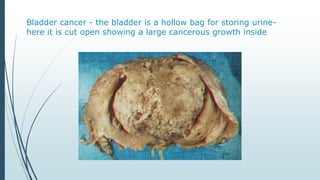
Bladder cancer - the bladder is a hollow bag for storing urine-
here it is cut open showing a large cancerous growth inside
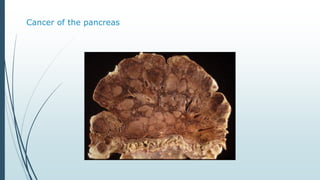
Cancer of the pancreas
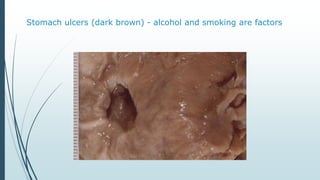
Stomach ulcers (dark brown) - alcohol and smoking are factors
Occupational Hazards & Smoking
Effect of smoking in the presence of pollutants like
asbestos, cotton, radioactive environment is either
multiplicative or additive.
41
Smoking during pregnancy
 Foetal retardation and growth retardation in
the children.
 Children of smokers are more prone to
become smokers later on.
42
Effects of Second Hand (Passive)
Smoking(SHS)
Children
Sudden infant death
Respiratory distress
Otitis media
Adults
Leads to discomfort, distress to asthmatics
 Nicotine is detected in blood and urine of passive
smokers.
Passive smoking by adults may lead to Ca-cervix,
CA lung, and coronary heart disease.
43
Treatment
Drugs
Nicotine replacement therapy
Patches
Gums
Nasal sprays
Inhalers
E-cigarettes
Hypnotics
Group therapy
44
Treatment
Real Treatment is by
 Motivation
 Commitment
 Determination and
 Effort and support in the struggle to quit
smoking.
45
Preventive measures
 Recommendations of WHO Framework Convention on
Tobacco Control (FCTC) should be implemented.
 Govt.’s responsibility for implementation of
recommendations and legislation.
 Ascertain the existence of smoking as health problem.
 Encourage not to start smoking.
 Encourage to stop smoking.
 Multi-sectoral approach.
46
Preventive measures
 Anti-smoking health education to general public but
special emphasis to focus on children and to the
occupational groups.
 Highlighting the positive effects of NOT smoking and
QUITING smoking.
 Awareness for the rights of non-smokers.
 Legislative action
47
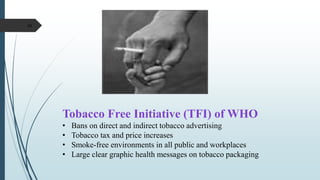
Tobacco Free Initiative (TFI) of WHO
• Bans on direct and indirect tobacco advertising
• Tobacco tax and price increases
• Smoke-free environments in all public and workplaces
• Large clear graphic health messages on tobacco packaging
48
Stepwise approach to quit smoking
Five Major Steps to Intervention (The "5 A's")
Successful intervention begins with identifying users and appropriate interventions based
upon the patient's willingness to quit. The five major steps to intervention are the "5 A's": Ask,
Advise, Assess, Assist, and Arrange.
 Ask - Identify and document tobacco use status for every patient at every visit. (You may
wish to develop your own vital signs sticker, based on the sample below).
 Advise - In a clear, strong, and personalized manner, urge every tobacco user to quit.
 Assess - Is the tobacco user willing to make a quit attempt at this time?
 Assist - For the patient willing to make a quit attempt, use counseling and
pharmacotherapy to help him or her quit. (See Counseling Patients To Quit and
pharmacotherapy information in this packet).
 Arrange - Schedule followup contact, in person or by telephone, preferably within the first
week after the quit date.
When smokers quit
Just 20 minutes after the smokers have smoked
the last cigarette, their body begins an ongoing
series of beneficial changes.
After 20 minutes:
Blood pressure drops to normal.
Pulse rate drops to normal.
Temperature of hands becomes normal.
After 8 hours:
Carbon monoxide level in blood drops to normal
Oxygen level in blood increases to normal.
50
When smokers quit
After 24 hours:
Chance of heart attack decreases
After 48 hours:
Nerve endings start growing.
Ability to smell and taste is enhanced.
Walking becomes easier.
After 2 weeks –3 months:
Circulation improves.
Lung function increases up to 30%.
51
When smokers quit
After 1-9 months:
Coughing, sneezing, congestion, fatigue,
shortness of breath decrease.
Cilia re-grow in the lungs, increasing ability
to handle mucous, clean the lungs and to
reduce infection.
1 year:
Risk of coronary heart disease is half that of
a smoker.
5 years after:
Stroke risk is reduced to that of a nonsmoker.
52
When smokers quit
 After 10 years:
The lung cancer death rate is about half
that of a continuing smoker's. The risk of
cancer of the mouth, throat, esophagus,
bladder, kidney, and pancreas decreases.
 After 15 years:
The risk of coronary heart disease is that of a
nonsmoker’s.
(Source: American Cancer society)
53
THANK YOU FOR
NOT SMOKING
54

Cigarette smoking and its ill effects converted

  • 1.
    CIGARETTE SMOKING AND ITSILL EFFECTS - BY AJITA SADHUKHAN
  • 2.
    Facts about smoking 1/3rd of world population-Smoker Males: > 1 billion Females: > 250 million  Industrialized Countries % of Male smokers: 50% % of Female smokers 22%  Developing countries Males 35% Females 9% (Source: World Health Report) 2
  • 3.
    Facts about smoking Threemillion deaths annually because of smoking – means one death after every 8 seconds. Ten million deaths annually expected by 2020 - means one death after every three seconds. Developed countries have reduced smoking by 10% while developing countries have increased by 60% after 1970. 3
  • 4.
    Types of tobaccosmoking  Cigarette - Most common and most harmful (a small cylinder of finely cut tobacco leaves rolled in thin paper for smoking)  Bidi(a type of cheap cigarette made of unprocessed tobacco wrapped in leaves)  Tobacco chewing(a type of smokeless tobacco product consumed by placing a portion of the tobacco between the cheek and gum or upper lip teeth)  Hookah(Hubble bubble)(single or multi-stemmed instrument for vaporizing and smoking flavoured tobacco, or sometimes cannabis, whose vapor or smoke is passed through a water basin—often glass-based—before inhalation)  Cigar(a tightly-rolled bundle of dried and fermented tobacco leaf, rolled in a series of types and sizes)  Snuff – Moist & Dry (fine-ground tobacco, intended for consumption by being inhaled or sniffed into the nose)  E-cigarette( a handheld electronic device that vaporizes a flavored liquid. The user inhales the vapor.) 4
  • 5.
  • 6.
    Causes of smoking Usuallythe adolescents (mostly of 10-15 yrs) indulge in smoking as a result of curiosity, adventurism, rebelliousness and adulthood, a manly and masculine act that will lead them to happiness, fitness, wealth, power and sexual success. Attractive advertisements influence the immature and unstable minds. 6
  • 7.
    Smoking a cigarettegives you:  Nicotine  Carbon monoxide  Tar  Carbon
  • 8.
    • Chemical intobacco plant cells • Addictive – affects the way the brain works • Stimulant drug Nicotine
  • 9.
    Effects of Nicotine Smokers have to maintain a level of nicotine in the blood for normal working.  Smokers have to smoke to avoid the discomfort experienced while not smoking. 9
  • 10.
    • Poisonous gas •Absorbed by red blood cells • Stops them from carrying oxygen Carbon monoxide
  • 11.
    • A mixtureof chemicals • Affects the ciliated cells • Condenses in the lungs • Linked to cancer • Linked to heart disease • Linked to circulation problems Tar
  • 12.
    Normal cells liningthe windpipe and bronchus have tiny hairs • Tar can damage these cells so lung infections are common. • Sticky mucus traps dust and microbes. • The hairs moves it out of the lungs.
  • 13.
    • Inflames theairways • Triggers asthma • Linked to bronchitis • Affects the ciliated cells Carbon
  • 14.
    Pathophysiology Potential pathways and mechanismsfor cigarette smoking- mediated cardiovascular dysfunction. The bold boxes and arrows in the flow diagram represent the probable central mechanisms in the complex pathophysiology of cigarette- smoking-mediated athero- thrombotic disease. H2O2= hydrogen peroxide; METC = mitochondrial electron transport chain; NADPH = nicotinamide adenine dinucleotide phosphate reduced form; NOS = nitric oxide synthase; ONOO−= peroxinitrite; O· 2 −= superoxide.
  • 15.
    Consequences of smoking Economic loss  Health loss  Socio-cultural loss  Psychological loss 15
  • 16.
    Smoking and Diseases An important causative/risk factor for various diseases.  About 25 diseases caused/aggravated by smoking. e.g.  Lung cancer: 80-90% deaths due to smoking. Incidence 10 times more than non-smokers.  Chronic bronchitis  Emphysema: 80- 95%  Ischaemic heart disease: 20-30% deaths . Risk is twice than non-smokers  Obstructive peripheral vascular disease Cerebrovascular disease Cancer of tongue, oesophagus, larynx & pancreas, Gastro- duodenal ulcers Cancer of the cervix and endometrium Cancer of the urinary bladder Still births, abortions Neonatal deaths Fracture of hip, wrist and vertebrae 16
  • 17.
    There is accumulationof carbon (smoke) within the walls of these air sacs in the lungs. This makes the air sacs inelastic and it is difficult for air to get out of the lungs (Emphysema)
  • 18.
    Clubbing of thefingers is a common condition which may indicate cancers, liver diseases and lung disease
  • 19.
    Focal dust emphysemais commonest in cigarette smokers and coal miners.The black colour in this lung is due to cigarette smoke
  • 20.
    Emphysema- these largespaces are due to the breakdown of the air sacs in the lungs
  • 21.
    Lungs: The pictureon the left is of emphysema (large air sacs) and the picture on the right is of normal lung – the picture on the left was came from a smoker.
  • 22.
    Cells lining thebronchus- here there are no microscopic hairs needed to move dirt and dust out of the lungs- they have been destroyed by the nicotine
  • 23.
    Cancer of thebronchus that has spread into the lungs
  • 24.
    Cells lining thewind pipes, the large nuclei are in cancer cells spreading through the lungs
  • 25.
    A blue colourationoccurs when blood circulation is poor such as heart failure and circulation damaged caused by cigarettes
  • 26.
    Most amputations in theUnited Kingdom are a direct result of smoking
  • 27.
    This man isa heavy smoker (see nicotine stained fingers) and has led to vascular disease which has resulted in a blood clot on one of his fingers on his right hand
  • 28.
    Damaged toes dueto poor blood circulation- will lead to amputation
  • 29.
    Amputated fingers- aresult of damage to blood vessels due to smoking
  • 30.
    Franks sign -an ear lobe crease thought to be indicative of heart problems, a possible sign of a smoking related disease
  • 31.
    Franks sign- earlobe crease a sign of heart disease
  • 32.
    Fluid collecting inthe tissues, note the dent where somebody has pressed on top of the hand- a sign of heart failure – probable cause - smoking
  • 33.
    Heart:This slice isalso through the heart (compare it to the next slide) The left side is towards the right of the image as you look at it, and shows a white area of in the heart wall. This is tissue, which has died due to lack of blood supply
  • 34.
    Heart: The leftventricle is towards the left of the screen, and shows enormous thickening of the wall, particularly in relation to the small cavity. The heart is almost twice the size it should be, as it has had to work much harder than normal.
  • 35.
    Expansion of fingerends- associated with chronic breathing and heart problems, again problems associated with smoking
  • 36.
    Cancer of oesophagus-this is where the oesophagus meets the stomach
  • 37.
    Cancer of thekidney- the cancer growth is the white tissue
  • 38.
    Bladder cancer -the bladder is a hollow bag for storing urine- here it is cut open showing a large cancerous growth inside
  • 39.
    Cancer of thepancreas
  • 40.
    Stomach ulcers (darkbrown) - alcohol and smoking are factors
  • 41.
    Occupational Hazards &Smoking Effect of smoking in the presence of pollutants like asbestos, cotton, radioactive environment is either multiplicative or additive. 41
  • 42.
    Smoking during pregnancy Foetal retardation and growth retardation in the children.  Children of smokers are more prone to become smokers later on. 42
  • 43.
    Effects of SecondHand (Passive) Smoking(SHS) Children Sudden infant death Respiratory distress Otitis media Adults Leads to discomfort, distress to asthmatics  Nicotine is detected in blood and urine of passive smokers. Passive smoking by adults may lead to Ca-cervix, CA lung, and coronary heart disease. 43
  • 44.
    Treatment Drugs Nicotine replacement therapy Patches Gums Nasalsprays Inhalers E-cigarettes Hypnotics Group therapy 44
  • 45.
    Treatment Real Treatment isby  Motivation  Commitment  Determination and  Effort and support in the struggle to quit smoking. 45
  • 46.
    Preventive measures  Recommendationsof WHO Framework Convention on Tobacco Control (FCTC) should be implemented.  Govt.’s responsibility for implementation of recommendations and legislation.  Ascertain the existence of smoking as health problem.  Encourage not to start smoking.  Encourage to stop smoking.  Multi-sectoral approach. 46
  • 47.
    Preventive measures  Anti-smokinghealth education to general public but special emphasis to focus on children and to the occupational groups.  Highlighting the positive effects of NOT smoking and QUITING smoking.  Awareness for the rights of non-smokers.  Legislative action 47
  • 48.
    Tobacco Free Initiative(TFI) of WHO • Bans on direct and indirect tobacco advertising • Tobacco tax and price increases • Smoke-free environments in all public and workplaces • Large clear graphic health messages on tobacco packaging 48
  • 49.
    Stepwise approach toquit smoking Five Major Steps to Intervention (The "5 A's") Successful intervention begins with identifying users and appropriate interventions based upon the patient's willingness to quit. The five major steps to intervention are the "5 A's": Ask, Advise, Assess, Assist, and Arrange.  Ask - Identify and document tobacco use status for every patient at every visit. (You may wish to develop your own vital signs sticker, based on the sample below).  Advise - In a clear, strong, and personalized manner, urge every tobacco user to quit.  Assess - Is the tobacco user willing to make a quit attempt at this time?  Assist - For the patient willing to make a quit attempt, use counseling and pharmacotherapy to help him or her quit. (See Counseling Patients To Quit and pharmacotherapy information in this packet).  Arrange - Schedule followup contact, in person or by telephone, preferably within the first week after the quit date.
  • 50.
    When smokers quit Just20 minutes after the smokers have smoked the last cigarette, their body begins an ongoing series of beneficial changes. After 20 minutes: Blood pressure drops to normal. Pulse rate drops to normal. Temperature of hands becomes normal. After 8 hours: Carbon monoxide level in blood drops to normal Oxygen level in blood increases to normal. 50
  • 51.
    When smokers quit After24 hours: Chance of heart attack decreases After 48 hours: Nerve endings start growing. Ability to smell and taste is enhanced. Walking becomes easier. After 2 weeks –3 months: Circulation improves. Lung function increases up to 30%. 51
  • 52.
    When smokers quit After1-9 months: Coughing, sneezing, congestion, fatigue, shortness of breath decrease. Cilia re-grow in the lungs, increasing ability to handle mucous, clean the lungs and to reduce infection. 1 year: Risk of coronary heart disease is half that of a smoker. 5 years after: Stroke risk is reduced to that of a nonsmoker. 52
  • 53.
    When smokers quit After 10 years: The lung cancer death rate is about half that of a continuing smoker's. The risk of cancer of the mouth, throat, esophagus, bladder, kidney, and pancreas decreases.  After 15 years: The risk of coronary heart disease is that of a nonsmoker’s. (Source: American Cancer society) 53
  • 54.