


Ill effects of smoking
Introduction
• Smoking is the inhalation of the smoke of burning tabacco encased in
cigarettes, pipes, and cigars.
• A smoking habit is a physical addiction to tabacco products.
• It became a psychological addiction, too, and one with serious health
consequences.
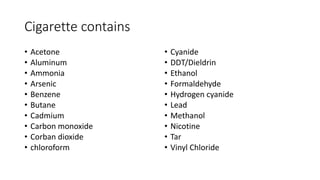
Cigarette contains
• Acetone
• Aluminum
• Ammonia
• Arsenic
• Benzene
• Butane
• Cadmium
• Carbon monoxide
• Corban dioxide
• chloroform
• Cyanide
• DDT/Dieldrin
• Ethanol
• Formaldehyde
• Hydrogen cyanide
• Lead
• Methanol
• Nicotine
• Tar
• Vinyl Chloride
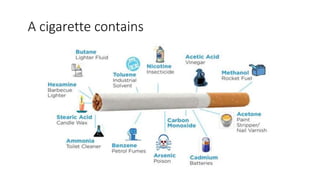
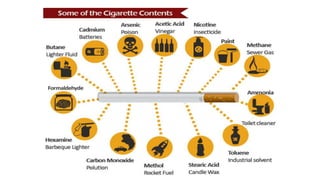
A cigarette contains
Ill effects of smoking
• Early death
• Poor health
• Addiction
• Cancer
• Heart disease
• Gum disease
• Cavities
• Air pollution
Effects of smoking
• Stained teeth, finders, and hair
• Increased frequency of colds
• Asthma
• Neuralgia
• Gastrointestinal difficulties, constipation, diarrhea etc.
• Headaches
• Nausea
• Convulsions
• Insomnia
• Heart murmur
• Buerger’s disease
• Arthritis
• Smokers' snack
• Nervousness
• Wrinkles and premature aging
• Tension
• Gastric, duodenal, and peptic ulcers
• Lung cancer
• Cancer of the lip, tongue, pharynx, bladder
• Emphysema
• High blood pressure
• Heart disease
• Atherosclerosis & arteriosclerosis
• Inflammation of the sinus passages
• Tabacco angina
• Impaired hearing
• Mental depression
• Decreased sexual activity
Harmful effects of smoking
• https://www.youtube.com/watch?v=gwuwrRK-I2Y
Is smoking a risk factor for autoimmune
diseases?
• The immune system is the body’s way of protecting itself from
infection and disease. Smoking compromises the immune system,
making smokers more likely to have respiratory infections.
• Smoking also causes several autoimmune diseases, including Crohn’s
disease and rheumatoid arthritis. It may also play a role in periodic
flare-ups of signs and symptoms of autoimmune diseases. Smoking
doubles your risk of developing rheumatoid arthritis.
• Smoking has recently been linked to type 2 diabetes, also known as
adult-onset diabetes. Smokers are 30% to 40% more likely to develop
type 2 diabetes than nonsmokers. Additionally, the more cigarettes an
individual smokes, the higher the risk for diabetes.
How does smoking affect my bones?
• Recent studies show a direct relationship between tobacco use and decreased
bone density. Smoking is one of many factors—including weight, alcohol
consumption, and activity level—that increase your risk for osteoporosis, a
condition in which bones weaken and become more likely to fracture.
• Significant bone loss has been found in older women and men who smoke.
Quitting smoking appears to reduce the risk for low bone mass and fractures.
However, it may take several years to lower a former smoker’s risk.
• In addition, smoking from an early age puts women at even higher risk for
osteoporosis. Smoking lowers the level of the hormone estrogen in your body,
which can cause you to go through menopause earlier, boosting your risk for
osteoporosis.
How does smoking affect my heart and blood
vessels?
• The chemicals in tobacco smoke harm your blood cells and damage the function of your heart. This damage
increases your risk for:
• Atherosclerosis, a disease in which a waxy substance called plaque builds up in your arteries
• Aneurysms, which are bulging blood vessels that can burst and cause death
• Cardiovascular disease (CVD), which includes:
• Coronary heart disease (CHD), narrow or blocked arteries around the heart
• Heart attack and damage to your arteries
• Heart-related chest pain
• High blood pressure
• Coronary Heart disease, where platelets—components in the blood—stick together along with proteins for
form clots which can then get stuck in the plaque in the walls of arteries and cause heart attacks
• Peripheral arterial disease (PAD), a condition in which plaque builds up in the arteries that carry blood to
the head, organs, and limbs
• Stroke, which is sudden death of brain cells caused by blood clots or bleeding
• Breathing tobacco smoke can even change your blood chemistry and damage your blood vessels. As you
inhale smoke, cells that line your body’s blood vessels react to its chemicals. Your heart rate and blood
pressure go up and your blood vessels thicken and narrow.
How does smoking affect my lungs and
breathing?
• Every cigarette you smoke damages your breathing and scars your lungs. Smoking
causes:
• Chronic obstructive pulmonary disease (COPD), a disease that gets worse over time and
causes wheezing, shortness of breath, chest tightness, and other symptoms
• Emphysema, a condition in which the walls between the air sacs in your lungs lose their
ability to stretch and shrink back. Your lung tissue is destroyed, making it difficult or
impossible to breathe.
• Chronic bronchitis, which causes swelling of the lining of your bronchial tubes. When this
happens, less air flows to and from your lungs.
• Pneumonia
• Asthma
• Tuberculosis
• People with asthma can suffer severe attacks when around cigarette smoke.
Can smoking affect my vision?
• Smoking is as bad for your eyes as it is for the rest of your body.
Research has linked smoking to an increased risk of developing age-
related macular degeneration, cataract, and optic nerve damage, all
of which can lead to blindness.
Do cigarettes cause cancer?
• Tobacco smoke contains more than 7,000 chemicals. About 70 of
them are known to cause cancer. Smoking cigarettes is the number-
one risk factor for lung cancer. But, smoking can affect your entire
body, and is known to cause cancer in the:
• Lungs, Trachea, Bronchus, Esophagus, Oral Cavity, Lip, Nasopharynx,
Nasal Cavity, Larynx, Stomach, Bladder, Pancreas, Kidney, Liver,
Uterine Cervix, Colon, Rectum.
• In addition, smoking is known to cause leukemia.
Do light cigarettes cause cancer?
• There is no such thing as a safe cigarette. People who smoke any kind
of cigarette are at an increased risk for smoking-related diseases.
Although it is no longer legal to sell light cigarettes, people who
smoked light cigarettes in the past are likely to have inhaled the same
amount of toxic chemicals as those who smoked regular cigarettes.
They remain at high risk of developing smoking-related cancers and
other diseases.
Do menthol cigarettes cause cancer?
• All cigarettes are harmful, including menthol cigarettes. Many
smokers think menthol cigarettes are less harmful, but there is no
evidence that menthol cigarettes are safer than other cigarettes. Like
other cigarettes, menthol cigarettes harm nearly every organ in the
body and cause many diseases, including cancer, cardiovascular
diseases, and respiratory diseases. Menthol cigarettes, like other
cigarettes, also negatively impact male and female fertility and are
harmful to pregnant women and their unborn babies.
• Some research shows that menthol cigarettes may be more addictive
than non-menthol cigarettes. More research is needed to understand
how addiction differs between menthol and non-menthol cigarette
use.
Can smoking cigars and pipes cause cancer?
• Cigar and pipe smoke, like cigarette smoke, contains toxic and cancer-causing chemicals
that are harmful to both smokers and non-smokers. Cigar and pipe smoking causes:
• Bladder cancer
• Esophageal cancer
• Laryngeal (voice box) cancer
• Lip cancer
• Lung cancer
• Mouth cancer
• Throat cancer
• Tongue cancer
• If you smoke cigars daily, you are at increased risk for developing heart disease and lung
diseases such as emphysema
Conclusion
• It is easy to become a smoker, but it is difficult to quit.
• If you are not started till now, a vow not to light your first cigarette at
any time in your life.
• If you are smoker, never to touch the next cigarette, and avoid the
company of your friends who still smokers.
• Never again light a cigarette for your entire lifetime, because the
difference between a chain smoker and occasional smoker is too thin
in cross.
Thank you

Ill effects-of-smoking

  • 1.
  • 2.
    Introduction • Smoking isthe inhalation of the smoke of burning tabacco encased in cigarettes, pipes, and cigars. • A smoking habit is a physical addiction to tabacco products. • It became a psychological addiction, too, and one with serious health consequences.
  • 3.
    Cigarette contains • Acetone •Aluminum • Ammonia • Arsenic • Benzene • Butane • Cadmium • Carbon monoxide • Corban dioxide • chloroform • Cyanide • DDT/Dieldrin • Ethanol • Formaldehyde • Hydrogen cyanide • Lead • Methanol • Nicotine • Tar • Vinyl Chloride
  • 4.
  • 6.
    Ill effects ofsmoking • Early death • Poor health • Addiction • Cancer • Heart disease • Gum disease • Cavities • Air pollution
  • 7.
    Effects of smoking •Stained teeth, finders, and hair • Increased frequency of colds • Asthma • Neuralgia • Gastrointestinal difficulties, constipation, diarrhea etc. • Headaches • Nausea • Convulsions • Insomnia • Heart murmur • Buerger’s disease • Arthritis • Smokers' snack • Nervousness • Wrinkles and premature aging • Tension • Gastric, duodenal, and peptic ulcers • Lung cancer • Cancer of the lip, tongue, pharynx, bladder • Emphysema • High blood pressure • Heart disease • Atherosclerosis & arteriosclerosis • Inflammation of the sinus passages • Tabacco angina • Impaired hearing • Mental depression • Decreased sexual activity
  • 8.
    Harmful effects ofsmoking • https://www.youtube.com/watch?v=gwuwrRK-I2Y
  • 9.
    Is smoking arisk factor for autoimmune diseases? • The immune system is the body’s way of protecting itself from infection and disease. Smoking compromises the immune system, making smokers more likely to have respiratory infections. • Smoking also causes several autoimmune diseases, including Crohn’s disease and rheumatoid arthritis. It may also play a role in periodic flare-ups of signs and symptoms of autoimmune diseases. Smoking doubles your risk of developing rheumatoid arthritis. • Smoking has recently been linked to type 2 diabetes, also known as adult-onset diabetes. Smokers are 30% to 40% more likely to develop type 2 diabetes than nonsmokers. Additionally, the more cigarettes an individual smokes, the higher the risk for diabetes.
  • 10.
    How does smokingaffect my bones? • Recent studies show a direct relationship between tobacco use and decreased bone density. Smoking is one of many factors—including weight, alcohol consumption, and activity level—that increase your risk for osteoporosis, a condition in which bones weaken and become more likely to fracture. • Significant bone loss has been found in older women and men who smoke. Quitting smoking appears to reduce the risk for low bone mass and fractures. However, it may take several years to lower a former smoker’s risk. • In addition, smoking from an early age puts women at even higher risk for osteoporosis. Smoking lowers the level of the hormone estrogen in your body, which can cause you to go through menopause earlier, boosting your risk for osteoporosis.
  • 11.
    How does smokingaffect my heart and blood vessels? • The chemicals in tobacco smoke harm your blood cells and damage the function of your heart. This damage increases your risk for: • Atherosclerosis, a disease in which a waxy substance called plaque builds up in your arteries • Aneurysms, which are bulging blood vessels that can burst and cause death • Cardiovascular disease (CVD), which includes: • Coronary heart disease (CHD), narrow or blocked arteries around the heart • Heart attack and damage to your arteries • Heart-related chest pain • High blood pressure • Coronary Heart disease, where platelets—components in the blood—stick together along with proteins for form clots which can then get stuck in the plaque in the walls of arteries and cause heart attacks • Peripheral arterial disease (PAD), a condition in which plaque builds up in the arteries that carry blood to the head, organs, and limbs • Stroke, which is sudden death of brain cells caused by blood clots or bleeding • Breathing tobacco smoke can even change your blood chemistry and damage your blood vessels. As you inhale smoke, cells that line your body’s blood vessels react to its chemicals. Your heart rate and blood pressure go up and your blood vessels thicken and narrow.
  • 12.
    How does smokingaffect my lungs and breathing? • Every cigarette you smoke damages your breathing and scars your lungs. Smoking causes: • Chronic obstructive pulmonary disease (COPD), a disease that gets worse over time and causes wheezing, shortness of breath, chest tightness, and other symptoms • Emphysema, a condition in which the walls between the air sacs in your lungs lose their ability to stretch and shrink back. Your lung tissue is destroyed, making it difficult or impossible to breathe. • Chronic bronchitis, which causes swelling of the lining of your bronchial tubes. When this happens, less air flows to and from your lungs. • Pneumonia • Asthma • Tuberculosis • People with asthma can suffer severe attacks when around cigarette smoke.
  • 13.
    Can smoking affectmy vision? • Smoking is as bad for your eyes as it is for the rest of your body. Research has linked smoking to an increased risk of developing age- related macular degeneration, cataract, and optic nerve damage, all of which can lead to blindness.
  • 14.
    Do cigarettes causecancer? • Tobacco smoke contains more than 7,000 chemicals. About 70 of them are known to cause cancer. Smoking cigarettes is the number- one risk factor for lung cancer. But, smoking can affect your entire body, and is known to cause cancer in the: • Lungs, Trachea, Bronchus, Esophagus, Oral Cavity, Lip, Nasopharynx, Nasal Cavity, Larynx, Stomach, Bladder, Pancreas, Kidney, Liver, Uterine Cervix, Colon, Rectum. • In addition, smoking is known to cause leukemia.
  • 15.
    Do light cigarettescause cancer? • There is no such thing as a safe cigarette. People who smoke any kind of cigarette are at an increased risk for smoking-related diseases. Although it is no longer legal to sell light cigarettes, people who smoked light cigarettes in the past are likely to have inhaled the same amount of toxic chemicals as those who smoked regular cigarettes. They remain at high risk of developing smoking-related cancers and other diseases.
  • 16.
    Do menthol cigarettescause cancer? • All cigarettes are harmful, including menthol cigarettes. Many smokers think menthol cigarettes are less harmful, but there is no evidence that menthol cigarettes are safer than other cigarettes. Like other cigarettes, menthol cigarettes harm nearly every organ in the body and cause many diseases, including cancer, cardiovascular diseases, and respiratory diseases. Menthol cigarettes, like other cigarettes, also negatively impact male and female fertility and are harmful to pregnant women and their unborn babies. • Some research shows that menthol cigarettes may be more addictive than non-menthol cigarettes. More research is needed to understand how addiction differs between menthol and non-menthol cigarette use.
  • 17.
    Can smoking cigarsand pipes cause cancer? • Cigar and pipe smoke, like cigarette smoke, contains toxic and cancer-causing chemicals that are harmful to both smokers and non-smokers. Cigar and pipe smoking causes: • Bladder cancer • Esophageal cancer • Laryngeal (voice box) cancer • Lip cancer • Lung cancer • Mouth cancer • Throat cancer • Tongue cancer • If you smoke cigars daily, you are at increased risk for developing heart disease and lung diseases such as emphysema
  • 18.
    Conclusion • It iseasy to become a smoker, but it is difficult to quit. • If you are not started till now, a vow not to light your first cigarette at any time in your life. • If you are smoker, never to touch the next cigarette, and avoid the company of your friends who still smokers. • Never again light a cigarette for your entire lifetime, because the difference between a chain smoker and occasional smoker is too thin in cross.
  • 19.