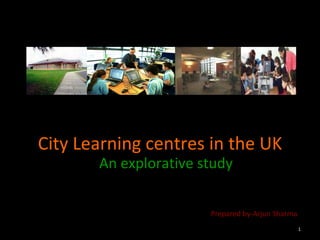
City Learning centres in the UK An explorative study Prepared by-Arjun Sharma
What are CLCs? City learning centres “CLCs”  in the UK are  “centres providing leading edge ICT rich learning opportunities for the pupils at the host school, for pupils at a network of surrounding schools and for the wider community” “ there are more than  105 CLCs  across the UK” “ aim of the CLC is to enhance learning and teaching across the whole curriculum for pupils, teachers, particularly in secondary schools but also in primary and special schools and to provide ICT access to the wider community”
Resources and facilities
Typically a CLC in the UK wants to achieve…
Organizational structure of a CLC
Research approach 17 CLCs included in the study 10 CLCs, directly visited/contacted CLCs from various regions were included in the study like Sheffield, London, Liverpool, Newcastle etcetera
Issues of research Conclusions with recommendation regarding Effectiveness and efficiency of a CLC Team and school development Lesson learned about the organization and activities of CLCs Best practices of the CLCs Student teachers and their educators role
Team and school development School development Case study: Innovative practices  using of technologies in learning and teaching Acting as  test bed Sharing practices Direct Support in school development  -BSF (Building school for the future) -E-safety -ICT Mark (review framework) -Security -E- Learning platform Team development and collaboration- mixed result
Lesson learned ….. Organization Transportation Plan Expertise Evaluation-  Not only self and peer review but   reflective action and critical review Activities Relationship  with schools, teachers, student teachers, educators, other related stakeholders matters other  internal factors   ( cultural and structural) associated like attitudes, preparation, facilities, participation, motivation, sharing practices among all stakeholders Staff/teacher  professional development   Short term , long term, system activities and plan for  sustainability  in the use of technologies in education
Best Practices “ Technological Innovation adoption and diffusion in teaching and learning ” And “ Partnership with several national educational developmental organization, Local Authority, School board and other  related organizations ”
Use of Technologies in teaching and learning   Voogt & Pelgrum (2001) compares the pedagogy in information society with  industrial society  Active learner Collaborative Creative Integrative Evaluative Futurelab (2007) independent enquiry creative thinking reflective learning team work self-management effective participation authentic a global view complete
Best practices Using various  video and audio  editing tools and technologies, working in collaboration with each other to make news, audio and video can be a best practice. This supports pupil’s creativity, collaboration and students are engaged and highly motivated. Use of  VLE  (virtual learning environment) supported flexibility, personalization, student directed, independent learning, rich media, and collaboration at the same time. Video conferencing  supported local and global collaboration and link learning in diverse cultural context, sharing innovation, interactivity, global view. Immersive media and games  support enthusiasm, engagement and motivation. It provides environment for non-linear learning containing multiple human knowledge at one time. It presents virtual reality and  a natural context for the learner. It can also connect to countless other learners.  For teachers it makes simple to keep track of every students about their strength and weaknesses in all their complexity. Mobile learning with portable devices  supports for flexible and any time any where learning. Above all, innovative technologies and their use always make the students active, engaged and enthusiastic
Are CLCs effective and efficient ?
Role of student teachers and their educators Student teachers will be able to able to : get a platform for practice with pupils and experts  finds a place to find examples and practices use and practise innovative tools and technologies to study and experiment  provide an opportunity to start research work together with teachers, researcher and CLC experts Educators, researchers will be able to: design and conduct research together with student teachers, teachers and a CLC experts diagnose the results and develop theories related with use of technologies in education find information, knowledge, evidences for decision making and policy making purpose
Conclusion and recommendations 5  Key Issues “MANTRA”
Partnership Some of the main advantages of the partnership model : Enabling support  regarding resources and facilities Direction and vision  from government and non-government educational organizations Support for  professional development Sharing good practices Research based knowledge  about the use and implementation of technologies “ ecological supportive environment for educational renewal”
Collaboration/Team work
How collaboration and team?
Evidence based practice Why? Opens up ways for  discovery  in education and promotes  innovation   Diagnose  the process and outcome of the educational activity Support replication  of best practices Reduces  time and extra cost Provides insight for  decision and policy making How to? Embedding research  in projects and activities Diagnose  and find out the real impact and outcome Involve  teachers, researchers interested for any study related with use of technology Collaborate  with schools and teachers for research Use  networked communication  for sharing practices and outcomes.
Involve in school development plan Inspiring and supporting for  professional development/teacher training  related with use of technology across the curriculum Including CLC initiatives and activities in  school improvement or development plan
Leadership A  visionary leadership  with pedagogical, organizational, technical knowledge and inter-personal skills can be very effective in this context  Making  effective plans ,  decision  with related activities Scenario prediction  for future development  and  Promoting cohesive  relationship  with stakeholders Effective network developer System approach  of organization but with  humanist value Promoting, supporting and managing  change
Thank you! "The most fruitful outcome for people arises from the clashes between the technologist perspective and the humanist perspective"  Snow, C. P. (1959)

Clc Project Copy

  • 1.
    City Learning centresin the UK An explorative study Prepared by-Arjun Sharma
  • 3.
    What are CLCs?City learning centres “CLCs” in the UK are “centres providing leading edge ICT rich learning opportunities for the pupils at the host school, for pupils at a network of surrounding schools and for the wider community” “ there are more than 105 CLCs across the UK” “ aim of the CLC is to enhance learning and teaching across the whole curriculum for pupils, teachers, particularly in secondary schools but also in primary and special schools and to provide ICT access to the wider community”
  • 4.
  • 5.
    Typically a CLCin the UK wants to achieve…
  • 6.
  • 7.
    Research approach 17CLCs included in the study 10 CLCs, directly visited/contacted CLCs from various regions were included in the study like Sheffield, London, Liverpool, Newcastle etcetera
  • 8.
    Issues of researchConclusions with recommendation regarding Effectiveness and efficiency of a CLC Team and school development Lesson learned about the organization and activities of CLCs Best practices of the CLCs Student teachers and their educators role
  • 9.
    Team and schooldevelopment School development Case study: Innovative practices using of technologies in learning and teaching Acting as test bed Sharing practices Direct Support in school development -BSF (Building school for the future) -E-safety -ICT Mark (review framework) -Security -E- Learning platform Team development and collaboration- mixed result
  • 10.
    Lesson learned …..Organization Transportation Plan Expertise Evaluation- Not only self and peer review but reflective action and critical review Activities Relationship with schools, teachers, student teachers, educators, other related stakeholders matters other internal factors ( cultural and structural) associated like attitudes, preparation, facilities, participation, motivation, sharing practices among all stakeholders Staff/teacher professional development Short term , long term, system activities and plan for sustainability in the use of technologies in education
  • 11.
    Best Practices “Technological Innovation adoption and diffusion in teaching and learning ” And “ Partnership with several national educational developmental organization, Local Authority, School board and other related organizations ”
  • 12.
    Use of Technologiesin teaching and learning Voogt & Pelgrum (2001) compares the pedagogy in information society with industrial society Active learner Collaborative Creative Integrative Evaluative Futurelab (2007) independent enquiry creative thinking reflective learning team work self-management effective participation authentic a global view complete
  • 13.
    Best practices Usingvarious video and audio editing tools and technologies, working in collaboration with each other to make news, audio and video can be a best practice. This supports pupil’s creativity, collaboration and students are engaged and highly motivated. Use of VLE (virtual learning environment) supported flexibility, personalization, student directed, independent learning, rich media, and collaboration at the same time. Video conferencing supported local and global collaboration and link learning in diverse cultural context, sharing innovation, interactivity, global view. Immersive media and games support enthusiasm, engagement and motivation. It provides environment for non-linear learning containing multiple human knowledge at one time. It presents virtual reality and a natural context for the learner. It can also connect to countless other learners. For teachers it makes simple to keep track of every students about their strength and weaknesses in all their complexity. Mobile learning with portable devices supports for flexible and any time any where learning. Above all, innovative technologies and their use always make the students active, engaged and enthusiastic
  • 14.
    Are CLCs effectiveand efficient ?
  • 15.
    Role of studentteachers and their educators Student teachers will be able to able to : get a platform for practice with pupils and experts finds a place to find examples and practices use and practise innovative tools and technologies to study and experiment provide an opportunity to start research work together with teachers, researcher and CLC experts Educators, researchers will be able to: design and conduct research together with student teachers, teachers and a CLC experts diagnose the results and develop theories related with use of technologies in education find information, knowledge, evidences for decision making and policy making purpose
  • 16.
    Conclusion and recommendations5 Key Issues “MANTRA”
  • 17.
    Partnership Some ofthe main advantages of the partnership model : Enabling support regarding resources and facilities Direction and vision from government and non-government educational organizations Support for professional development Sharing good practices Research based knowledge about the use and implementation of technologies “ ecological supportive environment for educational renewal”
  • 18.
  • 19.
  • 20.
    Evidence based practiceWhy? Opens up ways for discovery in education and promotes innovation Diagnose the process and outcome of the educational activity Support replication of best practices Reduces time and extra cost Provides insight for decision and policy making How to? Embedding research in projects and activities Diagnose and find out the real impact and outcome Involve teachers, researchers interested for any study related with use of technology Collaborate with schools and teachers for research Use networked communication for sharing practices and outcomes.
  • 21.
    Involve in schooldevelopment plan Inspiring and supporting for professional development/teacher training related with use of technology across the curriculum Including CLC initiatives and activities in school improvement or development plan
  • 22.
    Leadership A visionary leadership with pedagogical, organizational, technical knowledge and inter-personal skills can be very effective in this context Making effective plans , decision with related activities Scenario prediction for future development and Promoting cohesive relationship with stakeholders Effective network developer System approach of organization but with humanist value Promoting, supporting and managing change
  • 23.
    Thank you! "Themost fruitful outcome for people arises from the clashes between the technologist perspective and the humanist perspective" Snow, C. P. (1959)