LOW CARBON DEVELOPMENT 
- Development of Low Carbon Cement 
TARA 
CANSA Workshop 
26 August 2014
Concrete and sustainable development 
• There are a lot of misconceptions about cement and concrete 
TARA 
with respect to sustainable development. 
• If we want to improve things we have to start from a correct 
assessment of the situation 
• We hear a lot about the fact that cement and concrete account 
for some 5-8% of man-made CO2 
• What we don’t realise is that this is amazingly good for a 
material which makes up around half of everything produced.
TARA 
The Global Scenario
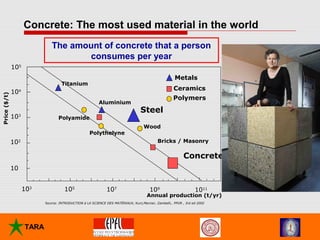
Concrete: The most used material in the world 
TARA 
The amount of concrete that a person 
Metals 
Ceramics 
Polymers 
consumes per year 
Steel 
Wood 
Bricks / Masonry 
Concrete 
Aluminium 
Titanium 
Polyamide 
Polythelyne 
Annual production (t/yr) 
Source: INTRODUCTION à LA SCIENCE DES MATÉRIAUX, Kurz,Mercier, Zambelli,. PPUR , 3rd ed 2002 
Price ($/t) 
105 
104 
103 
102 
10 
103 105 107 109 1011
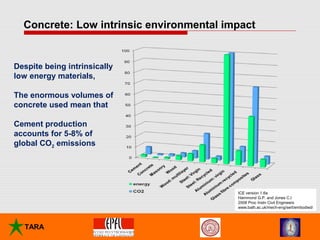
Concrete: Low intrinsic environmental impact 
TARA 
ICE version 1.6a 
Hammond G.P. and Jones C.I 
2008 Proc Instn Civil Engineers 
www.bath.ac.uk/mech-eng/sert/embodied/ 
Despite being intrinsically 
low energy materials, 
The enormous volumes of 
concrete used mean that 
Cement production 
accounts for 5-8% of 
global CO2 emissions
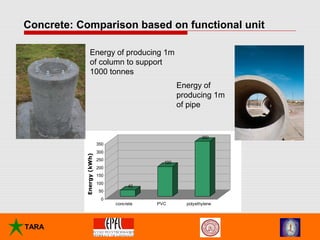
Concrete: Comparison based on functional unit 
TARA 
Energy of producing 1m 
of column to support 
1000 tonnes 
40 
190 
Energy of 
producing 1m 
of pipe 
350 
350 
300 
250 
200 
150 
100 
50 
0 
concrete PVC polyethylene 
Energy (kWh)
Forecasted demand 
TARA
TARA 
The Indian Perspective
Indian scenario - present 
Characteristic of Indian Cement Industry 
• One of the most efficient in the world 
 0.719 T of CO2/ T of cement 
(0.65 – 0.90 T of CO2) 
• Per capita consumption 191 kg 
 World average – 500 kg 
 China – 1581 kg 
• Produced 137 million tons of CO2 
 Approx. 7% of India’s total man-made CO2 
emissions 
TARA 
WBCSD: Cement 
Technology Roadmap 2009
Indian scenario – 2050 
The Indian Cement Industry 
• Increase in population 
TARA 
 1.2 billion to 1.7 billion 
• Rapid urbanization 
 380 million to 675 million (UN DESA, 2011) 
• GDP is expected to increase from 
 USD 4,060 billion to USD 37,721 billion 
‒ Large scale infrastructure development 
‒ Increased demand for concrete 
WBCSD: Cement 
Technology Roadmap 2009
Indian scenario 
Major concerns: 
• Energy consumption and costs 
• Environmental emission 
• Availability of raw materials 
• Market based competition 
TARA 
WBCSD: Cement 
Technology Roadmap 2009
TARA 
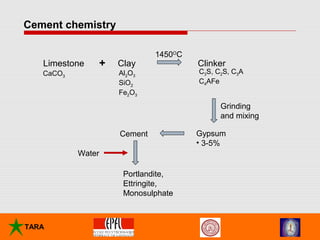
Chemistry of Cement
Cement chemistry 
TARA 
Cement Gypsum 
• 3-5% 
1450OC 
+ 
Limestone Clay 
CaCO3 
Al2O3 
SiO2 
Fe2O3 
Clinker 
C3S, C2S, C3A 
C4AFe 
Water 
Portlandite, 
Ettringite, 
Monosulphate 
Grinding 
and mixing
Origin of CO2 emissions in cement production 
1 tonne of cement leads to the emission of 650 – 900 kg CO2 
TARA 
60 
40 
CaCO3 
decomposition 
(CHEMICAL) 
Fuel 
CaCO3  CaO + CO2 
The production process 
is highly optimised 
Around 80% of 
thermodynamic limit. 
it is estimated that < 2% 
further savings can be 
made here 
Use of waste fuels, 
which can be > 80% 
reduces the demand 
for fossil fuels
TARA 
Low carbon chemistries
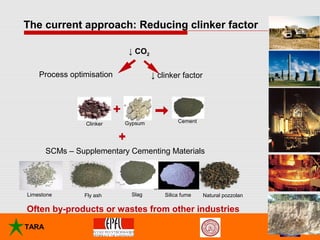
The current approach: Reducing clinker factor 
Process optimisation ↓ clinker factor 
Limestone Slag 
Often by-products or wastes from other industries 
TARA 
↓ CO2 
Clinker 
Gypsum Cement 
SCMs – Supplementary Cementing Materials 
Fly ash Silica fume Natural pozzolan
Why India 
 Facilitate uptake of PC / calcined clay / limestone blends 
 Create capacities for technology transfer to developing countries 
 Huge rise in consumption forecast in India 
 How to keep up with projected demand 
TARA 
 Only 25% of capacity needed in 2050 exists today 
 Need for range of blending materials 
 High level producers in free market economy 
 Excellent blend of research and application partnership 
 1st Country with national road map for sustainability 
under Cement Sustainability Initiative, CSI of 
World Business Council for Sustainable Development, WBCSD 
 Target for clinker factor 0.58 by 2030
TARA 
Low Carbon Cement Project 
- Entry Phase (2013-2014)
Results achieved till date 
• Trial grinding and blending in a commercial mini-cement unit 
Composition: 
TARA 
50% clinker 
15% limestone 
30% calcined clay 
5% gypsum 
Blends: 
B0: PPC 
B1: LSA + CA + gypsum + clinker 
B2: LSA + CB + gypsum + clinker 
B3: LSB + CA + gypsum + clinker 
B4: LSB + CB + gypsum + clinker
Results achieved till date 
TARA
Results achieved till date 
TARA
Results achieved till date 
TARA
Results achieved till date 
TARA 
Clinker Limestone 
Calcined clay Gypsum
Results achieved till date 
TARA
Results achieved till date 
TARA
Results achieved till date 
TARA
Results achieved till date 
TARA
Results achieved till date 
TARA
Results achieved till date 
TARA
Results achieved till date 
TARA
Results achieved till date 
TARA
Results achieved till date 
TARA
Results achieved till date 
TARA 
Standard MCR tiles 
vibration time range 
of 30-35 sec/tile
TARA 
Low Carbon Cement Project 
- 2014 - 2020
The Project 
TARA 
 Research and development (IITD) 
 Technology application (TARA) 
 Environmental assessments (TARA) 
 Economic assessment and tools (TARA) 
 Policy dialogue and influencing (TARA) 
 Technology packaging (TARA) 
 Knowledge sharing platform (IITD) 
 Project management and co-ordination (IITD/TARA)
Major stakeholders 
UNEP Lead partners 
TARA 
IIT Delhi 
Research 
TARA 
Application 
EPFL 
(Research and EU standards) 
- IIT, Chennai 
- IIT, Mumbai 
- Major cement 
companies 
- Mini cement 
producers 
- Consumers 
SDC 
Cuba (Grants) 
Dalmia Cements 
India Cements 
Madras Cements 
Holcim 
Denmark 
Brazil 
Thailand 
WBCSD 
L&T 
ACC 
TATA 
Housing
Rationale to South Asia 
TARA 
 Contributes to carbon emission reduction 
 Utilization of waste materials 
 Waste clay (no top soil) 
 Waste limestone (mine rejects) 
 Resource efficiency 
 Local cement production units
TARA 
Thanks

Development of Low Carbon Cement

  • 1.
    LOW CARBON DEVELOPMENT - Development of Low Carbon Cement TARA CANSA Workshop 26 August 2014
  • 2.
    Concrete and sustainabledevelopment • There are a lot of misconceptions about cement and concrete TARA with respect to sustainable development. • If we want to improve things we have to start from a correct assessment of the situation • We hear a lot about the fact that cement and concrete account for some 5-8% of man-made CO2 • What we don’t realise is that this is amazingly good for a material which makes up around half of everything produced.
  • 3.
  • 4.
    Concrete: The mostused material in the world TARA The amount of concrete that a person Metals Ceramics Polymers consumes per year Steel Wood Bricks / Masonry Concrete Aluminium Titanium Polyamide Polythelyne Annual production (t/yr) Source: INTRODUCTION à LA SCIENCE DES MATÉRIAUX, Kurz,Mercier, Zambelli,. PPUR , 3rd ed 2002 Price ($/t) 105 104 103 102 10 103 105 107 109 1011
  • 5.
    Concrete: Low intrinsicenvironmental impact TARA ICE version 1.6a Hammond G.P. and Jones C.I 2008 Proc Instn Civil Engineers www.bath.ac.uk/mech-eng/sert/embodied/ Despite being intrinsically low energy materials, The enormous volumes of concrete used mean that Cement production accounts for 5-8% of global CO2 emissions
  • 6.
    Concrete: Comparison basedon functional unit TARA Energy of producing 1m of column to support 1000 tonnes 40 190 Energy of producing 1m of pipe 350 350 300 250 200 150 100 50 0 concrete PVC polyethylene Energy (kWh)
  • 7.
  • 8.
    TARA The IndianPerspective
  • 9.
    Indian scenario -present Characteristic of Indian Cement Industry • One of the most efficient in the world  0.719 T of CO2/ T of cement (0.65 – 0.90 T of CO2) • Per capita consumption 191 kg  World average – 500 kg  China – 1581 kg • Produced 137 million tons of CO2  Approx. 7% of India’s total man-made CO2 emissions TARA WBCSD: Cement Technology Roadmap 2009
  • 10.
    Indian scenario –2050 The Indian Cement Industry • Increase in population TARA  1.2 billion to 1.7 billion • Rapid urbanization  380 million to 675 million (UN DESA, 2011) • GDP is expected to increase from  USD 4,060 billion to USD 37,721 billion ‒ Large scale infrastructure development ‒ Increased demand for concrete WBCSD: Cement Technology Roadmap 2009
  • 11.
    Indian scenario Majorconcerns: • Energy consumption and costs • Environmental emission • Availability of raw materials • Market based competition TARA WBCSD: Cement Technology Roadmap 2009
  • 12.
  • 13.
    Cement chemistry TARA Cement Gypsum • 3-5% 1450OC + Limestone Clay CaCO3 Al2O3 SiO2 Fe2O3 Clinker C3S, C2S, C3A C4AFe Water Portlandite, Ettringite, Monosulphate Grinding and mixing
  • 14.
    Origin of CO2emissions in cement production 1 tonne of cement leads to the emission of 650 – 900 kg CO2 TARA 60 40 CaCO3 decomposition (CHEMICAL) Fuel CaCO3  CaO + CO2 The production process is highly optimised Around 80% of thermodynamic limit. it is estimated that < 2% further savings can be made here Use of waste fuels, which can be > 80% reduces the demand for fossil fuels
  • 15.
    TARA Low carbonchemistries
  • 16.
    The current approach:Reducing clinker factor Process optimisation ↓ clinker factor Limestone Slag Often by-products or wastes from other industries TARA ↓ CO2 Clinker Gypsum Cement SCMs – Supplementary Cementing Materials Fly ash Silica fume Natural pozzolan
  • 17.
    Why India Facilitate uptake of PC / calcined clay / limestone blends  Create capacities for technology transfer to developing countries  Huge rise in consumption forecast in India  How to keep up with projected demand TARA  Only 25% of capacity needed in 2050 exists today  Need for range of blending materials  High level producers in free market economy  Excellent blend of research and application partnership  1st Country with national road map for sustainability under Cement Sustainability Initiative, CSI of World Business Council for Sustainable Development, WBCSD  Target for clinker factor 0.58 by 2030
  • 18.
    TARA Low CarbonCement Project - Entry Phase (2013-2014)
  • 19.
    Results achieved tilldate • Trial grinding and blending in a commercial mini-cement unit Composition: TARA 50% clinker 15% limestone 30% calcined clay 5% gypsum Blends: B0: PPC B1: LSA + CA + gypsum + clinker B2: LSA + CB + gypsum + clinker B3: LSB + CA + gypsum + clinker B4: LSB + CB + gypsum + clinker
  • 20.
  • 21.
  • 22.
  • 23.
    Results achieved tilldate TARA Clinker Limestone Calcined clay Gypsum
  • 24.
  • 25.
  • 26.
  • 27.
  • 28.
  • 29.
  • 30.
  • 31.
  • 32.
  • 33.
    Results achieved tilldate TARA Standard MCR tiles vibration time range of 30-35 sec/tile
  • 34.
    TARA Low CarbonCement Project - 2014 - 2020
  • 35.
    The Project TARA  Research and development (IITD)  Technology application (TARA)  Environmental assessments (TARA)  Economic assessment and tools (TARA)  Policy dialogue and influencing (TARA)  Technology packaging (TARA)  Knowledge sharing platform (IITD)  Project management and co-ordination (IITD/TARA)
  • 36.
    Major stakeholders UNEPLead partners TARA IIT Delhi Research TARA Application EPFL (Research and EU standards) - IIT, Chennai - IIT, Mumbai - Major cement companies - Mini cement producers - Consumers SDC Cuba (Grants) Dalmia Cements India Cements Madras Cements Holcim Denmark Brazil Thailand WBCSD L&T ACC TATA Housing
  • 37.
    Rationale to SouthAsia TARA  Contributes to carbon emission reduction  Utilization of waste materials  Waste clay (no top soil)  Waste limestone (mine rejects)  Resource efficiency  Local cement production units
  • 38.