CHAPTER 5:
CLAUSE AS REPRESENTATION
Annisa Medi
Faisal Bahri
Irliany
Ravica
5.1 Modelling Experience of Change
5.1.1 Construing experience as a third line of meaning in the clause
The clause is a multifunctional construct consisting of three
metafunctional lines of meaning. In this chapter, we come to the third
mode of meaning in the organization of the clause --- the experiential
line of organization
The three metafunctional lines are unified within the structure of the
clause, as shown for well, ‘usually’ means mostly, doesn’t it, Mary? in
figure 5-1 (example dialogue)
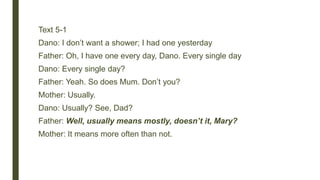
Text 5-1
Dano: I don’t want a shower; I had one yesterday
Father: Oh, I have one every day, Dano. Every single day
Dano: Every single day?
Father: Yeah. So does Mum. Don’t you?
Mother: Usually.
Dano: Usually? See, Dad?
Father: Well, usually means mostly, doesn’t it, Mary?
Mother: It means more often than not.
Explanation:
i. Well, usually means mostly, doesn’t it, Mary? presents a message as a new
turn in response to a query (to continuative well) concerned with a English
word (usually) that has just been queried; this is the Theme of the message.
The topical theme established in this clause is maintained as the Theme of
the next clause and is elaborate further within the Rheme: [theme:] It
[Rheme:] means more often than not
ii. Interpersonally, the clause enacts a proposition (realized by a tagged
declarative: usually means….doesn’t it) that is explicitly addressed to a
particular person, Mary. This statement has been prompted by Dano’s query
of usually and it elicits a response from Mary, adjusting the proposition. The
‘nub of the argument’ is realized by the Subject of clause and the Finite fixes
it as ‘present’ in relation to the now of speaking; usually means…..doesn’t it?-
--- It means….
iii. In the example, the clause contrues a relationship of significant
between a word its meaning: ‘usually’ signifies (represents, expresses)
‘mostly’. There are three elements in this relationship --- usually, means,
and mostly. One of these elements is the process ---- the process of
‘meaning’. This process is represented as being located in, and
unfolding through, time: the process is realized by a verb marked for
‘present’ tense, contrasting with ‘past’ meant and ‘future’ will mean. The
other two elements are participants involved in the process of meaning;
one of them represents the expression (usually) and the other its
meaning (mostly). These participant are the Token and Value in the
relationship of significant. There is one further example of a clause
significant --- it means more often than not; but the other clause
represent other types of process ---- wanting a shower ([senser:] I +
[process:] don’t want + [phenomenon:] a shower), and having a shower
([actor:] I + [process:] had + [scope:] one + [time:] yesterday)
5.1.2 Types of Process
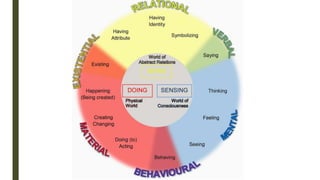
The most powerful impression of experience is that it consists of a flow of events or
‘goings-on’ and this flow of events is chuncked into quanta of change by the grammar
of the clause: each quantum of change is modelled as a figure (figure of happening,
doing, sensing, saying, being or having).
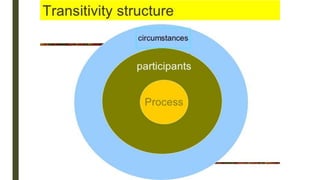
All figures consist of a process unfolding through time and of participant being directly
involved in the process; rather they are attendant on it. All such figures are sorted out
in the grammar of the clause. Thus as well as being a mode of action, of giving and
demanding goods&services and information, the clause is also a mode of reflection, of
imposing order on the endless variation and flow of events.
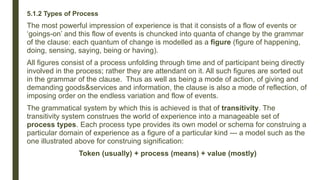
The grammatical system by which this is achieved is that of transitivity. The
transitivity system construes the world of experience into a manageable set of
process types. Each process type provides its own model or schema for construing a
particular domain of experience as a figure of a particular kind --- a model such as the
one illustrated above for construing signification:
Token (usually) + process (means) + value (mostly)
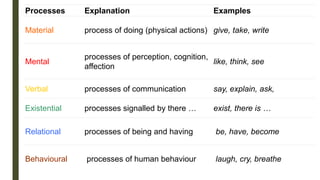
Processes Explanation Examples
Material process of doing (physical actions) give, take, write
Mental
processes of perception, cognition,
affection
like, think, see
Verbal processes of communication say, explain, ask,
Existential processes signalled by there … exist, there is …
Relational processes of being and having be, have, become
Behavioural processes of human behaviour laugh, cry, breathe
Clause as Representation

Clause as Representation

  • 1.
    CHAPTER 5: CLAUSE ASREPRESENTATION Annisa Medi Faisal Bahri Irliany Ravica
  • 2.
    5.1 Modelling Experienceof Change 5.1.1 Construing experience as a third line of meaning in the clause The clause is a multifunctional construct consisting of three metafunctional lines of meaning. In this chapter, we come to the third mode of meaning in the organization of the clause --- the experiential line of organization The three metafunctional lines are unified within the structure of the clause, as shown for well, ‘usually’ means mostly, doesn’t it, Mary? in figure 5-1 (example dialogue)
  • 3.
    Text 5-1 Dano: Idon’t want a shower; I had one yesterday Father: Oh, I have one every day, Dano. Every single day Dano: Every single day? Father: Yeah. So does Mum. Don’t you? Mother: Usually. Dano: Usually? See, Dad? Father: Well, usually means mostly, doesn’t it, Mary? Mother: It means more often than not.
  • 4.
    Explanation: i. Well, usuallymeans mostly, doesn’t it, Mary? presents a message as a new turn in response to a query (to continuative well) concerned with a English word (usually) that has just been queried; this is the Theme of the message. The topical theme established in this clause is maintained as the Theme of the next clause and is elaborate further within the Rheme: [theme:] It [Rheme:] means more often than not ii. Interpersonally, the clause enacts a proposition (realized by a tagged declarative: usually means….doesn’t it) that is explicitly addressed to a particular person, Mary. This statement has been prompted by Dano’s query of usually and it elicits a response from Mary, adjusting the proposition. The ‘nub of the argument’ is realized by the Subject of clause and the Finite fixes it as ‘present’ in relation to the now of speaking; usually means…..doesn’t it?- --- It means….
  • 5.
    iii. In theexample, the clause contrues a relationship of significant between a word its meaning: ‘usually’ signifies (represents, expresses) ‘mostly’. There are three elements in this relationship --- usually, means, and mostly. One of these elements is the process ---- the process of ‘meaning’. This process is represented as being located in, and unfolding through, time: the process is realized by a verb marked for ‘present’ tense, contrasting with ‘past’ meant and ‘future’ will mean. The other two elements are participants involved in the process of meaning; one of them represents the expression (usually) and the other its meaning (mostly). These participant are the Token and Value in the relationship of significant. There is one further example of a clause significant --- it means more often than not; but the other clause represent other types of process ---- wanting a shower ([senser:] I + [process:] don’t want + [phenomenon:] a shower), and having a shower ([actor:] I + [process:] had + [scope:] one + [time:] yesterday)
  • 6.
    5.1.2 Types ofProcess The most powerful impression of experience is that it consists of a flow of events or ‘goings-on’ and this flow of events is chuncked into quanta of change by the grammar of the clause: each quantum of change is modelled as a figure (figure of happening, doing, sensing, saying, being or having). All figures consist of a process unfolding through time and of participant being directly involved in the process; rather they are attendant on it. All such figures are sorted out in the grammar of the clause. Thus as well as being a mode of action, of giving and demanding goods&services and information, the clause is also a mode of reflection, of imposing order on the endless variation and flow of events. The grammatical system by which this is achieved is that of transitivity. The transitivity system construes the world of experience into a manageable set of process types. Each process type provides its own model or schema for construing a particular domain of experience as a figure of a particular kind --- a model such as the one illustrated above for construing signification: Token (usually) + process (means) + value (mostly)
  • 8.
    Processes Explanation Examples Materialprocess of doing (physical actions) give, take, write Mental processes of perception, cognition, affection like, think, see Verbal processes of communication say, explain, ask, Existential processes signalled by there … exist, there is … Relational processes of being and having be, have, become Behavioural processes of human behaviour laugh, cry, breathe