IMPROVING
COMMUNICATION
BETWEEN TEACHERS
AND PARAEDUCATORS
Dr. Tiffany Rodriguez
Cal State Fullerton
NRCP Conference 2012
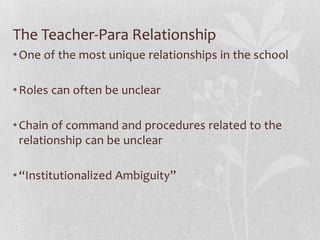
The Teacher-Para Relationship
• One of the most unique relationships in the school

• Roles can often be unclear

• Chain of command and procedures related to the
  relationship can be unclear

• “Institutionalized Ambiguity”
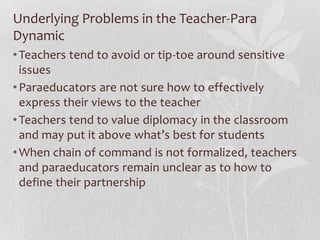
Underlying Problems in the Teacher-Para
Dynamic
• Teachers tend to avoid or tip-toe around sensitive
  issues
• Paraeducators are not sure how to effectively
  express their views to the teacher
• Teachers tend to value diplomacy in the classroom
  and may put it above what’s best for students
• When chain of command is not formalized, teachers
  and paraeducators remain unclear as to how to
  define their partnership
Opening the Lines of Communication
• Whatever your role, ask to sit down and meet for 20-30
  minutes with the teacher/paraeducator/principal to discuss
  the following:

 • Who does what? Why?
 • How should we handle differences of opinion?
 • Logistics: start time, end time, who to contact when late or
   absent, breaks, etc.
 • How do we want to make sure we’re communicating
   frequently? (use a comm book, phone
   calls, text, emails, weekly meetings)
Communication is HARD!
• Words are abstract symbols that represent real things, but words
  themselves are not real things.

• Example: think of a phone. How do you picture a phone? Color?
  Size? Cell phone? Land-line phone? Shape? Size?

• In schools, these kinds of misunderstandings can occur when we
  talk about things like “students with disabilities” “discipline” “good
  teaching” “autism” “positive behavior supports”. Our meaning of
  these issues can vary greatly and cause misunderstandings or an
  avoidance of communication from fear of conflict or disagreement.
What good communicators do
• They engage you, capture your attention, involve you.
• They make what they say relevant to you and your world so that
  you can relate.
• They share a part of themselves with you.
• They build a rapport by constantly tuning in to you, even when
  they’re just reporting information.
• They value you as a listener, checking in frequently and showing
  interest.
• They encourage you to share your thoughts.
• They paraphrase and reflect what you say.
• They communicate ideas, not simply words.
• They adjust their pace depending on the complexity of the topic.
                                DeBroer (1995)
Starting a conversation with a question
• Sometimes it can be uncomfortable to approach a particular
  subject. Questions can help open a conversation…

 • “I wonder how…”
 • “I am confused about…”
 • “I get the impression that…”
 • “What do you think about…”
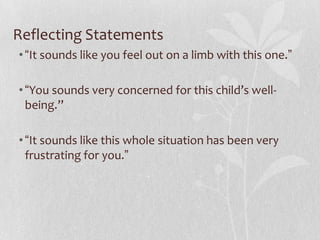
Reflecting Statements
• “It sounds like you feel out on a limb with this one.”

• “You sounds very concerned for this child’s well-
  being.”

• “It sounds like this whole situation has been very
  frustrating for you.”
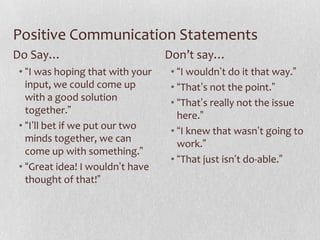
Positive Communication Statements
Do Say…                          Don’t say…
• “I was hoping that with your   • “I wouldn’t do it that way.”
  input, we could come up        • “That’s not the point.”
  with a good solution
                                 • “That’s really not the issue
  together.”                       here.”
• “I’ll bet if we put our two    • “I knew that wasn’t going to
  minds together, we can
                                   work.”
  come up with something.”
                                 • “That just isn’t do-able.”
• “Great idea! I wouldn’t have
  thought of that!”
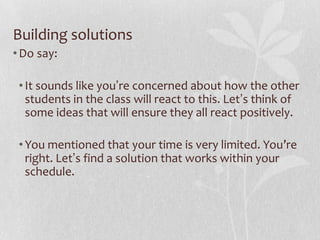
Building solutions
• Do say:

 • It sounds like you’re concerned about how the other
   students in the class will react to this. Let’s think of
   some ideas that will ensure they all react positively.

 • You mentioned that your time is very limited. You’re
   right. Let’s find a solution that works within your
   schedule.
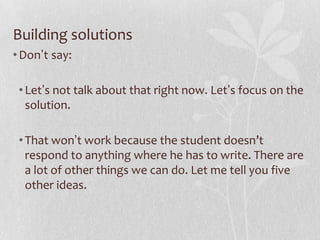
Building solutions
• Don’t say:

 • Let’s not talk about that right now. Let’s focus on the
   solution.

 • That won’t work because the student doesn’t
   respond to anything where he has to write. There are
   a lot of other things we can do. Let me tell you five
   other ideas.
Working with Challenging Personality Types
Know-It-Alls
• Have been around a long time
• May have a hard time letting go of their ideas and
  considering others
• Not likely to admit when they are wrong, so don’t try
  to make them
• Know your stuff, and speak confidently to them
• Give them a lot of credit
• Say things like, “That’s a really good point. Have you
  ever thought of this?” or “Can we try it this way for a
  week and I’ll take data on how it goes?”
Complainers
• Two types of complainers:
  • The “Debbie Downers” who are seemingly ALWAYS
    complaining about EVERYTHING
  • Those who really don’t know what to do – their complaining is
    more situational
• Listen and hear them out
• Move quickly to a solution (“Okay, I hear your dilemma. Now
  let’s try to solve this.”)
• Be cautious that they do not become dependent on you. Be
  upfront, firm, and kind. Say something like, “Okay, I will show
  you this one time. Take notes. I will talk and I want you to
  write down what I say. I expect that you will be able to do this
  on your own.”
Bullies
• Make and maintain eye contact
• Listen to them
• Let them go on and on
• When they start to slow down, speak up and be
  assertive: “Okay, I’ve been listening to you, and now
  I’d like you to listen to me.”
• When they interrupt you, be assertive again: “Now
  wait a minute, I listened to you and now it’s my turn.”
• You may or may not come to an agreement, but most
  likely they will respect you more and not bully you in
  the future.
Sniper
• A “sniper” is someone who makes comments under
  their breath or gossips about you.

• Call them out. In a nice way, say, “It sounded like you
  have some concerns when you said _______. Can you
  tell me more about that?” or “I heard that you’ve
  been unhappy about _____. Let’s talk about it.”

• Once they’re called out, they’re less likely to
  behave that way around you in the future.
Role Play
Choose one scenario each and take turns with a partner, with one of
you as the teacher and one of you as the paraeducator.

Scenario #1: You (the paraeducator) work in a classroom for students
with autism. It seems like the teacher lets the kids get away with a lot
of poor behavior. You’re not sure if you should follow how the
teacher does it or approach student behaviors the way you’ve always
done it.

Scenario #2: You (the paraeducator) work as a 1:1 with a 6 th grade
student with Down syndrome in a general education classroom. You
noticed that the teacher never includes the student in the classroom
reinforcement system, which you feel isn’t fair.
Letter of Appreciation Exercise
• If you are a paraeducator, take a couple of minutes now to write
  yourself a letter of appreciation for all that you do. This is yours to
  keep. Consider making a habit of this and doing it once monthly or
  quarterly. That way, you will have a chance to recognize yourself for
  all that you do and reflect on the positive impact you have every
  day in students’ lives.

• If you are a teacher or administrator, take a couple of minutes to
  write a letter of appreciation to a paraeducator you know. Consider
  doing this regularly to show your recognition and boost morale.

Nrcp communication

  • 1.
    IMPROVING COMMUNICATION BETWEEN TEACHERS AND PARAEDUCATORS Dr.Tiffany Rodriguez Cal State Fullerton NRCP Conference 2012
  • 2.
    The Teacher-Para Relationship •One of the most unique relationships in the school • Roles can often be unclear • Chain of command and procedures related to the relationship can be unclear • “Institutionalized Ambiguity”
  • 3.
    Underlying Problems inthe Teacher-Para Dynamic • Teachers tend to avoid or tip-toe around sensitive issues • Paraeducators are not sure how to effectively express their views to the teacher • Teachers tend to value diplomacy in the classroom and may put it above what’s best for students • When chain of command is not formalized, teachers and paraeducators remain unclear as to how to define their partnership
  • 4.
    Opening the Linesof Communication • Whatever your role, ask to sit down and meet for 20-30 minutes with the teacher/paraeducator/principal to discuss the following: • Who does what? Why? • How should we handle differences of opinion? • Logistics: start time, end time, who to contact when late or absent, breaks, etc. • How do we want to make sure we’re communicating frequently? (use a comm book, phone calls, text, emails, weekly meetings)
  • 5.
    Communication is HARD! •Words are abstract symbols that represent real things, but words themselves are not real things. • Example: think of a phone. How do you picture a phone? Color? Size? Cell phone? Land-line phone? Shape? Size? • In schools, these kinds of misunderstandings can occur when we talk about things like “students with disabilities” “discipline” “good teaching” “autism” “positive behavior supports”. Our meaning of these issues can vary greatly and cause misunderstandings or an avoidance of communication from fear of conflict or disagreement.
  • 6.
    What good communicatorsdo • They engage you, capture your attention, involve you. • They make what they say relevant to you and your world so that you can relate. • They share a part of themselves with you. • They build a rapport by constantly tuning in to you, even when they’re just reporting information. • They value you as a listener, checking in frequently and showing interest. • They encourage you to share your thoughts. • They paraphrase and reflect what you say. • They communicate ideas, not simply words. • They adjust their pace depending on the complexity of the topic. DeBroer (1995)
  • 7.
    Starting a conversationwith a question • Sometimes it can be uncomfortable to approach a particular subject. Questions can help open a conversation… • “I wonder how…” • “I am confused about…” • “I get the impression that…” • “What do you think about…”
  • 8.
    Reflecting Statements • “Itsounds like you feel out on a limb with this one.” • “You sounds very concerned for this child’s well- being.” • “It sounds like this whole situation has been very frustrating for you.”
  • 9.
    Positive Communication Statements DoSay… Don’t say… • “I was hoping that with your • “I wouldn’t do it that way.” input, we could come up • “That’s not the point.” with a good solution • “That’s really not the issue together.” here.” • “I’ll bet if we put our two • “I knew that wasn’t going to minds together, we can work.” come up with something.” • “That just isn’t do-able.” • “Great idea! I wouldn’t have thought of that!”
  • 10.
    Building solutions • Dosay: • It sounds like you’re concerned about how the other students in the class will react to this. Let’s think of some ideas that will ensure they all react positively. • You mentioned that your time is very limited. You’re right. Let’s find a solution that works within your schedule.
  • 11.
    Building solutions • Don’tsay: • Let’s not talk about that right now. Let’s focus on the solution. • That won’t work because the student doesn’t respond to anything where he has to write. There are a lot of other things we can do. Let me tell you five other ideas.
  • 12.
    Working with ChallengingPersonality Types
  • 13.
    Know-It-Alls • Have beenaround a long time • May have a hard time letting go of their ideas and considering others • Not likely to admit when they are wrong, so don’t try to make them • Know your stuff, and speak confidently to them • Give them a lot of credit • Say things like, “That’s a really good point. Have you ever thought of this?” or “Can we try it this way for a week and I’ll take data on how it goes?”
  • 14.
    Complainers • Two typesof complainers: • The “Debbie Downers” who are seemingly ALWAYS complaining about EVERYTHING • Those who really don’t know what to do – their complaining is more situational • Listen and hear them out • Move quickly to a solution (“Okay, I hear your dilemma. Now let’s try to solve this.”) • Be cautious that they do not become dependent on you. Be upfront, firm, and kind. Say something like, “Okay, I will show you this one time. Take notes. I will talk and I want you to write down what I say. I expect that you will be able to do this on your own.”
  • 15.
    Bullies • Make andmaintain eye contact • Listen to them • Let them go on and on • When they start to slow down, speak up and be assertive: “Okay, I’ve been listening to you, and now I’d like you to listen to me.” • When they interrupt you, be assertive again: “Now wait a minute, I listened to you and now it’s my turn.” • You may or may not come to an agreement, but most likely they will respect you more and not bully you in the future.
  • 16.
    Sniper • A “sniper”is someone who makes comments under their breath or gossips about you. • Call them out. In a nice way, say, “It sounded like you have some concerns when you said _______. Can you tell me more about that?” or “I heard that you’ve been unhappy about _____. Let’s talk about it.” • Once they’re called out, they’re less likely to behave that way around you in the future.
  • 17.
    Role Play Choose onescenario each and take turns with a partner, with one of you as the teacher and one of you as the paraeducator. Scenario #1: You (the paraeducator) work in a classroom for students with autism. It seems like the teacher lets the kids get away with a lot of poor behavior. You’re not sure if you should follow how the teacher does it or approach student behaviors the way you’ve always done it. Scenario #2: You (the paraeducator) work as a 1:1 with a 6 th grade student with Down syndrome in a general education classroom. You noticed that the teacher never includes the student in the classroom reinforcement system, which you feel isn’t fair.
  • 18.
    Letter of AppreciationExercise • If you are a paraeducator, take a couple of minutes now to write yourself a letter of appreciation for all that you do. This is yours to keep. Consider making a habit of this and doing it once monthly or quarterly. That way, you will have a chance to recognize yourself for all that you do and reflect on the positive impact you have every day in students’ lives. • If you are a teacher or administrator, take a couple of minutes to write a letter of appreciation to a paraeducator you know. Consider doing this regularly to show your recognition and boost morale.