Electronic Portfolios:  An Open Source Solution Stephen D. Sorden Northern Arizona University AACE E-Learn Conference Washington D.C. November 3, 2004
Flagstaff, Arizona
Problems in the Past Paper-based versions were bulky. Properly conducted, student-teacher interaction is very time consuming. After wide-spread interest, practical limitations have cooled enthusiasm.
New Promise  of ePortfolios Storage is no longer an issue. Geographical limits are overcome. Teacher-Student and peer interaction still time-consuming, but more manageable.
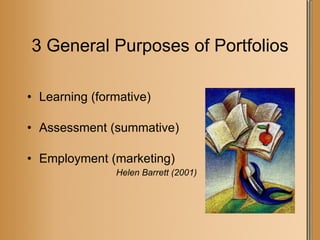
3 General Purposes of Portfolios Learning (formative) Assessment (summative) Employment (marketing) Helen Barrett (2001)
Assessment or  Learning Tool? ePortfolios remain controversial as a tool for assessment. Learner-centered approaches seem to encounter less resistance. Promote lifelong learning and reflection
Learning Portfolios Learning portfolios are purposeful collections of artifacts that demonstrate the learning experiences of the owner. Chen & Mazow (2002)
Reflection Reflection is the process of thinking about something from a new perspective in order to understand something more deeply. It is a critical part of the process in creating a learning portfolio.
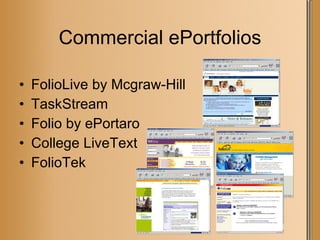
Commercial ePortfolios FolioLive by Mcgraw-Hill TaskStream Folio by ePortaro College LiveText FolioTek
Open Source Software Popular misconception is that it is free Key element is that source code is open Can usually be modified as needed Commercial support of O/S software Linux, Apache, MySQL, PHP, OpenOffice, uPortal, Sakai Project are examples.
Why Open Source Makes Sense for Higher Education Schools can pool technical resources Control product development cycles Product is tailored to higher education Few to no licensing restrictions Fulfills mission of higher education
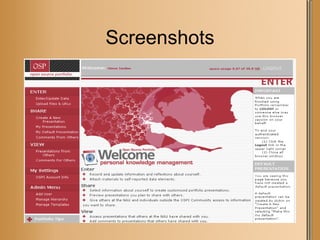
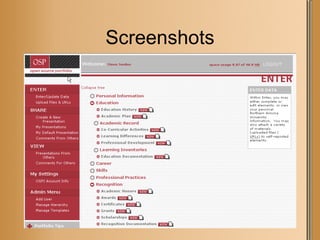
Open Source Portfolio Initiative Founded in 2003 by University of Minnesota, U. of Delaware, & r-smart Software is “free” No licensing restrictions Can be freely modified Thousands of downloads An active development community
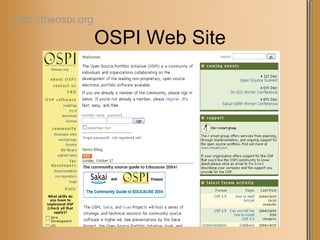
OSPI A community of individuals and organizations collaborating on the development of the leading non-proprietary, open source electronic portfolio software available. http://www.theospi.org
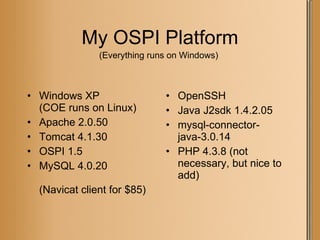
My OSPI Platform Windows XP  (COE runs on Linux) Apache 2.0.50 Tomcat 4.1.30 OSPI 1.5 MySQL 4.0.20 (Navicat client for $85) OpenSSH Java J2sdk 1.4.2.05 mysql-connector-java-3.0.14 PHP 4.3.8 (not necessary, but nice to add) (Everything runs on Windows)
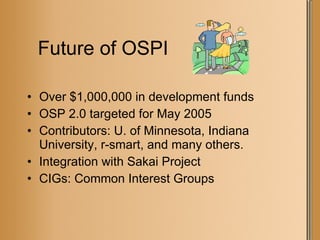
Future of OSPI Over $1,000,000 in development funds OSP 2.0 targeted for May 2005 Contributors: U. of Minnesota, Indiana University, r-smart, and many others. Integration with Sakai Project CIGs: Common Interest Groups
OSPI Web Site http:// theospi.org
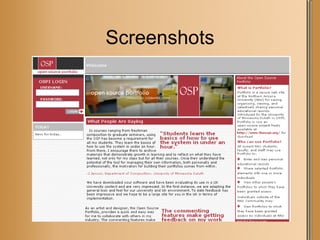
Screenshots
Screenshots
Screenshots

Eport

  • 1.
    Electronic Portfolios: An Open Source Solution Stephen D. Sorden Northern Arizona University AACE E-Learn Conference Washington D.C. November 3, 2004
  • 2.
  • 3.
    Problems in thePast Paper-based versions were bulky. Properly conducted, student-teacher interaction is very time consuming. After wide-spread interest, practical limitations have cooled enthusiasm.
  • 4.
    New Promise of ePortfolios Storage is no longer an issue. Geographical limits are overcome. Teacher-Student and peer interaction still time-consuming, but more manageable.
  • 5.
    3 General Purposesof Portfolios Learning (formative) Assessment (summative) Employment (marketing) Helen Barrett (2001)
  • 6.
    Assessment or Learning Tool? ePortfolios remain controversial as a tool for assessment. Learner-centered approaches seem to encounter less resistance. Promote lifelong learning and reflection
  • 7.
    Learning Portfolios Learningportfolios are purposeful collections of artifacts that demonstrate the learning experiences of the owner. Chen & Mazow (2002)
  • 8.
    Reflection Reflection isthe process of thinking about something from a new perspective in order to understand something more deeply. It is a critical part of the process in creating a learning portfolio.
  • 9.
    Commercial ePortfolios FolioLiveby Mcgraw-Hill TaskStream Folio by ePortaro College LiveText FolioTek
  • 10.
    Open Source SoftwarePopular misconception is that it is free Key element is that source code is open Can usually be modified as needed Commercial support of O/S software Linux, Apache, MySQL, PHP, OpenOffice, uPortal, Sakai Project are examples.
  • 11.
    Why Open SourceMakes Sense for Higher Education Schools can pool technical resources Control product development cycles Product is tailored to higher education Few to no licensing restrictions Fulfills mission of higher education
  • 12.
    Open Source PortfolioInitiative Founded in 2003 by University of Minnesota, U. of Delaware, & r-smart Software is “free” No licensing restrictions Can be freely modified Thousands of downloads An active development community
  • 13.
    OSPI A communityof individuals and organizations collaborating on the development of the leading non-proprietary, open source electronic portfolio software available. http://www.theospi.org
  • 14.
    My OSPI PlatformWindows XP (COE runs on Linux) Apache 2.0.50 Tomcat 4.1.30 OSPI 1.5 MySQL 4.0.20 (Navicat client for $85) OpenSSH Java J2sdk 1.4.2.05 mysql-connector-java-3.0.14 PHP 4.3.8 (not necessary, but nice to add) (Everything runs on Windows)
  • 15.
    Future of OSPIOver $1,000,000 in development funds OSP 2.0 targeted for May 2005 Contributors: U. of Minnesota, Indiana University, r-smart, and many others. Integration with Sakai Project CIGs: Common Interest Groups
  • 16.
    OSPI Web Sitehttp:// theospi.org
  • 17.
  • 18.
  • 19.