Assessment and
Evaluation in Blended
      Teaching
Summer Teaching Innovations Academy
           June 6, 2012
Assessment vs. Evaluation
O Assessing student learning
  O determining the quality of student work


O Evaluating your course
  O determining the worth or effectiveness of
    course design or teaching
How do you Assess Students?
Assessing Students Online
O Considering offering traditional forms of
  assessment in Blackboard
  O Rote learning
  O Simple assessment of mastery
  O Replace valuable class time with online
    assessments
  O Low stakes and frequent
Documents Process and
        Product
O Instructors are able to monitor learning
  before final product is due
O Offer help before final product is due
New Forms of Assessments
O Assessments may be offered in new ways
 through online or blended teaching
  O students can bring in additional resources
    on discussion forums
  O students “rehearse” a team project online
    and then present in the f2f session


O Group work is much easier to document
  O the entire process is documented
Types of Online Assessments
O Self Assessment: Practice
O Graded Assessment: Pre-test/Post-test
O Course Assessment: Formative
O Course Assessment: Summative
Tools for Assessment
O CATS – Classroom Assessment Techniques
  O very brief writing assignments
  O let’s you know how students think and feel
  O complete as soon as a module is done (or
    during)
  O designed to provide immediate feedback for
    both students and instructors
  O lets you know if your teaching is accomplishing
    what students are supposed to be learning
  O provides a clear understanding of students
    learning so you can adjust teaching
Benefits of CATS
O Less instructor prep time
O Students feel more connected
O Demonstrates instructor’s investment in
  students learning
O Students become monitors of their own
  learning
Examples of CATS
O Muddiest Point
  O What has been the muddiest point so far in this
    module? That is what remains the least clear to
    you?
O One Minute Paper
  O What is the one thing you learned in this
    module that you did not know when you
    started? or What are the 2 (or 3,4,5) most
    significant (insert another word such as
    surprising) things that you learned during this
    module?
More CATS
O One Sentence Summary
  O Students summarize knowledge of a topic
    by constructing a single sentence
    answering, “Who does what to whom,
    when, where, how and why?”
O Student Generated Test Questions
  O Students write test questions and model
    answers for specific topics in a format
    consistent with course exams.
How to Use a CAT
O Explain the purpose to your students
O Build it into your course as part of
  instruction and assessment
O Administer CAT online
O Summarize the responses and act on
  them
O Award small amounts of credit for
  completion
Selecting a CAT
O You should first determine the nature of
  the material that you wish to assess

O Three broad categories:
  O Course Related Knowledge and Skills
  O Learner Attitudes, Values, and Self
    Awareness
  O Learner Reaction to Instruction
More Tools for Assessment
O Rubrics
  O scoring guides used in assessment
  O designed to make instructor expectations
    about student performance explicit
  O Provides clear, well defined feedback to
    students
Teaching and Learning
     Benefits of Rubrics
O Instructors are able to assess consistently
  through objective criteria
  O avoids grading “drift”
O Eases workload for instructors
O Knowing instructors expectations
  improves student performance
O Motivational tool for student because
  performance level is defined
  O consider providing students with examples
Common Elements of a Rubric
Basic Types of Rubrics
O Analytical rubrics identify and assess
  components of a finished product
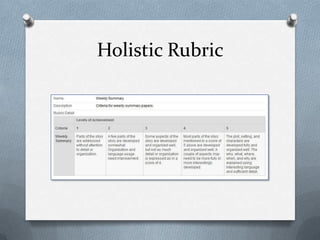
O Holistic rubrics provide a general
  assessment of performance
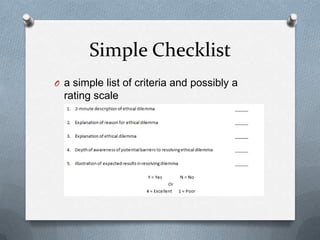
O Checklists provide a simple list of
  expectations
Analytical Rubric
Holistic Rubric
Simple Checklist
O a simple list of criteria and possibly a
  rating scale
Conclusions
O CATS and Rubrics
  O provide feedback to the instructor and
    students
  O reduces instructor workload by providing
    solid information
  O avoids the high stakes catastrophic
    assessment that more often terminated
    learning rather than extending it
  O encourages instructors and students to
    engage in dialogue about the course

Assessment evaluationblendedteaching

  • 1.
    Assessment and Evaluation inBlended Teaching Summer Teaching Innovations Academy June 6, 2012
  • 2.
    Assessment vs. Evaluation OAssessing student learning O determining the quality of student work O Evaluating your course O determining the worth or effectiveness of course design or teaching
  • 3.
    How do youAssess Students?
  • 4.
    Assessing Students Online OConsidering offering traditional forms of assessment in Blackboard O Rote learning O Simple assessment of mastery O Replace valuable class time with online assessments O Low stakes and frequent
  • 5.
    Documents Process and Product O Instructors are able to monitor learning before final product is due O Offer help before final product is due
  • 6.
    New Forms ofAssessments O Assessments may be offered in new ways through online or blended teaching O students can bring in additional resources on discussion forums O students “rehearse” a team project online and then present in the f2f session O Group work is much easier to document O the entire process is documented
  • 7.
    Types of OnlineAssessments O Self Assessment: Practice O Graded Assessment: Pre-test/Post-test O Course Assessment: Formative O Course Assessment: Summative
  • 8.
    Tools for Assessment OCATS – Classroom Assessment Techniques O very brief writing assignments O let’s you know how students think and feel O complete as soon as a module is done (or during) O designed to provide immediate feedback for both students and instructors O lets you know if your teaching is accomplishing what students are supposed to be learning O provides a clear understanding of students learning so you can adjust teaching
  • 9.
    Benefits of CATS OLess instructor prep time O Students feel more connected O Demonstrates instructor’s investment in students learning O Students become monitors of their own learning
  • 10.
    Examples of CATS OMuddiest Point O What has been the muddiest point so far in this module? That is what remains the least clear to you? O One Minute Paper O What is the one thing you learned in this module that you did not know when you started? or What are the 2 (or 3,4,5) most significant (insert another word such as surprising) things that you learned during this module?
  • 11.
    More CATS O OneSentence Summary O Students summarize knowledge of a topic by constructing a single sentence answering, “Who does what to whom, when, where, how and why?” O Student Generated Test Questions O Students write test questions and model answers for specific topics in a format consistent with course exams.
  • 12.
    How to Usea CAT O Explain the purpose to your students O Build it into your course as part of instruction and assessment O Administer CAT online O Summarize the responses and act on them O Award small amounts of credit for completion
  • 13.
    Selecting a CAT OYou should first determine the nature of the material that you wish to assess O Three broad categories: O Course Related Knowledge and Skills O Learner Attitudes, Values, and Self Awareness O Learner Reaction to Instruction
  • 14.
    More Tools forAssessment O Rubrics O scoring guides used in assessment O designed to make instructor expectations about student performance explicit O Provides clear, well defined feedback to students
  • 15.
    Teaching and Learning Benefits of Rubrics O Instructors are able to assess consistently through objective criteria O avoids grading “drift” O Eases workload for instructors O Knowing instructors expectations improves student performance O Motivational tool for student because performance level is defined O consider providing students with examples
  • 16.
  • 17.
    Basic Types ofRubrics O Analytical rubrics identify and assess components of a finished product O Holistic rubrics provide a general assessment of performance O Checklists provide a simple list of expectations
  • 18.
  • 19.
  • 20.
    Simple Checklist O asimple list of criteria and possibly a rating scale
  • 21.
    Conclusions O CATS andRubrics O provide feedback to the instructor and students O reduces instructor workload by providing solid information O avoids the high stakes catastrophic assessment that more often terminated learning rather than extending it O encourages instructors and students to engage in dialogue about the course

Editor's Notes

  • #7 safeguards data
  • #8 Self Assessment: PracticeWith self-assessment, students can track their progress to ensure they have mastered the course information. Practice provides the students with the opportunity to master course materials before proceeding to the next level of instruction. For example, online quizzes allow the student to get immediate feedback on their mastery of the content and to continue to the next level. If a student fails to master or understand the information, they can identify difficulties they are experiencing and either ask for help or continue in their practice of the materials.Grade Assessment: Pre-test/Post-testPre and Post tests sever two purposes. First, is to determine the skills or knowledge the students may already possess about the course materials. Second, post-testing serves as a means to measure the improvement in the skills or knowledge the students acquired from the presentation of the course materials.Course Assessment: FormativeFormative assessments are a learner-centered way to informally assess how students are learning throughout the course in order to improve the quality of student learning.Formative assessments are quick, relatively easy, and provide an excellent way to “check in” and receive feedback on learning effectiveness without the stress of formal exams and projects. Formative assessments can include everything from surveys to short hand-written papers.
  • #10 Less instructor prep time – you don’t have to grade a lengthy assignmentStudents feel more connected – ongoing exchange let’s students know that you have an interest in them doing wellDemonstrates instructor’s investment in students learning – produces an artifact that can be archived and accessed for later studyStudents become monitors of their own learning
  • #11 Muddiest Point and One Minute Paper – allows for a balanced response from students, may let you know what you need to review or revise, provides immediate feedback as closely as possible to the learning experience, assumes that not everything in the learning module is transparent, let’s students assert the fact that they do not entirely get what is going on in the module
  • #12 Once Sentence Summary - The purpose is to require students to select only the defining features of an idea. Evaluate the quality of each summary quickly and holistically. Note whether students have identified the essential concepts of the class topic and their interrelationships. Share your observations with your students.Student generated test questions - This will give students the opportunity to evaluate the course topics, reflect on what they understand, and what are good test items. Make a rough tally of the questions your students propose and the topics that they cover. Evaluate the questions and use the goods ones as prompts for discussion. You may also want to revise the questions and use them on the upcoming exam.
  • #13 Administer CAT online – use a discussion forum, survey or even a web 2.0 toolConsider summarizing and posting the results as an announcement – this can act as feedbackCATS can prompt additional learning and allow for redesign if something is clearly not working
  • #16 Example of easing workload: read through the discussion forum for norms, craft responses using the rubric, copy and paste into feedback area
  • #19 Analytical rubrics identify and assess components of a finished product
  • #20 Holistic rubrics provide a general assessment of performance