Research Presentation University of Sonora Summer Project
Department of Foreign Languages Building
Proposed Project Work with a few interested volunteers over the summer to create a community of support for e-learning. The goals are: That participants have a basic online course by the end of the summer That participants master the technologies necessary to be an effective online instructor
Proposed Calendar April 28-29: Visit UniSon to Present Ideas May: Begin online activities with UniSon faculty 5/30-6/3: Week-long workshop in Hermosillo June and July: Activities continue online. We practice with technology in an online community while you learn how to create online instruction. I provide support through distance technologies. Mid-August: Return to Hermosillo for another week to help wrap up the projects. September and beyond: ???
Study The study surrounding the project will look at the process of change and diffusion of innovations and will ultimately reflect upon the success or failure of the project, as well as try to identify the conditions that led to the successful or unsuccessful outcome.
A few of the professors from the Department of Foreign Languages
Research Question The research question for the pilot study will consider how positive educational innovation is successfully introduced through the use of technology and international cooperation, in spite of cultural and political differences. Also, what are the conditions that should exist or be created before such change is attempted?
ESL, Technology  & Developing Countries More than 50% of the world’s online content is in English and is accessible only through technology.
ESL, Technology  & Developing Countries Teachers will not integrate technology to teach the same English skills better, but they will likely make sacrifices to integrate technology if they believe that the mastery of technology as part of the English curriculum will contribute to the advancement of their students and their society.  Warschauer, M. (2002). A developmental perspective on technology in language education.  TESOL Quarterly, 36 (3), 453-475.
Diffusion of Innovations Theory Everett Rogers is widely recognized as one of the early pioneers of Diffusion Theory. This theory includes the innovation-decision process, which is the five-step process (knowledge, persuasion, decision, implementation, and confirmation) that we pass through from first awareness of an innovation to its adoption.
The Five Adopter Categories Rogers also discussed the five  adopter categories on the basis of innovativeness . Rogers lists these adopter categories as innovators (2.5%), early adopters (13.5%), early majority (34%), late majority (34%), and laggards (16%).
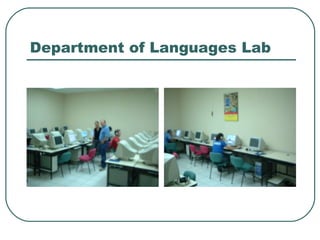
Department of Languages Lab
Ely’s Eight Conditions  for Change Dissatisfaction with the status quo. Existence of knowledge and skills. Availability of resources. Availability of time. Rewards of incentives exist. Participation. Commitment. Leadership.
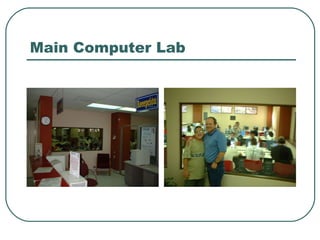
Main Computer Lab
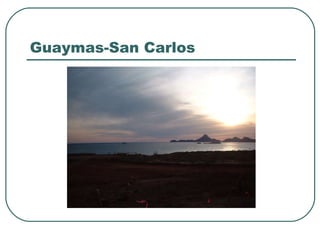
Guaymas-San Carlos
Guaymas-San Carlos
Miramar Beach near Guaymas
Research Presentation University of Sonora Summer Project

Research in Mexico

  • 1.
    Research Presentation Universityof Sonora Summer Project
  • 2.
    Department of ForeignLanguages Building
  • 3.
    Proposed Project Workwith a few interested volunteers over the summer to create a community of support for e-learning. The goals are: That participants have a basic online course by the end of the summer That participants master the technologies necessary to be an effective online instructor
  • 4.
    Proposed Calendar April28-29: Visit UniSon to Present Ideas May: Begin online activities with UniSon faculty 5/30-6/3: Week-long workshop in Hermosillo June and July: Activities continue online. We practice with technology in an online community while you learn how to create online instruction. I provide support through distance technologies. Mid-August: Return to Hermosillo for another week to help wrap up the projects. September and beyond: ???
  • 5.
    Study The studysurrounding the project will look at the process of change and diffusion of innovations and will ultimately reflect upon the success or failure of the project, as well as try to identify the conditions that led to the successful or unsuccessful outcome.
  • 6.
    A few ofthe professors from the Department of Foreign Languages
  • 7.
    Research Question Theresearch question for the pilot study will consider how positive educational innovation is successfully introduced through the use of technology and international cooperation, in spite of cultural and political differences. Also, what are the conditions that should exist or be created before such change is attempted?
  • 8.
    ESL, Technology & Developing Countries More than 50% of the world’s online content is in English and is accessible only through technology.
  • 9.
    ESL, Technology & Developing Countries Teachers will not integrate technology to teach the same English skills better, but they will likely make sacrifices to integrate technology if they believe that the mastery of technology as part of the English curriculum will contribute to the advancement of their students and their society. Warschauer, M. (2002). A developmental perspective on technology in language education. TESOL Quarterly, 36 (3), 453-475.
  • 10.
    Diffusion of InnovationsTheory Everett Rogers is widely recognized as one of the early pioneers of Diffusion Theory. This theory includes the innovation-decision process, which is the five-step process (knowledge, persuasion, decision, implementation, and confirmation) that we pass through from first awareness of an innovation to its adoption.
  • 11.
    The Five AdopterCategories Rogers also discussed the five adopter categories on the basis of innovativeness . Rogers lists these adopter categories as innovators (2.5%), early adopters (13.5%), early majority (34%), late majority (34%), and laggards (16%).
  • 12.
  • 13.
    Ely’s Eight Conditions for Change Dissatisfaction with the status quo. Existence of knowledge and skills. Availability of resources. Availability of time. Rewards of incentives exist. Participation. Commitment. Leadership.
  • 14.
  • 15.
  • 16.
  • 17.
  • 18.
    Research Presentation Universityof Sonora Summer Project