Research Proposal
             Presentation
               Karin Blackwood
                   EDU 710
               Dr. Helen Hawley


3/6/2012       Karin Blackwood, ID# 427003   1
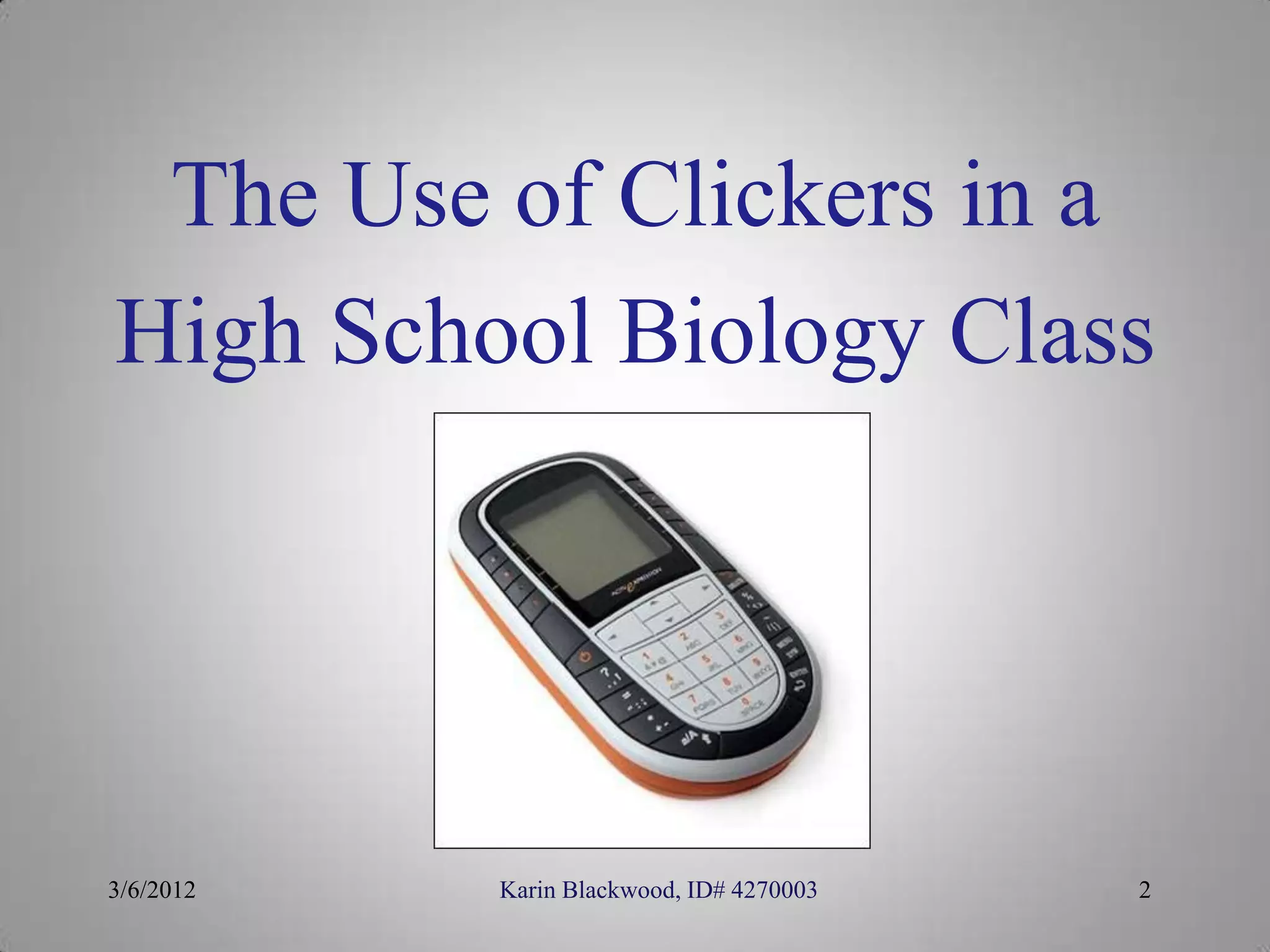
The Use of Clickers in a
High School Biology Class


3/6/2012   Karin Blackwood, ID# 4270003   2
Statement of the Problem
• Using a device, such as a handheld clicker, might
  level the playing field for the language learner and
  the reluctant learner; while capturing the attention
  of the tired and disengaged student.
• Educators find themselves in a very difficult time
  to teach, and teach well.
     – Language issues exist for many students
     – Students don’t get to touch technology even though it is
       all around them
     – Students are difficult to engage (over-stimulation,
       family issues, too many activities)
3/6/2012             Karin Blackwood, ID# 427003             3
Background & Need
• Response Systems have been around since the
  1960s but entered the educational arena in the 80s
• Clickers today transmit a student’s response & can
  instantly see it being evaluated
• It is a means of active learning while allowing the
  teacher to obtain & analyze student learning
  immediately
• Primarily used at the college level…most research
  done at the college level
• Need to evaluate the value of the clicker for stu-
  dent review sessions & its impact on summative
  assessment data at the high school level
3/6/2012         Karin Blackwood, ID# 427003        4
Proposed Methodology
• Research Method
     – Approach: Mixed-Method
     – sampling strategy:
           • 58 biology students will be participating from this
             teacher-researcher’s 3rd & 4th period classes
     – Timeframe: 1 school year
           • The fall semester of assessment scores will be the
             baseline data; overall GPAs will be collected as well
           • The spring semester of assessment scores will be
             collected after using the clickers for the review
             sessions; overall GPAs will be collected.

3/6/2012               Karin Blackwood, ID# 427003                 5
Methodology continued…
• Scope & location of research
     – This study takes place at a large high school in
       CA where enrollment if just over 2000 students
           • All students at this site must take biology
           • Classes are heterogeneous in age, ethnicity, and
             intellect
     – Triangulation of data? YES!!
           • The overall GPAs of the individual participants will
             be compared between the fall & spring semesters
           • Students will also be compared by grade level (9,
             10, 11, & 12)
           • Students will take a perception survey
3/6/2012               Karin Blackwood, ID# 427003              6
Issues & Limitations
• Ethical
     – Privacy: The students will remain anonymous
       and will be identified by student number, not
       name
     – Confidentiality: The data will be shared with
       the teacher-researchers content team and also
       with NVUSD, but the students will remain
       nameless

3/6/2012          Karin Blackwood, ID# 427003          7
Issues & Limitations continued…
• Limitations
     – Study limited to the accessibility of a class set
       of clickers
     – Steep learning curve for first time users
     – Most questions target factual questions that are
       lower down on Bloom’s taxonomy
     – Technology issues
     – Cheating
     – Cost & storage
3/6/2012           Karin Blackwood, ID# 427003         8
References
•   Achievement Gap. (2011, July 7). Education Week.
•   Beatty, I. (2004). Transforming student learning with classroom communication systems. EDUCAUSE Quarterly, 3, 5. Retrieved from
    http://www.educause.edu/LibraryDetailPage/?ID=ERB0403
•   Bloom, B. 1956. Taxonomy of educational objectives: Book 1, cognitive domain. New York: Longman.
•   Caldwell, J. E. (2007). Clickers in the large classroom: Current research and best-practice tips. Retrieved October 9, 2011, from
    http://www.lifescied.org////.full
•   Dills, I. (2011, October 9). School district launches $11 million learning plan. Napa Valley Register.
•   Gee, J. P. (2005). Learning by design: good video games as learning machines. E-learning, 2(1), 5-16.
•   Gee, J. P. (revised, 2008). What video games have to teach us about learning and literacy. In Empowered learners: Problem solving,
    understanding (pp. 8, 14). Basingstoke: Palgrave Macmillan.
•   Guess, A. (2008, July 18). Keeping clickers in the classroom. Retrieved from http://www.insidehighered.com
•   Herreid, C. F. (2006, October). “Clicker” cases: Introducing case study teaching into large classrooms. Journal of College Science Teaching,
    36(2), 43-37. Abstract obtained from “Clicker” cases: introducing case study teaching into large classrooms, 2006, 36, Abstract No. 2.
•   Johnson, C. (2007, January 24). Clickers in your classroom [Electronic mailing list message]. Retrieved from Wakonse-Arizona E-
    Newsletter: http://cite.asu.edu/wakonse//idea.htm
•   Lane, D., & Atlas, R. (1996, March). The networked classroom. Lecture presented at Computers & Psychology, York, UK.
•   Martyn, M. (2007). Clickers in the classroom: An active learning approach. EDUCAUSE Quarterly, 30, volume 30, number 2. Retrieved
    from http://Volum//7458
•   Marzano, R. J., Pickering, D. J., & Pollock, J. E. (2001). Classroom instruction that works: Research-based strategies for increasing student
    achievement.
•   McDaniel, R. (n.d.). Motivational theory. Retrieved from http://www.ehow.com/_5010005_theories-r
•   SARC data. (n.d.). Napa valley unified school district. Retrieved October 24, 2011, from NVUSD website: http://www.nvusd.k12.ca.us/
•   Strom, P. S., & Strom, R. D. (2002). Collaboration integration theory: Overcoming limitations of cooperative learning among community
    college students. The Community College Journal of Research and Practice, 315-331. Retrieved from http://www.public.asu.edu/~rdstrom/


3/6/2012                                                                                                                                      9
                                             Karin Blackwood, ID# 427003

Proposal preso template

  • 1.
    Research Proposal Presentation Karin Blackwood EDU 710 Dr. Helen Hawley 3/6/2012 Karin Blackwood, ID# 427003 1
  • 2.
    The Use ofClickers in a High School Biology Class 3/6/2012 Karin Blackwood, ID# 4270003 2
  • 3.
    Statement of theProblem • Using a device, such as a handheld clicker, might level the playing field for the language learner and the reluctant learner; while capturing the attention of the tired and disengaged student. • Educators find themselves in a very difficult time to teach, and teach well. – Language issues exist for many students – Students don’t get to touch technology even though it is all around them – Students are difficult to engage (over-stimulation, family issues, too many activities) 3/6/2012 Karin Blackwood, ID# 427003 3
  • 4.
    Background & Need •Response Systems have been around since the 1960s but entered the educational arena in the 80s • Clickers today transmit a student’s response & can instantly see it being evaluated • It is a means of active learning while allowing the teacher to obtain & analyze student learning immediately • Primarily used at the college level…most research done at the college level • Need to evaluate the value of the clicker for stu- dent review sessions & its impact on summative assessment data at the high school level 3/6/2012 Karin Blackwood, ID# 427003 4
  • 5.
    Proposed Methodology • ResearchMethod – Approach: Mixed-Method – sampling strategy: • 58 biology students will be participating from this teacher-researcher’s 3rd & 4th period classes – Timeframe: 1 school year • The fall semester of assessment scores will be the baseline data; overall GPAs will be collected as well • The spring semester of assessment scores will be collected after using the clickers for the review sessions; overall GPAs will be collected. 3/6/2012 Karin Blackwood, ID# 427003 5
  • 6.
    Methodology continued… • Scope& location of research – This study takes place at a large high school in CA where enrollment if just over 2000 students • All students at this site must take biology • Classes are heterogeneous in age, ethnicity, and intellect – Triangulation of data? YES!! • The overall GPAs of the individual participants will be compared between the fall & spring semesters • Students will also be compared by grade level (9, 10, 11, & 12) • Students will take a perception survey 3/6/2012 Karin Blackwood, ID# 427003 6
  • 7.
    Issues & Limitations •Ethical – Privacy: The students will remain anonymous and will be identified by student number, not name – Confidentiality: The data will be shared with the teacher-researchers content team and also with NVUSD, but the students will remain nameless 3/6/2012 Karin Blackwood, ID# 427003 7
  • 8.
    Issues & Limitationscontinued… • Limitations – Study limited to the accessibility of a class set of clickers – Steep learning curve for first time users – Most questions target factual questions that are lower down on Bloom’s taxonomy – Technology issues – Cheating – Cost & storage 3/6/2012 Karin Blackwood, ID# 427003 8
  • 9.
    References • Achievement Gap. (2011, July 7). Education Week. • Beatty, I. (2004). Transforming student learning with classroom communication systems. EDUCAUSE Quarterly, 3, 5. Retrieved from http://www.educause.edu/LibraryDetailPage/?ID=ERB0403 • Bloom, B. 1956. Taxonomy of educational objectives: Book 1, cognitive domain. New York: Longman. • Caldwell, J. E. (2007). Clickers in the large classroom: Current research and best-practice tips. Retrieved October 9, 2011, from http://www.lifescied.org////.full • Dills, I. (2011, October 9). School district launches $11 million learning plan. Napa Valley Register. • Gee, J. P. (2005). Learning by design: good video games as learning machines. E-learning, 2(1), 5-16. • Gee, J. P. (revised, 2008). What video games have to teach us about learning and literacy. In Empowered learners: Problem solving, understanding (pp. 8, 14). Basingstoke: Palgrave Macmillan. • Guess, A. (2008, July 18). Keeping clickers in the classroom. Retrieved from http://www.insidehighered.com • Herreid, C. F. (2006, October). “Clicker” cases: Introducing case study teaching into large classrooms. Journal of College Science Teaching, 36(2), 43-37. Abstract obtained from “Clicker” cases: introducing case study teaching into large classrooms, 2006, 36, Abstract No. 2. • Johnson, C. (2007, January 24). Clickers in your classroom [Electronic mailing list message]. Retrieved from Wakonse-Arizona E- Newsletter: http://cite.asu.edu/wakonse//idea.htm • Lane, D., & Atlas, R. (1996, March). The networked classroom. Lecture presented at Computers & Psychology, York, UK. • Martyn, M. (2007). Clickers in the classroom: An active learning approach. EDUCAUSE Quarterly, 30, volume 30, number 2. Retrieved from http://Volum//7458 • Marzano, R. J., Pickering, D. J., & Pollock, J. E. (2001). Classroom instruction that works: Research-based strategies for increasing student achievement. • McDaniel, R. (n.d.). Motivational theory. Retrieved from http://www.ehow.com/_5010005_theories-r • SARC data. (n.d.). Napa valley unified school district. Retrieved October 24, 2011, from NVUSD website: http://www.nvusd.k12.ca.us/ • Strom, P. S., & Strom, R. D. (2002). Collaboration integration theory: Overcoming limitations of cooperative learning among community college students. The Community College Journal of Research and Practice, 315-331. Retrieved from http://www.public.asu.edu/~rdstrom/ 3/6/2012 9 Karin Blackwood, ID# 427003