National Dip. in Teaching
Sudarshana Elapatha
Classify according to the
external features.
.
Sudarshana Elapatha
Considered ,
–Morphological
–Physiological
–Cytological and
–Molecular biological
features
Sudarshana Elapatha
Explains
the natural relationships
among organisms
of the same species
Sudarshana Elapatha
Explains
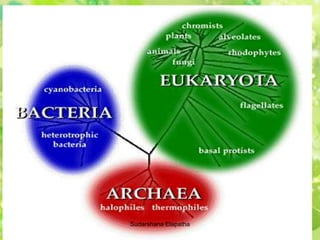
the evolutionary relationships
among different organisms
Sudarshana Elapatha
Sudarshana Elapatha
Carl woese
Sudarshana Elapatha
Sudarshana Elapatha
Sudarshana Elapatha
Sudarshana Elapatha
Sudarshana Elapatha
Sudarshana Elapatha
Sudarshana Elapatha
Sudarshana Elapatha
Sudarshana Elapatha
Sudarshana Elapatha
Sudarshana Elapatha
Sudarshana Elapatha
Sudarshana Elapatha
Sudarshana Elapatha
Next week……
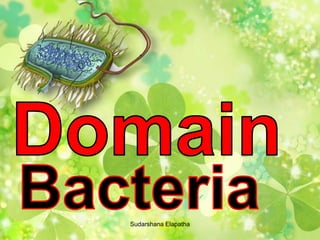
Bacteria
Sudarshana Elapatha
Sudarshana Elapatha
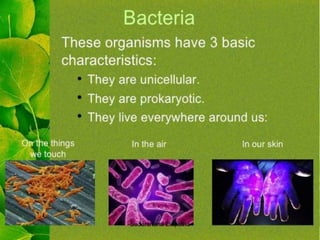
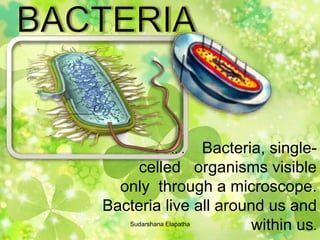
.. . Bacteria, single-
celled organisms visible
only through a microscope.
Bacteria live all around us and
within us.Sudarshana Elapatha
1.Structure
• Unicellular & microscopic
• The nucleus is not covered with a
membrane. ( Prokaryote) have not organized
nucleus
Sudarshana Elapatha
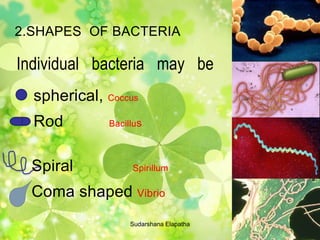
2.SHAPES OF BACTERIA
Individual bacteria may be
Spiral Spirillum
Coma shaped Vibrio
spherical, Coccus
Rod Bacillus
Sudarshana Elapatha
3.Nutrition
• Mostly heterotrophic.
• But Cyanobacteria are autotrophic.
Sudarshana Elapatha
4.Reproduction
• Mostly perform asexual
reproduction.
–Bacteria
•binary fission
–Cyanobacteria
•fragmentation & budding
Sudarshana Elapatha
5.Distribution
• Distribute Almost everywhere.
–In water ,soil ,air
–In the body of organisms
Sudarshana Elapatha
6.Examples
• Bacteria
• Nitrobactor, Nytrosomonas
• Rhizobium
• Vibrio cholera
• Cyanobacteria
• Anabaena
• Nostoc
Sudarshana Elapatha
Sudarshana Elapatha
Sudarshana Elapatha
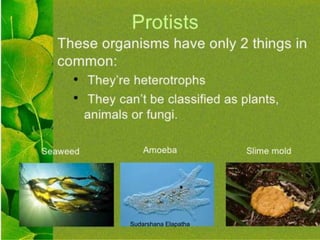
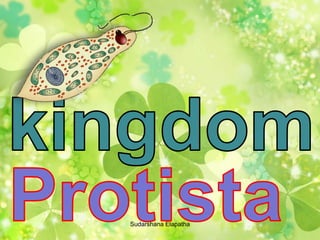
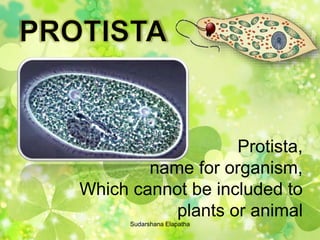
Protista,
name for organism,
Which cannot be included to
plants or animal
Sudarshana Elapatha
1.Structure
• Most are microscopic.
• But some possess large bodies.
• They are eukaryotes.
• Mostly unicellular. Some are multicellular
• Multicellular organisms do not show a
tissue differentiation.
Sudarshana Elapatha
2.Shape
• Different shapes can be seen
•Algae - leaf like
•Protozoa- sole of shoe shape
Sudarshana Elapatha
3.Nutrition
• Algae are phototrophic.
• Protozoans are heterotrophic.
Sudarshana Elapatha
4.Reproduction
• Mostly perform asexual
reproduction.
•binary fission
•Fragmentation
•Spore production
Sudarshana Elapatha
5.Distribution
• In water
–Saline water- most algae
–Fresh water- green algae & protozoa
• damp soil - green algae & protozoa
• inside the body of organisms -
protozoa
Sudarshana Elapatha
6.Examples
Sudarshana Elapatha
Sudarshana Elapatha
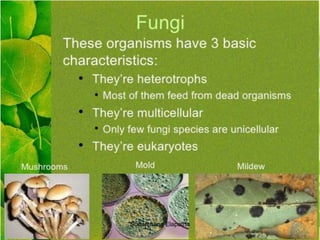
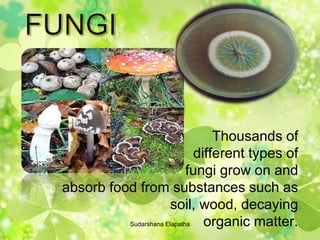
Thousands of
different types of
fungi grow on and
absorb food from substances such as
soil, wood, decaying
organic matter.Sudarshana Elapatha
1.Structure
• Most of them are microscopic.
– But some reproductive structures can be seen
with the naked eye. (Mushroom)
• They are eukaryotic organisms.
• Body is unicellular or multicellular.
• Multicellular organisms exist as mycelium.
• No tissue differentiation.
Sudarshana Elapatha
2.Shape
•Unicellular fungi has
single spherical cells
•Multicellular organisms
exist as fungi mycelium
Sudarshana Elapatha
3.Nutrition
• All are heterotrophic.
• Most of them obtain
nutrition as saprophytic
organisms.
Sudarshana Elapatha
4.Reproduction
• Reproduce by asexual spores
Sudarshana Elapatha
5.Distribution
•Live on
–organic matters
–Living bodies
Sudarshana Elapatha
6.Examples
• Yeast
• Mucor
• Penicilium
Sudarshana Elapatha
Sudarshana Elapatha
Sudarshana Elapatha
Sudarshana Elapatha

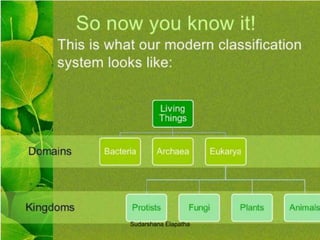
Classifies organisms