Classification of Living Things
What is classification?
Classification is the grouping of
living organisms according to
similar structures and functions.
Early classification systems
Aristotle grouped animals
according to the way they
moved
The modern classification system :
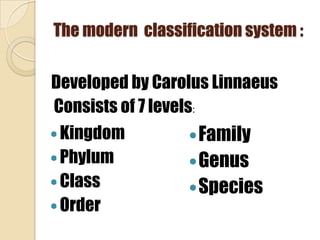
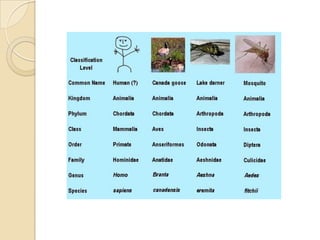
Kingdom
Phylum
Class
Order
Family
Genus
Species
Developed by Carolus Linnaeus
Consists of 7 levels:
Helpful way to remember the 7
levels
King Philip Came Over For
Grape Soda.
King Philip Came Over For
Green Skittles.
Binomial Nomenclature
Developed by Carolus Linnaeus
Two-name system:
◦First name is the organism’s
genus
◦Second name is the organism’s
species
What rules are used to write
scientific names?
 The first letter of the genus is ALWAYS
capitalized
 The first letter of the species is NEVER
capitalized
 Scientific names of organisms are
always italicized or underlined
Using the Classification System
Field guides help identify organisms.
-they highlight differences between similar
organisms (like trees)
Taxonomic Key (Dichotomous Key)
-paired statements that describe the
physical characteristics of different
organisms
Taxonomic Key
 1a Fruits occur singly ....................................................... Go to 3
 1b Fruits occur in clusters of two or more ......................... Go to 2
 2a Fruits are round ....................................................... Grapes
 2b Fruits are elongate ................................................... Bananas
 3a Thick skin that separates easily from flesh .............Oranges
 3b Thin skin that adheres to flesh .............................. Go to 4
 4a More than one seed per fruit ............................ Apples
 4b One seed per fruit ............................................ Go to 5
 5a Skin covered with velvety hairs .................... Peaches
 5b Skin smooth, without hairs ........................... Plums
What steps would you use to identify a peach?

Classification

  • 1.
  • 2.
    What is classification? Classificationis the grouping of living organisms according to similar structures and functions.
  • 3.
    Early classification systems Aristotlegrouped animals according to the way they moved
  • 4.
    The modern classificationsystem : Kingdom Phylum Class Order Family Genus Species Developed by Carolus Linnaeus Consists of 7 levels:
  • 7.
    Helpful way toremember the 7 levels King Philip Came Over For Grape Soda. King Philip Came Over For Green Skittles.
  • 8.
    Binomial Nomenclature Developed byCarolus Linnaeus Two-name system: ◦First name is the organism’s genus ◦Second name is the organism’s species
  • 9.
    What rules areused to write scientific names?  The first letter of the genus is ALWAYS capitalized  The first letter of the species is NEVER capitalized  Scientific names of organisms are always italicized or underlined
  • 10.
    Using the ClassificationSystem Field guides help identify organisms. -they highlight differences between similar organisms (like trees) Taxonomic Key (Dichotomous Key) -paired statements that describe the physical characteristics of different organisms
  • 11.
    Taxonomic Key  1aFruits occur singly ....................................................... Go to 3  1b Fruits occur in clusters of two or more ......................... Go to 2  2a Fruits are round ....................................................... Grapes  2b Fruits are elongate ................................................... Bananas  3a Thick skin that separates easily from flesh .............Oranges  3b Thin skin that adheres to flesh .............................. Go to 4  4a More than one seed per fruit ............................ Apples  4b One seed per fruit ............................................ Go to 5  5a Skin covered with velvety hairs .................... Peaches  5b Skin smooth, without hairs ........................... Plums What steps would you use to identify a peach?