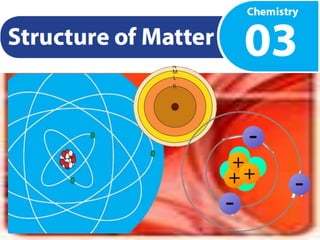
Matter
The things that occupy
space and have a mass
are called matter.
According to physical nature
the matter can be classified in
to three groups .
– Solid
– Liquid
– Gas
According to chemical composition
the matter can be classified in to two
groups
• Pure substances
–Elements and Compounds
• Mixtures
–Homogeneous mixtures
–Heterogeneous mixtures
Atoms
• Atoms are the building units of
matter.
• The atom is composed of subatomic
particles.
• protons, electrons and neutrons are
the main subatomic particles.
• The electron is a negatively
charged particle.
• Proton has a positive charge
• While neutrons have no charge.
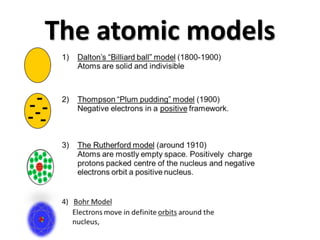
The atomic models
The nuclear model The Planetary Model of the Atom
• Their Is a nucleus at the centre of the atom.
• Protons and neutrons are accumulated in the
nucleus
• The nucleus is positively charged
• Electrons revole around the nucleus
• The number of electrons in an atom is equal to the
number of protons.
• the atom is electrically neutral.
This atomic model was introduced by
Ernest Rutherford in 1911
Bohr Model of the Atom
• Niels Bohr further elaborated the
Rutherford's model
According to Bohr Model ,
• The electrons move in definite paths or
shells around the positively charged
nucleus.
Energy levels
• There are four main energy levels or shells
around the nucleus .
• They are assigned either numbers 1, 2, 3, 4......
or letters K, L, M, N...... respectively starting
from the nearest to the nucleus.
• Each energy level has a specific energy
• When moving away from the nucleus this
energy increases. Nevertheless, the
difference between the energy levels
decreases
• In an atom, there is a maximum number of
electrons in any energy level.
Atomic number
The atomic number is the number of
protons in an atom of the element.
Atomic number = number of protons
Atomic number
symbol of the elemant
Mass number
The sum of the number of protons and
neutrons in the nucleus of an atom is
called the mass number
mass number = number of protons + number of neutrons
symbol of the element
mass number
Electronic Configuration
The arrangement of electrons
in the respective energy levels
of an atom
from the innermost level to
the outer most level
is known as
its electronic configuration

3. structure 0f matter

  • 2.
    Matter The things thatoccupy space and have a mass are called matter.
  • 3.
    According to physicalnature the matter can be classified in to three groups . – Solid – Liquid – Gas
  • 4.
    According to chemicalcomposition the matter can be classified in to two groups • Pure substances –Elements and Compounds • Mixtures –Homogeneous mixtures –Heterogeneous mixtures
  • 5.
    Atoms • Atoms arethe building units of matter. • The atom is composed of subatomic particles. • protons, electrons and neutrons are the main subatomic particles.
  • 6.
    • The electronis a negatively charged particle. • Proton has a positive charge • While neutrons have no charge.
  • 7.
  • 8.
    The nuclear modelThe Planetary Model of the Atom • Their Is a nucleus at the centre of the atom. • Protons and neutrons are accumulated in the nucleus • The nucleus is positively charged • Electrons revole around the nucleus • The number of electrons in an atom is equal to the number of protons. • the atom is electrically neutral. This atomic model was introduced by Ernest Rutherford in 1911
  • 9.
    Bohr Model ofthe Atom • Niels Bohr further elaborated the Rutherford's model According to Bohr Model , • The electrons move in definite paths or shells around the positively charged nucleus.
  • 10.
    Energy levels • Thereare four main energy levels or shells around the nucleus . • They are assigned either numbers 1, 2, 3, 4...... or letters K, L, M, N...... respectively starting from the nearest to the nucleus. • Each energy level has a specific energy • When moving away from the nucleus this energy increases. Nevertheless, the difference between the energy levels decreases
  • 11.
    • In anatom, there is a maximum number of electrons in any energy level.
  • 12.
    Atomic number The atomicnumber is the number of protons in an atom of the element. Atomic number = number of protons Atomic number symbol of the elemant
  • 13.
    Mass number The sumof the number of protons and neutrons in the nucleus of an atom is called the mass number mass number = number of protons + number of neutrons symbol of the element mass number
  • 15.
    Electronic Configuration The arrangementof electrons in the respective energy levels of an atom from the innermost level to the outer most level is known as its electronic configuration