VARIOUS FORMS OF
OFFICE
CORRESPONDENCE
OFFICE CORRESPONDENCE
A written exchange of internal and external
communication to support all business
processes.
It is also known as the business
correspondence.
BUSINESS MEMO
DEFINITION
 A short note written as a communication.
 A written communication strictly between the company’s
offices to another, or used in internal correspondence.
 The difference between a memo and a letter is that the
memo has its title line and series number.
 The employees tend to read the if the title line is related to
their job description. It is also used to implement internal
guidelines or procedures that the employees must follow.
SOME TYPES OF MEMOS
 OPERATIONAL MEMO
 FINANCIAL MEMO
 REQUEST FOR ACTION
 DIRECTIVES
 TRIP REPORT
 FIELD REPORT
 DRESS CODE MEMO
PURPOSE OF A BUSINESS MEMO
A memo’s purpose is often to inform, but it
ocassionaly includes as element of
persuation or a call to action.
BASIC CHARACTERISTICS/FEATURES OF
A MEMO
 Begins with headings such as To, From,
Date, and Subject; such headings are
frequently capitalized and in boldface type.
 Contains statement that is usually written
by higher authorities of an organization for
the purpose of sharing information.
 Records and relay information and makes
brief appeal.
 Less formal than a letter.
DO’S OF A MEMORANDUM
 Do stay informed
 Do continue to assume all hiring information
given to you by your employees is valid and
complies with the existing immigration laws.
 Do remember that you are a trusted source
of information.
 Do continue to complete form 1-9 for all new
hires.
 Do update your policies and procedures or
service letters, company loans and NCIS.
DON’TS OF A MEMORANDUM
 Don’t poll your employees
 Don’t refer your employees to a source
you have not vetted
 Don’t ignore that employees are excited
about the executive order
ORGANIZATION/PATTERN IN WRITING A
BUSINESS MEMO
 Present the main point first
 Maintain a professional, succinct style
 Create a very specific subject line to give the
reader as immediate idea of the memo’s subject
and purpose
 Provide a summary or overview of the main
points, especially if the memo is more than one
page
 Use format features, such as headings, to signal
structure and guide readers to the information
they’re seeking
BUSINESS LETTER MEMO SAMPLE
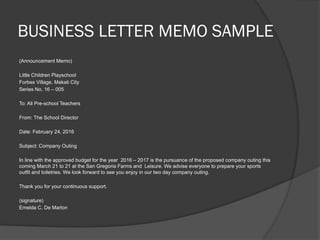
(Announcement Memo)
Little Children Playschool
Forbes Village, Makati City
Series No. 16 – 005
To: All Pre-school Teachers
From: The School Director
Date: February 24, 2016
Subject: Company Outing
In line with the approved budget for the year 2016 – 2017 is the pursuance of the proposed company outing this
coming March 21 to 21 at the San Gregoria Farms and Leisure. We advise everyone to prepare your sports
outfit and toiletries. We look forward to see you enjoy in our two day company outing.
Thank you for your continuous support.
(signature)
Emelda C. De Marlon
EXPLANATION:
The announcement memo includes
information about the company outing of
the employees. The company also uses
their own letterhead.
BUSINESS EMAIL
DEFINITION
•Business e-mail is an office correspondence that can
either be internal or external. There is no required
format in writing e-mail correspondence but it is
expected that the writer maintain a professional tone.
•Note that the header of the letter is written on the
blank fields including the ‘from’ and ‘to’ fields. ‘From’
contains e-mail from the sender while the field ‘to’
contains the email of the recipient.
PURPOSE
 For sharing basic information
 For marketing and advertising
 For negotiations
CHARACTERISTICS/FEATURES OF
BUSINESS EMAIL
 Concise
 Intention - focused
 Summarizing
 Well – organized
 Visually scanrable
 Polite tone and tone appropriate
 Clear on action
ORGANIZATION/PATTERN IN WRITING A
BUSINESS EMAIL
 Find your business email audience
 Know the structure of a business email
 How to write a business email?
Key Points To Remember:
- Be concise
- Don’t use as inappropriate email address from which to send your email (such
as ‘hotlips @yahoo.co-uk')
- Make sure you title your email clearly is the subject box as this helps the
reader to refer to your email at a later date.
- Use ‘plais-text‘ for your formatting rather than HTM2
- Use bulleted lists and keep paragraphs short
- Do not block capitals
- Do not use ‘emoticons‘
- Avoid over-familiar language, slang or abbreviations – such as LOL or BTW
- Don’t be sloopy with grammar or ignore formatting
DO’S OF A BUSINESS EMAIL
 Consider your readers
 Provide a clear, specific subject line
 Use excerpts from previous messages to clarify what
you’re replying to
 Remove long lists of recipients’ names and addresses
 Strike a balance between formal and casual language
 Read and then reread your message before you send it
 Key is your name at the end of your message
 Be careful how you present your message
 Acknowledge receipt of messages promptly
 Observe the common practices of your company
DON’TS OF A BUSINESS EMAIL
 Never substitute email for necessary face-to-face meetings
 Never assume that email is private
 Don’t assume that everyone reads email immediately
 Never send as angry message via email
 Never send as email message written in capital letters,
LIKE THIS (Using all capital letters in any context is
regarded as the email equivalent of shouting)
 Never forward jokes, spam, chain letters, or
advertisements
 Do not reply to everyone who received an email unless it’s
relevant to them
 Do not use email for any illegal or unethical purpose
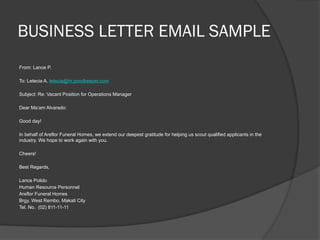
BUSINESS LETTER EMAIL SAMPLE
From: Lance P.
To: Letecia A. letecia@hr.goodkeeper.com
Subject: Re: Vacant Position for Operations Manager
Dear Ma’am Alvarado:
Good day!
In behalf of Areflor Funeral Homes, we extend our deepest gratitude for helping us scout qualified applicants in the
industry. We hope to work again with you.
Cheers!
Best Regards,
Lance Polido
Human Resource Personnel
Areflor Funeral Homes
Brgy. West Rembo, Makati City
Tel. No. (02) 811-11-11
EXPLANATION:
 In this example, the e-mail correspondence is informal
and external. It expresses gratitude towards the effort
made by the manpower agency.
 Make sure the office correspondence is concise and easy
to understand. It is recommended for a correspondence to
have brief sentences and paragraphs for the employees
tend to read it quickly.
 Controlling the tone of writing is important in any office
correspondence. It should not sound too formal or too
informal.
thank
you

10. Various fforms office correspondence.pptx

  • 1.
  • 2.
    OFFICE CORRESPONDENCE A writtenexchange of internal and external communication to support all business processes. It is also known as the business correspondence.
  • 3.
    BUSINESS MEMO DEFINITION  Ashort note written as a communication.  A written communication strictly between the company’s offices to another, or used in internal correspondence.  The difference between a memo and a letter is that the memo has its title line and series number.  The employees tend to read the if the title line is related to their job description. It is also used to implement internal guidelines or procedures that the employees must follow.
  • 4.
    SOME TYPES OFMEMOS  OPERATIONAL MEMO  FINANCIAL MEMO  REQUEST FOR ACTION  DIRECTIVES  TRIP REPORT  FIELD REPORT  DRESS CODE MEMO
  • 5.
    PURPOSE OF ABUSINESS MEMO A memo’s purpose is often to inform, but it ocassionaly includes as element of persuation or a call to action.
  • 6.
    BASIC CHARACTERISTICS/FEATURES OF AMEMO  Begins with headings such as To, From, Date, and Subject; such headings are frequently capitalized and in boldface type.  Contains statement that is usually written by higher authorities of an organization for the purpose of sharing information.  Records and relay information and makes brief appeal.  Less formal than a letter.
  • 7.
    DO’S OF AMEMORANDUM  Do stay informed  Do continue to assume all hiring information given to you by your employees is valid and complies with the existing immigration laws.  Do remember that you are a trusted source of information.  Do continue to complete form 1-9 for all new hires.  Do update your policies and procedures or service letters, company loans and NCIS.
  • 8.
    DON’TS OF AMEMORANDUM  Don’t poll your employees  Don’t refer your employees to a source you have not vetted  Don’t ignore that employees are excited about the executive order
  • 9.
    ORGANIZATION/PATTERN IN WRITINGA BUSINESS MEMO  Present the main point first  Maintain a professional, succinct style  Create a very specific subject line to give the reader as immediate idea of the memo’s subject and purpose  Provide a summary or overview of the main points, especially if the memo is more than one page  Use format features, such as headings, to signal structure and guide readers to the information they’re seeking
  • 10.
    BUSINESS LETTER MEMOSAMPLE (Announcement Memo) Little Children Playschool Forbes Village, Makati City Series No. 16 – 005 To: All Pre-school Teachers From: The School Director Date: February 24, 2016 Subject: Company Outing In line with the approved budget for the year 2016 – 2017 is the pursuance of the proposed company outing this coming March 21 to 21 at the San Gregoria Farms and Leisure. We advise everyone to prepare your sports outfit and toiletries. We look forward to see you enjoy in our two day company outing. Thank you for your continuous support. (signature) Emelda C. De Marlon
  • 11.
    EXPLANATION: The announcement memoincludes information about the company outing of the employees. The company also uses their own letterhead.
  • 12.
    BUSINESS EMAIL DEFINITION •Business e-mailis an office correspondence that can either be internal or external. There is no required format in writing e-mail correspondence but it is expected that the writer maintain a professional tone. •Note that the header of the letter is written on the blank fields including the ‘from’ and ‘to’ fields. ‘From’ contains e-mail from the sender while the field ‘to’ contains the email of the recipient.
  • 13.
    PURPOSE  For sharingbasic information  For marketing and advertising  For negotiations
  • 14.
    CHARACTERISTICS/FEATURES OF BUSINESS EMAIL Concise  Intention - focused  Summarizing  Well – organized  Visually scanrable  Polite tone and tone appropriate  Clear on action
  • 15.
    ORGANIZATION/PATTERN IN WRITINGA BUSINESS EMAIL  Find your business email audience  Know the structure of a business email  How to write a business email? Key Points To Remember: - Be concise - Don’t use as inappropriate email address from which to send your email (such as ‘hotlips @yahoo.co-uk') - Make sure you title your email clearly is the subject box as this helps the reader to refer to your email at a later date. - Use ‘plais-text‘ for your formatting rather than HTM2 - Use bulleted lists and keep paragraphs short - Do not block capitals - Do not use ‘emoticons‘ - Avoid over-familiar language, slang or abbreviations – such as LOL or BTW - Don’t be sloopy with grammar or ignore formatting
  • 16.
    DO’S OF ABUSINESS EMAIL  Consider your readers  Provide a clear, specific subject line  Use excerpts from previous messages to clarify what you’re replying to  Remove long lists of recipients’ names and addresses  Strike a balance between formal and casual language  Read and then reread your message before you send it  Key is your name at the end of your message  Be careful how you present your message  Acknowledge receipt of messages promptly  Observe the common practices of your company
  • 17.
    DON’TS OF ABUSINESS EMAIL  Never substitute email for necessary face-to-face meetings  Never assume that email is private  Don’t assume that everyone reads email immediately  Never send as angry message via email  Never send as email message written in capital letters, LIKE THIS (Using all capital letters in any context is regarded as the email equivalent of shouting)  Never forward jokes, spam, chain letters, or advertisements  Do not reply to everyone who received an email unless it’s relevant to them  Do not use email for any illegal or unethical purpose
  • 18.
    BUSINESS LETTER EMAILSAMPLE From: Lance P. To: Letecia A. letecia@hr.goodkeeper.com Subject: Re: Vacant Position for Operations Manager Dear Ma’am Alvarado: Good day! In behalf of Areflor Funeral Homes, we extend our deepest gratitude for helping us scout qualified applicants in the industry. We hope to work again with you. Cheers! Best Regards, Lance Polido Human Resource Personnel Areflor Funeral Homes Brgy. West Rembo, Makati City Tel. No. (02) 811-11-11
  • 19.
    EXPLANATION:  In thisexample, the e-mail correspondence is informal and external. It expresses gratitude towards the effort made by the manpower agency.  Make sure the office correspondence is concise and easy to understand. It is recommended for a correspondence to have brief sentences and paragraphs for the employees tend to read it quickly.  Controlling the tone of writing is important in any office correspondence. It should not sound too formal or too informal.
  • 20.