Classification of particles
Bivitha T K
Assistant Professor
Department of Physics
S N College,Kannur
 One way of studying the elementary particles is to classify them into different
categories based on certain behaviours or properties and then to look for
similarities or common characteristic among the classifications .
 We can classify particles according to the types of forces through which they
interact.
 Elementary particles fall in to two classes, leptons and hadrons, depending on
whether they respond to the strong interaction( hadrons) or do not(leptons)
 we can also classify particles by their intrinsic spins .
 Based on spin, one can grouped all particles into two categories, Fermions and
Bosons.
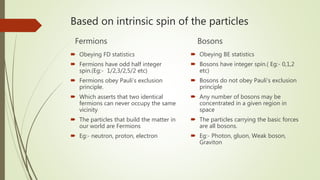
Based on intrinsic spin of the particles
Fermions
 Obeying FD statistics
 Fermions have odd half integer
spin.(Eg:- 1/2,3/2,5/2 etc)
 Fermions obey Pauli’s exclusion
principle.
 Which asserts that two identical
fermions can never occupy the same
vicinity
 The particles that build the matter in
our world are Fermions
 Eg:- neutron, proton, electron
Bosons
 Obeying BE statistics
 Bosons have integer spin.( Eg:- 0,1,2
etc)
 Bosons do not obey Pauli’s exclusion
principle
 Any number of bosons may be
concentrated in a given region in
space
 The particles carrying the basic forces
are all bosons.
 Eg:- Photon, gluon, Weak boson,
Graviton
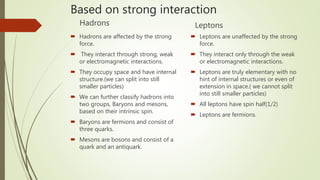
Based on strong interaction
Hadrons
 Hadrons are affected by the strong
force.
 They interact through strong, weak
or electromagnetic interactions.
 They occupy space and have internal
structure.(we can split into still
smaller particles)
 We can further classify hadrons into
two groups, Baryons and mesons,
based on their intrinsic spin.
 Baryons are fermions and consist of
three quarks.
 Mesons are bosons and consist of a
quark and an antiquark.
Leptons
 Leptons are unaffected by the strong
force.
 They interact only through the weak
or electromagnetic interactions.
 Leptons are truly elementary with no
hint of internal structures or even of
extension in space.( we cannot split
into still smaller particles)
 All leptons have spin half(1/2)
 Leptons are fermions.
Leptons
 Leptons are fermions which are unaffected by the strong force.
 There are six known leptons and their antiparticles.
Antiparticle
 The antiparticle of a particle has the same mass, spin and lifetime if unstable, but its charge( if any)
has the opposite sign. The alignment or antialignment between it spin and magnetic
moment(helicity) is also opposite that of the particle .
 All elementary particles have antiparticles.
 Positron is the antiparticle of electron. It has identical mass and spin, but has a positive charge. If an
electron encounters a positron, they annihilate with the transformation of their mass energies into
2 gamma Rays.
 e- +e+ -----2υ (annihilation)
 Antiparticles of stable particles (such as the positron and the antiproton) are themselves stable.
However, when a particle and its antiparticle meet, the annihilation reaction can occur: the particle
and antiparticle both vanish, and instead 2 or more photos can be produced.
 Carl Anderson discovered positron.
Antimatter
 Antimatter is composed of antiprotons, antineutrons and positrons.
 It behaves exactly like ordinary matter.
 If galaxies of antimatter stars existed, their spectra would not differ from the
spectra of galaxies of matter stars.
 Thus we have no way to distinguish between the two kinds of galaxies –except
when antimatter from one comes in contact with matter from the other.
 Mutual annihilation would then occur with the release of an immense amount of
energy.
Neutrino and antineutrino
 The electron neutrino was first postulated in 1930 by Poly to explain why the electrons in
beta decay were not emitted with the full reaction energy of the nuclear transition. The
apparent violation of conservation of energy and momentum was most easily avoided by
postulating another particle. Enrico Fermi called the particle a neutrino and developed a
theory of beta decay based on it, but it was not experimentally observed until 1956. It
could penetrate vast thickness of material without interaction.
 The spin of the neutrino is opposite in direction to the direction of its motion;
viewed from behind, that is, the neutrino spins counter clockwise. The spin of the
antineutrino on the other hand, is in the same direction as its direction of motion; viewed
from behind, it spins clockwise. Thus the neutrino moves through space in the manner of
a left handed screw, while the antineutrino does so in the manner of a right handed
screw .
Hadrons
 Unlike Leptons, Hadrons are subject to the strong interaction.
 We can classify hadrons into two groups, Baryons and mesons based on their spin.
 Baryons are fermions and consist of three quarks.
 We can classify baryons into Nucleons and Hyperons
 The lightest baryon is Proton, Which is also the only hadron stable in free space.
 The neutron, although stable inside a nucleus, beta decays in free space into a
proton, an electron and an antineutrino with a mean life of 14 minutes 49 seconds.
 Mesons are bosons and consist of a quark and an antiquark.
 The lightest meson is the pion
Thank You

Classification of particles

  • 1.
    Classification of particles BivithaT K Assistant Professor Department of Physics S N College,Kannur
  • 2.
     One wayof studying the elementary particles is to classify them into different categories based on certain behaviours or properties and then to look for similarities or common characteristic among the classifications .  We can classify particles according to the types of forces through which they interact.  Elementary particles fall in to two classes, leptons and hadrons, depending on whether they respond to the strong interaction( hadrons) or do not(leptons)  we can also classify particles by their intrinsic spins .  Based on spin, one can grouped all particles into two categories, Fermions and Bosons.
  • 3.
    Based on intrinsicspin of the particles Fermions  Obeying FD statistics  Fermions have odd half integer spin.(Eg:- 1/2,3/2,5/2 etc)  Fermions obey Pauli’s exclusion principle.  Which asserts that two identical fermions can never occupy the same vicinity  The particles that build the matter in our world are Fermions  Eg:- neutron, proton, electron Bosons  Obeying BE statistics  Bosons have integer spin.( Eg:- 0,1,2 etc)  Bosons do not obey Pauli’s exclusion principle  Any number of bosons may be concentrated in a given region in space  The particles carrying the basic forces are all bosons.  Eg:- Photon, gluon, Weak boson, Graviton
  • 4.
    Based on stronginteraction Hadrons  Hadrons are affected by the strong force.  They interact through strong, weak or electromagnetic interactions.  They occupy space and have internal structure.(we can split into still smaller particles)  We can further classify hadrons into two groups, Baryons and mesons, based on their intrinsic spin.  Baryons are fermions and consist of three quarks.  Mesons are bosons and consist of a quark and an antiquark. Leptons  Leptons are unaffected by the strong force.  They interact only through the weak or electromagnetic interactions.  Leptons are truly elementary with no hint of internal structures or even of extension in space.( we cannot split into still smaller particles)  All leptons have spin half(1/2)  Leptons are fermions.
  • 5.
    Leptons  Leptons arefermions which are unaffected by the strong force.  There are six known leptons and their antiparticles.
  • 6.
    Antiparticle  The antiparticleof a particle has the same mass, spin and lifetime if unstable, but its charge( if any) has the opposite sign. The alignment or antialignment between it spin and magnetic moment(helicity) is also opposite that of the particle .  All elementary particles have antiparticles.  Positron is the antiparticle of electron. It has identical mass and spin, but has a positive charge. If an electron encounters a positron, they annihilate with the transformation of their mass energies into 2 gamma Rays.  e- +e+ -----2υ (annihilation)  Antiparticles of stable particles (such as the positron and the antiproton) are themselves stable. However, when a particle and its antiparticle meet, the annihilation reaction can occur: the particle and antiparticle both vanish, and instead 2 or more photos can be produced.  Carl Anderson discovered positron.
  • 7.
    Antimatter  Antimatter iscomposed of antiprotons, antineutrons and positrons.  It behaves exactly like ordinary matter.  If galaxies of antimatter stars existed, their spectra would not differ from the spectra of galaxies of matter stars.  Thus we have no way to distinguish between the two kinds of galaxies –except when antimatter from one comes in contact with matter from the other.  Mutual annihilation would then occur with the release of an immense amount of energy.
  • 8.
    Neutrino and antineutrino The electron neutrino was first postulated in 1930 by Poly to explain why the electrons in beta decay were not emitted with the full reaction energy of the nuclear transition. The apparent violation of conservation of energy and momentum was most easily avoided by postulating another particle. Enrico Fermi called the particle a neutrino and developed a theory of beta decay based on it, but it was not experimentally observed until 1956. It could penetrate vast thickness of material without interaction.  The spin of the neutrino is opposite in direction to the direction of its motion; viewed from behind, that is, the neutrino spins counter clockwise. The spin of the antineutrino on the other hand, is in the same direction as its direction of motion; viewed from behind, it spins clockwise. Thus the neutrino moves through space in the manner of a left handed screw, while the antineutrino does so in the manner of a right handed screw .
  • 10.
    Hadrons  Unlike Leptons,Hadrons are subject to the strong interaction.  We can classify hadrons into two groups, Baryons and mesons based on their spin.  Baryons are fermions and consist of three quarks.  We can classify baryons into Nucleons and Hyperons  The lightest baryon is Proton, Which is also the only hadron stable in free space.  The neutron, although stable inside a nucleus, beta decays in free space into a proton, an electron and an antineutrino with a mean life of 14 minutes 49 seconds.  Mesons are bosons and consist of a quark and an antiquark.  The lightest meson is the pion
  • 12.