S.N. Saravanamoorthy M.Sc., M.Phil., B.Ed.,
Assistant Professor in Physics,
Devanga Arts College (Autonomous),
Aruppukottai – 626 101.
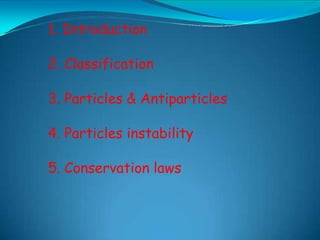
1. Introduction
2. Classification
3. Particles & Antiparticles
4. Particles instability
5. Conservation laws
* By the year 1932, only three elementary particles namely electron,
proton and photon were known.
* The discovery of Neutron by Chadwick in 1932 raised their number to
four.
* These elementary particles are the building blocks of matter & they
have characteristic properties such as rest mass, electric charge &
intrinsic angular momentum.
* The elementary particles discovered so far, form a long list of
around 200. These particles are elementary in the sense that they
are structureless, i.e., they cannot be explained as a system of
other elementary particles.
Baryons Leptons Mesons Antiparticles
Electron Photon Neutron Muon
kaon
Pion Eta
Nucleons Hyperons
Proton Lambda, Sigma, Omega
Neutron
Name Symbol Charge Spin Rest Energy (MeV)
Leptons
Photon γ 0 1
0
Neutrino
νe 0 1/2
0
νμ 0 1/2
0
Electron e+ −
, e +1, -1 1/2
0.511004(2)
Muon μ+ −
, μ +1, -1 1/2
105.659(2)
Mesons
Pion
π+ π−
, +1, -1 0
139.576(11)
πo 0 0
134.972(12)
Kaon
K+ −
, K +1, -1 0
493.82(11)
Ko 0 0
497.76(16)
Eta ηo 0 0 548.8(6)
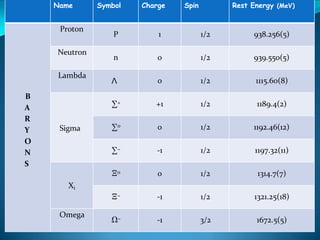
Name Symbol Charge Spin Rest Energy (MeV)
B
A
R
Y
O
N
S
Proton
P 1 1/2 938.256(5)
Neutron
n 0 1/2 939.550(5)
Lambda
Λ 0 1/2 1115.60(8)
Sigma
∑+ +1 1/2 1189.4(2)
∑o 0 1/2 1192.46(12)
∑− -1 1/2 1197.32(11)
Xi
Ξo 0 1/2 1314.7(7)
Ξ− -1 1/2 1321.25(18)
Omega
Ω− -1 3/2 1672.5(5)
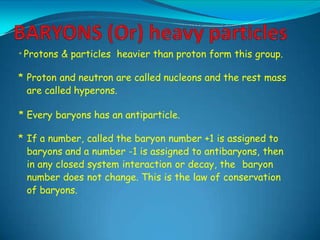
* Protons & particles heavier than proton form this group.
* Proton and neutron are called nucleons and the rest mass
are called hyperons.
* Every baryons has an antiparticle.
* If a number, called the baryon number +1 is assigned to
baryons and a number -1 is assigned to antibaryons, then
in any closed system interaction or decay, the baryon
number does not change. This is the law of conservation
of baryons.
* Time decay of the order of 10−10 seconds
* Mass value intermediate between neutron & deuteron
* Their decay time is very much greater than the time
of their formation (10−3 sec).
* K mesons – Strange Particles (Gellmann & Nishijima)
* Four types – Lambda, Sigma, Xi, Omega
* It contains electron, photon, neutrino & muon.
* All these elementary particles have masses smaller
than that of a pion.
ELECTRON
* First discovered particle
* negative charge & stable particle
* An electrostatic field exists between two electrons
PHOTON
* nocharge & no rest mass
* It has energy given by Plank’sequation E=hν
* It has an equivalent massgiven by Einstein’sequation
E=mc2.
NEUTRINO
* 1956 – Beta rayspectra in radioactivity
* nocharge & rest mass is zero
* It travelswith the speed of light
* Itexists in two form, oneassociated with electron &
theotherwith the muon
Muon
* It is similar to the electron except that its mass is
about 200 times that of theelectron.
* Itdecays very quickly with a half lifeof 2.2μs into
oneelectron and two neutrinos.
* It is negativelycharged and has a spin of ½.
* Itwas first discovered during the study of cosmic
rays.
MESONS
* Masses are between those of leptons & baryons.
* Theyare unstable.
* Theydecay into lighter mesonsor leptons.
* They haveeither positive, negativeat zero charge.
* The mesons include the pion, kaon and eta particles.
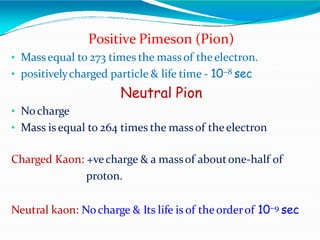
Positive Pimeson (Pion)
• Massequal to 273 times the massof theelectron.
• positivelycharged particle & life time - 10−8 sec
Neutral Pion
• Nocharge
• Mass is equal to 264 times the massof theelectron
Charged Kaon: +vecharge & a massof aboutone-half of
proton.
Neutral kaon: Nocharge & Its life is of theorderof 10−9 sec
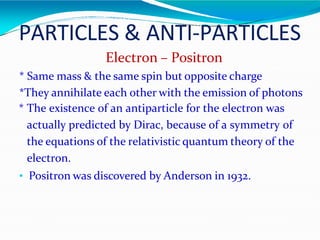
PARTICLES & ANTI-PARTICLES
Electron – Positron
* Same mass & the same spin but opposite charge
*They annihilate each other with the emission of photons
* The existence of an antiparticle for the electron was
actually predicted by Dirac, because of a symmetry of
the equations of the relativistic quantum theory of the
electron.
• Positron was discovered by Anderson in 1932.
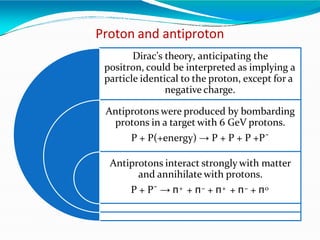
Proton and antiproton
Dirac’s theory, anticipating the
positron, could be interpreted as implying a
particle identical to the proton, except for a
negative charge.
Antiprotons were produced by bombarding
protons in a target with 6 GeV protons.
P + P(+energy) → P + P + P +P¯
Antiprotons interact strongly with matter
and annihilate with protons.
P + P¯ → π+ + π− + π+ + π− + π0
Neutron and Antineutron
Discovered in 1956 by Cork, Lamberton and Wenzel.
The natureof antineutron is notverywell known.
Both have zerocharge and thesame mass.
Antineutron is quicklyannihilated, either bya proton or
a neutron, usuallywith the production of several pions.
If an antineutron is notannihilated bya nucleon, it
decays by the reaction n¯ → P¯ + β+ + ν
Neutrino and Antineutrino
⚫It has Charge Zero, spin ½, zero rest mass and magnetic
moment smaller than 10−8 Bohr magneton or nearly zero.
⚫Finiteenergy, momentum and travels with the speed of
light. It does not cause ionization on passing through
matter.
⚫Thespin of the neutrino is opposite in direction to the
directionof its motion. (neutrino spins – counterclockwise)
⚫Thespin of theantineutrino is in the samedirection as its
directionof motion. (Itspins clockwise)
⚫The neutrino moves through space in the mannerof a left-
handed screw, while the antineutrino does so in the
mannerof a right-handed screw
.
Continue…
⚫Neutrino possesses a “left-handed” helicity ; the
antineutrino possesses a “right-handed” helicity.
⚫Neutrino’s emitted in Beta decay havea negative helicity
.
⚫Theyare longitudinally polarized with theirspin axes
antiparallel to theirdirection of travel.
⚫H = + 1 forν- ; H = - forν
⚫Because of its lack of charge and magnetic moment, a
neutrino has essentially no interaction with matter, except
that which leads to inverse beta decay. This interaction is
extremelyweak. (σ≈10- 20 barn)
⚫Matter is almost totally transparent to neutrinos.
Conservation Laws
⚫Conservationof parity
⚫Chargeconjugation symmetry
⚫Time reversal symmetry
⚫Combined Inversion of CPT
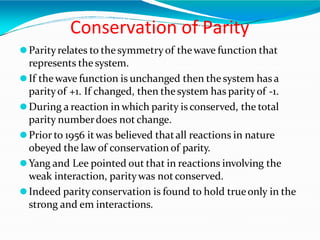
Conservation of Parity
⚫Parityrelates to thesymmetryof thewave function that
represents the system.
⚫If thewave function is unchanged then the system has a
parityof +1. If changed, then thesystem has parityof -1.
⚫During a reaction in which parity is conserved, the total
parity numberdoes not change.
⚫Prior to 1956 itwas believed thatall reactions in nature
obeyed the law of conservation of parity.
⚫Yang and Lee pointed out that in reactions involving the
weak interaction, paritywas not conserved.
⚫Indeed parityconservation is found to hold trueonly in the
strong and em interactions.
Charge conjugate symmetry
⚫It is theact of symmetryoperation in which every particle
in a system is replaced by its antiparticle.
⚫If theanti-system orantimattercounterpart exhibits the
same physical phenomena, then charge parity (C) is
conserved.
⚫In fact C is notconserved in theweak interaction.
Time reversal symmetry
⚫Time parityT describes the behaviourof awave function
when t is replaced by –t.
⚫Thesymmetryoperation thatcorresponds to the
conservation of time parity is time reversal.
⚫Thedirection of time is not significant, so that the reverseof
any process thatcan occur isalso a process thatcan occur.
⚫Prior to 1964, timeparityT was considered to be conserved in
every interaction.
⚫One form of Ko kaon can decay in to π+ π−, which violates the
,
conservation of T.
⚫Thesymmetryof phenomenaunder timereversal does not
seem to be universal.
Combined Inversion of CPT
⚫Thecombined symmetryoperation in which theantimatter
mirror-imageof a system is run in reverse allows a test of
CPT invariance.
⚫Theconservation of CPT means that forevery process there
is an antimatter mirror-image counterpart that takes place
in reverse.
⚫This particularsymmetry seems to hold forall
interactions, even though its component symmetries
sometimes fail individually.

elementaryparticles-101223114011-phpapp02.pptx

  • 1.
    S.N. Saravanamoorthy M.Sc.,M.Phil., B.Ed., Assistant Professor in Physics, Devanga Arts College (Autonomous), Aruppukottai – 626 101.
  • 2.
    1. Introduction 2. Classification 3.Particles & Antiparticles 4. Particles instability 5. Conservation laws
  • 3.
    * By theyear 1932, only three elementary particles namely electron, proton and photon were known. * The discovery of Neutron by Chadwick in 1932 raised their number to four. * These elementary particles are the building blocks of matter & they have characteristic properties such as rest mass, electric charge & intrinsic angular momentum. * The elementary particles discovered so far, form a long list of around 200. These particles are elementary in the sense that they are structureless, i.e., they cannot be explained as a system of other elementary particles.
  • 4.
    Baryons Leptons MesonsAntiparticles Electron Photon Neutron Muon kaon Pion Eta Nucleons Hyperons Proton Lambda, Sigma, Omega Neutron
  • 5.
    Name Symbol ChargeSpin Rest Energy (MeV) Leptons Photon γ 0 1 0 Neutrino νe 0 1/2 0 νμ 0 1/2 0 Electron e+ − , e +1, -1 1/2 0.511004(2) Muon μ+ − , μ +1, -1 1/2 105.659(2) Mesons Pion π+ π− , +1, -1 0 139.576(11) πo 0 0 134.972(12) Kaon K+ − , K +1, -1 0 493.82(11) Ko 0 0 497.76(16) Eta ηo 0 0 548.8(6)
  • 6.
    Name Symbol ChargeSpin Rest Energy (MeV) B A R Y O N S Proton P 1 1/2 938.256(5) Neutron n 0 1/2 939.550(5) Lambda Λ 0 1/2 1115.60(8) Sigma ∑+ +1 1/2 1189.4(2) ∑o 0 1/2 1192.46(12) ∑− -1 1/2 1197.32(11) Xi Ξo 0 1/2 1314.7(7) Ξ− -1 1/2 1321.25(18) Omega Ω− -1 3/2 1672.5(5)
  • 7.
    * Protons &particles heavier than proton form this group. * Proton and neutron are called nucleons and the rest mass are called hyperons. * Every baryons has an antiparticle. * If a number, called the baryon number +1 is assigned to baryons and a number -1 is assigned to antibaryons, then in any closed system interaction or decay, the baryon number does not change. This is the law of conservation of baryons.
  • 8.
    * Time decayof the order of 10−10 seconds * Mass value intermediate between neutron & deuteron * Their decay time is very much greater than the time of their formation (10−3 sec). * K mesons – Strange Particles (Gellmann & Nishijima) * Four types – Lambda, Sigma, Xi, Omega
  • 9.
    * It containselectron, photon, neutrino & muon. * All these elementary particles have masses smaller than that of a pion. ELECTRON * First discovered particle * negative charge & stable particle * An electrostatic field exists between two electrons
  • 10.
    PHOTON * nocharge &no rest mass * It has energy given by Plank’sequation E=hν * It has an equivalent massgiven by Einstein’sequation E=mc2. NEUTRINO * 1956 – Beta rayspectra in radioactivity * nocharge & rest mass is zero * It travelswith the speed of light * Itexists in two form, oneassociated with electron & theotherwith the muon
  • 11.
    Muon * It issimilar to the electron except that its mass is about 200 times that of theelectron. * Itdecays very quickly with a half lifeof 2.2μs into oneelectron and two neutrinos. * It is negativelycharged and has a spin of ½. * Itwas first discovered during the study of cosmic rays.
  • 12.
    MESONS * Masses arebetween those of leptons & baryons. * Theyare unstable. * Theydecay into lighter mesonsor leptons. * They haveeither positive, negativeat zero charge. * The mesons include the pion, kaon and eta particles.
  • 13.
    Positive Pimeson (Pion) •Massequal to 273 times the massof theelectron. • positivelycharged particle & life time - 10−8 sec Neutral Pion • Nocharge • Mass is equal to 264 times the massof theelectron Charged Kaon: +vecharge & a massof aboutone-half of proton. Neutral kaon: Nocharge & Its life is of theorderof 10−9 sec
  • 14.
    PARTICLES & ANTI-PARTICLES Electron– Positron * Same mass & the same spin but opposite charge *They annihilate each other with the emission of photons * The existence of an antiparticle for the electron was actually predicted by Dirac, because of a symmetry of the equations of the relativistic quantum theory of the electron. • Positron was discovered by Anderson in 1932.
  • 15.
    Proton and antiproton Dirac’stheory, anticipating the positron, could be interpreted as implying a particle identical to the proton, except for a negative charge. Antiprotons were produced by bombarding protons in a target with 6 GeV protons. P + P(+energy) → P + P + P +P¯ Antiprotons interact strongly with matter and annihilate with protons. P + P¯ → π+ + π− + π+ + π− + π0
  • 16.
    Neutron and Antineutron Discoveredin 1956 by Cork, Lamberton and Wenzel. The natureof antineutron is notverywell known. Both have zerocharge and thesame mass. Antineutron is quicklyannihilated, either bya proton or a neutron, usuallywith the production of several pions. If an antineutron is notannihilated bya nucleon, it decays by the reaction n¯ → P¯ + β+ + ν
  • 17.
    Neutrino and Antineutrino ⚫Ithas Charge Zero, spin ½, zero rest mass and magnetic moment smaller than 10−8 Bohr magneton or nearly zero. ⚫Finiteenergy, momentum and travels with the speed of light. It does not cause ionization on passing through matter. ⚫Thespin of the neutrino is opposite in direction to the directionof its motion. (neutrino spins – counterclockwise) ⚫Thespin of theantineutrino is in the samedirection as its directionof motion. (Itspins clockwise) ⚫The neutrino moves through space in the mannerof a left- handed screw, while the antineutrino does so in the mannerof a right-handed screw . Continue…
  • 18.
    ⚫Neutrino possesses a“left-handed” helicity ; the antineutrino possesses a “right-handed” helicity. ⚫Neutrino’s emitted in Beta decay havea negative helicity . ⚫Theyare longitudinally polarized with theirspin axes antiparallel to theirdirection of travel. ⚫H = + 1 forν- ; H = - forν ⚫Because of its lack of charge and magnetic moment, a neutrino has essentially no interaction with matter, except that which leads to inverse beta decay. This interaction is extremelyweak. (σ≈10- 20 barn) ⚫Matter is almost totally transparent to neutrinos.
  • 19.
    Conservation Laws ⚫Conservationof parity ⚫Chargeconjugationsymmetry ⚫Time reversal symmetry ⚫Combined Inversion of CPT
  • 20.
    Conservation of Parity ⚫Parityrelatesto thesymmetryof thewave function that represents the system. ⚫If thewave function is unchanged then the system has a parityof +1. If changed, then thesystem has parityof -1. ⚫During a reaction in which parity is conserved, the total parity numberdoes not change. ⚫Prior to 1956 itwas believed thatall reactions in nature obeyed the law of conservation of parity. ⚫Yang and Lee pointed out that in reactions involving the weak interaction, paritywas not conserved. ⚫Indeed parityconservation is found to hold trueonly in the strong and em interactions.
  • 21.
    Charge conjugate symmetry ⚫Itis theact of symmetryoperation in which every particle in a system is replaced by its antiparticle. ⚫If theanti-system orantimattercounterpart exhibits the same physical phenomena, then charge parity (C) is conserved. ⚫In fact C is notconserved in theweak interaction.
  • 22.
    Time reversal symmetry ⚫TimeparityT describes the behaviourof awave function when t is replaced by –t. ⚫Thesymmetryoperation thatcorresponds to the conservation of time parity is time reversal. ⚫Thedirection of time is not significant, so that the reverseof any process thatcan occur isalso a process thatcan occur. ⚫Prior to 1964, timeparityT was considered to be conserved in every interaction. ⚫One form of Ko kaon can decay in to π+ π−, which violates the , conservation of T. ⚫Thesymmetryof phenomenaunder timereversal does not seem to be universal.
  • 23.
    Combined Inversion ofCPT ⚫Thecombined symmetryoperation in which theantimatter mirror-imageof a system is run in reverse allows a test of CPT invariance. ⚫Theconservation of CPT means that forevery process there is an antimatter mirror-image counterpart that takes place in reverse. ⚫This particularsymmetry seems to hold forall interactions, even though its component symmetries sometimes fail individually.