Bacteria: Structure
and Function
INTRODUCTION
Bacteria are single-celled prokaryotes ubiquitous in
nature.
They can be found in different types of environments.
The bacteria contains a well-developed cell structure,
which is responsible for its biological structures and
pathogenicity.
Many structural features are unique to bacteria and
are not found among archaea or eukaryotes.
bacteria may exist as free-living organisms, symbiosis
with other organisms, as parasitic organisms that can
cause harm and disease in their hosts.
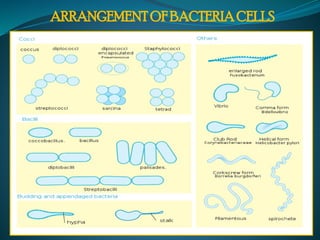
CELL MORPHOLOGY
The most elemental structural property
of bacteria is their morphology (shape).
The common examples are:
Coccus (circle or spherical)
Bacillus (rod-like)
Coccobacillus (between a sphere and a rod)
Spiral (corkscrew-like)
Filamentous(elongated)
Cell shape is generally characteristic of a given
bacterial species, but can vary depending on
growth conditions.
ARRANGEMENT OF BACTERIA CELLS
 The size of bacterial cells is different according to
their species.
 Normally cell size between 1µm to 100µm.
 E.Coli cell size – 2µm to 6µm in length and 1.1µm
to 1.5µm in width.
 Spirochetes- 500µm
 Oscillatoria- 7µm
SIZE OF BACTERIA CELLS
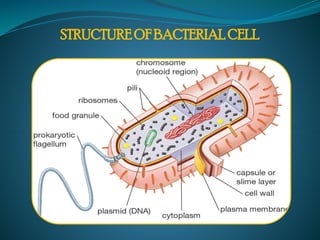
STRUCTURE OF BACTERIAL CELL
Bacterial cells mostly two types.
Gram Positive bacterial cell
Gram negative Bacterial cell
TYPES OF BACTERIAL CELL
 This group of bacteria is to retain the primary
stain (Crystal violet) during Gram staining (giving
a positive result).
 The cell-wall of Gram positive bacteria consists
of Peptidoglycan.
 The cell wall also consists of molecules known as
teichoic acids (polyol phosphate polymers).
 Gram positive bacteria have lipid content makes
up less than 5 percent of the cell wall.
 Here, these molecules play the role of anchoring
the membrane.
Gram Positive bacterial cell
 These bacteria are do not retain the primary stain
and thus appear red with counter stain (safranine)
when viewed under the microscope.
 Gram negative bacteria are also well distributed in
different environments.
 Gram negative bacteria also contain the thin
peptidoglycan (2-4nm) polymer in their cell wall.
 It's composed of long glycan that are cross-linked by
peptide molecules.
 This composition serves a number of functions
including protecting the bacterial cell from lysis.
Gram Negative bacterial cell
 Gram negative bacteria has the presence of
different forms of a complex macromolecule
known as lipopolysaccharide (LPS).
 They are particularly important for bacteria in that
they contribute to the pathogenesis of the
organisms.
 The other components of Gram negative bacteria
include:
 Cytoplasmic membrane
 Mesosomes
 Cytoplasm
 Nucleoid
 Endospores
CELL WALL
 Bacteria have a rigid cell wall.
 The cell wall is an essential structure that protects
the cell protoplast from mechanical damage and
from osmotic rupture or lysis.
 Cell wall made of porous, rigid material such
as murein, the component of bacterial cell walls.
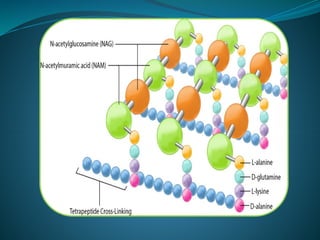
 Murein is a unique type of peptidoglycan, a polymer
of disaccharides (glycan) cross-linked by short
chains of amino acids (peptide).
 All Bacterial peptidoglycans contain N-
acetylmuramic acid and N-acetylglucosamine which
is connected by beta 1-4 glycosidic linkage.
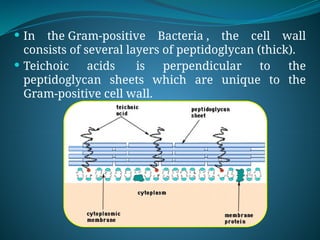
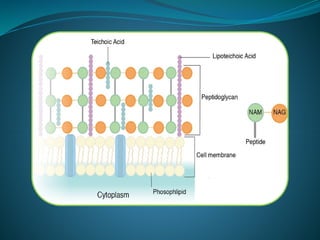
 In the Gram-positive Bacteria , the cell wall
consists of several layers of peptidoglycan (thick).
 Teichoic acids is perpendicular to the
peptidoglycan sheets which are unique to the
Gram-positive cell wall.
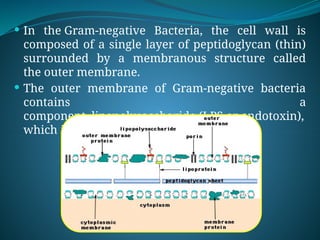
 In the Gram-negative Bacteria, the cell wall is
composed of a single layer of peptidoglycan (thin)
surrounded by a membranous structure called
the outer membrane.
 The outer membrane of Gram-negative bacteria

contains a
component, lipopolysaccharide (LPS or endotoxin),
which is toxic to animals.
PLASMA MEMBRANE
 The plasma membrane, also called the cytoplasmic
membrane.
 Its main function is as a selective permeability
barrier that regulates the passage of substances
into and out of the cell.
 The plasma membrane separating the cytoplasm
from the environment.
 The bacterial membrane allows passage of water
and small uncharged molecules, but does not allow
passage of larger molecules or any charged
substances.
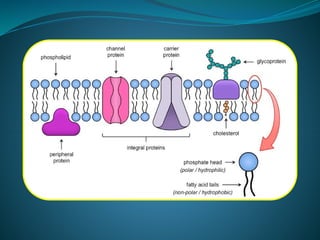
 Bacterial membranes are composed of 40 percent
phospholipid and 60 percent protein.
 The phospholipids are amphiphilic molecules
with a polar hydrophilic glycerol "head" attached
via an ester bond to two nonpolar hydrophobic
fatty acid tails, which naturally form a bilayer in
aqueous environments.
 The bilayer are various structural and enzymatic
proteins which carry out most membrane
functions.
 The arrangement of proteins and lipids to form a
membrane is called the fluid mosaic model.
Functions of the plasma membrane
 Permeability barrier
 Location of transport systems for specific solutes
(nutrients and ions)
 Energy generating functions, involving respiratory
and photosynthetic electron transport systems.
 Synthesis of membrane lipids (including
lipopolysaccharide in Gram-negative cells).
 Synthesis of murein (cell wall peptidoglycan)
 Assembly and secretion of extracytoplasmic proteins
 Coordination of DNA replication and segregation with
septum formation and cell division
 Location of specialized enzyme system
 Bacterial flagella are long, thin, whip-like
appendages that move the bacteria towards
nutrients and other attractants.
 Flagella are free at one end and attached to the cell
at the other end.
 Flagellum can never be seen directly with the light
microscope but only after staining with special
flagella stains.
 Flagella are usually found in gram-negative bacilli.
Gram-positive rods and cocci also have flagella.
FLAGILLA
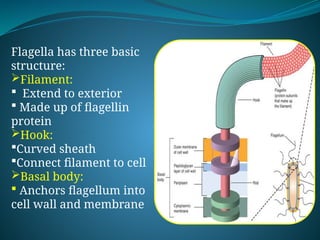
Flagella has three basic
structure:
Filament:
 Extend to exterior
 Made up of flagellin
protein
Hook:
Curved sheath
Connect filament to cell
Basal body:
 Anchors flagellum into
cell wall and membrane
Arrangement and Types
of Bacterial Flagella
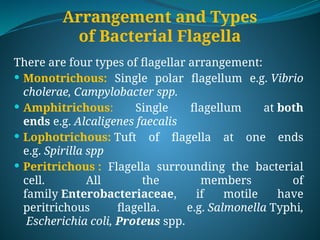
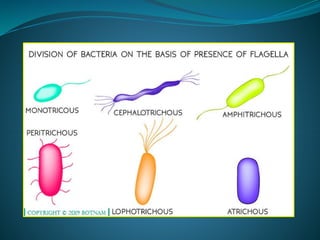
There are four types of flagellar arrangement:
 Monotrichous: Single polar flagellum e.g. Vibrio
cholerae, Campylobacter spp.
 Amphitrichous: Single flagellum at both
ends e.g. Alcaligenes faecalis
 Lophotrichous: Tuft of flagella at one ends
e.g. Spirilla spp
 Peritrichous : Flagella surrounding the bacterial
cell. All the members of
family Enterobacteriaceae, if motile have
peritrichous flagella. e.g. Salmonella Typhi,
Escherichia coli, Proteus spp.
Flagella Function
 They help an organism in movement.
 They act as sensory organs to detect temperature
and pH changes.
 Few eukaryotes use flagellum to increase
reproduction rates.
 Recent researches have proved that flagella are
also used as a secretory organelle. For eg., in
Chlamydomonas
Pilli
 The pilus is a short, hair-like structure on the cell surface of
bacterial cell associated with bacterial adhesion.
 It is related to bacterial colonization and infection.
 Pili are composed of oligomeric pilin proteins.
 They can have a role in movement.
 Pili are shorter and thinner than flagella. Pili can be found
evenly around the surface of the cell, or localized to one or
both of the poles.
 They are of Gram-negative bacteria, but can be found in
Gram-positive bacteria and archaea as well.
 There are also pili involved in the exchange of genetic
material, called the F pili.
 The pili are involved in conjugation process between two
bcaterial cells. The conjugation pilus, also called sex pilus or
F pilus. The F pilus are found on Escherichia coli.
Nucleoid region
 The nucleoid (meaning nucleus-like) is an
irregularly-shaped region within the cell of a
prokaryote.
 It contains all or most of the genetic material.
 The genome of prokaryotic organisms is a circular,
double-stranded piece of DNA, called genophore.
 The nucleoid, also has no membrane around it.
 The nucleoid doesn’t take a uniform shape and has
no specific size.
 The nucleoid is mainly composed of multiple
copies of DNA with the addition of some RNA and
proteins.
 The nucleoid is essential for controlling the
activity of the cell and reproduction.
 It is the site where transcription and replication
of DNA take place.
 It help the formation of DNA, facilitating cell
growth, and regulating the genetic material of
the cell.
Function of Nucleoid
Ribosomes
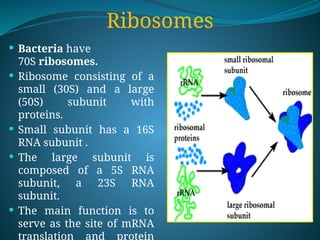
 Bacteria have
70S ribosomes.
 Ribosome consisting of a
small (30S) and a large
(50S) subunit with
proteins.
 Small subunit has a 16S
RNA subunit .
 The large subunit is
composed of a 5S RNA
subunit, a 23S RNA
subunit.
 The main function is to
serve as the site of mRNA
translation and protein
Metachromatic Granules
 Metachromatic granules, sometimes termed as
Volutin granules because of their colour reaction with the
dyes used in light microscopy.
 It contain polymerized inorganic phosphate, an energy-
rich compound that acts as a reserve store of energy.
 Polyphosphate granules display the metachromatic effect,
appearing red when stained with methylene blue.
 They can also be found in the cytoplasm of Saccharomyces.
 Metachromatic granules will stain pink with methylene
blue.
 They are composed of complex polyphosphate, lipid, and n
ucleoprotein molecules (volutin) and serve as an intracell
ular phosphate reserve.
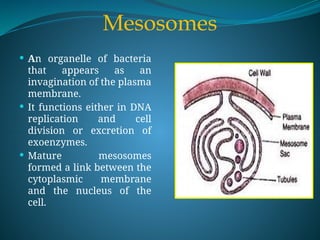
Mesosomes
 An organelle of bacteria
that appears as an
invagination of the plasma
membrane.
 It functions either in DNA
replication and cell
division or excretion of
exoenzymes.
 Mature mesosomes
formed a link between the
cytoplasmic membrane
and the nucleus of the
cell.
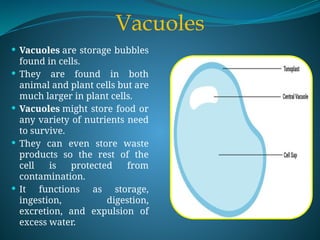
Vacuoles
 Vacuoles are storage bubbles
found in cells.
 They are found in both
animal and plant cells but are
much larger in plant cells.
 Vacuoles might store food or
any variety of nutrients need
to survive.
 They can even store waste
products so the rest of the
cell is protected from
contamination.
 It functions as storage,
ingestion, digestion,
excretion, and expulsion of
excess water.
 Vacuoles are essentially enclosed compartments
which are filled with water containing inorganic and
organic molecules including enzymes.
 Vacuoles has outer membrane called tonoplast.
 Vacuoles are formed by the fusion of multiple
membrane vesicles.
 The organelle has no basic shape or size; its structure
varies according to the requirements of the cell.
 It maintain an acidic internal pH.
 It containing small molecules.
 Exporting unwanted substances from the cell.
 Vacuoles also play a major role in autophagy.
 Spores are the single-celled reproductive unit of bacteria,
fungi, algae and non-flowering plants.
 Spores are units of asexual reproduction. They can
produced a new bacteria or plants.
 They are able to travel over long distances.
 Some bacteria also produce spores as to survive in very
harsh conditions.
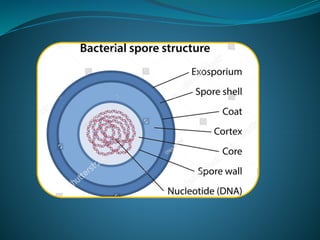
 A spore is a single cell surrounded by a thick cell wall for
protection.
 Once the spores are formed, the organism releases them
into the environment to grow.
 Spores are often formed through a process
called sporogenesis, through mitosis, or cellular
reproduction.
Spores
 Bacterial spores serve as a resting, or dormant, stage
in the bacterial life cycle, help to preserve the
bacteria through unfavourable conditions.
 Bacillus and Clostridium bacteria generally produced
spores.
 Spores are haploid in nature, germinate and
produced haploid gametophyte.
 Spores are classify into endospore and exospore
depending on the position.
 Endospore are generally produced by bacteria and
exospore are mainly produced by eukaryotes, fungi
and algae.
 Both have low metabolic rate and non- nutritive.
 They are highly resistant.
Cyst
 A microbial cyst is a resting or dormant stage of a
microorganism, that helps the organism to survive in
unfavorable environmental conditions.
 It is a state, in which the metabolic processes of the
cell are slowed and the cell ceases all activities like
feeding and locomotion.
 Unfavorable environmental conditions such as lack
of nutrients or oxygen, extreme temperatures, lack of
moisture and presence of toxic chemicals, which are
not suitable for the growth of the microbe trigger the
formation of a cyst.
 The cyst walls of bacteria are formed by the
thickening of the normal cell wall with
added peptidoglycan layers .
 Cyst is a group of cells, which come together to
protect the organism from harsh environmental
conditions.
 Cysts are not reproductive cells.
Thank You

Lesson 2- Bacteria structuresLesson 2- Bacteria structuresLesson 2- Bacteria structuresLesson 2- Bacteria structuresLesson 2- Bacteria structuresLesson 2- Bacteria structuresLesson 2- Bacteria structures.pptx

  • 1.
  • 2.
    INTRODUCTION Bacteria are single-celledprokaryotes ubiquitous in nature. They can be found in different types of environments. The bacteria contains a well-developed cell structure, which is responsible for its biological structures and pathogenicity. Many structural features are unique to bacteria and are not found among archaea or eukaryotes. bacteria may exist as free-living organisms, symbiosis with other organisms, as parasitic organisms that can cause harm and disease in their hosts.
  • 3.
    CELL MORPHOLOGY The mostelemental structural property of bacteria is their morphology (shape). The common examples are: Coccus (circle or spherical) Bacillus (rod-like) Coccobacillus (between a sphere and a rod) Spiral (corkscrew-like) Filamentous(elongated) Cell shape is generally characteristic of a given bacterial species, but can vary depending on growth conditions.
  • 4.
  • 5.
     The sizeof bacterial cells is different according to their species.  Normally cell size between 1µm to 100µm.  E.Coli cell size – 2µm to 6µm in length and 1.1µm to 1.5µm in width.  Spirochetes- 500µm  Oscillatoria- 7µm SIZE OF BACTERIA CELLS
  • 6.
  • 7.
    Bacterial cells mostlytwo types. Gram Positive bacterial cell Gram negative Bacterial cell TYPES OF BACTERIAL CELL
  • 8.
     This groupof bacteria is to retain the primary stain (Crystal violet) during Gram staining (giving a positive result).  The cell-wall of Gram positive bacteria consists of Peptidoglycan.  The cell wall also consists of molecules known as teichoic acids (polyol phosphate polymers).  Gram positive bacteria have lipid content makes up less than 5 percent of the cell wall.  Here, these molecules play the role of anchoring the membrane. Gram Positive bacterial cell
  • 9.
     These bacteriaare do not retain the primary stain and thus appear red with counter stain (safranine) when viewed under the microscope.  Gram negative bacteria are also well distributed in different environments.  Gram negative bacteria also contain the thin peptidoglycan (2-4nm) polymer in their cell wall.  It's composed of long glycan that are cross-linked by peptide molecules.  This composition serves a number of functions including protecting the bacterial cell from lysis. Gram Negative bacterial cell
  • 10.
     Gram negativebacteria has the presence of different forms of a complex macromolecule known as lipopolysaccharide (LPS).  They are particularly important for bacteria in that they contribute to the pathogenesis of the organisms.  The other components of Gram negative bacteria include:  Cytoplasmic membrane  Mesosomes  Cytoplasm  Nucleoid  Endospores
  • 11.
    CELL WALL  Bacteriahave a rigid cell wall.  The cell wall is an essential structure that protects the cell protoplast from mechanical damage and from osmotic rupture or lysis.  Cell wall made of porous, rigid material such as murein, the component of bacterial cell walls.  Murein is a unique type of peptidoglycan, a polymer of disaccharides (glycan) cross-linked by short chains of amino acids (peptide).  All Bacterial peptidoglycans contain N- acetylmuramic acid and N-acetylglucosamine which is connected by beta 1-4 glycosidic linkage.
  • 13.
     In theGram-positive Bacteria , the cell wall consists of several layers of peptidoglycan (thick).  Teichoic acids is perpendicular to the peptidoglycan sheets which are unique to the Gram-positive cell wall.
  • 15.
     In theGram-negative Bacteria, the cell wall is composed of a single layer of peptidoglycan (thin) surrounded by a membranous structure called the outer membrane.  The outer membrane of Gram-negative bacteria contains a component, lipopolysaccharide (LPS or endotoxin), which is toxic to animals.
  • 16.
    PLASMA MEMBRANE  Theplasma membrane, also called the cytoplasmic membrane.  Its main function is as a selective permeability barrier that regulates the passage of substances into and out of the cell.  The plasma membrane separating the cytoplasm from the environment.  The bacterial membrane allows passage of water and small uncharged molecules, but does not allow passage of larger molecules or any charged substances.
  • 17.
     Bacterial membranesare composed of 40 percent phospholipid and 60 percent protein.  The phospholipids are amphiphilic molecules with a polar hydrophilic glycerol "head" attached via an ester bond to two nonpolar hydrophobic fatty acid tails, which naturally form a bilayer in aqueous environments.  The bilayer are various structural and enzymatic proteins which carry out most membrane functions.  The arrangement of proteins and lipids to form a membrane is called the fluid mosaic model.
  • 19.
    Functions of theplasma membrane  Permeability barrier  Location of transport systems for specific solutes (nutrients and ions)  Energy generating functions, involving respiratory and photosynthetic electron transport systems.  Synthesis of membrane lipids (including lipopolysaccharide in Gram-negative cells).  Synthesis of murein (cell wall peptidoglycan)  Assembly and secretion of extracytoplasmic proteins  Coordination of DNA replication and segregation with septum formation and cell division  Location of specialized enzyme system
  • 20.
     Bacterial flagellaare long, thin, whip-like appendages that move the bacteria towards nutrients and other attractants.  Flagella are free at one end and attached to the cell at the other end.  Flagellum can never be seen directly with the light microscope but only after staining with special flagella stains.  Flagella are usually found in gram-negative bacilli. Gram-positive rods and cocci also have flagella. FLAGILLA
  • 21.
    Flagella has threebasic structure: Filament:  Extend to exterior  Made up of flagellin protein Hook: Curved sheath Connect filament to cell Basal body:  Anchors flagellum into cell wall and membrane
  • 22.
    Arrangement and Types ofBacterial Flagella There are four types of flagellar arrangement:  Monotrichous: Single polar flagellum e.g. Vibrio cholerae, Campylobacter spp.  Amphitrichous: Single flagellum at both ends e.g. Alcaligenes faecalis  Lophotrichous: Tuft of flagella at one ends e.g. Spirilla spp  Peritrichous : Flagella surrounding the bacterial cell. All the members of family Enterobacteriaceae, if motile have peritrichous flagella. e.g. Salmonella Typhi, Escherichia coli, Proteus spp.
  • 24.
    Flagella Function  Theyhelp an organism in movement.  They act as sensory organs to detect temperature and pH changes.  Few eukaryotes use flagellum to increase reproduction rates.  Recent researches have proved that flagella are also used as a secretory organelle. For eg., in Chlamydomonas
  • 25.
    Pilli  The pilusis a short, hair-like structure on the cell surface of bacterial cell associated with bacterial adhesion.  It is related to bacterial colonization and infection.  Pili are composed of oligomeric pilin proteins.  They can have a role in movement.  Pili are shorter and thinner than flagella. Pili can be found evenly around the surface of the cell, or localized to one or both of the poles.  They are of Gram-negative bacteria, but can be found in Gram-positive bacteria and archaea as well.  There are also pili involved in the exchange of genetic material, called the F pili.  The pili are involved in conjugation process between two bcaterial cells. The conjugation pilus, also called sex pilus or F pilus. The F pilus are found on Escherichia coli.
  • 26.
    Nucleoid region  Thenucleoid (meaning nucleus-like) is an irregularly-shaped region within the cell of a prokaryote.  It contains all or most of the genetic material.  The genome of prokaryotic organisms is a circular, double-stranded piece of DNA, called genophore.  The nucleoid, also has no membrane around it.  The nucleoid doesn’t take a uniform shape and has no specific size.  The nucleoid is mainly composed of multiple copies of DNA with the addition of some RNA and proteins.
  • 27.
     The nucleoidis essential for controlling the activity of the cell and reproduction.  It is the site where transcription and replication of DNA take place.  It help the formation of DNA, facilitating cell growth, and regulating the genetic material of the cell. Function of Nucleoid
  • 28.
    Ribosomes  Bacteria have 70Sribosomes.  Ribosome consisting of a small (30S) and a large (50S) subunit with proteins.  Small subunit has a 16S RNA subunit .  The large subunit is composed of a 5S RNA subunit, a 23S RNA subunit.  The main function is to serve as the site of mRNA translation and protein
  • 29.
    Metachromatic Granules  Metachromaticgranules, sometimes termed as Volutin granules because of their colour reaction with the dyes used in light microscopy.  It contain polymerized inorganic phosphate, an energy- rich compound that acts as a reserve store of energy.  Polyphosphate granules display the metachromatic effect, appearing red when stained with methylene blue.  They can also be found in the cytoplasm of Saccharomyces.  Metachromatic granules will stain pink with methylene blue.  They are composed of complex polyphosphate, lipid, and n ucleoprotein molecules (volutin) and serve as an intracell ular phosphate reserve.
  • 30.
    Mesosomes  An organelleof bacteria that appears as an invagination of the plasma membrane.  It functions either in DNA replication and cell division or excretion of exoenzymes.  Mature mesosomes formed a link between the cytoplasmic membrane and the nucleus of the cell.
  • 31.
    Vacuoles  Vacuoles arestorage bubbles found in cells.  They are found in both animal and plant cells but are much larger in plant cells.  Vacuoles might store food or any variety of nutrients need to survive.  They can even store waste products so the rest of the cell is protected from contamination.  It functions as storage, ingestion, digestion, excretion, and expulsion of excess water.
  • 32.
     Vacuoles areessentially enclosed compartments which are filled with water containing inorganic and organic molecules including enzymes.  Vacuoles has outer membrane called tonoplast.  Vacuoles are formed by the fusion of multiple membrane vesicles.  The organelle has no basic shape or size; its structure varies according to the requirements of the cell.  It maintain an acidic internal pH.  It containing small molecules.  Exporting unwanted substances from the cell.  Vacuoles also play a major role in autophagy.
  • 33.
     Spores arethe single-celled reproductive unit of bacteria, fungi, algae and non-flowering plants.  Spores are units of asexual reproduction. They can produced a new bacteria or plants.  They are able to travel over long distances.  Some bacteria also produce spores as to survive in very harsh conditions.  A spore is a single cell surrounded by a thick cell wall for protection.  Once the spores are formed, the organism releases them into the environment to grow.  Spores are often formed through a process called sporogenesis, through mitosis, or cellular reproduction. Spores
  • 35.
     Bacterial sporesserve as a resting, or dormant, stage in the bacterial life cycle, help to preserve the bacteria through unfavourable conditions.  Bacillus and Clostridium bacteria generally produced spores.  Spores are haploid in nature, germinate and produced haploid gametophyte.  Spores are classify into endospore and exospore depending on the position.  Endospore are generally produced by bacteria and exospore are mainly produced by eukaryotes, fungi and algae.  Both have low metabolic rate and non- nutritive.  They are highly resistant.
  • 36.
    Cyst  A microbialcyst is a resting or dormant stage of a microorganism, that helps the organism to survive in unfavorable environmental conditions.  It is a state, in which the metabolic processes of the cell are slowed and the cell ceases all activities like feeding and locomotion.  Unfavorable environmental conditions such as lack of nutrients or oxygen, extreme temperatures, lack of moisture and presence of toxic chemicals, which are not suitable for the growth of the microbe trigger the formation of a cyst.
  • 37.
     The cystwalls of bacteria are formed by the thickening of the normal cell wall with added peptidoglycan layers .  Cyst is a group of cells, which come together to protect the organism from harsh environmental conditions.  Cysts are not reproductive cells.
  • 38.